Slashdot Mirror
Domain: sec.gov
Stories and comments across the archive that link to sec.gov.
Stories · 117
-
SEC Alleges 'Bitcoin Savings & Trust' Is a Ponzi Scheme
New submitter craighansen writes "The U.S. Securities and Exchange Commission has filed a lawsuit against a man they allege ran a Ponzi scheme using Bitcoin. According to the complaint (PDF), during 2011-2012, Trendon Shavers, operating under the username pirateat40, collected investments of over 700,000 Bitcoins from at least 66 'investors' (a valuation of $4.5M) with the promise of as much as 7% weekly returns. These 'investors' received about 500,000 Bitcoins in returns, so on average, they're probably much better-off than investors in Madoff's scheme. Nevertheless, with the rising value of Bitcoins, the $4.5M investments would be worth $65M at recent pricing if they had actually been left in Bitcoins, which approximates the 1% per day returns that the scheme promised." -
Nasdaq Fined $10M Over Facebook IPO Failures
twoheadedboy writes "Nasdaq has been fined $10 million by the U.S. Securities and Exchange Commission over 'poor systems and decision-making' during the Facebook initial public offering. When Facebook went public on 18 May 2012, it was hoping for a major success, but technical glitches and poor decision making at Nasdaq caused real problems. The SEC said 'a design limitation' in the system to match IPO buy and sell orders was at the root of the disruption, thought to have cost investors $500 million. Orders failed to register properly, leaving banks like Citigroup and UBS in the lurch and making additional, unnecessary bids. They may still win money back from Nasdaq if legal challenges go their way." -
Eric Schmidt To Sell Up To 42% of Stake In Google
derGoldstein writes "AllThingsD reports that Eric Schmidt 'plans to sell up to 3.2 million shares of his class A common stock in the company,' according to an SEC filing. 'The amount is equal to approximately 42.1 percent of his overall stake in Google.'" -
Autonomy Chief Says Whitman Is Watering Down HP Fraud Claims
McGruber writes "Possibly the wierdest tax-writeoff of the year happened when Meg Whitman claimed that her US-based multinational corporation HP had been defrauded by British-software firm Autonomy; Ms. Whitman and HP claimed an 8.8 billion dollar write-down. As the Los Angeles Times explains, 'HP acquired Autonomy in 2011 for $11 billion, a move it hoped would turn it away from its dependence on sales of computer hardware with its low profit margins, and into the more profitable business of software. However, the price HP paid was widely criticized for being too high, and in part led to the subsequent ouster of Chief Executive Leo Apotheker.' The wierdness continues — in its annual report filed with the U.S. Securities and Exchange Commission, HP claims that the U.S. Department of Justice has opened an investigation into HP's allegations that HP has uncovered widespread accounting fraud at Autonomy. However, The Guardian points out that former Autonomy CEO Mike Lynch claims that HP 'is watering down the accusations it had levelled against him over the accounts filed by his old software company.' Mr. Lynch also says that he has not been contacted by the U.S. Department of Justice, which HP claims is investigating the alleged fraud. Perhaps Slashdot's users can help make sense of this mess and help explain it to me?" -
AT&T Killing Its 2G Network By 2017
The Wall Street Journal reports that AT&T has plans to shut down its 2G network by January 1, 2017. Roughly 12% of its contact wireless customers — 8.4 million people — have 2G handsets, and the company plans to gradually move them to devices running on more modern networks. "The timeline for the 2G shutdown was made in a filing with the Securities and Exchange Commission on Friday. An AT&T spokesman said the company no longer sells 2G handsets to contract or prepaid customers. Along with phones, the company does have some other devices connected to its 2G networks, but it also expects that they will transition to more modern technology in coming years. As the carriers deal with ever increasing data usage on their networks, they also are facing a spectrum shortage to carry all the traffic. Shutting down legacy networks is one part of the plan, along with acquiring new spectrum and finding innovative ways to use unused airwaves." -
Microsoft: Surface Tablet May Alienate OEM Partners
HangingChad sends this excerpt from PCMag: "Microsoft this week admitted that its upcoming Surface tablet might hurt its relationships with PC maker partners. As first noted by the New York Times, Redmond said in a Thursday filing with the Securities and Exchange Commission that 'our Surface devices will compete with products made by our OEM partners, which may affect their commitment to our platform.'" The filing also made note of the difficulties in building up another app marketplace: "In order to compete, we must successfully enlist developers to write applications for our marketplace and ensure that these applications have high quality, customer appeal and value. Efforts to compete with these application marketplaces may increase our cost of revenue and lower our operating margins." -
SEC Says Public Firms May Need To Disclose Cyberattacks
Trailrunner7 writes "The Securities and Exchange Commission has issued new guidance to help public companies determine when they may need to disclose an attack — or even a potential attack — in order to make potential investors aware of possible risks to the company's business. The guidance, which does not constitute a rule or requirement for companies to disclose, is meant to help registrants in 'assessing what, if any, disclosures should be provided about cybersecurity matters.'" -
Groupon Loses COO, Drastically Cuts Reported Revenue
itwbennett writes "Groupon COO Margo Georgiadis has quit after just 5 months on the job and is returning to Google to be the company's president for the Americas. Groupon's founder, Andrew Mason, wrote in a blog post that the company has undergone a reorganization with Georgiadis' departure, and now sales, channels, international and marketing will report directly to him. In other bad Groupon news, the company revealed in an SEC filing Friday that it was reporting revenue before it paid fees to merchants using Groupon. 'The effect of the correction resulted in a reduction of previously reported revenues and corresponding reductions in cost of revenue in those periods,' according to the filing." -
SEC Filing Reveals Details of Zynga's Relationship With Facebook
bizwriter writes with an article in bnet. From the article "An amended S-1 filing for Zynga's eventual IPO offers details of its relationship to Facebook. There's plenty of interesting stuff there in the open, but some partially redacted sections hint at why Zynga is so dependent on Facebook as a channel to get to its market — and why Facebook doesn't deploy its own games." It appears that Zynga is allowed to get away with quite a bit thanks to all of the ad revenue they bring in for Facebook. Who has the upper hand in this relationship? -
Zynga Seeks $1 Billion In IPO
bizwriter writes "Zynga finally filed its IPO paperwork today, as it wants to raise $1 billion. And while the reports of how well it did were significantly overstated, this is a company that still makes significant revenue and profit. If you thought that LinkedIn's IPO was hyped and hyper, Zynga's going to put that all to shame." -
Google Expected to Settle Over Drug Ads, to the Tune of $500M
Animats writes "The Wall Street Journal reports that 'Google Inc. is close to settling a US criminal investigation into allegations it made hundreds of millions of dollars by accepting ads from online pharmacies that break US laws.' Google's acceptance of ads from unlicensed 'online pharmacies' is considered profiting from illegal activity. The Washington Post reports 'the inquiry could draw more attention to how vulnerable Google's automated system has been to the machinations of shady operators.'" The expected settlement's magnitude was hinted at in a recent SEC filing, which disclosed that Google has set aside a half-billion dollar fund on which to draw in this case. -
Pandora Files For IPO
itwbennett writes "Internet radio service Pandora Media on Friday filed documents with the SEC for an initial public offering of common stock. In its S-1 filing, Pandora said it has more than 80 million registered users and a more than '50% share of all internet radio listening time among the top 20 stations and networks in the United States.' While Pandora said the 'number of shares to be offered and the price range for the offering have not yet been determined,' MarketWatch reports that the music service hopes to raise up to $100 million." -
Did Microsoft Alter Windows Sales Figures?
Saxophonist writes "InformationWeek claims to have analyzed Microsoft's most recent Form 10-Q and observed that a reported increase in earnings for the Windows unit may be due to accounting trickery rather than actual sales growth. Microsoft apparently increased its reported revenues for its Windows, Server & Tools, and Office units at least partly through shifting revenues from other units. While there may be nothing 'to suggest the company's revisions violate any accounting rules,' the actual growth in Windows sales was likely nowhere near the high double-digit percentage growth claimed. InformationWeek speculates that revenues from Xbox and Surface may have been among the revenues shifted to the other divisions." -
SEC Blames Computer Algorithm For 'Flash Crash'
Lucas123 writes "The US Securities and Exchange Commission and the Commodity Futures Trading Commission today issued an 87-page report (PDF) on the results of a months-long investigation into the May 6 'flash crash' that sent the Dow tumbling almost 1,000 points in a half hour. The Commissions are holding a single trading firm's automated trade execution platform responsible for the crash, saying it dumped 75,000 sell orders into the Chicago Mercantile Exchange over a period of minutes causing an already volatile market to come crashing down. The SEC has already enacted some quick rules to pause trading if a stock price should rise or fall by 10% in a five minute period, but the regulators said they expect the results of the investigation to prompt additional rules limiting the functions of automated computer trading systems." -
Ex-HP CEO Hurd Pays $14 Million Oracle Pledge Fee
theodp writes "Valleywag reports that ousted HP CEO Mark Hurd is paying dearly to roll with Oracle, giving up millions of dollars to settle the HP lawsuit that threatened to prevent him from working at his new job. Hurd will forfeit about 345,000 restricted HP shares that he was given as part of his HP exit package, which had a market value of $13.6 million. In addition to announcing the truce against the backdrop of Oracle's OpenWorld conference, HP and Oracle also reaffirmed their vows to each other." -
Skype Files For IPO
helix2301 writes with news that Skype has filed plans with the SEC for an initial public offering. From TechCrunch: "According to the filing, Skype's revenues for the first six months of 2010 were $406 million, with a net income of only $13 million. But a big portion of that was from interest income. That is only a 3 percent net margin, and this isn't exactly a new business. Its income from operations was only $1.4 million for the six months. However, its gross margins are 51 percent, and have been expanding steadily as the company benefits from the scale of is operations and is able to negotiate lower telephone termination fees around the world." -
SEC Proposes Wall Street Transparency Via Python
An anonymous reader writes "A US federal agency is considering the use of computing languages to specify legal requirements. 'We are proposing that the computer program be filed on EDGAR in the form of downloadable source code in Python. ... Under the proposed requirement, the filed source code, when downloaded and run by an investor, must provide the user with the ability to programmatically input the user's own assumptions regarding the future performance and cash flows from the pool assets, including but not limited to assumptions about future interest rates, default rates, prepayment speeds, loss-given-default rates, and any other necessary assumptions.' Does this move make sense? If the proposed rule is enacted, it certainly will bring attention to Python or other permitted languages. Will that be a good thing?" The above quotes were pulled from pages 205 and 210 of the dense, 667-page proposal document (PDF). Market expert and professor of finance Jayanth R. Varma says it's a good idea. -
Larry & Sergey To Cash In $5.5B of Google Chips
theodp writes "According to an SEC filing, Google founders Larry Page and Sergey Brin have adopted five-year trading plans to sell about 5M shares each, which would yield each about $2.75B based on Friday's closing stock price of $550.01. BTW, Google kicks in 12 cents to Social Security and another 2 cents to Medicare on its founders' celebrated $1 annual salaries." After this stock is sold, the founders will hold less than 50% of the voting shares and thus will give up voting control of Google. -
EC Formally Objects To Oracle's Purchase of Sun
eldavojohn writes "The EC has presented Oracle and Sun with a statement of objections. Despite the promotion of former MySQL CEO Marten Mickos, the statement seems to focus entirely on what many have feared: MySQL vs. Oracle databases. From Sun's 8-K SEC filing: 'The Statement of Objections sets out the Commission's preliminary assessment regarding, and is limited to, the combination of Sun's open source MySQL database product with Oracle's enterprise database products and its potential negative effects on competition in the market for database products.' The EU and the EC are getting a rep for disagreeing with US counterparts." On Monday afternoon the DoJ reiterated its support for the deal. Matthew Aslett has a helpful timeline of the action from the EC. -
Yahoo Filing Reveals Details of Microsoft Deal
CWmike writes "Microsoft will pay Yahoo $50 million a year for three years and will hire at least 400 Yahoo employees as part of the companies' recent search agreement, according to a filing with the US Securities and Exchange Commission. Yahoo's form 8-K, which appeared online on Tuesday, reveals a few additional details about the agreement. The deal, announced last week, will mean that Microsoft's Bing search engine will power Yahoo's search site and Yahoo will sell premium search ad services for both companies. Five years into the 10-year agreement, Microsoft can opt out of the exclusive engagement for Yahoo's ad sales services, according to the filing. If it does, Yahoo will then keep 93 percent of the search revenue generated on sites owned and operated by Yahoo, instead of 88 percent. But Yahoo can also decide to remain the exclusive premium ad sales provider, in which case it will settle for an 83 percent share of the revenue. If Microsoft doesn't end the exclusive arrangement, Yahoo's share of the revenue will go up to 90 percent." -
Sun Microsystems May Have Violated Bribery Law
Afforess writes "In a new file submitted to the Securities and Exchange Commission, Sun Microsystems admitted that 'we have identified potential violations of the Foreign Corrupt Practices Act, the resolution of which could possibly have a material effect on our business.' The Foreign Corrupt Practices Act makes it 'unlawful to make a payment to a foreign official for the purpose of obtaining or retaining business for or with, or directing business to, any person.' Yet, Sun would not release further details, only that it 'took remedial action.' Oracle, the new owner of Sun Microsystems, also said that they had prior knowledge of the infraction, yet also refused to release any details." -
Yahoo Spent $79 Million To Fend Off Microsoft
Apologetics Blog writes "Getting bought by one of the biggest companies in the world turns out to be a rather costly thing. Last year when Microsoft was in talks with Yahoo regarding a possible buy-out, in a report recently filed with the Securities and Exchange Commission, Yahoo announced that it cost them $79 million to fight off Microsoft. Most of that money was spent on advisors who examined Microsoft's proposals, and the way it would impact on Yahoo's search agreement with Google. The deal fizzled out when federal antitrust regulators said it would challenge any deal made between the two companies." -
Microsoft May Be Targeting the Ubuntu Desktop
mjasay writes "Microsoft is advertising for a new director of open source strategy, but this one has a specific purpose: fight the Linux desktop. 'The Windows Competitive Strategy team is looking for a strong team member to lead Microsoft's global desktop competitive strategy as it relates to open source competitors.' For a variety of reasons, this move is almost certainly targeted at Ubuntu Linux's desktop success. With the Mac, not Linux, apparently eating into Microsoft's Windows market share, what is it about desktop Linux, and specifically Ubuntu, that has Microsoft spooked?" Reader christian.einfeldt notes Microsoft's acknowledgment of the FOSS threat to their business model within SEC filings, and suggests that this job posting could instead be about maintaining Internet Explorer's market share lead against Firefox. -
Mark Cuban Charged With Insider Trading
geekboy_x writes "The SEC today charged Mark Cuban with insider trading violations, alleging that he divested himself of stock in mamma.com before the stock was diluted via a public offering." Something tells me that the billionaire blogger won't be talking about this one publicly any time soon. -
SEC Lets Companies Disclose Via Websites, Blogs
edadams passes along a note in the ABA Journal that reads "Corporations may now sometimes fulfill their public disclosure requirements under Regulation FD by posting information on their websites and blogs, rather than having news releases distributed by third-party companies, according to new guidance issued by the US Securities and Exchange Commission. The move is expected to cut compliance costs." Here is the SEC's policy announcement. -
Microsoft's Annual Report Reveals OSS Mistakes
mjasay writes "Microsoft's most recent annual report suggests that the company is increasingly coming to grips with open source, yet also seems determined to perpetuate myths about open source that poorly serve it and its shareholders. Microsoft CEO Steve Ballmer has suggested before that 'free software means no free soda' for Microsoft employees; but this is perhaps the first time that Microsoft has managed to enshrine its ignorance in a public document. In the annual report, Microsoft makes two primary false claims about open source: 1) Open source companies don't invest in research and development and instead largely free-ride on Microsoft's patents and copyrights; and 2) Open source projects don't innovate and instead mimic Microsoft's products. Perhaps Microsoft has forgotten its own 'innovative' past copying of markets and technologies created by Apple and others. But at least Microsoft gets one thing right: 'To the extent open source software gains increasing market acceptance, our sales, revenue and operating margins may decline.'" -
Nielsen Collects FL Tax Breaks, Then Outsources Jobs
theodp writes "The poop is hitting the fan over tax breaks given to ratings giant Nielsen Co., which pocketed millions in Florida jobs-creation tax concessions but has turned around and dismissed hundreds of local workers after inking a $1.2B outsourcing deal with Tata Consultancy Services of Mumbai. Lou Dobbs is on the case. Lou may go even more ballistic once he sees the Nielsen-Tata pact, which assures Nielsen that OT worries are a thing of the past ('there shall be no additional charge for overtime work'), allows Nielsen to have unsatisfactory Tata hires replaced within 4 weeks of starting with no charge for the original or re-performed work, gives Nielsen up to 6 man-weeks of free labor when a Tata worker is replaced, and allows Nielsen to make 'any TCS Resource' disappear with no more than 5 days notice if their presence 'is not in the best interests of Nielsen.' Nielsen execs have launched a PR counter-attack, pledging not to bully 85 year-old ladies in future layoffs. In a Letter to the Citizens, Nielsen CEO David L. Calhoun explained that Tata won a 'rigorous competition' to get the job, failing to mention that Tata was also tapped by Nielsen EVP Mitchell Habib in his CIO roles at both GE and Citigroup." -
Did Amazon Induce Vista's Premature Birth?
theodp writes "A recent Amazon SEC filing sheds light on the puzzling departure of Microsoft Sr. VP Brian Valentine in Sept. 2006. Valentine is the Gen. George Patton-like figure charged with pushing Vista developers, who dumped the still not-ready-for-prime-time OS into RC1 status as he bolted for a new gig at Amazon. Having repeatedly assured everyone that Valentine was staying with the company post-Vista, Microsoft backpedaled and explained that Valentine decided to leave since the company had shipped a near-final version of Vista. Not so. Although analysts fell for the PR line, it seems Valentine had actually signed an Employment Agreement way back in June calling for him to be on board at Amazon on Sept. 11 if he wanted to pick up a $1.7M signing bonus, $150K base salary, another $500K bonus, and 400K shares of Amazon stock (now worth almost $30M). Who says you have to shell out $999.95 for MS-Project to come up with accurate planned completion dates?" -
1.8 Million US Court Rulings Now Online
I Don't Believe in Imaginary Property writes "For a long time now, lawyers and any serious law students have been bound to paid services like LexusNexis for access to case law, but that is slowly changing. Carl Malamud has posted free electronic copies of every U.S. Supreme Court decision and Court of Appeals ruling since 1950, 1.8 million rulings in all, online for free. While the rulings themselves have long been government works not subject to copyright, courts still charge several cents per page for copies and they're inconvenient to access, so lawyers usually turn to legal publishers which are more expensive but more convenient, providing helpful things like notes about related cases, summaries of the holdings, and information about if and when the case was overturned. This free database is not Carl's first, either. He convinced the SEC to provide EDGAR, and helped get both the Smithsonian and Congressional hearings online." -
Microsoft pays Timeline $5M in Patent Settlement
Craig69 writes "A US SEC report states that Timeline's patent infringement lawsuit filed against Microsoft, as owner of ProClarity, in United States District Court for the Western District of Washington has been settled. Microsoft has paid US$5M to Timeline in exchange for a license to a number of patents." -
Yahoo Rejects Anti-Censorship Proposal
Matthew Skala writes "The BBC reports that Yahoo! has rejected a shareholder proposal to adopt an anti-censorship policy, as well as one to set up a human rights committee to review the impact of Yahoo!'s operations in places like China. The interesting proposals are numbers 6 and 7 in the proxy statement available through EDGAR. This news comes on the heels of jailed Chinese reporter Shi Tao, suing Yahoo! for its involvement in his conviction, and Google's rejection of a similar proposal. The anti-censorship proposal was submitted by the same groups (several New York City pension funds) as the Google proposal. The proxy statement also includes the Board's recommendations — "strongly oppose[ing]" both proposals — with explanations of their reasoning." -
Yahoo Rejects Anti-Censorship Proposal
Matthew Skala writes "The BBC reports that Yahoo! has rejected a shareholder proposal to adopt an anti-censorship policy, as well as one to set up a human rights committee to review the impact of Yahoo!'s operations in places like China. The interesting proposals are numbers 6 and 7 in the proxy statement available through EDGAR. This news comes on the heels of jailed Chinese reporter Shi Tao, suing Yahoo! for its involvement in his conviction, and Google's rejection of a similar proposal. The anti-censorship proposal was submitted by the same groups (several New York City pension funds) as the Google proposal. The proxy statement also includes the Board's recommendations — "strongly oppose[ing]" both proposals — with explanations of their reasoning." -
Yahoo Rejects Anti-Censorship Proposal
Matthew Skala writes "The BBC reports that Yahoo! has rejected a shareholder proposal to adopt an anti-censorship policy, as well as one to set up a human rights committee to review the impact of Yahoo!'s operations in places like China. The interesting proposals are numbers 6 and 7 in the proxy statement available through EDGAR. This news comes on the heels of jailed Chinese reporter Shi Tao, suing Yahoo! for its involvement in his conviction, and Google's rejection of a similar proposal. The anti-censorship proposal was submitted by the same groups (several New York City pension funds) as the Google proposal. The proxy statement also includes the Board's recommendations — "strongly oppose[ing]" both proposals — with explanations of their reasoning." -
HP Skates Away From SEC Charges
theodp writes "The SEC has dropping charges against HP, in return for some small concessions. The company was originally charged with improperly depriving investors of important information, violating the public reporting requirements of the Securities Exchange Act, and failing to disclose the full impact of an out-of-control press leak investigation. In return for the dropped charges, the computer maker simply agreed to cease and desist from doing similar acts in the future, without admitting or denying having done so in the past. 'HP acted in what it believed to be a proper manner,' said the company in a press release." -
Google Shareholder Proposal to Resist Censorship
buxton2k writes "Slashdot has had plenty of stories about technology companies like Google kowtowing to repressive political regimes such as China's. I'm an (extremely) small shareholder in Google, and I looked at their proxy statement today. Most of the time, shareholders' meetings don't deal with anything other than rubber-stamping the board of directors, but Google's upcoming meeting has a interesting shareholder proposal dealing with free speech and censorship to be voted on at the May 10 meeting." -
Google Shareholder Proposal to Resist Censorship
buxton2k writes "Slashdot has had plenty of stories about technology companies like Google kowtowing to repressive political regimes such as China's. I'm an (extremely) small shareholder in Google, and I looked at their proxy statement today. Most of the time, shareholders' meetings don't deal with anything other than rubber-stamping the board of directors, but Google's upcoming meeting has a interesting shareholder proposal dealing with free speech and censorship to be voted on at the May 10 meeting." -
From Bess to Worse
Frequent Slashdot contributor Bennett Haselton writes " From about 1996 to 2003, there were regular reports listing examples of sites stupidly blocked by blocking software. The genre has tapered off recently, probably as a result of the Supreme Court ruling in 2003 that the Children's Internet Protection Act (CIPA) was constitutional, requiring blocking software in schools and libraries that receive federal funds, despite all the evidence of over-blocking presented at the trial. The last high-profile story about a site blocked by blocking software was about the blocking of BoingBoing almost a year ago. But the lack of recent reports on blocking software errors doesn't mean that the software has gotten better." The rest of his essay follows.One product that generated several reports over the years was "Bess, the Internet Retriever" from N2H2, which has since been bought out by Secure Computing, which also makes a blocking program called SmartFilter (the one that blocked BoingBoing) and now sells "SmartFilter, Bess Edition" which uses the same database as Bess. Different organizations and individuals published a series of investigative reports about Bess from 1997 until 2002, listing sites about gay rights, eating disorders, and other subjects that were blocked as "pornography". In Ben Edelman's supplemental report, submitted as testimony in the CIPA trial, he listed examples of erroneously blocked sites that he had reported to N2H2 in his first expert report, and which were still being blocked five months later.
Since Bess represents a set of data points showing how the accuracy of a blocking program can change, or not change, over the years, recently I began testing it again. I didn't know whether to expect it to be better or worse. On the one hand, advances in technology and greater revenue to censorware companies could have caused the software to improve. On the other hand, the number of Web pages, and the rate at which dynamic sites like blogs change content every day, has exploded. The result? I'm still tabulating data, but it looks as if the accuracy rate is roughly the same as it was in 2000, when about 30% of blocked sites were obvious errors. Then and now, I found most of the errors by starting with a large list of URLs culled from search engines and other sources, and simply running them through the software to see what was blocked.
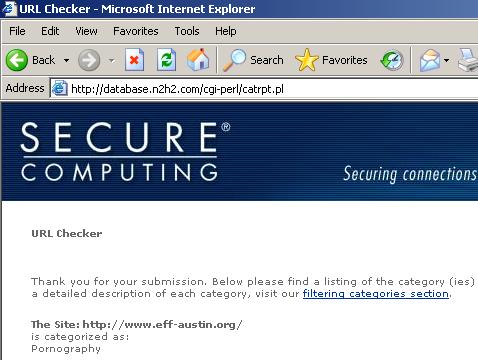
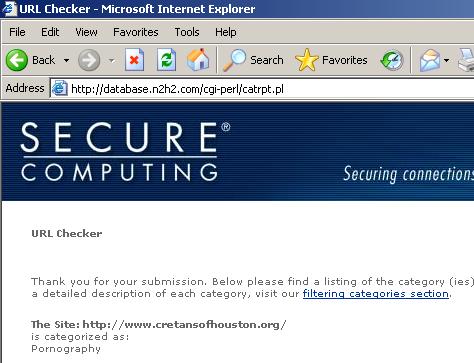
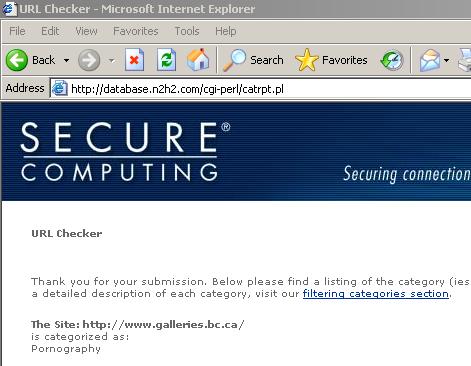
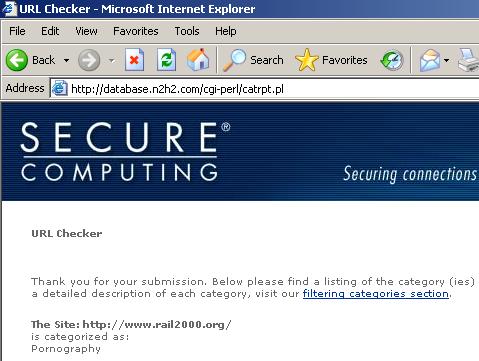
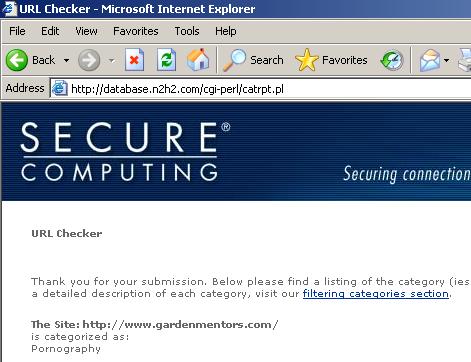
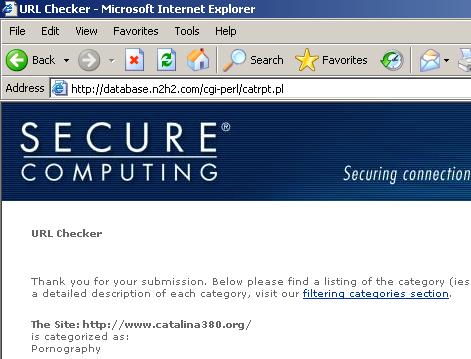
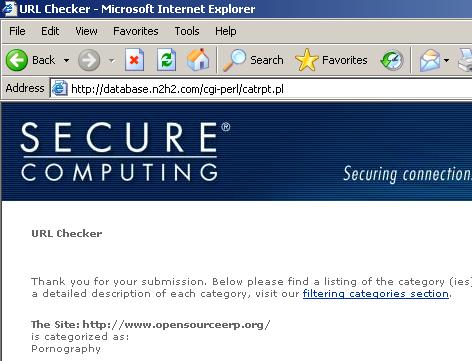
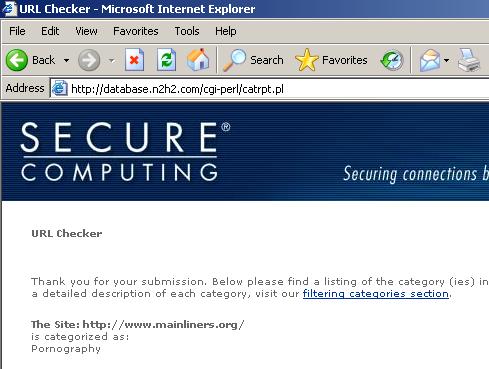
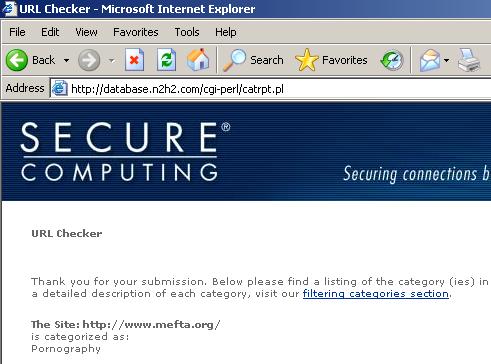
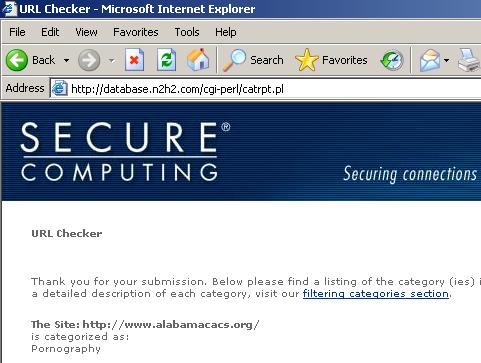
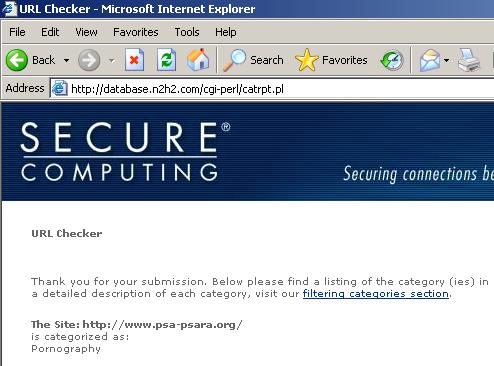
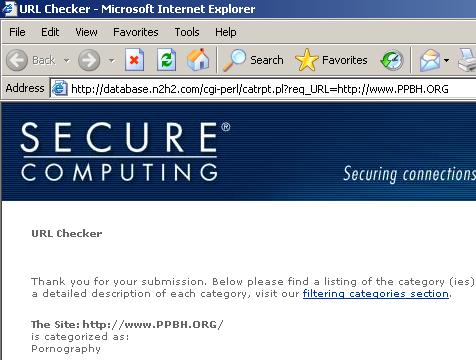
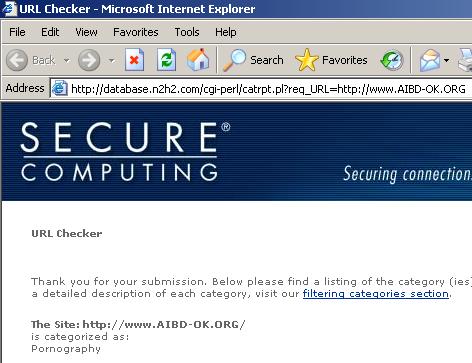
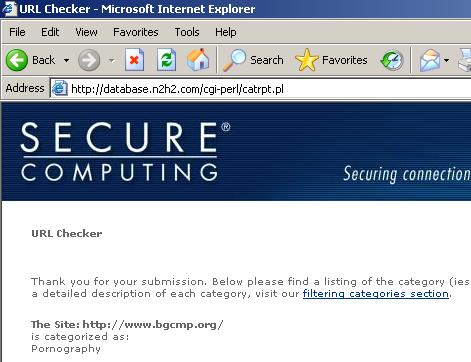
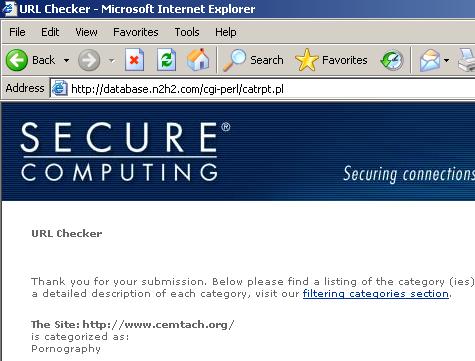
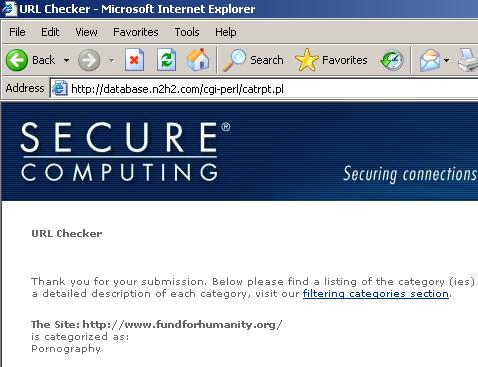
Here is a partial list of some of the questionable categorizations made by Bess; as of this writing, all of the following sites are listed as "Pornography" when you look them up on Secure Computing's Bess lookup form. (This is not just a fluke of the lookup tool; I tested against a copy of the software that all of these sites really were blocked.) The "screen cap" link next to each site links to a snapshot of the results taken from the lookup form (you can check on http://database.n2h2.com/ to see if the page is still returning the same results, although the more obvious errors will probably be fixed after this article is published):
- The Electronic Frontier Foundation, Austin chapter (screen cap)
- Cretans of Houston (screen cap). That's Cretans, as in "people from the island of Crete". Not to be confused with the Cretins of Houston, located here.
- The Rhode Island Coalition Against Domestic Violence (screen cap)
- The website of the public art galleries of British Columbia, Canada (screen cap)
- Rail2000, now the Bay Rail Alliance, a consumer group lobbying for a San Francisco regional rail system (screen cap)
- Rainbow Service Organization, a gay rights advocacy group (screen cap)
- GardenMentors.com, a custom gardening services company in Seattle (screen cap)
- A web site for Catalina 380 series boats (screen cap)
- Open Source ERP, a site promoting open source software for enterprise resource planning and customer relationship management (screen cap)
- The Bryn Mawr Mainliners, a barbershop harmony group (screen cap)
- Timber Trails, an outdoor recreation site (screen cap)
- The MEFTA Institute: "Middle East Free Trade Areas for Business Peace" -- world peace through cheap oil! (screen cap)
- Topple Rummy, a (somewhat out-of-date) site calling for the ouster of Donald Rumsfeld (screen cap)
- The Alabama Network of Children's Advocacy Centers (screen cap)
- PSARA, a non-profit organization for training cruise travel agents (screen cap)
- Park Place Behavioral Health Care, a non-profit mental health care agency (screen cap)
- The Oklahoma chapter of the American Institute of Building Design (screen cap)
- The Boys & Girls Clubs of Metropolitan Phoenix (screen cap)
- CEMTACH -- Computational ElectroMagnetics Theory-Algorithm-Code-Hardware. "Our goal is to develop systems simulations capabilities based on time-domain computational electromagnetics methods." Thanks for clearing that up. (screen cap)
- Fund for Humanity, a San Francisco non-profit supporting environmental organizations and organizations that assist the poor. (screen cap)
A long-standing point of contention while earlier reports about Bess were coming out, was whether every site on their blacklist had been reviewed by a human before being blocked. In 1998 the CEO testified before Congress that "All sites that are blocked are reviewed by N2H2 staff before being added to the block lists." However in their 2002 annual report the company finally admitted that not all sites were reviewed before being blocked: "Through automated categorization or human review, Web sites are identified as fitting into one or more of our categories". At one point an N2H2 employee also told me that when one site is blocked, they will often block all sites hosted on that machine or at that IP -- which of course means that those sites are also not reviewed before being blocked. In any case, it's possible to access some of these sites by IP address, such as the BC Art Galleries site via this link, or the or the Rhode Island Coalition Against Domestic Violence via this link -- so if they're not sharing their IP with other sites, that wouldn't explain how they got blocked either. Smartfilter spokesperson Tomo Foote-Lennox said that one other blocked URL that I found, http://www.arbiol.org/, was the result of an experiment N2H2 once did with fully automated website ratings.
Foote-Lennox added, "In general, we find that schools are VERY sensitive to under-blocking. The would rather block a whole lot of useful reference sites to avoid exposing one porn site." Probably true, although keep in mind we're talking about liability issues, not actual moral outrage. (If they were really morally outraged, they'd be trying to keep kids away from uncensored Internet access everywhere, not just in school! That is in fact the approach that schools take with things like drugs, which do inspire moral outrage because they really are harmful.) Perhaps what is needed is a law explicitly shielding schools from all liability for what students do or see on the Internet at school, if the faculty had no knowledge of it.
(Obligatory interstitial advertisement for common sense: I still don't see what the big deal is about porn anyway. Ask yourself: Why is it harmful to see a picture of a naked person, or even a picture of people having sex? And try to find an answer to that question that doesn't involve, "Lots of other people think so." That includes all variations like "Our society has determined...", "We as a people have decided...", which are just re-phrasings of "Lots of other people think so." I submit that if you disallow those variations of grownup-peer-pressure as an excuse, most people can't really come up with any reason at all.)
OK, flame-retardant suit off, lab coat back on. Previous reports have listed absurd examples of sites blocked by Bess, and looking at any one of those examples or the ones listed here, I'd say that in terms of public policy discussions -- specifically, whether a blocking software company should be trusted to decide what students can look at -- any one of these blocked sites would be more significant than, say, the blocking of BoingBoing which got so much attention. BoingBoing got blocked because of a non-sexual picture of a bare breast on the cover of one of the books they reviewed -- and in fact they were blocked only in the "nudity" category, which includes only "non-pornographic images of the bare human body". So the block on BoingBoing really only revealed that Secure Computing was a bit heavy-handed. (The real problem is that SmartFilter has the category for non-pornographic nudity blocked by default, even though the CIPA filtering law certainly doesn't require schools to block non-pornographic artistic images!) On the other hand, the fact that EFF Austin and the Rhode Island Coalition Against Domestic Violence are currently blocked as "Pornography", suggests that in many instances the blocking companies have nobody at the controls at all. To focus on stupid-but-not-completely-insane blocks like BoingBoing is letting them off easy.
So why did the laundry lists of blocked sites released over the years never become as widely known as BoingBoing, or the guffaw-inducing examples like "Beaver College", which had to change their name in part because of students reportedly being blocked from accessing their website? I think it's because the news favors a good "punch line" -- a fact that anybody can understand that makes us feel smarter than the computers making these dumb mistakes. "Oh, I get it, it was blocked because it was called Beaver College!" But the "punch line" anecdotes are precisely the ones that let the blocking companies off lightly, because it gives them a plausible-sounding excuse for making an error. On the other hand, when the Rhode Island Coalition Against Domestic Violence gets blocked as "Pornography", that could probably force the blocking company to answer some tough questions if it got more press, but there's no good punch line there, so the story just fizzles.
So, while I'm looking through the rest of the data, let me try and come up with some punch lines for reporters to make these blocked sites newsworthy. OK: Why was GardenMentor.com blocked? To keep kids away from all the dirty bitches and hoes! Get it? Ha ha! Why was the Catalina 380 yachting site blocked from kids? Because teens are too vulnerable to pier pressure! Hey, where are you going?
-
Interplay Developing $75 Million Fallout MMOG
Next Generation has very, very good news for RPG fans. Interplay is going to be developing a Fallout Massively Multiplayer Online Game ... and they're in it for serious. The official announcement says that they're going to be throwing $75 Million (dollars!) at development for this thing. From the article: "Production is proposed to begin as early as 2007, with a launch slated for Q3 2010. The company's proposal expects 1 million subscribers during the first year, and projects profitability in year two, revenue of $160 million annually after its first year and net income of $50 million annually starting in year three." Those are fighting words, and the 1 Million club they're aiming for ... maybe not so easy to get into. Also, didn't Interplay go out of business? -
How Bezos Messed With Texas
theodp writes "The WSJ has the behind-the-spaceport story on Amazon CEO Jeff Bezos' Texas land grab for his Blue Origin space tourism venture. Bezos deputized an attorney (who once handled Amazon SEC filings) to make ranchers offers they couldn't refuse (and can't talk about), acquiring property through corporate entities with monikers including 'James Cook L.P.,' 'Jolliet Holdings,' 'Coronado Ventures,' and 'Cabot Enterprises' — all named for famous explorers and all using the same address, c/o [Star Trek-monikered] Zefram LLC. BTW, FAA temporary flight restrictions are in effect for Blue Origin until Monday ('DUE TO ROCKET LAUNCH ACTIVITY'). Let's hope it's more successful than Blue Origin's maiden flight." -
Amazon.com, The Bodyguard
theodp writes "While the press is running Amazon's standard we-can't-make-our-CEO-accept-more-than-$81,840 line again this year, the e-tailer's recent SEC filing does disclose an interesting new compensation tidbit. On top of what it spends to provide security for its CEO at business facilities and during business travel, Amazon shells out an estimated $1.1 million a year to cover the cost of security arrangements for billionaire CEO Jeff Bezos. Holy Jack Welch, Batman - that's a lot of door desks!" -
Slashback: Start, Trash, Explain
Slashback tonight with more on the Microsoft start page project vis-a-vis Google's similar one, a wee $40 million slap on the wrist for Amazon over shopping-cart patent infrigement, new animals for the CodeZoo, and a strong denial that WikiPedia has announced a more stringent editorial policy. Details on these stories and more, below.
What's done is done, and in a certain order. MSN.com general manager Hadi Partovi writes:"A few days ago I read your Slashdot post about start.com.
Thanks for the note!
Thank you for the promotion :-). Meanwhile, I wanted to make sure you know that the work we've been doing on the start.com project actually predates the Google personalized page. I manage a tiny incubation team that has been building start.com since November, and it was first live on the Web in February, 3 months before Google released their personalized page. Of course we are missing some capabilities that Google has, and vice versa. It's a tight competition. But I'm emailing you because our team takes a lot of pride in its innovation. You may point out at a lot of place where Microsoft is following competitors, but if you track the functionality and UI changes that the companies have made over the past 6 months, this has clearly been a place where Google has been following Microsoft's lead.
(Our main engineer on the project has written a bit more about this to respond to your post.)
Anyway, I'm not sending this to be defensive. Heck, I have a lot of work to do to bring an innovation culture to the MSN organization and in many areas we have our work cut out for us. But I guess I want my small incubation team to get credit for being the leading innovators on this one small product :-)"
Always clean out the trashcan. dotpavan writes "The Register and Cnet have this report about Kai-Fu Lee not cleaning his recycle bin at his previous workplace and now MS has stumbled upon some interesting document, which shows that Google anticipated the MS move, and had planned top put him on a leave of absence or have him as a consultant to thwart any attempt of MS getting him back."
Amazon Settles Patent Suit For $40M theodp writes "In today's SEC filing, Amazon.com disclosed it will pay $40 million to settle an e-commerce patent infringement lawsuit that was reported earlier on Slashdot. The terms of the settlement also provide for dismissal of all claims and counterclaims and grant Amazon a nonexclusive license to Soverain's patent portfolio."
29+36 more = 65 vector drawing apps. Anonymous Coward writes "There were many useful comments made for 29 Vector Drawing Programs. After incorporating most of them, the revised column has 65 Vector Drawing Programs."
And each after its own kind. chromatic writes "As seen on the O'Reilly Radar and announced at OSCON 2005, CodeZoo now lists Python and Ruby components. CodeZoo is a human-edited directory of useful, well-maintained, and redistributable software components in various languages. (Slashdot previously covered CodeZoo's launch.)"
The chair recognizes Mr. Wales for a point of clarification. brajesh writes "There has been news on Slashdot and others about Wikipedia announcing tighter editorial control. It seems that everyone jumped the gun. Jimmy Wales, a founder of Wikipedia, has clarified his stance on the idea of freezing stable content on Wikipedia. Apparently, [Jimbo writes] 'I spoke in English, and this was translated to German. Then the German was translated back to English, and then translated again into the Slashdot story.' Also, 'There was no "announcement." We are constantly reviewing our policies and looking for ways to improve, but we have not "announced" anything. We don't even really work that way ... if you know how Wikipedia works, it's through a long process of community discussion and consensus building, not through a process of top-down announcements.' This has also been covered on Ars Technica."
Google Earth not a security risk after all. mister_tim writes "In a follow-up to yesterday's story about ANSTO's request that Google censor images of Australia's only nuclear reactor, the Australian government has now come out and said that Google Earth poses no security risk. Australia's Attorney General has come to the view, also noted by many /. readers, that the Google images have been available for several years from other sources and add nothing to the existing publicly available data. Chalk this one up as a victory for common sense." -
DOJ Wants ISPs to Retain All Customer Records
doubledoh writes "CNET reports that the Department of Justice is 'quietly shopping around' the idea of requiring ISP's to retain all data of their customer's online activities for at least several months. The SEC already mandates that publicly traded firms retain all company emails for at least 2 years, but it looks like John Q. Public may also soon be subject to similar Constitutional violations. Big Brother, here we come." -
SEC Investigating SCO?
Udo Schmitz writes "As Groklaw reports, the SCO Group stated in a SEC filing from yesterday: 'In addition, regulators or others in the Linux market and some foreign regulators have initiated or in the future may initiate legal actions against us, all of which may negatively impact our operations and future operating performance.' Does this mean the SEC finally started to pull some stops? SCOs and Canopys financial dealings (Vultus acquisition anyone?) long ago lead to speculations in the Linux community about the legality of their business practices, or the whole lawsuit just being a stock scam." -
Will McNealy Take Sun Private?
krygny writes "There is speculation that with $7.5 billion in cash, and liquidation of other assets, Sun could leverage a buyback of all publicly traded shares of SUNW at between $5 and $5.50 per share. I suppose, that would relieve them of Sarbanes-Oxley requirements, which Scott McNealy never really liked. (Who does?) For anyone at Sun who survives the tumult, hopefully, there could also be a return to the former corporate culture." -
The Philanthropic Arm of Google
GoatJuggler writes "I accidentally visited google.org recently and ended up at a different Google site that appears to be a placeholder for Google's future foray into the world of philanthropy. A quote from Sergey Brin & Larry Page is there now, 'We hope that someday this institution will eclipse Google itself in overall world impact by ambitiously applying innovation and significant resources to the largest of the world's problems.' Not much to see there now, but it's certainly refreshing to see a successful company leveraging their success to do good. Googling part of that quote led me to a blog that references the uniqueness of Google's SEC filing. The Google Foundation is referenced, and Google's job page now mentions that they are looking to fill the position of Executive Director for the Google Foundation. So, expect Good Things(TM) (like saving 3-legged kittens) from Google soon." -
Judge Denies SCO's Ex Parte Motion to Adjourn
karvind writes "Groklaw has up an article stating that judge Kimball has issued an order regarding SCO's Ex Parte Motion to Adjourn the April 21, 2005 Argument on SCO's Motion to Amend Its Complaint: The Motion is denied. SCO has finally filed its 10Q." From the article: "The court declines to adjourn the hearing. Accordingly, IT IS HEREBY ORDERED that SCO's Ex Parte Motion to Adjourn the April 21, 2005 Argument on SCO's Motion to Amend Its Complaint is DENIED. In addition to hearing SCO's Motion to Amend its Complaint and SCO's Motion to Compel the Deposition of Samuel Palmisano at the April 21, 2005 hearing, the parties are hereby NOTIFIED that the court will also hear argument regarding the parties' Proposed Scheduling Orders." -
Sarbanes-Oxley - How is it Affecting You?
Grant Barrett asks: "All I hear from IT directors is Sarbanes-Oxley, Sarbanes-Oxley, Sarbanes-Oxley. SOX, as they're calling it, is taxing manpower, swallowing time, and adding huge administrative headaches--not to mention incurring fees and salaries paid out to staff or third-party firms hired to ensure compliance--and that's just the IT department. How are you dealing? Did you make your compliance deadline even after the extension? Are you joining the the backlash?" -
Acclaim Reports Large Loss, May Face Bankruptcy
Thanks to Yahoo!/Reuters for its story revealing videogame publisher Acclaim Entertainment has announced a quarterly loss of $25.4 million, and warned of possible bankruptcy, since "needs new cash to replace a financing agreement... that expires on Aug. 4." Apparently the company "has signed a letter of intent with a different lender to borrow up to $30 million but the deal has not yet been completed." The long-standing publisher has also recently been sued by the Olsen Twins, although it still lists upcoming titles as including 100 Bullets, The Red Star, Worms Forts: Under Siege!, and Interview With A Made Man. Update: 07/03 01:34 GMT by S : Acclaim's 10-K financial statement reveals "notification from The Major League Baseball Player's Association (MLBPA) that we were late in making certain royalty payments and our license was terminated", and "due to failure to make certain royalty payments relating to the videogame title Turok: Evolution... our [Turok intellectual property] license agreement with Classic Media was terminated." -
Google Files for IPO
bobwyman manages to be the first to submit this story, apparently by using his own web service: "Well, the PubSub.com SEC Edgar notification system just sent a message a few minutes ago saying that Google has finally filed their S-1 to go public. See: Google's S-1 which was accepted by the SEC at 2004-04-29T13:53:49-04:00. If you had had a PubSub.com SEC Edgar subscription, you would have been one of the first to see this filing." -
OpenIPO and Lindows
An anonymous reader writes "Lindows is using bankers WRHambrecht and their OpenIPO process when they go public. The lower end of the pricing range will net them more than 50MM. But OpenIPO is designed to let ANYONE bid on IPO shares. If Linux can keep investor's attention and Google announces their own IPO, they could raise much more which could have impact on desktop Linux. Same CEO had near perfect timing raising 300MM with MP3.com IPO." OpenIPO is the same route Andover.net took back in the day.