Slashdot Mirror
Domain: slashdot.org
Stories and comments across the archive that link to slashdot.org.
Stories · 37,380
-
Edward Snowden Is Not Dead Despite Mysterious Tweets, Says Glenn Greenwald (inquisitr.com)
Saturday Slashdot reader MouseTheLuckyDog wrote:Some mysterious going ons on the web is causing people to ask if everything is alright with Edward Snowden. His last two tweets, since deleted, were a cryptic message...followed a few days later by a 64 character hex string. This combined with the recent move against torrents sites has the more conspiratorially oriented people speculating that perhaps he is dead and various agencies are slamming torrent sites to slow the spread of more Snowden leaks.
Saturday night The Inquisitr reported: The cryptic code tweets led many to believe that Snowden may have been captured or killed and the codes were the result of a "dead man's switch" designed to release if he did not check in to the computer at a certain time. However, a journalist with The Intercept that has worked with the whistleblower in the past says that Snowden is "fine," but would not elaborate further.
On Saturday Glenn Greenwald tweeted simply, "He's fine". While Snowden's first tweet was reported as "It's time," its complete text seems to suggest Snowden was gathering information for a book. "Did you work with me? Have we talked since 2013? Please recontact me securely, or talk to @bartongellman. It's time." That tweet ended with a URL that led to a tweet by Gellman. "If you have information on the work @Snowden did in the IC, help me tell it truthfully." And Saturday night Gellman also added a message on Twitter for "everyone requesting proof" that Snowden was alive. "Take a deep breath..." -
Ask Slashdot: Share Your Experiences With Windows 10
Long-time Slashdot reader shanen writes: The Start button is broken on one of my Windows 10 machines. Left click is dead. Fairly well known problem, but none of the solutions from non-Microsoft web pages has fixed it... My little meta-problem of the day is being locked out of Microsoft's so-called support. The email part (on outlook.live.com) works as usual, but every attempt to access the support part returns "Something went wrong and we can't sign you in right now. Please try again later." It's a black hole page with no links or options or suggestions. Once you get there, you are dead to Microsoft. Whenever I try to go to Microsoft support, that's all I've seen for several weeks now. ..
In general, Windows 10 seems to be a good thing -- but I don't really know how much it is abusing my personal information and privacy. The abusive relationship with Microsoft support is clearly the same, bad as it ever was.
The original submission has more thoughts on the market for consumer operating systems, and asks for suggestions about these two previously-known issues -- a start button that ignores left clicks, and an ongoing lock-out from Microsoft support. But there's obviously much more to talk about -- so share your thoughts in the comments. Have you had any interesting recent experiences with Windows 10? -
Online Fame Distracts 9th-Grader Who Built That Clock Mistaken For A Bomb (washingtonpost.com)
An anonymous Slashdot reader writes: This week the Washington Post ran a long profile of Ahmed Mohamed, the 14-year-old boy whose home-made clock got him arrested after school officials and the local police mistook it for a bomb last summer. The Justice Department is currently investigating the incident -- while the school district is suing the Texas attorney general, and the boy's family is suing the school district. But Ahmed has just returned back to Texas, and spoke to the press -- including a local Fox news affiliate which later broadcast a commentary saying his family was obsessed with fame and plotted the arrest.
Over the last year Ahmed's read everything that appeared online about him, but never responds because he doesn't want to give in to anger. The Post writes that while some kids at school called him ISIS Boy, "Sympathetic crowdfunders raised $18,000 for his education. He visited the White House, the Google Science Fair and the president of his home country of Sudan (a wanted war criminal, but Mohamed said it would be rude not to accept the invitation)." Though he'd like to return to the U.S. someday for college, he's been living in Qatar, where a government organization paid for private schooling for him and his sister. But the Post says he still sometimes imagines what his life might've been like if the incident had never happened. "By now he could have invented something new -- not just a clock that only took him a few minutes to put together from parts in his family's garage, which was full of '90s-era electronics from when his uncle ran a chain called Beeper Warehouse." -
Online Fame Distracts 9th-Grader Who Built That Clock Mistaken For A Bomb (washingtonpost.com)
An anonymous Slashdot reader writes: This week the Washington Post ran a long profile of Ahmed Mohamed, the 14-year-old boy whose home-made clock got him arrested after school officials and the local police mistook it for a bomb last summer. The Justice Department is currently investigating the incident -- while the school district is suing the Texas attorney general, and the boy's family is suing the school district. But Ahmed has just returned back to Texas, and spoke to the press -- including a local Fox news affiliate which later broadcast a commentary saying his family was obsessed with fame and plotted the arrest.
Over the last year Ahmed's read everything that appeared online about him, but never responds because he doesn't want to give in to anger. The Post writes that while some kids at school called him ISIS Boy, "Sympathetic crowdfunders raised $18,000 for his education. He visited the White House, the Google Science Fair and the president of his home country of Sudan (a wanted war criminal, but Mohamed said it would be rude not to accept the invitation)." Though he'd like to return to the U.S. someday for college, he's been living in Qatar, where a government organization paid for private schooling for him and his sister. But the Post says he still sometimes imagines what his life might've been like if the incident had never happened. "By now he could have invented something new -- not just a clock that only took him a few minutes to put together from parts in his family's garage, which was full of '90s-era electronics from when his uncle ran a chain called Beeper Warehouse." -
Online Fame Distracts 9th-Grader Who Built That Clock Mistaken For A Bomb (washingtonpost.com)
An anonymous Slashdot reader writes: This week the Washington Post ran a long profile of Ahmed Mohamed, the 14-year-old boy whose home-made clock got him arrested after school officials and the local police mistook it for a bomb last summer. The Justice Department is currently investigating the incident -- while the school district is suing the Texas attorney general, and the boy's family is suing the school district. But Ahmed has just returned back to Texas, and spoke to the press -- including a local Fox news affiliate which later broadcast a commentary saying his family was obsessed with fame and plotted the arrest.
Over the last year Ahmed's read everything that appeared online about him, but never responds because he doesn't want to give in to anger. The Post writes that while some kids at school called him ISIS Boy, "Sympathetic crowdfunders raised $18,000 for his education. He visited the White House, the Google Science Fair and the president of his home country of Sudan (a wanted war criminal, but Mohamed said it would be rude not to accept the invitation)." Though he'd like to return to the U.S. someday for college, he's been living in Qatar, where a government organization paid for private schooling for him and his sister. But the Post says he still sometimes imagines what his life might've been like if the incident had never happened. "By now he could have invented something new -- not just a clock that only took him a few minutes to put together from parts in his family's garage, which was full of '90s-era electronics from when his uncle ran a chain called Beeper Warehouse." -
Yahoo's New Anti-Abuse AI Outperforms Previous AI (wired.co.uk)
16.4% of the comments on Yahoo News are "abusive," according to human screeners. Now Yahoo has devised an abuse-detecting algorithm "that can accurately identify whether online comments contain hate speech or not," reports Wired UK: In 90 per cent of test cases Yahoo's algorithm was able to correctly identify that a comment was abusive... The company used a combination of machine learning and crowdsourced abuse detection to create an algorithm that trawled the comment sections of Yahoo News and Finance to sniff out abuse. As part of its project, Yahoo will be releasing the first publicly available curated database of online hate speech.
The machine-learning algorithm was "trained on a million Yahoo article comments," according to the article, and Slashdot reader AmiMoJo writes "The system could help AIs avoid being tricked into making abusive comments themselves, as Microsoft's Tay twitter bot did earlier this year." -
Is The US Social Security Site Still Vulnerable To Identity Theft? (krebsonsecurity.com)
Slashdot reader DERoss writes: Effective 1 August, the U.S. Social Security Administration (SSA) requires users who want to access their SSA accounts to use two-factor authentication. This involves receiving a "security" code via a cell phone text message. This creates two problems. First of all, many seniors who depend on the Social Security benefits to pay their living costs do not have cell phones [or] are not knowledgeable about texting.
More important, cell phone texting is NOT secure. Text messages can be hacked, intercepted, and spoofed. Seniors' accounts might easily be less secure now than they were before 1 August... This is not because of any law passed by Congress. This is a regulatory decision made by top administrators at SSA.
In addition, Krebs on Security reports that the new system "does not appear to provide any additional proof that the person creating an account at ssa.gov is who they say they are" and "does little to prevent identity thieves from fraudulently creating online accounts to siphon benefits from Americans who haven't yet created accounts for themselves." Users are only more secure after they create an account on the social security site -- and Krebs also notes that ironically, the National Institute for Standards and Technology already appears to be deprecating the use of SMS-based two-factor authentication. -
Car Thieves Arrested After Using Laptop and Malware To Steal More Than 30 Jeeps (abc13.com)
New submitter altnuc writes: Two thieves in Houston stole more than 30 Jeeps by using a laptop and a stolen database. The thieves simply looked up the vehicles' VIN numbers in a stolen database, reprogramed a generic key fob, started the cars, and drove away. Chrysler has confirmed that more than 100 of their vehicles have been stolen in the Houston area since November. Chrysler/Jeep owners should always make sure their vehicles are locked! The Wall Street Journal issued a report in July with more details about how hackers are able to steal cars with a laptop. The whole process takes roughly 6 minutes. CrimeStopHouston has posted a video on YouTube of one of the thieves in action. -
Microsoft To Release Two Major Windows 10 Updates Next Year (arstechnica.com)
An anonymous reader quotes a report from Ars Technica: With the Windows 10 Anniversary Update, aka Windows 10 version 1607, released earlier this week, it's time to look forward to what's next. Windows 10 has multiple release tracks to address the needs of its various customer types. The mainstream consumer release, the one that received the Anniversary Update on Tuesday, is dubbed the Current Branch (CB). The Current Branch for Business (CBB) trails the CB by several months, giving it greater time to bed in and receive another few rounds of bug fixing. Currently the CBB is using last year's November Update, version 1511. In about four months, Microsoft plans to bump CBB up to version 1607, putting both CB and CBB on the same major version. [The Long Term Servicing Branch, an Enterprise-only version that will receive security and critical issue support for 10 years, will also be updated.] Going forward, however, the differences between both current branch variants (CB and CBB) and LTSB will become more marked. Microsoft is not planning another major update this year. There will be no equivalent to last year's 1511 release, but Microsoft will have two next year. These are believed to be codenamed Redstone 2 (rs2) and Redstone 3 (rs3), with this week's 1607 release being Redstone 1 (rs1). Current expectation is that rs2 will have a heavy mobile focus and be shipped simultaneously with new Surface branded hardware. -
Man Says Tesla Autopilot Saved His Life By Driving Him To the Hospital (cnbc.com)
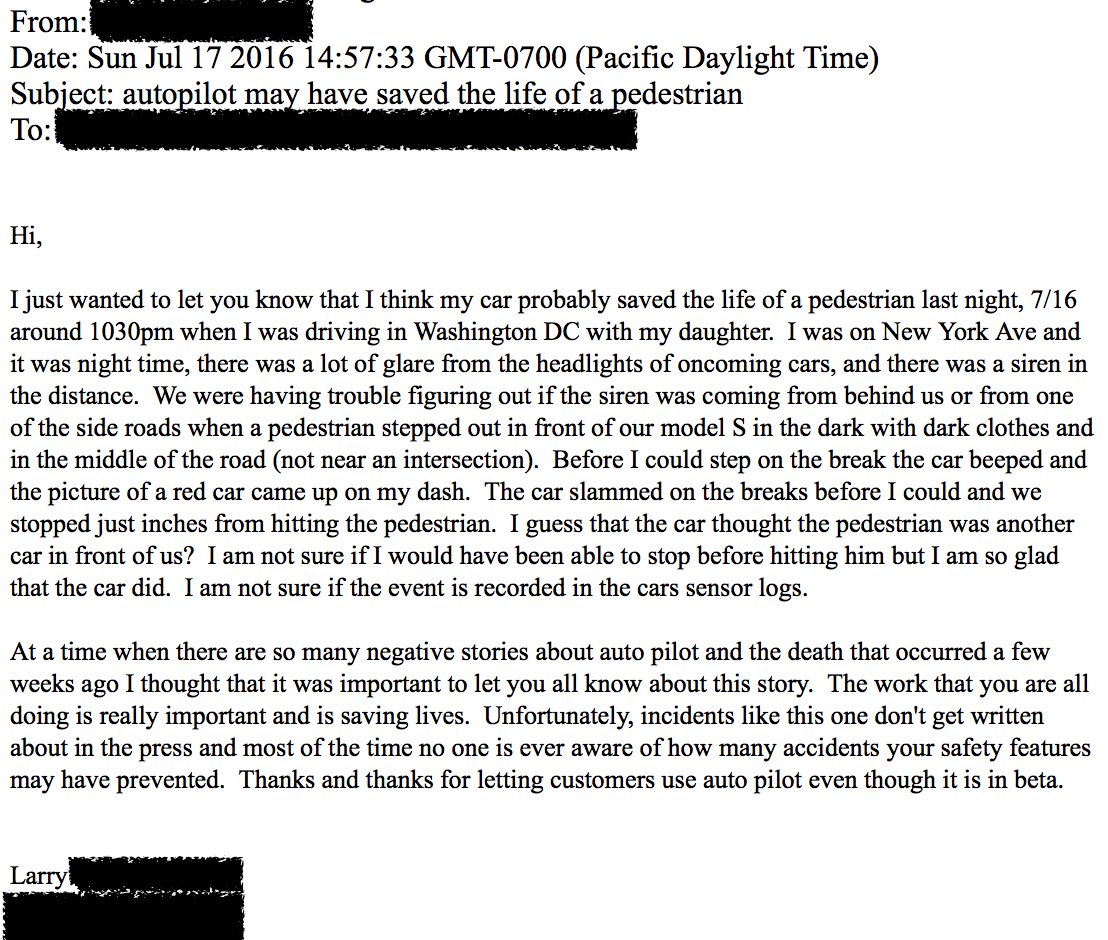
An anonymous reader writes: Last month a man sent an email to Elon Musk explaining how his Tesla Model S with Autopilot activated may have saved a pedestrian's life. Now, it appears Autopilot may have saved the life of a Tesla Model X driver. CNBC reports: "A Missouri man says his Tesla helped saved his life by driving him to the hospital during a life-threatening emergency. Joshua Neally is a lawyer and Tesla owner from Springfield, Missouri, who often uses the semi-autonomous driving system called Autopilot on his Tesla Model X. The system has come under fire after it was involved in a fatal Florida crash in May, but Neally told online magazine Slate that Autopilot drove him 20 miles down a freeway to a hospital, while Neally suffered a potentially fatal blood vessel blockage in his lung, known as a pulmonary embolism. The hospital was right off the freeway exit, and Neally was able to steer the car the last few meters and check himself into the emergency room, the report said." -
Man Says Tesla Autopilot Saved His Life By Driving Him To the Hospital (cnbc.com)
An anonymous reader writes: Last month a man sent an email to Elon Musk explaining how his Tesla Model S with Autopilot activated may have saved a pedestrian's life. Now, it appears Autopilot may have saved the life of a Tesla Model X driver. CNBC reports: "A Missouri man says his Tesla helped saved his life by driving him to the hospital during a life-threatening emergency. Joshua Neally is a lawyer and Tesla owner from Springfield, Missouri, who often uses the semi-autonomous driving system called Autopilot on his Tesla Model X. The system has come under fire after it was involved in a fatal Florida crash in May, but Neally told online magazine Slate that Autopilot drove him 20 miles down a freeway to a hospital, while Neally suffered a potentially fatal blood vessel blockage in his lung, known as a pulmonary embolism. The hospital was right off the freeway exit, and Neally was able to steer the car the last few meters and check himself into the emergency room, the report said." -
Microsoft Swaps Toy Gun Emoji For Revolver -- Days After Apple Does the Opposite (arstechnica.co.uk)
The pistol emoji has become a heated topic of debate among people. Apple's decision to replace the gun with a toy pistol is getting a mixed response. Amid all this, Microsoft has announced it is replacing the toy gun emoji with a symbol for a real revolver. ArsTechnica reports: This emoji change is part of the Windows 10 Anniversary Update, which is rolling out now. The move has surprised some, as Microsoft and Apple had been seen as allies in an effort to dial down violence in emoji generally. In June it emerged that the two had successfully lobbied to have a sports rifle removed from the latest collection of emoji, as it was felt that two firearm symbols would be too many.Microsoft says it is only trying "to align with the global Unicode standard." The issue is that despite Apple's thought on the matter, when an iPhone (or iPad or a Mac) user sends a water pistol emoji, people with devices running non-Apple OS are only going to see a regular pistol. The article adds: Analysts had been worried that without standardisation between platforms, intent for violent emoji could be misunderstood. For instance, if someone sent an acquaintance a message using their iPhone offering to come around with some friends and some waterguns, that acquaintance might well misunderstand the thrust of the message if they were using an Android phone and saw a series of pistols.Emojipedia, an emoji reference website has a good suggestion: Apple: Don't change the pistol emoji. At least not today. Hide it. Unicode does not depreciate emojis, but there is no requirement to show all approved emojis on the keyboard. The pistol emoji could be removed from the iOS emoji keyboard without causing any cross platform compatibility issues. -
Microsoft Swaps Toy Gun Emoji For Revolver -- Days After Apple Does the Opposite (arstechnica.co.uk)
The pistol emoji has become a heated topic of debate among people. Apple's decision to replace the gun with a toy pistol is getting a mixed response. Amid all this, Microsoft has announced it is replacing the toy gun emoji with a symbol for a real revolver. ArsTechnica reports: This emoji change is part of the Windows 10 Anniversary Update, which is rolling out now. The move has surprised some, as Microsoft and Apple had been seen as allies in an effort to dial down violence in emoji generally. In June it emerged that the two had successfully lobbied to have a sports rifle removed from the latest collection of emoji, as it was felt that two firearm symbols would be too many.Microsoft says it is only trying "to align with the global Unicode standard." The issue is that despite Apple's thought on the matter, when an iPhone (or iPad or a Mac) user sends a water pistol emoji, people with devices running non-Apple OS are only going to see a regular pistol. The article adds: Analysts had been worried that without standardisation between platforms, intent for violent emoji could be misunderstood. For instance, if someone sent an acquaintance a message using their iPhone offering to come around with some friends and some waterguns, that acquaintance might well misunderstand the thrust of the message if they were using an Android phone and saw a series of pistols.Emojipedia, an emoji reference website has a good suggestion: Apple: Don't change the pistol emoji. At least not today. Hide it. Unicode does not depreciate emojis, but there is no requirement to show all approved emojis on the keyboard. The pistol emoji could be removed from the iOS emoji keyboard without causing any cross platform compatibility issues. -
North Korea Hopes To Plant Flag On The Moon Within 10 Years (ap.org)
An anonymous reader quotes a report from The Associated Press: In an interview with The Associated Press, a senior official at North Korea's version of NASA said international sanctions won't stop the country from launching more satellites by 2020, and that he hopes to see the North Korean flag on the moon within the next 10 years. "Even though the U.S. and its allies try to block our space development, our aerospace scientists will conquer space and definitely plant the flag of the DPRK on the moon," said Hyon Kwang Il, director of the scientific research department of North Korea's National Aerospace Development Administration. An unmanned, no-frills North Korean moon mission in the not-too-distant future isn't as far-fetched as it might seem. Outside experts say it's ambitious, but conceivable. While the U.S. is the only country to have conducted manned lunar missions, other nations have sent unmanned spacecraft there and have in that sense planted their flags. Hyon said the current five-year plan, at the order of leader Kim Jong Un, focuses on launching more Earth observation satellites and what would be its first geostationary communications satellite -- which, technologically, would be a major step forward. He said universities are also expanding programs to train rocket scientists. "We are planning to develop the Earth observation satellites and to solve communications problems by developing geostationary satellites. All of this work will be the basis for the flight to the moon," Hyon said on July 28, adding that he personally would like to see that happen "within 10 years' time." Meanwhile, North Korea's southern neighbors are planning a similar mission to place a probe in orbit around the moon and a small lander and rover on the surface of the moon by 2020. -
Popular BitTorrent Search Engine Site Torrentz.eu Mysteriously Disappears (softpedia.com)
monkeyzoo writes: Softpedia reports that Torrentz.eu, the internet's biggest BitTorrent meta-search engine, has mysteriously and suddenly shut down. Visitors of the website see a simple message that reads, "Torrentz was a free, fast and powerful meta-search engine combining results from dozens of search engines." Trying to run a search, or clicking any link on the site changes that message to "Torrentz will always love you. Farewell." The main .EU domain, as well as all backup domains (.ME, .CH, and .IN), have the same message. The reason for the disappearance is mysterious, but there is speculation that Torrentz.eu admins decided to pull the plug on their own and avoid any future legal problems in the wake of increasing legal pressure on The Pirate Bay and the arrests related to KickassTorrents. It also cannot be ruled out that the site was hacked. -
Galaxy Note 7 Iris Scanner Explained (androidauthority.com)
An anonymous reader writes from a report via Android Authority: The Galaxy Note 7 was just announced and one of the most intriguing features is its iris scanner. Android Authority has a report explaining how it works: "According to the company, the device stores your registered iris information as an encrypted code safely in its hardware using its KNOX security platform. Whenever you want to access content, such as a protected app, the device first captures your iris pattern for recognition, extracts and digitizes it, and then proceeds to match it with the encrypted code to provide access. You can be sure that no one else apart from you can access your device in case it is stolen or lost because the Note 7 registers the iris information of only one person. Samsung has made all this possible by including a dedicated iris camera for recognizing the composition of the user's eyeballs. The dedicated iris camera uses a special image filter to receive and recognize the reflected images of the irises through an infrared light on the other end of that panel. The light emitted from the Galaxy Note 7's display allows the scanner to receive data even in low light environments." The iris scanner can be used to access private information via Samsung's Secure Folder feature. Samsung also plans to partner with major financial institutions to incorporate its iris scanner into mobile banking applications. -
US Judge Dismisses Part of Alibaba Counterfeit Goods Lawsuit (reuters.com)
Reuters reports: A U.S. judge on Thursday dismissed part of a lawsuit filed last year by Gucci, Yves Saint Laurent and other luxury brands accusing Alibaba Group Holding Ltd of promoting the sale of counterfeit goods. U.S. District Judge Kevin Castel in Manhattan dismissed racketeering claims asserted by brands owned by Paris-based Kering SA, saying their complaint failed to allege facts that could sustain those claims.Alibaba is not the only company which has been subjected to such accusations. Amazon has been treading the same path, with some sellers even leaving the platform. -
US Judge Dismisses Part of Alibaba Counterfeit Goods Lawsuit (reuters.com)
Reuters reports: A U.S. judge on Thursday dismissed part of a lawsuit filed last year by Gucci, Yves Saint Laurent and other luxury brands accusing Alibaba Group Holding Ltd of promoting the sale of counterfeit goods. U.S. District Judge Kevin Castel in Manhattan dismissed racketeering claims asserted by brands owned by Paris-based Kering SA, saying their complaint failed to allege facts that could sustain those claims.Alibaba is not the only company which has been subjected to such accusations. Amazon has been treading the same path, with some sellers even leaving the platform. -
US Copyright Office Sides With Cable Companies Against FCC's Set Top Rules (arstechnica.com)
An anonymous reader writes: The United States Copyright Office has sided with cable companies in their fight against a Federal Communications Commission plan to boost competition in the TV set-top box market. The FCC proposal would force pay-TV providers to make channels and on-demand content available to third parties, who could then build their own devices and apps that could replace rented set-top boxes. Comcast and other cable companies complain that this will open the door to copyright violations, and US Register of Copyrights Maria Pallante agrees with them. The Copyright Office provided advice to the FCC at the FCC's request, and Pallante yesterday detailed the concerns her office raised in a letter to members of Congress who asked her to weigh in. "In its most basic form, the rule contemplated by the FCC would seem to take a valuable good -- bundled video programming created through private effort and agreement under the protections of the Copyright Act -- and deliver it to third parties who are not in privity with the copyright owners, but who may nevertheless exploit the content for profit," Pallante wrote. "Under the Proposed Rule, this would be accomplished without compensation to the creators or licensees of the copyrighted programming, and without requiring the third party to adhere to agreed-upon license terms." There are already "third-party set-top box devices, mainly produced overseas, that are used to view pirated content delivered over the Internet," and the FCC's plan could expand the market to include devices "designed to exploit the more readily available [cable TV] programming streams without adhering to the prescribed security measures," Pallante wrote. Cable companies are willing to pledge industry-wide commitment, but have expressed no desires of leaving control over the UI. -
China Builds 'Elevated Bus' That Drives Over Cars (washingtonpost.com)
An anonymous reader writes: Remember that futuristic bus design from China a few months ago? China has actually built it and is testing it on the streets. The Transit Elevated Bus or TEB-1, as it's called, stands nearly 16 feet tall and straddles two lanes of traffic, allowing cars to pass under it. The hope is for TEB-1 to someday alleviate major traffic in China and other crowded countries. Washington Post reports: "The Transit Elevated Bus piloted in China's Hebei province rolls along a designated track, making it similar in some ways to a commuter train or tram -- the key difference, of course, being that it runs on top of the existing roadway without the need to construct a separate overpass. Images distributed by Chinese media show a spacious passenger compartment -- measuring 72 feet long by 26 feet wide -- capable of holding up to 300 riders. Surprisingly, there are not very many seats. That would probably have to change should an American model ever come to fruition." The concept of the elevated bus first arrived in 2010, where the company claimed it would "cost 10% of a subway system and use 30% less energy than current bus technologies." -
China Builds 'Elevated Bus' That Drives Over Cars (washingtonpost.com)
An anonymous reader writes: Remember that futuristic bus design from China a few months ago? China has actually built it and is testing it on the streets. The Transit Elevated Bus or TEB-1, as it's called, stands nearly 16 feet tall and straddles two lanes of traffic, allowing cars to pass under it. The hope is for TEB-1 to someday alleviate major traffic in China and other crowded countries. Washington Post reports: "The Transit Elevated Bus piloted in China's Hebei province rolls along a designated track, making it similar in some ways to a commuter train or tram -- the key difference, of course, being that it runs on top of the existing roadway without the need to construct a separate overpass. Images distributed by Chinese media show a spacious passenger compartment -- measuring 72 feet long by 26 feet wide -- capable of holding up to 300 riders. Surprisingly, there are not very many seats. That would probably have to change should an American model ever come to fruition." The concept of the elevated bus first arrived in 2010, where the company claimed it would "cost 10% of a subway system and use 30% less energy than current bus technologies." -
Alphabet Will Begin Testing Project Wing Delivery Drones In the US (theguardian.com)
An anonymous reader writes: Google's parent company, Alphabet, has been granted permission by the White House on Tuesday to start testing its Project Wing delivery drones in the U.S. The Guardian reports: "The drones will be tested in one of six designated Federal Aviation Authority areas within the U.S. as part of the government's initiative to promote research into unmanned flight and safety legislation. The announcement was made alongside a pledge from the U.S. National Science Foundation to spend $35m (26 million British Pound) over the next five years on drone research, and comes a month after the U.S. government green-lit commercial drone flights, but with restrictions around line-of-sight control that made automated drone delivery infeasible. The tests will help shape U.S. legislation around the types of automated flying systems that Amazon and Alphabet hope to use to delivery goods and services via air, and establish requirements for unmanned pilot licenses." -
Tesla Posts 13th Straight Loss, Says On Track For Second-Half Deliveries (reuters.com)
An anonymous reader quotes a report from Reuters: Tesla Motors Inc reported its 13th straight quarterly loss as a rise in sales of its Model S and Model X electric cars failed to make up for the huge cost of ramping up production. The company, run by Silicon Valley entrepreneur Elon Musk, said on Wednesday it was on track to deliver about 50,000 new Model S and Model X vehicles during the second half of 2016. Shares of Tesla, which has offered to buy solar panel installer SolarCity Corp for $2.6 billion, were volatile in after-hours trading. They were last up 1 percent. Tesla delivered 14,402 vehicles in the second quarter, missing its goal of 17,000. It delivered 14,810 vehicles in the first quarter, which was also less than its expectations. Tesla said its net loss widened to $293.2 million, or $2.09 per share, in the second quarter, from $184.2 million, or $1.45 per share, a year earlier. Total revenue rose 33 percent to $1.27 billion in the quarter ended June 30. In addition to acquiring SolarCity, Tesla has unveiled its massive $5 billion Gigafactory in Nevada last week and announced its "Master Plan, Part Deux" not too long before that, which includes manufacturing electric trucks and buses, as well as a ride-sharing program. -
Tesla Posts 13th Straight Loss, Says On Track For Second-Half Deliveries (reuters.com)
An anonymous reader quotes a report from Reuters: Tesla Motors Inc reported its 13th straight quarterly loss as a rise in sales of its Model S and Model X electric cars failed to make up for the huge cost of ramping up production. The company, run by Silicon Valley entrepreneur Elon Musk, said on Wednesday it was on track to deliver about 50,000 new Model S and Model X vehicles during the second half of 2016. Shares of Tesla, which has offered to buy solar panel installer SolarCity Corp for $2.6 billion, were volatile in after-hours trading. They were last up 1 percent. Tesla delivered 14,402 vehicles in the second quarter, missing its goal of 17,000. It delivered 14,810 vehicles in the first quarter, which was also less than its expectations. Tesla said its net loss widened to $293.2 million, or $2.09 per share, in the second quarter, from $184.2 million, or $1.45 per share, a year earlier. Total revenue rose 33 percent to $1.27 billion in the quarter ended June 30. In addition to acquiring SolarCity, Tesla has unveiled its massive $5 billion Gigafactory in Nevada last week and announced its "Master Plan, Part Deux" not too long before that, which includes manufacturing electric trucks and buses, as well as a ride-sharing program. -
Tesla Posts 13th Straight Loss, Says On Track For Second-Half Deliveries (reuters.com)
An anonymous reader quotes a report from Reuters: Tesla Motors Inc reported its 13th straight quarterly loss as a rise in sales of its Model S and Model X electric cars failed to make up for the huge cost of ramping up production. The company, run by Silicon Valley entrepreneur Elon Musk, said on Wednesday it was on track to deliver about 50,000 new Model S and Model X vehicles during the second half of 2016. Shares of Tesla, which has offered to buy solar panel installer SolarCity Corp for $2.6 billion, were volatile in after-hours trading. They were last up 1 percent. Tesla delivered 14,402 vehicles in the second quarter, missing its goal of 17,000. It delivered 14,810 vehicles in the first quarter, which was also less than its expectations. Tesla said its net loss widened to $293.2 million, or $2.09 per share, in the second quarter, from $184.2 million, or $1.45 per share, a year earlier. Total revenue rose 33 percent to $1.27 billion in the quarter ended June 30. In addition to acquiring SolarCity, Tesla has unveiled its massive $5 billion Gigafactory in Nevada last week and announced its "Master Plan, Part Deux" not too long before that, which includes manufacturing electric trucks and buses, as well as a ride-sharing program. -
When It Comes To China, Google's Experience Still Says It All (backchannel.com)
Uber's defeat by its local competitor in China was the latest of a string of such cases, and Google's experience trying to establish itself there is illustrative of the challenges facing all American tech companies that aspire to dominate in that market, writes reader mirandakatz. Steven Levy writes at Backchannel:Perhaps because its market share never rose high enough, Uber did not experience the brunt of China's regulation. Still, who's to say what would have happened if Uber had managed to outperform Didi? If Uber's market share topped fifty percent, would the government have sat by as a neutral observer? Would the Uber app start experiencing slowdowns? Would its drivers be stopped? Would airports welcome Didi cars and not Uber? My bet is that, mixed with disappointment at not winning the country, Uber executives might be feeling a bit relieved that such worries are now off the table. As it is, Uber has become one more casualty in China's other wall, a towering fortress of restrictions, regulations and unfair play that keeps down American internet companies. -
Project Hosting Service Fosshub Compromised, Embedding Malware Inside Hosted Files (softpedia.com)
At least some applications on Fosshub, a free project hosting service appear to have been compromised, according to several reports. (Update: Fosshub has acknowledged the hack.) The software portal, furthermore, is serving malware payloads, reports add. Catalin Cimpanu of Softpedia says that a hacking group which goes by the name of PeggleCrew is responsible for the hack. "In short, a network service with no authentication was exposed to the internet," the hacker told Softpedia in an email. "We were able to grab data from this network service to obtain source code and passwords that led us further into the infrastructure of FOSSHub and eventually gain control of their production machines, backup and mirror locations, and FTP credentials for the caching service they use, as well as the Google Apps-hosted email." The hacker group told the publication that they have compromised the entire website, "including the administrator's email. He also revealed he didn't dump the site's database but claimed that "passwords weren't salted." A user on Reddit, who has since received lots of upvotes, adds: Some popular apps that have links to FossHub that may be infected include: Audacity, WinDirStat, qBittorrent, MKVToolNix, Spybot Search&Destroy, Calibre, SMPlayer, HWiNFO, MyPhoneExplorer, and IrfanView.Another application which has reportedly been compromised is Classic Shell. It is ostensibly overwriting the MBR on users' computers. Many users are upset with the timing of hack, noting that plenty of people were looking for Classic Shell amid the release of Windows 10 Anniversary Update. Update: 08/03 17:30 GMT by M :In a blog post, Audacity said that Fosshub was serving a hacked copy of its audio editing software for three hours. It adds that "no Audacity Team infrastructure was compromised." Fosshub team writes: Last night we had a security incident caused by a group of hackers that allowed them to log-in to FossHub developer *through* an user that was compromised. Shortly after, we noticed two users that were compromised. They simply logged-in using their passwords and this allowed them to escalate. [...] Several hours later, we noticed the attackers were able to gain access through an FTP account and we decided to shut down the main server immediately to prevent any further infection/damage. FossHub.com is down on purpose until we are able to identify the way hackers were able to escalate. Fosshub insists that the hacked copy of Classic Shell was only downloaded 300 times. In the meantime, if you know someone who may have downloaded the compromised copy of Classic Shell, here's what they need to do next. -
Your Battery Status Is Being Used To Track You Online (theguardian.com)
A paper published last year revealed that the battery on a laptop or phone can be used to track one's online activities. The vulnerability resided in a built-in HTML 5 specification, which could be tricked into identifying people and tracking their online activities. One year later, we are now learning that the vulnerability is being exploited in the wild. The Guardian reports: [...] Two security researchers from Princeton University have shown that the battery status indicator really is being used in the wild to track users. By running a specially modified browser, Steve Engelhard and Arvind Narayanan found two tracking scripts that used the API to "fingerprint" a specific device, allowing them to continuously identify it across multiple contexts. The research was highlighted by Lukasz Olejnik, one of the four researchers who first called attention to the potential issues with the battery status API in 2015. Although Olejnik achieved some success following his warning, with the body in charge of the web's standards thanking his group for the privacy analysis, the API still has the potential for misuse. And while it is only tracking scripts using it now, Olejnik warns that unscrupulous actors could do more. "Some companies may be analysing the possibility of monetising the access to battery levels," he writes. "When battery is running low, people might be prone to some -- otherwise different -- decisions. In such circumstances, users will agree to pay more for a service." -
Interviews: Ask Ruby on Rails Creator David Heinemeier Hansson a Question
David Heinemeier Hansson created the Ruby on Rails open-source web framework in 2003. David is also the founder and CTO of Basecamp, a project management tool that's been used by more than 15 million people. In addition, David is the best-selling author of REWORK, a book about starting and running businesses a better way. David has agreed to take some time to answer some of your questions.
Ask as many questions as you'd like, but please, one per comment. (And feel free to also leave your suggestions for who Slashdot should interview next.) We'll pick the very best questions -- and forward them on to David Heinemeier Hansson himself. -
NASA's 'Journey To Mars' Initiative Might Be Delayed Due To Government Audit (natureworldnews.com)
An anonymous reader quotes a report from Christian Science Monitor: NASA has taken bold steps toward crewed Mars exploration in recent years. But according to a new audit, the agency may be moving too hastily. The Government Accountability Office (GAO) expressed concerns this past week about the feasibility of NASA's Orion crew capsule and Space Launch System (SLS). In two government-requested audits, the GAO questioned NASA's ability to meet program deadlines, citing insufficient funding and internal management issues. According to the GAO, however, the agency's schedule just isn't realistic. By pushing for earlier launch dates, NASA is increasing the inherent risk of a deep space mission. NASA's budgeting practices are also scrutinized in GAO's audit. In September, the agency asked for $11.3 billion to prepare Orion for launch. "Ideally, if these programs go forward, NASA would be taking actions to reduce the risks we see now, which are being caused by management issues," says Cristina Chaplain, who led the GOA audit, in an interview with the Monitor. "They're going to face the technical issues no matter what. But they're exacerbating them with management concerns, like not having accurate cost estimates." The report adds: "NASA's 'Journey to Mars' initiative has been a source of both excitement and controversy. The Asteroid Redirect Mission, in which the agency will send four astronauts to redirect an asteroid into the moon's orbit, is slated to launch sometime in the next decade. The mission is designed to test new propulsion technology for future crewed Mars missions. In the 2030s, NASA hopes to send an Orion crew to the red planet. NASA plans to complete the first SLS launch in 2018. In the test mission, called Exploration Mission 1, the rocket will carry an empty Orion into orbit around the moon. In subsequent missions, SLS/Orion will launch with a full crew. NASA has scheduled Exploration Mission 2 for April 2023, but administrators hope to launch as early as 2021." -
Top DNC Staffers Leave Following WikiLeaks Email Scandal (usatoday.com)
An anonymous reader writes from a report via USA Today: Following the leak of nearly 20,000 Democratic National Committee emails and the resignation of DNC Chairwoman Debbie Wasserman Schultz, several more staffers are leaving their positions. USA Today reports Amy Dacey, the chief executive officer of the DNC, Luis Miranda, the party's communications director, and Brad Marshall, chief financial officer, are all leaving the DNC. The statement announcing the staff changes praises the outgoing aides and makes no mention of the email issue. "Thanks in part to the hard work of Amy, Luis, and Brad, the Democratic Party has adopted the most progressive platform in history, has put itself in financial position to win in November, and has begun the important work of investing in state party partnerships. I'm so grateful for their commitment to this cause, and I wish them continued success in the next chapter of their career," said Donna Brazile, the party's interim chairwoman. Some of the leaked emails from party staffers depicted officials favoring now-Democratic nominee Hillary Clinton over Vermont Sen. Bernie Sanders during their primary campaign. -
8TB Drives Are Highly Reliable, Says Backblaze (yahoo.com)
An anonymous reader writes from a report via Yahoo News: Cloud backup and storage provider Backblaze has published its hard drive stats for Q2 2016. Yahoo News reports: "The report is based on data drives, not boot drives, that are deployed across the company's data centers in quantities of 45 or more. According to the report, the company saw an annualized failure rate of 19.81 percent with the Seagate ST4000DX000 4TB drive in a quantity of 197 units working 18,428 days. The next in line was the WD WD40EFRX 4TB drive in a quantity of 46 units working 4,186 days. This model had an annualized failure rate of 8.72 percent for that quarter. The company's report also notes that it finally introduced 8TB hard drives into its fold: first with a mere 45 8TB HGST units and then over 2,700 units from Seagate crammed into the company's Blackblaze Vaults, which include 20 Storage Pods containing 45 drives each. The company moved to 8TB drives to optimize storage density. According to a chart provided in the report, the 8TB drives are highly reliable. The HGST HDS5C8080ALE600 worked for 22,858 days and only saw two failures, generating an annualized failure rate of 3.20 percent. The Seagate ST8000DM002 worked for 44,000 days and only saw four failures, generating an annual failure rate of 3.30 percent." For comparison, Backblaze's reliability report for Q1 2016 can be found here.
UPDATE 8/2/16: Corrected Seagate Model "DT8000DM002" to "ST8000DM002." -
Microsoft Releases Windows 10 Anniversary Update (zdnet.com)
Windows 10 Anniversary Update is now rolling out, Microsoft announced Tuesday. The major update brings with it Windows Ink, a dedicated hub designed especially for 2-in-1 devices with styluses, and improvements to Cortana among others. ZDNet's Mary Jo Foley writes: I'm hearing that the first users to get Anniversary Update via Windows Update will be those with the newest hardware, BIOSes and firmware. Those who may encounter compatibility issues because of drivers may get it slightly later through Windows Update, my contacts say. Microsoft actually delivered some of the Anniversary Update features for Xbox One on July 30. On August 1, Microsoft made Windows 10 Anniversary Update available to its volume licensees in the Microsoft Volume Licensing Service Center. It also made the Anniversary Update code available to its reseller partners via its Partner Portal yesterday. MSDN users can get the Anniversary Update bits today. Microsoft officials said a week ago to expect Microsoft to make Anniversary Update ISOs available today, August 2. The Media Creation Tool seems to now be updated to include the Anniversary Update release.We asked readers last week whether they would update their computers to Windows 10, and the majority of people indicated they wouldn't. -
Microsoft Releases Windows 10 Anniversary Update (zdnet.com)
Windows 10 Anniversary Update is now rolling out, Microsoft announced Tuesday. The major update brings with it Windows Ink, a dedicated hub designed especially for 2-in-1 devices with styluses, and improvements to Cortana among others. ZDNet's Mary Jo Foley writes: I'm hearing that the first users to get Anniversary Update via Windows Update will be those with the newest hardware, BIOSes and firmware. Those who may encounter compatibility issues because of drivers may get it slightly later through Windows Update, my contacts say. Microsoft actually delivered some of the Anniversary Update features for Xbox One on July 30. On August 1, Microsoft made Windows 10 Anniversary Update available to its volume licensees in the Microsoft Volume Licensing Service Center. It also made the Anniversary Update code available to its reseller partners via its Partner Portal yesterday. MSDN users can get the Anniversary Update bits today. Microsoft officials said a week ago to expect Microsoft to make Anniversary Update ISOs available today, August 2. The Media Creation Tool seems to now be updated to include the Anniversary Update release.We asked readers last week whether they would update their computers to Windows 10, and the majority of people indicated they wouldn't. -
Microsoft Releases Windows 10 Anniversary Update (zdnet.com)
Windows 10 Anniversary Update is now rolling out, Microsoft announced Tuesday. The major update brings with it Windows Ink, a dedicated hub designed especially for 2-in-1 devices with styluses, and improvements to Cortana among others. ZDNet's Mary Jo Foley writes: I'm hearing that the first users to get Anniversary Update via Windows Update will be those with the newest hardware, BIOSes and firmware. Those who may encounter compatibility issues because of drivers may get it slightly later through Windows Update, my contacts say. Microsoft actually delivered some of the Anniversary Update features for Xbox One on July 30. On August 1, Microsoft made Windows 10 Anniversary Update available to its volume licensees in the Microsoft Volume Licensing Service Center. It also made the Anniversary Update code available to its reseller partners via its Partner Portal yesterday. MSDN users can get the Anniversary Update bits today. Microsoft officials said a week ago to expect Microsoft to make Anniversary Update ISOs available today, August 2. The Media Creation Tool seems to now be updated to include the Anniversary Update release.We asked readers last week whether they would update their computers to Windows 10, and the majority of people indicated they wouldn't. -
Hacker Selling Data For 200 Million Yahoo Users On The Dark Web (softpedia.com)
An anonymous reader writes from a report via Softpedia: A listing was published today on TheRealDeal Dark Web marketplace claiming to be offering data on over 200 million Yahoo users, sold by the same hacker that was behind the LinkedIn, Tumblr, MySpace, and VK data dumps. In statements to Softpedia, Yahoo said it was investigating the breach, but based on the seller's reputation, it is very likely the data is authentic. The data is up for sale for 3 Bitcoin (approximately ~$1,800), and based on the sample the hacker provided, the data dump includes details such as usernames, MD5-hashed passwords, and dates of birth for all users. For some records, there is also a backup email address, country of origin, and ZIP code for U.S. users. The hacker, called Peace, has also told Softpedia that he previously made $50,000 from the LinkedIn breach alone, and over $65,000 in total from all breaches. -
Hacker Selling Data For 200 Million Yahoo Users On The Dark Web (softpedia.com)
An anonymous reader writes from a report via Softpedia: A listing was published today on TheRealDeal Dark Web marketplace claiming to be offering data on over 200 million Yahoo users, sold by the same hacker that was behind the LinkedIn, Tumblr, MySpace, and VK data dumps. In statements to Softpedia, Yahoo said it was investigating the breach, but based on the seller's reputation, it is very likely the data is authentic. The data is up for sale for 3 Bitcoin (approximately ~$1,800), and based on the sample the hacker provided, the data dump includes details such as usernames, MD5-hashed passwords, and dates of birth for all users. For some records, there is also a backup email address, country of origin, and ZIP code for U.S. users. The hacker, called Peace, has also told Softpedia that he previously made $50,000 from the LinkedIn breach alone, and over $65,000 in total from all breaches. -
Hacker Selling Data For 200 Million Yahoo Users On The Dark Web (softpedia.com)
An anonymous reader writes from a report via Softpedia: A listing was published today on TheRealDeal Dark Web marketplace claiming to be offering data on over 200 million Yahoo users, sold by the same hacker that was behind the LinkedIn, Tumblr, MySpace, and VK data dumps. In statements to Softpedia, Yahoo said it was investigating the breach, but based on the seller's reputation, it is very likely the data is authentic. The data is up for sale for 3 Bitcoin (approximately ~$1,800), and based on the sample the hacker provided, the data dump includes details such as usernames, MD5-hashed passwords, and dates of birth for all users. For some records, there is also a backup email address, country of origin, and ZIP code for U.S. users. The hacker, called Peace, has also told Softpedia that he previously made $50,000 from the LinkedIn breach alone, and over $65,000 in total from all breaches. -
Hacker Selling Data For 200 Million Yahoo Users On The Dark Web (softpedia.com)
An anonymous reader writes from a report via Softpedia: A listing was published today on TheRealDeal Dark Web marketplace claiming to be offering data on over 200 million Yahoo users, sold by the same hacker that was behind the LinkedIn, Tumblr, MySpace, and VK data dumps. In statements to Softpedia, Yahoo said it was investigating the breach, but based on the seller's reputation, it is very likely the data is authentic. The data is up for sale for 3 Bitcoin (approximately ~$1,800), and based on the sample the hacker provided, the data dump includes details such as usernames, MD5-hashed passwords, and dates of birth for all users. For some records, there is also a backup email address, country of origin, and ZIP code for U.S. users. The hacker, called Peace, has also told Softpedia that he previously made $50,000 from the LinkedIn breach alone, and over $65,000 in total from all breaches. -
One Year Later: Windows 10 Now Runs On Over 21% of All Desktops (winbeta.org)
An anonymous reader writes: On June 29, Microsoft announced that Windows 10 was running on 350 million devices -- 50 million more devices than the previous milestone announced by Microsoft on May 5. While the company is expected to update the number of devices running the latest OS when it releases the Windows 10 Anniversary Update on August 2nd, NetMarketShare has decided to conduct some research on its own. According to its report, Windows 10 currently runs on a 21.13% desktop OS share. Meanwhile, Windows 7 continues to dominate the market with a 47.01% share, with Windows 8 and Windows 8.1 representing less than 10% of the PC market, and Windows XP representing 10.34%. While the market share of Windows 10 is all but certain to rise, it likely won't rise as fast as it did between May and June or June and July for example, as Windows 10 is no longer offered as a free upgrade for PCs running Windows 7 or Windows 8. Microsoft has even backtracked on its original statement that Windows 10 will hit one billion devices by mid-2018, saying last month that Windows 10 likely won't in fact make that deadline. -
One Year Later: Windows 10 Now Runs On Over 21% of All Desktops (winbeta.org)
An anonymous reader writes: On June 29, Microsoft announced that Windows 10 was running on 350 million devices -- 50 million more devices than the previous milestone announced by Microsoft on May 5. While the company is expected to update the number of devices running the latest OS when it releases the Windows 10 Anniversary Update on August 2nd, NetMarketShare has decided to conduct some research on its own. According to its report, Windows 10 currently runs on a 21.13% desktop OS share. Meanwhile, Windows 7 continues to dominate the market with a 47.01% share, with Windows 8 and Windows 8.1 representing less than 10% of the PC market, and Windows XP representing 10.34%. While the market share of Windows 10 is all but certain to rise, it likely won't rise as fast as it did between May and June or June and July for example, as Windows 10 is no longer offered as a free upgrade for PCs running Windows 7 or Windows 8. Microsoft has even backtracked on its original statement that Windows 10 will hit one billion devices by mid-2018, saying last month that Windows 10 likely won't in fact make that deadline. -
PSA: Windows 10 Is Still Free For Those Who Use Assistive Technologies (theregister.co.uk)
BarbaraHudson writes: When is a deadline not a deadline? The Register is reporting that the Windows 10 upgrade is still free for 7/8.1 users. [Microsoft] had previously said that those who use assistive technologies would continue to be eligible after the July 29th deadline had passed, and I pointed out in a story last month that Microsoft hadn't figured out yet how they would be able to tell who would be eligible. Looks like they never did figure that one out. [The Register reports:] "Microsoft's year-long Windows 10 free upgrade offer ended over the weekend, but it's still possible to secure Redmond's finest -- even the new Anniversary Update -- for the low low price of 0.00 in whatever currency you prefer. The free upgrade is reserved for those who use assistive technologies, the many features that magnify text, offer text-to-speech or otherwise assist those who don't see or hear with the perfect acuity. But The Register browsed the site and found no checks before downloading. It looks like it's open to anyone." -
PSA: Windows 10 Is Still Free For Those Who Use Assistive Technologies (theregister.co.uk)
BarbaraHudson writes: When is a deadline not a deadline? The Register is reporting that the Windows 10 upgrade is still free for 7/8.1 users. [Microsoft] had previously said that those who use assistive technologies would continue to be eligible after the July 29th deadline had passed, and I pointed out in a story last month that Microsoft hadn't figured out yet how they would be able to tell who would be eligible. Looks like they never did figure that one out. [The Register reports:] "Microsoft's year-long Windows 10 free upgrade offer ended over the weekend, but it's still possible to secure Redmond's finest -- even the new Anniversary Update -- for the low low price of 0.00 in whatever currency you prefer. The free upgrade is reserved for those who use assistive technologies, the many features that magnify text, offer text-to-speech or otherwise assist those who don't see or hear with the perfect acuity. But The Register browsed the site and found no checks before downloading. It looks like it's open to anyone." -
Peter Thiel Is Interested In Harvesting The Blood Of The Young (gawker.com)
Presto Vivace writes: [Gawker reports:] "Peter Thiel, the tech billionaire-turned-Trump delegate who successfully bankrupted Gawker Media, has long been obsessed with anti-aging technologies. He believes people have been conned by 'the ideology of the inevitability of the death of every individual,' and has funded startups dedicated to extending the human lifespan. According to Jeff Bercovici of Inc. magazine, Thiel is so afraid of dying that he has begun exploring a novel, and fairly unsettling, technique: Harvesting, and injecting himself with, the blood of younger people." Vampire capitalism is real. In an unpublished interview with Bercovici last year, Thiel said: "I'm looking into parabiosis stuff [...] where they [infected] the young blood into older mice and they found that had a massive rejuvenating effect. [...] I think there are a lot of these things that have been strangely under-explored." When asked if he meant parabiosis was "really interesting" as a business opportunity or a personal-health treatment, Thiel suggested the latter: "That would be one where it's more just, do we think the science works? Some of these it's not clear there's actually a great company to start around it. [...]" -
Apple Replaces The Pistol Emoji With A Water Gun (cnn.com)
Apple has a announced a number of new emoji changes on Monday, but the most controversial new change is that the pistol emoji will be replaced with a green water gun emoji in the company's upcoming iOS 10 operating system: The water gun swap is not Apple's first foray into cartoon gun control. Earlier this year the governing body in charge of emojis nixed a proposed rifle emoji. It was one of a number of possible new additions, but Unicode Consortium members Apple and Microsoft argued against the Olympics-inspired gun, according to Buzzfeed. Last year, an organization called New Yorkers Against Gun Violence started a campaign to get Apple to replace its version of the pistol emoji. It launched a site, disarmtheiphone.com, and sent an open letter to remove the firearm emoji "as a symbolic gesture to limit gun accessibility." As it stands, Microsoft is the only major software company to use a toy gun emoji instead of a pistol emoji in Windows -- Google, Samsung, Facebook and Twitter all use realistic pistol emojis. Apple's iOS 10 will be released in fall, but you can download the iOS 10 public beta to be one of the first to wield the toy gun emoji. -
Gawker Founder Nick Denton Files For Bankruptcy (nydailynews.com)
An anonymous reader quotes a report from New York Daily News: Gawker's founder Nick Denton filed for personal bankruptcy Monday after a Florida appeals court refused to give him an emergency order that would block wrestler Hulk Hogan from collecting on a $140 million jury verdict. The District Court of Appeal in Lakeland, Fla., denied a request by Gawker and Denton to stay a ruling by lower court judge Pamela Campbell -- who said Hogan could start collecting on his award immediately. But declaring bankruptcy will give Denton protection from collectors including Hogan, whose real name is Terry Bollea. In the filing, Denton says he has assets of $10 to $50 million and liabilities of $100 to $500 million. His debts includes $125 million that he owes to Hogan, an $11.5 million loan that he took out on June 10 from Silicon Valley Bank, a $50,000 loan he took from his 401(k) at Gawker and his Time Warner Cable bill for $120.88. The jury's March verdict was the result of Gawker's decision to publish a tape on the internet of Hogan having sex with a friend's wife. The former WWF star said it was an invasion of his privacy. Gawker filed for bankruptcy shortly after the jury's verdict, but Denton resisted, asking the bankruptcy court to protect him as part of the process. The federal court refused. Now that the Florida courts have opened the door for Hogan to start collecting from Denton, he is expected to follow Gawker into federal bankruptcy court in lower Manhattan. -
Gawker Founder Nick Denton Files For Bankruptcy (nydailynews.com)
An anonymous reader quotes a report from New York Daily News: Gawker's founder Nick Denton filed for personal bankruptcy Monday after a Florida appeals court refused to give him an emergency order that would block wrestler Hulk Hogan from collecting on a $140 million jury verdict. The District Court of Appeal in Lakeland, Fla., denied a request by Gawker and Denton to stay a ruling by lower court judge Pamela Campbell -- who said Hogan could start collecting on his award immediately. But declaring bankruptcy will give Denton protection from collectors including Hogan, whose real name is Terry Bollea. In the filing, Denton says he has assets of $10 to $50 million and liabilities of $100 to $500 million. His debts includes $125 million that he owes to Hogan, an $11.5 million loan that he took out on June 10 from Silicon Valley Bank, a $50,000 loan he took from his 401(k) at Gawker and his Time Warner Cable bill for $120.88. The jury's March verdict was the result of Gawker's decision to publish a tape on the internet of Hogan having sex with a friend's wife. The former WWF star said it was an invasion of his privacy. Gawker filed for bankruptcy shortly after the jury's verdict, but Denton resisted, asking the bankruptcy court to protect him as part of the process. The federal court refused. Now that the Florida courts have opened the door for Hogan to start collecting from Denton, he is expected to follow Gawker into federal bankruptcy court in lower Manhattan. -
FCC Requires TP-Link To Support Open Source Router Firmware
An anonymous reader writes: Earlier today, the FCC reached a settlement with TP-Link over Wi-Fi router interference. Most of the agreement was routine, addressing compliance with radio emission rules.
But the FCC also did something unprecedented. It required TP-Link to support open source firmware on its routers. You might recall that, last year, the FCC caused a ruckus when it mistakenly suggested it was banning open source router firmware. In fact, the FCC only required that router vendors implement protections for specific radio emission parameters. But the FCC didn't work with router vendors in advance to maintain open source compatibility, resulting in certain vendors (including TP-Link) trying to lock down their routers.
The FCC eventually issued a clarification, but the damage was done. Only recently have a couple router vendors (Linksys and Asus) affirmed that they will continue to support open source firmware.
Today's settlement is a milestone for the FCC. The agency is finally doing something, with deeds and not just words, to demonstrate its support for the open source community. It would be better if the agency hadn't created this mess, but they deserve serious credit for working so hard to fix it. -
FCC Requires TP-Link To Support Open Source Router Firmware
An anonymous reader writes: Earlier today, the FCC reached a settlement with TP-Link over Wi-Fi router interference. Most of the agreement was routine, addressing compliance with radio emission rules.
But the FCC also did something unprecedented. It required TP-Link to support open source firmware on its routers. You might recall that, last year, the FCC caused a ruckus when it mistakenly suggested it was banning open source router firmware. In fact, the FCC only required that router vendors implement protections for specific radio emission parameters. But the FCC didn't work with router vendors in advance to maintain open source compatibility, resulting in certain vendors (including TP-Link) trying to lock down their routers.
The FCC eventually issued a clarification, but the damage was done. Only recently have a couple router vendors (Linksys and Asus) affirmed that they will continue to support open source firmware.
Today's settlement is a milestone for the FCC. The agency is finally doing something, with deeds and not just words, to demonstrate its support for the open source community. It would be better if the agency hadn't created this mess, but they deserve serious credit for working so hard to fix it. -
Microsoft's SwiftKey Suspends Sync After Keyboard Leaks Strangers' Contact Details (zdnet.com)
Swiftkey has suspended its cloud-sync service and switched off email address predictions amid reports of Microsoft-owned keyboard app delivering suggestions for strangers' email addresses and phone numbers. ZDNet reports: The move followed reports a week ago that the app was offering up email addresses to people they've never met. According to The Telegraph, one user claimed to have been contacted by a stranger and told that their brand-new phone had suggested two of the user's email addresses, as well as contact phone numbers. Reports of the bug also cite some users receiving predictions in languages they'd never used previously. "I logged into SwiftKey with Google+ and now, I'm getting someone else's German predictions with only English (UK) pack installed. I have never typed German in my entire life," one Reddit user reported last week. SwiftKey on Friday suggested the leaked contact details are due to a glitch in this sync service, which normally backs up what the app learns about a user to SwiftKey servers and then syncs that data to the user's other devices.Microsoft acquired SwiftKey app earlier this year for an estimated sum of $250 million.