Slashdot Mirror
Domain: slashdot.org
Stories and comments across the archive that link to slashdot.org.
Stories · 37,380
-
Hour of Code 2015 Star Wars Tutorial: Spare the IF Statement, Spoil the Child?
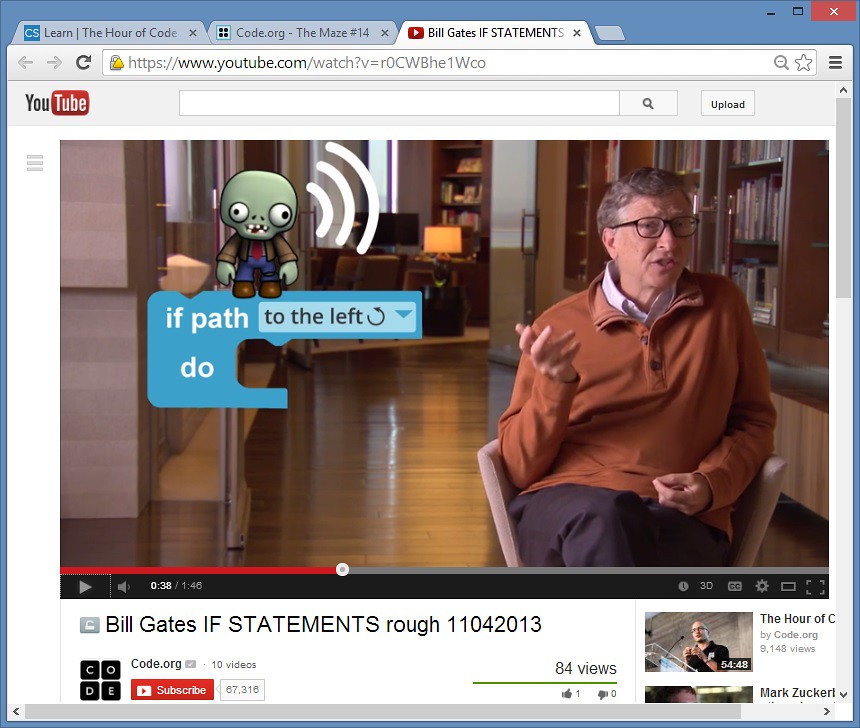
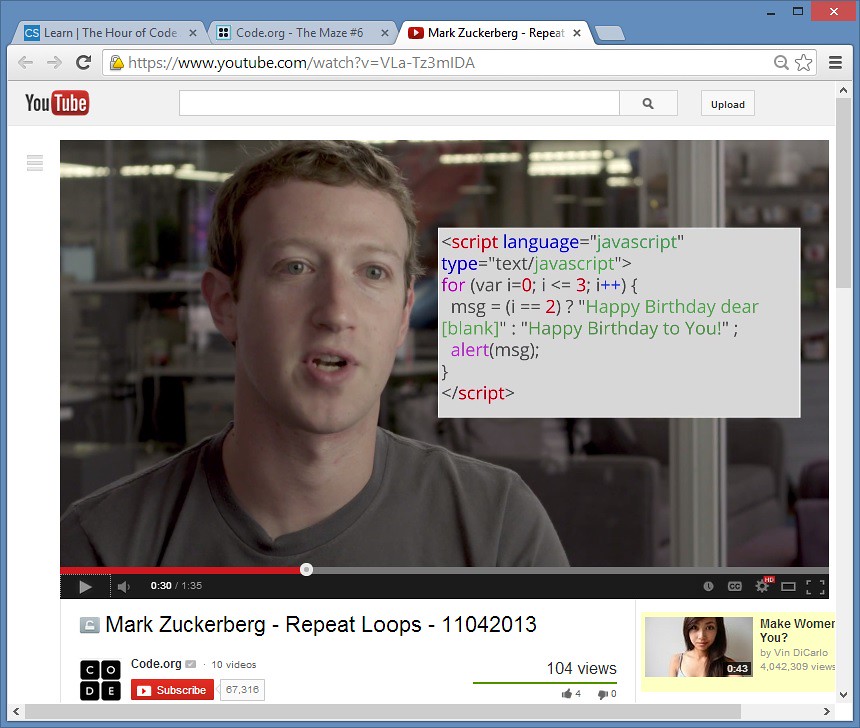
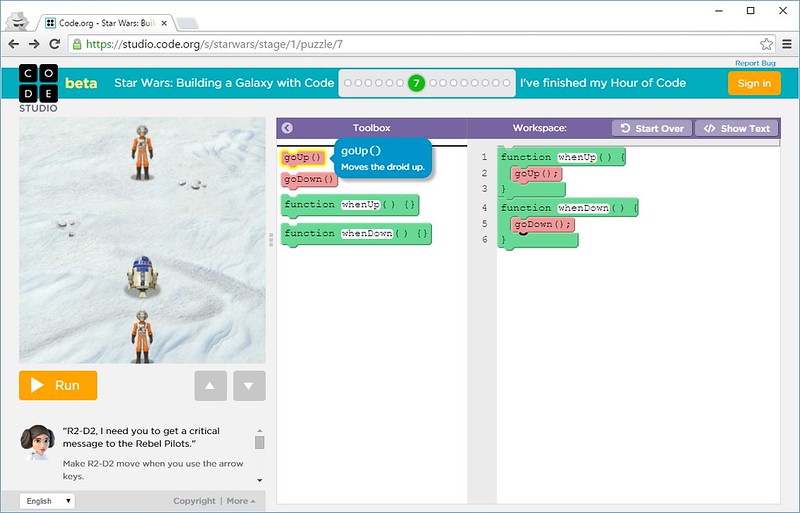
theodp writes: Teaching U.S. K-12 kids their programming fundamentals in past Hours of Code were an IF-fy Bill Gates and a LOOP-y Mark Zuckerberg. Interestingly, the new signature tutorial — Star Wars: Building a Galaxy with Code — created by Lucasfilm and Code.org ("in a locked room with no windows") for this December's Hour of Code, eschews both IF statements and loops. The new learn-to-code tutorial instead elects to show students "events" after they've gone through the usual move-up-down-left-right drills. With the NY Times and National Center for Women & Information Technology recently warning against putting Star Wars in the CS classroom ("Attracting more female high school students to computer science classes might be as easy as tossing out the Star Wars posters," claimed an Aug. 29th NCWIT Facebook post), the theme of the new tutorial seems an odd choice for Code.org, whose stated mission includes "increasing [CS] participation by women." But if Star Wars is, as some suggest, more aimed at boys, perhaps Code.org has something up its sleeve for girls (a la last year's Disney Princesses) with another as yet unannounced signature tutorial that it teased would be "just as HUGE" as the Star Wars one. Any guesses on what that might be? -
Paper Retracted After Anti-Immigrant Scientist Bans Use of His Software (sciencemag.org)
sciencehabit writes: An 11-year-old research paper describing Treefinder, a computer program used by evolutionary biologists, has been retracted after the program's developer banned its use in European countries he deemed too friendly to refugees. In September, German scientist Gangolf Jobb announced on his website that researchers in eight European countries, including Germany and the United Kingdom, were no longer allowed to use Treefinder, which builds phylogenetic trees from sequence data. The move sparked outrage among some scientists, and now, BMC Evolutionary Biology has pulled the 2004 paper describing the software because the license change 'breaches the journal's editorial policy on software availability.' -
Bluetooth 2016 Roadmap Brings Fourfold Range Increase and Mesh Networking (thestack.com)
An anonymous reader writes: The Bluetooth Special Interest Group (SIG) has announced its roadmap for Bluetooth Smart in 2016, promising a fourfold range increase in the low-energy, IoT-oriented version of the protocol, along with dedicated mesh networking, a 100% increase in speed and no extra consumption of energy. The last set of upgrades to the protocol offered direct access to the internet and security enhancements. Since Bluetooth must currently contend with attacks on everything from cars to toilets, the increased range means that developers may not be able to rely on 'fleeting contact' as a security feature quite as much. -
Bluetooth 2016 Roadmap Brings Fourfold Range Increase and Mesh Networking (thestack.com)
An anonymous reader writes: The Bluetooth Special Interest Group (SIG) has announced its roadmap for Bluetooth Smart in 2016, promising a fourfold range increase in the low-energy, IoT-oriented version of the protocol, along with dedicated mesh networking, a 100% increase in speed and no extra consumption of energy. The last set of upgrades to the protocol offered direct access to the internet and security enhancements. Since Bluetooth must currently contend with attacks on everything from cars to toilets, the increased range means that developers may not be able to rely on 'fleeting contact' as a security feature quite as much. -
Bluetooth 2016 Roadmap Brings Fourfold Range Increase and Mesh Networking (thestack.com)
An anonymous reader writes: The Bluetooth Special Interest Group (SIG) has announced its roadmap for Bluetooth Smart in 2016, promising a fourfold range increase in the low-energy, IoT-oriented version of the protocol, along with dedicated mesh networking, a 100% increase in speed and no extra consumption of energy. The last set of upgrades to the protocol offered direct access to the internet and security enhancements. Since Bluetooth must currently contend with attacks on everything from cars to toilets, the increased range means that developers may not be able to rely on 'fleeting contact' as a security feature quite as much. -
Linux Ransomware Has Predictable Key, Automated Decryption Tool Released (csoonline.com)
itwbennett writes: Last week a new piece of ransomware was discovered that targets Linux servers. Yesterday, researchers at Bitdefender discovered a critical flaw in how the ransomware (dubbed Linux.Encoder.1) operates while testing a sample in their lab and released a free tool that will automatically decrypt any files on a victim's system that were targeted. -
New Algorithm Recognizes Both Good and Bad Fake Reviews (thestack.com)
An anonymous reader writes: Researchers from the university of Sao Paolo have developed an algorithm able to identify both good and bad online reviews in the massive daily chatter of millions of peer-community posts, and in lateral mendacities at social network sites such as Google+ and Facebook reposts and 'likes'. Two of the datasets tested in the research were from Amazon, which has a vested interest in restoring the reputation of its community reviews, and has recently taken action on the matter. -
New Book Sold Out Offers a Look At the H-1B Debate
theodp writes: The New York Post has published an excerpt from Sold Out: How High-Tech Billionaires and Bipartisan Beltway Crapweasels Are Screwing America's Best and Brightest Workers, a new book on the H-1B debate from conservative syndicated columnist Michelle Malkin and programmer-turned-attorney John Miano. "Sold Out," notes a Computerworld review, "clearly has a point a view about the program (crapweasels, for instance), but it backs up its assertions and gives H-1B supporters a high threshold to cross. A serious argument in defense of the visa program requires explaining how America gains when a U.S. worker is replaced by a foreign visa holder hired to do the exact same job. If you are going to justify the H-1B program, then you have to defend firms that force their employees (no severance otherwise) to train their replacements. That may be the point here. This book lays bare the replacement process, the broad use of the H-1B visa by the IT offshore outsourcing industry, and the lobbying effort in Washington to minimalize the visa's use in displacing U.S. workers." With anecdotes like "how Microsoft wined and dined the Bush administration to expand the foreign worker supply through administrative fiat to circumvent public disclosure and congressional debate," the book seeks out a broader audience than just those already familiar with the H-1B issue. -
Interviews: Ask Stack Overflow Co-Founder Jeff Atwood a Question
Jeff Atwood is an author, entrepreneur, and software developer. He runs the popular programming blog Coding Horror and is the co-founder of Stack Overflow and the Stack Exchange Network. In early 2012 he decided to leave Stack Exchange so he could spend more time with his family. A year later he announced his new company the Civilized Discourse Construction Kit, Inc. and the Discourse open-source discussion platform which aims to improve conversations on the internet. Jeff has agreed to give some of his time to answer any questions you may have. As usual, ask as many as you'd like, but please, one question per post. -
App Companies Propose New Model For Worker Benefits (cio.com)
itwbennett writes: In late October, four delivery drivers for the app-based Amazon Prime Now service filed a class-action lawsuit alleging the company misclassifies its workers as contractors. In June, the California Labor Commission ruled that Uber drivers are employees, not contractors. Now, worker advocacy groups, companies offering services through apps (including Lyft, Etsy, Care.com, and Instacart), a variety of policy experts, and venture capitalists are proposing a new model for worker benefits that will be "portable" across the number of jobs they do in the new on-demand economy. "Self-employed workers choosing to engage in flexible work may also encounter unforeseen work disruptions or other hardships without the protections and benefits that may be provided through full time employment," the group said in a statement posted on Medium. -
App Companies Propose New Model For Worker Benefits (cio.com)
itwbennett writes: In late October, four delivery drivers for the app-based Amazon Prime Now service filed a class-action lawsuit alleging the company misclassifies its workers as contractors. In June, the California Labor Commission ruled that Uber drivers are employees, not contractors. Now, worker advocacy groups, companies offering services through apps (including Lyft, Etsy, Care.com, and Instacart), a variety of policy experts, and venture capitalists are proposing a new model for worker benefits that will be "portable" across the number of jobs they do in the new on-demand economy. "Self-employed workers choosing to engage in flexible work may also encounter unforeseen work disruptions or other hardships without the protections and benefits that may be provided through full time employment," the group said in a statement posted on Medium. -
Webmail Services Struggling Against DDoS Attacks (fastmail.com)
An anonymous reader writes: A few days ago, privacy-oriented webmail service ProtonMail was hit by a massive DDoS attack, which was accompanied by extortion. It turns out they're not the only ones. FastMail has warned that similar attacks could lead to service disruptions this week. They have refused extortion demands, and have been hit with a couple brief attacks already. This follows attacks over the last week on Runbox, Zoho, and Hushmail. Each service has been working with data centers and network providers to mitigate the attacks as well as possible, but they're still struggling with intermittent service disruptions. -
2016 Presidential Candidate Security Investigation (infosecinstitute.com)
New submitter Fryan writes: InfoSec Institute has assessed the security posture of 16 of the presidential candidates' websites. This is an indicator of the level of security awareness the candidate and the campaign staff has. The recent breaches and security lapses of high profile individuals highlight the absolute need for everyone to take security awareness seriously. The hacking of the Director of the CIA's (John Brennan) personal email account, and the storage of classified emails on a personal email server with Hillary Clinton, show how damaging a lack of basic good security hygiene can be. In this survey (of only the best known presidential candidates, not the scads of others), the authors give both their highest grade (an A) and lowest (a D) for candidates still in the race to two Republicans, Ben Carson and Jim Gilmore, respectively; surprising for a tech-focused campaign, Lawrence Lessig (who has ended his candidacy since the survey began) ranked even lower, with a D-.
Speaking of presidential candidates, the fourth Republican debate, hosted by Fox Business, will kick off about an hour after this post goes live (9:00 PM Eastern, 0200 GMT). Feel free to discuss it alongside the security report. -
Harnessing Conflict in the Workplace (video)
Nigel Dessau has written a book titled Become a 21st Century Executive: Breaking Away from the Pack. One thing he mentions both in his book and in conversation is that you should harness conflict in the workplace rather than try to stop it. And the first name that came to mind was Linus Torvalds, and how kernel developer Sarah Sharp recently quit the kernel development team loudly and publicly because of Linus's 'Brutal' Communications Style. And now the Washington Post has put out an article under the headline, Net of Insecurity: The Kernel of the Argument, which is about Linus's management style and his recent conflicts with almost every Internet security maven within reach of his online writing. Meanwhile, at ZDNet, Steven J. Vaughan-Nichols calls the Post article "re-bundled old FUD about Linux and the internet's security."
Nigel likes Linus (as do most people who've met him in person) and points out that Linus can get away with being somewhat prickly because he's a genius. The same could be said about the late Steve Jobs and a number of other interesting leaders in the computer business. And Nigel's book and this interview also talk about something that may be more important in the long run than this year's small spate of Linux publicity, namely mentoring and how it can help millennials become productive workers in knowledge fields -- which a whole bunch of them need to start doing PDQ because all the baby boomers everybody loves to hate are either retired already or will be retired before long. -
In Ireland, All RC and Drones Over 1kg To Be Registered (suasnews.com)
New submitter charliehotel writes: The Irish Aviation Authority announced that it will have its drone registry up and running by December 21st this year. This registry will be the first of its kind in Europe, and the Irish Aviation Authority will require all RPA / drones that weigh over 1kg to be registered; this includes model aircraft. I hope that the U.S.'s gathering storm of regulation doesn't start quite that small. -
SETI Fails To Detect Signals Coming From KIC 8462852 (examiner.com)
MarkWhittington writes: Rare excitement spread through the scientific community and the media when data from the Kepler Space Telescope indicated something strange going on around a star 1,500 light years away called KIC 8462852. An analysis of the pattern of light coming from the star suggested that a swarm of smaller objects was orbiting the planet. Scientists narrowed down the possible explanations for the data to either a swarm of comets or a group of alien megastructures. According to a story in Space Daily, an examination of KIC 8462852 by SETI, using the Allen Telescope Array, has failed to find any evidence that ET exists around that particular star. -
Interviews: Ask Mathematician Neil Sloane a Question
Considered by many to be one of the most influential mathematicians alive today, Neil Sloane has made major contributions to the fields of sphere packing, combinatorics, and error-correcting codes. He is probably best known for being the creator and curator of the On-Line Encyclopedia of Integer Sequences (OEIS), known simply as “Sloane” by its many users. The repository is over 50 years old and contains over 260,000 sequences.
Neil recently turned 76 but his passion for mathematics remains as strong as ever. Talking about a recent project, he writes: “Back in September I was looking at an old sequence in the OEIS. The sequence starts 1, 12, 123, 1234, 12345, ..., 123456789, 12345678910, 1234567891011, ... The n-th term: just write all the decimal numbers from 1 to n in a row and think of this as a big number. The entry for the sequence had a comment that it is expected that there are infinitely many terms which are primes, but that no prime was known, even though Dana Jaconsen had checked the first 64,000 terms. So I asked various friends and correspondents about this, and people extended the search somewhat. In fact Ernst Mayer has set up a cloud-source project to look for primes in the sequence, and the sequence has now been checked to nearly n = 270,000 without finding a prime. But I am hopeful that a prime will appear before we get to n = 10^6. When a prime is found, as it surely will be, it probably won't be the largest prime known, but it will be close to the record (which is held by the latest Mersenne prime). We may make it into the top ten. It will certainly be the largest known prime which is easy to write down! (Explicitly, I mean. You may know that 2^32582657-1 is prime, but you won't be able to write down the decimal expansion without using a computer).”
Neil has agreed to take some time away from his favorite sequences and answer any questions you may have. As usual, ask as many as you'd like, but please, one question per post. -
No Such Thing As 'Unlimited' Data (wired.com)
An anonymous reader writes: According to an article at Wired, the era of 'unlimited' data services is coming to an end. Carriers don't give them out anymore unless they're hobbled, and they're even increasing the prices of grandfathered plans. Comcast's data caps are spreading, and Time Warner has been testing them for years as well. It's not even just about internet access — Microsoft recently decided to eliminate its unlimited cloud storage plan. The big question now is: were these companies cynical, or just naive? We have no way of evaluating their claims that a small number of users who abused the system caused it to be unprofitable for them. (A recent leaked memo from Comcast suggests it's about extracting more money, rather than network congestion.) But it's certainly true that limited plans make costs and revenue much easier to predict. Another question: were we, as consumers, naive in expecting these plans to last? As the saying goes, if it sounds too good to be true, it probably is. Unlimited data plans clearly won't work too well if everybody uses huge amounts. So did we let ourselves get suckered by clever marketing? T-Mobile plans may also be dropping unlimited data in 2016. -
No Such Thing As 'Unlimited' Data (wired.com)
An anonymous reader writes: According to an article at Wired, the era of 'unlimited' data services is coming to an end. Carriers don't give them out anymore unless they're hobbled, and they're even increasing the prices of grandfathered plans. Comcast's data caps are spreading, and Time Warner has been testing them for years as well. It's not even just about internet access — Microsoft recently decided to eliminate its unlimited cloud storage plan. The big question now is: were these companies cynical, or just naive? We have no way of evaluating their claims that a small number of users who abused the system caused it to be unprofitable for them. (A recent leaked memo from Comcast suggests it's about extracting more money, rather than network congestion.) But it's certainly true that limited plans make costs and revenue much easier to predict. Another question: were we, as consumers, naive in expecting these plans to last? As the saying goes, if it sounds too good to be true, it probably is. Unlimited data plans clearly won't work too well if everybody uses huge amounts. So did we let ourselves get suckered by clever marketing? T-Mobile plans may also be dropping unlimited data in 2016. -
No Such Thing As 'Unlimited' Data (wired.com)
An anonymous reader writes: According to an article at Wired, the era of 'unlimited' data services is coming to an end. Carriers don't give them out anymore unless they're hobbled, and they're even increasing the prices of grandfathered plans. Comcast's data caps are spreading, and Time Warner has been testing them for years as well. It's not even just about internet access — Microsoft recently decided to eliminate its unlimited cloud storage plan. The big question now is: were these companies cynical, or just naive? We have no way of evaluating their claims that a small number of users who abused the system caused it to be unprofitable for them. (A recent leaked memo from Comcast suggests it's about extracting more money, rather than network congestion.) But it's certainly true that limited plans make costs and revenue much easier to predict. Another question: were we, as consumers, naive in expecting these plans to last? As the saying goes, if it sounds too good to be true, it probably is. Unlimited data plans clearly won't work too well if everybody uses huge amounts. So did we let ourselves get suckered by clever marketing? T-Mobile plans may also be dropping unlimited data in 2016. -
No Such Thing As 'Unlimited' Data (wired.com)
An anonymous reader writes: According to an article at Wired, the era of 'unlimited' data services is coming to an end. Carriers don't give them out anymore unless they're hobbled, and they're even increasing the prices of grandfathered plans. Comcast's data caps are spreading, and Time Warner has been testing them for years as well. It's not even just about internet access — Microsoft recently decided to eliminate its unlimited cloud storage plan. The big question now is: were these companies cynical, or just naive? We have no way of evaluating their claims that a small number of users who abused the system caused it to be unprofitable for them. (A recent leaked memo from Comcast suggests it's about extracting more money, rather than network congestion.) But it's certainly true that limited plans make costs and revenue much easier to predict. Another question: were we, as consumers, naive in expecting these plans to last? As the saying goes, if it sounds too good to be true, it probably is. Unlimited data plans clearly won't work too well if everybody uses huge amounts. So did we let ourselves get suckered by clever marketing? T-Mobile plans may also be dropping unlimited data in 2016. -
No Such Thing As 'Unlimited' Data (wired.com)
An anonymous reader writes: According to an article at Wired, the era of 'unlimited' data services is coming to an end. Carriers don't give them out anymore unless they're hobbled, and they're even increasing the prices of grandfathered plans. Comcast's data caps are spreading, and Time Warner has been testing them for years as well. It's not even just about internet access — Microsoft recently decided to eliminate its unlimited cloud storage plan. The big question now is: were these companies cynical, or just naive? We have no way of evaluating their claims that a small number of users who abused the system caused it to be unprofitable for them. (A recent leaked memo from Comcast suggests it's about extracting more money, rather than network congestion.) But it's certainly true that limited plans make costs and revenue much easier to predict. Another question: were we, as consumers, naive in expecting these plans to last? As the saying goes, if it sounds too good to be true, it probably is. Unlimited data plans clearly won't work too well if everybody uses huge amounts. So did we let ourselves get suckered by clever marketing? T-Mobile plans may also be dropping unlimited data in 2016. -
Google's Robotics Group Lacks Leadership (businessinsider.com)
An anonymous reader writes: Google has been snapping up promising robotics companies for the past several years, placing them in a division internally called "Replicant." But the division itself is struggling to come together, not having consistent leadership since Andy Rubin left in 2014. One robotics employee said, "The technology pieces we have are incredible. We just have to commit to a particular direction to go in and focus." While Google has accumulated bleeding-edge hardware and software systems, it hasn't been able to bring them together yet in any meaningful way. "Sources say that after Rubin left, there was no one who knew how to tie all the disparate acquisitions together. Rubin had provided a destination, but the team no longer had a road map or a guide to get there." -
Intel Skylake-U For Laptops Posts Solid Gains In Testing, Especially Graphics (hothardware.com)
MojoKid writes: Intel's 6th Generation Skylake family of Core processors has been available for some time now for desktops. However, the mobile variant of Skylake is perhaps Intel's most potent incarnation of the new architecture that has been power-optimized on 14nm technology with a beefier graphics engine for notebooks. In late Q3, Intel started rolling out Skylake-U versions of the chip in a 15 Watt TDP flavor. This is the power envelope that most "ultrabooks" are built with and it's likely to be Intel's highest volume SKU of the processor. The Lenovo Yoga 900 tested here was configured with an Intel Core i7-6500U dual-core processor that also supports Intel HyperThreading for 4 logical processing threads available. Its base frequency is 2.5GHz, but the chip will Turbo Boost to 3GHz and down clocks way down to 500MHz when idle. The chip also has 4MB of shared L3 cache and 512K of L2 and 128K of data cache, total. In the benchmarks, the new Skylake-U mobile chip is about 5 — 10 faster than Intel's previous generation Broadwell platform in CPU-intensive tasks and 20+ percent faster in graphics and gaming, at the same power envelope, likely with better battery life, depending on the device. -
British Spaceplane Skylon Could Revolutionize Space Travel (ieee.org)
MarkWhittington writes: The problem of lowering the cost of sending people and cargo into low Earth orbit has vexed engineers since the dawn of the space age. Currently, the only way to go into space is on top of multistage rockets which toss off pieces of themselves as they ascend higher into the heavens. The Conversation touted a British project, called Skylon, which many believe will help to address the problem of costly space travel. According to IEEE Spectrum, both BAE Systems and the British government have infused Skylon with $120 million in investment. -
Hackers Who Hit CIA Director Break Into Law Enforcement Tools (wired.com)
An anonymous reader writes: The same group of hackers who hacked into the personal email account of CIA director John Brennan have now exploited a vulnerability to gain access to a private law enforcement portal. They demonstrated access to a system called JABS — the Joint Automated Booking System — which is a database of arrest records. "It was through the vulnerable law enforcement portal that the hackers say they also obtained a list of about 3,000 names, titles, email addresses and phone numbers for government employees that they posted to Pastebin on Thursday. The posting, which they indicated was just "Part 1" of a presumably multi-part leak, consisted of a snippet of an alphabetical list of government employees working for the FBI and other federal agencies as well as various local police and sheriff departments around the country. It included job titles, email addresses and phone numbers." -
$1 Bid Wins Government Open Source Software Purchasing Experiment (gsa.gov)
An anonymous reader writes: A couple weeks ago we discussed a project from a software team within the U.S. General Services Administration. Its goal was to set up a portal to let developers bid on the creation of open source code needed by the government. From the beginning, they said it was an experiment, and now the results are in from their first project. The project was quickly bid all the way down to $1, and on Wednesday, the winner delivered a functional solution that met their criteria. They say, "When we received the $1 bid, we immediately tried to figure out whether it was intentional, whether it was from a properly registered company, and whether we could award $1. We contacted the bidder and we confirmed that the bid was valid, that the registration on SAM.gov was current, and that the bid would be the winning bid. It was a plot twist that no one here at 18F expected. This unexpected development will no doubt force us to rethink some of our assumptions about the reverse-auction model." Despite their surprise, the team feels this is proof that the system can succeed. They're now working to refine the process. -
Before Barbie's Brainy Makeover, Mattel Execs Met With White House, Google
theodp writes: Mattel came under fire last November over its portrayal of Computer Engineer Barbie as incompetent. But the toymaker is now drawing kudos for its new Imagine the Possibilities Barbie ad campaign (video), which shows little girls pretending to be professionals in real-life settings, including a college professor lecturing students about the brain. Ad Age, however, is cynical of the empowering spin on Barbie, which it says "comes across as a manipulative way to silence criticism." Interestingly, some of that criticism may have come from the White House.
WH Visitor Records show that Barbie's brainy makeover came after Mattel execs — Evelyn Mazzocco, Julia Pistor, Heather Lazarus — were summoned to the White House last April to meet with the White House Council on Women and Girls. A little Googling suggests other attendees at the sit-down included representatives of the nation's leading toy makers (Disney Consumer, Nickelodeon, Hasbro, American Girl), media giants (Disney Channels, Viacom, TIME, Scholastic, Univision, Participant Media, Cartoon Network, Netflix), retailers (Walmart, Target), educators, scientists, the U.S. Dept. of Education (including the Deputy Director of Michelle Obama's Reach Higher Initiative), philanthropists (Rockefeller, Harnisch Foundations) — and Google. Representing Google was CS Education in Media Program Manager Julie Ann Crommett, who has worked with Disney to shape programming to inspire girls to pursue CS in conjunction with the search giant's $50 million Made With Code initiative.
The April White House meeting appears to be a reschedule of a planned March meeting that was to have included other Mattel execs, including Stephanie Cota, Venetia Davie, and Lori Pantel, to whom the task of apologizing for Computer Engineer Barbie fell last November. For the first time in over a decade, Barbie was no longer the most popular girls' toy last holiday season, having lost her crown to Disney Princesses Elsa and Anna, who coincidentally teamed up with Google-backed Code.org last December to "teach President Obama to code" at a widely-publicized White House event. -
Before Barbie's Brainy Makeover, Mattel Execs Met With White House, Google
theodp writes: Mattel came under fire last November over its portrayal of Computer Engineer Barbie as incompetent. But the toymaker is now drawing kudos for its new Imagine the Possibilities Barbie ad campaign (video), which shows little girls pretending to be professionals in real-life settings, including a college professor lecturing students about the brain. Ad Age, however, is cynical of the empowering spin on Barbie, which it says "comes across as a manipulative way to silence criticism." Interestingly, some of that criticism may have come from the White House.
WH Visitor Records show that Barbie's brainy makeover came after Mattel execs — Evelyn Mazzocco, Julia Pistor, Heather Lazarus — were summoned to the White House last April to meet with the White House Council on Women and Girls. A little Googling suggests other attendees at the sit-down included representatives of the nation's leading toy makers (Disney Consumer, Nickelodeon, Hasbro, American Girl), media giants (Disney Channels, Viacom, TIME, Scholastic, Univision, Participant Media, Cartoon Network, Netflix), retailers (Walmart, Target), educators, scientists, the U.S. Dept. of Education (including the Deputy Director of Michelle Obama's Reach Higher Initiative), philanthropists (Rockefeller, Harnisch Foundations) — and Google. Representing Google was CS Education in Media Program Manager Julie Ann Crommett, who has worked with Disney to shape programming to inspire girls to pursue CS in conjunction with the search giant's $50 million Made With Code initiative.
The April White House meeting appears to be a reschedule of a planned March meeting that was to have included other Mattel execs, including Stephanie Cota, Venetia Davie, and Lori Pantel, to whom the task of apologizing for Computer Engineer Barbie fell last November. For the first time in over a decade, Barbie was no longer the most popular girls' toy last holiday season, having lost her crown to Disney Princesses Elsa and Anna, who coincidentally teamed up with Google-backed Code.org last December to "teach President Obama to code" at a widely-publicized White House event. -
Before Barbie's Brainy Makeover, Mattel Execs Met With White House, Google
theodp writes: Mattel came under fire last November over its portrayal of Computer Engineer Barbie as incompetent. But the toymaker is now drawing kudos for its new Imagine the Possibilities Barbie ad campaign (video), which shows little girls pretending to be professionals in real-life settings, including a college professor lecturing students about the brain. Ad Age, however, is cynical of the empowering spin on Barbie, which it says "comes across as a manipulative way to silence criticism." Interestingly, some of that criticism may have come from the White House.
WH Visitor Records show that Barbie's brainy makeover came after Mattel execs — Evelyn Mazzocco, Julia Pistor, Heather Lazarus — were summoned to the White House last April to meet with the White House Council on Women and Girls. A little Googling suggests other attendees at the sit-down included representatives of the nation's leading toy makers (Disney Consumer, Nickelodeon, Hasbro, American Girl), media giants (Disney Channels, Viacom, TIME, Scholastic, Univision, Participant Media, Cartoon Network, Netflix), retailers (Walmart, Target), educators, scientists, the U.S. Dept. of Education (including the Deputy Director of Michelle Obama's Reach Higher Initiative), philanthropists (Rockefeller, Harnisch Foundations) — and Google. Representing Google was CS Education in Media Program Manager Julie Ann Crommett, who has worked with Disney to shape programming to inspire girls to pursue CS in conjunction with the search giant's $50 million Made With Code initiative.
The April White House meeting appears to be a reschedule of a planned March meeting that was to have included other Mattel execs, including Stephanie Cota, Venetia Davie, and Lori Pantel, to whom the task of apologizing for Computer Engineer Barbie fell last November. For the first time in over a decade, Barbie was no longer the most popular girls' toy last holiday season, having lost her crown to Disney Princesses Elsa and Anna, who coincidentally teamed up with Google-backed Code.org last December to "teach President Obama to code" at a widely-publicized White House event. -
Hands-On With the Nintendo PlayStation (engadget.com)
An anonymous reader writes: Several months ago, we got a look at a weird bit of technology: a Nintendo PlayStation prototype made in the late '80s during an unusual partnership between Sony and Nintendo. Despite cries of "hoax" and "fake," the console turns out to be real. Engadget got to try it out, X-ray it, and even open the device up to try repairing the CD drive. They brought in Daniel Cheung, a retro console technician from Restart Workshop, and he said, "I got to see the real deal so I can't discredit it. And there's even an OS. You can't question it. It can't be fake. Going back to the chips we saw earlier on the logic board: NEC used to make gaming consoles, and Sony also participated here. And with Nintendo as part of this team, you just can't discredit this." -
Steam Has Brought 1,600 Games To Linux In the Past Three Years (phoronix.com)
An anonymous reader writes: Today marks three years since Valve's Steam client went into beta on Linux. In that time over 1,600 games have become natively available for Linux. Going beyond having many new Linux games, Phoronix recaps, "we've seen Valve make significant investments into the open-source graphics stack and other areas of Linux (in part through their sponsorship of Collabora and LunarG). Valve developers are significantly pushing SDL2. We've seen more mainstream interest in Linux gaming, and Valve has been heavily involved in the creation of the Vulkan graphics API. They have given away their entire game collection to the Mesa/Ubuntu/Debian upstream developers, and much more." The three-year anniversary is coincidentally just days before the release of Steam Machines. -
Senators Attempting To Remove Robocall Loophole
New submitter bearded_yak writes: Last week, it was reported here that a loophole for debt collection robocalls had found its way into the budget bill. In the end, the loophole survived. Now, several senators want to remove it with Senator Ed Markey's "Help Americans Never Get Unwanted Phone calls" (HANGUP) Act. Meanwhile, according to an article at Consumerist, "the Federal Communications Commission has nine months to craft rules dictating the conditions under which the government would be allowed to make these robocalls", so perhaps this loophole will meet its end before that time. -
Paris Data Center Not Too Noisy, After All (datacenterdynamics.com)
judgecorp writes: A Paris court has ruled that a suburban data center can continue to operate, reversing an earlier decision to close it down after protests from residents. The data center's owner, Interxion, cited noise impact studies form 2014 which showed the site was operating within authorized limits, and also within the levels it predicted in its planning application -
Microsoft Follows Mozilla In Considering Early Ban On SHA-1 Certificates (csoonline.com)
itwbennett writes: Following the first successful collision attack on the SHA-1 hashing algorithm last month, Mozilla said that it was considering a cut-off of July 1, 2016 to start rejecting all SHA-1 SSL certificates, ahead of an earlier scheduled date of Jan. 1, 2017. And now Microsoft is considering blocking the hashing algorithm on Windows by June next year. -
UK and US Suspect That ISIS Bomb Took Down Flight 9268 (cnn.com)
An anonymous reader writes with a report from CNN that U.S. and UK intelligence agencies believe it is more likely than not that the destruction on October 31st of a Russian A321 jetliner in Sinai "was most likely caused by a bomb on the plane planted by ISIS or an affiliate of the group." Kogalymavia Flight 9268 fell apart in flight, killing all aboard. From CNN's article: The British government announced Wednesday that it had "become concerned that the plane may well have been brought down by an explosive device." A formal conclusion has not been reached by the intelligence communities of either country. An UK aviation team is travelling to inspect the Sharm airport to look at whether there were proper security measures at the airport and the various scenarios by which an explosive device could have made it to the Russian airliner "including a person or in cargo," according to the British transport minister. Both Russian and Egyptian officials discount the claim, but detecting bombs is hard. -
Google-Supported CodeGirl Documentary Makes "Exclusive YouTube Premiere"
theodp writes: As part of our Made with Code and media perception initiatives," wrote YouTube CEO Susan Wojcicki over at the Official Google Blog, "I'm excited that we're supporting award-winning documentary filmmaker Lesley Chilcott — of An Inconvenient Truth and Waiting for Superman [and Code.org] fame — on her next film, CodeGirl. Until November 5 Lesley's film will be available for free on YouTube, before its theatrical debut in the next few weeks." Microsoft is pretty jazzed about the movie too, as is Al Gore. Decidedly less excited about CodeGirl is film critic Inkoo Kang, who writes, "CodeGirl, a chronicle of this year's Technovation contest, is just as well-intentioned as its subject. It coasts for as long as it can on the feel-good fuel of watching smart, earnest girls talk about creating an app, but with virtually no tension, context, narrative or characterization driving the story, the documentary grows to feel like a parent describing their daughter's involvement in an international competition. The girls' achievements are impressive, but you definitely don't want to hear about them for nearly two hours. -
Google-Supported CodeGirl Documentary Makes "Exclusive YouTube Premiere"
theodp writes: As part of our Made with Code and media perception initiatives," wrote YouTube CEO Susan Wojcicki over at the Official Google Blog, "I'm excited that we're supporting award-winning documentary filmmaker Lesley Chilcott — of An Inconvenient Truth and Waiting for Superman [and Code.org] fame — on her next film, CodeGirl. Until November 5 Lesley's film will be available for free on YouTube, before its theatrical debut in the next few weeks." Microsoft is pretty jazzed about the movie too, as is Al Gore. Decidedly less excited about CodeGirl is film critic Inkoo Kang, who writes, "CodeGirl, a chronicle of this year's Technovation contest, is just as well-intentioned as its subject. It coasts for as long as it can on the feel-good fuel of watching smart, earnest girls talk about creating an app, but with virtually no tension, context, narrative or characterization driving the story, the documentary grows to feel like a parent describing their daughter's involvement in an international competition. The girls' achievements are impressive, but you definitely don't want to hear about them for nearly two hours. -
Google-Supported CodeGirl Documentary Makes "Exclusive YouTube Premiere"
theodp writes: As part of our Made with Code and media perception initiatives," wrote YouTube CEO Susan Wojcicki over at the Official Google Blog, "I'm excited that we're supporting award-winning documentary filmmaker Lesley Chilcott — of An Inconvenient Truth and Waiting for Superman [and Code.org] fame — on her next film, CodeGirl. Until November 5 Lesley's film will be available for free on YouTube, before its theatrical debut in the next few weeks." Microsoft is pretty jazzed about the movie too, as is Al Gore. Decidedly less excited about CodeGirl is film critic Inkoo Kang, who writes, "CodeGirl, a chronicle of this year's Technovation contest, is just as well-intentioned as its subject. It coasts for as long as it can on the feel-good fuel of watching smart, earnest girls talk about creating an app, but with virtually no tension, context, narrative or characterization driving the story, the documentary grows to feel like a parent describing their daughter's involvement in an international competition. The girls' achievements are impressive, but you definitely don't want to hear about them for nearly two hours. -
Google-Supported CodeGirl Documentary Makes "Exclusive YouTube Premiere"
theodp writes: As part of our Made with Code and media perception initiatives," wrote YouTube CEO Susan Wojcicki over at the Official Google Blog, "I'm excited that we're supporting award-winning documentary filmmaker Lesley Chilcott — of An Inconvenient Truth and Waiting for Superman [and Code.org] fame — on her next film, CodeGirl. Until November 5 Lesley's film will be available for free on YouTube, before its theatrical debut in the next few weeks." Microsoft is pretty jazzed about the movie too, as is Al Gore. Decidedly less excited about CodeGirl is film critic Inkoo Kang, who writes, "CodeGirl, a chronicle of this year's Technovation contest, is just as well-intentioned as its subject. It coasts for as long as it can on the feel-good fuel of watching smart, earnest girls talk about creating an app, but with virtually no tension, context, narrative or characterization driving the story, the documentary grows to feel like a parent describing their daughter's involvement in an international competition. The girls' achievements are impressive, but you definitely don't want to hear about them for nearly two hours. -
Controversial New UK Internet Powers Bill Makes No Mention of VPNs (thestack.com)
An anonymous reader writes: The Draft Investigatory Powers Bill presented by the UK Home Secretary Theresa May to Parliament today has caused controversy because it proposes new legislation to force UK ISPs to retain an abbreviated version of a user's internet history for a year, and would also oblige vendors such as Apple not to provide consumer-level encryption that the vendor cannot access itself in accordance with a court order. But perhaps the most surprising aspect of DIPA is that Virtual Private Networks are mentioned nowhere in its 299 pages, even though VPNs are a subject of great interest to Europe, Russia, Iran, China and the United States. -
Controversial New UK Internet Powers Bill Makes No Mention of VPNs (thestack.com)
An anonymous reader writes: The Draft Investigatory Powers Bill presented by the UK Home Secretary Theresa May to Parliament today has caused controversy because it proposes new legislation to force UK ISPs to retain an abbreviated version of a user's internet history for a year, and would also oblige vendors such as Apple not to provide consumer-level encryption that the vendor cannot access itself in accordance with a court order. But perhaps the most surprising aspect of DIPA is that Virtual Private Networks are mentioned nowhere in its 299 pages, even though VPNs are a subject of great interest to Europe, Russia, Iran, China and the United States. -
Controversial New UK Internet Powers Bill Makes No Mention of VPNs (thestack.com)
An anonymous reader writes: The Draft Investigatory Powers Bill presented by the UK Home Secretary Theresa May to Parliament today has caused controversy because it proposes new legislation to force UK ISPs to retain an abbreviated version of a user's internet history for a year, and would also oblige vendors such as Apple not to provide consumer-level encryption that the vendor cannot access itself in accordance with a court order. But perhaps the most surprising aspect of DIPA is that Virtual Private Networks are mentioned nowhere in its 299 pages, even though VPNs are a subject of great interest to Europe, Russia, Iran, China and the United States. -
Controversial New UK Internet Powers Bill Makes No Mention of VPNs (thestack.com)
An anonymous reader writes: The Draft Investigatory Powers Bill presented by the UK Home Secretary Theresa May to Parliament today has caused controversy because it proposes new legislation to force UK ISPs to retain an abbreviated version of a user's internet history for a year, and would also oblige vendors such as Apple not to provide consumer-level encryption that the vendor cannot access itself in accordance with a court order. But perhaps the most surprising aspect of DIPA is that Virtual Private Networks are mentioned nowhere in its 299 pages, even though VPNs are a subject of great interest to Europe, Russia, Iran, China and the United States. -
Controversial New UK Internet Powers Bill Makes No Mention of VPNs (thestack.com)
An anonymous reader writes: The Draft Investigatory Powers Bill presented by the UK Home Secretary Theresa May to Parliament today has caused controversy because it proposes new legislation to force UK ISPs to retain an abbreviated version of a user's internet history for a year, and would also oblige vendors such as Apple not to provide consumer-level encryption that the vendor cannot access itself in accordance with a court order. But perhaps the most surprising aspect of DIPA is that Virtual Private Networks are mentioned nowhere in its 299 pages, even though VPNs are a subject of great interest to Europe, Russia, Iran, China and the United States. -
Controversial New UK Internet Powers Bill Makes No Mention of VPNs (thestack.com)
An anonymous reader writes: The Draft Investigatory Powers Bill presented by the UK Home Secretary Theresa May to Parliament today has caused controversy because it proposes new legislation to force UK ISPs to retain an abbreviated version of a user's internet history for a year, and would also oblige vendors such as Apple not to provide consumer-level encryption that the vendor cannot access itself in accordance with a court order. But perhaps the most surprising aspect of DIPA is that Virtual Private Networks are mentioned nowhere in its 299 pages, even though VPNs are a subject of great interest to Europe, Russia, Iran, China and the United States. -
FireEye: Many Companies Still Running XcodeGhost-Infected Apple Apps (csoonline.com)
itwbennett writes: In September, more than 4,000 applications were found to have been modified with a counterfeit version of Xcode, dubbed XcodeGhost. On Tuesday, FireEye said in a blog post that it has detected 210 enterprises that are still using infected apps, showing that the XcodeGhost malware 'is a persistent security risk.' In addition, whomever created XcodeGhost has also developed a new version that can target iOS 9, called XcodeGhost S, FireEye wrote. -
Can the Cloud Be More Secure Than Your Own Servers? (Video)
Sarah Lahav, CEO of Sysaid, believes "the cloud" can be more secure than keeping your software and data behind your firewall and administering it yourself, especially for small and medium-sized firms. Why? Because Amazon, Rackspace, and other major cloud and SaaS providers probably have lots more security experts and other IT people at their command than you do.
We've talked to Sarah before, and probably will again. She has strong opinions based on her experience in IT, and is happy to share those opinions. So take it away, Sarah... -
Intel Offers More Insight On Its 3D Memory (itworld.com)
itwbennett writes: When Intel and Micron Technology first announced the 3D XPoint memory in July, they promised about 1,000 times the performance of NAND flash, 1,000 times the endurance of NAND flash, and about 10 times the density of DRAM. At OpenWorld last week, Intel CEO Brian Krzanich disclosed a little more information on the new memory, which Intel will sell under the Optane brand, and did a demo on a pair of matching servers running two Oracle benchmarks. One server had Intel's P3700 NAND PCI Express SSD, which is no slouch of a drive. It can perform up to 250,000 IOPS per second. The other was a prototype Optane SSD. The Optane SSD outperformed the P3700 by 4.4 times in IOPS with 6.4 times less latency. -
Volkswagen Emissions Issues Spread To Gasoline Cars (bloomberg.com)
schwit1 writes: Just a day after news broke that Volkswagen's emissions scandal had expanded to its Porsche unit and Audi SUVs, the company has disclosed yet another problem, this time affecting carbon dioxide levels emitted by their cars. "Volkswagen said an internal probe showed 800,000 cars had "unexplained inconsistencies" concerning their carbon-dioxide output. Previously, the automaker estimated it would need to recall 11 million vehicles worldwide — more than Volkswagen sold last year." This batch of cars includes a small number of gasoline engines. Until now, only diesel engines were part of the problem.