Slashdot Mirror
Domain: slashdot.org
Stories and comments across the archive that link to slashdot.org.
Stories · 37,380
-
Book Review: Threat Modeling: Designing For Security
benrothke writes "When it comes to measuring and communicating threats, perhaps the most ineffective example in recent memory was the Homeland Security Advisory System; which was a color-coded terrorism threat advisory scale. The system was rushed into use and its output of colors was not clear or intuitive. What exactly was the difference between levels such as high, guarded and elevated? From a threat perspective, which color was more severe — yellow or orange? Former DHS chairman Janet Napolitano even admitted that the color-coded system presented 'little practical information' to the public. While the DHS has never really provided meaningful threat levels, in Threat Modeling: Designing for Security, author Adam Shostack has done a remarkable job in detailing an approach that is both achievable and functional. More importantly, he details a system where organizations can obtain meaningful and actionable information, rather than vague color charts." Read below for the rest of Ben's review. Threat Modeling: Designing for Security author Adam Shostack pages 624 publisher Wiley rating 10/10 reviewer Ben Rothke ISBN 978-1118809990 summary Invaluable guide to create a formal threat modeling program Rather than letting clueless Washington bureaucrats define threats, the book details a formal system in which you can understand and particularize the unique threats your organizations faces.
In the introduction, Shostack sums up his approach in four questions:
1. What are you building?
2. What can go wrong with it once it's built?
3. What should you do about those things that can go wrong?
4. Did you do a decent job of analysis?
The remaining 600 densely packed pages provide the formal framework needed to get meaningful answers to those questions. The book sets a structure in which to model threats, be it in software, applications, systems, software or services, such as cloud computing.
While the term threat modeling may seem overly complex, the book notes that anyone can learn to threat model. Threat modeling is simply using models to find security problems. The book notes that using a model means abstracting away a lot of the details to provide a look at the bigger picture, rather than the specific item, or piece of software code.
An important point the book makes is that there is more than one way to model threats. People often place too much emphasis on the specifics of how to model, rather than focusing on what provides them the most benefit. Ultimately, the best model for your organization is the one that helps you determine what the main threats are. Finally, the point is not just to find the threats; the key is to address them and fix them.
The beauty of the book is that it focuses on gaining empirical data around threats for your organization. Rather than simply taking an approach based on Gartner, USA Today or industry best practices.
While the author states a few times that threat modeling is not necessarily a complex endeavor, it nonetheless does take time. He writes that threat modeling requires involvement from many players from different departments in an organization to provide meaningful input. Without broad input, the threat model will be lacking, and the output will be incomplete.
For those organizations that are willing to put the time and effort into threat modeling, the benefits will be remarkable. At the outset, they will have confidence that they understand the threats their organization is facing, likely spend less on hardware and software, and will be better protected.
Chapter 18 quotes programmer Henry Spencer who observed that "those who do not understand Unix are condemned to reinvent it, poorly". Shostack writes that the same applies to threat modeling. The point he is making is that there are ways to fail at threat modeling. The first is simply not trying. The chapter then goes on into other approaches which can get in the way of an effective threat modeling program.
Why should you threat model for your IT and other technology environments? It should be self-evident from an architecture perspective. When an architect is designing an edifice, they first must understand their environment and requirements. A residence for a couple in Manhattan will be entirely different from the design for a residence for a family in Wyoming. But far too many IT architects take a monolithic approach to threats and that's precisely the point the book is attempting to obviate.
As noted, threat modeling is not overly complex. But even if it was indeed complex, it is far too important not to be done. The message of the book is that organizations need to stop chasing vague threats and industry notions of what threats are, and customize things so they deal with their threats.
For those that still think the topic is complex, the book references Elevation of Privilege (EoP), an easy way to get started threat modeling. EoP is a card game that developers, architects or security teams can play to easily understand the rudiments of threat modeling.
Risk modeling is so important that it must be seen as an essential part of a formal and mature information security program. Having firewalls, IDS, DLP and myriad other infosec appliances can be deceptive in thinking they provide protection. But if they are deployed in an organization that has not defined the threats these devices are expected to address, they only serve the purpose of giving an aura of infosec protection, and not real protection itself.
Amazon has over 800 Disney World guide books. Anyone who is going to invest their time and money to spend a few days at Disney World knows they have to do their research in order to get the most out of their visit.
There are only a handful of books on this topic and Threat Modeling: Designing for Security is perhaps the finest of them. No tourist would be so naïve to go to Disney World uninformed. And conversely, no one should go into the IT world without adequate threat information.
Threat modeling provides compelling benefits in the ability to make better information security decisions, better focus on often limited resources, all while designing a model to protect against current and future threats.
For those serious about the topic, Threat Modeling: Designing for Security will be one of the most rewarding information security books they could hope for.
Reviewed by Ben Rothke.
You can purchase Threat Modeling: Designing for Security from amazon.com. Slashdot welcomes readers' book reviews (sci-fi included) -- to see your own review here, read the book review guidelines, then visit the submission page. -
"The Fat Man" George Sanger Answers Your Questions About Music and Games
A while ago you had a chance to ask composer George Sanger about making music and sound effects for games, television, and film. Below you'll find "The Fat Man's" answers to those questions. Getting Started
by CanHasDIY
How did you get into the video game music business, and what advice would you have for aspiring artists looking to follow in your footsteps?
FAT: A good question--but do bear in mind: Anybody you ask that of has only gotten into the business approximately once. How's the old saying go? "Ask a man who has caught one fish to teach you to fish, and you will soon realize you would have been better off if he'd given you that fish." Hmmm. It goes on to say, "Do this enough times, or apply the one example to enough different situations, and you might see some patterns, understand something about life, shout 'Ah Ha!' jump up in delight, and fall backwards into a pond full of fish."
The thing I got into in 1983 is not the thing you think of as "the video games business." If you imagine an office building for a company that makes kids' toys along the lines of Barbie or Hot Wheels, and then picture further that the corporate committee decided to set up a separate building for a new line of toys that seemed to be selling well, you'll get a sense of the level of glamour that surrounded the Mattel Intellivision offices. I only went there once. Oh, wait, maybe I only drove past.
In 1983, there were no video game magazines that I know of. No trade organizations, no conferences. People who made games were called "programmers," and they worked by themselves and to be social read Dr. Dobbs Journal, a technical publication, because that was the only place they could find relevant communications from other people. The video game culture was mainly made up of kids and singles who hung out in arcades. This was occasionally portrayed in movies or novelty songs. That's about it, I think. What else? There was no Internet, telephones had cords, answering machines were still a bit of a novelty, bla bla bla, that kind of thing.
My '80's LA eigth-notes power pop new wave band had just broken up, and I was ready for something new, but my music degree and dabblings in other arts and sciences hadn't really prepared me for anything. Besides that, I had decided that games were more exciting, dynamic, and alive than Rock N Roll was. I thought there was more unexplored frontier, more potential. And I liked that they were, like early rock, completely undiscovered or misunderstood by adults, other than the few "cool ones" who ran arcades or repaired machines.
My brother had a college roommate, Dave Warhol. When I found out that he worked for Intellivision, I volunteered to empty trash cans for him, or whatever he wanted, for free. He said, "Weren't you a music major? I need a 10-second tune for an ice-skating penguins game." I was very insecure in my abilities as a composer. I got out my tools--a guitar, 4-track recorder, pencil, manuscript paper, and noodled two tracks of guitar until I had a pretty good oompah tune. Then I transcribed it onto the staff paper and turned it in. Dave, an excellent musician, very much thought that it sounded like ice skating penguins. He wrote code to play the notes and tones. The execs insisted I be paid. I billed for around $1,000, and got it. Billing was done by typewriter and US Mail. I kept a carbon copy, literally, of the bill, bla bla bla that kind of thing. Intellivision went out of business a few weeks later.
So, what can we learn from this and Get a Job?
I had a deep love of arcade games, and Dave W. picked up on that as a way to solve a problem he had, and he was in a position to get me hired. Also, the timing was right. Game programmers had generally worked alone--Dave was on one of the early game development _teams_ at Intellivision, so it was only _slightly_ unheard-of that he should go to somebody else to help out on music; something that a programmer traditionally would have done himself.
I think we can see indications of some things I believe in anyway, from having observed many one-fish wonders:
--Keep track of the things that you love; the ideas in the night that make you sit up in bed and laugh. Make them known. People will pick up on that, and you will be a happier person for it.
--Be aware of the people around you and what they need. I don't think anybody gets a job except for when they are solving a problem for somebody. Be especially ready to notice when somebody needs something that you love to do.
--Love many things. Of course, you can't decide what you love and what you don't love. Or can you?
--Be in the right place at the right time. I don't know what this means, but pay attention nonetheless. It's like pondering the phrase "Be yourself." How can you possibly be other than that? It's the one thing you can't help but be. How can you go about being in the right place at the right time, or NOT being there? Think about it enough, and BOOM! Enlightened.
PS: AH! I just found out that Dave Warhol will be receiving the Lifetime Achievement award for game audio from the Game Audio Network Guild. Congratulations, Dave!
Re:audio production software
by sycodon
What would you consider to be the dream workstation for a composer? Any specific sound cards or other equipment a "must have"?
FAT: Ewwww, I don't like to talk about equipment.
I can start with some crabby dogma, type at you for a while, and see if that gets me to a good, happy place.
Crabby Dogma: There are absolutely no "must haves."
You can compose perfectly well using a piano and a pencil. Get any MIDI sequencer--they all come with enough tones to get you started now--and an Internet connection, and you can compose professionally. Do it in your head. Mozart could get a gig.
Equipment is a troublesome necessity, and sound cards are an excellent illustration of that.
As a musician, I want the pretty noises to get into and out of the computer. Sometimes they do, sometimes they don't. Sometimes there is a hangup or a crash or a fuzzy noise or a time lag. What causes these? Might be the sound card. Should I become an expert and learn all about sound cards?
Answer: No--you are a musician. That is what you love. People will see this love, this focus. You will solve other peoples' problems with this love. See question 1 above.
Other answer: Yes. Oh, crap, you are now a Legendary Game Audio Guru. You will realize that no one person is smart enough to know all about sound cards. You will co-found a think-tank to solve the problems they cause. (projectbarbq.com, since 1996) It will be the place where most of the significant advances in audio on computers happen. You will notice issues in General MIDI that make it fail to work, and will establish a testing lab (Fat Labs) and a working group that will turn General MIDI (that's the MIDI files that, when you play them, the correct instruments play) into a viable standard. And you may ask yourself, "Where does this highway lead to?"
OK, OK, sound cards. I currently use a Presonus Firestudio Mobile because I have learned Presonus' quirks over the years. It is the devil I know, and I prefer it to the devil I don't yet know.
OK, OK, "Must haves" at the low end:
To work professionally as a composer, you "Must Have" at least this:
--Some kind of computer/software, and Internet. An iPad and $100 of software will do. See "Favorite Advancement" below.
--A place where you like to composeor at least a mental state in which you like to compose.
And the more other stuff you have, the harder it is to compose.
"Must haves" at the high end do not apply to composition, they apply to production:
OK, OK, "Must Haves" at the high end:
The dream workstation, like any dream, arises in the mind of the person who needs to dream it. Yours will be different. Listen. Do you hear? It calls you.
The toys that awaken my love, that make me chuckle at night; those that pop into my attention right now, today:
--Nuendo 6 with expansion pack, on a big fat PC. It does everything I need, which is good. And there are features and features and features and features that one could dig into for a lifetime and never master. Which is, actually, bad, because you can again become an expert at something you don't love. BUT, when I imagine something that I need, I can usually find in the many features of Nuendo, buried somewhere, something that will do the job or something close enough, or often something even better than I had imagined.
--A bunch of mics; with one really nice mic. A Neumann 87. I accidentally bought a silver-plated Anniversary Edition one that comes with a white glove, a presentation box, and a certificate. I never need feel embarassed by my mic again. Inspiration flows easily when facing the glowing talent substitute that is my Neumann 87. Do I like having a talent substitute? Some days everybody does--they're fun! Do I need it? Dude.
--UAD card, especially Dreamverb, Neve EQ, Fairchild limiter. These feel like "secret weapons" when I use them. Very little tweaking is required to get beautiful sounds--and they tend to be sounds that other people find beautiful, too.
--A pretty good trumpet and a Cascade "Fat Head" ribbon mic for recording it.
--Lots and lots of guitars. Old. New. Broken. Homemade. Classic. Unique.
--Lots and lots of instruments that I can't really play well YET. Saxes, trombones, cello, accordion. Play 'em one note at a time. Struggle. Explore. Love.
--Analog synths with patch cables. So silly. So fun. So scientific-seeming. They are the embodiment of joy--like a riding lawnmower.
--A nice workroom full of junk that can make sound effects, cables, and a soldering iron.
HAVE HAD, WOULD LIKE AGAIN:
If I'm missing anything myself, I'd say that I'd like a big room on a quiet street that's near a good deli.
And I miss having a lot of friends nearby who can come over and play. That'll take care of itself given time.
HAVE NEVER HAD:
Funny. There's nothing in this category. I don't know why.
Oooh! I'm in my happy place! Thank you, sycodon.
Favorite advancement
by Traksius Egas
Mr. Sanger, If you could point out just one favorite advancement in gaming audio, be it hardware, software, or something else in your experience what would that be?
FAT: Hmmm. Hardware, software, standards and systems again. I’d advise against reading my answers, they will be incomplete, and will bring you no lasting satisfaction in life. On the other hand, one could say the same of reading the Musician’s Friend catalog or going to a good dance. So, what the hell, take a break, and let’s dive into the Hell of Ten Thousand Things.
#1: MIDI and affordable personal computers, as an aid to composing: In school (I graduated in 1979), I was never that good at any one instrument, nor at hearing and writing conventionally notated music. I wasn't sure that I could ever be an effective composer, and this caused me a lot of insecurity and stress. When I finally got my hands on a MIDI composing rig (My friend Mark Hill let me borrow his Dr. T's sequencer, on an Amiga, around 1986), I got the relief and satisfaction of finding out that, yes, if you take away the time pressure of live performance, and let me work as long as I want on a piece, I can make cool music. I've since been able to add plenty of live sounds, conventional and otherwise, to my music, but almost always using MIDI as a skeleton upon which to hang the flesh. Whew. Thank God. Thank Dave Smith (co-invented MIDI). Thanks, Mark.
Some other things worth mentioning:
----MIDI as a medium for sound delivery. You could never be sure it would sound that good when it reached the listener. But it was soooo much nicer than the alternatives; writing things out on manuscript paper, or, worse, typing the music into some programmer's proprietary "this is the format we need the music in, George" system.
------Soundcards that play the same kind of files and mostly work. Before they had the capability of playing "WAV" files, there was a long time when sound cards were all different. Each had a different number of oscillators, different sounding boops and beeps, and so forth, and you had to write different versions of your music and sound effects for each one, never being sure of how things would end up sounding. This changed.
-----IPADS. So many possibilities, sooooo cheap.
I would encourage a new composer on a budget to start with an iPad, and challenge them to fill it up with software using the $5,000-$50,000 they just saved. Go nuts--you'll never exhaust the budget!! I've created sounds that have suited my clients needs very well, using the following iPad apps:
--Cubasis: a pro workstation on you iPad. Are you KIDDING?!?! Amazing.
--Cubase IC Pro: Use the iPad as a control surface for the big, expensive Cubase/Nuendo.
--MorphWiz: No bad tones with this synth by Jordan Rudess. Beautiful interface.
--Korg iMS-20: Analog synth emulator de LUXE. I've gotten 45,000 hits on my YouTube tutorial for it, too!
--iKaoscillator: Can't make a wrong note here. Just touch the screen, get a groove. Korg has such great tones, always.
--Animoog: Yeah, I could have used the _real_ Moog, but this one is different. Tricky interface, LUSH, motion-filled sounds.
--Symphony Pro: Notation software. Beautiful.
I also like to jam with:
--OnSong: Keeps track of my hundreds of jam charts. Thorough, useful software, worth every penny and more. I project the jam charts from the iPad to a big screen, so's everybody can read 'em and see the chords. Invaluable.
--Mugician: For some reason, even as a keyboard-challenged guitar player, I can play riffs on this interface and jam comfortably. The notes are laid out like stacked bass strings. It's related to GeoSynth and Cantor, but this is the one I seem to have the best success with. Buy 'em all. They're cheap, and we need to support these geniuses.
And I have a blast tinkering with:
--Mixtikl: I think I'll be able to use this one to create one of my holy grails: perfect predictable yet ever-evolving ambience for napping.
--GarageBand: Yeah, I'll admit it. I've used the "smart instruments" in a pro production. Once. Is it cheating when it sounds perfect in context? You tell me. I also use it to sketch quick backing tracks for songs I'm writing.
Other:
--Hex OSC full: I invented this hexagonal keyboard layout myself when I was in high school. Dad took me to see a patent lawyer to see if we could make money on it. I never got a chance to fiddle with it 'till this app came out, but they didn't _quite_ get the key touch or tones right. SO I'm still wondering if it makes for a good instrument.
--TouchOSC, MIDI Touch, V-Control
--GuitarAtSight, BetterEars, NailThatNote, etc. Ear training, sight reading apps. A little trip to boot camp never hurt the Fat Man. Maybe I'll get good at this stuff someday.
--I just heard great things about Twisted Wave.
Did I mention that I hate talking about equipment? Did you ever notice that sometimes when somebody tells you who they are, they're really telling you who they _aren't?_ Like when they say, "I'm a really funny guy." or "I'm a great bass player." or "I'm the Fat Man."
My favorite, ever.
by i kan reed
I'm playing some of the Master of Magic soundtrack right now, when this article appeared. I love the sheer range of composition you managed over the course of the 90s.
Anyways, my question is: Has the demand for live instrumentation on soundtracks negatively impacted the flexibility of game composers like yourself? Or were the midi device days harder?
FAT: Thanks for the kind words!
The composer/producer’s flexibility is improved when we widen the range of tones that's available to us. Live instruments definitely move us in the direction of limitless musical expression. Composition for MIDI devices was generally easier (not counting the drudgery of re-arranging the music for several different sound cards), and it was very satisfying--for me, anyway, because I always did as much as I could with the medium, and felt satisfied that there wasn't that much more that could be done. You can spend a thousand lifetimes exploring the entire world, or exploring a single lifeform. Both offer infinite possibilities for accomplishment and learning, but the two infinities are of a slightly different character. I think it’s a trick of the mind, but the latter study would tend less to make a body feel that he’s done an incomplete job, even though, of course, he is.
What does impact our flexibility historically is not a technical thing, it's a creative direction thing.
Now, the following rant does NOT apply to the precious exceptions such as Katamari Damacy and SSX Tricky, nor to the “radio” games like Grand Theft Auto. But it does apply to the majority of the work in what’s called “The Game Industry.”
The idea of a “soundtrack along the lines of John Williams' scores” first came up when we were doing the music for Wing Commander. “Something between Star Wars and Superman: The Movie,” I think, was the request, and, believe it or not, it was a novel and audacious idea at the time. As far as I know, nobody had tried that with a game, so we got to be the first, or at least we got to feel like we were the first, and it was fun--it felt like a creative, outrageous way to advance our medium. Dave Govett, Team Fat member and main composer on that project, was a huge John Williams fan and had had the Wing Commander theme rolling around in his head since high school anyway, it just hadn’t been written down yet. The MT-32 sound module was the first affordable “orchestra in a box,” and it was being considered not only a musician’s tool, but a “computer sound card.” The timing was right, and the soundtrack made a big impact--I got the impression that for a few years after Wing Commander, composers weren't so much asked to do "John Williams-like" scores as "Wing Commander-like" scores.
But, here is where we lose our flexibility: Accelerated by games’ growing ability to make orchestral sounds, and then eventually to play digital linear recordings, it wasn't long before the success of such scores became a formula, and in a way that is somewhat worse than way in which films have become formulaic.
You see, in films, there is at least a pretense and a tradition for being artistic. “Don’t ruin my masterpiece! I want the music to do this and this or you will never work in this town again!” etc. But in games
As our soundtracks became capable of “real sound” (I shudder at the term), composers started getting a whole lot of “Give me some John Williams” and “Throw in some Danny Elfman.” This attitude reveals deep ignorance and disrespect for the varied, sensitive work that these composers actually do to support a film’s intent. John Williams didn’t just do Star Wars, ya know. Jaws. Schindler’s List. Comedy stings for Gilligan’s Island. This might happen in films, too, but it gets worse—
Note how the creativity progressed as the capabilities increased:
--Give us Superman meets Star Wars
--Give us John Williams or Danny Elfman. Which is now code for “Superman meets Star Wars.” Next came
--Give us some Orchestral music. Which became code for the above. And finally, the worst of all of them:
--Give us something Movie-Like.
Entertainment without creativity is exploitation, and each step of the above descent becomes less creative and more imitative—an insecure grasping at a safe way to make entertainment. Making something “that people like” can’t be innovative, because if it is, you can’t know that people like it. As similar as movies sound these days in their attempt at safely appealing to audiences, we in gaming have sunk one step lower in our misguided attempt to succeed by doing what’s been done: Nobody ever gets excited about a movie sounding “movie-like.”
Being expected to sound “movie-like,” with all the baggage and disrespect for artistry that goes with that mindset: That’s where we’ve lost flexibility.
The olden days
by Dan East
Back in the late 80s, computer music was written in 4 channel trackers (Amiga, I'm thinking of you), and you had to try and cram as much "music" into just 4 channels as possible. Now the sky's the limit. I'm curious which you like better. The old days, where hardware limitations were always in your face and you had to use clever tricks and a lot of thought to work around them and keep it all in a few kilobytes of space, or the way things are now, where you have an unlimited number of tracks and instruments available and you just blow out static audio tracks (aka mp3)?
FAT: You have made an accurate summary of the situation.
To answer: I seem to like where I am. I think I liked where I was, but I am almost certainly remembering it inaccurately. And I expect I’ll like where I will be, but of course I can have no idea about that.
Thanks for the opportunity to sound all fancy and wise. It makes me giggle.
Interactive music
by Gibgezr
Have you tried composing interactive music, that dynamically changes according to choices the player makes "on-the-fly"? If so, what technology do you prefer to use when composing for interactive soundtracks?
The first time I remember hearing highly interactive music in a game was "Shogo: Mobile Armor Division", back in 1998; they used a program that was similar to the old Amiga "Bars & Pipes" to help compose that music. All I remember is that the program was part of the DirectX suite at the time.
FAT: My second game, Paul Edelstein’s “Capture the Flag” for Atari 800, used an interactive score. That was 1983 or 1984. The technology is irrelevant to the interactivity The parts were simple, and I had in mind how they would go. Paul implemented the “interactive” part in code—I just gave him the linear bits of music. But just for fun, I will tell you: I used the Atari Music Composer cartridge. Paul hacked into the saved music and used that for his code.
Wing Commander was widely acclaimed for music that reacted on-the-fly to various battle situations—that was 1990. And, not to appear to be less of a genius or anything, but the main battle theme, this great monument to innovative audio in gaming, was written as a linear piece ( see “Combat Full”).
After it was written, Chris Roberts decided on an interactive score. He asked us to chop the battle music into bits, such as “you are chasing a ship” or “a missile is chasing you.” Nothing brilliant was done there, except for Dave Govett’s excellent style of composing. When the game state changed, the music changed, instantaneously and unceremoniously, without regard for beat or measure, and it worked. And again, no special software was needed, but for the record, Dave used Dr. T’s sequencer on an Amiga to create MIDI files that would play on a Roland MT-32. It was a clean, straightforward toolkit, and we were unburdened with unnecessary technical issues.
On the other hand, my buddy (now, not so much then) Marc Schaefgen worked in the coal mines at Origin at the time, and he had the job of converting all that MIDI into code. Poor little fella! Hi, Marc! Look, I’m getting all the glory and you’re doing all the work! Oh, what the heck, I gotta say it Marc’s a real mensch, and he kicks my ass at blues guitar, among many other things.
More recently I did an interactive tune for Cosmic Highway, a racing game for Wii U by Monty Goulet in which the soundtrack changes musical style, depending on which of 6 different racers is in the lead. This was a fun, excellent idea and a delightful challenge. I simply used Nuendo to write the music in one style, then wrote the next version using the previous one as a reference track. Before long, I had six tracks I could pop into “solo” mode at any time to test the transitions.
As far as specific software for creating and experimenting with interactive works; For some reason I have never used FMod--an hour ago I promised a client that I would download it and learn it—and I expect that is what I would be recommending here if I had used it. Failing that, I would recommend Microsoft’s XAct tool, which is part of the DirectX software development kit. I’ve used it to develop and test some interactive audio schemes for slot machines, and it works great. And it’s free. AND if your client/developer doesn’t want to use DirectX to play back the files, he can fairly easily hack together an audio engine that plays the output files from XAct, because they are, to a programmer-type, very readable. Note how I use the phrase “fairly easily” for a task I am not intending to do myself. Ho Ho!
Integrating Game Voice/Sound into Music
by Jonah Hex
I, like so many, was blown away by the soundtrack for 7th Guest and a big part of that was the voice clips integrated directly into the music. Question: What do you think about integrating a games voice acting clips and/or sound effects directly into the music tracks?
FAT: Thanks for being blown away that’s nice of you.
Here’s the soundtrack.
I’m not sure quite how to answer your question: I don’t know that I did integrate voice clips directly into the music. Let me go down a little list of what might be what you mean
I wrote a bunch of in-game music, which had nothing to do with voices or sound effects.
Then again, for each game (7th Guest and 11th Hour), I scored some “cut scenes,” which are also now known as “Cinematics.” (We didn’t have a name for such things at the time, as they were such a new thing, just then appearing in games like Wing Commander and The 7th Guest. So I put forward the suggestion that they be called “FAT’s,” for “Finite Amount of Theater.”) For these I timed things so that the voice-over, if any, would fit into the music. It probably felt like something new to you to hear voice at the same time as music.
The 7th Guest was the first game to use General MIDI, so there was kind of a deep novelty to the way it sounded, which might also be part of what you were impressed by. The way the musical stings would sometimes come up with a yell from Stauf—I bet that’s the bit you liked. It was fun! But I just wrote the music, I didn’t have anything else to do with that.
One thing I did do was to talk the producers into including some “real music” (shudder, meaning “more than MIDI”) with the game, on the CD. This was kind of a special thing, since this was a very early CD-ROM game, and nobody was very sure as to what to do with a CD-ROM, what it was capable of, etc. I remember asking one of the producers, Graeme Devine, “So, this game is going to be on a thing called a ‘CD-ROM?’ Is it kind of like a regular CD? Could I, like, give you guys 20 minutes of extra music to include with the game? So, I could, like have singers and use a violin player and stuff?” His beautiful answer was, “Sure, Fat Man, whatever you say!”
Either way, you ask me what I think of integrating the music and voice, and of course, I’m all for it, whatever it means to you or me or the next person. We’re trying to do something effective and beautiful—we might do well to avail ourselves of all tools available. Let’s make the people smile. Why discriminate? Why separate?
Especially between voice and music—they’re made of the same stuff.
interaction between game designers and soundtrack
by mandginguero
Greetings George, thanks for taking the time to do this. Video games were some of my earliest exposure to types of music that my parents never played and has stayed a consistent influence on the music I create now some 20-30 years later.
I'm curious how much of a back and forth process it is to design music for games. At what stage are you often approached about creating music? Is it when there is a finished product for you to see, or during the early stages are you brought on board to share some sounds to inspire coders? Is there a standard timeline for bringing together visuals and gameplay and sounds, or does it vary from project to project? And if it does vary, has there been a general shift over time in the interaction between gameplay design and music design?
FAT: That’s fun, how people who are serious about their music got started on video game music. Who knew? I wonder if the producers of ‘60’s TV shows are surprised at how often people my age reference them. I admit, I had kinda hoped it would be like that but I had hoped that our “movement” would have had more of the freedom and creative energy that ‘60’s pop music had. I wanted games to be a little more like Woodstock. Which the indie games are getting around to!
The back and forth process in designing music for games is, as you would imagine, as varied as the companies that make games. The general shift over time, to my mind, has been away from “you’re the only guy we’ve ever heard of who can do this,” and more towards “do it like it’s supposed to be done, and if you can’t, move aside and let the 500 other kids outside that door do it for you.” There can be some merit in the latter approach, but it won’t deliver brilliant results, which equal beauty and entertainment, which is what sells and which is why we’re here. For my money the best attitude for a producer to take is something like this: hire somebody you trust to the ends of the earth to do no wrong, tell him what you want (a picture is worth a thousand words) and get out of his way. And make it known that this is your attitude.
You can still have complete control of the direction of the audio, through meetings and feedback loops and all, but with the respect expressed above guiding the relationship, your musician will still support your intent very well, and in addition you will get more, better, faster, better, more, and fantastic, and better music, and happier, and better. Which is, you know. Better.
Favourite piece?
by JigJag
Hello George, I love game soundtracks so much, that I have a folder dedicated to it on my drive, and it's one of my go-to when I do my work. I have played a number of games for which you composed the music, including Loom, Wing Commander II, Might & Magic III: Isles of Terra, Ultima Underworld, etc. and I love them all.
Which one of your work do you look back on with the most feelings? Which is your favourite piece?
FAT: Thanks! Love is good. Excellent question, too.
The project I most look back on with feelings is Putt-Putt Saves the Zoo.
Anyway, Team Fat had established itself in a little house in Leander, Texas, and it was a beautiful scene. We all worked together on that game, and you can hear everybody’s strong points shining through. Dave Govett did his orchestral stuff for the “three gates,” Joe McDermott had the quirky, atmospheric jungle music, Kevin Phelan did the whistling for Baldini’s store, and I got to do the Topiary Creatures song. We had a lot of fun doing the rhyming monkeys, too. It felt like being The Monkees, living like they did on their TV show. Somebody once said about us, “It’s like you guys are playing in the tree house. And Mom and Dad aren’t coming home for a long time, still.”
I think my favorite tune to listen to, though, is The Final Hour from The 11th Hour. It feels free and good—clever but not too clever. I like the lyrics, and I like how the 7th Guest theme comes back in as a countermelody. It was done in Leander, too, and has that fun feel of a bunch of guys doing something cool. All of Team Fat is playing or singing on it, and my brother Dave (7 Grammies with Asleep at the Wheel) is playing drums (Track 6, here).
The Suit
by StefanJ
I used to run into you at trade shows . . . gosh, going on 24 years ago. Do you still have that big red jacket with the gold coins?
Is your comic book a collector's item?
FAT: Hi! I hope you’re well! 24 years ago there weren’t that many of us in the industry, I bet I’d know who you by sight if I saw you.
Something beautiful happened around the red Nudie suit, so I took the hint from the Universe and gave the thing back. But I still have the black Nudie suit, and the blue “Snakes and Stars” suit that Susan Penn hand-embroidered for me (over the course of 3 years!) Those things carry some power.
I don’t know if the coloring books will ever catch on as collectors items. Who would collect such things? They are beautiful things, though, aren’t they? In 1994, Team Fat’s Joe McDermott drew those as an act of love and misguided promotional savvy. They depict the glory days of Team Fat at the Leander “ranch house.” We’re driving around in hot rods, trying to rid the world of General MIDI sound cards that don’t work right. The whole thing is highly symbolic and bizarre, and not so far from true.
I take it you have one. Want to scan it and post it so’s folks can see? We promise only to say nice things about your coloring.
FAT: THANK YOU for reading this, and for caring about game noises.
As good as they are, I feel that the questions asked in this AMA lean more towards the technical and business side of events that happened in a relatively short part of my career. And that career has been such a limitless laugh-riot of random junk that should provide sufficient belly-laugh candy to you, the World’s Greatest Nerds, to last each of you a lifetime. But it was hard to point you to that embarrassment of riches, in the context of these questions. Also, there’s just very little music in this format, and the noises are what it’s about.
So as a little respectful gift to you: I think the best way to expose you smart folks to the “they’ll never fit this in the movies” aspect of The Fat Man and Team Fat (whoever that really is) is to send you to a YouTube search for George Sanger.
Wander through this topiary garden, and see where it takes you. And remember, there’s more where that came from
And please accept my deepest thanks to you all for helping take me to where I am (wherever that really is!)
Love,
George “The Fat Man” Sanger -
Ouya CEO Talks Console's Tough First Year, and Ambitious "Ouya Everywhere" Plan
Nerval's Lobster writes "As founder and CEO of the Ouya (pronounced "OOO-yah") game company, Julie Uhrman's mission has been to lure gamers back to their living room televisions. Touch-screen gaming on a smartphone or tablet is nice, she suggests, but a big screen, coupled with the precision of a controller with buttons and analog sticks, offers the best platform for immersive, emotionally engaging experiences. Soon enough, though, you shouldn't need an Ouya console to play Ouya games. Later this week, Uhrman plans to announce 'Ouya Everywhere,' an initiative to bring Ouya games to television sets that aren't connected to Ouya hardware. As a company, Ouya remains vague about just how Ouya Everywhere will work; but in an interview with Slashdot, Uhrman provided a rough idea of what to expect: 'It could be another set-top [box],' she said. 'It could be the TV itself. There's a number of different ways that games can be played on the television, and we're actively exploring all of them.' To be clear, Ouya isn't getting out of the hardware business. The company has promised relatively frequent hardware refreshes, and already upgraded the original Ouya's controller to address early complaints. The next version of the Ouya hardware 'at a minimum will have a higher performing chipset,' she said. 'We have done a lot of work on our controller and we feel like there is even more work to do. Those are the two big things we're focused on.' But while her company builds hardware, Uhrman insists that Ouya is 'really a software company. The largest team inside Ouya is software engineers.' (Ouya has 49 employees, 19 of them engineers.) Ouya arrived with great fanfare in 2012, after a $950,000 Kickstarter campaign met its goal in just eight hours. The fundraiser ended up raising $8.6 million, and Kickstarter backers received their consoles in March 2013." -
The Mammoth Cometh: Revive & Restore Tackles De-Extinction
theodp writes "Slashdot's been following de-extinction efforts for a good 15 years. Now, in The Mammoth Cometh, this week's NY Times Magazine cover story, Nathaniel Rich writes that 'bringing extinct animals back to life is really happening — and it's going to be very, very cool. Unless it ends up being very, very bad.' Among the 'genetic rescues' being pursued by The Long Now Foundation's Revive & Restore project is The Great Passenger Pigeon Comeback. And returning a flock of passenger pigeons to the planet is just the tip of the iceberg. 'We're bringing back the mammoth to restore the steppe in the Arctic,' says Stewart Brand. 'One or two mammoths is not a success. 100,000 mammoths is a success.' De-extinction, while no doubt thrilling ('It would certainly be cool to see a living saber-toothed cat,' Stanford's Hank Greely and Jacob Sherkow argued in Science), is disturbing to many conservation biologists who question the logic of bringing back an animal whose native habitat has disappeared, worry about disease, and are concerned that money may be diverted from other conservation efforts." -
Google Funds San Francisco Bus Rides For Poor
theodp writes "The LA Times reports that Google will fund free bus passes for low- and middle-income kids in a move to quiet the controversy surrounding tech-driven gentrification in San Francisco. In a statement, Google said, 'San Francisco residents are rightly frustrated that we don't pay more to use city bus stops. So we'll continue to work with the city on these fees, and in the meantime will fund MUNI passes for low income students [an existing program] for the next two years.' SF Mayor Ed Lee said, 'I want to thank Google for this enormous gift to the SFMTA, and I look forward to continuing to work with this great San Francisco employer towards improving our City for everyone.' But not all were impressed. 'It's a last-minute PR move on their part, and they're trying to use youth unfairly to create a better brand image in the city,' said Erin McElroy of the SF Anti-Eviction Mapping Project." -
The Tech Industry Is Getting Ridiculous
An anonymous reader writes "Columnist Jon Evans points out that the tech industry has been slowly getting stranger over the past several years. When you look at the headlines individually, they all seem to make sense, but putting them together and trying to imagine them popping up a decade ago really illustrates how odd it has become. Quoting: 'In Japan, some half-billion dollars' worth of cryptocurrency vanished from a site founded to trade Magic: The Gathering cards. In New Zealand, the world's greatest Call of Duty player has launched a political party to revenge himself on those who had him arrested and seized his sports cars. In Britain, the secret service is busy collecting and watching homegrown porn. Here in Silicon Valley, mighty Apple just revealed that a flagrant, basic programming error gutted the security of all its devices for years. Google, "more wood behind fewer arrows" Google, now has its own navy, to go with its air force and robot army.'" -
The Tech Industry Is Getting Ridiculous
An anonymous reader writes "Columnist Jon Evans points out that the tech industry has been slowly getting stranger over the past several years. When you look at the headlines individually, they all seem to make sense, but putting them together and trying to imagine them popping up a decade ago really illustrates how odd it has become. Quoting: 'In Japan, some half-billion dollars' worth of cryptocurrency vanished from a site founded to trade Magic: The Gathering cards. In New Zealand, the world's greatest Call of Duty player has launched a political party to revenge himself on those who had him arrested and seized his sports cars. In Britain, the secret service is busy collecting and watching homegrown porn. Here in Silicon Valley, mighty Apple just revealed that a flagrant, basic programming error gutted the security of all its devices for years. Google, "more wood behind fewer arrows" Google, now has its own navy, to go with its air force and robot army.'" -
The Tech Industry Is Getting Ridiculous
An anonymous reader writes "Columnist Jon Evans points out that the tech industry has been slowly getting stranger over the past several years. When you look at the headlines individually, they all seem to make sense, but putting them together and trying to imagine them popping up a decade ago really illustrates how odd it has become. Quoting: 'In Japan, some half-billion dollars' worth of cryptocurrency vanished from a site founded to trade Magic: The Gathering cards. In New Zealand, the world's greatest Call of Duty player has launched a political party to revenge himself on those who had him arrested and seized his sports cars. In Britain, the secret service is busy collecting and watching homegrown porn. Here in Silicon Valley, mighty Apple just revealed that a flagrant, basic programming error gutted the security of all its devices for years. Google, "more wood behind fewer arrows" Google, now has its own navy, to go with its air force and robot army.'" -
The Spy In Our Living Room
An anonymous reader writes "Ben Kuchera at Polygon ponders the surveillance capabilities of our gaming consoles in light of recent NSA and GCHQ revelations. 'Xbox One Kinect can see in the dark. It can keep a moving human being in focus without motors. It knows how to isolate voices from background noise. The privacy implications of having a device that originally couldn't be removed pointed at your living room at all times was always kind of scary, and that fear has been at least partially justified.' Kuchera, like many of us, habitually disconnects cameras and microphones not currently in use. But he also feels a sense of inevitability about the whole thing: 'If the government wants this information they're going to get it, no matter what we do with our gaming consoles. It's important to pay attention to what our government is doing, but this issue is much bigger than our gaming consoles, and we open ourselves up to much greater forms of intrusion on a daily basis.'" -
Broadcom Releases Source For Graphics Stack; Raspberry Pi Sets Bounty For Port
One of the few but lingering complaints about the Raspberry Pi is that it relies on a proprietary GPU blob for communication between the graphics drivers and the hardware. Today, Broadcom released the full source for the OpenGL ES 1.1 and 2.0 driver stack for the Broadcom VideoCore IV 3D graphics subsystem running on one of its popular cellphone systems-on-a-chip. It's available under a BSD license, and Broadcom provided documentation for the graphics core as well. The SoC in question is similar to the one used on the Raspberry Pi, and Eben Upton says making a port should be 'relatively straightforward.' The Raspberry Pi Foundation has offered a $10,000 bounty for the first person who can demonstrate a functional port. (The test for functionality is, of course, being able to run Quake III Arena.) Upton says, 'This isn't the end of the road for us: there are still significant parts of the multimedia hardware on BCM2835 which are only accessible via the blob. But we're incredibly proud that VideoCore IV is the first publicly documented mobile graphics core, and hope this is the first step towards a blob-free future for Raspberry Pi.' Side note: the RPi is now two years old, and has sold 2.5 million units. -
Broadcom Releases Source For Graphics Stack; Raspberry Pi Sets Bounty For Port
One of the few but lingering complaints about the Raspberry Pi is that it relies on a proprietary GPU blob for communication between the graphics drivers and the hardware. Today, Broadcom released the full source for the OpenGL ES 1.1 and 2.0 driver stack for the Broadcom VideoCore IV 3D graphics subsystem running on one of its popular cellphone systems-on-a-chip. It's available under a BSD license, and Broadcom provided documentation for the graphics core as well. The SoC in question is similar to the one used on the Raspberry Pi, and Eben Upton says making a port should be 'relatively straightforward.' The Raspberry Pi Foundation has offered a $10,000 bounty for the first person who can demonstrate a functional port. (The test for functionality is, of course, being able to run Quake III Arena.) Upton says, 'This isn't the end of the road for us: there are still significant parts of the multimedia hardware on BCM2835 which are only accessible via the blob. But we're incredibly proud that VideoCore IV is the first publicly documented mobile graphics core, and hope this is the first step towards a blob-free future for Raspberry Pi.' Side note: the RPi is now two years old, and has sold 2.5 million units. -
Live Q&A With Ex-TSA Agent Jason Harrington
Jason Harrington (@Jas0nHarringt0n) is a controversial blogger, frequent contributor to McSweeney's Internet Tendency, and one of the TSA's least favorite ex-employees. His descriptions of life on the job as a TSA agent caused some big waves and restarted a national discussion on security theater. Jason will be answering your questions below for the next couple of hours, or until the security line starts moving again. Please keep it to one question per post so everyone gets a chance. Update: 03/01 02:11 GMT by S : Jason has finished up for now — you can skip to his answers at his user page, or simply browse the comments to read everything. Thanks Jason for answering our questions! -
Live Q&A With Ex-TSA Agent Jason Harrington
Jason Harrington (@Jas0nHarringt0n) is a controversial blogger, frequent contributor to McSweeney's Internet Tendency, and one of the TSA's least favorite ex-employees. His descriptions of life on the job as a TSA agent caused some big waves and restarted a national discussion on security theater. Jason will be answering your questions below for the next couple of hours, or until the security line starts moving again. Please keep it to one question per post so everyone gets a chance. Update: 03/01 02:11 GMT by S : Jason has finished up for now — you can skip to his answers at his user page, or simply browse the comments to read everything. Thanks Jason for answering our questions! -
Live Q&A With Ex-TSA Agent Jason Harrington
Jason Harrington (@Jas0nHarringt0n) is a controversial blogger, frequent contributor to McSweeney's Internet Tendency, and one of the TSA's least favorite ex-employees. His descriptions of life on the job as a TSA agent caused some big waves and restarted a national discussion on security theater. Jason will be answering your questions below for the next couple of hours, or until the security line starts moving again. Please keep it to one question per post so everyone gets a chance. Update: 03/01 02:11 GMT by S : Jason has finished up for now — you can skip to his answers at his user page, or simply browse the comments to read everything. Thanks Jason for answering our questions! -
Wolfram Language Demo Impresses
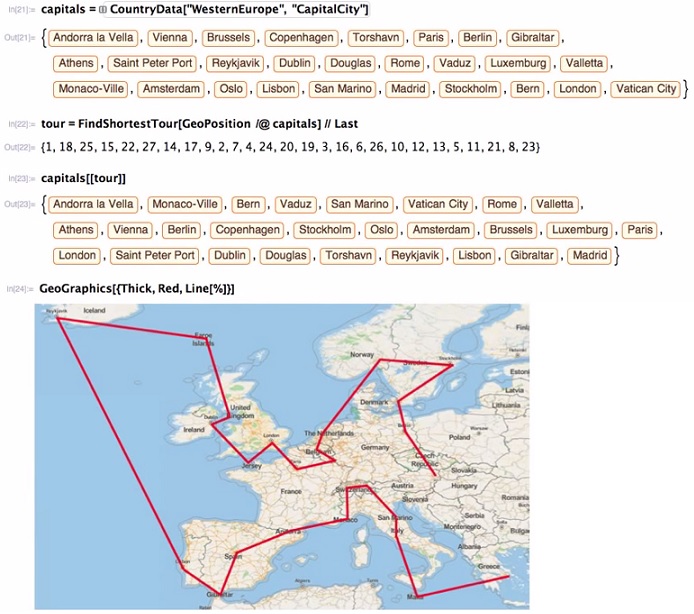
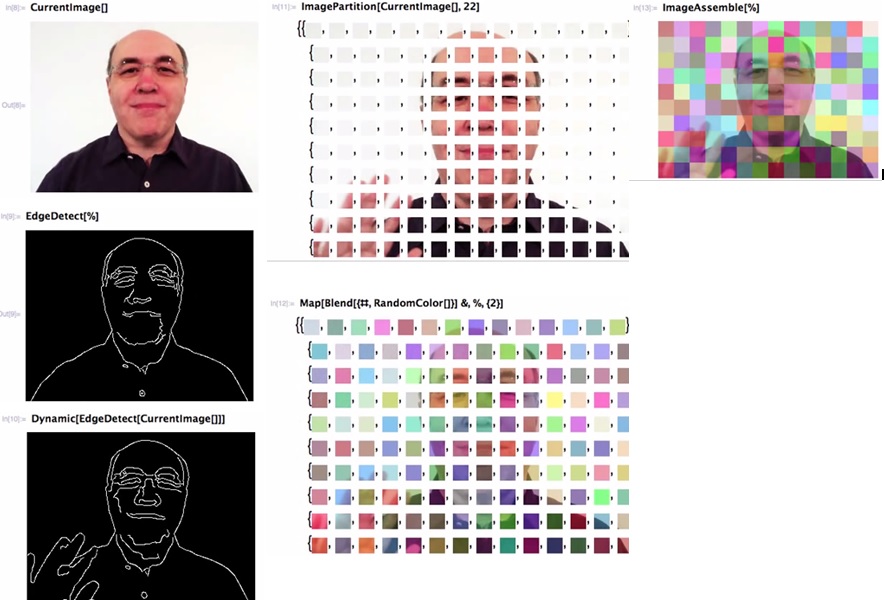
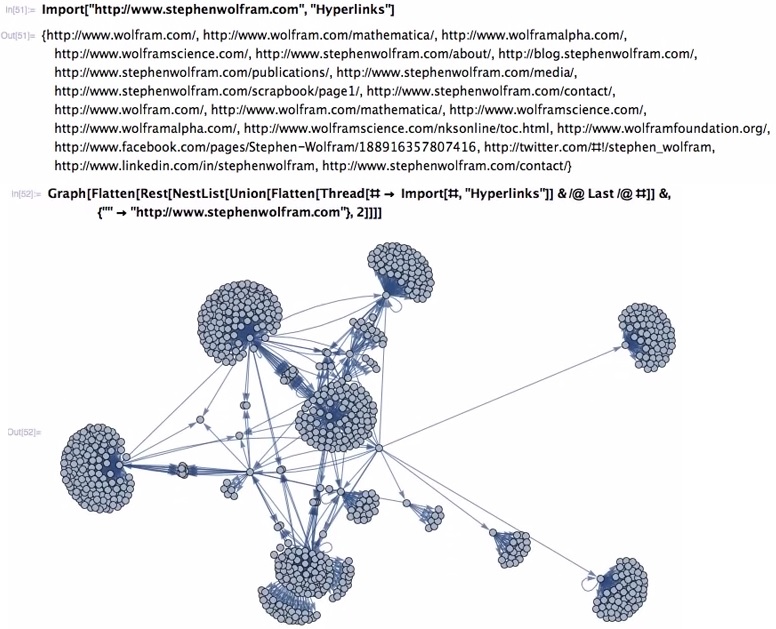
theodp writes "The devil will be in the details, but if you were stoked about last November's announcement of the Wolfram programming language, you'll be pleased to know that a just-released dry-but-insanely-great demo delivered by Stephen Wolfram does not disappoint. Even if you're not in love with the syntax or are a FOSS devotee, you'll find it hard not to be impressed by Wolfram's 4-line solution to a traveling salesman tour of the capitals of Western Europe, 6-line camera-capture-to-image-manipulation demo, or 2-line web crawling and data visualization example. And that's just for starters. So, start your Raspberry Pi engines, kids!" -
Wolfram Language Demo Impresses
theodp writes "The devil will be in the details, but if you were stoked about last November's announcement of the Wolfram programming language, you'll be pleased to know that a just-released dry-but-insanely-great demo delivered by Stephen Wolfram does not disappoint. Even if you're not in love with the syntax or are a FOSS devotee, you'll find it hard not to be impressed by Wolfram's 4-line solution to a traveling salesman tour of the capitals of Western Europe, 6-line camera-capture-to-image-manipulation demo, or 2-line web crawling and data visualization example. And that's just for starters. So, start your Raspberry Pi engines, kids!" -
Wolfram Language Demo Impresses
theodp writes "The devil will be in the details, but if you were stoked about last November's announcement of the Wolfram programming language, you'll be pleased to know that a just-released dry-but-insanely-great demo delivered by Stephen Wolfram does not disappoint. Even if you're not in love with the syntax or are a FOSS devotee, you'll find it hard not to be impressed by Wolfram's 4-line solution to a traveling salesman tour of the capitals of Western Europe, 6-line camera-capture-to-image-manipulation demo, or 2-line web crawling and data visualization example. And that's just for starters. So, start your Raspberry Pi engines, kids!" -
Code.org Resurrects 'Flappy Bird' As Programming Lesson
Nerval's Lobster writes "Flappy Bird might be kaput, but its hilariously awkward hero is serving another useful purpose in its afterlife: teaching people how to code. Flappy Bird, a free mobile game for Android and iOS that asks the player to guide the titular avian through an obstacle course of vertical pipes, became a sensation earlier this year, seizing the top spots on the Apple and Google Play app stores. Its creator, Dong Nguyen, said the game earned him an average of $50,000 a day through in-app advertising — but that didn't stop him from yanking the game offline in early February. Now Code.org has resurrected Flappy Bird, Phoenix-style, from the smoking wreckage, with a free tutorial that allows anyone with a bit of time to code his or her very own version of the game. There's no actual code to learn, thanks to a visual interface that allows budding developers to drag 'blocks' of commands into place. 'Flappy Bird recently met its untimely death. We might've been tempted to cry all day and give up on spreading computer science (not really, but R.I.P Flappy Bird),' read a note on Code.org's blog. 'Instead, we built a new drag-and-drop tutorial that lets you build your own Flappy game — whether it's Flappy Bird, or Flappy Easter Bunny, Flappy Santa, Flappy Shark with Lasers, Flappy Fairy or Flappy Underwater Unicorn.' Childish? Maybe. But it could help draw people into coding for fun or profit." -
Live Q&A With Ex-TSA Agent Jason Harrington Tomorrow 3pm ET
Jason Harrington's story pulling back the curtain on life as a TSA agent was an uncomfortable revelation to some, and a confirmation to many frustrated travelers. His descriptions of a typical day on the job highlighted why few in the security line were happy, including the agents: 'I hated it from the beginning. It was a job that had me patting down the crotches of children, the elderly and even infants as part of the post-9/11 airport security show. I confiscated jars of homemade apple butter on the pretense that they could pose threats to national security. I was even required to confiscate nail clippers from airline pilots—the implied logic being that pilots could use the nail clippers to hijack the very planes they were flying.' Jason will be sitting down with us tomorrow Friday, February 28th starting at 3pm ET (20:00 GMT) to talk with you live about security theater and life after the TSA. -
Ask Slashdot: Do You Still Trust Bitcoin?
Nerval's Lobster writes "It hasn't been a great week for Bitcoin. Cruise the Web, and you'll find stories from people who lost thousands (even millions, in some cases) of paper value when the Mt.Gox exchange went offline for still-mysterious reasons. (Rumors have circulated for days about the shutdown, ranging from an epic heist of the Bitcoins under its stewardship, to financial improprieties leading the exchange to the edge of bankruptcy.) But as one Slashdotter pointed out in a previous posting, Mt.Gox isn't Bitcoin (and vice versa), and it's likely that other exchanges will take up the burden of helping manage the currency. Even so, all currencies depend on a certain amount of stability and trust in order to survive, and Bitcoin faces something of a confidence crisis in the wake of this event. So here's the question: do you still trust Bitcoin?" -
Google Ordered To Remove Anti-Islamic Film From YouTube
cold fjord writes "The Verge reports, 'Google and YouTube must scrub all copies of Innocence of Muslims, a low-budget anti-Islam film that drew international protest in 2012, at the behest of an actress who says she received death threats after being duped into a role. The Ninth Circuit Court of Appeals has granted a temporary takedown order on behalf of Cindy Lee Garcia, who filed a copyright claim against Google in an attempt to purge the video from the web. While actors usually give up the right to assert copyright protection when they agree to appear in a film, Garcia says that not only was she never an employee in any meaningful sense, the finished film bore virtually no relation to the one she agreed to appear in. In a majority opinion, Judge Alex Kozinski said she was likely in the right.' — Techdirt has extensive commentary on the ruling that's worth reading. It seems likely there will be an appeal, with the distinct possibility that Google and the MPAA will be on the same side." -
The Rescue Plan That Could Have Saved Space Shuttle Columbia
An anonymous reader writes "In February, 2003, space shuttle Columbia was lost upon atmospheric re-entry. Afterward, NASA commissioned an exhaustive investigation to figure out what happened, and how it could be prevented in the future. However, they also figured out exactly what would have been required for a repair and rescue mission using Atlantis. Lee Hutchinson at Ars Technica went through the report and wrote a lengthy article explaining what such a mission would look like. In short: risky and terribly complex — but possible. 'In order to push Atlantis through processing in time, a number of standard checks would have to be abandoned. The expedited OPF processing would get Atlantis into the Vehicle Assembly Building in just six days, and the 24/7 prep work would then shave an additional day off the amount of time it takes to get Atlantis mated to its external tank and boosters. After only four days in the Vehicle Assembly Building, one of the two Crawler-Transporters would haul Atlantis out to Launch Complex 39, where it would stage on either Pad A or Pad B on Flight Day 15—January 30. ... Once on the pad, the final push to launch would begin. There would be no practice countdown for the astronauts chosen to fly the mission, nor would there be extra fuel leak tests. Prior to this launch, the shortest time a shuttle had spent on the launch pad was 14 days; the pad crews closing out Atlantis would have only 11 days to get it ready to fly.'" -
Will Peggy the Programmer Be the New Rosie the Riveter?
theodp writes "The Mercury News' Mike Cassidy reports that women are missing out on lucrative careers in computer science. 'The dearth of women in computing,' writes Cassidy, 'has the potential to slow the U.S. economy, which needs more students in the pipeline to feed its need for more programmers. It harms women by excluding them from some of the best jobs in the country. And it damages U.S. companies, which studies show would benefit from more diverse teams.' The promise of better financial results, says Anita Borg Institute Director Denise Gammal, is making diversity a business imperative. It's 'the sort of imperative that cries out for a movement,' argues Cassidy, 'maybe this time one led not by Rosie the Riveter, but by Peggy the Programmer.' So, where will Peggy the Programmer come from? Well, Google is offering $100 to girls attending U.S. public high schools who complete a Codecademy JavaScript course. 'Currently only 12% of computer science graduates are women,' explains Codecademy, 'and great tech companies like Google want to see more smart girls like you enter this awesome profession!' Google joins tech giant-backed Code.org in incentivizing teachers to bring the next generation of girls to the CS table.
But Silicon Valley claims the talent crisis is now (although there are 19 billion reasons to question SV's hiring acumen). So, what about the women who are here now, asks Dr. AnnMaria De Mars. 'If you are overlooking the women who are here now,' De Mars writes, 'what does that tell the girls you are supposedly bringing up to be the next generation of women in tech that you can overlook 15 years from now? Why do we hear about 16-year-old interns far more than women like me? If it is true, as the New York Times says, that in 2001-2 28% of computer science degrees went to women compared to the 10% or so now — where are those women from 12 years ago? It seems to me that when people are looking at minorities or women to develop in their fields, they are much more interested in the hypothetical idea of that cute 11-year-old girl being a computer scientist someday than of that thirty-something competing with them for market share or jobs. If there are venture capitalists or conference organizers or others out there that are sincerely trying to promote women who code, not girls, I've never met any. That doesn't mean they don't exist, but it means that whoever they are seeking out, it isn't people like me.'" -
Interview: Ask Richard Stallman What You Will
Richard Stallman (RMS) founded the GNU Project in 1984, the Free Software Foundation in 1985, and remains one of the most important and outspoken advocates for software freedom. He now spends much of his time fighting excessive extension of copyright laws, digital restrictions management, and software patents. RMS has agreed to answer your questions about GNU/Linux, how GNU relates to Linux the kernel, free software, why he disagrees with the idea of open source, and other issues of public concern. As usual, ask as many as you'd like, but please, one question per post. -
Mt. Gox Shuts Down: Collapse Should Come As No Surprise
New submitter Dan541 writes in with word that Mt. Gox has halted all operations indefinitely. A statement from the CEO: "As there is a lot of speculation regarding MtGox and its future, I would like to use this opportunity to reassure everyone that I am still in Japan, and working very hard with the support of different parties to find a solution to our recent issues. ... In light of recent news reports and the potential repercussions on MtGox's operations and the market, a decision was taken to close all transactions for the time being in order to protect the site and our users. We will be closely monitoring the situation and will react accordingly." MrBingoBoingo writes that we should not be surprised Mt. Gox appears to have failed "The recent closure of the famous Bitcoin exchange Mt. Gox has grabbed a lot of media attention lately, but people involved heavily in bitcoin have been raising alarms about business practices at Mt. Gox for quite some time now. With the Mt. Gox failure being Bitcoin's biggest since the collapse of the ponzi run by Trendon Shavers, also known as Pirateat40, it might be time to revisit the idea of counterparty risk in the world of irreversible cryptocurrency." -
YouTube Ordered To Remove "Illegal" Copyright Blocking Notices
An anonymous reader writes in with new developments in a two-year-old spat between YouTube and GEMA (a German music royalty collection foundation). After the courts ordered YouTube to implement tools to block videos that contained music GEMA licenses, it seems that telling users why content was blocked isn't making GEMA happy. From the article: "GEMA applied for an injunction to force YouTube to change the messages, claiming that they misrepresent the situation and damage GEMA’s reputation. YouTube alone is responsible for blocking the videos, claiming otherwise is simply false, GEMA argued. ... Yesterday the District Court of Munich agreed with the music group and issued an injunction to force YouTube to comply, stating that the notices 'denigrate' GEMA with a 'totally distorted representation of the legal dispute between the parties.' Changing the message to state that videos are not available due to a lack of a licensing agreement between YouTube and GEMA would be more appropriate, the Court said." The messages currently reads, "Unfortunately, this video is not available in Germany because it may contain music for which GEMA has not granted the respective music rights." Seems pretty neutral. Non-compliance with the order could result in fines of €250,000 per infraction. -
Scientists Demonstrate Virus That Spreads Across Wi-Fi Access Points
An anonymous reader writes "Researchers at the University of Liverpool have shown for the first time that WiFi networks can be infected with a virus that can move through densely populated areas as efficiently as the common cold spreads between humans. The team designed and simulated an attack by a virus, called 'Chameleon,' that not only could spread quickly between homes and businesses, but avoided detection and identified the points at which WiFi access is least protected by encryption and passwords. The research appears in EURASIP Journal on Information Security." The technical details are explained in the journal article. -
Electric Bikes Get More Elegant Every Year (Video)
Tim Lord first saw Faraday Bicycles at CES, where their bikes drew plenty of attention and a fair amount of media interest. The company ran a successful Kickstarter campaign in 2012, and 2014 is when they are starting to ship their pre-ordered bicycles and hope to get new orders for lots more. Tim's travels later took him to San Francisco, where he had a chance to visit the shop where Faraday bikes are made, and to talk with some of the people who are designing and making them. (If you don't see the video below, please use this link.) -
Meet the Developers Who Want To Build the Next Snapchat
Nerval's Lobster writes "Our lives online come with perils, whether from the NSA checking up on our digital communications, or the possibility of the wrong e-message going viral. Twitter, Facebook, Google, Instagram, and other social networks have collected all sorts of personal data about us, where we've been, what we're saying, what we like, and our friends. No wonder the idea of ephemeral messages — such as those sent via Snapchat and other services — is beginning to resonate, attracting lots of startups who want to service that very need. These creators of self-destructing message apps claim they don't care about monetization, and that their products are secure — but as so many apps from other startups have demonstrated, security is often a very porous thing, and government agencies are more than happy to fire off a warrant to see unread messages stored on a server. Lots of developers want to become the Snapchat (if it means they can take a multi-billion-dollar buyout), but in the case of vaporizing messages, they're tiptoeing into tricky territory." -
SpaceX Testing Landing Legs On Next Falcon9 Rocket
astroengine writes with news of SpaceX's next step in experimenting with vertical landings for rocket stages. From the article: "Space Exploration Technologies is installing landing legs on its next Falcon 9 rocket, part of an ongoing quest to develop boosters that fly themselves back to the launch site for reuse. For the upcoming demonstration, scheduled for March 16, the Falcon 9's first stage will splash down, as usual, in the ocean after liftoff from Cape Canaveral Air Force Station in Florida. This time, however, SpaceX hopes to cushion the rocket's destructive impact into the Atlantic Ocean by restarting the Falcon 9's engine and extending landing legs that will be attached to the booster's aft section. The goal is a soft touchdown on the water." The test is scheduled for their ISS resupply mission on March 16th 2014 (the mission also features the launch of the crowdfunded KickSat nano nanosatellites) . -
Book Review: Sudo Mastery: User Access Control For Real People
Saint Aardvark writes "If you're a Unix or Linux sysadmin, you know sudo: it's that command that lets you run single commands as root from your own account, rather than logging in as root. And if you're like me, here's what you know about configuring sudo:
1.) Run sudoedit and uncomment the line that says "%wheel ALL=(ALL) ALL".
2.) Make sure you're in the wheel group.
3.) Profit!
If you're a sysadmin, you need to stop people from shooting themselves in the foot. There should be some way of restricting use, right? Just gotta check out the man page.... And that's where I stopped, every time. I've yet to truly understand Extended Backus-Naur Form, and my eyes would glaze over. And so I'd go back to putting some small number of people in the 'wheel' group, and letting them run sudo, and cleaning up the occasional mess afterward. Fortunately, Michael W. Lucas has written Sudo Mastery: User Access Control for Real People." Keep reading for the rest of Saint Aardvark's review. Sudo Mastery: User Access Control For Real People author Michael W. Lucas pages 144 publisher Tilted Windmill Press rating 10/10 reviewer Saint Aardvark ISBN 1493626205 summary Teaches all there is to know about sudo If his name sounds familiar, there's a reason for that: he's been cranking out excellent technical books for a long time, on everything from FreeBSD to Cisco routers to DNSSEC. He takes deep, involved subjects that you don't even know you need to know more about, and he makes them understandable. It's a good trick, and we're lucky he's turned his attention to sudo.
The book clocks in at 144 pages (print version), and it's packed with information from start to finish. Lucas starts with the why and how of sudo, explaining why you need to know it and how sudo protects you. He moves on to the syntax; it's kind of a bear at first, but Chapter 2, "sudo and sudoers", takes care of that nicely. Have you locked yourself out of sudo with a poor edit? I have; I've even managed to do it on many machines, all at once, by distributing that edit with CFEngine. Lucas covers this in Chapter 3, "Editing and Testing Sudoers", a chapter that would have saved my butt. By the time you've added a few entries, you're probably ready for Chapter 4, "Lists and Aliases".
sudo has lots of ways to avoid repeating yourself, and I picked up a few tricks from this chapter I didn't know about — including that sudo can run commands as users other than root. Need to restart Tomcat as the tomcat user? There's a sudoers line for that. I'm ashamed to admit that I didn't know this.
There is a lot more in this book, too. You can override sudo defaults for different commands or users. You can stuff sudo directives into LDAP and stop copying files around. You can edit files with sudoedit. You can record people's sudo commands, and play them back using sudoreplay. The list goes on.
Sounds like a lot, doesn't it? It is. But the book flies by, because Lucas is a good writer: he packs a lot of information into the pages while remaining engaging and funny. The anecdotes are informative, the banter is witty, and there's no dry or boring to be found anywhere.
Shortcomings: Maybe you don't like humor in your tech books; if so, you could pass this up, but you'd be missing out. There wasn't an index in the EPUB version I got, which I always miss. Other than that: I'm mad Lucas didn't write this book ten years ago.
You can purchase The Plateau Effect: Getting from Stuck to Success from amazon.com. Slashdot welcomes readers' book reviews (sci-fi included) -- to see your own review here, read the book review guidelines, then visit the submission page. -
Book Review: Sudo Mastery: User Access Control For Real People
Saint Aardvark writes "If you're a Unix or Linux sysadmin, you know sudo: it's that command that lets you run single commands as root from your own account, rather than logging in as root. And if you're like me, here's what you know about configuring sudo:
1.) Run sudoedit and uncomment the line that says "%wheel ALL=(ALL) ALL".
2.) Make sure you're in the wheel group.
3.) Profit!
If you're a sysadmin, you need to stop people from shooting themselves in the foot. There should be some way of restricting use, right? Just gotta check out the man page.... And that's where I stopped, every time. I've yet to truly understand Extended Backus-Naur Form, and my eyes would glaze over. And so I'd go back to putting some small number of people in the 'wheel' group, and letting them run sudo, and cleaning up the occasional mess afterward. Fortunately, Michael W. Lucas has written Sudo Mastery: User Access Control for Real People." Keep reading for the rest of Saint Aardvark's review. Sudo Mastery: User Access Control For Real People author Michael W. Lucas pages 144 publisher Tilted Windmill Press rating 10/10 reviewer Saint Aardvark ISBN 1493626205 summary Teaches all there is to know about sudo If his name sounds familiar, there's a reason for that: he's been cranking out excellent technical books for a long time, on everything from FreeBSD to Cisco routers to DNSSEC. He takes deep, involved subjects that you don't even know you need to know more about, and he makes them understandable. It's a good trick, and we're lucky he's turned his attention to sudo.
The book clocks in at 144 pages (print version), and it's packed with information from start to finish. Lucas starts with the why and how of sudo, explaining why you need to know it and how sudo protects you. He moves on to the syntax; it's kind of a bear at first, but Chapter 2, "sudo and sudoers", takes care of that nicely. Have you locked yourself out of sudo with a poor edit? I have; I've even managed to do it on many machines, all at once, by distributing that edit with CFEngine. Lucas covers this in Chapter 3, "Editing and Testing Sudoers", a chapter that would have saved my butt. By the time you've added a few entries, you're probably ready for Chapter 4, "Lists and Aliases".
sudo has lots of ways to avoid repeating yourself, and I picked up a few tricks from this chapter I didn't know about — including that sudo can run commands as users other than root. Need to restart Tomcat as the tomcat user? There's a sudoers line for that. I'm ashamed to admit that I didn't know this.
There is a lot more in this book, too. You can override sudo defaults for different commands or users. You can stuff sudo directives into LDAP and stop copying files around. You can edit files with sudoedit. You can record people's sudo commands, and play them back using sudoreplay. The list goes on.
Sounds like a lot, doesn't it? It is. But the book flies by, because Lucas is a good writer: he packs a lot of information into the pages while remaining engaging and funny. The anecdotes are informative, the banter is witty, and there's no dry or boring to be found anywhere.
Shortcomings: Maybe you don't like humor in your tech books; if so, you could pass this up, but you'd be missing out. There wasn't an index in the EPUB version I got, which I always miss. Other than that: I'm mad Lucas didn't write this book ten years ago.
You can purchase The Plateau Effect: Getting from Stuck to Success from amazon.com. Slashdot welcomes readers' book reviews (sci-fi included) -- to see your own review here, read the book review guidelines, then visit the submission page. -
Ray Kurzweil Talks Google's Big Plans For Artificial Intelligence
Nerval's Lobster writes "Ray Kurzweil, the technologist who's spent his career advocating the Singularity, discussed his current work as a director of engineering at Google with The Guardian. Google has big plans in the artificial-intelligence arena. It recently acquired DeepMind, self-billed 'cutting edge artificial intelligence company' for $400 million; that's in addition to snatching up all sorts of startups and research scientists devoted to everything from robotics to machine learning. Thanks to the massive datasets generated by the world's largest online search engine (and the infrastructure allowing that engine to run), those scientists could have enough information and computing power at their disposal to create networked devices capable of human-like thought. Kurzweil, having studied artificial intelligence for decades, is at the forefront of this in-house effort. In his interview with The Guardian, he couldn't resist throwing some jabs at other nascent artificial intelligence systems on the market, most notably IBM's Watson: 'IBM's Watson is a pretty weak reader on each page, but it read the 200m pages of Wikipedia. And basically what I'm doing at Google is to try to go beyond what Watson could do. To do it at Google scale. Which is to say to have the computer read tens of billions of pages. Watson doesn't understand the implications of what it's reading.' That sounds very practical, but at a certain point Kurzweil's predictions veer into what most people would consider science fiction. He believes, for example, that a significant portion of people alive today could end up living forever, thanks to the ministrations of ultra-intelligent computers and beyond-cutting-edge medical technology." -
Why Copyright Trolling In Canada Doesn't Pay
An anonymous reader writes "In the aftermath of the Canadian file sharing decision involving Voltage Pictures that includes an order to disclose thousands of subscriber names, the big question is what comes next. Michael Geist examines the law and economics behind file sharing litigation in Canada and concludes that copyright trolling doesn't pay as the economics of suing thousands of Canadians for downloading a movie for personal purposes is likely to lead to hundreds of thousands in losses for rights holders." -
Nokia Announces Nokia X Android Smartphone
squiggleslash writes "Despite some industry skepticism, Nokia has indeed been working on an Android smartphone and finally unveiled the Nokia X today. As rumored, it's not a Google Play compatible device, running instead a Google-less AOSP build with a Nokia app store, and Windows Phone style shell. The budget phone will also not be marketed in North America. The Media seems convinced Microsoft — who are in the process of acquiring Nokia — will kill the project, but it's hard to see why Nokia would be working on such a project at this time if Microsoft had plans to do this." -
Who's On WhatsApp, and Why?
theodp writes "In announcing its $16B acquisition of WhatsApp, Facebook confessed it had very little data on WhatsApp's estimated 450 million users. Asked about the user data, Facebook CFO David Ebersman said, 'WhatsApp has good penetration across all demographics but you are not asked your age when you sign up.' Wall Street analysts concerned by Ebersman's answer won't be comforted by GeekWire reporter Taylor Soper's (non-scientific) poll of UW students, which suggested that WhatsApp may not exactly be BMOC (Big Messenger on Campus). 'I don't use it at all,' replied one UW junior. 'I've heard of it but I have so many other things I do online that it would just be another time-consuming thing. I use Facebook or texting to talk to people.' WhatsApp did fare better in a survey of Soper's Facebook network, where responders said they used WhatsApp mostly for communicating internationally and in groups. So, are you or someone you know using WhatsApp, and what's the motivation for doing so?" -
WhatsApp Founder Used Unchangable Airline Ticket To Pressure Facebook
McGruber writes "In a post on the Flyertalk website, WhatsApp founder Jan Koum provides another interesting detail about how he steered WhatsApp into a $16 billion deal with Facebook: 'we announced the deal with Facebook on wednesday after the market closed. during the process, we realized there was a chance we might not be able to get the deal wrapped up and signed on wednesday and it could delay. when the risk of the delay became real, i said: "if we don't get it done on wednesday, it probably wont get done. i have tickets on thursday to fly out to Barcelona which i bought with miles and they are not easily refundable or even possible to change. this has to be done by wednesday or else!!!"...and so one of the biggest deals in tech history had to be scheduled around my M&M award ticket." -
Netflix Blinks, Will Pay Comcast For Network Access
We've mentioned several times the tension between giant streaming sources (especially Netflix), and ISPs (especially Comcast, especially given that it may merge with Time-Warner). Now, Marketwatch reports that Netflix has agreed to pay Comcast (amount undisclosed) for continued smooth access to Comcast's network customers, "a landmark agreement that could set a precedent for Netflix's dealings with other broadband providers, people familiar with the situation said." From the article: "In exchange for payment, Netflix will get direct access to Comcast's broadband network, the people said. The multiyear deal comes just 10 days after Comcast agreed to buy Time Warner Cable TWC -0.79% Inc., which if approved would establish Comcast as by far the dominant provider of broadband in the U.S., serving 30 million households" I wonder how soon until ISPs' tiered pricing packages will become indistinguishable from those for cable TV, with grouped together services that vary not just in throughput or quality guarantees, but in what sites you can reach at each service level, or which sports teams are subject to a local blackout order. -
"Microsoft Killed My Pappy"
theodp writes "A conversation with an angry young developer prompts Microsoft Program Manager Scott Hanselman to blog about 'Microsoft Haters: The Next Generation.' 'The ones I find the most interesting,' says Hanselman, are the 'Microsoft killed my Pappy' people, angry with generational anger. My elders hated Microsoft so I hate them. Why? Because, you wronged me.' The U.S. and Japan managed to get over the whole World War II thing, Hanselman notes, so why can't people manage to get past the Microsoft antitrust thing, which was initiated in 1998 for actions in 1994? 'At some point you let go,' he suggests, 'and you start again with fresh eyes.' Despite the overall good-humored, why-can't-we-get-along tone of his post, Hanselman can't resist one dig that seems aimed at putting things into perspective for those who would still Slashdot like it's 1999: 'I wonder if I can swap out Chrome from Chrome OS or Mobile Safari in iOS.'" -
All In All, Kids Just Another Brick In the Data Wall
theodp writes "If you don't have kids of school age, you may not be aware that Data Walls — typically a low-tech "dashboard" of color-coded sticky notes on a wall bearing the names of pupils to highlight their achievement level, absences, or discipline problems — are apparently quite the rage. This is much to the chagrin of some teachers, including Peter A. Greene, who rails against the walls-of-shame in Up Against the Data Wall. Why stop there, Greene asks, tongue-in-cheek. Why not have data-driven dress codes? Data-driven recess? Pooh-poohing concerns of teachers who think Data Walls are mean but feel pressure to create them, the Supt. of Holyoke Public Schools said, "It's not a mandate whatsoever." Still, he went on to add, "I would say 99 percent of teachers see the benefit of it," which some might take as an implicit mandate. In other student privacy news, New York's Supreme Court has ruled that parental permission is not required to disclose student data to the Bill and Melinda Gates Foundation-funded inBloom, perhaps paving the way for the Great Data Wall of the U.S." -
Open Source Video Editor Pitivi Seeks Crowdfunding to Reach 1.0
Eloquence writes "Pitivi is perhaps the most mature, stable and actually usable open source video editor out there. They're now looking to raise funds to support the project's ongoing development. The lack of decent open source video editors has been one of the things keeping people locked into proprietary platforms, and video editing has been identified as a high priority project by the Free Software Foundation. 2014 may still not be the fabled year of the Linux desktop, but here's hoping it'll be the year of open source video editing." Work continues as well on the crowdfunded transition to cross-platform, open-source video editing with OpenShot, and developer Jonathan Thomas is presenting the work done so far at SCALE this weekend. -
Why Is Dropbox Back On the Chinese Market?
Nerval's Lobster writes "Dropbox has renewed access to the Chinese market for the first time in four years. But why? The Chinese government first blocked access to Dropbox in 2010, most likely to prevent people within China from sharing data via the cloud. Now Dropbox is back online in China, albeit at slower speeds. Despite repeated queries from Slashdot, however, Dropbox has declined to comment on why China may have dropped the in-country restrictions to its services. "We still have nothing to share," the company responded after the third email. Dropbox isn't the only foreign cloud service available on the Chinese market (although Google Drive remains blocked): in late 2013, Amazon announced it would open an Amazon Web Services (AWS) region in the country; at the time, the Amazon Web Services Blog alluded to the "legal and regulatory requirements" that this new AWS region will obey. So questions remain: Did Dropbox know it would regain entry to the Chinese market? If so, did it need to agree to certain conditions before the Chinese government would "flip the switch," as it were?" -
ISP Fights Causing Netflix Packet Drops
An anonymous reader writes "We've been hearing more and more reports of ISPs throttling Netflix and other high-bandwidth services lately. The ISPs have denied it, and even Netflix itself seems to believe them. If that's the case, what's going on? Well, according to this article, the blame still lies with the ISPs. While they may not be explicitly throttling connection speeds, they're refusing to upgrade network connections as they demand more money from content distributors. For example, Netflix pays Cogent to distribute their internet traffic. Cogent has an agreement with Verizon to exchange traffic — which works fine until the massive amount of traffic from Netflix makes it a lopsided arrangement. Verizon wants more money from Cogent, and one of their negotiating tactics is simply to stop upgrading their infrastructure so that service degrades. 'There are about 11 Cogent/Verizon peering connections in major cities around the country. When peering partners aren't fighting, they typically upgrade the connections (or "ports") when they're about 50 percent full, Cogent says. ... With Cogent and Verizon fighting, the upgrades are happening at a glacial pace, according to Schaeffer. "Once a port hits about 85 percent throughput, you're going to begin to start to drop packets," he said. "Clearly when a port is at 120 or 130 percent [as the Cogent/Verizon ones are] the packet loss is material."'" -
Is Google Making the Digital Divide Worse?
theodp writes "As Google Fiber forges ahead into new metro areas, Michael Brick reports on worries the fiber project will create a permanent underclass. Building the next generation of information economy infrastructure around current demand, experts say, will deny poor people the physical wiring needed to gain access while the privileged digerati advance at hyperspeed. 'The fiber service deployment means multiplicity of the digital divide, multidimensionality of the digital divide,' says Eun-A Park of the Univ. of New Haven. 'You can see it in Google's trial in Kansas City.' Speed matters, explains Google, 'because a world with universal access and 100 times faster internet could mean 100 times the learning.' Without universal access, as is the case in KC due to pricing that's out of the reach of many of the city's poor, one presumes the outcome could be 100x the learning divide. Another case of the unintended consequences of good intentions?" -
Microsoft Circles the Wagons To Defeat ODF In the UK
Andy Updegrove writes "Three weeks ago, we heard that Francis Maude, a senior UK government minister, was predicting the conversion to open source office suites by UK government agencies. Lost in the translation in many stories was the fact that this was based not on an adopted policy, but on a proposal still open for public comment — and subject to change. It should be no surprise that Microsoft is trying to get the UK to add OOXML, its own format standard, to the UK policy. Why? According to a messaging sent to its UK partners, because it believes that a failure to include OOXML 'will cause problems for citizens and businesses who use office suites which don't support ODF, including many people who do not use a recent version of Microsoft Office or, for example, Pages on iOS and even Google Docs.' Of course, that's because Microsoft pushed OOXML as an alternative to ODF a decade ago. If you don't want the same objection to be valid a decade from now, consider making your views known at the Cabinet Office Standards Hub. The deadline is February 26." -
Safety Measures Fail To Stop Fukushima Plant Leaks
AmiMoJo writes "The operator of the Fukushima Daiichi plant has been developing countermeasures to deal with repeated leaks from tanks of contaminated water. But despite the measures, 100 tons of radioactive water leaked on Wednesday and Thursday. 'The leaked water was among the most severely contaminated that Tepco has reported in the aftermath of the March 2011 disaster at the Fukushima Daiichi plant, when damage caused by an earthquake and a tsunami led to meltdowns in three of the plant’s reactors. Each liter of the water contained, on average, 230 million becquerels of particles giving off beta radiation, the company said. About half of the particles were likely to be strontium 90, which is readily taken up by the human body in the same way that calcium is, and can cause bone cancer and leukemia.' The estimated volume of the leaked radioactive materials caused Japan's nuclear regulator to rank the leak a level-3 serious accident. The international scale of nuclear and radiological events ranges from zero to 7." -
Safety Measures Fail To Stop Fukushima Plant Leaks
AmiMoJo writes "The operator of the Fukushima Daiichi plant has been developing countermeasures to deal with repeated leaks from tanks of contaminated water. But despite the measures, 100 tons of radioactive water leaked on Wednesday and Thursday. 'The leaked water was among the most severely contaminated that Tepco has reported in the aftermath of the March 2011 disaster at the Fukushima Daiichi plant, when damage caused by an earthquake and a tsunami led to meltdowns in three of the plant’s reactors. Each liter of the water contained, on average, 230 million becquerels of particles giving off beta radiation, the company said. About half of the particles were likely to be strontium 90, which is readily taken up by the human body in the same way that calcium is, and can cause bone cancer and leukemia.' The estimated volume of the leaked radioactive materials caused Japan's nuclear regulator to rank the leak a level-3 serious accident. The international scale of nuclear and radiological events ranges from zero to 7." -
Louis Suarez-Potts Talks About Making Money with FOSS (Video)
Louis Suarez-Potts has been community manager for OpenOffice since it was sponsored by Sun Microsystems. He's still working with OpenOffice now that it's under the Apache Foundation umbrella. He also has a business going, along with several other long-time Free and Open Source boosters, called Age of Peers. They say it's "a collective forum for consultants, practitioners and boutique agencies, to collaborate on a bigger picture. We mix these ingredients in an organization built to foster collaboration, and harness creative cooperation into powerful new ideas." The company is focused on Open Source developers and companies, and often doesn't charge startups or individual developers for their services. They will be doing a live Google Hangout interview on March 5 that might give you some ideas about how to start, manage, and market an Open Source project -- even if you have no money to spend, which many people who have good ideas do not, at least when they get started. (Alternate video URL) -
Google's Project Tango Seeks To Map a 3D World
Nerval's Lobster writes "Google's Advanced Technology and Projects Group is working on a new initiative, Project Tango, which could allow developers to quickly map objects and interiors in 3D. At the heart of Project Tango is a prototype smartphone with a 5-inch screen, packed with hardware and software optimized to take 3D measurements of the surrounding environment. The associated development APIs can feed tons of positioning and orientation data to Android applications written in Java, C/C++, and the Unity Game Engine. In addition to a 'standard' 4-megapixel camera, the device features a motion-tracking camera and an aperture for integrated depth sensing; integrated into the circuitry are two computer-vision processors. Google claims it only has 200 developer units in stock, and it's willing to give them to independent developers who can submit a detailed idea for a project involving 3D mapping of some sort. The deadline for unit distribution is March 14, 2014. In theory, developers could use ultra-portable 3D mapping to create better maps, visualizations, and games. ('What if you could search for a product and see where the exact shelf is located in a super-store?' Google's Website asks at one point.) The bigger question is what Google intends to do with the technology if it proves effective. Google Maps with super-detailed interiors, anyone?" -
Jolla Announces Sailfish OS 1.0
An anonymous reader writes "Sailfish, the Linux-based mobile operating system developed by Finnish devicemaker Jolla, has reached version 1.0. Sailfish arose from the ashes of several failed and interrupted projects to bring a new, major Linux-based platform to mobile devices. It's already running on phones sold in India and Russia, but more importantly, Sailfish was designed to be easily ported to existing Android devices. It's also built to support many Android apps. Jolla will begin providing complete firmware downloads during the first half of the year."