Slashdot Mirror
Domain: slashdot.org
Stories and comments across the archive that link to slashdot.org.
Stories · 37,380
-
The Quest To Build Xbox One and PS4 Emulators
Nerval's Lobster writes "Will Xbox One and PS4 emulators hit your favorite download Websites within the next few years? Emulators have long been popular among gamers looking to relive the classic titles they enjoyed in their youth. Instead of playing Super Mario Bros. on a Nintendo console, one can go through the legally questionable yet widespread route of downloading a copy of the game and loading it with PC software that emulates the Nintendo Entertainment System. Emulation is typically limited to older games, as developing an emulator is hard work and must usually be run on hardware that's more powerful than the original console. Consoles from the NES and Super NES era have working emulators, as do newer systems such as Nintendo 64, GameCube and Wii, and the first two PlayStations. While emulator development hit a dead end with the Xbox 360 and PS3, that may change with the Xbox One and PS4, which developers are already exploring as fertile ground for emulation. The Xbox 360 and PS4 feature x86 chips, for starters, and hardware-assisted virtualization can help solve some acceleration issues. But several significant obstacles stand in the way of developers already taking a crack at it, including console builders' absolute refusal to see emulation as even remotely legal." -
eBay CEO: Amazon Drones Are Fantasy
angry tapir writes "In the race to deliver online shopping purchases faster, drones don't impress eBay's CEO. 'We're not focusing on long-term fantasies, we're focusing on things we can do today,' John Donahue said in an interview. He was reacting to an interview Jeff Bezos, CEO of e-commerce rival Amazon, gave last weekend in which he said Amazon is investigating the use of drones for package delivery." -
The Yin and Yang of Hour of Code & Immigration Reform
theodp writes "The weeklong Hour of Code kicks off tomorrow, with Mark Zuckerberg and Bill Gates doing their part to address a declared nationwide CS crisis by ostensibly teaching the nation's schoolchildren how to code. But a recent NY Times Op-Ed by economist Paul Collier criticizing Zuckerberg's FWD.us PAC as self-serving advocacy (echoing earlier criticism) serves as a reminder that Zuckerberg and Gates' Code.org and Hour of Code involvement is the Yin to their H-1B visa lobbying Yang. The two efforts have been inextricably linked together for Congress, if not for the public. And while Zuckerberg argues it's 'the right thing to do', Collier argues that there are also downsides to the tech giants' plans to shift more bright, young, enterprising people from the poorest countries to the richest. 'An open door for the talented would help Facebook's bottom line,' Collier concludes, 'but not the bottom billion.'" -
Trans-Pacific Partnership Includes Unwanted Elements of SOPA
New submitter Error27 writes "Last month Wikileaks leaked a draft of the Trans-Pacific Partnership treaty. Here is Congresswoman Zoe Lofgren's response to the leaked documents. She points out that there several troubling issues with the trade agreement. It locks countries into extremely long copyright terms. It limits fair use. It includes DRM provisions which would make it illegal to unlock your cell phone. These laws come from the Stop Online Piracy Act (SOPA) which Americans already rejected." -
Why Reactive Programming For Databases Is Awesome
Nerval's Lobster writes "'Building on many lessons learned from spreadsheets, functional languages and model-driven application development environments, Reactive Programming (RP) is a recent approach to creating applications,' Val Huber, CTO of Espresso Logic, writes in a new column. 'In the RP paradigm, you can create complex applications from a series of simple declarative statements. Many of the details of implementation and work of gluing together various sorts of application constructs can be hidden because of the declarative approach.' He goes on to argue that RP makes maintenance easier and applications more adaptable, because RP offers automatic dependency management and reuse; at the same time, he also acknowledges that RP has some shortcomings. What say you?" -
Elsevier Going After Authors Sharing Their Own Papers
David Gerard writes "Elsevier, in final desperation mode, is going after authors sharing their own papers online. Academia.edu has told several researchers that Elsevier 'is currently upping the ante in its opposition to academics sharing their own papers online.' This is the sounds of a boycott biting." -
FSF Responds To Microsoft's Privacy and Encryption Announcement
An anonymous reader writes "Microsoft announced yesterday their plans to encrypt customer data to prevent government snooping. Free Software Foundation executive director John Sullivan questions the logic of trusting non-free software, regardless of promises or even intent. He says, 'Microsoft has made renewed security promises before. In the end, these promises are meaningless. Proprietary software like Windows is fundamentally insecure not because of Microsoft's privacy policies but because its code is hidden from the very users whose interests it is supposed to secure. A lock on your own house to which you do not have the master key is not a security system, it is a jail. ... If the NSA revelations have taught us anything, it is that journalists, governments, schools, advocacy organizations, companies, and individuals, must be using operating systems whose code can be reviewed and modified without Microsoft or any other third party's blessing. When we don't have that, back doors and privacy violations are inevitable.'" -
This Whole Bitcoin Thing Could Be Big, Says Bank of America
Nerval's Lobster writes "Bank of America has issued a research report suggesting that the crypto-currency Bitcoin could become 'a major means of payment for e-commerce' on its way to emerging as 'a serious competitor to traditional money transfer providers.' The bank attaches a 'maximum market capitalization' of Bitcoin at roughly $1,300, based on its position as a 'major player in both e-commerce and money transfer' as well as 'a significant store of value with a reputation close to silver.' Bitcoin has come close to exceeding that theoretical ceiling in recent weeks, although its valuation dove today after the People's Bank of China decided to declare it a volatile 'currency' without real legal status; that financial institution is also concerned about its use in money laundering and black markets. Bank of America sees Bitcoins' advantages as low transaction costs, its finite supply (which will protect its value), and its increasing attractiveness as an alternative to 'traditional' cash. As with the People's Bank of China, however, the bank sees the currency's extreme volatility and lack of legal backing as a bad thing, and frowns at the possibility that regulators could step in and increase transaction costs. 'A 50 minute wait before payment receipt confirmation is received will prohibit wider use,' the report adds. 'This is less of an issue for two parties that know each other because they trust the other will not double spend, but when dealing with an anonymous counterparty this creates a high level of unhedgeable risk.' Without a 'central counterparty' to verify transactions and thus mitigate that risk, Bitcoin could fail to break into wider use." -
Ask TechFreedom's Berin Szoka About Govt. Policy and Privacy Online
Berin Szoka is president and founder of the tech policy think tank TechFreedom. The group promotes a wide variety of digital rights and privacy issues. Most recently, they have started a petition demanding reforms to the Electronic Communications Privacy Act (ECPA) so that law enforcement will have to get a warrant before accessing emails stored in the cloud. With so much attention paid to the NSA snooping, Berin believes that the over 25-year-old ECPA has been overshadowed and is in dire need of changes. Mr. Szoka has agreed to answer your questions about privacy and government policy online. As usual, ask as many as you'd like, but please, one question per post. -
Thieves Who Stole Cobalt-60 Will Soon Be Dead
Hugh Pickens DOT Com writes "The Washington Post reports that the carjackers who set off international alarm bells by absconding with a truckload of highly radioactive cobalt-60, used in hospital radiotherapy machines, most likely had no idea what they were stealing and will die soon from exposure. The robbery occurred as the cobalt-60 was being driven from a public hospital in the border town of Tijuana to a storage facility in central Mexico. While waiting for daybreak at a gas station in the state of Hidalgo the drivers were jumped by two gunmen who beat them and stole the truck. "I believe, definitely, that the thieves did not know what they had; they were interested in the crane, in the vehicle," says Mardonio Jimenez, a physicist with Mexico's nuclear safety commission. The prospect that material that could be used in a radioactive dirty bomb had gone missing sparked an urgent two-day hunt that concluded when the material, cobalt-60, used in hospital radiotherapy machines, was found along with the stolen Volkswagen truck. The cobalt-60 was found, removed from its casing, in a rural area near the town of Hueypoxtla about 25 miles from where the truck was stolen. Jimenez suspects that curiosity got the better of the thieves and they opened the box. So far the carjackers have not been arrested, but authorities expect they will not live long. "The people who handled it will have severe problems with radiation. They will, without a doubt, die."" -
Microsoft's NSA 'Transparency' Push Remains Pretty Opaque
Nerval's Lobster writes "Microsoft will encrypt consumer data and make its software code more transparent, in a bid to boost consumer confidence in its security. Microsoft claims that it will now encrypt data flowing through Outlook.com, Office 365, SkyDrive, and Windows Azure. That will include data moving between customers' devices and Microsoft servers, as well as data moving between Microsoft data-centers. The increased-transparency part of Microsoft's new initiative is perhaps the most interesting, considering the company's longstanding advocacy of proprietary software. But Microsoft actually isn't planning on throwing its code open for anyone to examine, as much as that might quell fears about government-designed backdoors and other nefarious programming. Instead, according to its general counsel Brad Smith, "transparency" means "building on our long-standing program that provides government customers with an appropriate ability to review our source code, reassure themselves of its integrity, and confirm there are no back doors." In addition, Microsoft plans on opening a network of "transparency centers" where customers can go to "assure themselves of the integrity of Microsoft's products." That's not exactly the equivalent of volunteers going through TrueCrypt to ensure a lack of NSA backdoors, and it seems questionable whether such moves (vague as they are at this point) on Microsoft's part will assure anyone that it hasn't been compromised by government sources. But with Google and other tech firms making a lot of noise about encrypting their respective services, Microsoft has little choice but to join them in introducing new privacy initiatives." -
NSA Tracking Cellphone Locations Worldwide
tramp writes "The National Security Agency is gathering nearly 5 billion records a day on the whereabouts of cellphones around the world, according to top-secret documents and interviews with U.S. intelligence officials, enabling the agency to track the movements of individuals — and map their relationships — in ways that would have been previously unimaginable. Of course it is 'only metadata' and absolutely not invading privacy if you ask our 'beloved' NSA." Pretty soon, the argument about whether you have in any given facet of your life a "reasonable expectation of privacy" may take on a whole new meaning. Also at Slash BI. -
Nissan Leaf Prototype Becomes First Autonomous Car On Japanese Highways
cartechboy writes "As car manufacturers battle over futuristic announcements of when autonomous cars will (allegedly) be sold, they are also starting to more seriously put self-driving technology to the test. Earlier this week several Japanese dignitaries drove — make that rode along — as an autonomous Nissan Leaf prototype completed its first public highway test near Tokyo. The Nissan Leaf electric car successfully negotiated a section of the Sagami Expressway southwest of Tokyo, with a local Governor and Nissan Vice Chairman Toshiyuki Shiga onboard. The test drive reached speeds of 50 mph and took place entirely automatically, though it was carried out with the cooperation of local authorities, who no doubt cleared traffic to make the test a little easier. Nissan has already stated its intent to offer a fully autonomous car for sale by 2020." -
FCC Chair: It's Ok For ISPs To Discriminate Traffic
sl4shd0rk writes "Remember when the ex-cable lobbyist Tom Wheeler was appointed to the FCC chair back in May of 2013? Turns out he's currently gunning for Internet Service Providers to be able to 'favor some traffic over other traffic.' It would set a dangerous precedent, considering the Open Internet Order in 2010 forbade such action if it fell under unreasonable discrimination. The bendy interpretation of the 2010 order is apparently aimed somewhat at Netflix, as Wheeler stated: 'Netflix might say, "I'll pay in order to make sure that my subscriber might receive the best possible transmission of this movie."'" -
Retail Radeon R9 290X Graphics Cards Slower Than AMD's Press Samples
crookedvulture writes "AMD's recently introduced Radeon R9 290X is one of the fastest graphics cards around. However, the cards sent to reviewers differ somewhat from the retail units available for purchase. The press samples run at higher clock speeds and deliver better performance as a result. There's some variance in clock speeds between different press and retail cards, too. Part of the problem appears to be AMD's PowerTune mechanism, which dynamically adjusts GPU frequencies in response to temperature and power limits. AMD doesn't guarantee a base clock speed, saying only that the 290X runs at 'up to 1GHz.' Real-world clock speeds are a fair bit lower than that, and the retail cards suffer more than the press samples. Cooling seems to be a contributing factor. AMD issued a driver update that raises fan speeds, and that helps the performance of some retail cards. Retail units remain slower than the cards seeded to the press, though. Flashing retail cards with the press firmware raises clock speeds slightly, but it doesn't entirely close the gap, either. AMD hasn't explained why the retail cards are slower than expected, and it's possible the company cherry-picked the samples sent to the press. At the very least, it's clear that the 290X exhibits more card-to-card variance than we're used to seeing in a PC graphics product." -
Valve Joins the Linux Foundation
probain sent in this excerpt from Engadget "In case Valve's multi-tiered investment in Linux gaming weren't clear enough from SteamOS, the Steam Controller, and Steam Machines, the company's also joining the ranks of The Linux Foundation membership. Valve Linux head Mike Sartain calls the news, 'one of the many ways Valve is investing in the advancement of Linux gaming;' he sees the move as yet another step for Valve toward its bigger goal of popularizing accessible Linux-based gaming." Cloudius Systems and the HSA Foundation also joined the Linux Foundation today. -
Hotfile Settles With MPAA, Drops Countersuit Against Warner Bros
After winning the right to use the term perjury in regards to Warner Bros abuse of the DMCA takedown procedure, and successfully blocking the MPAA from using the term "piracy" at their trial, Hotfile settled out of court with the MPAA today (mere days before the trial was scheduled to begin). As part of the deal, they are dropping their countersuit against Warner Bros, paying $80 million, and halting all operations immediately. The Hotfile website has been replaced by an MPAA message. From Torrent Freak: "The settlement deal was rubber stamped by the U.S. District Court for the Southern District of Florida, ... The MPAA is happy with the outcome which it says will help to protect the rights of copyright holders on the Internet. 'This judgment by the court is another important step toward protecting an Internet that works for everyone,' MPAA boss Chris Dodd says." -
Spotify's Own Math Suggests Musicians Are Still Getting Hosed
Nerval's Lobster writes "Spotify wants to change the perception that it's killing artists' ability to make a living off music. In a new posting on its Website, the streaming-music hub suggests that songs' rights-holders earn between $0.006 and $0.0084 per stream, on average, and that a niche indie album on the service could earn an artist roughly $3,300 per month (a global hit album, on the other hand, would rack up $425,000 per month). 'We have succeeded in growing revenues for artists and labels in every country where we operate, and have now paid out over $1 billion USD in royalties to-date ($500 million of which we paid in 2013 alone),' the company wrote. 'We have proudly achieved these payouts despite having relatively few users compared to radio, iTunes or Pandora, and as we continue to grow we expect that we will generate many billions more in royalties.' But does that really counter all those artists (including Grizzly Bear and Damon Krukowski of Galaxie 500) who are on the record as saying that Spotify streaming only earns them a handful of dollars for tens of thousands of streaming plays? Let's say an artist earns $0.0084 per stream; it would still take 400,000 'plays' per month in order to reach that indie-album threshold of approximately $3,300. (At $0.006 per stream, it would take 550,000 streams to reach that baseline.) If Spotify's 'specific payment figures' with regard to albums are correct, that means its subscribers are listening to a lot of music on repeat. And granted, those calculations are rough, but even if they're relatively ballpark, they end up supporting artists' grousing that streaming music doesn't pay them nearly enough. But squeezed between labels and publishers that demand lots of money for licensing rights, and in-house expenses such as salaries and infrastructure, companies such as Spotify may have little choice but to keep the current payment model for the time being." -
Epson Tries to One-up Google Glass with Moverio-Goggles (Video)
In the world of head-worn displays, Google Glass seems to lately get most of the praise as well as most of the dirty looks, though it's far from alone. At this year's DroidCon in London, I talked with Epson Europe product manager Marc-Antoine Godfroid about a very different kind of head-worn display: the Moverio BT-100. Epson's display is running a Google operating system, but it isn't competing with Glass, at least not directly. The hardware in this case is a relatively high-definition stereo display meant for immersion (whether that means information overlays or watching recorded video) hooked to an external control unit running Android, rather than the sparer, information-dashboard, all-in-one approach of Glass. One other big difference: Epson's stereo, full-color headset is cheaper than Glass, and available now. Hit the link below to see what it looks like. -
Tesla Faces Off Against Car Dealers In Another State: Ohio
cartechboy writes "We've seen Tesla run into regulatory issues in Texas. And North Carolina. This time, it's Ohio, where car dealers are playing an entertainingly brazen brand of hardball. The Ohio Dealers Association is backing an anti-Tesla amendment to Ohio Senate Bill 137--which turns out to be an unrelated, uncontroversial proposal about drivers moving left when they see emergency vehicles (The bill is headed for adoption.) The sudden and subtle amendment would ban Tesla from selling its electric cars directly to customers, who place their orders online with the company after learning about the Model S in company-owned stores. A hearing on the amendment was suddenly scheduled for today; Tesla is fighting back by outlining the economic benefits to Ohio--after taking some legislators for a ride in the Model S (a Tesla tactic that has worked before)." -
How Much Is Oracle To Blame For Healthcare IT Woes?
Nerval's Lobster writes "The state of Oregon blames Oracle for the failures of its online health exchange. The health-insurance site still doesn't fully work as intended, with many customers forced to download and fill out paper applications rather than sign up online; Oracle has reportedly informed the state that it will sort out the bulk of technical issues by December 16, a day after those paper applications are due. 'It is the most maddening and frustrating position to be in, absolutely,' Liz Baxter, chairwoman of the board for the online exchange, told NPR. 'We have spent a lot of money to get something done—to get it done well—to serve the people in our state, and it is maddening that we can't seem to get over this last hump.' Oregon state officials insist that, despite payments of $43 million, Oracle missed multiple deadlines in the months leading up to the health exchange's bungled launch." (Read more, below.) "This isn't the first time Oracle's name has circulated in conjunction with the Affordable Care Act's digital drama. In November, USA Today published a piece suggesting that 'communication breakdowns' with Oracle Identity Manager had led to 'bottlenecks' in the registration process for Healthcare.gov, the federal online health exchange, which in turn prevented some users from signing up for healthcare. But a single contractor doesn't lie at the root of the federal Healthcare.gov's spectacular debacle: despite months of preparations, large sections of the site remained unfinished on launch day, and the completed parts crashed as soon as users began entering the site. According to multiple sources, the Medicare agency tasked with overseeing the project failed to adequately test, much less integrate, the site's complex elements ahead of launch day. Even if it didn't hold that much responsibility for the federal Website's issues, though, Oracle could find itself the target of much more blame in the Oregon case, where it was reportedly the sole contractor and overseer." -
Australian Spy Agency Offered To Share Data About Ordinary Citizens
An anonymous reader writes "Australian spy agencies offered to share personal information about law-abiding Australian citizens with overseas governments. This includes legal, religious and medical information, which was shared about this Canadian women. Departments in the Australian Public service has also been caught spying on citizens. Even low-ranking public servants can look up information such as phone calls and email metadata without needing a warrant. The target is not notified." -
Bursting the Filter Bubble
Jah-Wren Ryel writes with news that a few CS folks are working on a way to present opposing viewpoints without angering the reader. From the article: "Computer scientists have discovered a way to number-crunch an individual's own preferences to recommend content from others with opposing views. The goal? To burst the 'filter bubble' that surrounds us with people we like and content that we agree with. A recent example of the filter bubble at work: Two people who googled the term 'BP.' One received links to investment news about BP while the other received links to the Deepwater Horizon oil spill, presumably as a result of some recommendation algorithm." From the paper's abstract: "We found that recommending topically relevant content from authors with opposite views in a baseline interface had a negative emotional effect. We saw that our organic visualization design reverts that effect. We also observed significant individual differences linked to evaluation of recommendations. Our results suggest that organic visualization may revert the negative effects of providing potentially sensitive content." -
Neo900 Hacker Phone Reaches Minimum Number of Pre-Orders For Production
First time accepted submitter wick3t writes "The Neo900 fundraising campaign has already achieved the milestone of 200 pre-orders which means that mass production is now feasible. This follows a successful first prototype that was showcased at the OpenPhoenux-Hard-Software-Workshop 2013. Their next target is 1000 pre-orders as they aspire to reduce the production costs of each device." For those not familiar, the Neo 900 is an offshoot of the OpenMoko GTA04 designed for use in the popular Nokia N900 case (and, yes, they're fixing the weak usb port). -
D-Link Patches Critical Vulnerability In Older Routers
An anonymous reader writes "D-Link has released firmware patches for a number of its older routers sporting a critical authentication security bypass vulnerability discovered in October. The flaw was discovered and its exploitability proved with a PoC by Tactical Network Solutions' security researcher Craig Heffner. D-Link confirmed the existence of the problem a few weeks later." -
Property Managers Use DNA To Sniff Out Dog Poop Offenders
Nerval's Lobster writes "News changes during holidays. It gets thinner and lighter and weirder as the hordes of writers and editors who produce the overwhelming flood of news, updates and infotainments go home to annoy friends and family rather than readers and advertisers. Top points in ridiculousness, however, go to the condo- and apartment-complex managers in Braintree, MA, who were inspired to become amateur zoo-geneticists by resident pet owners who not only refused to clean up after their pets, but challenged the apartment managers to prove it was their pets contributing the increasingly hazardous, unpleasant piles of doggie doo on apartment properties. Rather than put up with a neverending supply of potential EcoBot fuel on marring the landscaping, facilities managers took cheek swabs of all the dogs on the property and sent them to A Knoxville, Tenn. that provided DNA profiles under a program with the dignified name 'PooPrints.' Now, for a fee of only $60 per pooch, residential managers can confirm the provider of a pile of PooPrintable material by comparing the DNA in the dog with the DNA in the pile. 'Now you don't really have to worry about dog poop,' said one fan of the practical application of zoological genetic analysis. 'The grass is now ours again, we don't have to worry about it [poop], and that's a good thing.' Restraint is just as important as innovation, of course, so the building managers made a point of telling the AP reporter who wrote the story that they wouldn't extend the effort to identifying which pooch peed on which bush and when. 'That's a little more difficult. We are not going to tackle that.' Finally, in this holiday season, something to be thankful for." The city of Petah Tikva, Israel started a similar identification program in 2008. -
Property Managers Use DNA To Sniff Out Dog Poop Offenders
Nerval's Lobster writes "News changes during holidays. It gets thinner and lighter and weirder as the hordes of writers and editors who produce the overwhelming flood of news, updates and infotainments go home to annoy friends and family rather than readers and advertisers. Top points in ridiculousness, however, go to the condo- and apartment-complex managers in Braintree, MA, who were inspired to become amateur zoo-geneticists by resident pet owners who not only refused to clean up after their pets, but challenged the apartment managers to prove it was their pets contributing the increasingly hazardous, unpleasant piles of doggie doo on apartment properties. Rather than put up with a neverending supply of potential EcoBot fuel on marring the landscaping, facilities managers took cheek swabs of all the dogs on the property and sent them to A Knoxville, Tenn. that provided DNA profiles under a program with the dignified name 'PooPrints.' Now, for a fee of only $60 per pooch, residential managers can confirm the provider of a pile of PooPrintable material by comparing the DNA in the dog with the DNA in the pile. 'Now you don't really have to worry about dog poop,' said one fan of the practical application of zoological genetic analysis. 'The grass is now ours again, we don't have to worry about it [poop], and that's a good thing.' Restraint is just as important as innovation, of course, so the building managers made a point of telling the AP reporter who wrote the story that they wouldn't extend the effort to identifying which pooch peed on which bush and when. 'That's a little more difficult. We are not going to tackle that.' Finally, in this holiday season, something to be thankful for." The city of Petah Tikva, Israel started a similar identification program in 2008. -
Amazon Reveals "Prime Air", Their Plans For 30-minute Deliveries By Drone
Z80xxc! writes "Amazon CEO Jeff Bezos revealed during a CBS 60 Minutes interview that the company is working on a service called 'Prime Air' to deliver packages by autonomous octocopter drones within 30 minutes of hitting the 'buy' button. The plan still requires more testing and FAA approval, but Bezos predicts it'll be available to the public in the next 4-5 years. With a lot of backlash against drones, and some towns even offering bounties to shoot them down, will this technology ever take off, or is this just another one of Amazon's eccentric CEO's fantastical flight ideas?" -
Amazon Reveals "Prime Air", Their Plans For 30-minute Deliveries By Drone
Z80xxc! writes "Amazon CEO Jeff Bezos revealed during a CBS 60 Minutes interview that the company is working on a service called 'Prime Air' to deliver packages by autonomous octocopter drones within 30 minutes of hitting the 'buy' button. The plan still requires more testing and FAA approval, but Bezos predicts it'll be available to the public in the next 4-5 years. With a lot of backlash against drones, and some towns even offering bounties to shoot them down, will this technology ever take off, or is this just another one of Amazon's eccentric CEO's fantastical flight ideas?" -
Amazon Reveals "Prime Air", Their Plans For 30-minute Deliveries By Drone
Z80xxc! writes "Amazon CEO Jeff Bezos revealed during a CBS 60 Minutes interview that the company is working on a service called 'Prime Air' to deliver packages by autonomous octocopter drones within 30 minutes of hitting the 'buy' button. The plan still requires more testing and FAA approval, but Bezos predicts it'll be available to the public in the next 4-5 years. With a lot of backlash against drones, and some towns even offering bounties to shoot them down, will this technology ever take off, or is this just another one of Amazon's eccentric CEO's fantastical flight ideas?" -
Ask Slashdot: How Do You Protect Your Privacy When It's Out of Your Control?
An anonymous reader writes "A week ago, Slashdot was asked, "How do you protect your privacy?" The question named many different ways privacy is difficult to secure these days, but almost all of the answers focused on encrypting internet traffic. But what can you do about your image being captured by friends and strangers' cameras (not to mention drones, police cameras, security cameras, etc.)? How about when your personal data is stored by banks and healthcare companies and their IT department sucks? Heck; off-the-shelf tech can see you through your walls. Airport security sniffs your skin. There are countless other ways info on you can be collected that has nothing to do with your internet hygiene. Forget the NSA; how do you protect your privacy from all these others? Can you?" -
Ask Slashdot: How Do You Protect Your Privacy When It's Out of Your Control?
An anonymous reader writes "A week ago, Slashdot was asked, "How do you protect your privacy?" The question named many different ways privacy is difficult to secure these days, but almost all of the answers focused on encrypting internet traffic. But what can you do about your image being captured by friends and strangers' cameras (not to mention drones, police cameras, security cameras, etc.)? How about when your personal data is stored by banks and healthcare companies and their IT department sucks? Heck; off-the-shelf tech can see you through your walls. Airport security sniffs your skin. There are countless other ways info on you can be collected that has nothing to do with your internet hygiene. Forget the NSA; how do you protect your privacy from all these others? Can you?" -
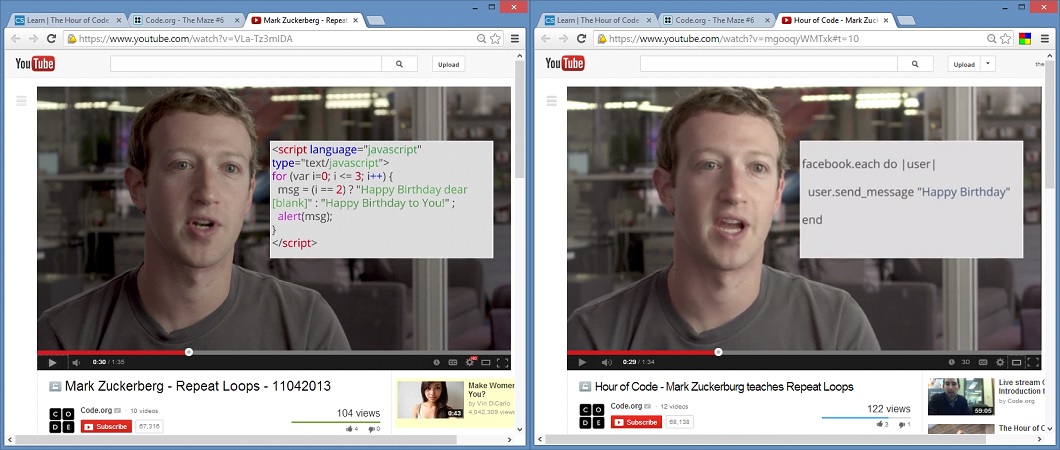
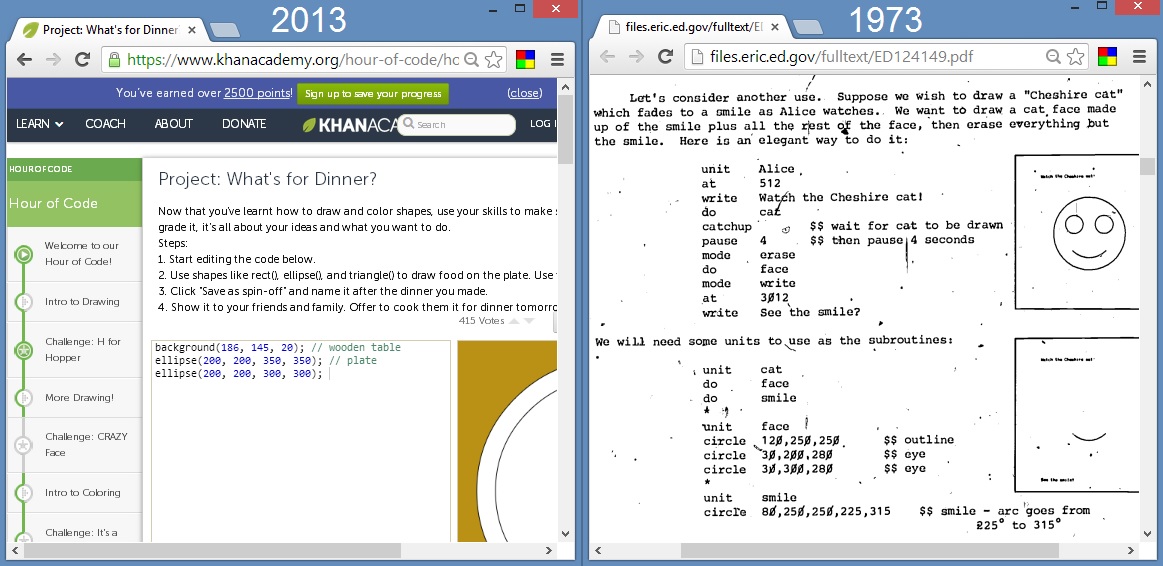
Zuckerberg Shows Kindergartners Ruby Instead of JavaScript
theodp writes "If one was introducing coding to 10 million K-12 kids over 5 days, one might settle on a programming language for examples more than a few weeks before D-Day. But the final tutorials for the Hour of Code aren't due now until the day they're to be taught, so Code.org was able to switch the example Facebook CEO Mark Zuckerberg uses to illustrate Repeat Loops from JavaScript to what looks like Ruby (earlier /. discussion of the JavaScript example), which will no doubt make things clearer for the kindergarten set working on the accompanying Angry Birds tutorial. Khan Academy, on the other hand, is sticking with JavaScript for its Hour of Code tutorial aimed at middle-schoolers, which culminates in a project showing the kids how they can draw a circular plate by invoking an ellipse function with equal major and minor axes. By the way, as Bret Victor might point out, the 2013 Khan Academy lesson looks a lot like circa-1973 PLATO!" -
Zuckerberg Shows Kindergartners Ruby Instead of JavaScript
theodp writes "If one was introducing coding to 10 million K-12 kids over 5 days, one might settle on a programming language for examples more than a few weeks before D-Day. But the final tutorials for the Hour of Code aren't due now until the day they're to be taught, so Code.org was able to switch the example Facebook CEO Mark Zuckerberg uses to illustrate Repeat Loops from JavaScript to what looks like Ruby (earlier /. discussion of the JavaScript example), which will no doubt make things clearer for the kindergarten set working on the accompanying Angry Birds tutorial. Khan Academy, on the other hand, is sticking with JavaScript for its Hour of Code tutorial aimed at middle-schoolers, which culminates in a project showing the kids how they can draw a circular plate by invoking an ellipse function with equal major and minor axes. By the way, as Bret Victor might point out, the 2013 Khan Academy lesson looks a lot like circa-1973 PLATO!" -
Zuckerberg Shows Kindergartners Ruby Instead of JavaScript
theodp writes "If one was introducing coding to 10 million K-12 kids over 5 days, one might settle on a programming language for examples more than a few weeks before D-Day. But the final tutorials for the Hour of Code aren't due now until the day they're to be taught, so Code.org was able to switch the example Facebook CEO Mark Zuckerberg uses to illustrate Repeat Loops from JavaScript to what looks like Ruby (earlier /. discussion of the JavaScript example), which will no doubt make things clearer for the kindergarten set working on the accompanying Angry Birds tutorial. Khan Academy, on the other hand, is sticking with JavaScript for its Hour of Code tutorial aimed at middle-schoolers, which culminates in a project showing the kids how they can draw a circular plate by invoking an ellipse function with equal major and minor axes. By the way, as Bret Victor might point out, the 2013 Khan Academy lesson looks a lot like circa-1973 PLATO!" -
Indian Mars Probe Successfully Enters Sun-Centric Orbit
New submitter palemantle writes with this excerpt from The Hindu, updating our earlier mention of the successful launch of India's Mars-bound probe: "In a remarkably successful execution of a complex manoeuvre, the Indian Space Research Organisation (ISRO) fired the propulsion system on board the spacecraft for a prolonged duration of 23 minutes from 0049 hours on Sunday. In space parlance, the manoeuvre is called Trans-Mars Injection (TMI). ISRO called it 'the mother of all slingshots.' Celebrations broke out at the control centre of the ISRO Telemetry, Tracking and Command Network (ISTRAC) at Bangalore from where the spacecraft specialists gave commands for the orbiter's 440 Newton engine to begin firing. The Mars Orbiter Mission (MOM), also known as Mangalyaan, is designed to demonstrate the technological capability to reach Mars orbit. But the $72m (£45m) probe will also carry out experiments, including a search for methane gas in the planet's atmosphere." -
No Shirt, No Shoes, No Service — and No Google Glass, Either
Seattle diners who want to take their food-tweeting pictures with Google glass were already facing a preemptively hostile environment; now (in a different restaurant), a diner's been asked to remove his Google Glass headset, or leave. He chose to leave. Maybe Faraday cages and anti-surveillance features will become the norm at the restaurants where things like Glass are most likely to appear. -
Woman Fined For Bad Review Striking Back In Court
An anonymous reader writes "Here's an update to the earlier Slashdot story about KlearGear.com 'fining' a couple for a bad review left four years earlier on RipoffReport: Not only did KlearGear report this as a bad debt to credit reporting agencies, but KlearGear is hiding behind a DomainsByProxy domain name to making finding their real identities harder. Now Public Citizen is representing the couple and is going after KlearGear for $75,000. The TV station that broke this story, KUTV, now reports that RipoffReport will likely be on the couple's side. The BBB and TRUSTe say their logos were used by KlearGear.com without permission, and credit reporting agency Experian is also investigating." -
Code.org Wants Participating Students' Data For 7 Years
theodp writes "As part of its plan to improve computer science education in the U.S., the Mark Zuckerberg and Bill Gates-backed Code.org is asking school districts to sign a contract calling for Code.org to receive 'longitudinal student achievement data' for up to seven academic years in return for course materials, small teacher stipends, and general support. The Gates Foundation is already facing a backlash from the broader academic community over attempts to collect student data as part of its inBloom initiative. The Code.org contract also gives the organization veto power over the district teachers selected to participate in the Code.org program, who are required to commit to teaching in the program for a minimum of two school years." -
With Burning Teslas In the News Ford Recalls Almost 140,000 Escapes
An anonymous reader writes "Tesla received a lot of attention over the Model S fires recently, but they're not the only car company having issues with spontaneous combustion. Ford has issued a recall on almost 140,000 Ford Escapes for potential engine fires. With little media attention on the recall, Musk might have a point about the unfair treatment Tesla gets in the news." -
With Burning Teslas In the News Ford Recalls Almost 140,000 Escapes
An anonymous reader writes "Tesla received a lot of attention over the Model S fires recently, but they're not the only car company having issues with spontaneous combustion. Ford has issued a recall on almost 140,000 Ford Escapes for potential engine fires. With little media attention on the recall, Musk might have a point about the unfair treatment Tesla gets in the news." -
Microsoft May Finally Put Windows RT Out To Pasture
onyxruby writes "Microsoft may finally be ready to put Windows RT out to pasture. After ignoring pundits, the public, and a staggering $900 writedown, the subsequent lack of sales for the second edition of the RT have finally gotten the message through. Speaking at a UBS seminar, Microsoft VP Julie Larson-Green said, 'It just didn't do everything that you expected Windows to do. So there's been a lot of talk about it should have been a rebranding. We should not have called it Windows (.DOCX). How should we have made it more differentiated? I think over time you'll see us continue to differentiate it more. We have the Windows Phone OS. We have Windows RT and we have full Windows. We're not going to have three.'" -
Psychologists Strike a Blow For Reproducibility
ananyo writes "Science has a much publicized reproducibility problem. Many experiments seem to be failing a key test of science — that they can be independently verified by another lab. But now 36 research groups have struck a blow for reproducibility, by successfully reproducing the results of 10 out of 13 past experiments in psychology. Even so, the Many Labs Replication Project found that the outcome of one experiment was only weakly supported and they could not replicate two of the experiments at all." -
Gift Review: Strandbeest Model Kit
Bennett Haselton has in years previous made some canny suggestions for tech-oriented holiday gifts; you can look forward to another one. Today, though, Bennett writes about one cool toy in particular: a kit to make your own creepy robot: "For over 20 years, Dutch inventor Theo Jansen has been building truck-sized sculptures that crab-walk eerily across the beach, using only the power of the wind to turn fan blades that power the gears and crankshafts and enable the walking motion. This kit allows you to assemble your own working model that 'walks' sideways across your desktop." Read on for the rest.The Strandbeest Model Kit is a home run in multiple categories. The box says "Ages 8 and up", and that seems about right (adult supervision recommended to make sure you're following all the assembly instructions exactly). It takes about 90 minutes to assemble (I timed it), which is enough to feel like a rewarding journey in itself, and not just an extra thing you have to do after you open the box. The work can be easily split between multiple people to make a family night out of it. The assembly instructions are reasonably clear and actually work. And the finished product actually does what the videos show it doing. (Most demo videos show the Strandbeest moving under the power of an air hose, but it works perfectly fine if you just blow on the fan.) When you can see all of the individual plastic parts moving in concert, it gives such an uncanny impression of an inanimate object come to life, that a few people that I showed the walking Strandbeest to, said that it "creeped them out". Like I said, home run.
And the kit provides a portal into the world of the full-sized Strandbeests, built from PVC pipe and corrugated cardboard by Dutch "kinetic sculptor" Theo Jansen. Of all of the links and videos that we keep sending each other about "amazing things around the world that you've never seen before", how could we have missed this?
Before or after you put the kit together, you and your kids can gorge on the over 20,000 Youtube videos showing the walking creatures. According to the BBC One piece, "Theo Jansen is evolving such clever designs that one day, he hopes they'll be able to leave home, and live permanently in the Dutch sand dunes." In the printed interview that comes with the assembly kit, Jansen says, "My ultimate goal is that the strandbeests stroll, eat, reproduce, and survive as as group on the beach without me," and I can't quite tell if he's kidding. The "reproduce" and "eat" parts are probably impossible, but as for "stroll" and "survive" -- if a future design becomes "smart" enough to change direction when it hit an incline, or to walk across uneven terrain, then couldn't they keep wandering in the sand dunes under the power of the wind, until one of the parts broke? Well, why not? I can imagine the full-size Strandbeests "in the wild" becoming such a tourist draw that they would need human volunteers at the beach just to stop visitors from getting too close and damaging them.
Until then, if you want to go in person to see one of the full-size Strandbeests walking alongside the ocean under the power of the wind, you'll probably have to check Theo Jansen's public event schedule when it ramps up again in the summer of 2014. According to his website, the studio is also open to the public year-round, where you can operate one of the non-wind-powered full-sized Strandbeests which has to be pushed or pulled manually. I'd be willing to go quite far out of my way to see one of these things up close, next time I'm anywhere in or near Holland.
The kit to build your own mini-beest is $35 from ThinkGeek. (When I wrote my gift guide last year, some people accused me of shilling for ThinkGeek, Slashdot's corporate cousin, but this year, they're owned by different parent companies, so suck it haterz.) Earlier versions of the kit cost about $70 and came only with Japanese instructions. Adam Savage from Mythbusters put one together in 45 minutes just from reading the diagrams, since he doesn't speak Japanese, but the rest of us will probably do better with the English version that is now finally available.
The kit comes with a "science and history guide" which, along with the interview with Jansen, describes the successive "generations" of Strandbeests he has built, and the new features that were added over the years, The models are described eerily like living creatures:
"Animals that can utilize wind energy to live do not need to eat food. This type of creature can dominate sandy beaches where there is an abundance of wind but not very much nutrients. This is a tremendous advantage to the strandbeests since they do not need to compete with the other animals in the nature."
In the "Vaporum period", Jansen added the ability for Strandbeests to harness energy from the wind and store it in the form of compressed air in plastic bottles attached to the bodies, which he calls "muscles". In the most recent "Cerebrum period", Jansen added the ability for different parts of the body to communicate using compressed air in polyurethane tubes, which he calls "nerves":
"When a sensory appendage, a polyurethane tube dragged behind on the ground, touches water, the beest turns itself around and walks away from the water, saving itself from drowning in the ocean. Furthermore, the beest is built with a step counter and a system to record its experience. From the second time around, the beest stops three steps in front of the memorized water line and turns itself around before its antenna hits the water."
To a steampunk fan, this must sound like one of their dreams come to life.
(Apparently a $60 coffee table book by Theo Jansen, describing the evolution of his designs and including a DVD with more video footage, also exists, but is currently out of stock.)
If you get hooked after putting your first Strandbeest together, there is at least one other model available, the mini Rhinoceros, currently only with Japanese assembly instructions. If the first English-language assembly kit is a hit, hopefully the instructions for the mini Rhinoceros kit will be translated into English some time in the next year.
In fact, judging from the quality of the "Engrish" on the box and in the "science and history" guide (presumably translated from Dutch by way of Japan), it looks as if the English-language translation was probably rushed in order to make the Christmas 2013 selling deadline -- the right decision, no doubt. (The assembly instructions, on the other hand, were clearly written by a native English speaker, and are easy to understand all the way through.) At first I the broken English detracted from the quality of the product, but now I kind of like the effect, since the writing gives the eerie feeling that the brilliantly designed object in your hands is a touchstone to a foreign culture much smarter than ours. All your beest are belong to us!
-
Gift Review: Strandbeest Model Kit
Bennett Haselton has in years previous made some canny suggestions for tech-oriented holiday gifts; you can look forward to another one. Today, though, Bennett writes about one cool toy in particular: a kit to make your own creepy robot: "For over 20 years, Dutch inventor Theo Jansen has been building truck-sized sculptures that crab-walk eerily across the beach, using only the power of the wind to turn fan blades that power the gears and crankshafts and enable the walking motion. This kit allows you to assemble your own working model that 'walks' sideways across your desktop." Read on for the rest.The Strandbeest Model Kit is a home run in multiple categories. The box says "Ages 8 and up", and that seems about right (adult supervision recommended to make sure you're following all the assembly instructions exactly). It takes about 90 minutes to assemble (I timed it), which is enough to feel like a rewarding journey in itself, and not just an extra thing you have to do after you open the box. The work can be easily split between multiple people to make a family night out of it. The assembly instructions are reasonably clear and actually work. And the finished product actually does what the videos show it doing. (Most demo videos show the Strandbeest moving under the power of an air hose, but it works perfectly fine if you just blow on the fan.) When you can see all of the individual plastic parts moving in concert, it gives such an uncanny impression of an inanimate object come to life, that a few people that I showed the walking Strandbeest to, said that it "creeped them out". Like I said, home run.
And the kit provides a portal into the world of the full-sized Strandbeests, built from PVC pipe and corrugated cardboard by Dutch "kinetic sculptor" Theo Jansen. Of all of the links and videos that we keep sending each other about "amazing things around the world that you've never seen before", how could we have missed this?
Before or after you put the kit together, you and your kids can gorge on the over 20,000 Youtube videos showing the walking creatures. According to the BBC One piece, "Theo Jansen is evolving such clever designs that one day, he hopes they'll be able to leave home, and live permanently in the Dutch sand dunes." In the printed interview that comes with the assembly kit, Jansen says, "My ultimate goal is that the strandbeests stroll, eat, reproduce, and survive as as group on the beach without me," and I can't quite tell if he's kidding. The "reproduce" and "eat" parts are probably impossible, but as for "stroll" and "survive" -- if a future design becomes "smart" enough to change direction when it hit an incline, or to walk across uneven terrain, then couldn't they keep wandering in the sand dunes under the power of the wind, until one of the parts broke? Well, why not? I can imagine the full-size Strandbeests "in the wild" becoming such a tourist draw that they would need human volunteers at the beach just to stop visitors from getting too close and damaging them.
Until then, if you want to go in person to see one of the full-size Strandbeests walking alongside the ocean under the power of the wind, you'll probably have to check Theo Jansen's public event schedule when it ramps up again in the summer of 2014. According to his website, the studio is also open to the public year-round, where you can operate one of the non-wind-powered full-sized Strandbeests which has to be pushed or pulled manually. I'd be willing to go quite far out of my way to see one of these things up close, next time I'm anywhere in or near Holland.
The kit to build your own mini-beest is $35 from ThinkGeek. (When I wrote my gift guide last year, some people accused me of shilling for ThinkGeek, Slashdot's corporate cousin, but this year, they're owned by different parent companies, so suck it haterz.) Earlier versions of the kit cost about $70 and came only with Japanese instructions. Adam Savage from Mythbusters put one together in 45 minutes just from reading the diagrams, since he doesn't speak Japanese, but the rest of us will probably do better with the English version that is now finally available.
The kit comes with a "science and history guide" which, along with the interview with Jansen, describes the successive "generations" of Strandbeests he has built, and the new features that were added over the years, The models are described eerily like living creatures:
"Animals that can utilize wind energy to live do not need to eat food. This type of creature can dominate sandy beaches where there is an abundance of wind but not very much nutrients. This is a tremendous advantage to the strandbeests since they do not need to compete with the other animals in the nature."
In the "Vaporum period", Jansen added the ability for Strandbeests to harness energy from the wind and store it in the form of compressed air in plastic bottles attached to the bodies, which he calls "muscles". In the most recent "Cerebrum period", Jansen added the ability for different parts of the body to communicate using compressed air in polyurethane tubes, which he calls "nerves":
"When a sensory appendage, a polyurethane tube dragged behind on the ground, touches water, the beest turns itself around and walks away from the water, saving itself from drowning in the ocean. Furthermore, the beest is built with a step counter and a system to record its experience. From the second time around, the beest stops three steps in front of the memorized water line and turns itself around before its antenna hits the water."
To a steampunk fan, this must sound like one of their dreams come to life.
(Apparently a $60 coffee table book by Theo Jansen, describing the evolution of his designs and including a DVD with more video footage, also exists, but is currently out of stock.)
If you get hooked after putting your first Strandbeest together, there is at least one other model available, the mini Rhinoceros, currently only with Japanese assembly instructions. If the first English-language assembly kit is a hit, hopefully the instructions for the mini Rhinoceros kit will be translated into English some time in the next year.
In fact, judging from the quality of the "Engrish" on the box and in the "science and history" guide (presumably translated from Dutch by way of Japan), it looks as if the English-language translation was probably rushed in order to make the Christmas 2013 selling deadline -- the right decision, no doubt. (The assembly instructions, on the other hand, were clearly written by a native English speaker, and are easy to understand all the way through.) At first I the broken English detracted from the quality of the product, but now I kind of like the effect, since the writing gives the eerie feeling that the brilliantly designed object in your hands is a touchstone to a foreign culture much smarter than ours. All your beest are belong to us!
-
Speed Test 2: Comparing C++ Compilers On WIndows
Nerval's Lobster writes "In a previous posting, developer and programmer Jeff Cogswell compared a few C++ compilers on Linux. Now he's going to perform a similar set of tests for Windows. "Like all things Windows, it can get costly doing C++ development in this environment," he writes. "However, there are a couple notable exceptions" such as free and open-source cygwin, mingW, Express Versions of Visual Studio, and Embacadero. He also matched up the Intel C++ Compiler, Microsoft C++ Compiler, and the Embarcadero C++ 6.70 Compiler. He found some interesting things — for example, Intel's compiler is pretty fast, but its annoying habit of occasionally "calling home" to check licensing information kept throwing off the rests. Read on to see how the compilers matched up in his testing." -
Speed Test 2: Comparing C++ Compilers On WIndows
Nerval's Lobster writes "In a previous posting, developer and programmer Jeff Cogswell compared a few C++ compilers on Linux. Now he's going to perform a similar set of tests for Windows. "Like all things Windows, it can get costly doing C++ development in this environment," he writes. "However, there are a couple notable exceptions" such as free and open-source cygwin, mingW, Express Versions of Visual Studio, and Embacadero. He also matched up the Intel C++ Compiler, Microsoft C++ Compiler, and the Embarcadero C++ 6.70 Compiler. He found some interesting things — for example, Intel's compiler is pretty fast, but its annoying habit of occasionally "calling home" to check licensing information kept throwing off the rests. Read on to see how the compilers matched up in his testing." -
Speed Test 2: Comparing C++ Compilers On WIndows
Nerval's Lobster writes "In a previous posting, developer and programmer Jeff Cogswell compared a few C++ compilers on Linux. Now he's going to perform a similar set of tests for Windows. "Like all things Windows, it can get costly doing C++ development in this environment," he writes. "However, there are a couple notable exceptions" such as free and open-source cygwin, mingW, Express Versions of Visual Studio, and Embacadero. He also matched up the Intel C++ Compiler, Microsoft C++ Compiler, and the Embarcadero C++ 6.70 Compiler. He found some interesting things — for example, Intel's compiler is pretty fast, but its annoying habit of occasionally "calling home" to check licensing information kept throwing off the rests. Read on to see how the compilers matched up in his testing." -
Why Scott Adams Wished Death On His Dad
theodp writes " I hope my father dies soon," Dilbert creator Scott Adams wrote Saturday in a frustrated, angry, and poignant blog post. 'My father, age 86, is on the final approach to the long dirt nap (to use his own phrase). His mind is 98% gone, and all he has left is hours or possibly months of hideous unpleasantness in a hospital bed. I'll spare you the details, but it's as close to a living Hell as you can get. If my dad were a cat, we would have put him to sleep long ago. And not once would we have looked back and thought too soon. Because it's not too soon. It's far too late. His smallish estate pays about $8,000 per month to keep him in this state of perpetual suffering. Rarely has money been so poorly spent. I'd like to proactively end his suffering and let him go out with some dignity. But my government says I can't make that decision. Neither can his doctors. So, for all practical purposes, the government is torturing my father until he dies.' Adams also had harsh words for those who would oppose assisted suicide, 'I don't want anyone to misconstrue this post as satire or exaggeration. So I'll reiterate. If you have acted, or plan to act, in a way that keeps doctor-assisted suicide illegal, I see you as an accomplice in torturing my father, and perhaps me as well someday. I want you to die a painful death, and soon. And I'd be happy to tell you the same thing to your face.' His father passed a few hours after Adams wrote his screed. Challenged later by the SF Chronicle's Debra J. Saunders, an opponent of assisted suicide, Adams stood firm on his earlier words. So, can Adams succeed in convincing the U.S. where Dr. Jack failed?" -
Science Museum Declines To Show Climate Change Film
sciencehabit writes "A premier science museum in North Carolina has sparked controversy by refusing to show an hour long film about climate change and rising sea levels. The museum may be in a bit of a delicate position. It is part of a state agency, the North Carolina Department of Environment and Natural Resources. The state government has been perceived as hostile to action on climate change; last year, the legislature passed a bill forbidding the state coastal commission from defining rates of sea-level rise for regulation before 2016."