Slashdot Mirror
Domain: slashdot.org
Stories and comments across the archive that link to slashdot.org.
Stories · 37,380
-
Should Google Get Aggressive About Monetizing Android?
Nerval's Lobster writes "Google's core search-advertising business is slowing down (despite an uptick in revenue and earnings for the most recent quarter) and a new report suggests that advertising ROI is much higher on iOS than Android. In light of that, it's worth asking whether Google, having dominated much of the mobile-device market with Android, will ever get around to more aggressively monetizing its mobile operating system, and what that could mean to the manufacturers that have been loading the software for free onto their hardware. If Google started charging licensing fees to manufacturers, and attempted to clamp down so that Google Play served as the only hub for Android apps (something that would definitely put it on a collision course with Amazon, which boasts its own Android app store), would it be shooting itself in the foot? Or would the rest of the ecosystem respond in a muted way, considering the sheer size of Google's power and presence?" -
Windows 8.1 Rolls Out Today
The newest iteration of Windows has begun rolling out, and is winning positive reviews. (Here's an in-depth review from Ars, and a more concise one from Wired — both give 8.1 a thumbs-up). Kelerei wrote with the above-linked TechDirt article on the release, noting that it is a staged rollout rather than global. Starting this morning, though, 8.1 is available to some customers. Kelerei writes: "The upgrade is optional (and free) for existing Windows 8 users, though if one looks at the changes, it's hard to imagine why those already on it wouldn't upgrade." Also at Slash BI. -
Windows 8.1 Rolls Out Today
The newest iteration of Windows has begun rolling out, and is winning positive reviews. (Here's an in-depth review from Ars, and a more concise one from Wired — both give 8.1 a thumbs-up). Kelerei wrote with the above-linked TechDirt article on the release, noting that it is a staged rollout rather than global. Starting this morning, though, 8.1 is available to some customers. Kelerei writes: "The upgrade is optional (and free) for existing Windows 8 users, though if one looks at the changes, it's hard to imagine why those already on it wouldn't upgrade." Also at Slash BI. -
Online Journalism Is Becoming a Billionaires' Plaything (Again)
Nerval's Lobster writes "In the 1941 film Citizen Kane, the titular newspaper magnate (played with cheeky insouciance by Orson Welles) gleefully tells a doubter that he's prepared to lose a million dollars every year in order to keep publishing. "At a rate of a million dollars a year," he smirks, "I'll have to close this place in 60 years." Over the past decade, of course, many newspapers and magazines have lost a lot more than a million dollars a year, and there are signs that online publications are having trouble holding their finances together, as well. But some very rich people are stepping in to prop things up: first Amazon CEO Jeff Bezos bought The Washington Post for $250 million, then eBay founder Pierre Omidyar offered journalist Glenn Greenwald a whole lot of cash to start up a general interest publication. Billionaires and multimillionaires, of course, have total freedom to fund whatever they want—and that could be a good thing for publications with a mission and a serious need for cash. But what if the rich investor disagrees with something that his pet publication releases into the world? If (and when) that situation occurs, it could serve as an interesting test of whether the latest version of this "generous benefactor" model can work more effectively as an impartial channel for news than it has in the past (when conflicts of interest often sparked titanic fights between editors and owners)." -
Most Parents Allow Unsupervised Internet Access To Children At Age 8
colinneagle writes "The timing for this study is interesting, given the arrests of two teenagers believed to have bullied a 12-year-old classmate until she committed suicide, but Microsoft found that 94% of parents said they allow their kids unsupervised access to at least one device or online service like email or social networks. The average age at which most children are allowed access to at least one online service, such as email or social media, was 8 years old, while 40% allow children under the age of 7 to access a computer unsupervised." -
Blizzard Wins Legal Battle Against WoW Bot Company
New submitter gamersunited writes with news of Blizzard Entertainment's defeat of another company that created bot software to automate World of Warcraft characters. Ceiling Fan Software faces a judgment of $7 million, and must disable any active licenses for the software. They're also forbidden from transferring or open-sourcing the bot software, and from facilitating its continued use in any way. The court order (PDF) follows more than two years of legal wrangling. Blizzard won a similar judgment a few years ago against another bot company called MDY Industries, which created the popular Glider bot. -
Snapchat Search Warrants Emphasize Data Vulnerability
Nerval's Lobster writes "This year's revelations about NSA surveillance have upended the idea that our data—any of it—is truly secure from prying eyes. That uncertainty has sparked the rise of several businesses with a simple proposition: you can send whatever you want via their online service (text, images, video), and that data will vaporize within seconds of the recipient opening it up. One of the most popular of those services is Snapchat, which allows users to take "Snaps" (i.e., videos or photos) that self-destruct a few seconds after the recipient opens them; that data also disappears from the company's servers. But is 'disappearing' data truly secure from prying eyes? Earlier this week, Snapchat admitted to a loophole in its schema that leaves Snaps open to viewing by law enforcement — provided the latter shows up at the company's front door with a warrant. Until a recipient opens a Snap, it's stored in the company's datacenter. In theory, law enforcement could request that Snapchat send it an unopened Snap. 'If we receive a search warrant from law enforcement for the contents of Snaps and those Snaps are still on our servers,' read an Oct. 14 posting on Snapchat's corporate blog, 'a federal law called the Electronic Communications Privacy Act (ECPA) obliges us to produce the Snaps to the requesting law enforcement agency.' Law-enforcement entities have hit Snapchat with 'about a dozen' search warrants for unopened Snaps since May 2013. 'Law enforcement requests sometimes require us to preserve Snaps for a time, like when law enforcement is determining whether to issue a search warrant for Snaps,' the blog continued. That surveillance could also go beyond unopened Snaps: Snapchat 'Stories,' or a cluster of Snaps, live on the company's servers for up to 24 hours and can be viewed multiple times, which broadens the window for law enforcement to poke its way in." -
1.5 Meter Long Meteorite Fragment Recovered From Russian Lake
MancunianMaskMan writes "The BBC writes about the meteorite that fell from the sky 8 months ago: 'The object plunged into Lake Chebarkul in central Russia on 15 February, leaving a 6m-wide hole in the ice. Scientists say that it is the largest fragment of the meteorite yet found.'" This is one of the ten largest meteorite fragments ever recovered. Unfortunately, it broke into three pieces after being lifted from the lake, and managed to destroy the scale used to weigh it when it hit 570kg. -
35,000 vBulletin Sites Have Already Been Exploited By Week Old Hole
realized writes "Last week Slashdot covered a new vBulletin exploit. Apparently hackers have been busy since then because according to security firm Imperva, more than 35,000 sites were recently hacked via this vulnerability. The sad part about this is that it could have all been avoided if the administrator of the websites just removed the /install and/or /core/install folders – something that you would think the installer should do on its own." Web applications that have write access to directories they then load code from have always seemed a bit iffy to me (wp-content anyone?) -
Under the Hood With Battlefield 4
MojoKid writes "EA took the wraps off Battlefield 4 this past week, offering players a chance to try an early beta. AMD has also been talking up Battlefield 4 in combination with their new Radeon R series line with a vengeance, highlighting the features of its new Mantle API and close partnership with DICE, Battlefield 4's developer. Sometimes, enough modest changes evolve into an entirely new product, and when you factor in the tessellation improvements, terrain deformation, Mantle API support, enhanced audio cues, and better particle effects, that's what BF4 is shaping up to be. And it appears likely the game is going to be a premiere title across all of the current and future consoles plus PCs. Battlefield 4 is going to be closely watched for a number of reasons; Mantle performance, comparisons between the Xbox 360 / PS3 and Xbox One / PS4 versions, and, of course, on its own merits." -
Ask Slashdot: Why Isn't There More Public Outrage About NSA Revelations?
Nerval's Lobster writes "This morning we discussed news that the National Security Agency (NSA) has siphoned up millions of online address books and contact lists. The Post drew its information from top-secret documents provided by government whistleblower Edward Snowden, who spent the summer feeding information about the NSA to a variety of news outlets. Snowden's documents (as outlined in The Guardian, Spiegel Online and other venues) have detailed a massive NSA program that's siphoning all sorts of personal information from a variety of sources — and yet the public seems to have greeted each new revelation with weakening outrage. Whereas the initial news reports about NSA splying in June kicked off a firestorm of controversy and discussion (aggravated by the drama of Snowden seeking asylum in pretty much any country that would have him), the unveiling of the NSA's Great Contact-List Caper has ranked below the news stories such as the government shutdown, negotiations over Iran's nuclear program, and invites for Apple's upcoming iPad event on aggregators such as Google News; it also didn't make much of a blip on Twitter and other online forums. There's the very real possibility that Americans, despite the assurances of government officials, are being monitored in a way that potentially violates their privacy. Surely that's an issue that concerns a great many individuals; and yet, as time goes by, it seems as if people are choosing to focus on other things. Are we suffering from 'surveillance fatigue?'" -
Ask Slashdot: Why Isn't There More Public Outrage About NSA Revelations?
Nerval's Lobster writes "This morning we discussed news that the National Security Agency (NSA) has siphoned up millions of online address books and contact lists. The Post drew its information from top-secret documents provided by government whistleblower Edward Snowden, who spent the summer feeding information about the NSA to a variety of news outlets. Snowden's documents (as outlined in The Guardian, Spiegel Online and other venues) have detailed a massive NSA program that's siphoning all sorts of personal information from a variety of sources — and yet the public seems to have greeted each new revelation with weakening outrage. Whereas the initial news reports about NSA splying in June kicked off a firestorm of controversy and discussion (aggravated by the drama of Snowden seeking asylum in pretty much any country that would have him), the unveiling of the NSA's Great Contact-List Caper has ranked below the news stories such as the government shutdown, negotiations over Iran's nuclear program, and invites for Apple's upcoming iPad event on aggregators such as Google News; it also didn't make much of a blip on Twitter and other online forums. There's the very real possibility that Americans, despite the assurances of government officials, are being monitored in a way that potentially violates their privacy. Surely that's an issue that concerns a great many individuals; and yet, as time goes by, it seems as if people are choosing to focus on other things. Are we suffering from 'surveillance fatigue?'" -
Irish Government May Close Apple's Biggest Tax Loophole
DavidGilbert99 writes "Ireland and its tax system came under some extreme scrutiny earlier this year when it was revealed that Apple funneled billions of dollars of revenue though three subsidiaries based in the country. Thanks to a loophole, none of these subsidiaries were tax-resident in Ireland, meaning they didn't even have to pay Ireland's relatively low 12.5% corporation tax rate. Worryingly for Apple, Ireland's finance minister may now shut this loophole. A measure within a new budget bill (PDF) would disallow Apple's status as a 'stateless' corporate entity for tax purposes. Apple will still be able to select a country like Bermuda as its tax residence, but it's a step in the right direction." -
Anant Agarwal Answers Your Questions About edX and the Future of Education
A few weeks ago you had the chance to ask the President of edX, Anant Agarwal, about the future of education and the growth of MOOCs. Below you'll find his answers to your questions. Could someone set up an archive site ?
by Taco Cowboy
The other day I was looking up an open course offered by Harvard that I had meant to try my hands on for the past few years (I know, I know, I procrastinated). I googled it up and clicked on the link - and long and behold, the Harvard server told me that the course had been deleted, due to some "incompatibility" of the video format and their new hardware, or something like that. I did not take that course. I have no idea if it was good or not. What if it was an excellent course ? Now that that particular course is gone (a few lessons still can still be had on youtube), the opportunity cost for many people does accumulate. If there was only an archive site for all the open-courses, wouldn't that be great ?
Agarwal: I know, why do today what you can put off till tomorrow :-) Seriously, a large number of our learners like you just want to audit a course and prefer it to be always available. For that reason, a significant number of our previous courses are indeed offered as "past courses" or "archived courses". You will see this on the announcements page when you go into such an archived course: "This is a past/archived course. Certain features of this course may not be active, but we still invite you to explore the available materials." To see archived courses you can click on courses at edx.org, select courses, and then select past courses. For example, the justice course from HarvardX is available as an archived course at: edx.org. In general, we strongly encourage our university partners to offer their past courses as archived courses. A few courses (like the one you tried perhaps) are not offered as an archived course. There are several reasons why a university might choose not to offer their course as an archived course. The next version of the course might have started, and so they might take down the archived course because they reuse some of the questions which have their answers available as handouts. Or, the course might need significant resources to run, for example, special grading servers may need to be maintained, for which they may not have resources.
Professors
by pyrognat
Dear Anant,
I am a young researcher at your own institution. One might think that online courses (such as those offered by edX) will make professors (at least those who teach) obsolete. What role do you see professors playing in the future of education? As someone on that career path, I am particularly interested in your views.
Sincerely,
Nathaniel Stapleton
Agarwal: First, let me point out that professors have been using various forms of online learning for decades, so what edx and others are doing with moocs is simply taking what we have been doing to the next level in terms of scalability and quality.
Think of online learning and platforms to create great online course material not as making teachers obsolete, but as tools for teachers, which will enable them to do a lot more than they could previously with the time they had. Sadly, among the few teaching tools we have given professors in the past few centuries has been a piece of chalk. Blogging sites and online news did not make journalists obsolete, rather created 10 million journalists, while making news much more interactive and exciting. In much the same manner, online learning has the potential to transform education. Online learning and moocs can give existing professors new tools to create additional modalities of teaching. Professors and soon-to-be professors like yourself that are quick to experiment with these new tools, are likely to find success, creating new ways of engaging our millennial generation of students who are perfectly comfortable texting, tweeting, blogging, emailing, moocing, youtubing, slashdotting ( :-) ) and snapchating.
We have also been experimenting with blended models of education where you combine the best of online and in person. Initial results are promising. In one these blended model experiments in which we collaborated with san jose state university, the students watched videos, did online exercises and virtual labs on the edx online platform, and then came to class for in-person activity including working in small groups and interacting with the professor to get a deeper understanding of the material. The pass rate for this course went from a traditional average of about 60% to 90% with the blended class. Research by Brewlow et al (you can see paper at edx.org also shows that student success in a mooc course was positively correlated with working with an instructor or mentor.
Making money
by peter303
How do the VCs plan to make back their investments? That was not clear to me.
Agarwal: edX is a non-profit startup, but we still need to be self-sustaining. So we are exploring several business models spanning both B2C and B2B. Unlike other MOOC providers, since edX is a non-profit, we do not have VC investors, rather we have institutional funders including MIT and Harvard. Many of our university partners such as the UT system have also contributed $s to our cause. One can view these initial contributions as an early round of investment in edX. In the B2C space, we use a freemium model. Students can take our courses for free, and they can even get an honor code certificate for free. However, we charge a small fee for ID verified certificates. In addition to the fee for the ID verified certificate (typically between $25 and $100 for a course), we offer the students the opportunity to contribute voluntarily to our cause by paying more than the minimum fee.
In the B2B space, we work with corporations, NGO, governments and state university systems. Here, edX hosts the platform for the institution, and the institution offers its courses on our platform for their employees or for other targeted learners. They pay edX for various services such as hosting, education services, training, etc. We have a number of such partnerships underway, including one with IMF.
What about moving to an badges based system
by Joe_Dragon
Where courses can be more right sized and not jammed / padded out into the older collgle time table system. Where you don't have to take a big 2-4-6+ year block of time to get something that says to you know some thing. It can also make ongoing education / learning new skills have more meaning as well. What about merging Professional certification systems into an over all badges based system? Do you think this is an good idea?
Agarwal: This is a good idea.
Good old degrees with 4 years in college, in stove-piped departments are an antediluvian concept. Why 4 years? My bachelor's degree at IIT madras was a 5-year program, and I probably use 20% of that in my job at this point in my life. Why specialize in one field? In today's fast moving, nimble world, learners and employers are looking for multidisciplinary education. Further, they are looking to refresh their skills as the workplace needs change.
A degree, fundamentally, is a signaling mechanism. It tells an employer that the holder likely has a set of skills. In the modern world, employers are looking for a diverse set of skills. So a promising alternative is one where learners acquire a traditional degree for 2 years (certainly less than the traditional 4 years), so that they can satisfy the bean-counting HR folks that need to see something that spells degree on the resume (and that will go away too with time). Then, the learner augments that with various other signals -- call them badges, or mooc-style certificates, so that employers can now see the whole portfolio.
A couple of weeks ago, edX also announced another interesting signaling mechanism, an XSeries certificate. Here a learner can take a sequence of courses in a given discipline on edx, and by passing all the courses in the sequence, earn an XSeries certificate. MIT and edX announced XSeries certificates in foundations of computer science and supply chain management for a start. Some of you have commented that individual courses do not mean much to employers, but mastery of a discipline is akin to a mini-masters or a minor program, and is meaningful. We believe these XSeries credentials from edX will have strong signaling value to employers and take MOOC credentialing and badging one additional step forward.
I can go on and on about this. I believe that in the future degree transcripts will be replaced by a colorful portfolio of credentials, including badges and certificates. OK OK, and degrees too, for backwards compatibility.
Why not get rid of the Honor Code?
by blue trane
The Honor Code seems like a holdover from obsolete old educational methods. It seeks to make the free and open sharing of information somehow dishonorable.Often students want to help each other in the forums. The quizzes and exercises can provide interesting applications that the instructor didn't go over in the videos. Why censor a student who, of his own free will, wants to help out another student?
The Honor Code, in forbidding explicit help to questions on assignments, encourages deviousness and obfuscation in the forums. Often, posts will be made deliberately vague, so that one has to make guesses, or "read between the lines", or try to mind-read. Wouldn't it be better to encourage clear, simple explanations on the forums? Students are sometimes as (or more) knowledgeable than the instructors, and can explain things in a better, simpler way. Often the instructors have been at the subject so long that they've forgotten what it's like to look at the material for the first time. Other students can fill in the gaps. But the Honor Code works against this type of peer-helping-peer interaction, because often the most interesting applications of the subject are in the exercises.
When I've argued for the dissolution of the Honor Code before, one response has been: you just have to wait until after the deadline. However this response is not adequate, because often the deadlines are a few weeks off. When a student is engaged in a particular problem, that is the most opportune time for him to learn. I've had questions I couldn't answer, and haven't gone back to check how to do them after the deadline passes, because I'm now involved in something else...
I think the Honor Code works against the spirit of openness and freedom of speech that the internet was founded on. What kind of skills are you trying to teach, by enforcing the Honor Code? Does a client care whether you "cheated" by looking up the answer to a programming problem on the internet, when you're writing a program for him?
I think there are better technological solutions than enforcing an archaic Honor Code. Can you put a "spoiler" tag on posts that reveal how to do an assignment question, and reward those students who don't click on those posts? You're supposed to be tracking our every click...
Agarwal: The question about the honor code brings up fundamental issues about teaching and learning and the answer is not obvious. Our current education approach, whether online or in person, attempts to address two distinct issues: learning and student assessment.
Assessment attempts to verify that the student has learned the given material and has achieved a certain level of mastery in the subject. EdX and our partner universities give an honor code certificate to students who pass the course, as measured by assessments like homeworks and exams. These certificates are highly valued by a significant proportion of our learners. They often serve as signaling credentials to employers for example.
For the honor code certificate granted to an individual student to mean something as a signaling mechanism indicating mastery of the material in the course, the assessment method must represent the student’s own level of accomplishment (at least to the extent allowed by the honor code) and not that of the collaboration group to which the student belonged, or the person from whom the student may have gotten an answer. Without an honor code, there would be no honor code certificate. And hence the honor code.
Of course, we have a number of continuing learners to whom the honor code certificate, and hence the honor code, is not important. They are simply interested in learning the material, and do not care about earning a signaling mechanism. For this class of learners, we make our courses available as archived courses once their final assessments have passed their due date. Archived courses have all the answers readily available, but do not offer a certificate. Here, students can discuss answers without any worry about the honor code because there is no certificate attached.
Prestige of Online Degrees
by Calsar
I received an under graduate and master’s degree from traditional universities. I also received two masters’ degrees through on-line classes. In my opinion programs like edX are the future of education, but on-line degrees are still not regarded with the same level of prestige as those received through traditional education. In part this has been due to questionable practices of some on-line educational institutions. How can this perception be changed and do you have and do you have any plans in that regard?
Agarwal: Indeed, online education has been around for several decades. But online degrees and credentials were previously not as highly regarded as those obtained through campus education. There were a number of reasons for this beyond those that you have identified including the poorer quality of the education and relatively low success rates compared to campus programs.
This trend has changed completely in the past year for several reasons. First, reputable non-profit institutions like MIT, Harvard, Stanford, and Berkeley and their star faculty are embracing MOOCs and online learning wholeheartedly, and validating online education. To be sure, these institutions were also experimenting with online learning for decades, but their recent public endorsement and huge investments in MOOCs and rigorous online education has really helped the field gain a new respect. Imagine, you can now take online one of the world’s best AI course from Dan Klein and Pieter Abbeel from Berkeley.
Second, recent advances in computing and communications have completely altered online education and dramatically improved its quality. Content distribution networks have transformed high quality video delivery. Cloud computing enables elastic scaling to hundreds of thousands of learners and provide instant feedback for learning exercises. Social networking and discussion forums enable peer to peer learning at a global scale. And massive amounts of computing power in the palm of our hand has enabled us to offer simulation based virtual laboratories with online game-like-interaction latencies. Of course, getting large numbers of the world’s great instructors to experiment with online teaching helps online education quality more than any technology. New technologies like virtual labs and the efforts of leading instructors have enabled us to offer courses whose rigor is similar to that of campus courses.
Third, reputed universities are offering credentials like free honor code certificates for passing online courses. The introduction of ID verified certificates for a small fee adds even more to the credibility of the credential.
These are some examples of approaches that have improved the perception of online education. However, we can do a lot more. We are working with campuses to blend online learning with in-person education. Initial results in student outcomes at institutions like San Jose State University, Mass Bay Community College, and Bunker Hill Community College, are very promising. As more of these blended experiments yield good results, the perception of online learning will continue to improve, and be viewed not as an alternative to on-campus learning, but rather as complementary to it.
Motivation in Online Courses
by Eric Hosman
Motivation plays a large role in any educational setting, but this is especially true in online courses. How do you best maintain a learner's motivation after the initial novelty has worn off? Online educational opportunities attract a wide array of learners, and we can't expect them all to be intrinsically motivated at a level consistent enough to complete a course, even if they are taking it for college credit or future growth opportunities. What are the best techniques to keep as many learners as possible engaged throughout an online course.
Agarwal: As we listen to our students who are taking MOOCs, or understand the correlators to success from researchers who are studying the big data of learning, we are seeing a number of approaches to increase student motivation and improve outcomes. Here are some of them.
A recent study by Lori Breslow et al edx.org found that students were motivated and had a better chance at success if they worked in groups. Anecdotal data also points to this result. I was chatting with a learner who was taking an edX course in Krgezistan and he had to drop out half way. Later he told me that he discovered that there were three other students taking the same class in his town close to where he lived, and had he known that, he would have connected with them and stayed the course. Following these learnings, we are encouraging our students to form study groups through meetups, and facilitating this with links to meetup sites in the course introduction email.
We are hearing from our learners that the certificate is a big part of the motivation. Although you can audit a course, we are giving free honor code certificates, and also ID verified certificates to our students for a small fee. EdX also provides an online link with a unique identifier for each of these certificates so that an employer can verify that the certificate is indeed authentic. Students are linking these certificates on their various social pages and on their resumes.
Many learners and employers have also asked us to create sequences of courses, so they have a program that they can follow. In response to this demand, we launched XSeries, a sequence of courses in a discipline. A student can also obtain a certificate for an XSeries. We believe that programs such as this will increase the motivation of students to complete their existing course, so they can go on to the next one, eventually earning an XSeries certificate to indicate mastery in a given discipline.
MOOCs more about Teachers than Learners
by IRGlover
As social creatures much of our knowledge is built from social interactions, where we integrate our own experiences and beliefs with that of others to build new knowledge and understanding (i.e. Social Constructivism). The current dominant MOOC model is extremely procedural, teacher-centered and discourages these types of social interactions. While this works well for some subjects (particularly at introductory levels), it is much less effective in other situations. How can the large MOOC platforms, and EdX in particular, encourage a more social method of learning?
Agarwal: I am not sure I agree with your thesis that the current dominant MOOC model is extremely procedural. Although many components are procedural, social and peer learning is a central part of MOOC platforms. Take the example of the discussion forum. Learners post questions on the forum, and a majority of the answers and discussion comes from peer learners. Many students are telling us that they are learning by teaching on the forum.
Based on feedback from many of our colleagues in the humanities where the small discussion group is a central part of the learning process, we created the concept of cohorts in the discussion forum. Cohorts enable us to create many smaller groups and assign each student to a specific cohort. A number of courses such as the Greek Heroes course from HarvardX and the Copyright Law course also from HarvardX used this mechanism during Spring 2013. Harvard went a step further and engaged their alumni to help as community moderators in each of these cohorts.
Many courses are taking advantage of the international diversity of the students on the platform to conduct course related studies and discussions. The Public Health course from Harvard for example did a study where they surveyed their worldwide students in the course in how they did certain things in their part of the world, and then discussed it on the forums. Such diversity and numbers are simply not possible in a campus class.
We have a wiki on the platform as part of each course where students work together and contribute material. In fact, in some of the courses the wiki notes produced by students are so good that it would not take the group much additional effort to turn the set of notes into a textbook.
For question types where the computer is not great at grading, we support peer grading, in which students grade each other’s work. Here again, the peer group is key to the learning and assessment process.
That said, we can and should do even more to take advantage of the peer learning effects that are possible with MOOCs. Here is but one example of the many that we have been thinking about.
It turns out that we can post some of our simulation laboratories on the wiki where students can collaborate on labs. Imagine asking the students to work together to solve a lab problem working jointly to design a circuit. In fact, when we posted our simulation lab tool on the wiki just for fun in the 6.002x circuits course, we had a student who had begun the design of a circuit on the wiki, and had then stepped out for a break. When he returned, he noticed his circuit had changed and he reported to us that the tool was buggy. Little did he realize that his circuit had been modified by an unknown collaborator probably from around the world!
Are teaching faculty dead?
by Anonymous Coward
Currently, many 2nd and 3rd tier universities rely heavily on (cost-effective) adjuncts and teaching-only "lecturers" for the majority of the instructional duties. To further maximize revenue, these schools could replace adjuncts and lecturers with MOOCs taught by professors at 1st tier universities. Are lecturers and adjuncts dead?
Agarwal: I believe the exact opposite will happen! I predict that 10 years from now there will be a much greater number of adjuncts and lecturers, and a much greater choice of courses for students in 2nd and 3rd tier universities. Similarly, the quality of education will also increase in all universities, whether 1st tier or 3rd tier. Read on.
Think of online learning and platforms to create great online course material not as making teachers obsolete, but as tools for teachers, which will enable them to do a lot more than they could previously with the time they had. Sadly, one of the few teaching tools we have given professors in the past few centuries has been a piece of chalk. Blogging sites and online news did not make journalists obsolete, rather created 10 million journalists, while making news much more interactive and exciting. In much the same manner, online learning has the potential to transform education. Online learning and moocs can give existing professors new tools to create additional modalities of teaching. Instructors that are quick to experiment with these new tools are likely to find success, creating new ways of engaging our millennial generation of students who are perfectly comfortable texting, tweeting, blogging, emailing, moocing, youtubing, slashdotting (:-) ) and snapchating.
We have also been experimenting with blended models of education where you combine the best of online and in person. This model seems perfect for courses which are taught by an adjunct, where the adjunct has the choice to leverage online material from a MOOC course much like a new-age textbook, and improve the overall student experience. The blended approach works great even for courses taught by a professor at a top tier university. My colleagues and I used this model ourselves for an experimental group of 20 students at MIT for the MITx 6.002x circuits and electronics, our first MOOC course on edX, and came away with a good experience (see the paper by Afridi et al at edx.org).
In one these blended model experiments in which we collaborated with San Jose State University, the students watched videos, did online exercises and virtual labs from the 6.002x course on our online platform, and then came to class for in-person activity including working in small groups and interacting with a professor to get a deeper understanding of the material. Armando Fox from Berkeley has termed such courses SPOCs (small private online courses). The pass rate for this course went from a traditional average of about 60% to 90% with the blended class. Research by Brewlow et al (you can see paper athttps://www.edx.org/research[edx.org]) also shows that student success in a mooc course was positively correlated with working with an instructor or lecturer.
This may seem surprising, but I believe that the opportunity to use MOOCs in the SPOC model will result in universities hiring more adjunct faculty to offer wider choices of quality courses for their students. This will be a good thing for both students and adjuncts. -
Unifying Undersea Wireless Communication Using TCP/IP
Nerval's Lobster writes "Wireless and cellular networks cover beaches and extend over the ocean to ships at sea but not, so far, under the ocean. A team of researchers at the University of Buffalo believe they've solved at least the technical problem of how to push wireless networking signals for long distances through the deep ocean to connect offshore oil and gas platforms, floating and underwater tsunami sensors and other remote facilities without having to bounce signals off a satellite first. Radio waves tend to be smothered or distorted by travel through water; most ocean-based sensors use acoustic waves instead, which link sensors into underwater acoustic sensor networks (UWASN). The team designed a low-power IPv4/IPv6-compatible networking protocol that uses very low power, compresses headers, is tolerant of fragmented data and connection delays, allows bi-directional communication with (and reconfiguration of) existing underwater sensors and is compatible with standard TCP/IP networks and IP router proxies. The approach is more than a simple translation from one networking medium to another. It leaves the higher-level TCP/IP networking protocols intact, but adds an adaptation layer between the data-link layer and network layer that compresses headers, changes packet size, transmission time-out settings and other requirements to be compatible with slower underwater transmissions. The team tested the implementation using a Linux-based driver, both PC and ARM-based computers and a Teledyne Benthos SM-75 Modem. They sealed two network nodes in 40-pound waterproof cases, dumped them into Lake Erie near Buffalo and transmitted instant-messaging signals from the application IPTUX from one to the other. They were also able to transfer files using FTP from an underwater client to server." -
Linux RNG May Be Insecure After All
Okian Warrior writes "As a followup to Linus's opinion about people skeptical of the Linux random number generator, a new paper analyzes the robustness of /dev/urandom and /dev/random . From the paper: 'From a practical side, we also give a precise assessment of the security of the two Linux PRNGs, /dev/random and /dev/urandom. In particular, we show several attacks proving that these PRNGs are not robust according to our definition, and do not accumulate entropy properly. These attacks are due to the vulnerabilities of the entropy estimator and the internal mixing function of the Linux PRNGs. These attacks against the Linux PRNG show that it does not satisfy the "robustness" notion of security, but it remains unclear if these attacks lead to actual exploitable vulnerabilities in practice.'" Of course, you might not even be able to trust hardware RNGs. Rather than simply proving that the Linux PRNGs are not robust thanks to their run-time entropy estimator, the authors provide a new property for proving the robustness of the entropy accumulation stage of a PRNG, and offer an alternative PRNG model and proof that is both robust and more efficient than the current Linux PRNGs. -
Linux RNG May Be Insecure After All
Okian Warrior writes "As a followup to Linus's opinion about people skeptical of the Linux random number generator, a new paper analyzes the robustness of /dev/urandom and /dev/random . From the paper: 'From a practical side, we also give a precise assessment of the security of the two Linux PRNGs, /dev/random and /dev/urandom. In particular, we show several attacks proving that these PRNGs are not robust according to our definition, and do not accumulate entropy properly. These attacks are due to the vulnerabilities of the entropy estimator and the internal mixing function of the Linux PRNGs. These attacks against the Linux PRNG show that it does not satisfy the "robustness" notion of security, but it remains unclear if these attacks lead to actual exploitable vulnerabilities in practice.'" Of course, you might not even be able to trust hardware RNGs. Rather than simply proving that the Linux PRNGs are not robust thanks to their run-time entropy estimator, the authors provide a new property for proving the robustness of the entropy accumulation stage of a PRNG, and offer an alternative PRNG model and proof that is both robust and more efficient than the current Linux PRNGs. -
Lessons From the Healthcare.gov Fiasco
Nerval's Lobster writes "In theory, the federal government's Health Insurance Marketplace was supposed to make things easy for anyone in the market for health insurance. But fourteen days after the Website made its debut, the online initiative—an integral part of the Obama administration's Affordable Care Act—has metastasized into a disaster. Despite costing $400 million (so far) and employing an army of experienced IT contractors (such as Booz Allen Hamilton and CGI Group), the Website is prone to glitches and frequent crashes, frustrating many of those seeking to sign up for a health-insurance policy. Unless you're the head of a major federal agency or a huge company launching an online initiative targeted at millions of users, it's unlikely you'll be the one responsible for a project (and problems) on the scale of the Health Insurance Marketplace. Nonetheless, the debacle offers some handy lessons in project management for Websites and portals of any size: know your IT specifications (federal contractors reportedly didn't receive theirs until a few months ago), choose management capable of recognizing the problems that arise (management of Healthcare.gov was entrusted to the Medicare and Medicaid agency, which didn't have the technical chops), roll out small if possible, and test, test, test. The Health Insurance Marketplace fiasco speaks to an unfortunate truth about Web development: even when an entity (whether public or private, corporation or federal government) has keen minds and millions of dollars at its disposal, forgetting or mishandling the basics of successful Web construction can lead to embarrassing problems." -
Book Review: Getting Started With Drupal Commerce
Michael Ross writes "An online store is one of the most common use cases for a website nowadays. For those web developers and business owners who choose the current version of Drupal as a basis for such an e-commerce project, the canonical solution is Drupal Commerce. There are numerous online resources for learning Commerce, and yet for the longest time no printed book. Now we have Getting Started with Drupal Commerce, written by Richard Jones." Read below for the rest of Michael's review. Getting Started with Drupal Commerce author Richard Jones pages 152 pages publisher Packt Publishing rating 7/10 reviewer Michael Ross ISBN 978-1783280230 summary An introduction to the leading Drupal e-commerce solution This title was released by Packt Publishing on 24 September 2013, under the ISBN 978-1783280230. (This review is based upon a copy of the book kindly provided by the publisher.) On the book's website, visitors can read information about the book, including its table of contents, errata (none listed, as of this writing), and a sample chapter (the third one, on "Planning Your Store").
At first glance, 152 pages may seem wholly inadequate for explaining how to build an online store using Drupal Commerce. However, the table of contents suggests that, within the book's 10 chapters, the author addresses most of the critical topics: installation of the Commerce project, product catalog and classification, product data, shopping cart functionality, the checkout process, shipping services, taxes, order management, discounts, and coupons. A bonus chapter, "Extending Commerce," is not included in the book itself, but is available as a free download. (Readers should note that the URL provided in the book is incorrect, as it is missing the last underscore.)
Prospective readers do not need to know how to program in PHP or Drupal; however, a working knowledge of Drupal site building through the user interface, would be helpful. Anyone who wishes to follow the steps performed in the book for creating the example Commerce site, must have access to a Drupal 7 installation, with sufficient privileges to install and configure modules and set permissions, as needed.
The first chapter, "Introducing Key Concepts," as the title suggests, introduces the reader to the Drupal Commerce package, its overall capabilities, its submodules, and its dependencies. The module list (on page 6) is missing nine entries. Other than that, the material provides a good sense of what is to come. The first chapter, like all the others in the book, concludes with a brief and utterly useless summary. In this case, it states that the readers now "understand the motivation of the developers," even though that was not discussed in the chapter.
Installing Drupal Commerce is the subject of the next chapter. MySQL is listed as a requisite download, but actually MariaDB, PostgreSQL, and SQLite are equally usable. The author mentions Mac OS X and Windows as possible environments, but neglects Linux. Most of the chapter assumes that the reader has elected to use the Acquia Dev Desktop, and it consequently may prove frustrating to anyone who uses a different distribution to get started, or who installs the needed components individually.
As an e-commerce website is developed and (usually) later modified, the participants discover the value in all of the time and effort invested upfront in planning the information needed to track products, customers, payments, and other facets of the operation. Thus the third chapter is arguably one of the most valuable in the book, and should prompt site designers and developers to ask plenty of questions of their clients.
With Chapter 4, "Products," the author begins describing and illustrating the creation of the example website — in this case, a wholesale coffee and tea store based in the UK. At a critical juncture (page 35), the reader is instructed to enable "Commerce Backoffice (Commerce package)" and "Commerce Backoffice (Product package)," which is odd, since all four Commerce Backoffice submodules are in the "Commerce (contrib)" package, and none have those two exact names. Readers may presume that Commerce Backoffice and Commerce Backoffice Product were intended. It later turns out that "Commerce Backoffice content" was also needed. It is possible that the author was using an earlier version of Commerce that had different names, but that's difficult to ascertain because he apparently does not mention which version of Commerce is used in the book.
Chapters 5 and 6 demonstrate how to set up a shopping cart and configure the checkout process. The material should be comprehensible to the typical reader, and possibly a pleasant relief if his head is still spinning from the terminology soup encountered in the fourth chapter. The author explains how to use PayPal for accepting customer payments, and what permissions to set so that visitors to one's store can check out. Strangely enough, there is no discussion as to what permissions, if any, visitors will need for viewing products and adding them to the shopping cart. This might seem obvious to those experienced with Drupal Commerce, but likely will not be to neophytes.
The next two chapters show how to set up flat rate shipping as an option for one's customers, and how to apply a value added tax to each order, including the use of the Rules module for handling special cases flexibly, such as offering free or discounted shipping when the checkout balance exceeds a certain amount on any order not being shipped internationally. Lastly, readers learn how to set up order tracking.
The last three chapters demonstrate how to apply various tax rates to customer orders, how to manage orders on the back-end (such as setting status codes and viewing payment transactions), and how to define discounts and coupons that can be offered to prospective customers. The 11th chapter, on extending Drupal Commerce, should have been included in the published volume itself, as it certainly would not have pushed the page count beyond a reasonable level.
Throughout the book, almost all of the explanations are clear and straightforward, with the only exceptions being the puzzling reference to a "uid property" (page 10), which is not explained, and the use of several different phrases to describe product display nodes (in the fourth chapter). Unfortunately, all of the material apparently assumes that the reader will encounter no problems in trying to perform the same steps, because no troubleshooting resources are mentioned.
Aside from the aforementioned faulty URL on page 2, this book contains too many errata relative to its size: "out of the box" (page 5; missing three hyphens), "Apache based" (page 13; same problem), a space in the URL (page 15), "than [a] necessity" (16), "to [the] recently" (17), "Specifying [the] language" (25), "to [the] public" (27), "other than helper modules" (35), "Images/" (39; should be lowercase), "fairtrade" and "fair trade" (46 etc.; should read "fair-trade"), "doesn't" (47; should read "isn't"), "top-" (64), "blocks" (67; should read "block"), "rules" (73; should read "rule"), "as [a] page" (76), "as screen" (93), "field_tax_code" (106-107; should read "field_vat_code"), and "cine" (108; movies and Jamaican coffee have the same pricing?).
Like so many other books in the computer field, this one contains other flaws in the writing, such as semicolons used where commas are called for (e.g., page 5), and the mixing of singular and plural terms (e.g., page 28). However, its quality of writing is better than that of the majority of Packt Publishing's offerings.
Most of this book's screenshots are quite helpful, although a few might cause some confusion, mostly in that they do not reflect what the reader will see in her own installation. Consider only a handful of examples: An image field "Progress indicator" is mentioned (page 39), but not evident in any screenshot nor on the "Product image" edit page in my own installation. The screenshot on page 45 does not include the "Description" field that the reader is instructed to create, two pages earlier. A "Product: Tax code" field is shown (page 57), prior to any tax functionality being implemented in the narrative. The checkout web page is missing a field for an e-mail address (page 80). Alert readers will immediately wonder where in Drupal Commerce they would go to modify the billing fields, but that doesn't seem to be covered (but I could be mistaken).
One may level the charge that this book provides only the information needed to create a fairly simple e-commerce website. But that would be missing the point, because this book is not intended as an exhaustive exposition of the subject. Getting Started with Drupal Commerce is a valuable starting point for anyone interested in learning how to build online stores using Drupal 7.
Michael Ross is a freelance web developer and writer.
You can purchase Getting Started with Drupal Commerce from amazon.com. Slashdot welcomes readers' book reviews (sci-fi included) -- to see your own review here, read the book review guidelines, then visit the submission page. -
Book Review: Getting Started With Drupal Commerce
Michael Ross writes "An online store is one of the most common use cases for a website nowadays. For those web developers and business owners who choose the current version of Drupal as a basis for such an e-commerce project, the canonical solution is Drupal Commerce. There are numerous online resources for learning Commerce, and yet for the longest time no printed book. Now we have Getting Started with Drupal Commerce, written by Richard Jones." Read below for the rest of Michael's review. Getting Started with Drupal Commerce author Richard Jones pages 152 pages publisher Packt Publishing rating 7/10 reviewer Michael Ross ISBN 978-1783280230 summary An introduction to the leading Drupal e-commerce solution This title was released by Packt Publishing on 24 September 2013, under the ISBN 978-1783280230. (This review is based upon a copy of the book kindly provided by the publisher.) On the book's website, visitors can read information about the book, including its table of contents, errata (none listed, as of this writing), and a sample chapter (the third one, on "Planning Your Store").
At first glance, 152 pages may seem wholly inadequate for explaining how to build an online store using Drupal Commerce. However, the table of contents suggests that, within the book's 10 chapters, the author addresses most of the critical topics: installation of the Commerce project, product catalog and classification, product data, shopping cart functionality, the checkout process, shipping services, taxes, order management, discounts, and coupons. A bonus chapter, "Extending Commerce," is not included in the book itself, but is available as a free download. (Readers should note that the URL provided in the book is incorrect, as it is missing the last underscore.)
Prospective readers do not need to know how to program in PHP or Drupal; however, a working knowledge of Drupal site building through the user interface, would be helpful. Anyone who wishes to follow the steps performed in the book for creating the example Commerce site, must have access to a Drupal 7 installation, with sufficient privileges to install and configure modules and set permissions, as needed.
The first chapter, "Introducing Key Concepts," as the title suggests, introduces the reader to the Drupal Commerce package, its overall capabilities, its submodules, and its dependencies. The module list (on page 6) is missing nine entries. Other than that, the material provides a good sense of what is to come. The first chapter, like all the others in the book, concludes with a brief and utterly useless summary. In this case, it states that the readers now "understand the motivation of the developers," even though that was not discussed in the chapter.
Installing Drupal Commerce is the subject of the next chapter. MySQL is listed as a requisite download, but actually MariaDB, PostgreSQL, and SQLite are equally usable. The author mentions Mac OS X and Windows as possible environments, but neglects Linux. Most of the chapter assumes that the reader has elected to use the Acquia Dev Desktop, and it consequently may prove frustrating to anyone who uses a different distribution to get started, or who installs the needed components individually.
As an e-commerce website is developed and (usually) later modified, the participants discover the value in all of the time and effort invested upfront in planning the information needed to track products, customers, payments, and other facets of the operation. Thus the third chapter is arguably one of the most valuable in the book, and should prompt site designers and developers to ask plenty of questions of their clients.
With Chapter 4, "Products," the author begins describing and illustrating the creation of the example website — in this case, a wholesale coffee and tea store based in the UK. At a critical juncture (page 35), the reader is instructed to enable "Commerce Backoffice (Commerce package)" and "Commerce Backoffice (Product package)," which is odd, since all four Commerce Backoffice submodules are in the "Commerce (contrib)" package, and none have those two exact names. Readers may presume that Commerce Backoffice and Commerce Backoffice Product were intended. It later turns out that "Commerce Backoffice content" was also needed. It is possible that the author was using an earlier version of Commerce that had different names, but that's difficult to ascertain because he apparently does not mention which version of Commerce is used in the book.
Chapters 5 and 6 demonstrate how to set up a shopping cart and configure the checkout process. The material should be comprehensible to the typical reader, and possibly a pleasant relief if his head is still spinning from the terminology soup encountered in the fourth chapter. The author explains how to use PayPal for accepting customer payments, and what permissions to set so that visitors to one's store can check out. Strangely enough, there is no discussion as to what permissions, if any, visitors will need for viewing products and adding them to the shopping cart. This might seem obvious to those experienced with Drupal Commerce, but likely will not be to neophytes.
The next two chapters show how to set up flat rate shipping as an option for one's customers, and how to apply a value added tax to each order, including the use of the Rules module for handling special cases flexibly, such as offering free or discounted shipping when the checkout balance exceeds a certain amount on any order not being shipped internationally. Lastly, readers learn how to set up order tracking.
The last three chapters demonstrate how to apply various tax rates to customer orders, how to manage orders on the back-end (such as setting status codes and viewing payment transactions), and how to define discounts and coupons that can be offered to prospective customers. The 11th chapter, on extending Drupal Commerce, should have been included in the published volume itself, as it certainly would not have pushed the page count beyond a reasonable level.
Throughout the book, almost all of the explanations are clear and straightforward, with the only exceptions being the puzzling reference to a "uid property" (page 10), which is not explained, and the use of several different phrases to describe product display nodes (in the fourth chapter). Unfortunately, all of the material apparently assumes that the reader will encounter no problems in trying to perform the same steps, because no troubleshooting resources are mentioned.
Aside from the aforementioned faulty URL on page 2, this book contains too many errata relative to its size: "out of the box" (page 5; missing three hyphens), "Apache based" (page 13; same problem), a space in the URL (page 15), "than [a] necessity" (16), "to [the] recently" (17), "Specifying [the] language" (25), "to [the] public" (27), "other than helper modules" (35), "Images/" (39; should be lowercase), "fairtrade" and "fair trade" (46 etc.; should read "fair-trade"), "doesn't" (47; should read "isn't"), "top-" (64), "blocks" (67; should read "block"), "rules" (73; should read "rule"), "as [a] page" (76), "as screen" (93), "field_tax_code" (106-107; should read "field_vat_code"), and "cine" (108; movies and Jamaican coffee have the same pricing?).
Like so many other books in the computer field, this one contains other flaws in the writing, such as semicolons used where commas are called for (e.g., page 5), and the mixing of singular and plural terms (e.g., page 28). However, its quality of writing is better than that of the majority of Packt Publishing's offerings.
Most of this book's screenshots are quite helpful, although a few might cause some confusion, mostly in that they do not reflect what the reader will see in her own installation. Consider only a handful of examples: An image field "Progress indicator" is mentioned (page 39), but not evident in any screenshot nor on the "Product image" edit page in my own installation. The screenshot on page 45 does not include the "Description" field that the reader is instructed to create, two pages earlier. A "Product: Tax code" field is shown (page 57), prior to any tax functionality being implemented in the narrative. The checkout web page is missing a field for an e-mail address (page 80). Alert readers will immediately wonder where in Drupal Commerce they would go to modify the billing fields, but that doesn't seem to be covered (but I could be mistaken).
One may level the charge that this book provides only the information needed to create a fairly simple e-commerce website. But that would be missing the point, because this book is not intended as an exhaustive exposition of the subject. Getting Started with Drupal Commerce is a valuable starting point for anyone interested in learning how to build online stores using Drupal 7.
Michael Ross is a freelance web developer and writer.
You can purchase Getting Started with Drupal Commerce from amazon.com. Slashdot welcomes readers' book reviews (sci-fi included) -- to see your own review here, read the book review guidelines, then visit the submission page. -
Brazil Announces Secure Email To Counter US Spying
Hugh Pickens DOT Com writes "Phys Org reports that Brazilian President Dilma Rousseff has announced her government is creating a secure email system to try and shield official communications from spying by the United States and other countries. 'We need more security on our messages to prevent possible espionage,' Rousseff said on Twitter, ordering the Federal Data Processing Service, or SERPRO, to implement a safe email system throughout the federal government. The move came after Rousseff publicly condemned spying against Brazilian government agencies attributed to the United States and Canada. 'This is the first step toward extending the privacy and inviolability of official posts,' Rousseff said. After bringing her complaints against U.S. intelligence agencies to the United Nations General Assembly last month and canceling a state visit to Washington, Rousseff announced that the country will host an international conference on Internet governance in April." -
A Peek At Apple's Planned $5B HQ
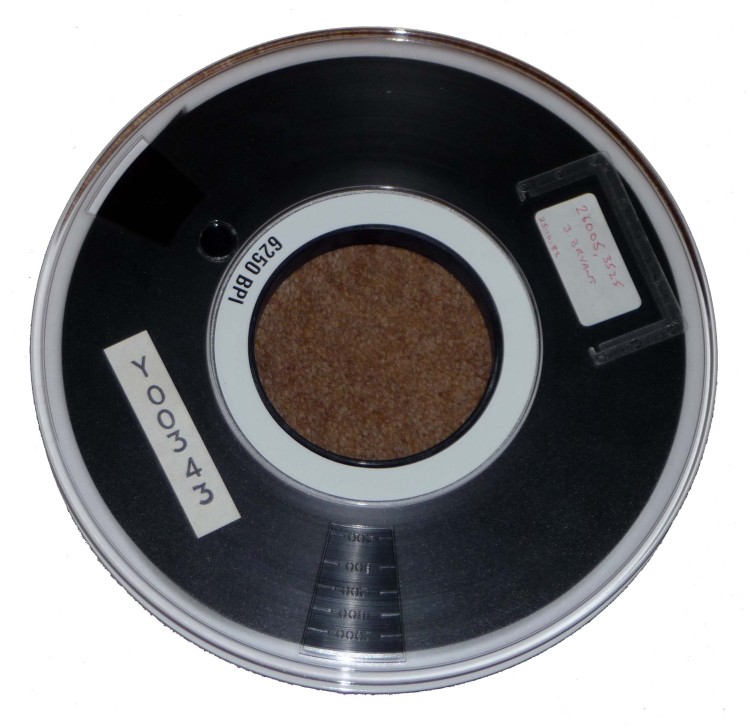
theodp writes "The Mercury News has an exclusive sneak peek of Apple's planned headquarters in Cupertino, which Steve Jobs personally sought approval for in 2011. 'We found that rectangles or squares or long buildings or buildings with more than four stories would inhibit collaboration,' Apple CFO Peter Oppenheimer said, explaining the motivation behind the so-called Apple Ring. Nice, but if you wanted to hurt the feelings of the Design Gods at Apple, you could point out that, for all its $5 billion glory, what Apple calls 'the best office building ever' doesn't look all that different from an old-school $3.95 6250 BPI magnetic tape reel (still available on eBay, kids!)." -
Dataland: the Emerging Dystopia
An anonymous reader writes "Winston Smith, the protagonist of George Orwell's novel 1984, resorted to hiding the bushes with his lover in a failed attempt to escape the government's ubiquitous surveillance. Orwell was concerned with totalitarianism and explicit thought control enforced by police action. While that is still very much an issue for many of the world's residents, here in the West there is an unsettling feeling about a more subtle form of thought manipulation, as more and more of our activities are watched, cataloged, and analyzed by more and more institutions — governments, businesses, non-profits, political parties, mostly for predictive purposes. At least we have a name for it now: 'Dataland', a term suggested by Kate Crawford of Microsoft Research, who studies the sociological effects of networking technologies. Crawford has been written up in Slashdot before. She's criticized the indiscriminate adoption of Big Data analytics on several grounds, including the loss of anonymity, erroneous conclusions from skewed datasets, and the prospect of secret discrimination." -
3D Printing a 'Terminator' Arm ... Or a Whole Body
Nerval's Lobster writes "One of the 600 3D-printed objects on display at a new London Science Museum exhibit is a Terminator-lookalike prosthetic arm designed by a 3D printing research group at the University of Nottingham, to demonstrate how printers can create both strong structural pieces, multi-directional joints and electronics to power touch sensors as part of a single process. "It's a mock-up but it shows circuits that sense temperature, feel objects and control the arm's movement," according to Richard Hague, director of the university's Additive Manufacturing and 3D Printing Research Group. The design is a step up in complexity from Robohand, an open-source engineering project launched in 2011 to design printable prostheses for those who have lost fingers or hands. The project posted many of its designs, including a full set of anatomically driven mechanical fingers, online for free download. Other manufacturers are exploring how robotics can best intersect with the human body and its need for replacement parts: pieces from 17 manufacturers went into "The Incredible Bionic Man," a full-body robotic prostheses assembled from artificial organs, limbs and other parts to demonstrate the current state-of-the-art for a Smithsonian Channel documentary due to air Oct. 20. The robot is 6'7, and able to stand and take a step with assistance; it contains a functioning heart, kidney, arms, legs, eyes and other parts. It also has a prosthetic, mobile face designed as a replacement for people who have lost noses or other features to accidents or disease." -
Book Review: The Circle
Nick Kolakowski writes "Here are the lessons imparted by Dave Eggers' The Circle, his new novel about the rise of a fictional technology company clearly modeled on Google or Facebook: 1) Sharing content with people online is a poor substitute for having real-life experiences with, like, kayaking and family gatherings and drinking and stuff. 2) Unless stopped, companies that build social-networking tools will create increasingly intrusive software. 3) The only sure way to stay sane in our increasingly interconnected (Eggers would say over-connected) world is to drive at high speed off a bridge." Read below for the rest of Nick's review. The Circle author Dave Eggers pages 504 publisher Knopf rating 8/10 reviewer Nick Kolakowski ISBN 0385351399 (ISBN-10); 978-0385351393 (ISBN-13) summary Sharing content with people online is a poor substitute for having real-life experiencesThe book's eponymous tech firm earns untold billions of dollars off the Unified Operating System, a portal through which virtually the entire world accesses the broader Web. The OS bans anonymous identities; all social information is posted out there for anyone to peruse; currencies such as Bitcoin have been discarded in favor of online banking accounts irrevocably linked to real identities. The Circle itself is headquartered in the Bay Area, on a playful campus that caters to its employees’ every material whim, so long as they're willing to work twenty-plus hours a day.
That the world would accept something like the Circle’s omnipresent software without debate, of course, is the most far-fetched of the book’s assumptions. But Eggers needs that exaggerated scenario to support his larger theme of how we’re slowly but surely letting our privacy slip away from us in exchange for digital baubles, and how online interactions—clicking "Likes," viewing posts—is an imperfect substitution for real life. As one of his characters (who acts as the doomed Voice of Reason) states early on:
“Judgments like ‘like’ and ‘dislike’ and ‘smiles’ and ‘frowns’ were limited to junior high. Someone would write a note and it would say, ‘Do you like unicorns and stickers?’ and you’d say, ‘Yeah, I like unicorns and stickers! Smile!’ That kind of thing. But now it’s not just junior high kids who do it, it’s everyone, and it seems to me sometimes that I’ve entered some inverted zone, some mirror world where the dorkiest shit in the world is completely dominant. The world has dorkified itself.”
The Circle’s employees, of course, have little problem with that world (until the end, of course, when another major character attempts to bring the whole system crashing down). Even if Eggers gets the technology wrong, in order to service his broader point, he perfectly nails the spirit of hubris and incessant self-congratulation that’s gripped many startups and tech behemoths in this era of easy VC money, huge app audiences, and massive acquisitions. That bit of software that makes all the world’s information easily accessible, he’s whispering in the background, is totally missing the point of what constitutes a real, lived-in existence.
In other words, The Circle isn’t much of a cautionary tale for the broader world, as no single commercial firm will ever (hopefully) eradicate our privacy to the degree that the company and its characters accomplish in the novel (although it’s clear that some tech giants will do their level best). But on another level, the text can still act as a cautionary tale to the current generation of developers and entrepreneurs” who think their software will effortlessly change the world for the better.
You can purchase The Circle from amazon.com. Slashdot welcomes readers' book reviews (sci-fi included) — to see your own review here, read the book review guidelines, then visit the submission page.
-
Book Review: The Circle
Nick Kolakowski writes "Here are the lessons imparted by Dave Eggers' The Circle, his new novel about the rise of a fictional technology company clearly modeled on Google or Facebook: 1) Sharing content with people online is a poor substitute for having real-life experiences with, like, kayaking and family gatherings and drinking and stuff. 2) Unless stopped, companies that build social-networking tools will create increasingly intrusive software. 3) The only sure way to stay sane in our increasingly interconnected (Eggers would say over-connected) world is to drive at high speed off a bridge." Read below for the rest of Nick's review. The Circle author Dave Eggers pages 504 publisher Knopf rating 8/10 reviewer Nick Kolakowski ISBN 0385351399 (ISBN-10); 978-0385351393 (ISBN-13) summary Sharing content with people online is a poor substitute for having real-life experiencesThe book's eponymous tech firm earns untold billions of dollars off the Unified Operating System, a portal through which virtually the entire world accesses the broader Web. The OS bans anonymous identities; all social information is posted out there for anyone to peruse; currencies such as Bitcoin have been discarded in favor of online banking accounts irrevocably linked to real identities. The Circle itself is headquartered in the Bay Area, on a playful campus that caters to its employees’ every material whim, so long as they're willing to work twenty-plus hours a day.
That the world would accept something like the Circle’s omnipresent software without debate, of course, is the most far-fetched of the book’s assumptions. But Eggers needs that exaggerated scenario to support his larger theme of how we’re slowly but surely letting our privacy slip away from us in exchange for digital baubles, and how online interactions—clicking "Likes," viewing posts—is an imperfect substitution for real life. As one of his characters (who acts as the doomed Voice of Reason) states early on:
“Judgments like ‘like’ and ‘dislike’ and ‘smiles’ and ‘frowns’ were limited to junior high. Someone would write a note and it would say, ‘Do you like unicorns and stickers?’ and you’d say, ‘Yeah, I like unicorns and stickers! Smile!’ That kind of thing. But now it’s not just junior high kids who do it, it’s everyone, and it seems to me sometimes that I’ve entered some inverted zone, some mirror world where the dorkiest shit in the world is completely dominant. The world has dorkified itself.”
The Circle’s employees, of course, have little problem with that world (until the end, of course, when another major character attempts to bring the whole system crashing down). Even if Eggers gets the technology wrong, in order to service his broader point, he perfectly nails the spirit of hubris and incessant self-congratulation that’s gripped many startups and tech behemoths in this era of easy VC money, huge app audiences, and massive acquisitions. That bit of software that makes all the world’s information easily accessible, he’s whispering in the background, is totally missing the point of what constitutes a real, lived-in existence.
In other words, The Circle isn’t much of a cautionary tale for the broader world, as no single commercial firm will ever (hopefully) eradicate our privacy to the degree that the company and its characters accomplish in the novel (although it’s clear that some tech giants will do their level best). But on another level, the text can still act as a cautionary tale to the current generation of developers and entrepreneurs” who think their software will effortlessly change the world for the better.
You can purchase The Circle from amazon.com. Slashdot welcomes readers' book reviews (sci-fi included) — to see your own review here, read the book review guidelines, then visit the submission page.
-
Book Review: The Circle
Nick Kolakowski writes "Here are the lessons imparted by Dave Eggers' The Circle, his new novel about the rise of a fictional technology company clearly modeled on Google or Facebook: 1) Sharing content with people online is a poor substitute for having real-life experiences with, like, kayaking and family gatherings and drinking and stuff. 2) Unless stopped, companies that build social-networking tools will create increasingly intrusive software. 3) The only sure way to stay sane in our increasingly interconnected (Eggers would say over-connected) world is to drive at high speed off a bridge." Read below for the rest of Nick's review. The Circle author Dave Eggers pages 504 publisher Knopf rating 8/10 reviewer Nick Kolakowski ISBN 0385351399 (ISBN-10); 978-0385351393 (ISBN-13) summary Sharing content with people online is a poor substitute for having real-life experiencesThe book's eponymous tech firm earns untold billions of dollars off the Unified Operating System, a portal through which virtually the entire world accesses the broader Web. The OS bans anonymous identities; all social information is posted out there for anyone to peruse; currencies such as Bitcoin have been discarded in favor of online banking accounts irrevocably linked to real identities. The Circle itself is headquartered in the Bay Area, on a playful campus that caters to its employees’ every material whim, so long as they're willing to work twenty-plus hours a day.
That the world would accept something like the Circle’s omnipresent software without debate, of course, is the most far-fetched of the book’s assumptions. But Eggers needs that exaggerated scenario to support his larger theme of how we’re slowly but surely letting our privacy slip away from us in exchange for digital baubles, and how online interactions—clicking "Likes," viewing posts—is an imperfect substitution for real life. As one of his characters (who acts as the doomed Voice of Reason) states early on:
“Judgments like ‘like’ and ‘dislike’ and ‘smiles’ and ‘frowns’ were limited to junior high. Someone would write a note and it would say, ‘Do you like unicorns and stickers?’ and you’d say, ‘Yeah, I like unicorns and stickers! Smile!’ That kind of thing. But now it’s not just junior high kids who do it, it’s everyone, and it seems to me sometimes that I’ve entered some inverted zone, some mirror world where the dorkiest shit in the world is completely dominant. The world has dorkified itself.”
The Circle’s employees, of course, have little problem with that world (until the end, of course, when another major character attempts to bring the whole system crashing down). Even if Eggers gets the technology wrong, in order to service his broader point, he perfectly nails the spirit of hubris and incessant self-congratulation that’s gripped many startups and tech behemoths in this era of easy VC money, huge app audiences, and massive acquisitions. That bit of software that makes all the world’s information easily accessible, he’s whispering in the background, is totally missing the point of what constitutes a real, lived-in existence.
In other words, The Circle isn’t much of a cautionary tale for the broader world, as no single commercial firm will ever (hopefully) eradicate our privacy to the degree that the company and its characters accomplish in the novel (although it’s clear that some tech giants will do their level best). But on another level, the text can still act as a cautionary tale to the current generation of developers and entrepreneurs” who think their software will effortlessly change the world for the better.
You can purchase The Circle from amazon.com. Slashdot welcomes readers' book reviews (sci-fi included) — to see your own review here, read the book review guidelines, then visit the submission page.
-
Fusion "Breakthrough" At National Ignition Facility? Not So Fast
sciencehabit writes "One unintended effect of the U.S. federal shutdown is that helpful press officers at government labs are not available to provide a reality check to some of the wilder stories that can catch fire on the Internet. They would have come in handy this week, when a number of outlets jumped on a report on the BBC News website. The National Ignition Facility (NIF) at Lawrence Livermore National Laboratory in California, it reported, had passed a 'nuclear fusion milestone.' NIF uses the world's highest energy laser system to crush tiny pellets containing a form of hydrogen fuel to enormous temperature and pressure. The aim is to get the hydrogen nuclei to fuse together into helium atoms, releasing energy. The BBC story reported that during one experiment last month, 'the amount of energy released through the fusion reaction exceeded the amount of energy being absorbed by the fuel — the first time this had been achieved at any fusion facility in the world.' This prompted a rush of even more effusive headlines proclaiming the 'fusion breakthrough.' As no doubt NIF's press officers would have told reporters, the experiment in question certainly shows important progress, but it is not the breakthrough everyone is hoping for." -
PengPod Crowdfunding a Tablet Made With OS-Switching In Mind
PengPod is running a crowdfunder to create a GNU Linux/Android tablet, the PengPod 1040. This is their second such product; the first was mentioned on Slashdot last year. PengPod has pledged to make all source and tools used to build the images available, so users can build their own OS top to bottom to guarantee that it's free of NSA tracking. The PengPod has previously found some success as a low-cost touch platform for industrial/commercial control systems and is partnered with ViewTouch, the original inventors of the graphical POS to offer PengPod1040s as restaurant register systems. The feature that the developers seem keenest to emphasize is that the PengPod is built to run conventional desktop Linux distros without special hacking required; Android is the default OS, but it's been tested with several others (including Ubuntu Touch) listed on their Indiegogo page. -
PengPod Crowdfunding a Tablet Made With OS-Switching In Mind
PengPod is running a crowdfunder to create a GNU Linux/Android tablet, the PengPod 1040. This is their second such product; the first was mentioned on Slashdot last year. PengPod has pledged to make all source and tools used to build the images available, so users can build their own OS top to bottom to guarantee that it's free of NSA tracking. The PengPod has previously found some success as a low-cost touch platform for industrial/commercial control systems and is partnered with ViewTouch, the original inventors of the graphical POS to offer PengPod1040s as restaurant register systems. The feature that the developers seem keenest to emphasize is that the PengPod is built to run conventional desktop Linux distros without special hacking required; Android is the default OS, but it's been tested with several others (including Ubuntu Touch) listed on their Indiegogo page. -
More From Don Marti About Why Targeted Ads are Bad (Video 2 of 2)
The intro for yesterday's video interview with Don Marti started out by saying, "Don Marti," says Wikipedia, "is a writer and advocate for free and open source software, writing for LinuxWorld and Linux Today." As we noted, Don has moved on since that description was written. In today's interview he starts by talking about some things venture capitalist Mary Meeker of Kleiner Perkins has said, notably that people only spend 6% of their media-intake time with print, but advertisers spend 23% of their budgets on print ads. To find out why this is, you might want to read a piece Don wrote titled Targeted Advertising Considered Harmful. Or you can just watch today's video -- and if you didn't catch Part One of our video conversation yesterday, you might want to check it out before watching Part 2. -
Why Julian Assange Should Embrace 'The Fifth Estate'
Nerval's Lobster writes "It's no secret that WikiLeaks founder Julian Assange has a low opinion of the new film, "The Fifth Estate," in which he's portrayed by Benedict Cumberbatch. He's railed against it several times, culminating in a lengthy statement (posted Oct. 9) in which he called it 'a geriatric snoozefest that only the US government could love.' That's in addition to a letter in which he refused to meet with Cumberbatch, saying that the script would force the actor to give a 'talented, but debauched, performance.' WikiLeaks and Assange are clearly attempting a bit of damage control ahead of the film's Oct. 11 release in the U.K. (followed by its U.S. debut on Oct. 18). But what if that pushback is the wrong reaction? That's not to say that Assange should gleefully embrace the film —the script portrays him as something of a hustler who freely lies about his past. Whatever its qualities, however, the film could get people talking about WikiLeaks' role in the broader geopolitical context, and that's ultimately a good thing for the organization: It's been quite some time since Assange and company have provided the world with an explosive, game-changing revelation. If nothing else, Assange can take some cold comfort from the case of Mark Zuckerberg, who faced similar issues when the David Fincher-directed 'The Social Network' made its debut in 2010; Facebook's PR team was probably preparing for the worst as the release date approached, but the film — despite its impressive box office, and the awards it won — ultimately did little to harm either the real-life Zuckerberg's reputation or Facebook's continuing growth." -
Army Researching Network System That Defends Against Social Engineering
Nerval's Lobster writes "The U.S. Army Research Laboratory has awarded as much as $48 million to researchers trying to build computer-security systems that can identify even the most subtle human-exploit attacks and respond without human intervention. The more difficult part of the research will be to develop models of human behavior that allow security systems decide, accurately and on their own, whether actions by humans are part of an attack (whether the humans involved realize it or not). The Army Research Lab (ARL) announced Oct. 8 a grant of $23.2 million to fund a five-year cooperative effort among a team of researchers at Penn State University, the University of California, Davis, Univ. California, Riverside and Indiana University. The five-year program comes with the option to extend it to 10 years with the addition of another $25 million in funding. As part of the project, researchers will need to systematize the criteria and tools used for security analysis, making sure the code detects malicious intrusions rather than legitimate access, all while preserving enough data about any breach for later forensic analysis, according to Alexander Kott, associate director for science and technology at the U.S. Army Research Laboratory. Identifying whether the behavior of humans is malicious or not is difficult even for other humans, especially when it's not clear whether users who open a door to attackers knew what they were doing or, conversely, whether the "attackers" are perfectly legitimate and it's the security monitoring staff who are overreacting. Twenty-nine percent of attacks tracked in the April 23 2013 Verizon Data Breach Investigations Report could be traced to social-engineering or phishing tactics whose goal is to manipulate humans into giving attackers access to secured systems." -
Disney Engineers Develop Touch Screens That Mimic Tactile Sensations
Lucas123 writes "Engineers at Disney Research in Pittsburgh have developed an algorithm that creates the illusion of a 3D surface on touch screens. Using electrical impulses, the touch screen technology offers the sensation of ridges, edges, protrusions and bumps and any combination of those textures. While Disney is not alone in developing tactile response touchscreens, its researchers said the traditional approach has been to use a library of 'canned effects,' that are played back when someone touches a screen. Disney's algorithm doesn't just playback one or two responses, but it offers a set of controls that make it possible to tune tactile effects to a specific visual artifact on the fly. 'Our algorithm is concise, light and easily applicable on static images and video streams,' the researchers stated." This summer Disney unveiled AIREAL, a system designed to give tactile sensations to people using motion control devices. -
TEPCO Workers Remove Wrong Pipe Get Splashed With Radioactive Water
An anonymous reader writes "A day after TEPCO workers mistakenly turned off cooling pumps serving the spent pool at reactor #4 at the crippled nuclear plant comes a new accident — 6 workers apparently removed the wrong pipe from a primary filtration system and were doused with highly radioactive water. They were wearing protection yet such continuing mishaps and 'small mistakes' are becoming a pattern at the facility." -
Samsung Creates Phone With Curved Display
iONiUM writes "Samsung today unveiled the Galaxy Round phone with a curved 5.7" display. It comes with a hefty $1,000 USD price tag. This is a follow-up to the 55" curved TVs it began selling in June, and is most likely an intermediate form in the development of fold-able phones. Considering the recent LG announcement of mass OLED flexible screen production, it seems we are getting close to flexible phones. One question I wonder: will Apple follow suit? So far there has been no indication they are even attempting flexible/bendable screens." -
Nest Protect: Trojan Horse For 'The Internet of Things'?
Nerval's Lobster writes "Nest (based in Palo Alto, and headed by former Apple executive Tony Fadell) is out to reinvent the ugly, blocky devices—starting with the thermostat—that we bolt to our walls and ceilings out of necessity. Its new Nest Protect, looks more like something for streaming music or movies than a smoke detector; inside its chic shell, the device packs an embedded system-on-a-chip and a handful of sensors, capable of connecting to other devices via wireless. 'Would this be a cherished product? Can it be more than a rational purchase — can it be an emotional one?' is the thought process that Fadell uses when evaluating new products for Nest-ification, according to Wired. That sounds like something Apple designer Jony Ive would say about the latest iDevice; your own mileage may vary on whether you consider that a good thing. Whether or not Nest actually succeeds, its emphasis on friendly design and function could serve as a template for helping popularize the so-called 'Internet of Things,' or the giant networks of interconnected devices that everybody seems to think is coming in a few short years: by giving stodgy hardware an iPhone-like sheen, complete with all sorts of bells and whistles, you could potentially change consumer mindsets from 'Do I really need to buy this thing?' to 'I want to buy this thing.' Some privacy advocates are already crying foul ('My dear privacy enthusiast: activity sensors?' The Kernel's Greg Stevens wrote, tongue somewhat in cheek, about Nest Protect in a recent blog posting. 'Ladies and gentlemen, how can you possibly stay silent about the possible abuses of such a device?'), but since when have concerns over privacy prevented people from buying the next 'cool' device?" -
Kickstarter For Open Source GPU
First time accepted submitter eekee writes "The targets are high, but so is the goal: releasing Verilog source code for a GPU implementation. The source will be open source, LGPL-licensed, and suitable for loading onto an FPGA. The first target is for a 2D GPU with PCI interface; perhaps not terribly interesting in itself, but the first stretch goal is much more exciting: full OpenGL and Direct3D graphics." Unlike the Open Graphics Project, this is starting from a working 2D accelerator and mostly working 3D accelerator cloning the features of the Number Nine Ticket to Ride hardware. If they get a meelion bucks they'll overhaul the chip to support something other than PCI (although you can bridge between PCI and PCIe) and implement a modern programmable rather than fixed-function chip. Also unlike OGP, they do not appear interested in producing hardware, instead focusing entirely on the core itself for use in FPGAs (anyone want to dust off the OGD1 design?) -
Mountain View To Partially Replace Google Wi-Fi
itwbennett writes "Google launched the citywide Wi-Fi network with much fanfare in 2006 as a way for Mountain View residents and businesses to connect to the Internet at no cost. It covers most of the Silicon Valley city and worked well until last year, as Slashdot readers may recall, when connectivity got rapidly worse. As a result, Mountain View is installing new Wi-Fi hotspots in parts of the city to supplement the poorly performing network operated by Google. Both the city and Google have blamed the problems on the design of the network. Google, which is involved in several projects to provide Internet access in various parts of the world, said in a statement that it is 'actively in discussions with the Mountain View city staff to review several options for the future of the network.'" -
8 Users of Silk Road Arrested, 'Many More To Come'
An anonymous reader writes "Last week authorities shut down Silk Road, an online black market that made use of Tor to hide activity. They also arrested the site's primary operator, Ross Ulbricht, and seized his possessions. Now, an AP report indicates at least 8 more arrests have been made on people suspected to have sold drugs through the site. Four of the arrests happened in the U.K., two were in the U.S. and two were in Sweden. It looks like they're gearing up for more arrests, as well. Keith Bristow of Britain's National Crime Agency said, 'These latest arrests are just the start; there are many more to come.' Authorities are reportedly mining the site's customer review system, which contains months worth of transaction data, for further leads." -
Arduino Gaming: Not So Retro Any More
beckman101 writes "Two years ago the Gameduino brought retro-style gaming to the Arduino. This week its successor launched on Kickstarter, still fully open-source but with a video that shows it running some contemporary-looking demos. Plus, it has a touch screen and a pretty decent 3-axis accelerometer. Farewell to the retro?" -
Car Dealers vs the Web: GM Shifts Toward Online Purchasing
cartechboy writes "Car dealers may be in for a new battle, and it turns out existing car manufacturers are joining the fun. Tesla Motors began the rebellion by trying to sell electric cars directly to buyers. Car dealers have fought that effort state-by-state and even complained to the DMV about Tesla's website. But things just got a little more interesting. General Motors announced plans to expand its new web-based shopping tool (aka a shopping web site) that allows customers to bypass showrooms when buying new cars. The idea is to use the Web as a giant test platform to see if the automaker can better target people who use the web to buy things. The catch is that the web app, called 'Shop-Click-Drive' will allow users to do almost everything they'd do at a dealer: customize the car, get pricing and financing and even arrange for delivery. But then when you push the button, your "purchase" will be routed to GM's network of 4,300 dealers, so you still have to visit a local dealer to sign on the dotted line. Even with this limitation, the move is still making dealers nervous. GM dealers aren't required to participate in the web-based test, and company officials say they have had some dealers turn it down." -
NC School District Recalls Its Amplify Tablets After 10% Break In Under a Month
Nate the greatest writes "Guilford County Schools' headline grabbing tablet program is back in the news again. The program came to an abrupt end last Friday when the school district announced that they were recalling all of the Amplify tablets. GCS had leased over 15 thousand of the tablets (at a cost of $200 a year) for its middle school students, but decided to recall the tablets just one month into the school year after some 1500 students reported a broken screen. Around two thousand complained of improperly fitting cases, and there were also 175 reports of malfunctioning power supplies. There's currently no explanation for the cases or power supplies, but GCS has stated that the tablets broke because they lacked a layer of Gorilla Glass. This was listed in the contract, but the school district did not confirm the condition of the tablets before accepting them. This program was the poster child for News Corp.'s entry into the educational market. It was the single largest program to use the Amplify tablet, and its failure represents a serious setback. The Amplify tablet now has a record for poor construction quality and a breakage rate that is 12 times higher than what Squaretrade reported in early 2012 for the iPad 2." -
Tour Houston's Texas-Sized Hackerspace (Video 2 of 2)
A few weeks ago, on his way to LinuxCon, Timothy stopped by the biggest hackerspace he'd ever seen. Houston's TX/RX Labs is not just big — it's busy, and booked. Unlike some spaces we've highlighted here before (like Seattle's Metrix:CreateSpace and Brooklyn's GenSpace, TX/RX Labs has room and year-round sunshine enough to contemplate putting a multi-kilowatt solar array in the backyard. Besides an array of CNC machines, 3-D printers, and wood- and metal-working equipment, TX/RX has workbenches available for members to rent. (These are serious workspaces, made in-house of poured concrete and welded steel tubing.) There's also a classroom full of donated workstations, lounge space, a small collection of old (but working) military trucks, and a kitchen big enough for their Pancake Science Sunday breakfasts. Labs member Steve Cameron showed me around. You saw Part One of his tour last week. Today's video is Part Two. -
Tour Houston's Texas-Sized Hackerspace (Video 2 of 2)
A few weeks ago, on his way to LinuxCon, Timothy stopped by the biggest hackerspace he'd ever seen. Houston's TX/RX Labs is not just big — it's busy, and booked. Unlike some spaces we've highlighted here before (like Seattle's Metrix:CreateSpace and Brooklyn's GenSpace, TX/RX Labs has room and year-round sunshine enough to contemplate putting a multi-kilowatt solar array in the backyard. Besides an array of CNC machines, 3-D printers, and wood- and metal-working equipment, TX/RX has workbenches available for members to rent. (These are serious workspaces, made in-house of poured concrete and welded steel tubing.) There's also a classroom full of donated workstations, lounge space, a small collection of old (but working) military trucks, and a kitchen big enough for their Pancake Science Sunday breakfasts. Labs member Steve Cameron showed me around. You saw Part One of his tour last week. Today's video is Part Two. -
Tour Houston's Texas-Sized Hackerspace (Video 2 of 2)
A few weeks ago, on his way to LinuxCon, Timothy stopped by the biggest hackerspace he'd ever seen. Houston's TX/RX Labs is not just big — it's busy, and booked. Unlike some spaces we've highlighted here before (like Seattle's Metrix:CreateSpace and Brooklyn's GenSpace, TX/RX Labs has room and year-round sunshine enough to contemplate putting a multi-kilowatt solar array in the backyard. Besides an array of CNC machines, 3-D printers, and wood- and metal-working equipment, TX/RX has workbenches available for members to rent. (These are serious workspaces, made in-house of poured concrete and welded steel tubing.) There's also a classroom full of donated workstations, lounge space, a small collection of old (but working) military trucks, and a kitchen big enough for their Pancake Science Sunday breakfasts. Labs member Steve Cameron showed me around. You saw Part One of his tour last week. Today's video is Part Two. -
Obama Administration Refuses To Overturn Import Ban On Samsung Products
Chris453 writes "In August 2013, President Obama issued a veto to an import ban of the iPhone 4S after Samsung won several court battles against Apple claiming that the iPhone 4S violated several of Samsung's patents. A few months ago, Samsung was on the receiving end of a very similar case filed by Apple. The International Trade Commission decided that several of Samsung's phones (Transform, Acclaim, Indulge, and Intercept models) violated Apple's patents, and should face import bans. Despite the similarities between the two cases, the Obama administration today announced that it would not veto the International Trade Commission import ban against Samsung products. The move that could spark a trade dispute between the U.S. and South Korea." -
Obama Administration Refuses To Overturn Import Ban On Samsung Products
Chris453 writes "In August 2013, President Obama issued a veto to an import ban of the iPhone 4S after Samsung won several court battles against Apple claiming that the iPhone 4S violated several of Samsung's patents. A few months ago, Samsung was on the receiving end of a very similar case filed by Apple. The International Trade Commission decided that several of Samsung's phones (Transform, Acclaim, Indulge, and Intercept models) violated Apple's patents, and should face import bans. Despite the similarities between the two cases, the Obama administration today announced that it would not veto the International Trade Commission import ban against Samsung products. The move that could spark a trade dispute between the U.S. and South Korea." -
Digital Revolution Will Kill Jobs, Inflame Social Unrest, Says Gartner
dcblogs writes "Gartner says new technologies are decreasing jobs. In the industrial revolution — and revolutions since — there was an invigoration of jobs. For instance, assembly lines for cars led to a vast infrastructure that could support mass production giving rise to everything from car dealers to road building and utility expansion into new suburban areas. But the "digital industrial revolution" is not following the same path. "What we're seeing is a decline in the overall number of people required to do a job," said Daryl Plummer, a Gartner analyst at the research firm's Symposium ITxpo. Plummer points to a company like Kodak, which once employed 130,000, versus Instagram's 13. The analyst believes social unrest movements, similar to Occupy Wall Street, will emerge again by 2014 as the job creation problem deepens." Isn't "decline in the overall number of people required to do a job" precisely what assembly lines effect, even if some job categories as a result require fewer humans? We recently posted a contrary analysis arguing that the Luddites are wrong. -
Digital Revolution Will Kill Jobs, Inflame Social Unrest, Says Gartner
dcblogs writes "Gartner says new technologies are decreasing jobs. In the industrial revolution — and revolutions since — there was an invigoration of jobs. For instance, assembly lines for cars led to a vast infrastructure that could support mass production giving rise to everything from car dealers to road building and utility expansion into new suburban areas. But the "digital industrial revolution" is not following the same path. "What we're seeing is a decline in the overall number of people required to do a job," said Daryl Plummer, a Gartner analyst at the research firm's Symposium ITxpo. Plummer points to a company like Kodak, which once employed 130,000, versus Instagram's 13. The analyst believes social unrest movements, similar to Occupy Wall Street, will emerge again by 2014 as the job creation problem deepens." Isn't "decline in the overall number of people required to do a job" precisely what assembly lines effect, even if some job categories as a result require fewer humans? We recently posted a contrary analysis arguing that the Luddites are wrong.