Slashdot Mirror
Domain: slashdot.org
Stories and comments across the archive that link to slashdot.org.
Stories · 37,380
-
How the Leap Second Bug Led Facebook To Build DCIM Tools
miller60 writes "On July 1, 2012 the leap second time-handling bug caused many Linux servers to get stuck in a loop. Large data centers saw power usage spike, sometimes by megawatts. The resulting "server storm" prompted Facebook to develop new software for data center infrastructure management (DCIM) to manage its infrastructure, providing real-time data on everything from the servers to the generators. The incident also offered insights into the value of flexible power design in its server farmss, which kept the status updates flowing as the company nearly maxed out its power capacity." -
Version 2.0 of 3D-Printed Rifle Successfully Fires 14 Rounds
coolnumbr12 writes "The world's first 3D-printed rifle, named 'The Grizzly' after Canadian-built tanks used in World War II, was fired in June, but the first shot fractured the barrel receiver. The creator, a Canadian man who simply goes by 'Matthew,' refined his design and posted a video Friday on YouTube of Grizzly 2.0 successfully firing 3 rounds of Winchester bullets. The video description says the Grizzly 2.0 fired 14 rounds before it cracked. The new rifle was also safe enough for Matthew to fire it by hand rather than the string system used in the first test." -
Apple Isn't the Next Microsoft (and That's a Good Thing)
Nerval's Lobster writes "In a new Gizmodo column, Andreas Goeldi calls it the 'frosted glass' effect: when a prominent tech company's latest upgrade to its flagship operating system features frosted-glass highlights as its primary innovation, you know that company is facing a period of severe stagnation. That's what happened to Microsoft around the time of Windows Vista, Goeldi wrote, and Apple's going down the same road with iOS 7. In light of what he views as Apple's sclerosis, it wasn't difficult for him to abandon his iPhone in favor of a Google Android ecosystem. But is Apple really becoming the next Microsoft? In short: no. Apple seems to recognize everything that seemed to elude Microsoft's corporate thinking six years ago: namely, that even the most successful companies need to keep breaking into new categories, and keep innovating, if they want to stay ahead of hungry rivals. Rumors have persisted for quite some time that Apple is prepping big pushes into wearable electronics and televisions, both of which could prove lucrative strategies if executed correctly. Goeldi faults iOS 7 for its frosted-glass effects, which he compares to those of Vista; but similar graphical elements aside, it's unlikely that iOS 7 will run into the same complaints over hardware requirements, compatibility, security, and so much more that greeted Vista upon its release. In fact, iOS 7 isn't even finished." -
Usenix and EFF Reps Talk About VW's Attempt to Suppress a Presentation (Video)
You may have read about this on Slashdot: Three researchers were going to present a paper next week at the USENIX Security '13 conference about security holes they found in one of Volkswagen's anti-theft systems, but a British court said they couldn't. One of the presenters works at a British university, and the court may have jurisdiction over him. The other two are not U.K. residents, and the Usenix conference is being held in Washington D.C., so jurisdiction questions are flying thick and fast. Amusingly, whether the paper is published and presented or not, the security holes and crack codes it is supposed to contain have been available on the Internet for quite a while, so bad guys who want to learn about them most likely have done so already. Then, last week, we heard that one of the presenters was going to show up at the conference and possibly ignore the injunction. Meanwhile, USENIX co-executive director Casey Henderson and EFF intellectual property director Corynne McSherry talked with Slashdot's Timothy Lord via Zoom and discussed this situation, and how this sort of problem might be prevented in the future. -
Usenix and EFF Reps Talk About VW's Attempt to Suppress a Presentation (Video)
You may have read about this on Slashdot: Three researchers were going to present a paper next week at the USENIX Security '13 conference about security holes they found in one of Volkswagen's anti-theft systems, but a British court said they couldn't. One of the presenters works at a British university, and the court may have jurisdiction over him. The other two are not U.K. residents, and the Usenix conference is being held in Washington D.C., so jurisdiction questions are flying thick and fast. Amusingly, whether the paper is published and presented or not, the security holes and crack codes it is supposed to contain have been available on the Internet for quite a while, so bad guys who want to learn about them most likely have done so already. Then, last week, we heard that one of the presenters was going to show up at the conference and possibly ignore the injunction. Meanwhile, USENIX co-executive director Casey Henderson and EFF intellectual property director Corynne McSherry talked with Slashdot's Timothy Lord via Zoom and discussed this situation, and how this sort of problem might be prevented in the future. -
Navy Version of Expedia Could Save DoD Millions
Nerval's Lobster writes "The U.S. Navy expects to save $20 million per year on its global logistics and transportation budget, thanks to technology that has been saving business travelers billions since 1996. The Navy is testing a system that consolidates information about freight and personnel travel schedules into a single database—the better to give individual decision-makers a choice of the quickest, cheapest options available using 'an Expedia-like' search capability, according to the Office of Naval Research, which developed the application. All that being said, the Transportation Exploitation Tool (TET) is a little more sophisticated than online-travel sites such as Expedia or Travelocity were in 1996: The system consolidates travel schedules and capacity reports for both military and civilian carriers to give logistics planners a choice of open spaces in ships, planes, trucks, trains or other means of travel, along with information about cost, estimated time of arrival and recommendations of the most efficient route. Previously, logistics planners trying to get an engine part to a Navy ship stranded in a foreign port, for example, might spend hours or days looking through separate databases to find a ship or plane able to carry the part that could deliver it within a limited window of time. 'This system is truly revolutionary,' Bob Smith, program manager at the Office of Naval Research (ONR), wrote in a statement announcing the system. 'TET uses advances in technology to provide outstanding optimization of available flights and ship routes, saving our logisticians enormous amounts of time—and that can literally mean saving lives.'" -
Interview: Jimmy Wales Answers Your Questions
A while ago you had a chance to ask Jimmy Wales about the amazing growth of Wikipedia, and his role advising the UK government in making academic research available online. Below you'll find his answers to your questions. Collaboration with National Libraries
by robcfg
I'd like to ask if there's the possibility of collaborating with National Libraries in scanning material (specially +25 year books) and let people access them. I know there's a lot of material just gathering dust and I see a potential for collaboration.
Wales: Our community, particularly through local chapters, is engaging increasingly in partnerships and collaborations with galleries, libraries, and museums, but there hasn't been very much work done to date on scanning per se. In general, we aren't necessarily the right partner for that sort of thing - we are a community of writers, editors, photographers, etc., rather than a hosting service for scanned materials. Having said that, fortunately there are some great projects who are working on this sort of thing. Take a look at http://archive.org/scanning as a leading exemplar.
Editing of Information
by sylivin
Wikipedia has become so large that students and youth in particular deem it the official truth. As such governments, companies, and individuals will constantly try to spin that to their own advantage.
Do you believe you will ever be able to reconcile with governments in regards to information they deem classified showing up on Wikipedia and private citizens that consider articles about them to be libel? Or, perhaps, is that just a fight you will need to struggle against for all eternity?
Wales: Human beings will never stop quarreling. It's part of the glorious nature of our species. Government will never cease being stupid and overstepping their boundaries. That, too, is part of the human condition.
The real question is: can open systems adapt and respond in mostly effective ways to deal with the worst of it? And the answer to that is clearly YES.
SPOF
by Anonymous Coward
Currently, Wikipedia Foundation is a single point of failure. It is not difficult to imagine various Alexandria Library scenarios in which Humanity looses crucial information.Instead of begging people for monetary donations to Wikimedia Foundation, wouldn't it be better to ask for donations of storage and bandwidth to keep the whole thing redundant and de-centralized? Are there any ongoing efforts to change Wikipedia's model in this direction?
Wales: The Wikimedia Foundation is not a single point of failure. There are many people and organizations who do backups which are already redundant and de-centralized, and this is in addition to our own internal backup strategy. If the Wikimedia Foundation were to vanish tomorrow, anyone could take the archives (freely licensed!) and start again tomorrow.
This is one of the key reasons why I've been so firm over the years that Wikipedia must be freely licensed.
Certified articles?
by rjlouro
There's the notion that the information on wikipedia can be edited for anyone, and referencing wikipedia sometimes brings a smile.
I always wondered why Wikipedia does not ask known experts for article certification. For example, you as the co-founder of wikipedia could certify that a section of the wikipedia wiki article (or the entire wiki article for wikipedia) was correct. Maybe you could even pay in some cases.
Has this ever been considered, or do you have any other ideas on how to get wikipedia to be received as a irrefutable source of information?
Wales: This is what I would consider to be a fallacious line of thinking. There's a notion that the way to get the very highest quality information is to have an expert certify it. But there's actually little evidence that this is true. There is far more evidence that the best way to get to high quality information is to have a thoughtful, open, public dialog and discussion and debate. To ask anyone with a concern to come forward and voice it reasonably. And to respond quickly and openly to errors.
So, no, I doubt if we'd consider stepping back to an antiquated way of thinking.
Game of Articles
by AmiMoJo
It seems like most major articles are "owned" by some editors who want to impose their own views and opinions on them. The rules of Wikipedia seem to be designed to facilitate this. The only solution seems to be for other editors to sit on the article constantly undoing the other editors edits. It's a war of attrition and it seems like the bad guys mostly win. A lot of good editors have given up. I gave up, tried it again a few years later and gave up again. Many previously good articles are now full of industry shill references and obviously biased rubbish. The quality of Wikipedia is degrading steadily over time. What is being done to reverse this trend? Can anything be done, or is this as good as a wiki gets?
Wales: Every aspect of this question is false. No major articles are "owned" by anyone. The rules of Wikipedia are designed to prevent this.
There is a bit of a war of attrition in some cases - but it is overwhelmingly the case that the good guys win.
All evidence is that the quality of Wikipedia has steadily increased over time. It is not perfect. It needs more work. There are problems, even problems with people trying to sit on articles. But the ongoing improvement of Wikipedia will continue.
As a side note, usually people who have this complaint fade into the background when asked to justify it, or show me an example - and in the vast majority of cases it turns out that the complaint is really "Why am *I* not allowed to own this article?"
Interactive tours and applications
by MassiveForces
Some of my fondest memories as a child was firing up the old 486 and playing through the interactive quests and games in Encarta. Some of them were timelines and guided learning experiences, others were programs that simulated things like gravity and orbits, and I liked playing with some software that could model particle behavior based on your parameters to describe gas diffusion and so on.
My question is, will Wikipedia ever be able to flex any interactive multimedia muscle, and create a more interactive and guided experience for young learners? People may be willing to devote their time writing out separate articles in the pages of an encyclopedia, but I imagine attracting multimedia development would be difficult (unless you can find whoever has been wasting their time writing a plethora of useless apps for browsers and mobiles).
Wales: I really hope we'll see more of this in the future. One problem that we've had is that for a significant period of time, Adobe Flash, which was a Frankenstein's monster of horrifically stupid and broken and proprietary technology, sucked the wind out of efforts to do interesting open multimedia. The ongoing and glorious demise of Flash is going to help a whole new generation of developers do more interesting things, in a freely licensed way. At least: I hope so.
Editors Dwindling
by Kagato
Back in 2011 the AP reported that you commented that the ranks of Editors was slowly dwindling. "We are not replenishing our ranks...it is not a crisis, but I consider it to be important." What's have you and Wikipedia done to address that? Do you see problems do you think need to be addressed with the editor population? What do you think is working well with Editors? How hands on are you with the editor population?
Wales: Things have mostly stabilized. It's still not a crisis, but I still consider it to be important. One of the most exciting developments is the visual editor, which I hope will bring in a whole new class of editors who were turned off by the complexities of wikitext. As I put it: there are lots of geeks who aren't computer geeks.
Wikicurriculums & Wikitextbooks
by PortHaven
When can we see this be developed? I know there is a start with Wikitextbooks. But they seem sporadic. I think we could create an entire curriculum and support library (textbooks) to accompany said curriculum. And have it freely available for all...
Wales: I agree, but it's a really big job. :-) I think it will come in due course, but leadership is needed. I hope something awesome emerges, possibly from the fast-growing MOOC movement. -
Snowden and the Fate of the Internet As a Global Network
Hugh Pickens DOT Com writes "John Naughton writes in the Guardian that the insight that seems to have escaped most of the world's mainstream media regarding the revelations from Edward Snowden is how the US has been able to bend nine US internet companies to its demands for access to their users' data proving that no US-based internet company can be trusted to protect our privacy or data. 'The fact is that Google, Facebook, Yahoo, Amazon, Apple and Microsoft are all integral components of the US cyber-surveillance system,' writes Naughton. 'Nothing, but nothing, that is stored in their "cloud" services can be guaranteed to be safe from surveillance or from illicit downloading by employees of the consultancies employed by the NSA.' This spells the end of the internet as a truly global network. 'It was always a possibility that the system would eventually be Balkanised, ie divided into a number of geographical or jurisdiction-determined subnets as societies such as China, Russia, Iran and other Islamic states decided that they needed to control how their citizens communicated. Now, Balkanisation is a certainty.' Naughton adds that given what we now know about how the US has been abusing its privileged position in the global infrastructure, the idea that the western powers can be allowed to continue to control it has become untenable. 'Why would you pay someone else to hold your commercial or other secrets, if you suspect or know they are being shared against your wishes?' writes Neelie Kroes, vice-president of the European Commission. 'Front or back door – it doesn't matter – any smart person doesn't want the information shared at all. Customers will act rationally, and providers will miss out on a great opportunity.'" -
First Ever Public Tasting of Lab-Grown Cultured Beef Burger
vikingpower writes "Today, at 14:00 Western European Time (9:00 am Eastern), Professor Mark Post of Maastricht University (the Netherlands) will present a world first: he will cook and serve a burger made from Cultured Beef in front of an invited audience in London. The event will include a brief explanation of the science behind the burger. You can watch the event live, online. The project's fact sheet is to be found here (pdf)." The BBC is reporting that Sergey Brin is the mystery backer behind the project. -
The Old Reader Will Stay Open To the Public Thanks To US Corporation
An anonymous reader writes "The Old Reader, a popular RSS service and alternative to Google Reader, last week revealed it would be closing its service to the public in two weeks. Soon after the backlash, there was hint of a stance reversal, and now it's happened: The Old Reader will remain open to the public, thanks to a bigger team and 'significantly more' resources, both provided by a new corporate entity located in the US. While details about this 'corporate entity' are indeed scarce, we do know the announcement was authored by an individual named Ben Wolf. He promises his team consists of 'big fans and users' of The Old Reader who want to help it 'grow and improve for years to come' and who will be introduced properly in the coming weeks." -
Did Goldman Sachs Overstep in Criminally Charging Its Ex-Programmer?
theodp writes "Programmer Sergey Aleynikov holds the dubious distinction of being the only Goldman Sachs employee since the 2008 financial meltdown to have actually served time in prison. After leaving Goldman, Sergey was accused of stealing computer code from his former employer and sentenced to eight years in federal prison. Exactly what he'd done neither the FBI nor the jury seemed to understand, so Moneyball author and financial journalist Michael Lewis decided to give Sergey a second trial, assembling a jury made up of programmers and people familiar with high-frequency trading, and asking them to level a judgment. Their verdict? Not guilty. 'I think it's quite possible that Goldman itself didn't know what he had taken, the value of it, the purpose of it, or anything else,' Lewis concludes. 'There was such turnover at Goldman, and the system was such a hairball, that I think people knew pieces but they didn't know the whole. Serge might have been as close as there was to an expert on the how the whole system worked. I think the valuable thing that Serge took when he walked out the door was himself.' Aleynikov was released on appeal in 2011, but subsequently re-arrested on state charges the following year, so he's still not out of the woods yet." -
Peter Capaldi Unveiled As the New Star of Doctor Who
Dave Knott writes "After months of speculation since Matt Smith announced that he was exiting the long-running British SF show Doctor Who, the BBC has announced the latest actor who will be taking on the titular role. In a live television announcement, with several previous stars on hand, it was revealed that Peter Capaldi will be portraying the newest incarnation of The Doctor. Capaldi is 55 years old, ending a recent trend towards younger Doctors, and had been flagged by bookmakers as the odd-on favourite in recent days, to the extent that they had suspended betting on the issue. He is best known for his role as the foul-mouthed government bureaucrat Malcolm Tucker on the The Thick Of It and has in fact showed up on Doctor Who previously as a guest star. But now Capaldi is set to take his place in the iconic lead role. To help celebrate the 50th anniversary, and the naming of the next Dr. Who, an ice cream shop put up a 35ft straw Dalek sculpture." -
Obama Administration Overrules iPhone Trade Ban
Back in June, the U.S. International Trade Commission issued an import ban on the iPhone 4 and iPad 2 3G due to patent violations. Now, the White House has exercised its privilege to overrule the ban. In his letter to the ITC (PDF), Ambassador Michael Froman said 'he was not making a decision about the merits of Samsung's case, or its right to seek compensation. Rather, he emphasized that because the patent in question was now a widely held technology standard, banning the products in question would be too disruptive to consumers and the economy.' This is the first time an ITC decision has been overruled since 1987. -
Luxury Car Hacker To Speak At USENIX Despite Injunction
alphadogg writes "The lead author of a controversial research paper about flaws in luxury car lock systems will deliver a presentation at this month's USENIX Security Symposium even though a UK court ruling (inspired by a Volkswagen complaint) has forced the paper to be pulled from the event's proceedings. USENIX has announced that 'in keeping with its commitment to academic freedom and open access to research,' researcher Roel Verdult will speak at the Aug. 14-16 conference, to be held in Washington, D.C. Verdult and 2 co-authors were recently prohibited by the High Court of Justice in the U.K. from publishing certain portions of their paper, 'Dismantling Megamos Crypto: Wireless Lockpicking a Vehicle Immobilizer.' Among the most sensitive information: Codes for cracking the car security system in Porsches, Audis, etc." -
Utah Set To Exempt NSA Datacenter From Power Tax, After All
Nerval's Lobster writes "They may not all support what the NSA will do with its giant new datacenter in Bluffdale, but Utah officials do seem to agree on the value of having a world-class, $1.5 billion datacenter built in their territory. In general, they're for it, and are proving that by changing a law that would have added about $2.4 million in taxes to the datacenter's power bill—an addition that was an unpleasant surprise to NSA officials when they heard about it in May. A bill signed into law April 1 imposed a tax of up to 6 percent on electricity from Rocky Mountain Power, a requirement the NSA protested in an email to Utah Gov. Gary Herbert April 26. State tax agencies swear they informed the NSA about the impact of the law when it was still under debate; NSA officials denied knowing anything about it and complained that it would make Utah a less attractive site for the datacenter, which was only three to four months from completion at the time." -
How Did My Stratosphere Ever Get Shipped?
Bennett Haselton writes "How did a $400-billion company ship millions of units of a phone with a calendar app that displays the wrong date, a texting app that can't reply to group texts, a screen capture function that doesn't work, and a phone app that won't let me use the keypad unless the speakerphone is on? The answer, perhaps, suggests deeper questions about why market forces fix certain problems but not others, and what to do about it." Read on for the rest of Bennett's thoughts.I've been using either a Samsung Stratosphere or a Samsung Stratosphere 2 from September 2012 to the present. Where to begin?
-
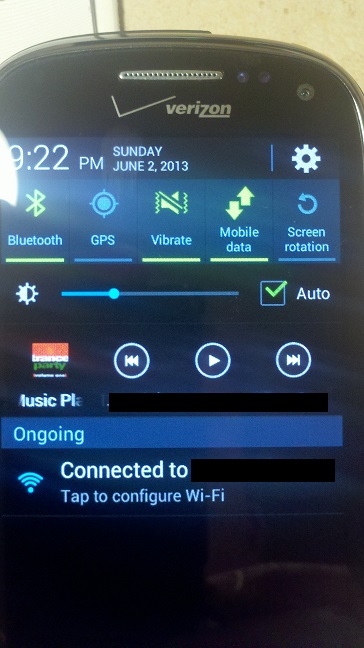
If you open the calendar application on the Stratosphere 2, it usually highlights tomorrow's date as "Today," and lists tomorrow's calendar entries as your list of things to do "Today." Here is a picture of my phone's screen taken on June 2, with the calendar app displaying "Today, Mon, Jun 3 2013" — despite the phone knowing the correct time is 9:22 PM on June 2.
Strangely, in the morning the calendar app would display the correct day as "Today," but would switch to the wrong day some time in the afternoon, and eventually I decided that the calendar app was probably using Coordinated Universal Time to decide what "Today" was, which is 9 hours ahead of Pacific Standard Time.
-
You'll notice that these images are not screen captures, but photos taken with another phone. This is because some time between the Stratosphere 1 and 2, the screen capture function broke — every support site says you're supposed to be able to take a screen cap on a Stratosphere by pressing the Home and Power buttons at the same time, and that works on the 1, but not on the 2.
-
If someone else sends a text to multiple recipients including you, the Stratosphere gives you no indication that it's a group text, and there's no way for you to see the other recipients or reply to the whole group. (I had a lot of awkward "What, you were asking everybody, not just me?" moments before I realized what was going on.) Other users have been complaining about this for months, and it apparently affects more Android phones than just the Stratosphere.
-
The built-in camera refuses to take a picture if the battery is low — it just says "Warning: low battery" and exits. Yes, I know they think they're doing it for my own good since the camera is a battery hog, but a few times I've wanted to take a picture where it was well worth using up a half a percent of my remaining battery life or however much it would have taken, but the phone wouldn't let me. That should be the user's decision, dammit.
-
When I was in Canada last week, if I tried sending a text message longer than 160 characters, the phone would tell me that the message sent, but it would actually fail silently and never get delivered. I'm not sure whether to blame Verizon, Android, or Samsung for this one (or just, you know), but in the end someone has to take responsibility for the product, and the phone telling you that a message was sent when it actually got lost, is a complete fail. If it doesn't work, fine, give me an error message, but never tell the user a message got sent successfully if it didn't.
-
During a phone call, the on-screen keypad doesn't work unless the phone is on speakerphone. If the speakerphone is off, the screen goes dark after about 1 second of inactivity, making it impossible to enter an account number or anything else. I can avoid this bug by turning on a speakerphone (which is how I know it's a software bug, not a problem with the touchscreen), but this is a pain if I'm in a public place and don't want to annoy everyone around me who would have to listen to all the voice prompts. (The phone's software seems to be following a rule like: "If the speakerphone is not on, then when the phone moves away from the user's face, assume the user is not actively using the phone and let the screen go dark" — where the bug is that it doesn't make an exception and keep the screen on if the user is actively pressing keys on the keypad.)
At first, these and many, many other bugs produce a state of mind that transcends annoyance to reach a kind of genuine curiosity, where you're asking "How did this happen?" not rhetorically, but because you actually want to know. But eventually the surprise wears off, and you're just left with bugs that are disproportionately aggravating because they obviously would have been caught during even the most basic UI testing. They're aggravating to me not because of how much they get in the way (you eventually get used to them), but because the existence of those bugs conveys a certain lazy attitude towards finding and fixing bugs at all.
I realize this is not a logical reaction. The aggravation you feel towards a bug should depend on how much the bug actually interferes with the user experience, not on how easily the manufacturer should have found it. Rationally speaking, the biggest problem with the phone right now (and the reason I'm having to mail to back to the manufacturer for a replacement) is that the charging port spontaneously broke, so that unless the micro USB charger is plugged in exactly right, the phone can't charge (even if you get it right and form a connection successfully, the connection breaks if you move the phone half an inch). Needless to say, that's exasperating — but it's hard for me to get mad at Samsung over that, because it's not an easy defect to catch at the manufacturing stage. On the other hand, if the calendar app displays the wrong day, I would say that someone should be fired over that except that probably nobody was assigned to do that testing in the first place.
I also posted questions about each of these problems on AndroidForums.com and AndroidCentral.com (those links show all questions recently posted from my username on each site), which have so far received hundreds of "views" but no replies. I mention this because some people think that if you do run into problems like these, all you have to do is post a question and The Community will help you out with a workaround. Nope.
Also, lest you think you can do away with these bugs by downloading third-party replacements for all of these apps, I spent part of an afternoon downloading different texting apps to see if any of them would fix even part of the problems I had with the built-in one. None of them worked much better, although several of them displayed pop-up ads over every third incoming text message, and most of them did not play nicely with each other, giving me no way to disable them so that their notifications would double and triple up on top of each other for every received text. So I gave up. Even if I thought I might eventually find a better app for texting, I didn't have time to test multiple replacements for every built-in default app that didn't work.
Farhad Manjoo has a column up at Slate arguing that the reason many Android phones suck is that they're laden down with adware attempting to extract more personal information and money from the user. I'm sure that's part of the problem, but I can't see how the manufacturer is making any money off of the bugs I ran into; they were just being lazy.
The problem, I think, is that phone manufacturers know that phone reviewers (and users, when they're choosing between models in the store) will focus on easily quanitifiable attributes, such as size, weight, battery life, and the number of megapixels in the camera. The number of aggravating bugs in the user interface is not something that is easy to compare across phones (and in any case would not be printed on the box). Thus market forces simply don't favor the development of a hassle-free interface, because in most cases the phone manufacturers wouldn't be rewarded for it.
And — I don't consider this too much of a stretch — this is where it connects with larger issues for me, because I've been arguing for years that the free market will usually fail to fix certain types of problems, often in the context of threats to free speech and civil liberties, especially if the user lacks information they need to compare multiple options. A major argument in favor of Net Neutrality is that the typical user wouldn't realize it if their ISP were throttling access to certain sites; they would just think that the remote site was responding slowly. Since that information would be hidden from the user, "the marketplace" won't solve the problem on its own. Similarly, every time I say that my Circumventor mailing list keeps getting blocked as "spam" by Yahoo, Hotmail, Gmail, or AOL (despite being 100% verified-opt-in, natch), someone tells me that if the free market is blocking my emails as unwanted, it must be because the users don't want them. That the free market might make a mistake (in this case, because users don't have full information about what is getting blocked as spam), doesn't occur to them. I think the belief in the infallibility of the free market, is one of the most widespread fallacies of our era — people who would never make the mistake of confusing correlation with causation, have no problem thinking that if a product or service gets blocked by a third-party intermediary, it must be because the end user didn't want it.
And so when I'm staring at my Stratosphere's calendar telling me that tomorrow is actually today, it brings out my aggravation not just towards Samsung, Google, and Verizon, but towards all the people I've heard over the years claiming that the marketplace will automatically reward good products and punish bad ones. If there weren't so many people who believed that, maybe we could have collectively put more effort into rating phones according to their usability, knowing that the "invisible hand" of the marketplace was not likely to solve those problems on its own, and maybe these bugs would have gotten fixed. Instead, the "marketplace" focuses disproportionately on attributes like dimensions, weight, and processor speed that are easily quantifiable.
So perhaps the solution — seriously — would be for some third-party review company to rate each new phone on the Stupid S#!% Index. They test the phone under normal usage, and each time they run into an idiotic bug like the calendar application not knowing what day it is, they file it under Stupid S#!%, and after some fixed period of phone usage they count up all the problems and rate the phone under the Stupid S#!% Index. For greater precision, you could compile multiple scores from different users for each phone and take the average. Now you have a quantifiable rating that can be used to compare one phone to another, and could incentivize manufacturers to do more testing on their phones in order to get a better Stupid S#!% Index score.
The message that Apple keeps pushing about the iPhone, after all, is essentially that it would get a good Stupid S#!% Index rating. In his keynote address at the 2011 Apple Worldwide Developers Conference, Steve Jobs repeated the words "It just works" like a mantra — unlike, presumably, everyone else's stuff. iPhones don't score well on price, openness, or compatibility with other companies' products (I always have to tell people that my car charger is not an iPhone charger, it's a literally-every-other-smartphone-in-the-entire-world charger) — but all of that scarcely matters to some people as long as It Just Works.
Well, I couldn't tell you. I can't test an iPhone under normal usage because I'm too addicted to the Stratosphere's slide-out keyboard, which enables me to type much faster than a touchscreen but which only comes on a few Android and Windows phones, and not on any version of the iPhone. Maybe I'll try one more time to make the switch to a touchscreen while my Stratosphere is in the shop.
Yes, these most First-World of First World Problems — especially the bugs specific to the Stratosphere — only apply to a small fraction of the population. But it should be a lesson for anyone who thinks the "free market" would prevent this sort of thing from happening.
Meanwhile, every time I hear an ad talking about how "thin" some new phone is going to be, I just want to say to the phone the same thing that I want to tell all the anorexic girls in nightclubs: You're already thin enough. So stop worrying about being thin, and just try to work on not being so f@#$ing stupid.
-
-
Surveillance Story Turns Into a Warning About Employer Monitoring
rtfa-troll writes "The story from yesterday about the Feds monitoring Google searches has turned into a warning about how work place surveillance could harm you. It turns out that Michele Catalano's husband's boss tipped off the police after finding 'suspicious' searches (including 'pressure cooker bombs') in his old work computer's search history. Luckily for the Catalanos, who even allowed a search of their house when they probably didn't have to, it seems the policemen and FBI agents were professional and friendly. Far from being imperiled by a SWAT raid, Catalano spoke to some men in black cars who were polite and even mentioned to Catalano that 99 times out of 100, these tip-offs come to nothing. Perhaps the lesson is to be a bit more careful about your privacy, so that what you do on the internet remains between you and the professionals at the NSA." -
Ask Slashdot: Favorite Thing Out of This Year's Black Hat?
Nerval's Lobster writes "This year's Black Hat conference wasn't just about the NSA director defending his agency's surveillance practices (and getting a bit heckled in the process). Other topics included hacking iOS devices via a modified charging station, eavesdropping on smartphones via compromised femtocells, demonstrating a password-security testing tools that leverage AWS (and 9TB of rainbow tables) to crush weak passwords, and compromising RFID tags with impunity. What was your favorite news out of Black Hat?" -
Ask Slashdot: Favorite Thing Out of This Year's Black Hat?
Nerval's Lobster writes "This year's Black Hat conference wasn't just about the NSA director defending his agency's surveillance practices (and getting a bit heckled in the process). Other topics included hacking iOS devices via a modified charging station, eavesdropping on smartphones via compromised femtocells, demonstrating a password-security testing tools that leverage AWS (and 9TB of rainbow tables) to crush weak passwords, and compromising RFID tags with impunity. What was your favorite news out of Black Hat?" -
Ask Slashdot: Favorite Thing Out of This Year's Black Hat?
Nerval's Lobster writes "This year's Black Hat conference wasn't just about the NSA director defending his agency's surveillance practices (and getting a bit heckled in the process). Other topics included hacking iOS devices via a modified charging station, eavesdropping on smartphones via compromised femtocells, demonstrating a password-security testing tools that leverage AWS (and 9TB of rainbow tables) to crush weak passwords, and compromising RFID tags with impunity. What was your favorite news out of Black Hat?" -
CouchDB: Roll Your Own, Or Go With a Service?
Nerval's Lobster writes "Developer and editor Jeff Cogswell asks: When it comes to implementing a CouchDB installation, do you roll your own, or go with a service that provides a hosted version of the database? He takes a look at some of the technologies present in CouchDB that can greatly influence that decision. His conclusion? Like all things, it's a little complicated. 'If you're going to be self-hosting—unless you're working on a really small system—don't use the basic CouchDB for anything,' he writes. 'If you want scalability, either go with Couchbase or BigCouch, or wait until Cloudant's BigCouch merger into CouchDB is officially available.' But going with a host also creates its own things to watch for, including potential issues with replication and eventual consistency." -
National Weather Service Upgrades Storm-Tracking Supercomputers
Nerval's Lobster writes "Just in time for hurricane season, the National Weather Service has finished upgrading the supercomputers it uses to track and model super-storms. 'These improvements are just the beginning and build on our previous success. They lay the foundation for further computing enhancements and more accurate forecast models that are within reach,' National Weather Service director Louis W. Uccellini wrote in a statement. The National Weather Service's 'Tide' supercomputer — along with its 'Gyre' backup — are capable of operating at a combined 213 teraflops. The National Oceanic and Atmospheric Administration (NOAA), which runs the Service, has asked for funding that would increase that supercomputing power even more, to 1,950 teraflops. The National Weather Service uses that hardware for projects such as the Hurricane Weather Research and Forecasting (HWRF) model, a complex bit of forecasting that allows the organization to more accurately predict storms' intensity and movement. The HWRF can leverage real-time data taken from Doppler radar installed in the NOAA's P3 hurricane hunter aircraft." -
Jono Bacon Talks About Ubuntu Phone Progress (Video)
Timothy Lord caught up with Ubuntu's Jono Bacon at OSCON and got a nice update on the state of the Ubuntu Phone, which Canonical first announced in January, 2013. Tim interviewed Jono about it on camera at CES in February. Look at the "Related Stories" attached to this intro and you'll see a bunch more Ubuntu phone stories. DISCLOSURE: At least two Slashdot editors currently run Ubuntu or Kubuntu, so we have at least a mild pro-Ubuntu bias. Bias or no, It's interesting to watch the Ubuntu phone development process, even as those who are satisfied with Android phone or iPhones, ask, "Why?" We could ask the same about the Firefox OS Phone, too. Maybe the most realistic answer in both cases is, "Because we could." But who knows? These new phone operating systems might turn out to be more useful than Android or iOS. We'll see. -
Jono Bacon Talks About Ubuntu Phone Progress (Video)
Timothy Lord caught up with Ubuntu's Jono Bacon at OSCON and got a nice update on the state of the Ubuntu Phone, which Canonical first announced in January, 2013. Tim interviewed Jono about it on camera at CES in February. Look at the "Related Stories" attached to this intro and you'll see a bunch more Ubuntu phone stories. DISCLOSURE: At least two Slashdot editors currently run Ubuntu or Kubuntu, so we have at least a mild pro-Ubuntu bias. Bias or no, It's interesting to watch the Ubuntu phone development process, even as those who are satisfied with Android phone or iPhones, ask, "Why?" We could ask the same about the Firefox OS Phone, too. Maybe the most realistic answer in both cases is, "Because we could." But who knows? These new phone operating systems might turn out to be more useful than Android or iOS. We'll see. -
Jono Bacon Talks About Ubuntu Phone Progress (Video)
Timothy Lord caught up with Ubuntu's Jono Bacon at OSCON and got a nice update on the state of the Ubuntu Phone, which Canonical first announced in January, 2013. Tim interviewed Jono about it on camera at CES in February. Look at the "Related Stories" attached to this intro and you'll see a bunch more Ubuntu phone stories. DISCLOSURE: At least two Slashdot editors currently run Ubuntu or Kubuntu, so we have at least a mild pro-Ubuntu bias. Bias or no, It's interesting to watch the Ubuntu phone development process, even as those who are satisfied with Android phone or iPhones, ask, "Why?" We could ask the same about the Firefox OS Phone, too. Maybe the most realistic answer in both cases is, "Because we could." But who knows? These new phone operating systems might turn out to be more useful than Android or iOS. We'll see. -
Early Surface Sales Pitiful
Nerval's Lobster writes "Microsoft has earned $853 million from sales of its Surface tablets, according to the company's annual Form 10-K filed with the SEC. That's a bit of a disaster, to put it bluntly. Earlier estimates put Surface sales at roughly 1.5 million units; the $853 million figure reinforces that projection. By comparison, Apple sold 14.6 million iPads in its last quarter alone. Adding insult to injury, Microsoft spent quite a bit producing and marketing Surface. The Windows division's 'cost of revenue increased $1.8 billion, reflecting a $1.6 billion increase in product costs associated with Surface and Windows 8, including a charge for Surface RT inventory adjustments of approximately $900 million,' read the Form 10-K. 'Sales and marketing expenses increased $1.0 billion or 34 percent, reflecting an $898 million increase in advertising costs associated primarily with Windows 8 and Surface.' Overall, Microsoft's Windows division earned $19.2 billion in its fiscal 2013." -
NASA Appoints New Chief Scientist
SchrodingerZ writes "Planetary Geologist Ellen Stofan, expert in the terrains of Venus, Mars, and Titan, has recently been appointed the Chief Scientist for the space agency. Stofan will act as the top adviser for Charles Bolden, NASA's current administrator. Beginning August 25th, Stofan will be Bolden's head adviser for NASA's project planning and investments. She will replace former chief scientist Dr. Waleed Abdalati, who left his position to be the director of the Cooperative Institute for Research in Environmental Sciences at the University of Colorado. Stofan has both a masters and doctoral degree of geological sciences from Brown University, and is known for her involvement in the Applied Science Laboratory's project to put a boat on Saturn's moon Titan, as well as a member of the radar team for the Cassini spacecraft. Though she'll be joining in a time of large budget cuts, Bolden explains that '[Stofan's] breadth of experience and familiarity with the agency will allow her to hit the ground running. We're fortunate to have her on our team.'" -
Sad Day In FarmVille: Facebook's New Game Developer Program
Nerval's Lobster writes "If struggling online-games developer Zynga thought things were bad before, they could be turning a whole lot worse: Facebook is rolling out a pilot program for small- and medium-sized game developers. 'Through the program, we will work with select game developers and provide promotional support for their games in placements across our mobile apps,' reads a note on the Facebook Developers Website. Facebook is promising those developers access to the social network's '800 million monthly mobile users,' a variety of analytics tools for measuring their games' impact, and a 'unique targeting ability' for finding the right audiences — all for a cut of the games' revenue. 'We will be collaborating deeply with developers in our program by helping them cultivate high-quality, long-term players for their games,' the note added. Zynga benefited mightily from its relationship with Facebook, but other developers have subsequently realized they can utilize many of Zynga's tricks — and the social network's enormous audience — for their own ends. King is now Facebook's top app developer, largely on the strength of its Candy Crush Saga game. If Facebook encourages more small- and medium-sized developers to jump into the social gaming, it could fill the arena with even more competitors, which could prove bad news for the already-reeling Zynga. But for Facebook, the benefits are obvious: if any of those tiny-for-the-moment developers create a hit game, the revenues will come flooding in. That would supplement the social network's ad revenue, all while ensuring it doesn't need to overly depend on a single large developer with a set portfolio of games. Zynga has already been suffering from gaming-studio closings, games being shut down, and a declining user-base." -
Ask Slashdot: Tags and Tagging, What Is the Best Way Forward?
siliconbits writes "The debate about tagging has been going for nearly a decade. Slashdot has covered it a number of times. But it seems that nobody has yet to come up with a foolproof solution to tagging. Even luminaries like Engadget, The Verge, Gizmodo and Slashdot all have different tagging schemes. Commontag, a venture launched in 2009 to tackle tagging, has proved to be all but a failure despite the backing of heavyweights like Freebase, Yahoo and Zemanta. Even Google gave up and purchased Freebase in July 2010. Somehow I remain convinced that a unified, semantically-based solution, using a mix of folksonomy and taxonomy, is the Graal of tagging. I'd like to hear from fellow Slashdotters as to how they tackle the issue of creating and maintaining a tagging solution, regardless of the platform and the technologies being used in the backend." A good time to note: there may be no pretty way to get at them, but finding stories with a particular tag on Slashdot is simple, at least one at a time: Just fill in a tag you'd like to explore after "slashdot.org/tag/", as in "slashdot.org/tag/bizarro." -
Ask Slashdot: Tags and Tagging, What Is the Best Way Forward?
siliconbits writes "The debate about tagging has been going for nearly a decade. Slashdot has covered it a number of times. But it seems that nobody has yet to come up with a foolproof solution to tagging. Even luminaries like Engadget, The Verge, Gizmodo and Slashdot all have different tagging schemes. Commontag, a venture launched in 2009 to tackle tagging, has proved to be all but a failure despite the backing of heavyweights like Freebase, Yahoo and Zemanta. Even Google gave up and purchased Freebase in July 2010. Somehow I remain convinced that a unified, semantically-based solution, using a mix of folksonomy and taxonomy, is the Graal of tagging. I'd like to hear from fellow Slashdotters as to how they tackle the issue of creating and maintaining a tagging solution, regardless of the platform and the technologies being used in the backend." A good time to note: there may be no pretty way to get at them, but finding stories with a particular tag on Slashdot is simple, at least one at a time: Just fill in a tag you'd like to explore after "slashdot.org/tag/", as in "slashdot.org/tag/bizarro." -
Ask Slashdot: Tags and Tagging, What Is the Best Way Forward?
siliconbits writes "The debate about tagging has been going for nearly a decade. Slashdot has covered it a number of times. But it seems that nobody has yet to come up with a foolproof solution to tagging. Even luminaries like Engadget, The Verge, Gizmodo and Slashdot all have different tagging schemes. Commontag, a venture launched in 2009 to tackle tagging, has proved to be all but a failure despite the backing of heavyweights like Freebase, Yahoo and Zemanta. Even Google gave up and purchased Freebase in July 2010. Somehow I remain convinced that a unified, semantically-based solution, using a mix of folksonomy and taxonomy, is the Graal of tagging. I'd like to hear from fellow Slashdotters as to how they tackle the issue of creating and maintaining a tagging solution, regardless of the platform and the technologies being used in the backend." A good time to note: there may be no pretty way to get at them, but finding stories with a particular tag on Slashdot is simple, at least one at a time: Just fill in a tag you'd like to explore after "slashdot.org/tag/", as in "slashdot.org/tag/bizarro." -
Ask Slashdot: Tags and Tagging, What Is the Best Way Forward?
siliconbits writes "The debate about tagging has been going for nearly a decade. Slashdot has covered it a number of times. But it seems that nobody has yet to come up with a foolproof solution to tagging. Even luminaries like Engadget, The Verge, Gizmodo and Slashdot all have different tagging schemes. Commontag, a venture launched in 2009 to tackle tagging, has proved to be all but a failure despite the backing of heavyweights like Freebase, Yahoo and Zemanta. Even Google gave up and purchased Freebase in July 2010. Somehow I remain convinced that a unified, semantically-based solution, using a mix of folksonomy and taxonomy, is the Graal of tagging. I'd like to hear from fellow Slashdotters as to how they tackle the issue of creating and maintaining a tagging solution, regardless of the platform and the technologies being used in the backend." A good time to note: there may be no pretty way to get at them, but finding stories with a particular tag on Slashdot is simple, at least one at a time: Just fill in a tag you'd like to explore after "slashdot.org/tag/", as in "slashdot.org/tag/bizarro." -
Ubuntu Edge Smartphone Funding Trends Low
alphadogg writes "The first heady rush of support for Canonical's crowd-funded Ubuntu Edge smartphone appears to have tapered off, as donations for the eye-catching device have slowed substantially over the past several days. The project sits just above the $7 million mark at the time of this writing – a large sum by the standards of crowd-funded projects, to be sure, but the $32 million goal is still a long way off. The Edge is slightly, but measurably, behind schedule – by about $600,000, according to a tracking graph made by Canonical's Gustavo Niemeyer. However, there's speculation that wealthy Canonical founder Mark Shuttleworth might contribute some of his personal fortune to the project." The campaign has already broken records with its spectacular first few days. I hope that Shuttleworth does kick in to make production feasible, because the idea and the design are impressive — but I'm leery of spending quite so much on any phone. -
Judge Rules In Favor of Volkswagen and Silences Scientist
sl4shd0rk writes "Samsung-is-not-as-cool-as-Apple Judge Colin Birss, rules in favor of Volkswagon to ban Flavio Garcia, a computer scientist, from revealing details about 'Wirelessly Lockpicking a Vehicle Immobiliser' at USENIX in August. Volkswagen says the flaw could allow someone to 'break the security and steal a car' so it is justifiable grounds for blocking Flavio's paper. No word yet on how soon Volkswagen will have a patch." -
Book Review: Present Yourself - Using SlideShare To Grow Your Business
benrothke writes "SlideShareis a free web 2.0 based slide hosting service where users can upload presentation-based files. Launched in October 2006, it's considered to be similar to YouTube, but for slideshows. It was originally meant to be used for businesses to share slides among employees more easily, but it has since expanded to also become a host of a large number of slides which are uploaded merely to entertain. SlideShare gets an estimated 58 million unique visitors a month and has about 16 million registered users. With such a strong user base, authors Kit Seeborg and Andrea Meyer write in Present Yourself: Using SlideShare to Grow Your Business how SlideShare users can use the site (including other similar collaborative sites such as Prezi and Scribd) to present their story to a worldwide audience. Given that visual presentations are the new language of business, understanding how to maximize their potential can be a valuable asset for the entrepreneur, job seeker and everyone in between." Read below for the rest of Ben's review. Present Yourself - Using SlideShare to Grow Your Business author Kit Seeborg and Andrea Meye pages 224 publisher OReilly Media rating 9/10 reviewer Ben Rothke ISBN 978-1-4493-4236-4 summary Great resource for maximizing the use of SlideShare and your online presentation presence The truth is a book on SlideShare alone would need no more than 15 pages (20 pages if you include the Pro edition). How difficult is it to upload a PowerPoint? As an aside, there is a huge market for publishing freely available content. Check out Emereo Publisherson Amazon. They have mastered the art of taking free Wikipedia content and charging for it. Enough digression – in this valuable book – the authors show not only how to use the product, but how to maximize its use.
Throughout the book, the authors quote liberally from science and research on the power of visualization. With that lies the inherent power of SlideShare, as humans like images and think more efficiently when they use them. The authors quote a study which shows that when carrying out routine office tasks, if the data is displayed more visually (such as through visual maps), individuals are 17% more productive and need to use 20% fewer mental resources. As to the saying that a picture is worth a thousand words; the authors show that it has a basis in biological fact.
The book is worth it just for the sage advice in the quote at the beginning of chapter 3 where Nancy Duarte, author of slide:ology: The Art and Science of Creating Great Presentations states about presentations, that "they didn't come to your presentation to see you. They came to find out what you can do for them. Success means giving them a reason for taking their time, providing content that resonates, and ensures it's clear what they are to do". Using Duarte's call to arms with the guidance in the book can hopefully start a meaningful change in how data is presented.
As to the presentation itself, the book notes that the presenter of today has a huge challenge in keeping the audience engaged. Anyone who has presently recently knows that many, often a majority of the audience will be distracted by their smartphones, Twitter, Facebook, Angry Birds and more. With that, presenters must put in extra effort to compete for the mindshare of a distracted audience. The book shows you how to overcome such obstacles and suggests that one way to win more audience attention is to include engaging visual slides with your presentation and show them intermittently instead of in parallel with your talk.
Throughout the book, it is clear that the authors are passionate about the topic and it lists many resources and uses to make presentation much more effective. The book has numerous real-world examples of such users. One is Adam Tratt of Haiku Deck; a free presentation app for the iPad that makes presentations simple, beautiful, and fun.
Another example is that of Jeremiah Owyang of the Altimeter Group, a research and advisory firm whose reports consistently rank in the top 100 most viewed documents on SlideShare. The amazing thing about their research, which competing firms charge thousands of dollars for, is that it is all free on SlideShare. The example also shows how they use SlideShare Pro for the secure creation of the reports. They view this model of open research as a core asset that has served the firm well, establishing its credibility and reputation as a trusted resource
While the book has business in its title, it still has significant relevance for end-users, specifically in chapter 7. There it details how you can use SlideShare to further your career and find a job. This is crucial regardless of your profession and industry, in that while the traditional resume is still alive and well, the ability to place your experience on-line opens up new horizons. A full professional presence requires both a paper resume and an online presence.
The chapter notes that a comprehensive online presence, especially with a compete profile on LinkedIn, is forty times more likely to receive job opportunities. The authors note that even if a person is not a presenter, there are things they can do on SlideShare to highlight themselves; including a presentation that serves as a visual resume of their career, a portfolio presentation that displays their creative work and more. Even for those who are not speakers, the authors recommend that the serious job searcher consider public speaking as part of their career strategy,
For those that want to take a look, the first chapter of the book is available here. Not surprisingly, it is on SlideShare.
For those that want to learn everything about SlideShare, from the mundane of adding a SlideShare widget to your website, sharing your presentation across social platforms, sharing your content, collaboration, finding a more rewarding job and much more, Present Yourself: Using SlideShare to Grow Your Business is a great resource.
Reviewed by Ben Rothke
You can purchase Present Yourself - Using SlideShare to Grow Your Business from amazon.com. Slashdot welcomes readers' book reviews (sci-fi included) -- to see your own review here, read the book review guidelines, then visit the submission page. -
Book Review: Present Yourself - Using SlideShare To Grow Your Business
benrothke writes "SlideShareis a free web 2.0 based slide hosting service where users can upload presentation-based files. Launched in October 2006, it's considered to be similar to YouTube, but for slideshows. It was originally meant to be used for businesses to share slides among employees more easily, but it has since expanded to also become a host of a large number of slides which are uploaded merely to entertain. SlideShare gets an estimated 58 million unique visitors a month and has about 16 million registered users. With such a strong user base, authors Kit Seeborg and Andrea Meyer write in Present Yourself: Using SlideShare to Grow Your Business how SlideShare users can use the site (including other similar collaborative sites such as Prezi and Scribd) to present their story to a worldwide audience. Given that visual presentations are the new language of business, understanding how to maximize their potential can be a valuable asset for the entrepreneur, job seeker and everyone in between." Read below for the rest of Ben's review. Present Yourself - Using SlideShare to Grow Your Business author Kit Seeborg and Andrea Meye pages 224 publisher OReilly Media rating 9/10 reviewer Ben Rothke ISBN 978-1-4493-4236-4 summary Great resource for maximizing the use of SlideShare and your online presentation presence The truth is a book on SlideShare alone would need no more than 15 pages (20 pages if you include the Pro edition). How difficult is it to upload a PowerPoint? As an aside, there is a huge market for publishing freely available content. Check out Emereo Publisherson Amazon. They have mastered the art of taking free Wikipedia content and charging for it. Enough digression – in this valuable book – the authors show not only how to use the product, but how to maximize its use.
Throughout the book, the authors quote liberally from science and research on the power of visualization. With that lies the inherent power of SlideShare, as humans like images and think more efficiently when they use them. The authors quote a study which shows that when carrying out routine office tasks, if the data is displayed more visually (such as through visual maps), individuals are 17% more productive and need to use 20% fewer mental resources. As to the saying that a picture is worth a thousand words; the authors show that it has a basis in biological fact.
The book is worth it just for the sage advice in the quote at the beginning of chapter 3 where Nancy Duarte, author of slide:ology: The Art and Science of Creating Great Presentations states about presentations, that "they didn't come to your presentation to see you. They came to find out what you can do for them. Success means giving them a reason for taking their time, providing content that resonates, and ensures it's clear what they are to do". Using Duarte's call to arms with the guidance in the book can hopefully start a meaningful change in how data is presented.
As to the presentation itself, the book notes that the presenter of today has a huge challenge in keeping the audience engaged. Anyone who has presently recently knows that many, often a majority of the audience will be distracted by their smartphones, Twitter, Facebook, Angry Birds and more. With that, presenters must put in extra effort to compete for the mindshare of a distracted audience. The book shows you how to overcome such obstacles and suggests that one way to win more audience attention is to include engaging visual slides with your presentation and show them intermittently instead of in parallel with your talk.
Throughout the book, it is clear that the authors are passionate about the topic and it lists many resources and uses to make presentation much more effective. The book has numerous real-world examples of such users. One is Adam Tratt of Haiku Deck; a free presentation app for the iPad that makes presentations simple, beautiful, and fun.
Another example is that of Jeremiah Owyang of the Altimeter Group, a research and advisory firm whose reports consistently rank in the top 100 most viewed documents on SlideShare. The amazing thing about their research, which competing firms charge thousands of dollars for, is that it is all free on SlideShare. The example also shows how they use SlideShare Pro for the secure creation of the reports. They view this model of open research as a core asset that has served the firm well, establishing its credibility and reputation as a trusted resource
While the book has business in its title, it still has significant relevance for end-users, specifically in chapter 7. There it details how you can use SlideShare to further your career and find a job. This is crucial regardless of your profession and industry, in that while the traditional resume is still alive and well, the ability to place your experience on-line opens up new horizons. A full professional presence requires both a paper resume and an online presence.
The chapter notes that a comprehensive online presence, especially with a compete profile on LinkedIn, is forty times more likely to receive job opportunities. The authors note that even if a person is not a presenter, there are things they can do on SlideShare to highlight themselves; including a presentation that serves as a visual resume of their career, a portfolio presentation that displays their creative work and more. Even for those who are not speakers, the authors recommend that the serious job searcher consider public speaking as part of their career strategy,
For those that want to take a look, the first chapter of the book is available here. Not surprisingly, it is on SlideShare.
For those that want to learn everything about SlideShare, from the mundane of adding a SlideShare widget to your website, sharing your presentation across social platforms, sharing your content, collaboration, finding a more rewarding job and much more, Present Yourself: Using SlideShare to Grow Your Business is a great resource.
Reviewed by Ben Rothke
You can purchase Present Yourself - Using SlideShare to Grow Your Business from amazon.com. Slashdot welcomes readers' book reviews (sci-fi included) -- to see your own review here, read the book review guidelines, then visit the submission page. -
Most Americans Think Courts Are Failing To Limit Government Surveillance
Nerval's Lobster writes "More than half of Americans believe that the federal courts have failed to limit the U.S. government's collection of personal information via phone records and the Internet, according to a new survey from the Pew Research Center for the People and the Press. But that's nothing compared to the 70 percent who believe that the government 'uses this data for purposes other than investigating terrorism,' according to the organization's summary of its survey. Another 63 percent of respondents indicated they thought the government is collecting information about the content of their communications. The Pew Research Center surveyed 1,480 adults over the course of five days in July. 'The public's views of the government's anti-terrorism efforts are complex, and many who believe the reach of the government's data collection program is expansive still approve of the effort overall,' the organization's summary added. 'In every case, however, those who view the government's data collection as far-reaching are less likely to approve of the program than those who do not.' Some 47 percent of those surveyed approved of the government's collection of phone and Internet data, while 50 percent disapproved. Among those who thought the government is reading their personal email or listening to their phone calls, some 40 percent approved of the data collection, even as 58 percent disapproved. There's much more, including how opinions of government surveillance break across political party lines on the Pew Research Center's Website." -
Dentist Who Used Copyright To Silence Her Patients Drops Out of Sight
According to a report at Ars Technica, a dentist named Stacy Makhnevich, who billed herself as "the Classical Singer Dentist of New York," threatened patients who wrote bad Yelp reviews with lawsuits, along the same lines as the online dental damage-control outlined in a different Ars story in 2011. This time, though, there's something even stranger than bargaining with patients to forgo criticism: when a patient defied that demand by describing his experience in negative terms on Yelp, Makhnevich followed up on the threat by seeking a takedown order based on copyright (putatively signed over to her for any criticism that patients might write, post-visit) — then disappeared entirely when lawyers for patient Robert Lee filed a class-action lawsuit challenging the validity of the agreement. -
Microsoft's Math-Challenged STEM Education Contest
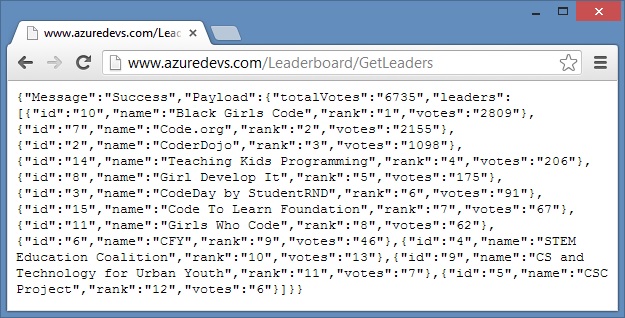
theodp writes "As noted earlier, Microsoft is tackling the CS education crisis with a popularity contest that will award $100K in donations to five technology education nonprofits that help make kids technically literate. Hopefully, the nonprofits will teach kids that the contest's voting Leader Board is a particularly good example of what-not-to-do technically. In addition to cherry-picking the less-pathetic vote totals to make its Leader Board, Microsoft also uses some dubious rounding code that transforms the original voting data into misleading percentages. Indeed, developer tools reveal that the top five leaders in the Microsoft STEM education contest miraculously account for 130% of the vote. Let's hope the quality control is better for those Microsoft Surface voting machines!" -
Russian Vehicle Delivers Spacesuit Repair Kit To ISS
A Russian spacecraft has successfully delivered new supplies to the ISS. Crucially, its payload is meant to prevent a repeat of the aborted spacewalk of earlier this month. Says the article:: "The cargo ship is loaded with nearly 3 tons (2.7 tonnes) of food, fuel, hardware and science experiment equipment for the six-person crew of the station's Expedition 36 mission. Among its cargo is a set of tools intended to help the astronauts investigate and patch up the spacesuit that malfunctioned during a July 16 spacewalk outside the orbiting laboratory." -
Man Formerly Charged With Rigging Student Ballot Exposed As Labor Official
First time accepted submitter pocock writes "Motivated by reports of Matthew Weaver's twelve month jail sentence for rigging CalState student elections, a comprehensive blog describes in detail how a generation of student ballot riggers from the late 1990s have graduated unhindered into federal politics, playing a pivotal role in Australia's upcoming federal election. One can only wonder if Weaver had not been caught, would he too have eventually swiped a million dollars and put the SRC into liquidation?" -
Fidus Writer: Open Source Collaborative Editor For Non-Geek Academics
johanneswilm writes "While writing my Ph.D in anthropology I found out it's almost impossible to get non-geeks to help me with editing my thesis because it was written in Latex. Lyx is almost there, but as it's not web based, it's difficult to use for online collaboration. Writelatex.com is online, but typing LaTeX code is a no-go for non-geeks. Google Docs is web based and near-WYSIWYG, but lacks support for professional print formats such as Latex. The Ph.D took longer than expected, so before finishing me and three others were able to code an entirely new editor: Fidus Writer: web based, open source (AGPL), almost-WYSIWYG and with tools for academics such as citation management and formula support and output formats PDF, Epub, Latex, HTML." -
Every Public School Student In LA Will Get an iPad In 2014
Jeremiah Cornelius writes "After signing a $30 million iPad deal with Apple in June, the Los Angeles School Board of Education has revealed the full extent of the program that will provide tablets to all students in the district. CiteWorld reports that the first phase of the program will see pupils receive 31,000 iPads this school year, rising to 640,000 Apple tablets by the end of 2014. Apple previously announced that the initiative would include 47 campuses and commence in the fall." Certain companies (not just Apple) stand to benefit from this kind of outlay. -
News Worth Buying On Paper
theodp writes " Last night,' confesses Business Insider's Henry Blodget, 'I did something I very rarely do: I bought a newspaper. Why? 'Because there was some news in the newspaper that I wanted that wasn't available online for free [a hyperlocal zoning story].' The problem in the news industry, suggests Blodget, is there is way too much commodity news coverage of the same stories, so it has to be given away for free. To be able to charge for news, Blodget suggests, you need more news that can't be found anywhere else. So, is there any type of news that you're still willing to pay for these days?" I've recently discovered that a newspaper in The Villages, Florida publishes a monthly list of "Golf Cart Crashes (With Injuries)," googling for which only seems to bring up ads for lawyers specializing in that area, so paper will have to do. -
New for 2013: An In-Depth Analysis of Kubrick's 2001: a Space Odyssey
An anonymous reader writes "Long time /. member maynard has written one of the most obsessively detailed and extensive analyses of Stanley Kubrick's classic 2001: A Space Odyssey seen in some time. At more than 22,000 words, it contains still images, film clips, musical score selections and copious references, including by Piers Bizony, author of Filming the Future, Nietzsche, Foucault, Freud, and film theorists like Bazin, Kracauer and Zizek. It's already gained some notoriety, having been retweeted by Nicholas Jackson, former editor of the Atlantic Monthly and Slate. Anyone who loves the film or SF in general should find this an amazing read!" I don't know whether it can topple my all-time favorite analysis of 2001, Leonard F. Wheat's Kubrick's 2001: A Triple Allegory . -
New for 2013: An In-Depth Analysis of Kubrick's 2001: a Space Odyssey
An anonymous reader writes "Long time /. member maynard has written one of the most obsessively detailed and extensive analyses of Stanley Kubrick's classic 2001: A Space Odyssey seen in some time. At more than 22,000 words, it contains still images, film clips, musical score selections and copious references, including by Piers Bizony, author of Filming the Future, Nietzsche, Foucault, Freud, and film theorists like Bazin, Kracauer and Zizek. It's already gained some notoriety, having been retweeted by Nicholas Jackson, former editor of the Atlantic Monthly and Slate. Anyone who loves the film or SF in general should find this an amazing read!" I don't know whether it can topple my all-time favorite analysis of 2001, Leonard F. Wheat's Kubrick's 2001: A Triple Allegory . -
The Shortest Internet Censorship Debate Ever
rysiek writes "When a politician starts talking about defending the innocence of children, there's bound to be a great policy initiative ahead. That's how British PM David Cameron introduced the British porn block. That's also how the Polish Minister of Justice started his remarks yesterday morning on how good an idea it is and that it should be introduced in Poland. This started the shortest Internet censorship debate ever, as in the evening of the same day the Polish Prime Minister and the Minister of Administration and Digitization denounced any such ideas: 'We shall not block access to legal content regardless of whether or not it appeases us aesthetically or ethically.' There had been several full-blown Internet censorship debates in Poland during the last four years. Apparently the arguments against it were not lost on at least some of Polish politicians." -
US Promises Not To Kill Or Torture Snowden
Hugh Pickens DOT Com writes "The WSJ reports that Attorney General Eric Holder promises Edward Snowden won't be tortured or face the death penalty in a new letter hoping to persuade Russia not to grant him asylum or refugee status. Holder's letter, dated Tuesday, notes that press reports from Russia indicated Snowden sought asylum in part based on claims he could be tortured or killed by the US government. It is common for the US to promise not to seek the death penalty against individuals being sought in other countries, because even America's closest allies won't turn over suspects if they believe that person might be executed. The United Nations special rapporteur on torture found Bradley Manning's detention was 'cruel and inhuman'." Update: 07/27 13:15 GMT by T : Several readers have noted that change.gov, established by the Obama transition team in 2008, has recently (last month) gone offline; among other things, it contained language specifically addressing the protection of whistleblowers. -
Hackers Using Bots, Scripts To Lock Down Restaurant Reservations
Nerval's Lobster writes "Forget about hacking an app or database: for a small cadre of hackers in San Francisco, it's all about writing code that can score them a great table at a hot restaurant. According to the BBC, these developers and programmers have designed bots that scan restaurant Websites for open tables and reserve them. Diogo Mónica, a security engineer with e-commerce firm Square, is one of those programmers. A self-described foodie, he decided to get around his inability to score a table at the ultra-popular State Bird Provisions by writing a script that sent out an email every time the restaurant's reservation page changed. 'Once a reservation got canceled I would get an email and could quickly get it for myself,' he wrote in a blog posting. But soon he noticed something peculiar: 'As soon as reservations became available on the website (at 4am), all the good times were immediately taken and were gone by 4:01am.' He suspected it was automated 'reservation bots at work,' built by other programmers with a hankering for fine cuisine. 'After a while even cancellations started being taken immediately from under me,' he wrote. 'It started being common receiving an email alerting of a change, seeing an available time, and it being gone by the time the website loaded.' His solution was to build his own reservation bot, using Ruby, and post the code in the wild." -
FSF Launches Fundraiser For Replicant
gnujoshua writes "The FSF has launched a fundraiser for Replicant, the fully free Android distro. As of version 4.0 0004, Replicant runs on 10 different devices, but, the hopes are that with additional funds, the developers will be able to purchase more devices and grow the project so it will run on more devices. Yesterday, the FSF asked Mark Shuttleworth if the Ubuntu EDGE would commit to using only free software and be able to support Replicant. But, in an AMA on Reddit, Shuttleworth confirmed that Replicant would not be supported because the EDGE hardware will require proprietary drivers/binary-blobs." Replicant now supports ten devices, compared to only the HTC Dream not all that long ago.