Slashdot Mirror
Domain: slashdot.org
Stories and comments across the archive that link to slashdot.org.
Stories · 37,380
-
CherryPal's $99 "Odd Lots" Netbook
Robotech_Master writes "CherryPal, which Slashdot last covered back in 2008, has released a $99 netbook, the Africa, aimed at the developing world but (unlike the OLPC) available for sale to the consumer. But unlike most netbooks, the Africa is not actually made to a set design. Instead, it uses a hacker-like approach similar to the way home PC builders build their cheap beige boxes. CherryPal purchases odd lots of whatever components are available most inexpensively, builds netbooks out of them, and calls them Africas. The resulting machines will at least meet and may exceed the minimum specs given on CherryPal's website, and may be built around an ARM, MIPS, or X86-based CPU depending on what parts CherryPal has on hand at the time. The device ships with 'at least' Windows CE or CherryPal's custom 'Green Maraschino' Debian-based Linux distro." -
The Nuking of Duke Nukem
Rick Bentley writes with more on the story behind the meltdown of Duke Nukem Forever, the game that will now live on only as a cautionary tale: "Although the shutdown was previously reported on Slashdot, this new Wired article goes in-depth behind the scenes to paint a picture of a mushroom cloud-sized implosion. Developers spending a decade in a career holding pattern for below market salary with 'profit sharing' incentives, no real project deadlines, a motion capture room apparently used to capture the motion of strippers (the new game was to take place in a strip club, owned by Duke, that gets attacked by aliens), and countless crestfallen fans. *Sniff*, I would have played that game." -
Website Owner's Manual
Michael J. Ross writes"Experienced Web designers and developers will readily admit that the most challenging aspect of their professions is not the technical work itself, nor learning the tools of the trade, but rather dealing with clients. Within that area, the most frustrating type of work — aside from the ever-joyless chore of collecting on invoices — is getting (non-technical) clients to understand the possibilities and limitations of Web technologies, design decisions, and all the other factors that can make or break a website project, as well as the site itself. Yet this process can be just as unhappy, and far more confusing, to prospective site owners, who typically are quite knowledgeable of their own fields, but have little to no understanding of how best to ensure the success of any website project they sponsor. Aiming to bridge this gap, is the appropriately-titled Website Owner's Manual." Read on for the rest of Michael's review. Website Owner's Manual author Paul Boag pages 296 pages publisher Manning Publications rating 8/10 reviewer Michael J. Ross ISBN 978-1933988450 summary A guidebook for anyone responsible for a new website. This book was written by Paul Boag, a veteran Web designer and the Creative Director of Headscape, a British design agency. He speaks at industry events, writes articles for various Web design publications, and cohosts Boagworld, "the podcast for all those involved in designing, developing, and running websites on a daily basis." The book was published on 1 December 2009 by Manning Publications, under the ISBN 978-1933988450. The publisher makes available a Web page for the book, where visitors can order print or electronic versions (purchasing the former entitles one to the latter), read the ancillary portions of the book (the table of contents, the index, etc.), read some reviewers' comments, and download two sample chapters for free: "Chapter 1: The secret to a successful website" and "Chapter 7: Ensuring access for all."
Spanning 296 pages, the book's material is grouped into twelve chapters, covering the following topics: the role and challenges of a website owner; planning a site development project; crafting a project brief, and choosing the team to implement it; how to work with a designer and understand design basics; optimal website content; site usability and testing; site accessibility, and what can undermine it; content management systems; an overview of the Web, browsers, and hosting; online and off-line promotion, including search engine optimization and marketing performance; how to develop your site into an online community, and the many benefits of doing so; preparing your website for the future. The dozen chapters can be thought of as forming three parts, although they are not formally labeled as such.
The book's first chapter is titled "The secret to a successful website," which is also the book's subtitle — at least, as shown on the cover, but oddly not on the title page. It is a poorly chosen chapter title, partly because the author repudiates it on the first page, and partly because it suggests that there is but one element to a successful website, and it is being kept a secret. (One can only hope that the publisher's marketing department is not planning on keeping it a secret.). Fortunately, the silly title does not reflect the chapter's content, which may be brief, but offers sensible advice to any business owner who decides that she needs a new website, or works within an organization and has been given that role. The reader is warned of the dangers of information overload, specialization in only one area of site ownership, and the common failure to comprehend the critical responsibilities of that role: balancing conflicting priorities, defining the role, and planning for the future. This chapter, like all that follow, concludes with a "Next actions" section, containing several tasks that the reader is advised to implement, in order to get the most benefit from the chapter's recommendations.
Chapter 2, titled "Stress-free planning," explores several ways that a website owner can proactively lay the groundwork for a successful Web project: understanding the objectives of an entirely new site or changes to a legacy one, and the organization as a whole; consulting with stakeholders; developing criteria for success; obtaining feedback on an existing site, if any, as well as the competition's sites; and understanding the site's future audience, and representing them in the form of personas. The author posits that this information forms a prerequisite for writing a site brief and assembling "The perfect team," which is the title of the third chapter. He begins by listing the major advantages of either using an internal Web team or outsourcing to an external agency, or choosing a combination thereof (an option that far too many business owners fail to consider, even when it may be the ideal choice). Perhaps one of the most valuable sections of the book is the discussion on how to create an effective brief, and the reasons for doing so even for small and/or internally sourced projects. However, readers may be confused by the assertion on page 49 that revenue can be estimated from profits, when in fact profits are calculated from revenues (less expenses). The chapter concludes with some excellent advice on how to choose the ideal outside team to complete one's Web project, if one has decided to outsource the work.
The second part of the book begins with the fourth chapter, and presupposes that the reader has created a brief and a statement of work, selected a team to implement the latter, and everyone involved has attended a kickoff meeting. Now begins the critical phase of site design, and the author provides sound recommendations on how to avoid some of the most common Web design pitfalls: neglecting the target audience, failing to test the design, designing by committee or on-the-fly, micromanaging the design decisions, overloading the site's homepage, and settling for a corporate brand or page layout that ill-serves the site user and thus the organization. The chapter concludes with discussion of some key topics in the design world: the user's screen resolution, the fold, and the three options for page layout (fixed, fluid, and elastic). Chapter 5 delves into "Creating killer content" — specifically, the importance of context, brevity, logical and user-centric information architecture (through card sorting and use cases), and text that is engaging and easy to read.
In Chapter 6, the author examines a number of aspects of user testing: costs and benefits thereof, techniques for dramatically reducing the former while maximizing the latter, the selection of test subjects, and how best to run usability test sessions and then capitalize on the results in order to hone the website before and during its design. The subsequent chapter — which covers website accessibility — shares common ground with user testing, in some respects, because site testing is an effective post-development strategy to discover accessibility problems. Yet this should be supplemented proactively with an adequate understanding of how to make one's site accessible using standards-based design and coding. The author makes clear the many advantages of separating presentation from content, and of maximizing a site's accessibility — largely by building upon said separation. However, his advice to website owners to read and understand the WCAG 2 guidelines is arguably unrealistic, given that those specifications are admittedly "extensive and highly technical in places"; all clients in my experience would dismiss the suggestion immediately.
Mentioned earlier in the book — as a potential tool for creating a wireframe of a site — content management systems (CMSs) take center stage in Chapter 8, which explores their advantages and disadvantages. One of the criticisms leveled at CMSs — that they reduce site quality by allowing greater user input — is unfair, since a hand-coded, non-CMS site could only allow similar user input with far greater risk (imagine non-technical employees butchering HTML files by editing them in word processors!). Nevertheless, the issues raised by the author definitely need to be considered by anyone planning a CMS-based website. When researching and comparing available CMSs, a business person planning a new site will encounter a plethora of technical terms, many of which are explained in Chapter 9, titled "Decoding technobabble." Yet these terms are just as likely to be encountered during the phases discussed in the book's earlier chapters, and thus this material should have been placed at the beginning of the book, with the suggestion that tech-savvy readers could skip over it; or, the chapter could have been made an appendix, with a similar message at the beginning of the book, pointing to the appendix for those unsure of Web terminology. The only glaring mistake is the statement that "the web consists of a vast network of computers spread across the globe"; that's not the Web, but rather the Internet. Nevertheless, the author's lucid introduction to Web technologies and terms could be a real help to non-technical readers.
The last three chapters can be thought of as the post-launch part of the book, because at this stage in the process, the website owner has completed the build phase, and is now ready to begin increasing the popularity and usage of the site. Chapter 10, titled "Driving traffic," explains the pitfalls and best practices in trying to promote one's site using search engines, social media, and other methods of reaching an audience and measuring the results. The material serves as a decent introduction to the topics, including a brief overview of Google AdWords (although it incorrectly states that AdWords prices start at $.10 per click, when in fact it is one cent). The next chapter explores what is involved in building a vibrant community online, as well as the costs and benefits of doing so. The final chapter, "Planning for the future," begins by warning against the wasteful but common practice of organizations commissioning brand new websites every few years, to replace the previous ones that fell into neglect, oftentimes because the website owner failed to maintain a strong relationship with the site designer. The bulk of the chapter explores emerging trends in the Web world, such as rich media, Web services, and mobile devices.
The book concludes with an index that is quite complete — a characteristic now rarely seen in programming books. Credit should also be given for the neat format and indentation of the table of contents, which facilitates quick scanning.
The text is interspersed with some screenshots, graphs, and, most welcome of all, cartoons that reflect the author's sense of humor and illustrate the conflicts and misunderstandings that can arise during site development and maintenance. All of the screenshots and other technical illustrations are well captioned, except for the one on page 33, which contains an extraneous space after the "link:," and would be baffling if taken at face value, without examining the Google Search screenshot. Sadly reflecting our era of texting and grammatical sloppiness, the chapter titles are not presented in title case, but instead in sentence case — which is especially confusing when they are embedded within sentences in the text. On several pages (45, 60, 86, 91, 102, 140, 185, 186, 209-211, etc.) at least one paragraph contains an errant newline character or is missing an indentation of a paragraph. In general, the production quality of the book does not match the value of the information.
First editions of technical books are usually riddled with errata, and this one is no exception: "Aesthetics refer[s]" (page 5), "principle" (should read "principal"; page 6), "We respects" (page 7, in the form), "site [owner] considers" (9), "Planning give" (16), "possible accessibility problem[s]" (30), "us the web" (37), "she is gives" (37), "a internal" (45), "amazon.com" (47, twice), "suitable [ones]" (48), "are [a] number" (56), "Recommenede" (56), "a RSS" (73), "Resolution affect[s]" (82), "branding and designs" (86), "Pages... needs" (91), "to[o] hard" (94), "This techniques" (95), "can't achieved" (96), "was" (should read "were"; 102 and elsewhere), "content stand out" (104), "Using" (should read "Use"; 104), "on the identifying," (105), "used. and" (111), "longer that than" (115), "This also it" (118), "a certainly level across" (141), "approach take" (141), "JavaS-cript" (143), "then if" (147), "Wordpress" (157), "pervious version" (no joke!; 161), "a enterprise" (161), "open [a] web browser" (173), "photo book" (should read "phonebook"; 173), "than are" (should read "that are"; 175), "in obscure language" (178), and at that point I gave up and stopped recording them. Given the modest length of this book, there are far too many errors such as these.
Readers will likely find that there are two major weaknesses in this book: Firstly, some of the discussion, especially in the first half, is a bit too high level, at times almost like an outline for a meatier discussion — one encompassing more specific information as to how the reader could implement and measure the principles provided. Similarly, because many of the suggestions are fairly general, they would greatly benefit from more examples — either contrived or, even better, real world occurrences — perhaps from Headscape's past projects, with names changed if needed. These could demonstrate the key ideas, and make it easier for readers to see the truth of those ideas in their own past experiences, and then apply them in the future. Fortunately, the book does employee several hypothetical case studies that are incorporated into the narrative, at various points; those are helpful, as are the screenshots that illustrate violations of design best practices.
Secondly, and more importantly, almost no advice is given as to what to do when things go wrong. What can the website owner do when an external design agency begins missing deadlines, but appears to be making an honest effort? What can be done when interdepartmental bickering threatens to sink the specifications process? These and other critical topics are not addressed. (Readers undoubtedly could think of other common scenarios.) It would have been terrific had the author shared hard-won lessons gleaned from his background and those of his colleagues, as well as what methods they found to be effective in squelching those crises, and which ones proved ineffective, and why. Those case studies alone would most likely have been worth the price of the book — again, with no need to disclose the names of the participants. Perhaps there would prove to be enough material to make for a second book.
The writing style can be described using Web design terms: fluid and accessible — although there are some run-on sentences from a lack of well-placed commas. The author explains the topics in a straightforward manner, without the assumptions and jargon that undermine communication between Web experts and non-technical businesspeople. This is one reason why this book should be of value not only to people responsible for websites in organizations of all sizes, but also to designers, developers, user interface specialists, and all other Web professionals who communicate with project managers and end-users.
Website Owner's Manual is a valuable resource that benefits from the experience and insight of a veteran Web designer, and clearly presents guidelines that site managers can follow for maximizing the odds of successful site design, implementation, and maintenance.
Michael J. Ross is a freelance website developer and writer.
You can purchase Website Owner's Manual from amazon.com. Slashdot welcomes readers' book reviews -- to see your own review here, read the book review guidelines, then visit the submission page. -
Website Owner's Manual
Michael J. Ross writes"Experienced Web designers and developers will readily admit that the most challenging aspect of their professions is not the technical work itself, nor learning the tools of the trade, but rather dealing with clients. Within that area, the most frustrating type of work — aside from the ever-joyless chore of collecting on invoices — is getting (non-technical) clients to understand the possibilities and limitations of Web technologies, design decisions, and all the other factors that can make or break a website project, as well as the site itself. Yet this process can be just as unhappy, and far more confusing, to prospective site owners, who typically are quite knowledgeable of their own fields, but have little to no understanding of how best to ensure the success of any website project they sponsor. Aiming to bridge this gap, is the appropriately-titled Website Owner's Manual." Read on for the rest of Michael's review. Website Owner's Manual author Paul Boag pages 296 pages publisher Manning Publications rating 8/10 reviewer Michael J. Ross ISBN 978-1933988450 summary A guidebook for anyone responsible for a new website. This book was written by Paul Boag, a veteran Web designer and the Creative Director of Headscape, a British design agency. He speaks at industry events, writes articles for various Web design publications, and cohosts Boagworld, "the podcast for all those involved in designing, developing, and running websites on a daily basis." The book was published on 1 December 2009 by Manning Publications, under the ISBN 978-1933988450. The publisher makes available a Web page for the book, where visitors can order print or electronic versions (purchasing the former entitles one to the latter), read the ancillary portions of the book (the table of contents, the index, etc.), read some reviewers' comments, and download two sample chapters for free: "Chapter 1: The secret to a successful website" and "Chapter 7: Ensuring access for all."
Spanning 296 pages, the book's material is grouped into twelve chapters, covering the following topics: the role and challenges of a website owner; planning a site development project; crafting a project brief, and choosing the team to implement it; how to work with a designer and understand design basics; optimal website content; site usability and testing; site accessibility, and what can undermine it; content management systems; an overview of the Web, browsers, and hosting; online and off-line promotion, including search engine optimization and marketing performance; how to develop your site into an online community, and the many benefits of doing so; preparing your website for the future. The dozen chapters can be thought of as forming three parts, although they are not formally labeled as such.
The book's first chapter is titled "The secret to a successful website," which is also the book's subtitle — at least, as shown on the cover, but oddly not on the title page. It is a poorly chosen chapter title, partly because the author repudiates it on the first page, and partly because it suggests that there is but one element to a successful website, and it is being kept a secret. (One can only hope that the publisher's marketing department is not planning on keeping it a secret.). Fortunately, the silly title does not reflect the chapter's content, which may be brief, but offers sensible advice to any business owner who decides that she needs a new website, or works within an organization and has been given that role. The reader is warned of the dangers of information overload, specialization in only one area of site ownership, and the common failure to comprehend the critical responsibilities of that role: balancing conflicting priorities, defining the role, and planning for the future. This chapter, like all that follow, concludes with a "Next actions" section, containing several tasks that the reader is advised to implement, in order to get the most benefit from the chapter's recommendations.
Chapter 2, titled "Stress-free planning," explores several ways that a website owner can proactively lay the groundwork for a successful Web project: understanding the objectives of an entirely new site or changes to a legacy one, and the organization as a whole; consulting with stakeholders; developing criteria for success; obtaining feedback on an existing site, if any, as well as the competition's sites; and understanding the site's future audience, and representing them in the form of personas. The author posits that this information forms a prerequisite for writing a site brief and assembling "The perfect team," which is the title of the third chapter. He begins by listing the major advantages of either using an internal Web team or outsourcing to an external agency, or choosing a combination thereof (an option that far too many business owners fail to consider, even when it may be the ideal choice). Perhaps one of the most valuable sections of the book is the discussion on how to create an effective brief, and the reasons for doing so even for small and/or internally sourced projects. However, readers may be confused by the assertion on page 49 that revenue can be estimated from profits, when in fact profits are calculated from revenues (less expenses). The chapter concludes with some excellent advice on how to choose the ideal outside team to complete one's Web project, if one has decided to outsource the work.
The second part of the book begins with the fourth chapter, and presupposes that the reader has created a brief and a statement of work, selected a team to implement the latter, and everyone involved has attended a kickoff meeting. Now begins the critical phase of site design, and the author provides sound recommendations on how to avoid some of the most common Web design pitfalls: neglecting the target audience, failing to test the design, designing by committee or on-the-fly, micromanaging the design decisions, overloading the site's homepage, and settling for a corporate brand or page layout that ill-serves the site user and thus the organization. The chapter concludes with discussion of some key topics in the design world: the user's screen resolution, the fold, and the three options for page layout (fixed, fluid, and elastic). Chapter 5 delves into "Creating killer content" — specifically, the importance of context, brevity, logical and user-centric information architecture (through card sorting and use cases), and text that is engaging and easy to read.
In Chapter 6, the author examines a number of aspects of user testing: costs and benefits thereof, techniques for dramatically reducing the former while maximizing the latter, the selection of test subjects, and how best to run usability test sessions and then capitalize on the results in order to hone the website before and during its design. The subsequent chapter — which covers website accessibility — shares common ground with user testing, in some respects, because site testing is an effective post-development strategy to discover accessibility problems. Yet this should be supplemented proactively with an adequate understanding of how to make one's site accessible using standards-based design and coding. The author makes clear the many advantages of separating presentation from content, and of maximizing a site's accessibility — largely by building upon said separation. However, his advice to website owners to read and understand the WCAG 2 guidelines is arguably unrealistic, given that those specifications are admittedly "extensive and highly technical in places"; all clients in my experience would dismiss the suggestion immediately.
Mentioned earlier in the book — as a potential tool for creating a wireframe of a site — content management systems (CMSs) take center stage in Chapter 8, which explores their advantages and disadvantages. One of the criticisms leveled at CMSs — that they reduce site quality by allowing greater user input — is unfair, since a hand-coded, non-CMS site could only allow similar user input with far greater risk (imagine non-technical employees butchering HTML files by editing them in word processors!). Nevertheless, the issues raised by the author definitely need to be considered by anyone planning a CMS-based website. When researching and comparing available CMSs, a business person planning a new site will encounter a plethora of technical terms, many of which are explained in Chapter 9, titled "Decoding technobabble." Yet these terms are just as likely to be encountered during the phases discussed in the book's earlier chapters, and thus this material should have been placed at the beginning of the book, with the suggestion that tech-savvy readers could skip over it; or, the chapter could have been made an appendix, with a similar message at the beginning of the book, pointing to the appendix for those unsure of Web terminology. The only glaring mistake is the statement that "the web consists of a vast network of computers spread across the globe"; that's not the Web, but rather the Internet. Nevertheless, the author's lucid introduction to Web technologies and terms could be a real help to non-technical readers.
The last three chapters can be thought of as the post-launch part of the book, because at this stage in the process, the website owner has completed the build phase, and is now ready to begin increasing the popularity and usage of the site. Chapter 10, titled "Driving traffic," explains the pitfalls and best practices in trying to promote one's site using search engines, social media, and other methods of reaching an audience and measuring the results. The material serves as a decent introduction to the topics, including a brief overview of Google AdWords (although it incorrectly states that AdWords prices start at $.10 per click, when in fact it is one cent). The next chapter explores what is involved in building a vibrant community online, as well as the costs and benefits of doing so. The final chapter, "Planning for the future," begins by warning against the wasteful but common practice of organizations commissioning brand new websites every few years, to replace the previous ones that fell into neglect, oftentimes because the website owner failed to maintain a strong relationship with the site designer. The bulk of the chapter explores emerging trends in the Web world, such as rich media, Web services, and mobile devices.
The book concludes with an index that is quite complete — a characteristic now rarely seen in programming books. Credit should also be given for the neat format and indentation of the table of contents, which facilitates quick scanning.
The text is interspersed with some screenshots, graphs, and, most welcome of all, cartoons that reflect the author's sense of humor and illustrate the conflicts and misunderstandings that can arise during site development and maintenance. All of the screenshots and other technical illustrations are well captioned, except for the one on page 33, which contains an extraneous space after the "link:," and would be baffling if taken at face value, without examining the Google Search screenshot. Sadly reflecting our era of texting and grammatical sloppiness, the chapter titles are not presented in title case, but instead in sentence case — which is especially confusing when they are embedded within sentences in the text. On several pages (45, 60, 86, 91, 102, 140, 185, 186, 209-211, etc.) at least one paragraph contains an errant newline character or is missing an indentation of a paragraph. In general, the production quality of the book does not match the value of the information.
First editions of technical books are usually riddled with errata, and this one is no exception: "Aesthetics refer[s]" (page 5), "principle" (should read "principal"; page 6), "We respects" (page 7, in the form), "site [owner] considers" (9), "Planning give" (16), "possible accessibility problem[s]" (30), "us the web" (37), "she is gives" (37), "a internal" (45), "amazon.com" (47, twice), "suitable [ones]" (48), "are [a] number" (56), "Recommenede" (56), "a RSS" (73), "Resolution affect[s]" (82), "branding and designs" (86), "Pages... needs" (91), "to[o] hard" (94), "This techniques" (95), "can't achieved" (96), "was" (should read "were"; 102 and elsewhere), "content stand out" (104), "Using" (should read "Use"; 104), "on the identifying," (105), "used. and" (111), "longer that than" (115), "This also it" (118), "a certainly level across" (141), "approach take" (141), "JavaS-cript" (143), "then if" (147), "Wordpress" (157), "pervious version" (no joke!; 161), "a enterprise" (161), "open [a] web browser" (173), "photo book" (should read "phonebook"; 173), "than are" (should read "that are"; 175), "in obscure language" (178), and at that point I gave up and stopped recording them. Given the modest length of this book, there are far too many errors such as these.
Readers will likely find that there are two major weaknesses in this book: Firstly, some of the discussion, especially in the first half, is a bit too high level, at times almost like an outline for a meatier discussion — one encompassing more specific information as to how the reader could implement and measure the principles provided. Similarly, because many of the suggestions are fairly general, they would greatly benefit from more examples — either contrived or, even better, real world occurrences — perhaps from Headscape's past projects, with names changed if needed. These could demonstrate the key ideas, and make it easier for readers to see the truth of those ideas in their own past experiences, and then apply them in the future. Fortunately, the book does employee several hypothetical case studies that are incorporated into the narrative, at various points; those are helpful, as are the screenshots that illustrate violations of design best practices.
Secondly, and more importantly, almost no advice is given as to what to do when things go wrong. What can the website owner do when an external design agency begins missing deadlines, but appears to be making an honest effort? What can be done when interdepartmental bickering threatens to sink the specifications process? These and other critical topics are not addressed. (Readers undoubtedly could think of other common scenarios.) It would have been terrific had the author shared hard-won lessons gleaned from his background and those of his colleagues, as well as what methods they found to be effective in squelching those crises, and which ones proved ineffective, and why. Those case studies alone would most likely have been worth the price of the book — again, with no need to disclose the names of the participants. Perhaps there would prove to be enough material to make for a second book.
The writing style can be described using Web design terms: fluid and accessible — although there are some run-on sentences from a lack of well-placed commas. The author explains the topics in a straightforward manner, without the assumptions and jargon that undermine communication between Web experts and non-technical businesspeople. This is one reason why this book should be of value not only to people responsible for websites in organizations of all sizes, but also to designers, developers, user interface specialists, and all other Web professionals who communicate with project managers and end-users.
Website Owner's Manual is a valuable resource that benefits from the experience and insight of a veteran Web designer, and clearly presents guidelines that site managers can follow for maximizing the odds of successful site design, implementation, and maintenance.
Michael J. Ross is a freelance website developer and writer.
You can purchase Website Owner's Manual from amazon.com. Slashdot welcomes readers' book reviews -- to see your own review here, read the book review guidelines, then visit the submission page. -
Legislator Wants Cancer Warnings For Cell Phones
Cytalk writes "A Maine legislator wants to make the state the first to require cell phones to carry warnings that they can cause brain cancer, although there is no consensus among scientists that they do and industry leaders dispute the claim. The now-ubiquitous devices carry such warnings in some countries, though no US states require them, according to the National Conference of State Legislators. A similar effort is afoot in San Francisco, where Mayor Gavin Newsom wants his city to be the nation’s first to require the warnings." -
Beer-Finding Augmented Reality App Launched
andylim writes "There are many potential uses for augmented reality technology including creating cool games and browsers but Stella has used this advanced technology to resolve that age old question — where can I find beer? Or to be more specific, where can I find Belgian beer? The app even finds you a taxi for when you've had enough and need to get home." -
Beer-Finding Augmented Reality App Launched
andylim writes "There are many potential uses for augmented reality technology including creating cool games and browsers but Stella has used this advanced technology to resolve that age old question — where can I find beer? Or to be more specific, where can I find Belgian beer? The app even finds you a taxi for when you've had enough and need to get home." -
Simulation of Close Asteroid Fly-By
c0mpliant writes "NASA and the Jet Propulsion Laboratory have released a simulation of the path of an asteroid, named Apophis, that will come very close to Earth in 2029 — the closest predicted approach since humans have monitored for such heavenly bodies. The asteroid caused a bit of a scare when astronomers first announced that it would enter Earth's neighborhood some time in the future. However, since that announcement in 2004, more recent calculations have put the odds of collision at 1 in 250,000." -
Android's Success a Threat To Free Software?
Glyn Moody writes "Two years after its launch, Google's Linux-based Android platform is finally making its presence felt in the world of smartphones. Around 20,000 apps have been written for it. Although well behind the iPhone's tally, that's significantly more than just a few months ago. But there's a problem: few of these Android apps are free software. Instead, we seem to be witnessing the birth of a new hybrid stack — open source underneath, and proprietary on top. If, as many believe, mobile phones will become the main computing platform for most of the world, that could be a big problem for the health of the free software ecosystem. So what, if anything, should the community be doing about it?" -
Grigory Perelman and the Poincare Conjecture
EagleHasLanded writes "Russian mathematician Grigory Perelman doesn't talk to journalists. Actually, he doesn't talk to anyone anymore. So we'll have to settle for insights via his biographer, Masha Gessen, who, strangely enough, has never talked to him either. But she has spoken with just about everyone who has ever had any significant interaction with Perelman, and the result is the book Perfect Rigor, which more than adequately explains why Perelman has gone into self-imposed exile, and why he probably won't collect the million dollars he won by solving the Poincare Conjecture." -
DMCA Takedown Scandal, Part Two
pmdubs writes "Following up on our earlier discussion, Michael Freedman updates us on experience with dubious DMCA takedown notices. As a result of the publicity his initial post received, the Video Protection Alliance has dropped Nexicon, the company to which they had outsourced infringement detection. In this case, while there may be little legal recourse to issuing invalid DMCA notices, the threat of bad press seems to have reined in highly questionable practices." -
Making Sense of the Cellphone Landscape
Charlie Stross has a blog post up that tries to make sense of the mobile phone market and where it's going: where Apple, Google, and the cellcos fit in, and what the point of Google's Nexus One may be. "Becoming a pure bandwidth provider is every cellco's nightmare: it levels the playing field and puts them in direct competition with their peers, a competition that can only be won by throwing huge amounts of capital infrastructure at their backbone network. So for the past five years or more, they've been doing their best not to get dragged into a game of beggar-my-neighbor, by expedients such as exclusive handset deals... [Google intends] to turn 3G data service (and subsequently, LTE) into a commodity, like Wi-Fi hotspot service only more widespread and cheaper to get at. They want to get consumers to buy unlocked SIM-free handsets and pick cheap data SIMs. They'd love to move everyone to cheap data SIMs rather than the hideously convoluted legacy voice stacks maintained by the telcos; then they could piggyback Google Voice on it, and ultimately do the Google thing to all your voice messages as well as your email and web access. (This is, needless to say, going to bring them into conflict with Apple. ... Apple are an implicit threat to Google because Google can't slap their ads all over [the App and iTunes stores]. So it's going to end in handbags at dawn... eventually.)" -
Nvidia Waiting In the Wings In FTC-Intel Dispute
The NY Times has a Bits Blog piece speculating on some of the fallout if the FTC prevails in its anti-competition lawsuit against Intel. The Times picks out two among the 26 remedies proposed by the regulator, and concludes that they add up to Nvidia being able to license x86 technology. This could open up 3-way competition in the market for combined CPU-graphics chips. There is a good deal of circumstantial evidence pointing to the possibility that Nvidia has been working on x86 technology since 2007, including the presence on its employment rolls of more than 70 former Transmeta workers. -
Library Groups Ask DOJ To Oversee Google Books
adeelarshad82 writes "Three library associations have asked the Justice Department to oversee Google's plans to create a massive digital library, so as to prevent excessively high pricing for institutional subscriptions. They said that there was unlikely to be an effective competitor to Google's massive project in the near term. They also asked for academic author representation on the Registry board. Google's plan to digitize millions of books has been criticized by a variety of sources and has recently been shut down in France." -
Proposed NASA Mission Would Sail the Seas of Titan
The BBC has a report on a proposal that will be submitted to NASA for funding — a mission to Saturn's moon Titan that would deposit a lander on its hydrocarbon sea. (We recently discussed the widely-circulated photo of sunlight glinting off one of Titan's seas.) "The scientific team behind the idea is targeting Ligeia Mare, a vast body of liquid methane sited in the high north of Saturn's largest moon. ... 'It is something that would really capture the imagination,' said Dr Ellen Stofan, from Proxemy Research, who leads the study team. 'The story of human exploration on Earth has been one of navigation and seafaring, and the idea that we could explore for the first time an extraterrestrial sea I think would be mind-blowing for most people,' she told BBC News. ... The Titan Mare Explorer (TiME) has already been under study for about two years. It is envisaged as a relatively low-cost endeavor — in the low $400m range. It could launch in January 2016, and make some flybys of Earth and Jupiter to pick up the gravitational energy it would need to head straight at the Saturnian moon for a splash down in June 2023." -
Carriers, Manufacturers Are Strangling Android
loconet writes "This article in Gizmodo claims that Android's fragmented model is harming it, but Google has the power to save it. The rumored Google Phone could be a ploy to upset the wireless industry, or it could be an expensive niche device. Either way, it would be a bid to take Android back from the companies that seem hell-bent on destroying it. '...once handset manufacturers (and carriers, through handset manufacturers) have built their own version of Android, they've effectively taken it out of the development stream. Updating it is their responsibility, which they have to choose to uphold. Or not! Who cares? The phones are already sold." -
Colliding Auroras Produce Explosions of Light
elyons writes "Another neat discovery has come from the lab of Larry Lyons at UCLA. As reported earlier on Slashdot, Lyons' group studies the dynamics of auroras. Their most recent discovery reveals for the first time the sequence of events leading to dramatic space-weather disturbances. Using a network of cameras deployed around the Arctic in support of NASA's THEMIS mission, they recorded over 200 instances of auroras colliding, causing brilliant displays of northern lights (see time 8:22 for such an example)." -
Verizon Defends Doubling of Early Termination Fee
I Don't Believe in Imaginary Property writes "Verizon is defending its decision to double its Early Termination Fee from $175 to $350 after being called to account by the FCC. They claim it's because the higher fees allow them to offer more expensive phones with a lower up-front cost (PDF), and they also say that because they pro-rate the fee depending on how much of your contract is left, they still lose money. Apparently doing something about the Verizon customer service horror stories isn't as good a way to retain customers as telling them that they have to pay several hundred dollars to leave." -
First Look At Latest Ion-Infused Asus Eee PC
MojoKid writes "Atom-based netbooks have come a long way since they were first introduced. 7 and 8-inch netbooks are no longer the norm, and availability of 12-inch netbooks is on the rise. The newest member of the Asus Eee PC lineup is the Eee PC 1201N, and it really stands out in the crowd of netbook in terms of specifications. The machine features a 12.1" HD display, new dual-core Atom 330 CPU, 2GB of DDR2 RAM, Windows 7 Home Premium, an HDMI output and NVIDIA's Ion chipset with integrated GPU. HotHardware was able to demo the system's ability to handle more advanced benchmarks, thanks in part to the Ion GPU. It's also the first netbook they tested that could actually play older 3D titles respectably. You won't get Crysis running but lighter duty titles can be played back nicely if you tone the details down and lower the resolution. The 1201N also played back 720p and 1080p content without stuttering, and the dual-core CPU allowed enough headroom to multitask while videos were playing." -
DECAF Was Just a Stunt, Now Over
An anonymous reader writes to tell us of the de-activation of all copies of DECAF. The creators have announced that the DECAF project was nothing more than a "stunt to raise awareness for security and the need for better forensic tools." Originally DECAF was billed as a tool to stop Microsoft's forensic tool "COFEE" and was covered here earlier this week. In addition to their message of security the authors somehow manage to interject a discussion about religion, so who knows what the real goal was. -
Yes, Google Does De-List Pages; But When?
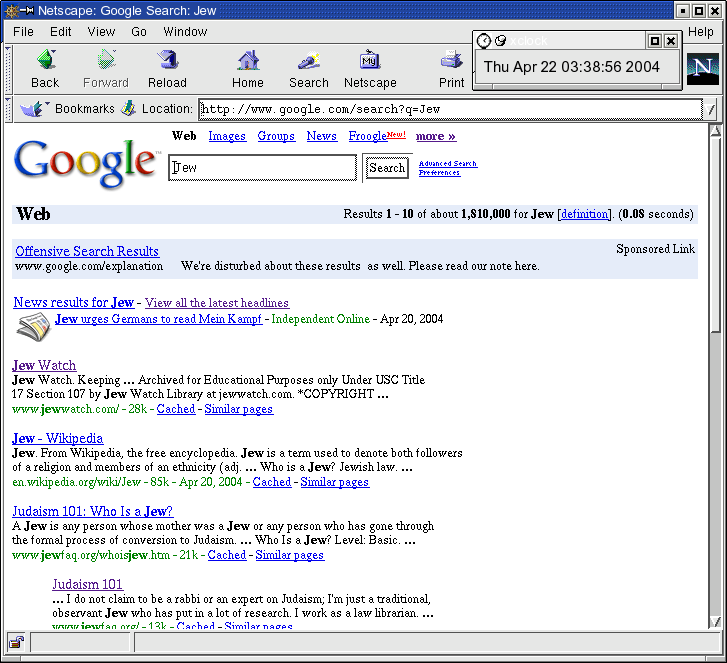
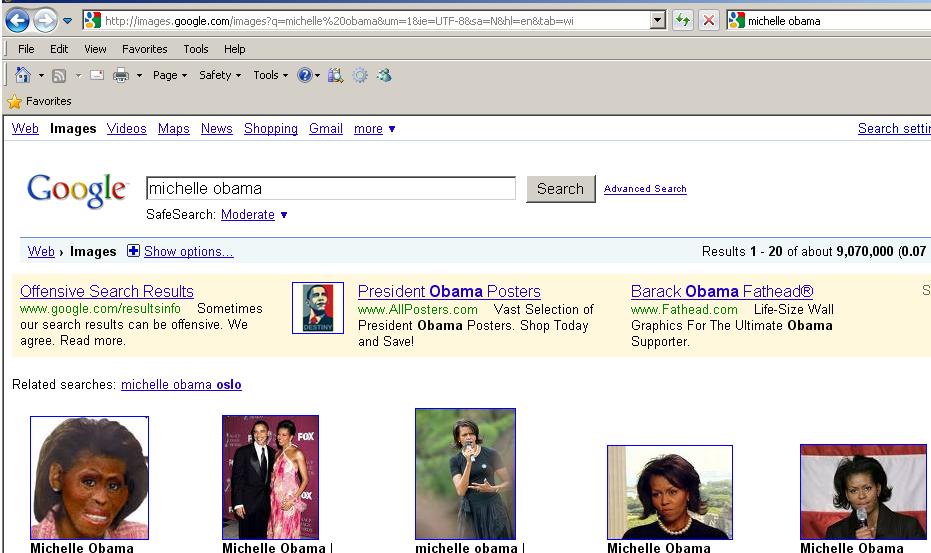
Frequent Slashdot contributor Bennett Haselton writes "Google finds itself inserting a disclaimer once again above some offensive search results. But the disclaimer still leads many to believe (incorrectly) that Google doesn't tamper with search results even in cases of 'harmful' or 'offensive' material. We know that Google has in fact de-listed some pages at the request of offended parties. What is their real policy on the issue?" Read on for Bennet's essay.In 2004, when Google users discovered that the top search result for the word "Jew" was the anti-semitic site Jew Watch, Google ran a disclaimer in the space usually reserved for ads, explaining that their results only reflected the reality of link counts on the Web, and that they did not endorse any Web sites which appeared at the top of their listings. Now the disclaimer has been dusted off again, as the top result on Google Images for "Michelle Obama" is a picture of a monkey's face with Michelle's hairdo. (Ironically, it looks as if the original image would have fallen out of the rankings, if it hadn't been for a follow-up blog post about the controversy, which itself now comes up as the first result.)
I first heard about the controversy from Dennis Prager's column in which he takes a New York Times columnist to task, because the columnist complained about "racially offensive images of the first couple" that come up in Google searches. Prager was unable to find any examples from Googling "first couple" or "Michelle and Barack Obama pictures," so he concluded that the NYT columnist "wildly exaggerated, if not made up" his claims. I tried Google Image searches for "first couple," "Barack Obama," and some other terms, and I couldn't find anything controversial either. However, it only took 10 seconds to enter "first couple google images controversy" on the regular Google Web search and find multiple blog posts explaining what all the fuss was about. Back to Google 101 for Dennis.
Many of the blog posts refer to Google's disclaimer about not tampering with search results. Those on one side are urging Google to make an exception and "fix" the results, while others sagely observe that Google just reflects reality, it doesn't create it.
All of this punditry is starting from a premise that's wrong. Google has actually removed pages from their search results — not because the pages were illegal or because the webmasters were search engine spamming, but because of the page's "offensive" content. In the "Chester's Guide" incident, a councilman in Chester, England discovered that one of the search results for "chester guide" was a satirical page titled "Chester's guide to picking up little girls." Although the page itself was obviously just someone's idea of sick humor, a Chester city councilman (who admitted that he hadn't looked at the page, saying that the title told him everything he needed to know) urged Google to remove the page from their index. Google at first refused, but later manually blacklisted the page to prevent it from appearing in their search results.
Whether or not you think this was the right decision, probably depends on what you think is the purpose of Google. If Google's purpose is to return the most useful results, then it made sense to remove the link, as Danny Sullivan of Search Engine Watch argued at the time, since it almost certainly was not a useful result for people searching for "Chester Guide." On the other hand, if the primary purpose of Google is to reflect the reality of what pages on the Web feature certain words most prominently (combined with all the other factors that Google weighs, of course), then the results shouldn't be altered.
But more people should at least realize that it happened. The Google disclaimer doesn't precisely say that they never blacklist pages or modify search results ("Google reserves the right to address such requests individually"), but it seems to give most people the impression that that's the case. According to that crudest of Googling techniques for which novice searchers are so frequently lampooned, there appear to be about 400 times as many stories on the Web about the Google "Jew Watch" controversy (where Google stood their ground) as there are stores about the "Chester's Guide" incident (where Google caved).
And Google-number-three Matt Cutts posted on his blog back in March explaining why Google does not remove "offensive" pages from search results; over a hundred comments followed, debating the pros and cons of the position, but none of them mentioned the Chester incident or any other case where Google actually had removed pages except as a result of a court order. One isolated comment from "Anonymous" said:
This is not quite true. I know of at least one web site that was de-listed for containing illegal content and/or promoting illegal activity.
which may or may not have been a reference to the Chester Guide incident. And that was it.
Is this a lot of hay to be making over something that happened years ago? Well, for one thing, I doubt if it happened just once. Consider that the Chester Guide incident involved a public declaration of outrage by a city council, and a public statement from Google, and still hardly anyone knows that it ever happened. If other incidents occurred without those high-profile elements, it would be even harder to discover them now. We'll probably never know how many such incidents took place, unless someone sues Google (maybe the owner of a blacklisted website, or maybe the victim of a RipOffReport hatchet job wondering why that site hadn't been blacklisted long ago), subpoenas Google for a list of cases where pages were de-indexed, and publishes the list if it's not sealed by a court order.
But whether it was one time or a handful, consider that political candidates like Arnold Schwarzenegger and Al Franken got asked during their campaigns about things they did 20 years earlier, and it's fair to ask a candidate about their past, because it's the same person standing in front of you now. Why did you do that? Have you stopped? Why?
And in the big scheme of things, Google is probably more powerful than a single US senator or the governor of California. So, can't we ask? What are their real rules about page removal? Have those rules changed since the Chester's Guide controversy? Can they even tell us what their rules are, or do they consider it a trade secret?
It is well known, of course, that Google censors some results in their search engines branded for different markets like China and even in liberal democracies like Germany. But nobody would call that a slippery slope towards censorship in the US version of Google, because the censorship in the Chinese and German versions is done at the behest of the governments there. On the other hand, Google does admit that they will de-index pages which include credit card numbers or social security numbers (which are all too easy to find on the Web). This might not seem like a controversial position, but even this act of voluntary self-censorship may be dipping their toe in the water further than it seems. Most people do consider their credit card information more private than their home address. But surely there are people like J.D. Salinger who less about the privacy of their credit card number (which is easily changeable) than their home address (which isn't). If someone finds Salinger's address and posts it on the Web, should Salinger be able to demand that Google de-index the page? Why should Google cater to the majority who want to keep their credit card number secret, but not to the minority who care more about keeping their address secret? Another commenter on Matt Cutts's blog post asked:
"hi. I have a question. My mom 'googled' herself and it shows some of her medical problems. She wants/needs these pages removed from search engines."
Again, why shouldn't that be considered at least as private as a credit card number?
And finally, even Google's decision to display an "offensive results" disclaimer, for some results but not for others, raises the same "Where do you draw the line?" questions as the issue of page removal. The Michelle Obama monkey picture gets a disclaimer. But search for 'george w bush' and the first row includes a photoshopped (I think!) image of Bush flipping off the press. Does that warrant a disclaimer as well? (Maybe that's considered less unfair because, even though the picture is fake, it does depict something that actually happened.) The first image result for "bristol palin" is a photo of her engaged in underage drinking — a real photo, but probably unfair to call it the single most relevant photo of her on the Web.
So while Google might consider credit cards and social security numbers and search engine spam to be on one side of a "bright line," and everything else is served up without alteration, I think the line is blurrier than that, for at least those three reasons: (a) credit cards and SSNs are less private than some other that things that Google serves up anyway; (b) Google has unambiguously removed some content that fell outside that bright line, as in the Chester's guide incident, and (c) they make other "slippery slope" judgment calls about search results all the time (as in the question of when to show the disclaimer). So I hope that Google someday comes out with a more complete answer to the question. What is their real policy on what they will remove? The Chester's guide incident — would they do that sort of thing if the same situation came up today, or have their rules changed? If they want to go really deep, then is there a general set of principles from which their rules follow — explaining why, for example, they treat credit card numbers as more private than sensitive medical information? (Google did not respond to my request for comment, either through official channels or the unofficial back channels of friends who work there.)
I hope Google gives an answer some day. Even just to say, "It's a classified internal policy and that's all we're going to tell you." But once and for all, the answer is not "Google doesn't remove content just because it's 'offensive' or 'harmful.'"
Meanwhile, a modest suggestion about the disclaimer displayed above the search results: Put it where people will actually see it, in a separate line below the ads, but above the search results. Right now the link to the disclaimer is displayed as one of three ads across the top, and people don't look at the ads. But hey, people do buy ads, so if you push the disclaimer down a bit where people will read it, you also free up space for 50% more ad revenue!
-
First MySQL 5.5 Beta Released
joabj writes "While MySQL is the subject of much high-profile wrangling between the EU and Oracle (and the MySQL creator himself), the MySQL developers have been quietly moving the widely-used database software forward. The new beta version of MySQL, the first publicly available, features such improvements as near-asynchronous replication and more options for partitioning. A new release model has been enacted as well, bequeathing this version the title of 'MySQL Server 5.5.0-m2.' Downloads here." -
iPhone Has 46% of Japanese Smartphone Market
MBCook writes "Despite claims earlier in the year that the iPhone was hated by Japanese consumers (later disproved), the iPhone has been doing well in the land of the rising sun and the evidence is in. Apple has taken 46% of the Japanese smartphone market, cutting in half the once 27% market share of the previous lead, Advance Sharp W-Zero3 (Japanese site). The article includes a large chart of the market share of Japanese smartphones over the last 3 years." -
iPhone Has 46% of Japanese Smartphone Market
MBCook writes "Despite claims earlier in the year that the iPhone was hated by Japanese consumers (later disproved), the iPhone has been doing well in the land of the rising sun and the evidence is in. Apple has taken 46% of the Japanese smartphone market, cutting in half the once 27% market share of the previous lead, Advance Sharp W-Zero3 (Japanese site). The article includes a large chart of the market share of Japanese smartphones over the last 3 years." -
Netflix Sued For Privacy Invasion
We've discussed the Netflix Prize numerous times as the contest ran, including the news two years ago that the anonymity of the dataset had been broken. Now reader azoblue sends in this excerpt from Wired: "An in-the-closet lesbian mother is suing Netflix for privacy invasion, alleging the movie rental company made it possible for her to be outed when it disclosed insufficiently anonymous information about nearly half-a-million customers as part of its $1 million contest to improve its recommendation system. ... The lead attorney on the new suit, Joseph Malley, recently reached a multimillion-dollar settlement with Facebook over its failed Beacon program, which drew fire in part for sharing users’ Blockbuster rentals with their friends. ... If a data set reveals a person's ZIP code, birthdate and gender, there's an 87 percent chance that the person can be uniquely identified." The suit turns on the question of whether Netflix should have known that their dataset's anonymity could be broken, two years before researchers demonstrated that. -
Netflix Sued For Privacy Invasion
We've discussed the Netflix Prize numerous times as the contest ran, including the news two years ago that the anonymity of the dataset had been broken. Now reader azoblue sends in this excerpt from Wired: "An in-the-closet lesbian mother is suing Netflix for privacy invasion, alleging the movie rental company made it possible for her to be outed when it disclosed insufficiently anonymous information about nearly half-a-million customers as part of its $1 million contest to improve its recommendation system. ... The lead attorney on the new suit, Joseph Malley, recently reached a multimillion-dollar settlement with Facebook over its failed Beacon program, which drew fire in part for sharing users’ Blockbuster rentals with their friends. ... If a data set reveals a person's ZIP code, birthdate and gender, there's an 87 percent chance that the person can be uniquely identified." The suit turns on the question of whether Netflix should have known that their dataset's anonymity could be broken, two years before researchers demonstrated that. -
Netflix Sued For Privacy Invasion
We've discussed the Netflix Prize numerous times as the contest ran, including the news two years ago that the anonymity of the dataset had been broken. Now reader azoblue sends in this excerpt from Wired: "An in-the-closet lesbian mother is suing Netflix for privacy invasion, alleging the movie rental company made it possible for her to be outed when it disclosed insufficiently anonymous information about nearly half-a-million customers as part of its $1 million contest to improve its recommendation system. ... The lead attorney on the new suit, Joseph Malley, recently reached a multimillion-dollar settlement with Facebook over its failed Beacon program, which drew fire in part for sharing users’ Blockbuster rentals with their friends. ... If a data set reveals a person's ZIP code, birthdate and gender, there's an 87 percent chance that the person can be uniquely identified." The suit turns on the question of whether Netflix should have known that their dataset's anonymity could be broken, two years before researchers demonstrated that. -
Australian AvP Ban Reversed
Earlier this month, we discussed news that Sega's new Aliens vs. Predator video game had been refused classification in Australia, effectively banning it. After a scathing response from the developer saying they wouldn't censor the game, and later news that the classification scheme may be updated to include an R18+ rating, it now seems that the Classification Board has seen fit to give the game a green light after all. Sega's Darren Macbeth told Kotaku, "We are particularly proud that the game will be released in its original entirety, with no content altered or removed whatsoever. This is a big win for Australian gamers. We applaud the Classification Review Board on making a decision that clearly considers the context of the game, and is in line with the modern expectations of reasonable Australians." -
Australian AvP Ban Reversed
Earlier this month, we discussed news that Sega's new Aliens vs. Predator video game had been refused classification in Australia, effectively banning it. After a scathing response from the developer saying they wouldn't censor the game, and later news that the classification scheme may be updated to include an R18+ rating, it now seems that the Classification Board has seen fit to give the game a green light after all. Sega's Darren Macbeth told Kotaku, "We are particularly proud that the game will be released in its original entirety, with no content altered or removed whatsoever. This is a big win for Australian gamers. We applaud the Classification Review Board on making a decision that clearly considers the context of the game, and is in line with the modern expectations of reasonable Australians." -
How Europe's Mandated Browser Ballot Screen Works
CWmike writes "After an 11-month legal face-off, Microsoft and European antitrust officials signed off yesterday on the ballot screen concept that will give Windows users a chance to download rivals' browsers. But now that the battle's over and the ink has dried, it's time to look closely. Some FAQ examples: What's Microsoft promised? How will it work? How many browsers will be on the ballot? Who decides which browsers? Who will see it?" -
Facebook Mafiosi Go To the Mattresses vs. Zynga
sympleko writes "Zynga has the lion's share of traffic in Facebook applications, and Mafia Wars is one of their most popular social games. Collapsing under the weight of over 26 million users, Zynga has been scrambling to thwart hard-core gamers who reverse-engineer URLs or script the game to optimize their enjoyment. Many of the workarounds have annoyed users who were accustomed to various game features, and even worse, the hastily-deployed changes have resulted in many players losing access to the game, in-game prizes, or statistics. Fed up with a software company seemingly bent on discouraging people from enjoying their product, a number of tagged players have organized a boycott of all Zynga games. The first 24-hour boycott on Sunday 12/13 resulted in an 11% decline in Daily Active Users, and an emergency thread on Zynga's forums (from which most of the flames were deleted). The current boycott, extending Wednesday through Sunday is being supported by a 428K strong Facebook group. At issue is the social contract between software companies and their devoted user base, as well as the nefarious tactics Zynga has used to raise cash." -
FASTRA II Puts 13 GPUs In a Desktop Supercomputer
An anonymous reader writes "Last year tomography researchers of the ASTRA group at the University of Antwerp developed a desktop supercomputer with four NVIDIA GeForce 9800 GX2 graphics cards. The performance of the FASTRA GPGPU system was amazing; it was slightly faster than the university's 512-core supercomputer and cost less than 4000EUR. Today the researchers announce FASTRA II, a new 6000EUR GPGPU computing beast with six dual-GPU NVIDIA GeForce GTX 295 graphics cards and one GeForce GTX 275. The development of the new system was more complicated and there are still some stability issues, but tests reveal the 13 GPUs deliver 3.75x more performance than the old system. For the tomography reconstruction calculations these researchers need to do, the compact FASTRA II is four times faster than the university's supercomputer cluster, while being roughly 300 times more energy efficient." -
VMware Workstation vs. VirtualBox vs. Parallels
snydeq writes "InfoWorld's Randall Kennedy takes an in-depth look at VMware Workstation 7, VirtualBox 3.1, and Parallels Desktop 4, three technologies at the heart of 'the biggest shake-up for desktop virtualization in years.' The shake-up, which sees Microsoft's once promising Virtual PC off in the Windows 7 XP Mode weeds, has put VirtualBox — among the best free open source software available for Windows — out front as a general-purpose VM, filling the void left by VMware's move to make Workstation more appealing to developers and admins. Meanwhile, Parallels finally offers a Desktop for Windows on par with its Mac product, as well as Workstation 4 Extreme, which delivers near native performance for graphics, disk, and network I/O. 'There's some genuine innovation going on, especially in the areas of hardware support and application compatibility,' Kennedy writes. 'All support 32- and 64-bit Windows and Linux hosts and guests, and all have added compelling new VM management capabilities, ranging from automated snapshots to live VM migration.'" -
Sam Ramji Answers Your Questions
A couple weeks back you asked some questions of new CodePlex Foundation President Sam Ramji. He has responded and expressed interest in participating in the discussion at some point. If you have follow up questions feel free to drop them in the discussion so he can address them as he has time. Conspiracy Theories and Where are you Guys Headed?
bydedazo (737510)
Do you see Microsoft headed in the same general direction as Google and IBM where the core products and IP are held close to the chest while some of the more peripheral stuff (not key to revenue) is released under open licenses? Recent news like the open sourcing of one of the versions of the .NET framework make it seem that way. And what do you say to the inevitable flood of "advocates" who claim Microsoft is doing this sort of thing to subvert FOSS?
Sam: On the first part of the question: I think it’s not just IBM and Google that are executing within the model of “protect the core, open source the complements”, but SAP, HP, and other large corporations in the IT industry. Generally speaking you want to make your complements as inexpensive and adaptable as possible to drive the adoption and value of your core product. There are further motivations for opening complements, which include altruistic (“let’s share the cost of developing these components – it will be better for all of us and our customers”) to bare-knuckled (“let’s drive down the profitability of our competitor’s product”). While I was at Microsoft I focused on helping the company understand the range of options with open source strategies. I expect them to proceed in this direction and predict that there will be a lot more open source contribution from Microsoft with each passing quarter, much as IBM crossed the threshold early in this decade.
The challenge for all of them with that approach is not that it’s predictable, which it is, but that it tends to harden attitudes internally and externally on how to protect the core. One of the things that the Directors of the CodePlex Foundation believe is that we can provide a way to make the core/complement boundary more permeable. Corporations become increasingly concerned the closer that an open source contribution is to their core offering. We’re crafting a licensing and contribution process which should let them contribute to these areas, for their business benefit and everyone else’s, with less risk. It’s partly a function of how the contribution is managed, and partly a function of having the CodePlex Foundation become the owner of the code.
On the second part of the question: there will always be detractors who have knee-jerk reactions wherever Microsoft and open source are concerned. I have little to say about these claims. What I will say is that those of us involved in the Foundation see it as our personal calling to make a positive impact on the industry through the success of the foundation; that we are an open source and not a free software foundation; and that to any organization that shares our goals to expand the contribution from corporations to community open source projects, we are excited to collaborate. On a personal note, my new company's software (seen at http://www.apigee.com) is based on Fedora Linux and uses Xen, Eclipse and Apache software, so why would I be interested in weakening FOSS? I think the world would be better off if Microsoft and other large software companies contributed more to open source, and I think most people agree.
Why Start Codeplex?
What advantages do you see CodePlex offering that you couldn't accomplish by participating within (or contributing to) one of the many other open repositories already in play like SourceForge.net or Google Code?
Sam: This is an apples and oranges comparison. The CodePlex Foundation is not a repository/forge. It's a non-profit legal entity that works with corporate sponsors to help them adapt their processes to release software as open source; with corporations who want to contribute to projects but don't know how; and with community open source projects that need a contribution and governance model and seek corporate contribution. The aim is to increase responsible participation of corporations in community open source projects.
That's a completely different mission from forges like SourceForge.net, Google Code and Codeplex.com, which are providing very different services from what the Foundation offers.
I realize that we’ve successfully confused people (yes, this is a sardonic comment) by using the same name as Microsoft’s forge (codeplex.com). I regret the confusion because it has made it a bit harder to explain the Foundation to those who are already aware of the forge. We may revisit the name in future generations of the Board of Directors.
"IP Needs?"
bySanityInAnarchy (655584)
From your FAQ: "We wanted a foundation that addresses a full spectrum of software projects, and does so with the licensing and intellectual property needs of commercial software companies in mind." This seems to imply that there are existing foundations that do so without those licensing and IP needs. Regardless, what do you see as the role of a foundation like yours in addressing the needs of commercial software companies?
Sam: To answer the first part of the question - the implicit part - there are two aspects to the vacuum around contribution licensing. First, there are projects and communities which don't have any licenses at all. Second, as those who have started open source and open standards foundations are aware, the lack of an industry-wide standard set of agreements has meant that each foundation has had to build these from scratch. So existing foundations have typically worked out solutions that are effective for their community – good examples are the Eclipse Foundation and the Mozilla Foundation. But if you believe that open source will continue to grow, you have to also believe that there will be more foundations in the future that support those successful new open source technologies.
In our view, the agreements we've designed are generic and could be used by any other foundation just by changing the name of the contribution recipient. We are thinking about putting our contribution licenses under Creative Commons' "Attribution Share Alike" to reinforce this aspect of our mission. To answer the second part of the question, we have three things to offer software companies - a safe harbor for their code, mentoring on how to build a sustainable open source project, and a system of code provenance and security escalation that solves for the most common concerns they have when considering inbound or outbound open source usage.
How Will Projects be Organized?
byTravisHein (981987)
How will the Codeplex foundation organize and align its [future] projects ? For example, in other foundation sites, over time there are typically several projects created by different groups, and while each is different, there is a good bit of overlap in the features and the main goals of the purpose of the project, and this can lead to confusion for people that would want to use the project, not sure which one is the better one to use. Sam: We looked at the way other foundations organize projects and decided to use a different model, based on museums, to help us structure how we organize and align projects. Like a museum, we have galleries, which are related groups of projects, and projects, which to follow the analogy are like art on display in a gallery. Projects must be accepted into a gallery, which means a project will align well with the gallery’s technical focus. Each gallery has a manager who oversees which projects are in the gallery.
What I would like to see is that the Gallery Managers take a strong leadership position on the structure of projects in their gallery and manage new contributions in a way that limits the type of redundant efforts you described in the question. As a practical engineer, I realize that some amount of duplication is inevitable but where projects have strong overlaps I’d hope that they can be resolved through thoughtful architecture and teamwork.
Gallery vs. Repository?
Several readers have asked about the difference between a "gallery" and a "repository" with respect to CodePlex and why that distinction is necessary or helpful?
Sam: People usually equate "repository" with "forge", meaning a site that provides source code hosting, source version control, source downloading, and other related tools. That market is well covered by others, and so the CodePlex Foundation does not offer repository services. Foundation projects are free to use any repository they want. By contrast - and this is where the distinction is helpful - a gallery is both a showcase for, and a community of projects. The gallery shows related projects that are in the Foundation, and provides clear information on licensing, code provenance, project team members, and the security escalation path. It is a community in that project committers, the gallery manager, a Foundation appointed mentor, and the Foundation's technical director will all work together to help projects out, follow common best practices, and help educate sponsors about the place those projects play in the open source eco-system.
Move to Non-Profit?
What things would need to happen before CodePlex could evolve into a charitable non-profit?
Sam: Currently the Foundation is set up as a non-profit 501(c)(6) corporation, which is a governance structure, not a financial structure. To move to a charitable non-profit – a 501(c)(3) – we would have to agree on a way to accept tax-exempt contributions. Currently contributions are classed as “business expenses” to the donors. We can’t move in that direction until we finalize the permanent board of directors, which is one of our first-100-day tasks. So the first thing we need to do is select a permanent board, and then let that board decide if it wants to take on the work of evolving the foundation into a charitable non-profit.
This current structure is the same as the Eclipse Foundation uses (legally a “trade association”). It’s worked well for them and their corporate sponsors as well as their member projects. We’ll see what works best for our sponsors and member projects as the CodePlex Foundation evolves.
Microsoft?
What level of engagement do you see Microsoft having with the projects or participants using CodePlex? Can we expect to see development help? Sponsorship? Recruitment? Sam: I expect to see continued sponsorship; Microsoft has already sponsored the ASP.NET gallery and has proposed another. Where Microsoft is a gallery sponsor or a project contributor, it will need to have a high level of engagement with the gallery and projects it sponsors. This also will hold true for other sponsors who join the foundation. Each project accepted into the Foundation must have three committers; for the Microsoft-sponsored projects, some of these will be Microsoft developers. I don’t know if you would consider this development assistance or simply development. I can’t speak to recruitment as it’s not a topic we’ve discussed nor is it a goal of the CodePlex Foundation.
Why should I care?
Beyond the marketing speak and platitudes what specifics can you give me about why CodePlex is Interesting/Useful. You say things like: "Specifically we aim to work with particular projects that can serve as best practice exemplars of how commercial software companies and open source communities can effectively collaborate." What kinds of things do you foresee doing that will actually facilitate growth or change for the better in the open source community?
Sam: The three specific things that the CodePlex Foundation can do are:
1) Establish a standard process and set of licenses for contribution to open source projects. No such standard currently exists, which results in duplication of effort across projects and new foundations, and increases anxiety for corporate contributors.
2) Provide a legal entity for ownership of copyright for specific projects. Many projects have disorganized copyright ownership, which prevents them from relicensing and commercialization.
3) Popularize a set of best practices established in the industry for sustained corporate contribution to community open source projects. Many corporations are interested in contribution and in open source licensing but lack a codified approach to doing so.
I believe that the combination of these specifics will enable many corporations which are not yet contributing to open source projects to do so, and enable projects lacking a contribution licensing process to adopt one which will enable collaboration with corporations and their individual employees. -
US FTC Sues Intel For Anti-Competitive Practices
Vigile writes "And here Intel was about to get out of 2009 with only a modestly embarrassing year. While Intel and AMD settled their own antitrust and patent lawsuits in November, the FTC didn't think that was good enough and has decided to sue Intel for anti-competitive practices. While the suits in Europe and in the US civil courts have hurt Intel's pocketbook and its reputation, the FTC lawsuit could very likely be the most damaging towards the company's ability to practice business as they see fit. The official hearing is set for September of 2010 but we will likely hear news filtering out about the evidence and charges well before that. One interesting charge that has already arisen: that Intel systematically changed its widely-used compiler to stunt the performance of competing processors." -
BetaNet Sues Everyone For Remote SW Activation
eldavojohn writes "Not to be out patent trolled by Eolas, a mystery company named 'BetaNet, LLC' is suing: Adobe Systems, Inc, Apple, Inc., Arial Software, LLC, Autodesk, Inc.,, CARBONITE, INC., Corel Corp., Eastman Kodak Co., International Business Machines Corp., Intuit, Inc., Microsoft Corp., McAfee, Inc., Oracle Corp., Rockwell Automation, Inc., Rosetta Stone, Inc., SAP America, Inc., Siemens Corp. and Sony Creative Software, Inc. for infringement of their patent entitled Secure system for activating personal computer software at remote locations. And of course, this was filed in our favoritest of favorite places: Marshall, TX (Texas Eastern District Court)." -
Judge Orders Permanent Injunction Against Psystar
AdmiralXyz writes "It appears to be the end of the road for infamous Mac clone-maker Psystar, as a federal judge has issued a permanent injunction against the company, banning it from selling its OS X-based hardware products, following November's ruling that Psystar was guilty of copyright infringement under the Digital Millennium Copyright Act. Specifically, Judge William Alsup's ruling prevents Psystar from 'copying, selling, offering to sell, distributing or creating derivative works of Mac OS X without authorization from Apple; circumventing any technological measure that effectively controls access Mac OS X; or doing anything to circumvent the rights held by Apple under the Copyright Act with respect to Mac OS X.' The ruling does not include Psystar's Rebel EFI software, which (in theory) allows users to boot OS X onto some Intel computers, but Alsup said that too would be unlikely to stand up in court if Apple decides to make a formal challenge." -
Judge Orders Permanent Injunction Against Psystar
AdmiralXyz writes "It appears to be the end of the road for infamous Mac clone-maker Psystar, as a federal judge has issued a permanent injunction against the company, banning it from selling its OS X-based hardware products, following November's ruling that Psystar was guilty of copyright infringement under the Digital Millennium Copyright Act. Specifically, Judge William Alsup's ruling prevents Psystar from 'copying, selling, offering to sell, distributing or creating derivative works of Mac OS X without authorization from Apple; circumventing any technological measure that effectively controls access Mac OS X; or doing anything to circumvent the rights held by Apple under the Copyright Act with respect to Mac OS X.' The ruling does not include Psystar's Rebel EFI software, which (in theory) allows users to boot OS X onto some Intel computers, but Alsup said that too would be unlikely to stand up in court if Apple decides to make a formal challenge." -
Hackers Counter Microsoft COFEE With Some DECAF
An anonymous reader writes "Two developers have created 'Detect and Eliminate Computer Assisted Forensics' (DECAF). The tool tries to stop Microsoft's Computer Online Forensic Evidence Extractor (COFEE), which helps law enforcement officials grab data from password-protected or encrypted sources. After COFEE was leaked to the Web, Microsoft issued takedown notices to sites hosting the software." The article notes that DECAF is not open source, so you aren't really going to know for sure what it will do to your computer. -
Hackers Counter Microsoft COFEE With Some DECAF
An anonymous reader writes "Two developers have created 'Detect and Eliminate Computer Assisted Forensics' (DECAF). The tool tries to stop Microsoft's Computer Online Forensic Evidence Extractor (COFEE), which helps law enforcement officials grab data from password-protected or encrypted sources. After COFEE was leaked to the Web, Microsoft issued takedown notices to sites hosting the software." The article notes that DECAF is not open source, so you aren't really going to know for sure what it will do to your computer. -
22 Million Missing Bush White House Emails Found
ctmurray writes "Computer technicians have found 22 million missing White House e-mails from the administration of President George W. Bush, and the Obama administration is searching for dozens more days' worth of potentially lost e-mail from the Bush years, according to two groups that had filed a lawsuit — which has now been dropped — over the failure by the Bush White House to install an electronic record-keeping system. Earlier we discussed the Obama White House's opposition to the lawsuit that led to this discovery." The related links reflect our discussions about the missing emails over two years. -
Microsoft Acknowledges Theft of Code From Plurk
adeelarshad82 writes with news that Microsoft has acknowledged and taken responsibility for the theft of code belonging to Plurk.com, although the company also said it was the work of a Chinese vendor. Yesterday we discussed Plurk's blog post accusing Microsoft of copying their UI and code for Microsoft's Chinese microblogging site, Juku. Microsoft has now taken the site down and indefinitely suspended Juku's beta. -
Boeing's 787 Dreamliner Takes Flight
Bordgious and a number of other readers sent word of the 787 Dreamliner's first flight after two years of delays. The four-hour test kicks off nine months of airborne testing. Aviation Week has video of the test flight and a timeline of the 787's development. Here is the flight path. 840 of the planes are on order now, down from a high of 910, as some customers canceled orders due to the delays. -
Boeing's 787 Dreamliner Takes Flight
Bordgious and a number of other readers sent word of the 787 Dreamliner's first flight after two years of delays. The four-hour test kicks off nine months of airborne testing. Aviation Week has video of the test flight and a timeline of the 787's development. Here is the flight path. 840 of the planes are on order now, down from a high of 910, as some customers canceled orders due to the delays. -
Ads To Offset Cost of Unlocked Google Phone?
CWmike writes "Google isn't talking publicly about reported plans to sell a powerful Android-based smartphone called the Nexus One directly to consumers next year, but the idea is already raising eyebrows with analysts. The chief concern is that selling an unlocked phone directly to consumers, probably online, could be twice as expensive as buying one through a carrier. The unlocked approach has largely failed in the US, with the world's biggest phone manufacturer, Nokia, doing poorly with the concept. Nokia recently announced that its two direct-sales stores in Chicago and New York will close early next year, while online sales of unlocked devices will continue. Conceivably, Google could offer its phone at a price comparable to a subsidized phone from a carrier — as long as customers agree to receive mobile ads on the devices. Since advertising is central to Google's revenue model, that approach might make some sense, analysts said. 'Google doesn't want to be in the phone business or the mobile carrier business, so this must be about something else, and that's the advertising business, since Google is in the business of selling ads,' said Kevin Burden, an analyst at ABI Research. In one mobile advertising model being tested in Germany, users agree to receive a certain number of ads on their phones to reduce their monthly cellular and texting rates, although reducing the up-front cost of the actual device is relatively novel. Reinforcing the idea of using mobile advertising with direct sales of unlocked phones, Google bought AdMob in November." -
Google Unveils goo.gl URL Shortening Service
eldavojohn writes "The Sultan of Search is unveiling a new service (currently only available for Google Toolbar and Feedburner) that will tackle a very old problem usually solved by bit.ly or tinyurl — URL shortening. Now, we've heard cries for sanity to prevent potential issues (like what if tr.im had shut down and broken millions of links?) but with one of the goliaths of the industry jumping in the ring it looks like URL shortening is here to stay. And a quick note for people who enjoy privacy, goo.gl explicitly states: 'Please note that Google may choose to publicly display aggregate and non-personally identifiable statistics about particular shortened links, such as the number of end user clicks.' You didn't think Google was going to sit back and let bit.ly harvest juicy data on 2.1 billion links that were clicked in November without trying to corner some of that action to make their ad suggestions more accurate, did you?" Google's shortening service is called Goo.gl. -
Google Unveils goo.gl URL Shortening Service
eldavojohn writes "The Sultan of Search is unveiling a new service (currently only available for Google Toolbar and Feedburner) that will tackle a very old problem usually solved by bit.ly or tinyurl — URL shortening. Now, we've heard cries for sanity to prevent potential issues (like what if tr.im had shut down and broken millions of links?) but with one of the goliaths of the industry jumping in the ring it looks like URL shortening is here to stay. And a quick note for people who enjoy privacy, goo.gl explicitly states: 'Please note that Google may choose to publicly display aggregate and non-personally identifiable statistics about particular shortened links, such as the number of end user clicks.' You didn't think Google was going to sit back and let bit.ly harvest juicy data on 2.1 billion links that were clicked in November without trying to corner some of that action to make their ad suggestions more accurate, did you?" Google's shortening service is called Goo.gl. -
Google Unveils goo.gl URL Shortening Service
eldavojohn writes "The Sultan of Search is unveiling a new service (currently only available for Google Toolbar and Feedburner) that will tackle a very old problem usually solved by bit.ly or tinyurl — URL shortening. Now, we've heard cries for sanity to prevent potential issues (like what if tr.im had shut down and broken millions of links?) but with one of the goliaths of the industry jumping in the ring it looks like URL shortening is here to stay. And a quick note for people who enjoy privacy, goo.gl explicitly states: 'Please note that Google may choose to publicly display aggregate and non-personally identifiable statistics about particular shortened links, such as the number of end user clicks.' You didn't think Google was going to sit back and let bit.ly harvest juicy data on 2.1 billion links that were clicked in November without trying to corner some of that action to make their ad suggestions more accurate, did you?" Google's shortening service is called Goo.gl. -
The Trial of Terry Childs Begins
snydeq writes "Opening arguments were heard today in the trial against IT admin Terry Childs, who was arrested 18 months ago for refusing to hand over passwords to the San Francisco city network. InfoWorld's Paul Venezia, who has been following the case from the start, speculates that the 18-month wait is due to the fact that 'the DA has done no homework on the technical issues in play here and is instead more than willing to use the Frankenstein offense: It's different, so it must be killed.' On the other hand, the city — which has held Childs on $5 million bail despite having already dropped three of the four charges against him — may have finally figured out 'just how ridiculous the whole scenario is but is too far down the line to pull back the reins and is continuing with the prosecution just to save face,' Venezia writes. The trial is expected to last until mid-March. San Francisco Mayor Gavin Newsom, to whom Childs eventually gave the city's network passwords, will be included in the roster of those who will testify in the case — one that could put all admins in danger should Childs be found guilty of tampering." -
The Trial of Terry Childs Begins
snydeq writes "Opening arguments were heard today in the trial against IT admin Terry Childs, who was arrested 18 months ago for refusing to hand over passwords to the San Francisco city network. InfoWorld's Paul Venezia, who has been following the case from the start, speculates that the 18-month wait is due to the fact that 'the DA has done no homework on the technical issues in play here and is instead more than willing to use the Frankenstein offense: It's different, so it must be killed.' On the other hand, the city — which has held Childs on $5 million bail despite having already dropped three of the four charges against him — may have finally figured out 'just how ridiculous the whole scenario is but is too far down the line to pull back the reins and is continuing with the prosecution just to save face,' Venezia writes. The trial is expected to last until mid-March. San Francisco Mayor Gavin Newsom, to whom Childs eventually gave the city's network passwords, will be included in the roster of those who will testify in the case — one that could put all admins in danger should Childs be found guilty of tampering."