Slashdot Mirror
Domain: slashdot.org
Stories and comments across the archive that link to slashdot.org.
Stories · 37,380
-
Oracle To Sell Sun's Hardware Business To HP?
Underholdning writes "With the DOJ approving Oracle's Sun buyout, the question arises what Oracle might want to do with Sun's hardware business. It's no secret that what Oracle wanted was the software part. Now The Inquirer is running a story claiming that Oracle will sell the hardware business of Sun to HP. This will give Oracle a juicy check while HP can increase its services. Larry Ellison denies that it will take place, but a source for CNN claims otherwise." -
Snow Leopard Drops Palm OS Sync
adeelarshad82 writes "It's been just a little over a month since Apple blocked iTunes sync with Palm Pre, and now Apple takes that strategy one step further by blocking Snow Leopard sync with Palm-OS powered smartphones. Even though Palm has officially retired Palm OS and is now focusing hard on its next-generation WebOS in the Palm Pre, the company is still selling Palm OS-powered smartphones; two current models are the Treo Pro on Sprint and the Centro." -
Microsoft Drops Xbox 360 Pricing
Kawahee was one of several readers to tip news of a price cut for the Xbox 360. This comes after Sony dropped PS3 prices and unveiled the Slim model last week. The 360 Elite will now retail for $299, but will no longer ship with HD cables. The 360 Pro has been reduced to $249, but Microsoft is phasing it out. Analysts don't expect this new price point to be a huge boon for sales because the Elite doesn't match the PS3's hardware capabilities and is still more expensive than the Wii. Microsoft has "no plans" for a smaller version of the 360. -
WPA Encryption Cracked In 60 Seconds
carusoj writes "Computer scientists in Japan say they've developed a way to break the WPA encryption system used in wireless routers in about one minute. Last November, security researchers first showed how WPA could be broken, but the Japanese researchers have taken the attack to a new level. The earlier attack worked on a smaller range of WPA devices and took between 12 and 15 minutes to work. Both attacks work only on WPA systems that use the Temporal Key Integrity Protocol (TKIP) algorithm. They do not work on newer WPA 2 devices or on WPA systems that use the stronger Advanced Encryption Standard (AES) algorithm." -
TiVo Relaunching As a Patent Troll?
An anonymous reader writes "TiVo's quarterly call was a bit more dramatic than usual. While they continue to lose customers and innovate 'at a very unhurried pace,' TiVo seeks a repeat DISH Network performance in going after AT&T (T) and Verizon (VZ) for infringement. Basically, TiVo's current business model appears to be ad sales and patent trolling." -
Red Hat Releases Windows Virtualization Code
dan_johns writes "Only one month after Microsoft released Linux code to improve the performance of Linux guests on Windows, Red Hat has done the reverse. Red Hat has quietly released a set of drivers to improve the performance of Windows guests hosted on Linux's Kernel-based Virtual Machine (KVM) hypervisor. The netkvm driver is a network driver and viostor is a Storport driver to improve the performance of high-end storage. This release includes paravirtual block drivers for Windows. Linux and Windows — virtually coming together at last." -
Steam-Powered Car Breaks Century-Old Speed Record
mcgrew writes "New Scientist reports that a steam-powered car has broken the 1906 record of 204 km/hr (127 mph) for the fastest steam-powered automobile, the Stanley Steamer. The Inspiration made a top speed of 225 kilometres per hour (140 miles per hour) on August 26. 'The car's engine burns liquid petroleum gas to heat water in 12 suitcase-sized boilers, creating steam heated to 400C. The steam then drives a two-stage turbine that spins at 13,000 revolutions per minute to power its wheels.The FIA requires two 1.6-km-long runs to be performed in opposite directions — to cancel out any effect from wind — within 60 minutes.'" -
Time Denies Issuing DMCA Over Obama Joker Image
An anonymous reader writes "Last week Slashdot posted on the Flickr censorship case where Flickr removed the controversial Obama/Joker image from their site. A representative from Flickr claimed that they only removed the image because they received a DMCA takedown notice over the image and then accused the press and blogosphere of being 'makey uppey,' subsequently locking the thread where Flickr users were complaining about the takedown. But now it appears that Time, DC Comics, and the photographer of the original photograph used to make the parody image are all denying having issued Flickr a takedown notice. Flickr was asked who issued the notice by the Los Angeles Times and told the Times that they were not able to provide that information. The original artist says Flickr has not told him who filed it either, despite the fact that Yahoo has in the past provided the information to people when DMCA takedown requests are issued. So if Time didn't file the DMCA notice, and DC Comics didn't file the DMCA notice, and the original photographer did not file the DMCA notice, then who exactly did?" -
Proposed UK File-Sharing Laws May Be Illegal, ISPs Upset
mindbrane writes "Once in a while, a sidebar will throw a lot of light on a difficult problem. The BBC has a short piece on British ISPs' anger over proposed new laws governing file sharing in the UK. The new laws would include cutting repeat offenders off from the Internet. Early response suggests such tactics would fail: 'UK ISP Talk Talk said the recommendations were likely to "breach fundamental rights" and would not work. ... Virgin said that "persuasion not coercion" was key in the fight to crack down on the estimated six million file-sharers in the UK. ... Talk Talk's director of regulation Andrew Heaney told the BBC News the ISP was as keen as anyone to clamp down on illegal file-sharers. ... "This is best done by making sure there are legal alternatives and educating people, writing letters to alleged file-sharers and, if necessary, taking them to court."' The article also mentions a statement issued by the Department for Business, Innovation and Skills which 'proposes that internet service providers are obliged to take action against repeat infringers and suggests that the cost of tracking down persistent pirates be shared 50:50 between ISPs and rights holders.' Unsurprisingly, said rights holders are in favor of the idea." -
Coder of Swiss Wiretapping Trojan Speaks Out
Lars Sobiraj writes "Ruben Unteregger has worked for a long time as a software-engineer for the Swiss company ERA IT Solutions. His job there was to code malware that would invade PCs of private users, and allow the wiretapping of VoIP calls — in particular, calls made through Skype. In the German-speaking areas of the country, the Trojans were called 'Bundestrojaner' because the Swiss government was involved with their development and use. Unfortunately, Unteregger has to remain silent about the customers of the company. Last night, he published the source code of his Skype-Trojan under the GPL." -
Who Will Fix the Internet? No One, Apparently
blackbearnh writes "It seems like everyone focuses on the latest and greatest killer Internet applications, but the underlying infrastructure that all of them run on is showing its age. That's the claim made by a recent article in the Christian Science Monitor. IPv4 is relatively ancient, and even stalled improvements like IPv6 aren't significant enough to matter, according to some researchers. With no one 'in charge' of the Internet, it's almost impossible to get any sweeping technical improvements made, especially since there's no financial incentive on the part of the ISPs and telecoms to invest in basic infrastructure. CalTech Professor John Doyle puts it this way: 'To the extent I've been working in this field for the last 10 years, I've been mostly working on band-aids. I'm really trying to get out of that business and try to help the people, the few people, who are really trying to think more fundamentally about what needs to be done.'" -
Microsoft Poland Photoshops Black Guy To White One
wanted writes "If you look at Microsoft's Poland business solutions Web site, you will probably not notice anything odd about the main picture. However, when you compare it with the original English version, you can see that someone decided that showing black people in Poland is probably not going to be convincing to business. They just Photoshopped the head of a white guy in for the black one, in an amateurish way, leaving his hand unchanged. (Here's a mirror in case something should happen to the original.)" We noted a few months back that the city of Toronto had done something similar. -
Finalists Chosen In Apps For America 2 Contest
Andurin writes "Sunlight Labs has announced three finalists for its $25,000 Apps for America 2 competition. Forty-seven apps were submitted, each relying on Data.gov and providing a useful spin on government data. This We Know compiles federal information on a local level; govpulse is a searchable version of the Federal Register; and DataMasher allows simple mashups of government data sets. Voting is now open to determine the winner in the contest." -
FairPort Accused of Faking Network Readiness Test
wytcld writes "When Verizon spun off its Northern New England lines to FairPoint, FairPoint leased Verizon's computer network to manage them. This was costly, so FairPoint readied its own network. To prove its own network was ready for the switchover a demonstration was prepared for an outside auditor, Liberty. Now a whistleblower claims: '...when Liberty was watching what they thought was "flow thru" within a system and from one system to another, they were really only seeing a small program that was created to assimilate what they wanted the systems to do. They were not actually in the systems at the time nor were they in the test systems. They were in a newly created small program that used screen shots from the real system to deceive the audience into believing that they were watching a real demonstration.' How easy is it to find auditors who can be fooled by such a simple trick? Whether or not the test was faked, the network has proved so unready that FairPoint is close to bankruptcy, and may have its licenses to operate revoked in Maine, New Hampshire and Vermont." -
Open Source Russian Vacuum Fluorescent Tube Clock
ptorrone writes "Hacker extraordinaire Ladyada (whose open source hardware projects we have discussed before) has just published a complete how-to, with design document, on making your own open source Russian vacuum fluorescent clock. The vacuum fluorescent tubes aren't as dangerous as (high-voltage) Nixie tubes, and there seem to be more of them available in the world. If you're not interested in building a clock from scratch, you can also pick up a kit version. All the schematics, source code, and files are available on the project's page." -
Open Source Russian Vacuum Fluorescent Tube Clock
ptorrone writes "Hacker extraordinaire Ladyada (whose open source hardware projects we have discussed before) has just published a complete how-to, with design document, on making your own open source Russian vacuum fluorescent clock. The vacuum fluorescent tubes aren't as dangerous as (high-voltage) Nixie tubes, and there seem to be more of them available in the world. If you're not interested in building a clock from scratch, you can also pick up a kit version. All the schematics, source code, and files are available on the project's page." -
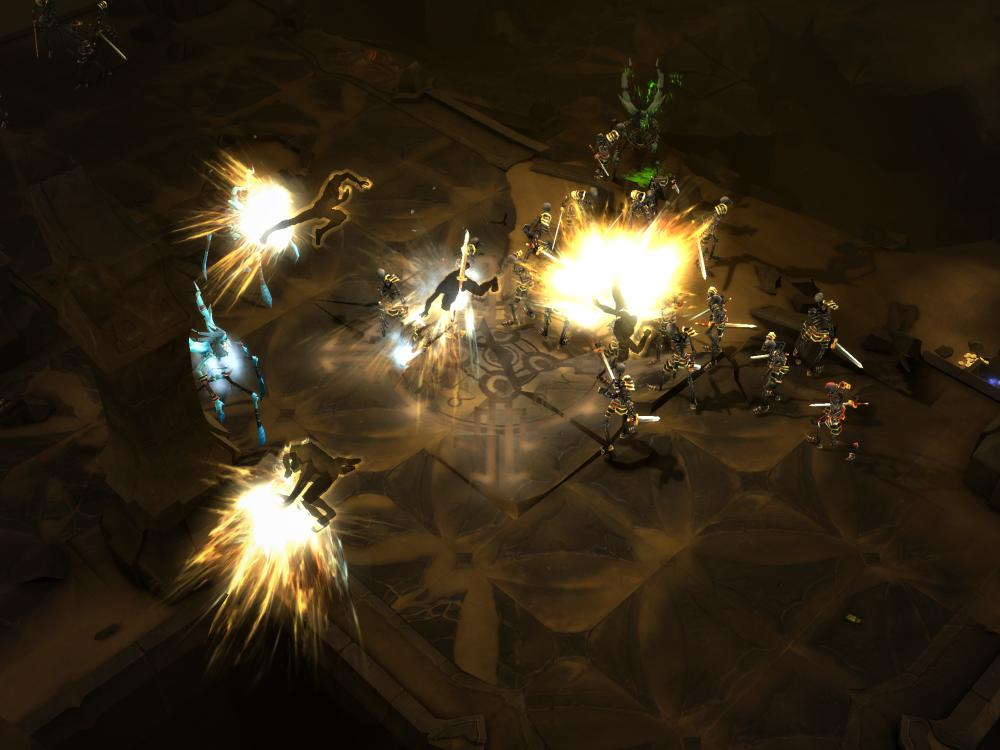
Blizzard Answers Your Questions and More
Last week we asked for interview questions to help supplement our face-to-face interviews at Blizzcon. Over the course of the two-day con we were able to sit down with StarCraft II's Dustin Browder, Diablo III's Leonard Boyarsky, WoW's J. Allen Brack, and Battle.net expert Rob Pardo to answer a few questions on each of the four major camps in Blizzard at the moment. Since this wasn't a usual Slashdot-style interview, we tried to use as many of your suggestions as possible, but the conversation often took us in a unique direction once it got rolling. Dustin Browder — Lead Designer, Starcraft 2
Slashdot: How much of the team has already rolled over to Heart of the Swarm?
Dustin Browder: Almost no one. Occasional meetings with Cinematics team, who wants to get a jump on things, and the occasional water cooler conversation. Pretty much everyone is focused entirely on Wings of Liberty.
Slashdot: How much of your work from Wings of Liberty will you be able to duplicate throughout the other two installments of the trilogy?
Dustin Browder: Very little. We have tools and we have an engine, and that's huge. We also have a lot more knowledge of what we're trying to accomplish with the scenes and with the story, so we have a lot of benefit from the software that is already created and a lot of knowledge to help us move faster.
Slashdot: How many of those software tools are going to be available to the community-at-large?
Dustin Browder: As many as we can. Certainly the data editor, the map editor, and the terrain editor. That lets users create pretty much anything the design staff can create. Since the story-mode stuff is put together by one of our designers — he collects the art from cinematics and makes it all happen — all that stuff is accessible as well. I'm not gonna lie to you and tell you this stuff is easy; this guy is really smart, and this stuff is complicated, but it's totally doable. We have seen our fans do some amazing things in the past with a very limited toolset by comparison. In this case we're really hopeful that they will do a lot of cool stuff. I can't even guess what they are going to do. [Dustin gave a panel later on in the day where demonstrated some of the things that Blizzard employees had done in their spare time just playing around with the tools. A few examples were; an "Uberlisk" which had a number of spine crawlers on his back and wandered around terrorizing a board filled with hostiles, a zoomed-in third-person action game with a Ghost as the main character, with the ability to interact with "quest givers" and actually go inside buildings and underground, and a top-scrolling space shooter.]
Slashdot: There has been some talk that the streamlining of commands has been moving the focus away from actions per minute [APM]. How important is APM as a metric for you and will we see a decline in the importance of this metric?
Dustin Browder: That type of feedback is incredibly important for us. We want players making smart decisions all the time and we want a lot of skill required to play this game at the highest levels. We absolutely want the best players to be the best players. We're not looking to even out or flatten the skill curve so that "everybody can be a winner." This is not the first grade. We want this to be tennis, baseball, football, whatever, we want this to be a game that requires real skill. But at the same time we don't want this to be a bunch of bogus skill. We have definitely gotten rid of some clicks, but we have also added some clicks back in. We got rid of some clicks in terms of how you had to select your buildings and how you had to give build commands, but we also made sure that we had the finest amount of control at the same time.
When we originally put it out there we said you could double-click the barracks and hit 'M,' and you get five marines, one from each barracks for instance. The fans were outraged and we kind of ignored them, saying, "Whatever, this is a better gameplay experience," but as we played it, we realized that it wasn't a better gameplay experience. Maybe when you hit 'M,' what you really wanted was three marines and two marauders, and you couldn't do that. Instead we have said you can select all of your barracks at once, but each click sends a build command individually to each of those barracks. So now you are able to hit "M, M, M, D, D." This gave us a decent amount of clicks, but actually the correct amount of control. That's actually the control you wanted as a player. We weren't looking to hurt you by giving you too many clicks or hold your hand by taking away some of the gameplay experience. We were actually giving you the controls that made you powerful by having the correct balance between the two.
Also we have a bunch of macro mechanics in the game to encourage players to control their economy better, because as you know in Starcraft, economy is king. One of the things that we loved about the original Starcraft was not so much that we want you to click a bunch, but that there was a lot of tension between players who were micro-oriented and players who were economy-oriented. For instance, if you are playing Zerg and are micro-oriented and I'm playing Zerg and I'm economy-oriented, we're kind of playing two different races — not exactly, but a little bit. We're having a very different experience, and that style difference now becomes the interesting problem for both of us, and that is what we're really pursuing with a lot of this stuff. So, we've definitely taken some clicks away, but we have added some back, and I think the fans will be fine with it. Certainly the hardcore fans I've spoken with, who have actually had a chance to play the game, seem to be very positive about the experience.
Slashdot: It looks like the new league system is going a long way toward making the play experience much better across the board, and will allow people to grow at their own pace. What can you tell us about how this system works?
Dustin Browder: We think this system will really help a lot of players. Even if you are going to stay down in the copper league forever, at least you are playing against your skill level and can hope to win something. In Warcraft 3, minus the "Smurfs" who would come through and ruin everybody's day, we had a pretty good matchmaking system and you could win about half your games. I know most people would prefer to win about 70% of their games, but that would mean someone else has to lose 70% of their games, and we don't want that. If we can match you against your skill level, I think that's where you wanna be and you'll have a good time. So now, if I can put you in a bronze league of 100 players and all those players are your skill level, that means you have a shot of being number one in that league at the end of the season. I think that is going to be a lot more fun for people. When you go to play intramural softball, you know Sammy Sosa isn't showing up. While it might be fun for about two minutes, it would ruin the game and no one would have a good time. If we can keep everyone organized into the skill level they belong I think everyone will have a lot more fun.
Slashdot: What kind of side projects is Blizzard looking at? Any possibility of expanding things to the console, tangentially-related mobile games of any kind, or maybe another pass at Ghost?
Dustin Browder: Starcraft 2. That's about it. We're really focused and we don't mess around with a research division or anything like that. When we think of cool ideas, we build them until they are done and we don't stop. We had the mobile Armory that we announced, but that's more of a support tool than a new game or stand-alone app. For console, we certainly don't have anything that I'm aware of that's going on right now. I'm not saying we wouldn't explore it down the road; it could be a very real possibility. All of us play console games and we all love our XBoxes, Wiis, and Playstations. The gamers are there, the fanaticism exists in the building, it's just a question of when it will bubble to the surface and find a successful outlet.
Slashdot: How do you see ongoing content being developed? You have the main trilogy, but once you are done with that, do you see discrete content releases of some sort, ongoing smaller patches, or maybe even interesting things like the holiday patches in WoW? The new Battle.net framework seems to offer you a lot more options for keeping people up-to-date.
Dustin Browder: The holiday stuff is certainly something we would like to explore via free patches, just to throw it out there. Other smaller patches like new maps or bug-fixes would also certainly come quickly as it was needed. What additional content we actually choose to possibly charge for, I don't know, but I think it would have to be something of extreme value in order to get excited about that. We don't like putting out stuff that we feel dirty about. We argue about it quite a bit, what is enough value and what isn't, what did it cost us, what do we have to charge, those kinds of decisions. Most of those decisions happen above my level, which is great, but certainly the teams have a great deal of influence over those decisions. Most of that stuff, at least initially, will be more patch oriented, but if we find something that is of real value we'll discuss it.
Slashdot: With Starcraft being so data-oriented, you have already put out some really cool tools for recap and data-analysis. Is there any hope of external APIs so that third party developers can do things like scorebots, profiling, armory-type tools that don't necessarily live within Blizzard?
Dustin Browder: Certainly a lot of that stuff is exposed and is possible for players to get their hooks into. I don't know what will happen ultimately with that, but I'm certainly hopeful that we have a large, happy, thriving community of people developing third-party support tools.
Slashdot: As Linux and open source continue to gain popularity and market share, is there any hope of Blizzard allowing some of the internal Linux-based tools and clients to make their way into the public domain, even if they weren't supported?
Dustin Browder: I have no idea what the rules surrounding that are or why that may or may not happen. I don't know of any plans, but that doesn't mean they aren't happening out there. Certainly we have supported the Mac for years and years and definitely plan to continue to do so. We try to support other platforms, but at this point I don't know of any specific plans for Linux.
Slashdot: The other question that is a constant concern within the fan base of Starcraft is the question of disallowing LAN play. How are you solving problems like making sure this is a valid replacement for LAN plan; security, reliability, speed, or even people playing behind things like NAT routers?
Dustin Browder: These are issues that we continue to address as we go forward. Some of these things we have some plans for, but not all of them. It is something that we definitely plan on working on as we go forward to make sure we have things in place to handle every possible user case out there. We just know from WoW that most people can connect online and play. There are some cases out there, some legitimate-use cases — that aren't just people that refuse to buy a modem or are crazy and weird and living in a closet. We want to make sure we are able to support these legitimate-use cases for LAN play and make it accessible to those users, but we're still trying to identify all of those and decide which cases are legitimate and which are not. These are definitely legitimate concerns, and we're certainly looking to address them.
Leonard Boyarsky — Lead World Designer, Diablo III
Slashdot: I noticed that you have moved away from the strict left mouse/right mouse ability limitation and have created more opportunities for players to map keys and use abilities beyond the two major "equipped" abilities. What was the driving reason behind this decision?
Leonard Boyarsky: Well, we had that to some degree in Diablo II, it was just really inaccessible and not fun. Our main goal is to have the player focus on two skills and maybe that alternate ability that you can tab in, while moving some of the more passive or non-targeted abilities to the hotbar. Of course, minor refinements are going to continue to go on as we develop, but we wanted a way for you to augment your main skills. In a game like Diablo, your character is really defined by what your main attack is. Unless you are a real hardcore user, you probably aren't going to be switching up attacks constantly.
Slashdot: With the advent of the new Battle.net features and the evolution of gameplay in Diablo III, do you anticipate any major changes to the PvM Ladder setup or maybe some specific PvP elements?
Leonard Boyarsky: A lot of the stuff being developed for Starcraft II and Battle.net, we want to incorporate. All of the community features and chatting across games is very important and we'll definitely incorporate that where it makes sense. We haven't talked a lot about a PvP component, but we think it is a great aspect of the game. The part that we didn't like from the earlier games is that people could turn hostile at any time and stab party members in the back. The people who get upset that we're not going to have that aspect are generally the people who would kill their party members at a moments notice. So, maybe we'll find something where they can all go stab each other in the back apart from the people who don't want that as an experience. As far as specifics for PvP, rest assured that we're going to come up with whatever we can that is the best possible PvP experience for a Diablo-style game. Right now, we're really focused on the co-op play and using whatever we can from Battle.net to enhance that experience.
Slashdot: When you integrate with Battle.net, will that also integrate with other data streams? Recently when they were discussing World of Warcraft's integration with Battle.net, there was the possibility of a guild news RSS feed. Can we expect to see things like data export and clan support?
Leonard Boyarsky: I don't really know what the plans are for that, but I would assume if they are going to have something like that for WoW or StarCraft II and it works out, there is no reason why we wouldn't integrate that into Diablo III. I'm not the most technically-minded person; I'm more on the artistic/creative side of things, but we talk all the time about how to get all the community stuff that we can in, even if it isn't there at launch, so that it becomes this fantastic player experience.
Slashdot: Speaking of the artistic side of the house, are you looking to leverage your community for artistic injections into the Diablo III universe, like custom levels, modding, or even total conversion mods that just utilize the Diablo III engine?
Leonard Boyarsky: We discussed that early on because Starcraft II is doing so much modding support. But when you look at the style of game that Diablo is, it is based around a lot of random content. So when you look at it from that standpoint, someone might be able to make some very specific content, but the basis of what we're providing for the player is a random system. So are they just going to provide a different random system? Also, the creation of our art is very intense in terms of not only the talent and technical expertise required to get it into the engine, but manipulating it and using it with our tools. It would take a lot of work to make that friendly for the end user who didn't have a programmer there to help them figure out some of the finer points. We just didn't see the bang for the buck in doing something like that and it was never really a big part of the Diablo fan base. Having said that, if someone comes along and takes the Diablo engine and makes a fantastic game out of it, more power to them. We just didn't feel that was where we could add the most value for the players, because that just isn't what the community is about.
Slashdot: The Diablo franchise is especially iconic for things like easter eggs and secrets. Can we expect the same of depth in Diablo III? Any hints?
Leonard Boyarsky: No, no hints. They wouldn't be easter eggs then. We'll probably drop some hints here and there, maybe post some easter eggs on the web for people to dig out. Maybe some red herrings to send people in the wrong direction, but most of that stuff just comes naturally during development. As you develop areas, these things come up, and we're always throwing around ideas. So yeah, we talk about that all the time, and we are planning on doing quite a bit of that stuff.
Slashdot: I'm sure you guys are tired of the LAN dispute, but what specific things are the Diablo team looking at in terms of trying to provide value from Battle.net to assuage some of the fear that this is just an inconvenient take on DRM?
Leonard Boyarsky: Well, once again, I'm not the most technically-minded person and I want to get you guys a really good answer for that. I don't want to steer you guys the wrong way. Right now most of the implementation of Battle.net is Starcraft-focused, so I know that is our goal right now, but I know Rob [Pardo] has talked about how their fans use LANs for tournaments and the like ,so they have talked about how their fan base might need some kind of deployable LAN solution. The Diablo team is in the enviable position of letting them work out how all that is going to work and how they are going to solve all of those contingencies. Hopefully our track record will speak for itself and our fans can take us at our word that we are doing this not because of any business model or corporate mandate. We believe that we can give the best multiplayer experience by going in this direction. Just in terms of philosophy, we're all about making choices for the gameplay and then worry about the monetization later, which is great because there are many companies out there that go the opposite direction.
Slashdot: One of the things some of our readers really want to know is: what are the biggest deficiencies that you are seeing from young college grads trying to break into the industry? What words of wisdom could you impart to people trying to get their start, especially with respect to gaming?
Leonard Boyarsky: I can speak a little bit more to the artistic stuff because of the position I'm in; that's how I came up. I would say that, from an artistic standpoint, it's not about how well you use 3D Studio Max. Obviously you need background in some sort of 3D program, unless you just want to be a concept artist, but it's more about just being a great artist and having a great artistic eye. The same thing goes for creativity; it's more about having something to show that shows what you can do. If someone comes in and has something to show, it doesn't matter where they went to school or what they accomplished at school; it's what we can see. Because there are so many people out there that have resumes with great schools, it just really comes down to what they can do. If I find someone who just blew me away, I could care less if they even have a diploma. I think the biggest thing you can tell people is to do stuff on their own. It's probably easiest as a level designer, because you can get a Half-Life or a Quake and build your own levels, and then you have something to show. The more stuff you do just shows your passion, your creativity, your ability, as opposed to trying to get a job first if that makes sense.
J. Allen Brack — Production Director, World of Warcraft
Slashdot: What caused you to make the new level cap 85 as opposed to increasing it the usual 10 levels.
J. Allen Brack: Well, we looked at a lot of the things that we wanted to do for this expansion. Going back and revamping the old world and bringing the level of quality of the experience of the 20-60 game up to the level you saw in Burning Crusade and Wrath of the Lich King was a hugely monumental task. We also looked at how much people say they like leveling, then tried to balance that with people who say the game doesn't start until max level, and tried to figure out what the right decision for the game was. We definitely didn't want to feel like we were trapped into adding 10 levels every time, because I think we could make an expansion that was very compelling where we didn't add any level increase, and I think there are situations where we would want a 20 level increase. It all comes down to what the right decision for the game is.
Slashdot: Can you describe the difference between this expansion and previous ones in terms of the time and difficulty it took to revamp an existing area versus creating an entirely new area?
J. Allen Brack: Well, this is actually, by far, the largest expansion that we have ever done. We are creating five new zones completely from scratch for level 80-85, we're also going back and retouching a lot of the existing zones. Some of the existing zones have been very good and have worked out very well and some of them we have always regretted and not worked out very well at all, but we're going back and evaluating those on a zone-by-zone basis. Many of the old zones are actually getting rebuilt from scratch just due to the massive amounts of changes.
Slashdot: How are you going to manage the difference between someone who has just purchased vanilla WoW versus someone who has all of the expansions up to and including Cataclysm?
J. Allen Brack: Well, we haven't talked about launch plan specifics, but we do want everyone to get Cataclysm. It is our intention that the world will experience the cataclysm for every player regardless of patch level. There are a couple of reasons for that, but one of the main reasons is we want people to play together and the idea of having segregated the players into the "bought Cataclysm" and "didn't" camps is really not the right decision. The other thing is that Cataclysm has lore and a reason behind it, so it doesn't really make sense to have it happen for some players and not for others.
Slashdot: There has been a lot of talk about the new phasing technology that allows entire continents to change. Was that very difficult to implement compared to what was already in Wrath of the Lich King?
J. Allen Brack: Yeah, it was. In Lich King, we didn't really have the ability to do terrain; we had the ability to skyboxes, quests, and effects, but now we have the ability to have different versions of terrain that get triggered based on other events. One example is being able to go into a cliffside dwelling and down into the storm cellar to weather a storm and when you come out, the entire cliff has been sheared off and there is nothing left. It's pretty exciting.
Slashdot: We have heard a lot about how StarCraft II is going to integrate with Battle.net, and a little about what World of Warcraft is going to do. Is there more coming?
J. Allen Brack: Sure. Battle.net is going to be the way that all players log into Blizzard games in the future. We have optional Battle.net conversion right now, but that will be mandatory at some point in the not-too-distant future. Once we have that integration, we'll layer the Battle.net features on top of World of Warcraft. We're not talking about changing the way that Guilds or Friend Lists work for Battle.net; it's more of just adding a layer of Battle.net features and community features on top of the existing game.
Slashdot: Has there been any talk of making APIs or data feeds that would allow fan sites or forums to integrate game data directly?
J. Allen Brack: That is an interesting idea. Yeah, we have seen a lot of neat little apps come out of the armory, to a degree that I don't think we really anticipated. There are now loot apps, community aggregation apps, and others, but we certainly were not prepared for the amount of traffic that is just to gather data from the armory for other apps.
Slashdot: The EVE team recently announced a project called Dust 514 that is a separate game that hooks into the EVE universe. Has Blizzard considered any side projects that might have some tie in to existing games?
J. Allen Brack: We typically think about things as a team — in my case, World of Warcraft — and what we could do within the existing WoW universe. Something like that offers a lot of wish fulfillment for me as a gamer, and we definitely talk about what kind of gameplay experience that we want to offer with each expansion, so we definitely have a lot of new things that we're talking about for Cataclysm, just not quite that extreme.
Slashdot: How about a console version for WoW?
J. Allen Brack: Console is one of those things that we probably talk about once every six months. I have probably met with Microsoft two or three times to discuss what it would be like to have WoW on the console. Where we are today, and I can't say we'll always be here, but right now WoW is very much designed for the mouse and keyboard interface, and doing another type of control scheme would be very challenging. I think it will be done, and if we had started WoW with the idea that we would move to console, I think it would be a much different game and the control scheme would support that.
Slashdot: Once the Battle.net integration is complete, you'll be able to talk to friends from different servers and even different games. Has there been any talk of being able to form instance groups across servers?
J. Allen Brack: Yes, and we're actually doing that in an upcoming patch. In 3.3 we're going to revamp the Looking For Group interface to allow that. The idea wasn't necessarily for existing players that are in a guild at high level, it's more for the people who want to run Wailing Caverns on a character that is level appropriate.
Slashdot: Lately there have been some problems with instance server congestion; is that something you are focused on?
J. Allen Brack: We're hugely focused on it. I mentioned the cross-server instancing — that is also a part of that solution as well. We have some technology that allows multiple servers to share certain instance blades and that gives us a lot of efficiency. We're going back and reconfiguring all of our servers for this, so it should be done before we launch 3.3.
Slashdot: There is always a call for increased support (even if it isn't official) for Linux, Wine, etc. Is there any possibility that future support for WoW on the Linux platform could grow?
J. Allen Brack: We have been a long time supporter of alternate platforms with the Mac, and have supported many of our games on both PC and Mac, so we're a big supporter of platform independence. We have experimented with a Linux client back in the day, but right now it is a resource problem. We have to consider how many resources it would take to put out a Linux client versus how many people would actually use something like that. We have to consider how many people aren't playing WoW right now and would if we had a Linux client. Or is it people who play already and just want support in their preferred operating system? If we decided to support a new platform, we would have to figure out how many game features we had to give up development on in order to develop a new client.
Rob Pardo — Executive VP Game Design
Slashdot: Is there any any possibility that Battle.net might interact with other systems like XBox Live, Steam, or other games?
Rob Pardo: I think there is the potential to do something like that, but there are certainly no immediate plans. We certainly are trying to engineer the platform in a way that it could do those sorts of things, and we have talked about trying to link in things like Facebook, Twitter, and mobile applications. We definitely have kept in mind that if we do go to console, we can still use Battle.net, in which case we would have to talk to things like XBox Live. So while there are no plans to do something like that, we certainly are keeping it in mind.
Slashdot: Are you thinking about making any APIs for Battle.net that would allow the community to start scraping some of the data directly?
Rob Pardo: That is a question I'm not entire sure of the answer, so I don't want to screw it up. Probably not extensively, but I know that in the past we have done things with game results and similar things, plus we have the Marketplace, which is a pretty big area. But we don't have plans to allow people to reconfigure Battle.net in a major way like that add-on system for WoW.
Slashdot: Now that you have mentioned the Marketplace, is there going to be an approval/rejection system for the things that are uploaded?
Rob Pardo: Yes there will, although our philosophy will probably be more of an iPhone philosophy and less of an XBox philosophy. We really want to try to have the community itself manage that, but we will probably still need some sort of light approval system to make sure that there aren't any viruses or wildly objectionable content. I really don't want us trying to make a quality call; that's where I don't want us to be.
Slashdot: Apple has been taking a lot of heat lately for how opaque they are when they reject a particular app. When you reject something, is there going to be some indication or explanation why?
Rob Pardo: I would hope so, but it's all new to us, so I can't tell you how it's all going to work. We have never done anything like this before, but we know where we want to be philosophically. We have done a lot of research on the other services, but I'm sure there will be lots of surprises to us when we start rolling it out.
Slashdot: We have heard a lot about how Starcraft II is going to be affected by Battle.net. Can you tell us a little bit about how Diablo III and WoW might be integrated?
Rob Pardo: Nothing specific yet, because all of our focus is on StarCraft II. But certainly, since I have been really involved with Battle.net, it's something that is always on my mind. A lot of the Starcraft II design was done so that it could be agnostic to our other games, so I would say that assuming everything goes well and the new service is as great as we want it to b,e I would imagine that you would see something very similar. There will obviously be Diablo-specific features that don't make sense for StarCraft II and vice versa, but as far as the always-connected experience and being able to talk across games, I would expect the same experience.
Slashdot: The LAN-play question has been a major issue. What are you doing to facilitate gameplay between people who are in the same room?
Rob Pardo: There are definitely some things we are investigating. Whether or not they will be in at launch, I don't know. I really think that the vast majority of people wont have an issue. Even if you look at Warcraft 3, which did have LAN play, the vast, vast majority of people played on Battle.net and that was what, seven years ago? So I think that it is a very small percentage of people that will be affected, and only a small percentage of the time. That said, we are looking at some technology that would allow us to detect a peer-to-peer connection if we detect something like a high latency over a certain amount. Unfortunately, this would only be able to work for custom games, since we need to ensure the accuracy of competitive or ladder games via Battle.net.
Slashdot: Are there any plans to build in some sort of reputation tracking to see how often someone has disconnected from games in progress or partakes in harassment of some sort?
Rob Pardo: No, there isn't at the moment, although it is something I'm interested in looking at in the future. We have talked a lot about it; it was one of those features that when we tried to develop a good social rating system we didn't see a great one out there that we could point at. It is a pretty tricky system to design, but it is something that I would like to tackle; maybe in the expansion.
Slashdot: With World of Warcraft, there are regional server groupings. How is Battle.net going to integrate with different parts of the world?
Rob Pardo: I believe the current plan is to do a similar approach to the way WoW is set up, so there will be large regional breakdowns. Hopefully in the future we will even have the ability for you to move around, but that isn't decided yet. -
Joomla! 1.5: A User's Guide, 2nd Edition
Michael J. Ross writes "There are countless content management systems (CMSs) available for building websites, and they offer varying levels of built-in functionality. But once a site developer has successfully installed any given CMS, a critical form of help (or hindrance) is the CMS's documentation, which for some CMSs is quite impressive, and for others absolutely atrocious. Joomla is a powerful and popular choice for Web developers, but can be daunting to newbies confused by its non-intuitive menu structure and restrictive content hierarchy. The documentation for Joomla is frequently criticized, for various reasons, and that may largely account for the popularity of third-party books — such as Barrie M. North's Joomla! 1.5: A User's Guide, now in its second edition." Read on for the rest of Michael and Ethelyn's review. Joomla! 1.5: A User's Guide, 2nd Edition author Barrie M. North pages 480 publisher Prentice Hall rating 9/10 reviewer Michael J. Ross and Ethelyn Holmes ISBN 978-0137012312 summary A comprehensive introduction to creating sites using Joomla. The book was published by Prentice Hall, on 1 June 2009, under the ISBN 978-0137012312. Just as with its predecessor, this updated edition spans 480 pages, and the material is grouped into 12 chapters: an introduction to CMSs in general and Joomla in particular; downloading and installing Joomla; basic Joomla administration; content management using Joomla; menus and navigation; enhancing Joomla functionality with extensions, components, modules, plug-ins, and templates; creation of content via the back-end and front-end; attracting Web traffic using SEO, referrals, and other techniques; how to create pure CSS templates; and building example websites for a school, a restaurant, and a blog. The book wraps up with four appendices on getting assistance with any Joomla development hurdles; four separate Joomla case studies; an introduction to SEO concepts; and installing WampServer.
On the book's Web page, the publisher makes available a description of the book, excerpts from Amazon.com reviews, the table of contents, and a sample chapter — "Creating Pure CSS Templates in Joomla!" — as both an online article and as a downloadable PDF file. There are also links for purchasing the print version, and for reading the Safari Books online version.
In conjunction with the book, Prentice Hall has published a DVD training course, titled Fundamentals of Joomla!, under the ISBN 978-0137017812. It consists of 13 lessons, spanning more than nine hours of video instruction. The DVD includes a bonus chapter explaining how to set up a membership site, not covered in the print book. The DVD disc is accompanied by a 128-page book, which includes all of the PHP and CSS code used in the training, plus additional material. As of this writing, Barnes & Noble is selling Joomla! 1.5: A User's Guide, 2nd Edition and the video training course bundled together. Anyone purchasing the video course should be aware that Lesson #6 on the DVD has a compression problem, which causes a small lag between the audio and video streams. In response to this, Prentice Hall uploaded that particular lesson as a free download to the product's site, under the "Updates" tab. A multimedia training course such as this may be the ideal tool for someone who finds printed technical books to be rather dry, and prefers learning from audiovisual material.
In this review, we will be examining both the book and the DVD training course, as the two complement one another.
Barrie North is well regarded in the Joomla community, and for good reason. He frequently blogs about Joomla on the website of Compass Design, a consulting firm specializing in Joomla Web design and SEO. Joomla developers consider Compass Design's site a source for some of the most up-to-date information on the subject. Barrie also founded Joomlashack, a noted provider of Joomla templates and customization services. He has more than 15 years of Internet experience as a Web designer, plus over a decade of classroom teaching experience and curriculum development expertise. He consults on Web marketing, search engine optimization, usability, and standards compliance for Joomla. He's also a former member of the Joomla Design and Documentation Working Groups.
The title of his book's first chapter, "Content Management Systems and an Introduction to Joomla!," fairly describes what the reader will find. As a CMS, Joomla's primary function is to organize and present all the content stored in a site's database, avoiding the problems in the past of static HTML files. This chapter presents Joomla's out-of-the-box features and delineates its various parts, templates, and modules. The DVD mentioned above shows the differences between constructing an ordinary Web page with Dreamweaver and constructing one with Joomla. People who learn best visually should be pleased with this demonstration, as well as Barrie North's teaching approach. He holds one's attention with a friendly yet informative conversational style. This first chapter provides an in-depth tutorial that explains how Joomla displays its content articles, and how the developer can organize them into a hierarchical structure. It details how to plan and organize the content and user experience for the site. It also explains the hierarchy structure currently used in Joomla — sections and categories — and how to best structure content into them for small and large sites.
The second chapter, "Downloading and Installing Joomla!," gives the reader a very detailed explanation on how to get up and running with Joomla. It explains where one can find the most current Joomla files; how to unpack these files on a home computer or into a remote Web hosting account; how to use the Joomla Installation Wizard; and how one can support the Joomla project. Barrie states that the worst part of the Joomla installation process is setting up the MySQL database, and uploading all the files to a remote server. But for anyone who has performed those tasks with other software technologies, the process should not pose a problem.
Chapter 3, "Joomla! Administration Basics," shows how the power of the Joomla site administration system, despite its simplicity. Compared to such site administration systems as those for WebLogic and Oracle AS, Joomla's system is a piece of cake. Reader should find the DVD especially helpful during the presentation of the back-end, front-end, control panels, and menus — especially the demonstration and explanation of such topics as articles, the front page, sections, categories, and modules. Barrie also gives tips on how to import and export users to Joomla, and about language extensions.
The fourth chapter, "Content Is King: Organizing Your Content," is a substantial and key chapter for those building a site with Joomla. It delves into Joomla's so-called "managers": the Article Manager, Frontpage Manager, Section Manager, Category Manager, and Module Manager. The author explains how to organize content logically, and the role of components and modules. Someone new to Joomla could otherwise find the many components and modules confusing. Of course, one can play around with them, but it is much more efficient to learn what one is doing from an expert. He demonstrates the Custom HTML module very well, and in the DVD walks the viewer through the development of a site using it.
Creating menus and navigation in a CMS is often perplexing to the uninitiated, and that's the topic of Chapter 5. It covers how to work with menu items, and clears up the issue about how to get rid of the dreaded "Welcome to the Frontpage." It also gets into managing modules (as opposed to Chapter 4's managing module content). Barrie North states that menus are perhaps the core of a Joomla site. In a static HTML site, they merely serve as navigation; in a Joomla site, they not only serve that purpose, but also determine the layout of what a dynamic page will look like and what content will appear on that page when the visitor navigates to it. The relationships among menus, menu items, pages, and modules, are perhaps the most confusing aspect of Joomla. Newbies can find daunting why some menu content shows up in articles, and then how to get rid of it. In this chapter, the reader learns how to create a navigation scheme that works for a new site.
Chapter 6, "Extending Joomla!," explains why extensions are essential to any well-functioning Joomla site. Rare is the Joomla-powered website that has no additional functionality, beyond the basics. In the world of Joomla, the term "extension" collectively describes components, modules, plugins, and languages. There are many hundreds available, both free and commercially from third-party providers. This chapter covers the Joomla 1.5 core templates — Khepri, Milkyway, JA Purity, and Beez — as well as how to use third-party templates.
In Chapter 7, "Expanding Your Content: Articles and Editors," the author returns to the critical topic of content management — specifically, WYSIWYG (what you see is what you get) editing, and how it relates to the backend with what Joomla refers to as Managers, Administrators, and Super Administrators. Barrie North then examines how authors, editors, and publishers can manage content through the front-end, as well as how administrators can set various permissions through the Menu Managers. This is critical for the site developer who wants users to be able to update content in a controlled manner, without breaking other things (inadvertently or otherwise!). Quite useful is Joomla's "global checkout" feature, which allows only one user at a time the ability to lock and then edit articles, and, if necessary, fix problems with checked-out articles.
The most attractive and powerful Joomla site in the world will be useless without visitors. Chapter 8, "Getting Traffic to Your Site," benefits from the author's knowledge and experience in online marketing and search engine optimization. For instance, he explains why the developer should discourage clients who ask for Flash-heavy sites, because pages loaded down with Flash elements can discourage traffic, for various reasons. In the DVD training material, he presents a step-by-step process of bringing traffic to an example site, using Wordtracker and Google tools. He also shows how to use Google advertising tools such as AdWords and AdSense. Interestingly, Barrie North does not put too much stock in keywords and metadata, but rather emphasizes the use of page titles as traffic magnets. He argues in both the DVD and the book that while email blasts may be effective and popular marketing tools, they should be used with caution. He also covers how blogs are another useful method for bringing traffic to one's sites.
The final four chapters in the book are all hands-on application of concepts and lessons covered in the earlier part of the book — specifically, how to create pure CSS templates, and how to create the three sample sites (for a school, a restaurant, and a blog).
Appendix A provides information on getting help with Joomla. If one is interested in seeing how Joomla is used in the real world, then Appendix B should prove valuable, because it offers information on Joomla's usage for commercial and government websites. Appendix C provides a quick overview of search engine optimization. Appendix D goes into detail on WampServer installation, with corresponding illustrations.
The book contains some errata: "Cpanel" (pages 25, 27, and 289), and "add fee" (should read "ad fee"; page 218). Those errata were present in the first edition, and even pointed out to the publisher in an earlier review.
The book's material is organized so that the reader can utilize it as a tutorial, reading from cover to cover, or skim through and take what is needed at the moment. The introductory ideas in the earlier chapters are developed and built upon to help the reader understand more advanced concepts later on. The book can also be used as a reference. For instance, if the reader desires a quick overview of what newsletter extensions are available, Chapter 6 provides that information. Lastly, the appendices contain valuable extra information about various aspects of Joomla. The target audience does not have to understand PHP in order to read this book or work through the many examples. Each example is presented in a clear step-by-step fashion. If a reader were to implement all of the examples in her development environment, then she would gain the skills to be able to build a substantial website. The DVD has an extra chapter on building a membership site. If the reader would like to go into the business of creating Joomla templates, the author even has a chapter showing how to do just that.
Joomla! 1.5: A User's Guide, 2nd Edition is to be recommended, particularly when matched with the DVD training course. Together they form a valuable reference guide and self-teaching tool, for newbies as well as seasoned website developers.
Michael J. Ross is a freelance website developer and writer. Ethelyn Holmes is a software and website developer — primarily using Java / J2EE and Joomla.
You can purchase Joomla! 1.5: A User's Guide, 2nd Edition from amazon.com. Slashdot welcomes readers' book reviews -- to see your own review here, read the book review guidelines, then visit the submission page. -
Joomla! 1.5: A User's Guide, 2nd Edition
Michael J. Ross writes "There are countless content management systems (CMSs) available for building websites, and they offer varying levels of built-in functionality. But once a site developer has successfully installed any given CMS, a critical form of help (or hindrance) is the CMS's documentation, which for some CMSs is quite impressive, and for others absolutely atrocious. Joomla is a powerful and popular choice for Web developers, but can be daunting to newbies confused by its non-intuitive menu structure and restrictive content hierarchy. The documentation for Joomla is frequently criticized, for various reasons, and that may largely account for the popularity of third-party books — such as Barrie M. North's Joomla! 1.5: A User's Guide, now in its second edition." Read on for the rest of Michael and Ethelyn's review. Joomla! 1.5: A User's Guide, 2nd Edition author Barrie M. North pages 480 publisher Prentice Hall rating 9/10 reviewer Michael J. Ross and Ethelyn Holmes ISBN 978-0137012312 summary A comprehensive introduction to creating sites using Joomla. The book was published by Prentice Hall, on 1 June 2009, under the ISBN 978-0137012312. Just as with its predecessor, this updated edition spans 480 pages, and the material is grouped into 12 chapters: an introduction to CMSs in general and Joomla in particular; downloading and installing Joomla; basic Joomla administration; content management using Joomla; menus and navigation; enhancing Joomla functionality with extensions, components, modules, plug-ins, and templates; creation of content via the back-end and front-end; attracting Web traffic using SEO, referrals, and other techniques; how to create pure CSS templates; and building example websites for a school, a restaurant, and a blog. The book wraps up with four appendices on getting assistance with any Joomla development hurdles; four separate Joomla case studies; an introduction to SEO concepts; and installing WampServer.
On the book's Web page, the publisher makes available a description of the book, excerpts from Amazon.com reviews, the table of contents, and a sample chapter — "Creating Pure CSS Templates in Joomla!" — as both an online article and as a downloadable PDF file. There are also links for purchasing the print version, and for reading the Safari Books online version.
In conjunction with the book, Prentice Hall has published a DVD training course, titled Fundamentals of Joomla!, under the ISBN 978-0137017812. It consists of 13 lessons, spanning more than nine hours of video instruction. The DVD includes a bonus chapter explaining how to set up a membership site, not covered in the print book. The DVD disc is accompanied by a 128-page book, which includes all of the PHP and CSS code used in the training, plus additional material. As of this writing, Barnes & Noble is selling Joomla! 1.5: A User's Guide, 2nd Edition and the video training course bundled together. Anyone purchasing the video course should be aware that Lesson #6 on the DVD has a compression problem, which causes a small lag between the audio and video streams. In response to this, Prentice Hall uploaded that particular lesson as a free download to the product's site, under the "Updates" tab. A multimedia training course such as this may be the ideal tool for someone who finds printed technical books to be rather dry, and prefers learning from audiovisual material.
In this review, we will be examining both the book and the DVD training course, as the two complement one another.
Barrie North is well regarded in the Joomla community, and for good reason. He frequently blogs about Joomla on the website of Compass Design, a consulting firm specializing in Joomla Web design and SEO. Joomla developers consider Compass Design's site a source for some of the most up-to-date information on the subject. Barrie also founded Joomlashack, a noted provider of Joomla templates and customization services. He has more than 15 years of Internet experience as a Web designer, plus over a decade of classroom teaching experience and curriculum development expertise. He consults on Web marketing, search engine optimization, usability, and standards compliance for Joomla. He's also a former member of the Joomla Design and Documentation Working Groups.
The title of his book's first chapter, "Content Management Systems and an Introduction to Joomla!," fairly describes what the reader will find. As a CMS, Joomla's primary function is to organize and present all the content stored in a site's database, avoiding the problems in the past of static HTML files. This chapter presents Joomla's out-of-the-box features and delineates its various parts, templates, and modules. The DVD mentioned above shows the differences between constructing an ordinary Web page with Dreamweaver and constructing one with Joomla. People who learn best visually should be pleased with this demonstration, as well as Barrie North's teaching approach. He holds one's attention with a friendly yet informative conversational style. This first chapter provides an in-depth tutorial that explains how Joomla displays its content articles, and how the developer can organize them into a hierarchical structure. It details how to plan and organize the content and user experience for the site. It also explains the hierarchy structure currently used in Joomla — sections and categories — and how to best structure content into them for small and large sites.
The second chapter, "Downloading and Installing Joomla!," gives the reader a very detailed explanation on how to get up and running with Joomla. It explains where one can find the most current Joomla files; how to unpack these files on a home computer or into a remote Web hosting account; how to use the Joomla Installation Wizard; and how one can support the Joomla project. Barrie states that the worst part of the Joomla installation process is setting up the MySQL database, and uploading all the files to a remote server. But for anyone who has performed those tasks with other software technologies, the process should not pose a problem.
Chapter 3, "Joomla! Administration Basics," shows how the power of the Joomla site administration system, despite its simplicity. Compared to such site administration systems as those for WebLogic and Oracle AS, Joomla's system is a piece of cake. Reader should find the DVD especially helpful during the presentation of the back-end, front-end, control panels, and menus — especially the demonstration and explanation of such topics as articles, the front page, sections, categories, and modules. Barrie also gives tips on how to import and export users to Joomla, and about language extensions.
The fourth chapter, "Content Is King: Organizing Your Content," is a substantial and key chapter for those building a site with Joomla. It delves into Joomla's so-called "managers": the Article Manager, Frontpage Manager, Section Manager, Category Manager, and Module Manager. The author explains how to organize content logically, and the role of components and modules. Someone new to Joomla could otherwise find the many components and modules confusing. Of course, one can play around with them, but it is much more efficient to learn what one is doing from an expert. He demonstrates the Custom HTML module very well, and in the DVD walks the viewer through the development of a site using it.
Creating menus and navigation in a CMS is often perplexing to the uninitiated, and that's the topic of Chapter 5. It covers how to work with menu items, and clears up the issue about how to get rid of the dreaded "Welcome to the Frontpage." It also gets into managing modules (as opposed to Chapter 4's managing module content). Barrie North states that menus are perhaps the core of a Joomla site. In a static HTML site, they merely serve as navigation; in a Joomla site, they not only serve that purpose, but also determine the layout of what a dynamic page will look like and what content will appear on that page when the visitor navigates to it. The relationships among menus, menu items, pages, and modules, are perhaps the most confusing aspect of Joomla. Newbies can find daunting why some menu content shows up in articles, and then how to get rid of it. In this chapter, the reader learns how to create a navigation scheme that works for a new site.
Chapter 6, "Extending Joomla!," explains why extensions are essential to any well-functioning Joomla site. Rare is the Joomla-powered website that has no additional functionality, beyond the basics. In the world of Joomla, the term "extension" collectively describes components, modules, plugins, and languages. There are many hundreds available, both free and commercially from third-party providers. This chapter covers the Joomla 1.5 core templates — Khepri, Milkyway, JA Purity, and Beez — as well as how to use third-party templates.
In Chapter 7, "Expanding Your Content: Articles and Editors," the author returns to the critical topic of content management — specifically, WYSIWYG (what you see is what you get) editing, and how it relates to the backend with what Joomla refers to as Managers, Administrators, and Super Administrators. Barrie North then examines how authors, editors, and publishers can manage content through the front-end, as well as how administrators can set various permissions through the Menu Managers. This is critical for the site developer who wants users to be able to update content in a controlled manner, without breaking other things (inadvertently or otherwise!). Quite useful is Joomla's "global checkout" feature, which allows only one user at a time the ability to lock and then edit articles, and, if necessary, fix problems with checked-out articles.
The most attractive and powerful Joomla site in the world will be useless without visitors. Chapter 8, "Getting Traffic to Your Site," benefits from the author's knowledge and experience in online marketing and search engine optimization. For instance, he explains why the developer should discourage clients who ask for Flash-heavy sites, because pages loaded down with Flash elements can discourage traffic, for various reasons. In the DVD training material, he presents a step-by-step process of bringing traffic to an example site, using Wordtracker and Google tools. He also shows how to use Google advertising tools such as AdWords and AdSense. Interestingly, Barrie North does not put too much stock in keywords and metadata, but rather emphasizes the use of page titles as traffic magnets. He argues in both the DVD and the book that while email blasts may be effective and popular marketing tools, they should be used with caution. He also covers how blogs are another useful method for bringing traffic to one's sites.
The final four chapters in the book are all hands-on application of concepts and lessons covered in the earlier part of the book — specifically, how to create pure CSS templates, and how to create the three sample sites (for a school, a restaurant, and a blog).
Appendix A provides information on getting help with Joomla. If one is interested in seeing how Joomla is used in the real world, then Appendix B should prove valuable, because it offers information on Joomla's usage for commercial and government websites. Appendix C provides a quick overview of search engine optimization. Appendix D goes into detail on WampServer installation, with corresponding illustrations.
The book contains some errata: "Cpanel" (pages 25, 27, and 289), and "add fee" (should read "ad fee"; page 218). Those errata were present in the first edition, and even pointed out to the publisher in an earlier review.
The book's material is organized so that the reader can utilize it as a tutorial, reading from cover to cover, or skim through and take what is needed at the moment. The introductory ideas in the earlier chapters are developed and built upon to help the reader understand more advanced concepts later on. The book can also be used as a reference. For instance, if the reader desires a quick overview of what newsletter extensions are available, Chapter 6 provides that information. Lastly, the appendices contain valuable extra information about various aspects of Joomla. The target audience does not have to understand PHP in order to read this book or work through the many examples. Each example is presented in a clear step-by-step fashion. If a reader were to implement all of the examples in her development environment, then she would gain the skills to be able to build a substantial website. The DVD has an extra chapter on building a membership site. If the reader would like to go into the business of creating Joomla templates, the author even has a chapter showing how to do just that.
Joomla! 1.5: A User's Guide, 2nd Edition is to be recommended, particularly when matched with the DVD training course. Together they form a valuable reference guide and self-teaching tool, for newbies as well as seasoned website developers.
Michael J. Ross is a freelance website developer and writer. Ethelyn Holmes is a software and website developer — primarily using Java / J2EE and Joomla.
You can purchase Joomla! 1.5: A User's Guide, 2nd Edition from amazon.com. Slashdot welcomes readers' book reviews -- to see your own review here, read the book review guidelines, then visit the submission page. -
Joomla! 1.5: A User's Guide, 2nd Edition
Michael J. Ross writes "There are countless content management systems (CMSs) available for building websites, and they offer varying levels of built-in functionality. But once a site developer has successfully installed any given CMS, a critical form of help (or hindrance) is the CMS's documentation, which for some CMSs is quite impressive, and for others absolutely atrocious. Joomla is a powerful and popular choice for Web developers, but can be daunting to newbies confused by its non-intuitive menu structure and restrictive content hierarchy. The documentation for Joomla is frequently criticized, for various reasons, and that may largely account for the popularity of third-party books — such as Barrie M. North's Joomla! 1.5: A User's Guide, now in its second edition." Read on for the rest of Michael and Ethelyn's review. Joomla! 1.5: A User's Guide, 2nd Edition author Barrie M. North pages 480 publisher Prentice Hall rating 9/10 reviewer Michael J. Ross and Ethelyn Holmes ISBN 978-0137012312 summary A comprehensive introduction to creating sites using Joomla. The book was published by Prentice Hall, on 1 June 2009, under the ISBN 978-0137012312. Just as with its predecessor, this updated edition spans 480 pages, and the material is grouped into 12 chapters: an introduction to CMSs in general and Joomla in particular; downloading and installing Joomla; basic Joomla administration; content management using Joomla; menus and navigation; enhancing Joomla functionality with extensions, components, modules, plug-ins, and templates; creation of content via the back-end and front-end; attracting Web traffic using SEO, referrals, and other techniques; how to create pure CSS templates; and building example websites for a school, a restaurant, and a blog. The book wraps up with four appendices on getting assistance with any Joomla development hurdles; four separate Joomla case studies; an introduction to SEO concepts; and installing WampServer.
On the book's Web page, the publisher makes available a description of the book, excerpts from Amazon.com reviews, the table of contents, and a sample chapter — "Creating Pure CSS Templates in Joomla!" — as both an online article and as a downloadable PDF file. There are also links for purchasing the print version, and for reading the Safari Books online version.
In conjunction with the book, Prentice Hall has published a DVD training course, titled Fundamentals of Joomla!, under the ISBN 978-0137017812. It consists of 13 lessons, spanning more than nine hours of video instruction. The DVD includes a bonus chapter explaining how to set up a membership site, not covered in the print book. The DVD disc is accompanied by a 128-page book, which includes all of the PHP and CSS code used in the training, plus additional material. As of this writing, Barnes & Noble is selling Joomla! 1.5: A User's Guide, 2nd Edition and the video training course bundled together. Anyone purchasing the video course should be aware that Lesson #6 on the DVD has a compression problem, which causes a small lag between the audio and video streams. In response to this, Prentice Hall uploaded that particular lesson as a free download to the product's site, under the "Updates" tab. A multimedia training course such as this may be the ideal tool for someone who finds printed technical books to be rather dry, and prefers learning from audiovisual material.
In this review, we will be examining both the book and the DVD training course, as the two complement one another.
Barrie North is well regarded in the Joomla community, and for good reason. He frequently blogs about Joomla on the website of Compass Design, a consulting firm specializing in Joomla Web design and SEO. Joomla developers consider Compass Design's site a source for some of the most up-to-date information on the subject. Barrie also founded Joomlashack, a noted provider of Joomla templates and customization services. He has more than 15 years of Internet experience as a Web designer, plus over a decade of classroom teaching experience and curriculum development expertise. He consults on Web marketing, search engine optimization, usability, and standards compliance for Joomla. He's also a former member of the Joomla Design and Documentation Working Groups.
The title of his book's first chapter, "Content Management Systems and an Introduction to Joomla!," fairly describes what the reader will find. As a CMS, Joomla's primary function is to organize and present all the content stored in a site's database, avoiding the problems in the past of static HTML files. This chapter presents Joomla's out-of-the-box features and delineates its various parts, templates, and modules. The DVD mentioned above shows the differences between constructing an ordinary Web page with Dreamweaver and constructing one with Joomla. People who learn best visually should be pleased with this demonstration, as well as Barrie North's teaching approach. He holds one's attention with a friendly yet informative conversational style. This first chapter provides an in-depth tutorial that explains how Joomla displays its content articles, and how the developer can organize them into a hierarchical structure. It details how to plan and organize the content and user experience for the site. It also explains the hierarchy structure currently used in Joomla — sections and categories — and how to best structure content into them for small and large sites.
The second chapter, "Downloading and Installing Joomla!," gives the reader a very detailed explanation on how to get up and running with Joomla. It explains where one can find the most current Joomla files; how to unpack these files on a home computer or into a remote Web hosting account; how to use the Joomla Installation Wizard; and how one can support the Joomla project. Barrie states that the worst part of the Joomla installation process is setting up the MySQL database, and uploading all the files to a remote server. But for anyone who has performed those tasks with other software technologies, the process should not pose a problem.
Chapter 3, "Joomla! Administration Basics," shows how the power of the Joomla site administration system, despite its simplicity. Compared to such site administration systems as those for WebLogic and Oracle AS, Joomla's system is a piece of cake. Reader should find the DVD especially helpful during the presentation of the back-end, front-end, control panels, and menus — especially the demonstration and explanation of such topics as articles, the front page, sections, categories, and modules. Barrie also gives tips on how to import and export users to Joomla, and about language extensions.
The fourth chapter, "Content Is King: Organizing Your Content," is a substantial and key chapter for those building a site with Joomla. It delves into Joomla's so-called "managers": the Article Manager, Frontpage Manager, Section Manager, Category Manager, and Module Manager. The author explains how to organize content logically, and the role of components and modules. Someone new to Joomla could otherwise find the many components and modules confusing. Of course, one can play around with them, but it is much more efficient to learn what one is doing from an expert. He demonstrates the Custom HTML module very well, and in the DVD walks the viewer through the development of a site using it.
Creating menus and navigation in a CMS is often perplexing to the uninitiated, and that's the topic of Chapter 5. It covers how to work with menu items, and clears up the issue about how to get rid of the dreaded "Welcome to the Frontpage." It also gets into managing modules (as opposed to Chapter 4's managing module content). Barrie North states that menus are perhaps the core of a Joomla site. In a static HTML site, they merely serve as navigation; in a Joomla site, they not only serve that purpose, but also determine the layout of what a dynamic page will look like and what content will appear on that page when the visitor navigates to it. The relationships among menus, menu items, pages, and modules, are perhaps the most confusing aspect of Joomla. Newbies can find daunting why some menu content shows up in articles, and then how to get rid of it. In this chapter, the reader learns how to create a navigation scheme that works for a new site.
Chapter 6, "Extending Joomla!," explains why extensions are essential to any well-functioning Joomla site. Rare is the Joomla-powered website that has no additional functionality, beyond the basics. In the world of Joomla, the term "extension" collectively describes components, modules, plugins, and languages. There are many hundreds available, both free and commercially from third-party providers. This chapter covers the Joomla 1.5 core templates — Khepri, Milkyway, JA Purity, and Beez — as well as how to use third-party templates.
In Chapter 7, "Expanding Your Content: Articles and Editors," the author returns to the critical topic of content management — specifically, WYSIWYG (what you see is what you get) editing, and how it relates to the backend with what Joomla refers to as Managers, Administrators, and Super Administrators. Barrie North then examines how authors, editors, and publishers can manage content through the front-end, as well as how administrators can set various permissions through the Menu Managers. This is critical for the site developer who wants users to be able to update content in a controlled manner, without breaking other things (inadvertently or otherwise!). Quite useful is Joomla's "global checkout" feature, which allows only one user at a time the ability to lock and then edit articles, and, if necessary, fix problems with checked-out articles.
The most attractive and powerful Joomla site in the world will be useless without visitors. Chapter 8, "Getting Traffic to Your Site," benefits from the author's knowledge and experience in online marketing and search engine optimization. For instance, he explains why the developer should discourage clients who ask for Flash-heavy sites, because pages loaded down with Flash elements can discourage traffic, for various reasons. In the DVD training material, he presents a step-by-step process of bringing traffic to an example site, using Wordtracker and Google tools. He also shows how to use Google advertising tools such as AdWords and AdSense. Interestingly, Barrie North does not put too much stock in keywords and metadata, but rather emphasizes the use of page titles as traffic magnets. He argues in both the DVD and the book that while email blasts may be effective and popular marketing tools, they should be used with caution. He also covers how blogs are another useful method for bringing traffic to one's sites.
The final four chapters in the book are all hands-on application of concepts and lessons covered in the earlier part of the book — specifically, how to create pure CSS templates, and how to create the three sample sites (for a school, a restaurant, and a blog).
Appendix A provides information on getting help with Joomla. If one is interested in seeing how Joomla is used in the real world, then Appendix B should prove valuable, because it offers information on Joomla's usage for commercial and government websites. Appendix C provides a quick overview of search engine optimization. Appendix D goes into detail on WampServer installation, with corresponding illustrations.
The book contains some errata: "Cpanel" (pages 25, 27, and 289), and "add fee" (should read "ad fee"; page 218). Those errata were present in the first edition, and even pointed out to the publisher in an earlier review.
The book's material is organized so that the reader can utilize it as a tutorial, reading from cover to cover, or skim through and take what is needed at the moment. The introductory ideas in the earlier chapters are developed and built upon to help the reader understand more advanced concepts later on. The book can also be used as a reference. For instance, if the reader desires a quick overview of what newsletter extensions are available, Chapter 6 provides that information. Lastly, the appendices contain valuable extra information about various aspects of Joomla. The target audience does not have to understand PHP in order to read this book or work through the many examples. Each example is presented in a clear step-by-step fashion. If a reader were to implement all of the examples in her development environment, then she would gain the skills to be able to build a substantial website. The DVD has an extra chapter on building a membership site. If the reader would like to go into the business of creating Joomla templates, the author even has a chapter showing how to do just that.
Joomla! 1.5: A User's Guide, 2nd Edition is to be recommended, particularly when matched with the DVD training course. Together they form a valuable reference guide and self-teaching tool, for newbies as well as seasoned website developers.
Michael J. Ross is a freelance website developer and writer. Ethelyn Holmes is a software and website developer — primarily using Java / J2EE and Joomla.
You can purchase Joomla! 1.5: A User's Guide, 2nd Edition from amazon.com. Slashdot welcomes readers' book reviews -- to see your own review here, read the book review guidelines, then visit the submission page. -
Blizzcon 2009 Wrap-Up
Last year's Blizzcon was tremendously popular. So much so that their servers were unable to handle the strain of fans competing for 15,000 available tickets. This year, Blizzard was more prepared; they made an additional 5,000 tickets available and set up a queue so that the transaction servers weren't overwhelmed. CEO Mike Morhaime said during the keynote address that if you weren't able to get into the queue within 30 seconds of its opening, the tickets were sold out before your turn came. Tens of thousands more chose to order the pay-per-view coverage, demonstrating the extraordinary enthusiasm felt for Blizzard's games. Their presentations didn't disappoint. Read on for details on the status of StarCraft II, Diablo III, World of Warcraft: Cataclysm, and the new Battle.net. It's divided into sections by game in case you're only interested in one or two of them.
StarCraft II / Battle.netThe big StarCraft II news this year wasn't so much about the first installment, Wings of Liberty, as it was about two of the major features shipping with the game: the editor and Battle.net. Both look to be extremely powerful, and they're being given the same level of care and polish you'd expect from the game proper. Still, the devs spoke a little bit about their philosophy and vision for the game. One of the major themes is making sure the player has options. When selecting missions in the single-player campaign, players can choose from several different paths to advance the main plot. There are also optional missions; you can choose to skip them if you want, or you can finish them to open up new units that you wouldn't have access to otherwise.
Even within missions themselves, Blizzard wants to give you different ways to get the job done. One example they gave was an escort mission where you're shown the path some escaping civilians will be taken, so you can plan out how you want to prepare for attacks and decide how many resources to commit at a particular time. Another mission features high terrain surrounded by low terrain. Zerg attack frequently, and every so often, lava rises out of nearby crevasses and floods the low terrain. The goal of the mission is to build up a certain amount of money, which puts a new spin on resource planning. Spending a lot of money to fight off the Zerg goes contrary to the mission objective, but spending too little has its own risks. You can also decide to be as aggressive or as cautious as you want when playing chicken with the lava. Harvesting those extra few minerals can make a huge difference if you time it well enough.
This leads into another major theme: keeping all the missions unique and interesting. Even with the brief look at the single-player campaign that we've already seen, there are several cool new mechanics that make the game more than "build up an army and smash the other army" thirty times in a row. It'll do great things for replayability, and I think it will make the single-player portion of the game stand on its own more than in the original StarCraft. Solo-play in RTS games is often referred to as "training" for multi-player, but Blizzard doesn't look at it this way; the missions are far too unlike PvP to be useful in that regard. Instead, they've added what they call "Challenges," which do train you for common PvP scenarios. There will be mini-missions for things like maximizing your economy, learning how to counter particular units, or using micro-management skills to take out a superior force. You'll be able to keep trying, improve your scores, and track your performance — thanks to the new Battle.net.
Battle.net is shaping up to be a really impressive addition. Match-making is at the heart of it, but calling it simply a match-making system doesn't really do it justice. Communication, stat-tracking, and mod-sharing are also central to the new platform. Players will be able to create friends lists that span the different games, allowing somebody in World of Warcraft to talk with somebody playing Wings of Liberty. They're rolling out what is essentially an integrated IM client with all the features you'd expect for keeping track of people and conversations — multiple frames, online/offline notices, setting an alias for somebody, etc. I think it'll be an incredible boon for multi-player when people are able to look for groups in one game while playing another. Blizzard also made sure to mention that they were aware of the privacy concerns involved in such a system, and they'll be implementing controls to let you limit the amount of information you share.
The new system also supports looking at your performance in myriad ways. When reviewing a game, you'll be able to see how the players' economies developed, what their build orders were, unit production, battle details, and more. What's more, you'll get a much more useful replay system, allowing you to fast-forward, rewind, jump to particular points in the game, view from different places, and look at stats as they're being accumulated. In addition to this is a full achievement system with a ton of things to unlock and show off. One of the coolest parts is the ability to unlock and choose artistic decals which will then be rendered on your units in-game.
But, of course, the matchmaking system itself can't be overshadowed. Their goal when designing it was to give a competitive experience to as many people as possible, and it looks like they've found a way. As you play against other people and start to accumulate wins and losses, you are put in a League with players of a similar skill level. There are seven Leagues: Pro, Platinum, Gold, Silver, Bronze, Copper, Practice. The Leagues are broken down further into Divisions, which include opponents even closer to your skill level. Divisions are limited to 100 people. Players will be ranked against others in their Division, and there will be seasons of play. Tournaments held at the end of the season will determine Division winners, who can complete for the League championship. The idea is that everyone should be paired against people of their own skill level as much as possible, and everyone should have a reasonable chance of winning their division — even the most hopeless of casuals. Speaking of which — for the truly new (or truly terrible), there will be a few maps designed specifically to be "anti-rush" so that they can learn the basics without fear of being immediately crushed.
Another significant fact to keep in mind is that these ratings will be tied to Battle.net accounts, which will require the purchase of a Blizzard game to use. This allows for two great new controls: first, people will be much less likely to try cheating, since they can't just register a new account for free. Second, your game rating is tied to your account, so the problem of "smurfing" — when highly-skilled players make a new account for the sole purpose of being matched against (and then demolishing) newer players — is neatly eliminated. Providing meaningful, interesting matches to every player will go a long way toward a thriving, sustainable PvP community. Also, the rating system will apply to co-op match-making as well. Each team of players has its own rating, so you don't have to worry about dropping in the standings if you want to goof off with your friends in 3v3. Speaking of co-op, the match-making and game creation system has been streamlined in that regard as well. It's simple to, for example, join up with one friend and then drop into a 3v3 or 4v4 game as a group of two. You also don't have to jump through hoops to get your friends in a game and select settings before letting random people in to fill the extra slots.
The last major feature of the new Battle.net is the support for custom maps and mods. They're making it very easy to browse custom games and download maps without having to repeatedly get booted from a server or visit a third-party site. The Blizzard developers were extremely enthusiastic about what they called the StarCraft II Marketplace — essentially an App-Store-like interface for browsing and getting maps and mods. You could feel the wariness from the Blizzcon audience when this was announced; people were wondering if they would be required to pay for custom maps. But, for the most part, this won't be the case. The capacity for premium mods does exist, but the devs said that even a massively-popular mod like DotA would probably be too simple to expect people to pay for. The ability to charge was put into place so development teams that were interested could plan for a budget, in order to build extremely detailed or complex maps and mods. You can expect free access to all the great fan-made maps and mods that are typical of Blizzard games.
This naturally leads to questions about the editor that will be coming with StarCraft II. From what we've seen so far, the Blizzard devs are going out of their way to include a ridiculous amount of flexibility in the tools they are providing. They seem to have a tremendous respect for what fans have done with their previous games; fully one-third of their design staff has come out of the mod community, and they have every intention of contacting people who make incredible creations for StarCraft II. Put simply, everything in the single-player campaign can be done with their editor. Many things not in the single-player campaign can be done with the editor. They gave a few simple examples: nothing in StarCraft II makes use of an inventory, but the code is there to support it. One of the powerful Zerg units, an Ultralisk, was modified with spiny grafts on its back that rapidly shot back and forth to destroy smaller units. When the Ultralisk was surrounded, it gave off a huge circular flame wave, destroying what was, literally, a screen full of enemies.
Most impressive, though, were the two complicated examples. Using just the editor, they were able to transform the game into a third-person shooter. You took control of a unit (a Ghost, of course), and ran around the map (even underground) shooting Zerg, complete with a shooter UI, keyboard movement controls and mouse-look. They were also able to turn the game into a top-down scrolling space shooter. Take a look. And they're still adding features. They're looking for ways to create libraries that can be passed around — they want to give mod-makers the ability to work on different tasks at the same time. They're also very aware of the possibility that people might grab somebody else's custom map, make one minor change, and re-submit it as their own — Blizzard is making it very difficult to do this, and they're already working on a report and review system for objectionable content. The editor will be available during the beta, but probably not right away.
With all of this in development, it's easy to see why Blizzard is so focused on getting people to use Battle.net. The oft-repeated suggestion that it's just DRM to fight piracy isn't the case. Hearing them talk about it and finally seeing what Battle.net has to offer makes it plain that they really do think the gaming experience will be better for it. That said, the door to LAN play doesn't seem to be closed. Rob Pardo acknowledged that there are a number of fringe cases where access to the internet isn't available or networking concerns prevent decent gameplay, and they're still looking into ways to give people what they want. They're also continuing to look into ways to optimize for situations where people are playing with each other from the same location.
Diablo III
The big reveal for Diablo III this year was the new Monk class. It's the game's second melee character, after the Barbarian, but manages to have a completely distinct style and feel. The inspiration for the Monk came from rather disparate sources; pen-and-paper RPGs and arcade-style fighting games (think Street Fighter). Since a Monk is holy by nature, Blizzard felt he should have access to a bit of holy magic to enhance his martial-arts style of fighting. Interestingly, they drew on a more Eastern European background, rather than the archetypical Southeast Asian variety, and the departure works well; the character seems to have the discipline and focus expected of a devoted adherent while concealing a craziness that would make him try to kill a bear with his teeth. And win.
When designing the Monk, they wanted a fragile fighting class with more depth than just running up and smashing something. They looked at World of Warcraft's Rogue and Diablo II's Assassin, but decided each was ultimately unsatisfying for a game like Diablo III. They wanted something with a limited amount of skills but many ways to have those skills work together. Thus was born the combo system. Many of the Monk's major attacks have three different stages. Clicking on an enemy once gives you the first stage, clicking again (within a short period of time) gives you the second stage, and another click for the third stage. For example: Exploding Palm. The first stage hits for 35% of your weapon damage. Second stage hits for 50%. Third stage puts a damage-over-time bleed effect on the enemy, exacerbated by movement. If the enemy dies from the bleed effect, it explodes, causing a huge amount of damage to nearby enemies. This happens quite often, and it's a very powerful area-of-effect attack. Another example: Way of the Hundred Fists. The first attack is a quick dash, striking one enemy. The second stage is a rapid series of low-damage attacks. The third stage is a powerful area-of-effect damage and knock-back effect around the player.
Now, the most interesting part about these combos is that you can mix and match. You can take the first stage from one ability, second stage from another, and the third stage from still another. This lets you tailor the way you attack to fit whatever situation you're in. These combine with more typical single-stage abilities, although some of the abilities themselves are anything but typical. An attack called Seven Sided Strike makes the Monk zip around part of the screen, teleporting between enemies to attack them. It's great fun to use, and very reminiscent of combo attacks in arcade fighting games. It's not something you'd expect in a Diablo game, but it fits perfectly. Everything feels like an impact.
There were hands-on gaming areas set up throughout the convention, so we got to sit down and play through a level using the brand-new Monks, and it was probably the most entertaining time I spent there. Figuring out interesting ways to weave the abilities together is fun. Plus, one of the coolest things I noticed was how well two players could complement each other, even playing the same class. As I got comfortable with the Monk's skills and began to watch what my partner (also a Monk) was doing, I found that if I planned my attacks to play into his, we could tackle much stronger groups of monsters than we could otherwise. I could use my knock-back to bump a few monsters in to his area-attack or to give him a little space when he was vulnerable. We could layer our disorient spell so that monsters had less time to hit us. It gave me great hope for group synergy.
Blizzard had some neat tidbits on display within the level itself, too. Several boss monsters, and even some regular ones, required strategic movement and ability use — not just blindly running in the opposite direction waiting for our heath bars to fill up, as was often the case in Diablo II. By playing smart, we could avoid a lot of the damage, which is how it should be. There was also an interesting side-dungeon; upon zoning in, we were warned that the place was collapsing, and a timer began ticking down. As we moved further inside, the ceiling would periodically drop rocks on us, forcing us to dodge quickly or take damage. But here's the rub: the further you go into the dungeon the more and better loot you get from chests. So it becomes a race — a challenge. How far can you go before you can't get back? When the timer expires, everything collapses, and you die.
Several quests were available in the demo level as well. They all operate in a very smooth and story-driven manner. Several lessons have obviously been taken from World of Warcraft in that regard, but not in a way that undermines the Diablo style. They succeeded in showing a very dark thematic tone in a visually bright level. The developers spent some time talking about their design process and philosophy, and showed some examples of what they had in the works. They're trying to do interesting things with the monsters without making an individual monster too complex. Difficulty and complexity is achieved through combining different types of monsters. They have a variety of archetypes, such as swarmers, ranged attackers, enemies that weaken you in some way, monsters that alter or constrict your movement through area-effect spells, and many others. Knowing how to prioritize your targets will be a valuable skill.
Diablo III is a game that's already impressive, but very much still in development. Blizzard isn't ready to talk about many things; major decisions for the PvP system haven't been made yet, Battle.net integration is something for the future (though they will have cross-game communication, like the others), and the much-anticipated rune system for customizing skills is on hold until they finalize the skills themselves. Even things like the Barbarian's resource system and graphical effects are still going through new iterations, and they're trying to smooth out the bumps in monster design. They mentioned a sand-shark which would become much more powerful in the open desert (think Tremors), making the sand feel less safe to stand on than nearby rocks. Unfortunately, in playtesting, they found that it was hard to balance and confusing for the players, so they're tinkering with the design. I wouldn't expect this game before 2011.
A few more random snippets: the stash will be "gigantic," and there will still be endgame loot runs, but they will most likely be "diversified" such that you'd actively want to kill multiple bosses rather than the same one over and over. There will be some method for transferring items between your characters, and they're working on ways to prevent item duping/hacking. They want Diablo III to have a more meaningful economy than Diablo II. They don't feel like modding or map-making provides any substantial benefit for the game, and they don't plan to support it. They like the idea of using the Horadric Cube to craft items, but wouldn't be satisfied duplicating the way it was implemented.
World of Warcraft: Cataclysm
The unveiling of World of Warcraft's third expansion was perhaps the biggest hit of the conference. It was clear since the launch of The Burning Crusade that Blizzard has gotten much better at quest and zone design since the original two continents were created. Wrath of the Lich King only emphasized that point; comparing the landscape of Howling Fjord to that of Desolace made you wonder that they were part of the same game. Players had been asking for a better leveling experience for years, and their demands did not go unnoticed. Cataclysm is easily the biggest expansion, and is sure to further solidify the game's place at the top of the MMO food chain.
So, what do we know about Cataclysm? Well, it'll affect every zone on Kalimdor and the Eastern Kingdoms, some to greater extent than others. Northrend will be affected too, though not as much. The Outland, being separate from the world of Azeroth, won't undergo significant physical change, but quests and dialogues will be updated to reflect such a major event. In addition to the remodeling of the two major continents, several entirely new areas will be available to players as well, including an underwater zone. The phasing technology introduced in Wrath is being upgraded to affect terrain, and players will be able to use their flying mounts in Azeroth.
That's a lot to digest, but the WoW developers just kept piling on more information throughout the convention. There are five new high-level zones for taking players from level 80 to 85. Two of them, Mount Hyjal and the Sunken City of Vashj'ir, are starter zones. Vashj'ir is the underwater zone. The devs promised to "make sure it won't be annoying." From what they described, most of the combat will be done on the bottom of the ocean, with characters able to move around and fight much like normal. They'll also be able to detach themselves from the bottom and swim through the water above them. Underwater mounts will be introduced that move as quickly as flying mounts, and there may even be some areas at the bottom of the sea that will be enclosed, containing air. They showed some concept art that was very bright and colorful, what you might expect from a documentary on a lively reef on the Discovery channel. Hyjal will be under siege by an old enemy — Ragnaros. He's not too happy about what happened to him the last time around, and he's trying to take out his anger on the World Tree.
Deepholm was termed the "hub" of the new 80-85 areas; it will facilitate quick transport to any of them. A temple in the center of the zone is where the expansion's villain, Deathwing, broke through and caused the cataclysm. It's designed to feel like an enclosed space, and the art we've seen makes it look like a giant cavern, which will definitely give it a different feel from any zone we've seen before. Uldum is a long-awaited addition to Azeroth. As it turns out, it was always "there," but Titan-created machines prevented anyone from seeing it. The cataclysm broke those machines, so it's open season on this Egypt-inspired zone. Twilight Highlands is home to the Twilight's Hammer cult, the ones who helped to free Deathwing. It'll have Grim Batol, one of the new raids, as well as new port towns for both the Horde and the Alliance.
The cataclysm will have political ramifications as well, resulting in two new playable races. The Goblins will be forced from their neutrality into partnership with the Horde, and a break in the Greymane Wall puts the Worgen squarely on the side of the Alliance. They each get their own starting zone (levels 1-15), and both will have fairly powerful racial abilities; Worgen get a sprint ability, slightly increased damage, and a bonus to skinning — which they don't require a knife to do. Goblins get price discounts regardless of reputation, engineering abilities (one launches them at their target, another fires rockets, but they share a cooldown), and a bonus to their alchemy skill, which includes increased effects from potions. You don't need to worry that these are more powerful than the old races — all of them will be updated to a similar level of usefulness when Cataclysm launches. Oh, and race changes will become available at some point as well.
More big news: rated battlegrounds will be arriving with Cataclysm. They will function differently from arenas in that you won't have particular teams, and your rating will never go down — only up. Every week a particular battleground can be used for rated matches. If you win, you gain rating determined by your current rating and the quality of your opponents. If you lose, your rating stays the same. Winning also awards you a number of arena points per game. Arenas will be shifting to this system as well. Your rating will determine the maximum number of points you can earn in a week. You won't have rated teams for battlegrounds, but you will need to queue as a group. A variety of new bonuses and awards are being introduced, including epic ground mounts and the return of honor titles, like Grand Marshal.
Also on the PvP front, a new world-PvP zone will be opening: an island called Tol Barad. The intent is to combine the battles in Wintergrasp with the daily quest hub of the Isle of Quel'Danas. When the battle isn't active, players from both factions can do daily quests and choose whether or not they want to rumble on their own terms. When the fight is underway, daily quests shut down until there is a victor. The winner gets access to an instance and a few more daily quests. The action will be spread out over a larger area in order to avoid some of the crippling lag that plagued Wintergrasp on some servers, and different areas will have different types of combat. There will be a new battleground too, the Battle of Gilneas, which will have players trying to capture districts of a city. There will probably be new arena maps as well.
Perhaps as significant as the physical changes to World of Warcraft are the changes to itemization that are in the works. Mana per 5 is being rolled into Spirit. Attack Power will be abandoned for Strength and Agility. Spell Power will be rolled into Intellect. Defense and Armor Penetration are going away (almost) entirely. Block value is gone too; blocks now absorb a flat percentage of the damage, making it a useful stat against bosses. The intent is to streamline gear so that players don't need giant spreadsheets to figure out whether something is an upgrade. Most of these stats will be replaced by a new stat called "Mastery," which "makes you better at what you do best." The talent trees are being revised to remove talents that give a passive bonus to your character, since that's kind of boring. Instead, simply spending points in a particular talent tree will give you appropriate passive bonuses. The further you go, the better the bonuses are. It will allow for more meaningful choices in how the characters is played. The system will be smart enough to know what weapon specialization you use, and if you go all the way down to the bottom of a tree, you'll see some really interesting bonuses. One they showed for Paladins granted a percentage reduction in cooldown duration.
Some big class changes are underway too; Hunters will no longer use mana, but instead adopt the Focus system used by their pets. This lets them ignore Intellect gear and reduces the need for cooldowns on their abilities, since that can be handled by their resource system. Warlocks are seeing a substantial change in the way Soul Shards work. No longer will they have to carry around a few dozen in their bags; instead, they'll acquire a max of three, held in a UI system similar to Death Knight Runes. They won't be easily recharged during combat, but grant substantial boosts to spell effects. For example, one might be used to make a long summoning spell or their biggest, slowest damage spell instant-cast instead.
It wouldn't be an expansion without a new profession, and once again Blizzard is doing it in a way they haven't done before; Archaeology is a new secondary profession, so everyone can get it without taking up one of their primary profession slots. It's also the key to a new max-level character progression system called "Paths of the Titans." This will be a way to gradually improve your character once you've hit the level cap. Progress will be limited; they don't want people to feel obligated to grind it out, so it'll become available slowly. There are 10 ranks to each Path, and you get bonuses to your character at every rank. The bonuses are not class specific, so it's feasible for a warrior and a priest to pick the same one; it just depends on what abilities you'd like. The examples they gave included a passive damage reduction to your character and an activated ability that reduced damage to nearby allies. It uses the glyph system, but the glyphs come from Archaeology rather than Inscription. Another way to customize will be an ability called Reforging. It will let you exchange part of one stat on an item for another. For example, a ring with 10 Intellect could be changed to a ring with 5 Intellect and 5 Spirit.
That's not all with regard to customization, however. Cataclysm will be introducing a Guild leveling system. Almost everything you do — boss kills, level-ups, skill-ups, PvP, etc. — contributes toward your guild gaining levels, to a maximum of 20. Guilds will have their own talent trees, which only apply to its members. Blizzard showed a few of the possible talents; one reduced repair costs, and another granted a mass resurrection spell. They also talked about talents for removing reagent costs and having extra gold drop from monsters. There will also be Guild Achievements and Guild Heirlooms. Heirloom recipes can be purchased, allowing anyone of that profession within the guild to craft the item. If a person with one of those items leaves the guild, the item is put back in the guild bank.
It was an eventful two days for the WoW team. They mentioned a variety of other news, too. They're doing away with spell ranks; they all just scale with level now. Incidentally, this opens the door to a mentoring system, which they may decide to implement at some point. They're making "big changes" to fishing so it will be "more fun." Players with two gathering professions will be able to track both simultaneously. The terrain phasing system will let you see entire coastlines change as the cataclysm progresses. There will be a guild news feed, not to mention cross-faction, cross-realm, and cross-game communication through Battle.net. Cross-server instance groups (aimed at PUGs) are planned for the next major patch. The revamped leveling zones will lead to each other in a more contiguous manner, so expect some high level zones to become low-level zones, and vice versa.
All in all, it looks like the WoW devs have been busy cramming every cool feature they could manage into this expansion, while simultaneously addressing some of the game's biggest weaknesses. It's getting hard to see how new MMOs will ever be able to compete against something like this. Blizzard wants new players to have this experience, so it's likely they'll integrate Cataclysm into the base game. It'll be interesting to see whether the development cycle takes longer than the previous expansions, since it seems like Cataclysm will require a lot more work. I'm sure we'll have a better idea after the next Blizzcon!
-
Model Drops Lawsuit After Outing Anonymous Blogger
JumperCable writes "The NY Daily News is reporting that model Liskula Cohen, who was suing the 'Skanks of NYC' blogger for defamation, is dropping the lawsuit now that she has outed the anonymous blogger, who is a Fashion Institute of Technology student named Rosemary Port. This brings up the question of potential abuse of the legal system to 'out' anonymous authors even if there is no intention actually to pursue a case against an anonymous individual. Also, according to the article, the outed blogger intends to sue Google for $15 million because it 'breached its fiduciary duty to protect her expectation of anonymity.' Do Web hosting services even have a fiduciary duty to protect their clients, or is this all legal bluff and bluster?" Should such anonymity-busting court rulings include a provision for penalties if the plaintiff does not follow through with legal action after outing their target? -
Linux Port For id's Tech 5 Graphics Engine Unlikely
DesiVideoGamer writes "John Carmack, the lead developer for id's Tech 5 graphics engine, does not plan on making a Linux port for the new engine. From his e-mail: 'It isn't out of the question, but I don't think we will be able to justify the work. If there are hundreds of thousands of Linux users playing Quake Live when we are done with Rage, that would certainly influence our decision.' One of the reasons for not making a Linux port was due to the fact that the new engine 'pushes a lot of paths that are not usually optimized' and that the Linux port would have to use the binary blob graphics driver in order to work." -
Apple, Google, AT&T Respond To the FCC Over Google Voice
We've recently been following the FCC's inquiry into Apple's rejection of the Google Voice app. Apple, Google, and AT&T have all officially responded to the FCC's questions: Apple says they haven't actually rejected the app, they're just continuing to "study it," and that it may "alter the iPhone's distinctive user experience by replacing the iPhone's core mobile telephone functionality and Apple user interface with its own user interface for telephone calls, text messaging, and voicemail." The interesting bits of Google's response seem to have been redacted, but they talk a little about the approval process for the Android platform. AT&T claims it had "no role" in the app's rejection and notes that there are no contractual provisions between the two companies for the consideration of individual apps. Reader ZuchinniOne points out a report in The Consumerist analyzing some of the statements made in these filings, as well as TechCrunch's look into the veracity of their claims. -
A History of the Shrinking Game Console
After Sony's announcement of the PS3 Slim earlier this week, CNet took a look back at size-reducing hardware revisions over the past couple decades in console design, noting that they're gradually arriving sooner and sooner after the initial release. "Does that mean it'll creep even lower, into two-year or even yearly cycles between major revisions? Quite possibly, yes. It's worked very well with handheld gaming devices, and even some consumer electronics devices like iPods. Apple has turned out slimmer, more powerful versions of the iPod every year since 2001, and yearly events like E3 put continued pressure on console makers to show off something big. In the case of the PS3 Slim though, it could just be that the PS3 had to be pushed out to meet its launch window, and that the Slim is what Sony was going for in the first place. Advances in the PlayStation 3's core technology, like the cell processor, also underwent changes since the console launched, including changes to fabrication that have taken the chip down from 90 nanometers to 65, then 45 — the size that can be found inside the Slim. These changes meant less power consumption, smaller components, and easier cooling." -
DOJ Gives Oracle Approval To Buy Sun
k33l0r writes "The BBC is reporting that the US Justice Department has approved Oracle's takeover of Sun Microsystems. The acquisition gives Oracle control over (or a leading role in), among other things, Java, MySQL, (Open)Solaris, ZFS, OpenOffice, and the NetBeans IDE. 'The European Commission has still to rule on the deal, a step that will be required before it can close. That body has indicated it will issue an initial opinion on Sept. 3, according to the Wall Street Journal. It may OK the deal at that time or launch a four-month probe of it. ... The Justice Department ruling came earlier than expected, a possible response to Sun's declining revenues and precarious business position in a steep recession, as the required reviews proceeded.' We first discussed the deal back when it was announced in April." -
3 of 4 Charges Against Terry Childs Dropped
phantomfive writes "Terry Childs, who was arrested nearly a year ago for refusing to turn over the passwords to San Francisco's FiberWAN network, has been cleared of three of the four charges against him. The dropped charges referred to the attachment of modems to the network; the remaining charge is for refusing to turn over the password. The prosecutor has vowed to appeal, to have the charges reinstated. We have the original story, and the story where Childs tells his side, for those who want a refresher." -
3 of 4 Charges Against Terry Childs Dropped
phantomfive writes "Terry Childs, who was arrested nearly a year ago for refusing to turn over the passwords to San Francisco's FiberWAN network, has been cleared of three of the four charges against him. The dropped charges referred to the attachment of modems to the network; the remaining charge is for refusing to turn over the password. The prosecutor has vowed to appeal, to have the charges reinstated. We have the original story, and the story where Childs tells his side, for those who want a refresher." -
Developing World's Parasites, Diseases Enter US
reporter alerts us to a story up at the Wall Street Journal on the increasing prevalance in the US of formerly rare, 3rd-world diseases such as toxocariasis, chagas, and cysticercosis. Health-care legislation pending in the House calls for a full report to Congress about the threat from this cluster of diseases, termed "neglected infections of poverty." "Parasitic infections and other diseases usually associated with the developing world are cropping up with alarming frequency among US poor, especially in states along the US-Mexico border, the rural South, and in Appalachia, according to researchers. Government and private researchers are just beginning to assess the toll of the infections, which are a significant cause of heart disease, seizures and congenital birth defects among black and Hispanic populations. ... 'These are diseases that we know are ten-fold more important than swine flu,' said [one] leading researcher in this field. 'They're on no one's radar.' ... These diseases share a common thread. 'People who live in the suburbs are at very low risk,' Dr. Hotez said. But for the 37 million people in the US who live below the poverty line, he said, 'There is real suffering.'" Update: 08/23 16:55 GMT by KD : The submitter pointed out that the usual "Related" link to the original submission was missing on this story. We are testing a new version of the story editor and this was probably caused by a bug; reported. Here's the original. -
Developing World's Parasites, Diseases Enter US
reporter alerts us to a story up at the Wall Street Journal on the increasing prevalance in the US of formerly rare, 3rd-world diseases such as toxocariasis, chagas, and cysticercosis. Health-care legislation pending in the House calls for a full report to Congress about the threat from this cluster of diseases, termed "neglected infections of poverty." "Parasitic infections and other diseases usually associated with the developing world are cropping up with alarming frequency among US poor, especially in states along the US-Mexico border, the rural South, and in Appalachia, according to researchers. Government and private researchers are just beginning to assess the toll of the infections, which are a significant cause of heart disease, seizures and congenital birth defects among black and Hispanic populations. ... 'These are diseases that we know are ten-fold more important than swine flu,' said [one] leading researcher in this field. 'They're on no one's radar.' ... These diseases share a common thread. 'People who live in the suburbs are at very low risk,' Dr. Hotez said. But for the 37 million people in the US who live below the poverty line, he said, 'There is real suffering.'" Update: 08/23 16:55 GMT by KD : The submitter pointed out that the usual "Related" link to the original submission was missing on this story. We are testing a new version of the story editor and this was probably caused by a bug; reported. Here's the original. -
Big Bang Could Be Recreated Inside a Metamaterial
KentuckyFC writes "Metamaterials are substances with a permittivity and permeability that has been manipulated in a way that allows fine control over the behavior of light. They have famously been used to create an invisibility cloak that hides objects from view. Now Igor Smolyaninov, a physicist in the US, has calculated how metamaterials could be used for a much more profound demonstration: to reproduce the behavior of light in various kinds of spacetimes, in particular a (2+2) spacetime (one having two dimensions of space and two of time). His method is to show that there is formal mathematical analogy between the way metamaterials and spacetimes affect light. He goes on to show how a phase transition in a (2+2) spacetime leads to the creation of a (2+1) spacetime filled with photons, an event analogous to the Big Bang." Here are the abstract and the preprint (PDF). -
Big Bang Could Be Recreated Inside a Metamaterial
KentuckyFC writes "Metamaterials are substances with a permittivity and permeability that has been manipulated in a way that allows fine control over the behavior of light. They have famously been used to create an invisibility cloak that hides objects from view. Now Igor Smolyaninov, a physicist in the US, has calculated how metamaterials could be used for a much more profound demonstration: to reproduce the behavior of light in various kinds of spacetimes, in particular a (2+2) spacetime (one having two dimensions of space and two of time). His method is to show that there is formal mathematical analogy between the way metamaterials and spacetimes affect light. He goes on to show how a phase transition in a (2+2) spacetime leads to the creation of a (2+1) spacetime filled with photons, an event analogous to the Big Bang." Here are the abstract and the preprint (PDF). -
Sweden Launches Criminal Probe of Pirate Bay Sale
uolamer writes with word that the Economic Crimes Bureau in Sweden has opened an investigation into the upcoming purchase of The Pirate Bay by Global Gaming Factory X. Quoting: "The Swedish newspaper SvD reported Saturday that authorities are looking for possible insider trading after Global Gaming's stock jumped a week before they announced plans to acquire The Pirate Bay. Trading of Global Gaming shares was halted by AktieTorget, a Swedish exchange, on Friday after officials there requested proof that Global Gaming had enough money to complete the sale. Global Gaming has yet to produce the required documentation. Until officials get the proof they need, they said they won't allow the stock to be traded again." -
Scientists Find Way To Combat Forged DNA
An anonymous reader writes to tell us that while scientists may have learned how to forge DNA, it appears that a group of Israeli scientists has created a DNA authentication method that is able to distinguish between real and faked DNA samples. "The new process was tested on natural and artificial samples of blood, saliva and touched surfaces, with complete success, Nucleix said. It also identifies 'contaminated' DNA that has been mixed with two or more samples." -
BlizzCon Keynote — New WoW Expansion, Diablo 3 Details
BlizzCon kicked off this morning with a keynote address that brought some major announcements for some of their games. First, World of Warcraft's third expansion, Cataclysm, was officially revealed. It differs from the previous expansions in that they will not be creating an entirely new continent for players to explore. Instead, the two huge continents from the original game will be going through a literal cataclysm, causing some zones to be destroyed, new ones to become available, and existing ones to be entirely revamped. Big news came for Diablo III as well, with the announcement of the Monk class and a trailer showing how it plays. More details for both games as well as StarCraft II will undoubtedly become available over the next few days, but read on for more about what we already know. If you have any questions, don't forget to post them here. Cataclysm will also be different due to the fact that the new level cap is 85 — a five-level increase, as opposed to the ten-level increases from previous expansions. That's not to say there is less content, but the idea is that each individual level will be more meaningful. There will be two new playable races for this expansion: Goblins for the Horde and Worgen for the Alliance. The disaster apparently strikes the Goblins hard, forcing from their lands and into conflict with an "unknown enemy," which the Horde helps them with. Meanwhile, the Greymane Wall has broken open, revealing the kingdom of Gilneas, the residents of which were turned into the werewolf-like Worgen, but were able to keep their human minds.
The revamped Azeroth will include updated dungeons — heroic versions of Shadowfang Keep and the Deadmines — as well as entirely new dungeons for leveling and endgame. It's not yet clear whether the old version of the damaged zones will still be around in some form, but look for an explanation in the next few days. Players will be able to use their flying mounts in the new Azeroth. The dragon Deathwing is making a return, and will serve as a major villain. In addition to the damaged zones, some will change in other ways — Desolace, which is currently a barren wasteland, will find new life from the water of the tidal waves, turning the land green. The more damaged zones will feature lots of lava and broken terrain. There will be new Battlegrounds, new Race/Class combinations (we saw a Troll Druid, Tauren Paladin, and Gnome Priest), a new profession called Archaeology, a guild leveling system, tons of new monsters and quests, as well as a new "character progression" system called "Path of the Titans."
From the Diablo III Monk trailer, you can see that the class seems to have an area-of-effect swing of his weapon, a way to reflect spells, and an attack that sprints between a bunch of enemies, hitting each of them. The monk also seems to be able to make enemies explode quite easily. And messily. -
Ten Ways To Destroy a Hard Disk
Barence writes "Following his blog last week about the homemade hard disk destroyer, Bustadrive, Mike Jennings was deluged with comments from readers, both on the blog and here on Slashdot. Most seemed to like the product, but also offered up far more innovative and madcap methods of hard disk destruction, with a wide range of implements used — household and otherwise. In this follow-up post, he rounds up the best of an imaginative bunch of hard disk destruction methods." -
Ask Blizzard About Starcraft2, Diablo III, WoW, or Battle.net
Well, Blizzcon 2009 is about to get underway (look for the big news from the keynote in a few hours) and given how fast it sold out I'm sure there are still many rabid fans interested in what Blizzard might have to say that don't want to shell out the $40 for Pay-Per-View access. So, to that end we have interviews scheduled tomorrow with the teams from Starcraft2, Diablo III, World of Warcraft, and Battle.net. If there is anything you wish to know about the progress or juicy details from any of these teams please leave it in the comments below. We'll try to parse through for the best questions and get you answers during our interview slots tomorrow. The usual Slashdot interview rules apply. -
Opting Out of the Google Books Settlement, Pro & Con
Here are diametrically opposing view on what authors should do about the upcoming deadline to opt out of the Google Books settlement. Miracle Jones writes "The William Morris Agency has come out strongly against the Google Books settlement for its clients, citing the fact that the settlement creates a non-competitive marketplace for a whole new product (orphan books), in addition to containing provisions that will make it impossible for writers to remove books from the database after 27 months have passed: 'We believe that the license being given to Google to publish and display with impunity out-of-print "orphan" works (where the rights owner is unknown and estimated by the Financial Times to be between 2.8 and 5 million books out of 32 million books protected by copyright in the United States) will open the door to establishing Google as the most comprehensive database, potentially a monopoly, with unfair bargaining power.'" On the other side of the debate, James Gleick writes "With the deadline approaching for 'opting out' of the Google Books settlement, the Authors Guild has posted an aggressive explanation of who it thinks should do that: no one. Not a single author in the world, it argues, stands to benefit from removing himself or herself from the class. This comes as part of a new set of 'Answers' meant to push back against what the authors group thinks is widespread confusion about the settlement; they also address questions about just what kind of money we might be talking about, and what kind of control authors will have over Google's use of their work." -
Opting Out of the Google Books Settlement, Pro & Con
Here are diametrically opposing view on what authors should do about the upcoming deadline to opt out of the Google Books settlement. Miracle Jones writes "The William Morris Agency has come out strongly against the Google Books settlement for its clients, citing the fact that the settlement creates a non-competitive marketplace for a whole new product (orphan books), in addition to containing provisions that will make it impossible for writers to remove books from the database after 27 months have passed: 'We believe that the license being given to Google to publish and display with impunity out-of-print "orphan" works (where the rights owner is unknown and estimated by the Financial Times to be between 2.8 and 5 million books out of 32 million books protected by copyright in the United States) will open the door to establishing Google as the most comprehensive database, potentially a monopoly, with unfair bargaining power.'" On the other side of the debate, James Gleick writes "With the deadline approaching for 'opting out' of the Google Books settlement, the Authors Guild has posted an aggressive explanation of who it thinks should do that: no one. Not a single author in the world, it argues, stands to benefit from removing himself or herself from the class. This comes as part of a new set of 'Answers' meant to push back against what the authors group thinks is widespread confusion about the settlement; they also address questions about just what kind of money we might be talking about, and what kind of control authors will have over Google's use of their work." -
Opting Out of the Google Books Settlement, Pro & Con
Here are diametrically opposing view on what authors should do about the upcoming deadline to opt out of the Google Books settlement. Miracle Jones writes "The William Morris Agency has come out strongly against the Google Books settlement for its clients, citing the fact that the settlement creates a non-competitive marketplace for a whole new product (orphan books), in addition to containing provisions that will make it impossible for writers to remove books from the database after 27 months have passed: 'We believe that the license being given to Google to publish and display with impunity out-of-print "orphan" works (where the rights owner is unknown and estimated by the Financial Times to be between 2.8 and 5 million books out of 32 million books protected by copyright in the United States) will open the door to establishing Google as the most comprehensive database, potentially a monopoly, with unfair bargaining power.'" On the other side of the debate, James Gleick writes "With the deadline approaching for 'opting out' of the Google Books settlement, the Authors Guild has posted an aggressive explanation of who it thinks should do that: no one. Not a single author in the world, it argues, stands to benefit from removing himself or herself from the class. This comes as part of a new set of 'Answers' meant to push back against what the authors group thinks is widespread confusion about the settlement; they also address questions about just what kind of money we might be talking about, and what kind of control authors will have over Google's use of their work." -
i4i Says OpenOffice Does Not Infringe Like MS Word
I Don't Believe in Imaginary Property writes "After the permanent injunction barring Microsoft from selling Microsoft Word, many armchair lawyers and pundits wondered how the ruling would affect OpenOffice. The company with the patent, i4i, believes that OpenOffice does not infringe upon it. But lest anyone think that therefore ODF will win out over OOXML, keep in mind that Microsoft has its own broad XML document patent, which issued just two weeks ago, having been filed in December 2004, and they're telling the Supreme Court to apply the Bilski ruling narrowly, so that it doesn't invalidate patents like theirs (and i4i's). After all, unlike most companies and individuals, Microsoft can afford $290 million infringement fines. Then again, given that Microsoft's new patent has only two independent claims (claim #1 and claim #12), and both of those claims 'comprise' something using an 'XML file format for documents associated with an application having a rich set of features,' maybe they wouldn't be that hard to work around if you just make sure any otherwise infringing format is only associated with an application lacking in the feature richness department." -
Sony Announces PS3 Slim, Price Cut, Improvements To Home
Sony's press conference today at the Gamescom convention was full of announcements. They officially revealed the PS3 Slim, which will be 36% lighter and 33% smaller than the normal PS3. It will come with a 120 GB hard drive and list for $299 when it hits retail stores in early September. Normal PS3s will drop to that price as well starting tomorrow. (Unfortunately for Sony, their unveiling was spoiled a bit by several retailers jumping the gun on new advertisements, not to mention the rumors that had been swirling for weeks ahead of time.) Sony also announced a PS3 firmware update as well as new features and customization options for Home. In addition to that, the PS3 and PSP will be getting a digital reader service. At launch it will bring access to Marvel comic books, and will expand from there. They didn't talk much about their upcoming motion control scheme, but promised more details next month at the Tokyo Game Show. -
iPhone 3GS Is Number One In Japan
mudimba writes "The iPhone 3GS 32GB is currently the best selling phone in Japan (the 16GB version came in at number nine). This is in stark contrast to reports from earlier this year that the Japanese hate the iPhone. Nobody is sure what specific features caused the change of heart, though it is speculated that video capture and voice control might be part of the answer. When the 3G iPhone first came out it saw a spike in sales, but unlike the 3GS it was unable to outsell locally-made handsets." -
Suitable Naming Conventions For Workstations?
spectre_240sx writes "We've discussed server naming a fair amount in the past, but I haven't seen much about workstations. Where I currently work, we embed a lot of information in our workstation names: site, warranty end date, machine type, etc. I'm of the opinion that this is too much information to overload in the machine name when it can more suitably be stored in the computer description. I'd love to hear how others are naming their workstations and some pros and cons for different naming schemes. Should computers be logically tied to the person that they're currently assigned to, or does that just cause unnecessary work when a machine changes hands? Do the management tools in use make a difference in how workstations are named?" -
Suitable Naming Conventions For Workstations?
spectre_240sx writes "We've discussed server naming a fair amount in the past, but I haven't seen much about workstations. Where I currently work, we embed a lot of information in our workstation names: site, warranty end date, machine type, etc. I'm of the opinion that this is too much information to overload in the machine name when it can more suitably be stored in the computer description. I'd love to hear how others are naming their workstations and some pros and cons for different naming schemes. Should computers be logically tied to the person that they're currently assigned to, or does that just cause unnecessary work when a machine changes hands? Do the management tools in use make a difference in how workstations are named?" -
Microsoft Files "Emergency Motion" To Ship Word
adeelarshad82 writes "Several days after a judge ordered Microsoft to halt sales of Word and handed down $290M in fines, the software giant has moved to stop the ban. On Friday Microsoft filed an emergency motion to stop the judgment and waive the bond requirement, according to court filings. The actual document was filed under seal, so the full contents of the request have not yet been made public." -
Microsoft Files "Emergency Motion" To Ship Word
adeelarshad82 writes "Several days after a judge ordered Microsoft to halt sales of Word and handed down $290M in fines, the software giant has moved to stop the ban. On Friday Microsoft filed an emergency motion to stop the judgment and waive the bond requirement, according to court filings. The actual document was filed under seal, so the full contents of the request have not yet been made public." -
Three Indicted In Huge Identity/Data Breach
ScentCone and other readers let us know about an indictment just unsealed in federal court for stealing 130 million credit cards and other data useful in identity theft, or just plain money theft. The breaches were at payment processor Heartland (accounting for the bulk of the 130M), Hannaford, 7-11, and two unnamed "national retailers." Interestingly, the focus of the indictment, Albert "Segvec" Gonzalez, is currently awaiting trial for masterminding the TJX break-in, which until Heartland counted as the largest credit-card theft ever. The indictment cites SQL injection attacks as the entry vector. Two unnamed Russia-based conspirators were also indicted. Securosis has analysis of the security implications of the breach ("These appear to be preventable attacks using common security controls. It's possible some advanced techniques were used, but I doubt it") and the attackers' methodology. -
Three Indicted In Huge Identity/Data Breach
ScentCone and other readers let us know about an indictment just unsealed in federal court for stealing 130 million credit cards and other data useful in identity theft, or just plain money theft. The breaches were at payment processor Heartland (accounting for the bulk of the 130M), Hannaford, 7-11, and two unnamed "national retailers." Interestingly, the focus of the indictment, Albert "Segvec" Gonzalez, is currently awaiting trial for masterminding the TJX break-in, which until Heartland counted as the largest credit-card theft ever. The indictment cites SQL injection attacks as the entry vector. Two unnamed Russia-based conspirators were also indicted. Securosis has analysis of the security implications of the breach ("These appear to be preventable attacks using common security controls. It's possible some advanced techniques were used, but I doubt it") and the attackers' methodology. -
IBM Scientists Build Computer Chips From DNA
snydeq writes "Scientists at IBM are experimenting with using DNA molecules as a way to create tiny circuits that could form the basis of smaller, more powerful computer chips. The technique builds on work done by Cal Tech's Paul Rothemund, who found that DNA molecules can be made to 'self-assemble' into tiny forms [PDF] such as triangles, squares and stars. 'To make a chip, the scientists first create lithographic templates using traditional chip making techniques. After, they pour a DNA solution over the surface of the silicon and the tiny triangles and squares — what the scientists call DNA origami — line themselves up to the patterns etched out using lithography.' DNA-based chips may sound like crackpot tech, but those involved believe the methodology could lead to a new way of fabricating features on the surface of chips that allows semiconductors to be made even smaller, faster and more power-efficient than they are today."