Slashdot Mirror
Domain: slashdot.org
Stories and comments across the archive that link to slashdot.org.
Stories · 37,380
-
A Replica of the First 4004 Calculator
mcpublic writes "For the 37th anniversary of Intel's 4004, the world's first off-the-shelf, customer-programmable microprocessor, vintage computer enthusiast Bill Kotaska has successfully built a replica of Busicom's historic 141-PF printing calculator using vintage Intel chips. Decades before the ubiquitous 'Intel inside' sticker, Japanese calculator maker Busicom introduced the first product ever built around an Intel microprocessor. Bill's homebrew replica includes a rare Shinshu Seiki Model-102 drum printer and runs firmware extracted from the original Busicom ROMs. Schematics and photos of his re-creation are available at the unofficial 4004 web site, along with Tim McNerney's new PIC-based emulator of the Model-102 printer. The site includes the Busicom 'source code,' 4004 details, interactive simulators, and other goodies for students, engineers, and computer historians." We discussed the 36th 4004 anniversary project here last year. -
"Heat Wheel" Could Lower Data Center Power Bills
miller60 writes "An air conditioning technology called the 'heat wheel' is getting a test drive in data centers, and early adopters cite impressive reductions in their power bills. The heat wheel — also known as a rotary heat exchanger or Kyoto Cooling — is a refinement of cooling systems using outside air. Rather than introducing exterior air directly into the server room (the air economization we discussed recently), the heat wheel briefly mixes the outside air and exhaust air to create an air-to-air heat exchanger. A data center in the Netherlands using this approach only has to use chillers 11 days a year." The article points out that the heat wheel is not new, but it hasn't been applied to data centers until recently. -
Pentagon Clears Flying-Car Project For Takeoff
unassimilatible writes "DARPA has announced a 'Personal Air Vehicle Technology' project. It will 'ultimately lead to a working prototype of a military-suitable flying car — a two- or four-passenger vehicle that can "drive on roads" one minute and take off like a helicopter the next. The hybrid machine would be perfect for "urban scouting," casualty evacuation and commando-delivery missions, the agency believes.' Wired has the summary of the project." Maybe they'll take inspiration from Terrafugia's "drivable airplane." -
Obama's Impending NASA Decisions
eldavojohn writes "From delaying Project Constellation to an additional $2 billion in funding, Space.com looks at some immediate decisions the President Elect will have to make once he takes office in January. The biggest one will be the shuttle plan: do we retire the shuttle fleet or keep it on for more missions? If it is retired, we would have to rely on another country to bring our astronauts into space between 2010 and 2015 as a new fleet is built. Will Obama hold true on his $2 billion pledge to NASA?" -
Obama's Impending NASA Decisions
eldavojohn writes "From delaying Project Constellation to an additional $2 billion in funding, Space.com looks at some immediate decisions the President Elect will have to make once he takes office in January. The biggest one will be the shuttle plan: do we retire the shuttle fleet or keep it on for more missions? If it is retired, we would have to rely on another country to bring our astronauts into space between 2010 and 2015 as a new fleet is built. Will Obama hold true on his $2 billion pledge to NASA?" -
Internal Emails Released In Vista Capable Debacle
An anonymous reader writes "As previously discussed, Microsoft's attempt to shield itself from further discovery over the Windows Vista Capable debacle has failed and more internal emails have been released. Although Microsoft has successfully kept CEO Steve Ballmer away from the witness stand on grounds the he 'has no unique knowledge of the facts in this case,' emails suggest otherwise. An email was released in which Intel CEO Paul Otellini thanks Ballmer for listening and making changes to the program allowing their 915 chipset to pass the grade: 'I know you did it.'" -
Irish Gov't Seeks To Rein In Cyber Bullying
An anonymous reader points out a story on the Irish Times that says "the Irish government is looking for ways to combat 'cyber-bullying' after data indicated that a significant percentage of young children are subjected to this kind of abuse via their mobile phone and popular social network accounts. The industry has been asked to come up with solutions for this problem and a government office is due to publish a guide on the issue in the near future. Surely this is a problem faced by children in all developed countries these days." Add "for the children" to the list of reasons to track the Web-site habits of mobile web users in Ireland. -
AMD Banks On Flood of Stream Apps
Slatterz writes "Closely integrating GPU and CPU systems was one of the motivations for AMD's $5.4bn acquisition of ATI in 2006. Now AMD is looking to expand its Stream project, which uses graphics chip processing cores to perform computing tasks normally sent to the CPU, a process known as General Purpose computing on Graphics Processing Units (GPGPU). By leveraging thousands of processing cores on a graphics card for general computing calculations, tasks such as scientific simulations or geographic modelling, which are traditionally the realm of supercomputers, can be performed on smaller, more affordable systems. AMD will release a new driver for its Radeon series on 10 December which will extend Stream capabilities to consumer cards." Reader Vigile adds: "While third-party consumer applications from CyberLink and ArcSoft are due in Q1 2009, in early December AMD will release a new Catalyst driver that opens up stream computing on all 4000-series parts and a new Avivo Video Converter application that promises to drastically increase transcoding speeds. AMD also has partnered with Aprius to build 8-GPU stream computing servers to compete with NVIDIA's Tesla brand." -
The Trap Set By the FBI For Half Life 2 Hacker
eldavojohn writes "You might remember the tiny news that Half Life 2 source code was leaked in 2003 ... it is the 6th most visited Slashdot story with over one kilocomment. Well, did anything happen to the source of the leak, the German hacker Axel 'Ago' Gembe? Wired is reporting he was offered a job interview so that Valve could get him into the US and bag him for charges. It's not the first time the FBI tried this trick: 'The same Seattle FBI office had successfully used an identical gambit in 2001, when they created a fake startup company called Invita, and lured two known Russian hackers to the US for a job interview, where they were arrested.'" -
Debian Running On the T-Mobile G1
chrb writes "Following hot on the heels of the G1 root exploit, Jay Freeman now has Debian ARM running on the G1. The RC30 update has fixed the root hole, but with utilities and images already available to replace the flash image with your own signed code, it looks like the manufacturer-hacker arms race is on." -
Review: Gears of War 2
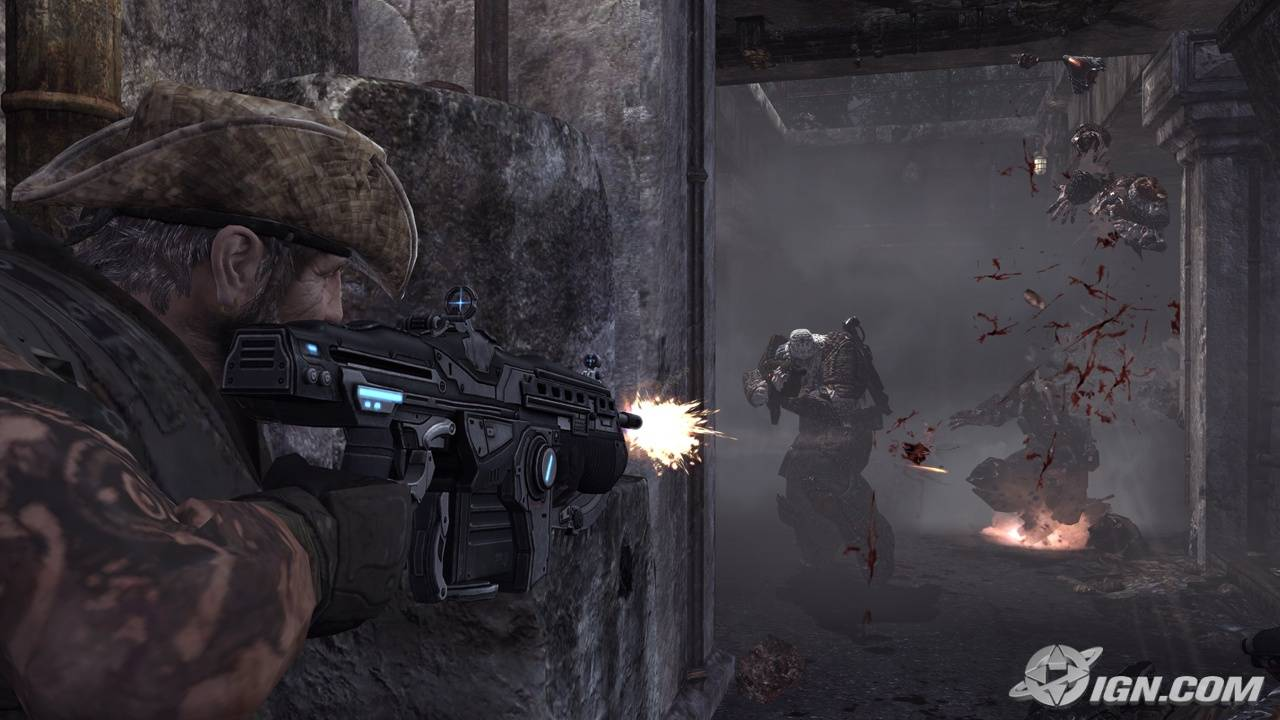
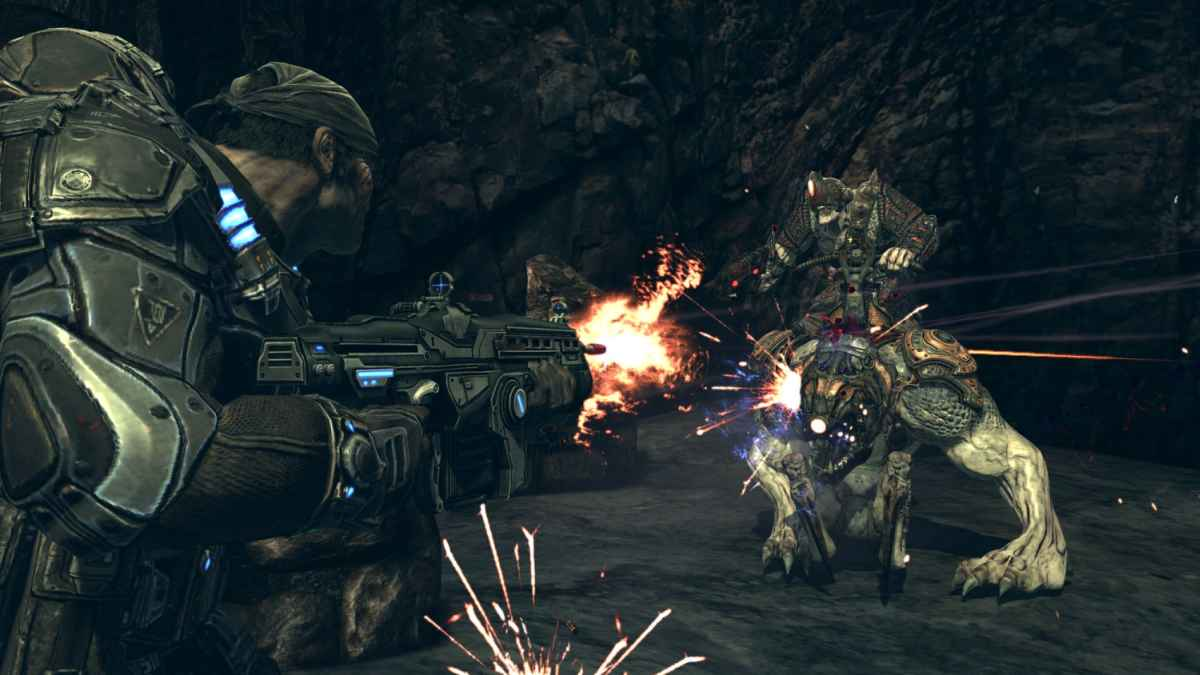
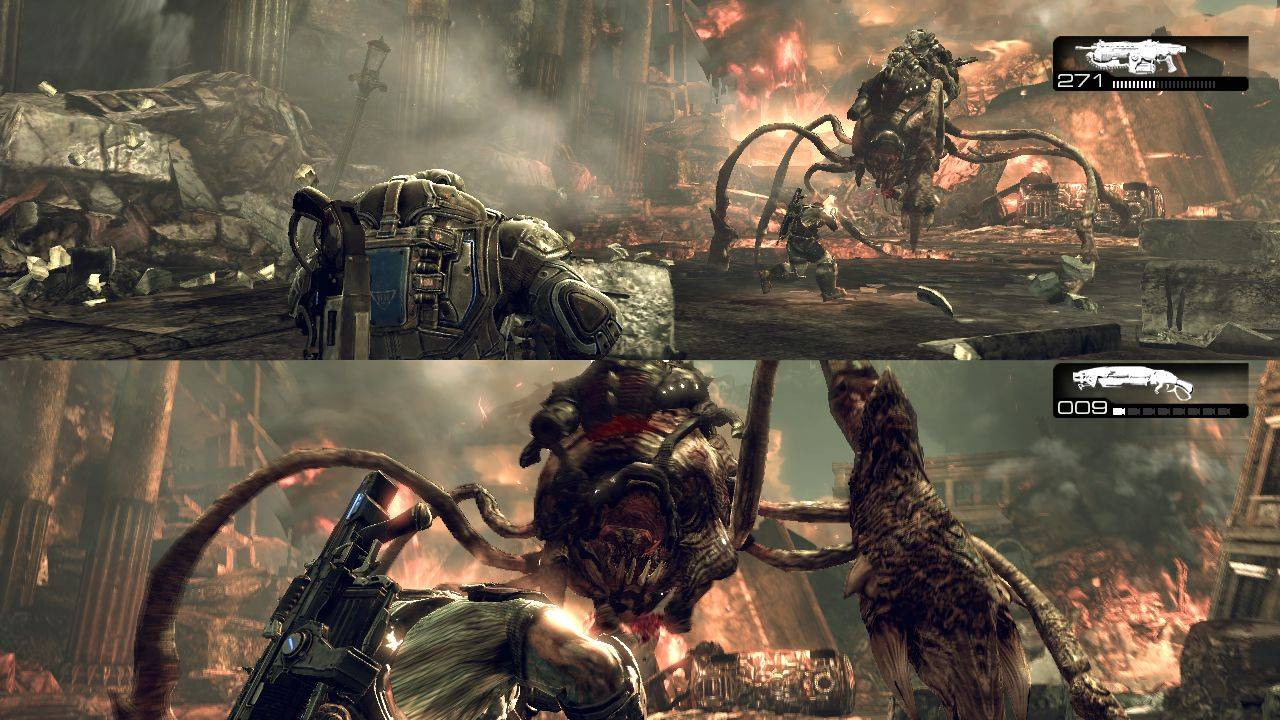
The original Gears of War was one of the most popular games of 2006, helping to solidify the Xbox 360's place in the console market. Since then, it's sold about 5 million copies. When word leaked out that a sequel was in the works, many wondered if Epic Games could reach the bar set by the first game. As it turns out, they could. Gears of War 2 will feel very familiar to those who have played its predecessor. Games often have a way of reinventing themselves as sequels come and go, but Epic stuck to the basics of what had already worked so well, and simply set about improving, polishing, and fleshing out the Gears world as much as they could. Read on for the rest of the review.- Title: Gears of War 2
- Developer: Epic Games
- Publisher: Microsoft Game Studios
- System: Xbox 360
- Reviewer: Soulskill
- Score: 9/10
In the first game, humans on a planet called Sera were locked in a struggle against the Locust Horde — a group of misshapen humanoids and their monstrous pets and cohorts. The game's main character, Marcus Fenix, led a group of soldiers known as Delta Squad into the depths of the planet, where they left a very large bomb to try to demolish the source of the Locusts. As we learn in Gears of War 2, that didn't quite work out. The Locust Horde is back, literally digging humanity's last remaining cities out from underneath. Delta Squad's job is to head back into the caves and tunnels of the Locust stronghold and find a way to put a stop to it.
The game is played in third-person mode, usually looking over Fenix's shoulder as he moves throughout the world. Its focus for combat is on the cover system made popular by the first game. Get near a wall and tap a button, and you'll spin around and put your back to it. Using the aiming trigger, you'll peek past the corner, with a cross-hair showing where your bullets will go. You can take cover behind a large variety of objects; tables, half-walls, overturned cars, even mortally wounded enemies. It's very advantageous to take cover; the damage you sustain out in the open is often far too much for a "run-and-gun" style. Some types of cover are better than others; it's pretty funny to blast apart a rickety wooden table with your shotgun, leaving the enemy who was behind it scrambling to get away. You also get a selection of moves you can do from your covered position. You can hop over small barriers, dive from side to side, and shuffle quickly to another covered spot. The AI uses cover as well, and does so realistically for the most part. Enemies lose track of you if you're sneaky, and your teammates don't (typically) get themselves killed easily.
Weaponry in the game is varied and interesting. You have your standard shooter-game implements — handguns, machine guns, shotgun, sniper rifle — and then some flashier hardware as well — flamethrower, grenade launcher, mortar launcher, chain gun. You're also frequently given special weapons to use that are mounted to a platform or vehicle. Turrets, cannons, and volleys of rockets all make an appearance, and they're all quite fun to use. You also have your trusty chainsaw. In most games, a melee weapon is an afterthought; something to use when you've run out of ammo, but nothing more. Gears of War 2 gives you many opportunities to use your chainsaw, and occasionally for very impressive results. The selection of guns for typical room-to-room use is quite good. You can almost always use whichever gun feels best for the task at hand. Between that and the frequency with which special weapon missions are interspersed throughout the game, you really won't have a chance to get tired of a particular style of fighting.
Gears of War 2 maintains a strong focus on changing things up for the player. You'll very rarely find yourself fighting the same enemies for very long, or even fighting in the same way. It's clear that Epic consciously went about stitching together the levels in a way that wouldn't leave the player bored. You'll fight some grunts, then some more impressive enemies, then hop in a vehicle and defend it, or sometimes assault something that's in your way. You'll defend a base with a turret by shooting down incoming mortars, you'll split up the team and take turns covering each other as you move through separate areas, and one section of the game is almost like a platformer. Without spoiling too much, it isn't enemies within the level that are working to send you to your death, but rather the level itself. Even when you're digging out Locust forces room-by-room, you can count on seeing many variations of the "trying-to-kill-you" theme. As drones try to snipe you from cover, Tickers — dog-sized suicide bombers — and packs of scrambling Wretches will swarm toward you. Every so often you'll encounter shield-toting, mace-swinging Maulers, or the tough, ninja-like Kantus. You'll frequently get a chance to engage the large, impressive heavy-hitters of the Gears world — Brumak, Reavers, and Corpsers.
The game's story is more fleshed-out this time around, but not overly so. The cinematics and smaller cutscenes are to-the-point, and are often capped with a Keanu-Reaves-like "Whoa.." moment. In one section, you're driving through a dark, icy cave, trying to avoid notice. When you're faced with no option but to drive off a cliff, the screen goes dark as you land and the vehicle's power fails. As a member of your squad works frantically to get it started again, nasty things roar and rumble at you in the dark, setting up a rather tense situation when your lighting is restored. Other scenes are character-driven; the world is ending, and Epic doesn't beat around the bush when it comes to the atrocities of war. Torture, suicide, euthanasia — this is not a game for young kids. The cutscenes set up enough interest and emotional investment to make you want to grab a rifle and head toward the next objective without taking momentum from the actual fighting; it often seems like you're playing a story that ranges from cool to impressive to downright brutal.
Fighting often seems intense and hectic; Epic isn't above giving you a ton of things to shoot at, but your comrades are reasonably competent, and can be trusted to handle their share of the fight. Several times you'll rush to defend something and end up needing to man one of the aforementioned turrets to shoot down incoming bombs or flying enemies. The turrets are somewhat harder to succeed with, mainly because your targets are usually dodging and weaving through the air, and it can take some practice to keep up with them. You'll also get to fight battles at high speeds on various vehicles, and on... well, on things that aren't strictly vehicles. Things that don't necessarily want you riding them. The game does well at setting up situations where you think, "Man, I wish I could use that," and then actually letting you do it later on.
The levels themselves flow well; you naturally look and go where you're supposed to go, without being obviously herded along. As I mentioned earlier, there are several places where you split up the team, and get to choose one path over another. It's entertaining in the Solo campaign, but even more so in Co-op. You usually have some way to affect the other path, either via objects in the environment, throwing down cover fire, or perhaps lending a helping hand grenade to disperse some enemies who are focused on your partner. The levels look amazing; they use expansive backdrops to feel like really epic spaces, and the art really contributes to the atmosphere of the game. They look much bigger than they are, but you'll still be surprised at how far you can explore them sometimes. Particular events or "gimmicks" tend to be over quickly, like with the "platformer" level I mentioned earlier. You do something enough for it to be entertaining, but not enough to become tedious. This goes back to the game's theme of keeping things moving along, always changing. Gears of War 2 is also filled with a bunch of nice touches — at one point you're trapped in a building that's fallen on its side, and started burning. You head for the elevator, which just barely still works... sideways. As you slide past other burning floors, you get glimpses of various beasts trapped and struggling to get out.
Gears of War 2 does have its annoyances. When you deal a ton of damage to an enemy, he'll drop to the ground, mortally wounded, and start dragging himself away. If one of his teammates reaches him in time, they can heal him, and bring him back into the fight. Unfortunately, with the cover system in this game, it's quite common to make an enemy fall, but have no way to finish him off before he gets revived. It can be frustrating to have this happen several times in a row. The nature of the cover system also impedes movement at times, causing you to become briefly stuck in a place you don't want to be, or to leave cover in a manner other than what you intended. It can be bothersome at times, but I don't know how they could avoid it, especially in the more cramped spaces. There are also times in the game where you simply have too much to shoot at, or the things you need to kill are moving too quickly. I could swear one of the levels near the end took pity on me, after a few tries, by having the incoming Reavers land and stand still so I could mow them down with my turret.
The multi-player aspect of the game shines as well. Going through the campaign on Co-op is a lot of fun, since many of the levels were designed with a second player in mind. You can also have multiple saved campaigns now, which facilitates the occasional game with a friend, or a quick couple of levels at a party. There's also the "Horde" multi-player setting, which is even better for group play. Up to five players cooperate to fight wave after wave of enemies. Each wave gets stronger, and there are 50 in total. They get quite difficult after a while. Tougher enemies start joining the drones, and all enemies start gaining health and doing more damage. You'll have to start managing your ammo, and work with your teammates to keep from getting picked apart one-by-one. If you quit for a while, you can easily return to the wave at which you left off, which is nice for regular group play.
More familiar multi-player modes are available as well. In "Execution," you can only mortally wound enemies with your weapons. To kill them, you need to run up and administer a fairly gruesome killing blow by hand. In "Submission," a character is labeled the "meatflag." Your goal is to mortally wound him, then use him as a human shield while you drag him to a particular spot on the map. There's also "Wingman," where you fight in five teams of two, and of course, "King of the Hill." Other modes include your typical deathmatches. The updated UI and the camera functions are a big improvement over the first game. All of these modes have bot support, which is great for playing alone or in small groups.
Gears of War 2 retains its character as a testosterone-filled action hero game. It reminded me a bit of the movie 300; I get the feeling that the developers routinely went over a design and asked "How can we make this more over-the-top?" The dialogue contributes to that quite a bit. It's harsh, filled with swearing and macho one-liners. Augustus Cole a.k.a. Cole Train is back, and he's just as hilarious as ever. The cutscenes occasionally show members of Delta Squad doing some ridiculously cool stunt that would be right at home in a Mission: Impossible or James Bond movie. And, as I mentioned earlier, you get to interact with some huge, intimidating friends and foes, which lends to the game's epic feel. It's definitely a better, more polished version of the original game, which is really what we were hoping for.
-
Review: Gears of War 2
The original Gears of War was one of the most popular games of 2006, helping to solidify the Xbox 360's place in the console market. Since then, it's sold about 5 million copies. When word leaked out that a sequel was in the works, many wondered if Epic Games could reach the bar set by the first game. As it turns out, they could. Gears of War 2 will feel very familiar to those who have played its predecessor. Games often have a way of reinventing themselves as sequels come and go, but Epic stuck to the basics of what had already worked so well, and simply set about improving, polishing, and fleshing out the Gears world as much as they could. Read on for the rest of the review.- Title: Gears of War 2
- Developer: Epic Games
- Publisher: Microsoft Game Studios
- System: Xbox 360
- Reviewer: Soulskill
- Score: 9/10
In the first game, humans on a planet called Sera were locked in a struggle against the Locust Horde — a group of misshapen humanoids and their monstrous pets and cohorts. The game's main character, Marcus Fenix, led a group of soldiers known as Delta Squad into the depths of the planet, where they left a very large bomb to try to demolish the source of the Locusts. As we learn in Gears of War 2, that didn't quite work out. The Locust Horde is back, literally digging humanity's last remaining cities out from underneath. Delta Squad's job is to head back into the caves and tunnels of the Locust stronghold and find a way to put a stop to it.
The game is played in third-person mode, usually looking over Fenix's shoulder as he moves throughout the world. Its focus for combat is on the cover system made popular by the first game. Get near a wall and tap a button, and you'll spin around and put your back to it. Using the aiming trigger, you'll peek past the corner, with a cross-hair showing where your bullets will go. You can take cover behind a large variety of objects; tables, half-walls, overturned cars, even mortally wounded enemies. It's very advantageous to take cover; the damage you sustain out in the open is often far too much for a "run-and-gun" style. Some types of cover are better than others; it's pretty funny to blast apart a rickety wooden table with your shotgun, leaving the enemy who was behind it scrambling to get away. You also get a selection of moves you can do from your covered position. You can hop over small barriers, dive from side to side, and shuffle quickly to another covered spot. The AI uses cover as well, and does so realistically for the most part. Enemies lose track of you if you're sneaky, and your teammates don't (typically) get themselves killed easily.
Weaponry in the game is varied and interesting. You have your standard shooter-game implements — handguns, machine guns, shotgun, sniper rifle — and then some flashier hardware as well — flamethrower, grenade launcher, mortar launcher, chain gun. You're also frequently given special weapons to use that are mounted to a platform or vehicle. Turrets, cannons, and volleys of rockets all make an appearance, and they're all quite fun to use. You also have your trusty chainsaw. In most games, a melee weapon is an afterthought; something to use when you've run out of ammo, but nothing more. Gears of War 2 gives you many opportunities to use your chainsaw, and occasionally for very impressive results. The selection of guns for typical room-to-room use is quite good. You can almost always use whichever gun feels best for the task at hand. Between that and the frequency with which special weapon missions are interspersed throughout the game, you really won't have a chance to get tired of a particular style of fighting.
Gears of War 2 maintains a strong focus on changing things up for the player. You'll very rarely find yourself fighting the same enemies for very long, or even fighting in the same way. It's clear that Epic consciously went about stitching together the levels in a way that wouldn't leave the player bored. You'll fight some grunts, then some more impressive enemies, then hop in a vehicle and defend it, or sometimes assault something that's in your way. You'll defend a base with a turret by shooting down incoming mortars, you'll split up the team and take turns covering each other as you move through separate areas, and one section of the game is almost like a platformer. Without spoiling too much, it isn't enemies within the level that are working to send you to your death, but rather the level itself. Even when you're digging out Locust forces room-by-room, you can count on seeing many variations of the "trying-to-kill-you" theme. As drones try to snipe you from cover, Tickers — dog-sized suicide bombers — and packs of scrambling Wretches will swarm toward you. Every so often you'll encounter shield-toting, mace-swinging Maulers, or the tough, ninja-like Kantus. You'll frequently get a chance to engage the large, impressive heavy-hitters of the Gears world — Brumak, Reavers, and Corpsers.
The game's story is more fleshed-out this time around, but not overly so. The cinematics and smaller cutscenes are to-the-point, and are often capped with a Keanu-Reaves-like "Whoa.." moment. In one section, you're driving through a dark, icy cave, trying to avoid notice. When you're faced with no option but to drive off a cliff, the screen goes dark as you land and the vehicle's power fails. As a member of your squad works frantically to get it started again, nasty things roar and rumble at you in the dark, setting up a rather tense situation when your lighting is restored. Other scenes are character-driven; the world is ending, and Epic doesn't beat around the bush when it comes to the atrocities of war. Torture, suicide, euthanasia — this is not a game for young kids. The cutscenes set up enough interest and emotional investment to make you want to grab a rifle and head toward the next objective without taking momentum from the actual fighting; it often seems like you're playing a story that ranges from cool to impressive to downright brutal.
Fighting often seems intense and hectic; Epic isn't above giving you a ton of things to shoot at, but your comrades are reasonably competent, and can be trusted to handle their share of the fight. Several times you'll rush to defend something and end up needing to man one of the aforementioned turrets to shoot down incoming bombs or flying enemies. The turrets are somewhat harder to succeed with, mainly because your targets are usually dodging and weaving through the air, and it can take some practice to keep up with them. You'll also get to fight battles at high speeds on various vehicles, and on... well, on things that aren't strictly vehicles. Things that don't necessarily want you riding them. The game does well at setting up situations where you think, "Man, I wish I could use that," and then actually letting you do it later on.
The levels themselves flow well; you naturally look and go where you're supposed to go, without being obviously herded along. As I mentioned earlier, there are several places where you split up the team, and get to choose one path over another. It's entertaining in the Solo campaign, but even more so in Co-op. You usually have some way to affect the other path, either via objects in the environment, throwing down cover fire, or perhaps lending a helping hand grenade to disperse some enemies who are focused on your partner. The levels look amazing; they use expansive backdrops to feel like really epic spaces, and the art really contributes to the atmosphere of the game. They look much bigger than they are, but you'll still be surprised at how far you can explore them sometimes. Particular events or "gimmicks" tend to be over quickly, like with the "platformer" level I mentioned earlier. You do something enough for it to be entertaining, but not enough to become tedious. This goes back to the game's theme of keeping things moving along, always changing. Gears of War 2 is also filled with a bunch of nice touches — at one point you're trapped in a building that's fallen on its side, and started burning. You head for the elevator, which just barely still works... sideways. As you slide past other burning floors, you get glimpses of various beasts trapped and struggling to get out.
Gears of War 2 does have its annoyances. When you deal a ton of damage to an enemy, he'll drop to the ground, mortally wounded, and start dragging himself away. If one of his teammates reaches him in time, they can heal him, and bring him back into the fight. Unfortunately, with the cover system in this game, it's quite common to make an enemy fall, but have no way to finish him off before he gets revived. It can be frustrating to have this happen several times in a row. The nature of the cover system also impedes movement at times, causing you to become briefly stuck in a place you don't want to be, or to leave cover in a manner other than what you intended. It can be bothersome at times, but I don't know how they could avoid it, especially in the more cramped spaces. There are also times in the game where you simply have too much to shoot at, or the things you need to kill are moving too quickly. I could swear one of the levels near the end took pity on me, after a few tries, by having the incoming Reavers land and stand still so I could mow them down with my turret.
The multi-player aspect of the game shines as well. Going through the campaign on Co-op is a lot of fun, since many of the levels were designed with a second player in mind. You can also have multiple saved campaigns now, which facilitates the occasional game with a friend, or a quick couple of levels at a party. There's also the "Horde" multi-player setting, which is even better for group play. Up to five players cooperate to fight wave after wave of enemies. Each wave gets stronger, and there are 50 in total. They get quite difficult after a while. Tougher enemies start joining the drones, and all enemies start gaining health and doing more damage. You'll have to start managing your ammo, and work with your teammates to keep from getting picked apart one-by-one. If you quit for a while, you can easily return to the wave at which you left off, which is nice for regular group play.
More familiar multi-player modes are available as well. In "Execution," you can only mortally wound enemies with your weapons. To kill them, you need to run up and administer a fairly gruesome killing blow by hand. In "Submission," a character is labeled the "meatflag." Your goal is to mortally wound him, then use him as a human shield while you drag him to a particular spot on the map. There's also "Wingman," where you fight in five teams of two, and of course, "King of the Hill." Other modes include your typical deathmatches. The updated UI and the camera functions are a big improvement over the first game. All of these modes have bot support, which is great for playing alone or in small groups.
Gears of War 2 retains its character as a testosterone-filled action hero game. It reminded me a bit of the movie 300; I get the feeling that the developers routinely went over a design and asked "How can we make this more over-the-top?" The dialogue contributes to that quite a bit. It's harsh, filled with swearing and macho one-liners. Augustus Cole a.k.a. Cole Train is back, and he's just as hilarious as ever. The cutscenes occasionally show members of Delta Squad doing some ridiculously cool stunt that would be right at home in a Mission: Impossible or James Bond movie. And, as I mentioned earlier, you get to interact with some huge, intimidating friends and foes, which lends to the game's epic feel. It's definitely a better, more polished version of the original game, which is really what we were hoping for.
-
Review: Gears of War 2
The original Gears of War was one of the most popular games of 2006, helping to solidify the Xbox 360's place in the console market. Since then, it's sold about 5 million copies. When word leaked out that a sequel was in the works, many wondered if Epic Games could reach the bar set by the first game. As it turns out, they could. Gears of War 2 will feel very familiar to those who have played its predecessor. Games often have a way of reinventing themselves as sequels come and go, but Epic stuck to the basics of what had already worked so well, and simply set about improving, polishing, and fleshing out the Gears world as much as they could. Read on for the rest of the review.- Title: Gears of War 2
- Developer: Epic Games
- Publisher: Microsoft Game Studios
- System: Xbox 360
- Reviewer: Soulskill
- Score: 9/10
In the first game, humans on a planet called Sera were locked in a struggle against the Locust Horde — a group of misshapen humanoids and their monstrous pets and cohorts. The game's main character, Marcus Fenix, led a group of soldiers known as Delta Squad into the depths of the planet, where they left a very large bomb to try to demolish the source of the Locusts. As we learn in Gears of War 2, that didn't quite work out. The Locust Horde is back, literally digging humanity's last remaining cities out from underneath. Delta Squad's job is to head back into the caves and tunnels of the Locust stronghold and find a way to put a stop to it.
The game is played in third-person mode, usually looking over Fenix's shoulder as he moves throughout the world. Its focus for combat is on the cover system made popular by the first game. Get near a wall and tap a button, and you'll spin around and put your back to it. Using the aiming trigger, you'll peek past the corner, with a cross-hair showing where your bullets will go. You can take cover behind a large variety of objects; tables, half-walls, overturned cars, even mortally wounded enemies. It's very advantageous to take cover; the damage you sustain out in the open is often far too much for a "run-and-gun" style. Some types of cover are better than others; it's pretty funny to blast apart a rickety wooden table with your shotgun, leaving the enemy who was behind it scrambling to get away. You also get a selection of moves you can do from your covered position. You can hop over small barriers, dive from side to side, and shuffle quickly to another covered spot. The AI uses cover as well, and does so realistically for the most part. Enemies lose track of you if you're sneaky, and your teammates don't (typically) get themselves killed easily.
Weaponry in the game is varied and interesting. You have your standard shooter-game implements — handguns, machine guns, shotgun, sniper rifle — and then some flashier hardware as well — flamethrower, grenade launcher, mortar launcher, chain gun. You're also frequently given special weapons to use that are mounted to a platform or vehicle. Turrets, cannons, and volleys of rockets all make an appearance, and they're all quite fun to use. You also have your trusty chainsaw. In most games, a melee weapon is an afterthought; something to use when you've run out of ammo, but nothing more. Gears of War 2 gives you many opportunities to use your chainsaw, and occasionally for very impressive results. The selection of guns for typical room-to-room use is quite good. You can almost always use whichever gun feels best for the task at hand. Between that and the frequency with which special weapon missions are interspersed throughout the game, you really won't have a chance to get tired of a particular style of fighting.
Gears of War 2 maintains a strong focus on changing things up for the player. You'll very rarely find yourself fighting the same enemies for very long, or even fighting in the same way. It's clear that Epic consciously went about stitching together the levels in a way that wouldn't leave the player bored. You'll fight some grunts, then some more impressive enemies, then hop in a vehicle and defend it, or sometimes assault something that's in your way. You'll defend a base with a turret by shooting down incoming mortars, you'll split up the team and take turns covering each other as you move through separate areas, and one section of the game is almost like a platformer. Without spoiling too much, it isn't enemies within the level that are working to send you to your death, but rather the level itself. Even when you're digging out Locust forces room-by-room, you can count on seeing many variations of the "trying-to-kill-you" theme. As drones try to snipe you from cover, Tickers — dog-sized suicide bombers — and packs of scrambling Wretches will swarm toward you. Every so often you'll encounter shield-toting, mace-swinging Maulers, or the tough, ninja-like Kantus. You'll frequently get a chance to engage the large, impressive heavy-hitters of the Gears world — Brumak, Reavers, and Corpsers.
The game's story is more fleshed-out this time around, but not overly so. The cinematics and smaller cutscenes are to-the-point, and are often capped with a Keanu-Reaves-like "Whoa.." moment. In one section, you're driving through a dark, icy cave, trying to avoid notice. When you're faced with no option but to drive off a cliff, the screen goes dark as you land and the vehicle's power fails. As a member of your squad works frantically to get it started again, nasty things roar and rumble at you in the dark, setting up a rather tense situation when your lighting is restored. Other scenes are character-driven; the world is ending, and Epic doesn't beat around the bush when it comes to the atrocities of war. Torture, suicide, euthanasia — this is not a game for young kids. The cutscenes set up enough interest and emotional investment to make you want to grab a rifle and head toward the next objective without taking momentum from the actual fighting; it often seems like you're playing a story that ranges from cool to impressive to downright brutal.
Fighting often seems intense and hectic; Epic isn't above giving you a ton of things to shoot at, but your comrades are reasonably competent, and can be trusted to handle their share of the fight. Several times you'll rush to defend something and end up needing to man one of the aforementioned turrets to shoot down incoming bombs or flying enemies. The turrets are somewhat harder to succeed with, mainly because your targets are usually dodging and weaving through the air, and it can take some practice to keep up with them. You'll also get to fight battles at high speeds on various vehicles, and on... well, on things that aren't strictly vehicles. Things that don't necessarily want you riding them. The game does well at setting up situations where you think, "Man, I wish I could use that," and then actually letting you do it later on.
The levels themselves flow well; you naturally look and go where you're supposed to go, without being obviously herded along. As I mentioned earlier, there are several places where you split up the team, and get to choose one path over another. It's entertaining in the Solo campaign, but even more so in Co-op. You usually have some way to affect the other path, either via objects in the environment, throwing down cover fire, or perhaps lending a helping hand grenade to disperse some enemies who are focused on your partner. The levels look amazing; they use expansive backdrops to feel like really epic spaces, and the art really contributes to the atmosphere of the game. They look much bigger than they are, but you'll still be surprised at how far you can explore them sometimes. Particular events or "gimmicks" tend to be over quickly, like with the "platformer" level I mentioned earlier. You do something enough for it to be entertaining, but not enough to become tedious. This goes back to the game's theme of keeping things moving along, always changing. Gears of War 2 is also filled with a bunch of nice touches — at one point you're trapped in a building that's fallen on its side, and started burning. You head for the elevator, which just barely still works... sideways. As you slide past other burning floors, you get glimpses of various beasts trapped and struggling to get out.
Gears of War 2 does have its annoyances. When you deal a ton of damage to an enemy, he'll drop to the ground, mortally wounded, and start dragging himself away. If one of his teammates reaches him in time, they can heal him, and bring him back into the fight. Unfortunately, with the cover system in this game, it's quite common to make an enemy fall, but have no way to finish him off before he gets revived. It can be frustrating to have this happen several times in a row. The nature of the cover system also impedes movement at times, causing you to become briefly stuck in a place you don't want to be, or to leave cover in a manner other than what you intended. It can be bothersome at times, but I don't know how they could avoid it, especially in the more cramped spaces. There are also times in the game where you simply have too much to shoot at, or the things you need to kill are moving too quickly. I could swear one of the levels near the end took pity on me, after a few tries, by having the incoming Reavers land and stand still so I could mow them down with my turret.
The multi-player aspect of the game shines as well. Going through the campaign on Co-op is a lot of fun, since many of the levels were designed with a second player in mind. You can also have multiple saved campaigns now, which facilitates the occasional game with a friend, or a quick couple of levels at a party. There's also the "Horde" multi-player setting, which is even better for group play. Up to five players cooperate to fight wave after wave of enemies. Each wave gets stronger, and there are 50 in total. They get quite difficult after a while. Tougher enemies start joining the drones, and all enemies start gaining health and doing more damage. You'll have to start managing your ammo, and work with your teammates to keep from getting picked apart one-by-one. If you quit for a while, you can easily return to the wave at which you left off, which is nice for regular group play.
More familiar multi-player modes are available as well. In "Execution," you can only mortally wound enemies with your weapons. To kill them, you need to run up and administer a fairly gruesome killing blow by hand. In "Submission," a character is labeled the "meatflag." Your goal is to mortally wound him, then use him as a human shield while you drag him to a particular spot on the map. There's also "Wingman," where you fight in five teams of two, and of course, "King of the Hill." Other modes include your typical deathmatches. The updated UI and the camera functions are a big improvement over the first game. All of these modes have bot support, which is great for playing alone or in small groups.
Gears of War 2 retains its character as a testosterone-filled action hero game. It reminded me a bit of the movie 300; I get the feeling that the developers routinely went over a design and asked "How can we make this more over-the-top?" The dialogue contributes to that quite a bit. It's harsh, filled with swearing and macho one-liners. Augustus Cole a.k.a. Cole Train is back, and he's just as hilarious as ever. The cutscenes occasionally show members of Delta Squad doing some ridiculously cool stunt that would be right at home in a Mission: Impossible or James Bond movie. And, as I mentioned earlier, you get to interact with some huge, intimidating friends and foes, which lends to the game's epic feel. It's definitely a better, more polished version of the original game, which is really what we were hoping for.
-
Review: Gears of War 2
The original Gears of War was one of the most popular games of 2006, helping to solidify the Xbox 360's place in the console market. Since then, it's sold about 5 million copies. When word leaked out that a sequel was in the works, many wondered if Epic Games could reach the bar set by the first game. As it turns out, they could. Gears of War 2 will feel very familiar to those who have played its predecessor. Games often have a way of reinventing themselves as sequels come and go, but Epic stuck to the basics of what had already worked so well, and simply set about improving, polishing, and fleshing out the Gears world as much as they could. Read on for the rest of the review.- Title: Gears of War 2
- Developer: Epic Games
- Publisher: Microsoft Game Studios
- System: Xbox 360
- Reviewer: Soulskill
- Score: 9/10
In the first game, humans on a planet called Sera were locked in a struggle against the Locust Horde — a group of misshapen humanoids and their monstrous pets and cohorts. The game's main character, Marcus Fenix, led a group of soldiers known as Delta Squad into the depths of the planet, where they left a very large bomb to try to demolish the source of the Locusts. As we learn in Gears of War 2, that didn't quite work out. The Locust Horde is back, literally digging humanity's last remaining cities out from underneath. Delta Squad's job is to head back into the caves and tunnels of the Locust stronghold and find a way to put a stop to it.
The game is played in third-person mode, usually looking over Fenix's shoulder as he moves throughout the world. Its focus for combat is on the cover system made popular by the first game. Get near a wall and tap a button, and you'll spin around and put your back to it. Using the aiming trigger, you'll peek past the corner, with a cross-hair showing where your bullets will go. You can take cover behind a large variety of objects; tables, half-walls, overturned cars, even mortally wounded enemies. It's very advantageous to take cover; the damage you sustain out in the open is often far too much for a "run-and-gun" style. Some types of cover are better than others; it's pretty funny to blast apart a rickety wooden table with your shotgun, leaving the enemy who was behind it scrambling to get away. You also get a selection of moves you can do from your covered position. You can hop over small barriers, dive from side to side, and shuffle quickly to another covered spot. The AI uses cover as well, and does so realistically for the most part. Enemies lose track of you if you're sneaky, and your teammates don't (typically) get themselves killed easily.
Weaponry in the game is varied and interesting. You have your standard shooter-game implements — handguns, machine guns, shotgun, sniper rifle — and then some flashier hardware as well — flamethrower, grenade launcher, mortar launcher, chain gun. You're also frequently given special weapons to use that are mounted to a platform or vehicle. Turrets, cannons, and volleys of rockets all make an appearance, and they're all quite fun to use. You also have your trusty chainsaw. In most games, a melee weapon is an afterthought; something to use when you've run out of ammo, but nothing more. Gears of War 2 gives you many opportunities to use your chainsaw, and occasionally for very impressive results. The selection of guns for typical room-to-room use is quite good. You can almost always use whichever gun feels best for the task at hand. Between that and the frequency with which special weapon missions are interspersed throughout the game, you really won't have a chance to get tired of a particular style of fighting.
Gears of War 2 maintains a strong focus on changing things up for the player. You'll very rarely find yourself fighting the same enemies for very long, or even fighting in the same way. It's clear that Epic consciously went about stitching together the levels in a way that wouldn't leave the player bored. You'll fight some grunts, then some more impressive enemies, then hop in a vehicle and defend it, or sometimes assault something that's in your way. You'll defend a base with a turret by shooting down incoming mortars, you'll split up the team and take turns covering each other as you move through separate areas, and one section of the game is almost like a platformer. Without spoiling too much, it isn't enemies within the level that are working to send you to your death, but rather the level itself. Even when you're digging out Locust forces room-by-room, you can count on seeing many variations of the "trying-to-kill-you" theme. As drones try to snipe you from cover, Tickers — dog-sized suicide bombers — and packs of scrambling Wretches will swarm toward you. Every so often you'll encounter shield-toting, mace-swinging Maulers, or the tough, ninja-like Kantus. You'll frequently get a chance to engage the large, impressive heavy-hitters of the Gears world — Brumak, Reavers, and Corpsers.
The game's story is more fleshed-out this time around, but not overly so. The cinematics and smaller cutscenes are to-the-point, and are often capped with a Keanu-Reaves-like "Whoa.." moment. In one section, you're driving through a dark, icy cave, trying to avoid notice. When you're faced with no option but to drive off a cliff, the screen goes dark as you land and the vehicle's power fails. As a member of your squad works frantically to get it started again, nasty things roar and rumble at you in the dark, setting up a rather tense situation when your lighting is restored. Other scenes are character-driven; the world is ending, and Epic doesn't beat around the bush when it comes to the atrocities of war. Torture, suicide, euthanasia — this is not a game for young kids. The cutscenes set up enough interest and emotional investment to make you want to grab a rifle and head toward the next objective without taking momentum from the actual fighting; it often seems like you're playing a story that ranges from cool to impressive to downright brutal.
Fighting often seems intense and hectic; Epic isn't above giving you a ton of things to shoot at, but your comrades are reasonably competent, and can be trusted to handle their share of the fight. Several times you'll rush to defend something and end up needing to man one of the aforementioned turrets to shoot down incoming bombs or flying enemies. The turrets are somewhat harder to succeed with, mainly because your targets are usually dodging and weaving through the air, and it can take some practice to keep up with them. You'll also get to fight battles at high speeds on various vehicles, and on... well, on things that aren't strictly vehicles. Things that don't necessarily want you riding them. The game does well at setting up situations where you think, "Man, I wish I could use that," and then actually letting you do it later on.
The levels themselves flow well; you naturally look and go where you're supposed to go, without being obviously herded along. As I mentioned earlier, there are several places where you split up the team, and get to choose one path over another. It's entertaining in the Solo campaign, but even more so in Co-op. You usually have some way to affect the other path, either via objects in the environment, throwing down cover fire, or perhaps lending a helping hand grenade to disperse some enemies who are focused on your partner. The levels look amazing; they use expansive backdrops to feel like really epic spaces, and the art really contributes to the atmosphere of the game. They look much bigger than they are, but you'll still be surprised at how far you can explore them sometimes. Particular events or "gimmicks" tend to be over quickly, like with the "platformer" level I mentioned earlier. You do something enough for it to be entertaining, but not enough to become tedious. This goes back to the game's theme of keeping things moving along, always changing. Gears of War 2 is also filled with a bunch of nice touches — at one point you're trapped in a building that's fallen on its side, and started burning. You head for the elevator, which just barely still works... sideways. As you slide past other burning floors, you get glimpses of various beasts trapped and struggling to get out.
Gears of War 2 does have its annoyances. When you deal a ton of damage to an enemy, he'll drop to the ground, mortally wounded, and start dragging himself away. If one of his teammates reaches him in time, they can heal him, and bring him back into the fight. Unfortunately, with the cover system in this game, it's quite common to make an enemy fall, but have no way to finish him off before he gets revived. It can be frustrating to have this happen several times in a row. The nature of the cover system also impedes movement at times, causing you to become briefly stuck in a place you don't want to be, or to leave cover in a manner other than what you intended. It can be bothersome at times, but I don't know how they could avoid it, especially in the more cramped spaces. There are also times in the game where you simply have too much to shoot at, or the things you need to kill are moving too quickly. I could swear one of the levels near the end took pity on me, after a few tries, by having the incoming Reavers land and stand still so I could mow them down with my turret.
The multi-player aspect of the game shines as well. Going through the campaign on Co-op is a lot of fun, since many of the levels were designed with a second player in mind. You can also have multiple saved campaigns now, which facilitates the occasional game with a friend, or a quick couple of levels at a party. There's also the "Horde" multi-player setting, which is even better for group play. Up to five players cooperate to fight wave after wave of enemies. Each wave gets stronger, and there are 50 in total. They get quite difficult after a while. Tougher enemies start joining the drones, and all enemies start gaining health and doing more damage. You'll have to start managing your ammo, and work with your teammates to keep from getting picked apart one-by-one. If you quit for a while, you can easily return to the wave at which you left off, which is nice for regular group play.
More familiar multi-player modes are available as well. In "Execution," you can only mortally wound enemies with your weapons. To kill them, you need to run up and administer a fairly gruesome killing blow by hand. In "Submission," a character is labeled the "meatflag." Your goal is to mortally wound him, then use him as a human shield while you drag him to a particular spot on the map. There's also "Wingman," where you fight in five teams of two, and of course, "King of the Hill." Other modes include your typical deathmatches. The updated UI and the camera functions are a big improvement over the first game. All of these modes have bot support, which is great for playing alone or in small groups.
Gears of War 2 retains its character as a testosterone-filled action hero game. It reminded me a bit of the movie 300; I get the feeling that the developers routinely went over a design and asked "How can we make this more over-the-top?" The dialogue contributes to that quite a bit. It's harsh, filled with swearing and macho one-liners. Augustus Cole a.k.a. Cole Train is back, and he's just as hilarious as ever. The cutscenes occasionally show members of Delta Squad doing some ridiculously cool stunt that would be right at home in a Mission: Impossible or James Bond movie. And, as I mentioned earlier, you get to interact with some huge, intimidating friends and foes, which lends to the game's epic feel. It's definitely a better, more polished version of the original game, which is really what we were hoping for.
-
Nuke Site Converted Into Green Data Center
1sockchuck writes "If you had 100,000 servers, would you put them on top of a former nuclear fuel facility? One of the world's largest web hosts, 1&1 Internet, is building a new data center on a site in Hanau, Germany previously used by Siemens to produce mixed oxide rods made from enriched uranium and plutonium. The site has been cleaned up, and 1&1 is converting it into a 'green' data center powered by renewable energy and using free cooling to save on air conditioning costs." -
11,000-Year-Old Temple Found In Turkey
Ralph Spoilsport writes "In Southeast Turkey, the archaeologist Klaus Schmidt has discovered an 11,000-year-old temple. Established civilization theory suggests that agriculture created cities, and cities created monuments. This discovery suggests just the opposite — people got together to build a huge monument to their religion, and in order to sustain it, communities were formed and agriculture (already in development) quickly followed on to sustain the population. Truly a startling find with significant implications." -
ESRB Supplements Rating System With Summaries
The Entertainment Software Rating Board (ESRB) announced today that in addition to their standard ratings for video games, they'll begin including summaries of the games, highlighting the parts which earned the rating. As Giant Bomb points out, some are quite entertaining to read. The new policy drew praise from Senators Hillary Clinton (D-NY) and Joe Lieberman (I-CT), both of whom have spoken out against "inappropriate" game content in the past. The summaries are viewable at the ESRB's website; thus far, they've only done them for games rated since July 1st. -
ESRB Supplements Rating System With Summaries
The Entertainment Software Rating Board (ESRB) announced today that in addition to their standard ratings for video games, they'll begin including summaries of the games, highlighting the parts which earned the rating. As Giant Bomb points out, some are quite entertaining to read. The new policy drew praise from Senators Hillary Clinton (D-NY) and Joe Lieberman (I-CT), both of whom have spoken out against "inappropriate" game content in the past. The summaries are viewable at the ESRB's website; thus far, they've only done them for games rated since July 1st. -
IBM Bringing Powerline Broadband Back?
KindMind writes "IBM, in partnership with International Broadband Electric Communications, appears to be bringing back powerline broadband back from the dead. This time, the idea is to build out in rural areas not currently serviced by broadband, and isn't for competing with other broadband solutions. From the article: 'Their strategy is to sign up electric cooperatives that provide power to sparsely populated areas across the eastern United States. Rather than compete toe-to-toe with large, entrenched cable or DSL providers, IBEC is looking for customers that have been largely left out of the shift to high-speed Internet.'" -
Mars Rover "Spirit" In Danger
Riding with Robots writes "Just days after announcing that the Mars Phoenix Lander has met its icy demise, NASA reports that a dust storm has left the rover Spirit on the edge of power failure. During one recent Martian day, the robotic geologist's solar array produced only 89 watt hours of energy, the lowest output by either rover in their nearly five years on Mars. Mission managers are taking steps to protect the hardy, battle-worn spacecraft, but the agency describes Spirit's status as 'vulnerable.'" -
Googling Security
brothke writes "It has been suggested that if one was somehow able to change history so that aspirin had never been discovered until now, it would have died in the lab and stand no chance of FDA approval. Similarly, if we knew the power that Google would have in 2008 with its ability to aggregate and correlate personal data, it is arguable that various regulatory and privacy bodies would never allow it to exist given the extensive privacy issues." Read below for the rest of Ben's review. Googling Security: How Much Does Google Know About You? author Greg Conti pages 360 publisher Addison-Wesley Professional rating 9 reviewer Ben Rothke ISBN 978-0321518668 summary Explores the many security risks around Google and other search engines In a fascinating and eye-opening new book Googling Security: How Much Does Google Know About You?, author Greg Conti explores the many security risks around Google and other search engines. Part of the problem is that in the rush to get content onto the web, organizations often give short shrift to the security and privacy of their data. At the individual level, those who make use of the innumerable and ever expanding amount of Google free services can end up paying for those services with their personal information being compromised, or shared in ways they would not truly approve of; but implicitly do so via their acceptance of the Google Terms of Service.
While the book focuses specifically on Google, the security issues detailed are just as relevant to Yahoo, MSN, AOL, Ask and the more than 50 other search engines.
My friend and SEO guru Shimon Sandler has a blog around search engine optimization (SEO). In the over three years that his blog has been around, my recent post on The Need for Security in SEO was the first on the topic of SEO security. Similar SEO blogs have a very low number (and often no) articles on SEO and security. Sandler notes that when he mentions privacy issues around search to his clients, it is often the first time they have thought of it.
The book opens with the observation that Google's business model is built on the prospect of providing its services for free. From the individual user's perspective, this is a model that they can live with. But the inherent risk is that the services really are not completely free; they come at the cost of the loss of control of one's personal information that they share with Google.
The book lists over 50 Google services and applications which collect personal information. From mail, alerts, blogging, news, desktop, images, maps, groups, video and more. People are placing a great deal of trust into Google as each time they use a Google service, they are trusting the organization to safeguard their personal information. In chapter 5, the book lists over 20 stated uses and advantages of Google Groups, and the possible information disclosure risks of each.
In the books 10 chapters, the author provides a systematic overview of how Google gets your personal data and what it does with it. In chapter 3, the book details how disparate pieces of data can be aggregated and mined to create extremely detailed user profiles. These profiles are invaluable to advertisers who will pay Google dearly for such meticulous user data. This level of personal data aggregation was impossible to obtain just a few years ago, given the lack of computing power, combined with the single point of user data. The book notes that this level of personalization, while golden to advertisers, is a privacy anathema.
Chapter 6 is particularly interesting in that it details the risks of using Google Maps. Conti explains that the privacy issue via the use of Google Maps is that it combines disclosure risks of search and connects it to mapping. You are now sharing geographic locations and the associated interactions. By clicking on a link in a Google map, the user discloses and strengthens the link between the search they performed and what they deemed as important in the result. By aggregating source IP addresses and destinations searches, Google can easily ascertain confidential data.
After detailing over 250 pages of the risks of Google and related services, Chapter 9 is about countermeasures. Short of simply not using the services, the book notes that there is no clear solution for protecting yourself and company from web-based information disclosure. Nonetheless, the chapter lists a number of things that can be done to reduce the threat. Some are easier, some are harder; but they can ultimately add up to a significant layer of protection. Chapter 9 details 11 specific steps that help users appreciate the magnitude of their disclosures and make informed decisions about which search services to use.
Googling Security: How Much Does Google Know About You? is an important book given that far too many people do not realize how much personal information they are disclosing on a daily basis. An important point that the book makes is that small information disclosures are not truly small when they are aggregated over the course of years. Advances in data mining and artificial intelligence are magnifying the importance of the threat, all under the guise of improving the end-user experience. The book emphasizes the need to evaluate the short-term computing gains with the long-term privacy losses.
The final chapter notes that apathy is the enemy. As a user becomes aware of the magnitude of the threat, they will see it grow every day. But the next step is to take action. Be it with technical countermeasures, taking your business where privacy is better supported, or petitioning lawmakers.
As to the underlying question, "how much does Google know about you?", the answer is that it is a colossal amount, far more than most people realize. For anyone who uses the Internet, Googling Security should be on their list of required reading. The risks that Google and other search engines present are of great consequence and can't be overlooked. If not, privacy could slowly be a thing of the past.
Ben Rothke is the author of Computer Security: 20 Things Every Employee Should Know.
You can purchase Googling Security: How Much Does Google Know About You? from amazon.com. Slashdot welcomes readers' book reviews -- to see your own review here, read the book review guidelines, then visit the submission page. -
Googling Security
brothke writes "It has been suggested that if one was somehow able to change history so that aspirin had never been discovered until now, it would have died in the lab and stand no chance of FDA approval. Similarly, if we knew the power that Google would have in 2008 with its ability to aggregate and correlate personal data, it is arguable that various regulatory and privacy bodies would never allow it to exist given the extensive privacy issues." Read below for the rest of Ben's review. Googling Security: How Much Does Google Know About You? author Greg Conti pages 360 publisher Addison-Wesley Professional rating 9 reviewer Ben Rothke ISBN 978-0321518668 summary Explores the many security risks around Google and other search engines In a fascinating and eye-opening new book Googling Security: How Much Does Google Know About You?, author Greg Conti explores the many security risks around Google and other search engines. Part of the problem is that in the rush to get content onto the web, organizations often give short shrift to the security and privacy of their data. At the individual level, those who make use of the innumerable and ever expanding amount of Google free services can end up paying for those services with their personal information being compromised, or shared in ways they would not truly approve of; but implicitly do so via their acceptance of the Google Terms of Service.
While the book focuses specifically on Google, the security issues detailed are just as relevant to Yahoo, MSN, AOL, Ask and the more than 50 other search engines.
My friend and SEO guru Shimon Sandler has a blog around search engine optimization (SEO). In the over three years that his blog has been around, my recent post on The Need for Security in SEO was the first on the topic of SEO security. Similar SEO blogs have a very low number (and often no) articles on SEO and security. Sandler notes that when he mentions privacy issues around search to his clients, it is often the first time they have thought of it.
The book opens with the observation that Google's business model is built on the prospect of providing its services for free. From the individual user's perspective, this is a model that they can live with. But the inherent risk is that the services really are not completely free; they come at the cost of the loss of control of one's personal information that they share with Google.
The book lists over 50 Google services and applications which collect personal information. From mail, alerts, blogging, news, desktop, images, maps, groups, video and more. People are placing a great deal of trust into Google as each time they use a Google service, they are trusting the organization to safeguard their personal information. In chapter 5, the book lists over 20 stated uses and advantages of Google Groups, and the possible information disclosure risks of each.
In the books 10 chapters, the author provides a systematic overview of how Google gets your personal data and what it does with it. In chapter 3, the book details how disparate pieces of data can be aggregated and mined to create extremely detailed user profiles. These profiles are invaluable to advertisers who will pay Google dearly for such meticulous user data. This level of personal data aggregation was impossible to obtain just a few years ago, given the lack of computing power, combined with the single point of user data. The book notes that this level of personalization, while golden to advertisers, is a privacy anathema.
Chapter 6 is particularly interesting in that it details the risks of using Google Maps. Conti explains that the privacy issue via the use of Google Maps is that it combines disclosure risks of search and connects it to mapping. You are now sharing geographic locations and the associated interactions. By clicking on a link in a Google map, the user discloses and strengthens the link between the search they performed and what they deemed as important in the result. By aggregating source IP addresses and destinations searches, Google can easily ascertain confidential data.
After detailing over 250 pages of the risks of Google and related services, Chapter 9 is about countermeasures. Short of simply not using the services, the book notes that there is no clear solution for protecting yourself and company from web-based information disclosure. Nonetheless, the chapter lists a number of things that can be done to reduce the threat. Some are easier, some are harder; but they can ultimately add up to a significant layer of protection. Chapter 9 details 11 specific steps that help users appreciate the magnitude of their disclosures and make informed decisions about which search services to use.
Googling Security: How Much Does Google Know About You? is an important book given that far too many people do not realize how much personal information they are disclosing on a daily basis. An important point that the book makes is that small information disclosures are not truly small when they are aggregated over the course of years. Advances in data mining and artificial intelligence are magnifying the importance of the threat, all under the guise of improving the end-user experience. The book emphasizes the need to evaluate the short-term computing gains with the long-term privacy losses.
The final chapter notes that apathy is the enemy. As a user becomes aware of the magnitude of the threat, they will see it grow every day. But the next step is to take action. Be it with technical countermeasures, taking your business where privacy is better supported, or petitioning lawmakers.
As to the underlying question, "how much does Google know about you?", the answer is that it is a colossal amount, far more than most people realize. For anyone who uses the Internet, Googling Security should be on their list of required reading. The risks that Google and other search engines present are of great consequence and can't be overlooked. If not, privacy could slowly be a thing of the past.
Ben Rothke is the author of Computer Security: 20 Things Every Employee Should Know.
You can purchase Googling Security: How Much Does Google Know About You? from amazon.com. Slashdot welcomes readers' book reviews -- to see your own review here, read the book review guidelines, then visit the submission page. -
(Useful) Stupid BlackBerry Tricks?
-
(Useful) Stupid BlackBerry Tricks?
-
(Useful) Stupid BlackBerry Tricks?
-
(Useful) Stupid BlackBerry Tricks?
-
Gadgets For a Budding Geek?
fprintf writes "As much as I hate to admit it, it looks like my 13-year-old son is following in my footsteps and preferring interesting, science-based toys. In the past he has been really interested in Lava Lamps, Newton's Cradle, and anything magnetic. It seems the knick-knacks that have generated the most interest were small and relatively inexpensive. For example, a small laser pointer keychain I bought him a couple of years ago still provides tons of entertainment. Yesterday I showed him ThinkGeek and he really liked the Levitron. I wanted to ask the Slashdot crowd what were some other really neat, interesting gadgets? Is there anything cool in the under-$50 range that you would like in your stocking this year?" -
An Appeal In the "Harry Potter Lexicon" Case
NewYorkCountryLawyer writes "RDR Books, the would-be publisher of the book version of the 'Harry Potter Lexicon' Web site, has filed an appeal from the judge's decision in Warner Bros. Pictures v. RDR Books, the case involving the Harry Potter Lexicon. The judge, after a bench trial, issued an injunction and awarded statutory damages of $6,750 (as we discussed at the time), holding that the Lexicon was not protected by fair use due to (a) sloppiness in attribution in sections, (b) the length of some of the quotes, and (c) imitation of J. K. Rowling's writing style in portions. I recently wrote an article criticizing the opinion, but doubting that an appeal would be taken in view of the small damages award. I guess I underestimated the resolve of the defendants and defendants' lawyers — who include the Stanford Law School Center for Internet and Society." -
Seagate Acknowledges Problems With 1.5-TB HDD
AnInkle writes "Seagate's 1.5TB Barracuda has been available for a couple months from multiple retailers. But shortly after release, reports of random freezes appeared on several sites. The hang apparently occurs in Linux, Mac OS X, and Windows Vista when streaming video or transferring files at low speeds. After a couple of weeks of silence, Seagate has finally officially acknowledged the problem. In a response to The Tech Report, they say they're investigating the 'issue' affecting 'a small number of Barracuda 7200.11 hard drives.' Acknowledging the 'inconvenience' is a start, but most users expect at least average performance and prompt service from the capacity king of data storage." In a related story, reader Lucas123 plugs a ComputerWorld piece examining the question of Seagate's plans to stay relevant at a time when SSDs increasingly capture OEM mindshare. -
Titan Balloon Mission Being Drafted
eldavojohn writes "After Huygens & Cassini corrected our assumptions about Titan (a moon of Saturn), scientists are now debating about their next mission, and one of the choices is the Titan and Saturn System Mission. What makes Titan a good choice? 'Although the atmosphere of Titan is filled with a smoggy orange hydrocarbon haze, it is primarily composed of nitrogen — just like Earth's. In fact, Astrobiologists think Titan's atmosphere may be quite similar to how the Earth's was billions of years ago, before life on our planet generated oxygen.' We also discussed its liquid hydrocarbons earlier this year." -
Titan Balloon Mission Being Drafted
eldavojohn writes "After Huygens & Cassini corrected our assumptions about Titan (a moon of Saturn), scientists are now debating about their next mission, and one of the choices is the Titan and Saturn System Mission. What makes Titan a good choice? 'Although the atmosphere of Titan is filled with a smoggy orange hydrocarbon haze, it is primarily composed of nitrogen — just like Earth's. In fact, Astrobiologists think Titan's atmosphere may be quite similar to how the Earth's was billions of years ago, before life on our planet generated oxygen.' We also discussed its liquid hydrocarbons earlier this year." -
How Regulations Hamper Chemical Hobbyists
An anonymous reader writes "Chemical & Engineering News just ran this story that relates how government regulations create a terribly restrictive atmosphere for people who do chemistry as a hobby. (A related story was previously posted.)" The article gives some examples of why hamfisted regulations are harmful even to those who aren't doing the chemistry themselves: "Hobby chemists will tell you that home labs have been the source of some of chemistry's greatest contributions. Charles Goodyear figured out how to vulcanize rubber with the same stove that his wife used to bake the family's bread. Charles Martin Hall discovered the economical electrochemical process for refining aluminum from its ore in a woodshed laboratory near his family home. A plaque outside Sir William Henry Perkin's Cable Street residence in London notes that the chemist 'discovered the first aniline dyestuff, March 1856, while working in his home laboratory on this site and went on to found science-based industry.'" -
Former IBM Exec Ordered To Stop Working For Apple
tom_guyette writes "ComputerWorld reports a federal judge has ordered former IBM executive Mark Papermaster, recently hired as Apple's vice president of hardware devices engineering, to stop working for Apple. The judge's ruling is based on a motion for preliminary injunction made by IBM, which states Papermaster's new job violates a non-compete agreement he signed in 2006. In response, Papermaster asserted to the court that 'Nothing about his new job will implicate any trade secrets from IBM.'" -
Philosophy and Computer Science Revisited
Soren Kierkegaard writes "While reading the two-and-a-half-year-old Slashdot post on Does Philosophy have a role in Computer Science, it occurred to me that over these past few years Philosophy has a more prominent role in Computer Science then ever before. Cognitive Science and Computer Ethics are more established disciplines in universities, and the numbers of philosophy graduates double majoring in computer science and information systems are climbing. Is a merger of Philosophy, a discipline steeped in history and intelligent thought, and Computer Science, a discipline that looks to the future, the best of both worlds?" -
Beating the College Bubble
An anonymous reader writes "The real estate bubble is long gone. Oil prices are sliding down. Are we in an education bubble? The author of Beating the College Bubble says so. He's written a short, simple guide to avoiding the crushing college debt that he thinks is about to bankrupt all of us. Just as easy loans encouraged people to dream big and buy a McMansion, big college loans are tempting students with too much Comp Lit and Frat Parties. When they graduate, the debt is so hefty that the students are stuck living in their parents' basement for 10 years until they've paid it all off. I can tell you from personal experience that there's some real truth to the hangover. The beer headache is gone after a week, but the monthly payments just keep going." Read below for the rest of cdog40's review Beating the College Bubble author C. Davis pages 140 publisher Edububble Press rating 9 reviewer cdog40 ISBN 1438235909 summary Don't go to college. Save your money. The author spells out why he wrote the book: his kids are graduating soon and he wants to do the right thing. Should he encourage them to spend big on an impressive, Cadillac-grade education or should he be really cheap so they can be free of loans? Which will help the kids?
Chapter 2 works through a handful of examples of people who spent too much on education. Of course he brings up the fact that all of the big guys in the computer business skipped out on college after a few courses. Steve Jobs and Bill Gates started the trend and now it looks like Mark Zuckerberg is following in the famous footsteps.
The author writes out that some of the people in Chapter 2 really did benefit from their education. The lawyers and the doctors who sell their credentials did very well with fancy diplomas.
Chapter 3 is a largely obvious summary of what we all know: lots of college courses don't have any real use in the world. It's not as bad as jokes like: What do you call an English major? (Waiter!) The problem is that the Internet is very good at exporting bits and most college degrees specialize in manipulating bits. The Internet can and will ship this work to the lowest-wage countries in the world. So if you're interested in making money by manipulating bits, the Internet is going to cut you off at your knees. The real secret to making money he says is getting a career in something like sewer maintenance because that can't be exported despite what that famous Senator says about the Internet just being a bunch of pipes.
Chapter 4 is a great piece that explains where the money is going: into the pockets of the college presidents. Many of them make more than a million dollars a year in salary. Well, that's not all true. Some of it is going into the big, expensive buildings. Apparently long ago, students put on shows without fancy state-of-the-art, high-tech arts complexes. They just used an auditorium. No longer. Schools love to spend money on big-name architects. There's a good mention made of the high price tag, the bar, and the leaky roof at MIT's Stata Center.
Chapter 5 is a kind of a nice guy section added so the author couldn't be accused of being completely cynical and nasty. It points out that most schools aren't just spending the cash on the president's new yacht, but on things the students use like fancy dorms and swanky exercise rooms. I know this is true of my school. The dorms are much better. You can't even see the mortar between the cinder blocks any longer. He's still annoyed by this because all of the fancy features pump up the tuition bill.
Chapter 6 is where the book starts to get useful. He talks about how to negotiate for better terms on the debt or how to avoid picking up too much. You can pretty much skip Chapter 7 and move right on to Chapters 8 and 9 which describe how to save money by getting cut rate degrees or skipping college altogether.
I'm not sure whether I buy all of the techniques. He suggests that internet forums like Slashdot are more informative than a college classroom, something I'm not sure I believe. Yes, there's more discussion and the moderation system does a good job of shutting up that bossy know-it-all in the front row, but it would be nice to have a professor. I guess that's what they mean when we're supposed to read the article before commenting. Hah. No one did at my school either.
There are good ones. He tells of low-cost degree programs at most schools. You can save 80% of the price of going to Harvard, for instance. I think he's pretty honest about this because he does point out that you lose something when you take the cheap route. But freedom is just another word for nothing left to pay on your loans.
The book's website is trying to make the book interactive by posting new news stories and alternative solutions for college. It listed the new School of Everything as an alternative.
This is where the meat of the book lies. The only way to avoid getting hurt by a bursting bubble is to get out early. This book made me think long and hard about college. You can't go back and do a scientific experiment because you can only live life once. But I do think that's how he put it. We're really in love with the idea of college that we'll spend anything. It's like when you fall head over heels over some beautiful girl that you don't even know. Then you run up your credit card on an expensive meal to impress her only to find out that she's kind of snobby or flakey or just not interested in the right things (PS3, BitTorrent, Android, Erlang etc). When the bill comes a month later, you feel kind of dumb. This book is trying to help the next generation avoid that headache.
You can purchase Beating the College Bubble from amazon.com. Slashdot welcomes readers' book reviews -- to see your own review here, read the book review guidelines, then visit the submission page. -
Beating the College Bubble
An anonymous reader writes "The real estate bubble is long gone. Oil prices are sliding down. Are we in an education bubble? The author of Beating the College Bubble says so. He's written a short, simple guide to avoiding the crushing college debt that he thinks is about to bankrupt all of us. Just as easy loans encouraged people to dream big and buy a McMansion, big college loans are tempting students with too much Comp Lit and Frat Parties. When they graduate, the debt is so hefty that the students are stuck living in their parents' basement for 10 years until they've paid it all off. I can tell you from personal experience that there's some real truth to the hangover. The beer headache is gone after a week, but the monthly payments just keep going." Read below for the rest of cdog40's review Beating the College Bubble author C. Davis pages 140 publisher Edububble Press rating 9 reviewer cdog40 ISBN 1438235909 summary Don't go to college. Save your money. The author spells out why he wrote the book: his kids are graduating soon and he wants to do the right thing. Should he encourage them to spend big on an impressive, Cadillac-grade education or should he be really cheap so they can be free of loans? Which will help the kids?
Chapter 2 works through a handful of examples of people who spent too much on education. Of course he brings up the fact that all of the big guys in the computer business skipped out on college after a few courses. Steve Jobs and Bill Gates started the trend and now it looks like Mark Zuckerberg is following in the famous footsteps.
The author writes out that some of the people in Chapter 2 really did benefit from their education. The lawyers and the doctors who sell their credentials did very well with fancy diplomas.
Chapter 3 is a largely obvious summary of what we all know: lots of college courses don't have any real use in the world. It's not as bad as jokes like: What do you call an English major? (Waiter!) The problem is that the Internet is very good at exporting bits and most college degrees specialize in manipulating bits. The Internet can and will ship this work to the lowest-wage countries in the world. So if you're interested in making money by manipulating bits, the Internet is going to cut you off at your knees. The real secret to making money he says is getting a career in something like sewer maintenance because that can't be exported despite what that famous Senator says about the Internet just being a bunch of pipes.
Chapter 4 is a great piece that explains where the money is going: into the pockets of the college presidents. Many of them make more than a million dollars a year in salary. Well, that's not all true. Some of it is going into the big, expensive buildings. Apparently long ago, students put on shows without fancy state-of-the-art, high-tech arts complexes. They just used an auditorium. No longer. Schools love to spend money on big-name architects. There's a good mention made of the high price tag, the bar, and the leaky roof at MIT's Stata Center.
Chapter 5 is a kind of a nice guy section added so the author couldn't be accused of being completely cynical and nasty. It points out that most schools aren't just spending the cash on the president's new yacht, but on things the students use like fancy dorms and swanky exercise rooms. I know this is true of my school. The dorms are much better. You can't even see the mortar between the cinder blocks any longer. He's still annoyed by this because all of the fancy features pump up the tuition bill.
Chapter 6 is where the book starts to get useful. He talks about how to negotiate for better terms on the debt or how to avoid picking up too much. You can pretty much skip Chapter 7 and move right on to Chapters 8 and 9 which describe how to save money by getting cut rate degrees or skipping college altogether.
I'm not sure whether I buy all of the techniques. He suggests that internet forums like Slashdot are more informative than a college classroom, something I'm not sure I believe. Yes, there's more discussion and the moderation system does a good job of shutting up that bossy know-it-all in the front row, but it would be nice to have a professor. I guess that's what they mean when we're supposed to read the article before commenting. Hah. No one did at my school either.
There are good ones. He tells of low-cost degree programs at most schools. You can save 80% of the price of going to Harvard, for instance. I think he's pretty honest about this because he does point out that you lose something when you take the cheap route. But freedom is just another word for nothing left to pay on your loans.
The book's website is trying to make the book interactive by posting new news stories and alternative solutions for college. It listed the new School of Everything as an alternative.
This is where the meat of the book lies. The only way to avoid getting hurt by a bursting bubble is to get out early. This book made me think long and hard about college. You can't go back and do a scientific experiment because you can only live life once. But I do think that's how he put it. We're really in love with the idea of college that we'll spend anything. It's like when you fall head over heels over some beautiful girl that you don't even know. Then you run up your credit card on an expensive meal to impress her only to find out that she's kind of snobby or flakey or just not interested in the right things (PS3, BitTorrent, Android, Erlang etc). When the bill comes a month later, you feel kind of dumb. This book is trying to help the next generation avoid that headache.
You can purchase Beating the College Bubble from amazon.com. Slashdot welcomes readers' book reviews -- to see your own review here, read the book review guidelines, then visit the submission page. -
(Useful) Stupid Regex Tricks?
careysb writes to mention that in the same vein as '*nix tricks' and 'VIM tricks', it would be nice to see one on regular expressions and the programs that use them. What amazingly cool tricks have people discovered with respect to regular expressions in everyday life as a developer or power user?" -
(Useful) Stupid Regex Tricks?
careysb writes to mention that in the same vein as '*nix tricks' and 'VIM tricks', it would be nice to see one on regular expressions and the programs that use them. What amazingly cool tricks have people discovered with respect to regular expressions in everyday life as a developer or power user?" -
How to Search Today's Usenet For Programming Information?
DeadlyBattleRobot writes "I've been using Usenet searches since about 1995 to get programming information, sample code, etc., mostly for those standard APIs that are never documented well enough in the official documentation. At first I used dejanews, and now Google Groups (Google bought dejanews). Over the last few years, I've noticed a steady decline in the quantity of search results on programming topics on Usenet from Google, increasing difficulty with their search UI and result pages, and today I find I'm completely unable to get a working Usenet search on their advanced group search page. I'm used to searching on 'microsoft.*' or 'comp.*,' sometimes supplemented with variations like '*microsoft*' or 'comp*.' As an example, try to find a post from the 1996-1998 time period on 'database' in either the comp.* or microsoft.* hierarchies, and if you can do it, please show your search expression. There should be thousands of results, but I'm getting the result 'Your search — database group:comp.* — did not match any documents.'" -
Two New Class-Action Suits Against EA Over DRM
In September, we discussed a class-action suit filed against Electronic Arts over the DRM in Spore. Now, two new class-action suits have been filed that target the SecuROM software included in a free trial of the Spore Creature Creator (PDF) and in The Sims 2: Bon Voyage (PDF). If this sort of legal reprisal continues to catch on, EA could be seeing quite a few class-action suits in the future. One of the suits accuses: "The inclusion of undisclosed, secretly installed DRM protection measures with a program that was freely distributed constitutes a major violation of computer owners' absolute right to control what does and what does not get loaded onto their computers, and how their computers shall be used ... [SecuROM] cannot be completely uninstalled. Once installed it becomes a permanent part of the consumer's software portfolio ... EA's EULA for Spore Creature Creator Free Trial Edition makes utterly no mention of any Technical Protection Measures, DRM technology, or SecuROM whatsoever." -
German Doctor Cures an HIV Patient With a Bone Marrow Transplant
reporter writes "HIV is the virus that causes Acquired Immune Deficiency Syndrome (AIDS). Until now, HIV has no cure and has led to the deaths of over 25 million people. However, a possible cure has appeared. Dr. Gero Hutter, a brilliant physician in Germany, replaced the bone marrow of an HIV patient with the bone marrow of a donor who has natural immunity to HIV. The new bone marrow in the patient then produced immune-system cells that are immune to HIV. Being unable to hijack any immune cell, the HIV has simply disappeared. The patient has been free of HIV for about 2 years. Some physicians at UCLA have developed a similar therapy and plan to commercialize it." -
German Doctor Cures an HIV Patient With a Bone Marrow Transplant
reporter writes "HIV is the virus that causes Acquired Immune Deficiency Syndrome (AIDS). Until now, HIV has no cure and has led to the deaths of over 25 million people. However, a possible cure has appeared. Dr. Gero Hutter, a brilliant physician in Germany, replaced the bone marrow of an HIV patient with the bone marrow of a donor who has natural immunity to HIV. The new bone marrow in the patient then produced immune-system cells that are immune to HIV. Being unable to hijack any immune cell, the HIV has simply disappeared. The patient has been free of HIV for about 2 years. Some physicians at UCLA have developed a similar therapy and plan to commercialize it." -
Amazon's Cloud Data Center To Follow Google To Oregon
1sockchuck writes "All your online data doesn't really live in a big, fluffy cloud. It resides in servers and data centers. That's why Amazon.com is quietly building a large data center complex in Oregon along the Columbia River, not far from Google's secret data lair in The Dalles. Amazon Web Services started as a way to monetize excess data center capacity for its retail operation, but has grown to the point where it requires dedicated infrastructure. Amazon recently said that its S3 cloud storage service is hosting 29 billion objects." -
NYCL Responds to RIAA Accusations
NewYorkCountryLawyer writes "You may recall that when the RIAA decided to run away with its tail between its legs in the long running Brooklyn case against a home health aide who has never used a computer, UMG v. Lindor, it decided to take some parting shots at the defendant and NewYorkCountryLawyer, asking for 'discovery sanctions,' and blaming them for its inability to prove its case. Today NYCL gave them his response, accusing the RIAA lawyers of persistent misstatements of fact (PDF) throughout their motion papers, and of flouting the rules and misstating the law (PDF). Although the RIAA's motion papers took a number of shots at NYCL's copyright law blog, 'Recording Industry vs. The People,' NYCL confined his response on that subject to a single footnote." -
Malaysia Frees "Anti-Islamic" Blogger
quarterbuck writes "The Malaysian blogger who was under arrest on sedition charges has been freed by the courts. Raja Petra Kamarudin's comments were interpreted by the government as being anti-Islam and anti-government; he was arrested under Malaysia's Internal Security Act. Now, a court has ruled that the government was overstepping its limits in what is being called a landmark ruling." -
Netbooks Take a Bite Out of Windows Profits
twitter writes "Analysts at Bloomberg noticed the tumble in Microsoft's traditional software sales last quarter and blamed it on netbooks: 'The devices, which usually cost less than $500, are the fastest-growing segment of the personal-computer industry — a trend that's eating into Microsoft's revenue. Windows sales fell short of forecasts last quarter and the company cut growth projections for the year, citing the lower revenue it gets from netbooks. When makers of the computers do use Windows, they typically opt for older and cheaper versions of the software. Equipping Linux on a computer costs about $5, compared with $40 to $50 for XP and about $100 for Vista, according to estimates by Jenny Lai, a Taipei-based analyst at CLSA Ltd.' This is why MS declared war on the segment last year and palm top computers in previous years. While they may have successfully tamed the Asus EEE PC, they can't hold back everyone who wants to make a buck on cheap hardware and free software. Analysts have predicted the fall of MS's business model when computers break below $250/unit retail. We are there now, and it has shown in the bottom line." -
Netbooks Take a Bite Out of Windows Profits
twitter writes "Analysts at Bloomberg noticed the tumble in Microsoft's traditional software sales last quarter and blamed it on netbooks: 'The devices, which usually cost less than $500, are the fastest-growing segment of the personal-computer industry — a trend that's eating into Microsoft's revenue. Windows sales fell short of forecasts last quarter and the company cut growth projections for the year, citing the lower revenue it gets from netbooks. When makers of the computers do use Windows, they typically opt for older and cheaper versions of the software. Equipping Linux on a computer costs about $5, compared with $40 to $50 for XP and about $100 for Vista, according to estimates by Jenny Lai, a Taipei-based analyst at CLSA Ltd.' This is why MS declared war on the segment last year and palm top computers in previous years. While they may have successfully tamed the Asus EEE PC, they can't hold back everyone who wants to make a buck on cheap hardware and free software. Analysts have predicted the fall of MS's business model when computers break below $250/unit retail. We are there now, and it has shown in the bottom line." -
Netbooks Take a Bite Out of Windows Profits
twitter writes "Analysts at Bloomberg noticed the tumble in Microsoft's traditional software sales last quarter and blamed it on netbooks: 'The devices, which usually cost less than $500, are the fastest-growing segment of the personal-computer industry — a trend that's eating into Microsoft's revenue. Windows sales fell short of forecasts last quarter and the company cut growth projections for the year, citing the lower revenue it gets from netbooks. When makers of the computers do use Windows, they typically opt for older and cheaper versions of the software. Equipping Linux on a computer costs about $5, compared with $40 to $50 for XP and about $100 for Vista, according to estimates by Jenny Lai, a Taipei-based analyst at CLSA Ltd.' This is why MS declared war on the segment last year and palm top computers in previous years. While they may have successfully tamed the Asus EEE PC, they can't hold back everyone who wants to make a buck on cheap hardware and free software. Analysts have predicted the fall of MS's business model when computers break below $250/unit retail. We are there now, and it has shown in the bottom line." -
Telco Appeals Minnesota City's Fiber-Optic Win
tsa writes "In a predictable move, TDS Telecom has filed an appeal after its complaint against Monticello, Minnesota's new fiber network was tossed by a county judge in early October. As you may remember, the city decided to build its own fiber-optic network after the telco made it clear they wouldn't build it because it wouldn't be economically feasible for them. TDS Telecom then changed its mind and sued the city for unfair competition." -
Telco Appeals Minnesota City's Fiber-Optic Win
tsa writes "In a predictable move, TDS Telecom has filed an appeal after its complaint against Monticello, Minnesota's new fiber network was tossed by a county judge in early October. As you may remember, the city decided to build its own fiber-optic network after the telco made it clear they wouldn't build it because it wouldn't be economically feasible for them. TDS Telecom then changed its mind and sued the city for unfair competition."