Slashdot Mirror
Domain: slate.com
Stories and comments across the archive that link to slate.com.
Stories · 448
-
Jenny McCarthy: "I Am Not Anti-Vaccine'"
Hugh Pickens DOT Com (2995471) writes "Jenny McCarthy is claiming she has been misunderstood and is not anti-vaccine. In an op-ed in the Chicago Sun-Times, McCarthy tries to ignore everything she's been saying about vaccines for years and wipe the record clean. 'People have the misconception that we want to eliminate vaccines,' McCarthy told Time magazine science editor Jeffrey Kluger in 2009. 'Please understand that we are not an anti-vaccine group. We are demanding safe vaccines. We want to reduce the schedule and reduce the toxins.' But Kluger points out that McCarthy left the last line out of that quotation: 'If you ask a parent of an autistic child if they want the measles or the autism, we will stand in line for the f--king measles.' That missing line rather changes the tone of her position considerably, writes Phil Plait and is a difficult stance to square with someone who is not anti-vaccine. As Kluger points out, her entire premise is false; since vaccines don't cause autism, no one has to make the choice between measles (and other preventable, dangerous diseases) and autism. Something else McCarthy omitted from her interview with Kluger: 'I do believe sadly it's going to take some diseases coming back to realize that we need to change and develop vaccines that are safe,' said McCarthy. 'If the vaccine companies are not listening to us, it's their f*cking fault that the diseases are coming back. They're making a product that's sh*t. If you give us a safe vaccine, we'll use it. It shouldn't be polio versus autism.' Kluger finishes with this: 'Jenny, as outbreaks of measles, mumps and whooping cough continue to appear in the U.S.—most the result of parents refusing to vaccinate their children because of the scare stories passed around by anti-vaxxers like you—it's just too late to play cute with the things you've said.' For many years McCarthy has gone on and on and on and on and on and on about vaccines and autism. 'She can claim all she wants that she's not anti-vax,' concludes Plait, 'but her own words show her to be wrong.'" -
Illustrating the Socioeconomic Divide With iOS and Android
An anonymous reader writes: "Android has a huge market share advantage over iOS these days, but it hasn't had as much success at following the money. iOS continues to win over many app developers and businesses who want to maximize their earnings. Now, an article at Slate goes over some of the statistics demonstrating this trend. A map of geo-located Tweets show that in Manhattan, a generally affluent area, most of the Tweets come from iPhones. Meanwhile, in nearby Newark, which is a poorer area, most Tweets come from Android devices. In other tests, traffic data shows 87% of visits to e-commerce websites from tablets come from iPads, and the average value of an order from an iPad is $155, compared to $110 from Android tablets. (Android fairs a bit better on phones). Android shows a huge market share advantage in poorer countries, as well. Not all devs and business are just chasing the money, though. Twitter developer Cennydd Bowles said, 'I do hope, given tech's rhetoric about changing the world and disrupting outdated hierarchies, that we don't really think only those with revenue potential are worth our attention. A designer has a duty to be empathetic; to understand and embrace people not like him/herself. A group owning different devices to the design elite is not a valid reason to neglect their needs.'" -
If Ridesharing Is Banned, What About Ride-Trading?
Bennett Haselton writes "The city of Seattle just imposed new limits on commercial app-based ride-sharing companies like Uber and Lyft, effectively protecting taxi companies from low-cost competition in the form of smartphone apps. If other cities follow suit, could a company help ridesharers circumvent the restrictions by creating a ride-trading app, allowing drivers to earn 'miles' by driving passengers, and redeem those miles later to get rides for themselves?" Continue reading below to see what Bennett has to say.The cab companies got Seattle to crack down on ridesharing companies by arguing that by letting drivers charge money for rides, they were essentially operating illegal unlicensed taxi services. So it's not hard to imagine other cities taking similar action on the same ambiguous legal grounds, as Los Angeles did in sending cease-and-desist notices to Uber, Lyft and Sidecar, ordering them to stop operating entirely.
I tried some of these services and actually never saw what the big deal was. Much of the time, they were almost as expensive as taxis, much too pricey to use on a regular basis, and I would never use them unless my own poor planning left me somewhere without my own car and desperate somewhere faster than public transit could take me. Perhaps cab companies were afraid of where the services were eventually headed -- especially towards a model where drivers could set their own prices. As far as I know, currently all ridesharing services set a minimum price per mile and don't let drivers set their rate any lower. But many drivers would probably be willing to drive at a price lower than what the app allows, and a set-your-own-price model probably really would put the cab companies out of business.
Perhaps some cities will take a more benign view of ridesharing in the long run, but as long as money is changing hands, (1) the city will certainly view it as within their rights to regulate the ridesharing industry, and (2) taxi companies will be able to argue, not unreasonably, that the companies are effectively running unlicensed taxi services. Of course the real solution would be for cities to stop limiting the supply of taxi medallions and artificially enriching cab companies at everyone else's expense (if the city's concern is with rider "safety", they could increase the number of taxi medallions while still requiring all drivers to take safety training). But that doesn't seem likely to happen any time soon. So instead, what if a company created an app that attempted to circumvent the legal restrictions, by allowing users to trade rides -- not for cash, but for returning the favor?
Here's how it could work: When you sign up as a new user, you have a "miles" balance of zero. (The very first users of the system would have to start out with a nonzero balance, so that there are some units in the system to trade, but everyone who joins after that starts at zero.) You have to earn miles by giving someone else a ride before you can redeem your miles by getting a ride yourself. So you log in as a driver, and some other user "hails" you through their smartphone app, much as riders hail drivers through Uber or Lyft. You pick up a passenger and give them a ride to their destination, and at the end of the journey, they transfer a number of "miles" to you indicating how far you drove them. You now have a positive miles balance, and you can "spend" it by hailing a ride yourself later on. Drivers and riders could leave ratings for each other just as they do on Uber and Lyft. What Couchsurfing is to Airbnb, this service would be to Uber.
Since no money is changing hands, the arrangements would presumably not be covered by existing taxi statutes. You could even make an argument that a city couldn't pass a law regulating these ride-trades even if they wanted to, because as voluntary arrangements between consenting parties, they're protected under our First Amendment right of freedom of association! Of course, libertarians believe all commercial transactions between consenting parties ought to be exempt from regulation as well, but most state and local governments take a dim view of that premise. However, take money out of the equation, and you're on much stronger ground that your ride-trading arrangements aren't covered by existing laws.
(It is of course silly and inconsistent that the law often forbids selling something for money, but allows trading it for something of "value", or permits it if the nature of the trade is not made explicitly clear. If a girl sleeps with you and you occasionally "lend" her money, she's a high-maintenance girlfriend, but if she ever does you the courtesy of spelling out the arrangement explicitly, she's a prostitute and can go to jail. But as long as the government makes those silly and arbitrary distinctions, we might as well use them when they count in our favor.)
Would ride-trading with strangers be safe? Well, when a rider pages a driver, the system could tell the rider the license plate of the car associated with that driver's profile, so unless the driver was in a stolen car, the system would always have a record of the license plate (and, hence, the owner) of any car that picked up a passenger. More generally, if I were a user in a system like this and someone told me it sounded unsafe, I would just say the same thing I always say about Couchsurfing (where I've hosted over 50 people with no bad experiences). Namely: "Look, have you or any of your friends ever gone home with someone you met at a bar? And that's fine, I'm not judging you, I'm just saying that was a hell of a lot more risky than meeting up with someone in a system where you can read other people's references." Besides, in many cities there's already thriving subculture of slugging -- picking up total strangers so you can use the carpool lane and they get a free ride.
I feel like I would be happy to have this ride-trading service available if I ever wanted a quick ride across town and didn't have my car. The only "cost" to me would be the cost of giving someone an equal-length ride at some other point in time when I wasn't in a hurry. (Or even giving someone a lift to a place that I was already going.) It's an efficient transaction because it lets me spend miles when my time is valuable, and then rack up the miles later on when I have some time to kill that's not as valuable. You can realize even more efficiencies by letting people pay "premium rates" for periods when demand is high (Friday and Saturday nights) or supply is low (early mornings when people need rides to the airport), so that the balance of miles that you pay for a ride may be greater than the actual number of miles traveled.
On the other hand, there's an inefficiency in that the system cannot serve the needs of people who want a ride, but whose time is too valuable to spend it driving in order to "earn" the miles to redeem for the ride. This is a limitation in any system that bans money as a means of trade and only lets you trade a service for a repayment-in-kind of the same service.
To environmentalists who would object that this promotes greater car usage: First of all, it might result in more impromptu car pooling over routes that were being inadequately served by buses, in which case the passengers were going to have to take cars anyway, so they might as well be piled into fewer of them. But in any case, I would actually take the bus more if a service like this existed. I live in Bellevue, about a 20-minute bus ride outside of Seattle, and I'd gladly take the bus in to Seattle if I was going to a specific destination close to the bus line, and knew I was coming right back afterwards. The problem is that once I'm in Seattle, if I want to get to some other arbitrary destination in Seattle, taking public transit is slow and annoying (and, you may have heard, often involves some waiting around in the rain). I drive my car in to Seattle not because I want to drive to the city, but in order to have a car while I'm there. If I could summon a ride in under two minutes to take me anywhere else in the city (with the only price being to return the favor to someone else later), I wouldn't need my car and could take the bus downtown.
So, even assuming a service like this would be useful, why would a company create it? We know how Airbnb and Uber make money, by skimming a cut off of each transaction. But how would a company make money just by connecting riders and drivers for complimentary rides through a free app? Well, Couchsurfing connects users for free stays in each other's houses, and they got venture capitalists to invest $22 million. The thinking seems to be that if even a free a service has enough users, it must be worth something.
The major obstacle to deploying the system, is that the system would require a critical mass of users in any given city, before it could become effective. If there aren't enough drivers active in the city, then hailing a ride would take so long that after factoring in the delay, you might as well have taken the bus. You'd need enough drivers active to be reasonably sure that in any given neighborhood, you can catch a ride quickly -- and for the drivers have to be out in force, they have to know that there's a critical mass of riders who are ready to offer some miles in their balance for rides. Services that require a critical mass of users in order to be successful, are notoriously hard to get off the ground. If the project had the feeling of a social movement behind it -- in the spirit of resource sharing, as well as environmental friendliness insofar as people like me would be more likely to start using the bus -- perhaps the founders could sign up a base of users over time, prior to actually launching the service. And then once the number of enrolled users was large enough, could launch the live service with a critical mass of users already in place. (Of course, if they tried that out here, this being Seattle, most of those enrolled users who said they would show up, would probably flake out.)
-
Tesla's Fight With Car Dealers Could Help Decide the Next Presidential Election
Hugh Pickens DOT Com (2995471) writes "Marcus Wohlsen writes that the most recent ban against Tesla selling cars directly from the company instead of through third-party dealers was enacted in New Jersey with the support of Gov. Chris Christie, a possible contender for the GOP nomination. That prompted Florida Sen. Marco Rubio, a Christie rival, to heartily defend Tesla's direct sales model. 'Customers should be allowed to buy products that fit their need,' says Rubio, 'especially a product that we know is safe and has consumer confidence beneath it.' Perhaps even more surprising is the love shown by Texas Gov. Rick Perry, the once and possibly future presidential hopeful whose oil-rich state bars employees in Tesla's two showrooms from even telling potential customers how much the Model S costs. 'I think it's time for Texans to have an open conversation about this,' says Perry, 'the pros and the cons. I'm gonna think the pros of allowing this to happen outweigh the cons.' The sudden GOP embrace of an electric car company once reviled as a symbol of Northern California enivro-weenies might seem ironic says Wohlsen, but the real irony is that conservative politicians ever opposed Tesla at all.
'The widespread franchise rules giving car dealers virtual monopolies in their territories epitomize the government-controlled marketplace Republicans purportedly despise,' writes Wohlsen adding that possible presidential contenders realize there may be political capital to be gained in supporting Tesla. But the real winner is Tesla. If the company can manage to associate its brand with all the positive qualities Rubio and Perry hope rub off on them, few politicians will want to take the risk to stand against them. Mitt Romney called Tesla Motors a 'loser' company during his 2012 run for president. In 2016 running against Tesla might seem about as smart as running against Apple." -
New Information May Narrow Down Malaysian Jet's Path
mdsolar (1045926) writes with this excerpt from Slate on the still-missing Malaysian Airline flight "In a case that is swirling with uncertainties, a few pieces of evidence have stood apart for seeming reliability. Among them was the revelation last Saturday by Malaysia Prime Minister Najib Razak that his country's investigators, in collaboration with U.S. authorities, had analyzed an electronic ping that MH370 had broadcast to the Inmarsat satellite at 8:11 a.m. on the morning of the disappearance. Based on this data, the investigators had determined that at that moment MH370 must have been somewhere along one of two broad arcs: one which passed through Central Asia, and the other of which covered a swath of largely empty Indian Ocean, far to the south. The revelation left a burning question unresolved: what about the six earlier pings, which had been exchanged between the aircraft and the satellite about once per hour? Could any position data be deduced from them? Today, Inmarsat revealed some crucial information. 'The ping timings got longer,' Inmarsat spokesman Chris McLaughlin stated via email. That is to say, at each stage of its journey, the aircraft got progressively farther away from the geostationary satellite's position, located over a spot on the equator south of Pakistan, and never changed its heading in a direction that took it closer—at least for very long." -
Sons of Anarchy Creator On Google Copyright Anarchy
theodp writes "Over at Slate, Sons of Anarchy creator Kurt Sutter argues that Google's anti-copyright stance is just a way to devalue content, which is bad for artists and bad for consumers. The screed is Sutter's response to an earlier anti-copyright rant in Slate penned by a lawyer who represents Google and is a Fellow at the New America Foundation, a public policy institute chaired by Google Chairman Eric Schmidt that receives funding from Schmidt and Google. 'Everyone is aware that Google has done amazing things to revolutionize our Internet experience,' writes Sutter. 'And I'm sure Mr. and Mrs. Google are very nice people. But the big G doesn't contribute anything to the work of creatives. Not a minute of effort or a dime of financing. Yet Google wants to take our content, devalue it, and make it available for criminals to pirate for profit. Convicted felons like Kim Dotcom generate millions of dollars in illegal revenue off our stolen creative work. People access Kim through Google. And then, when Hollywood tries to impede that thievery, it's presented to the masses as a desperate attempt to hold on to antiquated copyright laws that will kill your digital buzz. It's so absurd that Google is still presenting itself as the lovable geek who's the friend of the young everyman. Don't kid yourself, kids: Google is the establishment. It is a multibillion-dollar information portal that makes dough off of every click on its page and every data byte it streams. Do you really think Google gives a s**t about free speech or your inalienable right to access unfettered content? Nope. You're just another revenue resource Google can access to create more traffic and more data streams. Unfortunately, those streams are now pristine, digital ones of our work, which all flow into a huge watershed of semi-dirty cash. If you want to know more about how this works, just Google the word "parasite."'" -
Sons of Anarchy Creator On Google Copyright Anarchy
theodp writes "Over at Slate, Sons of Anarchy creator Kurt Sutter argues that Google's anti-copyright stance is just a way to devalue content, which is bad for artists and bad for consumers. The screed is Sutter's response to an earlier anti-copyright rant in Slate penned by a lawyer who represents Google and is a Fellow at the New America Foundation, a public policy institute chaired by Google Chairman Eric Schmidt that receives funding from Schmidt and Google. 'Everyone is aware that Google has done amazing things to revolutionize our Internet experience,' writes Sutter. 'And I'm sure Mr. and Mrs. Google are very nice people. But the big G doesn't contribute anything to the work of creatives. Not a minute of effort or a dime of financing. Yet Google wants to take our content, devalue it, and make it available for criminals to pirate for profit. Convicted felons like Kim Dotcom generate millions of dollars in illegal revenue off our stolen creative work. People access Kim through Google. And then, when Hollywood tries to impede that thievery, it's presented to the masses as a desperate attempt to hold on to antiquated copyright laws that will kill your digital buzz. It's so absurd that Google is still presenting itself as the lovable geek who's the friend of the young everyman. Don't kid yourself, kids: Google is the establishment. It is a multibillion-dollar information portal that makes dough off of every click on its page and every data byte it streams. Do you really think Google gives a s**t about free speech or your inalienable right to access unfettered content? Nope. You're just another revenue resource Google can access to create more traffic and more data streams. Unfortunately, those streams are now pristine, digital ones of our work, which all flow into a huge watershed of semi-dirty cash. If you want to know more about how this works, just Google the word "parasite."'" -
Happy Pi Day
mikejuk writes to let us know that today is Pi Day — 3/14 in American date notation. He writes, "This year, it feels as though we aren't celebrating alone. For the first time, it looks as if momentum has built up to the point where people have heard about Pi Day. There are even attempts to sell you Pi-related items as if it was a real holiday. But there is always some one to spoil the party so what ever you do to celebrate don't miss Vi Hart's Anti-Pi Rant video." Thus begins the yearly debate over Pi Day vs. Tau Day (June 28). Phil Plait has a post defending Pi Day's honor, and MIT isn't holding back their Pi Day celebrations. Large-scale celebration of Pi Day began in 1988, mostly through the efforts of physicists Larry Shaw and Ron Hipschmann at the San Francisco Exploratorium. The Exploratorium still runs Pi Day events 26 years later, including Pi-themed processions and pie for dessert. In 2009, Pi Day became semi-official through a vote by the House of Representatives. (They did a better job with Pi than did Indiana, who almost legislated it to be 3.2.)
The best way to celebrate Pi Day is to get together with some friends and talk math over a pie. You could even go for a pizza pie, since a pizza with radius 'z' and height 'a' has volume = pi * z * z * a. If you'd care for a game, head over to the Pi Day Challenge, which features a series of pi-related logic puzzles. Or just spend the day learning about pi.
Cool pi facts: Pi is currently known to about 10 billion decimal places. You can calculate pi using the Fibonacci sequence. A few years ago, Steven Rochen mapped the digits of pi to musical notes and turned it into a violin solo (video). Others have made music from pi as well. Mankind didn't know the first hundred digits of pi until the year 1701. How many digits of pi can you recite? The record for memorization currently stands at 67890 digits. The record for reciting pi while juggling three balls is just under 10,000. -
Police Say No Foul Play In Death of Bitcoin Exchange CEO Autumn Radtke
An anonymous reader writes with this excerpt: "The CEO of a virtual-currency exchange was found dead near her home in Singapore. A police spokesman said Thursday that initial investigations indicated there was no suspicion of 'foul play' in the Feb. 26 death, meaning officers do not suspect murder. The spokesman said police found 28-year-old Autumn Radtke, an American, lying motionless near the apartment tower where she lived. Police have so far classified the death as 'unnatural,' which can mean an accident, misadventure, or suicide." Hat tip to Jamie McCarthy for Slate's thoughtful take on Radtke's death, and the way it's been reported (notably, several sources have speculated that her death was a suicide, with little support). -
WikiLeaks Cables Foreshadow Russian Instigation of Ukrainian Military Action
Now that Russia has sent troops to seize the Crimean Peninsula, international politics are tense and frantic. An anonymous reader notes an article from Joshua Keating at Slate, which points out that some of the diplomatic cables on WikiLeaks illustrate how this situation is not at all unexpected. Quoting a cable from October, 2009: "... pro-Russian forces in Crimea, acting with funding and direction from Moscow, have systematically attempted to increase communal tensions in Crimea in the two years since the Orange Revolution. They have done so by cynically fanning ethnic Russian chauvinism towards Crimean Tatars and ethnic Ukrainians, through manipulation of issues like the status of the Russian language, NATO, and an alleged Tatar threat to 'Slavs,' in a deliberate effort to destabilize Crimea, weaken Ukraine, and prevent Ukraine's movement west into institutions like NATO and the EU." The article points out another cable from a few days later, which was titled, "Ukraine-Russia: Is Military Conflict No Longer Unthinkable?" -
Astronomers Catch Asteroid Striking Moon On Video
spineas writes "A 4.5-foot-wide asteroid struck the moon in September 2013, and astronomers were lucky enough to catch the impact flash on video, now confirmed as the brightest ever witnessed from Earth. The Orlando Sentinel reports that the asteroid likely weighed nearly 900 pounds, and exploded on impact with the moon with the force of 15 tons of TNT." -
Psychologists: Internet Trolls Are Narcissistic, Psychopathic, and Sadistic
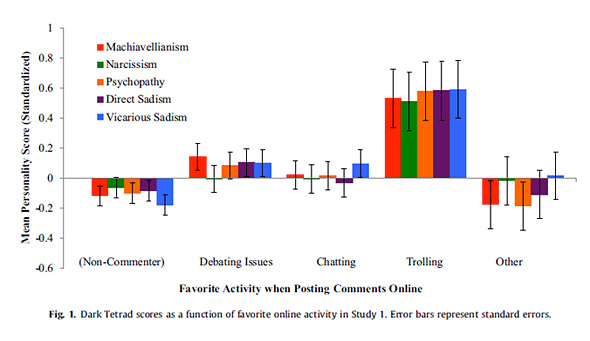
Hugh Pickens DOT Com writes "Chris Mooney reports at Slate that research conducted by Erin Buckels of the University of Manitoba confirmed that people who engage in internet trolling are characterized by personality traits that fall in the so-called Dark Tetrad: Machiavellianism (willingness to manipulate and deceive others), narcissism (egotism and self-obsession), psychopathy (the lack of remorse and empathy), and sadism (pleasure in the suffering of others). In the study, trolls were identified in a variety of ways. One was by simply asking survey participants what they 'enjoyed doing most' when on online comment sites, offering five options: 'debating issues that are important to you,' 'chatting with others,' 'making new friends,' 'trolling others,' and 'other.' The study recruited participants from Amazon's Mechanical Turk website and two measures of sadistic personality were administered (PDF): the Short Sadistic Impulse Scale and the Varieties of Sadistic Tendencies Scale. Only 5.6 percent of survey respondents actually specified that they enjoyed 'trolling.' By contrast, 41.3 percent of Internet users were 'non-commenters,' meaning they didn't like engaging online at all. So trolls are, as has often been suspected, a minority of online commenters, and an even smaller minority of overall Internet users. Overall, the authors found that the relationship between sadism and trolling was the strongest, and that indeed, sadists appear to troll because they find it pleasurable. 'Both trolls and sadists feel sadistic glee at the distress of others. Sadists just want to have fun ... and the Internet is their playground!' The study comes as websites are increasingly weighing steps to rein in trollish behavior but the study authors aren't sure that fix is a realistic one. 'Because the behaviors are intrinsically motivating for sadists, comment moderators will likely have a difficult time curbing trolling with punishments (e.g., banning users),' says Buckels. 'Ultimately, the allure of trolling may be too strong for sadists, who presumably have limited opportunities to express their sadistic interests in a socially-desirable manner.' Perhaps posting rights should only be unlocked if you pass a test." -
Psychologists: Internet Trolls Are Narcissistic, Psychopathic, and Sadistic
Hugh Pickens DOT Com writes "Chris Mooney reports at Slate that research conducted by Erin Buckels of the University of Manitoba confirmed that people who engage in internet trolling are characterized by personality traits that fall in the so-called Dark Tetrad: Machiavellianism (willingness to manipulate and deceive others), narcissism (egotism and self-obsession), psychopathy (the lack of remorse and empathy), and sadism (pleasure in the suffering of others). In the study, trolls were identified in a variety of ways. One was by simply asking survey participants what they 'enjoyed doing most' when on online comment sites, offering five options: 'debating issues that are important to you,' 'chatting with others,' 'making new friends,' 'trolling others,' and 'other.' The study recruited participants from Amazon's Mechanical Turk website and two measures of sadistic personality were administered (PDF): the Short Sadistic Impulse Scale and the Varieties of Sadistic Tendencies Scale. Only 5.6 percent of survey respondents actually specified that they enjoyed 'trolling.' By contrast, 41.3 percent of Internet users were 'non-commenters,' meaning they didn't like engaging online at all. So trolls are, as has often been suspected, a minority of online commenters, and an even smaller minority of overall Internet users. Overall, the authors found that the relationship between sadism and trolling was the strongest, and that indeed, sadists appear to troll because they find it pleasurable. 'Both trolls and sadists feel sadistic glee at the distress of others. Sadists just want to have fun ... and the Internet is their playground!' The study comes as websites are increasingly weighing steps to rein in trollish behavior but the study authors aren't sure that fix is a realistic one. 'Because the behaviors are intrinsically motivating for sadists, comment moderators will likely have a difficult time curbing trolling with punishments (e.g., banning users),' says Buckels. 'Ultimately, the allure of trolling may be too strong for sadists, who presumably have limited opportunities to express their sadistic interests in a socially-desirable manner.' Perhaps posting rights should only be unlocked if you pass a test." -
The Death Cap Mushroom Is Spreading Across the US
Hugh Pickens DOT Com writes "Discovery News reports that the death cap mushroom is now an invasive species on every continent except Antarctica. It is spreading along the East and West Coasts of the U.S. and appears to be moving south into Mexico. 'When someone eats Amanita phalloides, she typically won't experience symptoms for at least six and sometimes as many as 24 hours,' says Cat Adams. 'Eventually she'll suffer from abdominal cramps, vomiting, and severely dehydrating diarrhea. This delay means her symptoms might not be associated with mushrooms, and she may be diagnosed with a more benign illness like stomach flu. To make matters worse, if the patient is somewhat hydrated, her symptoms may lessen and she will enter the so-called honeymoon phase.' Without proper, prompt treatment, the victim can experience rapid organ failure, coma, and death. But good news is on the way. S. Todd Mitchell of Dominican Hospital in Santa Cruz, California has treated more than 60 patients with a drug derived from milk thistle. The patients who have started the drug on time (within 96 hours of ingesting the mushroom) and who have still had kidney function intact have all survived. 'When administered intravenously, the compound sits on and blocks the receptors that bring amatoxin into the liver, thus corralling the amatoxins into the blood stream so the kidneys can expel them faster,' says Adams. Still, Mitchell cautions against the 'regular look"'of deadly mushrooms. 'They smell very good and when they're cooked, many patients have described them as the most delicious mushrooms they've ever eaten.'" -
Non-Coders As the Face of the Learn-to-Code Movements
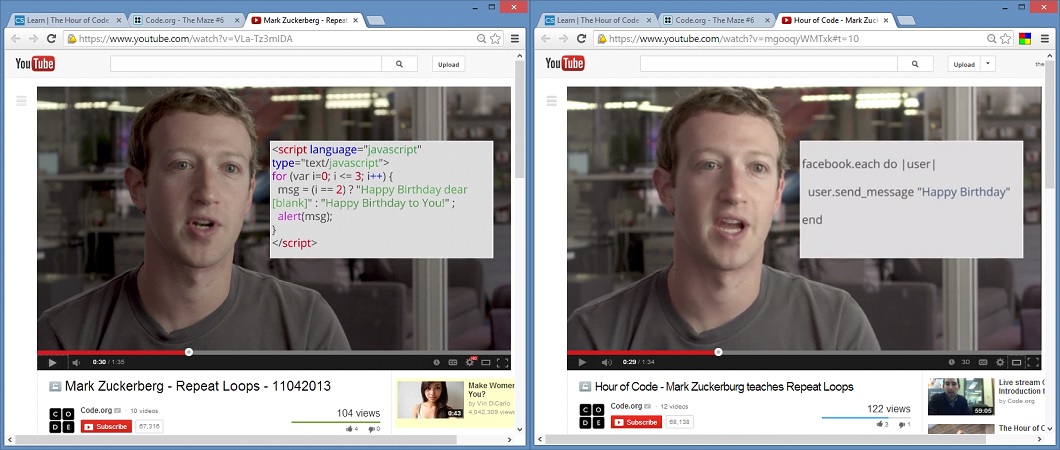
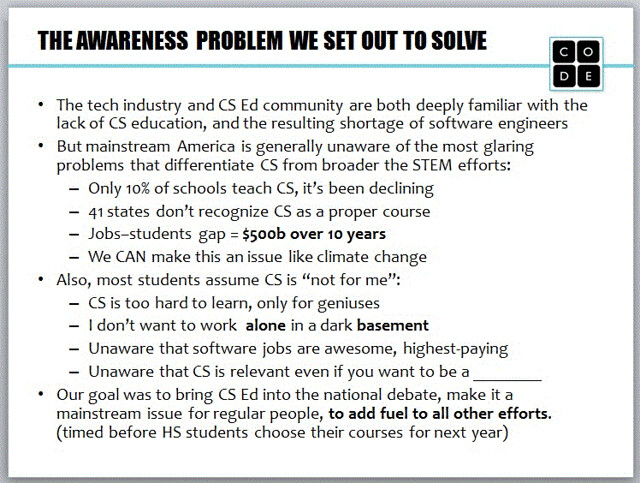
theodp writes "You wouldn't select Linus Torvalds to be the public face for the 'Year of Basketball.' So, why tap someone who doesn't code to be the face of 'The Year of Code'? Slate's Lily Hay Newman reports on the UK's Year of Code initiative to promote interest in programming and train teachers, which launched last week with a Director who freely admits that she doesn't know how to code. "I'm going to put my cards on the table," Lottie Dexter told Newsnight host Jeremy Paxman on national TV. I've committed this year to learning to code...so over this year I'm going to see exactly what I can achieve. So who knows, I might be the next Zuckerberg." "You can always dream," quipped the curmudgeonly Paxman, who was also unimpressed with Dexter's argument that the national initiative could teach people to make virtual birthday cards, an example straight out of Mark Zuckerberg's Hour of Code playbook (coming soon to the UK). Back in the States, YouTube chief and Hour of Code headliner Susan Wojcicki — one of many non-coder Code.org spokespersons — can be seen on YouTube fumbling for words to answer a little girl's straightforward question, "What is one way you apply Computer Science to your job at Google?". While it's understandable that companies and tech leaders probably couldn't make CS education "an issue like climate change" (for better or worse) without embracing politicians and celebrities, it'd be nice if they'd at least showcase a few more real-life coders in their campaigns." -
Major Internet Censorship Bill Passes In Turkey
First time accepted submitter maratumba writes to explain a bill in Turkey that extends what are already hefty Internet curbs in place under a controversial 2007 law that Earned Turkey equal ranking with China as the world's biggest web censor according to a Google Transparency report published in December. The text notably permits a government agency, the Telecommunications Communications Presidency (TIB), to block Access to websites without court authorization if they are deemed to violate privacy or with content Seen as 'insulting.' Erdogan, Turkey's all-powerful leader since 2003, is openly suspicious of the Internet, branding Twitter a 'menace' for being Utilized in organisation of mass nationwide protests in June in which six people died and thousands were injured." -
Map of Publicly-Funded Creationism Teaching
Capt.Albatross writes "At Slate, Chris Kirk presents a map of schools in the USA that both receive public funding and teach creationism. It also shows public schools in those states where they are allowed to teach creationism (without necessarily implying that creationism is taught in all public schools of those states). There is a brief outline of the regulations in those states where this occurs, but the amounts involved are not discussed." -
ShapeShifter: Beatable, But We'll Hear More About It
Slashdot contributor Bennett Haselton writes: "A California company called Shape Security claims that their network box can disable malware attacks, by using polymorphism to rewrite webpages before they are sent to the user's browser. Most programmers will immediately spot several ways that the system can be defeated, but it may still slow attackers down or divert them towards other targets." Read on for the rest of Bennett's thoughts.When a ShapeShifter appliance is installed in a datacenter alongside a web server, it takes the website's content and rewrites it before sending it to the user's browser, using techniques to obfuscate the contents such as changing the names of various form fields, or perhaps using obfuscated JavaScript to generate the page contents. (Many Slashdotters will understand these terms, but if you're not sure what I mean by "changing form fields" or "obfuscated JavaScript," it's a bit too technical to explain within this article. Suffice to say that obfuscated JavaScript is itself not a new idea; you can see a demonstration here, which takes simple JavaScript code and rewrites it in such a way that it's much harder to scan automatically, but the code still does the same thing.) The idea is that by obscuring the webpage contents, ShapeShifter makes it harder for bots and malware to conduct automated attacks against the website, since the bots now have to be smart enough to parse the obfuscated JavaScript or decipher the renamed form fields.
The idea has attracted glowing reviews from tech writers, including some who say they can "barely stay awake for a lot of startup pitches" but who were evidently enthralled by this one. My first reaction was that it's not hard to think of ways that this system can be defeated, and some readers will have thought of some ways to attack it even before finishing the previous paragraph. However, the attacks will perhaps require some malware and bot writers to rewrite their malicious programs to target websites in new ways. It remains to be seen how long that will take, and whether Shape will have a countermove after bots evolve to defeat their systems.
If you watch the video on Shape Security's website and pay close attention to their claims, note that they never actually say that ShapeShifter can stop malware from stealing a user's credentials — perhaps a deliberate omission for honesty's sake, since their technology, as they've described it, cannot prevent that. If your machine is infected with malware, and you're filling out a form on a website, the malware can eavesdrop at the level of the user interface to watch what you're typing into a form -- and if you fill out a form which contains a password field, or which contains a string of numbers that pass the credit card number checksum, the malware can capture the entire form contents and silently transmit it back to the attacker. No amount of obfuscation and shapeshifting in the HTML can stop the malware from capturing your password at the user interface level.
Now consider, instead, two of the claims actually made in the ShapeShifter video:
"Financial sites face man-in-the-browser attacks. This kind of bot waits for a legitimate user to authenticate, and then manipulates financial transactions. By disrupting the scripts that Man-in-the-Browser bots rely on, the ShapeShifter allows banks to safely serve their customers, even when their customers are infected with malware."
and
"On e-commerce sites, account takeover has evolved into a serious source of losses. 60% of users use the same password across multiple sites. When user credentials on one site are compromised, attackers program bots to test user credentials on other sites. The ShapeShifter prevents bots from testing stolen credentials on your website."
What both of these claims are essentially saying that once your credentials have been stolen, ShapeShifter can mitigate the damage by preventing a bot from executing transactions using those stolen credentials, or from testing those credentials on other sites. However, I would argue that once your credentials have been stolen successfully, 90% of the damage has been done. ShapeShifter can't do anything to stop a human from testing your stolen credentials manually, and if the attacker has already infected your machine, they can use your machine as a proxy when testing out your credentials, so that the target website doesn't even notice a login from an unusual IP address.
And is it even true that ShapeShifter can stop bots from automating an attack against a target website? Even if a website relayed through ShapeShifter has its HTML obfuscated with JavaScript and re-named form fields, it's still easy to write scripts that automate the act of launching a web browser and filling content into those form fields — such as entering a username and password into two fields, and submitting them to see if the website accepts the login. I'm not sure (it's been a long time since I've written browser automation code, using frameworks like Selenium), but I think you can even automate the interaction "silently," without actually opening up a visible browser window. Which, of course, means you can do it on a user's machine that has been conscripted into a botnet, without the user knowing what's going on.
Now, automating interaction with a website through the browser, may be harder than writing a script to interact with the website at the network level. But as long as someone figures out a way to do it, they can sell the method and the toolkit to others. (The credit card security breach at Target was carried out using software that a 17-year-old wrote and sold off-the-shelf on the black market.)
What about straight denial-of-service attacks, where an attacker doesn't care about breaking into a website or stealing data, but simply wants to take it offline by flooding it with traffic? Could ShapeShifter protect against those types of attacks? It depends on the type of attack. If you're trying to take down a website simply by sending an overwhelming number of requests for the website's front page, and nothing else, then ShapeShifter wouldn't be able to mitigate this attack, since every incoming front-page request still has to be passed through to the web server being protected, and if that's too much for the web server to handle, it will still go down. On the other hand, some denial-of-service attacks use more sophisticated tricks, like running a search query on the target website — knowing that handling a search query requires a lot more processing power than simply serving up the site's front page, so it would take a smaller number of requests to effectively tie up the webserver. If ShapeShifter can effectively stop bots from logging in to a website, running search queries, or performing other actions that are resource-intensive, then that type of denial-of-service attack could be stopped or slowed down.
So, at least based on the product description from the company itself, can ShapeShifter stop malware from stealing your users' logins on your site? Definitely not. Can ShapeShifter stop a botnet from conducting automated attacks against your user interface? For some types of botnets, maybe, but probably not in the long run. Will ShapeShifter be able to evolve a defense against bots that use browser automation? It's hard to see what they could possibly do in response. One of the company founders says, "We are populating our roadmap for the next five, six or seven steps cybercriminals will make and figuring out a countermove," but without knowing what those countermoves are, we only have their word to go on.
But in spite of my misgivings, I wouldn't predict on that basis that the product won't sell a lot of units. Some companies may buy the box without realizing that it does nothing to prevent their users' credentials from being compromised by malware, and that it provides only limited protection against automated attacks. Some companies may realize the limitations of the protection, but decide to buy it anyway because it looks good to their investors or their cybersecurity insurance underwriters. In such situations, even just the appearance of proactivity can be worth a million dollars a year.
-
New Supernova Seen In Nearby Galaxy M82
The Bad Astronomer writes "A new and potentially bright supernova was just discovered in the nearby galaxy M82. This is a Type Ia supernova, the catastrophic explosion of a white dwarf. It appears to be on the rise, and may have been caught as much as two weeks before peak brightness. It's currently already brighter than magnitude 12, and may get to mag 8, easy to see in small telescopes. The galaxy is less than 12 million light years away, so this may become one of the best-studied supernovae in recent times. Type Ia supernovae are used to measure dark energy, so seeing one nearby is a huge boon to astronomy." -
Rosetta Probe Awakens, Prepares To Chase Comet
sciencehabit writes "The European comet-chasing probe Rosetta is up and running again today after it successfully roused itself from a 2½-year sleep and signaled anxious controllers on the ground. The spacecraft had been put into hibernation during the most distant part of its 10-year journey in pursuit of comet 67 P/Churyumov-Gerasimenko because sunlight was too dim to keep its solar-powered systems running. Dozing in a slow stabilizing spin, Rosetta could not receive signals from the ground, so there was a risk that some problem might prevent it from responding to its preset alarm call at 10:00 GMT. Even then, there were many processes to go through before news reached Earth: The spacecraft's heaters would need to warm up its systems, its startrackers get a fix, boosters halt the spin, solar arrays turn towards the sun, and, finally, its communications antenna would need to point at Earth. It was not till 18:18 GMT that the signal was picked up by NASA's ground stations at Goldstone, California, and Canberra in Australia, and transmitted to the European Space Agency's (ESA's) control center at Darmstadt in Germany." -
Creationism In Texas Public Schools
An anonymous reader writes "Slate reports on new anti-science education coming out of Texas. The state has a charter school system called Responsive Education Solutions, which is publicly funded. Unfortunately, 'it has been connected from its inception to the creationist movement and to far-right fundamentalists who seek to undermine the separation of church and state.' The biology workbook used in these schools actually reads, "In the beginning, God created the Heavens and the Earth." It also brings up social Darwinism as if it's an aspect of evolutionary theory and introduces doubt that the Earth is billions of years old. The article continues, 'To get around court rulings, Responsive Ed and other creationists resort to rhetoric about teaching "all sides" of "competing theories" and claiming that this approach promotes "critical thinking." In response to a question about whether Responsive Ed teaches creationism, its vice president of academic affairs, Rosalinda Gonzalez, told me that the curriculum "teaches evolution, noting, but not exploring, the existence of competing theories."' Other so-called education texts being used by the Responsive Ed program teach Western superiority and how feminism forced women to 'turn to the state as a surrogate husband.'" -
Programmer Privilege
An anonymous reader writes "Philip Guo, an Asst. Professor of Computer Science at the University of Rochester, has written a thoughtful article on his education in programming. Guo explains that he was no particular coding wizard while growing up, but when he jumped into a CS major when he went to college at MIT, he received all sorts of passive and active encouragement — simply because he 'looked the part.' He says, 'Instead of facing implicit bias or stereotype threat, I had the privilege of implicit endorsement. For instance, whenever I attended technical meetings, people would assume that I knew what I was doing (regardless of whether I did or not) and treat me accordingly. If I stared at someone in silence and nodded as they were talking, they would usually assume that I understood, not that I was clueless. Nobody ever talked down to me, and I always got the benefit of the doubt in technical settings.' Guo compares this to the struggles faced by other minority groups and women to succeed in a field that is often more skeptical of their abilities. 'I want those people to experience what I was privileged enough to have gotten in college and beyond – unimpeded opportunities to develop expertise in something that they find beautiful, practical, and fulfilling.'" -
Rare Exoplanet Found In Star Cluster, Orbits Sun's 'Twin'
astroengine writes "Three new exoplanets have been discovered inside a star cluster, which is a rare find as only a handful of such exoplanets are known to exist. However, one of the three new finds is even more remarkable — it orbits a star that appears to be 'an almost perfect solar twin.' The discovery was made by astronomers using the European Southern Observatory's HARPS exoplanet-hunting instrument (PDF) attached to the 3.6-meter telescope at the La Silla Observatory in Chile and was confirmed by other collaborating observatories. The astronomers' attention was focused on the Messier 67 open star cluster, which is located approximately 2,600 light-years away in the constellation Cancer." -
Exoplanet Camera Now Online
The Bad Astronomer writes with news that the Gemini Planet Imager is officially online "The Gemini Planet Imager is a camera that is designed to take direct photos of exoplanets, alien worlds orbiting other stars. In a test run last November it spotted the exoplanet Beta Pictoris b, a dusty ring around a nearby star, and even snapped a portrait of Jupiter's moon Europa. Up to now, only about a dozen exoplanets have been directly imaged; GPI is expected to find dozens more in the next few years." From the Gemini project: "'Even these early first-light images are almost a factor of 10 better than the previous generation of instruments. In one minute, we are seeing planets that used to take us an hour to detect,' says Bruce Macintosh of the Lawrence Livermore National Laboratory who led the team that built the instrument." The announcement has pictures. -
Counterpoint: Why Edward Snowden May Not Deserve Clemency
Hugh Pickens DOT Com writes "Fred Kaplan, the Edward R. Murrow press fellow at the Council on Foreign Relation, writes at Slate that if Edward Snowden's stolen trove of beyond-top-secret documents had dealt only with the domestic surveillance by the NSA, then some form of leniency might be worth discussing. But Snowden did much more than that. 'Snowden's documents have, so far, furnished stories about the NSA's interception of email traffic, mobile phone calls, and radio transmissions of Taliban fighters in Pakistan's northwest territories; about an operation to gauge the loyalties of CIA recruits in Pakistan; about NSA email intercepts to assist intelligence assessments of what's going on inside Iran; about NSA surveillance of cellphone calls 'worldwide,' an effort that 'allows it to look for unknown associates of known intelligence targets by tracking people whose movements intersect.' Kaplan says the NYT editorial calling on President Obama to grant Snowden 'some form of clemency' paints an incomplete picture when it claims that Snowden 'stole a trove of highly classified documents after he became disillusioned with the agency's voraciousness.' In fact, as Snowden himself told the South China Morning Post, he took his job as an NSA contractor, with Booz Allen Hamilton, because he knew that his position would grant him 'to lists of machines all over the world [that] the NSA hacked.' Snowden got himself placed at the NSA's signals intelligence center in Hawaii says Kaplan for the sole purpose of pilfering extremely classified documents. 'It may be telling that Snowden did not release mdash; or at least the recipients of his cache haven't yet published — any documents detailing the cyber-operations of any other countries, especially Russia or China,' concludes Kaplan. 'If it turned out that Snowden did give information to the Russians or Chinese (or if intelligence assessments show that the leaks did substantial damage to national security, something that hasn't been proved in public), then I'd say all talk of a deal is off — and I assume the Times editorial page would agree.'" -
Isaac Asimov's 50-Year-Old Prediction For 2014 Is Viral and Wrong
Daniel_Stuckey writes "The media is currently praising Isaac Asimov's vision for 2014, which he articulated in a New York Times opinion piece in 1964. The sci-fi writer imagined visiting the 2014 World Fair, and the global culture and economy the exhibits might reflect. NPR called his many predictions, which range from cordless smart telephones, to robots running our leisure society, to machine-cooked 'automeals,' 'right on.' Business Insider called the forecast 'spot on.' The Huffington Post called the projections 'eerily accurate.' The only thing is, they're not. Taken as a whole, Asimov's vision for 2014 is wildly off. It's more that 'Genius predicted the future 50 years ago' makes for a great article hook. Asimov does hit a couple pretty close to home: He got pretty close to guessing the world population (6.5 billion); he anticipated automated cars ('vehicles with 'robot brains'"); and he seems to have described the current smartphone/tablet craze ('sight-sound' telephones that 'can be used not only to see the people you call but also for studying documents and photographs and reading passages from books.') But he also thought we'd have a colony on the moon, be living under a global population control regime, eating at multi-flavored algae bars, and letting machines prepare us personalized meals. Most divergent of all, he believed that increasing automatization of labor would spawn not inequality or joblessness, but spiritual malaise." -
The Strange Story Of the Sculpture On the Moon
braindrainbahrain writes "Slate magazine has written a story about the only work of art placed on the Moon: the Fallen Astronaut sculpture. It was placed on the Moon during the Apollo 15 mission to commemorate both American and Soviet deceased astronauts. The little statue, rather than bringing fame and fortune, ended up being nearly forgotten, and got both Apollo astronaut David Scott and Belgian sculptor Van Hoeydonck in hot water with the U.S. government." -
How Astronauts Took the Most Important Photo In Space History
The Bad Astronomer writes "On December 24, 1968, the Apollo 8 astronauts saw the Earth rising over the limb of the Moon. The photo they took of this moment — dubbed Earthrise — has become an icon of our need to explore, and to protect our home world. NASA has just released a video explaining how the astronauts were able to capture this unique moment, which included a dash of both coincidence and fast teamwork." -
Facebook Tracks the Status Updates and Messages You Don't Write Too
Jah-Wren Ryel writes "It turns out Facebook tracks the stuff that people type and then erase before hitting the post button. If you start writing a message, and then think better of it and decide not to post it, Facebook still adds it to the dossier they keep on you. From the article: 'Storing text as you type isn't uncommon on other websites. For example, if you use Gmail, your draft messages are automatically saved as you type them. Even if you close the browser without saving, you can usually find a (nearly) complete copy of the email you were typing in your Drafts folder. Facebook is using essentially the same technology here. The difference is that Google is saving your messages to help you. Facebook users don't expect their unposted thoughts to be collected, nor do they benefit from it.'" -
How the Lessons of Columbine Saved Lives At Arapahoe High School
Hugh Pickens DOT Com writes "Ray Sanchez reports at CNN that the handling of Friday's shooting at Arapahoe High School, just 10 miles from the scene of the 1999 Columbine High School shooting, drew important lessons from the earlier bloodshed. At Arapahoe High School, where senior Claire Davis, 17, was critically injured before the shooter turned the gun on himself, law enforcement officers responded within minutes and immediately entered the school to confront the gunman rather than surrounding the building. As the sound of shots reverberated through the corridors, teachers immediately followed procedures put in place after Columbine, locking the doors and moving students to the rear of classrooms. "That's straight out of Columbine," says Kenneth Trump, president of National School Safety and Security Services. "The goal is to proceed and neutralize the shooter. Columbine really revolutionized the way law enforcement responds to active shooters." Arapahoe County Sheriff Grayson Robinson credits the quick police response time for the fact that student Karl Pierson, the gunman, stopped firing on others and turned his weapon on himself less than 1 minute, 20 seconds after entering the school. Authorities knew from research and contact with forensic psychologists that school shooters typically continue firing until confronted by law enforcement. "It's very unfortunate that we have to say that there's a textbook response on the way to respond to these," says Trump, "because that textbook was written based on all of the incidents that we've had and the lessons learned (PDF)."" -
Why the NSA Piggybacks On Consumer Tracking
An anonymous reader writes "'Snooping on the Internet is tricky. The network is diffuse, global, and packed with potential targets. There's no central system for identifying or locating individuals, so it's hard to keep track of who is online and what they're up to. What's a spy agency to do?' In a Slate op-ed, Ed Felten explains how consumer tracking makes the NSA's job much easier. Felten was the first-ever Chief Technologist at the Federal Trade Commission, serving as the agency's lead technical expert on privacy issues. Now back in academia, he argues that the NSA gets a 'free ride on the private sector,' from distinguishing users, to pinpointing geolocation, to slurping up network traffic." -
Study: People Are Biased Against Creative Thinking
An anonymous reader writes "Despite how much people might say they like creative thinking, they don't, at least according to studies. 'We think of creative people in a heroic manner, and we celebrate them, but the thing we celebrate is the after-effect,' says Barry Staw, a researcher at the University of California–Berkeley business school who specializes in creativity. 'As much as we celebrate independence in Western cultures, there is an awful lot of pressure to conform,' he says." -
U.S. Measles Cases Triple In 2013
An anonymous reader writes "The U.S. Centers for Disease Control have announced that measles cases in the U.S. spiked this year, rising to three times their recent average rate. It's partly due to a greater number of people traveling to the U.S. when they're infectious, but also because a frustrating number of people are either failing to have their children vaccinated, or are failing to do so in a timely manner. Dr. Thomas Friedman said, 'Around 90 percent of the people who have had measles in this country were not vaccinated either because they refused, or were not vaccinated on time.' Phil Plait adds, 'In all three of these outbreaks, someone who had not been vaccinated traveled overseas and brought the disease back with them, which then spread due to low vaccination rates in their communities. It's unclear how much religious beliefs themselves were behind the outbreaks in Brooklyn and North Carolina; it may have been due to widespread secular anti-vax beliefs in those tight-knit groups. But either way, a large proportion of the people in those areas were unvaccinated.'" -
Three New Exoplanets Seen In Direct Photographs
The Bad Astronomer writes "Planets orbiting other stars are usually found indirectly (by blocking their stars' light or inducing a Doppler shift in the light as they orbit, for example), but direct images of exoplanets are extremely rare. However, using the 10-meter Keck telescope in Hawaii, astronomers have taken photographs of three nearby exoplanets, all young, massive, and hot. One may be massive enough to count as a brown dwarf, but the other two are more likely in the planet-mass range. All three are very far from their stars, which means they may have formed differently than the planets in our solar system." -
How Blockbuster Could Have Owned Netflix
schnell writes "Your age probably determines whether you think of Blockbuster Video as a fond memory or a dinosaur predestined for extinction. While the last Blockbuster rental at the last remaining Blockbuster video store took place last week, Variety retells a now-classic story of how Blockbuster could have bought Netflix for a song, but didn't because it failed to take the new DVD-by-mail and video streaming markets seriously. Who is next to join Blockbuster, Polaroid, Borders and Best Buy on the ash heap of superseded retail business models?" -
Don't Call It Stack Rank: Yahoo's QPR System For Culling Non-Performers
An anonymous reader writes "Employees don't like to be graded on the bell curve (or any other curve except for Lake Wobegon's) — we know that from the Microsoft experience. But Yahoo is struggling with what some say is vastly bloated headcount, and CEO Marissa Mayer has implemented a 'quarterly performance review' system that requires, or strongly recommends, that managers place a certain quota of their charges in the less-than-stellar categories. That sounds a lot like the infamous GE-Microsoft stack rank system. But according to AllThingsD's Kara Swisher, who (as usual) broke the latest story about life inside Mayer's Yahoo, Mayer's curve may more similar to the elaborate evaluation system used by her old employer, Google." -
Chelyabinsk-Sized Asteroid Impacts May Be More Common Than We Thought
The Bad Astronomer writes "Using data from the Feb. 15, 2013 asteroid impact over Russia, scientists have determined that we may be hit by objects in this size range (10 — 50 meters across) more often than we previously thought, something like once every 20 years (abstract). They also found the Chelyabinsk asteroid was likely a single rock about 19 meters (60 feet) across, had a mass of 12,000 tons, and was criss-crossed with internal fractures which aided in its breakup as it rammed through the Earth's atmosphere." -
Why There Shouldn't Be a Chess World Champion
An anonymous reader writes "An article at Slate makes the case that the time has come to stop crowning World Chess Champions. This week, challenger Magnus Carlsen is trying to take the title from reigning champion Viswanathan Anand. Despite currently holding the title, Anand is very much the underdog, which only serves to illustrate why the current system is broken. The article suggests measuring greatness the same way tennis does. Quoting: 'Here's what Carlsen should do: Beat Anand for the title, and then work with FIDE to institutionalize four big tournaments as chess's Grand Slams, simultaneously eliminating the title of world champion. Corporate funding for even major chess tournaments can come and go with frustrating regularity, meaning FIDE itself has to get involved. Perhaps the grand slam tournaments could be located in three cities permanently—Moscow, Amsterdam, and a Spanish locale such as Linares would be natural picks—with a fourth that would rotate from year to year. This would give chess the same clear and predictable yardstick for greatness that golf and tennis have instead of the extremely crude world champion benchmark.'" -
One In Five Sun-Like Stars May Have an Earth-Like Planet
The Bad Astronomer writes "A new study, looking at over 40,000 stars viewed by the Kepler spacecraft, indicates that 22% of stars like the Sun should have Earth-like planets orbiting them — planets that are similar in size to our home world and with a surface temperature hospitable for liquid water. There are some caveats (they don't include atmospheric issues like the greenhouse effect, which may reduce the overall number, or at cooler stars where there may be many more such planets) but their numbers indicate there could be several billion planets similar to Earth in the Milky Way alone." -
Does Software Need a Siskel and Ebert?
theodp writes "Over at Scripting News, Dave Winer laments the lack of serious software reviews in the NY Times. That wasn't always the case, recalls Dave. 'When they started doing software reviews in the early '80s it was with the usual Times flair,' says Winer. 'But somewhere along the line they stopped taking tech seriously. It's as if they would only review Saturday morning television shows. How could television like The Sopranos or Breaking Bad take root in the culture if there was no criticism that discussed it? Yet that's where we are today with software.' So, does software need a Siskel and Ebert (or A.O. Scott and Manohla Dargis for you highfalutin NYT readers!)?" -
Jeffrey Zients Appointed To Fix Healthcare.gov
An anonymous reader writes with news that the Obama administration has appointed Jeffrey Zients to lead the effort to revamp Healthcare.gov after its trouble rollout earlier this month. Zients said, "By the end of November, healthcare.gov will work smoothly for the vast majority of users." Obama created a position for Zients within the government in 2009, when he was made the OMB's Chief Performance Officer. The purpose of his position was to analyze and streamline the government's budget concerns. "Healthcare.gov covers people in the 36 states that declined to run their own health-insurance exchanges. About 700,000 applications have been begun nationwide, and half of them have come in through the website. The White House aims to have 7M uninsured Americans covered by the scheme by the end of March." Zients's appointment came after a contentious House Committee hearing about the healthcare website, in which many were blamed and few took responsibility. The government also said that contractor Quality Software Services Inc., a subsidiary of UnitedHealth group, would "oversee the entire operation" of Healthcare.gov. QSSI has already done work on the website, building the pipeline that transfers data between the insurance exchanges and the federal agencies. -
No, the Earth (almost Certainly) Won't Be Hit By an Asteroid In 2032
The Bad Astronomer writes "Last week, astronomers discovered 2013 TV135, a 400-meter wide asteroid that will swing by the Earth in 2032. The odds of an impact at that time are incredibly low — in fact, the chance it will glide safely past us is 99.99998%! But that hasn't stopped some venues from playing up the apocalypse angle. Bottom line: we do not have a good orbit for this rock yet, and as observations get better the chance of an impact will certainly drop. We can breathe easy over this particular asteroid." -
Saturn In All Its Glory
The Bad Astronomer writes "On Oct. 10, 2013, the Cassini spacecraft took a series of wide-angle pictures of Saturn from well above the plane of the rings. Croatian software developer and amateur astronomical image processor Gordan Ugarkovic assembled them into a stunning mosaic (mirrored on Flickr), showing the planet from a high angle not usually seen. There's a lot to see in this image, including the rings (and the gaps therein), moons, and the planet itself, including the remnants of a monstrous northern hemisphere storm that kicked off in 2010. It's truly wondrous." -
Russian Missile Test Seen and Photographed By ISS Astronauts
The Bad Astronomer writes "It sounds like a scene from Gravity: Astronauts aboard the International Space Station Thursday saw a weird, glowing cloud of light in the distance, most likely caused by a fuel dump or leaking fuel from a Russian missile launch. The extended life of a Topol missile was being tested in a ballistic launch to a test target in Kazakhstan, and the astronauts were able to take pictures of both the launch vapor trail and the glowing cloud. This event is similar to the eerie spiral lights seen over Norway in 2009 caused by a Russian missile launch as well." -
The Luddites Are Almost Always Wrong: Why Tech Doesn't Kill Jobs
Mystakaphoros writes "Mike Masnick of Techdirt argues that we can all put down our wooden shoes and take a chill pill: technology 'rarely destroys jobs.' For example, telephone operators have largely gone by the wayside, but a (brave) new world of telemarketing and call center support jobs have opened up because of advances in technology, not to mention the Internet. Masnick points out writing from Professor James Bessen that makes the same point: 'In other cases, technology creates offsetting job growth in different occupations or industry segments. For example, word processors and voice mail systems reduced the numbers of typists and switchboard operators, but these technologies also increased the number of more highly skilled secretaries and receptionists, offsetting the job losses. Similarly, Amazon may have eliminated jobs at Borders and other national book chains that relied on bestsellers, but the number of independent booksellers has been growing and with it, more jobs for sales clerks who can provide selections and advice that Amazon cannot easily match.' That said, I think it's worth asking: if machines are going to replace all our fast food workers, are we going to start paying our gourmet chefs minimum wage just because we can?" -
Do Comments On Web Pages Ruin Science?
GregLaden writes "Last week Popular Science shut down comments on their web pages citing the damage being done to the public perception of science as their reason. Earlier research suggested this might be a good idea because trollish, negative comments can color the perception by readers of a news story. However, some have taken Popular Science's move to be anti-science, implying that science itself is positively affected by web and blog comments, as though these comments contributed to the science being done itself. Here, I take exception to this and suggest that while comments are important in relation to the public perception of science (which itself is important) blog and web commentary never, or only rarely, influences the process of scientific inquiry itself." -
Conflict Minerals and Cell Phones
Presto Vivace sends in this story at Slate: "If you are reading this on a smartphone, then you are probably holding in your palm the conflict minerals that have sent the biggest manufacturing trade group in the U.S. into a court battle with the Securities and Exchange Commission. At stake in this battle between the National Association of Manufacturers and the government is whether consumers will know the potentially blood-soaked origins of the products they use every day and who gets to craft rules for multinational corporations—Congress or the business itself. ... These minerals are tantalum (used in cellphones, DVD players, laptops, hard drives, and gaming devices), tungsten, tin, and gold, if they are mined in the Democratic Republic of Congo and surrounding countries including Rwanda, where the mineral trade has fueled bloody conflicts. The rule requiring disclosure of conflict minerals will go into effect in 2014. Congress included it in Dodd-Frank out of concern for what is known as the “resource curse”—the phenomenon wherein poor counties with the greatest natural resources end up with the most corrupt and repressive governments. The money earned from selling the natural resources props up these harsh regimes and funds violence against their citizens and neighbors." -
'Alien Life' Story of Dubious Provenance Goes Viral
Sockatume writes "By now you have likely read about the 'alien life forms' discovered in the upper atmosphere over Yorkshire, via the mass media reprinting a press release from the University of Sheffield. Unfortunately, the paper comes from researchers with an infamous tendency to identify inanimate objects as aliens, and is published in a journal that seems to principally exist to print unlikely astrobiological claims. Phil Plait points out flaws in a number of their claims. Quoting: 'They found what appears to be a fragment of a frustrule, the hard outer casing around a diatom. It certainly does look like one. But is it? Weirdly, they apparently didn’t even check. Seriously, in the paper they describe the photo of the object and say [emphasis mine], "On one stub was discovered part of a diatom which, we assume, is clear enough for experts on diatom taxonomy to precisely identify." That implies very strongly they didn’t ask an expert in diatoms to look at their sample. That’s bizarre. If I were claiming this were an ET plant, that’s the very first thing I’d do!'" -
To Boldly Go Nowhere, For Now
An anonymous reader writes "A recent Slate article makes the argument that manned space exploration is not useful and we should concentrate on Robots. The article makes the claim that manned space exploration was never popular and by diverting money to robotic space exploration we can get more bang for the buck. From the article: 'Most of the arguments in favor of manned space exploration boil down to the following: a) We need to explore space using people since keeping the entire human race on a single piece of rock is a bad strategy, and even if we send robots first, people would have to make the journey eventually; and b) humans can explore much better than robots. Both these arguments are very near-sighted—in large part because they assume that robots aren’t going to get any better. They also fail to recognize that technology may radically change humans in the next century or so.'" -
Toronto Family Bans All Technology In Their Home Made After 1986
Hugh Pickens DOT Com writes "Mary Am Shah reports in the Toronto Sun that 26-year-old Blair McMillan has banned any technology in his house post-1986, the year he and his girlfriend Morgan were born. They're doing it because their kids – Trey, 5, and Denton, 2 – wouldn't look up from their parents' iPhones and iPads long enough to kick a ball around the backyard. 'That's kind of when it hit me because I'm like, wow, when I was a kid, I lived outside,' says Blair adding that now 'we're parenting our kids the same way we were parented for a year just to see what it's like.' The McMillans do their banking in person instead of online. They develop rolls of film for $20 each instead of Instagramming their sons' antics. They recently traveled across the United States using paper maps and entertaining their screaming kids with coloring books and stickers, passing car after car with TVs embedded in the headrests and content infants seated in the back. Their plan is to continue living like it's 1986 until April 2014. Morgan, who admits she thought her boyfriend was 'crazy,' now devours books to pass the time and only uses a computer at work. 'I remember the day before we started this, I was a wreck and I was like I can't believe I have to delete my Facebook!' Blair originally experienced a form of phantom pain for the first few days after giving up his cellphone. 'The strangest thing without having a cellphone is that I could almost feel my pocket vibrating and I wanted to check my pocket.' Still Morgan says the change has been good for their family's spirit. 'We're just closer, there's more talking,'"