Slashdot Mirror
Domain: slate.com
Stories and comments across the archive that link to slate.com.
Stories · 448
-
LAPD Orders Body Cams That Will Start Recording When Police Use Tasers
HughPickens.com writes: Lily Hay Newman reports that the LAPD has ordered 3,000 Tasers which, when discharged, will automatically activate cameras on officers' uniforms, creating visual records of incidents at a time of mounting concern about excessive force by U.S. law enforcement officers. The new digital Taser X26P weapons record the date, time, and duration of firing, and whether Taser wires actually strike suspects and how long the thousands of volts of electricity pulse through them. "This technology gives a much better picture of what happens in the field," says Steve Tuttle.
The idea of using a Taser discharge as a criterion for activating body cams is promising, especially as more and more police departments adopt body cams and struggle to establish guidelines for when they should be on or off. Police leadership — i.e., chiefs and upper management — is far more supportive of the technology and tends to view body-worn cameras as a tool for increasing accountability and reducing civil liability. On the other hand, the patrol officer culture is concerned that the technology will be an unfair intrusion into their routine activities — for instance, it might invite over-managing minor policy violations. "In addition to these new Taser deployments, we plan to issue a body-worn camera and a Taser device to every officer," says Police Chief Charlie Beck. "It is our goal to make these important tools available to every front line officer over the next few years." -
Four Facepalm Bugs In USPS Label-Printing Site
"The United States Postal Service "Click-N-Ship" site suffered no outages or slowdowns during Christmas rush," writes Bennett Haselton. "It just has bugs that make the process more annoying than just standing in line at the post office, which defeats the purpose. The most frustrating part is that most of these bugs could have been fixed, just by having some testers run through the ordering process and make a note of anything that seems confusing or wrong. (Although I've included notes on how to work around all the bugs, so you really can print your own labels and skip the line.)" Read on for the rest; what other gripes do you have about the current package delivery regime, and how would you resolve them? This suggestion on the LifeProTips subreddit reminded me that I'd been meaning to try printing my own USPS mailing labels to skip the lines at the post office. I'd been putting it off because I knew that I'd be determined to find the most efficient way of doing everything through the site, and if the site didn't steer me towards exactly the best options, I'd end up forcing myself to reverse-engineer their whole algorithm in order to find the most efficient way myself. That's why I always appreciate it when a website just tells me the best option instead of making me second-guess them.Right away, the USPS website failed that test because it does not allow you to print first-class mail labels, instead steering you towards the more expensive Priority Mail and Priority Mail Express options. Online users have complained about the lack of first-class-mail options on USPS.com for years, and users on several forums suggested using the PayPal Ship Now site instead, which does let you print first class mailing labels online, along with Priority Mail labels other options.
In my case it was a moot point because I had to use the Priority Mail labels in order for my packages to arrive by Christmas, but the deception was still hugely aggravating. Not just because of the thought of millions of people wasting money (and the finite resources of the postal system) due to the USPS site tricking them into a more expensive upgrade that they didn't need. But because it now meant I'd have to second-guess every recommendation they made, wondering if they were steering me toward something that was worse for me and better for them. The reason sites like Amazon are so stress-free to use is because, for the most part, they do display the options that are best for you, even at the expense of their own short-term profit. Some third-party merchant is selling a book for less than Amazon's list price? They'll let the seller list the book right on their site and undercut Amazon's own sales. The benefit to the user is not just the cost savings, but knowing that you don't have to feel like a chump for not wasting time on search engines trying to find a cheaper deal.
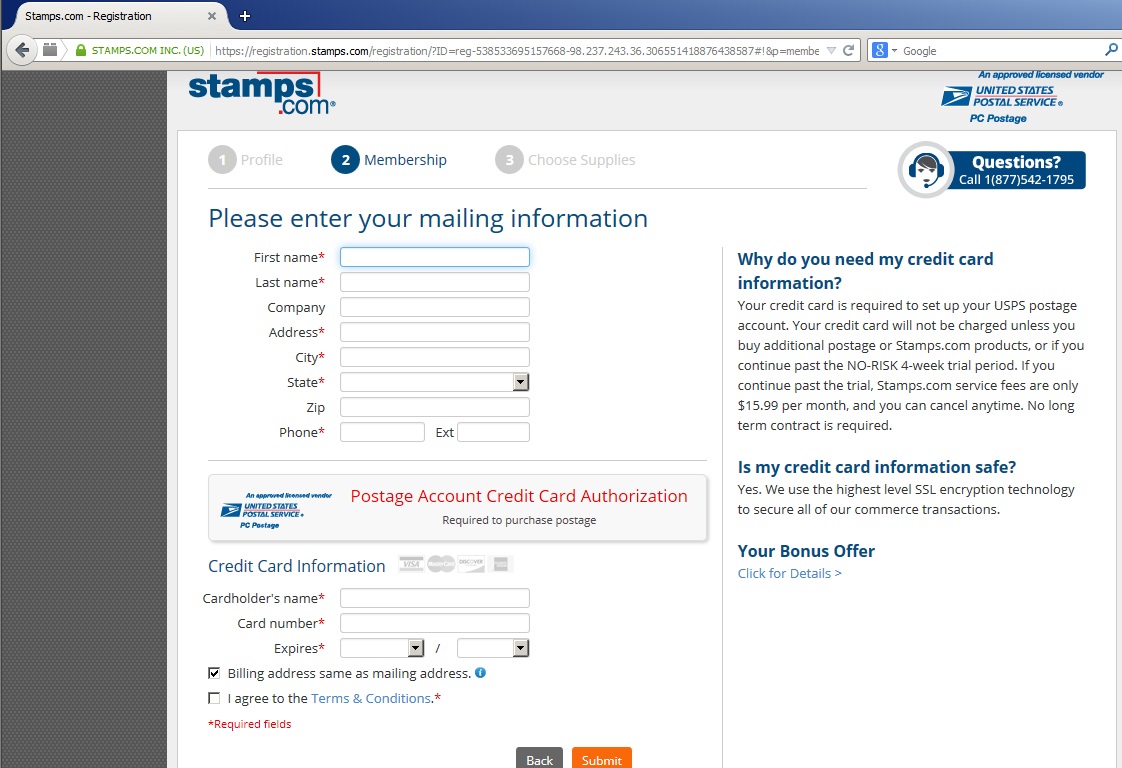
Once I realized the USPS site was concealing the cheaper options, in my determination to avoid getting ripped off by the USPS I almost ended up getting ripped off much worse by one of their "partners". I remembered an ad on a Google search mentioning Stamps.com, so I signed up for an account there and downloaded their software, which does in fact let you print first-class postage. It was only after reading a warning in the original subreddit that I realized I had unwittingly "agreed" to a $15.99/month charge. It turns out that the Stamps.com registration page says above the credit card form that your card info is "required to purchase postage", but this is misleading -- the fine print in the sidebar says you will be charged $15.99 per month if you don't cancel. (And neither the software nor the website gives you a link to cancel -- you have to call their customer service number.) Fortunately, I did call and cancel after realizing I'd been duped, but I was not surprised to learn on Wikipedia that the company had been the subject of over 1,000 Better Business Bureau complaints from users regarding the unauthorized monthly charges. (The part on Wikipedia about "long hold times" is out of date, though -- the automated prompts recognized my account by my phone number and let me cancel without any waiting.)
What does that have to do with USPS.com? Because it never would have happened if the USPS website had been on my side in the first place, giving me all the mailing options that I actually needed. It's bad enough when a private company does this, but the USPS works for us, don't they?
So that's not a "bug" in the traditional sense, but I'm counting it: #1: Not giving users all the mailing options they want to know about.
Most of the other bugs are not self-serving tricks; rather, they're just unclear directions where you have to pause and puzzle out what you're really supposed to do, which is different from what the site tells you to do. For example:
#2: Listing boxes as shipping options that don't fit the dimensions that you've already entered
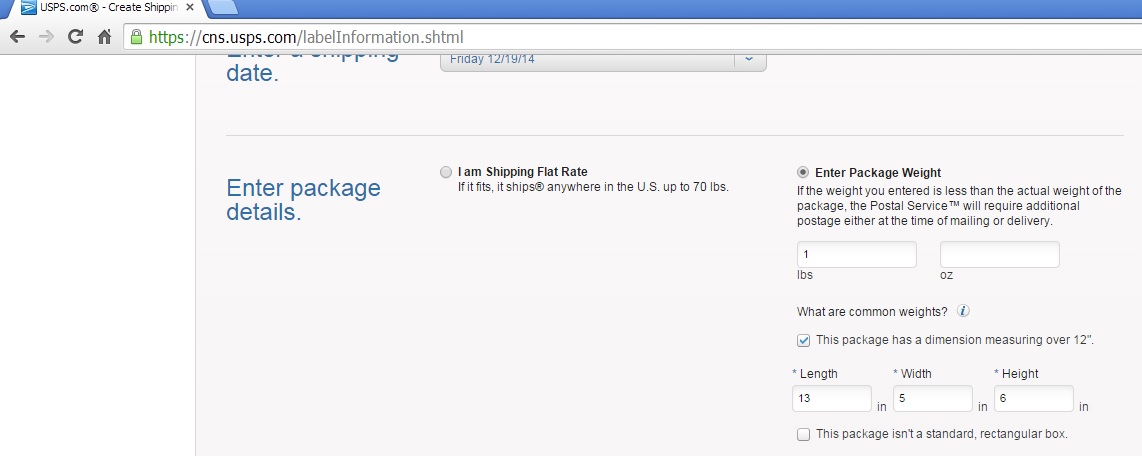
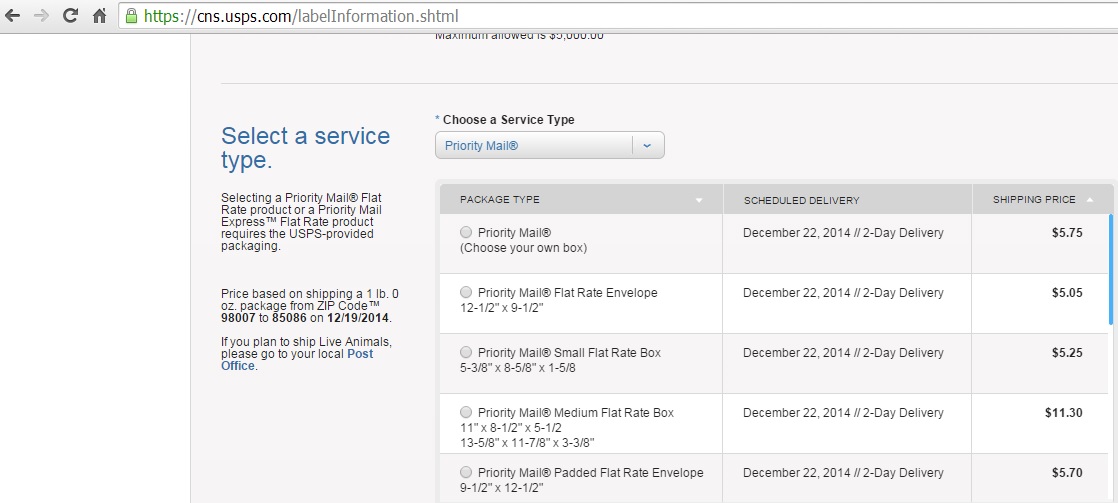
On the label printing page (requires a USPS.com login if you don't have one) is the option to enter package dimensions. If you specify package details of 1 lbs and 13x5x6 inches, and click to calculate "available Services and Prices" based on the details you've entered, you're presented with a list of options that include 'Priority Mail Flat Rate Envelope 12-1/2" x 9-1/2"', 'Priority Mail Small Flat Rate Box 5-3/8" x 8-5/8" x 1-5/8"', 'Priority Mail Medium Flat Rate Box 11" x 8-1/2" x 5-1/2"', 'Priority Mail Medium Flat Rate Box 13-5/8" x 11-7/8" x 3-3/8"', and 'Priority Mail Padded Flat Rate Envelope 9-1/2" x 12-1/2"' -- all of which, of course, are too small to hold the package whose dimensions you just specified.
You could argue that it's the user's responsibility to make sure their package fits into the box they select, but a user could reasonably assume that the whole point of entering the length, width and height is so that the USPS can recommend only those boxes that will hold the item. Remember, the user usually doesn't have these boxes in front of them at the time they're printing the label. They could end up selecting a box option, printing the label, taking it all the way to the post office along with their package, only to find out that the package doesn't fit into the box that they printed the label for, and that they have to wait in line anwyay to pay for an alternate method.
It's a middle-school-level programming exercise to take the length, width, and height of a package as an input, take as a second input a list of boxes of varying lengths, widths, heights, and costs, and find the lowest-cost box that will hold the package (keeping in mind that the package can be rotated to different orientations so that the "height" becomes the "width", etc.). It's reasonable to expect the postal service to be able to do this too.
#3: Everything wrong with the "print your labels" page
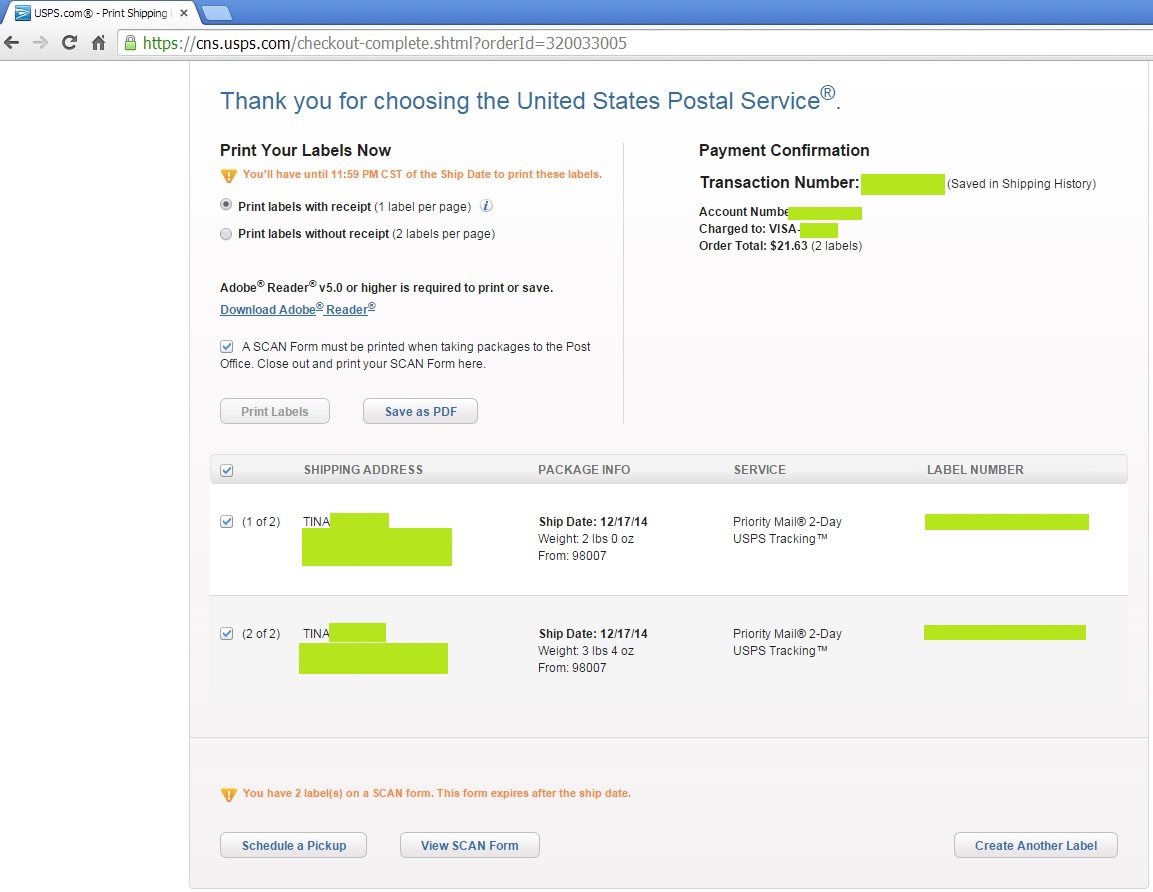
Here's a screen grab of the "print your labels" page that appears after you've paid, which you can use to play the Highlights "What's Wrong?" game:
-
The text at the top says "You'll have until 11:59 PM CST of the Ship Date to print these labels." OK, but if I print them at 11:59 PM, what good does it do if the post office closed at 6? Are the labels only valid on the ship date, or will they still work if I take them to the post office the next day? This should be more clear.
-
Text says "A SCAN Form must be printed when taking packages to the Post Office." Fine, but there's a checkbox next to that sentence. If that sentence describes a postal regulation, what does it mean if I un-check the box? That the regulation no longer applies to me? Can someone tell me if the drug laws work that way as well?
-
The next sentence says: "Close out and print your SCAN Form here." I have no idea what that sentence means. Close out of the browser? And where is "here"? When it's not hyperlinked, "here" means here.
-
WHY IS THE "PRINT LABELS" BUTTON DISABLED?? I have the checkboxes checked for both labels. I want to print them. What else do you want me to DO? (My PC has a printer, which the Chrome browser is aware of -- it lets me print from other webpages with no problem.) I got it to work by saving the PDF and printing that, but I never figured out why the Print button was just sitting there, mocking me from behind its veil of grey.
-
The "Schedule a Pickup" button at the bottom -- same problem as the "print until 11:59 PM" message at the top. Since I printed these labels with the ship date specified as today, it should be more clear if the labels will still be considered valid tomorrow, which is the soonest time that a pickup could be scheduled.
#4: Over an hour on hold and never got through.
As an adherent to the touchingly quaint notion that a reporter should talk to the subjects of their story before running it, and also because I just wanted clarification on some of these questions, I called the USPS help line and waited on hold for 30 minutes before their help line disconnected me. I called back and waited for another 40 minutes before I hung up this time. OK, strictly speaking that's not a "bug". They just suck.
In the end, after reverse-engineering their pricing options as I had vowed to do, I determined what appeared to be their rules, (applies only to domestic Priority Mail), which you may find handy:
- If you're shipping in a Flat Rate box, the weight of the package doesn't matter (up to the 70 lb limit), only the dimensions, to the extent that they determine which Flat Rate box you can fit it into, with the bigger ones being more expensive.
- On the other hand, if you pick the Priority Mail "Use your own box" option, then the dimensions don't matter (unless you exceed the allowed limits), only the weight -- a 5 lb, 3"x3"x3" package and a 5 lb, 21"x21"x21" package both ship for $15.22, but if you change the weight, that's when the price changes. (If you try to ship a 22"x22"x22" package, you get an error that you've exceeded the dimensions for a Click-N-Ship.)
Using this, I was able to strategically break my one shipment, which would have cost about $30, into two separate shipments which cost $12 and $8. All told, with the effort to reverse-engineer their pricing options and to document all of the bugs for posterity, it took me about an hour to figure out that $10 savings and to print labels that I could take to the post office and skip the line -- which, it turned out, looked only about 3 minutes long -- in order to experience what one redditor described as "feeling the hate from the people standing in line as I casually stroll up and drop my packages off at the front desk". But the important thing is, I did it efficiently.
-
-
Publications Divided On Self-Censorship After Terrorist Attack
New submitter wmofr writes: Major U.S. and British publications refused to publish related satirical cartoons, at least those about the "prophet", after the terrorist attack in Charlie Hebdo's office, which had 12 people killed. An editor of the Independent said:"But the fact is as an editor you have got to balance principle with pragmatism, and I felt yesterday evening a few different conflicting principles: I felt a duty to readers; a duty to the dead; I felt a duty to journalism – and I also felt a duty to my staff. I think it would have been too much of a risk to unilaterally decide in Britain to be the only newspaper that went ahead and published so in a sense it is true one has self-censored in a way I feel very uncomfortable with. It's an incredibly difficult decision to make." But still many media organizations bravely publishing those cartoons, declining self-censorship. Charlie Hebdo's surviving staff say the magazine will publish again next week, saying, "stupidity will not win." Meanwhile, cartoonists around the world have published strips in response to the attack. The Onion has a poignant take as well. With regard to the attackers, one suspect turned himself in to police, and the other two remain at large. -
New App Detects Government Stingray Cell Phone Trackers
HughPickens.com writes IMSI catchers, otherwise known as stingrays, are those surveillance tools that masquerade as cell towers and trick mobile phones into connecting, spewing private data in the process. Law-enforcement agencies have been using them for almost two decades, but there's never been a good way for individuals to detect them. Now Lily Hay Newman reports that SnoopSnitch scans for radio signals that indicate a transition to a stingray from a legitimate cell tower. "SnoopSnitch collects and analyzes mobile radio data to make you aware of your mobile network security and to warn you about threats like fake base stations (IMSI catchers), user tracking and over-the-air updates." say German security researchers Alex Senier, Karsten Nohl, and Tobias Engel, creators of the app which is available now only for Android. The app can't protect people's phones from connecting to stingrays in the first place, but it can at least let them know that there is surveillance happening in a given area. "There's no one set of information, taken by itself, that allows you to detect an IMSI catcher," says Nohl. "But we do stream analysis of everything that happens on your phone, and can come out with a warning if it crosses a certain threshold."
Stingrays have garnered attention since a 2011 Arizona court case in which one agent admitted in an affidavit that the tool collaterally swept up data on "innocent, non-target devices" (U.S. v. Rigmaiden). The government eventually conceded in this case that the "tracking operation was a Fourth Amendment search and seizure," meaning it required a warrant. But given that the Justice Department has continued to claim that cellphone users have no reasonable expectation of privacy over their location data, it may take a Supreme Court judgement to settle the Stingray issue countrywide. -
New App Detects Government Stingray Cell Phone Trackers
HughPickens.com writes IMSI catchers, otherwise known as stingrays, are those surveillance tools that masquerade as cell towers and trick mobile phones into connecting, spewing private data in the process. Law-enforcement agencies have been using them for almost two decades, but there's never been a good way for individuals to detect them. Now Lily Hay Newman reports that SnoopSnitch scans for radio signals that indicate a transition to a stingray from a legitimate cell tower. "SnoopSnitch collects and analyzes mobile radio data to make you aware of your mobile network security and to warn you about threats like fake base stations (IMSI catchers), user tracking and over-the-air updates." say German security researchers Alex Senier, Karsten Nohl, and Tobias Engel, creators of the app which is available now only for Android. The app can't protect people's phones from connecting to stingrays in the first place, but it can at least let them know that there is surveillance happening in a given area. "There's no one set of information, taken by itself, that allows you to detect an IMSI catcher," says Nohl. "But we do stream analysis of everything that happens on your phone, and can come out with a warning if it crosses a certain threshold."
Stingrays have garnered attention since a 2011 Arizona court case in which one agent admitted in an affidavit that the tool collaterally swept up data on "innocent, non-target devices" (U.S. v. Rigmaiden). The government eventually conceded in this case that the "tracking operation was a Fourth Amendment search and seizure," meaning it required a warrant. But given that the Justice Department has continued to claim that cellphone users have no reasonable expectation of privacy over their location data, it may take a Supreme Court judgement to settle the Stingray issue countrywide. -
The Billionaires' Space Club
theodp writes Silicon sultans are the new robber barons, writes The Economist, adding that "they have been diversifying into businesses that have little to do with computers, while egotistically proclaiming that they alone can solve mankind's problems, from aging to space travel." Over at Slate, NYU journalism prof Charles Seife is less-than impressed with The Billionaires' Space Club. "It's an old trick," begins Seife. "Multimillionaires regularly try to spin acts of crass ego gratification as selfless philanthropy, no matter how obviously self-serving. They jump out of balloons at the edge of the atmosphere, take submarines to the bottom of the ocean, or shoot endangered animals on safari, all in the name of science and exploration. The more recent trend is billionaires making fleets of rocket ships for private space exploration. What makes this one different is that the public actually seems to buy the farce." Seife goes on to argue that "neither [Elon] Musk's nor [Richard] Branson's goals really seem to break new ground, despite all the talk of exploration." -
The World Is Not Falling Apart
An anonymous reader writes: As much as we like complaining, and as much as the big media stations like to focus on the most horrible news of the day, the world is actually becoming a better place. Stephen Pinker and Andrew Mack have an article in Slate going through many of the statistics for things like homicide rates, child abuse, wars, and even autocracy vs. democracy. They're all trending in the right direction. Maybe not fast, or even fast enough, but it's getting better.
They say, "Too much of our impression of the world comes from a misleading formula of journalistic narration. Reporters give lavish coverage to gun bursts, explosions, and viral videos, oblivious to how representative they are and apparently innocent of the fact that many were contrived as journalist bait. Then come sound bites from "experts" with vested interests in maximizing the impression of mayhem: generals, politicians, security officials, moral activists. The talking heads on cable news filibuster about the event, desperately hoping to avoid dead air. Newspaper columnists instruct their readers on what emotions to feel. There is a better way to understand the world. ... An evidence-based mindset on the state of the world would bring many benefits." -
The Magic of Pallets
HughPickens.com writes Jacob Hodes writes in Cabinet Magazine that there are approximately two billion wooden shipping pallets in the holds of tractor-trailers in the United States transporting Honey Nut Cheerios and oysters and penicillin and just about any other product you can think of. According to Hodes the magic of pallets is the magic of abstraction. "Take any object you like, pile it onto a pallet, and it becomes, simply, a "unit load"—standardized, cubical, and ideally suited to being scooped up by the tines of a forklift. This allows your Cheerios and your oysters to be whisked through the supply chain with great efficiency; the gains are so impressive, in fact, that many experts consider the pallet to be the most important materials-handling innovation of the twentieth century." Although the technology was in place by the mid-1920s, pallets didn't see widespread adoption until World War II, when the challenge of keeping eight million G.I.s supplied—"the most enormous single task of distribution ever accomplished anywhere," according to one historian—gave new urgency to the science of materials handling. "The pallet really made it possible for us to fight a war on two fronts the way that we did." It would have been impossible to supply military forces in both the European and Pacific theaters if logistics operations had been limited to manual labor and hand-loading cargo.
To get a sense of the productivity gains that were achieved, consider the time it took to unload a boxcar before the advent of pallets. "According to an article in a 1931 railway trade magazine, three days were required to unload a boxcar containing 13,000 cases of unpalletized canned goods. When the same amount of goods was loaded into the boxcar on pallets or skids, the identical task took only four hours." Pallets, of course, are merely one cog in the global machine for moving things and while shipping containers have had their due, the humble pallet is arguably "the single most important object in the global economy." -
Skeptics Would Like Media To Stop Calling Science Deniers 'Skeptics'
Layzej writes: Prominent scientists, science communicators, and skeptic activists, are calling on the news media to stop using the word "skeptic" when referring to those who refuse to accept the reality of climate change, and instead refer to them by what they really are: science deniers. "Not all individuals who call themselves climate change skeptics are deniers. But virtually all deniers have falsely branded themselves as skeptics. By perpetrating this misnomer, journalists have granted undeserved credibility to those who reject science and scientific inquiry." -
"Team America" Gets Post-Hack Yanking At Alamo Drafthouse, Too
Slate reports that even old movies are enough to trigger a pretty strong knee jerk: Team America, World Police, selected as a tongue-in-cheek replacement by Dallas's Alamo Drafthouse Theater for the Sony-yanked The Interview after that film drew too much heat following the recent Sony hack, has also been pulled. The theater's tweet, as reprinted by Slate: "due to circumstances beyond our control,” their Dec. 27 Team America screening has also been canceled." If only I had a copy, I'd like to host a viewing party here in Austin for The Interview, which I want to see now more than ever. (And it would be a fitting venue.) -
"Team America" Gets Post-Hack Yanking At Alamo Drafthouse, Too
Slate reports that even old movies are enough to trigger a pretty strong knee jerk: Team America, World Police, selected as a tongue-in-cheek replacement by Dallas's Alamo Drafthouse Theater for the Sony-yanked The Interview after that film drew too much heat following the recent Sony hack, has also been pulled. The theater's tweet, as reprinted by Slate: "due to circumstances beyond our control,” their Dec. 27 Team America screening has also been canceled." If only I had a copy, I'd like to host a viewing party here in Austin for The Interview, which I want to see now more than ever. (And it would be a fitting venue.) -
Why Didn't Sidecar's Flex Pricing Work?
Bennett Haselton writes Sidecar is a little-known alternative to Lyft and Uber, deployed in only ten cities so far, which lets drivers set their own prices to undercut other ride-sharing services. Given that most amateur drivers would be willing to give someone a ride for far less than the rider would be willing to pay, why didn't the flex-pricing option take off? Keep reading to see what Bennet has to say.I live in Seattle, and nobody I know here has significantly changed the way they think about getting around in the city, as a result of Uber or Lyft. Of course it's more convenient to open an app on your phone and press a button to summon a driver, than to call a taxi company and wait on hold until an operator picks up. And it's reassuring to see a little dot moving across a map on your phone screen showing you how far away your Uber driver is, instead of staring out the window and wondering when your cab is going to arrive. But on price, UberX and Lyft are about the same price as a taxi or less (UberX being the cheaper version of Uber), and sometimes more during "surge pricing" periods. It sounds hip to drop a reference to "taking an Uber" instead of taking a cab, but when cost-conscious people need to get somewhere, they still drive themselves or take a bus, just like they always have.
So I was noodling about writing an article suggesting that a ride-sharing company should try to grab all the market share by implementing a "set-your-own-price" model, which would allow drivers to name their own price for how much they would charge to take a rider from A to B. I even had a specific company in mind: Sidecar, sensitively referred to as the "forgotten stepsister" of Uber and Lyft, should up-end the came and challenge the titans by undercutting them on price. My reasoning was simply that if I want to travel from my house to a location 30 minutes away, a cab might cost $30. But if anybody close by (with a reasonably modern car and safe driving record) can compete on price to take me on that trip, I could probably find someone willing to do it for $10. And with Sidebar not being able to compete with Uber and Lyft on funding or marketing, what have they got to lose by trying a game-changer?
So, beginning of an article sketched out in my head, only to find... that Sidecar has been doing this since February. And nobody noticed. Well, apart from some guy named "Richard Branson", but he hasn't been getting the word out. (All right, be honest: If I hadn't told you that this was an idea backed by Richard Branson, and went with the original article saying it was just my suggestion, would you already be composing comments in your head about what another half-baked Bennett Haselton idea this was?)
So why didn't it change everything? Why do none of my friends talk about "grabbing a Sidecar" to downtown or to the airport?
Well, trivially because there are fewer Sidecar drivers than Uber or Lyft drivers, but that just begs the question: Once a preferable (cheaper) option existed in the form of Sidecar, why didn't more users start trying it out, which in turn draws in more drivers to serve those greater numbers of users? This is the standard textbook economic prediction of what should happen. And while the real world doesn't always follow textbook economic predictions, it's a little surprising to see the reality this far off in this case. A competitor offered a service 50% cheaper than the leading brands, and nobody noticed.
Driver-set pricing has another advantage, which is to blunt criticism of "price-gouging" during periods of high demand. Economists have long puzzled over why Apple and Microsoft don't charge more for their new gadgets, since as long as people are lining up to buy out the stock, sellers could raise the price and still be assured of selling out completely. Various theories abound, including that the act of raising prices would create too much resentment that would cost the company more in the long run. This seems to be the case with Uber, which has long been the target of sarcastic jibes about its "surge pricing", and which was charging four times its standard rate to transport people out of Sydney during a hostage crisis, before the company reversed course after an outcry and offered free rides to passengers trying to leave the city.
Now, most economists would say that raising prices during periods of high demand is what suppliers should do, for various reasons. First, you're going to be providing the good/service to somebody, so by providing it to the people willing to pay the most, you are at least making an effort to provide the service to the person who needs the most. Second, the widely publicized high prices will draw more suppliers into the marketplace to meet the demand, which helps bring prices back down (the standard "surge pricing" notification in the Uber app tries to make this point: "Rates have increased to get more Ubers on the road"). That means even if you're an altruist who planned on burning all the money that you got from driving during "surge pricing", you're still doing more good for the world by charging the highest rate the market will bear. (If you're still feeling guilty about all that extra money, you can donate it to charity rather than "donating" it to your customers by offering them below-market fares.) But I've never heard of a company successfully fighting off charges of price-gouging, by making the economic argument that they were doing the right thing. Usually they just don't engage in a discussion at all, or they cave like Uber did.
But with driver-set pricing, companies could say that they have nothing to do with the sudden price hikes. That's your driver gouging you! And then the driver could justify it to the rider by explaining -- truthfully, in at least some cases -- that they were in the middle of doing something else, when they suddenly got the alert that they could make extra money by providing rides, and it was only because of the high price point that they could justify interrupting their work to come out and drive. By putting it in these personal terms, the drivers would essentially be imparting to their riders the aforementioned economic lesson, the one that no company has ever tried to explain to its customers when it's the company itself jacking up the price. (Although, I expect this would create a new running joke about ride-share drivers: during surge pricing, everybody claims that they stopped whatever else they were doing and came out to "help meet demand", even though some of those drivers must be liars who were already out on the road when the surge hit.)
But in most cases, driver-set pricing would be cheaper than the standard fare set by Uber or Lyft. So why didn't the cheaper option take off? Maybe Sidecar underestimated the disadvantage of only being rolled out in 10 cities -- because Uber and Lyft are deployed in far more markets, they also get name-dropped in vastly more news stories and pop culture references, so even Seattleites won't know what Sidecar is if they only hear about ride-sharing services on TV. Maybe people taking Uber and Lyft rides are consciously or subconsciously trying to be trendy, and there's no point in using the less popular alternative. (Hipsters, on the other hand, now there's a marketing opportunity -- "I'm using this really obscure ride-sharing app, you've probably never heard of it...")
But I think the simpler answer is that the free market is just not the meritocracy that people think it is, or that it's portrayed to be in textbook economic exercises (which would predict that Sidecar should have captured 100% of the market by now). People use what they've heard of, and if a critical mass of influencers happen to talk up a particular product or service at the same time, that gets the snowball rolling, so that still other users will be attracted to the product or service because of the large numbers already using it. Whether the product is objectively "the best" has little to do with the outcome. In a plausible parallel world, Sidecar could have captured more of the initial buzz purely by accident, and led the pack with its flex-pricing model, and now we'd all be talking about Richard Branson's brilliant move that "shook up the industry."
-
Why Didn't Sidecar's Flex Pricing Work?
Bennett Haselton writes Sidecar is a little-known alternative to Lyft and Uber, deployed in only ten cities so far, which lets drivers set their own prices to undercut other ride-sharing services. Given that most amateur drivers would be willing to give someone a ride for far less than the rider would be willing to pay, why didn't the flex-pricing option take off? Keep reading to see what Bennet has to say.I live in Seattle, and nobody I know here has significantly changed the way they think about getting around in the city, as a result of Uber or Lyft. Of course it's more convenient to open an app on your phone and press a button to summon a driver, than to call a taxi company and wait on hold until an operator picks up. And it's reassuring to see a little dot moving across a map on your phone screen showing you how far away your Uber driver is, instead of staring out the window and wondering when your cab is going to arrive. But on price, UberX and Lyft are about the same price as a taxi or less (UberX being the cheaper version of Uber), and sometimes more during "surge pricing" periods. It sounds hip to drop a reference to "taking an Uber" instead of taking a cab, but when cost-conscious people need to get somewhere, they still drive themselves or take a bus, just like they always have.
So I was noodling about writing an article suggesting that a ride-sharing company should try to grab all the market share by implementing a "set-your-own-price" model, which would allow drivers to name their own price for how much they would charge to take a rider from A to B. I even had a specific company in mind: Sidecar, sensitively referred to as the "forgotten stepsister" of Uber and Lyft, should up-end the came and challenge the titans by undercutting them on price. My reasoning was simply that if I want to travel from my house to a location 30 minutes away, a cab might cost $30. But if anybody close by (with a reasonably modern car and safe driving record) can compete on price to take me on that trip, I could probably find someone willing to do it for $10. And with Sidebar not being able to compete with Uber and Lyft on funding or marketing, what have they got to lose by trying a game-changer?
So, beginning of an article sketched out in my head, only to find... that Sidecar has been doing this since February. And nobody noticed. Well, apart from some guy named "Richard Branson", but he hasn't been getting the word out. (All right, be honest: If I hadn't told you that this was an idea backed by Richard Branson, and went with the original article saying it was just my suggestion, would you already be composing comments in your head about what another half-baked Bennett Haselton idea this was?)
So why didn't it change everything? Why do none of my friends talk about "grabbing a Sidecar" to downtown or to the airport?
Well, trivially because there are fewer Sidecar drivers than Uber or Lyft drivers, but that just begs the question: Once a preferable (cheaper) option existed in the form of Sidecar, why didn't more users start trying it out, which in turn draws in more drivers to serve those greater numbers of users? This is the standard textbook economic prediction of what should happen. And while the real world doesn't always follow textbook economic predictions, it's a little surprising to see the reality this far off in this case. A competitor offered a service 50% cheaper than the leading brands, and nobody noticed.
Driver-set pricing has another advantage, which is to blunt criticism of "price-gouging" during periods of high demand. Economists have long puzzled over why Apple and Microsoft don't charge more for their new gadgets, since as long as people are lining up to buy out the stock, sellers could raise the price and still be assured of selling out completely. Various theories abound, including that the act of raising prices would create too much resentment that would cost the company more in the long run. This seems to be the case with Uber, which has long been the target of sarcastic jibes about its "surge pricing", and which was charging four times its standard rate to transport people out of Sydney during a hostage crisis, before the company reversed course after an outcry and offered free rides to passengers trying to leave the city.
Now, most economists would say that raising prices during periods of high demand is what suppliers should do, for various reasons. First, you're going to be providing the good/service to somebody, so by providing it to the people willing to pay the most, you are at least making an effort to provide the service to the person who needs the most. Second, the widely publicized high prices will draw more suppliers into the marketplace to meet the demand, which helps bring prices back down (the standard "surge pricing" notification in the Uber app tries to make this point: "Rates have increased to get more Ubers on the road"). That means even if you're an altruist who planned on burning all the money that you got from driving during "surge pricing", you're still doing more good for the world by charging the highest rate the market will bear. (If you're still feeling guilty about all that extra money, you can donate it to charity rather than "donating" it to your customers by offering them below-market fares.) But I've never heard of a company successfully fighting off charges of price-gouging, by making the economic argument that they were doing the right thing. Usually they just don't engage in a discussion at all, or they cave like Uber did.
But with driver-set pricing, companies could say that they have nothing to do with the sudden price hikes. That's your driver gouging you! And then the driver could justify it to the rider by explaining -- truthfully, in at least some cases -- that they were in the middle of doing something else, when they suddenly got the alert that they could make extra money by providing rides, and it was only because of the high price point that they could justify interrupting their work to come out and drive. By putting it in these personal terms, the drivers would essentially be imparting to their riders the aforementioned economic lesson, the one that no company has ever tried to explain to its customers when it's the company itself jacking up the price. (Although, I expect this would create a new running joke about ride-share drivers: during surge pricing, everybody claims that they stopped whatever else they were doing and came out to "help meet demand", even though some of those drivers must be liars who were already out on the road when the surge hit.)
But in most cases, driver-set pricing would be cheaper than the standard fare set by Uber or Lyft. So why didn't the cheaper option take off? Maybe Sidecar underestimated the disadvantage of only being rolled out in 10 cities -- because Uber and Lyft are deployed in far more markets, they also get name-dropped in vastly more news stories and pop culture references, so even Seattleites won't know what Sidecar is if they only hear about ride-sharing services on TV. Maybe people taking Uber and Lyft rides are consciously or subconsciously trying to be trendy, and there's no point in using the less popular alternative. (Hipsters, on the other hand, now there's a marketing opportunity -- "I'm using this really obscure ride-sharing app, you've probably never heard of it...")
But I think the simpler answer is that the free market is just not the meritocracy that people think it is, or that it's portrayed to be in textbook economic exercises (which would predict that Sidecar should have captured 100% of the market by now). People use what they've heard of, and if a critical mass of influencers happen to talk up a particular product or service at the same time, that gets the snowball rolling, so that still other users will be attracted to the product or service because of the large numbers already using it. Whether the product is objectively "the best" has little to do with the outcome. In a plausible parallel world, Sidecar could have captured more of the initial buzz purely by accident, and led the pack with its flex-pricing model, and now we'd all be talking about Richard Branson's brilliant move that "shook up the industry."
-
Sony Reportedly Is Using Cyber-Attacks To Keep Leaked Files From Spreading
HughPickens.com writes Lily Hay Newman reports at Slate that Sony is counterhacking to keep its leaked files from spreading across torrent sites. According to Recode, Sony is using hundreds of computers in Asia to execute a denial of service attack on sites where its pilfered data is available, according to two people with direct knowledge of the matter. Sony used a similar approach in the early 2000s working with an anti-piracy firm called MediaDefender, when illegal file sharing exploded. The firm populated file-sharing networks with decoy files labeled with the names of such popular movies as "Spider-Man," to entice users to spend hours downloading an empty file. "Using counterattacks to contain leaks and deal with malicious hackers has been gaining legitimacy," writes Newman. "Some cybersecurity experts even feel that the Second Amendment can be interpreted as applying to 'cyber arms'." -
Sony Reportedly Is Using Cyber-Attacks To Keep Leaked Files From Spreading
HughPickens.com writes Lily Hay Newman reports at Slate that Sony is counterhacking to keep its leaked files from spreading across torrent sites. According to Recode, Sony is using hundreds of computers in Asia to execute a denial of service attack on sites where its pilfered data is available, according to two people with direct knowledge of the matter. Sony used a similar approach in the early 2000s working with an anti-piracy firm called MediaDefender, when illegal file sharing exploded. The firm populated file-sharing networks with decoy files labeled with the names of such popular movies as "Spider-Man," to entice users to spend hours downloading an empty file. "Using counterattacks to contain leaks and deal with malicious hackers has been gaining legitimacy," writes Newman. "Some cybersecurity experts even feel that the Second Amendment can be interpreted as applying to 'cyber arms'." -
Excuse Me While I Kiss This Guy: The Science of Misheard Song Lyrics
HughPickens.com writes Maria Konnikova writes in The New Yorker that mondegreens are funny but they also give us insight into the underlying nature of linguistic processing, how our minds make meaning out of sound, and how in fractions of seconds, we translate a boundless blur of sound into sense. One of the reasons we often mishear song lyrics is that there's a lot of noise to get through, and we usually can't see the musicians' faces. Other times, the misperceptions come from the nature of the speech itself, for example when someone speaks in an unfamiliar accent or when the usual structure of stresses and inflections changes, as it does in a poem or a song. Another common cause of mondegreens is the oronym: word strings in which the sounds can be logically divided multiple ways. One version that Steven Pinker describes goes like this: Eugene O'Neill won a Pullet Surprise. The string of phonetic sounds can be plausibly broken up in multiple ways—and if you're not familiar with the requisite proper noun, you may find yourself making an error.
Other times, the culprit is the perception of the sound itself: some letters and letter combinations sound remarkably alike, and we need further cues, whether visual or contextual, to help us out. In a phenomenon known as the McGurk effect, people can be made to hear one consonant when a similar one is being spoken. "There's a bathroom on the right" standing in for "there's a bad moon on the rise" is a succession of such similarities adding up to two equally coherent alternatives.
Finally along with knowledge, we're governed by familiarity: we are more likely to select a word or phrase that we're familiar with, a phenomenon known as Zipf's law. One of the reasons that "Excuse me while I kiss this guy" substituted for Jimi Hendrix's "Excuse me while I kiss the sky" remains one of the most widely reported mondegreens of all time can be explained in part by frequency. It's much more common to hear of people kissing guys than skies. -
Twitter Use By Romney and Obama In 2012 Highlight the Speed of Social Media
HughPickens.com writes On 30 August 2012, Hollywood star Clint Eastwood took the stage to lambast President Obama. What ensued was an odd, 11-minute monologue where Eastwood conversed with an empty chair upon which an imaginary Barack Obama sat. The evening of Eastwood's speech the official campaign Twitter account @MittRomney did not mention the actor, while the Obama campaign deftly tweeted out from @BarackObama a picture of the president sitting in his chair with the words "This Seat's Taken". The picture was retweeted 59,663 times, favorited 23,887 times, and, as importantly, was featured in news articles across the country. According to Daniel Kress both campaigns sought to influence journalists in direct and indirect ways, and planned their strategic communication efforts around political events such as debates well in advance. Despite these similarities, staffers say that Obama's campaign had much greater ability to respond in real time to unfolding commentary around political events (PDF) given an organizational structure that provided digital staffers with a high degree of autonomy.
Romney's social media team did well when it practiced its strategy carefully before big events like the debates. But Obama's social media team was often quicker to respond to things and more creative. According to Kress, at extraordinary moments campaigns can exercise what Isaac Reed calls "performative power," influence over other actors' definitions of the situation and their consequent actions through well-timed, resonant, and rhetorically effective communicative action and interaction. During the Romney campaign as many as 22 staffers screened posts for Romney's social media accounts before they could go out. As Romney's digital director Zac Moffatt told Kreiss, the campaign had "the best tweets ever written by 17 people. ... It was the best they all could agree on every single time." -
Programmer Father Asks: What Gets Little Girls Interested In Science?
nbauman writes Programmer David Auerbach is dismayed that, at a critical developmental age, his 4-year-old daughter wants to be a princess, not a scientist or engineer, he writes in Slate. The larger society keeps forcing sexist stereotypes on her, in every book and toy store. From the article: "Getting more women into science and technology fields: Where’s the silver bullet? While I might get more hits by revealing the One Simple Trick to increase female participation in the sciences, the truth is there isn’t some key inflection point where young women’s involvement drops off. Instead, there is a series of small- to medium-sized discouraging factors that set in from a young age, ranging from unhelpful social conditioning to a lack of role models to unconscious bias to very conscious bias. Any and all of these can figure into why, for example, women tend to underrate their technical abilities relative to men. I know plenty of successful women in the sciences, but let’s not fool ourselves and say the playing field in the academic sciences or the tech world is even. My wife attributes her pursuit of programming to being a loner and pretty much ignoring wider society while growing up: 'Being left alone with a computer (with NO INTERNET TO TELL ME WHAT I COULDN’T DO) was the deciding factor,' she tells me." -
Pizza Hut Tests New "Subconscious Menu" That Reads Your Mind
HughPickens.com writes Allison Griswold reports at Slate that Pizza Hut wants to help you order your food subconsciously with a new product that is being tested at 300 locations across the UK that uses eye-tracking technology to allow diners to order within seconds using only their eyes. The digital menu shows diners a canvas of 20 toppings and builds their pizza based on which toppings they look at longest. To try again, a diner can glance at a "restart" button. "Finally the indecisive orderer and the prolonged menu peruser can cut time and always get it right," a Pizza Hut spokesperson said in a statement, "so that the focus of dining can be on the most important part — the enjoyment of eating!" According to news release from Tobii Technology, the Subconscious Menu can determine which ingredients your mind and eyes have been looking at longest in exactly 2.5 seconds. The menu then uses a powerful mathematical algorithm to identify, from 4896 possible ingredient combinations, the customer's perfect pizza. "Tests on the Subconscious Menu have been incredibly positive with 98% of people, recommended a pizza with ingredients they love." -
James Watson's Nobel Prize Goes On Auction This Week
HughPickens.com writes: Nicholas St. Fleur reports at The Atlantic that James Watson, the famed molecular biologist and co-discoverer of DNA, is putting his Nobel Prize up for auction on Thursday. He's the first Nobel laureate in history to do so. In 2007, Watson, best known for his work deciphering the DNA double helix alongside Francis Crick in 1953, made an incendiary remark regarding the intelligence of black people that lost him the admiration of the scientific community. It made him, in his own words, an "unperson." That year, The Sunday Times quoted Watson as saying that he felt "inherently gloomy about the prospect of Africa" because "all our social policies are based on the fact that their intelligence is the same as ours—whereas all the testing says not really." Watson has a history of making racist and sexist declarations, according to Time. At a science conference in 2012, Watson said of women in science, "I think having all these women around makes it more fun for the men but they're probably less effective." To many scientists his gravest offense was not crediting Rosalind Franklin with helping him deduce the structure of DNA.
Watson is selling his prized medallion because he has no income outside of academia, even though for years he had served on many corporate boards. The gold medal is expected to bring in between $2.5 million and $3.5 million when it goes to auction. Watson says that he will use the money to purchase art and make donations to institutions that have supported him, such as the University of Chicago. He adds that the auction will also offer him the chance to "re-enter public life." "I've had a unique life that's allowed me to do things. I was set back. It was stupid on my part," says Watson. "All you can do is nothing, except hope that people actually know what you are." -
What Happens When Nobody Proofreads an Academic Paper
An anonymous reader writes: Drafts are drafts for a reason. Not only do they tend to contain unpolished writing and unfinished thoughts, they're often filled with little notes we leave ourselves to fill in later. Slate reports on a paper recently published in the journal Ethology that contained an unfortunate self-note that made it into the final, published article, despite layers upon layers of editing, peer review, and proofreading. In the middle of a sentence about shoaling preferences, the note asks, "should we cite the crappy Gabor paper here?" When notified of the mistake, the publisher quickly took it down and said they would "investigate" how the line wasn't caught. One of the authors said it wasn't intentional and apologized for the impolite error. -
Will the Google Car Turn Out To Be the Apple Newton of Automobiles?
An anonymous reader writes The better question may be whether it will ever be ready for the road at all? The car has fewer capabilities than most people seem to be aware of. The notion that it will be widely available any time soon is a stretch. From the article: "Noting that the Google car might not be able to handle an unmapped traffic light might sound like a cynical game of 'gotcha.' But MIT roboticist John Leonard says it goes to the heart of why the Google car project is so daunting. 'While the probability of a single driver encountering a newly installed traffic light is very low, the probability of at least one driver encountering one on a given day is very high,' Leonard says. The list of these 'rare' events is practically endless, said Leonard, who does not expect a full self-driving car in his lifetime (he’s 49)." -
NASA's HI-SEAS Project Results Suggests a Women-Only Mars Crew
globaljustin writes "Alan Drysdale, a systems analyst in advanced life support and a contractor with NASA concluded, "Small women haven't been demonstrated to be appreciably dumber than big women or big men, so there's no reason to choose larger people for a flight crew when it's brain power you want," says Drysdale. "The logical thing to do is to fly small women." Kate Greene, who wrote the linked article, took part in the first HI-SEAS experiment in Martian-style living, and has some compelling reasons for an all-women crew, energy efficiency chief among them: Week in and week out, the three female crew members expended less than half the calories of the three male crew members. Less than half! We were all exercising roughly the same amount—at least 45 minutes a day for five consecutive days a week—but our metabolic furnaces were calibrated in radically different ways. During one week, the most metabolically active male burned an average of 3,450 calories per day, while the least metabolically active female expended 1,475 calories per day. It was rare for a woman on crew to burn 2,000 calories in a day and common for male crew members to exceed 3,000. ... The calorie requirements of an astronaut matter significantly when planning a mission. The more food a person needs to maintain her weight on a long space journey, the more food should launch with her. The more food launched, the heavier the payload. The heavier the payload, the more fuel required to blast it into orbit and beyond. The more fuel required, the heavier the rocket becomes, which it in turn requires more fuel to launch. -
Could Maroney Be Prosecuted For Her Own Hacked Pictures?
Contributor Bennett Haselton writes with a interesting take on the recent release of racy celebrity photos: "Lawyers for Olympic gymnast McKayla Maroney succeeded in getting porn sites to take down her stolen nude photos, on the grounds that she was under 18 in the pictures, which meant they constituted child pornography. If true, that means that under current laws, Maroney could in theory be prosecuted for taking the original pictures. Maybe the laws should be changed?" Read on for the rest.Online warnings about the dangers of teen sexting, from sources ranging from the FBI to MTV, frequently warn that even a minor who takes a sexually explicit picture of themselves can be prosecuted for violating child pornography laws.
And these prosecutions really do happen. One Pennsylvania district attorney threatened child pornography charges against two teen girls who posed for a photo in their bras making peace signs, and tried to force them to write a report on why their actions were wrong and "what it means to be a girl in today's society." (With the ACLU's help, the girls' parents sued to stop the D.A. from following through.) A study from the American Academy of Pediatrics found that in teen "sexting" incidents reported to the police, even in cases where the sexting was between two minors and there were no "aggravating" circumstances (abuse or lack of clear consent), police made arrests in 18% of those cases. (The arrest rate was higher in cases involving "aggravating" circumstances or where an adult was involved in the sexting.)
Meanwhile, hundreds of articles have been written about Porn.com being forced to take down the nude pictures of McKayla Maroney, after receiving word from her lawyers that she was underage when the pictures were taken. As far as I can tell, none of the articles about the incident mentioned that, if her lawyers are correct, then Maroney could be theoretically prosecuted for creating, possessing, and distributing child pornography. Of course nobody wants to see that happen, but the elephant in the living room is that before Maroney's photo leak scandal, many teens were arrested for doing essentially the same thing, and more of them will continue to be arrested after the celebrity nude hacking scandal is old news.
That's not to say that Maroney's photos necessarily did constitute child pornography. Nude or topless photos of minors are not necessarily illegal, if they're not sexually explicit; Thora Birch was under 18 for her topless scene in American Beauty. I haven't seen the Maroney photos (honest -- although I'd like to think that whatever she was doing, she was making her not impressed face). Maybe they really were explicit enough to qualify as child pornography. Maybe they weren't, and Maroney's lawyers misunderstood the law and thought that any of her underage nude or topless selfies were automatically child porn. Or maybe her lawyers knew the pictures were not really child porn, but they were bluffing when they demanded that Porn.com take the pictures down. Whatever the case, Maroney's lawyers claimed the pictures were child pornography, and if they're right, the lawyers just criminally implicated their client as well.
If the pictures really were explicit and she sent them to any of her same-age friends, she could also be charged with disseminating obscene material to a minor. Iowa teenager Jorge Canal was convicted on this charge, and his conviction upheld by the Iowa Supreme Court, after his 14-year-old female friend asked him to send him a picture of his erect penis, and he obliged. (Although since he was 18 at the time of sending the picture, there was no child porn charge.) If his defense attorneys tried a defense along the lines of, "My clients actions harmed absolutely no one, and it's the prosecutors who have ruined the lives of not only my client but also his supposed 'victim', by putting them both through a trauma that will hang over them for the rest of their lives," it didn't work.
Many states have attempted to pass laws specifically addressing sexting by and/or to teenagers by reducing the penalty from a felony child pornography charge to something less severe. What all of these laws still have in common, though, is that they retain the option to impose some criminal penalties on teens for sexting even among themselves. The ACLU has opposed such a bill in Pennsylvania on the grounds that even a misdemeanor charge for teen sexting would be too draconian of a punishment.
"The Need for Sexting Law Reform: Appropriate Punishments for Teenage Behaviors", written by Alexandra Kushner, a legal associate at Winston & Strawn LLP, and published in the University of Pennsylvania Journal of Law and Social Change, argues for de-criminalizing consensual sexting among teens. (The paper argues for retaining the option to prosecute cases involving abuse or malicious forwarding of a sexted picture.) Much of the paper is refreshing for the plain language not often found in legal argumentation; discussing the case of a 16-year-old and 17-year-old who faced child pornography charges for taking sexy pictures of each other, Kushner writes, "They should not have been charged at all because they were not harming each other or anyone else by taking and keeping these pictures." This is exactly the right way to frame the issue, but to most legal scholars, sentences like these are considered simply adorable.
For the other side, you can read "A Legal Response Is Necessary for Self-Produced Child Pornography", by law professor Susan Hanley Duncan. I found it less than convincing because much of the paper stresses that sexting can have serious unforeseen consequences for teens, including public humiliation if the pictures are forwarded to their friends. Well, we know that. But that just raises the obvious question: Isn't that punishment enough, and why do we need criminal charges on top of that? Even buying into the stereotype that teens are focused only on the present -- if a teen is not deterred by the humiliating prospect of having her photo forwarded around the entire school, then why would they be deterred by the threat of prosecution, which is less likely, further out in the future, and a potential risk that they might not even be aware of?
(Note that this logic does not apply to students who forwarded sexted images to harass the person appearing in them -- the person forwarding the image usually does not face the short-term threat of public humiliation, which means a legal penalty might be the only deterrent they would care about. That's one argument for retaining the option to prosecute people who forward sexted pictures maliciously.)
Even the FBI, in their "Advice for Young People" regarding sexting, betrays a certain embarrassment over the hypocritical nature of the laws. To a person forwarding an image of someone else, they warn: "You could face child pornography charges, go to jail, and have to register as a sex offender;" but to the person taking the original picture, they say only vaguely that you could "even get in trouble with the law" -- while leaving out the fact that all of the draconian penalties in their list, also apply to the person who takes the picture, under the laws that the FBI enforces.
But unless or until sexting laws are changed, Maroney probably did violate them according to the statements from her own lawyers, which might lead cynics to think that she escaped being charged because of her celebrity status. I think that's unlikely. Recall that "only" 18% of teens who sexted each other were arrested in cases where the incidents were reported to police, so if she had been a non-celebrity, she probably would have gotten off scot-free as well. Whether a teen gets arrested or charged for "sexting," probably depends less on what they actually did, than the luck of the draw as far as which police officer hears the report of the incident, and which prosecutor ultimately has the discretion to decide whether to file charges. (Of course that makes me a cynic too, but I'm the kind who thinks that people see patterns and non-existent reasons for outcomes that are far more random than we'd like to believe.)
Public reaction is another matter. When District Attorney George Skumanick prosecuted those two girls for posing in their bras making peace signs, he may not have had all of the public on his side, but there would have been an absolute tsunami of outrage if he had tried the same thing against a celebrity like Maroney, trying to get her to write an essay about "what it means to be a girl in today's society." I'm sure she would have been not impressed.
-
Could Maroney Be Prosecuted For Her Own Hacked Pictures?
Contributor Bennett Haselton writes with a interesting take on the recent release of racy celebrity photos: "Lawyers for Olympic gymnast McKayla Maroney succeeded in getting porn sites to take down her stolen nude photos, on the grounds that she was under 18 in the pictures, which meant they constituted child pornography. If true, that means that under current laws, Maroney could in theory be prosecuted for taking the original pictures. Maybe the laws should be changed?" Read on for the rest.Online warnings about the dangers of teen sexting, from sources ranging from the FBI to MTV, frequently warn that even a minor who takes a sexually explicit picture of themselves can be prosecuted for violating child pornography laws.
And these prosecutions really do happen. One Pennsylvania district attorney threatened child pornography charges against two teen girls who posed for a photo in their bras making peace signs, and tried to force them to write a report on why their actions were wrong and "what it means to be a girl in today's society." (With the ACLU's help, the girls' parents sued to stop the D.A. from following through.) A study from the American Academy of Pediatrics found that in teen "sexting" incidents reported to the police, even in cases where the sexting was between two minors and there were no "aggravating" circumstances (abuse or lack of clear consent), police made arrests in 18% of those cases. (The arrest rate was higher in cases involving "aggravating" circumstances or where an adult was involved in the sexting.)
Meanwhile, hundreds of articles have been written about Porn.com being forced to take down the nude pictures of McKayla Maroney, after receiving word from her lawyers that she was underage when the pictures were taken. As far as I can tell, none of the articles about the incident mentioned that, if her lawyers are correct, then Maroney could be theoretically prosecuted for creating, possessing, and distributing child pornography. Of course nobody wants to see that happen, but the elephant in the living room is that before Maroney's photo leak scandal, many teens were arrested for doing essentially the same thing, and more of them will continue to be arrested after the celebrity nude hacking scandal is old news.
That's not to say that Maroney's photos necessarily did constitute child pornography. Nude or topless photos of minors are not necessarily illegal, if they're not sexually explicit; Thora Birch was under 18 for her topless scene in American Beauty. I haven't seen the Maroney photos (honest -- although I'd like to think that whatever she was doing, she was making her not impressed face). Maybe they really were explicit enough to qualify as child pornography. Maybe they weren't, and Maroney's lawyers misunderstood the law and thought that any of her underage nude or topless selfies were automatically child porn. Or maybe her lawyers knew the pictures were not really child porn, but they were bluffing when they demanded that Porn.com take the pictures down. Whatever the case, Maroney's lawyers claimed the pictures were child pornography, and if they're right, the lawyers just criminally implicated their client as well.
If the pictures really were explicit and she sent them to any of her same-age friends, she could also be charged with disseminating obscene material to a minor. Iowa teenager Jorge Canal was convicted on this charge, and his conviction upheld by the Iowa Supreme Court, after his 14-year-old female friend asked him to send him a picture of his erect penis, and he obliged. (Although since he was 18 at the time of sending the picture, there was no child porn charge.) If his defense attorneys tried a defense along the lines of, "My clients actions harmed absolutely no one, and it's the prosecutors who have ruined the lives of not only my client but also his supposed 'victim', by putting them both through a trauma that will hang over them for the rest of their lives," it didn't work.
Many states have attempted to pass laws specifically addressing sexting by and/or to teenagers by reducing the penalty from a felony child pornography charge to something less severe. What all of these laws still have in common, though, is that they retain the option to impose some criminal penalties on teens for sexting even among themselves. The ACLU has opposed such a bill in Pennsylvania on the grounds that even a misdemeanor charge for teen sexting would be too draconian of a punishment.
"The Need for Sexting Law Reform: Appropriate Punishments for Teenage Behaviors", written by Alexandra Kushner, a legal associate at Winston & Strawn LLP, and published in the University of Pennsylvania Journal of Law and Social Change, argues for de-criminalizing consensual sexting among teens. (The paper argues for retaining the option to prosecute cases involving abuse or malicious forwarding of a sexted picture.) Much of the paper is refreshing for the plain language not often found in legal argumentation; discussing the case of a 16-year-old and 17-year-old who faced child pornography charges for taking sexy pictures of each other, Kushner writes, "They should not have been charged at all because they were not harming each other or anyone else by taking and keeping these pictures." This is exactly the right way to frame the issue, but to most legal scholars, sentences like these are considered simply adorable.
For the other side, you can read "A Legal Response Is Necessary for Self-Produced Child Pornography", by law professor Susan Hanley Duncan. I found it less than convincing because much of the paper stresses that sexting can have serious unforeseen consequences for teens, including public humiliation if the pictures are forwarded to their friends. Well, we know that. But that just raises the obvious question: Isn't that punishment enough, and why do we need criminal charges on top of that? Even buying into the stereotype that teens are focused only on the present -- if a teen is not deterred by the humiliating prospect of having her photo forwarded around the entire school, then why would they be deterred by the threat of prosecution, which is less likely, further out in the future, and a potential risk that they might not even be aware of?
(Note that this logic does not apply to students who forwarded sexted images to harass the person appearing in them -- the person forwarding the image usually does not face the short-term threat of public humiliation, which means a legal penalty might be the only deterrent they would care about. That's one argument for retaining the option to prosecute people who forward sexted pictures maliciously.)
Even the FBI, in their "Advice for Young People" regarding sexting, betrays a certain embarrassment over the hypocritical nature of the laws. To a person forwarding an image of someone else, they warn: "You could face child pornography charges, go to jail, and have to register as a sex offender;" but to the person taking the original picture, they say only vaguely that you could "even get in trouble with the law" -- while leaving out the fact that all of the draconian penalties in their list, also apply to the person who takes the picture, under the laws that the FBI enforces.
But unless or until sexting laws are changed, Maroney probably did violate them according to the statements from her own lawyers, which might lead cynics to think that she escaped being charged because of her celebrity status. I think that's unlikely. Recall that "only" 18% of teens who sexted each other were arrested in cases where the incidents were reported to police, so if she had been a non-celebrity, she probably would have gotten off scot-free as well. Whether a teen gets arrested or charged for "sexting," probably depends less on what they actually did, than the luck of the draw as far as which police officer hears the report of the incident, and which prosecutor ultimately has the discretion to decide whether to file charges. (Of course that makes me a cynic too, but I'm the kind who thinks that people see patterns and non-existent reasons for outcomes that are far more random than we'd like to believe.)
Public reaction is another matter. When District Attorney George Skumanick prosecuted those two girls for posing in their bras making peace signs, he may not have had all of the public on his side, but there would have been an absolute tsunami of outrage if he had tried the same thing against a celebrity like Maroney, trying to get her to write an essay about "what it means to be a girl in today's society." I'm sure she would have been not impressed.
-
Earth Gets Another Quasi-Moon
The Bad Astronomer writes Astronomers have found a new asteroid, 2014 OL339, that is a quasi-moon of the Earth. Discovered accidentally earlier this year, the 150-meter asteroid has an orbit that is more elliptical than Earth's, but has a period of almost exactly one year. It isn't bound to Earth like a real moon, but displays apparent motion as if it did, making it one of several known quasi-moons. -
California Governor Vetoes Bill Requiring Warrants For Drone Surveillance
schwit1 sends word that California governor Jerry Brown has vetoed legislation that would have required warrants for surveillance using unmanned drones. In his veto message (PDF), Brown said, "This bill prohibits law enforcement from using a drone without obtaining a search warrant, except in limited circumstances. There are undoubtedly circumstances where a warrant is appropriate. The bill's exceptions, however, appear to be too narrow and could impose requirements beyond what is required by either the 4th Amendment or the privacy provisions in the California Constitution."
The article notes that 10 other states already require a warrant for routine surveillance with a drone (Florida, Idaho, Illinois, Indiana, Iowa, Montana, Oregon, Tennessee, Utah, and Wisconsin). Further, Brown's claims about the bill's exceptions are overstated — according to Slate, "California's drone bill is not draconian. It includes exceptions for emergency situations, search-and-rescue efforts, traffic first responders, and inspection of wildfires. It allows other public agencies to use drones for other purposes — just not law enforcement." -
New Research Casts Doubt On the "10,000 Hour Rule" of Expertise
First time accepted submitter Scroatzilla writes What makes someone rise to the top in music, games, sports, business, or science? This question is the subject of one of psychology's oldest debates. Malcolm Gladwell's '10,000 hours' rule probably isn't the answer. Recent research has demonstrated that deliberate practice, while undeniably important, is only one piece of the expertise puzzle—and not necessarily the biggest piece. -
California Declares Carpooling Via Ride-Share Services Illegal
An anonymous reader writes: Ride-share companies like Uber, Lyft, and Sidecar got letters from the California Public Utilities Commission this week telling them that carpool features for their services are illegal. "Basically, the CPUC says that under California law it's illegal for these ride-sharing services to charge passengers an individual fare when carrying multiple people in one vehicle. If the companies would like to add a carpool feature, they first have to request an adjustment to their existing permits with the CPUC or petition the state legislature to modify the law. Uber, Lyft and Sidecar all unveiled carpool features last month. The three companies say the feature lets strangers in multiple locations, but heading the same direction, share rides and split fares — saving passengers up to 50 percent per ride." This news arrives just as Uber gave in to the demands of striking drivers who claim the company is undermining their ability to earn a livable wage. -
To Really Cut Emissions, We Need Electric Buses, Not Just Electric Cars
An anonymous reader writes: All the EV attention these days is going to Tesla and other sedan manufacturers, but this article makes the case that it's far more important to switch our buses over to electric power than our cars. "Last year, according to the American Public Transportation Association, buses hauled 5.36 billion passengers. While usage has fallen in recent years, thanks in part to the growth of light rail and subway systems, buses still account for more rides each year than heavy rail, light rail, and commuter rail combined—and for about half of all public transit trips." This, while managing around 4-5 miles per gallon of gas, and public buses usually average about 50,000 miles per year. The electric buses themselves are significantly more expensive, but the difference is made up dramatically lower fuel costs. And there will be difficulties: "The range—up to 30 miles—limits Proterra buses to certain routes, so it's hard for an agency to go all in. Drivers have to be trained to brake and accelerate differently, and to maneuver into the docking stations. And Doran Barnes of Foothill Transit notes that some of the cost advantage of using electricity instead of diesel can dissipate. Electric cars can be charged at night, when power prices are low. But buses have no choice but to recharge in the middle of the day, when utilities often impose higher peak usage rates." -
Astronomers Find What May Be the Closest Exoplanet So Far
The Bad Astronomer writes: Astronomers have found a 5.4 Earth-mass planet orbiting the star Gliese 15A, a red dwarf in a binary system just 11.7 light years away (PDF). Other exoplanets candidates have been found that are closer, but they are as yet unconfirmed. This is more evidence that alien planets are common in the galaxy. -
No, a Stolen iPod Didn't Brick Ben Eberle's Prosthetic Hand
New submitter willoremus writes A wounded Army vet had his $75k prosthetic hand bricked when someone stole his iPod Touch? Yeah, not so much. I'm a tech reporter for Slate.com, and a Slashdot post earlier this week prompted me to look into this story and ultimately debunk some of the key info. Sorry for self-posting, but I thought folks here might be interested in the truth since the false story was one of the top posts earlier this week. -
Put A Red Cross PSA In Front Of the ISIS Beheading Video
Bennett Haselton writes After footage of James Foley's beheading by ISIS terrorists was posted online on Tuesday, Twitter and Youtube elected to remove any footage or links to the footage posted by users. Obviously this reduces the incentive for terrorist groups to post such content, by shrinking their audience, but it also reduces the public's access to information. Would it be ethical to make the content available, if it was preceded by an advertisement for a cause that runs counter to everything ISIS stands for? Read below to see what Bennett has to say.This Slate article by Lily Hay Newman summarizes the pros and cons of Twitter's and Youtube's decision to remove the footage. (Interestingly, note that the quotes in favor of censoring the images all came from average users, while the arguments against censoring the content, were quotations from respected journalism experts.) In addition to agreeing more with the anti-censorship arguments, I've also felt that for a news organization to tell their readers, "We have elected not to publish the link," smacks of elitism -- because certainly they feel that they are entitled to view the video in the course of their research. If a group of journalists in a news office were working together to find the video online, and one of them announced to the room, "Well, I've found the link, but I've made a decision not to share it with the rest of you," they would rightly be fired. But when the same journalists announce they're not going to share the link with the rest of us, that's considered an ethics call.
But that's in a simple binary choice between publishing and not publishing the content. Suppose you had the option of posting the video, preceded by a (non-skippable) message exhorting users to donate to the Red Cross, or some other organization that was either fighting ISIS directly, or mitigating the damage they're doing? (And then if users post links to the video at any other source, then rather than suspending those users' accounts or removing the content outright, Twitter and Youtube could mandate that users link instead to the PSA-prepended version.)
If this sounds idiotic at first, I'm not suggesting just taking the average banal Red Cross PSA and splicing it in at the beginning, followed by the execution video. The Red Cross could (hastily) record an announcement specifically addressing the situation, reminding people of the similar brutalities that are being committed every day, and the need for support and help. Attempting to secure permission from the victim's family would be a good idea too. To avoid accusations that the Red Cross was attempting to "profit" from the tragedy, any funds raised via a direct prompt in the ad (such as as 5-digit number that you can text to make a donation) would have to go into an account earmarked strictly to be used only for aid to victims, not for Red Cross employees' salaries or for any other purpose whatsoever.
Of course, no matter how many times you emphasize that funds being raised are absolutely being used only to help victims, some viewers will react with disgust at the idea of the video pre-mercial being used for "fundraising". But while it would be very tricky to get the message right in practice, I don't think I would object in principle to a pre-pended message in front of the video, that either raised funds for humanitarian aid, or otherwise counteracted the goals of the terrorists.
So if Youtube allows the video to be posted along with a pre-pended PSA, this trivially achieves the goal of "making the information available to the public"; does it also prevent the dissemination of the video from helping ISIS, and does it reduce the incentive for terrorists to release similar videos in the future? Or to put it precisely, (1) does releasing the video this way, sufficiently undermine the goals of ISIS? and (2) would ISIS perceive that their goals are undermined if we release the video this way?
Unfortunately, when the goal of an organization is to spread terror, then humanitarian aid to their victims may not undermine their goal as much as we might hope, because the point of launching a newsworthy terror attack is usually not to harm the victims directly but to terrorize the rest of the population. If the original victims are rescued and nursed back to health after the cameras have stopped rolling, that doesn't neutralize the intimidating effect on everyone else.
But perhaps that just means that the Red Cross is not the right organization to benefit from a PSA posted at the beginning of the video. If we want to make sure ISIS is harmed every time someone watches the video -- and more importantly, that ISIS knows it is being harmed every time someone watches the video -- then maybe it should be pre-pended with a message exhorting people to sign up for training with the armed services, to help wipe ISIS off the face of the Earth.
Yes, that would elicit howls of protest from some people who might not have objected to the Red Cross PSA, but the goal should not be to favor some cuddly organization that is the least controversial to everybody. The goal should be to punish ISIS to the maximum extent with every additional viewing of the video, in order to reduce the chances that ISIS, or anyone else, would release a video like that again. What is the one thing that ISIS would least want people to see before watching their gruesome propaganda clip? If the answer is, "A message urging people to join the military and fight against ISIS," then that's what should be put in front of the video.
It all still sounds like quite a bizarre idea, to me as well, but the fact remains that if we're going to support making the video available at all, this seems like the way to do it that would harm ISIS instead of benefiting them. Perhaps someone else can think of a better way. (On the other hand, to people who think the video should be suppressed, it's all a moot point anyway.)
-
No, a Huge Asteroid Is Not "Set To Wipe Out Life On Earth In 2880"
An anonymous reader writes "Phil Plait wants you to know that asteroid 1950 DA is very, very unlikely to hit the Earth in 2880, despite what you may have read. He writes: "As it happens, 1950 DA is what's called a 'near-Earth asteroid', because its orbit sometimes brings it relatively close to Earth. I'll note that I mean close on a cosmic scale. Looking over the next few decades, a typical pass is tens of millions of kilometers away, with some as close as five million kilometers — which is still more than ten times farther away than the Moon! Still, that's in our neighborhood, which is one of the reasons this asteroid is studied so well. It gets close enough that we can get a decent look at it when it passes. Can it impact the Earth? Yes, kindof. Right now, the orbit of the asteroid doesn't bring it close enough to hit us. But there are forces acting on asteroids over time that subtly change their orbits; one of them is called the YORP effect, a weak force that arises due to the way the asteroid spins and radiates away heat. The infrared photons it emits when it's warm carry away a teeny tiny bit of momentum, and they act pretty much like an incredibly low-thrust rocket. Over many years, this can change both the rotation of the asteroid as well as the shape of its orbit." -
3 Congressmen Trying To Tie Up SpaceX
An anonymous reader writes: Phil Plait reports that a trio of U.S. Congressmen are asking NASA to investigate what they call "an epidemic of anomalies" at SpaceX. They sent a memo (PDF) demanding that SpaceX be held accountable to taxpayers for mission delays stemming from the development of new rockets. Plait notes, "[A]s a contractor, the rules are different for them than they would be if NASA themselves built the rockets, just as the rules are for Boeing or any other contractor. In fact, as reported by Space News, NASA didn't actually pay for the development of the Falcon 9; Elon Musk did." He adds, "Another reason this is silly is that every rocket ever made has undergone problems; they are fiendishly complex machines and no design has ever gotten from the drafting board to the launch pad without issues. Sure, SpaceX has experienced launch delays and other problems, but the critical thing to remember is that those problems are noted, assessed, and fixed sometimes within hours or minutes." Plait accuses the congressmen of trying to bury private spaceflight under red tape in order to protect established industries in their own states. -
Psychology's Replication Battle
An anonymous reader sends this excerpt from Slate: Psychologists are up in arms over, of all things, the editorial process that led to the recent publication of a special issue of the journal Social Psychology. This may seem like a classic case of ivory tower navel gazing, but its impact extends far beyond academia. ... Those who oppose funding for behavioral science make a fundamental mistake: They assume that valuable science is limited to the "hard sciences." Social science can be just as valuable, but it's difficult to demonstrate that an experiment is valuable when you can't even demonstrate that it's replicable. ...Given the stakes involved and its centrality to the scientific method, it may seem perplexing that replication is the exception rather than the rule. The reasons why are varied, but most come down to the perverse incentives driving research. Scientific journals typically view "positive" findings that announce a novel relationship or support a theoretical claim as more interesting than "negative" findings that say that things are unrelated or that a theory is not supported. The more surprising the positive finding, the better, even though surprising findings are statistically less likely to be accurate." -
The Last Three Months Were the Hottest Quarter On Record
New submitter NatasRevol (731260) writes The last three months were collectively the warmest ever experienced since record-keeping began in the late 1800s. From the article: "Taken as a whole, the just-finished three-month period was about 0.68 degrees Celsius (1.22 degrees Fahrenheit) above the 20th-century average. That may not sound like much, but the added warmth has been enough to provide a nudge to a litany of weather and climate events worldwide. Arctic sea ice is trending near record lows for this time of year, abnormally warm ocean water helped spawn the earliest hurricane ever recorded to make landfall in North Carolina, and a rash of heat waves have plagued cities from India to California to the Middle East." Also, it puts to bed the supposed 'fact' that there's been a pause in temperature increase the last 17 years. Raw data shows it's still increasing. bizwriter also wrote in with some climate related news: A new report from libertarian think tank Heartland Institute claims that new government data debunks the concept of global climate change. However, an examination of the full data and some critical consideration shows that the organization, whether unintentionally or deliberately, has inaccurately characterized and misrepresented the information and what it shows. The Heartland Institute skews the data by taking two points and ignoring all of the data in between, kind of like grabbing two zero points from sin(x) and claiming you're looking at a steady state function. -
U.S. Supreme Court Upholds Religious Objections To Contraception
An anonymous reader writes In a legislative first, the U.S. Supreme Court ruled on Monday that for-profit companies can, in essence, hold religious views. Given the Supreme Court's earlier decisions granting corporations the right to express political support through monetary donations, this ruling is not all that surprising. Its scope does not extend beyond family-owned companies where "there's no real difference between the business and its owners." It also only applies to the contraception mandate of the health care law. The justices indicated that contraceptive coverage can still be obtained through exceptions to the mandate that have already been introduced to accommodate religious nonprofits. Those exceptions, which authorize insurance companies to provide the coverage instead of the employers, are currently being challenged in lower courts. The "closely held" test is pretty meaningless, since the majority of U.S. corporations are closely held. -
Facebook's Emotion Experiment: Too Far, Or Social Network Norm?
Facebook's recently disclosed 2012 experiment in altering the tone of what its users saw in their newsfeeds has brought it plenty of negative opinions to chew on. Here's one, pointed out by an anonymous reader: Facebook's methodology raises serious ethical questions. The team may have bent research standards too far, possibly overstepping criteria enshrined in federal law and human rights declarations. "If you are exposing people to something that causes changes in psychological status, that's experimentation," says James Grimmelmann, a professor of technology and the law at the University of Maryland. "This is the kind of thing that would require informed consent." For a very different take on the Facebook experiment, consider this defense of it from Tal Yarkoni, who thinks the criticism it's drawn is "misplaced": Given that Facebook has over half a billion users, it’s a foregone conclusion that every tiny change Facebook makes to the news feed or any other part of its websites induces a change in millions of people’s emotions. Yet nobody seems to complain about this much–presumably because, when you put it this way, it seems kind of silly to suggest that a company whose business model is predicated on getting its users to use its product more would do anything other than try to manipulate its users into, you know, using its product more. ... [H]aranguing Facebook and other companies like it for publicly disclosing scientifically interesting results of experiments that it is already constantly conducting anyway–and that are directly responsible for many of the positive aspects of the user experience–is not likely to accomplish anything useful. If anything, it’ll only ensure that, going forward, all of Facebook’s societally relevant experimental research is done in the dark, where nobody outside the company can ever find out–or complain–about it." -
Computational Thinking: AP Computer Science Vs AP Statistics?
theodp writes: "What if learning to code weren't actually the most important thing?" asks Mother Jones' Tasneem Raja. "Rather than increasing the number of kids who can crank out thousands of lines of JavaScript, we first need to boost the number who understand what code can do." Computational thinking, Raja explains, is what really matters. So, while Google is spending another $50 million (on top of an earlier $40 million) and pulling out all the stops in an effort to convince girls that code and AP Computer Science is a big deal, could AP Statistics actually be a better way to teach computational thinking to college credit-seeking high school students? Not only did AP Statistics enrollment surge as AP CS flat-lined, it was embraced equally by girls and boys. Statistics also offers plenty of coding opportunities to boot. And it teaches one how to correctly analyze AP CS enrollment data! -
New Mars Crater Spotted In Before-and-After Pictures
The Bad Astronomer (563217) writes "The Mars Reconnaissance Orbiter spotted a new crater on the surface of Mars, and, using before-and-after pictures, the impact date has been nailed down to less than a day — it happened on or about March 27, 2012. The crater is 50 meters or so in size, and surrounded by smaller craters that may have been caused by smaller impacts due to the incoming meteoroid breaking up. Several landslides were spotted in the area as well, possibly due to the shock wave of the impact." -
Really, Why Are Smartphones Still Tied To Contracts?
Bennett Haselton writes: "It's not trivial to explain why cell phone companies find it profitable to sell phones at a deep up-front discount and make it back over a two-year contract. Why don't other companies sell similarly-priced goods the same way? (And why, for that matter, has T-Mobile found it more profitable to do the opposite, selling the phone and the service separately?) I'm trying to come up with an explanation that makes realistic and consistent assumptions about the stupidity of the buying public, and still makes sense." Read on for the rest of Bennett's thoughts.Matthew Yglesias at Slate wrote a year and a half ago about T-Mobile up-ending the cell phone industry by starting to sell phones and phone service separately. Yglesias wrote about the prevailing cell phone business model up to that point:
The customer walks out thrilled with the deal he got on his phone. Only later, when his ridiculous, complicated, and obscenely high bill comes, does he realize he has been fleeced.
[...]
The subsidy model is basically a scam, but it only arose thanks to our own collective mental failings. A phone-buying public used to getting high-end devices for $200 or $300 may simply balk at the discovery that a pocket-sized computer’s actual price is twice that or more. Until now, limited competition in the industry has let us optimistically believe that the American phone-buying public is the victim of unscrupulous business practices. But if T-Mobile can’t make this work, the lesson will be that the real fault lies with ourselves.I always thought the underlying question was more complicated than that. First of all, if customers really realized that they had been "fleeced" after the first of their 24 monthly bills came in, that scam should only work on a particular customer for... two years, and then they would be wiser the second time around. But plenty of users stay with Verizon and AT&T year after year, getting new free phone "upgrades" that lock them into extended contracts. And besides, are so many phone buyers really that dumb, that they would take a "free" phone while entering into a two-year recurring billing contract, without thinking about how much that would commit them to paying in the long run? This is why I think that explanation doesn't meet the criteria of making realistic assumptions about how easy it is to fool the public.
Or if you think people really are that gullible, then the obvious question is why that tactic doesn't work for other products sold just a few feet away at the same Best Buy. While cars and other big-ticket items are often advertised for "No money down and just 24 monthly payments of $X", the vast majority of laptops and other expensive consumer goods are simply advertised with their sale price, and if you want to pay for them in installments, you can work that out at the time of purchase. If consumers are really dumb enough to be swindled into overpaying for their cell phones over two years, why aren't laptops and other items advertised in terms of two-year monthly payment contracts? This explanation makes inconsistent assumptions about how dumb we are.
And it can't be as simple as "Some people don't have the money to pay for the phone up front," because most places you enter into a cell phone service contract, will also let you buy the phone outright and set up an installment plan to pay it off (which of course is basically the same thing as paying it off over your two-year contract). You have to get a credit check to get on an installment plan, but you have to get a credit check to get on a cell service contract too. So that can't be the complete explanation either.
And then there's the twin mystery of why T-Mobile finds it profitable to do the opposite and avoid contracts entirely. This, at least, has a plausible explanation -- T-Mobile, with the smallest coverage area of the major cell providers, was looking for a way to differentiate itself from competitors that didn't involve slashing prices in proportion to their smaller coverage. So their phones don't work out in the boonies, but you know exactly what you're paying for when you buy the phone, and when you buy the service plan.
But why does everyone else continue to sell phones on contracts? Why do we still fall for it? And why don't the same tricks work for other expensive electronic goods?
The best explanation I've heard so far involves a combination of the following:
- Cell phones, unlike cars and laptops, don't look like they should cost as much as they do. (Electronics engineers know that of course it's harder and more expensive to fit fancy circuitry into a smaller space, but regular phone buyers instinctively think smaller should be cheaper.) So people would instinctively balk at the sticker price of a smartphone, even if it were payable in installments so they didn't have to have the cash up front. As a result, they pay instead through a more expensive service contract, even though the total ends up being more than if they had just bought the phone and paid in installments.
- Cell phones, unlike cars and laptops, are only useful when tied to recurring purchases of another product, the cell phone service plan. This presents an opportunity to confuse buyers who have no idea how much that service plan should actually cost, so they don't realize how much the service plan fee has been inflated to cover the cost of the phone. A laptop, by contrast, may only be useful when connected to the Internet, but there isn't a one-to-one pairing of laptops with Internet service contracts because multiple laptops in the same household usually share the same WiFi bill. And all cars require gas, but it would be hard to sell someone a cheap subsidized car and then require them to buy all of their gas from one overpriced vendor for the next two years.
These explanations are at least internally consistent, so they could be true. Who knows if they actually are true. Can you think of others?
The good news is that other cell phone companies are catching on: When I called the local AT&T store to ask if they had any "free" phones that came with a two-year contract, the salesman immediately steered me towards purchasing the phone and the plan separately, T-Mobile-style, saying it was cheaper. He said I could get a Nokia 920 for free with a two-year contract to pay $40/month, or I could buy the phone outright and pay it off in installments of $11/month, while meanwhile using the service plan for $25/month, for a lower combined price of $36/month. The local Verizon store said I could get the latest Droid for free with a 2-year contract paying $75/month, or I could pay the phone off in installments of $16/month while getting a discounted non-contract service plan for $65/month. So Verizon in this case doesn't actually make it cheaper to buy the phone outright and pay it off in installments, but at least it's a step in the right direction. (When I bought a phone from Verizon two years ago, they didn't offer any discount on their monthly service plan even if you bought the device outright. It has always been possible to buy cell phones at a full retail price, but of course it didn't make sense unless you would get a corresponding discount on the service plan.)
So this is good news, but it makes the relevant question even more difficult: Why is it that cell phone companies previously found it profitable only to sell phones on contracts, and now find it profitable to move slightly in the opposite direction? With any luck, soon the question will be a historic one: "How come cell phone companies used to confuse us about what we were really paying for our cell phones, and why did we put up with it?"
-
Astronomers Determine the Length of Day of an Exoplanet
The Bad Astronomer writes: "Astronomers have just announced that the exoplanet Beta Pic b — a 10-Jupiter-mass world 60 light years away — rotates in about 8 hours. Using a high-resolution spectrometer and exploiting the Doppler shift of light seen as the planet spins, they measured its rotation velocity as 28,000 mph. Making reasonable assumptions about the planet's size, that gives the length of its day. This is the first time such a measurement has been achieved for an exoplanet." -
US Nuclear Missile Silos Use Safe, Secure 8" Floppy Disks
Hugh Pickens DOT Com (2995471) writes "Sean Gallagher writes that the government built facilities for the Minuteman missiles in the 1960s and 1970s and although the missiles have been upgraded numerous times to make them safer and more reliable, the bases themselves haven't changed much and there isn't a lot of incentive to upgrade them. ICBM forces commander Maj. Gen. Jack Weinstein told Leslie Stahl from "60 Minutes" that the bases have extremely tight IT and cyber security, because they're not Internet-connected and they use such old hardware and software. "A few years ago we did a complete analysis of our entire network," says Weinstein. "Cyber engineers found out that the system is extremely safe and extremely secure in the way it's developed." While on the base, missileers showed Stahl the 8-inch floppy disks, marked "Top Secret," which is used with the computer that handles what was once called the Strategic Air Command Digital Network (SACDIN), a communication system that delivers launch commands to US missile forces. Later, in an interview with Weinstein, Stahl described the disk she was shown as "gigantic," and said she had never seen one that big. Weinstein explained, "Those older systems provide us some, I will say, huge safety, when it comes to some cyber issues that we currently have in the world."" -
The Fall and Rise of Larry Page
schnell (163007) writes "Slate has a long, detailed story about how Larry Page founded Google, how he struggled with its growth, and ultimately how he came back to reinvigorate it. The story recounts fascinating details about Page's relationship to Sergey Brin, the combative culture Page fostered in the company's early years, his resistance to having engineers managed by non-engineers, the company's struggle through its rapid growth, and how Page once even wanted to hire Steve Jobs as Google's CEO." -
Frigid Brown Dwarf Found Only 7.2 Light-Years Away
An anonymous reader writes "Astronomer Kevin Luhman just found the 7th closest star to the sun. It's a mere 7.2 light-years away, discovered using NASA's Spitzer and WISE telescopes. How could it exist so close for so long without us knowing? It's a brown dwarf — barely a star at all. 'Brown dwarfs are star-like objects that are more massive than planets, but not quite massive enough to ignite sustained fusion in their cores. Hydrogen fusion is what powers the Sun, and makes it hot; it's the mighty pressure of the Sun's core that makes that happen. Brown dwarfs don't have the oomph needed to keep that going.' This small almost-star is downright chilly at around 225-260 Kelvin. That's -48 to -13 C (or -54 to 9 F). As Phil Plait points out, that's not much different from the temperature in the freezer in your kitchen. He adds, 'It implies this object is very old, too, because it would've been a few thousands degrees when it formed, and would take at least a billion years to cool down to its current chilly temperature. It's hard to determine how old it actually is, but it's most likely 1-10 billion years old. It has a very low mass, too, probably between 3 and 10 times the mass of Jupiter. That's pretty lightweight even for a brown dwarf. And here's another amazing thing about it: It might be a planet. What I mean is, it may have formed around a star like a planet does, then got ejected by gravitational interactions with other planets.'" -
The Design Flaw That Almost Wiped Out an NYC Skyscraper
Hugh Pickens DOT Com (2995471) writes "Joel Werner writes in Slate that when Citicorp Center was built in 1977 it was, at 59 stories, the seventh-tallest building in the world but no one figured out until after it was built that although the chief structural engineer, William LeMessurier, had properly accounted for perpendicular winds, the building was particularly vulnerable to quartering winds — in part due to cost-saving changes made to the original plan by the contractor. "According to LeMessurier, in 1978 an undergraduate architecture student contacted him with a bold claim about LeMessurier's building: that Citicorp Center could blow over in the wind," writes Werner. "LeMessurier realized that a major storm could cause a blackout and render the tuned mass damper inoperable. Without the tuned mass damper, LeMessurier calculated that a storm powerful enough to take out the building hit New York every 16 years." In other words, for every year Citicorp Center was standing, there was about a 1-in-16 chance that it would collapse." (Read on for more.) Pickens continues: "LeMessurier and his team worked with Citicorp to coordinate emergency repairs. With the help of the NYPD, they worked out an evacuation plan spanning a 10-block radius. They had 2,500 Red Cross volunteers on standby, and three different weather services employed 24/7 to keep an eye on potential windstorms. Work began immediately, and continued around the clock for three months. Welders worked all night and quit at daybreak, just as the building occupants returned to work. But all of this happened in secret, even as Hurricane Ella, the strongest hurricane on record in Canadian waters, was racing up the eastern seaboard. The hurricane became stationary for about 24 hours, and later turned to the northeast away from the coast. Hurricane Ella never made landfall. And so the public—including the building's occupants—were never notified.
Until his death in 2007, LeMessurier talked about the summer of 1978 to his classes at Harvard. The tale, as he told it, is by turns painful, self-deprecating, and self-dramatizing--an engineer who did the right thing. But it also speaks to the larger question of how professional people should behave. "You have a social obligation," LeMessurier reminded his students. "In return for getting a license and being regarded with respect, you're supposed to be self-sacrificing and look beyond the interests of yourself and your client to society as a whole."" -
Kepler-186f: Most 'Earth-Like' Alien World Discovered
astroengine (1577233) writes "About 500 light-years away in the constellation Cygnus lives a star, which, though smaller and redder than the sun, has a planet that may look awfully familiar. With a diameter just 10 percent bigger than Earth's, the newly found world is the first of its size found basking in the benign temperature region around a parent star where water, if it exists, could pool in liquid form (abstract). Scientists on the hunt for Earth's twin are focused on worlds that could support liquid surface water, which may be necessary to brew the chemistry of life. "Kepler-186f is significant because it is the first exoplanet that is the same temperature and the same size (well, ALMOST!) as the Earth," David Charbonneau, with the Harvard-Smithsonian Center for Astrophysics, wrote in an email to Discovery News. "Previously, the exoplanet most like Earth was Kepler-62f, but Kepler-186f is significantly smaller. Now we can point to a star and say, 'There lies an Earth-like planet.'"" -
Jenny McCarthy: "I Am Not Anti-Vaccine'"
Hugh Pickens DOT Com (2995471) writes "Jenny McCarthy is claiming she has been misunderstood and is not anti-vaccine. In an op-ed in the Chicago Sun-Times, McCarthy tries to ignore everything she's been saying about vaccines for years and wipe the record clean. 'People have the misconception that we want to eliminate vaccines,' McCarthy told Time magazine science editor Jeffrey Kluger in 2009. 'Please understand that we are not an anti-vaccine group. We are demanding safe vaccines. We want to reduce the schedule and reduce the toxins.' But Kluger points out that McCarthy left the last line out of that quotation: 'If you ask a parent of an autistic child if they want the measles or the autism, we will stand in line for the f--king measles.' That missing line rather changes the tone of her position considerably, writes Phil Plait and is a difficult stance to square with someone who is not anti-vaccine. As Kluger points out, her entire premise is false; since vaccines don't cause autism, no one has to make the choice between measles (and other preventable, dangerous diseases) and autism. Something else McCarthy omitted from her interview with Kluger: 'I do believe sadly it's going to take some diseases coming back to realize that we need to change and develop vaccines that are safe,' said McCarthy. 'If the vaccine companies are not listening to us, it's their f*cking fault that the diseases are coming back. They're making a product that's sh*t. If you give us a safe vaccine, we'll use it. It shouldn't be polio versus autism.' Kluger finishes with this: 'Jenny, as outbreaks of measles, mumps and whooping cough continue to appear in the U.S.—most the result of parents refusing to vaccinate their children because of the scare stories passed around by anti-vaxxers like you—it's just too late to play cute with the things you've said.' For many years McCarthy has gone on and on and on and on and on and on about vaccines and autism. 'She can claim all she wants that she's not anti-vax,' concludes Plait, 'but her own words show her to be wrong.'" -
Jenny McCarthy: "I Am Not Anti-Vaccine'"
Hugh Pickens DOT Com (2995471) writes "Jenny McCarthy is claiming she has been misunderstood and is not anti-vaccine. In an op-ed in the Chicago Sun-Times, McCarthy tries to ignore everything she's been saying about vaccines for years and wipe the record clean. 'People have the misconception that we want to eliminate vaccines,' McCarthy told Time magazine science editor Jeffrey Kluger in 2009. 'Please understand that we are not an anti-vaccine group. We are demanding safe vaccines. We want to reduce the schedule and reduce the toxins.' But Kluger points out that McCarthy left the last line out of that quotation: 'If you ask a parent of an autistic child if they want the measles or the autism, we will stand in line for the f--king measles.' That missing line rather changes the tone of her position considerably, writes Phil Plait and is a difficult stance to square with someone who is not anti-vaccine. As Kluger points out, her entire premise is false; since vaccines don't cause autism, no one has to make the choice between measles (and other preventable, dangerous diseases) and autism. Something else McCarthy omitted from her interview with Kluger: 'I do believe sadly it's going to take some diseases coming back to realize that we need to change and develop vaccines that are safe,' said McCarthy. 'If the vaccine companies are not listening to us, it's their f*cking fault that the diseases are coming back. They're making a product that's sh*t. If you give us a safe vaccine, we'll use it. It shouldn't be polio versus autism.' Kluger finishes with this: 'Jenny, as outbreaks of measles, mumps and whooping cough continue to appear in the U.S.—most the result of parents refusing to vaccinate their children because of the scare stories passed around by anti-vaxxers like you—it's just too late to play cute with the things you've said.' For many years McCarthy has gone on and on and on and on and on and on about vaccines and autism. 'She can claim all she wants that she's not anti-vax,' concludes Plait, 'but her own words show her to be wrong.'"