Slashdot Mirror
Domain: slate.com
Stories and comments across the archive that link to slate.com.
Stories · 448
-
Why One Woman Says Sending Your Kid To Private School Is Evil
theodp writes "Slate's Allison Benedikt is ruffling some feathers with her recent manifesto, If You Send Your Kid to Private School, You Are a Bad Person. 'Not bad like murderer bad,' Benedikt writes, 'but bad like ruining-one-of-our-nation's-most-essential-institutions-in-order-to-get-what's-best-for-your-kid bad. So, pretty bad.' If your local school stinks and you send your child there, Benedikt explains, 'I bet you are going to do everything within your power to make it better.'" -
Measles Outbreak Tied To Texas Megachurch
New submitter the eric conspiracy sends this quote from NBC: "An outbreak of measles tied to a Texas megachurch where ministers have questioned vaccination has sickened at least 21 people, including a 4-month-old infant — and it's expected to spread further, state and federal health officials said. 'There's likely a lot more susceptible people,' said Dr. Jane Seward, the deputy director for the viral diseases division at the Centers for Disease Control and Prevention. ... All of the cases are linked to the Eagle Mountain International Church in Newark, Texas, where a visitor who'd traveled to Indonesia became infected with measles – and then returned to the U.S., spreading it to the largely unvaccinated church community, said Russell Jones, the Texas state epidemiologist. ... Terri Pearsons, a senior pastor of Eagle Mountain International said she has had concerns about possible ties between early childhood vaccines and autism. In the wake of the measles outbreak, however, Pearsons has urged followers to get vaccinated and the church has held several vaccination clinics. ... 'In this community, these cases so far are all in people who refused vaccination for themselves and their children,' [Steward] added. The disease that once killed 500 people a year in the U.S. and hospitalized 48,000 had been considered virtually eradicated after a vaccine introduced in 1963. Cases now show up typically when an unvaccinated person contracts the disease abroad and spreads it upon return to the U.S." -
How Did My Stratosphere Ever Get Shipped?
Bennett Haselton writes "How did a $400-billion company ship millions of units of a phone with a calendar app that displays the wrong date, a texting app that can't reply to group texts, a screen capture function that doesn't work, and a phone app that won't let me use the keypad unless the speakerphone is on? The answer, perhaps, suggests deeper questions about why market forces fix certain problems but not others, and what to do about it." Read on for the rest of Bennett's thoughts.I've been using either a Samsung Stratosphere or a Samsung Stratosphere 2 from September 2012 to the present. Where to begin?
-
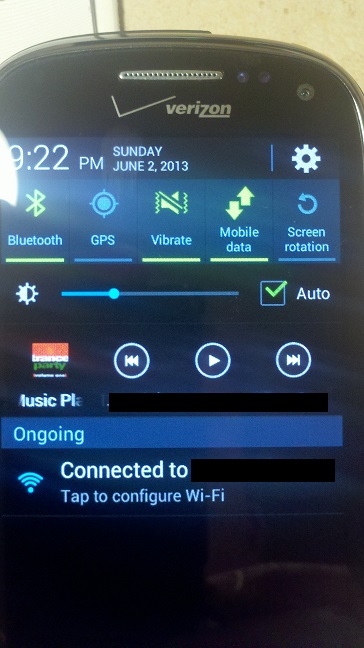
If you open the calendar application on the Stratosphere 2, it usually highlights tomorrow's date as "Today," and lists tomorrow's calendar entries as your list of things to do "Today." Here is a picture of my phone's screen taken on June 2, with the calendar app displaying "Today, Mon, Jun 3 2013" — despite the phone knowing the correct time is 9:22 PM on June 2.
Strangely, in the morning the calendar app would display the correct day as "Today," but would switch to the wrong day some time in the afternoon, and eventually I decided that the calendar app was probably using Coordinated Universal Time to decide what "Today" was, which is 9 hours ahead of Pacific Standard Time.
-
You'll notice that these images are not screen captures, but photos taken with another phone. This is because some time between the Stratosphere 1 and 2, the screen capture function broke — every support site says you're supposed to be able to take a screen cap on a Stratosphere by pressing the Home and Power buttons at the same time, and that works on the 1, but not on the 2.
-
If someone else sends a text to multiple recipients including you, the Stratosphere gives you no indication that it's a group text, and there's no way for you to see the other recipients or reply to the whole group. (I had a lot of awkward "What, you were asking everybody, not just me?" moments before I realized what was going on.) Other users have been complaining about this for months, and it apparently affects more Android phones than just the Stratosphere.
-
The built-in camera refuses to take a picture if the battery is low — it just says "Warning: low battery" and exits. Yes, I know they think they're doing it for my own good since the camera is a battery hog, but a few times I've wanted to take a picture where it was well worth using up a half a percent of my remaining battery life or however much it would have taken, but the phone wouldn't let me. That should be the user's decision, dammit.
-
When I was in Canada last week, if I tried sending a text message longer than 160 characters, the phone would tell me that the message sent, but it would actually fail silently and never get delivered. I'm not sure whether to blame Verizon, Android, or Samsung for this one (or just, you know), but in the end someone has to take responsibility for the product, and the phone telling you that a message was sent when it actually got lost, is a complete fail. If it doesn't work, fine, give me an error message, but never tell the user a message got sent successfully if it didn't.
-
During a phone call, the on-screen keypad doesn't work unless the phone is on speakerphone. If the speakerphone is off, the screen goes dark after about 1 second of inactivity, making it impossible to enter an account number or anything else. I can avoid this bug by turning on a speakerphone (which is how I know it's a software bug, not a problem with the touchscreen), but this is a pain if I'm in a public place and don't want to annoy everyone around me who would have to listen to all the voice prompts. (The phone's software seems to be following a rule like: "If the speakerphone is not on, then when the phone moves away from the user's face, assume the user is not actively using the phone and let the screen go dark" — where the bug is that it doesn't make an exception and keep the screen on if the user is actively pressing keys on the keypad.)
At first, these and many, many other bugs produce a state of mind that transcends annoyance to reach a kind of genuine curiosity, where you're asking "How did this happen?" not rhetorically, but because you actually want to know. But eventually the surprise wears off, and you're just left with bugs that are disproportionately aggravating because they obviously would have been caught during even the most basic UI testing. They're aggravating to me not because of how much they get in the way (you eventually get used to them), but because the existence of those bugs conveys a certain lazy attitude towards finding and fixing bugs at all.
I realize this is not a logical reaction. The aggravation you feel towards a bug should depend on how much the bug actually interferes with the user experience, not on how easily the manufacturer should have found it. Rationally speaking, the biggest problem with the phone right now (and the reason I'm having to mail to back to the manufacturer for a replacement) is that the charging port spontaneously broke, so that unless the micro USB charger is plugged in exactly right, the phone can't charge (even if you get it right and form a connection successfully, the connection breaks if you move the phone half an inch). Needless to say, that's exasperating — but it's hard for me to get mad at Samsung over that, because it's not an easy defect to catch at the manufacturing stage. On the other hand, if the calendar app displays the wrong day, I would say that someone should be fired over that except that probably nobody was assigned to do that testing in the first place.
I also posted questions about each of these problems on AndroidForums.com and AndroidCentral.com (those links show all questions recently posted from my username on each site), which have so far received hundreds of "views" but no replies. I mention this because some people think that if you do run into problems like these, all you have to do is post a question and The Community will help you out with a workaround. Nope.
Also, lest you think you can do away with these bugs by downloading third-party replacements for all of these apps, I spent part of an afternoon downloading different texting apps to see if any of them would fix even part of the problems I had with the built-in one. None of them worked much better, although several of them displayed pop-up ads over every third incoming text message, and most of them did not play nicely with each other, giving me no way to disable them so that their notifications would double and triple up on top of each other for every received text. So I gave up. Even if I thought I might eventually find a better app for texting, I didn't have time to test multiple replacements for every built-in default app that didn't work.
Farhad Manjoo has a column up at Slate arguing that the reason many Android phones suck is that they're laden down with adware attempting to extract more personal information and money from the user. I'm sure that's part of the problem, but I can't see how the manufacturer is making any money off of the bugs I ran into; they were just being lazy.
The problem, I think, is that phone manufacturers know that phone reviewers (and users, when they're choosing between models in the store) will focus on easily quanitifiable attributes, such as size, weight, battery life, and the number of megapixels in the camera. The number of aggravating bugs in the user interface is not something that is easy to compare across phones (and in any case would not be printed on the box). Thus market forces simply don't favor the development of a hassle-free interface, because in most cases the phone manufacturers wouldn't be rewarded for it.
And — I don't consider this too much of a stretch — this is where it connects with larger issues for me, because I've been arguing for years that the free market will usually fail to fix certain types of problems, often in the context of threats to free speech and civil liberties, especially if the user lacks information they need to compare multiple options. A major argument in favor of Net Neutrality is that the typical user wouldn't realize it if their ISP were throttling access to certain sites; they would just think that the remote site was responding slowly. Since that information would be hidden from the user, "the marketplace" won't solve the problem on its own. Similarly, every time I say that my Circumventor mailing list keeps getting blocked as "spam" by Yahoo, Hotmail, Gmail, or AOL (despite being 100% verified-opt-in, natch), someone tells me that if the free market is blocking my emails as unwanted, it must be because the users don't want them. That the free market might make a mistake (in this case, because users don't have full information about what is getting blocked as spam), doesn't occur to them. I think the belief in the infallibility of the free market, is one of the most widespread fallacies of our era — people who would never make the mistake of confusing correlation with causation, have no problem thinking that if a product or service gets blocked by a third-party intermediary, it must be because the end user didn't want it.
And so when I'm staring at my Stratosphere's calendar telling me that tomorrow is actually today, it brings out my aggravation not just towards Samsung, Google, and Verizon, but towards all the people I've heard over the years claiming that the marketplace will automatically reward good products and punish bad ones. If there weren't so many people who believed that, maybe we could have collectively put more effort into rating phones according to their usability, knowing that the "invisible hand" of the marketplace was not likely to solve those problems on its own, and maybe these bugs would have gotten fixed. Instead, the "marketplace" focuses disproportionately on attributes like dimensions, weight, and processor speed that are easily quantifiable.
So perhaps the solution — seriously — would be for some third-party review company to rate each new phone on the Stupid S#!% Index. They test the phone under normal usage, and each time they run into an idiotic bug like the calendar application not knowing what day it is, they file it under Stupid S#!%, and after some fixed period of phone usage they count up all the problems and rate the phone under the Stupid S#!% Index. For greater precision, you could compile multiple scores from different users for each phone and take the average. Now you have a quantifiable rating that can be used to compare one phone to another, and could incentivize manufacturers to do more testing on their phones in order to get a better Stupid S#!% Index score.
The message that Apple keeps pushing about the iPhone, after all, is essentially that it would get a good Stupid S#!% Index rating. In his keynote address at the 2011 Apple Worldwide Developers Conference, Steve Jobs repeated the words "It just works" like a mantra — unlike, presumably, everyone else's stuff. iPhones don't score well on price, openness, or compatibility with other companies' products (I always have to tell people that my car charger is not an iPhone charger, it's a literally-every-other-smartphone-in-the-entire-world charger) — but all of that scarcely matters to some people as long as It Just Works.
Well, I couldn't tell you. I can't test an iPhone under normal usage because I'm too addicted to the Stratosphere's slide-out keyboard, which enables me to type much faster than a touchscreen but which only comes on a few Android and Windows phones, and not on any version of the iPhone. Maybe I'll try one more time to make the switch to a touchscreen while my Stratosphere is in the shop.
Yes, these most First-World of First World Problems — especially the bugs specific to the Stratosphere — only apply to a small fraction of the population. But it should be a lesson for anyone who thinks the "free market" would prevent this sort of thing from happening.
Meanwhile, every time I hear an ad talking about how "thin" some new phone is going to be, I just want to say to the phone the same thing that I want to tell all the anorexic girls in nightclubs: You're already thin enough. So stop worrying about being thin, and just try to work on not being so f@#$ing stupid.
-
-
Watch the Crab Nebula Expand Over a 13 Year Period
The Bad Astronomer writes "A thousand years ago, the light from the explosion of a massive star reached the Earth. We now call this supernova remnant the Crab Nebula, and a new image of the Crab taken by astronomer Adam Block shows the physical expansion of the debris, made obvious in a short video comparing his 2012 observations with some taken in 1999. The outward motion of filaments and knots in the material can be easily traced even over this relatively short time baseline." -
The Book That Is Making All Movies the Same
Bruce66423 writes "This Slate story explains how a 2005 book has led to all Hollywood movies following the same structure — to a depressing extent. From the article: '...Summer movies are often described as formulaic. But what few people know is that there is actually a formula—one that lays out, on a page-by-page basis, exactly what should happen when in a screenplay. It’s as if a mad scientist has discovered a secret process for making a perfect, or at least perfectly conventional, summer blockbuster. The formula didn’t come from a mad scientist. Instead it came from a screenplay guidebook, Save the Cat! The Last Book on Screenwriting You’ll Ever Need. In the book, author Blake Snyder, a successful spec screenwriter who became an influential screenplay guru, preaches a variant on the basic three-act structure that has dominated blockbuster filmmaking since the late 1970s.' I've always known we could be manipulated — but this provides a segment by segment, almost minute by minute, guide how to do it." -
Texas School District Drops Embattled RFID Student IDs; Opts For Cameras
The Northside Independent School District (NISD) of Texas, has decided to drop their controversial student RFID card plans and settle on hundreds of cameras to monitor students. Apparently, the technology wasn't quite the attendance silver bullet administration thought it would be, as Slate's Will Oremus discovered. 'Northside Independent School District spokesman Pascual Gonzalez told me that the microchip-ID program turned out not to be worth the trouble. Its main goal was to increase attendance by allowing staff to locate students who were on campus but didn't show up for roll call. That was supposed to lead to increased revenue. But attendance at the two schools in question a middle school and a high school barely budged in the year that the policy was in place. And school staff found themselves wasting a lot of time trying to physically track down the missing students based on their RFID locators. "We're very confident we can still maintain a safe and secure school because of the 200 cameras that are installed at John Jay High School and the 100 that are installed at Jones Middle School. Plus we are upgrading those surveillance systems to high-definition and more sophisticated cameras. So there will be a surveillance-camera umbrella around both schools," Gonzalez said."' -
Dutch Government: Number of Internet Taps Has Quintupled In One Year
vikingpower writes "A Dutch newspaper has a digital version of the letter Mr. Opstelten, Secretary of Justice and Security, sent to Dutch Parliament (PDF in Dutch), in which he quietly admits to 56,825 phone taps (a 3% rise in one year) and to 16,676 internet taps in 2012, a 400% rise, or a fivefold increase, in one year. An older report already exposed the Netherlands as one of the biggest wiretappers in the western world. Slate also knew, back in 2006, that Europeans actually love wiretapping and internet tapping. In the Netherlands, a country with a population of only 16 million, the practice has risen to the level of a staggering 1 in 1,000 phones being tapped." -
J.K. Rowling Should Try the Voting Algorithm
Frequent contributor Bennett Haselton proposes a new use for online, anonymous voting: helping sort skill from luck in the cheek-by-jowl world of best-selling (and would-be best-selling) authors: "J.K. Rowling recently confirmed that she was the author of a book she had published under a pseudonym, which spiked in sales after she was outed as the true author. Perhaps she was doing an experiment to see how much luck had played a role in propelling her to worldwide success, and whether she could recreate anything close to that success when starting from scratch. But a better way to answer that question would be to strike a deal with an amateur-fiction-hosting site and use the random-sample-voting algorithm that I've written so much about, to test how her writing stacks up against other writers in the same genre." Read on for more. Update: 07/20 01:23 GMT by T : Note: An editorial goof (mine) swapped out the word "confirmed" for "revealed" (above) in an earlier rendering of this story.Rowling confirmed (after the information leaked accidentally) that she had authored a new book, The Cuckoo's Calling, under the male pseudonym Robert Galbraith, which went on to sell only about 1,500 copies before she announced that she was the real author and sales of the book spiked 150,000%.
Stephen King actually tried something similar in the 1970s, publishing a series of books under the pseudonym "Richard Bachman," which he later said was partly an attempt to answer the question of whether his success was due to talent or luck. (The Richard Bachman books sold 10 times as many copies after King was revealed as the author.) Rowling has not said whether she was attempting a similar experiment, having issued a statement that before the revelation, it had been "wonderful to publish without hype or expectation, and pure pleasure to get feedback under a different name."
But if either J.K. Rowling or Stephen King really wants to find the answer to the question of talent vs. luck, the solution lies in the random-sample voting algorithm that I've been advocating in occasional articles for years now, going back to "Censorship By Glut" in 2006. Here's how the experiment could work, for evaluating the quality of fiction writing:
-
Rowling or King could approach a pre-established amateur fiction hosting site with a large number of registered users. Or they could create their own fiction hosting site and announce it to the world for the purpose of running the experiment, which would almost certainly attract a large number of users to sign up. (The experiment only works if the site has a large number of users, for reasons that will become clear.)
-
When a user submits a new short story to the site, the site randomly selects a small subset of other users on the site (say, 20 other users), emails them a link to the new story, and invites them to read it and rate its content. There are several ways you could incentivize those users to read the link and rate the story on a scale of 1 to 10. You could bill it as the "civic duty" of registered users of the site (in the same way that it's the civic duty of registered Wikipedia editors to maintain the quality of articles, even though the editors are working for free). You could require registered users to read and rate any stories that are emailed to them (although of course there'd be no way to stop someone from lazily submitting a rating without even reading the story). You could actually require payments from users who submit stories, and then use that money to distribute small payments to the raters as compensation for reading the story (although that seems like it would be the biggest headache, since you'd have to jump through legal and logistical hoops to set it up, and it would attract cheaters who would try to abuse the system just for the free small payments). But in any case, you don't need every user who gets emailed a story, to actually click through to read the story and rate it. All that matters is that out of those 20 users, enough of them click through to read the story, that you get a statistically representative sample of what users think of the quality.
Optionally, the story raters could also submit written feedback about why they liked or did not like a story. But the important part is collecting the numeric ratings so that they can be averaged into a single overall rating for the piece of content.
-
If a story gets a high enough average rating in the first round of voting, then it gets emailed out to a larger random sample of voters, say, 200. The ratings given by this larger sample can be used to distinguish the very best stories from the merely good. (We expect that for good stories, the ratings would tend to cluster around the high end of the scale, so with that smaller variance, it would take a larger sample size to find a statistically significant difference between the quality of two stories.)
-
The stories that get the highest ratings can be featured on the front page of the site, so that everybody can have the benefit of enjoying the "best" stories. Meanwhile, J.K. Rowling and Stephen King have the benefit of finding out how their stories compare against stories written by unpublished amateur writers.
It all sounds deceptively simple, but the important feature is that you've taken the arbitrariness out of the outcome. As long as your sample sizes are large enough, the rating that a story obtains in this system, will be approximately equal to the average rating it would get from all users across the site. "Luck" is no longer a factor, because you could re-run the experiment twice with the same set of stories, and get approximately the same outcome.
This is important, because numerous experiments and real-world studies have shown that in any environment where users can recommend content to each other and browse content that is already known to be popular — in other words, how most of us discover content in the real world — luck plays a much greater role in which content becomes wildly successful. The generally accepted explanation is that an initial stroke of luck can have a self-reinforcing snowball effect — if a few key influencers happen to discover and recommend a piece of content at the same time, their friends and followers will be drawn to that content as well, and once it crosses that threshold, the content has now become "popular" enough that even more users will be drawn to it just because it's popular.
This is also why any of the existing fiction-rating sites would not work for this experiment — because most such sites allow authors to invite their friends to sign up and give high ratings to their stories, or to form cliques that all give high ratings to each other's writings. It's usually in the site's best interests to allow these tricks, because it gives authors the incentive to promote the site to their friends in order to get them to sign up. But it also means that (a) authors can easily game the system, and the highest-rated stories may not be the highest-quality ones but the ones whose authors simply play the game the best, and (b) even without "gaming the system", the fact that users can see other users' ratings and can seek out "most popular" or "trending" stories, creates the snowball effects discussed above, and introduces a huge amount of arbitrariness into the process.
Duncan Watts' excellent book Everything Is Obvious (Once You Know The Answer) is an excellent introduction to the arbitrariness phenomenon, but if you don't have time to read the whole book, just read about the Matthew Salganik 'many-worlds' experiment", which Watts co-authored and which I've linked to in pretty much every other article I've written about the random-sample-voting algorithm. The gist was that if you divide users into multiple artificial "worlds," where users can recommend content only to other users within those worlds, and seed all artificial worlds with the same content (in this case, songs), then songs which become wildly popular in some worlds will become duds in others.
The whole of Everything is Obvious is at least as insightful as anything ever written by Malcolm Gladwell, and would appeal to the same people, but it never became a bestseller, because — well, probably because we live in one of the many possible worlds of a Salganik experiment, and in the world we happen to live in, the luck of the draw meant that book didn't take off.
But back to the proposed experiment. It is true that the votes of the average users would not tell us anything about whether the winning stories were "artistically" good, however you define that. But in King's case, he was not trying to answer questions about artistic merit. he was trying to find out if his bestselling-author status was due to talent or luck, so the average rating from regular readers would be quite on point. Rowling said that she wanted to write without any hype and receive honest feedback, and it's hard to imagine a better place to do that than writing under a pseudonym for a fiction site that distributes your content directly to the public.
Both King and Rowling deserve some credit for even addressing the question of whether their success was due to talent or luck. It would have been easy for them to assume that their global success was due to their innate skill and hard work, and 99% of the world would have accepted that explanation, so it took no small amount of courage to even raise the question of how luck might have played a role. (We all know plenty of successful people who take umbrage if you even mention "the L word".)
But King did say that he thought he was outed too early to obtain any conclusive results from the experiment (and Rowling also said she wished she could have kept writing under the pseudonym, although she didn't say whether she had any similar "experiment" in mind). The random-sample-voting algorithm would provide instant feedback, not just to King and Rowling, but to any other writer who wanted to see how their writings would stack up against others in the field, from unpublished amateurs to worldwide bestselling authors.
My prediction, if such an experiment is ever conducted: King's and Rowling's writings would be rated very good, but so would many other writers' stories, including struggling writers who have never been published. Or as economist Daniel Kahneman put it: "success = talent + luck; great success = a little more talent + a lot of luck." (That took a certain amount of modesty on his part too, having achieved "great success" himself in the form of a Nobel Prize.) If J.K. Rowling or Stephen King ever launched such an experiment, the biggest favor they'd be doing for the world would not be to boost the egos of a few struggling writers, but to call more attention to the role that luck plays the world.
It's not as if their own egos would have to be bruised in the process. Donald Trump, the last person in the world that I would have guessed to have uttered these words, actually said that "Everything in life is luck," but it didn't seem to deflate his opinion of himself. You don't have to be a jerk like Trump, but just because some unpublished author's story gets a higher rating than yours, doesn't mean you have to let him come live in your mansion.
-
-
The Little Bomb-Detecting Device That Couldn't
theodp writes "Widely deployed in Iraq and promoted by military leaders, BusinessWeek reports the ADE 651 bomb-detecting device had one little problem: it wouldn't detect explosives (earlier Slashdot story). 'The ADE 651,' reports Adam Higginbotham, 'was modeled on a novelty trinket conceived decades before by a former used-car salesman from South Carolina, which was purported to detect golf balls. It wasn't even good at that.' One thing the ADE 651 did excel at, however, was making money — estimates suggest that the authorities in Baghdad bought more than 6,000 useless bomb detectors, at a cost of at least $38 million. Even though ADE 651 manufacturer James McCormick was found guilty of three counts of fraud and sentenced to 10 years in prison in May, the ADE 651 is still being used at thousands of checkpoints across Baghdad. Elsewhere, authorities have never stopped believing in the detectors. Why? According to Sandia Labs' Dale Murray, the ideomotor effect is so persuasive that for anyone who wants or needs to believe in it, even conclusive scientific evidence undermining the technology it exploits has little power." -
New Moons of Pluto Named Kerberos and Styx; Popular Choice 'Vulcan' Snubbed
MarkWhittington writes "The International Astronomical Union announced on July 2, 2013 its picks to name the two recently discovered moons of Pluto, hitherto known as P4 and P5. They will now be known as Kerberos and Styx respectively. In Greek and Roman mythology Kerberos is the name of the mythological three headed hound that guards the entrance to the underworld. Styx is the name of the river that separated the underworld from the real world. The names, picked in a popular contest, were actually the second and third choices. The first choice was Vulcan, which was officially touted because it was the name of a Roman god who was a relative of Pluto's and was associated with fire and smoke. The real reason that Vulcan shot up to the top of the list was that was a choice by Star Trek fans in a campaign instigated by actor William Shatner, who played Captain James Kirk in the original series." Shatner is sad and may lead a revolt. Phil Plait wins the award for best headline for this news. -
The Plight of Star Wars Droids
malachiorion writes "Does George Lucas hate metal people? I know, sounds like standard click-bait, but I think I present a relatively troll-free argument in the piece I wrote for Slate. We stuck to the Star Wars canon, pointing out the relatively grim state of affairs for droid rights, and the lack of any real sympathy for their plight from the heroes, or, it would seem, George Lucas. C-3PO is more correct than he might realize, when the says that droids 'seem to be made to suffer.'" -
How To Block the NSA From Your Friends List
Atticus Rex writes "The fact that our social networking services are so centralized is a big part of why they fall so easily to government surveillance. It only takes a handful of amoral Zuckerbergs to hand over hundreds of millions of people's data to PRISM. That's why this Slate article makes the case for a mass migration to decentralized, free software social networks, which are much more robust to spying and interference. On top of that, these systems respect your freedom as a software user (or developer), and they're less likely to pepper you with obnoxious advertisements." On a related note, identi.ca is ditching their Twitter clone platform for pump.io which promises an experience closer to the Facebook news feed. Unfortunately, adoption seems slow since Facebook, Google, et al have an interest in preventing interoperability and it can be lonely on the distributed social network. -
Google Asks Government For More Transparency, Other Groups Push Back Against NSA
Nerval's Lobster writes "In an open letter addressed to U.S. attorney general Eric Holder and FBI director Robert Mueller, Google chief legal officer David Drummond again insisted that reports of his company freely offering user data to the NSA and other agencies were untrue. 'However,' he wrote, 'government nondisclosure obligations regarding the number of FISA national security requests that Google receives, as well as the number of accounts covered by those requests, fuel that speculation.' In light of that, Drummond had a request of the two men: 'We therefore ask you to help make it possible for Google to publish in our Transparency Report aggregate numbers of national security requests, including FISA disclosures—in terms of both the number we receive and their scope.' Apparently Google's numbers would show 'that our compliance with these requests falls far short of the claims being made.' Google, Drummond added, 'has nothing to hide.'" Another open letter was sent to Congress from a variety of internet companies and civil liberties groups (headlined by Mozilla, the EFF, the ACLU, and the FSF), asking them to enact legislation to prohibit the kind of surveillance apparently going on at the NSA and to hold accountable the people who implemented it. (A bipartisan group of senators has just come forth with legislation that would end such surveillance.) In addition to the letter, the ACLU sent a lawsuit as well, directed at President Obama, Eric Holder, the NSA, Verizon and the Dept. of Justice (filing, PDF). They've also asked (PDF) for a release of court records relevant to the scandal. Mozilla has also launched Stopwatching.us, a campaign to "demand a full accounting of the extent to which our online data, communications and interactions are being monitored." Other reactions: Tim Berners-Lee is against it, Australia's Foreign Minister doesn't mind it, the European Parliament has denounced it, and John Oliver is hilarious about it (video). Meanwhile, Edward Snowden, the whistleblower who leaked the information about the NSA's surveillance program, is being praised widely as a hero and a patriot. There's already a petition on Whitehouse.gov to pardon him for his involvement, and it's already reached half the required number of signatures for a response from the Obama administration. -
Lowest Mass Exoplanet Ever Directly Imaged. Probably.
The Bad Astronomer writes "Astronomers announced today that they have taken a direct image of the lowest mass exoplanet ever seen. HD 95086 b has a mass about 4 to 5 times that of Jupiter, and orbits a star 300 light years away that is slightly more massive and hotter than the Sun. The planet is not 100% confirmed, but it appears very likely to be real. If so, it's a hot gas giant, still cooling from its formation less than 20 million years ago. The picture, taken in the infrared, clearly shows the planet, making it one of fewer than a dozen such planets seen in actual telescopic images." -
Big Asteroid (With Its Own Moon) To Have Closest Approach With Earth Today
An anonymous reader writes "Asteroid 1998 QE2 has an estimated diameter of 2.7 km. This asteroid will have a close approach with Earth at about 15.2 LD (Lunar Distances = ~384,000 kilometers) or 0.0392 AU (1 AU = ~150 million kilometers) at 2059 UT on 2013 May 31 and it will reach the peak magnitude ~10.8 on May 31 around 2300 UT." Radar images of the asteroid taken Wednesday show that 1998 QE2 has its own tiny moon, about 600 meters wide. Phil Plait explained how the images were taken, and what further information we gleaned from them. 'The very presence of the moon is a good thing. By measuring how long it takes to go around the primary, the mass of the primary can be found using math known for centuries (the more massive the big asteroid, the faster the moon will go around it at a given distance). We also know the size of the primary, so that means we can find its density, and therefore what it’s made of (probably mostly rock).' -
Missile Test Creates Huge Expanding Halo of Light Over Hawaii
The Bad Astronomer writes "A Minuteman III missile launch from California early Wednesday morning created a weird, expanding halo of light seen from the CFHT observatory on Hawaii's Mauna Kea. The third stage of the missile has ports that open and dump fuel into the near-vacuum. This cloud expands rapidly as a spherical shell, shock-exciting the air molecules and causing them to glow, creating the bizarre effect." -
The Canadian Government's War On Science
FuzzNugget writes "A contributor at ScienceBlogs.com has compiled and published a shockingly long list of systematic attacks on scientific research committed by the Canadian government since the conservatives came to power in 2006. This anti-scientific scourge includes muzzling scientists, shutting down research centers, industry deregulation and re-purposing the National Research Council to align with business interests instead of doing real science. It will be another two years before Canadians have the chance to go to the polls, but how much more damage will be done in the meantime?" -
N. Carolina May Ban Tesla Sales To Prevent "Unfair Competition"
nametaken writes with this excerpt from Slate: "From the state that brought you the nation's first ban on climate science comes another legislative gem: a bill that would prohibit automakers from selling their cars in the state. The proposal, which the Raleigh News & Observer reports was unanimously approved by the state's Senate Commerce Committee on Thursday, would apply to all car manufacturers, but the intended target is clear. It's aimed at Tesla, the only U.S. automaker whose business model relies on selling cars directly to consumers, rather than through a network of third-party dealerships. ... [The article adds] it's easy to understand why some car dealers might feel a little threatened: Tesla's Model S outsold the Mercedes S-Class, BMW 7 Series, and Audi A8 last quarter without any help from them. If its business model were to catch on, consumers might find that they don't need the middle-men as much as they thought." State laws imposing restrictions on manufacturers in favor of dealers aren't new, though; For more on ways that franchise operations have "used state regulations to protect their profits" long before Tesla was in the picture, check out this 2009 interview with Duke University's Michael Munger. -
Astronaut Chris Hadfield Performs Space Oddity On the ISS
An anonymous reader writes "With updated lyrics, commander of expedition 35 on the International Space Station, Chris Hadfield, sings Space Oddity on board the ISS. He's not Bowie, but he's pretty good." -
Scientists May Have Detected Neutrinos From Another Galaxy
The Bad Astronomer writes "A experiment called IceCube — consisting of sensitive light detectors buried deep in the Antarctic ice — has detected two ultra-high-energy neutrinos, each with over a peta-electronVolt of energy (a quadrillion times the energy of a visible light photon), the highest energy neutrinos ever seen. The two events, nicknamed Bert and Ernie, have a 99% chance of originating outside our galaxy, likely created either by a supermassive black hole or an exploding gamma-ray burst." -
Explosions at the Boston Marathon
Reports are coming in that the headquarters at the Boston Marathon have been locked down after two explosions were reported near the finish line. According to reports "dozens of people have been seriously injured." CNN has live coverage. Google has a Person Finder up for Boston.
Update: The Boston Police Dept. says 2 people have died and 23 are injured. News conference scheduled for 4:30 ET. -
Why PC Sales Are Declining
First time accepted submitter Benedick writes "I have a four year old desktop and a three year old notebook. Why haven't I upgraded to a new machine? Because they still work great. PC sales aren't declining because of Windows 8. They are declining because our PCs are so good, they last a lot longer. Will Oremus of Slate explains it better than I can." -
Getting a Literature Ph.D. Will Make You Into a Horrible Person
An anonymous reader writes "An assistant professor at Ohio State University who recently earned her Ph.D. in literature writes a warning in Slate for others following the same path. She says, 'I now realize graduate school was a terrible idea because the full-time, tenure-track literature professorship is extinct. After four years of trying, I've finally gotten it through my thick head that I will not get a job—and if you go to graduate school, neither will you. ... Don't misunderstand me. There is unquantifiable intellectual reward from the exploration of scholarly problems and the expansion of every discipline—yes, even the literary ones, and even if that means doing bat-s**t analysis like using the rule of "false elimination" to determine that Josef K. is simultaneously guilty and not guilty in The Trial. But there is one sort of reward you will never get: monetary compensation from a stable, non-penurious position at a decent university. ... By the time you finish—if you even do— your academic self will be the culmination of your entire self, and thus you will believe, incomprehensibly, that not having a tenure-track job makes you worthless. You will believe this so strongly that when you do not land a job, it will destroy you, and nobody outside of academia will understand why. (Bright side: You will no longer have any friends outside academia.) ... In the place of actual jobs are adjunct positions: benefit-free, office-free academic servitude in which you will earn $18,000 a year for the rest of your life." -
Boston Cops Go Undercover Online To Crack Down on Concerts
Boston Police, according to an article at Slate, are engaging in a strange use of social media to fight crime. Or at least, to stop raucous music from disturbing the city. As the Slate writer says, "While police departments have been using social media to investigate for years, its use in such seemingly trivial crimes would be rather chilling, if these efforts didn’t seem so laughably inept." -
Real-Time Gmail Spying a 'Top Priority' For FBI This Year
Fnord666 sends this quote from an article at Slate: "Despite the pervasiveness of law enforcement surveillance of digital communication, the FBI still has a difficult time monitoring Gmail, Google Voice, and Dropbox in real time. But that may change soon, because the bureau says it has made gaining more powers to wiretap all forms of Internet conversation and cloud storage a 'top priority' this year. ... a 1994 surveillance law called the Communications Assistance for Law Enforcement Act only allows the government to force Internet providers and phone companies to install surveillance equipment within their networks. But it doesn't cover email, cloud services, or online chat providers like Skype. Weissmann said that the FBI wants the power to mandate real-time surveillance of everything from Dropbox and online games ('the chat feature in Scrabble') to Gmail and Google Voice. 'Those communications are being used for criminal conversations,' he said." -
Aaron Swartz's Estate Seeks Release of Documents
theodp writes "The Boston Globe reports that the estate of Aaron Swartz filed a motion in federal court in Boston Friday to allow the release of documents in the case that has generated national controversy over the U.S. attorney's aggressive pursuit of a stiff sentence. The Court filing (PDF) suggests that the U.S. attorney's office is still up for jerking Aaron around a little posthumously, seeking what his lawyers termed overbroad redactions, including names and titles that are already publicly known. Swartz's family also seeks the return of his seized property (PDF). Last week, Swartz's girlfriend accused MIT of dragging its feet on investigating his suicide. Meanwhile, Slate's Justin Peters asks if the Justice Department learned anything from the Aaron Swartz case, noting that Matthew Keys, who faces 25 years in prison for crimes that include aiding-and-abetting the display of humorously false content, could replace Swartz as the poster boy for prosecutorial overreach." -
Why Earth Hour Is a Waste of Time and Energy
An anonymous reader writes "Next Saturday from 8:30PM to 9:30PM EST is 'Earth Hour' (0:30 to 1:30 UTC on Sunday). Millions of people will be participating by shutting off their lights for an hour to show they care about the environment. However, according to this article in Slate, Earth Hour is simply 'vain symbolism,' and it won't actually save any energy — quite the opposite. Quoting: 'Notice that you have not been asked to switch off anything really inconvenient, like your heating or air-conditioning, television, computer, mobile phone, or any of the myriad technologies that depend on affordable, plentiful energy electricity and make modern life possible. If switching off the lights for one hour per year really were beneficial, why would we not do it for the other 8,759? Hypothetically, switching off the lights for an hour would cut CO2 emissions from power plants around the world. But, even if everyone in the entire world cut all residential lighting, and this translated entirely into CO2 reduction, it would be the equivalent of China pausing its CO2 emissions for less than four minutes. In fact, Earth Hour will cause emissions to increase. As the United Kingdom's National Grid operators have found, a small decline in electricity consumption does not translate into less energy being pumped into the grid, and therefore will not reduce emissions. Moreover, during Earth Hour, any significant drop in electricity demand will entail a reduction in CO2 emissions during the hour, but it will be offset by the surge from firing up coal or gas stations to restore electricity supplies afterward.'" -
Evidence For Comet-Borne Microfossils Supports Panspermia
New submitter onyxruby writes "On December 29th of last year a comet exploded over Sri Lanka. When examined by Cardiff University one of the comet samples was found to contain micro-fossils akin to plankton. NASA's Marshall Space Flight Center tested additional samples with similar results. The research paper was published in the Journal of Cosmology. In practice this means that the argument that life did not start on Earth has gained additional evidence." Update: 03/12 16:59 GMT by S : On the other hand, Phil Plait says the paper is very flawed; the sample rocks the researchers tested may not even be meteorites. -
Astronomers Discover Third-Closest Star System To Earth
The Bad Astronomer writes "Astronomers have found the third-closest star system to the Earth: called WISE 1049-5319, it's a binary brown dwarf system just 6.5 light years away. Brown dwarfs are faint, low mass objects 13 — 75 times the mass of Jupiter, and are so dim they are very difficult to detect. These newly-found nearby objects were seen in observations from 1978 but went unnoticed at the time, but since that date the large apparent motion of the binary made their proximity obvious. Only two star systems are closer: Alpha Centauri (4.3 light years) and Barnard's star (6 light years)." -
Scientists Transplant Functional Eyes On the Tails of Tadpoles
New submitter physlord writes in with a story about tadpoles with eyes on their tails. "Using embryos from the African clawed frog (Xenopus), scientists at Tufts' Center for Regenerative and Developmental Biology were able to transplant eye primordia—basically, the little nubs of flesh that will eventually grow into an eye—from one tadpole's head to another's posterior, flank, or tail....Amazingly, a statistically significant portion of the transplanted one-eyes could not only detect LED changes, but they showed learning behavior when confronted with electric shock." -
The Real Reason Journal Articles Should Be Free
Bennett Haselton writes "The U.S. government recently announced that academic papers on federally-funded research should become freely available online within one year of publication in a journal. But the real question is why academics don't simply publish most papers freely anyway. If the problem is that traditional journals have a monopoly on the kind of prestige that can only be conferred by having your paper appear in their hallowed pages, that monopoly can easily be broken, because there's no reason why open-access journals can't confer the same imprimatur of quality." Read on for the rest of Bennett's thoughts on the great free-access debate.Around the time of the tragic suicide of Aaron Swartz, who lobbied tirelessly for free access to academic articles (in his sometimes grey-hat manner, which ultimately got him in trouble), I admitted to some friends that I didn't understand how this became a problem. Why aren't all journal articles free, all the time?
I don't mean that I didn't know why the journal publishers charged exorbitant fees for their subscriptions. If academic researchers have to have access to journal articles in order to do their jobs, then you can expect the journals to gouge academic libraries on the prices. What I didn't understand was: Why do academics even publish in journals that demand exclusive publishing rights for their work, and then charge readers huge fees to read it?
Well actually, we know the answer to that too: academics want the prestige of publishing in big-name journals that have established reputations, and as a result, those well-known journals are in a position to dictate the terms of the contract. A professor might genuinely want to publish their paper in a journal where it can be read for free by all, but they can hardly be blamed for thinking of their own career path first.
Here's the question I really wanted answered: If "prestige" only exists in the minds of other academics within a field, then why don't the academics within a given field just agree to confer "prestige" on papers published in open-access journals, if they can see for themselves that the quality is equivalent to what would be published in the old-guard journals that charge an arm and a leg? And then make hiring, promotion, and tenure decisions accordingly?
I don't mean that the papers published in an open-access journal would bypass the peer-review process, and that everyone in the field would have to judge the papers for themselves without any prior certification of their quality. One of the points that Peter Suber makes repeatedly in his book Open Access is that open access is not about skipping peer review and dumping papers directly onto the web. Rather, the process would work similarly to peer review for a traditional journal:
-
Author submits a paper to journal XYZ.
-
Journal XYZ selects one or more peer reviewers from among their list of people they consider qualified to review the paper. The peer reviewers send back their usual suggestions and some consensus is reached as to whether or not to publish.
-
If Journal XYZ publishes the paper, then they have certified that the paper passed the quality controls in step #2, and the author can now legitimately claim that they had a paper published in Journal XYZ.
-
If people in the field know that Journal XYZ is not skimping on the quality controls in step #2 — that Journal XYZ is sending the papers to the same academics who would do peer review for one of the old-guard journals, and who are holding the papers to the same standard — then they should respect the paper just as much as if it were published in a traditional journal. If a person has never heard of Journal XYZ, then it should only take a minute to explain to them how it works (and crucially, that Journal XYZ is just as strict about quality as the old-guard journals that everybody has heard of).
Each step in this process should cost the journal virtually nothing. The "hard cost," the part that consumes the time of people with unique skills, is the peer review step, but peer reviewers are usually paid by universities and consider peer review for academic journals to be part of their job description. At a minimum, all the editors really have to do is maintain the list of people they consider qualified to do the peer review, and send the submitted papers off to them.
Moreover, the entire process should be fast. Again, the "hard cost" in time is the peer review, but there's no reason that the delays between submission and publication should be in the range of months or years.
(I'm assuming that the article authors would want their writings to be widely read, or at least would not be opposed to it. That may not be the case if, for example, the authors were commissioned by a pharmaceutical company for a study that cast their drug in a favorable light, but the authors realize that their research methods contained errors and want to minimize the number of eyes on their paper, to reduce the chances of their chicanery being caught. Ben Goldacre's Bad Pharma documents these types of problems very thoroughly, but I'm sidestepping that issue for now.)
So, with that in mind as the ideal, I asked my friends, including many current and former academics, why this essentially wasn't the model that was used. Several mentioned the Public Library of Science, which publishes all articles in its journals under a Creative Commons Attribution License (free for anyone to read and reproduce in full, as long as the original author is cited), and finances its operations through publication fees. These fees are in the $2,000-$3,000 range, heavily discounted for low-income countries and authors, and in any case most academic authors pay the fees out of their research grants and not out of their own pockets. That sounded much better than the traditional model, I thought, but I still didn't understand why the costs weren't even closer to zero. Another friend pointed out that PLOS costs cover the expenses for many of their other activities — which are all noble goals, to be sure, but at the same time, why isn't anybody operating a more bare-bones model which minimizes all expenses, and charges almost nothing for publication or subscription?
This, it turns out, appears to be the approach of the PeerJ project, which aims to let authors pay a one-time fee of $99 at article submission time for the right to publish one article per year — or, if you prefer to pay only if your article is accepted for publication, you can pay $129 "on acceptance" (explained here). And the author of the Techdirt piece mentions that he submitted a paper which was published in the inaugural edition of one of PeerJ's journals, 10 weeks after the submission date. This is cheap and fast enough that I'd call it a validation of the theoretical model which predicts the whole process should be able to be done for almost no cost in almost no time. In other words, I think PeerJ will succeed, but even if it does fail, it will only be because of some anomalous business snafu, not because the hard costs of the service they're providing are greater than the dirt-cheap price they're charging for it. If for any reason PeerJ doesn't happen to get it right the first time, they or some other company should keep trying until someone makes it work.
The basic algorithm at work here — taking a piece of content, submitting it to one or more suitably qualified reviewers, and then certifying the content based on the feedback of the reviewers — is something I've advocated in many contexts over the years, for many different types of problems. In one article I argued that we could make success in the music industry into much more of a meritocracy, with far less arbitrariness in determining who succeeds and fails, if a suitably popular site like Pandora simply took new submissions from artists, had the content "rated" by a random sample of listeners interested in that type of music, and if enough of them liked it, push the content out to all of the fans of that genre. In "Crowdsourcing the Censors" I suggested that Facebook's complaint review process should use the same principle: If a given page received enough complaints, have the page contents reviewed by a random subset of Facebook users who had signed up to be "abusive content" reviewers, and then only flag the page for removal if a high enough percentage of those users voted that the page had indeed violated Facebook's guidelines. This year I argued that "We The People", the White House's online petition-drive-organizing website, should rate ideas based on what a random subset of users think of each idea, rather than allowing users to organize mobs of their friends and followers to vote their own ideas to the top of the pile (which, in case you missed it, is how 4chan gave us this). Or, if you think the general public is not qualified to rate ideas according to how they should be prioritized by the White House (and I'd be inclined to agree), you could have the ideas rated by a random subset of, say, the nation's economics professors.
Of course, I haven't heard of any plans to implement this algorithm in any of those contexts. Not that I expected the key power players to be reading my articles, but it's a little surprising that none of them ever came up with this idea independently, either. (To this day, the only website I'm aware of that ever implemented random-sample voting correctly, was HotOrNot.com, where users could rate members' pictures by attractiveness — but each picture's rating was determined by showing it to a random subset of the site's visitors. That system is gone, since the site has made itself over into a date-finding service.)
But academia in general, and science specifically, is different from other arenas in a number of key ways which could help this algorithm succeed:
-
Academia, uniquely, is comprised of many professionals whose love of knowledge and intellectual inquiry, is greater than their desire for money. That's not to say that I don't think the same algorithm could work just as well in a business like the music industry, where most of the stakeholders are in it for the money. But even if Pandora did successfully implement the algorithm, it would meet a lot of resistance from entrenched interests in the music industry, who make their money by finding and promoting and managing talent and would not be happy about a new system that threatened to make them irrelevant. In academia, by contrast, it's quite plausible that even the "entrenched interests" — the people who had become superstars under the old system — would see the new system's great potential for disseminating free knowledge, and would welcome it even if it gave scrappy new upstart academics a chance to dethrone them. Not everybody in academia loves knowledge more than they love their own prestige, but I know more people like that in academia than anywhere else.
-
In academia, even among people who do care primarily about their own prestige, many of them have tenure and guaranteed job security, a situation that does not exist in most other industries. This gives them the freedom to experiment with new models, such as submitting papers to upstart PeerJ journals. But more importantly for our purposes, it means they can announce that in their department's hiring and promotion decisions, they will count PeerJ-published papers as legitimate professional accomplishments, for the benefit of non-tenured faculty members who do have to worry about their resume.
- Academics, particularly in maths and sciences, are more prone to the kind of thinking that would lead a person naturally in the direction of the kind of system that PeerJ embodies. First, think of a theoretical model (like the kind I described near the beginning of the article). This model predicts that, ideally, it should be possible to publish papers at very low cost with quick turnaround times, without sacrificing peer-review quality assurance. Now, try to approximate that model as closely as possible in the real world. (In most other industries that I've worked in, there's much more inertia around the existing way of doing things, and far less willingness to entertain any discussion about whether a theoretical model can show how we could accomplish the same thing with vastly less overhead.)
And that, in the end, is the real reason journal articles should be free. Not because the U.S. government is making it a condition for taxpayer-funded research, although that is a welcome development. But because there's no part of the process that should cost very much to begin with, if article authors and peer reviewers are already being paid by their employers. The last piece of the puzzle is that enough academics and faculty departments have to agree to confer "prestige" on articles published in open-access journals, equivalent to the level of prestige that they would accord for an article published in a traditional journal of the same quality. If they won't do that, then the old-guard journals will maintain their monopoly on conferring "prestige", and don't be surprised if journal prices keep growing to the point where even Harvard can't pay for them.
-
-
Spinning Black Hole's Edge Rotates At Nearly the Speed of Light
astroengine writes "Astronomers have directly measured the spin of a black hole for the first time by detecting the mind-bending relativistic effects that warp space-time at the very edge of its event horizon. By monitoring X-ray emissions from iron ions (iron atoms with some electrons missing) trapped in the black hole's accretion disk, the rapidly-rotating inner edge of the disk of hot material has provided direct information about how fast the black hole is spinning. Astronomers used NASA's Nuclear Spectroscopic Telescope Array (NuSTAR) — that was launched into Earth orbit in June 2012 — and the European observatory XMM-Newton measured X-ray radiation as a tool to directly infer the spin of NGC 1365's black hole. 'What excites me is the fact that we are able to do this for the very massive black holes at the centers of galaxies but we can also make the same measurement for black holes in our galaxy ... black holes that resulted from the explosion of a star ... The fact we can extend this from billions of solar masses to 10 solar masses is pretty cool,' Fiona Harrison, professor of physics and astronomy at the California Institute of Technology, Pasadena, Calif., and principal investigator of the NuSTAR mission, told Discovery News." -
Interviews: Khan Academy Lead Developer Ben Kamens Answers Your Questions
A couple of weeks ago you had the chance to ask Khan Academy lead developer Ben Kamens about the future of online education and the academy itself. Below you'll find his answers to the questions we sent and a few extra that he found interesting. Higher Education
by null etc.
Joel Spolsky has famously stated that he prefers software engineers who come from highly accredited universities, preferably Ivy-league. His thought is that one has to distinguish oneself in order to be granted admission to such places. Do you think that Joel's opinion, and those of other elitist employers, will change with the introduction of free, quality online education?
Kamens:Yes. It's not just access to education, it's the ease with which somebody can demonstrate their ability. Ask any developer if they'd sleep better at night having just hired:
A) somebody from a no-name school with an impressive github profile and side projects
B) somebody from an impressive school with no github profile nor side projects
Then take everybody who answered B and keep them away from me. And here's the thing: I'm confident Joel agrees. Joel's most famous edict when it comes to hiring is making sure somebody's "Smart and Gets Things Done." There was a time when a college degree was the best credential for Smart and Gets Things Done. In many hiring situations, it still is.
In the programming world right now? Not so much. There are too many chances to prove your ability before you graduate for that name on your degree to carry all the weight. Sure, between two otherwise equal candidates, neither of whom have littered the internet with blog posts and side projects and bits of their code, highly accredited universities can still help differentiate. It's a helpful filter, especially when sorting through thousands of otherwise similar resumes.
Even at Fog Creek 6 years ago, graduating from a top-tier university only gave you one point (out of 6 possible) in the initial resume screening process...which was the most trivial part of an otherwise lengthy recruiting pipeline designed to figure out if you're Smart and Get Things Done.
Short version: yes, this is changing and will continue to. Quality online education will hopefully continue advancing alongside easier and easier ways to demonstrate your skills to the world. At Khan Academy, we've hired people from all sorts of colleges (even three high schoolers!) who've demonstrated tremendous skill way before a degree credentials it. We'll continue to do so.
Platform For Schools
by GeneralSecretary
I've heard that KhanAcademy has a platform for schools. Students can learn using Khan Academy and teachers can monitor their progress and help students where they need it most. When I last heard about this the platform was a pilot program being launched at select schools. Are there plans to make this platform generally available? or even open source?
Kamens:It's actually for any teacher in any school right now, for free. Our "teacher toolkit" is the best place to start, w/ videos of other schools' usage and tips from their implementations.
When a teacher signs up and gets their class on Khan Academy, they'll get the exact same platform our pilot classrooms receive. Same product a parent would get if they signed up with their child. Those teachers in the pilot program you mention aren't using anything special.
The significant difference is our ability to personally engage with specific teachers and classrooms. We're a small team and have to focus on a (relatively) small number of classrooms. We use these few pilots to get feedback, learn from students, try to understand how our product can empower teachers, etc. But any changes we make as a result are then given to all students around the world.
Verification
by GeneralSecretary
It seems to me that the problem with online education is being able to prove what you have learned. I can learn Calculus online at Khan Academy or at my local community college. I'll probably learn Calculus better at Khan Academy and for less money. But, I cannot use that knowledge to get a degree nor would I have any other way of proving my knowledge to other schools or potential employers. Do you have a solution to this problem?
Kamens:It's a big deal. The MOOCs have already started tackling this. Coursera, Udacity, and edX are working with colleges to provide official credit for their online classes.
There's more than one way to work this issue. The MOOCs are attempting to build an educational brand that's valued in much the same way as, say, Stanford. They can then hand out stamps of approval that serve as signals for employers or colleges who're trying to assess candidates.
There's also the github model. Github doesn't bill itself as an accreditation machine. It doesn't try to hand out branded stamps of approval. But talk to employers about the power of github profiles and you'll hear an interesting story. And they're not the only ones. Sites like Stack Overflow have managed to build systems of reputation that send meaningful signals (disclosure: I'm biased about Stack Overflow).
Bottom line: your question represents an *enormous*, world-changing opportunity, and Khan Academy has some important choices to make. The team is sprinting on this problem as I type.
Where are all the CS courses?
by Anonymous Coward
Where are all the "traditional" Computer Science courses? I'm not asking about the "interactive manual" type courses like how to do loops in Python - there are a ton of materials about that all over the web. I'm asking about theoretical computer science, such as Turing completeness, Chomsky hierarchy, abstract data types, compiler design, that kind of stuff which is the backbone of a university computer science education. The reason I'm asking is not to diminish the value of hands-on courses, but because many (including myself) were not able to get a "traditional" CS degree, coming into programming jobs from other disciplines (or no degree at all) and are largely self taught. Self teaching is great when it comes to practical stuff early on, but once you move on to more senior roles you start feeling the gaps of not understanding the theory behind your tools, design, and implementation, as much as you should.
Kamens:Agreed!
I'd encourage you to check out the computer science section we have. While it's not the high-level content you mention, it's far from those "interactive manuals" you see around the web. John Resig and his team have built something pretty special.
That being said, the most honest answer we can give when asked about missing content is that we've chosen to focus on a few topics (like core math) until we nail them and the experience built around them.
We're opportunistic when we find an incredible person to help us teach other areas while the rest of the team focuses on core math. Examples would be Dr. Beth Harris and Dr. Steven Zucker's Art History content and Vi Hart's brilliant and somewhat indescribable videos.
We are building quite a content team. There's little we don't hope to cover one day. Just not focusing on higher-level CS *yet*.
Explanation vs exploration: Pedagogical challenge?
by fantomas
I've heard a criticism of the Khan Academy pedagogic approach is that it is explanation based (effectively the old model: the teacher talks, the student listens, the student carries out an exercise, listens again) - while schools are moving towards exploration based learning (where students are encourage to try and approach problems from different angles supported by teacher-as-facilitator). To what extent does Khan Academy replicate a very old fashioned rote-learning form of education (albeit delivered and presented via a new media with minor improvements like pause and rewind), and in what aspects does it offer significant new pedagogical advances in learning?
Kamens:Dangit, I just listened to Sal answer this exact question at a dinner yesterday. Now you're gonna make me feel like I'm a puppet. I'll do my best to break free of these puppet shackles and answer with my own words.
The fundamental belief of Khan Academy is that students should engage with content they need on-demand, at their own pace. We agree that any curriculum that forces all students in a class to follow the same, preordained "watch this video, do this exercise, watch this other video" path isn't using technology in a meaningful way. So we design our product and work with teachers to help students feel ownership of the learning process.
Our classrooms see varying implementations, but the best of them try hard to help students move at their own pace. Some students might never need to listen to Sal say a word. They can master content by experimenting on their own. Absolutely. Fine. By. Us. Others may benefit from rewinding one of Sal's videos over and over and over until a concept clicks. But not every student masters content at the same speed.
It takes a fearless teacher to embrace this controlled chaos in a classroom. I've seen it happen. I have the highest respect in the world for those teachers able to do it. They're simultaneously ready to help mentor a student who's stuck working on fractions and another who may've advanced all the way to trigonometry. They let one student run free on her own while giving another strong encouragement to try the next challenge. Watching these teachers in action is a sight to behold.
Khan Academy exists to give students the freedom to engage with the content they need while giving teachers immediate feedback about who's working on what and where they need help. We think we can help teachers by making this acquisition of core skills a more personalized, efficient process.
In doing so, we hope to move teachers _up_ the value chain so they can focus on exploration-based learning and targeted coaching with the rest of their class time.
I personally think that'd be a significant advance in learning. And FWIW, we consider anybody who fights for exploration-based learning to be an ally of Khan Academy.
Plans to make KA easier for researchers to use?
by Anonymous Coward
I'm a middle school teacher experimenting with using KA with my classes. I think it is an amazing tool, especially for differentiation -- helping teachers to help their students who are behind have successes in math and, ideally, work towards getting caught back up to their peers. I think it can allow math teachers to do more interesting and fun (non-drill) types of work in the classroom, such as focusing more on students learning by doing open-ended, authentic, rich projects with each other. The key word there is that I *think* it must be helpful to the type of classroom described above. I want to know it is, and as part of our practice in Ontario, Canada, it is encouraged that teachers engage in personal inquiry projects to get more data on whether what we think is working actually is. It is difficult to get the data I need out of KA. We're having to do a lot of manual grabbing of student usage times and populating spreadsheets with that. Any plans to extend the external API to allow more sophisticated queries? Or, perhaps plans to provide a tool allowing more extensive data dumps which researchers can use? And if you don't have plans at the moment, does this post influence that? ;-) With a more thorough access to student data, I expect there will be researchers who will be more interested in investigating KA in their research and fleshing out the actual benefits (and also any issues that might be addressed). My students and I thank you!
Kamens:Holy crap, I should've just pasted your first couple sentences in response to the previous question! Would've been way more authentic.
Ouch. This one hits home. I want our API to support this type of thing, and I know it's far from perfect. Can you make sure the specific API queries you need are requested here? We haven't had time to do everything we want, but we're always on the lookout for big API wins that'll enable the community to build cool stuff. Thanks for being an early API adopter. Sorry you've had trouble. Please know that we want to help.
The large data dump request is a bit more complicated due to student privacy issues, but it's on our radar.
lead dev
by vlm
I always ask coder/tech types whats their coolest hack / coolest piece of code. Not something else someone else did, not some giant overall project or vague thing like "world peace" just your coolest isolated to one individual "thing" hack. Something they did personally not hired someone else to do, or something their boss did. Maybe in your LOB its an amazing caching technique, or an astounding way to compress video or whatever. Or some astounding workflow thingy. A short story just a paragraph no more. The kind of thing a /. audience would respond with "cool!" when they read it.
Kamens:While I can't promise "amazing" or "astounding" I can at least make you cringe. A couple years ago we had to take Khan Academy down for maintenance. Was gonna take a couple hours. We put up a cutesy little "Shhhh...we're studying!" page to let users know we'd be back soon.
We were Google App Engine novices at the time. The method we used to display that "Shhh...we're studying!" page did something we didn't expect: it returned a caching header that told all downstream clients to cache the page. For 365 days. For _all of our URLs_. And this was _entirely_ our fault (not App Engine's).
Every server or browser between us and our users was now allowed to return "Shhh...we're studying!" for every Khan Academy URL without ever asking us for new content. Our users were gonna sit there, smashing reload, and seeing "Shhh...we're studying!" for a freaking _year_. And our servers would never even see their requests to get a chance to fix the problem. Thankfully, the App Engine team came through in the middle of the night and gave us a way to clear the cache for exactly two URLs on all of their frontend servers, where most of this problematic caching was happening. We chose the homepage URL, www.khanacademy.org, and (here's where the hack comes in), the URL of javascript file that all of our pages, including the static "Shhhh...we're studying!" page, happened to be referencing. Something like khanacademy.org/jquery.js. We replaced that javascript file with a single line that redirected users to a new subdomain we'd set up at www2.khanacademy.org. The www2 URLs weren't cached all over the entire internet, so kids could start learning again!
Once the disaster died down we switched back to www.khanacademy.org and modified our URLs in a different way to avoid any remaining caches. Surprisingly, our traffic didn't take a hit and everything recovered nicely. But we wondered for about a year if anybody was still seeing that "Shhh...we're studying!" page.
Internships
by Niris
As someone who is currently a senior in computer science and looking for summer internships, what is it that Khan Academy developers look for in perspective interns? I've looked over the blog posts from some of the past interns, and their projects all seem pretty amazing. Is it possible for someone who doesn't have a fair amount of professional level experience to jump in to the internship program with Khan Academy? Disclaimer: I currently have an application in for the internship program, hence my curiosity :)
Kamens:Side projects. Blogs. Having built or written things that others find useful. Being passionate enough to find us and ask interview questions on slashdot.
A past filled with creating value will go a long, long way. Rooting for you.
Jude the Obscure
by Quirkz
Discussions about online learning tend to remind me of the book Jude the Obscure, by Thomas Hardy. It's been a couple of decades, but from what I remember it's the tragic story of a poor working man who dreams of pursuing education/knowledge but who can only barely scrape by with the essentials and can rarely afford even the occasional book. Do institutions like Khan Academy mostly or completely erase that scenario in the modern day? Would a modern Jude have been able to educate and better himself? Are there other obstacles that replace the cost as a barrier to taking this free learning and finding advancement or satisfaction?
Kamens:Ever read The Diamond Age? We give a copy to all interns on their first day. Our long-term sci-fi dream is to remove exactly these obstacles. If we can get one small step closer to The Young Lady's Illustrated Primer (sounds like it would've helped this Jude)...well, that's a dream. -
Astronomers Find Planet Barely Larger Than Earth's Moon
The Bad Astronomer writes "A team of astronomers has announced the discovery of the smallest exoplanet orbiting a Sun-like star yet found: Kepler-37b, which has a diameter of only 3865 kilometers — smaller than Mercury, and only a little bigger than our own Moon. It was found using the transit method; as it orbits its star, it periodically blocks a bit of the starlight, revealing its presence (abstract). Interestingly, the planet has been known for some time, but only new advances in asteroseismology (studying oscillations in the star itself) have allowed the star's size to be accurately found, which in turn yielded a far better determination of the planet's diminutive size. Also, the asteroseismology research was not funded by NASA, but instead crowd funded by a non-profit, which raised money by letting people adopt Kepler target stars." -
Huge Meteor Blazes Across Sky Over Russia; Hundreds Injured
New submitter dovf writes "The Bad Astronomer analyzes incoming reports about the apparent meteoric fireball over Russia: 'Apparently, at about 09:30 local time, a very big meteor burned up over Chelyabinsk, a city in Russia just east of the Ural mountains, and about 1500 kilometers east of Moscow. The fireball was incredibly bright, rivaling the Sun! There was a pretty big sonic boom from the fireball, which set off car alarms and shattered windows. I'm seeing some reports of many people injured (by shattered glass blown out by the shock wave). I'm also seeing reports that some pieces have fallen to the ground, but again as I write this those are unconfirmed." This is the best summary I've found so far, and links to lots of videos and images. He also clarifies something I've been wondering about: 'This is almost certainly unrelated to the asteroid 2012 DA14 that will pass on Friday.'" -
Could New York City Cut Emissions 90% By 2050?
First time accepted submitter jscheib writes "According to Will Oremus in Slate, a report released today finds that 'New York City could slash its emissions by a whopping 90 percent by 2050 without any radical new technologies, without cutting back on creature comforts, and maybe even without breaking its budget.' The key elements are insulating buildings to cut energy needs, converting to (mostly) electric equipment, and then using carbon-free electricity to supply the small amount of energy still needed. Oremus notes that including energy savings would reduce the net price tag to something more like $20 billion." -
How a Chinese Hacker Tried To Blackmail Me
An anonymous reader writes "Slate provides the first-person account of a CEO who received an e-mail with several business documents attached threatening to distribute them to competitors and business partners unless the CEO paid $150,000. 'Experts I consulted told me that the hacking probably came from government monitors who wanted extra cash,' writes the CEO, who successfully ended the extortion with an e-mail from the law firm from the bank of his financial partner, refusing payment and adding that the authorities had been notified. According to the article, IT providers routinely receive phone calls from their service providers if they detect any downtime on the monitors of network traffic installed by the Chinese government, similar to the alerts provided to telecom providers about VoIP fraud on their IP-PBX switches. 'Hundreds of millions of Chinese operate on the Internet without any real sense of privacy, fully aware that a massive eavesdropping apparatus tracks their every communication and move...' writes the CEO. 'With China's world and ours intersecting online, I expect we'll eventually wonder how we could have been so naive to have assumed that privacy was normal- or that breaches of it were news.'" -
Slate's Mini-Biography of Aaron Swartz
New submitter ElDuque writes "Slate's top story today is a long, heavily-researched article about the life of, and case against, Aaron Swartz. It covers the formative years of both Mr. Swartz and the free information / open knowledge movement he felt so strongly about. Quoting: 'Aaron Swartz is a difficult puzzle. He was a programmer who resisted the description, a dot-com millionaire who lived in a rented one-room studio. He could be a troublesome collaborator but an effective troubleshooter. He had a talent for making powerful friends, and for driving them away. He had scores of interests, and he indulged them all. ... He was fascinated by large systems, and how an organization’s culture and values could foster innovation or corruption, collaboration or paranoia. Why does one group accept a 14-year-old as an equal partner among professors and professionals while another spends two years pursuing a court case that’s divorced from any sense of proportionality to the alleged crime? How can one sort of organization develop a young man like Aaron Swartz, and how can another destroy him?'" -
Fox News: US Solar Energy Investment Less Than Germany Because US Has Less Sun
Andy Prough writes "Apparently those wise folks at Fox have figured out America's reluctance to invest as much money in solar energy as Germany — the Germans simply have more sun! Well, as Will Oremus from Slate points out, according to the U.S. Dept. of Energy's Solar Resource map comparison of the U.S. and Germany, nothing could be further from the truth — Germany receives as much sunlight as the least lit U.S. state — Alaska." -
How To Stop Prediction Market Manipulation
Frequent contributor Bennett Haselton is still thinking about prediction markets, and giving away money. He writes: "In an article last December I described a problem with prediction markets, where even markets with cap on betting limits could be manipulated by a single trader willing to spend a lot of money to distort the marketplace odds. So I offered a $100 cash prize to be split between readers who collectively came up with the best solution to the problem. Here's an idea that I think would work." Read on for the rest.In November I wrote an article arguing that prediction markets like Intrade -- where users can bet on the odds of, say, Obama or Romney becoming president -- were a useful tool for aggregating the wisdom of crowds, but could be manipulated by someone placing a large bet in order to create the illusion that "the markets" were favoring their candidate. If the fake "market odds" were reported in the news, it could have the effect of causing more supporters to switch to that candidate, thus increasing the true odds of their victory and creating a self-fulfilling prophecy before the markets had the chance to correct themselves. The solution, I thought at first, was to have a cap on the amount that individual users could bet (which is one of the rules at the Iowa Electronic Markets), and make it illegal for a single mastermind to pay large numbers of third parties to make bets in order to circumvent the single-bettor limit.
As I admitted in a follow-up article, it turns out this regulation would not work after all. The problem is that as long as long as overseas betting markets like Intrade have no limit on wagers, a market manipulator could place a huge bet on Intrade to cause the odds to shift on that market -- for example, changing the odds of Obama-to-win from 4:1 to 6:1. Meanwhile, the odds in a domestic prediction market with a betting limit -- call it CappedEx -- would initially stay at their non-manipulated value of 4:1. But then "arbitrage players" could spot the difference in the odds being offered, and make opposing bets in the two markets in a way that would be guaranteed to make a net profit. (The details are spelled out in my last article, but basically, any time two markets are offering different odds of an event happening, you can pick appropriate amounts to bet in the two markets so that you're guaranteed a profit whether the event occurs or not.) These arbitrage players would continue making opposing bets in the two markets until the odds being offered in the two markets converged onto the same value -- at which point, the market manipulator has successfully manipulated the odds in the capped market, even without ever placing a bet there. Essentially, the market manipulator has hired all of those arbitrage players and paid them to make bets on his behalf, but done so indirectly to avoid violating laws against hiring an army of bet-placers.
I should be clear about the two different time frames being discussed here. If a manipulator places a large bet on Intrade, causing the odds on Intrade to diverse significantly from the odds on CappedEx, then the arbitrage players should cause the odds on the two markets to converge to the same value very rapidly -- plausibly in less than one minute. (Whoever spots the difference first, gets guaranteed free money. It would be easy to write a bot that could watch for any divergence in the odds in the two markets, and place guaranteed-profit bets as soon as a gap appeared.) Then, as political observers noticed that the odds have shifted (without any real-world event in the news that could plausibly explain the shift), another wave of bettors would take advantage of the distorted odds, to bet on the side of the event whose odds had been artificially lowered by the market manipulation. (The odds favor making such a bet, although it's not as good as a guaranteed profit.) As enough people made these opportunistic bets, the market odds would correct themselves to their original values. However, this second wave of betting would probably take a few hours, because it requires humans to think critically about the events. (One likely case of manipulation managed to shift the odds for a few minutes for just $20,000, so it's not unreasonable to think that a million dollars or two -- still small change by the standards of presidential candidates, especially when it's not subject to spending limits -- could distort the market for several hours.) The danger is that the market manipulation could cause the odds to shift in the capped market almost instantly, but the market correction would not take place until several hours later, and in that time the damage (in altering people's perceptions, and possibly creating a self-fulfilling prophecy) would already be done.
It didn't seem like there was any obvious solution to this problem. The U.S. government could ban its citizens from betting on foreign uncapped markets, but it would be too easy for a U.S. citizen to coordinate with an overseas partner to place the arbitrage bets together and split the profits. Or the U.S. could try to ban prediction markets entirely (capped or uncapped), but many economists argue that they're a useful tool for assessing the wisdom of crowds to assess the odds of an event. You could ban media reporting on the odds given by prediction markets (to try and avoid the self-fulfilling-prophecy problem), but that would probably be unconstitutional in the U.S., and unenforceable anyway if people could get their news from overseas.
So in my last article I offered up to $100 to be split between readers who came up with the best arguments for how to stop prediction markets, even markets with individual betting limits, from being shifted by manipulators who place large bets on foreign markets and then count on arbitrage players to pass on the effects to the capped markets. (I've offered cash prizes to readers who submit winning ideas before, and it usually doesn't take this long to get to the follow-up and pay out the prizes. Some follow-up articles that I submitted got lost in the editors' spam filters, sigh, and then there were some other articles in the pipeline that had to go out first. If I offer prize money for ideas and you submit a winning idea, normally you'll get your money much faster.)
Before reading any further, you might want to stop and try to think of what you would consider to be the best solution to this problem (even if the prize money has already been allocated), and then compare it to what we came up with.
... And, welcome back. Here's what I think is the best answer so far: For each event that the capped markets allow users to bet on, the capped market should also be required to monitor the odds that any overseas uncapped markets are offering on the same event. Then if there has been any recent time period where the odds on the overseas markets differed significantly from the odds on the domestic market (significantly enough to indicate manipulation -- and, similarly, significantly enough that the difference probably motivated arbitrage players to place bets to close the gap), then the reported odds should appear with a disclaimer saying, "There was a recent divergence in the odds on capped vs. uncapped markets, so the odds displayed here may have been manipulated, and should be regarded skeptically." This would help to avoid the self-fulfilling prophecy problem, if people are less likely to regard the manipulated odds as a reflection of reality.
The key assumption here is that if a real-world event happens that changes the probability of, say, an Obama victory, then the market odds in both the capped and uncapped markets should shift at about the same time to reflect that new probability. On the other hand, if the odds have shifted significantly in only one of those markets, that could be taken as a sign that that market was being manipulated. Arbitrage players would still be free to make opposing bets in the two markets to narrow the gap, so the odds in both the capped and uncapped marketplaces would still change in the short term, but in the regulated capped market, the odds would be reported with a disclaimer that they're not reliable. After a few more hours, opportunistic bettors would make bets taking advantage of the distorted odds, and the market would correct itself.
This idea did not come from any particular reader but came up as the result of the back-and-forth I had with several people.
A few readers also had interesting ideas for regulations that could fix the problem if they could be applied to all markets. For example, Nathan Dykman suggested that in order to wager larger amounts, you would have to wager that your candidate would win by a larger margin (e.g. if you can bet $1,000 that Romney would win by 1 million votes or more, or you could bet $10,000 that Romney would win by 10 million votes or more -- so that large "manipulative" bets would stand out more obviously). Andy Jobe suggested "staggering" bets so that high rollers could only bet large amounts by placing lots of small bets in sequence, paced slowly enough that the market would probably detect the manipulation attempt and start correcting for it, before all of your bets went through. Jonathan Pearson suggested mandating that markets report the number of people making particular bets as well as the market odds, so that single large manipulative bets could be easily spotted. Ben Griffin suggested simply requiring disclosure of large bets by certain people (as he put it, the headline "Saudi Prince believes that Romney will win the election. What does he know that we don't?!" contains more useful information than "Romney's odds of victory looking better at Intrade").
I think these points are all correct, but the problem with all of these ideas is that they only work if all of the relevant markets are regulated. And if you allow that assumption, then the problem becomes trivial -- because you can just require an individual betting cap in all of the markets. On the other hand, if there's at least one market anywhere in the world that is beyond the reach of your regulations, then they don't have to disclose any statistics about their bettors or follow any other rules that you make. Then when a manipulator places a large bet in that unregulated market, when the arbitrage players place their many small corresponding bets in your domestic regulated market, the detection mechanisms described above, won't do anything to stop that -- those bets in your regulated market look like real bets because they are real bets.
By contrast, if you require domestic capped markets to monitor the overseas uncapped markets, and disclose if the uncapped odds have diverged recently from the capped odds, this still works even if the regulations only apply to your domestic capped market. People can still place manipulative bets on foreign markets, but if the media reports the current "market odds" by looking at the capped market, those odds will be harder to manipulate without getting caught, because they'll run a disclaimer if manipulation has been detected recently. (Of course if the media gets their "odds" from the overseas uncapped market, and reports those odds as literal truth even when the domestic capped markets are running a disclaimer saying that those same odds have recently been manipulated, we can't do anything about that. The hope is that news agencies, no matter how lazy they may be, will at least choose to report accurate information if it takes the same effort as reporting inaccurate information, and thus would prefer getting their information from the domestic capped market, where they can easily check if there's a disclaimer saying the odds have been manipulated recently.)
Some interesting points made by other readers:
-
Carl Pearson mentioned that if campaigns had to start diverting attention to prediction market manipulation in addition to all of their other business, this might hurt small third-party candidates more than big campaigns -- because smaller campaigns have fewer available resources to put towards handling new kinds of problems. (True, I think, but only if the markets can be manipulated. If they can't be manipulated, and they're just a barometer of what people are thinking will happen, then you don't need to waste campaign time fighting on that front.)
-
Michael Mendenhall pointed out that even in a capped market, the cap should be high enough to create a high "signal-to-noise" ratio. If the cap is too low, the market odds will reflect the betting of more uninformed people who use the betting as a low-cost opportunity to cheer for what they think should happen instead of what they think will happen. (On the other hand, if the cap is too high, then the market is too easily to manipulate.)
-
Marc Beaupré argued that prediction markets can probably never be stamped out anyway, because anonymous payment protocols like Bitcoin make it possible for crypto-anarchists to place best on unregulated darknets where they can ignore caps and disclosure requirements all they want. I'm not sure that's true (how do you place a bet in an anonymous peer-to-peer market -- who enforces the payment from the loser to the winner, depending on the outcome?) but it actually doesn't change the main thrust of my argument -- you can still have a regulated, capped domestic market, which is where the media could go for accurate information about the current market odds. So a manipulator could throw their Bitcoin money away on an unregulated peer-to-peer betting network, but it wouldn't do them any good.
Splitting the $100 in prize money, all 7 of the readers credited here get $15. There may be a simpler idea that we missed, or a different reason why this proposed idea would not work. Either way, I'm always grateful for the high quality of the comments that get emailed to me as part of these contests. Eventually I'd like to run some article contests for people to email ideas for a follow-up article, but without offering prize money, to see if that affects the quality of the submissions. It would be impossible to run a precisely controlled experiment (because you can't write a single article where half of your readers are eligible to submit ideas for prize money, and the other half are expected to submit ideas for free), but if we run contests for a large number of articles, and about half of those contests involve cash prizes while the other half offer only acknowledgement, it should eventually become clear if there's a difference in the quality of submissions. It may be that, unlike prediction markets, idea-improvement contests work just as well when there's no money involved.
-
-
Earth May Have Been Hit By a Gamma-Ray Burst In 775 AD
The Bad Astronomer writes "Studies of carbon-14 in Japanese trees and beryllium-10 in Antarctic ice indicate the Earth was hit by a big radiation blast in 775 AD. Although very rare, occurring only once every million years or so, the most likely culprit is a gamma-ray burst, a cosmic explosion accompanying the birth of a black hole. While a big solar flare is still in the running, a GRB from merging neutron stars produces the ratio of carbon and beryllium observed, and also can explain why no bright explosion was seen at the time, and no supernova remnant is seen now." -
Facebook Lets You Harvest Account Phone Numbers
Frequent contributor Bennett Haselton writes with some strong cautions on a Facebook "feature" that lets you search for random phone numbers and find the accounts of users who have registered that number on their Facebook profile. This has privacy implications that are more serious than searching by email address. Especially in light of the expanding emphasis that Facebook is putting both on search qua search and on serving as a VoIP intermediary (not to mention the stream of robocalls that the FCC is unable to stop), this might make you think twice about where your phone number ends up. Read on for Bennett's description of the problem and some possible solutions.A few weeks ago a friend of mine said she was getting harassing text messages from a particular phone number, which she didn't recognize and which didn't appear in any of her own records. On a whim, I suggested entering the number into the Facebook search box, whereupon we found the guy's profile (even though he had no friends in common with the account we were logged in under), realized who he was, and ratted the thirty-something out to his Mom.
Then I thought: Is it really a good idea, for this to be possible? I tried entering consecutive phone numbers (starting with a random valid number, and varying the last 2 digits from 00 to 99) into Facebook's search box, and 13 of them came up with valid matches. None of those matches had any friends in common with the account we were searching from; as far as I can tell, anybody could enter any phone number into Facebook's search box and find the account associated with it, if there is one.
I think this has non-trivial privacy implications. (I repeatedly contacted Facebook explaining why I think this is a problem, but they haven't responded.) I'm not talking about the ability to find the account associated with a particular phone number — I think relatively few people have a legitimate need to send text messages from a truly anonymous phone number, and if they do, it's their own fault if they're dumb enough to put that number on their Facebook profile. And it wouldn't be a practical way to unmask the phone number associated with a particular account, either — even if you knew the person's area code, and narrowed down the list of possible exchange numbers following the area code, you'd still have to try tens of thousands of possibilities.
Rather, the problem is that you could use this technique to build up a database of phone numbers and associated accounts without targeting any specific phone number or account. Not only would you know the names associated with each of the numbers, you could associate the phone number with anything else that was discoverable from the person's Facebook profile &mdash which usually includes their location, their interests, and the names of their other friends. (By default, all such information is visible on your Facebook profile — even to users who aren't your Facebook friends and have no friends in common with you — but your contact information is supposed to be hidden from other users unless you've confirmed them as friends.)
An attacker could do this with email addresses too, of course, if they had a long list of email addresses known to be valid, by searching to see which ones were associated with Facebook accounts. Or they could supplement it with a list of automatically generated email addresses like john001@hotmail.com, john002@hotmail.com, similar to what spammers use in a dictionary harvest attack, and hope that some of those would map to valid accounts as well. The difference is that because the space of possible email addresses is effectively infinite, and because many people use email addresses on Facebook that aren't on any publicly circulating databases, an email search would probably not hit more than a small portion of Facebook accounts that were searchable by email address. On the other hand, since the space of possible phone numbers is finite, with enough patience you could uncover every Facebook account that had an associated phone number. As my short experiment above showed (13 out of 100 random numbers mapping to accounts), you could start building up a list of valid hits pretty quickly.
Similarly, it's already trivially possible for an attacker to build up a long list of other users' Facebook accounts - start with one person's account, go through their friends list, then visit the profile of each of those users and index their friends list, etc., like a search engine recursively spidering the Web. However, you'd be left with a large list of Facebook accounts but no way to contact them — you wouldn't have their email addresses or phone numbers, and if you send a message to a non-friend on Facebook, it goes into a subfolder of their Inbox marked "Other", which most users never check. The phone number dictionary attack described above, is the only loophole I can think of that lets you harvest a large list of Facebook users and a means to contact them in a way that they will actually see.
What could somebody do with such a database? Well, even if you only had a small list of a few thousand people, you could try spamming or scamming the numbers via text message. SMS scams are nothing new, of course, but they would probably be more effective if supplemented with the details you could get from a person's Facebook profile. (For straight-up spam, you can target it based on the interests listed in a person's profile. For scams, remember that you can use names taken from a person's friends list: "Hi, this is Jessica Smith. I have to pay off a parking ticket online or my car will get towed; can I borrow your credit card number and then I'll pay you tomorrow?")
Or if you spidered so many accounts that you built up a database which included a significant portion of all Facebook users with phone numbers on their profile, you could even launch your own publicly searchable website, splattered with grey-market pop-up advertisements: "Look up any Facebook user's phone number! If they've got their number on their Facebook profile, we have it here!" (While this would certainly raise awareness of the problem, I think it's more likely that the data harvester would decide they could make more money trading the data on the black market.)
I haven't seen this issue raised anywhere else, but lest you accuse me of "giving the bad guys ideas", I do think it's sufficiently obvious that some people on the dark side have probably discovered it, or would have, even if I hadn't brought it up. And even if any of these outcomes is unlikely, it would only have to be done once, to put the users' data permanently in the hands of the attackers, with Facebook unable to put the cat back into the bag. (Although they could at least rectify the problem for new users going forward.)
Balanced against this, what is the upside of being able to search for someone's profile on Facebook using their phone number? In my Facebook-using days, I never did it, since it was always easier to find someone using their email address, or by searching for their name, or by finding them in the friends list of one of our mutual friends. But even in a case where all you had was the person's phone number, is it too much to text them and ask for their first and last name, or their email address, so you can add them on Facebook?
Although Facebook did not respond to my inquiries, it's true that the existing behavior doesn't technically look like a violation of their Privacy Policy ("To make it easier for your friends to find you, we allow anyone with your contact information (such as email address or telephone number) to find you through the Facebook search bar..."). And I verified with a new test account that by default, in your privacy settings, under "How You Connect", the setting "Who can look you up using the email address or phone number you provided?" is set to "Everyone." The problem is that this setting casually lumps the two together, and users — as well as Facebook itself — might not realize that the implications of being findable by your phone number, are different from being findable by your email address.
Facebook should probably just go ahead and block searches by phone number — or, at least, make you fill out a CAPTCHA every time you do a phone number search, to make it harder to harvest them in bulk. There's no way to know if scammers are trying this already, but at least we can prevent it going forward. That would require a small edit to Facebook's privacy policy, but luckily for them, they can now do that without even calling a vote.
- - - - - - - - - - - - - - - - - - - - - - - - - - Do you have a feature idea for Slashdot? Contact us at feedback@slashdot.org, and give us a heads-up!
-
No, Life Has Not Been Found In a Meteorite
The Bad Astronomer writes "News is going around the web that a scientist in the UK has found life (in the form of microscopic diatoms) in a meteorite, and has even published a paper about it. However, there are a lot of reasons to strongly doubt the claim. While the diatoms appear to be real, they are certainly from Earth. The meteorite itself, on the other hand, does not appear to be real. Many of the basic scientific steps and claims made in the paper are very shaky. Also, the scientist making the claim, N. C. Wickramasinghe, has made many fringe claims like this in the past with little or no evidence (such as the flu and SARS being viruses from space). To top it off, the website that published the paper, the Journal of Cosmology, has an interesting history of publishing fringe claims unsupported by strong evidence. All in all, this claim of life in a space rock is at best highly doubtful, and in reality almost certainly not true." -
Texas High School Student Loses Lawsuit Challenging RFID Tracking Requirement
Chris453 writes "Earlier today, a Texas High School student named Andrea Hernandez and her family lost the first round of the lawsuit filed to prevent her school district from forcing its students to wear RFID badges for tracking purposes. The judge in the case declared that the district's compromise for the student (a badge without the battery) was sufficient and dismissed any First Amendment issues. The badges are RFIDs powered by built-in batteries and one of the concerns was that the badges would be used to track students off-campus. Interestingly enough, the school district claims in court documents that 'The badges do not work off campus (PDF).' However, on their website, the school district confirms that it is conceivable that an off-campus RFID reader could access badge serial numbers, but tries to downplay the significance: 'Therefore, an intruder or "hacker" can only learn that the tag serial number is, for example, #69872331, but that does not provide any useful information. Has the district committed perjury by claiming that the active RFIDs magically deactivate themselves when off school property?" -
Study Estimates 100 Billion Planets In the Milky Way Galaxy
The Bad Astronomer writes "A new study finds that there may be 100 billion alien planets in the Milky Way alone, with 17 billion of them the size of Earth. Announcements like this have been made before, but this new research is more robust than previous studies, using data from the Kepler planet-hunting spacecraft over a longer period and analyzing it in a more statistically solid way (PDF). They also found that smaller planets are not as picky about their host stars, with terrestrial planets forming around stars like the Sun or as small as tiny, cool red dwarfs with equal ease." -
Futuristic Highway Will Glow In the Dark For Icy Conditions
Hugh Pickens writes writes "Will Oremus reports that a glow-in-the-dark highway will be installed in the Netherlands that will replace standard road markings with photoluminescent powder that charges in the daylight and glows through the night for up to 10 hours. But the new highway's most interesting feature is when the temperature drops below freezing, the road will automatically light up with snowflake indicators to warn drivers of icy conditions (video). 'One day I was sitting in my car in the Netherlands, and I was amazed by these roads we spend millions on but no one seems to care what they look like and how they behave,' says designer Daan Roosegaarde. 'I started imagining this Route 66 of the future where technology jumps out of the computer screen and becomes part of us.' The first few hundred meters of glow-in-the-dark, weather-indicating road will be installed in the province of Branbant in mid-2013, followed by priority induction lanes for electric vehicles, interactive lights that switch on as cars pass and wind-powered lights within the next five years. 'Research on smart transportation systems and smart roads has existed for over 30 years — call any transportation and infrastructure specialist and you'll find out yourself,' adds Emina Sendijarevick. 'What's lacking is the implementation of those innovations and making those innovations intuitive and valuable to the end-consumers — drivers.'" -
Can Fotobar Make Polaroid Relevant Again?
The years have not been kind to Polaroid. The company has gone through a couple of bankruptcies, and has tried to reinvent itself with a number of less-than-popular products including: an Android powered "smart camera," and a digital camera that incorporates instant printing. They hope to reverse their fortunes now by partnering with a startup called Fotobar and plan "to open a chain of retail stores where customers can come in and print out their favorite pictures from their mobile phones." The first is scheduled to open in February in Delray Beach, Florida, and the goal is to open 10 locations across the country before the year is out." -
Anti-GMO Activist Recants
Freddybear writes "Former anti-GMO activist Mark Lynas, who opposed genetically modified food in the 1990s, said recently, at the Oxford Farming Conference: 'I want to start with some apologies. For the record, here and upfront, I apologize for having spent several years ripping up GM crops. I am also sorry that I helped to start the anti-GM movement back in the mid 1990s, and that I thereby assisted in demonizing an important technological option which can be used to benefit the environment. As an environmentalist, and someone who believes that everyone in this world has a right to a healthy and nutritious diet of their choosing, I could not have chosen a more counter-productive path. I now regret it completely. So I guess you'll be wondering — what happened between 1995 and now that made me not only change my mind but come here and admit it? Well, the answer is fairly simple: I discovered science, and in the process I hope I became a better environmentalist.' To vilify GMOs is to be as anti-science as climate-change deniers, he says. To feed a growing world population (with an exploding middle class demanding more and better-quality food), we must take advantage of all the technology available to us, including GMOs. To insist on 'natural' agriculture and livestock is to doom people to starvation, and there’s no logical reason to prefer the old ways, either. Moreover, the reason why big companies dominate the industry is that anti-GMO activists and policymakers have made it too difficult for small startups to enter the field." -
Using Technology To Make Guns Safer
Hugh Pickens writes writes "Farhad Manjoo writes that there are a number of technologies that gunmakers could add to their products that might prevent hundreds or thousands of deaths per year. One area of active research is known as the 'smart gun' — a trigger-identification system that prevents a gun from being fired by anyone other than its authorized user. Researchers at New Jersey Institute of Technology created a working prototype of a gun that determines whether or not to fire based on a user's 'grip pattern.' Gunmakers have been slow to add other safety technologies as well, including indicators that show whether a gun is loaded, and 'magazine safeties' that prevent weapons from being fired when their ammunition magazine is removed (PDF). That could save 400 lives a year. So why aren't gunmakers making safer guns? Because guns are exempt from most of the consumer safety laws that have improved the rest of American life. The Consumer Product Safety Commission, charged with looking over thousands of different kinds of products, is explicitly prohibited from regulating firearms. In 2005, Congress passed and President George W. Bush signed the Protection of Lawful Commerce in Arms Act, which immunizes gun makers against lawsuits resulting from 'misuse' of the products. If they can't be sued and can't be regulated, gunmakers have no incentive to make smarter guns." Note that gun safety features (not universally loved) like loaded-chamber indicators, grip safeties, and magazine disconnects are constantly evolving and have been available in some form and in various combinations for many decades, so gun makers seem to have some incentive to produce and improve them, and that the PLCAA does not prevent consumer safety lawsuits, but does shield gun makers from suits based on criminal conduct by gun buyers (though imperfectly). -
Property Rights In Space?
ATKeiper writes "A number of companies have announced plans in the last couple of years to undertake private development of space. There are asteroid-mining proposals backed by Larry Page and Eric Schmidt, various moon-mining proposals, and, announced just this month, a proposed moon-tourism venture. But all of these — especially the efforts to mine resources in space — are hampered by the fact that existing treaties, like the Outer Space Treaty, seem to prohibit private ownership of space resources. A new essay in The New Atlantis revisits the debates about property rights in space and examines a proposal that could resolve the stickiest treaty problems and make it possible to stake claims in space."