Slashdot Mirror
Domain: sourceforge.net
Stories and comments across the archive that link to sourceforge.net.
Stories · 1,414
-
Non-Lethal Sniper Rifle: You're Tagged For Life
gbjbaanb writes "Cool new urban battlefield weaponry for the geeks to fear. The Id Sniper is a nonlethal sniper rifle that fires tiny GPS microchips into the body of the target. The idea is that a rowdy crowd can be tagged for later 'processing' by law enforcement officials. Apparently the chip hitting you will feel like a mosquito-bite lasting a fraction of a second. Although it looks, and sounds like a cyberpunk weapon, its for real from a Danish company that has already shown it off at a Chinese Police exhibition. check out the tracking software." Here's hoping this is cautionary artwork. -
Spyware More Common in Popular Software?
Keith Young asks: "Over the past month, we have seen a 1500% increase of spyware denials on our firewall primarily due to WildTangent 'spyware' installed with AOL IM 5.5 and adware installed with Weatherbug. Since many of these widely-installed types of applications have an automatic upgrade feature, how can these be tested for license agreements, spyware, and security 'irregularities'? Is this another reason to approach management to choose only open source alternatives?" -
PlayFair Pulled Due to DMCA Request
doubleacr writes "MacSlash is reporting that PlayFair has been removed from SourceForge.net. Didn't see that one coming." We posted about PlayFair on Monday. SourceForge.net received a DMCA complaint from Apple on Thursday, claiming PlayFair is in violation of the anti-circumvention provision of the DMCA, section 1201(a)(2). As per SourceForge.net policy, the project has been disabled. Should the project managers file a counterclaim, the project could be restored. SourceForge.net is owned by OSDN, the parent company of Slashdot. -
Monday Releases Cause Crashes
The two big releases yesterday, Apple's Security Update and the DRM-canceling PlayFair, are causing problems. The Security Update appears to break cvs over pserver under some conditions (hangs for a long time, then quits with a malloc error), and ryanw writes, "according to the SF.net forum for playfair, the 'iTMS DRM stripping tool' destroys your purchased songs: the resulting files crash iTunes, the iPod, and QuickTime." Those who follow the rules -- wait a few days to install Apple's updates, and make backups of your iTMS files -- will be unaffected. -
Monday Releases Cause Crashes
The two big releases yesterday, Apple's Security Update and the DRM-canceling PlayFair, are causing problems. The Security Update appears to break cvs over pserver under some conditions (hangs for a long time, then quits with a malloc error), and ryanw writes, "according to the SF.net forum for playfair, the 'iTMS DRM stripping tool' destroys your purchased songs: the resulting files crash iTunes, the iPod, and QuickTime." Those who follow the rules -- wait a few days to install Apple's updates, and make backups of your iTMS files -- will be unaffected. -
Linux for iPod Matures
elinenbe writes "The Linux on iPod Project has just crossed a milestone. Currently their firmware works on all ipod models other then the new mini. Sound plays and for many people it has more features then the original iPod firmware!" -
New Tool Cracks Apple's FairPlay DRM
goombah99 writes "PlayFair is an integrated utility that removes the DRM from AAC music files protected by Apple's FairPlay encryption. Information is limited, but the source code is on SourceForge.net and it appears to actually remove the encryption itself and not simply hijack the QuickTime audio stream as earlier methods did. The cracking operation can only be done on songs the user has already has valid licenses for and requires either an iPod or a windows computer for key recovery. If you choose to redistribute these songs you will be violating the contract you bought them under: better hope they aren't watermarked or you might end up paying for releasing one in the wild. To me the authors are vandals not revolutionaries, and may have ensured WMA becomes the standard." -
Microsoft WiX Code Released to SourceForge.Net
nberardi writes "On Monday, April 5, 2004, as part of the Shared Source Initiative, Microsoft released the source code for the Windows Installer XML (WiX) developer tool to SourceForge under the IBM Common Public License or CPL. The WiX project is the first Shared Source Initiative to go "public" on Source Forge rather than a Microsoft site. It is also the first to use an externally created Open Source license. Microsoft supports the idea that a software developer should be free to choose how they license their work and for the goals of WiX, the CPL was the right fit. Is this another ploy from Microsoft to not look like the bad guy, or do you think they are embracing on the Open Source movement?" Slashdot and SourceForge are both part of OSDN. -
Microsoft WiX Code Released to SourceForge.Net
nberardi writes "On Monday, April 5, 2004, as part of the Shared Source Initiative, Microsoft released the source code for the Windows Installer XML (WiX) developer tool to SourceForge under the IBM Common Public License or CPL. The WiX project is the first Shared Source Initiative to go "public" on Source Forge rather than a Microsoft site. It is also the first to use an externally created Open Source license. Microsoft supports the idea that a software developer should be free to choose how they license their work and for the goals of WiX, the CPL was the right fit. Is this another ploy from Microsoft to not look like the bad guy, or do you think they are embracing on the Open Source movement?" Slashdot and SourceForge are both part of OSDN. -
Microsoft WiX Code Released to SourceForge.Net
nberardi writes "On Monday, April 5, 2004, as part of the Shared Source Initiative, Microsoft released the source code for the Windows Installer XML (WiX) developer tool to SourceForge under the IBM Common Public License or CPL. The WiX project is the first Shared Source Initiative to go "public" on Source Forge rather than a Microsoft site. It is also the first to use an externally created Open Source license. Microsoft supports the idea that a software developer should be free to choose how they license their work and for the goals of WiX, the CPL was the right fit. Is this another ploy from Microsoft to not look like the bad guy, or do you think they are embracing on the Open Source movement?" Slashdot and SourceForge are both part of OSDN. -
Microsoft WiX Code Released to SourceForge.Net
nberardi writes "On Monday, April 5, 2004, as part of the Shared Source Initiative, Microsoft released the source code for the Windows Installer XML (WiX) developer tool to SourceForge under the IBM Common Public License or CPL. The WiX project is the first Shared Source Initiative to go "public" on Source Forge rather than a Microsoft site. It is also the first to use an externally created Open Source license. Microsoft supports the idea that a software developer should be free to choose how they license their work and for the goals of WiX, the CPL was the right fit. Is this another ploy from Microsoft to not look like the bad guy, or do you think they are embracing on the Open Source movement?" Slashdot and SourceForge are both part of OSDN. -
Zero Install: The Future of Linux on the Desktop?
SiegeX writes "Zero Install ,which is apart of the ROX desktop environment is not just a new packaging system, it's a whole new way of thinking; a way that I believe is exactly what Linux needs to become a serious contender for Joe User's desktop. Zero Install uses an NFS to both run *and* install apps from. The apps are all self-contained in their own directory; binaries, docs, source code and all. Once the app has been downloaded its kept in a cache from that point on to minimize delay. The beauty becomes apparent when Zero Install is combined with ROX which runs the application by just clicking on the directory it was installed to. Deleting the application along with all the other misc files is as simple as removing the directory it's contained in. This method of partitioning applications in their own directories also allows installing multiple versions of any application trivial. This is something even the greatest of technophobes could understand and use with ease." -
Zero Install: The Future of Linux on the Desktop?
SiegeX writes "Zero Install ,which is apart of the ROX desktop environment is not just a new packaging system, it's a whole new way of thinking; a way that I believe is exactly what Linux needs to become a serious contender for Joe User's desktop. Zero Install uses an NFS to both run *and* install apps from. The apps are all self-contained in their own directory; binaries, docs, source code and all. Once the app has been downloaded its kept in a cache from that point on to minimize delay. The beauty becomes apparent when Zero Install is combined with ROX which runs the application by just clicking on the directory it was installed to. Deleting the application along with all the other misc files is as simple as removing the directory it's contained in. This method of partitioning applications in their own directories also allows installing multiple versions of any application trivial. This is something even the greatest of technophobes could understand and use with ease." -
PuTTY Beta For Symbian OS
-
Apple's Chess 2.0 Source Code Available
Petrochard writes "For all of you programmers who are big chess fans, check out Apple's release of Chess 2.0's source code. It would be cool if somebody could make a Simpson's Chess mod." Chess is based on sjeng (logic) and glChess (interface). -
Demo of Free Software Voter-Verifiable Voting
Lulu of the Lotus-Ea writes "The Open Voting Consortium (OVC) is holding a demonstration of its Free Software voting system in Santa Clara, California on April 1, 2004 (yeah, I know the date, but it's not a joke). An announcement on the OVC homepage has further details. The Sourceforge hosted EVM2003 project of the OVC has produced touchscreen and vision-impared interface voting systems that produce visually inspectable (or machine-aided audio verification) paper ballots. As well, OVC will demonstrate systems for reconcilliation and reporting of precint results, and provide handouts and a presentation explaining the virtues of a publicly inspectible system with a tamper-proof paper trail." -
SCO Seeks Licenses Down Under
WildCode writes "SCO is now targeting Aussies in its continuing Linux licence saga. According to the story, one Aussie organization has already signed up for the licence. The ACCC has no comment at this time but this certainly puts a twist on things as the ACCC were waiting for the results of the lawsuits in the U.S. before making any judgement. Personally I think its time for the ACCC to say to SCO 'wait for the U.S outcomes before taking action here.'" An anonymous reader points to another story at internetnews.com. -
Amiga Sells AmigaOS
rocketjam writes "Amiga, Inc. announced today that it has sold the Amiga Operating System to KMOS, Inc., a corporation which 'develops and distributes enabling technology.' The deal included 'all of Amiga's right, title, source code, and all versions, from the "Classic Amiga Operating System" through AmigaOS 4.0 and all subsequent versions.' A spokesman said the sale would have no adverse affect on the release of a consumer version of AmigaOS 4.0 later this year. Amiga said it made the move in order to focus on the growing mobile market. The long saga of AmigaOS 4.0 continues." Reader Da writes "there're always other options should the Amiga curse continue. Also mentioned on OSNews." -
DSPAM v2.10 Released
Nuclear Elephant writes "DSPAM v2.10 is finally available, after four months of development. This is the first stable release to include Bayesian Noise Reduction which was recently mentioned on Slashdot and in Wired News as an algorithm providing accuracy levels as high as 10x that of a human. Some other new features include Neural Networking - which finds nodes in a network that are contextually similar to form a decision matrix, Global Filtering - which provides SpamAssassin-like out-of-the-box type filtering for new users until they build up their own wordlist, Automatic Whitelisting - which automatically learns who your trusted senders are, and many other optimizations and enhancements. Head on over and download the latest tar ball." -
Design a Virtual Office with Open Source?
apropos asks: "An interesting question came up recently when discussing (yet again) starting an open-source based consulting company: 'How would you design the ultimate virtual office with open source software?' With things like fax, VoIP, web, email, security and office suites all available as open source products, what kind of useful things could be done? One idea that came to mind was emailing answering machine recordings. What would you put into your ultimate virtual office solution?" -
Intel Releases Linux Driver For Centrino WLAN
Werner Heuser writes "Finally Intel has made their different announcements about Linux support for the WLAN part of the Centrino technology become true. Though not yet officially announced an Open-Source driver with included firmware is available at SourceForge. The driver is still experimental and supposed to work with 2.4 Kernels as well as with 2.6 ones." (See these previous stories for some background.) -
Audacity 1.2.0 Released
mbrubeck writes "After almost two years of development, the free cross-platform sound editor Audacity has released a new stable version for Linux, Mac OS X, and Windows. Audacity 1.2 has major improvements including professional-quality dithering and resampling, and new pitch- and speed-changing effects. Our previous stable release was announced on Slashdot in June 2002. More recently, Audacity was presented at this year's CodeCon in San Francisco." -
DIY HVAC
An anonymous reader writes "I found this very interesting project called DIY Zoning. It allows one to add air flow balancing, temperature control, zoning, home automation, and more to an existing or new HVAC system. After getting a $200 electric bill, this sounds like a good solution for those who are getting screwed with outrageously high electric bills due to their HVAC unit especially since organizations like TVA have raised the electric rates." -
Hardware Hacking Projects for Geeks
PHPee (Rob Maeder) writes "Scott Fullam's Hardware Hacking Projects for Geeks is an excellent book outlining all you need to know to get started in the wonderful world of hardware hacking. With step-by-step guides to fifteen useful, amusing and off the wall projects, even a novice hacker can be up and running with some basic hacks in a few hours. The book demonstrates various ways consumer electronics can be modified to do things they were never intended to do, and shows you just how much fun voiding your warranty can be." (We mentioned this book yesterday, too.) Read on for PHPee's review. Hardware Hacking Projects for Geeks author Scott Fullam pages 348 publisher O'Reilly rating 8 reviewer PHPee ISBN 0596003145 summary How to get started in exploiting the hidden capabilities in hardware you may already own.Fullam takes the reader from the very basics of hardware hacking and quickly gets up to speed with some fun and interesting hacks. Projects start out easy and increase in complexity and cost as the book progresses. Hardware Hacking covers many popular hacks we've all seen before, such as the "Macquarium" (Mac Aquarium), a web-enabled coffee machine, and the Blinkenlights building-sized display.
The book is divided into two main parts, the first covering basic hacks, and the second covering more advanced hacks.
Part One:
Starting with the basics, Fullam takes the reader through a crash course in electronics, covering concepts like soldering, using a voltmeter, identifying various electronic components and reading schematics. This section of the book is by no means a replacement for a course in electrical engineering, but it is definitely a solid primer for those of us who weren't born with a soldering iron in our hands. If you've never played with electronics before and don't know the difference between a resistor and a capacitor, this section should get you up to speed fairly quickly.After the brief basics lesson, the next chapter dives right in to the first project, which is a portable laptop power supply made with a pile of D-cell batteries, a battery holder and some wire. This project is very simple and requires no soldering at all, yet it gives the reader a quick and easy way to make something useful with very little investment in time or money.
Each of the projects is presented in a well-organized manner, starting out with a brief summary and some background information about where the hack originated. A list of necessary tools and materials is also given, followed by a project overview, outlining the major tasks required to get the project completed. Each project outline gives estimates for the cost range, time required and difficulty level for the hack.
After the introductory stuff is out of the way, step-by-step instructions are given on how to assemble, modify or hack the device in question. The instructions are easy to follow and are complete with images or illustrations where appropriate. Many pages contain sidebars that contain additional information related to the project, such as more photos, hints and tips, and links to relevant websites. These sidebars really help to fill in any gaps that may be present in the main text.
At the end of each chapter, Fullam has an "extensions" section, where he suggests ways the hacks can be hacked further, to improve upon the design or alter them to offer more or different functionality. This is one point where the book really shines, advocating the true spirit of hacking and encouraging creativity and experimentation whenever possible throughout the book.
At the end of each chapter is a "Bill of Materials" and schematics for the hack. The bill of materials outlines in great detail all tools and hardware required for the project, including approximate costs as well as sources where they can be purchased.
Some of the highlights in the first section of the book include the "Macquarium," a water-based PC cooling system, and the infamous Furby hack. The Macintosh mod teaches some valuable lessons on using a Dremel tool and working with Plexiglas, which are great skills any budding case modder would want to have. The water-based PC cooling project is one of the more useful hacks presented in the book, showing the reader how to create an inexpensive but effective means to cool down an overclocked CPU. And hacking the Furby to give it a new vocabulary is... well, definitely a great topic for conversation if nothing else. If you have to ask why someone would do such a thing, you wouldn't understand the answer.
Part Two:
Part Two of the book starts off with another more advanced lesson in electronics. It delves into more detail, describing different types of resistors, capacitors and connectors. It also introduces transistors, looking at integrated circuits and surface-mount components as well. One thing I found particularly useful was the section explaining how to read and interpret manufacturers' data sheets for integrated circuits.The advanced hacks featured in Part Two of Hardware Hacking are a little more exciting than those featured in the first half of the book, but are definitely more involved. The section starts off with a chapter on building a PC-based PVR, using Mandrake Linux. Sample code is included to create shell scripts for a simple, text-based interface, although Fullam does briefly mention some of the more popular GUI-based PVR software available, such as Freevo and MythTV.
Another great hack featured in the advanced section is the "Building-Size Display" hack, reminiscent of Blinkenlights. The chapter starts off with instructions on how to build a display matrix on a much smaller scale, using a series of ultra bright LEDs, but later shows how the project can be expanded to create a 12-story display using an entire building.
Some other mentionable hacks in the advanced chapters include a cubicle intrusion-detection system, an Internet-enabled toaster and coffee maker, and a remote object tracker. These projects provide instructions on how to use more advanced components such as photodiodes, lasers, GPS receivers and microcontrollers (such as the BasicStamp2, in particular).
Two other noteworthy projects in Part Two include a MAME cabinet and a wearable computer.
Plans for the MAME cabinet are very well done, taking the reader through cutting MDF, building the cabinet, installing the software and interfacing the controls to his PC. This chapter goes into great detail, even covering things like creating a monitor bezel and a backlit marquee, and using T-molding for that authentic arcade machine look.
The wearable computer hack is very interesting, covering a wide range of concepts I would never have considered. Fullam gives ideas on what to use for a head-mounted display (HMD), what types of motherboards and CPUs work best, and looks at various power sources, including batteries, solar panels and different generators. The chapter also presents ideas for input devices, such as keyboards and mice, but also speech recognition systems, cameras and GPS receivers. At the end of the chapter, there is an extensive list of websites related to wearable computer projects, offering much more reading to the interested hacker.
The appendixes, while quite brief, do offer more information on topics like creating and editing schematics, using microcontrollers and using different power sources. There is also a list of resources for further reading and a short list of parts suppliers.
Hardware Hacking also has an accompanying website, where readers can download all of the images, illustrations and schematics from the book. The files are available in EPS, PDF and TIFF formats, although they are all gzipped, and are not readily viewable without downloading and extracting first. The website supposedly has code downloads as well, but the links are broken as of this writing, so you'll be stuck typing in code from the book until the site is fixed.
Overall Thoughts
Overall, I was very impressed with this book. Fullam has given the geek community a valuable resource that will provide inspiration for aspiring and veteran hackers alike. It covers many projects that I have personally wanted to build or learn more about, and presents concepts that would be of interest to many fellow Slashdotters.The only things preventing me from giving this book a 10 are the aforementioned issues with the accompanying website (which I'm sure will be fixed soon) and the quality of some of the photos. Most of the photographs in the book are crisp and clear, but some are rather grainy or pixelated, as if they were enlarged from a website image. Fullam does make mention of the image quality, stating that many photos actually were taken from the original Web sources, and "the clarity of the photograph suffers in print." It's a small point, but definitely noticeable in certain sections of the book. However, as mentioned, the images are available online, and often do look better on a monitor in full color, as opposed to the black and white images in the book.
I highly recommend Hardware Hacking Projects for Geeks to anyone with an interest in those fun projects that only nerds can understand.
You can purchase Hardware Hacking Projects for Geeks from bn.com. Slashdot welcomes readers' book reviews -- to see your own review here, read the book review guidelines, then visit the submission page. -
Two Spam Filters 10 Times As Accurate As Humans
Nuclear Elephant writes "The authors of two spam filters, CRM114 and DSPAM, announced recently that their filters have achieved accuracy rates ten times better than a human is capable of. Based on a study by Bill Yerazunis of CRM114, the average human is only 99.84% accurate. Both filters are reporting to have reached accuracy levels between 99.983% and 99.984% (1 misclassification in 6250 messages) using completely different approaches (CRM114 touts Markovan, while DSPAM implements a Dolby-type noise reduction algorithm called Dobly). If you're looking for a way to rid spam from your inbox, roll on over to one of these authors' websites." -
Two Spam Filters 10 Times As Accurate As Humans
Nuclear Elephant writes "The authors of two spam filters, CRM114 and DSPAM, announced recently that their filters have achieved accuracy rates ten times better than a human is capable of. Based on a study by Bill Yerazunis of CRM114, the average human is only 99.84% accurate. Both filters are reporting to have reached accuracy levels between 99.983% and 99.984% (1 misclassification in 6250 messages) using completely different approaches (CRM114 touts Markovan, while DSPAM implements a Dolby-type noise reduction algorithm called Dobly). If you're looking for a way to rid spam from your inbox, roll on over to one of these authors' websites." -
Two Spam Filters 10 Times As Accurate As Humans
Nuclear Elephant writes "The authors of two spam filters, CRM114 and DSPAM, announced recently that their filters have achieved accuracy rates ten times better than a human is capable of. Based on a study by Bill Yerazunis of CRM114, the average human is only 99.84% accurate. Both filters are reporting to have reached accuracy levels between 99.983% and 99.984% (1 misclassification in 6250 messages) using completely different approaches (CRM114 touts Markovan, while DSPAM implements a Dolby-type noise reduction algorithm called Dobly). If you're looking for a way to rid spam from your inbox, roll on over to one of these authors' websites." -
Firebird Relational Database 1.5 Final Out
firebirdy writes "The Firebird Project is pleased to announce that the v1.5 release of the Firebird database engine is now available for immediate download. The v1.5 release represents a major upgrade to the engine, which has been developed by an independent team of voluntary developers from the InterBase(tm) source code that was released by Borland under the InterBase Public License v.1.0 on 25 July 2000. Development on the Firebird 2 codebase began early in Firebird 1 development, with the porting of the Firebird 1 C code to C++ and the first major code-cleaning. Firebird 1.5 is the first release of the Firebird 2 codebase. Install packages are currently only available for Windows and Linux but other platforms should follow shortly." This product is not to be confused with newly renamed Firefox web browser, which was also called Firebird for some time. -
Firebird Relational Database 1.5 Final Out
firebirdy writes "The Firebird Project is pleased to announce that the v1.5 release of the Firebird database engine is now available for immediate download. The v1.5 release represents a major upgrade to the engine, which has been developed by an independent team of voluntary developers from the InterBase(tm) source code that was released by Borland under the InterBase Public License v.1.0 on 25 July 2000. Development on the Firebird 2 codebase began early in Firebird 1 development, with the porting of the Firebird 1 C code to C++ and the first major code-cleaning. Firebird 1.5 is the first release of the Firebird 2 codebase. Install packages are currently only available for Windows and Linux but other platforms should follow shortly." This product is not to be confused with newly renamed Firefox web browser, which was also called Firebird for some time. -
Freenet Project More Stable, In Need
An anonymous reader writes "The Freenet Project is asking for donations to help keep their main programmer, Matthew Toseland. After a long time, finally Freenet, software which 'lets you publish and obtain information on the Internet without fear of censorship' is working fine (and fast) again, since their overload problems are almost completely fixed. They even plan to write a paper about the overload problems. If you want to try, be sure to run the latest stable or unstable snapshot." -
Freenet Project More Stable, In Need
An anonymous reader writes "The Freenet Project is asking for donations to help keep their main programmer, Matthew Toseland. After a long time, finally Freenet, software which 'lets you publish and obtain information on the Internet without fear of censorship' is working fine (and fast) again, since their overload problems are almost completely fixed. They even plan to write a paper about the overload problems. If you want to try, be sure to run the latest stable or unstable snapshot." -
Freenet Project More Stable, In Need
An anonymous reader writes "The Freenet Project is asking for donations to help keep their main programmer, Matthew Toseland. After a long time, finally Freenet, software which 'lets you publish and obtain information on the Internet without fear of censorship' is working fine (and fast) again, since their overload problems are almost completely fixed. They even plan to write a paper about the overload problems. If you want to try, be sure to run the latest stable or unstable snapshot." -
SCO Lists Specific Code-Infringement Claims
mugnyte writes "Those tireless folks at groklaw have transcribed and published the documents from the latest IBM/SCO hearing. In it, the exact lines of the supposed Dynix / AIX / Linux logic are given. SCO claimed that Linux's read copy update, journaling file system, enterprise volume management system, AIO (Asynchronous I/O), and "scatter gather" I/O code had been derived from either AIX or Dynix/ptx. Now we can take a look at what SCO thinks makes Linux an enterprise-ready platform started at 2.4, stealing away their market share. However, IBM released these things under the GPL ... so what license did IBM really have from SCO to do this? Which raises the question, What license did SCO have from Novell to disallow this?" -
GEOS Available for Download After 18 Years
gp writes "Back in 1986, Berkeley Softworks presented GEOS, the Graphical Environment Operating System for the Commodore 64 (screenshots). GEOS effectively turned the 8-bit Commodore 64 into something very similar to a Macintosh, but for an 8th of the price. In 2004, pushed hard by rivaling C64 open source alternatives such as the Contiki operating system and desktop environment and the LUnix *nix clone, the owners of GEOS have finally decided to release GEOS to the public. Hordes of Commodore 64 users are expected to download the system." Sadly, there's no mention of GEOS for the Apple 2 series of computers, which also enjoyed this fine precursor of GUIs to come. -
Eiffel Programming Contest Results
Berend de Boer writes "NICE, the nonprofit International Consortium for Eiffel, has announced the results of its fifth International Eiffel Programming Contest. This year had cash prizes of up to 1400 USD and software valued up to $8000 USD. There were 17 entries. The top scores were:ePalm, bringing Eiffel to PalmOS; ewg, generating C code binding glue; and Hbchess, a chess engine." -
Eiffel Programming Contest Results
Berend de Boer writes "NICE, the nonprofit International Consortium for Eiffel, has announced the results of its fifth International Eiffel Programming Contest. This year had cash prizes of up to 1400 USD and software valued up to $8000 USD. There were 17 entries. The top scores were:ePalm, bringing Eiffel to PalmOS; ewg, generating C code binding glue; and Hbchess, a chess engine." -
NSIS 2.0 Final Released
nandhp writes "The NSIS (Nullsoft Scriptable Install System) project has finally released version 2.0 final. NSIS is a powerful open-source install system for Windows that is based on scripts. It was invented by Nullsoft for the distribution of WinAmp. You can get it here" -
NSIS 2.0 Final Released
nandhp writes "The NSIS (Nullsoft Scriptable Install System) project has finally released version 2.0 final. NSIS is a powerful open-source install system for Windows that is based on scripts. It was invented by Nullsoft for the distribution of WinAmp. You can get it here" -
Bochs x86 IA-32 Emulator 2.1 Released
Asmodeus writes "Just noticed that the 2.1 release of the Bochs IA-32 emulator is out at the Bochs home page For those not in the know, Bochs is an open source implementation of the x86 instruction set(s) and a virtual PC (al la VMWare) which is capable of booting FreeDOS and Linux under the host control of another OS." -
WINE for Mac OS X in Development
TylerL82 writes "The Darwine Project aims to get WINE up and running through X11 on Mac OS X/Darwin. According to the site, WINE itself compiles rather well, and they'll be using Bochs for the actual x86 emulation. Quite an interesting idea. It's crazy, but it just might work!" -
Linux Centrino Driver Update
Edy52285 writes "An article on News.com talks about how Intel has been, and still is, dragging on releasing their Linux drivers for Centrino. Intel is reluctant to release its drivers as open source since doing so would reveal secrets about their wireless hardware. Linux in currently unable to take advantage of Centrino's wireless networking devices, without, that is, prying $20 from your thin wallet to buy Linuxant's DriverLoader (discussed in an earlier story). Will Swope (Intel's General Manager of Software and Solutions Group) said in an interview said "What I believe will happen is we will end up having a Linux compatibility driver that is not open source at first, then designing future drivers in such a way that they are open source but will not expose intellectual property," Intel seem to be taking its time on releasing the drivers, and even in the article, there is a lack of any commitment on a date or under what conditions the drivers will be released." Also, someone pointed out that it's worth checking out ndiswrapper for the driver. -
Open Source Operating System For Smart Cards
Scott writes "The OSNews site refers to a new open source operating system for smart cards, and more specifically adapted for contactless and dual-interface chips. This operating system named jayaCard ('success card' in malaysian ?) is compatible with ISO 7816 and ISO 14443. It is currently ported to freely available microprocessor like the ATmega161/162 from Atmel. A simulator version for Windows and Linux is already available and the full cleanroom source code can be inspected at Sourceforge. It should be noted also that although still in alpha version, this software is more complete, more standard, more complex but as more ambitious as SOSSE, the first available OS of this type." -
Open Source Operating System For Smart Cards
Scott writes "The OSNews site refers to a new open source operating system for smart cards, and more specifically adapted for contactless and dual-interface chips. This operating system named jayaCard ('success card' in malaysian ?) is compatible with ISO 7816 and ISO 14443. It is currently ported to freely available microprocessor like the ATmega161/162 from Atmel. A simulator version for Windows and Linux is already available and the full cleanroom source code can be inspected at Sourceforge. It should be noted also that although still in alpha version, this software is more complete, more standard, more complex but as more ambitious as SOSSE, the first available OS of this type." -
CodeCon, FOSDEM Both Around The Corner
An anonymous reader writes "The program for CodeCon was quietly announced a few days ago. The third edition of this groundbreaking programmer's conference, which adheres to a strict set of rules geared to providing a high-content event (such as requiring working demos of projects presented, and all presentations to be given by an active developer) is well stocked with interesting p2p, crypto, coding, and open source projects. Some of the highlights of this year's con include Audacity, Bram and Ross Cohen's Codeville, The U.S. Navy's Onion Router, and PGP Universal. Other notable applications, like Bittorrent, the Invisible IRC project, GNU Radio, and Mixminion all made their public debuts at past CodeCons. Produced by cypherpunk Len Sassaman and BitTorrent programmer Bram Cohen, this grass-roots conference is a must-see." CodeCon runs Feb. 20-22 in San Francisco, while FOSDEM (the Free and Open Source Software Developers' European Meeting) is taking place in Brussels on Feb 20-21. -
CodeCon, FOSDEM Both Around The Corner
An anonymous reader writes "The program for CodeCon was quietly announced a few days ago. The third edition of this groundbreaking programmer's conference, which adheres to a strict set of rules geared to providing a high-content event (such as requiring working demos of projects presented, and all presentations to be given by an active developer) is well stocked with interesting p2p, crypto, coding, and open source projects. Some of the highlights of this year's con include Audacity, Bram and Ross Cohen's Codeville, The U.S. Navy's Onion Router, and PGP Universal. Other notable applications, like Bittorrent, the Invisible IRC project, GNU Radio, and Mixminion all made their public debuts at past CodeCons. Produced by cypherpunk Len Sassaman and BitTorrent programmer Bram Cohen, this grass-roots conference is a must-see." CodeCon runs Feb. 20-22 in San Francisco, while FOSDEM (the Free and Open Source Software Developers' European Meeting) is taking place in Brussels on Feb 20-21. -
Application-Centricity in Our Schools?
bccomm asks: "Here on Slashdot, we continually hear about new successes in bringing free software closer to the desktop. What about schools? I am a student and was once asked to redo an entire presentation because I had used Prosper instead of PowerPoint. The explanation I received from him was 'the curriculum says I'm supposed to teach Word, PowerPoint, etc, not word processing and presentations.' How is this for irony: presentation has to be about volunteer work/hobbies, and I chose to show that my computer runs a daily NetBSD snapshot. I think it just lost some effectiveness. Is anyone else bothered by this?" -
GNOME/KDE Integration Gets A Few Boosts
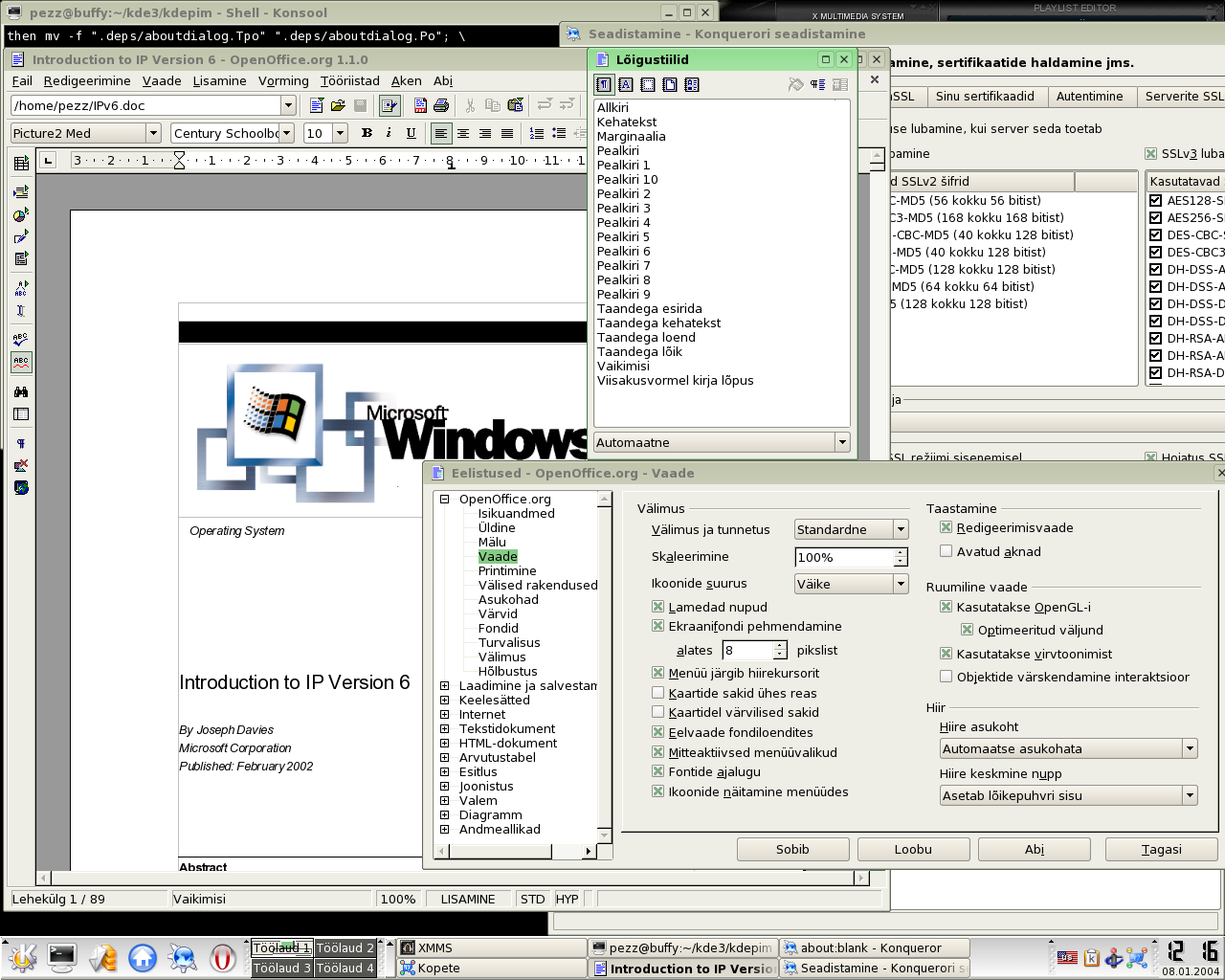
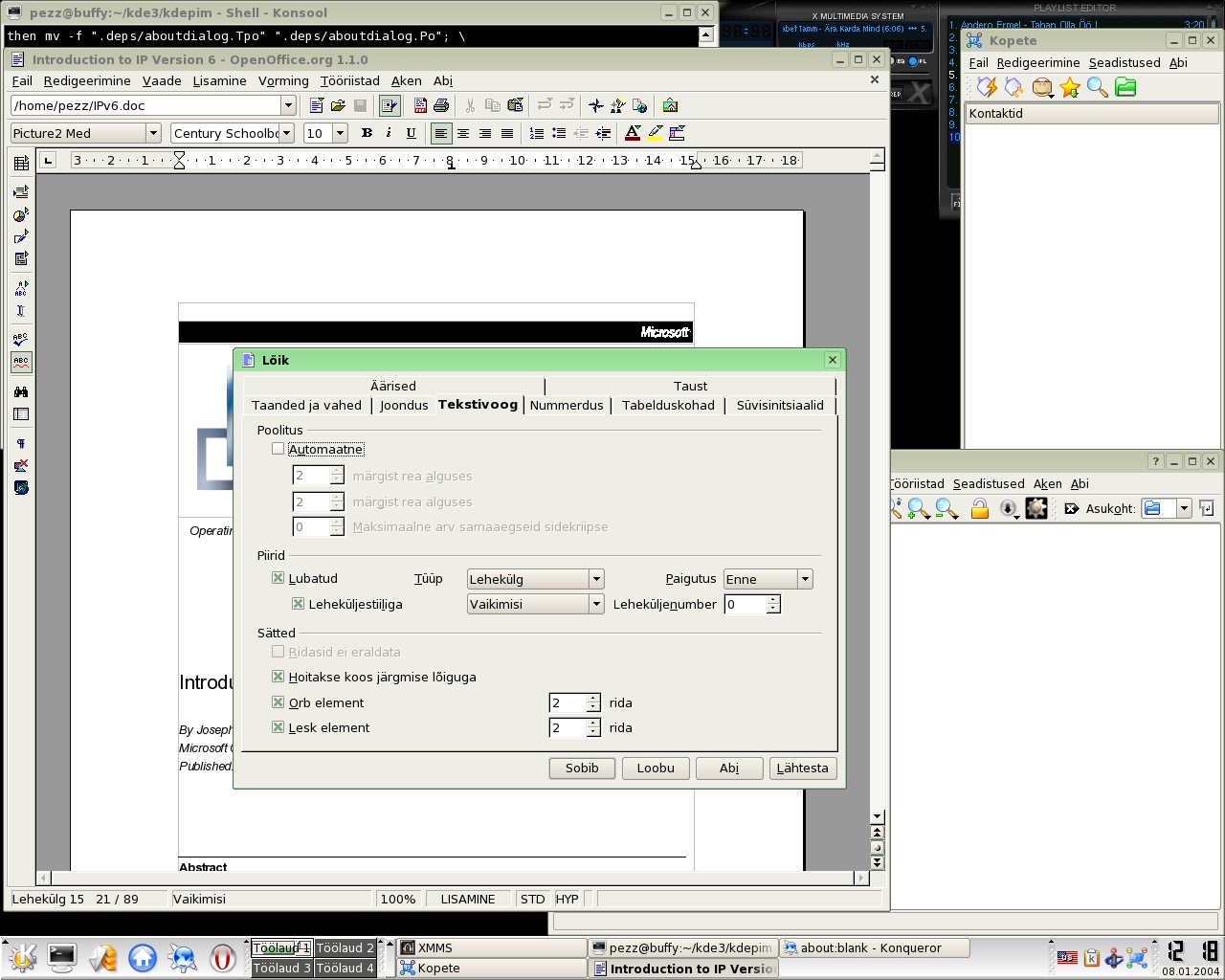
Balinares writes "Great bunch of news on the Linux desktop unification front. After the unification of GTK and Qt themes that Slashdot already reported on, it is OpenOffice's turn to get the unified look treatment (screenshot 1, screenshot 2, screenshot 3). In related news, the recently released QtGTK library allows to merge the Qt event loop with that of GTK. In other words, this means you can now easily use KDE's DCOP, IOslaves, and, last but not least, file dialogs, from inside your GTK apps. (Screenshot of this feature used in XMMS2: 1 2). It comes with a tutorial that explains the basics. Finally, the new fuse_kio tool now makes it possible to use KDE's IOslaves directly at the filesystem level, from any Linux app. 2004 is really beginning well for all those of us who use Linux as their primary desktop!" -
GNOME/KDE Integration Gets A Few Boosts
Balinares writes "Great bunch of news on the Linux desktop unification front. After the unification of GTK and Qt themes that Slashdot already reported on, it is OpenOffice's turn to get the unified look treatment (screenshot 1, screenshot 2, screenshot 3). In related news, the recently released QtGTK library allows to merge the Qt event loop with that of GTK. In other words, this means you can now easily use KDE's DCOP, IOslaves, and, last but not least, file dialogs, from inside your GTK apps. (Screenshot of this feature used in XMMS2: 1 2). It comes with a tutorial that explains the basics. Finally, the new fuse_kio tool now makes it possible to use KDE's IOslaves directly at the filesystem level, from any Linux app. 2004 is really beginning well for all those of us who use Linux as their primary desktop!" -
GNOME/KDE Integration Gets A Few Boosts
Balinares writes "Great bunch of news on the Linux desktop unification front. After the unification of GTK and Qt themes that Slashdot already reported on, it is OpenOffice's turn to get the unified look treatment (screenshot 1, screenshot 2, screenshot 3). In related news, the recently released QtGTK library allows to merge the Qt event loop with that of GTK. In other words, this means you can now easily use KDE's DCOP, IOslaves, and, last but not least, file dialogs, from inside your GTK apps. (Screenshot of this feature used in XMMS2: 1 2). It comes with a tutorial that explains the basics. Finally, the new fuse_kio tool now makes it possible to use KDE's IOslaves directly at the filesystem level, from any Linux app. 2004 is really beginning well for all those of us who use Linux as their primary desktop!" -
MUTE Grows In Popularity, Iterations
jcr13 writes "MUTE is a search-and-download file sharing network that uses ant-inspired routing to make both downloaders and uploaders anonymous. Version 0.2 was released today (change log). Since its mid-December 0.1 release, MUTE has risen from complete obscurity to one of the top-ten most active SourceForge projects. Several people have described MUTE as a "third-generation file sharing network," with the first two generations being Napster and Gnutella (and generation zero being the web---remember when MP3s were traded through web pages?). Each generation circumvents the tactics that the RIAA used to squash the previous generation. Alas, each generation is less and less efficient (though MUTE's dynamic routing works surprisingly well). MUTE was discussed in a previous Slashdot story. Oh, and if you are wondering, it's M.U.T.E., lady, an acronym, not "mute," and we had best not go into it any further."