Slashdot Mirror
Domain: sourceforge.net
Stories and comments across the archive that link to sourceforge.net.
Comments · 31,462
-
Re:OS X and Linux are great alternatives.As well as SpeakUp (http://www.linux-speakup.org/) and EmacsSpeak (http://emacspeak.sourceforge.net/) which give voice access to the Linux console and console applications, newer Linux releases include api-based assistive technology support for applications that use gtk+, mozilla, or Java... via an interface called "AT-SPI" (http://developer.gnome.org/doc/API/2.0/at-spi/in
d ex.html) which very much resembles (but predates) the accessibility APIs used in OSX.
Support for AT-SPI in Qt is slated for a future release of KDE/Qt.
New versions of the Gnome desktop include the built-in gnopernicus screenreader and magnifier, which supports speech, braille, and magnification (http://www.baum.ro/gnopernicus.html), and the gok suite of dynamic onscreen keyboards too (http://www.gok.ca./ There's also another free (as in freedom) screenreader available from ftp.gnome.org, called "orca" - it's a less full-featured offering, but it has scripting capabilities that make it interesting to hackers, and it's written in python.
There are also some speech and magnification utilities included with KDE, thanks to the "KDE Accessibility Project", though they are currently more limited in scope. When support for the AT-SPI is available for KDE apps, all the assistive technologies written to this api should interoperate nicely. I believe that there may be a talking version of konqueror already. There are also projects that provide talking plugins for Mozilla.
Since the GUI-based Linux [and Solaris
Provided the distros recognize the value in all this, we can expect improved testing and support in upcoming Linux distributions.
There is a mailing list available for early adopters of this technology: http://mail.gnome.org/mailman/listinfo/gnome-acces sibility-list
Bill Haneman
Gnome Accessibility Project
FSG Accessibility Work Group
Sun Microsystems Inc. -
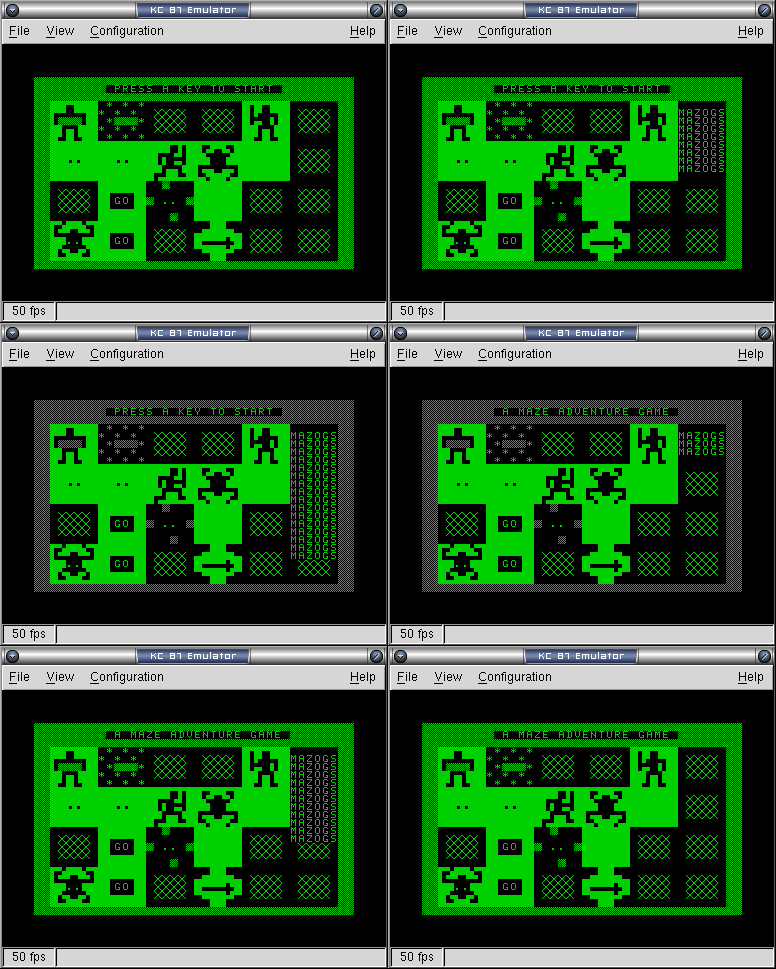
I want my Mazogs!
I want to know when I can run Sinclair Spectrum games on it!
Yes, the ultimate platform for a rousing game of Mazogs.
-
Several ideas
Given the level of your school, I think you should introduce the students to some (semi-) formal methods of designing web sites beside introducing the technologies (DB, CSS,
My suggestions are:
WebML and WebRatio
Additionally (shameless plug), you could introduce some special cases of web design such as the one described here and implemented here. -
Be safe, use a MUTE client
Much safer, these people have been working on this a long time.
Many clients, downloads:
http://www.planetpeer.de/wiki/index.php
or
http://mute-net.sourceforge.net/ -
Re:If there's anything I've learned...
Well, see gEDA for GPL electronic design automation software. In particular, they've been putting some development work into updating pcb, which has been around since the dawn of time. I've used pcb to make a few boards, it definitely has that late-80's X11-Athena feel to it but it's quite versatile once you get used to it.
For dirt cheap PCB fabbing for hobbyists, check out sparkfun's pcb pooling offer. There are also a lot of hobbyist-friendly PCB prototyping services out there, but they're mostly catering to actual engineering shops even if they don't mind working with hobbyists.
-
Re:That logo
help me with the logo, give me another one, make suggestions, give me ideas see alternative logo http://larytet.sourceforge.net/logos.shtml
-
Re:I happen to like non-anonymitythis is http://larytet.sourceforge.net/rodiHash.xml how Rodi Hash file looks like in your browser. this is a table of hosts http://larytet.sourceforge.net/ipRange/ipRanges.x
m l (think about tracker/seed) - immediate result of XML databases.+ ability to use multicast in the future, + signed by DSA 512/1024 packets (optional), + decetralized content search in text/pdf files/meta data.
do not underestimate Rodi. its' about five times larger than just IP spoofing. help it to happen. i invite you to particpate in the success story.
-
Re:I happen to like non-anonymitythis is http://larytet.sourceforge.net/rodiHash.xml how Rodi Hash file looks like in your browser. this is a table of hosts http://larytet.sourceforge.net/ipRange/ipRanges.x
m l (think about tracker/seed) - immediate result of XML databases.+ ability to use multicast in the future, + signed by DSA 512/1024 packets (optional), + decetralized content search in text/pdf files/meta data.
do not underestimate Rodi. its' about five times larger than just IP spoofing. help it to happen. i invite you to particpate in the success story.
-
Re:See also:
You forgot to mention the Freenet project.
-
MUTE
I haven't read how this softare works yet, but I can explain a bit about how a very similar piece of software called Mute works.
The paths between the sender and receiver are of variable length, between 2 and 5 links. If you are C and you receive a query for a file from A, you cannot be sure that A was the start of the chain. More often than not, A was simply forwarding a query from someone else. There is no easy way to see where the query originates from, even if you own a relatively large number of the nodes on the network. -
Re:Bah to your 'Hmph'
-
Isn't this conceptually similar to MUTE?
It seems to me that the anoymizing technique used in Roti is essentially the same as that used in MUTE. Would anyone more qualified than I care to make a comparison?
-
Re:How is this annonymous?
As I understand it this is similar to how Freenet works.
Everyone's requests are bounced around random machines, such that it is impossible (or at least bloody hard) to figure out who is requesting what.
-
Java -- then why not use SWT??...
This seems to be a great app.. but, I am surprised why not many developers are using SWT to improve the GUI. Not to flamebait, but I have used SWT and Swing on Windows/Linux....and prefer SWT. If the developers only target the geek community, I dont see any day to day user trying the app... BTW, on a side note, Azureus (http://azureus.sourceforge.net/) is probably the greatest SWT app written, ever!
-
See also:
Other anonymous filesharing systems currently avaliable/in development
MUTE
ANTS p2p
GNUNet
and not specifically filesharing, but the I2P anonymity layer allows for anonymous bittorrent amongst other things.
Of these, I've found I2P is excellent, although requires a little time investment in setup, and MUTE seems quite promising - speeds are reasonable for an anonymous p2p system, but the user base is currently tiny. I've not had too much luck with ANTS, and haven't tried GNUNet -
See also:
Other anonymous filesharing systems currently avaliable/in development
MUTE
ANTS p2p
GNUNet
and not specifically filesharing, but the I2P anonymity layer allows for anonymous bittorrent amongst other things.
Of these, I've found I2P is excellent, although requires a little time investment in setup, and MUTE seems quite promising - speeds are reasonable for an anonymous p2p system, but the user base is currently tiny. I've not had too much luck with ANTS, and haven't tried GNUNet -
Re:Xbox
Yep Xbox+XBMC
I absolutely love it! (softmodded mine, so didn't even have to buy a modchip)
But as you state: Unless you need PVR...
Which is exactly what I want next
Because I partly blame this story for the rejection of my own, as it happensed exactly half an hour ago:
I'm planning to assemble, install and configure a Mediaportal or MythTv box. I'm mainly interested in the TV-related features: Timeshifting, PVR, On Screen TV Program Guides; though I consider every extra feature a bonus. As for online TV Guides: I'm located in the dutch-speaking part of Belgium (Central Europe). I assume part of the Slashdot community has experience with at least one of the 2. What are the upsides, downsides? Which do you prefer, and why? And last bust not least: Where can one find _decent_ documentation? Ohw, and since I have a WinXP license don't botter argumenting that MythTv is cheaper than Mediaportal because of the OS. -
Re:Graphical History
NetSurf implements a graphical history:
http://netsurf.sourceforge.net/screenshots/ (last screenshot)
We're looking for developers to work on the GTK port, which currently doesn't implement this. -
Making this self-referential ... how about Slash?
Have you contacted the Slash admins about the 78 open bugs and 171 feature requests they have open on their SourceForge page? It would be nice for a project covered on Slashdot to fix bugs or add features to Slashdot.
-
Re:fascinating
Probability models can handle non-exact or "fuzzy" matches just fine. If your corpus includes a phrase like "The shirt costs $20," then the probability that its translation is acceptable for "The blouse costs $30" is higher than that of "Freedom is on the march."
Stochastic models can also deal with idioms for the same reason -- if your corpus includes equivalences between "it's raining cats and dogs" and "il tombe des cordes" then that idiom will be learned.
Word boundaries are usually dealt with by using n-grams. Given knowledge of a language's vocabulary, you pick a size of "n" that serves as a word length. You then identify "words" by sliding a window of size n across the corpus, picking up every sequence of "n" consecutive characters, including whitespace. This avoids the problem of having to devise a great word tokenizer. It's also essential to dealing with ideographic languages or languages, like Thai, in which word boundaries can only be identified with a dictionary.
Alternate character systems are tough. Japanese has three writing systems and it's possible to say "the same" thing in more than one of them. You want a really big corpus -- one that provides coverage of all systems.
Punctuation rules can be dealt with stochastically. In fact they have to -- translation "units" are typically sentences and so you need a model that knows how to find sentences in a given language. At first blush you might think it's just periods, question marks, and exclamation points. But remember that sentences can end with a period. They sometimes end with elipses. Periods are used in addresses (St. Ave.) and in names (Dr. John Q. Blankenship). And quotations sometimes contain question marks and exclamation points.
Sentence segmentation for translation is made even thornier when you consider that it's a many-to-many mapping. That is, one sentence in English might equal three in French. But in Chinese, you might map one sentence to that same English sentence *plus* the one before it.
The problem with using a corpus like UN translator transcripts is that while it's fine for dealing with (reasonably) civil discourse among educated elites, it's less good for learning the argot of Saudi-born terrorists who've been hiding in an Afghani cave for four+ years. Just as there aren't likely to be many Texas-isms or Yorkshire-isms (or whatever dialect you like) in UN transcripts, there sure isn't going to be a lot of coverage for regional Arabic variations. And even if there were, humans will simply change the rules of their spoken language, leaving the MT trainers with no good corpus to feed their models. NSA's onto you because you used the word bomb? Start calling it something else.
There is an open source implementation of the "maximum entropy" approach to statistical natural language processing that is used for systems of this kind. If you're curious, it (and the scientific work on which it is based) would be a good place to start: http://opennlp.sourceforge.net/. -
Re:Won't work.
Audacity http://audacity.sourceforge.net/ does this for you. It will record any output from your sound card and encode it in any formay you want. No cable replugging needed.
-
Regression testing made easySo, everybody who fixes something that (incidentally) affects emission of debug annotations in Gcc has to learn all the idiot formats used in AIX, Solaris, Tru64, PE, and what-have-you just because FSF happens to have those machines?
That's what regression testing is for. It is not unreasonable for any large system to contain a constantly growing testsuite that tests core features of the system. In fact, GCC does have a testsuite, although I don't know how versatile it is. For a compiler suite a reasonable testsuite would contain programs of varying complexity in the source language as well as object files for each valid combination of optimization/feature level and a platform (not a very difficult thing to produce).
The testsuite would then handle each such program in the following manner:
- Compile it using a given optimization/feature level
- Perform a binary diff against the "canonical" object code. Maybe do the same thing for aseembly outputs. Fail if outputs differ.
- Link a program, run it, and compare result to the expected one.
The only challenging part of this process is to "seed" the testsuite with canonical object files: someone would have to either trust a stable compiler version or to proof-read each
Combine the above with a distributed build system (like Tinderbox or CruiseControl) and you've got an automated regression testing system. After that, every applied patch would have to go through this ordeal to ensure that it doesn't break the compiler.
-
Re:Being nostalgic
I remember those days too. I once got to see Chris Goggans (Erik Bloodaxe) and Scott Chasin (Doc Holliday) -- of course, being 13 I was just in awe at the time.
and com programs like Telemate, Procomm, or Qmodem quietly were replaced by Trumpet winsock.
Now that I'm all grown up, I've started bringing the tools of my childhood into the current era. Qmodem(tm) lives again for those of us who want zmodem over ssh with "ANSI color" and usable scrollback -- without having to resort to Xterm.
-
Re:OpenOffice is a Gateway Drug...
I agree. A prime example is Gaim, and it too could be considered a 'gateway drug' to F/OSS.
Now, I don't want to speak for the Gaim devs on this, but IMO, porting it to Win32 has little, if any, effect on it's development. Correct me if I'm wrong, but the main devs and patch writers put it all together and when it comes to release time, one guy compiles WinGaim and works out any Win32-specific bugs as needed. Given, the Windows port can be two or three days later than the *nix release, but as for the progress of the project overall, it certainly doesn't "slow down development and testing."
For more on who-does-what in the Gaim project, go here. -
Dropping Windows compatability
I'm not sure I totally agree with this article - at least as far as Windows porting is concerned.
I second that. The first thing I do on a freshly installed Windows 2003 machine after hardening it for security is to install the GNU tools and vim. That may seem like a silly thing to do but I am familiar with the GNU tools and I think Microsoft made native commandline utilities really suck so it makes life on Windows a little bit more bearable. -
Dropping Windows compatability
I'm not sure I totally agree with this article - at least as far as Windows porting is concerned.
I second that. The first thing I do on a freshly installed Windows 2003 machine after hardening it for security is to install the GNU tools and vim. That may seem like a silly thing to do but I am familiar with the GNU tools and I think Microsoft made native commandline utilities really suck so it makes life on Windows a little bit more bearable. -
Re:Why can't it automatically remove?
It allows people who don't have complete copies of a high-demand file can contribute to the swarm.
You probably haven't used gnutella in over 2 or 3 years. Modern gnutella clients have had partial file sharing for years now that allows people who don't have complete copies of a file to contribute to the swarm, complete with hash checking of each individual piece, not just the entire file (using "tiger tree" hashing or THEX, I think).
Searches are really fast, too, because you can immediately hop on the network and find most anything you need immediately.
That is true thanks to "dynamic querying" that some gnutella clients already have. Dynamic querying helps gnutella clients not waste as much bandwidth on extremely popular searches, so that a lot less of the searches for rare content would be dropped on the network (that would have been dropped from excessive bandwidth usage of popular queries or query replies).
-
I applaud Chuck E. Cheese. More!
I've found it to be one of the few remaining wholesome entertainment palaces for children. Remind you all, "Chuck E. Cheese" is an account held subscribing to the Linux mascott-themed game Tux Racer. Jokes aside, part of the fun in visiting "Chuck E. Cheese" is to see how bad the on-screen party entertainment and employees realy are. I mean, that job has really gotta suck and it is only bearable when paying customers point-out the obvious just as they step on the stage and sing annoying songs to hyperactive children spilling food and rubbing snot over every inch of the table. They clean it all up...without a tip other than "bye". Muah ha ha ha! Anyone have any similar fassion to share on their exploits, other than poking fun at the especially gifted children?
-
Re:Windows and Linux
Actually it's much easier than that. Download and install two files from http://gimp-win.sourceforge.net/stable.html, one for GTK and one for The GIMP, and you're ready.
Still too hard for most users. Finding an obscure program from an obscure website when they could've just popped in the Linux install disks and gone to town?
Disclaimer: I'm an OS X user, which is (IMNSHO) still the best choice, especially for the kinds of users we seem to be talking about. -
Re:Like it ot not,
.NET is the most advanced RAD environment on the market today. It's a joy to program in, and it's so well designed that in 99.5% of cases you don't even need documentation. Things are just done the way they should be done.
The only downside is that
You have got to be fucking kidding. Microsoft
Then there is Windows.Forms. If you used it, you probably know how much of a piece of crap it is. No ability to do input masks on textboxes (corrected in 2.0, which isn't here yet), and all kinds of weird issues like keyboard and mouse controls for a treeview not working well together. It's as if they expect you to resort to writing Win32 libraries instead of using pure
It's typical of Microsoft to put out a half-assed product and hype it up. It's sad that all the PHB's thought it was a usable system and have pushed for using it in projects.
Take a good look at what's going on the Java world, especially in open source. -
peep!
There is an audio network status tool called peep.
http://sourceforge.net/projects/peep/
Give it a try!
Back in "the day" we used to put an AM radio on top of the IBM 1130 and listen to the resulting noise to determine if the programs were working properly. Every program had a different sound and every phase of operation of each program was usually discernible from the sound. -
Re:How Intel AMT really works. Some info
Additional note: there is some Linux support for this, including ipmitool, which lets you send system management commands to remote machines. AMT-equipped machines may respond to that tool. Somebody should test this.
-
Yeah
I've only been monitoring this sort of thing with EtherApe for about 4 years now.
http://etherape.sourceforge.net/ -
Watch the grandsons infections
On our home network I watch the infections eminating from the grandsons Windoze gaming boxen with etherape - http://etherape.sourceforge.net/ it's not a desktop background, but it's cool (the grandson reckons its sick)
-
Re:Sales.
The TCG is about open'ness, and you can even download code from IBM
at SourceForge FREE!...
http://sourceforge.net/projects/trousers
TC has not hit the big top because linux is secure and for one, the NSA is
making security advancements free on the website: http://www.nsa.gov/selinux/index.cfm.
Intel wants to gain back some market from AMD, by DRM they hope !. -
Problem Solved
First, get Azureus Java BitTorrent Client.Now, help yourself to whatever 3D modelling apps you like!
Can't find what you want? Go to:
http://www.torrentsearch.us
http://www.mininova.org
http://www.torrentreactor.net
and you're golden. Enjoy!
-
Mouse
Moving your mouse around for a minute should be enuff, sure it takes a bit, but so does setting up a mic and getting styrophome.
IMagine how many time the mouse changes direction, and how many different spots u can hit in 60 seconds, I dont think ne1 could reproduce that. I remember Waste(http://waste.sourceforge.net/) asked me to move my mouse around to generate a 1024, or 2048 bit key, have fun cracking something that huge, takes long enuff to crack 128 bit. -
Re:Windows and Linux
Sure you could install Gimp on WinXP, but you'd need to compile and install GTK+ and then compile and install Gimp.
Linked from the gimp website is http://gimp-win.sourceforge.net/ which has binaries for windows including the gtk binaries. -
Re:Off topic (your sig)
Heh..
I actually realised that you meant it as a joke. But I wanted to see if there was a serious and thought out opinion behind it.
I also wanted to know if the comment mainly was against Visual Studio (Anti MS), or code generation using XML and XSLT.
Code generation is not the solution for everything. But there are some places where it makes sense. I could go on, but you can take a look at the link below. It is a short read with my take on it.
http://vsxgen.sourceforge.net/whentousecodegen.htm l
The reason I'm basing it on XML and XSLT is because that is a stable, widespread and powerful technology. And it is also a technology where your knowledge about it can be used for many other things. It is win-win.
The tool came about because I wanted to generate some code. I downloaded CodeSmith and although it is a great tool it has a special code generation language that I don't want to spend time to learn and that locks you into using CodeSmith.
That's why I built my own simple tool.
Sorry for boring you to tears with a subject that interests me. -
Re:The KEDIT editor
try THE: "THE is a powerful text editor modelled on the VM/CMS text editor XEDIT with the best features of Mansfield Software's Kedit"... http://hessling-editor.sourceforge.net/
-
Apple Mac USB support
I've done lots of driver development on various machines (linux, solaris, OSX, vxWorks), and my favorite for general hacking has been OSX. Besides the traditional OS-level drivers, it also allows user-level USB drivers. I use the user-level access for my projects and it provides simple no-hassle operation. The code is still limited by the user's permissions, but I don't need access to other system resources. The windows equivalents need to rely on libusb, a generic os-level driver that passes user-level commands through to the USB device. Because of window's USB driver model, though, libusb can only work for one device type and must have the VID/PID's set before installation. OSX is much simpler when you need to write a hack that modifies a device's PID - it doesn't need another driver installation to continue talking with the device.
Actually, vxworks was the easiest to write drivers for, but since it is an embedded OS with no distinction between user code and OS (they share the same namespace!), it doesn't really count. -
Re:F/OSS = Popularity
So to me the question is: who's going to care enough about mundane, boring, business-rules based code to keep it up to date? Certainly not me -- not for free. And therein lies the limits of F/OSS.
Ironically if anybody is going to grow OSS, it's large businesses. Some businesses see value in using some OS code for their own use and returning some of their own code to the wild. Open Sourcing some software allows it to be developed without having to pay programmers for all of the work. Or perhaps the company views releasing their code for code they use to be a form of barter. It won't really work for all types of software, but some are very amenable to this treatment.
I suppose the other place that OSS will continue to be extended is in universities. OSS projects make the perfect starting point for many research projects, thesises, etc. And not just within comp sci. ESRI, the de-facto standard in GIS software, was originally started by a couple of landscape design students (It's definately closed source, but just shows that other academic disciplines are very computer savy and reliant.) And a school's own payroll, record keeping, accounting, etc etc seems like a good place to start rolling business oriented software, and it might make sense to make it OSS as schools really are supposed to be contributing to the general knowledge base, not fighting over every scrap of IP they can get their hands on.
I know many biology teachers, especially in the field of conservation, use and contribute to open source software in their field. Just take a look at these pieces of software. I personally like the summary for Sashimi: Looking for a way to interpret the mass spectrometry (MS) data from your last proteomic experiment? Need to quantitate proteins in your ICAT sample? Want some help choosing the correct protein/peptide assignments? What are you waiting for?!?!
Another organization that seems like they should be amenable to open source, but I personally haven't seem much of is libraries. They do a lot of behind the scenes tracking of data and just plain providing terminals for patrons to work on. I'd think that OSS would tie in brilliantly with their philosophy (and budget) but somehow most libraries just don't seem to have been infected with the meme yet. -
Re:F/OSS = Popularity
So to me the question is: who's going to care enough about mundane, boring, business-rules based code to keep it up to date? Certainly not me -- not for free. And therein lies the limits of F/OSS.
Ironically if anybody is going to grow OSS, it's large businesses. Some businesses see value in using some OS code for their own use and returning some of their own code to the wild. Open Sourcing some software allows it to be developed without having to pay programmers for all of the work. Or perhaps the company views releasing their code for code they use to be a form of barter. It won't really work for all types of software, but some are very amenable to this treatment.
I suppose the other place that OSS will continue to be extended is in universities. OSS projects make the perfect starting point for many research projects, thesises, etc. And not just within comp sci. ESRI, the de-facto standard in GIS software, was originally started by a couple of landscape design students (It's definately closed source, but just shows that other academic disciplines are very computer savy and reliant.) And a school's own payroll, record keeping, accounting, etc etc seems like a good place to start rolling business oriented software, and it might make sense to make it OSS as schools really are supposed to be contributing to the general knowledge base, not fighting over every scrap of IP they can get their hands on.
I know many biology teachers, especially in the field of conservation, use and contribute to open source software in their field. Just take a look at these pieces of software. I personally like the summary for Sashimi: Looking for a way to interpret the mass spectrometry (MS) data from your last proteomic experiment? Need to quantitate proteins in your ICAT sample? Want some help choosing the correct protein/peptide assignments? What are you waiting for?!?!
Another organization that seems like they should be amenable to open source, but I personally haven't seem much of is libraries. They do a lot of behind the scenes tracking of data and just plain providing terminals for patrons to work on. I'd think that OSS would tie in brilliantly with their philosophy (and budget) but somehow most libraries just don't seem to have been infected with the meme yet. -
Re:This proves only one thing
In order not to lose perspective.
It is annoying but true as PC computer (not console) goes - Windows has the vastest set of games available.
Mega-corps wishing to push Linux to the "family" desktop, should stop being so obstinate and realize they must invest in Game Development.
I run Linux - it's OK I like it.
I would have a mac-mini, if I had spare money, since I like making web pages accessible to all.
Otherwise I might get round finalizing the installation of this some day.
It's just hard or I am being lazy (or both) -
Re:Windows and Linux
I'm still looking for a decent text editor(!?!), media player
Try looking at SciTE. It's for Win32 and Linux, free, open, blah blah. I use it for a variety of things, mostly scripting and programming and it does a very good job. Very configurable.
For a media player, I'm not sure what you have against WMP 10, but I will admit occasionally I've come across a video that doesn't play quite right (a small problem with the encoding I've found usually). When this happens I try Media Player Classic. It's a revamped version of WMP 6.4 (many say the best version of WMP released, ever). It supports all the installed codecs and DirectShow like WMP 10. If that still doesn't do it for you, try out some that others posted. -
IBM and the Rexx Lang Assoc.
have made Rexx open source: get yourself some of that here
-
Re:Windows and Linux
No, it doesn't have rudimentary support for msn webcams in the latest release. They're waiting on farsight, which looks rather over-engineered and will likely take ages to finish.
You can blame it all on GStreamer.
-
Re:Windows and Linux
I think gaim-vv has rudimentary support for MSN webcams.
From glancing at the forums, it's probably flaky as hell just now, and probably not entirely easy to set up, but at least progress is being made. If MSN webcams is your idea of progress, that is. -
Re:Well you are just going to have to innovate!
And if you're a shrink wrap house, you'll pay these high IQ salaries with... what exactly? If you *do* come up with something great, you'll have 100 SourceForge copycats within a month and they will erode your market.
F/OSS is the great poison pill of software. If anyone comes out with something that is good (and it isn't you), then just put some effort into a F/OSS "alternative" and poison the whole market... basically make it where if *I* can't make any money in that market, then no one will.That isn't quite correct. If someone comes up with a nifty utility to base their business on, then yeah, the OSS community will duplicate it in no time, but then, so will commercial vendors.
It seems most of these complaints come from companies who charge money for the most trivial of crap, such as this password generator. Nevermind that it has one of the worst user interfaces ever designed (look at that screenshot), it's a freaking PASSWORD GENERATOR! Trivial software is trivial to reimplement. It's offensive that someone would even charge money for this.
Now if a company develops something non-trivial, for which there aren't already a thousand similar products, this shouldn't be a problem. For example, just try finding an F/OSS product that can compete with 3D Studio Max or Maya. Blender isn't even in the same league. Photoshop? The Gimp is neat for web logos or hobbiest graphics, but doesn't even fully support the most fundamental Photoshop features such as native CMYK color.
Siebel Systems makes non-trivial software, but it is only non-trivial in that it is large. It isn't innovative; it's just a lot of work. I don't know of any OSS products that compete with, for example, their customer management software, but if there are, I would not doubt that it is because Siebel's stuff sucks (I've used it), and some smart developer got fed up and decided to show Siebel how it's done. If they do a better job, should we feel sorry for poor Siebel for losing revenue to the F/OSS guy, or should we root for the OSS project because any multi-billion dollar company which can't make a better project than a handful of F/OSS programmers needs to die?
Another example is the game market. There are neat OSS technologies such as the Irrlicht engine, but Itari and Blizzard aren't exactly concerned about F/OSS games taking over their market. When's the last time you played an open-source game which was even comparable to Farcry, Starcraft, or Alpha Centauri in terms of refinement, scale, and fun factor?
With all that said, I don't see how F/OSS is any different than another commercial competitor. An intelligently run business targets their product to account for competitors' weaknesses and tries to downplay its strengths. Seems to be working for Microsoft, and every single one of their core products have powerful and mature F/OSS competitors, yet their revenue has grown every year.
Specifically, the F/OSS community may be great at making low-level technical stuff, such as libraries, web servers, and DBMS software, but it isn't very good at polishing user interfaces (compare Visual C++ to KDevelop or Anjuta, though this being Slashdot will probably prefer the latter two regardless), at making high-end enterprise software (MySQL is neat but it can't even touch Teradata), or making the absolute highest-performance software (Apache is sort of fast, but Zeus and even recent versions of IIS can blow it away, especially in static page serving [That said, most corporations are even worse at making performance software, using bloatware tools such as MFC to make bloatware apps such as Norton Utilities]).
In short, the reasons given sound like the kind of reasons given by the kind of companies that make password generators or horribly poor quality customer management software and then complain that the F/OSS community is stealing your marketshare. Hell, -
Re:Windows and Linux
Well, I'm sorry but I find it fair. When you install your WinXp system, how do you process images? The only tool you got is MS Paint, unless you want to pay some £500+ for photoshop.
Or install The GIMP.
On the other hand, on Linux you got Gimp which is included on your installation, is on par with photoshop and costs nothing.
Sure you could install Gimp on WinXP, but you'd need to compile and install GTK+ and then compile and install Gimp. That's too much for most average users.
Actually it's much easier than that. Download and install two files from http://gimp-win.sourceforge.net/stable.html, one for GTK and one for The GIMP, and you're ready.