Slashdot Mirror
Domain: spaceflightnow.com
Stories and comments across the archive that link to spaceflightnow.com.
Stories · 128
-
Satellites Mating Via Robotic Arm
Roland Piquepaille writes "The launch of the Orbital Express mission, with its two satellites ASTRO and NextSat, the first one servicing the other, was widely covered a month ago. But what is happening in space now? In 'Robotic satellite servicer rehearsal underway in orbit,' Spaceflight Now reports about the progress done. A week ago, the two satellites were able to link to each other to operate the first transfer of hydrazine fuel from ASTRO's propellant tanks into NextSat. This weekend, ASTRO's ten-foot-long robotic arm is going to be used to move objects to NextSat. But what does it mean for international satellite operators when they need help with their space birds? Will they use a system designed for U.S.'s DARPA? " -
SpaceX's Falcon Launches... Sort Of
JHarrison writes "Spaceflight Now is running a story on the SpaceX Falcon 1 launch yesterday. Those of you watching the stream will have no doubt noticed the telemetry failure at 04:50, and turns out that was more than them turning the webcast off.. "A year after its maiden flight met a disastrous end, the SpaceX booster lifted off at 9:10 p.m. EDT (0110 GMT Wednesday) from a remote launch pad on Omelek Island, part of a U.S. Army base at Kwajalein Atoll in the Marshall Islands. Controllers lost contact with the Falcon during the burn of the second stage that would have placed the rocket into orbit around Earth. "We did encounter, late in the second stage burn, a roll-control anomaly," Elon Musk, founder and chief executive officer of Space Exploration Technologies Corp., said in a post-launch call with reporters. Live video from cameras mounted aboard the rocket's second stage showed increasing oscillations about five minutes after liftoff, just before the public webcast was cut off. The rolling prevented the necessary speed to achieve a safe orbit, instead sending the stage on a suborbital trajectory back into the atmosphere."" -
Space Telescope Catches Monster Flare
gollum123 writes, "NASA's Swift satellite has seen a giant flare explode from a nearby star. Our sun also flares when twisted magnetic field lines in the solar atmosphere suddenly snap — but this was on a far larger scale, perhaps 100 million times as strong. The energy released by the explosion on II Pegasi was equivalent to about 50 quintillion atomic bombs. If the Sun were ever to produce such an outburst, it would almost certainly cause a mass extinction on Earth. II Pegasi is a binary system 135 light-years from Earth in the constellation Pegasus. Its two stars are close, only a few stellar radii apart; as a result, tidal forces cause both stars to spin quickly, rotating in lockstep once in seven days compared to the Sun's 28-day rotation period. Fast rotation is thought to be conducive to strong stellar flares." -
Space Station Gyro Problem Dangerous?
mysterystevenson writes "After bringing more mass than ever before up to the ISS, one of the gyros has failed. Gyros help maintain attitude position in space; the more mass needed to be controlled, the more force that is exerted on the gyros. Now there is the danger that the Shuttle may be bringing yet more mass and starting construction while turning off another gyro, which could cause a need for thrusters to maintain attitude. The assemblies are not all constructed to be able to withstand such force and in a bad situation there could be a collapse which could affect the Shuttle and the ISS as well. Worse case could be total loss; a wise idea might be to alter the construction schedule and address the Gyro and Gyro design problems, before going forward with the introduction of more mass." -
NASA Finds 4-5" Crack in Shuttle Insulation
PresidentKang writes "Spaceflight Now is reporting that a large crack has been found in an external tank foam of Space Shuttle Discovery on the launch pad. According to the article: "Engineers inspecting the shuttle Discovery's external tank following Sunday's launch scrub found a crack in the tank's foam insulation near a bracket holding a 17-inch oxygen feed line in place. Some engineers believe the crack must be repaired but senior managers say a variety of options are on the table, from fly as is to making repairs."" -
NASA Finds 4-5" Crack in Shuttle Insulation
PresidentKang writes "Spaceflight Now is reporting that a large crack has been found in an external tank foam of Space Shuttle Discovery on the launch pad. According to the article: "Engineers inspecting the shuttle Discovery's external tank following Sunday's launch scrub found a crack in the tank's foam insulation near a bracket holding a 17-inch oxygen feed line in place. Some engineers believe the crack must be repaired but senior managers say a variety of options are on the table, from fly as is to making repairs."" -
NASA To Retire Atlantis by 2008
SirBruce writes "As reported by Space.com, Spaceflight Now, and elsewhere, NASA is now planning to retire the Space Shuttle Atlantis by 2008, after just 5 more flghts. By doing so, they would avoid a costly and time consuming scheduled overhaul, and could still fly the remaining 12 missions (17 total) with Discovery and Endeavour, which are just now completing their ODMPs (orbiter maintenance down period). Atlantis would be kept for spare parts to keep Discovery and Endeavour flying until the shuttle program is shut down in 2010." -
Future of Hayabusa Asteroid Probe Looks Bleak
mj_1903 writes "After landing, then not landing, then potentially landing on an asteroid it appears as though the Japanese spacecraft may have collected specimens of the asteroid. Unfortunately a host of problems is continuing to plague it including a lack of fuel, a shutdown of part of the chemical orientation system, a complete failure of the flywheels and communication issues. The Japanese team are however not giving up on it and are still hopeful that they can return it to the earth in June of 2007." -
SpaceX announces new Falcon 1 launch date
mj_1903 writes "In an extremely frank and open post, SpaceX has announced that the maiden flight of their totally private spacecraft will be held no earlier than the 20th of December. They also outline the mistakes that kept them on the ground including leaving a small valve open that allowed precious liquid oxygen to boil off and the difficulties in getting oxidiser to a remote site. More coverage at Spaceflight Now." -
ISS Orbit-Raising Attempt Fails
hpulley writes "ITAR-TASS reports that the Progress cargo ship currently docked at the ISS attempted an orbit raising burn this morning but the engine failed three minutes into the firing. Further burns are cancelled until they figure out the problem and meanwhile, the station continues to lose approximately a kilometer of altitude every week, with the rate increasing as the orbit decays. At present, the schedule says the next Progress, 20P, will be launched on December 21st, nearly 9 weeks from now. Normally the shuttle would also raise the orbit of ISS but it is not scheduled to launch until May 3rd at the earliest. Nominally the ISS orbits at 358km but if it drops to 300km, it may decay in a matter of days. It was down to 340km already on October 13th." -
Maps Show Mars Was Once More Like Earth
vrioux writes "NASA scientists have discovered additional evidence that Mars once underwent plate tectonics, slow movement of the planet's crust, like the present-day Earth. A new map of Mars' magnetic field made by the Mars Global Surveyor spacecraft reveals a world whose history was shaped by great crustal plates being pulled apart or smashed together. ." -
First modernized GPS satellite Launched
A reader writes "The first GPS 2R-M satellite has launched from Cape Canaveral, Florida on top of a Boeing Delta 2 rocket. The government is now competing with Europe's Galileo system, and has added two additional military channels and one civilian channel, which will increase the accuracy and performance of GPS - as well as increase its resistance to jamming." -
First modernized GPS satellite Launched
A reader writes "The first GPS 2R-M satellite has launched from Cape Canaveral, Florida on top of a Boeing Delta 2 rocket. The government is now competing with Europe's Galileo system, and has added two additional military channels and one civilian channel, which will increase the accuracy and performance of GPS - as well as increase its resistance to jamming." -
Mars Orbiter Launch Delayed
Mictian writes "NASA's newest Mars probe, Mars Reconnaissance Orbiter (MRO), was originally scheduled to be launched from Kennedy Space Center Wednesday morning atop an Atlas 5 rocket. However a potential problem with the Atlas' Redundant Rate Gyro Units (RRGUs), that are part of the vehicle's flight control system, detected at Lockheed Martin's factory has caused the engineers to make sure that the two RRGUs in MRO's rocket are working, thus delaying the launch at least until Thursday morning. There is a 1.5 hour launch window daily until the end of the month." -
Mars Orbiter Launch Delayed
Mictian writes "NASA's newest Mars probe, Mars Reconnaissance Orbiter (MRO), was originally scheduled to be launched from Kennedy Space Center Wednesday morning atop an Atlas 5 rocket. However a potential problem with the Atlas' Redundant Rate Gyro Units (RRGUs), that are part of the vehicle's flight control system, detected at Lockheed Martin's factory has caused the engineers to make sure that the two RRGUs in MRO's rocket are working, thus delaying the launch at least until Thursday morning. There is a 1.5 hour launch window daily until the end of the month." -
Falling Window Cover Damages Discovery
Mz6 writes "At 5:30PM EDT, one of the space shuttle's protective window covers fell and struck the left Orbital Maneuvering System engine pod on Discovery today. The window cover hit the carrier panel around the OMS pod. NASA is taking a new panel to the launch pad to replace the one hit by the falling cover. NASA is expected to know by 7 PM EDT if the replacement panel will work and whether launch can proceed tomorrow as planned. The window cover in question is from one of the overhead windows. It fell on its own, not when workers were handling it. The cover was found after it had fallen and hit the orbiter. In addition to the carrier panel that workers plan to replace tonight, engineers are looking for any other damage." Update: 07/13 02:03 GMT by T : RmanB17499 points out a CNN story according to which "the launch of the space shuttle Discovery will go ahead as scheduled Wednesday after technicians replaced two protective tiles damaged near the spacecraft's tail Tuesday, a NASA spokeswoman said." -
Crack Found in Shuttle Tank
hpulley writes "The shuttle's new fuel tank, supposedly redesigned to be safer, has a crack in it. Pictures were sent to the manufacturer who decided that it is too small to be worrisome. Hmm, what caused the Columbia disaster, pieces of foam? Meanwhile, there will be a second shuttle on standby, just in case the first one has problems after being hit by foam, etc. If the first shuttle has a design flaw, what's to say the second one isn't afflicted by the same problem? Won't there be a good chance of them stranding the rescue crew in addition to the original crew? If an aircraft crashes and the redesign to fix it crashes, would you send another of the same type to rescue it? Of course not! The ISS is going to be a smelly, scary place with the regular complement and two shuttle crews onboard and no way home but a Russian Soyuz capsule that isn't slated to launch again until September and has seats for just three..." -
Orbital Resort to Launch by 2010
Neil Halelamien writes "Popular Science has a cover feature on self-made billionaire and space enthusiast Robert Bigelow (who's been mentioned before on Slashdot). The article has new info on Bigelow's plans to launch a 'CSS Skywalker' orbital resort by 2010 and sell space habitats to others, such as scientists, manufacturers, Hollywood producers, and countries. The habitats will be made of inflatable modules with multilayered kevlar-like walls. A prototype habitat will be launching on a SpaceX Falcon V next year. To help ensure cost-effective access to the station, Bigelow is also running the $50 million America's Space Prize. In the long run, he plans to use the modules as the basis for space yachts and moon cruisers." -
A Star of Space and Film
Rollie Hawk writes "Three years ago, light from V838 Monocerotis (a star about 20,000 light years from us) reached the Earth that showed the star exploding. The more politically correct term for what happened is "stellar outburst." In the time since, images from a pulse of light released during the outburst have been arriving here on Earth. In October of 2004, Hubble captured a beautiful image of the scene with the pulse lighting up interstellar gasses that encapsulated the area around this red giant (a star 600,000 times brighter than our Sun). The release of this photo just days ago seems rather timely, as it appears that some of Hubble's funding may be cut in the near future. There is also talk of eliminating the program entirely." -
Top 10 Scientific Advances of 2004
TarrVetus writes "Science Magazine's The Top Ten Science Breakthroughs of 2004 have been announced. The winner: The NASA Rovers and their evidence of water on Mars. The runner up was the Hobbit species found in Indonesia. Other breakthroughs include cloned human embryos and the first discovered pulsar pair." -
Satellite Loaded With AI For Self-Diagnosis
TheReckoning writes "NASA has loaded its E0-1 Satellite with Artificial Intelligence to diagnose on-board failures. The software 'works by comparing a computerized model of how the spacecraft's systems and software should perform against actual performance. If the spacecraft's behavior differs from the model, then the ... "reasoner" looks for the root cause of this difference and gives flight controllers several suggestions of what might have gone wrong.' Another NASA probe loaded with AI was Deep Space 1." -
Details On Inflatable Space Modules
Decibel writes "Although it's been mentioned on Slashdot twice now, this article contains more details about Robert T. Bigelow's plan to orbit massive inflatable space habitats, with the first test modules to be launched next year. It also details the $50 million "America's Space Prize", with the objective to "spur development of a low-cost commercial manned orbital vehicle capable of launching 5-7 astronauts at a time to Bigelow inflatable modules by the end of the decade."" -
Antarctic Telescope?
angkor pastes "'A novel Antarctic telescope with 16-m diameter mirrors would far outperform the Hubble Space Telescope, and could be built at a tiny fraction of its cost, says a scientist from the Anglo-Australian Observatory in Sydney, Australia.'" -
Messenger En Route To Mercury
Soft writes "NASA's Messenger space probe has lifted off on its second try on a Delta 2-Heavy rocket. As mentioned earlier on Slashdot, it is poised to orbit Mercury in 2011 after three flybys, as well as two flybys of Venus and one of Earth for course corrections. It will be the first probe to visit the innermost planet since Mariner 10 in 1974 and 1975. Stories on the BBC and SpaceflightNow." -
ISS Spacewalk Cut Short
RobertB-DC writes "The spacewalk that was intended to replace a balky power supply ended almost before it started, according to Spaceflight Now's Mission Status Center play-by-play. The Russian Orlan spacesuit worn by US astronaut Mike Fincke developed a problem with its oxygen supply (!), forcing both spacewalkers back to the airlock after less than 15 minutes. Mission control and the ISS crew are still debating what to do next." -
NASA Seeks Proposals For Hubble Robotic Servicing
hcg50a writes "SpaceFlight Now has an article about NASA asking for proposals to mount a robotic mission to service the Hubble Space Telescope. Such a Hubble-servicing mission would occur toward the end of calendar year 2007. If you like politics mixed with your spaceflight, you can read NASA Administrator O'Keefe's speech in which the announcement was made." -
Cassini Alters Path. Phoebe Now In Sight!
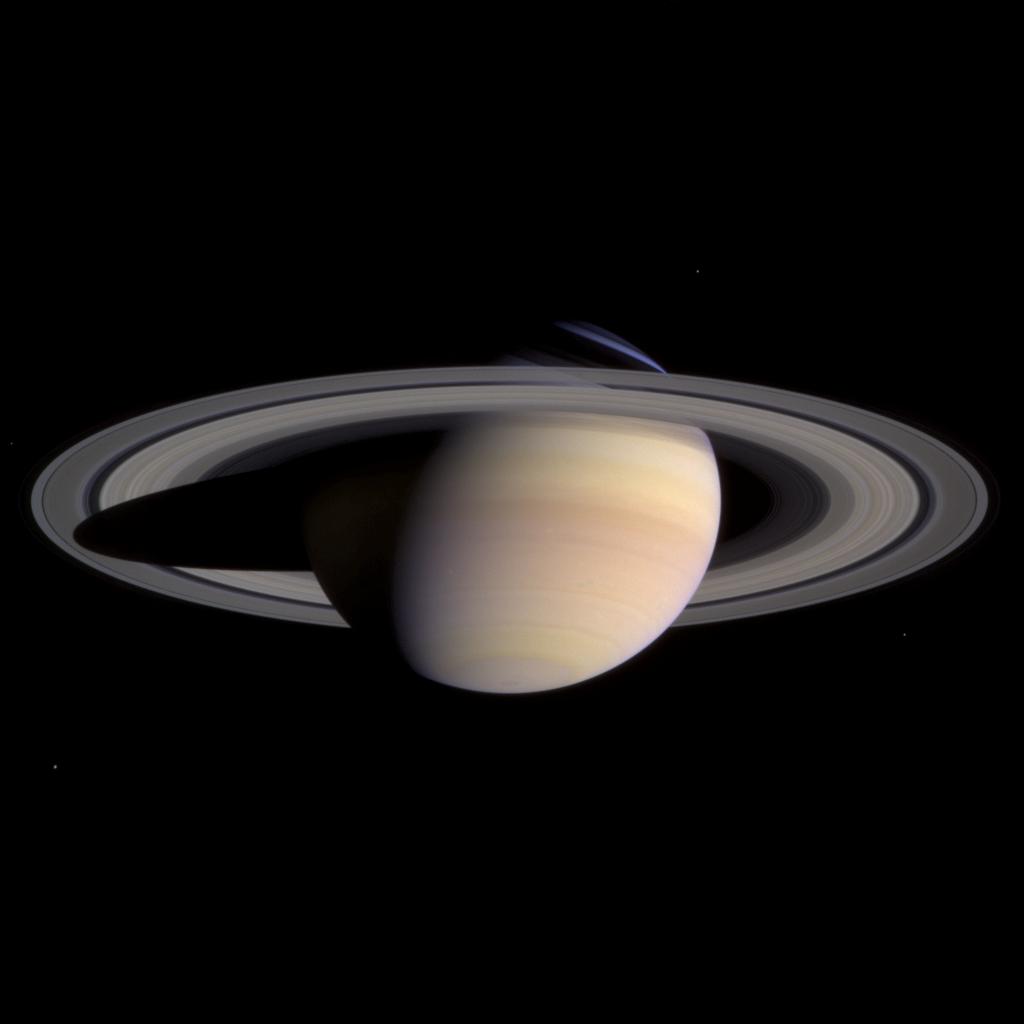
Anonymous Explorer writes "This week the Cassini-Huygens Spacecraft finally entered the Saturn system and made its first main-engine burn in five years in preparation of for the Phoebe flyby. This long journey has been one filled with much promise and peril. Launched in 1997, Cassini is expected to have a rendezvous with the moon Phoebe on June 11. For those of us who are lazy, that's just a tad under two weeks away. After the Phoebe flyby, it's on to the ringed planet, with an anticipated July 1 ground orbit insertion. The ESA's Huygens probe will descend into the atmosphere of Titan a few months after Cassini is inserted into orbit. This mission promises to be one that brings a very psychedelic and beautiful area of our solar system into clearer focus. This multinational mission is one the most ambitious scientific explorations yet undertaken and promises some truly otherworldly images in the near future. With 31 moons/natural satellites thus far discovered orbiting Saturn, there should be a lot to keep us occupied. Anyone else excited about the journey to a ringed world? Lets all enjoy this ride. It promises to be a unique one as much as for the scenery as for the science. Informal discussion regarding the Cassini-Huygens mission can be found at #cassini on irc.freenode.net." -
Mercury Probe Delayed by Ten Weeks, and Two Years
Gogo Dodo writes "Spaceflight Now reports that NASA's MESSENGER probe launch has been delayed by 10 weeks. Unfortunately, this means MESSENGER will not arrive at Mercury until 2011, a two year delay." -
Spirit 'Will Be Perfect Again'
G. Holst writes "NASA technicians are preparing to wipe Spirit's flash memory clean of science and engineering files that have stymied its software. The fix, likely to be made Friday, could completely restore Spirit. "I think it will be perfect again," says the Mission Manager. Chalk this one up for earth!" There are numerous stories about Spirit and Mars: one describes being careful with rm -rf. Reader Tablizer sends in an interesting site: "I discovered Bill Momsen's website where he describes his experiences working on the first successful photographic mission to another planet: Mariner IV to Mars." -
Mars Landers - Opportunity, Bedrock, Aerosmith?
Iphtashu Fitz writes "As was reported last week, the first Mars rover Spirit had some communications problems that the folks at the JPL have finally managed to trace to problems with its flash memory. Reuters is reporting that Opportunity seems to be having some power-related problems, too. It appears a faulty thermostat is turning a heater on overnight without being told to do so. While NASA isn't concerned about the rover overheating, they're exploring the long-term effects of continued power drain on the second rover." The article also notes: "The first three-dimensional, panoramic images beamed back from Opportunity showed an intriguing outcrop of exposed bedrock" - there's now a color version of the same image. Finally, lightwaveman points to the Spaceflight Now status page regarding new priorities for the Mars mission: "The airing of today's Mars rover news conference is being delayed on NASA TV to show the band Aerosmith touring International Space Station Mission Control at Houston's Johnson Space Center." -
Mars Landers - Opportunity, Bedrock, Aerosmith?
Iphtashu Fitz writes "As was reported last week, the first Mars rover Spirit had some communications problems that the folks at the JPL have finally managed to trace to problems with its flash memory. Reuters is reporting that Opportunity seems to be having some power-related problems, too. It appears a faulty thermostat is turning a heater on overnight without being told to do so. While NASA isn't concerned about the rover overheating, they're exploring the long-term effects of continued power drain on the second rover." The article also notes: "The first three-dimensional, panoramic images beamed back from Opportunity showed an intriguing outcrop of exposed bedrock" - there's now a color version of the same image. Finally, lightwaveman points to the Spaceflight Now status page regarding new priorities for the Mars mission: "The airing of today's Mars rover news conference is being delayed on NASA TV to show the band Aerosmith touring International Space Station Mission Control at Houston's Johnson Space Center." -
Mars Rover Opportunity Lands Safely
JoeRobe writes "All indications are that the Mars Exploration Rover Opportunity has safely landed on Mars. After 10 minutes of bouncing and rolling, it has come to a rest and transmitted its signal. There are no fault tones, indicating that there were no errors during landing and rolling. The rover has landed in the Meridiani Planum, where there are large deposits of hematite, indicating the presence of past water. The lander has landed on one of its side petals, so the next step is to make itself upright and deflate its airbags." And loconet writes "Reuters and abc.net.au, among others, are of the first news sources to confirm that Opportunity has successfully landed on Mars. The probe had successfully made contact with controllers on Earth after landing at 0505 GMT on Sunday in an area of the planet known as the Meridiani Planum. The landing procedures achieved a best-case scenario on which all systems performed as expected. At first, engineers thought the lander had been rolling for a long time, but it turns out the antenna used to communicate with Earth was pointing towards the ground, which made the signal bounce off Mars and as the Earth moves, made it seem as if it had been bouncing for over 5 minutes. The lander is currently side petal down, and will take a while before it straightens itself out. California's governor Arnold Schwarzenegger and Ex Vice-president Al Gore were in attendance at the event in the JPL facilities." Many readers also wrote to point out the coverage at spaceflightnow. -
Mars Rover Spirit Back Online
Skyshadow writes "Just in time for the arrival of its twin, the Spirit Mars Rover is back in working order. Programmers at the JPL have traced the problem to the rover's flash RAM, which it uses to maintain its filesystems. They are using a ramdisk in the rover's RAM to bypass the bad flash memory, and are working on a workaround for the bad flash. Good news, but the rover is still potentially weeks away from full operational status." -
Spirit Rover Lands Successfully
So, as I write this, the latest word is: the Spirit rover has landed and NASA has received a signal indicating it landed right-side up (so it shouldn't have any problems in the unfolding process) and will shortly be retracting the protective airbags which kept it from splattering all over the countryside. Y'all can fill in later news in the comments below. There's a nice site with up-to-the-minute text updates. -
Supersonic Flight Without The Sonic Boom
fname writes "Here's a story from Spaceflight Now about a new test aircraft that can travel at supersonic speeds without triggering a sonic boom. The technology works by modifying the shape of the plane. Although it's been believed to be possible for a long time, this is the first actual flight test, barring black box projects I suppose." -
Control the Camera on Mars Global Surveyor
Angry Toad writes "According to Spaceflight Now, NASA is getting ready to take suggestions for what parts of the surface of Mars the Mars Global Surveyor should take pictures of next. Currently there are high-resolution images for around 3% of the surface of Mars, and they are willing to consider any reasonable suggestions for new imaging locations. Of course this is a publicity stunt, but all the same it would be rather cool to have a bit of 'virtual control' of the MGS camera." -
Control the Camera on Mars Global Surveyor
Angry Toad writes "According to Spaceflight Now, NASA is getting ready to take suggestions for what parts of the surface of Mars the Mars Global Surveyor should take pictures of next. Currently there are high-resolution images for around 3% of the surface of Mars, and they are willing to consider any reasonable suggestions for new imaging locations. Of course this is a publicity stunt, but all the same it would be rather cool to have a bit of 'virtual control' of the MGS camera." -
Mars Exploration Rover Spirit Launches
Joost Schuur writes "Two down and one to go. After several delays, due to bad weather, Mars Exploration Rover 'Spirit', the second of three Mars probes destined for the Red Planet this year has launched successfully. An identical probe, named Opportunity by 9 year old Sofi Collis, is set to launch June 25th. Earlier this month, the European Space Agency's Mars Express took off in Baikonur and is already well on its way. All three will rendezvous December/January 2003/4 and include landing modules, when late-comer, Japanese probe Nozomi will catch up after a 5 year trip and several course corrections that sent in in a slingshot maneuver around the Sun to build up enough velocity." -
Martian 'Happy Face' Crater
Astroturtle writes "The two pictures shown here are taken from the same daily global image mosaic (the only difference is that each was processed slightly differently). The pictures show Galle Crater, informally known as 'Happy Face,' as it appeared in early southern winter." -
Columbia Accident Board Preliminary Recommendations
fwc writes "The Columbia Accident Investigation Board (CAIB) has released some preliminary recommendations to NASA - To do a better job at inspecting the leading edge of the shuttle's wings, and also to ensure that pictures of the orbiter are taken while in orbit. More recommendations are to follow in the full report which is expected in June. More detailed information on the recommendations are at space.com and spaceflightnow.com. NASA Administrator O'Keefe seems optimistic that they will be able to return the shuttle fleet to flight by the end of the year since there has been no show-stopping problems which have been discovered during the investigation." -
Europe Spaceworthy Again
Soft writes "After last february's retirement of the Ariane 4 and last year's failure of the uprated Ariane 5 EC-A, an Ariane 5G ("generic") successfully launched two communications satellites tonight. Stories at SpaceflightNow and the BBC. Atlas, Delta, watch out, we're still game!" -
It's Official: Black Holes Have Lots Of Mass
KewlPC writes "Spaceflight Now reports in this article that some scientists have been able to measure the "weight" (yeah, yeah, it's actually mass, not weight) of a black hole that is (or was, 13 billion years ago) eating up the most distant known quasar, some 13 billion light years away." -
It's Official: Black Holes Have Lots Of Mass
KewlPC writes "Spaceflight Now reports in this article that some scientists have been able to measure the "weight" (yeah, yeah, it's actually mass, not weight) of a black hole that is (or was, 13 billion years ago) eating up the most distant known quasar, some 13 billion light years away." -
Hubble Discovers an Evaporating Planet
Licensed2Hack writes "For the first time, astronomers using NASA's Hubble Space Telescope have observed the atmosphere of an extrasolar planet evaporating off into space. Much of the planet may eventually disappear, leaving only a dense core. The planet is a type of extrasolar planet known as a "hot Jupiter." Spaceflightnow and Nature have the details." -
ESA Satellite Recovers: Total Loss To Geostationary
Slimbob writes "About 2 years ago an Ariane 5 rocket malfunctioned and left a very expensive Artemis satellite in an unusable orbit. Well, over the course of 18 months, the European Space Agency actually managed to push the satellite into a usable orbit using measly 15mN ion thrusters! They managed the feat by reprogramming about 20% of the original control software and uplinking the patches to the satellite! See the ESA press release . Achievements include the first first major reprogramming of a telecommunications satellite, the first orbital transfer to geostationary orbit using ion propulsion, and the longest ever operational drift orbit." -
More on the Mars Ice Cap
bfwebster writes "In a striking example of how a preliminary (but wrong!) scientific conclusion can persist for decades, Space.com has a story about how the south polar ice cap on Mars is mostly water, not mostly carbon dioxide (dry ice), as has been stated since the late 1960s. The new finding is based on analysis of Mars Observer readings that show that the souther polar ice cap is too warm at certain seasons to be dry ice. This finding has negative implications both for those claiming that liquid flow structures on Mars were caused by C02 instead of H20, as well as those who were hoping to use all that CO2 for terraforming." -
Latest Columbia News
Russia is suspending its space tourist program, for fairly obvious reasons. An NYT story notes that the obsolete but reliable computers driving the shuttle are to be examined as part of the inquiry. But most interestingly, a story in Aviation Week claims that a tracking camera trained on the shuttle detected damage to the wing prior to the breakup. -
Kosmotras Launches Again
apsmith writes "When somebody says "world space power", how many of you think of Ukraine? Kosmotras has done it again though, with a third $1000/pound launch December 20, 2002 to low Earth orbit of six spacecraft on the Dnepr (formerly SS-18 ICBM) launch vehicle. Among the six were a variety of small European, South American, and one Saudi satellite, and a 'dummy' of the commercial TrailBlazer craft headed to the Moon next year. The Rubin2 craft launched yesterday is also of interest, as it will be the first Internet-controlled spacecraft to operate 24 hours a day without having to use ground stations." -
Astra 1K Communications Satellite now Space Junk
bachelor#3 writes "Astra 1K, which was to replace 3 other satellites, didn't make it. Launch services were being provided by International Launch Services. Here's a timeline, from T-minus 30 minutes onwards." -
First Emergency Use of Whole-Aircraft Parachute
Ahotasu writes "Over at SpaceFlightNow, there is a short NASA news release discussing the development of and first emergency use of a production parachute system for a general aviation aircraft. Whole-ultralight parachute systems have been available and used for some time, but this is apparently the first use in a "certified general-aviation aircraft". From the article: "In October 2002, a pilot released his single engine aircraft's parachute and landed safely in a Texas mesquite- tree grove. The pilot was uninjured, and there was minimal damage to the plane. The safe landing made aviation history, as it was the first emergency application of an airframe parachute on a certified aircraft." Here's the company's website. Looks like right now, they only have models for a select few gen. aviation aircraft, probably the most popular models."