Slashdot Mirror
Domain: spaceflightnow.com
Stories and comments across the archive that link to spaceflightnow.com.
Comments · 567
-
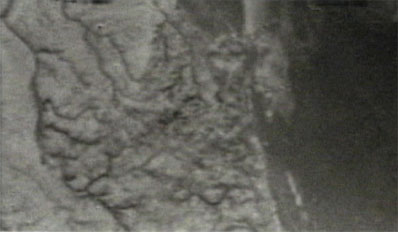
First picture released!
-
First picture
SpaceflightNow has the first picture from Huygens. (mirror)
-
First Image!!!!
Here there is the first image!!!
http://www.spaceflightnow.com/cassini/050114pic1.h tml/ -
Re:First Image from Huygens!!!!!
Obvious rivers of
-
First image
http://www.spaceflightnow.com/cassini/050114pic1.
h tml
"The first image shows what appear to be drainage channels flowing to a possible shoreline"
from http://www.spaceflightnow.com/cassini/status.html -
First image
http://www.spaceflightnow.com/cassini/050114pic1.
h tml
"The first image shows what appear to be drainage channels flowing to a possible shoreline"
from http://www.spaceflightnow.com/cassini/status.html -
Re:Why oh whyWhat I'm wondering is: We're still detecting that Huygens is alive up there even now while Cassini has turned away and started sending the data.
What if Huygens is still alive when Cassini comes back over the horizon?
Will (Can?) they have Cassini point back to Titan to get another pass of data from Huygens?
-
Current Status Page
...can be found at http://spaceflightnow.com/cassini/status.html. You're welcome.
-
Re:Timeline and (better) coverage...
Something about that makes the hairs on the back of my neck stand on end. Goodness knows how he feels today!
I've got a copy of the ESA Bulletin journal from either January or February 1985 which was given to me years ago by a friend of the family - and one of the main articles is about the Huygens probe, in a form very similar to the final version launched in 1997. I think I ought to scan the article and post it online, just to give people an indication of how thoroughly planned these projects are. Unfortunately it's at home, and I'm in Brussels.
I was five years old when they had a detailed design for this probe. Now that's scary.
(Oh, and captain, we get signal! Now just waiting for main screen turn on... -
Re:Timeline and (better) coverage...Thank you for the very interesting SpaceFlight Now link. The best line I found in that article was this:
"I've been involved in this mission almost 21 years," said Lebreton.
Something about that makes the hairs on the back of my neck stand on end. Goodness knows how he feels today!
-
Not just images...
but hopefully audio as well.
From SpaceflightNow
"Also among the expected post-landing data are sounds from a microphone that might capture the rustling of frigid nitrogen winds or lapping waves." -
Timeline and (better) coverage...
... at SpaceFlight Now
It'd be worth staying up for, but the last time I did that, I jinxed the Mars Polar Lander.
If the Huygens timeline executes as planned, it will rank among the coolest engineering achievements in history. It will also have happened thanks to one guy who kept his eye on the ball when nobody else was paying attention. -
As always .....
As always there are updates at spaceflightnow.com. It appears the spacecraft has safed itself as of a few minutes ago....not good.
-
O2 Generator is Back on-line
This is a non-story. The problem was fixed. Here is a link to Spaceflight Now: SpaceFlightNow
-
Re:Arthur C. Clarke and Iapetus.And you think Clark thought of it first?
With a diameter of about 1,400 kilometers (890 miles), Iapetus is Saturn's third largest moon. It was discovered by Jean-Dominique Cassini in 1672. It was Cassini, for whom the Cassini-Huygens mission is named, who correctly deduced that one side of Iapetus was dark, while the other was white.
Not sure how much that vision of the moon has improved since, but going from that to the idea that maybe something went <SPLAT!> on the moon leaving a black circle isn't what I'd call a stroke of genius. (Regardless of wether a splat really caused the dark region, or some other process). Clarke has come up with many great ideas, and promoted great new ideas of others, but this isn't one of them IMHO.
-
Re:Well then.
http://www.spaceandtech.com/spacedata/engines/rd1
2 0_sum.shtml http://www.spaceandtech.com/spacedata/engines/rd18 0_sum.shtml http://www.spaceflightnow.com/news/n0412/22atlas5n ro/ http://www.friends-partners.org/partners/mwade/lvs . html and: http://www.friends-partners.ru/partners/mwade/lvfa m/energia.htm Sorry for the inconvenience in the previous post. -
Delta IV Heavy
The Delta Four launch scheduled for Saturday had to be postponed. The good news is the next window isn't 2 months away, it's Tues. afternoon (the 21st) if they decide to go for it. The D4 Heavy version is the first version of the D4 to use three main booster rockets, forming a booster theoretically capable of servicing the ISS at much less cost to orbit than the shuttle. While the "multi-barrel" design is just becoming operational, regular Delta IVs with the same engine have entered successful service in 2003.
The Delta IV Heavy is staged from Nasa's pad 37B, which last saw service as the launchpad for the Saturn 1B Apollo missions.
http://www.spaceflightnow.com/delta/d310/041201del ta4heavy.html/
http://www.boeing.com/defense-space/space/delta/de lta4/delta4.htm/
The Delta 4 Heavy supports payloads of up to about 50,000 pounds to low-Earth orbit (i.e. the International Space Station). It can put about 29,000 pounds into Geosyncronous orbit 22,300 miles above the planet, or 22,000 pounds to the moon, or about 17,500 pounds to Mars.
The IV Heavy's possible successors, clustering more first stage rockets, include a 7 tube design with MORE lift than the Saturn 5. -
Re:It looks like...
Ah, but Intelsat IA-7 was not as dead as originally thought.
-
Muuuuch better shot for scale...
...had to hunt for it, but here it is:
http://spaceflightnow.com/news/n0106/02x43failure/ x43.jpg -
WRONG!
The underlying article is a day late. The test is currently happening.
Have a look at:
http://www.spaceflightnow.com/x43a/status.html -
SpaceFlightNow has much better updates
-
More information
i couldn't find anything on pressure thresholds, but there is an article talking about how turgor pressure effects plant growth. turgor is a biology term that princeton defines better than i do. i'd imagine that the turgor pressure corresponds to atmospheric pressure in slightly different ratios species-to-species... The article also talks about yield threshold, which i think is just the output of good crop. here is more info on what plants NASA wants to grow for their astronauts ( wheat, rice, lettuce, cabbage, soy, potatoes, and others ) and some issues that they are facing ( one article mentions nuts and fruits are difficult ). too bad NASA is really buries their information...
-
Summary articleThere's another article with the summary of the report on SpaceFlightNow.
My personal summary: They forgot to put the bolts in. People got sloppy/lazy and just signed off on stuff without really looking at what they signed off on.
-
Re:extra weightBrass is heavy, yes
In both cases, only a pilot was on board. The total required weight - 270 kilograms, or 595 pounds - was made up of the pilot, video documentation equipment and personal items selected by the staff at Rutan's company, Scaled Composites, and the X Prize foundation, including Rutan's college slide rule, a teddy bear that will be auctioned off for charity and seedlings.
And, on the first flight, the ashes of Rutan's mother. Otherwise, Rutan said, "we are not flying things that will end up on eBay and be sold or dealt with in any commercial nature at all," Rutan said before the first flight. "There's only a couple of things that are charity related, the rest are things the person who flies it has signed an agreement with us that he will not sell it, that it is for him and his family."
-
Re:368,000 ft, not 328,000
BTW, did anyone else notice that NASA TV didn't cover this flight? It's too bad, because the Ansari X-Prize feed was completely useless. Once people jumped onto the webcast, the poor server just didn't have the bandwidth to keep up.
I checked NASA TV first, which is where I watched last week's flight - and there was nothing.
In fact, I couldn't find any live feeds, although the 'News Multiscreen' thingy on BBC News 24 on Freeview was showing the launch. Yes, a tiny quarter-screen, silent view from a ground-based tracking camera, but it was better than nothing.
It looked a lot smoother flight than last week's, as while it wobbled a bit from side to side while the rocket was burning, it had none of the terrifying roll. Interestingly, it was a different pilot at the controls - Brian Binnie instead of Mike Melvill. Still, he seemed to do okay.
Probably been linked to already, but here's Spaceflight Now's coverage. -
Re:Multiple rolls on ascent
Yeah,give him credit. Though now it appears that he's backpedalling a bit and saying he doesn't think he made a mistake, but he "might have" stepped on the rudder.
They'll have to do a full data analysis, I expect, before the issue is resolved. -
Re:Multiple rolls on ascent
According to an interview, pilot Mike Melville claims that it was his error that caused the rolls, and the SS1 performed properly.
The engine burn was shut down 11 seconds early because of the rolls. -
TOUCHDOWN!!!
SpaceShipOne has landed safely, bringing Mike Melvill back to Earth after a seemingly frightening flight that experienced a major roll during the engine firing!!!
More info here -
Events summary up to 11:18 a.m. EDT
1509 GMT (11:09 a.m. EDT)
DROP! SpaceShipOne has been released from the White Knight mothership.
1510 GMT (11:10 a.m. EDT)
IGNITION! SpaceShipOne is firing to space in pursuit of the $10 million Ansari X Priz
1512 GMT (11:12 a.m. EDT)
Altitude is 250,000 feet. Craft appears to be in a tumble from the tracking cameras.
1512 GMT (11:12 a.m. EDT)
Altitude achieved was 330,000 feet, which was needed for the X Prize.
1514 GMT (11:14 a.m. EDT)
The ship appears in a much smoother orientation following the major roll experienced at the end of the burn. The wings have feathered for the descent.
1516 GMT (11:16 a.m. EDT)
The descent continues. SpaceShipOne looks to be under good control as the wings are folded back down and locked for a powerless glide to landing on the runway.
1518 GMT (11:18 a.m. EDT)
SpaceShipOne is descending through 35,000 feet and cleared for landi
More here -
Aerodynamics and 'correction'
Did anyone notice this?
I was watching the live feed, and saw the plane spin wildly before he cut off the engine.
The SpaceFlightNow status update page said "The craft is in a major tumble!". Several minutes after that, it was 'corrected' to : "The craft is in a major roll!"
I think they still have some issues with the aerodynamics at this speed.
Not that this will affect them in their bid in the race. They seem to be well poised to win.
-
Re:Kiss that stream good bye
The take-off was about 40 minutes later than the expected take-off time posted on spaceflightnow.com.
-
Weblog-style coverage
Given that the webcast is fscking useless, the best coverage I've dug up so far is that by "Spaceflight Now": http://spaceflightnow.com/ss1/status.html
-
More info on Bigelow inflatable modules
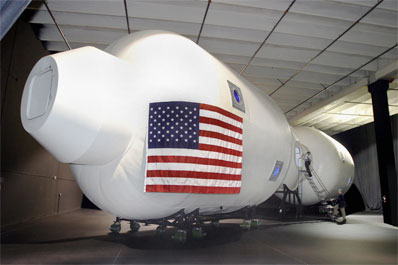
The submission was a little sparse on the info, and since I've been following Bigelow Aerospace for a while, I feel obligated to share some more info on it. First off, there's an article with better photographs available here, and a press release here. The founder Robert Bigelow was also the founder of Budget Suites of America, and is applying a lot of the cost-cutting tricks he learned from his previous contracting experience to the aerospace industry. He licensed the Transhab technology from NASA (which had previously had its funding cut), and is subcontracting for things like life support from other companies who already have systems running.
The inflatables themselves (photograph here)are quite interesting, with a docking mechanism designed to attach with either a Russian Soyuz, a Chinese Shenzhou, and/or whatever vehicle comes out of the aforementioned America's Space Prize. A one-third size prototype of the inflatable module will be launched on the maiden flight of SpaceX's Falcon V rocket, which is itself a very interesting vehicle (~3000kg into LEO for $12 million, and the first orbital vehicle designed to be man-rated since the space shuttle). The first full-size inflatable habitat will be up by 2008, and it's planned to have a crew by 2010.
What's exciting about this is that the inflatable modules appear to be designed, built, and have undergone some preliminary tests. The outsides of the modules have withstood projectile impact tests fairly well. Pretty much all that needs to happen now is for them to undergo further tests and be launched. Bigelow's use of multiple contractors for the same part will allow him to ramp up production if there's a demand for it, and sell the inflatable modules for ~$100 million each to whoever wants them.
Regarding the prize itself, I'd actually be quite interested to see if somebody ends up just designing a descent capsule and sticks it on a Falcon V. -
More info on Bigelow inflatable modules
The submission was a little sparse on the info, and since I've been following Bigelow Aerospace for a while, I feel obligated to share some more info on it. First off, there's an article with better photographs available here, and a press release here. The founder Robert Bigelow was also the founder of Budget Suites of America, and is applying a lot of the cost-cutting tricks he learned from his previous contracting experience to the aerospace industry. He licensed the Transhab technology from NASA (which had previously had its funding cut), and is subcontracting for things like life support from other companies who already have systems running.
The inflatables themselves (photograph here)are quite interesting, with a docking mechanism designed to attach with either a Russian Soyuz, a Chinese Shenzhou, and/or whatever vehicle comes out of the aforementioned America's Space Prize. A one-third size prototype of the inflatable module will be launched on the maiden flight of SpaceX's Falcon V rocket, which is itself a very interesting vehicle (~3000kg into LEO for $12 million, and the first orbital vehicle designed to be man-rated since the space shuttle). The first full-size inflatable habitat will be up by 2008, and it's planned to have a crew by 2010.
What's exciting about this is that the inflatable modules appear to be designed, built, and have undergone some preliminary tests. The outsides of the modules have withstood projectile impact tests fairly well. Pretty much all that needs to happen now is for them to undergo further tests and be launched. Bigelow's use of multiple contractors for the same part will allow him to ramp up production if there's a demand for it, and sell the inflatable modules for ~$100 million each to whoever wants them.
Regarding the prize itself, I'd actually be quite interested to see if somebody ends up just designing a descent capsule and sticks it on a Falcon V. -
More details
More details available from SpaceFlightNow, which is actually a re-print of an Aviation Week & Space Technology article.
-
Failure timeline
Here are some relevant quotes from the Spaceflight Now play-by-play. It looks like there were a number of things that could have gone wrong. Let's say it again, class... "Space Ain't Easy."
* Starting about 1045 GMT, the spacecraft spins itself up to 10 revolutions per minute. The spinning will provide the unguided sample return capsule with additional stability during entry. The spacecraft then rotates to the proper orientation for release and spins up to 15 revolutions per minute.
* Genesis will be stabilize with its nose down because of the location of its center of gravity, its spin rate and its aerodynamic shape.
* About 45 seconds after entry interface, the capsule will be exposed to a deceleration force three times the force of Earth gravity, or 3 G's. This arms a timer that is started when the deceleration force passes back down through 3 G's. All of the parachute releases are initiated from this timer.
* After one minute of atmospheric descent, the capsule should be at an altitude of 197,000 feet [...] Slightly over 10 seconds later, the capsule will be exposed to about 30 G's, the greatest deceleration it will endure during Earth entry.
* 1554 GMT (11:54 a.m. EDT)
The capsule has been spotted high over the planet!
* 1557 GMT (11:57 a.m. EDT)
The capsule appears to be tumbling!
* 1557 GMT (11:57 a.m. EDT)
The Genesis sample return capule is rapidly tumbling with no chute.
* 1558 GMT (11:58 a.m. EDT)
IMPACT! The capsule has slammed into the Utah desert after failing to deploy its chutes and parafoil.
* 1604 GMT (12:04 p.m. EDT)
Mission control says without the drogue chute and subsequent parafoil, the capsule would hit the ground at about 100 mph.
* 1610 GMT (12:10 p.m. EDT)
Recovery forces are moving toward the capsule, which has made a very spectacular crater.
(Disclaimer: I posted this in the pre-impact discussion as well.) -
Re:Chutes did not deploy!
Replying to my own post, so shoot me. Here are some relevant quotes from the Spaceflight Now play-by-play:
* Starting about 1045 GMT, the spacecraft spins itself up to 10 revolutions per minute. The spinning will provide the unguided sample return capsule with additional stability during entry. The spacecraft then rotates to the proper orientation for release and spins up to 15 revolutions per minute.
* Genesis will be stabilize with its nose down because of the location of its center of gravity, its spin rate and its aerodynamic shape.
* About 45 seconds after entry interface, the capsule will be exposed to a deceleration force three times the force of Earth gravity, or 3 G's. This arms a timer that is started when the deceleration force passes back down through 3 G's. All of the parachute releases are initiated from this timer.
* After one minute of atmospheric descent, the capsule should be at an altitude of 197,000 feet [...] Slightly over 10 seconds later, the capsule will be exposed to about 30 G's, the greatest deceleration it will endure during Earth entry.
* 1554 GMT (11:54 a.m. EDT)
The capsule has been spotted high over the planet!
* 1557 GMT (11:57 a.m. EDT)
The capsule appears to be tumbling!
* 1557 GMT (11:57 a.m. EDT)
The Genesis sample return capule is rapidly tumbling with no chute.
* 1558 GMT (11:58 a.m. EDT)
IMPACT! The capsule has slammed into the Utah desert after failing to deploy its chutes and parafoil.
* 1604 GMT (12:04 p.m. EDT)
Mission control says without the drogue chute and subsequent parafoil, the capsule would hit the ground at about 100 mph.
* 1610 GMT (12:10 p.m. EDT)
Recovery forces are moving toward the capsule, which has made a very spectacular crater. -
Chutes did not deploy!
Just checked in with the Spaceflight Now Mission Status Center. The chute failed to deploy, and the capsule is "half-buried" in the Utah desert floor. Looks intact, but then, so did my Fiat after I wrecked it as a teenager.
-
Silicone
Ah, USA today, how I love you for your technical prowness...
Together, the charged atoms captured on the capsule's disks of gold, sapphire, diamond and silicone are no bigger than a few grains of salt
Atomic element or polymer, it's probably close enough. But Spaceflightnow say's it's the element Silicon. And they've got a cool picture of the spacecraft.
-
Re:Maybe not
Yeah sorry, that should be "some SORT of shell".... Here's a picture of it.
-
Maybe not
But one positive by-effect would be that NASA would be forced to consider better booster solutions.
One of those better booster solutions is sitting on the pad right now. It is even more vulnerable to damage than the shuttle orbiters. The Delta IV heavy or derivative is a likely candidate for a post shuttle manned booster. It would be bad news if it were damaged.
-
Re:I love that...
Supposedly it is a data relay satellite, intended to relay intelligence data from other spacecraft to Earth, probably replacing an older spacecraft. A codename "Quasar" is being whispered. See here. So, you might be closer to the truth than you thought when posting
-
Spaceflight Now articles
Good articles from Spaceflight Now:
-
Spaceflight Now articles
Good articles from Spaceflight Now:
-
Spaceflight Now articles
Good articles from Spaceflight Now:
-
Spaceflight Now articles
Good articles from Spaceflight Now:
-
I thought we knew this bit already . . .From the Spaceflight Now
How did Mercury, believed to be 60 percent iron, end up with an oversize core, a thin shell of a crust and the highest density in the solar system? Was its crust blasted away in the distant past by a cataclysmic impact? Was it boiled away in the extreme heat of the young, nearby sun? Or were metals for some reason concentrated in the inner region of the solar nebula that coalesced to form the sun and planets?
Perhaps my knowledge is a little dated, but I thought that the inner four planets have higher density because the sun stripped the inner solar system of light gasses like hydrogen due to the larger mass and higher gravitational field of the sun during the formation of the sun and the solar system. Outer planets are gas giants because the Sun's (or the pre-sun center of the accretion disk ) gravitational field was not strong enough to grab the light elements from the portion of the solar system that would become the gas giants (further from the center of the pre solar system accretion disk). Also, this was thought to be why Pluto is an oddball (far away from the sun, but a frozen rock of a planet) that might be an escaped moon or oort cloud refugee.
Can anyone confirm this? Or am I citing stone age planetary science that is no longer valid?
-
NewScientist Scoop?
Well, this article is pretty fascinating, and not only for its content - None of the other space exploration sites I visit regularly seem to have this information - At most, they talk about Opportunity's discovery of the Razorback feature, but no discussion of analysis. Has NewScientist scooped everyone on this discovery, or was this publicized prematurely?
No tinfoil required, really, just an observation.
-
Spaceflight Now status
Also see SpaceflightNow's Live Status Report.
-
Re:I'm not obsessed by size or anything