Slashdot Mirror
Domain: ssb.no
Stories and comments across the archive that link to ssb.no.
Comments · 48
-
Re:Say again?
It's the median per household. The median for a single person with no children (i.e. a household of one) is about 285,000 NOK after tax. https://www.ssb.no/en/ifhus
-
Re:Say again?
No, it's the median: https://www.ssb.no/en/ifhus
-
Re: Wait, all of us?
Norway gives their young people the choice of doing community service as an alternative to national service in the Army. Only 10% of the population go to university. The majority of the population lives in small towns of 10,000 or less all along the fjords on the Eastern side of the country, with four larger cities (Trondheim = 120,000, Stavanger, Oslo = 500,000, Bergen = 265,000). There really isn't much air pollution apart from the cruise liners that use sulphur based coal. Main food in Norway is fish.
Some corrections here:
- 33.4% of the population has education at bachelor level or higher, not 10%
- While it would be nice if the main food in Norway was fish, it isn't. Norwegians eat an average of 76 kg meateach year. Fish is less than half of that, and sinking.
- The populations numbers are also way off... the cities are larger. E.g in the area around Oslo, the population is around 1.5 million
- There was never an actual choice of doing community service rather than the military service. These days, it's voluntary. In the past, if you were accepted as a conscientious objector you would be set to do community service - but it wasn't a choice
-
Re:Good excuse
According to Statistics Norway at the end of 2015 there were 2.6 million passenger cars registered in Norway.
So how is it possible that all these other auto companies can transport millions of cars but Tesla "is having difficulties finding competent transporters that comply to Norway's road requirements"?
They're not transporting "millions of cars" every year, at most 200 thousand in a good year and Teslas have been 3-5% of the volume for the past several years, sometimes as much at 10% for a single quarter.
-
Re:Good excuse
According to Statistics Norway at the end of 2015 there were 2.6 million passenger cars registered in Norway.
So how is it possible that all these other auto companies can transport millions of cars but Tesla "is having difficulties finding competent transporters that comply to Norway's road requirements"?
-
Re: Earlier police failures...
(Until recently. When, lo and behold, some mysterious local increases in crime seem to have occurred
Please cite this from a good study
Posting anonymously because I seriously don't care to be involved with the darker side of Slashdot in an argument about immigration. Not thinking of you, Demena
The quote from the grandparent is partly true, but misleading *. This is a paper about immigrant crime in Norway from the very reliable Statistics Norway.
Google Translation of summary:
The proportion of perpetrators was 6.7 per cent among immigrants, 11.3 per cent among Norwegian-born with immigrant parents and 4.5 per cent in the rest of the population among the over 15 years who lived in 2010.
When taking into account differences in gender and age composition, the overrepresentation is reduced. The proportion of perpetrators among immigrants goes down from 6.7 per cent to 5.8 per cent, and among Norwegian-born immigrant parents, it goes from 11.3 per cent to 6.8 per cent.
There are still large variations between immigrants from different countries, but overrepresentations have become smaller for all groups since the previous report, which looked at settlers in 2001.
The decline is greatest among refugees and immigrants from African countries.It is true that overall crime has risen slightly with increasing immigration since the 1970's. However the proportion of criminals amongst immigrants is currently decreasing, not increasing. There has been a notable reduction of immigrant crime since 2001, and also the education and employment ratios are far higher than they used to be due to substantial efforts by both immigrant communities and Norwegian authorities. Here's an article from Dec 2017 that confirms the reduction in crime. Again in Norwegian, but Google Translate should give you the gist of the content.
There are also huge variations by country of origin. Immigrants from the Phillipines, for instance, are proportionally less than "half as criminal" as Norwegians without immigrant background (2.18 % convicted criminals vs 4.49 % for non-immigrants). Refugees from war-torn and unstable countries like Somalia and Afghanistan is especially overrepresented in violent and drug-related crime. Some poor countries and countries recovering from conflicts and economic crises, like Kosovo and Lituania, are overrepresented within the areas of fraud, theft and less serious crimes. The types and seriousness of crime varies vastly with different countries/areas of origin.
In my experience the vast majority of immigrants are hard-working, nice people. I live in an area of Oslo with a high portion of immigrants, and a history of gang-related crime. There is next to no crime (violent or otherwise) against "civilians" who are not involved with these gangs, and I feel completely safe every hour of the day even when I pass known gang-members. All the immigrants I know personally are honorable people and upstanding citizens, like the married couple of MDs that live next door.
-AC (will check back later to try to answer questions)
-
Re: Earlier police failures...
(Until recently. When, lo and behold, some mysterious local increases in crime seem to have occurred
Please cite this from a good study
Posting anonymously because I seriously don't care to be involved with the darker side of Slashdot in an argument about immigration. Not thinking of you, Demena
The quote from the grandparent is partly true, but misleading *. This is a paper about immigrant crime in Norway from the very reliable Statistics Norway.
Google Translation of summary:
The proportion of perpetrators was 6.7 per cent among immigrants, 11.3 per cent among Norwegian-born with immigrant parents and 4.5 per cent in the rest of the population among the over 15 years who lived in 2010.
When taking into account differences in gender and age composition, the overrepresentation is reduced. The proportion of perpetrators among immigrants goes down from 6.7 per cent to 5.8 per cent, and among Norwegian-born immigrant parents, it goes from 11.3 per cent to 6.8 per cent.
There are still large variations between immigrants from different countries, but overrepresentations have become smaller for all groups since the previous report, which looked at settlers in 2001.
The decline is greatest among refugees and immigrants from African countries.It is true that overall crime has risen slightly with increasing immigration since the 1970's. However the proportion of criminals amongst immigrants is currently decreasing, not increasing. There has been a notable reduction of immigrant crime since 2001, and also the education and employment ratios are far higher than they used to be due to substantial efforts by both immigrant communities and Norwegian authorities. Here's an article from Dec 2017 that confirms the reduction in crime. Again in Norwegian, but Google Translate should give you the gist of the content.
There are also huge variations by country of origin. Immigrants from the Phillipines, for instance, are proportionally less than "half as criminal" as Norwegians without immigrant background (2.18 % convicted criminals vs 4.49 % for non-immigrants). Refugees from war-torn and unstable countries like Somalia and Afghanistan is especially overrepresented in violent and drug-related crime. Some poor countries and countries recovering from conflicts and economic crises, like Kosovo and Lituania, are overrepresented within the areas of fraud, theft and less serious crimes. The types and seriousness of crime varies vastly with different countries/areas of origin.
In my experience the vast majority of immigrants are hard-working, nice people. I live in an area of Oslo with a high portion of immigrants, and a history of gang-related crime. There is next to no crime (violent or otherwise) against "civilians" who are not involved with these gangs, and I feel completely safe every hour of the day even when I pass known gang-members. All the immigrants I know personally are honorable people and upstanding citizens, like the married couple of MDs that live next door.
-AC (will check back later to try to answer questions)
-
Re:State rep. quote is complete rubbish
And you are among the exception. Actually I would argue that you were never permenately addicted to begin with. While yes you did develop a short term chemical dependacy you never developed or at least changed the nerve dependacy that makes change harder to impossible to quit.
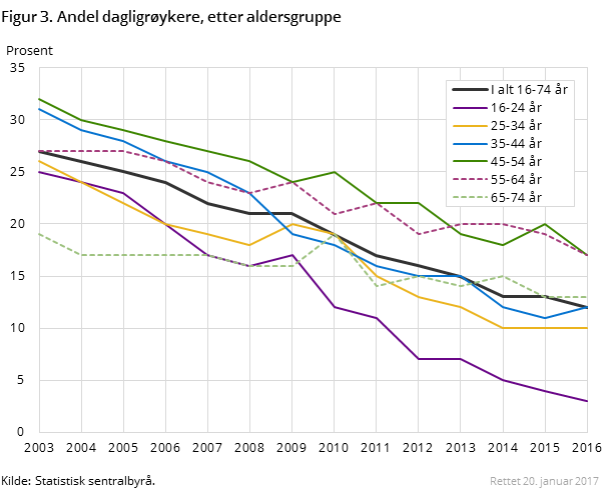
My dad and two of my uncles quit all after smoking 20+ years. In fact that older people quit is quite easily shown with statistics, it's in Norwegian but daily smokers by age group, since the statistics goes over more than 10 years you can easily compare:
16-24 in 2003: 25% -> 25-34 in 2013: 12%*
25-34 in 2003: 26% -> 35-44 in 2013: 15%
35-44 in 2003: 31% -> 45-54 in 2013: 19%
45-54 in 2003: 32% -> 55-64 in 2013: 20%
55-64 in 2003: 25% -> 65-74 in 2013: 14%* Should have been 15-24 to fit the pattern.
So slightly over half quit young, but there's all sorts of reasons why 16-24 is the hardest party age with the most experimentation. In every other age group though, smoking also went down with ~40%. There's not enough data here to see over 20 years, but the trend is pretty clear. It's very much culture and attitude, once your friends quit smoking and it's very unlikely you'll be the lone wolf still smoking. And if you do, you'll do it outside not in the house, not in the car, not near your kids or grandkids... basically it's become your personal vice, but don't bother us with it. That's been enough to make most people quit.
-
Re:36% Read your link. They buy nuclear from Swede
Note that Norway also exports a lot of their hydroelectric power to Sweden, so they simultaneously contribute to increasing the amount of renewables used in Sweden. Thus, you should really compare the number of kWh produced in Norway vs. the number of kWh used in Norway to get a good estimate. Let's look at the actual numbers. In 2013, they spent 129 TWh, while the renewable energy production was 131 TWh. In other words, Norway produces more renewable energy, than their total consumption of energy. (Note that I know hydropower can't be used everywhere, and unlike many others, I don't have anything against nuclear; just wanted to point this out.)
-
Re:This has been planned for a very long time!
I.e. significantly longer than the US
I couldn't help but following your link after you said that, since it's one of those, "I knew Norway had a lot of coast, but THAT much?!" moments for me. I did want to point out that the numbers even at the link you shared are a bit incongruous, since they seem to vary quite a bit from source to source based on how they define a coast or shore (e.g. do they include freshwater or inland bodies of water? if they're measuring the actual coast (as opposed to the boundary of jurisdictional waters), are they measuring to a particular depth of tidal water, or are they measuring the shore as it's represented on a map? are overseas territories included in the country's total? ). For instance, here are some official numbers, most of which were pulled from the Wikipedia article you linked (I also grabbed numbers from other sources I've linked):
Norway's coast:
25,148 km (World Factbook) or 53,199 km (World Resources Institute) or 125,225 km (Statistics Norway)USA's coast:
19,924 km (World Factbook) or 133,312 km (World Resources Institute) or 153,646 km (NOAA)All of which is to say, while I can't say with any certainty which has the longer coastline (not that it matters), it's indisputable that the overall point you were driving at--that Norway has a LOT of coast (particularly given its size) and that it impacts things in all sorts of ways that most of us may be unaware of--is both correct and inherently fascinating. Thanks for sharing the info!
ADDENDA:
In case you're curious about the massive differences in the numbers...The World Resource Institute's dataset was designed to be used for comparisons between countries. They talk at that link about the difficulty in producing useful numbers and in comparing numbers from different sources. To get around most of the issues they identified, they used a vectorization of the coastlines at a constant resolution (to ensure that no country benefitted from having a more detailed mapping than other countries) and didn't include overseas territories. As such, theirs are useful approximations for the purpose of comparisons and are relatively accurate as far as these sorts of measurements go, but for coastlines with lots of nooks and crannies (e.g. Norway's), their approximations may have a greater degree of error than they would for locations with simpler coastlines.
NOAA and Statistics Norway are, I believe, both official organizations, but I wasn't able to find much about the methodology that either used. NOAA mentions that it includes outlying territories, so that immediately inflates their numbers a bit. They also include the shorelines of the Great Lakes, which makes some sense given that they are boundary waters between the US and Canada, but some people may question their inclusion. Either way, it's probably safe to say that both NOAA and Statistics Norway are working with highly detailed maps when making their measurements, so they're likely to be closer to the true numbers than the World Resource Institute's, though it's difficult to compare them without adjusting for differences in methodology.
As for the CIA World Factbook, they don't list their methodology in a place I could find, but it's pretty clear from their numbers for landlocked countries that they're not including inland bodies of water. Given how much lower their numbers are than everyone else's, I'd wager they were calculated at a low resolution, or else they may simply measure at a set distance from the shore, effectively decreasing the resolution of their measurements significantly.
At the end of the day, it looks like the US' coastline may be slightly longer, but the country also benefits from being significantly larger. Ba
-
Re:Tech Company arrogance.
1. Technology isn't alive. You can copy it, test it, break it, completely gut all the parts and rebuild it. Ethically you cannot do that with people and animals. And right now if it dies, it is dead you can't undead yet. Unlike technology, it dies you can bring it back to operational again.
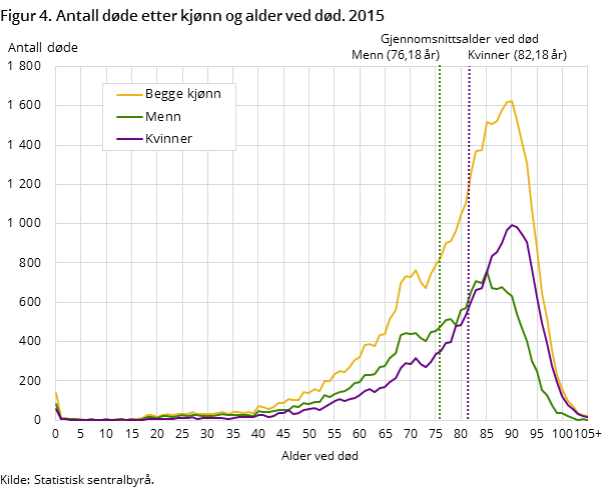
And this one is the blocker for the really interesting research now, which is combating aging. This graph is in Norwegian but it should be pretty understandable, it's number of deaths by age for each sex and in total. If you look at age 1-17 it's almost zero. from 18-40 we get to make our own stupid choices but still very low, 40-60 people start to check out, 60-80 it's climbing rapidly and 80-100 almost everyone dies. If we were all as resilient as 20 year olds we could live 1000+ years, we're fighting disease in a more and more frail body. I'm not saying it's pointless but it will get exponentially harder and harder to improve.
The problem is though that nobody wants to experiment on healthy people that don't suffer from anything but aging, that you're in good shape for a 60yo but considerably worse than when you were 20yo is only natural. Beyond that you should eat healthy, exercise and all those other lifestyle choices we're not going to make any real medical effort to make you young again. Could we for example clone a new heart and give me a heart transplant, for no other reason than it got 50 years less wear and tear? Can we fix presbyopia that from Greek literally means "see like old man"? What about a way regain lost hearing, that almost everyone loses with age?
This is not how you would maintain a car, you don't wait for it to break down first before you start doing anything. Parts have life spans, parts need service, parts that start showing signs of wear and tear gets replaced. Humans? Don't fix it if it's not broke, in fact we often can't even fix it when it's broke. You're just supposed to accept that you're not a spring chicken anymore, half your body's systems are failing and doctors are running around with the proverbial duct tape. At some point we have to try experimenting on making healthy people even healthier, to rejuvenate them. We haven't really started yet and we certainly won't finish in my lifetime, nor in the lifetime of anyone I'm likely to meet.
-
Re:How racism?
I think here is one example of the estimated costs of immigrants in Norway, which is near the levels I mentioned:
-
Re:Facebook isn't. But Slashdot is.
Do you have any sources for this "breaking it down on age, education, grades, jobs, actual experience (part-time vs full-time, overtime, time on leave) you find that most these differences disappear"?
I'm afraid most my primary sources are in Norwegian since I live in Norway, but I can start here. On average, women have an income of 326400 NOK and men 487800 NOK so about 67%, unfair right? Well, first of all 5.6% less of working age are in the workforce (77.1% vs 82.7%), I can't be bothered to cross-reference with medical or unemployment data but it's mostly stay-at-home moms, not that they're unable to work or unable to find work. In addition 34.7% of women work part time compared to 13.9% of men and without having the exact data here also overtime is male dominated.
Together when you plug those into the facts and compare full-time equivalents to full-time equivalents you find females make 87% of what men do. Breaking it down further this study (PDF) show that women prefer lower income, more risk adverse educations. This is also reflected in that the private sector is 36% women and the public sector 70% women, which generally is safer and pays less. In the study they find:
While the men in the application data have mean lifetime earnings of 12.46M NOK, weighting with the first choice probabilities, women have a corresponding mean lifetime earnings of 11.20M NOK, or about 10 percent less.
So now you're down to about a 3% unexplained difference. Now I'm entering a very touchy subject which I can't properly back up with data but my guess it's primarily maternity leave, as in Norway you have a total of 52 weeks, usually split into 42 weeks maternal leave and 10 weeks paternal leave and on average 1,78 births per woman. It makes some employers reluctant to hire women around 30 as they can't ask about such things and despite formally holding a job it's going to have consequences for experience and promotion opportunities. I know it would for me if I took that much leave.
-
Re:Facebook isn't. But Slashdot is.
Do you have any sources for this "breaking it down on age, education, grades, jobs, actual experience (part-time vs full-time, overtime, time on leave) you find that most these differences disappear"?
I'm afraid most my primary sources are in Norwegian since I live in Norway, but I can start here. On average, women have an income of 326400 NOK and men 487800 NOK so about 67%, unfair right? Well, first of all 5.6% less of working age are in the workforce (77.1% vs 82.7%), I can't be bothered to cross-reference with medical or unemployment data but it's mostly stay-at-home moms, not that they're unable to work or unable to find work. In addition 34.7% of women work part time compared to 13.9% of men and without having the exact data here also overtime is male dominated.
Together when you plug those into the facts and compare full-time equivalents to full-time equivalents you find females make 87% of what men do. Breaking it down further this study (PDF) show that women prefer lower income, more risk adverse educations. This is also reflected in that the private sector is 36% women and the public sector 70% women, which generally is safer and pays less. In the study they find:
While the men in the application data have mean lifetime earnings of 12.46M NOK, weighting with the first choice probabilities, women have a corresponding mean lifetime earnings of 11.20M NOK, or about 10 percent less.
So now you're down to about a 3% unexplained difference. Now I'm entering a very touchy subject which I can't properly back up with data but my guess it's primarily maternity leave, as in Norway you have a total of 52 weeks, usually split into 42 weeks maternal leave and 10 weeks paternal leave and on average 1,78 births per woman. It makes some employers reluctant to hire women around 30 as they can't ask about such things and despite formally holding a job it's going to have consequences for experience and promotion opportunities. I know it would for me if I took that much leave.
-
Re:About half
Ooh, found my answer, "20 % of private cars are equipped with DAB radio." So 80% aren't. I think 80% of people are going to not like this once it happens.
That doesn't even begin to cover it, many people have an FM radio that they occasionally use for example at cabins or whatever, more than 80% will probably have to replace some radio. And note that they asked for "digital listeners" not "DAB listeners" meaning if you use your smartphone or tablet or PC to listen to radio, you get counted in favor of DAB even though you don't use DAB.
Actually this (Norwegian) is the truth, in 2014 about 64% of the population listened to radio daily and only 19% on DAB. There's no numbers for it but even less exclusively used DAB. I don't have a DAB radio. It sucks for any kind of battery-driven device, meaning just the kind of remote places and mobile appliances where you'd want radio. We'd do better just upgrading so we'd get 3G/4G coverage everywhere rather than DAB.
Nobody else is phasing out FM or even planning to phase out FM. This is just Norway going off on its own crusade urged on by commercial interests of 10+ new channels, fuck whether it makes sense to throw out millions of radios. On the bright side, I expect this to lead to a massive interest in building out 3G/4G coverage as ex-FMers give DAB the middle finger. Streaming with Spotify + offline playlists is likely to be the new "radio".
-
Population not growing
I guess that is achievable when your population is flatlining and possibly about to decline.
-
Re:We really need
Your apparent point, that ISP rates are proportional to population density, is also wrong. Remote areas of Finland and Sweden have very low population density, yet still have more bandwidth and better prices than some large American cities.
Norway here, I just have to gloat a little, since our numbers just spiked (Norwegian) last quarter.
US population density: 32.43 pop./km^2
Norway population density: 15.6 pop./km^2
80,1% of households have fixed broadband
Mean speed: 23.1 Mbit/s
Median speed: 17.8 Mbit/s
No caps on fixed broadbandA few select areas already have gigabit, more are rolling out as new fiber nodes are ready while the old are mostly 100 Mbit/s. Actually one company has said they'll deliver 10 gigabit if anyone is willing to pay ($2300/month) but nobody's taken them up on that offer. If I won big in the lottery that'd be on my list though, lol.
-
Re:Yeah, but we're very productive
Yes, because that site is quite obviously wrong. Clearly there is a mistake in the number they are showing.
Here's another reference, consistent with the first two references I cited.
http://www.ssb.no/english/subjects/05/01/inntind_en/tab-2012-04-25-04-en.html
-
Re:Yeah, but we're very productive
The US is top 10 per-capita GDP in the world. This of course includes the massive rural areas that our country has in the average. Whatever point you were trying to make, "we're not making much money" is baloney.
We are not making much money. Corporations are.
Look at the median income for US Americans and compare it to the rest of the Western countries.According to the US Census Bureau, the median income for US households in 2011 was $50,054.
Since you mentioned Norway, according to the Norwegian Central Bureau of Statistics, the median post-tax income for Norwegian households in 2010 was ~$74,000.Yes, we're making much money - for others, not ourselves.
-
Re:Yep
Also some of the companies mentioned really aren't doing much in the way of any sort of lock-in. Yes Amazon has about 1% of the Internet in its data centers, which is pretty impressive, but it is just hosting. You buy the virtual servers to do as you please (within the ToS of course).
And I'm sure most "data centers" of the early Internet would love to have the 60/60 Mbit line that I have at home on a plain residential fiber connection, somewhat faster than a T3/DS3. Who needs the data center? You are the data center. Latest stats from Norway now is that the average broadband is 14.8 Mbit/s and the mean 7.9 Mbit/s, graph here as solid green and solid blue line respectively (the others are for business use). Honestly at the rate this is going bandwidth will almost cease to be a limited commodity, it's like asking when the water company will run out of water or the electricity company out of electricity.
-
Re:More governmental abuse in Europe
As a resident of a small island off the West coast of Europe, and having done my research, I can tell you now that Europe as a whole is not innocent; particularly Norway, where one fifth of the child population is in State care
Uhh.... what?? That claim doesn't exactly seem to match reality. Just below 4% get some attention, and most of them get assistance in the family.
-
Re:Death of land line greatly exaggerated
Not remotely. Sure mobile devices are going to take huge swaths of market share from land line phones but it's not hard to find use cases where a land line phone is required, useful or even preferable. Off the top of my head:
I'm not going to argue you point for point, but here's the statistic for Norway since 1998, light blue is landlines and dark blue is cell phones. Just last year there was a 7.2% decline in landlines and a 12.3% decline in landline traffic. This is what our biggest telco said earlier this year:
Telenor: In 7-8 years, no POTS in Norway and most of copper decommissioned
At Telenor's Capital Markets Day today, Berit Svendsen, CEO of Telenor Norway, explained that the cost of operating Telenor's copper network is no longer sustainable. Consequently, Telenor will roll out fibre and migrate copper-based customers to either fibre or coax - or mobile. In 7-8 years, there will no longer be any "plain old telephony service" (yes, that's what she called it) in Norway.
Arguably the first incumbent operator that put an end date for POTS. Copper will survive, in a modernised form, only in some rural areas where Telenor do not face fibre competition. But in large parts of the country, copper will be decommissioned entirely.
In practice when calling to a cell phone - which now outnumber landlines almost 4:1 - landlines are no cheaper and customers calling you from a cell phone themselves probably won't notice the difference between calling a landline and another cell phone in a place with good coverage and a good headset. And this is a fairly sparsely populated country with a fully built out "traditional" telephone network, if it's not worth maintaining here then I think copper networks will disappear from most urban areas on the globe.
-
Re:Had to be said
I think the Nordic model countries are somewhat close (depending on your definition of "close").
-
Re:Declining Real Wage?
It certainly is. I live in Norway, where income has grown steadily over the last 30 years (yes, that includes over the last 5 years), and there's no, or very little, such pessimism here. (you can find data here: http://www.ssb.no/english/subjects/05/01/10/inntekt_en/ )
If that makes people less risk-averse is hard to say. There's some risks it's easier to take - a work-market with an overabundance of good-paying jobs means you can quit to try it out on your own, knowing that if it doesn't work out, you'll very likely very easily be able to find a job, helps. Having a partner who earns well enough that the entire family could survive decently on his (or her) income, also helps.
-
Re:Dunno, might help but not solve problem
Perhaps in the US, but most everywhere else the bandwidth is still increasing. Here's the latest figures from Norway, solid green line is average speed and solid blue line is mean speed. All cable/DSL/fiber lines are sold uncapped and our consumer protection agency is making sure you get what you pay for, so those figures are quite meaningful. I've personally downloaded a 500GB+ torrent in 3 days on a 60 Mbit/s line and it was no problem. You can see about a year ago the average speed made a huge jump, that was the biggest fiber company doubling their speeds. Now cable and DSL have followed and the mean is 7.2 Mbit/s. I can't find a recent figure on the total number of fiber connections but the biggest supplier network has 280k of 1670k broadband subscriptions alone (17%) which means the total is probably 20-25%.somewhere.
All new housing is installed with fiber and they're still retrofitting it all over the place. Cable, telecom and electricity companies are all now fighting for a piece of that pie and there's a rush to lay fiber first because it's very hard for a runner-up to get enough customers to lay cable too with 20-25% year-over-year growth. And we're one of the thinnest populated countries in the world, we're 214th out of 242 while the US is 179th. Our biggest telecom operator has already said they're looking to phase out the copper lines and deliver only fiber and mobile, meaning PSTN, ISDN and DSL will go away like the telegraph and the beeper service. Maybe it'll still exist in rural areas as a legacy network but in cities I doubt you can get a regular landline in 2020. You talk on your cell phone and for Internet you're either on 4G+ mobile broadband or you're on fiber.
-
Re:I don't get it.
And once we have hundreds of terabytes how do we fill the drive? Most of the content on my PC is downloaded, but internet speeds have not increased drastically over the years, I'm still at the same speed now as I was in 2000 and paying about the same amount.
Speak for yourself, in 2000 I was on 64 kbps ISDN and now I'm on 60/60 Mbit fiber. That's almost three orders of magnitude and it's cheaper before even adjusting for inflation. Even the national statistics here in Norway show a >10x increase in both the average and mean since 2004 and that doesn't cover the revolution going from PSTN/ISDN to DSL in the years around y2k so I'd go as far as saying 100x is typical since 2000. Currently the mean is 6.7 Mbit/s and with the rollout of fiber, VDSL and DOCSIS 3.0 I don't see any reason why it should slow down.
I actually know one person that is pretty much like you though, he lives in a very rural area just on the border of ADSL services. Over his copper line it's probably not ever going to go faster, and the chances of an upgrade is slim. But he's the one exception to everyone else...
-
Re:The oldest person lived to 122.
The question is if there's a "knee" in the curve around 114. Maybe, but I don't think we've even got enough data to say for sure.
More like a crunch where it all really collapses. I have some mortality data from Norway here, "Dødssannsynlighet for alder x" = "Death probability at age x" in parts of 1000, "Begge kjønn" = "Both sexes". Already around 98 years it's up to over 30% per year but it doesn't continue the collapse, it stays in the 30-40% range up until 105 in this table and as I understood it up to 114. Of course with only 60-70% surviving each year the chance of living from 98 to 114 is 0.65^16 = 0.1%, but right now 114 looks very close to a cutoff. That perhaps now it's an additional cause of death, not just the sum of everything that's affected "younger" hundred and something year olds.
-
Re:convenience over quality
streaming is the future BECAUSE it involves higher DRM than dvd's have. its just that simple and no need to look any further.
Yeah that so totally explains iTunes and Spotify thriving and CD sales in sharp decline.
streaming is good FOR THEM. physical media is better FOR ME.
You may notice there's an 800lb gorilla in the room here, it's not legal but it mostly resembles streaming...
and as isp's put more and more caps on your bandwidth, I don't see being MORE dependant on the internet as being a good thing. not at all. its a drug dealer situation: they want you addicted to streaming so that they can control all the cards.
It's not my fault your country is going backwards technologically. Here's how a country with progress looks like, average = green, mean = blue. I'm on 60 Mbit uncapped for less than $100/mo and a BluRay costs about $30. Cue the Swede with 100 Mbit for $40. Delivering broadband is getting cheaper and cheaper, if you're not seeing it then you're getting ripped off.
-
Re:Just a matter of price...
I know, you're years ahead of us on paying off the initial cost. You guys had BBB and the like while we were barely getting started on ADSL, our fiber rollout has really been in the last few years. We're both just rubbing it in for the US guys though.
In Norway 73% of the households have broadband in a country with an average population density equal to Maine. We just passed 10 Mbit/s average and 5 Mbit/s mean this month, here's the statistics, green is average and blue is mean speed. And to anyone who reply that the US is larger, so what? Norway is a tiny corner of Europe, if we can get decent Internet here you can get it in tiny corners of the US.
-
Re:Lopsided interests -- I don't have much hope
That was a long rant but I think the short answer is that consumers are a pretty big force to be reckoned with anyway. There's a reason Spotify is in the scandinavian countries where piracy is at its highest. There's a reason he is a MEP from the Pirate Party. I very much doubt you can *force* people to stop pirating, no matter how much you make a mockery of justice. And the courts here will never do a Thomas-Rasset and award 2 million dollars for sharing a few songs. That's what we give to people that have been innocently jailed for 15 years, smashed up real good in car accidents and that sort of thing. Even the four TPB leaders got less than 2 million dollars/person and that is still under appeal and TPB is still running. So they can own the whole playground but they still have to make terms that make the consumers want to play. We're not at the end of the bandwidth revolution, we've really just started. Take a look at this graph. That's the average and mean broadband bandwidth from 2004 and until today here in Norway. It's only going one way - up, up and away. You haven't seen anything yet, when everyone is on 10-100Mbit connections then you'll know true P2P. Also unlike the US "up to" those are pretty much real speeds with no silly caps.
-
Pretty heavy definition...
I just checked the same numbers for Norway, and slightly less than half our "broadband" connections fall short of the 4 Mbit download mark, the mean being 4.1 Mbit (graph). There's no similar statistics for the upload speed, but I see Telenor (our biggest ISP) offer 5000/500 and 16000/800 kbps so many more will fail the 1 Mbit upload requirement. However these numbers are typically actual values, I'd be interested to know how much is claimed speed and how much is BS "up to", 5000/500 isn't so bad if you actually get it.
-
Re:It's true!
Policemen and firemen do not have a risky workday, at least not in Norway (see [1]). There are much more deaths and other accidents among farmers than policemen.
Another thing: A society also need people who do extreme things in remote places. When they get back, they can tell about their adventures to the rest of us and show us of how far humans can go in extreme situations. They push limits. That can be a positive thing, even if the situations they seek have no direct utillity value for the society.
[1] http://www.ssb.no/emner/02/02/10/rapp_200905/rapp_200905.pdf
-
Re:why would you ...
And I got the impression when I was interviewing around that [employee cell phone] was pretty much standard.... Then again, the coverage in Norway is a little bit better than the US.
Light blue is fixed connections, dark blue are cell phones. Note that we have 4.8 million people but 5.1 million cell phone subscriptions so we have more than 100% cell phone coverage + another 2 million fixed connections. What isn't shown is that 500k of these are VoIP, so only about 1.5 million traditional landlines. Most companies I work with have a fixed phone as well, but everyone has a cell phone - I have just the cell phone. Right now I think many companies and homes are using the existing grid but wouldn't invest in a new one, so I imagine it's slowly dying off.
The only reason it doesn't die off quick is that everyone wants broadband, be it dsl, cable or fiber. Throwing in phone service basically costs them nothing on top of that. I could have it for next to nothing along with my TV/internet package by cable, for example. It's just that it has no value for me whatsoever...
-
Re:I think you deserve the "d'oh".
I think you deserve the "d'oh"
No I don't, but damn if I can find a good english source for it:
"Nesten halvparten av den yngste aldersgruppen har drevet med fildeling av musikk eller filmer over nettet."
"Near half of the youngest age group has been doing file sharing of music or movies over the net."
http://www.ssb.no/vis/emner/10/03/ikthus/main.html"I aldersgruppen 16-24 år oppgir (..) 47 prosent sier de har utvekslet film og musikk gjennom fildeling."
"In the age group 16-24 years 47 percent say they have exchanged movies and music through file sharing."
http://www.klikk.no/teknologi/nyemedier/article332320.eceThis is quoting a different study of 12-29 year olds:
"56,1 prosent av de spurte i Pandoraundersøkelsen laster ned musikk fra fildelingsnettverk."
"56,1 percent of the participants in the "Pandora" study downloads music from file sharing networks."
http://www.dagbladet.no/kultur/2005/11/10/448948.htmlWhy I'm even bothering to dig all this up for an AC is beyond me...
-
Re:Passing a Law Against What Everyone Does
Grr. And of course the wrong table was in the copy-paste buffer, this is the right one, you'll see the numbers I quoted in the column "Utvekslet musikk, filmer ved fildeling" which directly translated means "Exchanged music, movies by file sharing".
-
Re:Passing a Law Against What Everyone Does
Please be sure to speak for yourself only and not assume that "everyone" does it.
Maybe not everyone, but a majority does in some age / sex brackets. Here's the latest stats from Q2 2008 here in Norway in percent of Internet users (which is 84% of all households, the rest mostly very old people). And they didn't have a category for those under 16 either:
File sharers: 19%
Males: 25%
Females: 12%16-24: 47%
25-34: 31%
35-44: 13%
45-54: 5%
55-64: 1%
65-74: 0%While the data isn't on that level, with a 2:1 ratio of males to females and 47% in the 16-24 age bracket overall, I'd estimate about 62% of males and 31% of females 16-24 do file sharing. That's right, if you're a young male and don't file share, you're probably in the minority. Note that this is the "file sharing" numbers, it's NOT the "watched youtube online" numbers. And while there's always the assumption that people will "settle down" when they get older, I think this trend will only continue as today's file sharers grow older.
-
Re:Who is Ragnar Tournqist?
Ragnar Danneskjold. Ragnar is a somewhat common Scandinavian name.
-
Re:Just an Excuse for Spying on EveryoneToday, just about all "computer forensic examiners" in the US spend 50-80% of their time on child porn cases. Well, from our criminal statistics here in Norway there were 218 pornography cases investigated in 2007, which would be mostly child porn (possibly a few bestiality cases too) in 4.75 million people. Multiply that to US size and it's about 14000 cases.
Still, it's better to put that number in comparison with something else, for example it's less than 0.1% of all reported crimes. It's less than 1/3rd of all cases of sex with minors (under 16), less than 1/4th the number of rapes, less than the number of aggrevated robberies, in short it's by no means a common crime. Frankly if they spent 50-80% on that, they're catering to the hysteria and not investigating other crimes. -
Re:IQeye
It is subject to where you live. If you live in a cesspool of crime, then perhaps the numbers look different. If you do, moving is going to be the better option, especially since you can't protect your entire family at gunpoint 24/7. (you -do- want your children to be able to play outdoors freely, don't you ?)
Where I live these numbers are -conservative- because the risk of being murdered in a crime is essentially -zero-. (TOTAL count of murders last year: 3.8/million people, murders by person not close to vicrim: 0.7/million And I should add that those 0.7 are mostly young males dying as the result of infighting among criminal gangs, if you're -not- part of such a gang, your real odds are more along the lines of 0.1/million.
Oh, and source ? http://www.ssb.no/ -
Re:Uh, you realize your error, right?
I choose to focus on burglaries because those take place in the home, and that is where most people store their guns.
If you're talking about concealed weapons carried at all time, then it's a completely different matter -- those are likely to be at hand in many more situations, on the other hand doing that also typically raises the odds of accidents.
I agree that multiplying by age is equally relevant for the crimes and the accidents. It makes both equally more likely. It was meant to illustrate that the odds of an accident aren't THAT low. One in 2500 lifetimes, would mean that in my town of 100K people, aproximately 40 of those would die from gun-accidents inside of 50 years, aproximately one a year. Probably 10 a year HURT by accidental gunfire. (yes this number comes out of my behind, but I hope you can agree that the TOTAL number of accidents is likely to be significantly higher than the number of LETHAL accidents)
There hasn't been a -single- case of anyone killed by a burglar in the last 10 years. Infact, there hasn't been a single case of anyone being killed by a stranger in the last 10 years. There's been a few manslaugthers, say someone (mostly a man) killing a wife (or a husband) in a quarrel or similar. Having more guns around wouldn't help with those. (infact it'd likely make it worse)
I guess my views -are- colored by living on a relatively peaceful place. Obviously the risk of accidents are relatively uninfluenced by where you live whereas the risk of crime varies wildly. Being murdered by a stranger is essentially a null risk in most of the world though. (Here the odds of being murdered at all are somewhat less than 0.1%, and about 75% of those are murders by someone you know well. Of the REMAINING 25% of the murders, 80% are in and by criminal gangs)
Put differently, if you are NOT an active member of a criminal gang, the odds that you (or your wife, or your children) will be murdered by someone you don't know well is something like 0.0025% or 1:20000. Which is completely ignorable. Notice that these are risks of dying that way AT ALL. Not risks of dying this way THIS YEAR.
Oh, and reference ? http://www.ssb.no/ -
Re:Advantages countCell phones were supposed to supplant all land-line phones, but it turns out there are places you can't get a signal, and you can also do a lot of other things with that land line that you can't do with a cell. Each of these supposed supplantive technologies turned out to have issues that the "old" tech didn't have. It doesn't mean that the new wasn't useful, but in terms of supplanting the old, it didn't happen. Maybe because the US cell phone market sucks? Here's a graph from Norway (in Norwegian, but it's landlines vs cell phone subscriptions):
http://www.ssb.no/aarbok/fig/fig-442.html
We've now got more subscriptions than people, probably because of work+home cell phones. The only reason landlines are doing ok is because people want cable/DSL and the phone is a nice add-on. Most of my friends just have a cell phone+Internet, several in my parent's generation have only the cell phone and dropped the landline. And before you bring it up, we got sparser population and plenty hills and mountains to make reception worse. And we had an established phone network, I imagine in developing countries it's cheaper to deploy cell phone towers than digging up town. I'm sure there'll be phones and hybrids and whatnot, but only because sending a 16kbps voice stream down a 20Mbit pipe is next to free. -
Re:The same reason so many are socialists
High unemployment in Norway? No, it's currently 2,7%. Source: http://www.ssb.no/english/subjects/06/arbeid_en/
-
Re:Question for /.
C'mon guys, you know grade school was hard enough for this fella.
I doubt it
As you can see from this graph, it's one of the most common names in Norway. (numbers on the left in percent) -
Re:Dammit
Why cant they change Norway to a huge tropical country? 4 604 800 peoples (and me) would be very happy if they did that.
-
Re:RP history...
Apparently you need to do some research, the U.S. granted the Philippine Islands commonwealth status (similar to present-day Puerto Rico) in 1935. The Republic of the Philippines was granted full independance on July 4, 1946.
I concede, my memory failed me by 4 years. Sorry about that. The commonwealth status was a precursor to statehood, which was rejected by corrupt politicians in the Philippines. This is something that you will not get a clear view of in the U.S., because it is somewhat embarassing.
Interestingly, there is still quite a bit of activity revolving around statehood for the Philippines. It could still happen, but it wouldn't be terribly soon. The U.S. would need to place them back into commonwealth status first, yady-yah... see this link
Work ethic ? Education ? Jeez, don't get me started; just let me say you have limited experiences.
My limited experiences include getting engaged to a Filipina, spending months in the Philippines on business and getting to know my future family, learning Tagalog and emersing myself in the culture to better understand what I was getting myself into. This on top of a long string of business relationships which led to me meeting my finacee in the first place.
Education: who's on top? IT Manager looking to outsource? Try these guys: link -
Re:It's a bit late, but...
I like people who are willing to offer some opposition, frequently there is a actualy working brain behind.
Hopefully you won't consider this a case of jumping to conclusions.
I probably wouldn't have reacted the way I did if not for the fact that I have, on more than one occasion, interacted with Americans that *genuinely* believed for example that Norway is a district in Sweden, that polar-bears roaming the streets in general prevents norwegians from letting their kids play outside and that the average scandinavian has 20 reindeer, drives a snow-mobile and hunts whale in the season.
Please forgive me if I happen to use some of these little-known facts in a future post. These individuals weren't in management by chance? But yes, I confess to knowing a few particularly dense individuals myself... the type that don't know and just don't want to know.
It's also surprising to hear how many Americans where never in other countries than USA and at most Canada. Yes, we understand that USA is a huge country, and that you can travel 1000 miles and still be in your own country. (that's also true for Norway by the way) But to me that's still enormously strange. It's not like you can't afford it, the average American has more money than the average
The concept of American (U.S.) prosperity is somewhat overestimated. If I told somebody how much the VAT and income and property taxes would work out to for them based on what they earn and consume here, he'd think you were all insane. If I then explained what you get for what you put in, both in taxes and on the job, he'd decide he's getting screwed. To get an idea of what the average citizen is left with, using the best statistics I could put together in three minutes (sorry), Norway's wealthiest 10% grossed 27% of Norway's total income in 2000. On the other hand, America's wealthiest 10% controlled 73% of America's wealth in 1997 (this was originally a Wall Street Journal source and I believe was regarding net income). Life insurance, medical insurance, dental insurance, car insurance, medical procedures not covered by medical insurance, medicine not covered by medical insurance, schooling, and sometimes lawyers combine to take a pretty large chunk out of paychecks. Some of these may be provided by an employer with varying degrees of coverage, but the expense is becoming such that employers are cutting back.
We consume a disproportionate amount of the world's resources in relation to our population, which along with our reputation for knowing how to party may give the impression of having lots of disposable income and free time, but the average worker gets a vacation allotment of two weeks a year. Among those who can leave a job that long without things going to hell, and those who don't have kids or whose kids are grown up, and those who have a couple of thousand dollars saved (depending on vacation location of course), the plan is usually to take a week to visit a beach in our hemisphere and try to forget everything for a bit. The other week is generally used to get more time off around two major holidays (Christmas/Hannukah/Kwanza/? and Thanksgiving), either to visit distant relatives or prepare for them to visit you. Extra money also tends to go into vehicles or electronics or gadgets instead of vacations, I think.
Still, I guess when it comes to languages the US is not *that* multi-cultural. Maybe there's also some french along the Quebec-border ? And quite likely you've got some "ghettos" of immigrants that speak their only language. But still.
As far as language is considered, for most people they've got the option to tak
-
In your defense...
English-readers can find Wage Statistics on Norwegian government officials here, where you would find the Average Ministry Salary in 2002 was 30,200 Kroner, or about $4,260. There is a footnote, however, indicating that costs of health services are not included.
Interestingly enough, I ran across this through Google: "I do not think any job is worth 10 times a prime minister's salary," said Minister of Finance Gudmund Restad (Centre) when asked about Tormod Hermansen's NOK 7 million salary.", where one could infer that the prime minister's salary is ~700,000 NOK, or $102,734 on 5/20/2003, the day of this report. By comparison, Pres Bush's salary is $400,000 (raised from $200,000 by Pres Clinton in 1999, the first raise since 1969).
Personally, the salary levels in USA's government are outrageous, given the rate of increase (or lack thereof) of the common person's salary. My personal political beliefs align with the Republican party, who used to represent reduction of government... and recent budget bloat really concerns me... And you are correct, our cultures are vastly different. I for one, do not understand how you can have a political party called the "Christian People's Party" who can expect to remain neutral on affairs of church & state. It's also discouraging to me that the average Norwegian citizen cannot differetiate between the concepts of capitalism and greed; there is quite a difference between valuing and rewarding the risks and contributions of individuals, versus rewarding administrators at obscene rates for playing numbers games and bending rules for personal gain. -
Re:Trust me, they don't care.Not that I'm usually a tree-hugger, but it strikes me as hypocritical that the Scandinavians come across as looking good for pursuing "alternative" energy, when in fact that pursuit is motivated by profit margin and a scarcity of fossil fuel.
Yes, Norway really wants lower oil prices so they can spend less on all that fossil fuel imported there. Oh wait, Norway exported 34.62 million tons of crude oil just in the second quarter of 2002.