Slashdot Mirror
Domain: stanford.edu
Stories and comments across the archive that link to stanford.edu.
Comments · 4,853
-
Musical instrument
Put them all in a frame, each pointing at a phototransistor, and link to a frequency generator or microcontroller with MIDI output. Now you have a laser harp.
In fact, here's a very informative website on the subject: The 250 laser harp project. Includes links to different projects, schematics, part sources, etc. -
The Ultimate Laser Pointer
You will need:
322,951 crewmen
Several million tons of quadanium steel
Approx. 950,000 troopers in cool white plastic uniforms
One (1) small moon at the outer edges of the known galaxy at which to construct the thing.
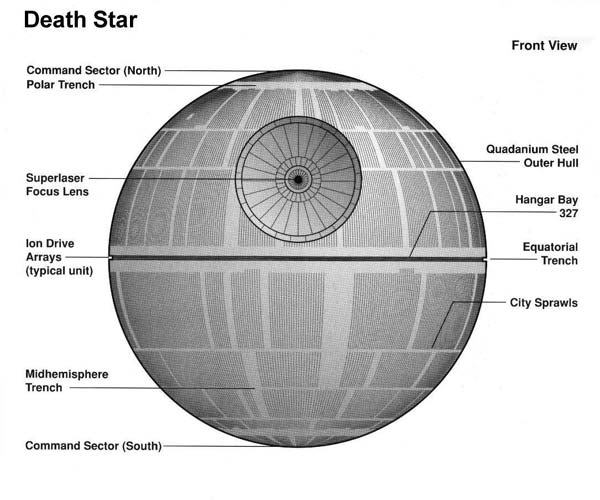
Here are some technical specs, and a handy diagram.
Basically, you do the following:
(1) Use all the steel to build this gigantic metal ball, with a dimple on one side. You use a huge rubber band (available at your friendly neighborhood hardware store) to hold the laser pointers together, and put them in the dimple (make sure the batteries are always charged.) Get all your 1.5-odd million crew guys and troops on board, and fire the bitch up.
(2)
(3)profit!
Warning: Warranty void in case of attack by swarms of rebel fighters and small foam balls. -
phytoremediationIt's called phytoremediation.
The plants function as a contaminant sink - they are capable of absorbing trace amounts of elements/minerals from the soil. If you harvest the biomass, then you collect some of the pollutants along with it.
It has been done in gold mine tailings with alfalfa: http://www-ssrl.slac.stanford.edu/research/highli
g hts_archive/alfalfa.htmlAlthough, I don't know if this is effective enough to warrant much commercial development. It works in small amounts, but I seriously doubt it is used for much other than to fob off the greenies.
A greenie website for more info: http://www.aibs.org/bioscience/bioscience-archive
/ vol45/green.clean.html -
Re:Apple Sucks
Uh, no.
Judging from your bile, I doubt that you'd likely ever care to be educated concerning the actual development of the Macintosh, but just in case, you can read about Jef Raskin's role in the development of the Macintosh here.
And you can read Jef's comments on the incredible amount of published "history" of the Xerox trip and its relation to the Macintosh here.
Where you got the notion that Jobs' "ideas" (whether you believe stolen or not) have anything to do with the Macintosh is beyond me. He took over the project, but he was not an engineer.
-
Re:US Research
>They are building a straigt accelerator, which in and of itself is unheard of.
wrong- ever hear of the Stanford Linear Accelerator? SLAC
-
Re:Nay, archetypal...Warning, some of my entries are slightly OT...but all pertain. You don't need to be purely scientific to be academic in nature or purpose.
In terms of pure science and academa, a few have been reasonably covered here already. A few from my personal library:
Anything from Donald Knuth
Andrew Tannenbaum and most of his publications
The greatest fundamental contributor to all great science, however, is inspiration. WRT/scientific inspiration, a few loom large in my mind...
Most things from:Marvin Minsky (Negative Expertise was at one point groundbreaking for me)
Richard Feynman holds a place in my personal history
Douglas R. Hofstadter and his writting, Godel, Escher, Bach
Roger Penrose and his writting, The Emperors New Mind
Carl Sagan, especially his work in The Demon-Haunted World. I read this in more recent years, and found myself launched into a new understanding and exploration of the nature of science and humanity.
UA
-
Doug Engelbart's NLS SystemThis is not a paper, but a video that was done in the late 60's. In it, you'll see many UI concepts that you see being "discovered" now.
For instance, he has the very first mouse, a word processor with cut, copy, paste, embedded graphics (remember how cool OLE seemed to be?), hyper-linking (remember how cool hypercard seemed to be?), embedded levels of text (kind of like looking at a hyper-linked table of contents in a book), multi-handed interface, a piece of groupware that allows him and a distant co-worker to work together in the same application (think collaborative real-time modification of the same document -- something we still don't really have), telepointers (graphical representation of other people's mouse pointers), embedded video (think webcam), and the list goes on and on and on.
When you think about the fact that this was done in the 1960's, you really begin to wonder, "what the hell have we been doing since then!?"
-
Re:Euclid's Elements of programming languages...Most people also forget that McCarthy invented time-sharing around the same time!
He was also one of the founders of the modern field of artificial intelligence (and I believe it was him and Minsky that coined the term).
-
Papers for Human-Computer InteractionA lot of people have covered a lot of great areas in computer science. Here's a short annotated list I've put together for an often-overlooked area, human-computer interaction.
- As We May Think, by Vannevar Bush. Bush was the Director of the Office of Scientific Research and Development, basically the precursor to NSF and DARPA. In this magazine article, he observed the problem of disseminating information, and noted that electronics may be a better medium (keep in mind that this was written in 1945). He also outlines what he calls the Memex, the first description of a hypertext machine. Bush's theme is that we need to create devices that will make it easier for us to store and access information, and ultimately solve problems better.
- Sketchpad, by Ivan Sutherland. Couldn't find a link to a video, but this truly is one of the seminal papers in computer science. This paper introduced the first graphical user interface (graphical as in graphics, not windows and mouse), the first object-oriented system, the first zooming interface, and the first constraint solver. Best quote:
"I once asked Ivan, 'How is it possible for you to have invented computer graphics, done the first object oriented software system and the first real time constraint solver all by yourself in one year?" And he said "I didn't know it was hard." -- Alan Kay on Ivan Sutherland.
The embarassing part is that, although this was done in the early 1960's, Sketchpad still looks cool and useful today. - Doug Engelbart's 1968 Demo. The link points to a video collection, which is easier to read than his papers. Engelbart is not the most exciting speaker, but keep in mind that in 1968 that people were still stuck using terminals and punchcards. What does he show them? The first mouse. The first hypertext implementation. The first use of video-conferencing. The first online help system. The first interactive word processor. Obviously a mind-blowing experience if you were there. As many people have said, this is the mother of all demos, and we still have not achieved many of his visions today.
- The Computer for the Twenty-First Century by Mark Weiser. Although this was written in 1991, I think that this might be the most important paper of the 1990s. Why? Keep in mind that in 1991, people were still using desktop PCs, that wireless had not achieved momentum, and that sensors were very few and far between.
So what is the basic idea? That computers should not be constrained to the physical desktop, but should become an everyday and seamless part of our lives. And in this paper, Weiser and his team at Xerox PARC introduced location-based computing; devices of all form factors, from small PDAs to tablet PCs to electronic whiteboards; sensors for integrating the physical and virtual worlds; wireless networking to make it all connected no matter where you were (in their office building anyway). Weiser's vision is so influential, that there are now (literally) thousands of researchers working on what he called ubiquitous computing, as well as several research conferences devoted to this theme, not to mention the direction that the commercial world has already taken with PDAs, WiFi, sensor networks, and so on.
-
Some suggestions
If you want a mind bender, there is always On the Duality of Operating System Structures. But if you want something a little more practical, I'd recommend Eliminating Receive Livelock in an Interrupt-Driven Kernel or The End to End Argument in System Design.
-
Some suggestions
If you want a mind bender, there is always On the Duality of Operating System Structures. But if you want something a little more practical, I'd recommend Eliminating Receive Livelock in an Interrupt-Driven Kernel or The End to End Argument in System Design.
-
Some suggestions
If you want a mind bender, there is always On the Duality of Operating System Structures. But if you want something a little more practical, I'd recommend Eliminating Receive Livelock in an Interrupt-Driven Kernel or The End to End Argument in System Design.
-
Euclid's Elements of programming languages...
McCarthy's paper on Lisp: Recursive Functions of Symbolic Expressions and Their Computation by Machine (Part I).
For a refreshing analysis of the paper by Lisp guru Paul Graham (the same guy who proposed the idea of Bayesian anti-spam filtering), see The Roots of Lisp. -
Re:How immutable are these plans?
The US has already started to build one collider to compete with the LHC at CERN and abandoned it after spending a billion or so on it. This is a wish list, not a final decision.
Quite why anyone thinks the linac is worth building is beyond me, by the time the machine is finished the LHC will have done all the interesting work at this energy scale. Also note the comment about the world wide web being created by the high energy physics world, but without mentioning it was actually their competitor at cern who did that one.
This is a really unimformed set of statements on high-energy particle physics which have appeared in several forms throughout this discussion. Let me clarify a couple things.
The Next Linear Collider (NLC) is not competition for the LHC. The Superconducting Supercollider (SSC) which was cancelled here about 10 years ago was competition to the LHC.
I'm really too young to know much about the SSC's cancellation, but I have heard older folks say that their big mistake was not putting enough money into R&D before beginning construction. (Hence expensive mistakes in design like another poster here mentioned.) Hopefully lessons have been learned from the failure of the SSC.
Back to the SSC vs LHC vs NLC. There are two fundamentally different types of collider. Hadron machines (SSC,LHC, TeVatron @ Fermilab) collide protons against (anti)protons. Lepton machines (LEP @ CERN closed in 2000, NLC, various machines at SLAC over the years) collide electrons and positrons (aka anti-electrons).
The hadron approach is good because a proton is 2000 times heavier than an electron. So it's much easier to get to very high energies. On the down side, protons are not point particles, but rather "bags" of 3 quarks each. So it's hard to get precision information because you don't know exactly what the initial 4-vectors of the interacting quarks were.
Lepton collisions are clean because the electrons are point particles. But as I said, they are a lot lighter than protons. This motivates building the NLC as a linear collider as opposed to a storage ring ala SSC, TeVatron, LEP, LHC, or PEP-II (@SLAC). The energy loss from syncrotron radiation goes as the relativistic gamma to the sixth (!!) power. For a given energy, a lepton machine will have a gamma 2000 times bigger than a proton machine. And so putting really high energy electrons into a ring is very difficult because they lose so much energy.
The general concensus among high-energy physicists is that for the field to progress both machines are necessary (LHC and Linear Collider). The LHC will (probably) find the Higgs boson and measure its mass. It may also find physics beyond the Standard Model. A lepton machine will then be necessary to do precision studies and really untangle what the LHC will (hopefully) discover.
Having the LHC allows us to have an idea what goals the NLC should be designed for. For example, if the LHC discovers some amazing new physics at (say) 800 GeV, then this gives us information about buildng the NLC--it had better not be a 500 GeV machine.
The big question is not whether to build the NLC--it is whether it will be here or in Europe, and how long will we have to wait.
-
Re:How immutable are these plans?
The US has already started to build one collider to compete with the LHC at CERN and abandoned it after spending a billion or so on it. This is a wish list, not a final decision.
Quite why anyone thinks the linac is worth building is beyond me, by the time the machine is finished the LHC will have done all the interesting work at this energy scale. Also note the comment about the world wide web being created by the high energy physics world, but without mentioning it was actually their competitor at cern who did that one.
This is a really unimformed set of statements on high-energy particle physics which have appeared in several forms throughout this discussion. Let me clarify a couple things.
The Next Linear Collider (NLC) is not competition for the LHC. The Superconducting Supercollider (SSC) which was cancelled here about 10 years ago was competition to the LHC.
I'm really too young to know much about the SSC's cancellation, but I have heard older folks say that their big mistake was not putting enough money into R&D before beginning construction. (Hence expensive mistakes in design like another poster here mentioned.) Hopefully lessons have been learned from the failure of the SSC.
Back to the SSC vs LHC vs NLC. There are two fundamentally different types of collider. Hadron machines (SSC,LHC, TeVatron @ Fermilab) collide protons against (anti)protons. Lepton machines (LEP @ CERN closed in 2000, NLC, various machines at SLAC over the years) collide electrons and positrons (aka anti-electrons).
The hadron approach is good because a proton is 2000 times heavier than an electron. So it's much easier to get to very high energies. On the down side, protons are not point particles, but rather "bags" of 3 quarks each. So it's hard to get precision information because you don't know exactly what the initial 4-vectors of the interacting quarks were.
Lepton collisions are clean because the electrons are point particles. But as I said, they are a lot lighter than protons. This motivates building the NLC as a linear collider as opposed to a storage ring ala SSC, TeVatron, LEP, LHC, or PEP-II (@SLAC). The energy loss from syncrotron radiation goes as the relativistic gamma to the sixth (!!) power. For a given energy, a lepton machine will have a gamma 2000 times bigger than a proton machine. And so putting really high energy electrons into a ring is very difficult because they lose so much energy.
The general concensus among high-energy physicists is that for the field to progress both machines are necessary (LHC and Linear Collider). The LHC will (probably) find the Higgs boson and measure its mass. It may also find physics beyond the Standard Model. A lepton machine will then be necessary to do precision studies and really untangle what the LHC will (hopefully) discover.
Having the LHC allows us to have an idea what goals the NLC should be designed for. For example, if the LHC discovers some amazing new physics at (say) 800 GeV, then this gives us information about buildng the NLC--it had better not be a 500 GeV machine.
The big question is not whether to build the NLC--it is whether it will be here or in Europe, and how long will we have to wait.
-
or use rdiff-backup or cvsupOr use rdiff-backup or cvsup.
rdiff-backup is:
rdiff-backup backs up one directory to another, possibly over a network. The target directory ends up a copy of the source directory, but extra reverse diffs are stored in a special subdirectory of that target directory, so you can still recover files lost some time ago. The idea is to combine the best features of a mirror and an incremental backup. rdiff-backup also preserves subdirectories, hard links, dev files, permissions, uid/gid ownership, and modification times. Also, rdiff-backup can operate in a bandwidth efficient manner over a pipe, like rsync. Thus you can use rdiff-backup and ssh to securely back a hard drive up to a remote location, and only the differences will be transmitted. Finally, rdiff-backup is easy to use and settings have sensical defaults.cvsup is:
CVSup is a software package for distributing and updating collections of files across a network. It can efficiently and accurately mirror all types of files, including sources, binaries, hard links, symbolic links, and even device nodes. CVSup's streaming communication protocol and multithreaded architecture make it most likely the fastest mirroring tool in existence today. -
Re:That would work...
Hmmm, technophobes won't use the command line no matter what. Many novices do not have geek friends to show them how to use the command line. So apt-get and emerge are out of the question for mainstream acceptance.
kpackage works fine most of the time but if you get into trouble, then you will definitely need to go to the command line.
I attempted to use kpackage to install the stable version of mono on debian. It failed and mozilla was thoroughly hosed after that. I had to use dpkg to fix it. It was easier than hacking the registry but harder than shopping on Amazon.
-
Re:Music Open Source software
Redhat users should check out Planet CCRMA. It's an apt archive for Redhat that provides everything you need for an audio workstation.
-
Re:Do Musicians care about Linux?
Sorry man, you are amazingly disconnected with the computer music scene. Although many of are enjoying macosx now, most of us know and like unix.
Perhaps its while we are using pure-data, or STK or maybe CLAM or by chance audacity
Linking is getting old, but being surronded by computer music, I promise you WE USE LINUX.
Kind Regards,
Rob -
Re:red hat?
Perhaps like Planet CCRMA?
-
some useful stats, but outdated
This study is based on extremely old data and is not particularly relevant for today's Gnutella. The Gnutella crawl data is from 2001, a time when Gnutella was a vastly different network with a completely different searching architecture. Gnutella at the time was a very young protocol. Since then, the search architecture has moved beyond the flooding model, now using a combination of distributed indexing and "dynamic querying." These techniques are specified in detail here.
The data on average number of shared files and uptime is interesting, but there's really not a lot in here that is actually useful for peer to peer development. There's a lot of active, very useful research being done elsewhere. The folks at Stanford have done a great deal of work in this area, much of it very applicable. Their work is here. -
What does Doug think?
This work reminds me of the work that Douglas Englebart was doing in the 1960s. And while I think this new interface work is great and needed I also believe that the biggest impediment to adopting new methods are cultural ones. While you could (and should) say that the delay in adoption of Englebart's ideas (windowing systems, a mouse for input) was the technical challenge of bringing these methods to home computing mahcines, you can't forget that cultural forces were also at work slowing down people's acceptance of the GUI.
But a more dramatic example of the slowness of cultural change is the fact that I am typing this on a QWERTY keyboard. Dvorak has been around for years but still we type on devices that show their Victorian age heritage. Even when there is no need at all for the random shuffling of the alphabet across the current keyboard in the way we use it!
Another fine example is the red-headed stepchild of the Englebart revolution; the BAT keyboard. The BAT is supposedly easier to learn to use (I've never tried it myself) than a regular keyoard and is also supposedly more ergonomic than a keyboard, as well. It is aslo easier on the joints (or so they say). Now it's mostly sold for people who have Carpal Tunnel Syndrome and other injuries/disabilities. But it was originally thought to be a better method for input for everyone (injured/disabled or not) to use.
Englebart was right about most things (which were later refined by others into the form in which we now recognize them), but the BAT just never caught on. Too different, probably, from what people had already been using for over a century.
-
did you rtfa?
Not that you did read the article, but here's a great paper (pdf) on low-power processor design with lots of graphs and equations showing where the architecture can tradeoff power to keep your silicon chips from melting.
The paper is out of Stanford paid for by your tax dollars.. Hopefully you won't notice the part about the address at Stanford University being the William Gates Computer Science Bldg -
Re:What they didn't tell youBe nice, this is my desktop: http://ari.stanford.edu/mcdonalds.mp3
I looked for this a few months ago and the only site I managed to find it on was one that had it as part of a really long real audio stream with a bunch of other stuff, so I ripped it out of that and converted to mp3. (Yeah, yeah, I know, bad quality, blah blah blah. This is a McDonald's jingle, do you really care about its sound quality?)
Enjoy. -
First-hand account
Okay, I work as one of two computer consultants responsible for overseeing the election tabulation process in my county. Yesterday's election was the first time we used the new electronic voting machines (iVotronic).
Things went off without a hitch. We began tabulating at about 6:30 and were done by 8:00. We used to use punch cards, and would normally get done around 11:00. So you can see why a lot of government officials are praising these things. They are faster, easier to use, and less prone to voting mistakes. Last year there were dozens of cards punched backwards or upside-down, hanging chads, and whatnot. That really slows things down a lot.
That said, I don't like these machines. There's a fundamental flaw in the construction that makes the whole thing insecure. Given the incentive ($$$), it would be incredibly easy for an employee of the manufacturer to slip some deviant code into the machine that said, "on election day make every fifth vote go towards this candidate".
I think the best analogy was one I heard on NPR the other day (I believe it was David Dill). The current process with electronic voting is akin to walking into a booth and telling your vote to a person on the other side of a curtain. Did he write down what you told him to? Who knows. -
Re:Not just Republicans and Democrats
Here are a few good representatives to mention if you want someone to debate on intellectual property issues:
Bruce Perens, former Debian project leader.
Lawrence Lessig, Professor of Law at Stanford Law School, Chair of the Creative Commons project, author of several books on intellectual property...
and,
you. Seriously. You are the best person to represent your own views. Then we know what you think. Just make sure that you know who you are speaking for - I am sure you can represent your views well, but I don't know if you represent my views very well.
If you want someone more local, start asking librarians at the local library if any of them have viewpoints on IP and DRM issues.
please post other such 'potentially good' representatives in reply.
But really, if you want someone with a suit and a long list of credentials to represent the people in a debate on intellectual property, pick the Professor of Law at Stanford, Lawrence Lessig. That's who I would pick. I like his views and his ideas. I publish some of my work under a creative commons license, and tried to follow the Elred case.
---- -
Information Visualization Resources on the Web
FYI: some more resources
-
economics
In short, the "Death of the Internet" due to lack of IP space is a myth, which doesn't bode well for getting IPv6 rolled out any time soon.
Perhaps, but IPv6 will make addresses cheap and plentiful. Right now I pay $10 a month for one static IP. I want there to be so many addresses available that providers start advertising "Over 60,000 static IPs free with every account!" (Or the equivalent in name-based routing or any other technology that makes it quick and easy for me to throw another box on the network and connect it to the rest of the world.) -
Re:No more income from me then
If you guys are so up in your panties about this move, go elsewhere for support. You can get updates elsewhere. I've successfully been maintaining servers in the 30 or 40 just using apt-get and kickstart -- for free.
Get started here:
Freshrpms.net
DAG RPMS
ATrpms
newrpms
KDE For Redhat/Fedora
JPackage
CCRMA (Karma)
Gstreamer
Kernel 2.6.0-test
And if you want up2date style GUI, get synaptic from ATrpms. -
Re:Maping 3D from video would be betterCarlo Tomasi, formerly of CMU and Stanford, at Duke as done some really nice work with this kind of thing. See his publications
Laser range finders are not that exciting. Kind of stuff you buy pre built. Unless you do some interesting processing with the data, it's nothing new, but always fun to play with.
-
Less-restrictively licensed alternative
Should you wish an alternative to the commercially-licensed JESS, Stanford has its own Java Theorem Prover, DAML-compliant and capable of handling forward- and backward-chained reasoning. Object code can be freely redistributed.
-
Re:This would be more interesting
Your post is a little confusing. You mention the two extremes and suggest that the amount of data per person is a bell curve. By definition a bell curve is a normal distribution and is symmetric. If the distribution really is a bell curve, and you ignored your outliers, you'd have the same average of 800 megs per person . .
The question really should be is it a normal distribution - I would guess yes . . . -
As Secure as MS Chinese Wall
MS has never had the concept of seperating O/S functions from application functions.
Not quite.
Earlier public statements by Microsoft executives indicated a "Chinese wall" [11,2] that separated the application developers and operating system developers. Professing such a separation was meant to allay fears of unfair early access to vital API's by Windows application developers.
It seems their public statements can be at odds with reality; certainly it was the case in the context that particular "firewall" policy.
Take heart: maybe Bill's lying again and really thinks code should be perfect, in which case we'd be better off than we are with "acceptably imperfect" code.
-
Re:User experience
Don't know.
But this is the problem : such a program is not obvious.
Oh. Looks like I had the name wrong. There's some general-media plugin that handles all sorts of media types and hands them off to helper apps. Well, here, this'll do the same thing here.
I never use it, because I *hate* animation on web pages. The first thing I do when using a browser on any OS is disable animated GIFs, Flash, movies, everything possible.
Rosegarden
Just one ?
And how can this reach Reason's level ?
I don't know whether it does -- I'm not a musician. It has some snazzy screenshots with music notes and whatnot, and it seems to be popular with creative types on Linux. If you want more music software packages, try PlanetCCRMA.
No, once again I am afraid the tools you mention are not even close to IB's level.
What are you missing?
Last time I checked, it didn't have a solver ?
Good news -- they've since added one.
I'm not a spreadsheet nut (a lot of spreadsheet stuff is easier to do with a regular programming language if you code a lot, IMHO). However, it does everything I've ever needed to do with Excel (which, to be fair, isn't a lot). There might well be major missing functionality that I wouldn't know about.
This one looks seriously good.
I've only used Illustrator briefly, but I remember it having a lot more palettes than Sodipodi, and fancy (not on the level of 2d CAD, but not bad) alignment functionality, and a lot of basic vector graphics functionality that Sodipodi doesn't have (like text-on-a-path). Ironically enough, the app here that you were most positive about is the one that I feel has the most glaring lacks between its closed source cousin (though it's still quite young compared to cousins like the GIMP...reminds me of the GIMP at around version 1).
-
We don't know squat.
From the article:
Space weather forecasters say this spate of strong solar flares is not consistent with normal solar behavior. The sun, which follows an 11-year activity cycle, has been quieting down since the last peak in 2000.
Although we humans have been looking at the sun since before we climbed out of the trees (and our moms have been telling us not to even longer), it's almost silly to say that any observation of our local star is "not consistent with normal solar behavior." Just how many of those 11-year cycles have been recorded?
If the ancient Chinese were using pinhole solar viewers to count sunspots for the past 5000 years, that would be one thing. But as has been posted in every Slashdot story on the subject, we have maybe 200 years of scientific data (of varying quality) out of the sun's five billion year history. Even W's pollsters would tell you that sample size is too small. -
Re:Semi-realtime satellite image of fire status
that image is too big, and downloads very very slowly.
try this -- slightly compressed JPG for just the SD region, with legend moved closer.
http://bowser.stanford.edu/10-27-AM-SD-fires.jpg -
Re:I can't take much more of this
Any game theorists knows that in the long run tit-for-tat is the guaranteed best strategy in any game---> It always allows for win-win, and discourages attempts to take advantage of the other (defecting).
This is clearly incorrect on many levels. First of all, I assume that you're thinking of a particularly simple type of game -- a prisoner's dilemma.
But, even with these constraints, your claim is not true. Let us take a game where double agreement produces a payoff of 1 to each player, where double disagreement produces a payoff of -1 to each player, and where agreement-disagreement produces a benefit of 2 to the disagreeing player and -2 to the agreeing player.
Let player 1 use a tit-for-tat strategy.
Let player 2 use a tit-for-tat strategy, modified to start with an initial disagreement.
In the long run, each player will average no gains or losses.
However, if player 1 switched his strategy to always-agree, he will average a score of 1 per round over the long run. Thus, in this situation, tit-for-tat is worse than another strategy.
You're probably thinking of Axelrod's Tournament, which many people have derived bogus conclusions from. -
Re:the next economic boom
The unemployable [...] will probably come up with fantastic artwork that would never have been created had they been spending 8 hours a day at McDonald's. That's a shame, because art is one of those of things robots can't build, and may never be able to build.
Computers create poetry, art, and music. (Scroll to the bottom, then go back up a couple pages for the sample MIDI links -- or search for "sample midi output".) There's also listenable Mandelbrot music.
Perhaps it's not Wordsworth, Dali, or Pink Floyd, but it can only get better.
(Some of the music from the first link reminds me of Ray Lynch's work.)
-
Re:Cheap overseas textbooks are harmful to them
Actually the MacDonalds analogy is a particularly bad one. Ever heard of The Economist's Big Mac scale of currencies?
-
Bruce at CIS
Bruce Schneier will be speaking (along with many other security experts) at the Stanford Center for Internet and Society's CyberSecurity conference this Nov. 22nd.
More info here. -
Yes!-List
-
Re:Yep. John Lott's a liar, too.Oh, so you're citing John Lott for your "guns reduce crime" statistics. according to this article
Earlier this year, Lott found himself facing serious criticism of his professional ethics. Pressed by critics, he failed to produce evidence of the existence of a survey -- which supposedly found that "98 percent of the time that people use guns defensively, they merely have to brandish a weapon to break off an attack" -- that he claimed to have conducted in the second edition of "More Guns, Less Crime". Lott then made matters even worse by posing as a former student, "Mary Rosh," and using the alias to attack his critics and defend his work online. When an Internet blogger exposed the ruse, the scientific community was outraged. Lott had created a "false identity for a scholar," charged Science editor-in-chief Donald Kennedy. "In most circles, this goes down as fraud."
Now of course Lott's fraud doesn't prove his conclusions are false; it only proves he's a liar an has no evidence for the conclusions drawn from that study. As for Lott & Mustard's famous 1997 paper, these folks found that small changes in Lott's model erase any influence of right-to-carry laws.And according to Ayres and Donohue who extended Lott's data through later years, Lott mostly managed to discover the start and end of the crack epidemic -- Crime rose and dropped just as much in urban areas without any changes in right-to-carry laws.
So you've answered my second question, and I thank you. You do have research to back up your claims; it's not good research, but at least it is research. Now how about getting rid of your straw man and dealing with what Clark actually said rather than what you find easy to argue against?
-
personal experienceI've been running dnet on an overclocked celeron (550 MHz -> 850 MHz) for about two years... no problems. With Windows versions before 2000, your CPU doesn't really "idle" in the sense that inactive parts are not shut down (that's why programs like "Rain" and "Waterfall" are popular for the 9x OS'es).
Most modern OS'es use HLT commands to power down inactive parts of the CPU. On such an OS, running a distributed worker like seti, folding, or dnet will make the chip run a little hotter, and probably draw an extra watt or two out of the power supply (depending on the chip and speed). On older OS'es it doesn't make a difference since the chip never really "idles" so to speak.
I'd say go for it. All processors die, but not all processors really live!
Some relevant links:
folding@home - For this one, if you're on Windows, use the cmdline version. I've found the Windows version to be a little nasty and ALT+TAB you out of games that run full screen.
There's a thousand more, but those are the big ones. Have fun!
-
Re:Free? No
Folding@Home lets you scale your CPU usage with a slider bar...
I don't know about SETI though, I never considered it to be worth anything enough to try it.
-
kerberos or srp
kerberos might be a bit admin-intensive(and you mentioned you were trying to convince your admin), therefore I recommend you look at http://srp.stanford.edu/ which might do what you require It even has windows-based binary client versions of ftp for those that require them.
-
Re:Slashdot editors are on crack (what else is new
Finding ways to exploit parallelism and hide memory latency are important problems in processor design, and definitely interesting stuff, my counter-sarcasm notwithstanding.
-
Re:INTERCAL
Donald Knuth seems to like INTERCAL.
Mentioned on his Recent News page (towards the middle of the page).
He implemented an algorithm in it here.
The same algorithm implemented in various other languages is here. -
Re:INTERCAL
Donald Knuth seems to like INTERCAL.
Mentioned on his Recent News page (towards the middle of the page).
He implemented an algorithm in it here.
The same algorithm implemented in various other languages is here. -
BOINC good; SETI@Home BadI disagree with Adam Beberg's (Duncan3)comments regarding BOINC as being somewhat outdated. In contrast I view it as being potentially very usefull in allowing users to allocate their spare CPU resources to the most useful projects. [Adam I believe was a significant contributer to the Folding@Home project, so he can be considered an informed source with regard to the perspective of the distribution of "work-units".]
However, the promotion of SETI@Home by anyone demonstrates they have not looked at the problem in detail.
There is reasonably extensive documentation on the probable intelligence of advanced civilizations (for example see papers by Dr. Anders Sandberg (here) or myself (here). As I have pointed out at conferences and in papers the difference between an advanced civilization and the human civilization is ~10^24 Ops. The difference between a single human and and a nematode worm is ~10^15 Ops. We don't talk to worms and advanced civilizations don't talk to us!
Furthermore the entire SETI effort does not take into account the information content of an advanced civilization. By my estimates this is of the order of 10^50 bits (probably more). One cannot communicate even an extremely small fraction of that information content across interstellar space using radio waves. They simply lack the information carrying capacity. So the SETI Institute, Drake, Tarter, Shostak, et al have sold millions of computer users (as well as Paul Allen) a "bill of goods" without having done their fundamental homework on the limits of evolution of civilizations. Why on earth would one attempt to communicate with a civilization that is fundamentally less sophisticated than a nematode worm and with whom it is impossible to exchange a significant amount of information that one has at ones disposal?
In contrast Marvin Minsky (probably one of the leading AI experts in the world) and Freeman Dyson (a brilliant mathematician/physicist who should have won a Nobel Prize for his contribution to the Tomonaga/Schwinger/Feynman contribution to quantum electrodynamics were it not for the Prize limits of 3 individuals) had this worked out in 1971 at the conference between Russian and foreign scientists at the Byurakan Astrophysical Observatory. Direct quote from the proceedings edited by Sagan:
MINSKY: Since radiation at any temperature above 3 deg. K is wasteful and a squandering of natural resources, the higher the civilization, the lower the infrared radiation. We should look for extended sources of 4 deg. K radiation. There should be very few natural such sources.
DYSON: I don't quite go along with this but to some extent you are right.
Minsky obtaining a concession from Dyson is significant. It has been ignored by the "radio waves from aliens" camp. They *will not* be trying to talk to us. But we *might* be able to observe them in the IR detection region. (Unfortunately IR detection is difficult to do from ground based telescopes.)
So the bottom line -- reallocate your spare computer resources to projects like folding or in the future to Nano@Home. SETI@Home is never going to succeed. It is based on outdated fantasies. Telescopes like the failed WIRE mission or the recently launched SIRTF *may* be able to detect alien civilizations but efforts such as SETI@Home are pointless until such time as the supporters make the case that advanced civilizations would want to waste their time communicating with sub-worm civilizations.
Robert
-
Re:A little late to the party...Adam, I'm not convinced your argument holds water. I'm unfamiliar with OGSA/web-services/etc. but it would appear to me that they have nothing to do with the problem of allocating computing resources on a personal preference basis. Right now I dedicate spare cycles to folding. But in the future I would most likely want to allocate some or most of them to nano@Home. That has little to do with distributed communication protocols or Grid computing. It has to do entirely with an underutilized resource allocation problem.
Robert