Slashdot Mirror
Domain: sun.com
Stories and comments across the archive that link to sun.com.
Comments · 7,362
-
Re:Beagle
You can download the source code for the JVM under SCSL or JRL licence in the same download page as the jsdk or runtime. The source for the libraries comes with the jsdk.
You can even download the development snapshots for the next version of Java 6.0 codenamed Mustang. It's still at a very early development stage. -
Opetorns're for low end customers
Sun's selling linux/opteron boxes only to low end customers. Remember, a linux box comes kick ass cheap and does not have half the features of S10. But for the serious ones, Sun still offers S10 on Sparc(heard of the 32 way Niagara?that's what you would call a beast of a server.A server for real internet workloads). The take home points:
1)Sun sells Linux too(surprise,surprise!!).
2)It does this for the low end guys
3)Sparc is still the defacto chip for any serious high end customer.
4)Sun's amd boxes will be far superior to those of IBM & HP. Why? 'cos HP & IBM don't have their own industry standard OSes, while sun has a beauty in the form of Solaris10 that will give you better value for money on your AMD64 processors.
Finally,learn to accept the truth.Call a spade a spade.S10 is simply a superioir OS to any other OS that exists on this planet today. Embrace it or be left behind. Use DTrace if you like S10 or be content with using top and gather cobwebs snuggling up to a cute penguin.
[ And the Sun never sets forever... -
Get a clue
Sun doesn't build servers from crap commodity components from the cheapest Taiwanese vendor they can find.
And it's Dell that wants to sell machines other than the toy computers that their product line is currently limited to. Maybe something like this
Oh, those 72 UltraSPARC-IV chips on that box are the equivalent of 144 single-core CPUs. And unlike the crap that Dell sells, those CPUs scale damn near linearly.
And please do the math on the IO bandwidth those SunFire boxes can support. It's a helluva lot more than the single PCI bus on that little Dell turdball. -
Re:Solaris and AMDI hadn't noticed the Solaris Linux Application Environment in Solaris 10 before. Sun has some interesting things to say about it at http://www.sun.com/software/solaris/ds/linux_inte
r op.jsp. I wonder how well it works.Sun is taking Linux interoperability to the next level with the new Solaris Linux Application Environment feature in the Solaris 10 Operating System (OS) for AMD Opteron and Intel Xeon x86-based systems. The Solaris Linux Application Environment (LAE) allows Linux applications to run unchanged on the Solaris OS when coupled with a Linux distribution. This enables businesses to take advantage of the innovations in the Solaris 10 OS without sacrificing investments in existing Linux applications.
-
Re:Scientific ApplicationsNope. We are just buying a large visualization facility - and the graphics cards are either ATI or NVidia. SGI (yes, they are still there) puts ATI chips in its Prism, and the top end systems at Sun and HP come with off-the-shelf NVidia cards. Granted, they are a bit more expensive than "consumer" cards, but the technology is the same. And these systems are the absolute top when you buy as a workstation.
We do 3D image reconstruction - the biggest techbological advantage for us is 64-bit, but the extra memory might come in handy for volume visualization - basically when you try to create a translucent image of the voxels in a cube and be able to rotate it in real time. That can be done with textures.
-
64 bits
Try the HP ProLiant DL line (or similar). Grab an Opteron or EM64T box, drop in RHEL AS4 (or another 64-bit distro), and your rollin! Of course, you can always call Sun. I've got a SunFire V20z which is rockin' with FreeBSD, OTOH don't write off the UltraSPARC...
-
Not Just Apple ...
It's a bug which was present in Sun JVMS:
http://sunsolve.sun.com/search/document.do?assetke y=1-26-57591-1&searchclause=57591
Fixed in J2SE 5, J2SE 1.4.2_06, and J2SE 1.3.1_14. -
Sun
Look at the Sun Java Workstations for a decently=priced, Tier-1 Opteron system.
No, they don't have to have anything whatsoever to do with Java if you don't want them to.
They are certified to run three families of Operating System - Linux, Solaris or Windows.
They're fast, built well and, most importantly, they have backup support that's second to none. -
This is really simpleGo look at a Sun 20z
The large system there has 4 GB RAM (4 1Gig memory sticks - substitute 8 2 GB RAM sicks gets you 16 GB memory). True, these don't have PCIe - Sun won't be getting PCIe until later this year, but the IO on this system isn't to be beatten.
If you want even more memory, try the 40z and 16 2GB RAM sticks for even more memory.
Don't expect Intel systems with Dual memory controllers to get you there - you need real systems.
-
took me 23 seconds to find that...
-
took me 23 seconds to find that...
-
Wost. Ask Slashdot. Ever.You need a PCIe slot? ARE YOU ABSOLUTELY SURE ABOUT THAT? If you are doing high-end visualisation, why not get a dedicated graphics workstation that supports massive amounts of RAM and hefty graphics cards?
Thousands of phamaceutical, oil and research companies around the world use this kit to get results, so why can't you?
-
Re:What's the difference??
/me too, but only after developing a highly interactive XForms document the last few weeks at work. It's available at CVSROOT=:pserver:anonymous@isscvs.cern.ch:/local/
r eps/moi for anyone interested in checking out a working example. Note that you need J2SE v 1.4.2_07 for install.bat to work... -
Check out "GUI Bloopers"
Quite a good book on what not to do. Kind of like a checklist of mistakes to avoid.
Gui Bloopers. Also I dislike Swing - but the Java Look and feel design guidelines are ok. Apple, and gnome have similar documents. -
Re:Yes but
They haven't built them yet, they area waiting for Microsoft WaxFeathers 4.0 to come out, since they are using MSFT Flight Sim, and it's incompatible with regular wax.
Yes, and unlike the standards-compliant version, it won't melt when you get to close to the solar globe. However, it will, if you get too close to the Sun. -
Re:Encryption
Here is an example of fortified key negotiation in use (a little sparse on details though).
Here are the references from Applied Cryptography (ISBN 0471117099):
R.J. Anderson and T.M.A. Lomas, "Fortifying Key Negotiating Schemes with Poorly Chosen Passwords," Electronics Letters, v. 30, n. 12, 23 Jun 1994, pp. 1040-1041.
T.M.A. Lomas, "Collision-Freedom, Considered Harmful, or How to Boot a Computer," Proceedings of the 1995 Korea-Japan Workshop on Information Security and cryptography, Inuyama, Japan, 24-26 Jan 1995, pp 35-42 -
Re:Java's fine for data crunching
> Repetitive CPU-bound work is a strength of JIT
> compilation. Java should do fine.
Right on, the JIT will do the job once the data gets into memory. And if the guys developing the DB backend need to, they can always use the Java NIO packages to make moving data to/from the disks faster. Good times all around. -
Re:"Hardware accelerated PDF viewers'' ?
Perhaps a way to handle many apps running at once without the desktop looking cluttered is next.
I saw Sun's Looking Glass project today at LinuxWorld. Might be useful for you. -
Re:"Hardware accelerated PDF viewers'' ?First of all, I've measured power consumption of desktop systems with an ammmeter. A power supply may be rated for 500W, but only draw 120W, especially if the hard-drive spins down. A real "X terminal" could be something like the Sun Ray, which has no noving parts at all (fan, hard drive,
Secondly, a regular desktop computer that's always-on can provide resources (CPU, disk space,
Finally, Unix window managers (starting with CDE, which is about 14 years old) support "saving a session". This means I can log off one computer, walk down the hall, log in on another, and get my terminal windows and (some) applications back in the exact same place where they were before. If that's not good enough, you can use VNC to save your application-windows on a virtual desktop exactly where you want them.
-
Re:Commercial GPL
WARNING WARNING WARNING! I AM NOT A LAWYER, AND THE FOLLOWING IS NOT LEGAL ADVICE. IN FACT, I KNOW VERY LITTLE OF THE REQUIRED KNOWLEDGE, AND THE FOLLOWING IS INTENDED TO REFLECT MY CURRENT THINKING ONLY. WARNING WARNING WARNING!
LGPL is what lets me use things like libPNG or ZLib in my commercial application without giving away the unrelated source code to my entire program. LGPL is a good thing if you value PNG support in other programs that aren't going to be using GPL themselves.
(The following assumes you are not the copyright holder to the MPL sources.)
Doesn't the MPL allow this as well? In fact, the only time you need to relicense your code under the MPL is if you directly use MPL text. If you don't modify the files or copy-and-paste from the MPL sources, then your contribution can be under any license you wish. IANAL, but that's what the MPL seems to indicate to me.
Now, you can't relicense works based on MPL source under the GPL; although, you can with the LGPL. I think that the main reason is the "patent peace" cause in the MPL. Still, that's a good idea that many licenses are starting to include. There are even rumors that the next generation of the GPL will include something simular. However in the meantime that's why there are MPL/LGPL/GPL tri-licenses is out there.
Now the MPL has its flaws. Some of the requirements don't seem very general purpose. I generally agree with the CDDL's modifications, except for its noted patent peace problems among other minor things. Personally, I want something like the MPL that is easy to apply to a project, yet allows other parties to use any license for other works that associate to/from/with the project or works that that don't contain any of the project's copyrighted stuff. Does anyone have any ideas?
-
Re:Released as LGPL - Are you watching, Sun...?
Their plans are to _prevent_ patent lawsuits, not cause them. Read this blog entry. In short, the FUD mongers are wrong. -
Re:We the people ...
> The fact that there's competition in the different
> supermarket chains means price-cutting and
> probably the livestock farmers of the world
> suffering as a result.
That's called competition, and yes it does involve a lot of hard work, worrying, risk, and hand wringing. That's the price we pay for having a more efficient system of production that doesn't result in us having 10 times as many chicken farmers as we actually need.
Buuuutt, the general point about massive corporations throwing their weight around is well taken. Take a look at this - http://blogs.sun.com/roller/page/mtibbets/20050214 #i_have_the_distinct_pleasure, notice items 1, 2 and 6. And what's this guy teaching? Corporate governance. Nice eh?
I try not to worry too much, our federal governments do have the penultimate seat of power - and if push comes to shove we should be able to "set things straight". -
Re:Serialize the objects in question...
Unfortunately, the OP does not have one single object that they can serialize, and they surely don't want to serialise the whole content of the memory...
You can change serialization behaviour with various means to only store exactly that what needs to be stored.From javadoc of java.io.Serializable :
[...]
This does not make it a language issue but it surely helps not to reinvent the wheel with every project.Classes that require special handling during the serialization and deserialization process must implement special methods with these exact signatures:
private void writeObject(java.io.ObjectOutputStream out)
[...]
throws IOException
private void readObject(java.io.ObjectInputStream in)
throws IOException, ClassNotFoundException;Serializable classes that need to designate an alternative object to be used when writing an object to the stream should implement this special method with the exact signature:
ANY-ACCESS-MODIFIER Object writeReplace() throws ObjectStreamException;
[...]Classes that need to designate a replacement when an instance of it is read from the stream should implement this special method with the exact signature.
ANY-ACCESS-MODIFIER Object readResolve() throws ObjectStreamException;
-
Serialize the objects in question...Just implement java.io.Serializable
From the guide:
Object Serialization supports the encoding of objects, and the objects reachable from them, into a stream of bytes; and it supports the complementary reconstruction of the object graph from the stream. Serialization is used for lightweight persistence
And serialization has been available from java 1.1 at least... -
Serialize the objects in question...Just implement java.io.Serializable
From the guide:
Object Serialization supports the encoding of objects, and the objects reachable from them, into a stream of bytes; and it supports the complementary reconstruction of the object graph from the stream. Serialization is used for lightweight persistence
And serialization has been available from java 1.1 at least... -
Re:Gaming needs to move to Java (or similar)
Actually there's already a very active gaming group at Sun, led by their Chief Gaming Officer. There are already a few commercial Java-based games around and I think there are more in the pipeline.
-
Re:Gaming needs to move to Java (or similar)
Actually there's already a very active gaming group at Sun, led by their Chief Gaming Officer. There are already a few commercial Java-based games around and I think there are more in the pipeline.
-
The best was the irony...
Disclaimer: I am a developer of OpenOffice.org Mac OS X and a founder of the NeoOffice project.
The DLS was held right across from a gun show (credit to The MacRat for the photo. I'm impressed the guy in the penguin suit at the door didn't go bonkers from the sun, run on over and get a semi and proceed to mow down geeks at will.
<shameless plug>
Of course, for me the highlight was Simon Phipps call for recognition of NeoOffice admist a truly wonderful presentation arguing that open source is a natural evolution of a connected society that will effect a societal transformation, similar to the rise of artisan guilds. But I very well may be just a tad bit biased having been a visual aid...
</shameless plug>
ed
-
The best was the irony...
Disclaimer: I am a developer of OpenOffice.org Mac OS X and a founder of the NeoOffice project.
The DLS was held right across from a gun show (credit to The MacRat for the photo. I'm impressed the guy in the penguin suit at the door didn't go bonkers from the sun, run on over and get a semi and proceed to mow down geeks at will.
<shameless plug>
Of course, for me the highlight was Simon Phipps call for recognition of NeoOffice admist a truly wonderful presentation arguing that open source is a natural evolution of a connected society that will effect a societal transformation, similar to the rise of artisan guilds. But I very well may be just a tad bit biased having been a visual aid...
</shameless plug>
ed
-
Re:Oracle is asking for it...
-
Re:Missing option
What about Mac OS X?
We use MySQL on a G5 xserve. Performance hasn't been a problem for us, but we haven't really stress tested it yet. We also use MySQL on two of our Suns (V210 Dual 1.25) and it has been rock solid and extremely fast on both machines. We stress tested Apache2 on the xserve and it fell apart before the V210... so I'm going to say that the v210 is probably a better mysql box than the xserve as well.. but the xserve is $1000 cheaper.
FWIW, mysql says that the most *stable* platforms for mysql is Solaris and SuSE Linux. Strange, I know. -
OT: Access controlstupid java's lack of a friends keyword
"Friend" access is default in java if you don't explicitly set a access specifier:
void foo() {
* class and classes in the same package.
*/
}A bit less restrictive is the protected keyword:
protected void foo() {
* class, from classes in the same package
* and by subclasses of this class.
*/
}More information on the subject can be found here.
-
Re:The next two years, will be the last chance to
1. The entire OS will be accessible through a set of managed APIs. This makes coding 10 times easier and faster, and raises productivity to unprecedented levels. This also makes buffer overflows and some other security issues a thing of the past.
I call bullshit. 10 times easier to develop/faster - I think not. And managed APIs whilst they may reduce the incidents of buffer overflows will not automagically solve your security problems. The fact is
2. New, resolution independent, vector based, GPU-enabled UI engine. Two years from Longhorn release people will be buying 200+ DPI displays because things look a lot better on them. What's KDE/Gnome users gonna do? That's right, try to discern tiny non-scalable icons on these displays.
And who are going to be buying these new 200+ DPI machines ? I surely doubt the ordinary user is going to find a need to view their word documents in super high quality. So do explain what is going to be the driver of these displays ?
3. Completely new UI, including some significant paradigm changes.
Completely new ? And what lose the ability of their installed base to jump right in and use the system. What about the significant investments in training done by companies ? The fact is Longhorn will be 95% identical to Windows XP simply because it has to be. If it isn't and businesses have to invest serious money in retraining staff, then why not retrain them in how to use Linux/OpenOffice ?
4. Seamless integration of client and server side (that's what XAML is all about, IMHO). Your webapps will actually run sandboxed
Whilst your thinking about the possibilities, some of us are actually implementing it. Java/Flash are already heavily used and Google is only just showing that JS/DHTML can be used to do amazing stuff. And they all work cross-platform.
The fact is developers can't target XAML so long as they have they have a significant number of end users that are running Windows 95/98/Linux/Mac/Firefox etc etc.
5. Reliable Web Services - Indigo, web services that don't suck. More importantly, web service protocol that's supported by the majority of computers in the world (when most people upgrade). And you can bet your ass they will upgrade, just like a couple of years after W95 was released almost everyone ran W95.
Web Services like CORBA is a developer's technology. Most end users won't know what web services is and why it is useful. You've been drinking the Microsoft kool-aid if you think end users are going to upgrade because of it. And Web Services works just as well on other platforms as well you know. Some even require little to no programming.
The most important thing is, all of this will be available to Windows users out of the box, without any tweaking/recompiling/downloading dependencies. That's where the real strength of this all is. Developers will be able to rely on this stuff when building next-gen apps and be reasonably sure that if a user runs Longhorn, the app will run there.
Bzzt. Except that when Longhorn comes out your going to have a even more fragmented Windows market (95/98/XP/Longhorn). Which means that as a developer you want to use the technology that will target the most number of platforms i.e. Win32. This is a huge problem for Microsoft and is why more Longhorn technologes are being backported to XP.
It's time to stop copying Windows XP, folks. It's time to start copying Longhorn. Gnome devs have already realised that.
WRONG. It is time for Linux to start making itself more and more interoperable with Windows XP. To the point where businesses will sidegrad -
API mattersWhat about an open library, cross-platform, multimedia oriented, along the line of SUN's mediaLib ? Would SUN allow freely the re-use of their API ?
I'm looking for such a library, with GPL/LGPL compatible license. The API has to be in C, to maximise audience. For many projects, C++ is not an option.
Primary use will be DSP work in GNU Radio project, but multimedia extensions could prove useful anywhere in GUI's to audio/video app, etc.
I would take any pointers to such an already existing API/project, or be ready to start a new one, if other people interested in.
-
We're heading in that direction
-
Re:What do these both have incommon?
Java source code is available with little effort. So if you want to check it out and do some security analysis, you can do it.
-
I don't think anyone really read what Gosling said
Are we just going to have this continuing debate in which every side is inaccurately reduced to one slashdot-blurb-sized sound bite?
Anyway, JNI doesn't need to be a security hole of the sort Mr. Box mentions; one can concieve of a Java VM which disallows unsafe JNI code from touching the memory of the bytecode-verified safe code, by partitioning JNI execution into a separate process. In fact at least one such JVM implementation exists already. -
Re:I didn't RTFA but can it....
I would love to see the menu look like something that Sun did with the Java Desktop
- MUD -
Re:Stealing Windows customers?
Have you ever checked out Sun's Project Looking Glass? It's pretty cool stuff, although some of its "advanced technology" we've already begun to seen come to market. Also, check out the demo by Jonathon Schwartz. (Warning: huge
I don't know how far along this project is. I think the demo was old when I saw it a few years ago. The point is that there are useful creative ways to approach the desktop other than the Apple approach. However, I will readily admit that Apple has done the best job so far with OS X. Not that you need to twist my arm to sing Apple's praises. =) -
Re:Stealing Windows customers?
Have you ever checked out Sun's Project Looking Glass? It's pretty cool stuff, although some of its "advanced technology" we've already begun to seen come to market. Also, check out the demo by Jonathon Schwartz. (Warning: huge
I don't know how far along this project is. I think the demo was old when I saw it a few years ago. The point is that there are useful creative ways to approach the desktop other than the Apple approach. However, I will readily admit that Apple has done the best job so far with OS X. Not that you need to twist my arm to sing Apple's praises. =) -
Re:Rediculous
Well considering Java, you CAN call JNI functions from web applet, assuming just about any jre older than 1.4.2_06 with the bug fix - sadly HUGE portion of the browsers' still have a vulnerable jre, mostly thanks to next to non-existent amount of noise raised about this security problem.
Yes, the fix may be ported to older series than 1.4.x, but don't ask me about that, RTFD instead.
Score: -1, Devious -
Re:Good idea
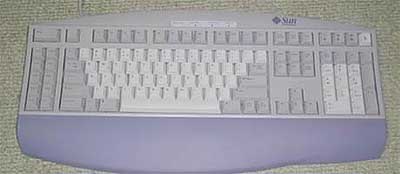
I use, and recommend, a Sun Type 6 keyboard, Item-number #320-1271. It comes with a standard USB connector and a Mac-friendly layout, including the "command" key in the correct position.
Here is a diagram, a picture, and the online ordering page.
Sometimes it can be ordered for less from different online stores. -
Re:Good idea
I use, and recommend, a Sun Type 6 keyboard, Item-number #320-1271. It comes with a standard USB connector and a Mac-friendly layout, including the "command" key in the correct position.
Here is a diagram, a picture, and the online ordering page.
Sometimes it can be ordered for less from different online stores. -
urban myth
Too bad that it was an urban myth. Funny although.
-
Re:What's the flaw again?
It's ugly and non-orthoganal. Look at the Arrays class for example; there are dozens of duplicated methods that are identical except that they take bytes, chars, shorts, ints, etc. as arguments. I'd much rather have everything be a true object
Than you'd be using the ArrayList class, which can store any object (including Integer, Float, etc), and has the same capacities.
ArrayList is the standard, basic Java collection class. The Arrays class is a utility class, as can be seen from the fact that all methods are static. It can be seen as a set of utilities for independent arrays of primitive types, but there's no need to use any such array. It's just there to help if you absolutely want to.
Thomas- -
Re:JNI
I agree about JNI. But just to point out the difference again - JNI is an API, it's there for integration. It's not something that a normal programmer will ever use. It doesn't bring unsafe code into the VM, it provides a way to invoke it from the VM.
I don't get your point. It's true that "JNI is an API", but it is also associated with implementations that consist of dynamic linking and also put the VM at risk of corruption. Even Sun admits this and uses it as an excuse for not applying access controls to native code. Just look at the JNI info they provide mentions that "JNI's permissiveness was a conscious design decision, given that native code can access and modify any memory location in the heap anyway" (See 10.9). While it is just an API, it does bring unsafe code into the JVM because, well, that's what the implementations do on the popular platforms. -
Re:What's the flaw again?
Just curious... What's wrong with that?
It's ugly and non-orthoganal. Look at the Arrays class for example; there are dozens of duplicated methods that are identical except that they take bytes, chars, shorts, ints, etc. as arguments. I'd much rather have everything be a true object; any performance issues can be handled by the compiler, runtime, or Moore's law. Autoboxing helps, but better to fix it for real than with syntactic sugar. -
Re:Who is to say someone else wouldn't have
The "NS" namespace comes from OpenStep-- the original Nextstep used the "NX" prefix. NS stands for Next/Sun.
-
Three rings
That'll look real nice right next to my Java ring.
-
Re:I wonder how much to render a Pixar flick...
Bit of trivia: Toy Story was rendered on 117 SparcStation 20 computers (87 dual, 30 quad). In that article they quote "800,000 computer hours" and "16 billion instructions per second", but remember that this is a press release from December 1995. Consider that in early 2001 Steve Jobs and a guy from Pixar demonstrated rendering Luxo Jr in REAL TIME!!!