Slashdot Mirror
Domain: swri.edu
Stories and comments across the archive that link to swri.edu.
Comments · 59
-
Any slashdot space pirates?
We now know its communications specs http://pluto.space.swri.edu/IM... and as it was made in the year 2000... NASA has most likely already made the communications protocols, if not the software itself, available to the public. NASA also doesn't have a timetable on reaquiring it, its orbit telemetry was linked in a comment, and this community probably has a few people who can slap an arduino based orbital tracking antenna together... but no one here would want a global observatory satillite or offworld server, right?
-
Re:Not enough orbital telescopes
The reason they went to South America to get this data is that the occultation wasn't visible from anywhere else. (here's the ground track and ephemera.) Otherwise, they could have gotten the data from ground-based telescopes in, say, the United States, or one of the big observatories in the Atacama. An occultation is essentially the same as an eclipse, and those are hardly visible from any ol' place.
Even if we had a dozen Hubbles out there, one would have had to modify its orbit so that it happened to coincide with the shadow track of this miniscule object at just the right moment. Part of the reason why they set up an array of ground telescopes was they there was enough uncertainty of the size and trajectory of the object they couldn't be sure exactly where on the ground to capture it. Only 5 of 24 telescopes managed to get it. At orbital velocities, your window of opportunity would be even smaller.
I do agree with your larger point, however: I would love to see a grand fleet of space-based observatories. -
Actual Photos
If you want the actual photos without all of the fake assery all the links show you, click this: https://www.missionjuno.swri.e...
-
Re:Pluto?
Wasnt Pluto reinstated as a planet not long ago (again)?
No. Alan Stern and some others from his team have made the argument again, and been soundly ignored by the rest of the planetary science community.
He's a respected worker (PI on New Horizons, for instance), so he'll get peer reviewed and published, but that doesn't mean that he'll carry the consensus with him.
I'm not a planetary scientist myself, but I do follow the field quite closely. When @plutokiller (Mike Brown, Caltech) killed Pluto, I was personally more in favour of a mechanics-based criterion (is it round, +/-10%?). But that would have made Uranus P6, Ceres P7, Neptune P8, Vesta P9, Pallas P10, Pluto P11, Chiron P12, and then the KBO discovery-factory started up with a couple of dozen more "planets" since then. If you think that's a preferable situation, then you too can make that argument.
Since then, I've read and digested Hal Levison's arguments, summarised at https://www.boulder.swri.edu/~... ; they make sense and I've decided to accept the IAU and accretion/ ejection (~="clearing) argument. Pluto is not a planet, it's a "dwarf planet", or a "small body" (there's still some argument over terminology.
Alan Stern, respected though he is, wants to have the topic of his career's study, Pluto, classified as a planet, along with the rest of the "big boys". Sorry, Alan ; no can do. Pluto has been pushed around all it's life, and will be pushed around for the rest of it's life, until the heat death of the universe.
-
Re:Braking maneuver at periapsis
Has anyone seen any links to Juno's orbital elements.
Must be a secret, since not even a very specific Google look-up yields any info. My googling even took me to a NASA sponsored forum, where a user [maybe yourself?] asked the same question, to no avail.
-
Re:Is Jupiter a planet?
So if the definition is something about clearing its orbit of anything that could possibly eject it, that isn't the definition I have ever heard.
That's because you're now near the cutting edge of science. This is a taxonomy for a continuous natural variable. There isn't an obvious criterion for separation (such as the "hydrogen fusion" criterion for distinguishing between a brown dwarf and a star - that's a natural binary criterion), but the IAU people were trying to find a definition which distinguishes between two different, but potentially overlapping, classes.
As a geologist, I don't get terribly fussed up over whether something is a "claystone" (grains averaging less than 1/256 mm in diameter) or a "siltstone" (grains averaging 1/32 to 1/256 mm) because (1) I don't have the apparatus to distinguish the two classes, (2) my clients don't care - they're both too low a permeability to be of interest, and (3) we have the useful term "mudstone" to cover both cases.
The IAU sought to tighten up the definition of "planet". That's a work in progress. One early paper discussing it was presented in 2002, with some additional thoughts by one of the authors here (that one is less than an hour's work to read, unless you want to check every line of the maths; it's what convinced me that my geological favour for the "gravitational self-rounding" criterion was misplaced). A more recent proposal is here. This last one is interesting, as it adds some interesting considerations that I'd not wasted too much of my life thinking about, but I now feel the need to consider.
By the time you've digested a couple of those, you'll be in a better place to discuss the arguments that are occupying almost no astronomer's time outside the bar at conferences. Taxonomy never really gets much attention, once the tool is "good enough" to be useful. Which is where things are, amongst the astronomical community.
-
Re:Is Jupiter a planet?
So if the definition is something about clearing its orbit of anything that could possibly eject it, that isn't the definition I have ever heard.
That's because you're now near the cutting edge of science. This is a taxonomy for a continuous natural variable. There isn't an obvious criterion for separation (such as the "hydrogen fusion" criterion for distinguishing between a brown dwarf and a star - that's a natural binary criterion), but the IAU people were trying to find a definition which distinguishes between two different, but potentially overlapping, classes.
As a geologist, I don't get terribly fussed up over whether something is a "claystone" (grains averaging less than 1/256 mm in diameter) or a "siltstone" (grains averaging 1/32 to 1/256 mm) because (1) I don't have the apparatus to distinguish the two classes, (2) my clients don't care - they're both too low a permeability to be of interest, and (3) we have the useful term "mudstone" to cover both cases.
The IAU sought to tighten up the definition of "planet". That's a work in progress. One early paper discussing it was presented in 2002, with some additional thoughts by one of the authors here (that one is less than an hour's work to read, unless you want to check every line of the maths; it's what convinced me that my geological favour for the "gravitational self-rounding" criterion was misplaced). A more recent proposal is here. This last one is interesting, as it adds some interesting considerations that I'd not wasted too much of my life thinking about, but I now feel the need to consider.
By the time you've digested a couple of those, you'll be in a better place to discuss the arguments that are occupying almost no astronomer's time outside the bar at conferences. Taxonomy never really gets much attention, once the tool is "good enough" to be useful. Which is where things are, amongst the astronomical community.
-
Re:its a dwarf planet!
This is what happens when you write naming conventions in order to "get" a planet for political reasons!
If you, for whatever reasons you have, think that is what happened, then nothing short of full-blown ECT is going to argue you out of it.
If you're actually interested in what happened, then here's some information for you. The discovery of Eris (by Mike Brown a.k.a @PlutoKiller and team) which was probably bigger than Pluto and clearly had not in any sense "cleared it's orbit," then it became obvious that the definition of "planet" needed firming up. There were several proposals as to how to do that, and a wording was settled. What exactly that wording means isn't so clear.
Hal Levison (if I need to write a potted biography of him, then you clearly need to strengthen your planetary science) wrote up his "hand-waving" version a while ago at SWRI, which uses an argument balancing the effects of accretion and ejection. There are other ways of expressing the discussion though - there were a couple of papers on Arxiv a month or so ago about search possibilities for "Putative" (otherwise known as "Planet9".
-
Re:ObAs I've said before, the reasons for "removing" "planet status" from Pluto (or, more strictly, defining "planet" and finding that it doesn't include Pluto) are not the reasons you give, but they are reasons.
For an accessible summary, see Hal Levison's "hand waving explanation." These may not be the criteria that you consider important, but the way to change that is to devote the couple of decades necessary to become a sufficiently respected voice in planetary science, and then to go and argue your case.
Hint : it's science. It is not a democracy. It is a meritocracy, with your merit being judged on the basis of your published work.
-
Re:Ninth, mofo.
Heck, Jupiter hasn't cleared its neighborhood.
You misunderstand what the IAU mean by "cleared".
Do you think it is possible for the Greeks and Trojans to conspire together to eject Zeus (Jupiter) from the Heavens? Even Homer would be using his groping-stick to club you to Hades.
FYI - a more reasoned expression of the technical argument.
-
Re:Ninth, mofo.
It's worth adding that if we go by the IAU's definition, this thing - despite being 10 times bigger than the Earth - would almost certainly not be considered a planet, due to its distant elliptical orbit.
No, it would (probably) not be considered a planet unless it was demonstrated that it had no bodies nearby which had enough proximity and mass to potentially eject it from Solar control.
The criteria are reasonably clear (astronomy, like my native geology has many confounding cases, because nature doesn't like to fit into our boxes), but gathering reliable evidence is going to be difficult. WTF - I help oil companies spend hundreds of millions of dollars searching for oil reserves - that's not easy either.
-
Re:Tenth
if you want to count some of the other semi-small planets.
I have spent considerable time sitting on the sidelines over this.
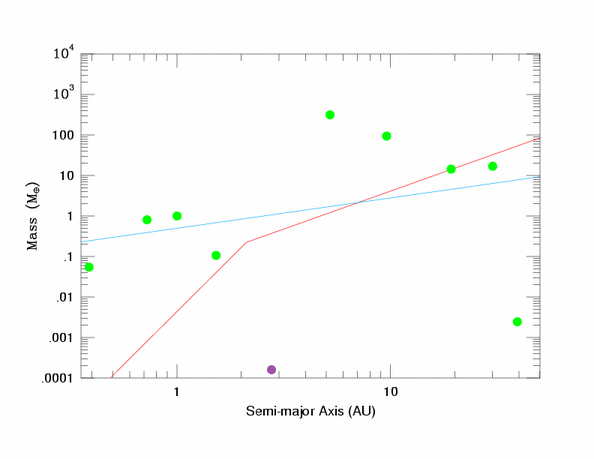
About a year ago, I was introduced to Hal Levison's (you give a serious shit about this ; then you don't need introduced to Levison ; if you need introduced to Levison, then you're a dilettante) "Hand-waving argument", which steers a fine line between technical detail and, well the "hand-waving" of the title.
The basic idea is that growing planets balance between accretion (of their growing peers) and ejection (by their growing peers), and objects that don't pass those tests are not planets.
I refer the honourable reader (and the less honourable questioner, an AC [Hawk, Spit}) in particular to the final graph where Pluto's outstanding nature in respect of these criteria is clearly shown.
I wasn't terribly happy about the IAU's decision (I supported the "self-gravitating to a sphere" criterion), but I now better understand their reasoning. And I accept it.
-
Re:Tenth
if you want to count some of the other semi-small planets.
I have spent considerable time sitting on the sidelines over this.
About a year ago, I was introduced to Hal Levison's (you give a serious shit about this ; then you don't need introduced to Levison ; if you need introduced to Levison, then you're a dilettante) "Hand-waving argument", which steers a fine line between technical detail and, well the "hand-waving" of the title.
The basic idea is that growing planets balance between accretion (of their growing peers) and ejection (by their growing peers), and objects that don't pass those tests are not planets.
I refer the honourable reader (and the less honourable questioner, an AC [Hawk, Spit}) in particular to the final graph where Pluto's outstanding nature in respect of these criteria is clearly shown.
I wasn't terribly happy about the IAU's decision (I supported the "self-gravitating to a sphere" criterion), but I now better understand their reasoning. And I accept it.
-
Re:And?There is a "thumbnail" (not a formal paper, but a good undergraduate level explanation) of the Pluto decision by one of TFA's authors (Hal Levison). I have always preferred the materials science POV for defining "planet" (i.e., it has self-gravitated to a rough sphere) over the IAU's complex criteria, but after reading Levison's "thumbnail" I am much less opposed to the IAU definition than I was 6 months ago. (For context, I've been interested in Planetary Science since the mid-80s, which includes this question.)
Levison's "thumbnail" ; he used the term "hand waving" ; [SHRUG].
-
Re:Question about deep space pictures
The main imager (LORRI) is a 208mm diameter telescope with a 2630mm focal length, or f/12.6. The spider and secondary obscure 11% of the area, so that's equivalent to f/13.4 in terms of light gathering for photographic purposes. Exposure times are 50-200 ms, or 1/20 to 1/5 sec.
On Earth, the sunny 16 rule says on a sunny day the proper exposure at f/16 is when your shutter speed is 1/ISO. So f/16, 100 ISO, 1/100 sec. The atmosphere absorbs roughly half the sunlight, so in earth orbit that would become f/16, 100 ISO, and 1/200 sec.
Pluto is about 32.6 AU from from the sun right now, so the sun's brightness there is 1/32.6^2 = 1/1063 what it is at Earth.
Going from f/16 to f/13.4 gets you about 1.43x more light.
Increasing exposure time from 1/200 sec to 1/10 sec gets you 20x more light.
That leaves a deficit of 37.2x, which you can get by increasing CCD sensitivity to ISO to 3,720.
ISO 3200 was easily attainable by high-end consumer digital camera sensors 10 years ago, much less a commercial one specially designed for scientific purposes. -
Re:Movie?
-
Re:Saturn pulling Jupiter
Nothing ever gets pulled closer, except that something else gets thrown further away in equal measure, anything else would violate conservation of momentum. This page give a bit of an overview: http://www.boulder.swri.edu/~k...
As I understand it the idea is that they were acting within a relatively dense gas-and-asteroid cloud rather than the modern vacuum. Jupiter was moving inwards as it scooped up gas and asteroids from the inner system, launching most of that material into the outer system. And miniscule Saturn was towed along in it's wake. Eventually the orbital resonance with an encroaching Saturn slowed and reversed Jupiter's motion, at which point they began scooping up the detritus that had been thrown outward on their inward journey and hurling it back inward again while they moved outwards, eventually moving outwards far enough that they could start scooping up the previously undisturbed outer-system cloud and hurling it inward, moving them even farther out than they had originated. And of course Uranus and Neptune had meanwhile been busy throwing more material inwards from the far-outer system as they performed their own migrations, further fueling the outward migration of Jupiter.
Think of it like a gravitationally powered rocket engine - every asteroid that does a gravitational slingshot around Jupiter transfers just as much momentum to Jupiter as it does to the asteroid.
Eventually Jupiter's orbit stabilized when it ran out of enough outer-system detritus to propel it further outward, while orbital resonance continued to propel Saturn even further outward at the expense of propelling Jupiter slightly inward, solidifying the new orbital position.
-
Re:Go SpaceX!
In term of technology, you're right, but in term of economy the cost to launch the Mars spacecraft to LEO is a major expense, if you check the cost breakdown at the end of this article, it shows the launcher is the most expensive part of the mission. Given cheap access to LEO, I think it would be much easier to design the rest of the mission since mass constraint would be greatly reduced.
No, the cost to protect the crew for the multi-year journey and stay on the planet is the major expense when looking at the total cost of the program. Cost to launch is applicable per mission, but not overall. Look at it this way. A heavy launch vehicle launching a satellite versus a manned capsule uses just as much resources to reach LEO, so the cost to launch is equivalent. However, the actual cost to put a capsule into space is much more than a satellite. Why? Because protecting the human cargo is more costly than protecting integrated circuits.
Now that is just to LEO. Extend that for a 76 million mile round trip, plus a 12 month or more stay on the planet and see what happens to the cost. If cost is the primary concern, unmanned exploration is always cheaper.
We are on the verge of having cars that can drive them self in everyday traffic. Surely the AI that is advanced enough for that is advanced enough for exploration on a distant planet. The question that needs to be asked is what does sending people to Mars and the associated extra costs get that sending sophisticated machines doesn't provide?
-
Re:Go SpaceX!
In term of technology, you're right, but in term of economy the cost to launch the Mars spacecraft to LEO is a major expense, if you check the cost breakdown at the end of this article, it shows the launcher is the most expensive part of the mission. Given cheap access to LEO, I think it would be much easier to design the rest of the mission since mass constraint would be greatly reduced.
-
Re:They rank these storms
'ranking system for CME/EMP effects'
Wow. Well, what you're talking about is the 'Flare Class' which only classifies the amount of x-ray energy given off by a flare. It's a log scale, so M is 10x as large as a C, and X is 10x as large as an M. Of course, there's no cap on it, and there have been X20 flares recorded. Of course, the sensors saturate, and as we're only really dealing with one significant figure and a magnitude, I don't know how much precision they have at those higher values.
To make things even more fun, there's also a flare 'importance' value, which is based on the energy and size of the flaring region in the optical (visible) spectrum.
But neither of these classifications have to do with CMEs, and particularly not their affects at earth. For that, you'd need to look at the solar wind folks, who are obsessed with things like 'Bz' (z-component of the magnetic field', ie, how is it oriented relative to the earth's magnetic field?) and radio bursts.
The closest thing that I can think of to what you describe would be a catalog of ICMEs (Interplanetary CMEs), but even those, if you look at the catalog, are just raw numbers, no sort of ranking to it. (the column with 'A' and 'B' in it are which of the two STEREO spacecraft saw the event, 'Ahead' or 'Behind')
Disclaimer : I'm not a solar physicist, but I work in a solar data archive, and have done work trying to normalize solar event catalogs.
-
Re:Earths Surface
but I am already shocked how fast life evolved,
I enjoy knocking people over with a landscape where you get to see 500 million years of geological activity, after climbing up a few million years of such activity. We're still looking at around twice that amount of time. That is a lot of time.
There is a geological term, "deep time" ; it's a gatekeeper to understanding geology in the same way that appreciating "astronomical distances" is to understanding astronomy. Which is why I repeatedly take aspirant geologists to sweat up that particular mountain, and look out on that landscape, and to take the kick in the head. Those who get it have got it, and those who don't get it end up mixing mud or turning drill pipe, but they're not worth training as geologists because they'd never be more than technicians. It's careers advice.I'll rephrase that : I won't waste my time on training them ; the Boss can spend as much money as he wants to on them, but he's learned to take my advice.
It must have been an awe inspiring site to see the impact from the surface of the earth. Well, in a pressure suit anyway.
For me, a decent telescope and a good deal of distance, thank you. A million miles sounds like a good excuse to get a better telescope.
What I can't figure out is the model they used for the gravitational effects.
[SNIP]
Such a gravitational system would be very dynamic so how such a stable apex could form for an object to assume an orbit of any kind is not spoken of in the paper.No need to figure it out. Read the papers. They use simple Newtonian models iterated over many "particles", over many time steps, adding up to an awful lot of calculation. Then they move the initial conditions trivially and re-run the simulation.
Lather, rinse, repeat.
Some people use dedicated hardware to solve the multi-body problems fast (GRAPE being a family tree of Japanese super computers for precisely these problems as well as comparable galactic interactions etc. ; other people seem to use COTS supercomputers.)Yes, the situations are very dynamic. What is a "Lagrange point" in one time step probably isn't when you project 100 million particle motions forward by a half-hour and re-calculate the overall gravitational field. So the "Lagrange points may not be "stable", but if they're moving in a regular manner through a constrained volume, then that volume may be disrupted less than non-Lagrange-ish regions, making them areas of net material relative accumulation. And you have to look at statistically significant numbers of runs to see which outcomes are more or less likely.
The science is published. I've given myself headaches reading and trying to understand it, and far be it from me to deny you that pleasure. [those pleasures]
Papers on http://www.boulder.swri.edu/~robin/rcpapers.html should give you a fair start. "TL;DR" is a credible but unhelpful (for you) response.
-
Re:More Info & Dashboard
No one is doubting Global Warming.
That's simply not true. There's a large contingency of folks who are outright denying even the temp rises. They're typically the mindless followers of Beck & Limbaugh.
By "solar weather theory" are you referring to the false arguments that AGW is caused by cosmic rays and/or temps are increasing on other planets? If so, no problem. Here's 34 different scientific papers that refute each aspect of them.
So, you ready to change your business model now? -
Southwest Research (or other research orgs)
There are think tanks which hire researchers/computer scientists to work on various projects which might be right up your alley. The one I work at is called Southwest Research Institute, but there are others. I work primarily in space research and have a BS in Computer Science from a local university. Some of my work has even shown up on Slashdot! I freely admit I know very little about space compared to the astronomers and physicists I work with; however, I use my computational/development skills to make it easier for scientists to do science. We have other divisions as well besides space, but none of them really fit exactly what you mentioned you were interested. Nevertheless, you may want to check them out...
-
Re:More Like it?
Recording is no problem, it's sending it back. [...] Even with the big dish it has and a 70 metre dish on the ground here, you only get about 1 kilobit per second of transfer out at Pluto.
Exactly right. "The 2.1m HGA [High-Gain Antenna] was designed to meet a requirement for a minimum of 600 bits/s downlink telemetry rate at 36 AU to return the Pluto data set" (page 19); further, "The downlink system will guarantee that the entire Pluto data set (estimated to be 5 Gbits after compression) in 172 days with one 8-hour pass per day using the DSN [Deep Space Network] 70m antennas. If there is sufficient power, such that both TWTAs [Traveling-Wave-Tube Amplifiers] can be used, the time to downlink the data set can be reduced to less than 88 days" (page 21).
-
Re:More Like it?
Recording is no problem, it's sending it back. [...] Even with the big dish it has and a 70 metre dish on the ground here, you only get about 1 kilobit per second of transfer out at Pluto.
Exactly right. "The 2.1m HGA [High-Gain Antenna] was designed to meet a requirement for a minimum of 600 bits/s downlink telemetry rate at 36 AU to return the Pluto data set" (page 19); further, "The downlink system will guarantee that the entire Pluto data set (estimated to be 5 Gbits after compression) in 172 days with one 8-hour pass per day using the DSN [Deep Space Network] 70m antennas. If there is sufficient power, such that both TWTAs [Traveling-Wave-Tube Amplifiers] can be used, the time to downlink the data set can be reduced to less than 88 days" (page 21).
-
Re:Illinois no more idiotic than IAU
A. Your reply seems to suggest that I favor the old definition. I do not.
B. I never said the Illinois action was not asinine; you are just projecting.
C. My favored Planetary Classification is described here: http://www.boulder.swri.edu/~hal/PDF/planet_def.pdf
1. This classification would benefit from further refinement, but represents a more logical (i.e. less asinine) approach.
2. This classification provides for upper as well as lower mass boundaries and allows inclusion of esoteric bodies like rogue planets and double planets.
3. Yes, this would result in a larger number of "new" planets... so what? The IAU approach irrationally favors fewer planets.
D. Your attempt to appear scholarly in your reply is juvenile and an excellent example of my use of the term "slashdot dweeb". An adult response would have been "What method of classification do you prefer and why?" or "What about the IAU method do you find objectionable?" -
Photo that shows the Apollo 17 LEM on the moon
You can even see its shadow.
http://www.boulder.swri.edu/~durda/Apollo/ls_17_5aa.html
Better yet, go to the root page, and explore the sites of each of the lunar missions. You can "tunnel" down to photos only a few hundred meters wide.
http://www.boulder.swri.edu/~durda/Apollo/landing_sites.html -
Photo that shows the Apollo 17 LEM on the moon
You can even see its shadow.
http://www.boulder.swri.edu/~durda/Apollo/ls_17_5aa.html
Better yet, go to the root page, and explore the sites of each of the lunar missions. You can "tunnel" down to photos only a few hundred meters wide.
http://www.boulder.swri.edu/~durda/Apollo/landing_sites.html -
Re:Star Wars Fakeout
The chances of dying from an asteroid or comet impact are about equal to the chances of dying in a passenger aircraft crash. In fact, you're *less* likely to die from a flood, tornado, or from a venom bite/sting than from an asteroid/comet impact.
-
Re:Great!
Ralph: A Visible/Infrared Imager for the New Horizons Pluto/Kuiper Belt Mission
"MVIC is composed of 7 independent CCD arrays on a single substrate. It uses two of its large format (5024x32 pixel)
CCD arrays, operated in time delay integration (TDI) mode, to provide panchromatic (400 to 975 nm) images. Four
additional 5024x32 CCDs, combined with the appropriate filters and also operated in TDI mode, provide the capability
of mapping in blue (400-550 nm), red (540-700 nm), near IR (780-975 nm) and narrow band methane (860-910 nm)
channels."
You did know that cameras like this take colour shots by merging multiple exposures with different filters applied, right? They're probably using their limited bandwidth to retrieve single exposures from each shot to get a quicker overview of what they've got. -
You don't have to go back to school...
If you are a programmer, and want to work in the sciences, just get a job programming in the sciences. I currently do programming for space research in a predominately physics oriented environment. I know nothing about space or even physics (hated it at school!), but I've been doing fairly well at my job. It's an interesting field to be in, and beats the humdrum of code monkey or boring business applications. Our company is Southwest Research Institute but I am sure there are others out there...
-
BingoI do a lot of interactive data processing. I use PDL a variant of Perl (which, recall, is JIT-compiled) that is designed for array handling. For most of what I do PDL is great -- the CPU spends most of its time waiting for me to make up my mind what I want to do, and moving my ponderously slow fingers to type the command at 110 baud. But some of the stuff I do (magnetohydrodynamic simulation) is exremely CPU-bound, and that stuff I write in C.
A lot of folks use languages like PDL, IDL, MatLab, Octave, or even NumPy to do array processing, and tout the fact that for large arrays those languages run "essentially as fast as C". But that's bullshit. All those languages vectorize their operations in exactly the wrong order - if you have a hundred million datapoints and you want to do six operations on each one, each of those vectorized languages will dutifully swap each of your hundred million datapoints out of RAM into the processor, multiply it by seven (or whatever), and push it back out to RAM before pulling them all back in to add six to each one. What you really want is to vectorize in pipeline order, doing all the operations you plan to on each data point once and for all so that you can take advantage of your processor's nice, fast cache. Nobody has (to my knowledge) figured out a way to do that, that is robust enough for an interactive/JIT language, so just writing it in "C" and getting the loops nested in the right order can speed you up by a factor of more than 10 on a modern AMD or Intel CPU. -
Re:*DOH!* Thanks for the correctionsI should fix up the Wikipedia article at some point; it seems a bit misleading to me at points. In the meantime, I point interested parties to the IBEX web site for basic background info. In particular, Section E of the IBEX Concept Study Report is handy. Of course, I can't find it on the site now....
Apropos of everything, IBEX is a SMEX (Small Explorer) mission. Budget cuts have delayed the next Announcement of Opportunity on the Explorer program (IBEX itself should be fine). This is where science gets done, folks. My pizza fund appreciates you contacting your congresscritter to encourage continued and expanded support of NASA (and NSF, while you're at it).
-
Re:Now to fill its spot in the labs
Actually, if you are interested in some more detailed photos of the apollo landing sites, check here
-
Re:Conspiracy!
i hope this doesn't break this site, because it doesn't belong to me.
Exploring the Apollo Landing Sites
lets you click thru pictures to zoom in farther and farther, using pics from earth- and orbit-based telescopes, as well as photos from the orbiters and command modules.
some are good enough resolution that you can see the lander, albeit barely. you can see the rover tracks in all of them though. -
Clickable image map of lunar landing sites
-
EarthshieldB612 Foundation is an example of what I've called earth shielding entities that will exploit earth-approaching asteroidal materials before they can be used as celestial weapons of mass destruction against earth:
Before growing far toward being heliocentric, the first biorb will need to begin the defense of Earth against celestial attacks.
Kinetic energy asteroidal weapons are the most likely technology to represent the greatest threat to Earth as a result of the growing solar biorb. Once asteroid mining begins in earnest, as it will once life becomes heliocentric, asteroids can be redirected via carefully planned celestial mechanics. Within a matter of decades, a malicious interest could send a swarm of tiny asteroids toward Earth at speeds comparable to that of the Swift Tuttle comet -- a popular candidate for global disaster scenarios. Since kinetic energy goes up as the square of velocity, the important thing is to find small asteroids with the right trajectories. This would most likely be carried out on the basis of a fairly complete atlas of the trajectories of small asteroids, searching for some large number of them that could be manipulated to converge on Earth with maximum relative velocity over a fairly narrow window of time.
The most economic defense will likely be the preemptive survey, cataloging and monitoring of all celestial objects (comets as well as asteroids) large enough to survive high speed passage through Earth's atmostphere with little loss due to ablation. This means the initial prospecting for asteroidal resources will be carried out by Earth shielding entities. It is difficult to second guess the technologies that would be available for this task so far in the future, but candidate technologies are already upon us and surveys are already being done.
Perhaps the most positive aspect of this situation is that when an asteroid is identified as a threat, it is also identified as a particularly attractive source of "fuel" for space transportation. Any asteroid that has a high velocity relative to Earth, or can be easily made to have such a velocity, and which has an orbit that can be made to come near Earth, can be used as reaction mass to navigate the inner solar system. Each time this is done, however, the threat represented by such asteroids diminishes. It's as though someone had discovered a way to burn nuclear fuel in jets without pollution. The bombs would get burned up due to economic demand.
Additional global threats to Earth are most likely decreased by removing technological civilization from its biosphere. -
Nuclear Loving LiberalI for one identify myself as an environmentalist liberal, yet love the thought of nuclear power. I know I am not alone.
As an aside, I worked at the Center for Nuclear Waste Regulatory Analysis towards attempting to solve the waste problem.
-
Sun activity and climate
One thing I'm curious about is what effect that the Sun's activity has on climate change. There have been spacecraft studying the sun and more spacecraft studying the magnetosphere and it's interaction with the solar wind. However, it seems that we only have understanding of individual events and the immediate effects of those events. It will be really interesting when some people get a good idea of what long term effects CMEs (coronal mass ejections) and other Sun activity has on our little blue world.
-
Alpha-Transparency
So people know what an "alpha-transparency is" -- it's this very beautiful flower... which is also on this page, unless you're using IE, in which case it's just blank. Some examples are also available here. Basically it's just a much nicer version of GIF's transparency.
-
Alternative Suppliers
-
It's in a bunch of places
How are electrical cars more energy efficent than gas powered ones?
Among other things, electric cars don't sit in traffic with their engines idling but doing no work. They also have no throttling losses from operating at part load.We get the majority of our electricity from burning fossil fuels.
If you have e.g. a Ford Ranger which uses 300 watt-hours/mile at the wheels while getting 25 miles per gallon at cruise, it is operating at about 21% efficiency. A typical old-technology coal-fired steam turbine gets 30-35% efficiency, a gas-fired combined-cycle turbine plant can beat 50% handily, and other technologies can probably hit 60% or more. If these are used along with co-generation to supply heat for other uses, total utilization of the fuel can probably exceed 80%. That's four times what the truck can get on its own.If we all convert over to electrical cars, will be not just burning more oil and coal in our power plants?
But given the higher efficiency, we'll be burning less overall. We'll also have the option of supplying cars from nuclear, wind, hydropower or solar; anything that makes electricity is the same as far as the car is concerned.The substantial storage capacity of electric car battery packs would also give benefits for the electrical grid (which should be high on our list of priorities after 8/14/2003). See the papers at acpropulsion.com about vehicle-to-grid ancillary services.
And no, I have no relationship with these guys, I just think they're clever and have a damned good idea.
-
Smallest visible object on the moon from Earth...Umm... the eye doesn't work by seeing a percent of area - the eye has a working resolution, like a digital camera. The question is, what's the resolution of the human eye, and what's the smallest thing that can be resolved by that resolution at the distance of the moon?
This Article indicates that an average resolution is either 4 arc-minutes or 6 arc-seconds. The 6 arc-seconds makes more sense than 4 arc-minutes (4 arc-minutes is a whopping 1.2 mm at a distance of 1 m (I don't know about you but I can see better than that!), where 6 arc-seconds is 0.03 mm (about
"Using math since 1986 to sound like I know what I'm saying"
-
Re:Speed vs CountYup. I use this almost everyday. With Seattle consistently ranking in the top 10 for traffic congestion, I find it to be very useful in planning the route home from work.
Before Seattle, I lived in San Antonio that has also had a similar system for a few years.
As far as I remember, both these programs were funded by the federal government. Southwest Research Institute was resposible for setting up the system in San Antonio back in 1996-1997.
-
Re:Speed vs CountYup. I use this almost everyday. With Seattle consistently ranking in the top 10 for traffic congestion, I find it to be very useful in planning the route home from work.
Before Seattle, I lived in San Antonio that has also had a similar system for a few years.
As far as I remember, both these programs were funded by the federal government. Southwest Research Institute was resposible for setting up the system in San Antonio back in 1996-1997.
-
Re:Why don't they...
quoted here from this excellent moon landing site web page
"seeing one of the lunar rovers from Earth would be like trying to see a grain of sand on a beach while flying high overhead in a jet airliner!" -
WHY ...
are they announcing this when the orbit hasn't been confirmed yet? I thought that after the embarrassing 1997 XF-11 false alarm, astronomers agreed to wait until they had enough data to confirm or rule out an impact, before releasing a press statement...
-
Re:Hey
I thought longer exposure times, sky conditions and a stable camera were key in astrophotography. If I'm wrong please correct me, but mounting a camera on an f-18 dosen't sound like good practice.
According to the SWUIS page the 60 fps rate of the camera is used for jitter compensation, so presumably the fast frame rate is quicker than the characteristic timescale of the aircraft motions.
An aside: for the larger aircraft-borne telescopes like the Stratospheric Observatory for Infrared Astronomy (SOFIA) the telescope is "as stable as a mountaintop telescope sitting on a 10 meter cement foundation" according to the FAQs. From that page:
So how do you do this? First, you isolate the telescope from the airplane by mounting it on a spherical pressurized oil bearing. The plane shakes and quakes, but the telescope doesn't feel it. Second, you direct the wind away from the telescope by shaping the side of the airplane so as to deflect it, and install a little deflector fence on the edge of the telescope cavity as well. Third, you stabilize the telescope against sudden motion (wind does get through) by spinning three orthogonal gyroscopes which are rigidly attached to the structure, and fourth, you steer the telescope so as to keep it steady, by tracking a distant star and giving the telescope magnetical nudges to point it toward a fixed direction.
-
Gratuitous URL for New Horizons
http://www.boulder.swri.edu/pkb/ will get you to the New Horizons mission website.
-
A federally-funded researcher's point of viewI study the Sun under grants from NASA, through the Southwest Research Institute. Plasma physics in the solar corona is complex enough to require sophisticated numerical methods to understand them, and numerical methods are crucial to current research and theory.
Even ``morphological'' studies are no longer done with magnifying glasses and film, but rather with large collections of digital images from spacecraft such as SOHO and TRACE. Image calibration and reduction software is mandatory if one is to do meaningful experimental analysis.
Fortunately, the solar community has by-and-large been good about releasing analysis tools into the public domain -- in fact, there's a homebrew distribution system that grew up, mostly before CVS, to nearly-universal status within the research community. Without the tools that are available via solarsoft, I literally could not do the work that I do without developing similar things myself (in fact, I do develop tools myself, and publish them... but that's another story)
Even within the relatively open solar community, there are software-based barriers to entry. For example, most of the current community develops in a proprietary language called IDL, which was developed in significant part (in its early years) with public funds. The developer, David Stern, started RSI, inc. to capitalize on his language. Currently, IDL licenses start at $1,000 per year, double the current cost of an entry-level workstation.
When workstations cost $10,000 and only large organizations could afford hardware capable of doing image processing, this cost was excusable. But now, in an era of cheap computers, high connectivity, and readily available space-borne solar data, the cost of supporting IDL is the main barrier preventing hobbyists, high school students, and interested amateurs from doing their own research programs. If IDL were open-source and free, RSI might well still exist (under the Cygnus / Red-Hat business model), and solar (and other) research would be much more accessible to the masses.
One may argue that IDL (and its competing product, MatLab) wouldn't have developed into the large, powerful packages that they are without commercialization. But such arguments are spurious: PDL, the Perl Data Language, is entirely open-source and free, and powerful enough that that I am now devloping tools in it instead of in IDL.
I signed the petition, and I encourage you to, too. Publicly funded intellectual property is your property, just as the national forests are your forests. Demand them.