Slashdot Mirror
Domain: ted.com
Stories and comments across the archive that link to ted.com.
Stories · 48
-
Ask Slashdot: What Would Your TED Talk Be About? (ted.com)
Slashdot reader shanen poses the question: if you had to give a TED Talk, what would you talk about? They write: Mostly based on my experiences at TEDx events, though of course I've seen a lot of TED videos. Nick Hanauer's censored TED Talk is still my all-time favorite, though you couldn't see it on the TED website. Proximate trigger for this question was actually looking at the coming TEDx events in the neighborhood... In my own case, I think you'd need to put a gun to my head as motivation, but maybe my sig would be worth a laugh or two? What would your TED Talk be about? How does this idea resonate with you? Feel free to explain in as little as one sentence...
For example: "The inequality of opportunity and how the stereotypical success is a function of where one is born." -
Can Marc Andreessen Stop Technology From Eating Our Jobs? (hackernoon.com)
Technology writer Tom Chanter explores the life story of venture capitalist Marc Andreessen to ask whether software will not only eat the world, but also the jobs of what one historian predicts will be a "massive new unworking class: people devoid of any economic, political or even artistic value." Can Marc Andreessen prevent a so-called "useless class" who "will not merely be unemployed -- it will be unemployable"?
Andreessen grew up in New Lisbon, Wisconsin (population: 1,500), and taught himself the BASIC programming language at age 8. He co-developed the original Mosaic web browser before he'd graduated from college, went on to co-found Netscape, and by age 23 was worth $53 million. He then transformed into a "super angel" investor in companies like Twitter, Airbnb, Lyft, Facebook, Skype, and GitHub. "Having been an innovator in the tech start-up game, Andreessen is now an innovator in the tech venture capital game," writes Chanter. "He is a jedi that has become the master." In 2011, Marc Andreessen published an article in the Wall Street Journal titled, Why Software Is Eating The World. He wrote, "Over the next 10 years, the battles between incumbents and software-powered insurgents will be epic...." 7 years later, it's clear Andreessen was correct. Lyft has destroyed taxi jobs. Airbnb has destroyed hotel jobs. Amazon destroyed independent bookstores. How does Andreessen feel about that? "Screw the independent bookstores," he said in his New Yorker profile. "There weren't any near where I grew up. There were only ones in college towns. The rest of us could go pound sand."
But the 4,900-word article also notes Andreessen's pledge to give half his income to charitable causes -- and his observation in a 2015 interview that outside of the United States, global income inequality is falling, not rising. "He has seen technology transform his own life, and has seen how technology has bridged the global wealth gap. Why shouldn't he be optimistic about the future of America's working class?"
And Andreessen's ultimate answer to the jobs destroyed by technology may be Udacity. The article cites Andreessen's investment in the company in 2012, and points to the online education platform's hopeful mission statement. "Virtually anyone on the planet with an internet connection and a commitment to self-empowerment through learning can come to Udacity, master a suite of job-ready skills, and pursue rewarding employment."
As a boy in Wisconsin he was starved for information. He has created an education institution accessible from Wisconsin to Africa. As a boy in Wisconsin he was starved for connection. He has married an innovative philanthropist and author, Laura Arrillaga-Andreessen. They have a son named John. Andreessen is optimistic for both the working class and the future tech elite.
In his New Yorker profile he says of his son, "He'll come of age in a world where ten or a hundred times more people will be able to contribute in science and medicine and the arts, a more peaceful and prosperous world."
He added, tongue in cheek, "I'm going to teach him how to take over that world!" -
Pioneering Data Genius Hans Rosling Passes Away At Age 68 (bbc.com)
An anonymous reader writes: On Tuesday, Sweden's prime minister tweeted that Hans Rosling "made human progress across our world come alive for millions," and the public educator will probably best be remembered as the man who could condense 200 years of global history into four minutes. He was a geek's geek, a former professor of global health who "dropped out" because he wanted to help start a nonprofit about data. Specifically, it urged data-based decisions for global development policy, and the Gapminder foundation created the massive Trendalyzer tool which let users build their own data visualizations. Eventually they handed off the tool to Google who used it with open-source scientific datasets. The BBC describes Rosling as a "public educator" with a belief that facts "could correct 'global ignorance' about the reality of the world, which 'has never been less bad.'" Rosling's TED talks include "The Best Data You've Never Seen" and "How Not To Be Ignorant About The World," and in 2015 he also gave a talk titled "How to Beat Ebola." Hans Rosling died Tuesday at age 68. -
Pioneering Data Genius Hans Rosling Passes Away At Age 68 (bbc.com)
An anonymous reader writes: On Tuesday, Sweden's prime minister tweeted that Hans Rosling "made human progress across our world come alive for millions," and the public educator will probably best be remembered as the man who could condense 200 years of global history into four minutes. He was a geek's geek, a former professor of global health who "dropped out" because he wanted to help start a nonprofit about data. Specifically, it urged data-based decisions for global development policy, and the Gapminder foundation created the massive Trendalyzer tool which let users build their own data visualizations. Eventually they handed off the tool to Google who used it with open-source scientific datasets. The BBC describes Rosling as a "public educator" with a belief that facts "could correct 'global ignorance' about the reality of the world, which 'has never been less bad.'" Rosling's TED talks include "The Best Data You've Never Seen" and "How Not To Be Ignorant About The World," and in 2015 he also gave a talk titled "How to Beat Ebola." Hans Rosling died Tuesday at age 68. -
Pioneering Data Genius Hans Rosling Passes Away At Age 68 (bbc.com)
An anonymous reader writes: On Tuesday, Sweden's prime minister tweeted that Hans Rosling "made human progress across our world come alive for millions," and the public educator will probably best be remembered as the man who could condense 200 years of global history into four minutes. He was a geek's geek, a former professor of global health who "dropped out" because he wanted to help start a nonprofit about data. Specifically, it urged data-based decisions for global development policy, and the Gapminder foundation created the massive Trendalyzer tool which let users build their own data visualizations. Eventually they handed off the tool to Google who used it with open-source scientific datasets. The BBC describes Rosling as a "public educator" with a belief that facts "could correct 'global ignorance' about the reality of the world, which 'has never been less bad.'" Rosling's TED talks include "The Best Data You've Never Seen" and "How Not To Be Ignorant About The World," and in 2015 he also gave a talk titled "How to Beat Ebola." Hans Rosling died Tuesday at age 68. -
After 150 Years, the American Productivity Miracle Is 'Over' (qz.com)
An anonymous reader shares an article on Quartz: Economist Robert Gordon has spent his career studying what makes the US labor force one of the world's most productive. And he has some bad news. American workers still produce some of most economic activity per hour of any economy in the world. But the near-miraculous productivity growth that essentially transformed the US into one of the world's most affluent societies is permanently in the country's rearview mirror. In his new book, The Rise and Fall of American Growth, the Northwestern University professor lays out the case that the productivity miracle underlying the American way of life was largely a one-time deal. It was driven by a flurry of technologies -- electric lights, telephones, automobiles, indoor plumbing -- that fundamentally transformed millions of American lives within a matter of decades. By comparison, Gordon argues, today's technological advancements -- Uber, Facebook, Amazon.com -- will touch the productivity of the American economy lightly -- if at all. And a combination of demographic factors, such as the aging of the US population, and sociological problems such as growing inequality and educational performance that's worsened in comparison to many other rich nations, will stymie economic growth for the foreseeable future.For those not following Gordon's work, he has been expressing these views for quite some time now. Here's his TED talk from 2013 It shouldn't come as a surprise that many strongly disagree with Gordon's views. Kevin Kelly wrote in 2013: I think Robert Gordon is wrong about his conclusion: According to Gordon growth has stalled in the internet age. This question was first asked by Robert Solow in 1987 and Gordon's answer is that there are 6 'headwinds' six negative, or contrary forces which deduct growth from the growth due to technology in the US (Gordon reiterates he is only speaking of the US). The six 'headwinds' slowing down growth are the aging of the US population, stagnant levels of education, rising inequality, outsourcing and globalization, environmental constraints, and household and government debt. I agree with Gordon about these headwinds, particularly the first one, which he also sees as the most important. Where Gordon is wrong is his misunderstanding and underestimating of the power of technological growth before it meets these headwinds. First, as mentioned above, he underestimates the value of the innovations that the internet has brought us. They seem trivial compared to running water and electric lights, but in fact, as billions around the world show us, they are just as valuable. [...] So the 3rd Industrial Revolution is not really computers and the internet, it is the networking of everything. And in that regime we are just at the beginning of the beginning. We have only begun to connect everything to everything and to make little network minds everywhere. It may take another 80 years for the full effect of this revolution to be revealed. In the year 2095 when economic grad students are asked to review this paper of Robert Gordon and write about why he was wrong back in 2012, they will say things like "Gordon missed the impact from the real inventions of this revolution: big data, ubiquitous mobile, quantified self, cheap AI, and personal work robots. All of these were far more consequential than stand alone computation, and yet all of them were embryonic and visible when he wrote his paper. He was looking backwards instead of forward." You might also find Freakonomics' Stephen J. Dubner views on this interesting. -
Interviews: Malcolm Gladwell Answers Your Questions
A few weeks ago, you had a chance to ask Malcolm Gladwell about his writing and social science research. Below you'll find his answers to your questions. Genetics
by Anonymous Coward
Today, your continued belief in the Tabula Rasa myth seems increasingly outdated and contradicted by a wide variety of research from many notable evolutionary psychologists and genetics researchers. How do you continue to believe that intelligence and ability is not significantly genetic despite overwhelming evidence to the contrary?
Gladwell: I'm not sure where you got the idea that I'm a "Tabula Rasa" believer. believe me: as a life-long competitive runner, I'm only too aware of the large contribution innate differences make to performance. I guess I would just say that I find the environmental piece of the equation more interesting, from an analytical perspective, because its the portion that we, as a society, can do something about. In looking at things like the 10,000 rule, I've always been interested in the interaction between nature and nature--as in, what kind of effort and resources are necessary to express native ability?
How
by werepants
You have made a career out of writing books that popularize scientific findings - it seems like this is a task fraught with potential dangers, in terms of representing something that your readers misinterpret and misapply, or perhaps taking a published study and drawing an unwarranted conclusion yourself that attracts the ire of the original researchers. Certainly, much science journalism lately can be criticized for sensationalizing scientific results in the pursuit of better headlines, sometimes at the cost of being deliberately misleading. Can you expound a bit on the issues you've run into as a purveyor of scientific results, and explain how you balance the need for a faithful presentation of the source material with the desire to find something relatable and compelling enough to write a book about?
Gladwell: Its a good question. there is always a tension between specificity and accessibility. If you are writing for an elite audience--as an academic does--the line gets shaded to one end; if you are writing for a popular audience--as I do--the line gets shaded to the other end. There is no simply or easy solution as to how those two conditions ought to be balanced. Those who pretend that you can do both simultaneously--that is, represent the full complexity of an issue and also render it comprehensible to a mass audience--are smoking crack.
Sharpshooter fallacy
by i kan reed
The areas you work in focus on very small sample sizes: software billionaires, major cultural shifts, and cases where the most improbable result happened.
Within these areas, you've developed mental frameworks off of shared elements between each. This runs into a problem, the Texas Sharpshoot fallacy. You pick out some characteristics that are shared by the things you're looking at, and then the only available data to confirm your hypothesis is the data you extracted your predictions from.
How did you address this when researching your books?
Gladwell: Story-telling is an exercise in learning from case studies. Anthropology and field sociology are, for example, exercises in extrapolating from the specific. Economics, say, or experimental psychology are exercises in drawing conclusions from group observations. I think you need both approaches. I would never say that my books should be the last word on any subject. At the same time, however, anyone who tries to construct a world view entirely from collections of empirical data will miss something crucial about the human experience.
Opinion On Basic Income
by Scottingham
I'm curious to know what your take is on a basic income for all US citizens versus our current 'conditional' welfare system. What do you think short term and long term outcome would be? Would the increased tax burden on the upper classes result in a total collapse rendering a basic income useless? My personal opinion is that it is necessary given the increasing rate of job automation coupled with our increasing population size (not to mention aging). Am I delusional? If so, why?
Gladwell: I haven't studied this issue, I'm afraid. But you've piqued my interest!
Left-Right dichotomy vs Compass
by FreedomFirstThenPeac
As a statistician, I am seriously annoyed with the usual Left-Right dichotomy we see in most press articles. While I like the Political Compass I am a bit nervous of their clustering algorithm, and the questions they use to feed the analytics. Even more interesting is Johathan Haidt who has achieved some TED Talk fame describing a five-dimensional feature space (though he does try to reduce to two clusters - liberals and conservatives). So I pose a two part question, (1) do you think the public discourse is hampered by the popular press always reducing politicians and voters to "liberals" and "conservatives"? And if you are concerned, (2) what can we do to push back against such simplifications, especially here on Slashdot?
Gladwell: Great question! As an immigrant to the United States (from Canada) I've always been amazed at the extent to which Americans love to exaggerate their differences: that is, they dwell on the left/right distinction well past the point that that particular division serves as a useful descriptor. For example, I would be labeled, in American terminology, as well left-of-center. But when I have conversations with self-styled Republicans or Libertarians, I find myself with far greater areas of agreement with them than disagreement.
Long term effects of filter bubbles/silos
by An dochasac
There is a positive feedback between human confirmation bias and reliance on information sources which increasingly give us what we want (e.g. Google/Facebook "filter bubbles", Amazon "if you like this... you'll like that." Do you expect this to create more social balkanization and extremism or other social effects? Is there anything we can do to stop or slow this process?
Gladwell: I'm suspicious of those kinds of filters that claim to give us what we want based on what we previously wanted. the things that most interest me and capture my imagination are invariably those that depart--often dramatically--from my previous patterns of experience. Filter bubbles assume we are consistent in our beliefs and wants. But what is particular about humans, surely, is our capacity for inspired and radical inconsistency. Gorbachev reached a deal with Ronald Reagan; protestants in Northern Ireland made peace with the IRA. Are these the aspects of human experience that matter the most?
Recent religious topics
by werepants
I imagine that the different circles you run in might have dramatically different responses to the religious emphasis in your recent work. What kind of reactions (wanted and unwanted) have you gotten from your recent move towards Christianity?
Gladwell: A very small amount of cynicism. A very large amount of genuine and heart-warming support.
Increasing automation
by werepants
We've got dramatic and sudden changes forecasted in the use of automation in various industries. The trucking industry alone could change in a few short years with the advent of self-driving vehicles, leaving millions out of work. What kind of social impact do you foresee with these developments - do you think this kind of automation will be a fundamentally different kind of technological advance than our society has previously dealt with?
Gladwell: I'm a skeptic. We've been replacing human labor with machines for getting on to 200 years now. Someone needs to convince me why the current automation revolution is any different from the numerous automation revolutions that have come before. A lot of the scare mongering that occurs over this issue seems to me to come from people who aren't reading their history.
Writing & Research Methods
by Sonetta
Elaborate on what ways have technological advances altered or impacted your craft. In terms of research I imagine that you must have begun as a Journalist at the end of the card catalog era. Many research studies and books are available via internet yet you continue to frequent libraries, perhaps due to the types of items and information you find within the library. Further, first person interviews are a basis to your books. Explain the significance of the face-to-face or one-on-one and the technological tools which assist you with those interviews. Also, do you ever utilize pen and paper and notebooks? Gracias!
Gladwell: I'm old school. I still go to the library. I still use paper and pencil, as well as a computer. I still love the face to face interview. Then again, I don't believe that the tools a writer uses ultimately make that much of a difference. Its your effort and the quality of your thinking that matter!
Reduced lead leading to reduced crime?
by Paul Fernhout
In The Tipping Point you advance the argument that it was better policing against minor infractions that reduced crime. "Economist Steven Levitt and Malcolm Gladwell have a running dispute about whether the fall in New York City's crime rate can be attributed to the actions of the police department and "Fixing Broken Windows" (as claimed in The Tipping Point). In Freakonomics, Levitt attributes the decrease in crime to two primary factors: 1) a drastic increase in the number of police officers trained and deployed on the streets and hiring Raymond W. Kelly as police commissioner (thanks to the efforts of former mayor David Dinkins) and 2) a decrease in the number of unwanted children made possible by Roe v. Wade, causing crime to drop nationally in all major cities -- "[e]ven in Los Angeles, a city notorious for bad policing"."
However, it looks like the drop in crime is most closely correlated with the fall in environmental lead (mostly from reducing the used of leaded gasoline). Since other places have seen their crime rate fall without drastic changes in policing, what do you think of the lead and crime connection?
Gladwell: Yes. I find a lot of the lead arguments very convincing. If I were rewriting The Tipping Point today, I think I'd definitely add a discussion of the lead question to my consideration of the decrease in crime in the mid-1990's. That's the problem with a 15-year old book! -
Interviews: Ask Adora Svitak About Education and Women In STEM and Politics
samzenpus writes Adora Svitak is a child prodigy, author and activist. She taught her first class on writing at a local elementary school when she was 7, the same year her book, Flying Fingers was published. In 2010, Adora spoke at a TED Conference. Her speech, "What Adults Can Learn from Kids", has been viewed over 3.7 million times and has been translated into over 40 different languages. She is an advocate for literacy, youth empowerment, and for the inclusion of more women and girls in STEM and politics. 17 this year, she served as a Youth Advisor to the USA Science and Engineering Festival in Washington, DC. and is a freshman at UC Berkeley. Adora has agreed to take some time from her books and answer any questions you may have. As usual, ask as many as you'd like, but please, one per post. -
Education Chief Should Know About PLATO and the History of Online CS Education
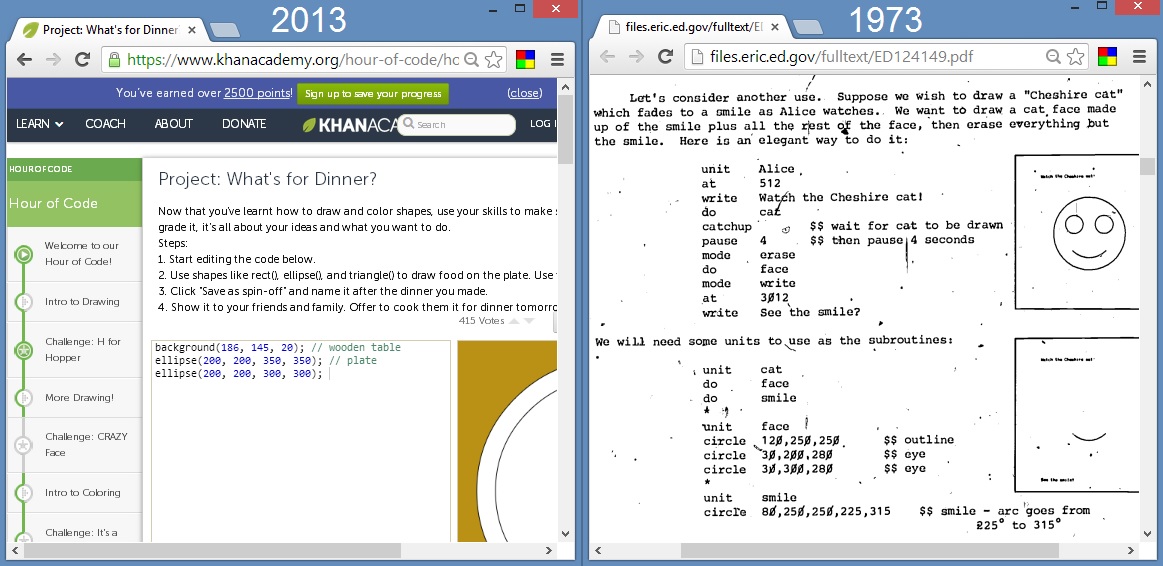
theodp writes Writing in Vanity Fair, U.S. Secretary of Education Arne Duncan marvels that his kids can learn to code online at their own pace thanks to "free" lessons from Khan Academy, which Duncan credits for "changing the way my kids learn" (Duncan calls out his kids' grade school for not offering coding). The 50-year-old Duncan, who complained last December that he "didn't have the opportunity to learn computer skills" while growing up attending the Univ. of Chicago Lab Schools and Yale, may be surprised to learn that the University of Illinois was teaching kids how to program online in the '70s with its PLATO system, and it didn't look all that different from what Khan Academy came up with for his kids 40 years later (Roger Ebert remarked in his 2011 TED Talk that seeing Khan Academy gave him a flashback to the PLATO system he reported on in the '60s). So, does it matter if the nation's education chief — who presides over a budget that includes $69 billion in discretionary spending — is clueless about The Hidden History of Ed-Tech? Some think so. "We can't move forward," Hack Education's Audrey Watters writes, "til we reconcile where we've been before." So, if Duncan doesn't want to shell out $200 to read a 40-year-old academic paper on the subject (that's a different problem!) to bring himself up to speed, he presumably can check out the free offerings at Ed.gov. A 1975 paper on Interactive Systems for Education, for instance, notes that 650 students were learning programming on PLATO during the Spring '75 semester, not bad considering that Khan Academy is boasting that it "helped over 2000 girls learn to code" in 2014 (after luring their teachers with funding from a $1,000,000 Google Award). Even young techies might be impressed by the extent of PLATO's circa-1975 online CS offerings, from lessons on data structures and numerical analysis to compilers, including BASIC, PL/I, SNOBOL, APL, and even good-old COBOL. -
Interviews: Ask Rachel Sussman About Photography and the Oldest Living Things
samzenpus writes Rachel Sussman is a photographer whose work covers the junction of art, science, and philosophy. Perhaps her most famous work is the "Oldest Living Things in the World" project. Working with biologists, she traveled all over the world to find and photograph organisms that are 2,000 years old and older. Sussman gave a TED talk highlighting parts of the project including a clonal colony of quaking aspen 80,000-years-old and 2,000-year-old brain coral off Tobago's coast. Rachel has agreed to put down her camera and answer any questions you may have about photography or any of her projects. As usual, ask as many as you'd like, but please, one per post. -
A Corporate War Against a Scientist, and How He Fought Back
AthanasiusKircher writes "Environmental and health concerns about atrazine — one of the most commonly used herbicides in the U.S. — have been voiced for years, leading to an EU ban and multiple investigations by the EPA. Tyrone Hayes, a Berkeley professor who has spearheaded research on the topic, began to display signs of apparent paranoia over a decade ago. He noticed strangers following him to conferences around the world, taking notes and asking questions aimed to make him look foolish. He worried that someone was reading his email, and attacks against his reputation seemed to be everywhere; search engines even displayed ad hits like 'Tyrone Hayes Not Credible' when his name was searched for. But he wasn't paranoid: documents released after a lawsuit from Midwestern towns against Syngenta, the manufacturer of atrazine, showed a coordinated smear campaign. Syngenta's public relations team had a list of ways to defend its product, topped by 'discredit Hayes.' Its internal list of methods: 'have his work audited by 3rd party,' 'ask journals to retract,' 'set trap to entice him to sue,' 'investigate funding,' 'investigate wife,' etc. A recent New Yorker article chronicles this war against Hayes, but also his decision to go on the offensive and strike back. He took on the role of activist against atrazine, giving over 50 public talks on the subject each year, and even taunting Syngenta with profanity-laced emails, often delivered in a rapping 'gangsta' style. The story brings up important questions for science and its public persona: How do scientists fight a PR war against corporations with unlimited pockets? How far should they go?" -
The Neuroscientist Who Discovered He Was a Psychopath
Hugh Pickens DOT Com writes "Joseph Stromberg writes at the Smithsonian that one afternoon in October 2005, neuroscientist James Fallon was sifting through thousands of PET scans to find anatomical patterns in the brain that correlated with psychopathic tendencies in the real world. 'Out of serendipity, I was also doing a study on Alzheimer's and as part of that, had brain scans from me and everyone in my family right on my desk,' writes Fallon. 'I got to the bottom of the stack, and saw this scan that was obviously pathological.' When he looked up the code, he was greeted by an unsettling revelation: the psychopathic brain pictured in the scan was his own. When he underwent a series of genetic tests, he got more bad news. 'I had all these high-risk alleles for aggression, violence and low empathy,' he says, such as a variant of the MAO-A gene that has been linked with aggressive behavior. It wasn't entirely a shock to Fallon, as he'd always been aware that he was someone especially motivated by power and manipulating others. Additionally, his family line included seven alleged murderers, including Lizzie Borden, infamously accused of killing her father and stepmother in 1892. Many of us would hide this discovery and never tell a soul, out of fear or embarrassment of being labeled a psychopath. Perhaps because boldness and disinhibition are noted psychopathic tendencies, Fallon has gone in the opposite direction, telling the world about his finding in a TED Talk, an NPR interview and now a new book published last month, The Psychopath Inside. 'Since finding all this out and looking into it, I've made an effort to try to change my behavior,' says Fallon. 'I've more consciously been doing things that are considered "the right thing to do," and thinking more about other people's feelings.'" -
Playing StarCraft Could Boost Your Cognitive Flexibility
First time accepted submitter briglass writes "Imagine being a total non-gamer and then suddenly playing an hour of StarCraft a day for almost two months. A new study of mine demonstrates that a group of female gaming novices (seriously novice, as in 0 to 1 hour of gaming per week novice) demonstrated increased cognitive flexibility after playing StarCraft, a sort of fast-paced chess on steroids. The control group played The Sims. It's been well known that video gaming can lead to psychological benefits, such as faster perceptual information processing after playing first-person shooter games. But this new study, published in PLOS ONE, shows that video gaming can also affect higher-level cognitive functions. The StarCraft game was customized to be adaptive and remain challenging as the newly minted gamers honed their skills, and in-game behavior was recorded to determine what aspects of StarCraft leads to the boost in flexibility." -
Open Source Drug Discovery Prompts a Fundamental Heart Failure Breakthrough
An anonymous reader writes "Case-Western researchers, led by Saptarsi Haldar MD., have made a fundamental discovery that could prevent heart failure after reviewing the "chemical recipe" for a cancer-treating molecule made open source by Jay Bradner MD. (whose TED Talk articulates the open source approach to drug discovery) This cross-discipline discovery, which was published in the August 2013 issue of CELL, is a fundamental breakthrough in heart failure research, and highlights the value of an open source approach outside of software development." -
Interviews: Ask David Gallo About Ocean Exploration
David Gallo is an oceanographer and Director of Special Projects at the Woods Hole Oceanographic Institution. He has participated in expeditions to all of the world’s oceans and was one of the first scientists to use a combination of robots and submarines to explore the deep seafloor. As a member of James Cameron’s Deep Ocean Task Force and the XPrize Ocean Advisory Board, David actively encourages the development of new technologies for ocean exploration. With more than 8 million views, his TED presentation entitled Underwater Astonishments is the 4th most viewed TED Talk to date. David has agreed to come up for air and answer any questions you may have. As usual, ask as many as you'd like, but please, one question per post. -
Fairy Penguins Send First Email
An anonymous reader writes "Australian researchers have successfully connected a Tasmanian colony of fairy penguins to the internet. The research effort was part of the Interspecies Internet initiative, promoted by Google's chief internet evangelist Vint Cerf and former Genesis lead singer Peter Gabriel in a TED talk earlier this year." -
MIT Researcher Demos Self-Assembling Objects
iONiUM writes "From the article: 'Many are only just getting their heads around the idea of 3D printing but scientists at MIT are already working on an upgrade: 4D printing. At the TED conference in Los Angeles, architect and computer scientist Skylar Tibbits showed how the process allows objects to self-assemble.' There could be many applications for this. Definitely a cool step forward." Pictures and video of the process. -
Sergey Brin Says Using a Smartphone Is 'Emasculating'
An anonymous reader writes "While speaking at the TED Conference in California earlier today, Sergey Brin seemingly tried to set the stage for a world where using Google Glass is as normal as using a smartphone. What's more, Brin went so far as to say that using smartphones is 'emasculating.' Brin said that smartphone users often seclude themselves in their own private virtual worlds. 'Is this the way you're meant to interact with other people,' Brin asked. Are people in the future destined to communicate via just walking around, looking down, and 'rubbing a featureless piece of glass,' Brin asked rhetorically. 'It's kind of emasculating. Is this what you're meant to do with your body?' Is wearing futuristic glasses any better?" Another reader sends in an article that also muses on our psychological connection to our devices. Or, as he puts it, the "increasingly weird and perhaps overly intimate relationship we have with our gadgets; the fist we touch when awake, the last at night. Our minds have become bookended by glass." -
Sergey Brin Says Using a Smartphone Is 'Emasculating'
An anonymous reader writes "While speaking at the TED Conference in California earlier today, Sergey Brin seemingly tried to set the stage for a world where using Google Glass is as normal as using a smartphone. What's more, Brin went so far as to say that using smartphones is 'emasculating.' Brin said that smartphone users often seclude themselves in their own private virtual worlds. 'Is this the way you're meant to interact with other people,' Brin asked. Are people in the future destined to communicate via just walking around, looking down, and 'rubbing a featureless piece of glass,' Brin asked rhetorically. 'It's kind of emasculating. Is this what you're meant to do with your body?' Is wearing futuristic glasses any better?" Another reader sends in an article that also muses on our psychological connection to our devices. Or, as he puts it, the "increasingly weird and perhaps overly intimate relationship we have with our gadgets; the fist we touch when awake, the last at night. Our minds have become bookended by glass." -
A School in the Cloud
gurps_npc writes "Recently there was a poorly designed study that claimed computers don't help teaching. Here with the opposing viewpoint is Sugata Mitra in his recent TED talk. He went to a tiny village in India and put a computer there with software about DNA replication (in English, even though they did not speak or read English). When he came back months later, a group of young children said, 'We don't understand anything — except that mistakes in DNA replication cause diseases.' At heart, his argument is that the old style of teaching derives from Victorian England's need for bureaucrats, so it creates minimally competent people that know how to read, write, and do math in their head. He wants to update our teaching methods with more creative and technological solutions." One of Mitra's main points is that given resources and a question to ponder, children will learn on their own. Interference and too much direction gets in the way of that. Mitra won the $1M TED prize this year for his work. He said in an interview, "We spent 7000 years debating this issue of how do we educate everybody. We have never lived in a world where one standard educated everyone. And given that we have failed for over 7000 years, perhaps we will never have one standard. Maybe the right conclusion is that we do away with standard education. Maybe the convergence of technology and curiosity will solve this problem." -
Controversy Over Violet Blue's Harm Reduction Talk
Weezul writes "The Ada Initiative's Valerie Aurora got Violet Blue's Hackers As A High-Risk Population (29c3 abstract) talk on harm reduction methodology pulled from the Security BSides meeting in San Francisco by claiming it contained rape triggers [ed note: you might not want to visit the main page of the weblog as it contains a few pictures that might be considered NSFW in more conservative places]. It's frankly asinine to object to work around hacker ethics as 'off topic' at such broad hacker conference. Is Appelbaum's 29c3 keynote 'off topic' for asking hackers to work for the 'good guys' rather than military, police, their contractors, Facebook, etc.? Yes, obviously harm reduction is a psychological hack that need not involve a computer, but this holds for 'social engineering' as well. It's simply that hacking isn't nearly as specialized or inaccessible as say theoretical physics. Worse, there is no shortage of terrible technology laws like the CFAA, DMCA, etc. that exist partially because early hackers failed to communicate an ethics that seemed coherent and reasoned to outsiders." The Ada Initiative responds that such talks do more harm than good. It could also be argued that "not working for the bad guys" type talks aren't off-topic, since the hacker community has traditionally cared about things like information freedom. -
School's In For Summer At Udacity
theodp writes "Forget about his self-driving cars. CNN reports that Sebastian Thrun's Udacity — where you and 159,999 fellow classmates can take a free, Stanford-caliber online course together at the same time — just might be the future of higher education. Interestingly, of all the students taking Thrun's AI class globally and at Stanford, the top 410 students were online; the 411th top performer was a Stanford student. 'We just found over 400 people in the world who outperformed the top Stanford student,' Thrun said." -
Why Your IT Department Needs To Staff a Hacker
First time accepted submitter anaphora writes "In this TED Talk, Rory Sutherland discusses the need for every company to have a staff member with the power to do big things but no budget to spend: these are the kinds of individuals who are not afraid to recommend cheap and effective ways to solve big company problems. This article argues that, in the IT world, this person is none other than a highly-skilled hacker. From the article: 'To the media, the term “hacker” refers to a user who breaks into a computer system. To a programmer, “hacker” simply means a great programmer. In the corporate IT field, hackers are both revered as individuals who get a lot done without a lot of resources but feared as individuals who may be a little more “loose cannon” than your stock IT employee. Telling your CEO you want to hire a hacker may not be the best decision for an IT manager, but actually hiring one may be the best decision you can make.'" -
Are Porn and Video Games Ruining a Generation?
silentbrad writes "An editorial published at CNN is titled 'The Demise of Guys: How Videogames and Porn are Ruining a Generation.' It makes the sensationalized case that not only do game addiction and porn addiction share similar characteristics, but they're also both damaging to young men, destroying their ability to connect with women, and therefore threatening the future of our entire species. A response by IGN dissects the idea that pornography and videogames are pretty much the same thing. 'The article, by psychologist Philip G. Zimbardo and Nikita Duncan argues that young men are "hooked on arousal, sacrificing their schoolwork and relationships in the pursuit of getting a tech-based buzz."' Zimbardo, has danced this jig before. At the Long Beach TED conference last year he told a delighted audience that "guys are wiping out socially with girls and sexually with women." He added that young men have been so zombiefied by games and porn that they are unable to function in basic human interactions. "It's a social awkwardness like a stranger in a foreign land", he said. "They don't know what to say. They don't know what to do."'" -
Fark Founder Drew Curtis Explains How Fark Beat a Patent Troll
Velcroman1 links to this coverage of Drew Curtis's explanation of how his company, Fark, managed to beat a patent troll's lawsuit alleging infringement of a patent on distribution of news releases by email. From the article: "It boils down to one thing: don't negotiate with terrorists," Curtis said during a talk at the TED 2012 conference in Long Beach, Calif." -
The Numbers Behind the Copyright Math
TheUnknownCoder writes "The MPAA claims $58 billion in actual U.S. economic losses and 373,000 lost jobs due to piracy. Where are these numbers coming from? Rob Reid puts these numbers into perspective in this TED Talk, leaving us even more puzzled about the math behind copyright laws. 'Ignoring improbabilities like pirated steaks and daffodils, I looked at actual employment and headcount in actual content industries, and found nothing approaching the claimed losses. There are definitely concrete and quantifiable piracy-related losses in the American music industry. The Recording Industry Association’s website has a robust and credible database that details industry sales going back to 1973, which any researcher can access for a few bucks (and annoying as I’ve found the RIAA to be on certain occasions, I applaud them for making this data available). I used it to compare the industry’s revenues in 1999 (when Napster debuted) to 2010 (the most recent available data). Sales plunged from $14.6 billion down to $6.8 billion — a drop that I rounded to $8 billion in my talk. This number is broadly supported by other sources, and I find it to be entirely credible. But this pattern just isn’t echoed in other major content industries.'" -
Mathematically Pattern-Free Music
gary.flake writes "'Scott Rickard set out to do what no musician has ever tried — to make the world's ugliest piece of music [video]. At TEDxMIA, he discusses the math and science behind creating a piece of music devoid of any pattern.' He used mathematics of Évariste Galois (who was born 200 years ago) to create pattern-free sonar pings which he mapped to notes on a piano, and then played them using the non-rhythm of a Golomb Ruler. Now, why didn't I think of that..." -
Bill Gates On Energy
Sam the Nemesis submitted an interview in Wired with Bill Gates on the future of energy. Gates sees nuclear as the only feasible option for base load generation. His views on the current direction of energy funding are particularly distressing: "But the economics are so, so far from making sense. And yet that's where subsidies are going now. We're putting 90 percent of the subsidies in deployment — this is true in Europe and the United States — not in R&D. And so unfortunately you get technologies that, no matter how much of them you buy, there's no path to being economical. You need fundamental breakthroughs, which come more out of basic research." -
Gates' Future of Education Straight Out of '60s
theodp writes "Bill Gates really should have talked more with ex-Microsoft CTO Ray Ozzie. While Khan Academy's new self-paced exercises, coach management options, and game mechanics (merit badges/points) prompted Gates to gush to the high-rollers at Salman Khan's TED Talk that they 'just got a glimpse of the future of education,' Ozzie's seen this movie before, having written similarly-featured PLATO courseware as a student at Illinois. In the '70s. On plasma terminals. With touch screens. Fifty years ago last Friday, 27-year-old EE PhD whiz kid Don Bitzer and partner Peter Braunfeld demonstrated the nascent PLATO system to assembled dignitaries at the 'President's Faculty Conference on Improving Our Educational Aims in the Sixties.' Hey, everything old is new again! Gates is hardly the only tech luminary who don't-know-much-about-PLATO-history — CS Prof Daniel Sleator felt compelled to school the Web's founders on PLATO in '94." -
Why Nokia Is Toast
CWmike writes "It's hard to remember now, but there was a time when Finland was at the center of the cell phone universe. No more. Nokia is being killed by complexity. Along comes Microsoft with Windows Phone 7, delivering more complexity. My view is that Microsoft doesn't matter, writes Mike Elgan. Although Windows Phone 7 is a way better operating system than Symbian, Nokia's problem isn't Symbian, and the solution isn't Windows Phone 7. Nokia's problem is that it follows the losing strategies of the other losers in the market, and rejects the only two known winning strategies. There are way too many Nokia phones. This causes either choice paralysis, sending buyers screaming to Apple for relief, or buyer's remorse. Nokia should take the advice Steve Jobs gave to Nike CEO Mark Parker: 'Just get rid of the crappy stuff and focus on the good stuff.'" And maybe Nokia isn't toast at all: reader high_rolla points out an interesting bit of speculation that the Nokia-Microsoft pact is part of a grand plan "to become the exclusive manufacturer of hardware for MS phones and tablets." -
How Gaming Can Save the World
An anonymous reader writes "Game designer and all-around interesting person Jane McGonigal just published a book arguing that playing games will help solve the urgent problems of the real world. To mark the publication, Discover Magazine has a Q&A with McGonigal on several topics, such as: exactly how much gaming is too much? 'There was a really significant study that tracked 1,100 soldiers for a year, and looked at how they were spending their free time with things they considered coping mechanisms—using Facebook, listening to music, reading, working out, or playing video games. They correlated this with incidences of post traumatic stress disorder (PTSD), depression, suicide attempts, and domestic violence. The found that by a very wide margin, the most psychologically protected individuals—who had the lowest rates of any of these negative experiences—were people who were playing video games 3 to 4 hours a day. ... That was fascinating—it was more beneficial than anything but working out 7 hours a day.' She also talks about how relationships forged in games can change the world, and which world problems exactly is she trying to solve via games. (Hint: think big.)" -
An Anonymous, Verifiable E-Voting Tech
Kilrah_il writes "After the recent news items about the obstacles facing E-voting systems, many of us feel it is not yet time for this technology. A recent TED talk by David Bismark unveiled a proposal for a new E-voting technology that is both anonymous and verifiable. I am not a cryptography expert, but it does seem interesting and possibly doable." -
Tennessee Town Releases Red Light Camera Stats
SonicSpike links to what he calls "a transparent look at some statistics released by a small town's red-light camera program," writing "Specifically, in the last fiscal quarter, 7,213 incidents were recorded, 2,673 incidents were rejected by the reviewing officer, and 662 incidents were not processed due to technical issues or lack of information. All in all 3,878 citations were issued between April 1 — June 30 in a town of 17,000 residents. Interestingly enough there are two nearby cities claiming that individuals 'have no presumption of innocence' when accused by the red light cameras." Fines for no-harm-no-foul rolling stops bug me, and remind me of Gary Lauder's suggestion to merge stop signs and yield signs. -
Kepler Investigator Says 'Galaxy Is Rich In Earth-Like Planets'
astroengine writes "In a recent presentation, Kepler co-investigator Dimitar Sasselov unexpectedly announced news that the Kepler Space Telescope has discovered scores of candidate Earth-like exoplanets. Not waiting for the official NASA press release to announce the discovery, Sasselov went into some detail at the TEDGlobal talk in Oxford, UK earlier this month. This surprise announcement comes hot on the heels of controversy that erupted last month when the Kepler team said they were withholding data on 400 exoplanet candidates until February 2011. In light of this, Sasselov's unofficial announcement has already caused a stir. Keith Cowing, of NASAWatch.com, has commented on this surprise turn of events, saying it is really annoying 'that the Kepler folks were complaining about releasing information since they wanted more time to analyze it before making any announcements. And then the project's Co-I goes off and spills the beans before an exclusive audience — offshore. We only find out about it when the video gets quietly posted weeks later.' Although Sasselov could have handled the announcement better (and waited until NASA made the official announcement), this has the potential to be one of the biggest astronomical discoveries of our time — so long as these Earth-like 'candidates' are confirmed by further study." -
Visualizing Data Inside the 30-ft Allosphere
TEDChris writes "The Allosphere, being created at UC Santa Barbara, is the most ambitious attempt yet at creating powerful 3d visualizations of raw scientific data, such as the structure of a crystal, or how quantum effects take place. Researchers watch from a bridge inside the 30-foot sphere, looking at data projected 360 degrees around them and listening to 3D sound. The first major public demo of the facility has just been posted at TED.com. Optimists would argue that many of the greatest scientific breakthroughs happened through a new visual way of imagining data. Penicillin and relativity come to mind. So this is either a killer new research vehicle, an incredible toy, or just an insanely expensive art project." -
Visualizing Data Inside the 30-ft Allosphere
TEDChris writes "The Allosphere, being created at UC Santa Barbara, is the most ambitious attempt yet at creating powerful 3d visualizations of raw scientific data, such as the structure of a crystal, or how quantum effects take place. Researchers watch from a bridge inside the 30-foot sphere, looking at data projected 360 degrees around them and listening to 3D sound. The first major public demo of the facility has just been posted at TED.com. Optimists would argue that many of the greatest scientific breakthroughs happened through a new visual way of imagining data. Penicillin and relativity come to mind. So this is either a killer new research vehicle, an incredible toy, or just an insanely expensive art project." -
Cracking the Code of Bacterial Communication
TEDChris writes "Microbiologist Bonnie Bassler explains her discovery of 'quorum sensing' — the amazing ability of bacteria to communicate with each other and coordinate attack strategies (video). By cracking the communication code, she has opened up potential for a new class of drugs tackling microbial diseases. The talk got a massive standing ovation at this year's TED and has just been posted. To quote one commenter: 'This is by far the most inspiring, amazing, and far-reaching talk I've seen in a very long time.'" -
Cracking the Code of Bacterial Communication
TEDChris writes "Microbiologist Bonnie Bassler explains her discovery of 'quorum sensing' — the amazing ability of bacteria to communicate with each other and coordinate attack strategies (video). By cracking the communication code, she has opened up potential for a new class of drugs tackling microbial diseases. The talk got a massive standing ovation at this year's TED and has just been posted. To quote one commenter: 'This is by far the most inspiring, amazing, and far-reaching talk I've seen in a very long time.'" -
Demo of a New "Sixth Sense" Technology
TEDChris writes "Here's an intriguing attempt at a versatile new tech device that tries to augment the wearer's five senses. It comes out of Patty Maes's group at the MIT Media Lab. By combining a computerized personal projector with a camera and linking both to the Net, a host of surprising new applications becomes possible. This 8-minute demo created a lot of buzz at TED last month and was posted online today. Would love to know what the Slashdot community makes of it." -
Demo of a New "Sixth Sense" Technology
TEDChris writes "Here's an intriguing attempt at a versatile new tech device that tries to augment the wearer's five senses. It comes out of Patty Maes's group at the MIT Media Lab. By combining a computerized personal projector with a camera and linking both to the Net, a host of surprising new applications becomes possible. This 8-minute demo created a lot of buzz at TED last month and was posted online today. Would love to know what the Slashdot community makes of it." -
Demo of Spatially Aware Blocks
Chris Anderson writes "This 5-min demo just posted from last week's TED — got a big crowd reaction. It's a new technology coming out of MIT, about to be commercialized. Siftables have been seen before, but not like this. They're toy blocks/tiles that are spatially aware and interact with each other in very cool ways. Initial use may be as toys, but there's big potential for new paradigm of spatially-aware physical mini computers." -
Demo of Spatially Aware Blocks
Chris Anderson writes "This 5-min demo just posted from last week's TED — got a big crowd reaction. It's a new technology coming out of MIT, about to be commercialized. Siftables have been seen before, but not like this. They're toy blocks/tiles that are spatially aware and interact with each other in very cool ways. Initial use may be as toys, but there's big potential for new paradigm of spatially-aware physical mini computers." -
What Tech Should Be Seen At TED?
J0sh writes "I've been lucky enough to be asked to do tech spotting for the TED conference, one of the biggest and most exclusive technology, entertainment, and design conferences in the US. Many of the folks there are superstars in their field (like Craig Venter and Stephen Hawking), and most of them have the opportunity to take action on the technology that they see there. The problem is that I'm only one guy trying to find the most mind-blowing technology on the planet in order to inform the few people who can make an immediate impact with it. I figured if there's one place to find those kinds of advances, it's here. What unknown tech is about to completely change the world that these people need to know about? Let me know." -
What Tech Should Be Seen At TED?
J0sh writes "I've been lucky enough to be asked to do tech spotting for the TED conference, one of the biggest and most exclusive technology, entertainment, and design conferences in the US. Many of the folks there are superstars in their field (like Craig Venter and Stephen Hawking), and most of them have the opportunity to take action on the technology that they see there. The problem is that I'm only one guy trying to find the most mind-blowing technology on the planet in order to inform the few people who can make an immediate impact with it. I figured if there's one place to find those kinds of advances, it's here. What unknown tech is about to completely change the world that these people need to know about? Let me know." -
Sneak Peek at Microsoft's WorldWide Telescope
Ted.com has a great sneak peek at Microsoft's new WorldWide Telescope project. In this video, presented by Roy Gould and Curtis Wong, you are able to see a combined view of satellites and telescopes from all over the planet and nearby space. The compiled image is rendered using Microsoft's new high-performance "Visual Experience Engine" that allows users to pan and zoom across the night sky seamlessly. -
The Beckoning Promise of Personal Fabrication
posys noted an interesting talk from Neil Gershenfeld's called "The beckoning promise of personal fabrication". It's a TED talk which I've found greatly enjoyable in the past, and is worth your time, assuming you have 20 minutes to see something really neat. If you are interested, you can also return to the original TED page. -
Birds Give a Lesson to Plane Designers
Roland Piquepaille points out a news release from the University of Michigan where researchers are looking to birds and bats for insights into aerospace engineering. Wei Shyy and his colleagues are learning from solutions developed by nature and applying them to the technology of flight. A presentation on this topic was also given at the 2005 TED conference. From the news release: "The roll rate of the aerobatic A-4 Skyhawk plane is about 720 degrees per second. The roll rate of a barn swallow exceeds 5,000 degrees per second. Select military aircraft can withstand gravitational forces of 8-10 G. Many birds routinely experience positive G-forces greater than 10 G and up to 14 G. Flapping flight is inherently unsteady, but that's why it works so well. Birds, bats and insects fly in a messy environment full of gusts traveling at speeds similar to their own. Yet they can react almost instantaneously and adapt with their flexible wings." -
"Interface-Free" Touch Screen at TED
Down8 writes, "Jeff Han, an NYU researcher, has recently shown off his 'interface free' touch screen technology at the TEDTalks in Monterey. Some sweet innovation that I hope makes it to the mainstream soon." The photo manipulation interface is reminiscent of "Minority Report."