Slashdot Mirror
Domain: toastytech.com
Stories and comments across the archive that link to toastytech.com.
Comments · 363
-
Re:Dear Apple
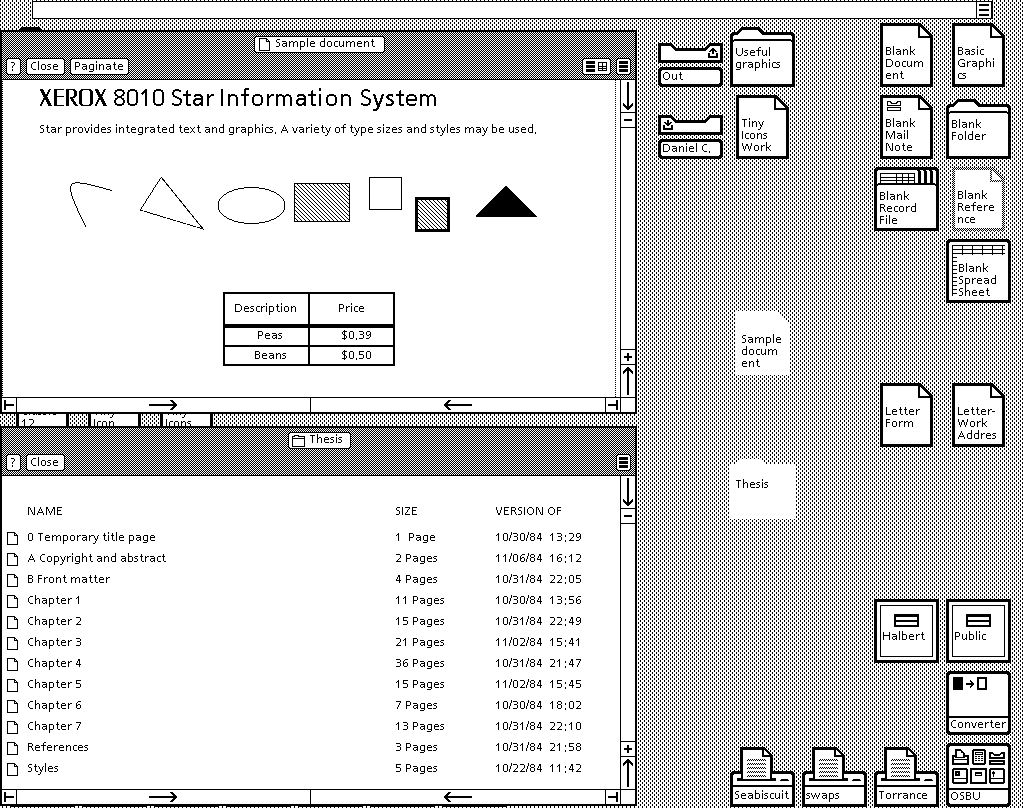
The granddaddy of them all was the Xerox Star workstation from 1981. This was what Steve Jobs saw while visiting PARC and became the inspiration for the GUI on the Lisa/Mac. As Jobs (the 1994 Jobs) said, Apple was always "shameless about stealing great ideas". Too bad the 2011 Jobs thinks behavior which helped build up Apple should be illegal for anyone else.
-
Re:Apple statement
Just look at what Android phones looked like before and after the iPhone was released in 2007.
Well yeah, if you limit your sample to phones which didn't look like an iPhone before the iPhone was released, of course it's going to look like they copied the iPhone. As it turns out LG announced this phone to the public with pics 3 weeks before the iPhone. Black, touchscreen covering nearly the entire front surface, rectangular, rounded corners, and icons arranged in a grid. So if we were to take your argument at face value, LG deserves credit for the current form factor of smartphones, Apple just happened to make the most successful copy, and Apple fans are deliberately ignoring history to spread misguided claims that Apple invented it all and others are copying from Apple.
The reality is that the current form factor is just the natural evolution of the smartphone due to a variety of factors, none of which has to do with a distinctive design that others are copying from LG (or Apple). You need to maximize screen size to comfortably browse the web on something the size of a phone, so the screen will cover almost the entire front surface. The screen needs to be black to maximize the contrast ratio - if you use a white screen you have to turn off the lights to maximize contrast. Capacitive touchscreens (which had just reached commercial critical mass, and the LG had before the iPhone) were responsive enough that they could replace trackballs or directional navigation keys. Rounded corners prevent it from poking you while in your pocket. And icons in a grid have been around since the Xerox Star IS in 1981; even earlier if you look outside computers. All of this is stuff which would be obvious to someone working in the field, and thus not worthy of patent protection. -
WP7 SCREENSHOTS
-
WP7 SCREENSHOTS
-
WP7 SCREENSHOTS
-
I don't usually make posts like this...
... but wow, what a fanboyish piece of shit. There is nearly no mention of Apple after its origin.
Leading into Windows 1 (after talking about Xerox, the Lisa, and the first Mac) he says "The era of GUI's was about to start. But apple [sic] was not meant to be the king."
- Vista copied many features straight out of Tiger
- I think we can all agree that WP7 would not look like it does if the iPhone had never been on the scene
- And now, after ten years of making poorly-selling tablets, Apple has shown how it should be done and MS is falling over themselves trying to catch upI'm not saying Apple has never copied anything either, but once the article hits Windows 1.0, it is all about MS. He goes from Windows 3 to Microsoft Bob, lays down exactly 10 words about Windows 95, then goes straight to XP, Vista, and 7. He dismisses over two decades of Mac OS with the words "In the meantime, Mac OS was undergoing a similar, slow evolution."
He then says "Last couple of years were really eventful. New families of computing devices became wildly popular -- smartphones, netbooks, tablets. Mobile operating systems became almost as complex and capable as desktop ones. Multi touch technologies challenged the age-old interface design, and required new approaches. And now Microsoft tells us the future belongs to tiles." and the rest of the article is about Windows 8 and tiles. REALLY? No mention at all of the iPhone, who was the first to market with multitouch, even if they didn't invent it? No mention of Palm, or WinCE or BeOS or the Amiga or a million other omissions? Come on. If he isn't a shill, he's got a BIG set of blinders on. If you want to see the history of GUIs, go here. They have a ridiculously thorough collection of screenshots.
-
Re:Admit it...
Apple tried to avoid it by using symbols wherever they could. But as someone else pointed out, that gives new problems, for example in Spanish, where "+" means "sum" not "add".
Exactly!
See, the problem you run into is that "Add Alarm" and "Wekker toevoegen" are going to take up different amounts of space. Thus, you may have to redesign your interface for different languages. At least in the Apple realm, this is relatively easy to do (localized nib files). So the buttons may not appear in the same places or there may be other interface issues that have to be solved. But they are solvable.
Conversely, putting in a bunch of pictures makes the developer's life easier by basically saying, "I'm going to come up with a brand new language that you're going to have to learn if you want to use my software." Then he/she sits there and scratches their head and says, "Gee, I can't understand why these stupid people can't use my software!" or "Gosh, why do people in the Netherlands buy my competitor's software instead of mine?"
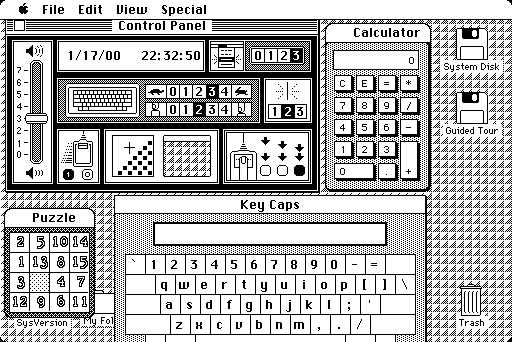
Take a look at the Control Panel in this picture of the original Macintosh desktop. Notice how there's no text. Notice how you have almost no idea what half the controls do. Now look at the same set of controls for System 6.0.8. Which one do you think is easier to understand?
But, yes, this meant that Apple had to hire people to localize the text. On the other hand, that created a better experience for people using the system. If your goal is to keep expenses down and you don't care about usability, then by all means--use obtuse symbols and expect your users to figure it out. If you want software that people might actually want to buy, spend the time, effort, and money to localize it.
-
Re:Why did they buy QNX?
Older readers may remember the excellent QNX Demo Disk, an OS on a bootable floppy complete with windowing system, file browser, editor, and a proper web browser:
http://toastytech.com/guis/qnxdemo.html
http://qnx.projektas.lt/qnxdemo/qnx_demo_disk.htmWho needs live CDs?
-
Re:I remember before Jobs was all about lock-in...
The answer you're looking for is "its progeny", which is the much-loved Cocoa toolkit. I was speaking of the OpenStep initiative itself, which consisted of a rebranded NextStep (which was also ported to x86) and API compatibility layers for NT and Solaris, neither of which exactly passed into legend.
One thing that's not often remembered is that the OS X kernel and APIs ran on x86 since Steve brought NeXT back to Apple with him. (Rhapsody and later OpenDarwin.) The rush for the big switch wasn't nearly as large as is often assumed, as Apple was quite prepared for it. -
Re:Shit gets shittier
Protip: Clippy and the Spot the dog are the same thing.
Protip: Adding "Protip" doesn't make something true.
Clippy and the dog were both animated characters that would offer help, but that is where the similarity ends. As I said, Clippy was so reviled because it got in the way. It forced itself in your face. Even worse, it spied on what you were doing and tried to "help" (which gave us the meme that people still use as a joke today).
It is really annoying when someone stands behind you doing reading what you type and interrupting with "helpful" comments, so it stands to reason that people would hate it in a virtual character too.
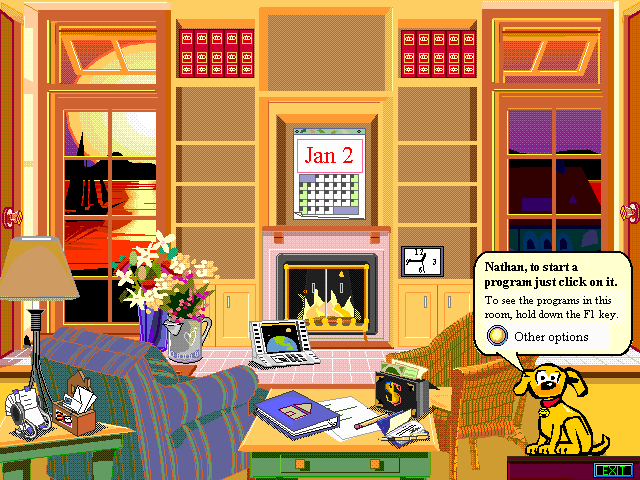
As for Bob, it was not because it was a virtual character that people hated it but that the software was was an unusable mess! You can't tell the difference between badly drawn scenery and badly drawn icons for programs (without pressing F1 to reveal them). This was made back in the days when people thought you needed to imitate the real world to make computers seem approachable, but as the screenshot shows that is a horribly wrong concept.
Ribbons in Explorer. Good lawd, I saw a screenshot. "Hey, everybody! Let's uselessly take up 128 vertical pixels in already vertically challenged widescreen displays!"
You can auto-hide the ribbon so it only appears when you move the mouse over the top of the window. But 128 pixels is nothing compared to what users would subject themselves to with the old toolbars in Office. I would set up our systems at work with a nice two line set of toolbars in Office, but when I look at them later I find every toolbar turned on and half the screen filled with the bloody things (all mixed up in random order too). This is why I prefer the menus, because they tended to stay the same on every computer I had to use.
When I watch my pathetic users try to access an unfamiliar feature, they hover over every single button looking at the tooltips to find the one they are looking for. Even if I would tell them which menu it was on they would ignore that and look for the button.
As much as the ribbon didn't suit me, it did seem like exactly the right thing for my users. While we might love our menus and keyboard shortcuts, the average user just does a hunt-and-peck on the toolbars. The ribbon is a huge step-up for them.
-
Re:Thanks for the notice... I almost unpacked my P
I was lucky enough to have a 1.44MB floppy drive that had no problems with NFORMAT 1.74MB disks. If you stacked those, you could get almost three and a half megs out of a single floppy.
-
Re:Short Version for the Lazy
Windows 1 applets won't run under Windows 3 and up without modifying the header. The guy in the video would have got modified versions from here, more likely than not: http://toastytech.com/guis/misc.html
-
Re:I haven't watched the video but...
Windows 3.0 applications will generally run fine under 32-bit Windows 7 - they're using the NTVDM, which is a form of virtualisation (albeit one which has been around since 1992). Then again, it depends on what you determie virtualisation to be... Windows 3.0 was capable of running multiple DOS sessions via the virtual 8086 mode found in 386s and up, which again is a form of virtualisation.
If you really want some fun, check out Toastytech - they've got the Windows 1 applets which will still run on Windows 7 (32-bit):
http://toastytech.com/guis/misc.html -
Re:Yeah, this is GREAT...
Maybe. But if he were doing the same on real hardware with Windows he would still have to go through several hardware upgrades...
I agree that it is pretty cool that the executables from Windows 2 will still run on Windows 7. I am pretty sure that the ones he were running were from windows 2 because Windows 1 apps won't run without modifying the header, but they still can run (see: http://toastytech.com/guis/misc.html)
-
Re:Windows
If you look at very early builds of Windows 95, you'll see an OS which was built on or at least based (concept-wise) Motif. Many widgets were undressed and so radio buttons and checkboxes looked like they would on Motif apps on *nix at the time, that is, radio buttons were diamond-shaped. Wait, I just found a screen shot with radio buttons:
http://toastytech.com/guis/c73prop2.gif
and another one (same site)
http://toastytech.com/guis/chicago3.html. .
-
Re:Windows
If you look at very early builds of Windows 95, you'll see an OS which was built on or at least based (concept-wise) Motif. Many widgets were undressed and so radio buttons and checkboxes looked like they would on Motif apps on *nix at the time, that is, radio buttons were diamond-shaped. Wait, I just found a screen shot with radio buttons:
http://toastytech.com/guis/c73prop2.gif
and another one (same site)
http://toastytech.com/guis/chicago3.html. .
-
Re:Some notes:
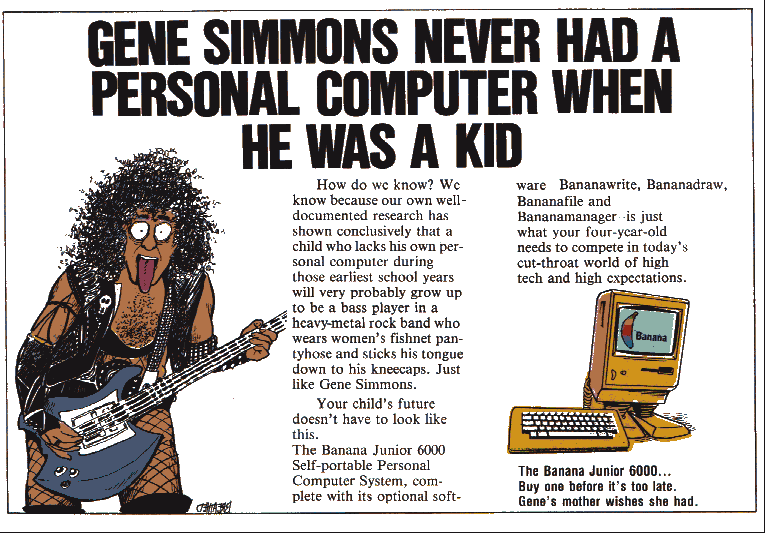
It was really a Banana Jr..
-
Have a look at a few of them....
This is a site I've enjoyed browsing for quite some time that gives small walk-throughs of the UI on many versions of different operating systems.
-
Re:OS/2
This site is generally more comprehensive, and has lots of screenshots (though can't see TopView, which is maybe just as well):
-
Re:VisiCorp Visi On
If that is your website, you should spell-check it. “services” is misspelled as “servcies” on NT 3.1.
-
VisiCorp Visi On
So many people comparing Windows 1.x to GEM, GEOS, Mac, and not one mention of VisiCorp Visi On, the first GUI for the IBM PC, released in 1983.
-
Re:Windows 1.0 was barely usable
3.0 was where I came in, and it wasn't that much worse than 3.1 (I dimly recall that the first practical application we had that required Windows was the control and analysis software for a lab instrument). This site has a nice history of GUIs, including early versions of Windows:
http://toastytech.com/guis/index.html
http://toastytech.com/guis/indexwindows.htmlMy first GUI was actually Suntools, several years before I tried a Mac (or Windows 3):
-
Re:Windows 1.0 was barely usable
3.0 was where I came in, and it wasn't that much worse than 3.1 (I dimly recall that the first practical application we had that required Windows was the control and analysis software for a lab instrument). This site has a nice history of GUIs, including early versions of Windows:
http://toastytech.com/guis/index.html
http://toastytech.com/guis/indexwindows.htmlMy first GUI was actually Suntools, several years before I tried a Mac (or Windows 3):
-
Re:Windows 1.0 was barely usable
3.0 was where I came in, and it wasn't that much worse than 3.1 (I dimly recall that the first practical application we had that required Windows was the control and analysis software for a lab instrument). This site has a nice history of GUIs, including early versions of Windows:
http://toastytech.com/guis/index.html
http://toastytech.com/guis/indexwindows.htmlMy first GUI was actually Suntools, several years before I tried a Mac (or Windows 3):
-
Re:Something I find interesting
Sure as hell wasn't computers. Gene Simmons didn't have a computer growing up and look what happened to him.
Buy your kids a Banana Jr. 6000 today!
-
Re:Once again....
The taskbar in Windows 95 and quick launch was stolen from the NextStep dock.
The NextStep dock was stolen from the Risc O/S.
If you look at the timeline on that site, RISC O/S came out much later than a bunch of other GUIs so I really don't see your point. NeXTStep popularize a number of concepts which later made it into windows and MSFT development tools. Interface builder was ahead of it's time.
-
Re:Once again....
The taskbar in Windows 95 and quick launch was stolen from the NextStep dock.
The NextStep dock was stolen from the Risc O/S.
-
Re:Who cares?
I like them... Reminds me how far we have come.
-
Re:Not the first and not the last
In their defense, AOL is still an okay company. They aren't as big as they used to be in the 90s, but then neither is Sega and I still like them.
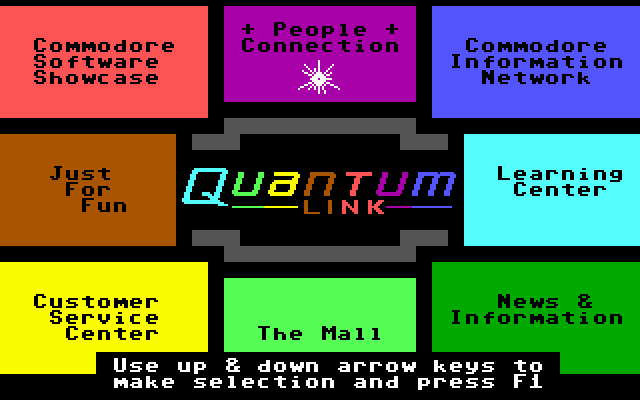
- I used AOL back in the 80s when they were called Quantum Link. It was the only service that provided full-color graphics, like a primitive website: http://toastytech.com/guis/c64gquantumlink.gif
- http://www.pbs.org/mediashift/files/Habitat%20scene.gif
- I continued using them for my first ISP to serve web pages to my Commodore Amiga.
- I dropped them after the whole "busy signal" debacle.
- But then went back to them when they provided Accelerated Dialup under the name "netscape isp". It's great for travel, or backup when the Broadband fails, and only costs $7.So basically I've been a customer of theirs, minus a brief break, for nearly 25 years.
-
Re:GUI is still there for remote desktop and it's
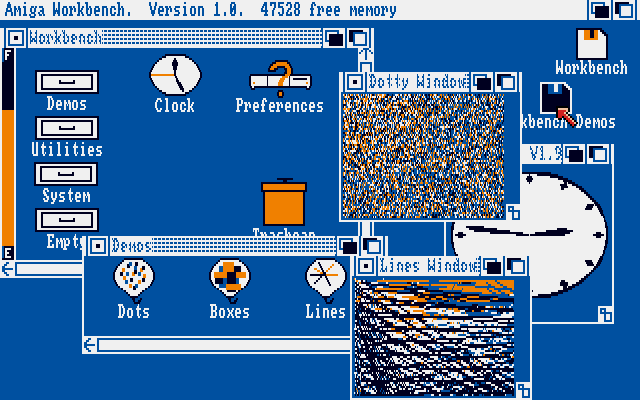
Bah. I always switch to the classic mode anyway. It updates the screen faster, is more responsive, and seeing as how I grew up with this (see links), I already think it's pretty enough - http://toastytech.com/guis/c64g.html http://www.guidebookgallery.org/pics/gui/desktop/full/amigaos10.png
Question:
Why does this flaw affect NT 6.1 and 6.2, but not 6.0 (vista)??? And why's the driver called "Canonical"?
-
Re:Epic patent trolls?
I'm pretty sure they got the patent from Xerox, for rooms. The idea was that you use a room and house analogy for your window manager. So all offices applications are in the office room, games in the gaming room, recipes belong in the kitchen, etc. And you had to switch rooms via a door icon, no joke.
-
Re:WPS
> Many ATM machines ran it because it was 8000% more stable than any of microsoft's Operating systems
A lot of the ATMs that ran OS/2 ran the Microsoft version of OS/2 (yes, Microsoft developed the first versions of OS/2 for IBM and had permission to OEM it, just like DOS). OS/2 went to IBM from v2.0, IIRC.
I've seen ATMs show "Microsoft OS/2" when rebooting to be serviced. Here's what the boot screen looks like.
-
Re:Great! Another deskop environment to mix things
There's a free clone of WPS for Windows 3.1 that ran after a fashion on Windows 95. I played with it some a decade ago and I kind of liked it -- which is unusual as I don't care for Apple's offerings, think that Windows peaked back about the Win95OSR2 release, and am certain that Gnome has to be some sort of joke. (Mostly I use XFCE and the KDE applications).
Anyway, the Zip file is still downloadable -- http://ftp.gaby.de/pub/win3x/wpsfw151.zip and there are some screen shots at http://toastytech.com/guis/wps.html.
I wonder if WPS will run under wine?
-
Re:comScore got it more or less right
>>>>>Like Windows XP with its lack of window scaling.
>>>
>>tweaking tools that let you enabled window scaling in Windows XPI see a lot of XP bashing but even if it didn't have "window scaling" I still consider it the best Microsoft OS. Still better than Windows 6.1's (7) ribbon interface. I liked this OS at first, due to it fixing the Vista Beta release, but now I'm sick of it. The menus keep randomly moving around instead of staying put. Well..... at least it's not as bad as Microsoft's other bad idea (Bob) but still, why must MS "fix" what was never broke.
More info here: http://toastytech.com/guis/win72.html
Oh and no I don't "have" to like Windows 7.
-
Re:Oh great...
There you are, take some screenies in your face.
-
Re:People need to stop bitching
It is unreasonable to expect a vendor to continue to support their old products forever.
Programmers must draw a line somewhere, how much of an OS do they want to re-implement in their application? Sometimes such re-implement has to be done, but other times it is just too much work and maintenance. It is all about balance.
On a related note Mozilla just released their final update to SeaMonkey 1.1 (1.1.19). Here is a screen shot of it running on NT 3.51! Very impressive work keeping it running on a 15-year old OS for this long. -
Re:I still have a copy...
I've used PubTech's File Organizer for Windows 2.x years ago. Hell, I would say that File Organizer was superior to Mac OS at the time (and would hold its own compared to more modern versions of Windows).
-
Choose AND change the GUI
When you get away from Windows, you can not only choose the UI (bash, ksh, zsh, etc) or GUI, but also change it. Before Microsoft became such a problem, it was the norm for people to not just tweak but show off their customizations. I know that most people really piss and moan about tweaking the defaults, but it is possible. The knowledge is gone from the mainstream, but the functionality is still there.
Whether you use KDE, CDE, Xfce, or GNOME you can choose not just the theme (appearance) but also the behavior. That goes especially for the window manager. You can do more with the window manager than deciding to have jiggly jello effects or not. When you talk about the GUI on a Linux, Solaris or BSD distro you're usually conflating about three things : the desktop environment, the window manager, and the settings for those two. It's not even necessary to run a full desktop, you can get by quite handily with just a window manager. Check out Enlightenment, OpenBox, Scrotwm,
Of course the desktop environment and window manager will come with default settings but those can be changed. If an in-your-face example is needed for just how much these can be configure to meet your needs install plain vanilla FVWM and give it a try. Then after that, install FVWM-crystal theme. Night and day different is there.
-
Re:Apple's strategy
Having played around with several of the old Chicago builds, I'm pretty sure you'll find that it was labeled "start" fairly early on, at least by the first beta build. See screen-shots at http://toastytech.com/guis/chicago.html.
-
Squatters, or Followers of the Subgenius?
Squatter, or just extreme slacker?
When I first reached out to google for the definition of squatter, I got a bit confused as to where the illegality lay[gr.?]. The definition of squatter hereseems to express two types, those with legal, and illegal. When I switched the search to cybersquatter, I then understood more about where the laws start, (though seems a amendment may be needed) here in the United States, Anticybersquatting Consumer Protection Act passed in 1999, an amendment to the Trademark Act 1946 also known as the Lanham Act.
Where am I going with this? How does one determine good faith? How do you differentiate between a person who might struggle to get it up (specially if a deadline looms overhead, further if that deadline is tightened) and one who is squatting maliciously, awaiting a time when they can resell the slot to someone else who has developed the application, put in the sweat, time, thought, tears, hours, etc...
To end with a wee bit of entertainment amidst all this legal jumbo-gumbo, figured I might throw a little head-nod to J.R. Bob "Dobbs" (not MS's failed project). Slacking is an artform, a religion, one that many take quite seriously. So much so they used it in the naming of a Linux distro. Slacker? Or Ill-memes willful disconsolation? -
Linux Kernel + Google Cloud
-
Re:"at war with my parents over who is in control"
MS Bob was managed by his girlfriend who he later married.
And actually the Search Doggy from Windows XP came from Bob
http://toastytech.com/guis/bob.html
Search Doggy was a very good dog, he always found my files when I lost them.
-
Re:"at war with my parents over who is in control"
MS Bob was managed by his girlfriend who he later married.
And actually the Search Doggy from Windows XP came from Bob
http://toastytech.com/guis/bob.html
Search Doggy was a very good dog, he always found my files when I lost them.
-
Re:He got something right...Microsoft Bob is certainly comical -- It's one of the biggest jokes around.
Except perhaps ME and Vista.I don't see the joke.
Vista's share of the desktop is 23 times that of Linux.
Windows 7 - which the geek persists in calling a "Service Pack" for Vista - has 1/5 of Linux's share of the web.
Microsoft BOB is close on to fifteen years dead.
---and yet--and yet ---
The moment you begin moving in a virtual environment and interacting with a character instead of a dialog box you are back in BOB's world.
-
Re:Dropping a big selling point!
"FF 3 does not run on those..."
Firefox 1.5 did. (And with a slight tweak Firefox 2 also ran under 95). Here are some screen shots:
-
What about?
I wonder if some of the pre-release versions had this feature.
-
What about?
I wonder if some of the pre-release versions had this feature.
-
so how'd these OSes look?
Great site with lots of pics of old OS user interfaces: http://toastytech.com/guis/
-
Re:release date
At least you can coax Linux to work in unplanned situations, but good luck on getting anything modern installed on a Win95 box.
-
Re:I'm no leagal wizz but...
Most of M$ patents are invalid, invented by somebody else, or invalidated by prior disclosure & sale.
Delorme beat M$ to the punch (mapping software + laptop in auto/plane/etc) back in 1995.. Their GPS receiver had NO physical user interface! To make it operate, one connected it (via rs-232) to a laptop running Delorme real-time mapping software.
To add even more salt to the wounds, nearly all of M$ Fat patents are defeated by their own EARLY BETA releases of Windows which often predate M$ patent filings by over a year.
Add to the mess.. Microsoft's Linux Labs internal distributions required agreement to GPL distribution/patent licensing terms.