Slashdot Mirror
Domain: toronto.edu
Stories and comments across the archive that link to toronto.edu.
Comments · 206
-
Re:Why America only? NO! ALSO IN CANADA
Check out www.toronto.edu
Wonder how that one slipped through... -
Re:Anti-trust.
> Cost to me: less than $1 Cost to feed a starving citizen so they can survive another day: less than $1
Multiplayer Strategy -
I did something like this
I made a program in my spare time (just a quick hack) over the summer to speak cantonese words given input in a textbox. Chinese windows (Big5) is required though (and a lot of ram)
Cantonese Speaker
My sys-admin made me take off all the audio files because it used around 10megs of their space, but e-mail me at lego_bot@yahoo.com if you are interested.
The voice is based on the "yale romanization" of cantonese (learn it to learrn cantonese!!!) I'm planning to extend this to include phrases in chinese and other stuff, and make it in something else.
-
You missed the point
- Here's my big question:
Why on *earth* is it a QWERT layout (looks like the Y got whacked by a function key)?!
From your question, you appear to have missed the point of this keyboard, which is facilitating skill transfer from standard touch typing.
It does indeed work. Most touch typists pick it up very quickly. If you don't believe me, download the demo and try it for yourself. Alternatively, you could just read this:
Edgar
- Here's my big question:
-
Re:Linux in education: it is!
All CS departments should adopt Linux as the basis for their operating system courses since it allows exactly this sort of experimentation.
In some places it already has been. The story gives one example; also, Prof. Steve Mann at the University of Toronto has undergrad students under him do their thesis work in Linux, since that's what runs his wearcomp.
I find it quite appropriate that Linux is getting use in schools. Correct me if I'm wrong, but didn't Linux start in the first place as Linus' school project?
---
Be gentle, it's my first post! -
The service has been renamed to...
... their.mp3.com.
Multiplayer Strategy -
Freely-Available Web Query Languages
For my thesis, I created a Web query system called ParaSite. The best introduction is the paper Squeal: A Structured Query Language for the Web, which I presented at the World-Wide Web Conference. Anybody is welcome to use my code, algorithms, or ideas.
-
This has been done before, for free
There was an SGI game whose name I sadly cannot recall which used the indy's onboard camera and you would make hand motions in front of it to control your character. This is just an even less sophisticated version of the same thing, and it's not free? Pshaw. Someone obviously needs to find the game I'm talking about. I did some websearching around, but couldn't find it, perhaps I was using the wrong words.
By the way, while I was searching for that, I came across this Input Devices Resources List which might be interesting to people reading this thread. Also see GestureVR. You might want to wade through This Page on VR Software Toolkits, but it's painful; This person has no idea what HTML is for.
-
"Beowulf Clustered Cubicles, Anyone?"
(I took the liberty of cleaning up the spelling, and other nits
I guess that would be amusing, wearing computers with "touch" connectivity, then forming a human chain around an inner circle of cubicles around Christmas, singing, "O! Holy Quake, Nailgun Blight" while the wireless components shake Aibo robots about the office flashing their eyes red and green. (Can they do that? Would these folks have any input on this question?)
If anyone does this, please do make an MPEG2/4 of that and post an URL to it on Slashdot! I'd like to see that! 8^]
-
Not Just About Knowledge/Skills
"Techies" should be hitting college for sure. Not because they need to learn technical skills, or because they need to have a theoretical background, or becuase they need to learn a work ethic. They should go to college to develop a social life! That's right people, go to college, move in to residence and meet some humans.
Multiplayer Strategy -
Open-Sourcing Communicator was a Bad Idea
Let's face it, from Netscape's point of view, it was a terrible idea. The market share is gone, and the release of Mozilla is not going to make a dent on the installed base of IE browsers on Windows machines. It might have been great for us, but as a company, Netscape should not have opened Communicator.
Multiplayer Strategy -
Oracle investigated Microsoft allies...
...and found that there were none.
Multiplayer Strategy -
Re:Perhaps good may come of this - Different now
Yet Another example:
The University of Toronto
www.toronto.edu and www.utoronto.ca.So please, get your facts straight before you post.
This is my -
Too late this time?It _seems_ too late for MS to try to take over with a Java clone (as this most likely is), yet it also seemed too late when MS released Internet Explorer, and yet they toughed it out and now dominate the browser scene.
This situation is similar, but on the server-side. It must kill MS to see the enormous success of Java on the server-side. Very likely, C# will attempt to steal some of this market away, but can it succeed? MS seems to be doing miserable in the server market, so they won't have nearly the leverage they had when they invaded the browser market by pre-installing IE. Oracle, Sun and IBM are ruling the server-side right now and Microsoft is the underdog. I predict that this product will not be an overwhelming success.
Multiplayer Strategy -
Plan9 - Differences from UnixPlan9 is oldish. Pike and others have moved on to brazil and inferno, but for it's time (early 90's) it was good research.
in the words of Gary
- specialist hardware - A typical Plan 9 installation will have a dedicated cpu server, a dedicated file server and many dedicated terminals The file server and cpu server will be connected by the fastest link available.
- "everything is a file" - Device drivers, network connections, environment variables and many other services are represented by files in the individuals file name space. This name space can be manipulated to customise the user's environment. User-level file servers are trivial to write and use, and all of this is easily distributed as the file server communication is all in a simple protocol.
- minimalist philosophy - Plan 9 is an operating system for programmers. It emphasises simplicity over configurability, good design over compatibility and pragmatism over "buzzword compliance".
- sensible security - There is no super-user or root. Communication with the file server is only through a simple protocol which allows no special access. Passwords are never transmitted across the network, instead the terminal manages a challenge/response session with the authentication server.
- 1990s user interface - A three-button mouse and bitmapped display are assumed. Support for Unicode has been included from the ground up. Character-based user-interfaces (vi, xterm, rn) have been superseded.
-
Plan9 - Differences from UnixPlan9 is oldish. Pike and others have moved on to brazil and inferno, but for it's time (early 90's) it was good research.
in the words of Gary
- specialist hardware - A typical Plan 9 installation will have a dedicated cpu server, a dedicated file server and many dedicated terminals The file server and cpu server will be connected by the fastest link available.
- "everything is a file" - Device drivers, network connections, environment variables and many other services are represented by files in the individuals file name space. This name space can be manipulated to customise the user's environment. User-level file servers are trivial to write and use, and all of this is easily distributed as the file server communication is all in a simple protocol.
- minimalist philosophy - Plan 9 is an operating system for programmers. It emphasises simplicity over configurability, good design over compatibility and pragmatism over "buzzword compliance".
- sensible security - There is no super-user or root. Communication with the file server is only through a simple protocol which allows no special access. Passwords are never transmitted across the network, instead the terminal manages a challenge/response session with the authentication server.
- 1990s user interface - A three-button mouse and bitmapped display are assumed. Support for Unicode has been included from the ground up. Character-based user-interfaces (vi, xterm, rn) have been superseded.
-
Plan9 - Differences from UnixPlan9 is oldish. Pike and others have moved on to brazil and inferno, but for it's time (early 90's) it was good research.
in the words of Gary
- specialist hardware - A typical Plan 9 installation will have a dedicated cpu server, a dedicated file server and many dedicated terminals The file server and cpu server will be connected by the fastest link available.
- "everything is a file" - Device drivers, network connections, environment variables and many other services are represented by files in the individuals file name space. This name space can be manipulated to customise the user's environment. User-level file servers are trivial to write and use, and all of this is easily distributed as the file server communication is all in a simple protocol.
- minimalist philosophy - Plan 9 is an operating system for programmers. It emphasises simplicity over configurability, good design over compatibility and pragmatism over "buzzword compliance".
- sensible security - There is no super-user or root. Communication with the file server is only through a simple protocol which allows no special access. Passwords are never transmitted across the network, instead the terminal manages a challenge/response session with the authentication server.
- 1990s user interface - A three-button mouse and bitmapped display are assumed. Support for Unicode has been included from the ground up. Character-based user-interfaces (vi, xterm, rn) have been superseded.
-
Plan9 - Differences from UnixPlan9 is oldish. Pike and others have moved on to brazil and inferno, but for it's time (early 90's) it was good research.
in the words of Gary
- specialist hardware - A typical Plan 9 installation will have a dedicated cpu server, a dedicated file server and many dedicated terminals The file server and cpu server will be connected by the fastest link available.
- "everything is a file" - Device drivers, network connections, environment variables and many other services are represented by files in the individuals file name space. This name space can be manipulated to customise the user's environment. User-level file servers are trivial to write and use, and all of this is easily distributed as the file server communication is all in a simple protocol.
- minimalist philosophy - Plan 9 is an operating system for programmers. It emphasises simplicity over configurability, good design over compatibility and pragmatism over "buzzword compliance".
- sensible security - There is no super-user or root. Communication with the file server is only through a simple protocol which allows no special access. Passwords are never transmitted across the network, instead the terminal manages a challenge/response session with the authentication server.
- 1990s user interface - A three-button mouse and bitmapped display are assumed. Support for Unicode has been included from the ground up. Character-based user-interfaces (vi, xterm, rn) have been superseded.
-
Plan9 - Differences from UnixPlan9 is oldish. Pike and others have moved on to brazil and inferno, but for it's time (early 90's) it was good research.
in the words of Gary
- specialist hardware - A typical Plan 9 installation will have a dedicated cpu server, a dedicated file server and many dedicated terminals The file server and cpu server will be connected by the fastest link available.
- "everything is a file" - Device drivers, network connections, environment variables and many other services are represented by files in the individuals file name space. This name space can be manipulated to customise the user's environment. User-level file servers are trivial to write and use, and all of this is easily distributed as the file server communication is all in a simple protocol.
- minimalist philosophy - Plan 9 is an operating system for programmers. It emphasises simplicity over configurability, good design over compatibility and pragmatism over "buzzword compliance".
- sensible security - There is no super-user or root. Communication with the file server is only through a simple protocol which allows no special access. Passwords are never transmitted across the network, instead the terminal manages a challenge/response session with the authentication server.
- 1990s user interface - A three-button mouse and bitmapped display are assumed. Support for Unicode has been included from the ground up. Character-based user-interfaces (vi, xterm, rn) have been superseded.
-
Plan9 - Differences from UnixPlan9 is oldish. Pike and others have moved on to brazil and inferno, but for it's time (early 90's) it was good research.
in the words of Gary
- specialist hardware - A typical Plan 9 installation will have a dedicated cpu server, a dedicated file server and many dedicated terminals The file server and cpu server will be connected by the fastest link available.
- "everything is a file" - Device drivers, network connections, environment variables and many other services are represented by files in the individuals file name space. This name space can be manipulated to customise the user's environment. User-level file servers are trivial to write and use, and all of this is easily distributed as the file server communication is all in a simple protocol.
- minimalist philosophy - Plan 9 is an operating system for programmers. It emphasises simplicity over configurability, good design over compatibility and pragmatism over "buzzword compliance".
- sensible security - There is no super-user or root. Communication with the file server is only through a simple protocol which allows no special access. Passwords are never transmitted across the network, instead the terminal manages a challenge/response session with the authentication server.
- 1990s user interface - A three-button mouse and bitmapped display are assumed. Support for Unicode has been included from the ground up. Character-based user-interfaces (vi, xterm, rn) have been superseded.
-
Plan9 - Differences from UnixPlan9 is oldish. Pike and others have moved on to brazil and inferno, but for it's time (early 90's) it was good research.
in the words of Gary
- specialist hardware - A typical Plan 9 installation will have a dedicated cpu server, a dedicated file server and many dedicated terminals The file server and cpu server will be connected by the fastest link available.
- "everything is a file" - Device drivers, network connections, environment variables and many other services are represented by files in the individuals file name space. This name space can be manipulated to customise the user's environment. User-level file servers are trivial to write and use, and all of this is easily distributed as the file server communication is all in a simple protocol.
- minimalist philosophy - Plan 9 is an operating system for programmers. It emphasises simplicity over configurability, good design over compatibility and pragmatism over "buzzword compliance".
- sensible security - There is no super-user or root. Communication with the file server is only through a simple protocol which allows no special access. Passwords are never transmitted across the network, instead the terminal manages a challenge/response session with the authentication server.
- 1990s user interface - A three-button mouse and bitmapped display are assumed. Support for Unicode has been included from the ground up. Character-based user-interfaces (vi, xterm, rn) have been superseded.
-
Plan9 - Differences from UnixPlan9 is oldish. Pike and others have moved on to brazil and inferno, but for it's time (early 90's) it was good research.
in the words of Gary
- specialist hardware - A typical Plan 9 installation will have a dedicated cpu server, a dedicated file server and many dedicated terminals The file server and cpu server will be connected by the fastest link available.
- "everything is a file" - Device drivers, network connections, environment variables and many other services are represented by files in the individuals file name space. This name space can be manipulated to customise the user's environment. User-level file servers are trivial to write and use, and all of this is easily distributed as the file server communication is all in a simple protocol.
- minimalist philosophy - Plan 9 is an operating system for programmers. It emphasises simplicity over configurability, good design over compatibility and pragmatism over "buzzword compliance".
- sensible security - There is no super-user or root. Communication with the file server is only through a simple protocol which allows no special access. Passwords are never transmitted across the network, instead the terminal manages a challenge/response session with the authentication server.
- 1990s user interface - A three-button mouse and bitmapped display are assumed. Support for Unicode has been included from the ground up. Character-based user-interfaces (vi, xterm, rn) have been superseded.
-
Plan9 - Differences from UnixPlan9 is oldish. Pike and others have moved on to brazil and inferno, but for it's time (early 90's) it was good research.
in the words of Gary
- specialist hardware - A typical Plan 9 installation will have a dedicated cpu server, a dedicated file server and many dedicated terminals The file server and cpu server will be connected by the fastest link available.
- "everything is a file" - Device drivers, network connections, environment variables and many other services are represented by files in the individuals file name space. This name space can be manipulated to customise the user's environment. User-level file servers are trivial to write and use, and all of this is easily distributed as the file server communication is all in a simple protocol.
- minimalist philosophy - Plan 9 is an operating system for programmers. It emphasises simplicity over configurability, good design over compatibility and pragmatism over "buzzword compliance".
- sensible security - There is no super-user or root. Communication with the file server is only through a simple protocol which allows no special access. Passwords are never transmitted across the network, instead the terminal manages a challenge/response session with the authentication server.
- 1990s user interface - A three-button mouse and bitmapped display are assumed. Support for Unicode has been included from the ground up. Character-based user-interfaces (vi, xterm, rn) have been superseded.
-
Re:Python does NOT have all of the power of Perl
Yes, I use all of the above languages.
When I took csc324 at UofT course site we had to do so much, it seemed I was only doing that course (me and my partner) we didn't have time for anything else. ML, Lisp, Scheme, Prolog - those were the days. course description
Lovely languages, later I took AI were we only were using Lisp. So for me Lisp automatically translates to AI... -
more details
So the Star's article is completely devoid of details - it's a newspaper ! I'll add a few more details so people can get as much information about this topic as they want. First and foremost the latest issue of Nature has an article entitled "Photonics: Opal appeal" specifically about this breakthrough (subscription required). The catch phrase used is a "three-dimensional photonic bandgap material". The team that's accomplished this is a bit more international then indicated so far, consisting of a Spanish team making the opal template, Geoff Ozin's group filling the lattices & then dissolving the template, Henry VanDriel's group performing the laser experiments, and Sajeev John's group providing the theory framework.
For those of you who just want pretty pictures, here are some images of the opals.
Here's the ultimate resource for photonic bandgap materials.
So that should give you more then enough to visit & read. Basically what these materials do is prevent propagation of light of a specific frequency in 3-dimensions. The 'bandgap' of the light can be controlled during the fabrication process allowing these things to block different frequencies. So you could imagine placing one of these materials into an optical fibre & selectively blocking one of the data streams but allowing all others to pass through unimpeded. The current breakthrough is twofold, first these aren't imaginary, they've been made & tested and they aren't decades removed from insertion into optical networks, they're months or years from it, second, this is the first example of a 3D PBG material, previous versions have generally been 2D. One of the neater experiments performed involved putting liquid crystals into the opal holes & then by putting an electric field across the liquid crystals, controlling the transmission through the crystal. A variable transmission photonic bandgap device. Light is fast, electrons are slow, an all optical network would be blazingly fast & these devices bring us a step closer to making that happen.
CJM -
Re:Most of these are much harder than they seem.
I think you're confusing a couple aspects of infinity. You cannot use standard arithmetic when dealing with infinity. I.e., infinity + 1 is still infinity. Here's a link to an explanation: Why Infinity...
-
ReferancesAdamic and Huberman (1) 99. L. Adamic and B. Huberman. The nature of markets on the World Wide Web, Xerox PARC Technical Report, 1999.
Adamic and Huberman (2) 99. L. Adamic and B. Huberman. Scaling behavior on the World Wide Web, Technical comment on Barabasi and Albert 99.
Aiello, Chung, and Lu 00. W. Aiello, F. Chung and L. Lu. A random graph model for massive graphs, ACM Symposium on the Theory and Computing 2000.
Albert, Jeong, and Barabasi 99. R. Albert, H. Jeong, and A.-L. Barabasi. Diameter of the World Wide Web, Nature 401:130-131, Sep 1999.
Barabasi and Albert 99. A. Barabasi and R. Albert. Emergence of scaling in random networks, Science, 286(509), 1999.
Barford et. al. 99. P. Barford, A. Bestavros, A. Bradley, and M. E. Crovella. Changes in Web client access patterns: Characteristics and caching implications, in World Wide Web, Special Issue on Characterization and Performance Evaluation, 2:15-28, 1999.
Bharat et. al. 98. K. Bharat, A. Broder, M. Henzinger, P. Kumar, and S. Venkatasubramanian. The connectivity server: fast access to linkage information on the web, Proc. 7th WWW, 1998.
Bharat and Henzinger 98. K. Bharat, and M. Henzinger. Improved algorithms for topic distillation in hyperlinked environments, Proc. 21st SIGIR, 1998.
Brin and Page 98. S. Brin, and L. Page. The anatomy of a large scale hypertextual web search engine, Proc. 7th WWW, 1998.
Butafogo and Schniederman 91. R. A. Butafogo and B. Schneiderman. Identifying aggregates in hypertext structures, Proc. 3rd ACM Conference on Hypertext, 1991.
Carriere and Kazman 97. J. Carriere, and R. Kazman. WebQuery: Searching and visualizing the Web through connectivity , Proc. 6th WWW, 1997.
Chakrabarti et. al. (1) 98. S. Chakrabarti, B. Dom, D. Gibson, J. Kleinberg, P. Raghavan, and S. Rajagopalan. Automatic resource compilation by analyzing hyperlink structure and associated text, Proc. 7th WWW, 1998.
Chakrabarti et. al. (2) 98. S. Chakrabarti, B. Dom, D. Gibson, S. Ravi Kumar, P. Raghavan, S. Rajagopalan, and A. Tomkins. Experiments in topic distillation, Proc. ACM SIGIR workshop on Hypertext Information Retrieval on the Web, 1998.
Chakrabarti, Gibson, and McCurley 99. S. Chakrabarti, D. Gibson, and K. McCurley.Surfing the Web backwards, Proc. 8th WWW, 1999.
Cho and Garcia-Molina 2000 J. Cho, H. Garcia-Molina Synchronizing a database to Improve Freshness . To appear in 2000 ACM International Conference on Management of Data (SIGMOD), May 2000.
Faloutsos, Faloutsos, and Faloutsos 99. M. Faloutsos, P. Faloutsos, and C. Faloutsos. On power law relationships of the internet topology, ACM SIGCOMM, 1999.
Glassman 94. S. Glassman. A caching relay for the world wide web , Proc. 1st WWW, 1994.
Harary 75. F. Harary. Graph Theory, Addison Wesley, 1975.Huberman et. al. 98. B. Huberman, P. Pirolli, J. Pitkow, and R. Lukose. Strong regularities in World Wide Web surfing, Science, 280:95-97, 1998.
Kleinberg 98. J. Kleinberg. Authoritative sources in a hyperlinked environment, Proc. 9th ACM-SIAM SODA, 1998.
Kumar et. al. (1) 99. R. Kumar, P. Raghavan, S. Rajagopalan, and A. Tomkins. Trawling the Web for cyber communities, Proc. 8th WWW , Apr 1999.
Kumar et. al. (2) 99. R. Kumar, P. Raghavan, S. Rajagopalan, and A. Tomkins. Extracting large scale knowledge bases from the Web, Proc. VLDB, Jul 1999.
Lukose and Huberman 98. R. M. Lukose and B. Huberman. Surfing as a real option, Proc. 1st International Conference on Information and Computation Economies, 1998.
Martindale and Konopka 96. C. Martindale and A K Konopka. Oligonucleotide frequencies in DNA follow a Yule distribution, Computer & Chemistry, 20(1):35-38, 1996.
Mendelzon, Mihaila, and Milo 97. A. Mendelzon, G. Mihaila, and T. Milo. Querying the World Wide Web, Journal of Digital Libraries 1(1), pp. 68-88, 1997.
Mendelzon and Wood 95. A. Mendelzon and P. Wood. Finding regular simple paths in graph databases, SIAM J. Comp. 24(6):1235-1258, 1995.
Pareto 1897. V Pareto. Cours d'economie politique, Rouge, Lausanne et Paris, 1897.
Pirolli, Pitkow, and Rao 96. P. Pirolli, J. Pitkow, and R. Rao. Silk from a sow's ear: Extracting usable structures from the Web , Proc. ACM SIGCHI, 1996.
Pitkow and Pirolli 97. J. Pitkow and P. Pirolli. Life, death, and lawfulness on the electronic frontier, Proc. ACM SIGCHI, 1997.
Simon 55. H.A. Simon. On a class of stew distribution functions, Biometrika, 42:425-440, 1955.
White and McCain 89. H.D. White and K.W. McCain, Bibliometrics, in: Ann. Rev. Info. Sci. and Technology, Elsevier, 1989, pp. 119-186.
Yule 44. G.U. Yule. Statistical Study of Literary Vocabulary, Cambridge University Press, 1944.
Zipf 49. G.K. Zipf. Human Behavior and the Principle of Least Effort, Addison-Wesley, 1949.
___ -
ReferancesAdamic and Huberman (1) 99. L. Adamic and B. Huberman. The nature of markets on the World Wide Web, Xerox PARC Technical Report, 1999.
Adamic and Huberman (2) 99. L. Adamic and B. Huberman. Scaling behavior on the World Wide Web, Technical comment on Barabasi and Albert 99.
Aiello, Chung, and Lu 00. W. Aiello, F. Chung and L. Lu. A random graph model for massive graphs, ACM Symposium on the Theory and Computing 2000.
Albert, Jeong, and Barabasi 99. R. Albert, H. Jeong, and A.-L. Barabasi. Diameter of the World Wide Web, Nature 401:130-131, Sep 1999.
Barabasi and Albert 99. A. Barabasi and R. Albert. Emergence of scaling in random networks, Science, 286(509), 1999.
Barford et. al. 99. P. Barford, A. Bestavros, A. Bradley, and M. E. Crovella. Changes in Web client access patterns: Characteristics and caching implications, in World Wide Web, Special Issue on Characterization and Performance Evaluation, 2:15-28, 1999.
Bharat et. al. 98. K. Bharat, A. Broder, M. Henzinger, P. Kumar, and S. Venkatasubramanian. The connectivity server: fast access to linkage information on the web, Proc. 7th WWW, 1998.
Bharat and Henzinger 98. K. Bharat, and M. Henzinger. Improved algorithms for topic distillation in hyperlinked environments, Proc. 21st SIGIR, 1998.
Brin and Page 98. S. Brin, and L. Page. The anatomy of a large scale hypertextual web search engine, Proc. 7th WWW, 1998.
Butafogo and Schniederman 91. R. A. Butafogo and B. Schneiderman. Identifying aggregates in hypertext structures, Proc. 3rd ACM Conference on Hypertext, 1991.
Carriere and Kazman 97. J. Carriere, and R. Kazman. WebQuery: Searching and visualizing the Web through connectivity , Proc. 6th WWW, 1997.
Chakrabarti et. al. (1) 98. S. Chakrabarti, B. Dom, D. Gibson, J. Kleinberg, P. Raghavan, and S. Rajagopalan. Automatic resource compilation by analyzing hyperlink structure and associated text, Proc. 7th WWW, 1998.
Chakrabarti et. al. (2) 98. S. Chakrabarti, B. Dom, D. Gibson, S. Ravi Kumar, P. Raghavan, S. Rajagopalan, and A. Tomkins. Experiments in topic distillation, Proc. ACM SIGIR workshop on Hypertext Information Retrieval on the Web, 1998.
Chakrabarti, Gibson, and McCurley 99. S. Chakrabarti, D. Gibson, and K. McCurley.Surfing the Web backwards, Proc. 8th WWW, 1999.
Cho and Garcia-Molina 2000 J. Cho, H. Garcia-Molina Synchronizing a database to Improve Freshness . To appear in 2000 ACM International Conference on Management of Data (SIGMOD), May 2000.
Faloutsos, Faloutsos, and Faloutsos 99. M. Faloutsos, P. Faloutsos, and C. Faloutsos. On power law relationships of the internet topology, ACM SIGCOMM, 1999.
Glassman 94. S. Glassman. A caching relay for the world wide web , Proc. 1st WWW, 1994.
Harary 75. F. Harary. Graph Theory, Addison Wesley, 1975.Huberman et. al. 98. B. Huberman, P. Pirolli, J. Pitkow, and R. Lukose. Strong regularities in World Wide Web surfing, Science, 280:95-97, 1998.
Kleinberg 98. J. Kleinberg. Authoritative sources in a hyperlinked environment, Proc. 9th ACM-SIAM SODA, 1998.
Kumar et. al. (1) 99. R. Kumar, P. Raghavan, S. Rajagopalan, and A. Tomkins. Trawling the Web for cyber communities, Proc. 8th WWW , Apr 1999.
Kumar et. al. (2) 99. R. Kumar, P. Raghavan, S. Rajagopalan, and A. Tomkins. Extracting large scale knowledge bases from the Web, Proc. VLDB, Jul 1999.
Lukose and Huberman 98. R. M. Lukose and B. Huberman. Surfing as a real option, Proc. 1st International Conference on Information and Computation Economies, 1998.
Martindale and Konopka 96. C. Martindale and A K Konopka. Oligonucleotide frequencies in DNA follow a Yule distribution, Computer & Chemistry, 20(1):35-38, 1996.
Mendelzon, Mihaila, and Milo 97. A. Mendelzon, G. Mihaila, and T. Milo. Querying the World Wide Web, Journal of Digital Libraries 1(1), pp. 68-88, 1997.
Mendelzon and Wood 95. A. Mendelzon and P. Wood. Finding regular simple paths in graph databases, SIAM J. Comp. 24(6):1235-1258, 1995.
Pareto 1897. V Pareto. Cours d'economie politique, Rouge, Lausanne et Paris, 1897.
Pirolli, Pitkow, and Rao 96. P. Pirolli, J. Pitkow, and R. Rao. Silk from a sow's ear: Extracting usable structures from the Web , Proc. ACM SIGCHI, 1996.
Pitkow and Pirolli 97. J. Pitkow and P. Pirolli. Life, death, and lawfulness on the electronic frontier, Proc. ACM SIGCHI, 1997.
Simon 55. H.A. Simon. On a class of stew distribution functions, Biometrika, 42:425-440, 1955.
White and McCain 89. H.D. White and K.W. McCain, Bibliometrics, in: Ann. Rev. Info. Sci. and Technology, Elsevier, 1989, pp. 119-186.
Yule 44. G.U. Yule. Statistical Study of Literary Vocabulary, Cambridge University Press, 1944.
Zipf 49. G.K. Zipf. Human Behavior and the Principle of Least Effort, Addison-Wesley, 1949.
___ -
Have you ever actually tried packaging something?
>My point is that its hard to maintain open source packages.
Which is why YOU shouldn't. Here's how Open Source works:
1) Programmer A has an itch.
2) Programmer A scratches until the itch stops.
3) Programmer B tries to use the same program to scratch his itch, but finds himself only half-scratched. He patches until the itch is fully scratched.
You seem to be overlooking the fundamental problem with releases - programmer B has to *UNDERSTAND* the code that programmer A wrote.
This involves one of two things.
Option #1: Programmer B has to spend weeks digging through leftover cruft that programmer A didn't bother to delete and reverse-engineering code that programmer A didn't bother to document and finding specs that programmer A didn't bother to write or point to.
Option #2: Programmer A has to spend a few person-weeks of effort and clean _up_ the code, _write_ documentation, and attend to all of the other details of packaging the release that allow other programmers to modify it without pain.
This takes a LOT of effort, and if it has to be done in one-hour chunks while you work at your day-job or take courses full-time or what-have-you, it will take a long time to do.
I've done this myself. I wrote a series of extensions to the driver for the Linux Media Labs 33 video capture card and posted packaged results to the web. http://www-ug.eecg.toronto.edu/~thoma sc/lml33.
Please make sure that you have full knowledge of the effort involved in a task before belittling someone else's efforts with it. -
Re:Here's what I don't understandHasbro has Shockwave versions of several of the disputed games at atari.com as a sales hook for the online store (play Missile Command for free, eventually lose, hey look, click here for the online store, repeat).
The Atari game market (I'm talking strictly about the titles marketed at the atari.com web site) now seems to be nostalgia games, so it seems logical that Hasbro would want to shut down other nostalgia titles which "rip off" their trademarked/copyrighted titles.
They also market a brand of play-by-email games. Hasbro claims to have rights to some of the originals (X-Com and Scrabble are the two I confirmed, possibly also Clue), which means they might pursue lawsuits against knockoff-makers of those titles. X-Com you'd expect, that's a newer title than the Atari titles, but what surprised me was that they also aggressively protect Scrabble.
The board game has been around for ages, and after some brief poking around, it appears Hasbro is indeed requesting that people who author free knockoffs, well, knock it off. I've seen three or four web sites in the last hour or so with Java scrabble (and such) that have been shut down, usually with a note to the effect that Hasbro made them do it. This link to a FAQ for a scrabble-playing MUD seems to describe the line between knock-off and acceptable use reasonably well.
So after a little digging around, it seems to me that this instance (Hasbro bringing a case against other game manufacturers) is a little bit noiser than other similar legal actions by Hasbro, but that Hasbro is following a standard operating procedure of protecting its intellectual property.
Whether that's a bad thing or not... I don't know.
-
Here's some real innovation . . .
None of these devices are any good for text entry, which is what "most people" do on PCs. There's a new PDA coming out in December that does:You can type 64 wpm on this thing, and one model is no larger than a cellphone (4.88 x 1.77 inches). Downloadable demo of the system is available too.
This first unit slated for release is pretty basic, but future models will be programmable and have more features.
-
Intensional HTMLThere's something called Intensional HTML that might be worth investigating. This site lists papers and information including a link to this document by its authors. Of particular interest is section 3, which gives this site as an example (a site that can be viewed in English or Turkish).
I personally never got the hang of it, but the version we used was still pretty beta and we only spent a few weeks with it. Still, it is designed for multiversioned sites.
-
Re:Contrary to popular belief, I am not a Java zea
3 words:
Money Oriented Programming
JVM for Java, VB4/5 for Visual Basic
Both are virtual machines.
VB - a functional not natively Object Oriented language
Java - OO top down, bottom up, an oversimplification of C++ with more natural human Language API's
So what?
Java is nice, it's defenetely less platform dependent than VB
More and more people write in Java (Java is the modern VB, RAD principles + platform independence.)
Look what STL author had to say about Java, go to this page Interview STL creator and search for "java" on the page. "Can I summarize your thinking as "find the [generic] data structure inside an algorithm" instead of "find the [virtual] algorithms inside an object"?
A: Yes. Always start with algorithms. "
The man is absolutely 100% correct.
Real programming has to do with finding the best possible algorithm and reducing your problem to that algorithm (Stephen Cook, creator of Computability and Complexity CSC364 here
in any case, all languages have their use, assembler for speed; Fortran, ADA, Logo, Forth, PL1 for math; basic for kids; lisp, scheme, ml, prolog for AI; C, C++ for systems and game programming; Pascal, Turing for studies; Cobol, VB, Java for Money Oriented Programming
I love assembler, c, c++, my first language was basic for Atari 600, my first hextris was written in tp 7, my first fax driver in assemblerx86 and c++, my first tic-tac-toe game in scheme, first adventure game in prolog, first spreadsheet calculator in c, first AT&T rebiller app in Java, first bellmobility.ca Invoice On Line app in ASP, COM and HTML, first dynamic catalog in VB6, first xerox price calculator in java and c with NetCommerce, first mobile phone service for bell mobility in JSP, JS and java servlets, first Trinity Activeweb mobile server product for davinci.ca in Enterprise Java Beans with OODB and/or LDAP for distributed cache, corba, rmi.........
it's always a first. -
One word: AlphaAlpha still blows both Intel and Athlon out of the water, esp. on floating point. The best benchmark for such things is the SPECmark - see John DiMarco's handy SPECmark table, as well as the SPEC site itself for numbers, but the bottom line is that even a 500 MHz A21264 is about twice as fast on floating point than a 700-750 MHz PIII or Athlon, and DEC, er, Compaq is now shipping 667 MHz A21264's.
Note that there is a new 1U rack version of the DS10, called the DS10L (code-named "Slate"), that is very attractive for highly compute-intensive tasks. There's a picture of a rack full of these in the Linux section of Compaq's web site.
-
Respect!Congrats to St. Petersburg State University, and especially to UWaterloo! Nice to see a Canadian University right up there. Though, too bad U of T didn't fare so well, but at least we tied with with MIT! Oh yeah, next year, MIT's Dean of Science will become the University of Toronto's new President, who not to mention is a U of T graduate. So much for the "canadian bashing".
And regarding the CompSci program at U of T, it is an excellent program, which is right up there with UWaterloo's program. You can get more information at the following website: Computer Science @ U of T
By the way, U of T is better than UWaterloo!! (in everything else that is
-
Distributed OSes
There have been various attempts at distributed operating systems in the past; some, such as amoeba and plan 9 are actually usable, to a certain point. Unix is here to stay--it's not going to disappear until someone maxes the next "big step" in computing, and maybe not even then. There are a number of projects out there that are quite interesting. On the one hand, you have OSes like QNX which were designed to be entirely distributable (for lack of a better word) from the ground up. One of K&R (I can't remember which one) once said that one of the places where unix failed to take the "everything is a file" concept to its logical conclusion was networking. (In plan9, pretty much everything, including networked stuff is a file). I don't think that distributed OSes will kill unix, but that unix will eventually become a distributed OS. For example, GNU/HURD (which is getting along very nicely BTW), while not an attempt at a distributed OS, is designed in such a way that it will be easy to transform into a distributed system.
-
Reference Books Online
This book looks great. In general, more technical books need to made available online. Right now, the web seems well-suited as a reference guide for technical info, but there are few topics for which you can find a complete, book-like read on the net. The Gimp is no longer one of those!
Multiplayer Strategy -
I hope Apple Can Enforce Their Copyright...
...because I have never seen so many nasty-looking iMac knock-off computer cases, printers, mice and keyboards as there are right now. Damn. Seriously, it makes the "boring beige case" look good all over again.
Multiplayer Strategy -
SensationalismEverywhere it reigns, from Wal-Mart to AOL/Time Warner to Microsoft, corporatism discourages creativity, pushes individuals to the margins and promotes conformity and control of software, hardware, intellectual content and culture.
Obviously, this is an opinion piece, but this little paragraph definitely falls under the category of "sensationalism". Such a strong statement should be backed up with some evidence, lest it be dismissed as superstition.
Multiplayer Strategy -
Geeks Rarely Eat Anyways
This hand-held burrito thing isn't going to cut it. Until these things reach pill format, I'm not interested. Currently, the closest thing to the ultimate geek food I know of is Greens+.
How many times have you programmed for about 12 hours straight only to realize that you are parched, starving and your bladder is about to burst?
The fact is, geeks don't like to eat, drink or even take a whiz when they're programming. All of those things are distractions... they are crude, biological mechanisms.
So, spare us your so-called "future-food", Dilbert. I'm sticking with my IV.
Multiplayer Strategy -
It's a satire, guys...
C'mon guys!?!? I'm disappointed that almost everybody here needs to be told that this is a satire... it's not real, it's a lame attempt at comedy.
Multiplayer Strategy -
Context sensitive system
Take a look at whe Steve Mann has been doing with video, etc with his wearables. Context sensitive as in the real world input being used to tell the wearable what to display. One use is when he gets to the market, the computer recognizes the market, and displays a list of items to be bought. Another use is in face recognition. This is one that I would love. I'm horrible with peoples faces. I can remember the face and the name, but I just can't seam to link the two together till I seen the pers a large number of times.
-
Wearing computers
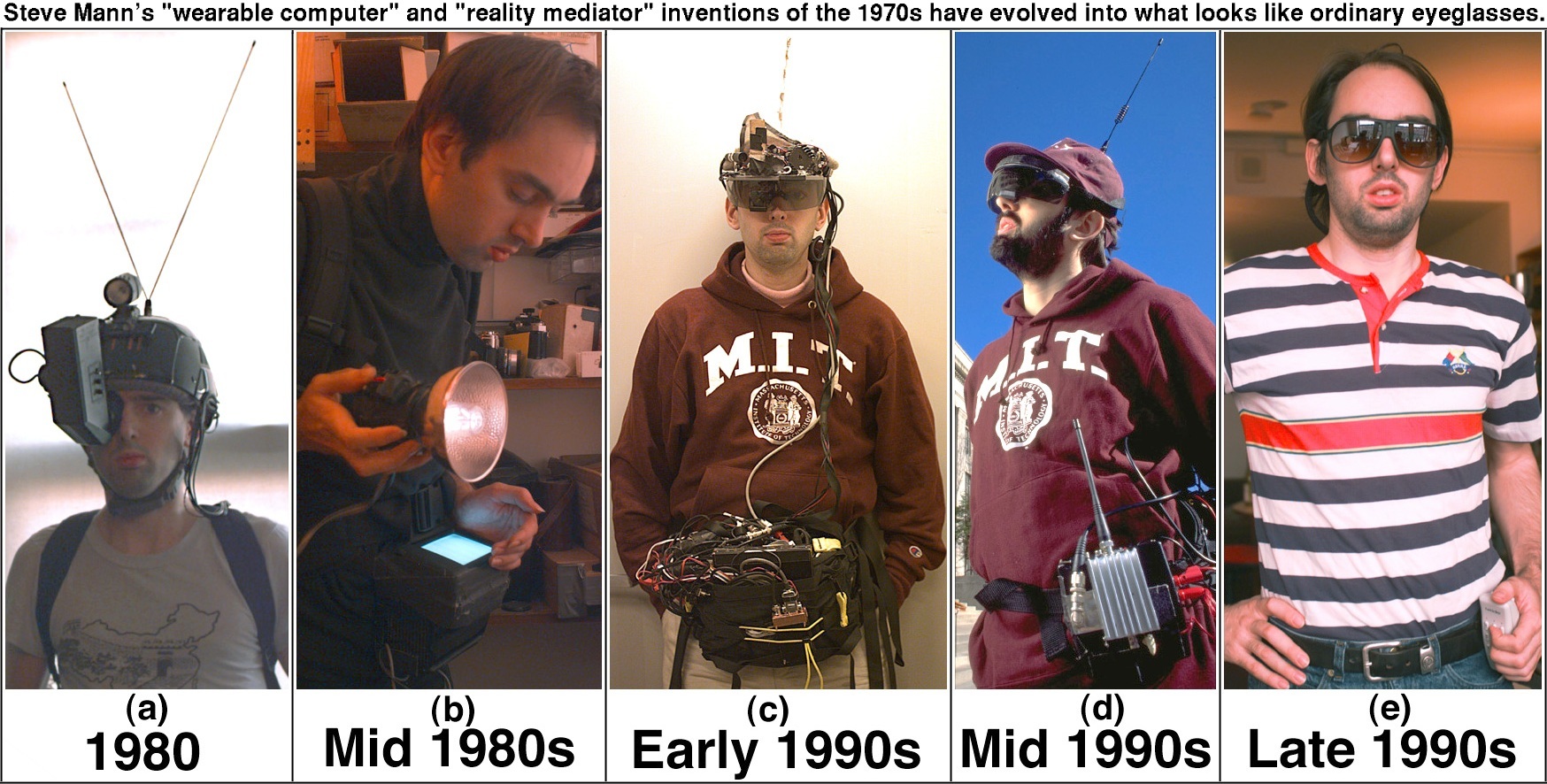
Obviously the PC is not going to disappear from the horizon, but more and more cheap 'specialty' gadgets will enter our lifes. wearing computers, wearing more computers, Steve Mann at UofT (Toronto) Personally I find it cool that you can wear all those computers on you, and noone will even suspect it. the photo to the right However, after working with all these wireless phones for over 3 years, I have realized that they give me headaches. So I dumped my PCS.
-
The Cyborg response (care of Steve Mann).This is relevant:
Steve Mann, one of the original Media Lab borg units, was motivated partly by a desire to have more control over his personal visual place.
IOW, he wanted his visor to block out bilboards.
Check him out:
http://www.eecg.toronto.edu/~mann/
And
in this page:
Solitude: It can function as an information filter, and allow us to block out material we might not wish to experience, whether it be offensive advertising, or simply a desire to replace existing media with different media. In less severe manifestations, it may simply allow us to alter our perception of reality in a very mild sort of way.
Discuss. -
The Cyborg response (care of Steve Mann).This is relevant:
Steve Mann, one of the original Media Lab borg units, was motivated partly by a desire to have more control over his personal visual place.
IOW, he wanted his visor to block out bilboards.
Check him out:
http://www.eecg.toronto.edu/~mann/
And
in this page:
Solitude: It can function as an information filter, and allow us to block out material we might not wish to experience, whether it be offensive advertising, or simply a desire to replace existing media with different media. In less severe manifestations, it may simply allow us to alter our perception of reality in a very mild sort of way.
Discuss. -
The Cyborg response (care of Steve Mann).This is relevant:
Steve Mann, one of the original Media Lab borg units, was motivated partly by a desire to have more control over his personal visual place.
IOW, he wanted his visor to block out bilboards.
Check him out:
http://www.eecg.toronto.edu/~mann/
And
in this page:
Mediation: Unlike hand held devices, laptop computers, and PDAs, the wearable computer can encapsulate us (Fig 1c). It doesn't necessarily
need to completely enclose us, but the concept allows for a greater degree of encapsulation than traditional portable computers. There are two
aspects to this encapsulation:
Solitude: It can function as an information filter, and allow us to block out material we might not wish to experience, whether it be offensive
advertising, or simply a desire to replace existing media with different media. In less severe manifestations, it may simply allow us to alter
our perception of reality in a very mild sort of way.
Discuss. -
The Cyborg response (care of Steve Mann).This is relevant:
Steve Mann, one of the original Media Lab borg units, was motivated partly by a desire to have more control over his personal visual place.
IOW, he wanted his visor to block out bilboards.
Check him out:
http://www.eecg.toronto.edu/~mann/
And
in this page:
Mediation: Unlike hand held devices, laptop computers, and PDAs, the wearable computer can encapsulate us (Fig 1c). It doesn't necessarily
need to completely enclose us, but the concept allows for a greater degree of encapsulation than traditional portable computers. There are two
aspects to this encapsulation:
Solitude: It can function as an information filter, and allow us to block out material we might not wish to experience, whether it be offensive
advertising, or simply a desire to replace existing media with different media. In less severe manifestations, it may simply allow us to alter
our perception of reality in a very mild sort of way.
Discuss. -
Re:Diagram of Unistroke CharactersDisclaimer: I'm not as smart as I think I am.
You could be right there
While Unistroke might look ugly, It was designed that the most common characters are also the fastest to draw. These little gestural languages are surprisingly easy to pick up. My masters thesis was on a Unistrokes-derived music input language, and non-computer users could be fluent in the (admitedly small sub-) set of signs in about 5 minutes, but these were experienced musicians. While the subset was small, with music, the vast majority of things you might like to write can be expressed in very few symbols.
Also worthy of note is that while the basic idea can be written on the back of an envelope, the devil is in the details, and there are a lot of details in producing a working handwriting system. Unistrokes is probably the result of a decade of PARC work in trying things that didn't even start to fly.
The unistroke alphabet was introduced to the world in Goldberg, D. & Richardson, C. (1993). Touch typing with a stylus. SIGGRAPH Video Review 88, New York: ACM., so presumably is was invented some years before.
Also of possible interest to the interested public is the work of Bill Buxton, and his Input Research Group at the University of Toronto. He discusses unistrokes, among other things in his chapter on Touch, Gesture and Marking. He's also a good speaker, and if you get a chance to hear him speak, grab it.
-
Re:Diagram of Unistroke CharactersDisclaimer: I'm not as smart as I think I am.
You could be right there
While Unistroke might look ugly, It was designed that the most common characters are also the fastest to draw. These little gestural languages are surprisingly easy to pick up. My masters thesis was on a Unistrokes-derived music input language, and non-computer users could be fluent in the (admitedly small sub-) set of signs in about 5 minutes, but these were experienced musicians. While the subset was small, with music, the vast majority of things you might like to write can be expressed in very few symbols.
Also worthy of note is that while the basic idea can be written on the back of an envelope, the devil is in the details, and there are a lot of details in producing a working handwriting system. Unistrokes is probably the result of a decade of PARC work in trying things that didn't even start to fly.
The unistroke alphabet was introduced to the world in Goldberg, D. & Richardson, C. (1993). Touch typing with a stylus. SIGGRAPH Video Review 88, New York: ACM., so presumably is was invented some years before.
Also of possible interest to the interested public is the work of Bill Buxton, and his Input Research Group at the University of Toronto. He discusses unistrokes, among other things in his chapter on Touch, Gesture and Marking. He's also a good speaker, and if you get a chance to hear him speak, grab it.
-
Personal Ad BlockerWhat you see isn't always the real thing, Steve Mann wrote an article in LJ about something i he called mediated reality. Where you would wear a pair of glasses which could filter out things you didn't want to see (ads), you should go read the article in LJ instead, I don't remmember much about it.
It seems like Mann has done pretty much research in WearComp, If some want to know more just visit his homepage, or Unv. Toronto.