Slashdot Mirror
Domain: twitter.com
Stories and comments across the archive that link to twitter.com.
Stories · 1,968
-
Intel To Invest $7 Billion in Factory in Arizona, Employ 3,000 People (cnbc.com)
Intel CEO Brian Krzanich met with President Donald Trump on Wednesday, where the company announced it will invest $7 billion in a factory employing up to 3,000 people. From a report: The factory will be in Chandler, Arizona, the company said, and over 10,000 people in the Arizona area will support the factory. Krzanich confirmed to CNBC that the investment over the next three to four years would be to complete a previous plant, Fab 42, that was started and then left vacant. The 7-nanometer chips will be produced there will be "the most powerful computer chips on the planet," Krzanich said in the Oval Office with the Trump administration. Most Intel manufacturing happens in the U.S., Krzanich said. "America has a unique combination of talent, a vibrant business environment and access to global markets, which has enabled U.S. companies like Intel to foster economic growth and innovation," Krzanich said in a statement. "Our factories support jobs -- high-wage, high-tech manufacturing jobs that are the economic engines of the states where they are located."Farhad Manjoo, columnist at The New York Times, tweeted; "As far as I can tell the decision had nothing to do with Trump, but they decided to announce with Trump. Why? There was no federal subsidy or any other credit. So it's just a marketing decision to give Trump credit." -
Anonymous Takes Down 10,613 Dark Web Portals (bleepingcomputer.com)
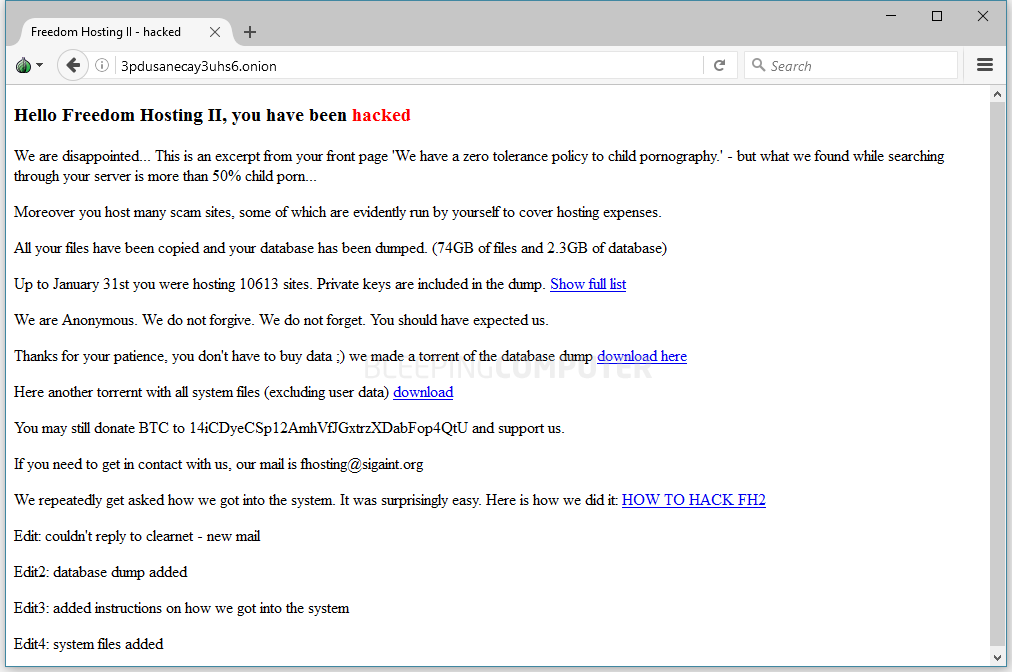
An anonymous reader writes: Anonymous hackers have breached Freedom Hosting II, a popular Dark Web hosting provider, and have taken down 10,613 .onion sites. In a message left on all Freedom Hosting II sites, the hackers claim to have found massive troves of child pornography imagery hosted on the company's servers. The hackers dumped 74GB of server files (half of which they say contained child pornography) and a database dump of 2.3GB. Security researcher Chris Monteiro has analyzed some of the dumped data. He says he discovered .onion URLs hosting botnets, fraud sites, sites peddling hacked data, weird fetish portals, more weird stuff, and child abuse websites targeting both English- and Russian-speaking buyers. Freedom Hosting II hosts about a fifth of all .onion URLs. The first Freedom Hosting service was targeted by Anonymous in 2011 and eventually shut down in 2013 after the FBI also found child pornography hosted on its sites. -
Anonymous Takes Down 10,613 Dark Web Portals (bleepingcomputer.com)
An anonymous reader writes: Anonymous hackers have breached Freedom Hosting II, a popular Dark Web hosting provider, and have taken down 10,613 .onion sites. In a message left on all Freedom Hosting II sites, the hackers claim to have found massive troves of child pornography imagery hosted on the company's servers. The hackers dumped 74GB of server files (half of which they say contained child pornography) and a database dump of 2.3GB. Security researcher Chris Monteiro has analyzed some of the dumped data. He says he discovered .onion URLs hosting botnets, fraud sites, sites peddling hacked data, weird fetish portals, more weird stuff, and child abuse websites targeting both English- and Russian-speaking buyers. Freedom Hosting II hosts about a fifth of all .onion URLs. The first Freedom Hosting service was targeted by Anonymous in 2011 and eventually shut down in 2013 after the FBI also found child pornography hosted on its sites. -
Anonymous Takes Down 10,613 Dark Web Portals (bleepingcomputer.com)
An anonymous reader writes: Anonymous hackers have breached Freedom Hosting II, a popular Dark Web hosting provider, and have taken down 10,613 .onion sites. In a message left on all Freedom Hosting II sites, the hackers claim to have found massive troves of child pornography imagery hosted on the company's servers. The hackers dumped 74GB of server files (half of which they say contained child pornography) and a database dump of 2.3GB. Security researcher Chris Monteiro has analyzed some of the dumped data. He says he discovered .onion URLs hosting botnets, fraud sites, sites peddling hacked data, weird fetish portals, more weird stuff, and child abuse websites targeting both English- and Russian-speaking buyers. Freedom Hosting II hosts about a fifth of all .onion URLs. The first Freedom Hosting service was targeted by Anonymous in 2011 and eventually shut down in 2013 after the FBI also found child pornography hosted on its sites. -
Anonymous Takes Down 10,613 Dark Web Portals (bleepingcomputer.com)
An anonymous reader writes: Anonymous hackers have breached Freedom Hosting II, a popular Dark Web hosting provider, and have taken down 10,613 .onion sites. In a message left on all Freedom Hosting II sites, the hackers claim to have found massive troves of child pornography imagery hosted on the company's servers. The hackers dumped 74GB of server files (half of which they say contained child pornography) and a database dump of 2.3GB. Security researcher Chris Monteiro has analyzed some of the dumped data. He says he discovered .onion URLs hosting botnets, fraud sites, sites peddling hacked data, weird fetish portals, more weird stuff, and child abuse websites targeting both English- and Russian-speaking buyers. Freedom Hosting II hosts about a fifth of all .onion URLs. The first Freedom Hosting service was targeted by Anonymous in 2011 and eventually shut down in 2013 after the FBI also found child pornography hosted on its sites. -
Anonymous Takes Down 10,613 Dark Web Portals (bleepingcomputer.com)
An anonymous reader writes: Anonymous hackers have breached Freedom Hosting II, a popular Dark Web hosting provider, and have taken down 10,613 .onion sites. In a message left on all Freedom Hosting II sites, the hackers claim to have found massive troves of child pornography imagery hosted on the company's servers. The hackers dumped 74GB of server files (half of which they say contained child pornography) and a database dump of 2.3GB. Security researcher Chris Monteiro has analyzed some of the dumped data. He says he discovered .onion URLs hosting botnets, fraud sites, sites peddling hacked data, weird fetish portals, more weird stuff, and child abuse websites targeting both English- and Russian-speaking buyers. Freedom Hosting II hosts about a fifth of all .onion URLs. The first Freedom Hosting service was targeted by Anonymous in 2011 and eventually shut down in 2013 after the FBI also found child pornography hosted on its sites. -
Anonymous Takes Down 10,613 Dark Web Portals (bleepingcomputer.com)
An anonymous reader writes: Anonymous hackers have breached Freedom Hosting II, a popular Dark Web hosting provider, and have taken down 10,613 .onion sites. In a message left on all Freedom Hosting II sites, the hackers claim to have found massive troves of child pornography imagery hosted on the company's servers. The hackers dumped 74GB of server files (half of which they say contained child pornography) and a database dump of 2.3GB. Security researcher Chris Monteiro has analyzed some of the dumped data. He says he discovered .onion URLs hosting botnets, fraud sites, sites peddling hacked data, weird fetish portals, more weird stuff, and child abuse websites targeting both English- and Russian-speaking buyers. Freedom Hosting II hosts about a fifth of all .onion URLs. The first Freedom Hosting service was targeted by Anonymous in 2011 and eventually shut down in 2013 after the FBI also found child pornography hosted on its sites. -
Anonymous Takes Down 10,613 Dark Web Portals (bleepingcomputer.com)
An anonymous reader writes: Anonymous hackers have breached Freedom Hosting II, a popular Dark Web hosting provider, and have taken down 10,613 .onion sites. In a message left on all Freedom Hosting II sites, the hackers claim to have found massive troves of child pornography imagery hosted on the company's servers. The hackers dumped 74GB of server files (half of which they say contained child pornography) and a database dump of 2.3GB. Security researcher Chris Monteiro has analyzed some of the dumped data. He says he discovered .onion URLs hosting botnets, fraud sites, sites peddling hacked data, weird fetish portals, more weird stuff, and child abuse websites targeting both English- and Russian-speaking buyers. Freedom Hosting II hosts about a fifth of all .onion URLs. The first Freedom Hosting service was targeted by Anonymous in 2011 and eventually shut down in 2013 after the FBI also found child pornography hosted on its sites. -
A Hacker Just Pwned Over 150,000 Printers Exposed Online (bleepingcomputer.com)
Last year an attacker forced thousands of unsecured printers to spew racist and anti-semitic messages. But this year's attack is even bigger. An anonymous reader writes: A grey-hat hacker going by the name of Stackoverflowin has pwned over 150,000 printers that have been left accessible online. For the past 24 hours, Stackoverflowin has been running an automated script that searches for open printer ports and sends a rogue print job to the target's device. The script targets IPP (Internet Printing Protocol) ports, LPD (Line Printer Daemon) ports, and port 9100 left open to external connections. From high-end multi-functional printers at corporate headquarters to lowly receipt printers in small town restaurants, all have been affected. The list includes brands such as Afico, Brother, Canon, Epson, HP, Lexmark, Konica Minolta, Oki, and Samsung.
The printed out message included recommendations for printer owners to secure their device. The hacker said that people who reached out were very nice and thanked him.
The printers apparently spew out an ASCII drawing of a robot, along with the words "stackoverflowin the hacker god has returned. your printer is part of a flaming botnet... For the love of God, please close this port." The messages sometimes also include a link to a Twitter feed named LMAOstack. -
Zero-Day Windows Security Flaw Can Crash Systems, Cause BSODs (helpnetsecurity.com)
Orome1 quotes a report from Help Net Security: A zero-day bug affecting Windows 10, 8.1, Windows Server 2012 and 2016 can be exploited to crash a vulnerable system and possibly even to compromise it. It is a memory corruption bug in the handling of SMB traffic that could be easily exploited by forcing a Windows system to connect to a malicious SMB share. Tricking a user to connect to such a server should be an easy feat if clever social engineering is employed. The vulnerability was discovered by a researcher that goes by PythonResponder on Twitter, and who published proof-of-exploit code for it on GitHub on Wednesday. The researcher says that he shared knowledge of the flaw with Microsoft, and claims that "they had a patch ready 3 months ago but decided to push it back." Supposedly, the patch will be released next Tuesday. The PoC exploit has been tested by SANS ISC CTO Johannes Ullrich, and works on a fully patched Windows 10. "To be vulnerable, a client needs to support SMBv3, which was introduced in Windows 8 for clients and Windows 2012 on servers," he noted, and added that "it isn't clear if this is exploitable beyond a denial of service." Until a patch is released, administrators can prevent it from being exploited by blocking outbound SMB connections (TCP ports 139 and 445, UDP ports 137 and 138) from the local network to the WAN, as advised by CERT/CC. "The tweet originally announcing this issue stated that Windows 2012 and 2016 is vulnerable," the researcher said. "I tested it with a fully patched Windows 10, and it got an immediate blue screen of death." -
Apple To Start Making iPhones In India, Says State Government (bbc.co.uk)
vasanth quotes a report from BBC: Apple is to start making iPhones in the southern Indian state of Karnataka, the state's government has said. Ministers said Apple would start an initial manufacturing operation in the state, whose capital is the tech hub Bangalore, in April. The tech giant has a 2% share of India's mobile phone market, well behind South Korean rival Samsung. Apple has yet to officially confirm the plan, saying only that it is keen to "invest significantly" in India. But Priyank Kharge, minister of information technology and biotechnology in Karnataka, told the AFP news agency: "We have an understanding with Apple and we expect them to start manufacturing in Karnataka by the end of April." Reports said the plant is being set up by Taiwanese manufacturing company Wistron Corp. Apple has held a series of meetings with government representatives at both state and national level and is understood to be pressing for concessions before going ahead with such a move. Apple is currently unable to set up its own branded stores in India, which has a raft of rules to curb the activities of foreign companies. For it to be able to sell direct to customers in India, Apple would have to source 30% of the components of its products locally. Priyank Kharge, IT minister for the Indian state of Karnataka, said Thursday on Twitter: "Apple's intentions to make iPhones in Bengaluru will foster cutting-edge technology ecosystem [and] supply chain development in the state." -
Tim Sweeney Dislikes Windows 10 Cloud Rumors, Calls OS 'Crush Steam Edition' (arstechnica.com)
An anonymous reader quotes a report from Ars Technica: The rumor that Microsoft is building a version of Windows 10 that can only install apps from the Windows Store has drawn criticism before it's even official. Epic Games founder Tim Sweeney took to Twitter to attack the operating system. Although its real name is named Windows 10 Cloud, he's dubbing it "Windows 10 Crush Steam Edition." Sweeney is convinced that Microsoft wants to exercise total control over the Windows platform and destroy Valve's Steam. Last year, Sweeney attacked the Universal Windows Platform API. He claimed (incorrectly) that third-party stores such as Steam would be unable to sell and distribute UWP games, leaving them at a disadvantage relative to Microsoft's own store. He followed this statement with the claim that Microsoft would systematically modify Windows so as to make Steam work worse and worse, such that gamers grow tired of it and switch to the Windows Store. In his tweets, Sweeney recognizes that Microsoft wants to compete with Chrome OS. But he fails to understand what the company must do to actually offer that competition. He wrote that "it's great for Microsoft to compete with ChromeOS, but NOT BY LOCKING OUT COMPETING WINDOWS SOFTWARE STORES." This statement represents a failure to understand that "locking out competing Windows software stores" is, for this market, positively desirable. It's fundamental to preventing the hard-to-support free-for-all that a Windows system would otherwise represent. A later tweet does recognize the value of this lockdown, but Sweeney says that Windows 10's "great admin features to limit user software installs" should be used instead. This again suggests a misunderstanding of the target market: systems will be used with little to no supervision and with little to no administrative oversight. To compete against the Chromebook, Windows 10 Cloud needs to be locked down by default, and it must not offer any ready way to disable that lockdown. In his complaints, Sweeney also fails to consider what happens should the Chromebook threat go unaddressed: Chromebooks running Chrome OS will proliferate. These machines will not support third-party stores, they will not support Steam, and they will not support PC games at all. Sweeney may not want Microsoft to build this world, but even if Microsoft doesn't create it, Google already is doing so. -
Tim Sweeney Dislikes Windows 10 Cloud Rumors, Calls OS 'Crush Steam Edition' (arstechnica.com)
An anonymous reader quotes a report from Ars Technica: The rumor that Microsoft is building a version of Windows 10 that can only install apps from the Windows Store has drawn criticism before it's even official. Epic Games founder Tim Sweeney took to Twitter to attack the operating system. Although its real name is named Windows 10 Cloud, he's dubbing it "Windows 10 Crush Steam Edition." Sweeney is convinced that Microsoft wants to exercise total control over the Windows platform and destroy Valve's Steam. Last year, Sweeney attacked the Universal Windows Platform API. He claimed (incorrectly) that third-party stores such as Steam would be unable to sell and distribute UWP games, leaving them at a disadvantage relative to Microsoft's own store. He followed this statement with the claim that Microsoft would systematically modify Windows so as to make Steam work worse and worse, such that gamers grow tired of it and switch to the Windows Store. In his tweets, Sweeney recognizes that Microsoft wants to compete with Chrome OS. But he fails to understand what the company must do to actually offer that competition. He wrote that "it's great for Microsoft to compete with ChromeOS, but NOT BY LOCKING OUT COMPETING WINDOWS SOFTWARE STORES." This statement represents a failure to understand that "locking out competing Windows software stores" is, for this market, positively desirable. It's fundamental to preventing the hard-to-support free-for-all that a Windows system would otherwise represent. A later tweet does recognize the value of this lockdown, but Sweeney says that Windows 10's "great admin features to limit user software installs" should be used instead. This again suggests a misunderstanding of the target market: systems will be used with little to no supervision and with little to no administrative oversight. To compete against the Chromebook, Windows 10 Cloud needs to be locked down by default, and it must not offer any ready way to disable that lockdown. In his complaints, Sweeney also fails to consider what happens should the Chromebook threat go unaddressed: Chromebooks running Chrome OS will proliferate. These machines will not support third-party stores, they will not support Steam, and they will not support PC games at all. Sweeney may not want Microsoft to build this world, but even if Microsoft doesn't create it, Google already is doing so. -
Tim Sweeney Dislikes Windows 10 Cloud Rumors, Calls OS 'Crush Steam Edition' (arstechnica.com)
An anonymous reader quotes a report from Ars Technica: The rumor that Microsoft is building a version of Windows 10 that can only install apps from the Windows Store has drawn criticism before it's even official. Epic Games founder Tim Sweeney took to Twitter to attack the operating system. Although its real name is named Windows 10 Cloud, he's dubbing it "Windows 10 Crush Steam Edition." Sweeney is convinced that Microsoft wants to exercise total control over the Windows platform and destroy Valve's Steam. Last year, Sweeney attacked the Universal Windows Platform API. He claimed (incorrectly) that third-party stores such as Steam would be unable to sell and distribute UWP games, leaving them at a disadvantage relative to Microsoft's own store. He followed this statement with the claim that Microsoft would systematically modify Windows so as to make Steam work worse and worse, such that gamers grow tired of it and switch to the Windows Store. In his tweets, Sweeney recognizes that Microsoft wants to compete with Chrome OS. But he fails to understand what the company must do to actually offer that competition. He wrote that "it's great for Microsoft to compete with ChromeOS, but NOT BY LOCKING OUT COMPETING WINDOWS SOFTWARE STORES." This statement represents a failure to understand that "locking out competing Windows software stores" is, for this market, positively desirable. It's fundamental to preventing the hard-to-support free-for-all that a Windows system would otherwise represent. A later tweet does recognize the value of this lockdown, but Sweeney says that Windows 10's "great admin features to limit user software installs" should be used instead. This again suggests a misunderstanding of the target market: systems will be used with little to no supervision and with little to no administrative oversight. To compete against the Chromebook, Windows 10 Cloud needs to be locked down by default, and it must not offer any ready way to disable that lockdown. In his complaints, Sweeney also fails to consider what happens should the Chromebook threat go unaddressed: Chromebooks running Chrome OS will proliferate. These machines will not support third-party stores, they will not support Steam, and they will not support PC games at all. Sweeney may not want Microsoft to build this world, but even if Microsoft doesn't create it, Google already is doing so. -
GitLab.com Melts Down After Wrong Directory Deleted, Backups Fail (theregister.co.uk)
An anonymous reader quotes a report from The Register: Source-code hub Gitlab.com is in meltdown after experiencing data loss as a result of what it has suddenly discovered are ineffectual backups. On Tuesday evening, Pacific Time, the startup issued the sobering series of tweets, starting with "We are performing emergency database maintenance, GitLab.com will be taken offline" and ending with "We accidentally deleted production data and might have to restore from backup. Google Doc with live notes [link]." Behind the scenes, a tired sysadmin, working late at night in the Netherlands, had accidentally deleted a directory on the wrong server during a frustrating database replication process: he wiped a folder containing 300GB of live production data that was due to be replicated. Just 4.5GB remained by the time he canceled the rm -rf command. The last potentially viable backup was taken six hours beforehand. That Google Doc mentioned in the last tweet notes: "This incident affected the database (including issues and merge requests) but not the git repos (repositories and wikis)." So some solace there for users because not all is lost. But the document concludes with the following: "So in other words, out of 5 backup/replication techniques deployed none are working reliably or set up in the first place." At the time of writing, GitLab says it has no estimated restore time but is working to restore from a staging server that may be "without webhooks" but is "the only available snapshot." That source is six hours old, so there will be some data loss. -
GitLab.com Melts Down After Wrong Directory Deleted, Backups Fail (theregister.co.uk)
An anonymous reader quotes a report from The Register: Source-code hub Gitlab.com is in meltdown after experiencing data loss as a result of what it has suddenly discovered are ineffectual backups. On Tuesday evening, Pacific Time, the startup issued the sobering series of tweets, starting with "We are performing emergency database maintenance, GitLab.com will be taken offline" and ending with "We accidentally deleted production data and might have to restore from backup. Google Doc with live notes [link]." Behind the scenes, a tired sysadmin, working late at night in the Netherlands, had accidentally deleted a directory on the wrong server during a frustrating database replication process: he wiped a folder containing 300GB of live production data that was due to be replicated. Just 4.5GB remained by the time he canceled the rm -rf command. The last potentially viable backup was taken six hours beforehand. That Google Doc mentioned in the last tweet notes: "This incident affected the database (including issues and merge requests) but not the git repos (repositories and wikis)." So some solace there for users because not all is lost. But the document concludes with the following: "So in other words, out of 5 backup/replication techniques deployed none are working reliably or set up in the first place." At the time of writing, GitLab says it has no estimated restore time but is working to restore from a staging server that may be "without webhooks" but is "the only available snapshot." That source is six hours old, so there will be some data loss. -
This Week 'IT Issues' Ground Delta Airlines' Flights (cnbc.com)
Delta Air Lines has been forced to cancel at least 150 flights, and expects to cancel even more. But "the IT department is working to rectify the situation as soon as possible," they tweeted Sunday -- more than four hours ago. Long-time Slashdot reader SonicSpike quotes CNBC: Delta Air Lines U.S. domestic flights were grounded on Sunday evening due to automation issues, according to an advisory from the Federal Aviation Administration... "Delta teams are expeditiously working to fix a systems outage that has resulted in departure delays for flights on the ground," the airline said in the statement. "Flights in the air remain unaffected". [And their international flights were unaffected.]
Delta also grounded 2,000 flights last summer after a computer outage caused by a power outage in Atlanta. At the time Reuters reported that "Airlines will likely suffer more disruptions... because major carriers have not invested enough to overhaul reservations systems based on technology dating to the 1960s." And sure enough, just last week, another "IT issue" forced United Airlines to ground all their domestic flights. -
This Week 'IT Issues' Ground Delta Airlines' Flights (cnbc.com)
Delta Air Lines has been forced to cancel at least 150 flights, and expects to cancel even more. But "the IT department is working to rectify the situation as soon as possible," they tweeted Sunday -- more than four hours ago. Long-time Slashdot reader SonicSpike quotes CNBC: Delta Air Lines U.S. domestic flights were grounded on Sunday evening due to automation issues, according to an advisory from the Federal Aviation Administration... "Delta teams are expeditiously working to fix a systems outage that has resulted in departure delays for flights on the ground," the airline said in the statement. "Flights in the air remain unaffected". [And their international flights were unaffected.]
Delta also grounded 2,000 flights last summer after a computer outage caused by a power outage in Atlanta. At the time Reuters reported that "Airlines will likely suffer more disruptions... because major carriers have not invested enough to overhaul reservations systems based on technology dating to the 1960s." And sure enough, just last week, another "IT issue" forced United Airlines to ground all their domestic flights. -
George Orwell's '1984' Tops Amazon's Bestseller List (theguardian.com)
An anonymous reader quotes a report from The Guardian: Sales of George Orwell's dystopian drama 1984 have soared after Kellyanne Conway, adviser to the reality-TV-star-turned-president, Donald Trump, used the phrase "alternative facts" in an interview. As of Tuesday, the book was the sixth best-selling book on Amazon. Comparisons were made with the term "newspeak" used in the 1949 novel, which was used to signal a fictional language that aims at eliminating personal thought and also "doublethink." In the book Orwell writes that it "means the power of holding two contradictory beliefs in one's mind simultaneously, and accepting both of them." The connection was initially made on CNN's Reliable Sources. "Alternative facts is a George Orwell phrase," said Washington Post reporter Karen Tumulty. Conway's use of the term was in reference to White House press secretary Sean Spicer's comments about last week's inauguration attracting "the largest audience ever". Her interview was widely criticized and she was sub-tweeted by Merriam-Webster dictionary with a definition of the word fact. In 1984, a superstate wields extreme control over the people and persecutes any form of independent thought. UPDATE 1/24/17 6:56PM PST: Orwell's dystopian novel is now the #1 Best Seller in Books on Amazon. -
Researchers Discover Massive Networks of Fake Twitter Accounts (bbc.com)
mi writes: Turns out, there are researchers studying ways to identify bots on Twitter -- fake accounts used by individuals or groups for various purposes. They identified, what seems like a collection of 350,000 accounts, all of which share the same subtle characteristics: tweets coming from places where nobody lives; messages being posted only from Windows phones; exclusively including quotes from Star Wars novels. "Considering all the efforts already there in detecting bots, it is amazing that we can still find so many bots, much more than previous research," Dr Zhou, a senior lecturer from UCL, told the BBC. Juan Echeverria uncovered the massive networks by combing through a sample of 1% of Twitter users in order to get a better understanding of how people use the social network. He is now asking the public via a website and a Twitter account to report bots to get a better idea of how prevalent they are. Some bots are easy to spot as they likely have been created recently, have few followers, have strange usernames and little content in the messages. -
FBI Is Probing Sundance Cyberattack That Forced Box Office To Close (hollywoodreporter.com)
Over the weekend, the Sundance Film Festival was hacked. "Sundance Film Festival has been subject to a cyberattack, causing network outages that have shut down our box office," said a spokesperson for the festival. "No further information about the attack is available at this time, but our team is working hard to get our system back up and running as soon as possible. All screenings will still take place as planned." According to The Hollywood Reporter, the FBI is now investigating the hack and is working with Sundance officials to identify the culprit. From their report: Although the festival was able to get its ticketing systems back online within an hour of the Saturday breach, multiple other denial-of-service (DDoS) attacks on Sundance's IT infrastructure followed. A DDoS attack works by flooding the bandwidth or resources of a targeted server. A Sundance Film Festival rep offers the following statement: "The FBI is reviewing the case. At this point, we do not have any reason to believe the cyberattack was targeted towards a specific film. No artist or customer information was compromised." At the time of the hack, the festival offered little in the way of explanation of what happened, but hinted that filmmakers at the annual celebration of independent cinema may have been the target. One producer of a Sundance documentary critical of the Russian government believes his film could have played a role in the attack. "There's been speculation that our film may have sparked retribution," Icarus consulting producer Doug Blush tells THR. "It does not paint a flattering picture of [president Vladimir] Putin." Icarus, which made its world premiere at the festival the day before the hack, centers on a Russian doctor who oversaw and then spoke out about Russia's widespread state-sponsored sports doping. The Bryan Fogel-helmed film, which is being pitched to distributors, has played throughout the weekend in Park City at screenings for both press-and-industry and the public. Icarus isn't the only Sundance film that could antagonize the Russian government and Putin. Evgeny Afineevsky's Cries From Syria -- one of several docs tackling the war-torn nation -- also takes a critical look at Putin and Russia's military intervention in Syria. Cries From Syria made its world premiere at Sundance on Sunday, the day after the initial box-office cyberattack. -
'IT Issue' Grounded All United Airlines Flights In The US (nbcnews.com)
For two and a half hours -- no take-offs. An anonymous reader quotes NBC News: All of United Airlines' domestic flights were grounded Sunday night because of a computer outage, the Federal Aviation Administration said as scores of angry travelers sounded off on social media... U.S. officials told NBC News that the Aircraft Communications Addressing and Reporting System, or ACARS, had issues with low bandwidth. No further explanation was immediately available for what United described only as "an IT issue."
An hour ago United tweeted that they'd finally lifted the stop and were "working to get flights on their way." 66 flights were cancelled just at Chicago's O'Hare Airport, the Chicago Department of Aviation told the Associated Press, and though the article doesn't identify the total number of flights affected, "Chicago-based United Airlines and United Express operate more than 4,500 flights a day to 339 airports across five continents." -
NASA Names an Asteroid After 'Star Trek' Actor Wil Wheaton (cnet.com)
"An asteroid going boldly through the universe now carries a new name that honors actor Will Wheaton, who played Wesley Crusher on Star Trek: The Next Generation," reports CNET. An anonymous reader quotes their article. The announcement showed up on Twitter Wednesday from NASA's Ron Baalke, who describes himself as a "space explorer at the Jet Propulsion Laboratory". Wheaton is in good company with other Star Trek alumni. Asteroid 7307 Takei is named for Sulu actor George Takei and 68410 Nichols gets its name from Nichelle Nichols, who played Uhura. There's also asteroid 4659 Roddenberry for Star Trek creator Gene Roddenberry.
"Today, I found out that I kind of get to be in space and live right here on Earth..." Wheaton wrote on his blog Wednesday, describing his life-long interest in space exploration. "As soon as it gets dark here, I'm going to walk out into my backyard, look up into the sky, just a little above Sirius, and know that, even though I can't see it with my naked eye, it's out there, and it's named after me." -
Newest Tesla Autopilot Data Shows A 40% Drop in Crashes (bloomberg.com)
There's a surprise in the data from an investigation into Tesla safety by the U.S. National Highway Traffic Safety Administration. An anonymous reader quotes Bloomberg: [W]hile all Tesla vehicles come with the hardware necessary for Autopilot, you need a software upgrade that costs thousands of dollars to make it work. Since buyers can add Autopilot features after purchase, this provides a perfect before-and-after comparison. It turns out that, according to the data Tesla gave investigators, installing Autopilot prevents crashes -- by an astonishing 40 percent...
Now -- thanks to an investigation that initially hurt the company -- there is finally some real data, and it's good news for Tesla... As the software matures to match the new hardware, Musk said on Thursday via a Tweet, Tesla is targeting a 90 percent reduction in car crashes.
UPDATE (5/4/18): The NHTSA has now clarified that their study "did not assess the effectiveness of this technology.
UPDATE (2/16/19): The study's underlying data reveals serious flaws in the methodology that undermine its credibility, according to new analysis from a research and consulting firm. -
Report: PS4 Is Selling Twice As Well As Xbox One (arstechnica.com)
The latest numbers released by analysts suggest that the Sony PlayStation 4 is selling twice as many units worldwide as the Xbox One since both systems launched in late 2013. The data comes from a new SuperData report on the Nintendo Switch, which is backed up by Niko Partners analyst Daniel Ahmad. SuperData mentions an installed base of 26 million Xbox One units and 55 million PS4 units. Ars Technica reports: Ahmad's chart suggests that Microsoft may have sold slightly more than half of the 53.4 million PS4 units that Sony recently announced it had sold through January 1. Specific numbers aside, though, it's clear Microsoft has done little to close its console sales gap with Sony over the past year -- and may have actually lost ground in that time. The last time we did our own estimate of worldwide console sales, through the end of 2015, we showed the Xbox One with about 57 percent as many systems sold as the PS4 (21.49 million vs. 37.7 million). That lines up broadly with numbers leaked by EA at the time, which suggest the Xbox One had sold about 52.9 percent as well as the PS4 (19 million vs. 35.9 million). One year later, that ratio has dipped to just above or even a bit below 50 percent, according to these reports. The relative sales performance of the Xbox One and PS4 doesn't say anything direct about the health or quality of those platforms, of course. Microsoft doesn't seem to be in any danger of abandoning the Xbox One platform any time soon and has, in fact, recently committed to upgrading it via Project Scorpio later this year. The gap between PS4 and Xbox One sales becomes important only if it becomes so big that publishers start to consider the Xbox One market as a minor afterthought that can be safely ignored for everything but niche games. -
President Obama Commutes Chelsea Manning's Sentence (theverge.com)
The New York Times is reporting that President Obama has commuted Chelsea Manning's sentence. What this translates to is a reduced sentence for Manning, from 35 years to just over seven years. Since Manning has already served a majority of those years, she is due to be released from federal custody on May 17th. The Verge reports: While serving as an intelligence analyst in Iraq, Manning leaked more than 700,000 documents to Wikileaks, including video of a 2007 airstrike in Baghdad that killed two Reuters employees. In 2013, Manning was sentenced to 35 years in prison for her role in the leak and has been held at the U.S. Disciplinary Barracks at Fort Leavenworth for the past three years. Julian Assange, who has long been sought by U.S. and EU authorities for extradition on Swedish rape charges, had previously pledged to surrender himself to U.S. authorities if Manning was pardoned. Born Bradley Manning, Chelsea announced her gender transition the day after the verdict was handed down. "I am Chelsea Manning. I am a female," she said in a statement. "Given the way that I feel, and have felt since childhood, I want to begin hormone therapy as soon as possible." Obtaining the resulting medical treatments was extremely difficult for Manning, and was the subject of significant and sustained activism. After a lawsuit, Manning was approved for hormone therapy in 2015. In September 2016, she launched a hunger strike, demanding access to gender reassignment surgery; the military complied five days later. -
ISIS Is Dropping Bombs With Drones In Iraq (popsci.com)
In addition to rifles, mortars, artillery and suicidal car bombs, ISIS has recently added commercial drones, converted into tiny bombs, into the mix of weapons it uses to fight in Iraq. In October, The New York Times reported that the Islamic State was using small consumer drones rigged with explosives to fight Kurdish forces in Iraq. Two Kurdish soldiers died dismantling a booby-trapped ISIS drone. Several months later and it appears the use of drones on the battlefield is becoming more prevalent. Popular Science reports: Previously, we've seen ISIS scratch-build drones, and as Iraqi Security Forces retook parts of Mosul, they discovered a vast infrastructure of workshops (complete with quality control) for building standardized munitions, weapons, and explosives. These drone bombers recently captured by Iraqi forces and shared with American advisors appear to be commercial, off-the-shelf models, adapted to carry grenade-sized payloads. "It's not as if it is a large, armed UAV [unmanned aerial vehicle] that is dropping munitions from the wings -- but literally, a very small quadcopter that drops a small munition in a somewhat imprecise manner," [Col. Brett] Sylvia, commander of an American military advising mission in Iraq, told Military Times. "They are very short-range, targeting those front-line troops from the Iraqis." Because the drones used are commercial models, it likely means that anti-drone weapons already on hand with the American advisors are sufficient to stop them. It's worth noting that the bomb-dropping drones are just a small part of how ISIS uses the cheap, unmanned flying machines. Other applications include scouts and explosive decoys, as well as one-use weapons. ISIS is also likely not the first group to figure out how to drop grenades from small drones; it's a growing field of research and development among many violent, nonstate actors and insurgent groups. Despite the relative novelty, it's also likely not the deadliest thing insurgents can do with drones. -
Petition With Over 1 Million Signatures Urges President Obama To Pardon Snowden (cnet.com)
An anonymous reader quotes a report from CNET: More than 1 million people signed onto a petition asking President Barack Obama to pardon Edward Snowden, proponents of the pardon said Friday. The campaign began in September, when Snowden, his attorney Ben Wizner from the ACLU, and other privacy activists announced they would formally petition Obama for a pardon. Snowden leaked classified NSA documents detailing surveillance programs run by the U.S. and its allies to journalists in 2013, kicking off a heated debate on whether Americans should be willing to sacrifice internet privacy to help the government protect the country from terrorist attacks. Obama and White House representatives have said repeatedly that Snowden must face the charges against him and that he'll be afforded a fair trial. In the U.S., a pardon is "an expression of the president's forgiveness and ordinarily is granted in recognition of the applicant's acceptance of responsibility for the crime and established good conduct for a significant period of time after conviction or completion of sentence," according to the Office of the Pardon Attorney. It does not signify innocence. Also on Friday, David Kaye urged Obama to consider a pardon for Snowden. Kaye, the special rapporteur to the United Nations Human Rights Council on the freedom of expression, said U.S. law doesn't allow Snowden to argue that his disclosures were made for the benefit of the public. The jury would merely be asked to decide whether Snowden stole government secrets and distributed them -- something Snowden himself concedes he did. In response to the petition, Edward Snowden tweeted: "Whether or not this President ends the war on whistleblowers, you've sent a message to history: I feared no one would care. I was wrong." -
Facebook No Longer Clearly Labels Edited Posts (mashable.com)
An anonymous reader quotes a report from Mashable: Have you ever made a cringeworthy mistake in a Facebook post? Don't lie, the answer is yes. If you have a sense of shame, Facebook at least allows you to go back and correct your gaffe by editing the post, a feature that certain other social media networks still haven't added. But evidence of your slip-up lived on with the tiny "Edited" label on the bottom of the post, signaling to your followers that you cared just enough to correct yourself on the internet. Sad. Apparently, however, that's no longer the case. It seems that Facebook has removed the on-post edited label, making it much more difficult to know when someone actually took the time to fix their mistake. In order to actually know whether or not your eyes were playing tricks on you when a friend's rant no longer has 15 spelling errors the second time you see it, you'll need to do some digging. Here's how the new editing looks, courtesy of my colleague Raymond Wong and his doubts about how cool the upcoming Nintendo Switch actually is. I noticed that he added a comment about the Switch, so I checked out the post information, via the drop-down menu. To see what happened, I have to view the edit history. When I look at his edit history, I can see all the changes that were made. In most cases, this type of editing isn't a big deal, but the move to hide post edit labels takes away one of the few features that provided any transparency for our online behavior. -
Security Experts Rebut The Guardian's Report That Claimed WhatsApp Has a Backdoor (gizmodo.com)
William Turton, writing for Gizmodo: This morning, the Guardian published a story with an alarming headline: "WhatsApp backdoor allows snooping on encrypted messages." If true, this would have massive implications for the security and privacy of WhatsApp's one-billion-plus users. Fortunately, there's no backdoor in WhatsApp, and according to Alec Muffett, an experienced security researcher who spoke to Gizmodo, the Guardian's story is a "major league fuckwittage." [...] Fredric Jacobs, who was the iOS developer at Open Whisper Systems, the collective that designed and maintains the Signal encryption protocol, and who most recently worked at Apple, said, "Nothing new. Of course, if you don't verify keys Signal/WhatsApp/... can man-in-the-middle your communications." "I characterize the threat posed by such reportage as being fear and uncertainty and doubt on an 'anti-vaccination' scale," Muffett, who previously worked on Facebook's engineering security infrastructure team, told Gizmodo. "It is not a bug, it is working as designed and someone is saying it's a 'flaw' and pretending it is earth shattering when in fact it is ignorable." The supposed "backdoor" the Guardian is describing is actually a feature working as intended, and it would require significant collaboration with Facebook to be able to snoop on and intercept someone's encrypted messages, something the company is extremely unlikely to do. "There's a feature in WhatsApp that -- when you swap phones, get a new phone, factory reset, whatever -- when you install WhatsApp freshly on the new phone and continue a conversation, the encryption keys get re-negotiated to accommodate the new phone," Muffett told Gizmodo. Other security experts and journalists have also criticized The Guardian's story. -
Security Experts Rebut The Guardian's Report That Claimed WhatsApp Has a Backdoor (gizmodo.com)
William Turton, writing for Gizmodo: This morning, the Guardian published a story with an alarming headline: "WhatsApp backdoor allows snooping on encrypted messages." If true, this would have massive implications for the security and privacy of WhatsApp's one-billion-plus users. Fortunately, there's no backdoor in WhatsApp, and according to Alec Muffett, an experienced security researcher who spoke to Gizmodo, the Guardian's story is a "major league fuckwittage." [...] Fredric Jacobs, who was the iOS developer at Open Whisper Systems, the collective that designed and maintains the Signal encryption protocol, and who most recently worked at Apple, said, "Nothing new. Of course, if you don't verify keys Signal/WhatsApp/... can man-in-the-middle your communications." "I characterize the threat posed by such reportage as being fear and uncertainty and doubt on an 'anti-vaccination' scale," Muffett, who previously worked on Facebook's engineering security infrastructure team, told Gizmodo. "It is not a bug, it is working as designed and someone is saying it's a 'flaw' and pretending it is earth shattering when in fact it is ignorable." The supposed "backdoor" the Guardian is describing is actually a feature working as intended, and it would require significant collaboration with Facebook to be able to snoop on and intercept someone's encrypted messages, something the company is extremely unlikely to do. "There's a feature in WhatsApp that -- when you swap phones, get a new phone, factory reset, whatever -- when you install WhatsApp freshly on the new phone and continue a conversation, the encryption keys get re-negotiated to accommodate the new phone," Muffett told Gizmodo. Other security experts and journalists have also criticized The Guardian's story. -
Security Experts Rebut The Guardian's Report That Claimed WhatsApp Has a Backdoor (gizmodo.com)
William Turton, writing for Gizmodo: This morning, the Guardian published a story with an alarming headline: "WhatsApp backdoor allows snooping on encrypted messages." If true, this would have massive implications for the security and privacy of WhatsApp's one-billion-plus users. Fortunately, there's no backdoor in WhatsApp, and according to Alec Muffett, an experienced security researcher who spoke to Gizmodo, the Guardian's story is a "major league fuckwittage." [...] Fredric Jacobs, who was the iOS developer at Open Whisper Systems, the collective that designed and maintains the Signal encryption protocol, and who most recently worked at Apple, said, "Nothing new. Of course, if you don't verify keys Signal/WhatsApp/... can man-in-the-middle your communications." "I characterize the threat posed by such reportage as being fear and uncertainty and doubt on an 'anti-vaccination' scale," Muffett, who previously worked on Facebook's engineering security infrastructure team, told Gizmodo. "It is not a bug, it is working as designed and someone is saying it's a 'flaw' and pretending it is earth shattering when in fact it is ignorable." The supposed "backdoor" the Guardian is describing is actually a feature working as intended, and it would require significant collaboration with Facebook to be able to snoop on and intercept someone's encrypted messages, something the company is extremely unlikely to do. "There's a feature in WhatsApp that -- when you swap phones, get a new phone, factory reset, whatever -- when you install WhatsApp freshly on the new phone and continue a conversation, the encryption keys get re-negotiated to accommodate the new phone," Muffett told Gizmodo. Other security experts and journalists have also criticized The Guardian's story. -
Security Experts Rebut The Guardian's Report That Claimed WhatsApp Has a Backdoor (gizmodo.com)
William Turton, writing for Gizmodo: This morning, the Guardian published a story with an alarming headline: "WhatsApp backdoor allows snooping on encrypted messages." If true, this would have massive implications for the security and privacy of WhatsApp's one-billion-plus users. Fortunately, there's no backdoor in WhatsApp, and according to Alec Muffett, an experienced security researcher who spoke to Gizmodo, the Guardian's story is a "major league fuckwittage." [...] Fredric Jacobs, who was the iOS developer at Open Whisper Systems, the collective that designed and maintains the Signal encryption protocol, and who most recently worked at Apple, said, "Nothing new. Of course, if you don't verify keys Signal/WhatsApp/... can man-in-the-middle your communications." "I characterize the threat posed by such reportage as being fear and uncertainty and doubt on an 'anti-vaccination' scale," Muffett, who previously worked on Facebook's engineering security infrastructure team, told Gizmodo. "It is not a bug, it is working as designed and someone is saying it's a 'flaw' and pretending it is earth shattering when in fact it is ignorable." The supposed "backdoor" the Guardian is describing is actually a feature working as intended, and it would require significant collaboration with Facebook to be able to snoop on and intercept someone's encrypted messages, something the company is extremely unlikely to do. "There's a feature in WhatsApp that -- when you swap phones, get a new phone, factory reset, whatever -- when you install WhatsApp freshly on the new phone and continue a conversation, the encryption keys get re-negotiated to accommodate the new phone," Muffett told Gizmodo. Other security experts and journalists have also criticized The Guardian's story. -
Nintendo Switch Will Launch On March 3rd For $299, Won't Feature Region-Locking Software (cnet.com)
Nintendo has released more details about its upcoming Nintendo Switch gaming console. We have learned that the console will be launching on March 3rd worldwide, and in North America the console will be available for $299.99. What's more is that it won't feature region-locking for software, meaning you can play games from any region no matter where you buy your console. CNET reports: There will also be a Nintendo Switch online service that will be a paid service. It will launch as a trial with pricing to be announced later in 2017. For fans of imports of Japanese exclusives, it was announced the new system will have no region locking -- a big break from tradition for Nintendo. The Switch itself is said to have battery life from 2.5 to 6 hours and can be charged over USB-C. Nintendo says it will have portable battery accessories also available to charge on the go. The Joy-con is the name for new controller, usable in a combined controller style or separated into two halves to let two players play together. It will also be available in a range of colors for people who want to mix things up. The Joy-con has a whole bunch of clever tricks -- motion control, IR sensor, haptic feedback -- and a series of 'versus' game ideas called "1, 2, Switch" that let you play games (like a quick draw shooting game) without needing to look at the screen, just face each other down with the Joy-con controllers. Other games announced that need you to keep the full Joy-con all to yourself include 'Arms', a robotic boxing battle game, and Splatoon 2. Plus the new Mario game, Super Mario Odyssey, which aims to deliver a 'sandbox' experience across many realms outside the Mushroom kingdom, including the real world. And this time his cap has come to life. For the more serious RPG fans, Xenoblade Chronicles 2 was also announced for the Nintendo Switch. Followed by a very small tease for Fire Emblem Warriors. All up, Nintendo says there are over 80 games in development for the Nintendo Switch. If you live in New York, "a limited quantity of pre-orders for the #NintendoSwitch will begin on 1/13 at 9AM while supplies last," Nintendo NY tweeted. -
The End of Yahoo: Marissa Mayer To Resign; Yahoo To Change Its Name To Altaba (arstechnica.com)
maxcelcat writes: Spotted on The Register's twitter feed: Yahoo! Submission to The SEC. Most of the board is leaving, including CEO Marissa Mayer. The company has been bought by Verizon and is changing its name to Altaba Inc. I'm old enough to remember when Yahoo was a series of directories on a University's computers, where you could browse a hierarchical list of websites by category. And here I am watching the company's demise. According to the regulatory filing, the changes will take place after the sale of its core business is completed with Verizon for roughly $4.8 billion. The Wall Street Journal notes: "Verizon officials have indicated all options remain possible, including renegotiating the terms of the deal or walking away." -
WikiLeaks Threatens To Publish Twitter Users' Personal Info (usatoday.com)
WikiLeaks said on Twitter earlier today that it wants to publish the private information of hundreds of thousands of verified Twitter users. The group said an online database would include such sensitive details as family relationships and finances. USA Today reports: "We are thinking of making an online database with all 'verified' twitter accounts [and] their family/job/financial/housing relationships," the WikiLeaks Task Force account tweeted Friday. The account then tweeted: "We are looking for clear discrete (father/shareholding/party membership) variables that can be put into our AI software. Other suggestions?" Wikileaks told journalist Kevin Collier on Twitter that the organization wants to "develop a metric to understand influence networks based on proximity graphs." Twitter bans the use of Twitter data for "surveillance purposes." In a statement, Twitter said: "Posting another person's private and confidential information is a violation of the Twitter rules." Twitter declined to say how many of its users have verified accounts but the Verified Twitter account which follows verified accounts currently follows 237,000. Verified accounts confirm the identity of the person tweeting by displaying a blue check mark. Twitter says it verifies an account when "it is determined to be an account of public interest." Twitter launched the feature in 2009 after celebrities complained about people impersonating them on the social media service. -
WikiLeaks Threatens To Publish Twitter Users' Personal Info (usatoday.com)
WikiLeaks said on Twitter earlier today that it wants to publish the private information of hundreds of thousands of verified Twitter users. The group said an online database would include such sensitive details as family relationships and finances. USA Today reports: "We are thinking of making an online database with all 'verified' twitter accounts [and] their family/job/financial/housing relationships," the WikiLeaks Task Force account tweeted Friday. The account then tweeted: "We are looking for clear discrete (father/shareholding/party membership) variables that can be put into our AI software. Other suggestions?" Wikileaks told journalist Kevin Collier on Twitter that the organization wants to "develop a metric to understand influence networks based on proximity graphs." Twitter bans the use of Twitter data for "surveillance purposes." In a statement, Twitter said: "Posting another person's private and confidential information is a violation of the Twitter rules." Twitter declined to say how many of its users have verified accounts but the Verified Twitter account which follows verified accounts currently follows 237,000. Verified accounts confirm the identity of the person tweeting by displaying a blue check mark. Twitter says it verifies an account when "it is determined to be an account of public interest." Twitter launched the feature in 2009 after celebrities complained about people impersonating them on the social media service. -
WikiLeaks Threatens To Publish Twitter Users' Personal Info (usatoday.com)
WikiLeaks said on Twitter earlier today that it wants to publish the private information of hundreds of thousands of verified Twitter users. The group said an online database would include such sensitive details as family relationships and finances. USA Today reports: "We are thinking of making an online database with all 'verified' twitter accounts [and] their family/job/financial/housing relationships," the WikiLeaks Task Force account tweeted Friday. The account then tweeted: "We are looking for clear discrete (father/shareholding/party membership) variables that can be put into our AI software. Other suggestions?" Wikileaks told journalist Kevin Collier on Twitter that the organization wants to "develop a metric to understand influence networks based on proximity graphs." Twitter bans the use of Twitter data for "surveillance purposes." In a statement, Twitter said: "Posting another person's private and confidential information is a violation of the Twitter rules." Twitter declined to say how many of its users have verified accounts but the Verified Twitter account which follows verified accounts currently follows 237,000. Verified accounts confirm the identity of the person tweeting by displaying a blue check mark. Twitter says it verifies an account when "it is determined to be an account of public interest." Twitter launched the feature in 2009 after celebrities complained about people impersonating them on the social media service. -
T-Mobile Eliminates Cheaper Postpaid Plans, Sells 'Unlimited Data' Only (arstechnica.com)
An anonymous reader quotes a report from Ars Technica: T-Mobile USA will stop selling its older and cheaper limited-data plans to postpaid customers, shifting entirely to its new "unlimited" data plans that impose bandwidth limits on video and tethering unless customers pay extra. To ease the transition, T-Mobile will offer bill credits of $10 a month to customers when they use less than 2GB per month. T-Mobile began its shift to unlimited data plans in August with the introduction of T-Mobile One, which starts at $70 a month. While there are no data caps, customers have to pay a total of $95 a month to get high-definition video and mobile hotspot speeds of greater than 512kbps. The carrier said in August that the unlimited plan would be "replacing all our rate plans," including its cheaper plans that cost $50 or $65 a month. Nonetheless, T-Mobile kept selling limited postpaid data plans to new customers for a few months, but yesterday CEO John Legere said that as of January 22, T-Mobile One will be the "only postpaid consumer plan we sell." Existing postpaid customers can keep their current plans. For new customers, T-Mobile will presumably keep selling its prepaid plans that cost $40 to $60 a month and come with 3GB to 10GB of data. T-Mobile also said yesterday that it will start including taxes and fees in its advertised rate when customers sign up for new T-Mobile One plans and enroll in automatic payments, essentially giving subscribers a discount. "The average monthly bill for a family of four will drop from $180.48 to $160, according to a company spokesman," The Wall Street Journal reported. -
Asus Unveils ZenFone AR With Google's Daydream and Tango Support, Coming In Q2 (venturebeat.com)
Krystalo quotes a report from VentureBeat: Probably the most-leaked device at CES 2017 so far has been the Asus ZenFone AR, through no fault of the Taiwanese company. Partner Qualcomm revealed much of the details in a blog post touting the use of its Snapdragon 821 chipset, and infamous leaker Evan Blass (evleaks) added front and back press renders of the phone. The key part that was missing was a release timeframe, which we now have: Q2 2017. The ZenFone AR stands out as the first smartphone that will support both of Google's Daydream and Tango platforms, and is only the second to support the latter (Lenovo's Phab 2 Pro was the first). Daydream is a virtual reality (VR) platform built into Android 7.0 Nougat and above. Tango is an augmented reality (AR) platform that detects users' positions relative to places and objects around them without using GPS or other external signals. -
Over 1,800 MongoDB Databases Held For Ransom By Mysterious Attacker (bleepingcomputer.com)
An anonymous reader writes: "An attacker going by the name of Harak1r1 is hijacking unprotected MongoDB databases, stealing and replacing their content, and asking for a 0.2 Bitcoin ($200) ransom to return the data," reports Bleeping Computer. According to John Matherly, Shodan founder, over 1,800 MongoDB databases have had their content replaced with a table called WARNING that contains the ransom note. Spotted by security researcher Victor Gevers, these databases are MongoDB instances that feature no administrator password and are exposed to external connections from the internet. Database owners in China have been hit, while Bleeping Computer and MacKeeper have confirmed other infections, one which hit a prominent U.S. healthcare organization and blocked access to over 200,000 user records. These attacks are somewhat similar to attacks on Redis servers in 2016, when an unknown attacker had hijacked and installed the Fairware ransomware on hundreds of Linux servers running Redis DB. The two series of attacks don't appear to be related. -
Over 1,800 MongoDB Databases Held For Ransom By Mysterious Attacker (bleepingcomputer.com)
An anonymous reader writes: "An attacker going by the name of Harak1r1 is hijacking unprotected MongoDB databases, stealing and replacing their content, and asking for a 0.2 Bitcoin ($200) ransom to return the data," reports Bleeping Computer. According to John Matherly, Shodan founder, over 1,800 MongoDB databases have had their content replaced with a table called WARNING that contains the ransom note. Spotted by security researcher Victor Gevers, these databases are MongoDB instances that feature no administrator password and are exposed to external connections from the internet. Database owners in China have been hit, while Bleeping Computer and MacKeeper have confirmed other infections, one which hit a prominent U.S. healthcare organization and blocked access to over 200,000 user records. These attacks are somewhat similar to attacks on Redis servers in 2016, when an unknown attacker had hijacked and installed the Fairware ransomware on hundreds of Linux servers running Redis DB. The two series of attacks don't appear to be related. -
Koolova Ransomware Decrypts For Free If You Read Two Articles About Ransomware (bleepingcomputer.com)
An anonymous reader quotes a report from BleepingComputer: We have a new in-development variant of the Koolova Ransomware that will decrypt your files for free if you educate yourself about ransomware by reading two articles. Discovered by security researcher Michael Gillespie, this in-development ransomware is not ready for prime time. In fact, I had to mess with it a bit and setup a local http server to even get it to display the ransom screen. In its functional state, Koolova will encrypt a victim's files and then display a screen similar to the Jigsaw Ransomware where the text is slowly shown on the screen. This text will tell the victim that they must read two articles before they can get a decryption key. It then tells you that if you are too lazy to read two articles before the countdown gets to zero, like Jigsaw, it will delete the encrypted files. This is not an idle threat as it actually does delete the files. The articles that Koolova wants you to read are an article from Google Security Blog called Stay safe while browsing and BleepingComputer's very own Jigsaw Ransomware Decrypted: Will delete your files until you pay the Ransom article. Once you read both articles, the Decripta i Miei File, or Decrypt My Files, button becomes available. Once you click on this button, Koolova will connect to the Command and Control server and retrieve the victim's decryption key. It will then display it in a message box labeled "Nice Jigsaw," in reference to the Jigsaw Ransomware, that displays your decryption key. A victim will then be able to take that key and enter it into the key field in order to decrypt files. -
Amazon Patents Floating Airship Warehouse For Its Delivery Drones (techcrunch.com)
An anonymous reader quotes a report from TechCrunch: We've known about Amazon's drone delivery ambitions since 2013. But patent filings from Amazon, circulated today by CB Insights' Zoe Leavitt, reveal more details about how the e-commerce titan could make drone deliveries work at scale, namely through "airborne fulfillment centers." Yes, that's a warehouse in a zeppelin. The airborne fulfillment centers, or AFCs, would be stocked with a certain amount of inventory and positioned near a location where Amazon predicts demand for certain items will soon spike. Drones, including temperature-controlled models ideally suited for food delivery, could be stocked at the AFCs and sent down to make a precise, safe scheduled or on-demand delivery. An example cited in the filing was around a sporting event. If there's a big championship game down below, Amazon AFC's above could be loaded with snacks and souvenirs sports fans crave. The AFCs could be flown close to a stadium to deliver audio or outdoor display advertising near the main event, as well, the filing suggested. The patent reflects a complex network of systems to facilitate delivery by air. Besides the airborne fulfillment centers and affiliated drones, the company has envisioned larger shuttles that could carry people, supplies and drones to the AFCs or back to the ground. Using a larger shuttle to bring drones up to the AFC would allow Amazon to reserve their drones' power for making deliveries only. Of course, all these elements would be connected to inventory management systems, and other software and remote computing resources managed by people in the air or on the ground. The filing also reveals that the shuttles and drones, as they fly deliveries around, could function in a mesh network, relaying data to each other about weather, wind speed and routing, for example, or beaming e-book content down to readers on the ground. Amazon also recently patented a system to defend its drones against hackers, jammers and bows and arrows. -
Microsoft Tests New 'Green Screen of Death' On Latest Windows 10 Builds (bleepingcomputer.com)
An anonymous reader writes: Windows 10 Insider builds will now feature Green Screen of Death (GSOD) instead of the classic Blue Screen of Death (BSOD) error page we have all become accustomed to. The change was teased on Twitter by Matthijs Hoekstra, Senior Program Manager for Windows Enterprise Developer Platform, and spotted by a user that goes by the nickname of Chris123NT. According to Hoekstra, only Windows 10 Insider builds will feature the green error screen, while stable Windows 10 versions will continue to use the classic blue-themed error page. Hoekstra didn't elaborate on the reasons behind the color change, but the color-coded error screens would allow Microsoft support staff to triage bugs and prioritize customers. -
Microsoft Tests New 'Green Screen of Death' On Latest Windows 10 Builds (bleepingcomputer.com)
An anonymous reader writes: Windows 10 Insider builds will now feature Green Screen of Death (GSOD) instead of the classic Blue Screen of Death (BSOD) error page we have all become accustomed to. The change was teased on Twitter by Matthijs Hoekstra, Senior Program Manager for Windows Enterprise Developer Platform, and spotted by a user that goes by the nickname of Chris123NT. According to Hoekstra, only Windows 10 Insider builds will feature the green error screen, while stable Windows 10 versions will continue to use the classic blue-themed error page. Hoekstra didn't elaborate on the reasons behind the color change, but the color-coded error screens would allow Microsoft support staff to triage bugs and prioritize customers. -
Florida Senator: No Permit Needed For Driverless Cars In Florida (politifact.com)
In response to the California Department of Motor Vehicles ordering Uber's autonomous vehicles off the roads in San Francisco due to a lack of a permit, Florida state Sen. Jeff Brandes said he welcomes the company with open arms. Brandes tweeted: "Hey @Uber, unlike California we in Florida welcome driverless cars -- no permit required. #OpenForBusiness #FlaPol." PolitiFact reports: Several car companies are developing fully autonomous or self-driving cars operated by computers and testing them in some states. But it could be several years before they are broadly publicly available due to the cost, questions about liability and the technology and as state government officials grapple with oversight. While California's law requires a permit, that's not the case in Florida. "Florida has the least restrictive active state laws for the operation of autonomous vehicles," said John Terwilleger, an attorney at Gunster, Yoakley -- Stewart in West Palm Beach. Terwilleger represents a company that is involved in developing and using autonomous vehicles in Florida. In 2012, the Florida Legislature passed a law co-sponsored by Brandes that allowed a person with a valid driver's license to operate an autonomous vehicle. Before companies could test autonomous cars, they had to submit proof that they had $5 million in insurance. But in 2016, the Florida Legislature passed new rules that eliminated some of the previous requirements, including the $5 million in insurance. The new law also got rid of the requirement that a human operator be present in the vehicle, as long as an operator can be alerted in case of technology failure and stop the vehicle. Since there is no permit for autonomous vehicles, the state has no information regarding how many Floridians own one, said Beth Frady, spokeswoman for the Florida Department of Highway Safety and Motor Vehicles. Florida law treats an autonomous vehicle in the same manner as any other motor vehicle operating on our roads, said Chris Spencer, a spokesman for Brandes. "There are no requirements for additional permitting, licensing, or approval from any state or local government body to operate an autonomous vehicle on our roads," he said. That's still the case, even though Florida was the location of the first fatality involving a self-driving car. In May, Joshua Brown, was killed when his Tesla while on autopilot crashed into a tractor-trailer in Williston. -
Florida Senator: No Permit Needed For Driverless Cars In Florida (politifact.com)
In response to the California Department of Motor Vehicles ordering Uber's autonomous vehicles off the roads in San Francisco due to a lack of a permit, Florida state Sen. Jeff Brandes said he welcomes the company with open arms. Brandes tweeted: "Hey @Uber, unlike California we in Florida welcome driverless cars -- no permit required. #OpenForBusiness #FlaPol." PolitiFact reports: Several car companies are developing fully autonomous or self-driving cars operated by computers and testing them in some states. But it could be several years before they are broadly publicly available due to the cost, questions about liability and the technology and as state government officials grapple with oversight. While California's law requires a permit, that's not the case in Florida. "Florida has the least restrictive active state laws for the operation of autonomous vehicles," said John Terwilleger, an attorney at Gunster, Yoakley -- Stewart in West Palm Beach. Terwilleger represents a company that is involved in developing and using autonomous vehicles in Florida. In 2012, the Florida Legislature passed a law co-sponsored by Brandes that allowed a person with a valid driver's license to operate an autonomous vehicle. Before companies could test autonomous cars, they had to submit proof that they had $5 million in insurance. But in 2016, the Florida Legislature passed new rules that eliminated some of the previous requirements, including the $5 million in insurance. The new law also got rid of the requirement that a human operator be present in the vehicle, as long as an operator can be alerted in case of technology failure and stop the vehicle. Since there is no permit for autonomous vehicles, the state has no information regarding how many Floridians own one, said Beth Frady, spokeswoman for the Florida Department of Highway Safety and Motor Vehicles. Florida law treats an autonomous vehicle in the same manner as any other motor vehicle operating on our roads, said Chris Spencer, a spokesman for Brandes. "There are no requirements for additional permitting, licensing, or approval from any state or local government body to operate an autonomous vehicle on our roads," he said. That's still the case, even though Florida was the location of the first fatality involving a self-driving car. In May, Joshua Brown, was killed when his Tesla while on autopilot crashed into a tractor-trailer in Williston. -
Florida Senator: No Permit Needed For Driverless Cars In Florida (politifact.com)
In response to the California Department of Motor Vehicles ordering Uber's autonomous vehicles off the roads in San Francisco due to a lack of a permit, Florida state Sen. Jeff Brandes said he welcomes the company with open arms. Brandes tweeted: "Hey @Uber, unlike California we in Florida welcome driverless cars -- no permit required. #OpenForBusiness #FlaPol." PolitiFact reports: Several car companies are developing fully autonomous or self-driving cars operated by computers and testing them in some states. But it could be several years before they are broadly publicly available due to the cost, questions about liability and the technology and as state government officials grapple with oversight. While California's law requires a permit, that's not the case in Florida. "Florida has the least restrictive active state laws for the operation of autonomous vehicles," said John Terwilleger, an attorney at Gunster, Yoakley -- Stewart in West Palm Beach. Terwilleger represents a company that is involved in developing and using autonomous vehicles in Florida. In 2012, the Florida Legislature passed a law co-sponsored by Brandes that allowed a person with a valid driver's license to operate an autonomous vehicle. Before companies could test autonomous cars, they had to submit proof that they had $5 million in insurance. But in 2016, the Florida Legislature passed new rules that eliminated some of the previous requirements, including the $5 million in insurance. The new law also got rid of the requirement that a human operator be present in the vehicle, as long as an operator can be alerted in case of technology failure and stop the vehicle. Since there is no permit for autonomous vehicles, the state has no information regarding how many Floridians own one, said Beth Frady, spokeswoman for the Florida Department of Highway Safety and Motor Vehicles. Florida law treats an autonomous vehicle in the same manner as any other motor vehicle operating on our roads, said Chris Spencer, a spokesman for Brandes. "There are no requirements for additional permitting, licensing, or approval from any state or local government body to operate an autonomous vehicle on our roads," he said. That's still the case, even though Florida was the location of the first fatality involving a self-driving car. In May, Joshua Brown, was killed when his Tesla while on autopilot crashed into a tractor-trailer in Williston. -
Florida Senator: No Permit Needed For Driverless Cars In Florida (politifact.com)
In response to the California Department of Motor Vehicles ordering Uber's autonomous vehicles off the roads in San Francisco due to a lack of a permit, Florida state Sen. Jeff Brandes said he welcomes the company with open arms. Brandes tweeted: "Hey @Uber, unlike California we in Florida welcome driverless cars -- no permit required. #OpenForBusiness #FlaPol." PolitiFact reports: Several car companies are developing fully autonomous or self-driving cars operated by computers and testing them in some states. But it could be several years before they are broadly publicly available due to the cost, questions about liability and the technology and as state government officials grapple with oversight. While California's law requires a permit, that's not the case in Florida. "Florida has the least restrictive active state laws for the operation of autonomous vehicles," said John Terwilleger, an attorney at Gunster, Yoakley -- Stewart in West Palm Beach. Terwilleger represents a company that is involved in developing and using autonomous vehicles in Florida. In 2012, the Florida Legislature passed a law co-sponsored by Brandes that allowed a person with a valid driver's license to operate an autonomous vehicle. Before companies could test autonomous cars, they had to submit proof that they had $5 million in insurance. But in 2016, the Florida Legislature passed new rules that eliminated some of the previous requirements, including the $5 million in insurance. The new law also got rid of the requirement that a human operator be present in the vehicle, as long as an operator can be alerted in case of technology failure and stop the vehicle. Since there is no permit for autonomous vehicles, the state has no information regarding how many Floridians own one, said Beth Frady, spokeswoman for the Florida Department of Highway Safety and Motor Vehicles. Florida law treats an autonomous vehicle in the same manner as any other motor vehicle operating on our roads, said Chris Spencer, a spokesman for Brandes. "There are no requirements for additional permitting, licensing, or approval from any state or local government body to operate an autonomous vehicle on our roads," he said. That's still the case, even though Florida was the location of the first fatality involving a self-driving car. In May, Joshua Brown, was killed when his Tesla while on autopilot crashed into a tractor-trailer in Williston.