Slashdot Mirror
Domain: ucr.edu
Stories and comments across the archive that link to ucr.edu.
Comments · 689
-
Re:"Nearby star"
Passengers on a manned flight at 1g acceleration/deceleration would experience it as only 6.2 years according to this.
-
Re:First Law of Thermodynamics
Additionally, physical cosmologists are au fait with General Relativity in which there is a more general conservation of energy-momentum in a space-time with nonzero curvature. The details involve pseudotensors and so forth; Baez has a good overview at http://math.ucr.edu/home/baez/physics/Relativity/GR/energy_gr.html, where one finds:
'The Cosmic Background Radiation (CBR) has red-shifted over billions of years. Each photon gets redder and redder. What happens to this energy? Cosmologists model the expanding universe with Friedmann-Robertson-Walker (FRW) spacetimes. (The familiar "expanding balloon speckled with galaxies" belongs to this class of models.) The FRW spacetimes are neither static nor asymptotically flat. Those who harbor no qualms about pseudo-tensors will say that radiant energy becomes gravitational energy.'
A bit more technically, the conserved currents of momentum, angular momentum and energy (and the physical symmetries they are related to via Noether) are globally exactly true when using the sum of the ordinary stress-energy tensor (driven by matter-energy in the most general sense) and the Landau-Lifshitz stress-energy-momentum pseudotensor (driven by gravitational energy, including gravitational self-energy).
Even more technically: http://en.wikipedia.org/wiki/Physical_theories_modified_by_general_relativity#Conservation_of_energy-momentum
In short, the much hotter denser smaller universe at the "early" boundary poses no problem for time reversal in principle, however there are issues with respect to the thermodynamic arrow of time. These are often dealt with by examining the difference in the degrees of freedom available in a universe with increasing entropy (in the microstates-per-macrostate sense) to one with decreasing entropy. That can be overcome in a few ways, mostly having to do with treating the degrees of freedom as part of an even more general conserved current that allows one to move degrees of freedom "over here" into excitations in a field "over there". That's usually treated as a broken symmetry, with the most obvious candidate Goldstone-Nambu boson being the graviton. Since evidence for that is pretty weak, other broken symmetries are often proposed, including ones that require fields much much bigger than the observable universe, and those tend not to shrink to infinitesimal size at the early boundary or conflict with observation, experiment, or naturalness.
Carroll and others like to toy with the idea of patches of a very large space-time with many regions in which the thermodynamic arrow of time points in different directions. In our patch, omelettes don't often unscramble and become eggs, whereas in a patch participating in the "entropic" conservation current, they often do. Such a space-time could be eternal without raising *physical* objections, but that's not really especially satisfying, as it doesn't really eliminate fine-tuning; it just makes the initial values surface more obscure
-
Background info
The Usenet Physics FAQ has some background information on the theory behind this question. It's 14 years old but still worth reading. One interesting bit:
Based on what we currently know, we would expect that the only significant force acting on a piece of falling antimatter is gravity; by the equivalence principle, this should make antimatter fall with the same acceleration as ordinary matter. However, some theories predict new, as yet unseen forces: these forces would make antimatter fall differently than matter. But in these theories, antimatter always falls slightly faster than matter; antimatter never falls up. This is because the only force that would treat matter and antimatter differently would be a vector force (mediated by the hypothetical gravivector boson). Vector forces (like electromagnetism) repel likes and attract opposites, so a gravivector force would pull antimatter down toward the matter-dominated Earth, while giving matter a slight upward push.
-
Background info
The Usenet Physics FAQ has some background information on the theory behind this question. It's 14 years old but still worth reading. One interesting bit:
Based on what we currently know, we would expect that the only significant force acting on a piece of falling antimatter is gravity; by the equivalence principle, this should make antimatter fall with the same acceleration as ordinary matter. However, some theories predict new, as yet unseen forces: these forces would make antimatter fall differently than matter. But in these theories, antimatter always falls slightly faster than matter; antimatter never falls up. This is because the only force that would treat matter and antimatter differently would be a vector force (mediated by the hypothetical gravivector boson). Vector forces (like electromagnetism) repel likes and attract opposites, so a gravivector force would pull antimatter down toward the matter-dominated Earth, while giving matter a slight upward push.
-
Re:Global warming
What is the ``scientific method''?
The scientific method is the best way yet discovered for winnowing the truth from lies and delusion. The simple version looks something like this:
1. Observe some aspect of the universe.
2. Invent a tentative description, called a hypothesis, that is consistent with what you have observed.
3. Use the hypothesis to make predictions.
4. Test those predictions by experiments or further observations and modify the hypothesis in the light of your results.
5. Repeat steps 3 and 4 until there are no discrepancies between theory and experiment and/or observation.http://physics.ucr.edu/~wudka/Physics7/Notes_www/node6.html
Your posts ("Actual science is a method of observation and has no business in speculation.", "We are discussing the definition of science. Not the definition of hypothesis.") seem to suggest that you do not consider the formulation of a hypothesis to be a part of the scientific method. That is incorrect. Formulating hypotheses is at the core of science, and you cannot have science without it. -
Re:So....
The Church allowed teaching of Heliocentrism as a theory, but Galileo was nevertheless convicted of heresy based on making too strong a case for Heliocentrism: http://physics.ucr.edu/~wudka/Physics7/Notes_www/node52.html
-
Re:Fucking crackpot moron
Started looking into arguments for and against and found an interesting treatment of the subject: http://math.ucr.edu/home/baez/vacuum.html
-
Re:Thick Atmosphere Theory ?
Wow. I'm not going to take the time to go through that entire site to see how it scores on the crackpot index, but just from a quick look at the first couple of pages, the author's going for an impressively high score.
-
Not even physics
You wouldn't see anything at FTL speeds as even radio waves would come on as gamma radiation.
How do you know? There is no known physics which can predict what FTL travel will look like because all the known laws of physics forbid FTL. This makes as much sense as using newtonian mechanics to explain quantum tunnelling: the existence of the phenomena you are trying to explain is forbidden by the very physics you are trying to describe it with! However that is NOT what the students did - they assumed a velocity very close to the speed of light but not greater than it then threw in the word "Millenium Falcon" which clearly excited the submitter so much they didn't bother to read the article and made up what they though sounded cool.
Having now got into a thoroughly grumpy mood I'm also astounded that what used to be one question on an assignment when I was a first year physics undergrad in the UK has now somehow morphed into an undergrad journal article. These used to publish original research done by senior undergrads not act as a means to publish first year assignment solutions, especially ones which even have existing web pages providing the answer with pictures generated by a computer program that not only solves the physics but generates the actual pictures too! -
Re:Not only NASA.
You admit to being slightly higher than a layman and this may be the beginnings of shaking off the shackles of ignorance because your comment proves at best a layman's level of knowledge on the subject. Macroevolution has been observed many times; for your edification I suggest talk.origins as a starting point. Evolution is the sole organizing principle in biology, without which nothing makes any sense. It is the inescapable conclusion of 200 years of scientific research.
And if you really want to boil your noodle start looking into virtual particles and the Casimir effect. Even nothing is more than nothing in this wonderful, strange, and beautiful universe of ours. -
Re:Really that short on page space for the graph?
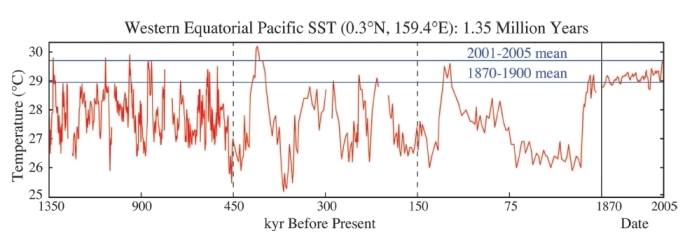
I prefer mine with some context. Like this one.
That's pretty poor context. That graph is pure distortion. It's has the time from 1870 to now at one scale and the rest in thousands of years. Moreover, it clearly shows that temperatures have been rising for years before civilization was around and is now at the high point.
Since we are all pretty well aware that we are between ice ages it doesn't say much at all and it gives absolutely no indication if the current warming trend is usual or not.
-
Really that short on page space for the graph?
I prefer mine with some context. Like this one.
-
Re:I don't get it
I think the point of OP is different: the light from this galaxy took 13.3 bln years to reach us; so this implies the light has been travelling for that distance (13.3 bln light-years) before it reached us. Otherwise it should have reached us earlier. (...)
Or are OP and me missing something? If so, what?
I suspect you're misunderstanding space inflation. The big bang wasn't so much an explosion in space than it was an explosion of space. Picture a balloon with dots on it. Roughly speaking, our 3d space would correspond to the balloon's surface. (The balloon's volume corresponds to nothing physical.) There isn't such a thing as a center of the balloon's surface any more than there is a center of the universe, and the big bang corresponds to a huge initial blowing into the balloon. Crunchy details if needed.
-
Re:...Why?
Maxwell's equations force E=0 inside perfect conductors, which means that vacuum fluctuations with a half-wavelength longer than the separation between the plates can't exist between the plates.
By the way: If you are going to refer to Maxwell's equations, you should use caution. Because often what are referred to as "Maxwell's Equations" are actually just Maxwell's simplifications of Heaviside's and Hamilton's quaternion equations, with introductions of arbitrary "constants" to cancel out inconveniences, much like Einstein's "cosmological constant". There is a good deal of modern evidence that Maxwell's attempt to simplify things may have been wishful thinking, and that Heaviside and Hamilton had it right all along. We rely much on Maxwell, but his conclusions are assumptions. Not only are they not proven, there is significant counter-evidence. [Jane Q. Public]
Good grief. Electric fields are zero in perfect conductors. I explain this fact to freshman physics students by asking: what would happen if we tried to place an electric field across a conductor? Electrons would move opposite the field, and positive electron holes would move with the electric field, exactly enough to cancel out the original field inside the conductor. Better conductors cancel out faster, so electric fields are zero in perfect conductors.
Mentioning that this fact can be derived from Maxwell's equations is meant to be helpful, because all physics students should be familiar with the first theory that emerged in a Lorentz-invariant form. In other words, Maxwell's equations were consistent with special relativity before relativity even existed. They're the basis of all radio equipment, and the correspondence principle checks that quantum electrodynamics (one of the most accurate theories in history) is identical to Maxwell's equations for large systems. If your reaction to hearing "Maxwell's equations" is to spray chaff about quaternions, you'll be disappointed to find that core classes based on junior-level Griffiths and graduate-level Jackson are almost exclusively about Maxwell's equations.
Quaternion notation is useful when desribing 3D rotations, but it's not used in electrodynamics because vector notation is more intuitive. That doesn't stop crackpots from insisting that Maxwell's equations are wishful thinking.
Physicists use Maxwell's vector equations despite the fact that we're well aware of quaternion notation. John Baez even wrote a paper on octonians. As Baez quips, if the noncommutative quaternions are like a shunned eccentric cousin, then the nonassociative octonians are like the crazy old uncle nobody lets out of the attic.
In fact, look at p542 of Griffiths 3rd edition: "Equation 12.136 combines our previous results into a single 4-vector equation-- it represents the most elegant (and the simplest) formulation of Maxwell's equations."
Page 555 of
-
Re:...Why?
... "zero point" energy is NOT in fact zero (it is actually pretty huge)... [Jane Q. Public]
While talking with my first research advisor around 2003, I mused that it's unfortunate how the Casimir effect only supresses vacuum fluctuations with wavelengths larger than twice the spacing between the plates. Since fluctuations with shorter wavelengths have more energy, the Casimir effect only depletes a vanishingly small fraction of the vacuum energy between the plates. So I agree that a naive quantum calculation leads to a huge vacuum energy. But as I've just explained, the same theory of general relativity [1] that implies stable wormholes and the Alcubierre drive also seems to renormalize the vacuum energy to zero. So this just means that depleting vacuum energy could potentially lead to very negative energy densities.
In fact I thought it was pretty obvious to most people that the fact that "zero point" energy is NOT in fact zero (it is actually pretty huge), has been the motivation for finding ways to "Maxwell's Demon" the quantum vacuum fluctuations. There is nothing theoretically preventing it; one team this year found a possible means of exploiting it. We shall see. [Jane Q. Public]
I asked which team and you replied:
I looked again, and didn't find anything from this year. So my memory could be incorrect. [Jane Q. Public]
Agreed:
What I am curious about is: assume you get the virtual particles which then tunnel: what is the probability that they will tunnel with the same probability, then recombine properly? It seems to me (without having done the math), that there is some possibility here of ending up with a quantum Goretex, or, in other words, a Maxwell's Demon of sorts, no matter how small its effect might be. [Jane Q. Public, 2009-04-21]
Not having done the math often does lead to quantum Goretex and ironic references to Maxwell's (broken) Demon.
But there's Maclay and Forward, from 2004. There are more recent examples but I will not have time to hunt them up today. [Jane Q. Public]
Maclay and Forward 2004 [2] imagined accelerating a mirror fast enough that the dynamic Casimir effect creates real photons. A more recent example was in 2009, which imagined spinning magneto-electric nanoparticles fast enough that the centripetal acceleration created real photons. At the time, I called this device a photon drive. On page 2 of their 2004 paper, Maclay and Forward point out that more conventional photon drives would arguably be better than their propulsion system.
Granted, it's only a thought experiment,
-
Re:...Why?
I will add a tidbit that I picked up last night shortly after I wrote the above. You mentioned that since the ground state (not your exact words) of the vacuum is "defined" to be 0, then the energy must be negative. I understand that logic. The problem is that the premise is incorrect. Planck's equations, as refined by Einstein et al. in 1913, show that in fact the vacuum energy of a quantum system must always be above its "potential well", or the theoretical zero state. Thus, "zero-point" energy is NOT "defined" to be zero, but in fact is always positive, and the Casimir effect then, even using your own framework, is not "negative energy". [Jane Q. Public]
If you really did "understand that logic" then you wouldn't have written all that nonsense about vectors. Instead, you'd have skipped immediately to this point, which now implicitly acknowledges that the Casimir vacuum has lower energy than the standard vacuum.
Remember that spacetime is curved near large masses, but ~flat far away from masses where only vacuum energy is present. This implies that vacuum energy exerts ~zero gravitational force, so its stress-energy tensor must be ~zero, so the standard vacuum has ~zero energy.
If you're interested in the details, John Baez summarizes several vacuum energy density calculations. A naive quantum field theory calculation yields a vacuum energy with a mass density of +10^96 kg/m^3, which would've ripped the universe apart [1] before galaxies could form. On the other hand, general relativity and observations of our nearly-flat universe place a more rigorous upper bound at +10^(-26) kg/m^3. It seems like [2] gravity renormalizes vacuum energy to zero, within about one part in 10^122. Even though renormalization was harshly criticized at first, it's necessary to explain why galaxies (and thus humans!) exist.
Here's another, purely quantum-based, argument [3] for renormalization:
"As there is no lower energy state than the ground state, there is no energy level transition available to release the ZPE. Therefore, it can be argued that hf/2 should be dropped before integration of the quantum expression. This procedure is an example of renormalization, which basically redefines the zero of energy." [Abbott et al. 1996]
Footnotes
[1] One might assume that a large positive vacuum energy would collapse the universe just like a large amount of positive mass-energy would. This doesn't happen because in general relativity gravity depends on energy and pressure. In natural units, vacuum energy has pressure equal and opposite to its energy density. Because the stress-energy tensor has three pressure terms (for x,y,z) and only one energy density term, the negative pressure of positive vacuum energy dominates, causing the expansion of the universe to accelerate. back
[2] It's also vaguely possible that zero point energy doesn't gravitate at all
-
Re:There is only one speed: c
Actually, photos do have an effective mass (=relativistic mass). You could say that they have no rest-mass, though.
Photos are affected by gravity - light bends around heavy stars, for example: the gravity lens effect.http://math.ucr.edu/home/baez/physics/ParticleAndNuclear/photon_mass.html
-
Re:What about the speed of information?
> Yes they have. It's the speed of light.
> But if the sun vanished right now, it would take 8 minutes for the earth to stop orbiting and shoot off into space.
http://math.ucr.edu/home/baez/physics/Relativity/GR/grav_radiation.html
There's a number of competing models which fit existing data.
http://scienceblogs.com/startswithabang/2010/08/25/what-is-the-speed-of-gravity/
See the closing paragraph referencing LISA ~ 2030 A.D.
The real way to measure the speed of gravity is to detect and study gravitational waves. By comparing the arrival of a gravitational-wave signal with that of an electromagnetic signal from an astrophysical source, one could compare the speed of gravity to that of light to parts in 10^(17).
As I understand it, we're still waiting to find out if gravitational waves/radiation propagates at the speed of light.
-
Re:WolframAlpha results
The correct equation is 1.94 arccosh (n/1.94 + 1) apparent years : where n = number of light years to travel. This takes into account 1g acceleration and deceleration. The andromeda galaxy can be reached in 28 years, not 3,115.
Here's a link for the derivations.
-
Re:Methinks people don't appreciate the scales her
I agree that they're putting the cart before the horse. We shouldn't worry much about interstellar travel until we've colonized the solar system. Besides, our own solar system is pretty interesting and surprisingly unknown.
That said, relativity isn't a concept that comes readily to most people. Interstellar distances are quite vast, but not insurmountable. If we had the technology, one could travel to the Andromeda Galaxy in a mere 28 years. There's no reason to return either, unless you want to be a Cro-Magnon and live in a zoo, so it's a one-way trip to start a colony. -
Nothing new....
Cliodynamics seems to be the new, trending name for... Cliology [see the afterward of the hard cover edition of "In the Country of the Blind" by Michael Flynn which originally appeared as a two part article 'Introduction to Psychohistory' in Analog magazine in 1988] and "Cycles Research" founded by economist Edward R. Dewey http://www.cyclesresearchinstitute.org/ Also a book by Dewey "Cycles, The Mysterious Forces that Trigger Events..." and some of the papers presented in the Journal of World Systems Research archives such as this one from 1995: "The Next World War: World-System Cycles and Trends" http://jwsr.ucr.edu/archive/vol1/v1_n6.php
Dewey was of the belief that the cycles he uncovered had a 'rational cause'...
-
Epistemology debate
There is a debate in Epistemology that relates to that subject.
Put simply, Popper and his followers claim that a scientific theory remains accepted until a falsifying evidence is found. Others (e.g. Feyerabend) disagree, calling this a rationalistic utopia. For them falsifying evidences are simply ignored, until a new theory emerges and makes its path through acceptation. As example they mention the Perihelion of Mercury, which was know a long time before the relativity theory appeared, but in no way was seen as a falsification of the Newtonian mechanics.
-
Re:G-force
As long as you don't accelerate too fast, the human body doesn't care about the relative speed that it's traveling. You have Sir Isaac Newton to thank for that.
Sounds more like Galilei's relativity than anything by Newton to me.
-
Re:We are a "snowball Earth", but life changed tha
I found this from http://faculty.ucr.edu/~martink/pdfs/Kennedy_2008_Nature.pdf
"The start of the Ediacaran period is defined by one of the most
severe climate change events recorded in Earth history—the recovery
from the Marinoan ‘snowball’ ice age,The distinctive features of Marinoan deglaciation that define the
base of the Ediacaran period can be attributed to the effects of
permafrost methane clathrate destabilization. In contrast to the
balanced feedbacks and progressive glacial–interglacial cycles of
Cenozoic deglaciation, the violent opening of the highly volatile
shelf-permafrost methane clathrate pool could act as a trigger to
catastrophic climate and biogeochemical reorganization of the
Earth system, abruptly bringing the long-lived and icy Cryogenian
period to a close and setting the stage for the appearance of metazoans
and dominance of a new Earth system. This event both identifies
the range of function of the climate system, and demonstrates a
mechanism activated by strong climate forcing not unlike projected
future effects of atmospheric CO2." -
Re:Accepted norms
...but I can illustrate the power of politics (i.e. university politics, scientific community politics, etc.) in science by noting that because my father was able to obtain more grant money than his superiors at UC Riverside, the university decided to close down the department that he headed: the air pollution research department. Of course, this meant a prolonged job hunt and a big move for my dad and his family (including me).
I bet there's more to this story than what you are letting on because there are a few things about it that don't make sense.
1. Air Pollution is not typically thought of as a field that would merit a department specifically dedicated to its study. If you mean the Air Pollution Research Center at the UC Riverside, well it still exists.
2. Departments and Centers are typically headed by tenured faculty. Tenured faculty can't be fired.
3. Individuals that can bring in grant money are treated like royalty and catered to at universities. Roughly 50% of that grant money goes to the university. They love people that can generate more money for them. It's possible that they would get rid of someone that that was bringing in lots of funding, but as you would imagine such an individual would have to be behaving pretty egregiously.
-
Re:Obligatory xkcdyou think it's misdirected because you think it's directed at you. i may have been using a sarcastic tone, but i was on your side here. i understood your point about 1000-2000 words being low. i was agreeing with you.
the glass is liquid statement was extremely general, and i find it hard to take the semantics of this seriously when water itself can be a liquid, crystalline solid and amorphous solid. have you ever seen molten glass? it's like a syrup. it's really about picking and choosing which phases of temperature and pressure you prefer to use for nitpicking. i'm on the sidelines of this academic deathmatch, ready to tell the winner it didn't really matter in the end.In terms of molecular dynamics and thermodynamics it is possible to justify various different views that it is a highly viscous liquid, an amorphous solid, or simply that glass is another state of matter that is neither liquid nor solid. The difference is semantic.
http://math.ucr.edu/home/baez/physics/General/Glass/glass.html
-
Re:Funding
"When particles are moving, relativistic mass provides a very economical description that absorbs the particles' motion naturally." -- Baez.
Okay, so after googling John Baer, it turns out that there's different views on the subject. And the last physicist to 'correct' me for using the term was a jerk for only pointing to resources that said relativistic mass shouldn't be used any more.
Personally whether physicists want to use it or not (and I liked Baer's explanation for why they should), at the very least it's highly useful for relating to newbies since relativistic mass is the value that relates most closely to classical mass in that it is what affects inertia and gravity.
-
Re:So wrong it's offensive
First
No, actually it was PAULI that said it. Dijkstra may have also said it later, but honestly, telling me unequivocally that I'm wrong without even spending the literal few seconds to check your facts just demonstrates your arrogance once again.
Second, the variant of the two-slit experiment, where the path of the photon is only observed after it has passed through the slit changes whether it generates an interference pattern or not, has two interpretations - the classical one, and the one that involves time actually working just fine in both directions at a small enough scale.
It's only the insistence of people that they must continue to build more and more convoluted "'splanations" (sort of like the pre-Copernian gang with their epicycles and cycles within cycles and all that crap) who deny the clear evidence of their eyes, that time does, at the most basic scales, go in either direction as required.
It's akin to Einstein's biggest mistake - saying that there's no such thing as "spooky action at a distance" - which also can be explained by either the Copenhagen gang OR by time working in both directions. Of the two, Occam's Razor makes it clear that time should be treated no differently than space (after all, we even call it space-time), as it provides the simplest explanation for everything from particle decay half-lives to particle entanglement (it just becomes another aspect of the laws of conservation of matter and energy).
But keep on rejecting the simpler, more obvious explanation, and build up those epicycles.
God-fucken-damn you're ignorant of the issues here. It's well known that time must be treated differently than space in non-relativistic quantum mechanics because it is impossible to construct an observable time operator. Now, it is true that space and time must be placed on even footing in special relativity, and special relativity forces us to consider quantum field theory, from which quantum mechanics is regained in the non-relativistic limit. However, the contortions required to fit quantum mechanics and special relativity together -- including the treatment of time on the same footing as space -- do not resolve the issue. If they did, you would have heard about it some decades ago, I assure you.
Now maybe we are all just stupid, and you can show us how all experimental results, that agree with standard quantum mechanics, are also predicted by a theory based on your "obvious" physical axiom regarding time, which at the same time resolves the mysteries of quantum entanglement, etc, and draws a neat little line under them. Because unless you can compose a theory which fits with what is empirically known, then you're just armchair quarterbacking, and you almost certainly don't appreciate the nuance of the problem.
But hey, I might be wrong -- if you can exhibit how your brilliant insight leads to such a revolution in physical understanding then you should write it up and get it published; or at least put it on the arXiv -- you'll no doubt find someone to endorse the submission. If you're right the there will be significant fame and fortune to be had, I'm sure.
And by the way, Occam's Razor is not a scientific authority. Experiment is. Comparing quantum mechanics to epicycles is completely disingenuous; a particularly obvious difference being that quantum mechanics makes new predictions that are borne out by experiment, in contrast to the epicycle models which only predict that which they were explicitly constructed to explain. That's what makes it science: an apparently subtle concept that seems to be completely over your head.
-
Re:22 light years
I read somewhere (I wish I could find it now) That if you were to accelerate at a constant 1G - The time dilation would allow you to visit the known visible universe within a human lifespan.(Well for the traveler anyway) - I really wish I could remember where this came from, I would really like to know if it was true or just something out of someone's ass.
Accelerating at 1g allows you to get just about anywhere in about 10-25 years (in your time frame).
100,000 LY (diameter of Milky Way) 11.8 years
2.6 million LY (nearest galaxy) 15.0 years
46.6 billion LY (radius of observable universe) 24.5 years.
Some important notes: First this would get you to these places travelling at near the speed of light. If you'd like to arrive stopped you'll have to roughly double the travel time, as half would be spent decelerating. Second, you could accelerate as long as you had a source of energy (and a functioning ship).
As for the claim you could visit the observable universe in a human lifespan, you couldn't reach all the points of it. But you certainly could reach the edge.
http://math.ucr.edu/home/baez/physics/Relativity/SR/rocket.html -
Re:I am not worried about it
To look it up yourself, here's a nice good old hypertext page on global temperatures.
And some excellent graphs. -
Re:I've always wondered about this
All of it makes me wonder what the mechanism is that determines c or the gravitational constant, the electro weak force and a myriad of other variables that determine the way the universe exists
All of the quantities you've listed have units, and therefore what determines them is our choice of a system of units. What makes sense is to ask what determines unitless constants such as the fine structure constant. Here is a nice discussion of this kind of thing: http://math.ucr.edu/home/baez/constants.html
-
Re:Can't say which one [Re:Okay]
The AC is basically right. Here are a couple of careful discussions of this topic: http://arxiv.org/abs/hep-th/0208093 , http://math.ucr.edu/home/baez/constants.html
-
not new; not really controversial, just wrong
First off, the slashdot summary is somewhat misleading, because the result is not new. Their result was announced in August 2010: http://arxiv.org/abs/1008.3907 . What is new is that they finally managed to get it published in a peer-reviewed journal. You can't judge whether it's right or wrong simply based on whether it's been published in a peer-reviewed journal. Peer review doesn't judge whether a result is right, or whether it can be reproduced. Peer review just tries to judge whether there are obvious mistakes, and things like whether it properly cites the previous literature. The fact that the journal is a prestigious one also doesn't mean it's right; it just means that *if* it were right, it would be of a high level of scientific importance.
Second, it's not really correct to say that the result is controversial. It's not controversial. It's wrong, and the fact that it's wrong is uncontroversial. Just because there's an overwhelming consensus that a result is wrong, that doesn't mean it can't be published in a peer-reviewed journal. Below is a FAQ entry I wrote about this stuff.
Has the fine structure constant changed over cosmological timescales?
It has been claimed based on astronomical observations that the unitless fine-structure constant alpha=e^2/hbar*c actually varies over time, rather than being fixed.[Webb 2001] This claim is probably wrong, since later attempts to reproduce the observations failed.[Chand 2004] Rosenband et al.[Rosenband 2008] have done laboratory measurements that rule out a linear decrease of alpha with time large enough to be consistent with Webb's results.
Webb et al. have recently made even more extraordinary claims that the fine structure constant varies over the celestial sphere.[Webb 2010] Extraordinary claims require extraordinary proof, and Webb et al. have not supplied that; their results are at the margins of statistical significance compared to their random and systematic errors.
Even if their claims are correct, this is not evidence that c is changing, as is sometimes stated in the popular press. If an experiment is to test whether a fundamental constant is really constant, the constant must be unitless.[Duff 2002] If the fine-structure constant does vary, there is no empirical way to assign blame to c as opposed to hbar or e. John Baez has a nice web page discussing the unitless constants of nature.
J.K. Webb et al., 2000, "Further Evidence for Cosmological Evolution of the Fine Structure Constant," http://arxiv.org/abs/astro-ph/0012539v3
J.K. Webb et al., 2010, "Evidence for spatial variation of the fine structure constant," http://arxiv.org/abs/1008.3907
H. Chand et al., 2004, Astron. Astrophys. 417: 853, http://arxiv.org/abs/astro-ph/0401094
Srianand et al., 2004, Phys.Rev.Lett.92:121302, http://arxiv.org/abs/astro-ph/0402177
Duff, 2002, "Comment on time-variation of fundamental constants," http://arxiv.org/abs/hep-th/0208093
Baez, http://math.ucr.edu/home/baez/constants.html
Rosenband et al., 2008, 319 (5871): 1808-1812, http://www.sciencemag.org/content/319/5871/1808.abstract
-
Re:"Just" 27 light years away
Well, constant acceleration means that you're nearing light speed fairly quickly, and relativistic effects (time dilation and length contraction) kick in. It's been four years since I studied physics, and haven't used it since, so I'll defer to a better explanation than I could give at the moment.
As for why to travel to stars, it's more a matter of what we might find in the future. Right now, if we were on Alpha Centauri, we would probably know about Jupiter or Saturn, but we'd have no idea the Earth existed, it's too small to wobble the star significantly. There could be tons of Earth-like planets orbiting the hundreds of "nearby" stars. With the human species' instinct to explore and multiply, I have little doubt that we'll reach out to the solar system, and eventually other stars before we meet some Malthusian prediction. -
Re:A lot of work
Five years ago Kip Thorne recommended Hartle's book "Gravity: An Introduction to Einstein's General Relativity", and it is a wonderful introduction to General Relativity. (I took calculus, linear algebra, advanced linear algebra, differential equations, real analysis, complex analysis, differential geometry, and Fourier analysis before taking the graduate course on General Relativity at UC Davis)
We used Carroll's book on General Relativity, which is more or less his lecture notes which are freely available online at http://preposterousuniverse.com/grnotes/
As far as understanding Einstein's field equations, a wonderful reference by John C. Baez and Emory F. Bunn: The Meaning of Einstein's Equation on Baez's webpage.
Dr Carlip recommended R. A. D'Inverno's Introducing Einstein's Relativity (Oxford University Press, Oxford, 1992) to the graduate physics class.
Dr. Joseph Biello recommended B. F. Schutz's A First Course in General Relativity (Cambridge University Press, Cambridge, 1985) as an introductory text, then follow it up with Robert Wald's General Relativity (University Of Chicago Press, First Edition edition, 1984). I don't know about this, because Wald himself admitted that he didn't give justice to the Lagrangian or Hamiltonian formalism for General Relativity.
When thinking about black holes, or any singularity, the standard reference on this subject is Hawking and Ellis' The Large Scale Structure of Space-Time (Cambridge University Press, 1975).
Everyone says "Misner, Thorne, and Wheeler" and I am inclined to agree. If you are serious about studying General Relativity, you have to read through this at least once. It is the Bible of General Relativity, although there are two opinions people have about it: they love it, or hate it. Those that hate it would object to my opinions...
When you want to start getting into quantum gravity or numerical relativity (i.e., using the computer to solve Einstein's field equations), you need to learn the ADM formalism. There are a few books on this.
Peter Peldan wrote a review article, "Actions for Gravity, with Generalizations" arXiv:gr-qc/9305011v1 which is a great review of all the many different types of variational ways to obtain General Relativity.
Bojowald just wrote a great book, Canonical Gravity and Applications, which is a fabulous introduction.
Poisson wrote a book on a lot of folklore topics in general relativity, which is based on his lecture notes (freely available online at http://www.physics.uoguelph.ca/poisson/research/agr.pdf). In fact, the only difference I can find is that the pdf doesn't have the index or table of contents, but everything else seems identical.
For numerical relativity, Baumgarte and Shapiro's Numerical Relativity: Solving Einstein Equations on the Computer is another fantastic reference. The only disadvantage is their index system is confusing.
As far as the mathematics, there are many books out there on differential geometry. The graduate course sequence on differential geometry at UC Davis used Manfredo P. do Carmo's Riemannian Geometry
However, many of them kind of ignore the intricacies of Lorentzian manifolds. Arthur L Besse's Einstein Manifolds (Springer, 2007) is a wonderful reference for this subject. (Arthur L Besse is a pseudonym for a group of mathematicians inspired by the Bourbaki group, and works primarily on differential geometry.)
-
John Baez
I love the mathematical physicist John Baez's stuff. (He's the singer Joan Baez's cousin.) He has a blog and a bunch of stuff on his web page including several hundred issues of This Week's Finds in Mathematical Physics (be warned: it's incredibly mathy, and high-level). There's tons more on his web page that's just plain interesting. I love that you can tell from his horrible site design that it was made by someone who's interested in content rather than fluff.
-
John Baez
I love the mathematical physicist John Baez's stuff. (He's the singer Joan Baez's cousin.) He has a blog and a bunch of stuff on his web page including several hundred issues of This Week's Finds in Mathematical Physics (be warned: it's incredibly mathy, and high-level). There's tons more on his web page that's just plain interesting. I love that you can tell from his horrible site design that it was made by someone who's interested in content rather than fluff.
-
Re:Newton's
Photons have mass, because they have energy. Furthermore, that photons have zero rest mass is still only an assumption in most models (ref)
-
Topical subject: Earthquakes
Computers can be used to detect earthquakes:
http://www.wired.com/science/planetearth/news/2008/03/quake_networkYou can get a free sensor from the Quake Catcher network (or use a laptop).
http://qcn.ucr.edu/Another subject that might be interesting: Fossils.
http://www.enchantedlearning.com/subjects/dinosaurs/dinofossils/Fossilhow.htmlBert
-
Time to fire-up your laptop, then
Your laptop can be used to detect earthquakes:
http://www.wired.com/science/planetearth/news/2008/03/quake_networkJoin the Quake Catcher network
http://qcn.ucr.edu/Bert
-
Re:Genetics Proves Evolution
To be honest, this doesn't prove Evolution, any more than changing program code and subsequently altering the result of the program - proves that code is self-changing [...]
We don't need it to prove that "the code is self-changing", as we've proven that enough times already. Also, take a look at flu virus mutation.
[...] or that the language's author doesn't exist either for that matter.
The status of this postulate doesn't even qualify as hypothesis (lacks falsifiability).
I don't suggest that DNA doesn't mutate - but i disagree with the basis of your 'proof'
True, it's not a proof by itself. Just another fact supporting other scientific results.
It seems to me that DNA is like any other programming language, really. You've got a set of instructions - that run through some process - to generate some output. Alter the instructions - alter the output.
Except that every programming language has a (usually because of it well known) author
You're completely right that this doesn't prove evolution, the headline is just typical modern journalism. Not too scientific, sadly.
-
Still not sure about the rate of credibility?
There's tried and true scientific measure for this stuff, Crackpot Index. Count score for yourself:
http://math.ucr.edu/home/baez/crackpot.html
Of course, measure is a little outdated, e.g. the founding of a scientific magazine for the publishing of your work is not rated, which is really a shame, hopefully the author will work it into some future version. -
Re:NASA Gets Busted All The Time
... the paradox that I mention is this: even if we have no global warming, the +0C result is within the band of error bars, so this counts as verification of the prediction. But a +5C change counts as invalidating the prediction.
If for some reason you decide to smooth the GCM output and sensor data at only 10 years, the error bars will be large. That's why professional climatologists usually smooth data and model output using ~20 year averages. [Dumb Scientist]
If you'd like to engage in a gedankenexperiment, consider if predictions after 20 years had error bars from +0C to +10C. (Error bars themselves are fuzzy things, but I digress.) The same paradox applies to the notions of falsification and verification. No change verifies AGW, but a massive +20C change falsifies AGW (technically, the current-best-guess-AGW theory). [ShakaUVM]
Huh? You quoted me and repeated "20 years" as though your statement was a response to mine. But you're talking about waiting "after 20 years" and implying that we need to perform gedankenexperiments rather than just reading the peer-reviewed literature? I haven't ever been talking about waiting 20 years. This whole time I've been talking about the applied smoothing. There's no waiting, no "after 20 years". So there's no need to make up numbers. In fact, I've already shown you the actual dependence of the error bars on the applied smoothing (or trend length- same idea.) Sadly, this isn't the first time you've ignored this point:
So multiple scientists have already tried to tell you that longer temperature trends have smaller error bars than shorter trends, but you're still blissfully fantasizing that the opposite is true. According to #6, you get another 5 points for using a thought experiment that contradicts the results of a widely accepted real experiment.
Clearly, we need to review the difference between an empirical climate model and a dynamical climate model.
An empirical climate model:
- Incorporates past temperature data into its sample data set, and predicts temperatures without requiring one to specify radiative forcings as the IPCC emission scenarios do.
- Is guaranteed to perform well over the sample data set; the real test would come with new data. Thus anyone claiming accuracy over the sample data would be laughed out of any scientific conference.
A dynamical climate model:
- Doesn't incorporate past temperature data into its sample data set, instead the model describes the laws of physics.
- As a result, the model requires input in the form of estimated and projected radiative forcing histories which are specified in the IPCC emission scenarios.
- Thus, a dynamical model predicts the climate's response to changes in forcings like the sun's brightness, CO2 levels, etc. One example prediction of modern GCM's is the value of the equilibrium climate sensitivity, which has units of (degrees C) / (doubling CO2 concentration).
-
Re:Lies, damned lies and statistics
Here's something I dug up after 5 minutes worth of googling and clicking: http://math.ucr.edu/home/baez/temperature/ (search for "Note this timeline is not to scale" to get to a representative figure, out of one of James Hansen's papers, no less
-
Re:Dead Fish always float only downstreamThis post made me think of the Crackpot Index, i.e.:
40 points for claiming that the "scientific establishment" is engaged in a "conspiracy" to prevent your work from gaining its well-deserved fame, or suchlike.
-
Re:Frame of Reference Problem
feeding the troll: http://math.ucr.edu/home/baez/physics/Relativity/GR/grav_speed.html
-
That is nothing comparing with 1+2+3+4...=-1/12
and 12+34...=1/4 Which, buy the way Euler proved by similar method http://math.ucr.edu/home/baez/qg-winter2004/zeta.pdf http://en.wikipedia.org/wiki/1_%E2%88%92_2_%2B_3_%E2%88%92_4_%2B_%C2%B7_%C2%B7_%C2%B7
-
Re:Nuclear pulse propulsion
Calculations here: http://math.ucr.edu/home/baez/physics/Relativity/SR/rocket.html
Basically, to just send a probe that flies by without stopping, it is remotely plausible (you would need 60 kg of antimatter for every kg of payload).
-
Re:Time dilation woes.
That depends what you mean by "significantly close to the speed of light." With constant acceleration at 1g for a year, you'd be traveling at 0.77c. You can't simply add the velocities like you'd expect when relativistic effects come into play. For a good explanation on this see here.
Apologies in advance if you already took that into consideration. -
Re:Glory hound
Wait! There's a checklist for this!
He seems to score fairly low on the Crackpot index based on the review, but if anyone has the book I wonder how high the actual text will score?