Slashdot Mirror
Domain: ucsc.edu
Stories and comments across the archive that link to ucsc.edu.
Comments · 594
-
Re:Headline Is So Very Wrong
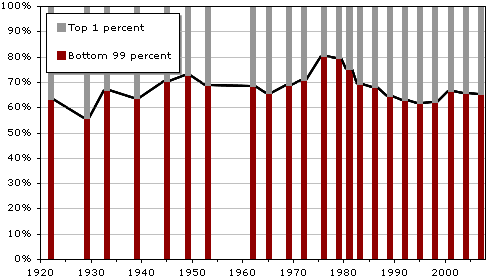
It's already been pointed out that the percentage the US' tax revenue paid by the rich can increase while the percentage of individual income paid by the rich falls as long as the rich's percentage of total US income increases faster than everyone else. But, I'll provide you with a chart:
Figure 5: Share of capital income earned by top 1% and bottom 80%, 1979-2003
http://sociology.ucsc.edu/whorulesamerica/power/images/wealth/Figure_5.gif
(From here: http://sociology.ucsc.edu/whorulesamerica/power/wealth.html)
In 1979, the richest 1% of Americans were earning roughly 38% of the income paid to Americans. By 2003, they were earning around 57% of it. Meanwhile, the poorest 80% of Americans were earning about 23% of income paid to Americans, and by 2003, it slipped to around 13%. -
Re:Headline Is So Very Wrong
It's already been pointed out that the percentage the US' tax revenue paid by the rich can increase while the percentage of individual income paid by the rich falls as long as the rich's percentage of total US income increases faster than everyone else. But, I'll provide you with a chart:
Figure 5: Share of capital income earned by top 1% and bottom 80%, 1979-2003
http://sociology.ucsc.edu/whorulesamerica/power/images/wealth/Figure_5.gif
(From here: http://sociology.ucsc.edu/whorulesamerica/power/wealth.html)
In 1979, the richest 1% of Americans were earning roughly 38% of the income paid to Americans. By 2003, they were earning around 57% of it. Meanwhile, the poorest 80% of Americans were earning about 23% of income paid to Americans, and by 2003, it slipped to around 13%. -
Re:Headline Is So Very Wrong
http://www.taxfoundation.org/news/show/250.html
Federal taxes only.
It shows part of what you are saying-- the wealthy pay more than their share of the federal tax bill.In 2008, the top 1 percent of tax returns paid 38.0 percent of all federal individual income taxes and earned 20.0 percent of adjusted gross income, compared to 2007 when those figures were 40.4 percent and 22.8 percent, respectively.
The top 5 percent earned 34.7 percent of the nation's adjusted gross income, but paid approximately 58.7 percent of federal individual income taxes.
However, not so fast.
http://sociology.ucsc.edu/whorulesamerica/power/wealth.html
uses the same data to produce different results.
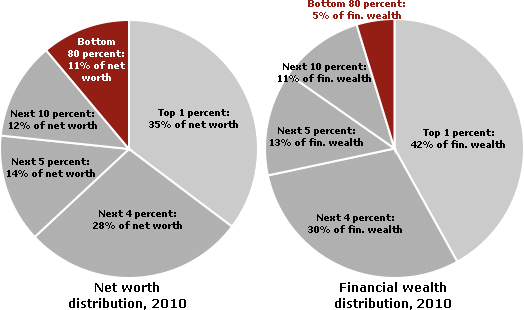
Reason- the wealthy successfully hide their income in capital appreciation, holding stocks which they do not realize profits on, equity in businesses which they are not taxed on and trusts.In the United States, wealth is highly concentrated in a relatively few hands. As of 2007, the top 1% of households (the upper class) owned 34.6% of all privately held wealth, and the next 19% (the managerial, professional, and small business stratum) had 50.5%,
Also...
in 2008, only 19% of the income reported by the 13,480 individuals or families making over $10 million came from wages and salaries. See Norris, 2010, for more details.)
---And none of the above addresses SStax. A 15% tax on most of us but not on the top 5%.
Doesn't address state tax. That's a separate PDF that I saved -- google it yourself- "tax rates by state". it breaks out all 50 states and the rates people pay. typically the wealthy pay
---
We are sliding into an oligarchy.
And on top of that, automation and robotics are going to destroy an enormous amount of jobs over the next two decades. We may reach a point where many can't find a job. What do we do? Let them starve? -
Re:Headline Is So Very Wrong
the top 10% of taxpayers paid 55% of total federal taxes in 2007. The lower 90% of taxpayers paid the other 45%.
In 2007, the top 10% of the population owned 73% of total assets and 83% of financial wealth in the US. If they're only paying 55% of the total taxes than the adage that "only the poor pay taxes" does in fact ring true.
-
Re:Headline Is So Very Wrong
These are the great weasel-words that appear in every tax debate. "10% of taxpayers". When it comes to wealth distribution, 80% of wealth in the US is held by only 10% of the population. http://sociology.ucsc.edu/whorulesamerica/power/wealth.html I don't have a whole lot of sympathy.
-
Re:That's the best strategy?
It's actually pretty interesting technique that they used. They don't just clump up the mutas. From the results page:
Contemporary StarCraft wisdom tells us that the best way to use mutalisks is to clump them. In human versus human battles, this makes it difficult to single out the weaker mutalisks, because the units are stacked on top of each other. However, UC Berkeley’s team identified a flaw in this tactic; it reduces the damage output of each individual mutalisk, because not all mutalisks will fire when using this tactic. Instead, they employed a model in which mutalisk are always moving, maximizing damage output while simultaneously maximizing movement.
Video can be found at the bottom of the page.
-
Re:First Union?
ok (and citations therein). If you can't be bothered to read the whole thing, search the page for "344:1" for the pay gap, and see the third-to-last paragraph for some discussion on unions and a reference.
-
Dr. Fuhrman Cures Diabetes; Drug Companies Object
See: http://www.youtube.com/watch?v=YzXBn5koFbY
http://www.alternativeratreatments.com/eat-to-live.html
http://www.drfuhrman.com/
http://www.diseaseproof.com/Check your vitamin D levels too:
http://www.vitamindcouncil.org/treatment.shtmlWhat you describe sound like a very respectable life.
"What Makes Mainstream Media Mainstream"
http://www.chomsky.info/articles/199710--.htmAnyway, I hope those first links might help with reversing Type-II diabetes.
BTW, two other boxes of democracy are moving box (to somewhere with better laws) and mail box (writing representatives).
Why the ammo box is problematical:
"Social Movements and Strategic Nonviolence"
http://sociology.ucsc.edu/whorulesamerica/change/science_nonviolence.htmlAnyway, the things they don't teach in school...
"Educating for a Peaceful World"
http://www.forums.alliance21.org/d_read/pax/articles/Deutsch.htmMaybe you were better off to get out sooner?
-
Re:Game Maker 8
If you want to go down that route, here's a syllabus from a course that's been taught a few times using Game Maker (also to mainly non-CS students), which might be useful to get ideas.
-
Social Movements and Strategic Nonviolence...
http://sociology.ucsc.edu/whorulesamerica/change/science_nonviolence.html
"Studies of social movements in the United States also show that the necessary social disruption has to be created through the principled use of strategic nonviolence. Any form of violence, whether property damage or physical battles with opponents and police, will turn off the great majority of Americans and bring down overwhelming police and military repression." -
On sensemaking tools to prevent such tragedies...
See: http://groups.google.com/group/openmanufacturing/msg/2846ca1b6bee64e1
on "The need for FOSS intelligence tools for sensemaking etc.".I wrote most of that weeks ago, but was getting it ready to post coincidentally on seeing this slashdot article.
From there
Summary: This note is essentially about how civilians could benefit by have access to the sorts of "sensemaking" tools the intelligence community (as well as corporations) aspire to have, in order to design more joyful, secure, and healthy civilian communities (including through creating a more sustainable and resilient open manufacturing infrastructure for such communities). It outlines why the intelligence community should consider funding the creation of such FOSS "dual use" intelligence applications as a way to reduce global tensions through increased local prosperity, health, and with intrinsic mutual security.
http://en.wikipedia.org/wiki/Sensemaking
http://en.wikipedia.org/wiki/Dual-use_technology
http://www.bluezones.com/makeover-about
http://en.wikipedia.org/wiki/Brittle_Power
http://www.beyondintractability.org/audio/morton_deutsch/?nid=2430How does one figure out what is right in such a manifesto and what may be
very wrong in a manifesto (or the actions that accompany it)?
"Social Movements and Strategic Nonviolence"
http://sociology.ucsc.edu/whorulesamerica/change/science_nonviolence....Again, better sensemaking tools could help with that.
sense and for educating people who use such tools.For example, if that despairing and angry guy had known, through a global
sensemaking process, that we could make self-replicating space habitats with
room for quadrillions of humans, maybe he would not have said so much about
"human overpopulation" in his Discovery manifesto? The Earth may have
limits, but space is limitless as far as we know (although we may reach
limits, but they are 1000s of years away). He might have learned that the
major problem in the industrialized world is actually lack of population
growth, not a high birth rate:
"[p2p-research] Peak Population crisis (was Re: Japan's Demographic Crisis)"
http://listcultures.org/pipermail/p2presearch_listcultures.org/2009-A...
Likewise, he might have seen that the problem is not lack of solutions
(because they were nicely cataloged in such a tool, including some with
their SKDB apt-get instructions), but the problem was more in lack of broad
understanding of the solutions we do know about, and lack of the will to put
them into action more quickly or think them through systematically, in part
from economic dogma? And then, rather than threaten the Discovery Channel
with a bomb, he perhaps could have seen a non-violent way forward to improve
his local community through contributing to the gift economy, democratic
resource-based planning, lobbying for a basic income, and helping improve
local subsistence production in a stronger community?Instead, lots of people went through a lot of stress and he is dead, and
some police officer has to live with having killed him, because of a failure
of effective sensemaking on his part, and, I might suggest, a lack of FOSS
public sensemaking tools that might have made the process easier for him.
And in the proc -
Re:US citizens pay more taxes than corporations
As more studies are published showing how the top 1% hoard wealth, the bottom percentages ask for more laws attempting to reclaim that wealth back to "the people". As you infer, the only effect is prices increase.
As a business owner [I'll assume small/med business] are you illustrating the poor lack of leadership these oligarchs are portraying? Or are you just standing in a corner pointing at the oligarchs and stating it is not your fault? Only the community of business owners can correct the faults of the business community. -
Re:Why Eben Moglen is misguided...
Good points, and I hope you are right.
"Ignorance, Apathy, and Greed"
http://www.progress.org/fold21.htm
"So, greed, apathy, and ignorance are all related. Greed depends on the absence of sympathy, and it benefits from ignorance about a social problem. Apathy can be reduced if there is less ignorance and less greed. Ignorance is reinforced by apathy, since apathetic folks don't care to obtain the knowledge which would reduce their apathy. Greed exploits the ignorance of the majority who do not have sufficient sympathy to counter the greedy faction. "And there are also larger "herd" social dynamics of systems, as social pendulums swing back and forth.
But even if you are right, the system still won't work given apathy, ignorance, and greed unless some committed people are out there doing good-for-most-everyone stuff. From:
"What Social Science Can Tell Us About Social Change"
http://sociology.ucsc.edu/whorulesamerica/change/science.html
"Third, the change agents have to understand a key difference between themselves and other people. Most people are focused on the joys, pleasures, and necessities of their everyday lives, and will not leave these routines unless those routines are disrupted, whereas change agents sacrifice their everyday lives -- family, schooling, career -- to work on social change every waking minute. This means that change agents must be patient for unexpected social circumstances to create disruption, or else find effective ways to disrupt everyday life without alienating those they wish to become supporters of their cause."Why bother? Well, historically lots of big systems collapse with suffering if just left entropically to meander on their own:
"Beyond Civilization" book review
http://www.swans.com/library/art9/mws042.html
http://en.wikipedia.org/wiki/Beyond_Civilization -
Ignorance, Apathy, and Greed
One other link:
"Social reformers must first eliminate their own ignorance to educate themselves to gain knowledge of the basic causes and remedies for social problems, including the economics, politics, and ethics of the problems and solutions. Then when they educate others, they must at the same time invoke their antipathy to the problem and arouse their sympathy with the remedy. When the masses are roused with sympathy and armed with knowledge of the remedy, the few greedy opponents will either be swayed themselves to join the righteous battle, or be overwhelmed by the greater force of the righteous revolution. To remedy social ills, replace ignorance, apathy and greed with knowledge, sympathy, and charity. "And another link, while I am at it, too:
"What Social Science Can Tell Us About Social Change"
http://sociology.ucsc.edu/whorulesamerica/change/science.html -
Re:yea you decide.it doesnt matter whether capital holders are good at something or not. if the result is domination of social life (economy is integral with it you know), it doesnt matter who is good at what. there occurs no choice, no freedom.
100 Years ago, most families couldn't afford shoes for eveyrone. Now they're dirt cheap at Walmart. If you want to pay $100 extra for a status symbol, that's your business (and none of mine), and not any sort of problem.
standards have skyrocketed since industrial revolution
http://sociology.ucsc.edu/whorulesamerica/power/wealth.html
80% of society has only 15% of income, whereas 7% has 72%. also, wealth. which means situation will worsen every day. currently it is FAR beyond, FAR worse than middle ages, the income disparage in between the noble and the serf. and people in usa are going bankrupt, dumpster diving.
technology is not linked with capitalism. technology was linked with age of ration, the freeing of mental faculty of society from the clutches of religion and conservatism, and common sharing. intellectual life was so vivid and fruitful because innumerable pioneers were freely sharing without any bonds or patents. as thomas jefferson himself said, there is NO difference in between innovation rates of countries which had patent systems, and which had not. ironically, the rate of inventions and innovations SLOWED DOWN towards the end of 19th century, and become less and less vivid and active by the early 20th century. which goes in parallel with patent systems' popularity and increasing enforcement.
no sir. you are living in an age long past. you should leave it behind, and come to 21st century. -
Re:Bioinformatics
I second that. Just in the past month or two, there has been:
- a Neanderthal genome sequenced
- a genome from two different types of human cancers
- genomes sequenced of a pair of identical twins, one twin has multiple sclerosis, the other doesn't
ALL of this data is in public databases. You can either access it through various web interfaces, or just download the sequences as text files, work with them offline. I am sure there is a lot of interesting information in it, just waiting to be discovered. If you are interested, check out http://www.genome.ucsc.edu/Neandertal/. Brush up on Perl, read up on BioPerl if you want, and dig away! -
that is old data
here, a recent one :
http://sociology.ucsc.edu/whorulesamerica/power/wealth.html -
Re:Not going to fix the problem
A) nothing I can address here.
B) This is really common knowledge. Yahoo had a big piece on 10 areas who are hit really hard by the double whammy. Large liabilities committed to on the assumption that the good times would not end, high unemployment, no demand for new housing (so no new housing jobs). Many houses under water, being foreclosed).
C) First-- are you really that out of the loop? This has been commonly known for over a decade. But okay.. I'll google it for you.
http://www.epi.org/economic_snapshots/entry/webfeatures_snapshots_20060621/
The wealthy pay a lower tax *rate* than everyone else at this point too. The secret is "fixed" state taxes like auto fees, property tax, etc. run 12% on poorest but only comprise
http://sociology.ucsc.edu/whorulesamerica/power/wealth.html"As of 2007, the top 1% of households (the upper class) owned 34.6% of all privately held wealth, and the next 19% (the managerial, professional, and small business stratum) had 50.5%, which means that just 20% of the people owned a remarkable 85%, leaving only 15% of the wealth for the bottom 80% (wage and salary workers)."
I can't find it now, but a later source (2008, 2009) said the top 1% now owned 42.7% (and the next had 42.3%) putting the top 20% at an incredble 95% of the wealth.
Our GINI index is close to most 3rd world countries now.
D) Again, this is fairly common knowledge. Surprised you are ignorant of it.
http://uchicagolaw.typepad.com/beckerposner/2010/04/american-wage-stagnationposner.html
"Between 1997 and 2008, median U.S. household income fell by 4 percent after adjustment for inflation. It presumably did not rise in 2009, and may not in 2010 either. A median is not an average; average income rose because the incomes of high earners rose, and so the effect was to increase the inequality of the income distribution..."E) If you can buy a device that can do any manual labor that a human can do for $100,000, then why hire a human. We are very close. You don't have to pay social security taxes for the work it does. It doesn't call in sick (it may break once in a while but will probably be modular and easy to fix). It's close. A decade. They can already pick random objects out of bins, toss things in the air and catch them, assemble things faster than humans.
We are running out of jobs to step up to. Most of the jobs we can step up to based on intellect or training. Many of those jobs have a couple billion new humans who are smart enough to do those jobs and happy to do them for under $30,000 a year. It could be a paradise-- no need for most to work, essentially free food and lodging- or it could be pretty hellish.
-
Re:so then ...
I'm not familiar with the case in Brazil, but if it's anything like what happened with black slaves in America after the abolition, then no, it wasn't slavery. I think the farmers who took advantage of the situation of their former-slaves were douchebags, but then again, if they hadn't been douchebags they wouldn't have had slaves in the first place.
you should be familiar with the post-slavery situation in brasil, and other countries who practiced slavery, in order to be able to this freely declare that something that is near slavery is ok, if there is a seeming 'choice'. seeming is the keyword here. i advise you to take up on some history research. you wont regret it.
The important thing is that while some (many?) farmers/plantation-owners decided to take advantage of the situation, that situation only persisted for the period which it took the freed slaves to create new options for themselves. And the difference between THAT and actual slavery is that slaves have ZERO chance of creating ANY new options for themselves. They have no rights. They can never leave. They can never chose to work for a better employer, or save enough money to buy a small piece of land. They have no right to refuse to be beaten or raped. All they can do is toil until they die.
there is the problem. if you move from ZERO chance to 1% chance of some opportunity, that doesnt make the new condition any different. back during slavery slaves also had the chance to run away and pretend as freemen, therefore passing as freemen in the north in united states, and maybe finding a job too. but, the chances were very slim to the point of nonexistent.
No matter what your opinion, though, you're making a false comparison. Microsoft never owned any slaves. These people voluntarily came to work at a business which offers them decent pay and relatively safe working conditions. No amount of blabbing about plantations and slaves is going to change that. Instead of going off on tangents, why not just admit you've lost the argument?
it is evident that you are no enthusiast of history. however i will humor you and establish what near slavery means, and how it is being perpetrated in current system, since you have established that you are not someone who is pro slavery. therefore i take it that your misconceptions and overly enthusiastic idealism about the current system we are living in, and its ramifications, are either due to you being rather young, or being too devoid of historical knowledge. so i will establish what modern slavery is and how it is perpetrated even in united states for you
first, very little chance of happening for something and that thing actually being forbidden are no different. if there is very slim chance of something happening, you dont need to forbid it or enforce it anyway. this is a logical axiom. ie, since there is no chance that someone can actually topple empire state building by leaning on one of its walls, we do not see the need to forbid leaning against its walls. i doubt you would find this objectionable.
therefore, all you need to perpetuate some situation that you desire, is to lower chances of anything other than that situation happening.
now lets take a look at the income and wealth distribution in united states, from recent stats
http://sociology.ucsc.edu/whorulesamerica/power/images/wealth/Figure_1.gif
in this picture you will see wealth distribution in united states. 80% of population can command only 7% of financial wealth. whereas, top 5% commands 73% of country's total financial wealth. top 5% has 62% of country's total worth, whereas bottom 80% has only 15% of its net worth. the disparage between incomes of top wage earners (ceos) and factory workers are even larger and getting larger with time.
original source :
-
Re:Mixed feelings
So then why doesn't that happen in other countries? Plenty of other places have universal health care, lower costs and longer life expectancy.
-
Re:So the government is forcing me to buy somethin
No way. You only have to look at a graph to see how absurd the difference is.
-
Cheap solutions for building a healthier world...
Human behavior is a product of many things, genetics, parenting, history, nutrition, community, environment, and others...
As I see it, you are asking, what do we do about psychopaths, and their lesser cousins, bullies?
"[p2p-research] The psychopath as peer?"
http://listcultures.org/pipermail/p2presearch_listcultures.org/2009-November/005499.htmlAs Jacque Fresco suggests in the following two videos, you can change the physical and social environment, and that will change a lot of human behavior in a healthier way, which is much better than passing laws:
http://www.youtube.com/user/jacquefresco#p/a/u/2/pbtbGcKiLiM
http://www.youtube.com/user/jacquefresco#p/a/u/1/PSbKfdOTRpYAnd as you suggest, today's prisons in the USA create criminals. The USA has many times more people in prison than other industrialized countries,
http://en.wikipedia.org/wiki/Incarceration_in_the_United_States
in large part because the sentences are way longer (part of that is that the prison industry is profitable to many who lobby for harsher laws or prevent removing harsh laws). For example, in New York State:
http://www.washingtonpost.com/wp-dyn/content/article/2009/03/27/AR2009032702834.html
"Then in November, Democrats captured the state Senate for the first time in years. The State Assembly in the past had proposed repealing the drug laws, but the effort was always blocked by Senate Republicans, many of whom represent largely rural, Upstate districts where most of the state's prisons are located."
And consider what was recently discovered in Pennsylvania:
"Pennsylvania rocked by 'jailing kids for cash' scandal"
http://www.cnn.com/2009/CRIME/02/23/pennsylvania.corrupt.judges/index.html
Where else in the USA does this happen?A basic income could remove much petty theft and physical crimes of mugging and armed robbery:
http://www.usbig.net/whatisbig.html
http://www.basicincome.org/bien/aboutbasicincome.htmlBeing non-violent does not mean being passive. We can actively work to create a better society that works for most everybody as an active process, especially in a democracy:
"Social Movements and Strategic Nonviolence"
http://sociology.ucsc.edu/whorulesamerica/change/science_nonviolence.htmlThe same as with terrorists, you may not be able to prevent individuals from planning to do harmful things, but what you can do is take away their social support network that enables them and provides cover for them to plan large scale harm. That goes for whether the terrorists are alienated fundamentalist extremists pursuing some radical cause, or ostensibly mainstream elected government officials invading other countries to remain in power and to create business opportunities for their friends.
Again, Voyage from Yesteryear is one picture of such an alternative society (even if it is not the only possible one).
http://www.jamesphogan.com/books/info.php?titleID=29&cmd=summaryBecause we live in such a schooled society, where most people have been broken and trained
-
Re:As long as you're even about it.
The upper 50% of the wage earners pay @97% of all tax collections, and the lower ones only @3%
Since that mirrors the distribution of wealth that would make sense. How about we ask the wealthy if they'd like to give up all of their assets in exchange for a lower effective federal tax rate? And instead of just sitting on their ass, investing in financial companies that exploit people and resources, they'd actually have to show up and do some real fucking work?
Oh, suddenly there's no problem? That's what I thought.
And by the way, go ahead an call me an anti-American commie. I'm in great company.
At the first session of our legislature after the Declaration of Independence, we passed a law abolishing entails. And this was followed by one abolishing the privilege of Primogeniture, and dividing the lands of intestates equally among all their children, or other representatives. These laws, drawn by myself, laid the axe to the root of Pseudo-aristocracy. And had another which I prepared been adopted by the legislature, our work would have been complete.
It was a Bill for the more general diffusion of learning. This proposed to divide every county into wards of 5 or 6 miles square, like your townships; to establish in each ward a free school for reading, writing and common arithmetic; to provide for the annual selection of the best subjects from these schools who might recieve at the public expence a higher degree of education at a district school; and from these district schools to select a certain number of the most promising subjects to be completed at an University, where all the useful sciences should be taught. Worth and genius would thus have been sought out from every condition of life, and completly prepared by education for defeating the competition of wealth and birth for public trusts.
I believe that banking institutions are more dangerous to our liberties than standing armies. Already they have raised up a monied aristocracy that has set the government at efiance. The issuing power should be taken from the banks and restored to the people to whom it properly belongs.
I hope that we shall crush in its birth the aristocracy of our monied corporations, which dare already to challenge our government to a trial of strength, and bid defiance to the laws of our country
-Thomas Jefferson
-
Re:Great, but don't go overboard
Gamesdon't have to use violence as a setting. Groups of people can cooperate to overcome natural disasters or other challenges. People building with Lego together does not have to be either violent or competitive to be fun. See Alfie Kohn's book:
http://www.amazon.com/No-Contest-Case-Against-Competition/dp/0395631254Non-violence even works better at the political level in a democracy:
http://sociology.ucsc.edu/whorulesamerica/change/science_nonviolence.html -
Re:A Novelty At Best
but I dare say the parameters are far too many and far too complicated.
Yeah, it sort of reminds me of the work in classical music by David Cope, who has been trying to use AI for decades to reproduce "new pieces" by Bach, Mozart, Chopin, Mahler, etc. While he makes grandiose claims and says that he has even fooled music faculty and graduate students at major universities (i.e., he plays them a piece by Chopin and a generated piece, and they supposedly can't tell the real one), I've always found such statements to be hard to believe. I've listened to the stuff, and his piano pieces "by Chopin" (for example) sound like a bunch of cliched chunks of Chopin-esque music chained together almost haphazardly. I can't imagine how such a piece would fool any professional classical musician, and indeed, when I've played this stuff for music professors and music graduate students, they can easily spot the "fake" one.
And I should also mention that the generated pieces that he shows off are always pre-selected by him. So, out of a dozen or more pieces generated by his AI algorithm, only one of them gets to be on the CD with his newest book -- and even those are pretty bad.
That's not to say that AI will never get there, and perhaps these guys have figured out something the Cope hasn't (as well as half a dozen other researchers) in decades of trying. But in the end, the biggest issue is that the output will succeed at modeling the parameters that the researcher understands, and from the view in the classical world, it's pretty clear that the standard music theoretical models don't do too well (as yet) at such tasks.
-
quite a bit of work on this
-
Re:Needle in a haystack?
On David Cope's pages, you can find a sample of random 5000 Bach-like chorales in MIDI format. So you can judge for yourself.
http://artsites.ucsc.edu/faculty/cope/5000.html -
Re:Haverford?
"the most beautiful campus in the US"? You haven't seen UC Santa Cruz, have you? Win.
-
He put 5000 pieces of Bach chorales by Emmy
online at his site. check the link :
http://artsites.ucsc.edu/faculty/cope/5000.html they are downloadable
and here you can check other emmy pieces http://artsites.ucsc.edu/faculty/cope/works2.htm
-
He put 5000 pieces of Bach chorales by Emmy
online at his site. check the link :
http://artsites.ucsc.edu/faculty/cope/5000.html they are downloadable
and here you can check other emmy pieces http://artsites.ucsc.edu/faculty/cope/works2.htm
-
Beethoven Example
I listened to his EMI program's sonata movement in the style of Beethoven and was not impressed. It sounds like it took the first movement of the Moonlight Sonata and just tweaked it a bit. You can find more samples here.
-
Beethoven Example
I listened to his EMI program's sonata movement in the style of Beethoven and was not impressed. It sounds like it took the first movement of the Moonlight Sonata and just tweaked it a bit. You can find more samples here.
-
Re:Bad examples
It's going very slowly, but here are a couple of examples
-
Re:Bad examples
You can find more examples on his site http://artsites.ucsc.edu/faculty/cope/mp3page.htm . These are the original, EMI.
Emily Howell seems to be the 'new' one, and you can find -
Re:Bad examples
You can find more examples on his site http://artsites.ucsc.edu/faculty/cope/mp3page.htm . These are the original, EMI.
Emily Howell seems to be the 'new' one, and you can find -
Noam Chomsky on defining terrorism
"International Terrorism: Image and Reality" by Noam Chomsky, notable linguist and self-declared Libertarian Socialist
http://www.chomsky.info/articles/199112--02.htm
"""
There are two ways to approach the study of terrorism. One may adopt a literal approach, taking the topic seriously, or a propagandistic approach, construing the concept of terrorism as a weapon to be exploited in the service of some system of power. In each case it is clear how to proceed. Pursuing the literal approach, we begin by determining what constitutes terrorism. We then seek instances of the phenomenon -- concentrating on the major examples, if we are serious -- and try to determine causes and remedies. The propagandistic approach dictates a different course. We begin with the thesis that terrorism is the responsibility of some officially designated enemy. We then designate terrorist acts as "terrorist" just in the cases where they can be attributed (whether plausibly or not) to the required source; otherwise they are to be ignored, suppressed, or termed "retaliation" or "self-defence."
"""There are many related comments by Chomsky on this:
http://www.google.com/search?hl=en&source=hp&q=chomsky+terrorismEven a book:
"excerpts from the book: The Culture of Terrorism by Noam Chomsky"
http://www.thirdworldtraveler.com/Chomsky/Culture%20of%20Terrorism.html
http://www.amazon.com/Culture-Terrorism-Noam-Chomsky/dp/0896083349More here:
http://en.wikipedia.org/wiki/Noam_Chomsky's_political_viewsAnd, not by him, but here is an essay by Prof. G. William Domhoff on why non-violence is the only moral and rational approach to social change in the USA:
http://sociology.ucsc.edu/whorulesamerica/change/science_nonviolence.html -
Re:A sad irony, and maybe from vitamin D deficienc
I decided to post the whole thing as a reply here since it is not easily accessible, even though there are a couple of replies there and additional comments by me.
Embedded software developer Joseph Stack allegedly intentionally flew a small plane into government offices in Austin, TX, in an act that has been labeled as domestic terrorism. He cited, among other things, IRS regulations about independent contractor status as well as other issues related to government corruption.
Could his behavior have been partially due to vitamin D deficiency syndrome from indoor work? Could vitamin D deficiency also have contributed to the violent behavior alleged of Hans Reiser or Amy Bishop? And is part of the problem also that Joe Stack was not talking to anyone about any of this to think through real solutions and find positive things to do that, as Mr. Rogers sang, would not hurt himself or anyone else?
Here are some useful resources for preventing more copycat violence to show how there are plenty of alternatives to violence despite Joe Stack's claim otherwise in his manifesto:
Treating Disease With Vitamin D
Dark Nights of the Soul: A Guide to Finding Your Way Through Life's Ordeals
Albert Einstein on: Religion and Science
A wombat talks about a global mindshift
TED | Peter Eigen on moving beyond corruption
Social Movements and Strategic Nonviolence
As another software developer who has done embedded work, here are some non-programming things I've worked on related to helping people see positive alternatives to violence:
Possible cures for a jobless recovery
Rebutting Communiqué from an Absent Future
The amazing thing to me is not that stuff like this happens. What is amazing is that it does not happen more often, which is a tribute to most of humanity's basic social nature. In a way, even Joe Stack chose a relatively limited approach; an embedded software developer such as he was could have done far more damage if trying to create general mayhem (he could have tampered with nuclear power plants or medical devices or airplane software). There is also irony here that a person took a very advanced piece of technology — a private airplane, and all that it represents as a technological marvel — and used it to destroy a past instead of to create a future.
What do people think and feel about all this?
-
also: UCSC Genome Browser, EBI's BioMart, Taverna
a few more favorite things: http://genome.ucsc.edu/ http://www.biomart.org/ http://www.taverna.org.uk/
-
Re:Gee, let's outsource governing to private firms
Governments do not 'reserve' anything. In a pure free market capitalist economy, if someone is unable to feed themselves (say because a powerful group has decreed 'no one give him any work if you want to do business with us.') then that person will starve to death. Destroyed, and not by a government. Corporations destroy people's lives all the time, and what do you think this financial mess was about? Corporations making money up out of thin air.
The bailouts: bad. The stimulus: meh, not done right. Health care? It's a moral issue. We're the only first world nation without socialized medicine. And we have the least effective yet most expensive system. Look at some figures:
http://en.wikipedia.org/wiki/File:International_Comparison_-_Healthcare_spending_as_%25_GDP.png
http://assets.opencrs.com/rpts/RL34175_20070917.pdf
http://dll.umaine.edu/ble/U.S.%20HCweb.pdf
http://ucatlas.ucsc.edu/spend.php
http://economix.blogs.nytimes.com/2008/11/14/why-does-us-health-care-cost-so-much-part-i/
Most recent polls show a supermajority of the population supports radical health care reform and socialized medicine. Despite big pharma spending billions to change public opinion.
-
Re:I am a med student, and I am horrified
Yet, this link seems to support my statement.
-
Re:Can't be true
http://ucatlas.ucsc.edu/spend.php
Switzerland is 2nd and WELL below the US in total cost. The Cuba point is also well illustrated on those charts. It performs well above the curve, the US well below. Canada btw is spending a bit over half what the US is. Honestly, follow ANY modern country other than the US and you will be doing well. -
Re:Is StarCraft the right game to use for this?
For logistical reasons there aren't a lot of options. Past competitions have used Wargus, since it's open source. Game-industry people tend to roll their eyes at it though, and would prefer a competition using a "real" RTS, i.e. a popular mainstream one. Starcraft is one of the only choices for that, because someone's made an API for it that allows you to write external AI to play the game. Most commercial RTSs don't have any way of doing that, unless you were to screen-scrape the display and then have to implement all sorts of computer vision to even figure out what's going on (in which case it'd be more of a vision than an AI-strategy competition).
-
Re:You're actually right
The problem, for admirers of this system such as yourself, anyway, is that America itself is starting to question such an arrangement. People are beginning to wonder why they can't have a good medical care system without expensive health insurance. They're starting to wonder just why it's necessary to be paying so much.(I have to cut about the bureaucratic nightmare to start a business because it's true...) And they're starting to vote appropriately. Compare health expenditures and life expectancies. You will wonder why american people pay so much for an average result...
-
Similar UCSC research commercially available 2009
"Second Sight expects the Argus II to be its first commercially available device, hitting the United States market in 2010. Mech said the company hasn't set a price, but suggested the Argus II would cost more than a cochlear implant. That could put the price between $60,000 and $100,000. Meanwhile, he hopes to start clinical trials in 2011 for a third generation of the device with more than 200 electrodes." [Science Notes 2009] http://scicom.ucsc.edu/SciNotes/0901/pages/vision/vision.html [Integrated Bioelectronics Research] http://ibr.soe.ucsc.edu/index.php?file=kop10.php
-
Similar UCSC research commercially available 2009
"Second Sight expects the Argus II to be its first commercially available device, hitting the United States market in 2010. Mech said the company hasn't set a price, but suggested the Argus II would cost more than a cochlear implant. That could put the price between $60,000 and $100,000. Meanwhile, he hopes to start clinical trials in 2011 for a third generation of the device with more than 200 electrodes." [Science Notes 2009] http://scicom.ucsc.edu/SciNotes/0901/pages/vision/vision.html [Integrated Bioelectronics Research] http://ibr.soe.ucsc.edu/index.php?file=kop10.php
-
Re:Global patent system?
Why do corporate incomes have to be double taxed? Tax the corporation, then tax the individual who actually takes home the income.
Extraordinarily rich people don't necessarily have extraordinarily high incomes. They just have extraordinarily wealth. Taxing companies allows the government to tax the increase in wealth of these individuals, even if that increase is in terms of assets rather than income. Let me give a brief example.
Someone has wealth of $1 billion, held in stock and bonds. (This is typical—the top 1% of households have 36.7% of all privately held stock, 63.8% of financial securities, and 61.9% of business equity.) If they don't sell any of their assets, they will have $0 income and will not be taxed, regardless of how much the value of the assets increases. To repeat my earlier point, taxing companies allows the government to tax the increase in wealth of these individuals. Also keep in mind that the current capital gains tax is 15%—this is far lower than the income tax rate.
There are any number of sources for the facts that I've cited. Here are a couple.
http://sociology.ucsc.edu/whorulesamerica/power/wealth.html
http://en.wikipedia.org/wiki/Distribution_of_wealth#In_the_United_States
http://en.wikipedia.org/wiki/Capital_gains_tax#United_States -
Re:Science is not open
That was an interesting insight, to question how open science really is in practice, based on the practical difficulty of accessing information, even now.
By the way, on the Bastille day part, just a reminder from:
"Social Movements and Strategic Nonviolence"
http://sociology.ucsc.edu/whorulesamerica/change/science_nonviolence.html
"Studies of social movements in the United States also show that the necessary social disruption has to be created through the principled use of strategic nonviolence. Any form of violence, whether property damage or physical battles with opponents and police, will turn off the great majority of Americans and bring down overwhelming police and military repression." -
What do you think people buy those shares with?1. Shares Cost Money (so it's about wealth distribution, not income distribution)
In the United States at the end of 2001, 10% of the population owned 71% of the wealth, and the top 1% controlled 38%. On the other hand, the bottom 40% owned less than 1% of the nation's wealth.
(diff article): Additionally, income does not capture the extent of wealth inequality. Wealth is derived over time from the collection of income earnings and growth of assets. The income of one year cannot encompass the accumulation over a lifetime. Income statistics view too narrow a time span for it to be an adequate indicator of financial inequality. For example, the Gini coefficient for wealth inequality increased from 0.80 in 1983 to 0.84 in 1989. In the same year, 1989, the Gini coefficient for income was only 0.52.[9] The Gini coefficient is an economic tool on a scale from 0 to 1 that measures the level of inequality. 0 signifies perfect equality and 1 represents perfect inequality. From this data, it is evident that in 1989 there was a discrepancy about the level of economic disparity with the extent of wealth inequality significantly higher than income inequality.(see wiki).
or see this So no, I don't care about the 40% of the population that might have 1 share in BP. -
Re:Do-over
Given that the top 1% own about 40% of the financial wealth in the country, having them pay 90% of the income tax bill seems pretty reasonable to me.
When they get down to maybe owning 20% of the country's financial wealth, then maybe it's time to back off a bit on the taxes. But it doesn't seem to be slowing them down much.
And as a member of the top 20% of income, (who own over half the country's financial wealth) I pay a noticably higher percentage of my income than someone who is poor. And I think that's fair too. I can afford it much better than they can. And the Gates and Forbes and other top 1% of the country can afford it even better than I can.
-
Re:Not Wall Street. Us.
Most people ARE Wall Street whether they know it or not. At least, anyone with a 401K, pension, or other retirement fund.
Far too many people are falling for this argument. The truth is, the top 1% alone owns over 30% of the wealth in America!. The bottom 80% of Americans, meanwhile, own only 16% of the wealth. So, sure, most Americans have a few stock holdings. But when people push for policies that rob workers to prop up speculators and sell it to the masses using this argument, it's a case of "100 for me, 1 for you."