Slashdot Mirror
Domain: universetoday.com
Stories and comments across the archive that link to universetoday.com.
Comments · 355
-
Re:Why return mission?
First, your points are pure conjecture. There is no information to point to for your analysis other than mere speculation based on scant information. The crafts were lost and there was no way to know for certain what the cause was. Stating as fact something that is pure conjecture is the height of ignorance and stupidity. You next statement made me laugh, "No one who actually works in the field of space travel is that concerned about micrometeorites. No one who reviews the spacecraft losses has concluded we've lost them to micrometeorites. And as far as I can tell, you don't even do basic research to check whether micrometeorites are an issue before talking about them." Actually, nothing could be further form the truth and is a very serious concern in point of fact. Tega Jessa just published an article on this very matter and http://www.universetoday.com/89804/micrometeorites/ just a few months ago. If you had taken more than a second to actually read up on this subject, you would realize it is a very serious concern.
> Well a very large hole would take a larger meteorite wouldn't it? And a larger meteorite we'd be able to track and see coming. The point of micrometeorites is that they're tiny and untrackable.
And your point is what? Maybe they could detect it coming, the likelihood they could avoid something moving that fast (even if it it is the size of a fist) is unlikely. Again, you dismiss something deadly as a non-threat because of your ignorance about the matter only. Being able to see something coming at you and being able to avoid it are two different things. Something large enough to cause a space craft to decompress is not that significant and detecting it in time to avoid it would be highly unlikely.
Also, thank you for the math lesson. However, it is just a simple a display of ignorance by employing averages. If you had any understanding of this field, you'd realize a few things: 1) the amount of material is NOT insignifcant (even though you try to pretend otherwise by employing averages which is silly because of point 2) fields of meteors (and micrometeorites) interact with the earth at varying densities. There are periods of time in which the earth has little meteor activity and periods of time in which the earth interact with dense fields of meteors. We call these meteor showers.
We simply do not know the density of the fields between Earth and Mars. Given the distance the craft has to travel and amount of time (over unknown space), it is highly likely the spacecraft will encounter fields of these particles of varying sizes. Given the speeds involved, the fact is that any craft going to Mars is highly likely to collide with micrometeorites. -
Re:Why return mission?
Its a no-brainer to anybody who's thought about it for more than 5 minutes.
http://www.universetoday.com/14544/one-way-mission-to-mars-us-soldiers-will-go/ -
Re:Why return mission?
Why would they be expecting rescue? Rescue from what? Theyre colonists.
Read about expeditions to the North and South poles. Read about guys who climb mount Everest. If human history was left to people like you we'd still be living in primordial swamps
"im not climbing out onto land! its just fine here with these gills i've got"
Maybe dont put your name forward then. They can send someone with balls:
http://www.universetoday.com/14544/one-way-mission-to-mars-us-soldiers-will-go/ -
Re:Seems like not that long...
The average star age is 1-10 billion years
Very massive stars don't last nearly as long.
From source http://www.universetoday.com/25160/how-long-do-stars-last/
"The mass of a star defines its lifespan. The least massive stars will live the longest, while the most massive stars in the Universe will use their fuel up in a few million years and end in a spectacular supernova explosion. So, how long do stars last?"
"How long do stars last? The biggest stars last only millions, the medium-sized stars last billions, and the smallest stars can last trillions of years." -
Re:And they plan to launch it with which...
And a few moments of Google-fu yields this article about man-rating the proposed LV for the X-37C platform.
-
Planetary Society
The Planetary Society should get kudos for getting the ball rolling early on this: http://www.universetoday.com/44551/planetary-society-to-launch-three-separate-solar-sails/
-
Re:Liquid Water
Sure, it seems reasonable
Essentially, we can only restrict ourselves to what we know. We can't rule out the possibility of some of this stuff, but we can't seriously consider it because it's basically science fiction since we have nothing to suggest it. So, from a science perspective, the answer is to ignore it.
If you can have a cloud of alcohol in space, and all of the other wacky stuff we see
For all we know, there's something living in a sea of liquid methanol right now
The point is, there is no way to search for alien life that is so alien as to be something we can't make any guesses about. I'll certainly defer to your chemistry knowledge
-
Re:Brute Force?
Yes. The number of atoms in the observable Universe is estimated to be between 10^78 and 10^82. Even if there are a few hundred orders of magnitude more atoms in the Universe, that figure he gave is still more than the number of atoms in the Universe. His counting is fine, how is yours?
-
Re:The big difference
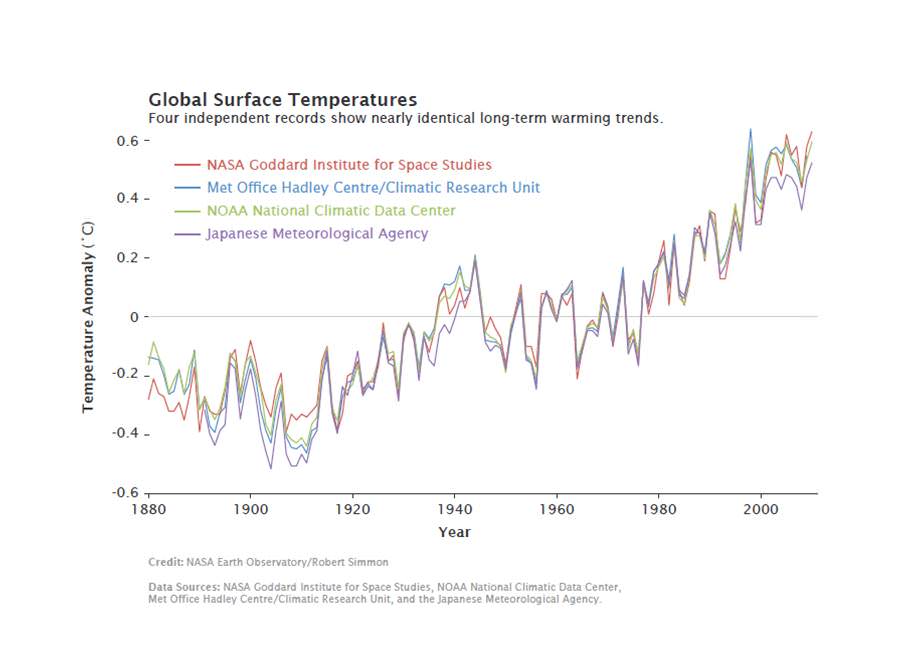
That's clever, but not convincing - the null hypothesis is that all observed climate changes are natural in origin.
So you can just hand wave natural causes without saying what they are? Guess what. Every conceivable natural cause has been evaluated many times. Some of the warming is natural. Most isn't. Want that Nobel prize? Find a new one that's causing it, but make sure you research before opening your mouth. I'm getting really tired of hearing how so-and-so isn't accounted for, when it has been.
Furthermore, isn't that confounded by the past 15 years of stalled temperatures but continually rising CO2? Oh wait, ad hoc special pleading to attribute the lack of warming to missing heat...or something, right?
No ad hoc special pleading. The trend is still clearly unchanged. One spike 15 years ago doesn't change that.
even the next 30 years
So we should wait 30 years before we do anything? I guess it's easier to die than admit you are wrong. There are many falsifiable hypothesis that make up global warming theory. Feel free to falsify one. I'd be thrilled, but smarter people that you have tried and failed.
-
Re:Read the writing on the wall
Add to that that no one has the balls to look at defense or education spending. Cutting NASA's funding ($17b*) will totally make more of an impact than looking at Defense ($613b*). More money has been spent on Air Conditioning in Iraq and Afghanistan than is being spent on NASA.
Americans spend more on pizza every year than they do NASA.
* - 2009 budget levels. -
Re:Chance
Yes, very close estimate, 1:3200
Guess they're trying to make it sound as innocuous as possible.
-
Yes, it is just a PR stunt
Since we're nowhere near having long-term colonization of the moon, and the summary actually acknowledges that this is a PR stunt why are getting this mentioned at all on Slashdot? This is ridiculous. There's no where near the tech level to easily put this sort of thing on the moon and there's no way the company will actually spend money to do this. Meanwhile all sorts of interesting science and technology developments are happening that aren't getting mentioned. For example, astronomers have discovered a star that doesn't fit with a lot of our theories of star formation http://www.sciencedaily.com/releases/2011/08/110831155340.htm. Or Slashdot could have given us another update on the ISS's current situation. Heck, if you need something with minimal actual scientific content you could have linked to this amusing video by the ISS crew about the matter http://www.universetoday.com/88559/iss-crew-provides-light-hearted-look-at-current-space-flight-plight/. Or you could talk about the new website devoted to the exploration of Mars by the Spirit and Opportunity http://www.universetoday.com/88562/driving-miss-spirit/. Stop wasting our time.
-
Yes, it is just a PR stunt
Since we're nowhere near having long-term colonization of the moon, and the summary actually acknowledges that this is a PR stunt why are getting this mentioned at all on Slashdot? This is ridiculous. There's no where near the tech level to easily put this sort of thing on the moon and there's no way the company will actually spend money to do this. Meanwhile all sorts of interesting science and technology developments are happening that aren't getting mentioned. For example, astronomers have discovered a star that doesn't fit with a lot of our theories of star formation http://www.sciencedaily.com/releases/2011/08/110831155340.htm. Or Slashdot could have given us another update on the ISS's current situation. Heck, if you need something with minimal actual scientific content you could have linked to this amusing video by the ISS crew about the matter http://www.universetoday.com/88559/iss-crew-provides-light-hearted-look-at-current-space-flight-plight/. Or you could talk about the new website devoted to the exploration of Mars by the Spirit and Opportunity http://www.universetoday.com/88562/driving-miss-spirit/. Stop wasting our time.
-
Re:Wrong idea
There's oil on Titan - more oil than Earth. There may even be a subterranean ocean of it.
-
Re:Better view from Mars Express
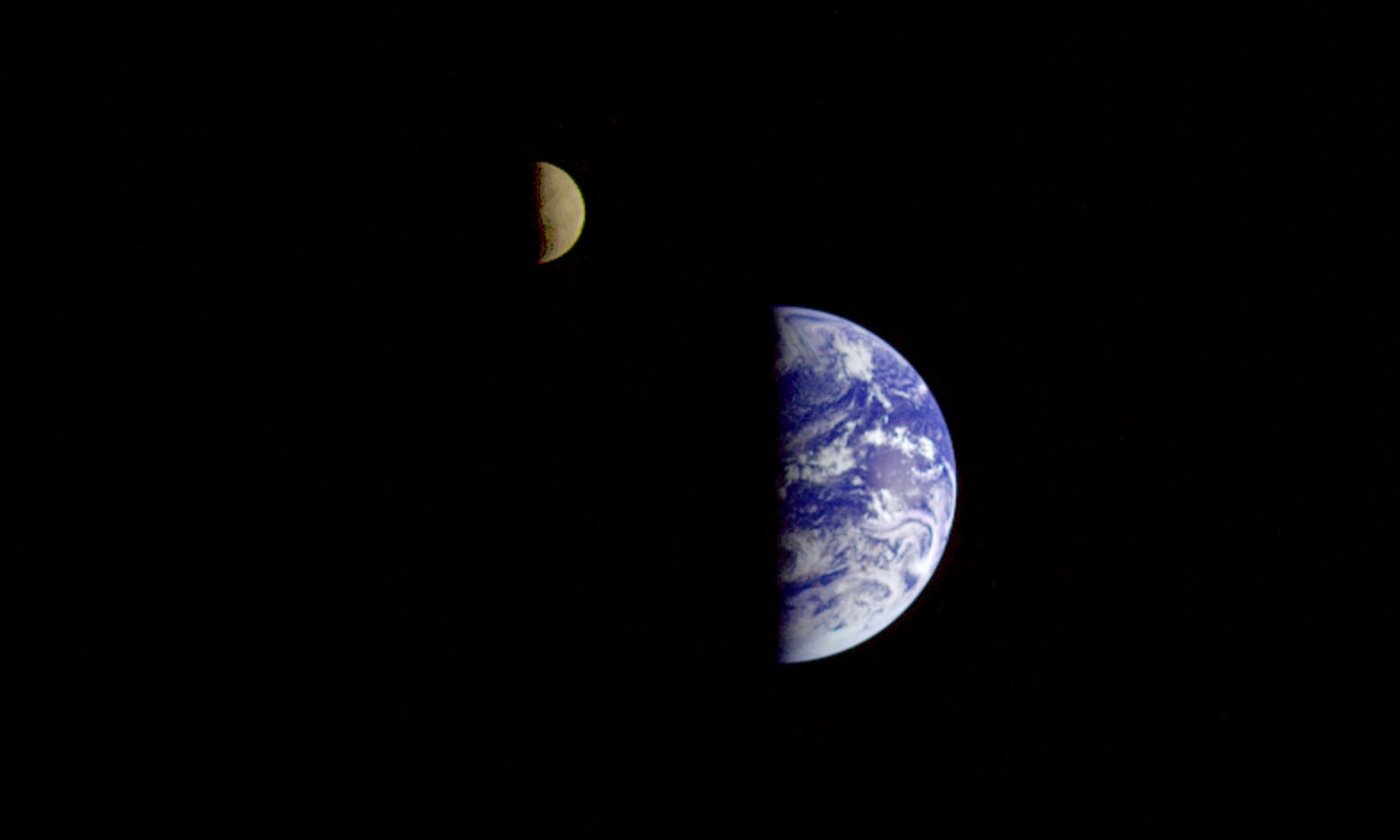
Back in 1977 when Voyager 1 began its' journey, it took this classic snapshot:
http://www.universetoday.com/wp-content/uploads/2010/07/The-Earth-Moon-System1.jpg -
Re:I'm afraid this means vodka rationing, boys
They already answered to the suborbital flights part. Regarding orbit, “If there were people sitting in the Dragon capsule today, they would have had a very nice ride,” http://www.nytimes.com/2010/12/09/science/space/09rocket.html The main reason they do not fly humans on Dragon (yet) is because it still lacks an escape system (that the Shuttle never had, and would have probably saved the Challenger crew). "Musk: Well actually if our safety threshold was equal to that of the Shuttle, then we could do that this year. In fact the Dragon spacecraft that we flew in December, if we had put someone in there with a seat, they would have had a fine journey. However we think that there needs to be an additional level of safety which is that there should be a launch escape system which the Shuttle does not have. And so that launch escape system will take us a few years to develop and verify all the functionality and so that's why we're expecting our first astronaut flight in about a few years." http://marketplace.publicradio.org/display/web/2011/07/08/pm-elon-musk-on-the-future-of-space-travel-and-exploration/ Apparently they are so ahead of schedule that they will be berthing the Dragon Capsule to the ISS this December instead of waiting for another year as originally planned. Of course the road is still long but I'll make sure to be near Vandemberg to witness the launch of Falcon Heavy, double the payload of the Shuttle and a tenth of the cost. As for the "third world countries" where you think they will be building their stuff: "[E. Musk] also outlines why he believes American innovation will trump countries like China in space –even though that country has the fastest growing economy in the world and lower labor rates than the US" http://www.universetoday.com/85409/elon-musk-why-the-us-can-beat-china/
-
Re:Can't see the quantum vacuum for the dark matte
Of course, that wouldn't have been possible without having some idea of what the ether should be.
What's your alternative then?
Just keep on staring out into space. Who knows how much more stuff we'll discover.
-
Re:no dark matter...In addition to Lord Kelvin, there were Hermann von Helmholtz and Simon Newcomb who believed the same theory and came up with similar values for the age of the Sun. Wikipedia.org
From Universe Today:
Darwin was fully aware of this problem. In a letter to a friend, he wrote that, “Thomson’s views of the recent age of the world have been for some time one of my sorest troubles”.
This doesn't sound like a reaction to one "opinionated and difficult to argue with" scientist.
The fact is that Kelvin and the others were wrong, but it was impossible to know that at the time.
Now, we have physicists insisting that their theory is correct, even though they have to keep adding "fudge factors" to it to make it fit the facts. Dark matter and dark energy may really exist, but they sure smell like the epicycles of Ptolemy.
-
Re:no dark matter...
I'm no cosmologist, but my understand is that there IS direct evidence of dark matter - in the way galaxies collide. Normal matter collides because it interacts through EM and hence slows down, while dark matter doesn't and doesn't. This can be seen by comparing X-ray imaging to map the normal matter and gravitational lensing to map the dark matter.
-
Re:In AD 2101, war was beginning...
Saturn's moon Titan has a thick atmosphere (acutal ground pic). It also has gravity low enough that if a person could strap on a pair of wings, they could fly and more oil than the entire planet.
-
Re:What climate model isn't flawed?
The moon is surrounded with vacuum, and ranges from -150C to 107C, much greater than the temperature fluctuations on earth. A vacuum only insulates against convection and conduction, not infrared/radiated heat. That is why vacuum mugs are often composed of a reflective material.
-
Re:Stop me if I'm wrong but...
When I saw the last stage I almost fell out of my chair!. What the hell happened to keeping it simple!
It's no worse than the various lunar landers.
The real question is whether they can get the budget to send that much mass to Mars.Landing anything big on Mars turns out to be quite hard. There's not enough atmosphere for a soft parachute landing. But there's enough atmosphere to require a heat shield while plowing through it. Then there's not enough atmosphere to brake from Mach 5 to Mach 1 before running out of altitude. There's too much gravity for a full rocket-powered descent. A rocket facing into the atmosphere won't work until the craft has slowed below supersonic speeds.
That's what leads to what looks like an overly complex system.
There's not too much gravity for a full rocket-powered descent; fully-propulsive Mars entry is a perfectly valid option, it just requires a lot more mass. Supersonic retropropulsion, even without much thought put into how you do it, is certainly no worse than retropropulsion in a full vacuum, it's just that it tend to decrease the drag... but it does still slow you down! "A rocket facing into the atmosphere" most certainly DOES work, just not as well as we would like (for the simplest case).
And besides, there are definitely ways of doing supersonic retropropulsion that work better than the naive method of just a single rocket engine firing straight down (multiple nozzles around the perimeter of a heatshield and pointing down work much better, allowing you to take advantage of most of the drag you otherwise would).
But yes, the skycrane method is the most efficient one yet for placing a rover on Mars... the biggest advantage is you don't need a platform; you can land the rover directly on its wheels, which saves a lot of weight.
There are ways of increasing the efficiency (say for a larger rover), like perhaps using a bipropellant rocket engine (the descent stage, sometimes semi-erroneously called the "skycrane", is monopropellant and has a relatively low Isp) or other propulsion system optimizations (the thrusters are small, so suffer from things like minimum gauge issues, etc, that might not be as big of an issue for larger systems).
Also, the skycrane method is also intended to allow landing at higher altitudes. If you picked a very low altitude, it should be possible to design a system which can land a much larger payload to the surface for the same Mars-insertion payload. Hellas Basin is my favorite place, with almost twice the average Martian surface atmospheric density.
But yes, landing large payloads on Mars is hard. Research into deployable heatshields (like ballutes) and parachutes able to deploy at higher supersonic speeds really would help any future, human missions.
-
Re:Stop me if I'm wrong but...
When I saw the last stage I almost fell out of my chair!. What the hell happened to keeping it simple!
It's no worse than the various lunar landers. The real question is whether they can get the budget to send that much mass to Mars.
Landing anything big on Mars turns out to be quite hard. There's not enough atmosphere for a soft parachute landing. But there's enough atmosphere to require a heat shield while plowing through it. Then there's not enough atmosphere to brake from Mach 5 to Mach 1 before running out of altitude. There's too much gravity for a full rocket-powered descent. A rocket facing into the atmosphere won't work until the craft has slowed below supersonic speeds.
That's what leads to what looks like an overly complex system.
-
Re:"Doomsday Asteroid?"
That would also be an opportunity to experiment with some way to steer its course. If it could be controlled precisely enough and reliably enough, it might be possible to eventually capture it in a useful orbit.
-
Re:Translation:
I can see from your sig that you're not easily swayed by pesky things like FACTS, but I'll try, anyways.
-
Just Google
-
Re:Current theory says the universe expands foreve
http://www.npl.washington.edu/AV/altvw94.html -- reference (not the one I was looking for, but it is mentioned)
Some other ideas about different boundary conditions at t=0 may be found at these pages:
http://www.npl.washington.edu/npl/int_rep/dtime/node4.html [conventional view]
http://www.space.com/4019-glimpse-time-big-bang.html
http://news.bbc.co.uk/2/hi/7440217.stm
http://www.universetoday.com/15051/thinking-about-time-before-the-big-bang/ -
H2O is fuel
Good one! The moon has water.
More over Mars has a CO2 atmosphere. Also on Mars is Magnesium that will burn in a CO2 atmosphere. You move CO2 and processed Metals that will burn in the presence of CO2 in to orbit. And you have a refueling station.
Given robots go first and make fuel lift it with to a space station for refueling. This way we get the fuel on sight, out of the gravity well. This fuel can be used for landing, blastoff and return. Getting the mass of the fuel, on site and all set up, before we commit people to the flight. This is simply good economy, and safety. -
Re:A better idea
Here you go:
http://www.universetoday.com/18431/the-suns-future/Now technically, we DON'T actually have to leave the planet to be safe
-
Re:Most boring planet?
Mercury has an extremely large iron core for its size, much larger by volume than Earth's. I'd say that's interesting.
-
Re:Anyone know the location of the moon landings?
All of the Moon landing sites have high res images from LRO.
Heck, they even found the long missing Lunakhod 1, enabling it to be recovered by LLR.
-
The link
-
Re:what, you don't have a firepit?
excellent tool for neutering storage. build up a roaring fire with about 6 inches of coals, and then toss the hard disk into it. retrieve in morning, dump in trash. done.
Don't be so sure of that.
And now, data recovery experts announced they were able to salvage scientific data from a charred hard drive.
Said hard drive deorbited on the Columbia.
What NASA sent to Kroll Ontrack was almost unrecognizable as a hard drive. Jon Edwards, a senior clean room engineer at the company said that the circuit board on the drive was burned beyond recognition and that all its components had fallen off. Every piece of plastic on the 400 MB Seagate hard drive had melted, and the chips were burned.
-
Re:Yeah let's do it!
What happens if you hit a magma vein in the Moon? Possibly something like Saturns moon Enceladus which spews out what appears to be something like water. But in the our Moons case your looking more at a volcano that could spew magma and that is unknown when it will stop since there is such low gravity.
The surface of the moon is cold. The liquid hot magma would cool quite rapidly, plugging up the hole. After all, that's where the lunar seas came from.
With enough pressure, it wouldn't. Remember, for a hole to plug up like that, it needs gravity. Thats why I mentioned Saturns moon Enceladus. Its even colder there then out Moon and they don't stop until they run out of pressure. Not because "It'll cool quite rapidly", the pressure will cause the cooling parts to keep flying outward.
This could cause things like ash to blow over the Earth
Ash from what? Volcanic ash on Earth is created by pulverized rock. The low gravity on the moon means the rock is launched upward instead of pulverized.
Liquid cord of the Moon means that is where the volcanic ash would come from. That why I mentioned what if they hit mamga. Magma is lava, it would burn and melt the sides of the whatever tunnel it is using to come out of, and would fly outward. Due to the Moons very low gravity, it wouldn't fall back down to the Moon but enter into the Earth's orbit. Similar to how Saturn's rings work.
possibly enter the atmosphere or other negative side effects (like lava rocks hitting satellites)
You have no real understanding of just how large space is, do you?
You have no real understanding of things in orbit work do you? Something like this happens, the cooling lava rocks won't go outward into space, Earth's gravity would be too strong. It would go inward, towards Earth. It's the reason satellites don't go flying out randomly into space. It's how any planet can keep a moon.
As well as the fact the a volcano on the Moon might cause it to shift orbit due to the gravity (like a jet engine, depending on the pressure and size of the volcano)
...and you have no real understanding of just how massive the moon is either.
Nor do we know just how much magma, sulpher and/or other materials are in the moon. Making an explosion large enough might cause enough of the Moon to tilt. Drain enough magma, ect, could cause the same effect. What would happen if you managed to cause enough rupturing to cause something like a new volcano the size of Olympus Mons, the largest volcano which happens to be on the smallest planet. Its possible without more information and since it's only just be figured out 2 weeks ago that the Moon most likely has a liquid core, it shows we know very little about the Moon. Also, we don't know how much pressure is built up within the Moons core, enough pressure and we make the only hole to the pressure and it could burst out, ripping a bigger hole. Maybe a volcanic eruption the size of the one that happened on Jupiters moon Io in 2002?
Another fact is that the Moon appears to possess light elements like sulphur and oxygen, which are both flammable
First, oxygen isn't flammable. Oxygen is an oxidizer that supports fire, but something else is burning. Second, how are you planning to sustain a sulfur fire without an atmosphere? Or are you asserting that the moon is covered with massive pockets of oxygen that are lined with sulfur? If that's your model the way you fight the fire is to vent the oxygen from the chamber. You're left with vacuum, and the sulfur fire goes out.
Again, we don't know enough a
-
Re:Join us tomorrow for part 2
Why not?
On one day, the Milky Way became 2x as thick as previously thought.
On another day, the estimated number of stars tripled.
And on a 3rd day, there's 30x as much entropy as previously thought.
So, why shouldn't astrophysicists come out next week and say that the Universe is actually younger (or older) than we once thought?
-
lottery
And the lucky lottery winner for 2011 is... ATK
OK, I know it's not a lottery -- it's on purpose (I'm sure someone intended this to happen). AND perhaps I shouldn't be picking on ATK since there's a lot of good people who work there -- I mean them no personal insult.
It looks like the bulk of the rest of the money goes to Lockheed for work on the Orion. That won't go to waste as it's likely Orion, or parts of it, will get used in some future system. It even appears Lockheed might try to put it to use on a commercial launcher:
Lockheed reserved Delta for 2013 test flight Lockheed Martin wants to Launch Orion on Delta IV Heavy
-
Re:Nice
Obama didn't cancel the shuttle, Bush did, and yes we do have a plan. It is the SLS.
http://www.universetoday.com/75522/president-signs-nasa-2010-authorization-act/
-
More pics here:
-
Mmmm... Secrets.
-
Re:Hindu Historians answered water-Planet Lucifer
200F surface temperature on Mars? Try 70F on a really hot day:
http://quest.nasa.gov/aero/planetary/mars.html
http://www.ehow.com/about_4610050_what-mars-highest-temperature.html
http://www.universetoday.com/35664/temperature-of-the-planets/This page claims 90F but that is speculation, and is still way shy of 200F:
http://www.astronomy.com/en/sitecore/content/Home/News-Observing/Astronomy%20Kids/2008/03/Mars.aspx
-
Re:Oops
Maybe the focusing problem was that the optical design was developed to focus on objects 35,000km below it instead of objects 13 million light years above it...?
-
Re:Four words why this is useless.
multiplied by millions or billions of chips. k.
Spread out over 149 million square kilometers. At a billion chips that comes out to be less than 7 chips per square kilometer. As someone else pointed out, it's about 3 micrograms of arsenic per chip for a total of about 20 micrograms per square kilometer.
Yes, there can be higher concentrations in places like trash dumps but it's still going to take a gigantic amount of these chips in one spot before anyone would have any reasonable concerns about the environmental impact due to the arsenic levels.
Somehow I think we'll be just fine...
-
Re:Did anyone else...
The Mars rovers were constantly negotiating new territory, while colonizing robots would be working very well known territory.
... for certain values of "new territory."
Those rovers only travelled (at a glacial pace) a handful of miles in total. The caterpillar trucks operating in the Alberta tarsands travel more distance over the course of a day than those rovers did over the course of a year.
-
Re:A baguette?
Wrong agency, we're talking about the folks that launched a bat into space this time. Personally, I think Brian's family is sabotaging the launch.
-
Re:Deniers...
6000 years? The Sun is only 20 years old
-
Re:Gold?
The word "gold" does not appear on that page. Nor did I see anything about accounting for the metals in the spacecraft in the general sense. So I'm still in the dark. Unless there's something indirect there you expected me to follow?
Jesus christ you're lazy!
I don't know, poke around. They even list a number to call to get a rebroadcast version of the press conference:
"Media Telecon: LCROSS and LRO Science Science Results of Lunar Impact10.21.10
Date: Thursday, Oct. 21, 2010
Time: 11 a.m. PDT / 2 p.m. EDT
A replay of the teleconference will be available until Nov. 4, 2010 by dialing 888-566-0674 from within the United States, or 203-369-3084 internationally. Passcode is 6267."You complained about not being able to access the information that we have a legal right to access freely (everything NASA does is public domain, or something like that).
I guess i figured my point went without saying, but i must have been wrong. My point was: If you look around, the information *is* available. It just might not be in the format you want. Some reporter for a newspaper sat around and listened to that press conference though, and made the data easier to get to. That paywall pays for that man's time. If you don't want to pay, NASA provides the number to call and listen yourself. Or, the other point I was trying to make, is that you could just google around. A quick search for "nasa lcross gold" brought up:
http://www.universetoday.com/76329/water-on-the-moon-and-much-much-more-latest-lcross-results/I'm sure NASA will put the data online at some point, but people have to write reports and all that. Until then, your options are pretty clear, and I don't see any cause to complain, except to be annoying.
-Taylor -
Re:nuclear accelerator
Ya mean an Ion thruster?
Of course NASA has pondered using Ion propulsion to get to Mars.
It seems how long it would take to get to Mars using ion propulsion depends on a number of considerations. But a figure bandied about last years was 39 days. -
Re:Dark Matter (Gravity); please explain
The dark matter halo around our galaxy is theorized roughly as a large sphere, not just extra mass along the flattened wheel of the spiral. Look at the graphic here: http://startswithabang.com/?p=656
That's a lot of extra room. So much so that even when those researchers calculated that our solar system should have 300 times the dark matter density compared to the galactic dark matter halo, this only ends up being a very tiny fraction of the earth's mass in dark matter bound to our solar system. See: http://www.universetoday.com/15266/dark-matter-is-denser-in-the-solar-system/
So basically, it's going to be rather difficult to detect dark matter nearby.
-
Re:Let's hope NASA is better at math than TFA
This is really just bad wording in his opening paragraph.
Really it's that:- 1) The railgun part needs to get things up to 600mph, 10x the rollercoaster speed.
- 2) Once launched at 600mph off the railgun the scramjet fires up and eventually gets the thing to 'Mach 10'
The Universe Today article is worded a little better: http://www.universetoday.com/73536/nasa-considering-rail-gun-launch-system-to-the-stars/
-
Wrong on many counts
First off the claim in an associated release was the "first astronomical object" discovered, not first scientific discovery.
Secondly, even that's not correct. It's the first by a distributed project with an "@" in the name. Just because a project doesn't have @home or @thegym doesn't mean it's not distributed.
For example the PSC (Pulsar Search Collaboratory), which probably ought to be called psc@home or some such had an earlier hit.
http://www.universetoday.com/41006/high-school-student-discovers-strange-pulsar-like-object/If they want to claim that this was the first pulsar found by a distributed project with @ in the name from Arecibo based data then they're probably correct.
It's a cool find and a great project, don't want to come of as *completely* jaded and glad Arecibo is getting good use.