Slashdot Mirror
Domain: unix.org
Stories and comments across the archive that link to unix.org.
Comments · 117
-
RIP Unix
UNIX: "The reports of my demise have been greatly exadurated"
Lets go on with a list of some the Unixes out there.
FreeBSD OpenBSD HP-UX Solaris AIX (HUGE user base)
Unix is hardly dead. The problem is most people don't know what UNIX acctually IS. GNU stands for GNU is NOT Unix. Unix is a standard that is owned by The Open Group http://www.unix.org/. If your OS meets the standards they set out, you can apply to call your product Unix. Linux, doesn't meet these standards and so can't be called Unix. The BSDs on the other hand DO, hense why we call them BSD Unix and not BSD Linux or some other moniker. To say "Unix is dead" is stupid. Large clustered servers using virtualization is a huge and growing compoent of IT infrastructure. So while you may think you are accessing a Windows NT server, that "Server" could very well being running as a virtualization in a large cluster that is running AIX.
People tend to only see what is in front of their eyes. Users think that Microsoft is the only way to go, or what their offices use exclusivly because that is what they see every day. Their entire backend could be Unix or Linux and they will still say they are a "Windows Shop". As for administrators, how many of THEM consider what OS their routers are running when asked "Do you run only Windows?"
Unix isn't going anywhere. The Open Group is doing just fine, and as Unix is a standard, not a company it means that ANYONE can make a new Unix. Stick that in your pipe and smoke it. Once MS is gone.. you will be able to say "Windows is Dead". Unix, like Rock and Roll, will never die, becuase someone will always insist on digging up the corpse.
Peace -
Re:Last time I checked, UNIX was a trademark
Trademark clarifications UNIX is a trademarked name that is owned by the Open Group. In order for a OS to call itself UNIX it must meet the Unix 03 standard (http://www.unix.org/unix03.html ). Linux does comply with the Unix 98 standard, but I am uncertain about the Unix 03 standard.
-
Last time I checked, UNIX was a trademark
Yup. UNIX isn't an OS. It's a trademark and a standard. And Linux is a kernel, not an OS.
http://www.unix.org/
http://www.kernel.org/
Also Windows aren't OS. It's an opening constructed in a wall or roof that functions to admit light or air.
Lastly Apple is not a company. It's a god damn fruit. Why is that ESPECIALLY MacOS users don't seem to get that Apple Computers are PC!?!? Try to ask a MacOS user this. "Do you have a PC?" I bet, 99% of them will say "No, I don't have PC, but I have a Mac." WTF?? -
Single Unix Standard, Version 3As a programmer, that's what I really consider as Unix - sus v3.
I code for this API and the sources end up being source compatible. But then there are library paths and stuff, which is why even something as homogenous as Linux is forced to create LSB standard. The API standard OTOH, is crystal clear - look at the API tables in terms of availability. And yeah, my project is called Portable.net, so I've put in my time writing portable code for various platforms (even BeOS and SkyOS). Wish the threading models worked the same, that's all
There is just *nix -
Single Unix Standard, Version 3As a programmer, that's what I really consider as Unix - sus v3.
I code for this API and the sources end up being source compatible. But then there are library paths and stuff, which is why even something as homogenous as Linux is forced to create LSB standard. The API standard OTOH, is crystal clear - look at the API tables in terms of availability. And yeah, my project is called Portable.net, so I've put in my time writing portable code for various platforms (even BeOS and SkyOS). Wish the threading models worked the same, that's all
There is just *nix -
Wrong, sorry...
It would be pretty stupid to lump UNIX and Linux sales together, given that Linux is not UNIX. As far as I can tell, not a single Linux distribution is certified against the Single UNIX Specification, which any Operating System must be in order to be UNIX.
They share similarities to be sure, but they are not the same and should not be lumped together any more than Windows and Linux should be lumped together. -
Re:Most irritating = YOU
Ok; sometimes things are just so bleedin' ignorant that I feel compelled to respond rather than crapflood.
Are you really saying that Unix has been around since 1946?!
Because it seems to me that if unix.org has anything to say about Unix, it's been around since the early seventies. Is that really twice as long as Apple's been in existence? What kind of math do you use where "early seventies" = 2 x 1976?
Damn. And they make MY POSTS negative one. -
Re:Apple should just buy out SCOThe UNIX trademark is owned by The Open Group, and they do a pretty good job of defending it - better than Linus has done with Linux, some might say.
What would really be good would be if the rest of the material relating to Unix, copyrights et al, were put into the public domain, once and for all. Then we could all read the Lyons book again!
-
Eunuchs
Why not just send a bunch of eunuchs? They can even bring along their own operating system.
-
Asking for legal trouble?The new FreeBSD site boldly states: "Based on BSD Unix (r)". To my knowledge, the AT&T vs. Berkeley case was settled with (among others) the regulation that BSD may not be called Unix. The official Unix trademark FAQ states that Unix "must not be used as a generic term. It must not be used in connection with products, unless the product is licensed to use the mark".
I am not sure whether the new headline on the homepage is a very wise and professional move of the FreeBSD project.
-
Re:helluva lot of code to rewrite
> Well, I was using it to remount Program Files in my
> besides the point. What happens when I want to use Japaniese, do I
> also have to segv because Japaniese isn't Unix?
Probably. There's a lot to hate about Unix. There are many things people would do differently if they were starting from scratch. But now, they're written in stone.
Why don't we revisit this conversation in a couple of years? The heavily entrenched Unix suckiness will still be there, and XML rcfiles will still be pie in the sky.
If you go way back to my original post, I linked a similar discussion in 2001. XML advocates were making your exact same points. Nothing has changed. XML rcfiles are not going to happen until someone stops preaching and starts coding. A lot of coding. A lot of thankless coding, redoing stuff that [mostly|sorta|almost] works, stuff that people already understand.
> If most existing configuration files are already in POSIX standard
> then I would expect that the POSIX standard is nothing more than,
> place your name at the top of the file, do what you like with the
> rest of it.
POSIX is the standard that defines Unix. (Freely readable, registration required) This standard including annoying stuff like the format of crontab, where fields are separated by spaces, TABs not allowed.
The crontab format is retarded and annoying, but at least it's "official Unix standard" retardation. I'm feeling better already.
I feel your pain, but I guess I've just learned to love the bomb. -
Re:Plenty of time to wait for 64 bit apps.
Errr... memory footprint doesn't double. Only the size of a pointer doubles in the currently accepted ABIs. So, your memory footprint increases a little but not dramatically. A byte's a byte. GIFs, JPEGs, MP3s, 3-D textures, Word documents... they all take up the same amount of space on a 64-bit machine as they do on a 32-bit machine.
The currently accepted x86-64 ABI is something called "LLP64," which means long long and pointers are 64 bit, whereas int and long are both 32 bit. Here's a handy page describing LLP64 and some alternatives.
The main advantage of 64 bits is large addressable space. If your working set is below 2GB, you won't benefit from that. The main advantage of x86-64 is the larger addressable register file, and that's completely separate of its 64-bit address space. -
We need a new license plate
Anybody remember the UNIX license plate?
-
Re:0wn3dLast I saw, the Open Group owns both the TradeMark and the POSIX API. According to the judge in SCO v. Novell, the copyrights were never transferred from Novel/USL to old SCO.
And now they wanna cry about the fact that they screwed themselves?
-
A rebuttal
"But since SCO owns the UNIX operating system...."
Quoth the wikipedia:
The present owner of the UNIX trademark is The Open Group, while the present claimants on the rights to the UNIX source code are The SCO Group and Novell. Only systems fully compliant with and certified to the Single UNIX Specification qualify as "UNIX" (others are called "UNIX system-like" or Unix-like).
Novell also has source code rights. Also, Darl, you should be careful to use the UNIX trademark so freely as it is clearly a registered trademark of the Open Group. From their website.
"Customers can identify UNIX certified products by the Open Brand logo and the mandatory attribution declaring to which version of the specification the product complies:"
So no Darl, you do not own UNIX. Get a clue.
"The competitive battle between Pepsi and Coke is legendary, as is the battle between GM and Ford, Boeing and Airbus, and the Red Sox and Yankees."
Your analogy between Pepsi and Coke (where did you learn to write anyways? 4th grade?) is so inherently flawed that the term "apples to oranges" doesn't even begin to describe how distorted this viewpoint is, as both are still fruit. My guess is that you were trying to provide some humour. I certainly got a good laugh.
" 1. OpenServer 6 Costs Less - OpenServer 6 offers very aggressive pricing.
The purchase price for SCO OpenServer 6 is priced from $599 to $1399
which includes the license to the product, software fixes, and access
to SCO's online knowledge base. Customers pay once for the product
and run it for as long as they like."
I don't really know what kind of math you are using Darl, because in my world, $599 is a whole lot more than $0. Also, I don't really see how asking for a support contract is a "bait and switch" tactic as you claim. If you don't need support, there are more than enough FREE, as in beer and speech, alternatives out there in the Linux universe.
" "Free" is one of the most searched words on the Web today. When you
type in "Free" in Yahoo search, it brings up more than 3 billion hits.
"Free" is a very powerful marketing concept. We all love free. Linux
lures you in with the promise of its being "free." But before you get
out of the "store," you are surprised to find out that it was anything
but free. Just remember the proverb, 'Free is the most expensive
price.'"
Darl. All I gotta ask is, can I have some of what you are smoking. It has GOTTA be good!
"OpenServer 6's features form a very powerful server."
Yeah. Especially now that you included a bunch of, get this, FREE software. How much did apache cost you? How much did you spend on developing the open source tools that you now use? Are we, as a collective, supposed to just swallow this pill, that you attack free, open source software, and then include it in your own operating system. If that is not sheer hypocricy that I have no idea what is. Go to hell Darl. We all know what UNIX is and was and it surely is not SCO anymore, or probably ever was for what it matters. Personally I hope your lawyers bleed what little liquidity you have left, if they are smart that is. You are a joke. Nobody respects your company anymore. I hope that you go to bed everynight worrying that your illegal insider trading activities may one day land you in court. Crooks like you, and the ones that fund your pitiful crusade, deserve to sit in a 4'x4' cell with your new wife, Bubba.
Have a wonderful day!
Sincerely,
Zos/Xavius.23 -
Re:"UNIX" title?
SCO does not currently own the UNIX trademark; UNIX a registered trademark of The Open Group. See Google's first hit for "Unix trademark". The Open Group is a "vendor- and technology-neutral consortium".
-
Re:"UNIX" title?
-
Re:"UNIX" title?
The UNIX trademark is owned by the Open Group, not SCO.
http://www.unix.org/trademark.html -
The reason behind sizeof(long) == 4 in LLP64
There are many ways to skin the cat.
The reason Microsoft chose LLP64 to ensure transparent portability between 32 and 64 bit compiles of Win32 apps. That was the most important consideration in their mind. I wouldn't call Microsoft's choice "stupid", but practical. There are very few applications for a 64 bit integer - it would just be wasted space most often, and it complicates portability between 32 and 64 bit compiles.
The reasons the Unix crowd went LP64 (sizeof(long) == 8) is they felt LLP64 requires extensive modifications to existing specifications to support those places which should naturally become 64-bit wide. In other words, they wanted APIs to natuarally grow to 64 bit.
All Microsoft APIs, and most third party APIs already use "Windows" types (BYTE, WORD, DWORD, QUADWORD, LPDWORD, etc) that are a fixed size. This is partly due to the fact that these DLLs are linked from many languages (VB, Pascal, C). They are not very C centric. Also, we are not used to recompiling everything to use a library: we likely don't have the source. We have to link carefully. Ints and longs won't do.
I do think Microsoft's choice (LLP64) fails to follow the spirit of Stroustrup's C++ standard that: "Plain ints have the natural size suggested by the architecture of the execution enviorment."
I personally have found myself avoid long in the last 5 years. After living through the 16 to 32 bit migration, I favor int32, int64, size_t, wchar_t, etc. You just can't count on the sizeof(long). I still use int, but just for counting and indexing within functions and methods, when I know my application won't come close to needing even 16 bits. If I need more than that, I use size_t.
-
Re:Linux needs a standard container
There is no such thing as "standard UNIX"
Damn, you really ought to tell these people. They seem to make their living selling something they call a "UNIX standard". I'm glad ThePurpleBuffalo is here to set them right! -
Re:ClonesIt was obvious that much of the design of QDOS was done by reading the documentation for CP/M. There's nothing illegal about that. Many people did the same thing to UNIX.
I might be wrong about this, but I think CP/M was a proprietary spec protected by copyrights while UNIX is an "open standard" spec currently defined by the Open Group.
In fact, DRI did consider legal action against Microsoft and IBM. Instead, DRI and IBM agreed to offer customers a choice of either DOS or CP/M when buying the original IBM PC (no OS was pre-installed). However, DRI was surprised when IBM charged $240 for CP/M and $40 for DOS. Guess which OS the customers chose.
From the BusinessWeek article "The Man Who Could Have Been Bill Gates":
But his problem was that software copyright had just become law three years earlier, and it wasn't clear what constituted infringement. Davis, the DRI lawyer, believes that based on the number of similarities DRI's forensic consultants found between the original DOS and CP/M, "in today's world, you could take it to court and get an infringement." But not in 1981. So rather than sue, Kildall agreed to license CP/M to Big Blue. He was floored when the PC was released and IBM charged $240 per copy for CP/M and just $40 for DOS. Kildall's conclusion, according to his memoir: "I believe the entire scenario was contrived by IBM to garner the existing standard at almost no cost."
-
From the horses mouth...
...The correct attribution is:
"UNIX is a registered trademark of The Open Group"
(http://www.unix.org/trademark.html) -
Defeats purpose
Wouldn't making only 3 possible Open Source licenses completely mostly defeat the purpose of having that organization.
Also I don't see what the real deal is. There have been a large number of licenses for quite a while, and only now do we hear about this, after Sun applies for one. Both articles mention the Sun license, there are 57 other open source license so why is this one getting so much guff. Especially since it's just a modified slightly modified version of a respected license.
I think cutting the number of license will just cause people to adopt open source, rather then Open Source. How many true Unix OS are there? -
Re:OT Unix - like OSI would say that it really depends on what happens when you open up a shell and type:
man man
But... that isn't really what "defines" the term.
I believe that in the end it is all about system calls.
In the end, it would be up to these guys to say that you are a Unix OS. The closer you get to meeting the spec... the more "Unix like" you are. -
Re:OSX
Sorry, just one more link! This one is the official history of UNIX, which includes a number of the BSD releases in the timeline. Same site as you mentioned, and they do mention major Linux kernel releases there. I still don't consider Linux a UN*X; I categorize it as UNIX-like.
-
Re:OSX
BSD is UNIX. Not only that, it's one of the first UNIX certified operating systems.
I don't see BSD mentioned anywhere on the list of certified products - do you have any information on some older version of the standard, e.g. UNIX 95, for which "BSD" is certified?
I can't tell you a great deal about the early days of UNIX, but University of California at Berkeley's computer science department did a lot of work with Bell Labs to create the original UNIX.
That's not exactly how "the early days of UNIX" went. The original UNIX came from Bell Labs; people at a number of universities, research institutions, etc. had their own sets of improvements to UNIX that they distributed to other licensees. The Berkeley Software Distribution was one of them; the Fourth Berkeley Software Distribution was arguably one of the most important, if not the most important, of those, and with 4.2BSD the Berkeley contribution was arguably as important as the contemporary AT&T contributions.
But the "original UNIX" wasn't a joint effort of AT&T and UCB, although just about any modern UNIX has a significant number of BSD contributions (sockets, symlinks, etc.), whether the code came from Berkeley or was a reimplementation of stuff from Berkeley.
UNIX is a certification and registered trademark, not a single operating system.
Yes, that's what it is now, at least at the legal level, as per The Open Group's What is UNIX ®. Sometimes "UN*X" is used to refer not only to those OSes certified as "UNIX®", but to those OSes that haven't gone through the registration procedure but that are generally thought of as enough like other OSes considered "UNIX" to be worthy of the name. (I'd definitely put the major Linux distribution into the "UN*X" category, along with {Free,Net,Open,Dragonfly}BSD and OS X.)
-
Re:OSX
CDE is only necessary for some UNIX specifications. The regular UNIX spec doesn't necessarily require any GUI stuff. Try to decipher what they have here. I can't.
-
Re:Open Group "UNIX(TM)" perverted by greedPerhaps you 'll find this interesing, perhaps you won't: http://www.opengroup.org/press/01jun04.htm/.
While coding in C, I mostly use http://www.opengroup.org/bookstore/catalog/t912.h
t m.I recommend browsing http://www.opengroup.org/ and http://www.unix.org/ because -- after registration -- documentation of incredibly high quality can be read online and legally downloaded for personal use. DO READ THE TERMS OF USAGE FIRST, as this is only my own personal interpretation of the conditions.
Following this link, in section "Technical Standards", you can find many documents of the Single Unix Specifications v1 (Unix95, issue 4 v2), v2 (Unix98, issue 5) and v3 (Unix03, issue 6): http://www.opengroup.org/bookstore/catalog/un.htm
Sorry for my weak English. I tried to avoid deep-linking into any of the mentioned sites.
I hope my wording and use of trademarks was compatible to what's written in http://www.opengroup.org/legal.htm, if not, my failure to do so happened against my intent.
-
Re:What is the point ?
UNIX® 03 is POSIX. It is a "common update to IEEE Std 1003.1,1996 Edition, IEEE Std 1003.2, 1992 Edition, their ISO/IEC counterparts and the previous version of the Single UNIX Specification".
In the case of uname, compare the UNIX and the IBM definitions. They look the same. In practise, the two ways it conforms to POSIX.1 yet differs from Solaris are the -m flag and the -r flag. With -m, AIX prints a hexadecimal number indicating the precise machine model rather than just the architecture (however this has become less useful on new IBM pSeries systems as "many new machines share a common machine ID of 4C"). This information can be augmented with the output of uname -M. With -r, I think only the major and minor version numbers are printed (it doesn't mention the point release since any point release should be compatible with other releases in that series). More precise information can be determined by running oslevel.
I agree it would be nicer if uname -m gave a human-readable architecture description as many other UNIX systems do, but POSIX doesn't require it be human readable or have a 1:1 mapping to CPU architecture.
-
Solaris is part BSD(writing this on a sunray, connected to a server running solaris 9)
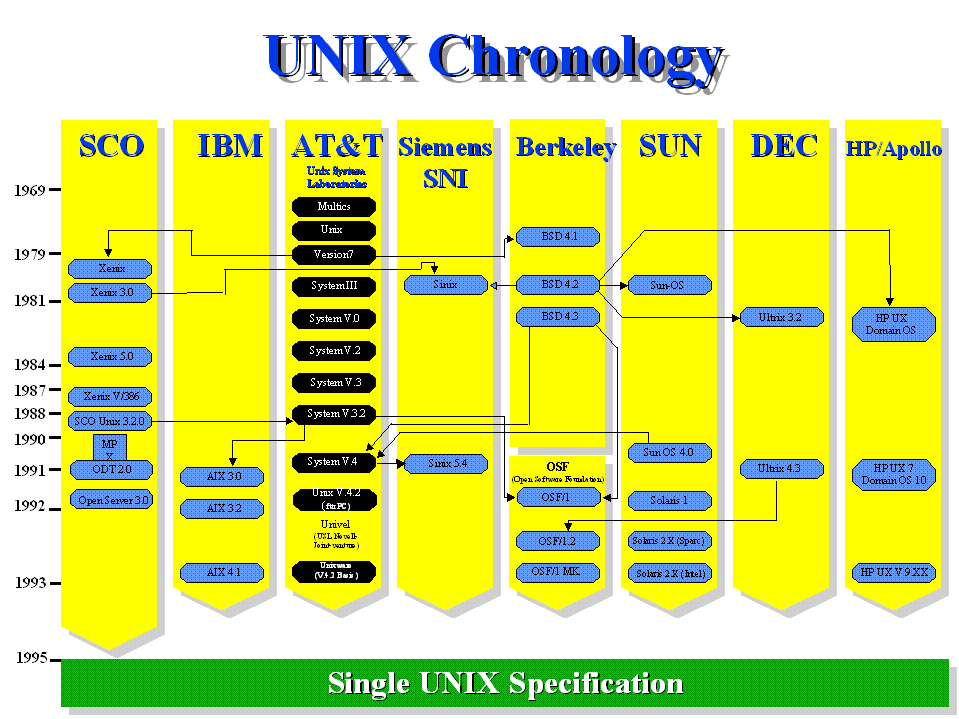
Remember that Solaris is actually a derivative of BSD. According to a chart by the Open Group, it was derived originally from 4.2BSD.
-
Re:Who else but AT&T?
I think he was more referring to the fact that AT&T developed unix. Funny though how it's come full circle...
-
Re:Is Linux "unix"?
Linux is definitely not UNIX, but it is very UNIX-like. Linux was written from scratch, and is not recognized as a UNIX by the open group (click).
My understanding is that unless someone wants to pony up money to have Linux reviewed, and potentially be certified as UNIX, it won't ever be a true UNIX. There are POSIX compliance tests, and lots of little standards that have to be implemented and be implemented correctly.
so, no. Linux is not UNIX. -
Re:Unix(tm) code?
Accorinding to section 2.1 of the Unix trademark use document this is not the case.
I can use a initial capital letters if I wish. *Their* convention is wholely capital letters. -
Re:Unix(tm) code?
The UNIX trademark is all upper case, even if it is not an acronym.
-
Re:Why?
Linux on X86 won't comply becuase some of the errno codes are incorrect, being based on Minix, which also uses incorrect values.
The Open Group Single UNIX Specification Version 3 only specifies names of errno codes in errno.h not the exact values.
-
Re:No. And Yes.
and unix means one thing to the open group
unix.org -
Definition of UNIX: The Open Brand
UNIX® describes any operating system sold under a brand licensing agreement with the Open Group. This requires the product to pass a checklist that includes certification to the Single UNIX Specification (free reg. req.) on a given set of supported hardware, based in part on product testing, and payment of brand fees pursuant to the Trademark Licensing Agreement (PDF). Often these brand fees are high enough to shut out publishers of low-volume operating system products.
-
What About The Open Group?
From The Open Group's Website:
SCO is licensed to use the registered trademark UNIX "on and in connection" with their products that have been certified by The Open Group, as are all other licensees.
These are the ONLY circumstances in which a licensee may use the trademark UNIX on and in connection with it's products.This seems like a pretty blatant abuse of a trademark owned by someone else. I'm guessing that if they ever made good on their "intent to use" this designation they would be served by TOG in about 15 minutes, backed by the $5 PayPal donations of every geek on the planet Earth.
-
Re:The difference
X runs on non-UNIX platforms too, e.g. VMS, OS/2, etc. UNIX systems typically use X for graphical applications, but X itself isn't UNIX, and never has been. The UNIX System, as defined by The Open Group, doesn't include a graphical interface.
-
Re:Solar is UNIX
Since Sun bought "rights" to UNIX from SCO some time ago, I think they can call it UNIX. Otherwise it would be Sunix and the President would need to change his/her last name to Sunis
SCO has nothing whatsoever to do with whether you can call your OS "UNIX". That depends only on Unix certification. The Open Group also offers a list of cetrified products. -
Microsoft wouldn't own Unix
Microsoft would own some marketing rights, that's all. Unix is owned by The Open Group. System V and UnixWare (at least) and the vast majority of corresponding copyrights and patents (except those held by OG) are owned by Novell. Oh, and Microsoft would also own a truckload of incoming lawsuits. How.. attractive.
-
Re:POSIX standard onlin
(POSIX 2001 and SUSv3 are the same document.)
-
Re:2000-07-20 register quote about SCO unix code lSCO does NOT own the Unix trademark. The Open Group does, and did for years before that article was published.
I'm surprised The Register got this one wrong.
-
Re:Coincidence?since you are already at +5 intersting, you dodn't need my mod point so here's why your comment is even more interesting; you said...
when all of this SCO brewhaha started I ventured over to opengroup's website, and found a reference to the probability that windowsNT (which I can't find now) would qualify for unix branding or would with very little effort. In fact unix.org does say thatMicrosoft(R) Windows NT was developed as a completely new, state of the art, 32 bit operating system. As such, it has no connection with the UNIX system source code. However, market demand for POSIX.1 , POSIX.2 has led to developments by several companies of add-ons that provide partial functionality. Should the functionality meet the requirements of the UNIX brand then indeed it could become a registered UNIX system.
So for Microsoft to give SCO $50M to either kill Linux or die trying is a win/win situation for Microsoft. -
Re:Coincidence?since you are already at +5 intersting, you dodn't need my mod point so here's why your comment is even more interesting; you said...
when all of this SCO brewhaha started I ventured over to opengroup's website, and found a reference to the probability that windowsNT (which I can't find now) would qualify for unix branding or would with very little effort. In fact unix.org does say thatMicrosoft(R) Windows NT was developed as a completely new, state of the art, 32 bit operating system. As such, it has no connection with the UNIX system source code. However, market demand for POSIX.1 , POSIX.2 has led to developments by several companies of add-ons that provide partial functionality. Should the functionality meet the requirements of the UNIX brand then indeed it could become a registered UNIX system.
So for Microsoft to give SCO $50M to either kill Linux or die trying is a win/win situation for Microsoft. -
Re:Yes, but...
SCO doesn't own the Unix name (trademark). The Open Group does.
SCO owns the copyright to the Unix System V source code and the license agreements that AT&T, USL, SCO (#1), and Novell negotiated with Unix vendors such as IBM, Sun, HP, Sequent, DEC, Pyramid, Stratus, SGI, etc. -
posix documentation licence
as many readers had noted, POSIX is avaible here, unfortunately, to download it, you shoud accept a licence that states "However, you are NOT permitted to amend, copy, reprint, offer for sale, or otherwise re-use material from these documents without explicit permission from The Open Group/IEEE." (emphasis added by me)
i wonder if "writing an opereting system" to be compliant to this documentation is to "reuse material" and in violation of the licence...
beware what you download and read if you are a kernel developer -
Re:Missing?
Well, linux is not unix. Technically...
Well, Linux could become Unix. Unix is now a specification, just like POSIX is a specification.
Certain Linux distributions have become POSIX certified, and it is conceivable that certain Linux distributions could some day become Unix certified. All it takes is for someone with deep enough pockets to want it enough.
-
I'll believe it when I see it, Bruce.
I think The Open Group should choose a name that reflects their long history with the Unix (not to be confused with UNIX--the registered trademark of The Open Group and you'd be stupid to use it in a sentence without their permission) community. For example:
"The Please-Pay-Us-Money-To-Call-That-UNIX Group"
"The We'll-Sue-Your-Sorry-Open-Source-Ass Group"
"The Everything-Is-Open-Except-For-Our-Trademarks Group"
"The Please-Buy-Closed-Source-Motif Group"
"The Never-Has-Been-Never-Will-Be Open Group"
Failing that, perhaps a more modern name that reflects their traditional outlook would be more appropriate:
"The goatse.cx Group"
"The Open-As-In-Gaping-Asshole Group"
* all copyrights, trademarks, service marks, patents, or other IP including but not limited to
Motif, UNIX, and The Open Group are probably property of The Open Group; any others mentioned are property of their respective owners. -
Should have enforced that mark, X/Open!Unfortunately for the Open Group, their failure to strongly police casual trade use of the term Unix tends to militate against their claim. BSD, for example, is not a licensed Unix (though some BSDs are licensed), but the Bach book certainly considers it so (c. 1986), calling it a Unix "variant." Indeed, were I to purchase a Unix book -- say, the Big Red Book -- and it didn't cover BSD and BSD-derived Unices, regardless of whether they're Open Group certified or not, I'd be much put out indeed, and I think most people would as well.
A longstanding failure to vigorously ensure that those third-party products only cover licensed Unices or otherwise make clear that unlicensed products are not Unix makes the Open Group's case a tough one to win. Just like asprin, kerosene and the thermos, Unix has arguably long been a generic term for a specific class of operating systems.
To put it another way, when you hear that an OS is Unix, do you immediately think, "Ah-hah, it's passed the UNIX 93, 95, 98 or Base conformance criteria administered by the Open Group! I can now use the T_TCO_TRANSFAILPROB QoS flag without fear!"
In any case, nothing can be more ironic than the X/Open version of the famous license plate: "Live Free Or Die: UNIX. (UNIX is a registered trademark of The Open Group.)"