Slashdot Mirror
Domain: uq.edu.au
Stories and comments across the archive that link to uq.edu.au.
Comments · 212
-
Re:9-1971
Starting in the 60's was harder, and is an actuarial question now. By the time of the early 70's, the PDP-8/e was on desktops and probably somewhat common. So was dial-up or even direct-connected terminals. (Both were available in high schools in central PA, which was NOT a high-tech area).
This https://en.wikipedia.org/wiki/... was "on desktops"
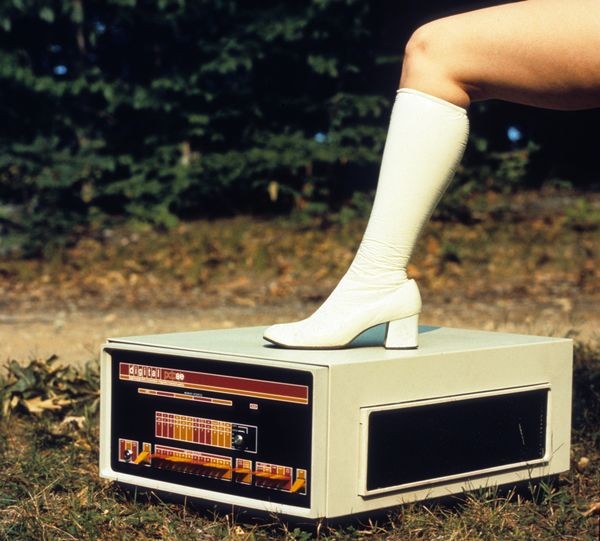
I don't think so.Perhaps you are thinking of the PDP-8, which was still not a desktop compter, but the CPU (taken out of the rack) could fit on top of a desk. http://images.computerhistory.... You'll still need peripheral devices (paper tape, maybe a disk drive) and of course a user interface (typically an ASR-33 http://physicsmuseum.uq.edu.au...).
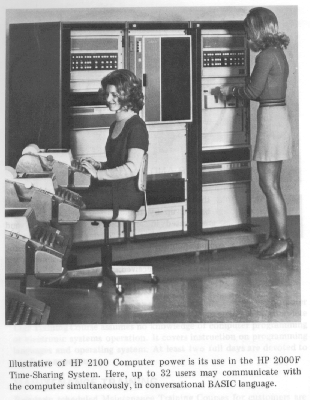
By the mid 1970s our school district had HP 2000 (that is HP 2100 series) minicomputers for timesharing (https://en.wikipedia.org/wiki/HP_Time-Shared_BASIC) and they were similar (in size and everything else) to the PDP-11 pictured above. http://www.decodesystems.com/h...
We had ASR-33s, ADM-3A CRTs. then later HP 2640 https://en.wikipedia.org/wiki/... "smart" CRT terminals.
When these HP 2000 TSB systems first came in, our school district, the richest one in the USA, was the only one outside of Cupertino (home of HP) to have this. These were very popular and by the late 70s there were a number of school districts in the country with similar setups.A sightly smaller system of the era you're talking about would be the HP 1000 series, but it is still not a "desktop" computer! http://www.memoires-informatiq...
The first desktop computer I saw was when I started programming in 1972: the Datapoint 2200 https://en.wikipedia.org/wiki/.... But I only used it as a smart terminal to submit virtual punch-card decks to the IBM/370. Well, and playing 3-D Tic-Tac-Toe (graphics!) on it, but no development environment was available to us.
The first real desktop computer I saw (and used) in those days was a few years later, in 1975, and it cost $20,000. That was the IBM 5100 https://en.wikipedia.org/wiki/.... I did APL programming on it (although mostly we worked on the mainframes, which were IBM/370 and Amdahl/470s).
The early-mid 1970s was the era of microcomputer kits (8080, Z80, 6502, 6800, etc.) and those would fit in a box on a desk. Typically with a television set on top. Keyboard separate, and probably some more boxes for periperhals (cassette tape player, floppy drives) etc. The Apple and TRS-80 complete computers all came much later.
As for tiny PDP-11 type systems...
The Heathkit H-11 https://en.wikipedia.org/wiki/... was a PDP-11 dekstop computer available in 1978 but was soon discontinued because it was too expensive for anyone to buy. (No market at that price point.) I also recall an advertisement in BYTE around 1979 for some kit that also used the LSI-11 and I am sure could fit on a tabletop by then. It might even be much slimmer than an Altair/OSI kind of box.
Of course the most beautiful desktop computer from the late 1970s was the Sol 20 http://oldcomputers.net/sol-20... . A friend of mine had one of those.
I've been programming since 1972. In the 1970s I was programming on IBM mainframes, Honeywell 6000 mainframes, HP 2000 minicomputers, PDP-10 mini-mainframes, a little microcomputer work. (A few years later I would be light years ahead, developing Lisp Machine wo
-
Re:Why not the Golden Age?
This is why not:
Crop yields are expected to decline because plants need more water as the temperature goes up:
http://www.qaafi.uq.edu.au/mai...
http://www.circleofblue.org/wa...
http://www.seeddaily.com/repor...
http://www.guardian.co.uk/envi...Also try this on for size; The spread of pests and disease:
http://www.bbc.co.uk/news/scie...
http://www.wunderground.com/ne...As for the rest of your assumptions: http://www.skepticalscience.co...
-
Re:It's all the prawn shop sells?
s/your/you're/. Duh. And I don't even have the excuse of Vitamin D deficiency.
-
Re:Solar cell that emits light....
-
Too fast for me!
I prefer something less frantic, like: http://smp.uq.edu.au/content/pitch-drop-experiment.
-
Re:So you are not going to participate in
Typo - the correct link is http://robotics.itee.uq.edu.au/~metr3800/.
-
Re:So what is the fuss?
There's a big difference between Postscript and PDF. Printable PDFs don't have any code that the printer will execute, they contain precalculated graphic primitives only. Postscript is a programming language. You can write a raytracer that runs on the printer in it, if you so desire.
-
Re:researchers find attack vector known for 20 yea
What is really scary is that in order to come up with a standard format for sending data to printers somebody decided to invent a turing-complete language. That means you can't even examine a set of data being sent to the printer and determine whether it will ever print anything without actually running it.
Not convinced? Try printing some of the files on this page.
-
Re:better link
I don't see it. Here is some info Also from this page I now understand the catch.
-
better link
better link. Also, I didn't realize it at first, this is the person mostly responsible for it. She is from Australia and she decided to do this. I wonder what the catch with her is...
-
Re:Please Donate
Apart from being a rich state within a rich country: Do they deserve donation money - or is this a classic case of reap what you sow - privatizing profits and socializing losses? Australia and especially conservative Queenslanders are amongst the staunchest climate change denialists out there (from link: "There's been a big swing back towards climate change denialists..."). Further, Queensland is a massive coal exporter - and more than happy to fuel dirty-coal burning both in Australia or at export sites the world over, all to make a quick buck. The costs of this flood will be minuscule compared to the Queensland coal industries profits:
In 2009, the [Queensland] state’s 52 coal mines produced a record 195 million tonnes of coal, generating $33.2 billion in export revenue. Queensland is a major player in the international coal market, exporting 168 Mt of coal in 2009 that accounted for 20% of the global trade. The industry generated $3.22 billion in coal royalties, accounting for 9% of the total income of the Queensland Government for the 2008-09 financial year.
Australian media is divided up amongst a few powerful players (Murdoch included) that don't want any meaningful public debate of climate change. For example most Australians are completely unaware of Australia complacency in the farce that is the "Copenhagen accord" on climate change as exposed by Wikileaks
So you care nothing about these people who have died (thankfully only a few)? And those who've gone missing due to this catastrophic flooding simply because a majority of them do not hold the same view as you do towards climate change? Put aside your political agenda/views and show some sympathy for those amidst tragedy. You sir and the climate change alarmists like you are the very reason I'm very skeptical of man-made climate change.
-
Re:Please Donate
Apart from being a rich state within a rich country: Do they deserve donation money - or is this a classic case of reap what you sow - privatizing profits and socializing losses? Australia and especially conservative Queenslanders are amongst the staunchest climate change denialists out there (from link: "There's been a big swing back towards climate change denialists..."). Further, Queensland is a massive coal exporter - and more than happy to fuel dirty-coal burning both in Australia or at export sites the world over, all to make a quick buck. The costs of this flood will be minuscule compared to the Queensland coal industries profits:
In 2009, the [Queensland] state’s 52 coal mines produced a record 195 million tonnes of coal, generating $33.2 billion in export revenue. Queensland is a major player in the international coal market, exporting 168 Mt of coal in 2009 that accounted for 20% of the global trade. The industry generated $3.22 billion in coal royalties, accounting for 9% of the total income of the Queensland Government for the 2008-09 financial year.
Australian media is divided up amongst a few powerful players (Murdoch included) that don't want any meaningful public debate of climate change. For example most Australians are completely unaware of Australia complacency in the farce that is the "Copenhagen accord" on climate change as exposed by Wikileaks
-
Original Source
There's an article on the University of Queensland's web site (where the researchers hail from).
The land surface that the asteroid hit is now buried under layers of sedimentary rock and Dr Uysal thinks the original crater most likely eroded away.
"Dr Uysal and Dr Glikson will present their findings at the Australian Geothermal Energy Conference in Adelaide, 16-19 November 2010."
To read more about their research, see their conference paper (pdf). (This may not be specifically on the impact, but on their geothermal research, instead.)
In short, not the biggest, oldest, newest, or any other superlative. Still, given the estimated size of the impact, I'd expect it to have had a major impact on the Earth's weather for quite a while.
-
Original Source
There's an article on the University of Queensland's web site (where the researchers hail from).
The land surface that the asteroid hit is now buried under layers of sedimentary rock and Dr Uysal thinks the original crater most likely eroded away.
"Dr Uysal and Dr Glikson will present their findings at the Australian Geothermal Energy Conference in Adelaide, 16-19 November 2010."
To read more about their research, see their conference paper (pdf). (This may not be specifically on the impact, but on their geothermal research, instead.)
In short, not the biggest, oldest, newest, or any other superlative. Still, given the estimated size of the impact, I'd expect it to have had a major impact on the Earth's weather for quite a while.
-
Re:Can atheists refute one simple fact?
...which reminds me of my philosophy professor telling us Gasking's proof (an ontological argument for the non-existence of God. He would have had many beers with Gasking.
-
Re:Article summary:
Once upon a time, in another career
-
Like this...
-
Re:Old Tech but New Challenges
-
Old Tech but New Challenges
The concept is not new but it is very difficult to turn it into practice. These guys at University of Queensland and others have been working on this for several years and have trialled severa prototypes before. http://www.uq.edu.au/news/index.html?article=20718 Not bad without military budgets - beat them to the punch!
-
Re:This could be quite useful
Many birders could be put at risk merely for taking a picture of a young chick.
'specially if that cute young blond chick shows a pussy too!
CAUTION! VIEW AT YOUR OWN RISK! -
Re:Climate change is a security threat
"Over half of the world's reefs have already completely disappeared or are rapidly declining. Most of this so far had been due to pollution and overexploitation, but an increasing percent is due to the warming and increasingly acidic waters"
{{citation needed}} - and something recent at that.
http://www.uq.edu.au/news/?article=17983
(although you bring in pollution, overexploatation and warm water - which is a cyclic phenomena - and yet try to blame it on global warming)
Regarding ocean "acidification", and don't forget to mention how we could measure it with three significant digits hundreds of years ago, it's neither historically nor recently a problem: http://www.whoi.edu/page.do?pid=7545&tid=282&cid=63809&ct=162
The only reason one could have for believing there is a problem is by being blissfully ignorant on geological levels of CO2 in the oceans as well as temperature changes.
-
Re:does anyone still use it?
DVICO dual fusion PCI (from memory, not at the machine right now). I don't think it is in the kernel and I personally wouldn't have bought it. My dad was at the shop getting it for my birthday, he rang me up and asked about brands/models and then bought the only one where I said "Don't get that!". He got it because for only a couple of dollars more than a supported haupage DVB card, he got (being phased out at the time and completely redundant) analogue included. He's getting old, bless him.
I'm still running an older kernel on that machine because it's my super stable, not allowed anywhere near bleeding edge workhorse. I won't find out if it's in the kernel now until next year, most likely.
Just in case this post shows up on google for someone looking for linux DVICO dual fusion PCI, go here. This Christopher Pascoe guy does good things, although I do have to massage the build, removing drivers that fail from the build config works for me. I wish I was at the machine, I could be more specific.
-
"Junk" = regulatory RNAProbably not - it's doing something far more important than that.
It's already been known for a few years now that the "junk" scales directly with complexity of the organism - unlike number of genes, which does not. It's becoming increasingly apparent that huge numbers of "junk" sections of DNA are actually transcribed to RNA, and play essential roles in regulating what gets made into protein.
The new hypothesis is that RNA is the computational engine of the cell, allowing it to rapidly process information and react appropriately, and the non-protein-coding "junk" sections are what it uses to do this.
There's a guy called John Mattick from the University of Queensland who has done a lot of really exciting work in this area, and gives a fantastic talk on the subject - here's an abstract for a version of it. Sample quote:
the extent of non-protein-coding DNA increases with increasing complexity, reaching 98.8% in humans, suggesting that much of the information required to program development may reside in these sequences. Moreover it is now evident the majority of the mammalian genome is transcribed, mainly into non-protein-coding RNAs (ncRNAs), and that there are tens if not hundreds of thousands of long and short RNAs in mammals that show specific expression patterns and subcellular locations. Our studies indicate that these RNAs form a massive hidden network of regulatory information that regulates epigenetic processes and directs the precise patterns of gene expression during growth and development.
Using the argument that cells are RNA machines, there is most likely no junk whatsoever in the human genome.
-
Re:G-forces ????
One simple one I played with was simply a pressure vessel that emptied into a three metre long barrel via a fast acting valve, with a fairly simple assembly at the bottom with a removable target block (big lumps of steel, frequently replaced threaded rod and a lot of vacuum grease). The barrel and block was pumped down to a relatively low pressure with a single vacuum pump. Nitrogen or helium were used to move projectiles (pvc mostly, velocity was all that mattered). That one was limited to velocities less than that of the wave speed of the gas, which was still perfectly adequate for making odd things like iron-pvc composites (the iron powder grains in contact would weld together when the shock wave hit yet very little of the polymer would burn).
T4 was a different beast for much higher velocities which starts with a gas gun driving a projectile and then uses the compressed gas to reach a higher velocity in the next chamber to test scramjet models. I think the first stage had a 87kg copper piston with helium as the working gas, and the valve from that to the second stage was an expendable thin steel plate. The piston got stuck on occassion.
Here's a description: http://www.uq.edu.au/hypersonics/index.html?page=32641&pid=0
It was relocated some time in the early 1990s to a larger building so is a bit longer and capable of faster velocities than when I saw it running. It originally crossed the main corridor of the building I was studying in and shook the building slightly with each shot. -
Re:Protestant Work Ethic
I asked for the notes because I thought it might be like some of my courses, and thus with a
1051, 1052, 1061, 2000, 2100, 2302, 3301, 2301, 2400, 3401, 3090.
The course notes (for those that have them) aren't too hard to find from there if you're particularly driven.
"My computer is doing it" pretty much means you've dropped off the rigour bandwagon. Maybe my problem is that it seems everyone says "calculus" and knows instantly what is being talked about. It's not so clear for me. Really though, calculus, even rigourously, is not difficult at all. Do you mean you were solving PDEs on prescribed contours or something?
-
Re:depends
in Australia, there are bike mounts on the front of the bus:
Image -
Re:Ethernet
But I think raytracing will be a bit beyond its capabilities.
If an Apple LaserWriter, which used a 12-MHz 68000, can do raytracing, this gadget (which is clocked two orders of magnitude faster, just for starters) should be more than up to the task.
-
Re:Feature Request
Agreed, why would one want another programming language embedded in a programming language? Postscript already can do all you would want. It is a bit hairy programming, but it can be done (see f.x. http://www.physics.uq.edu.au/people/foster/postscript.html). The best way to mitigate security issues with embedded code is to eliminate the execution. That is, until some one writes a javascript interpreter in postscript.
-
BOGUS ARTICLE
This is a bogus story, a media announcement was made by UQ essentially refuting the claims made in the news.com.au article.
Were this a true story it would get more (well, definitely more CREDIBLE) coverage than a single write up by a News LTD online tabloid newspaper.
Future note for Slashdot Editors - News LTD's online journalists are (allgegedly) notorious for being heavily biased and factually incorrect. Consider any submissions linking to www.news.com.au or its related websites as EXTREMELY suspect.
-
BOGUS ARTICLE
This is a bogus story, a media announcement was made by UQ essentially refuting the claims made in the news.com.au article.
Were this a true story it would get more (well, definitely more CREDIBLE) coverage than a single write up by a News LTD online tabloid newspaper.
Future note for Slashdot Editors - News LTD's online journalists are (allgegedly) notorious for being heavily biased and factually incorrect. Consider any submissions linking to www.news.com.au or its related websites as EXTREMELY suspect.
-
This is all hypothetical
From the horses mouth: http://www.uq.edu.au/news/index.html?article=16363
'Plans' referred to in the media were part of a hypothetical 'master class' to improve the design skills of professionals involved in planning. The master class's report includes the following disclaimer: "Whilst the University of Queensland has consented to the site being the subject of the Master Class, the consent does not in any way imply any intent of the University of Queensland insofar as the site is concerned."
-
Re:Cloudy
Well I guess that if I don't want to be caught, I just have to wait 'til it's cloudy to commit a crime...
Sadly, even that is not likely to work. If this article from wayyy back in 2000 is any indication, they can see through clouds, smoke, etc.
-
Re:No
For which athletes? I'm pretty sure the Greeks used to train and prepare for their games.
quote: The athletes
http://www.library.uq.edu.au/olympics/milns.html
Anyway, you are still going to have to draw a line somewhere: doping, cybernetics, gene mods etc. So not allowing doping is a valid practical line. And so is "allowing full body swimsuits but only those with a buoyancy between X and Y".
Car analogy: it's just like Formula 1 racing, there is really no "formula unlimited", because at the end of the day people have to decide "What is an acceptable car?" and "What is an acceptable way of winning?", so they might as well decide "What is an acceptable F1 car".
After all with future tech, there could be cybernetics, or genetically modified humans, or biomodified humans. And then you also start asking "what's human".
While the rules do restrict, the rules also help provide _shape_ to the event. Are we sure we are ready for a games with mods and doping? It could be a slippery slope to quite a lot of nastiness - even _in_ spectators.
On a vaguely related note - this is why to me, exploration in some areas of science should be discouraged till humans are ready (in terms of tech, medical, culture, society, religion - religion isn't going away any time soon whether you want it or not) for the implications. It's like the "Civ" game, where you do some stuff first, then only other stuff.
For instance say some genius suddenly creates a gene mod that makes us super fit, AND also makes it contagious. I don't think all of us want it automatically - no matter how good it seems.
-
Re:Perpetuating old myths
Just a couple of asides. There are plenty of cases where obsidian aka volcanic glass has been found with sharp undeformed splinters in geological settings, where it cannot have been disturbed for many millions of years hence the inference is no significant flow occured. There is also the Pitch Drop experiment, showing what a proper fluid will do.. http://www.physics.uq.edu.au/pitchdrop/pitchdrop.shtml I presume since it's not mentioned there has been no deformation and flow of the glass funnel...
-
Re:Ugh...
Know what's been plaguing housecats lately? Obesity and type-2 diabetes. Just like us with our energy-dense foods.
-
old technology - been done before
what took them 10 years to develop I protoyped in less than one for my thesis - http://innovexpo.itee.uq.edu.au/2001/projects/s369495/index.html
-
Some background
http://www.uq.edu.au/news/index.html?article=1118
3 So which Skyshot plane did fly here? -
Microblaze uclinuxIf we have, finally, a working [uc] Linux port to MB that alone is a great achievement. When I looked a year or two ago there was only one, non-functioning, port to a hardware that did not exist.
Petalogix maintains a Microblaze port of uClinux (link), which works perfectly. The software has been stable for six months and a new version is coming soon. Microblaze is a nice CPU with a clean "from scratch" architecture, and uClinux works very well on it.
-
Longest project ever
I think the award for longest project ever should go to this project.
The Pitch Drop Experiment
I can't wait for the tenth drop! WooHoo! -
The Pi SongOf course, I have to toot my own horn here and post my Pi Song:
(Sung to the tune of Supercalifragilisticexpialidocious)
(Note also that all digits should be read separately, as "Three point one four one five etc"!)
To find a circle's area will often make you queasy,
It's not just simply length by width or anything that easy.
But then one day you'll find a number that will help your brain,
It might be transcendental but it's sure to save you pain!
Oh!
Chorus:
3.141592653589
If you were to say it all then you'd be here a long time.
Multiply by two r and then you will have a curved line
3.141592653589For the rest of the verses, visit my Pi Song page!
-
Re:The irony
It's ironic that people can mention Froebel and Montessori and disregard technology, when both of them devised and introduced technology (props) in their practice. Not modern technology, sure, but what was available at their time - Froebel's "gifts" and Montessori's devices like buttoned panels. What we lacked until recently was adequate computational toys to introduce computers to kindergartners. But ingenious use of what existed was always possible. One obvious choice would be a ground "turtle" robot like Valiant's Roamer. I, my wife, and several preschool teachers have employed it extensively, with great results and to children's enjoyment (see a brief paper here). You can command it with command keys for "forward", "back", "turn left", "turn right", and can even program a sequence of these orders, like in Logo. Talking about programming, there are many things you can do in kindergarten. ToonTalk and Electronic Blocks come to mind. In general, you'd want children to be able to feel comfortable around a computer, not feel it is a "special" item for adults or special occasions, nor a "treat" for rewarding other behavior. Both of those perspectives would be inadequate for a healthy relationship with technology. Most modern research points towards adequate integration of computers in preschool practice, precisely by avoiding reserving them for special occasions or turning them into treats. I invariably find the best summary and guideline's to be those compiled by Rachel Bolstad for New Zealand's Ministry of Education, which you can find here (p. 41 - 55 in the PDF). With these in mind, I devised a four-approach guide which I presented two years ago at a conference, but is available on-line.
-
Hubble tribute songSeems like an appropriate time to post a parody I wrote recently. It's not really up to scratch, but you never know when you might need to sing a Hubble tribute! You can also find other physics songs and humour on my home page
Only Me (A Hubble Tribute)
To the tune of "Only you"
By Joel Gilmore, 2007Looking at the sky up above
Taking photos with love,
Can you fix me?
Found out only yesterday,
my orbit's soon to decay
Can't you boost me?Chorus:
All I needed was a manned space flight
All I needed for another night
Since 1993 -
only me.If I lose one more gyroscope
I don't know if I'll cope,
Send Discovery!
Install Wide Field Camera 3,
Spectrograph, batteries,
My camera's dying!Chorus:
All I needed was a manned space flight
All I needed for another night
Until James Webb, there'll be -
only ME! -
Re:SPAAAACE MEEEEAT !!!!
I am also a vegetarian, and all I can say is that once it has been tested and proven safe, I would have no ethical objection to eating Squirted Meat. However, since becoming vegetarian, the thought of eating meat (even ethically acquired meat, such as that of an animal that died of natural causes) has become distasteful to me, so I would not eat the meat unless necessary.
It should be noted though that if in a situation where other food was unavailable, I would have no hesitation to eat ethically acquired meat, whether it be from a laser printer, a cow or a human. In fact, if the infrastructure is in place then I would like to donate my body to be eaten by starving people when I die. See the following link for a very interesting and insightful discussion of the benefits of ethical cannibalism: http://www.uq.edu.au/~pdwgrey/web/can/cannibalism. html -
Links to university release & the article in Phere is the press brief from the university's website, includes a picture of Dr Ekberg
http://www.uq.edu.au/news/index.html?article=11048 and if you have the chops to read the study, here is a link to the abstract
http://www.pnas.org/cgi/content/abstract/103/45/17 030looks like the full text is free (unless my institution's IP range has a subscriptionn and it would otherwise be locked down)
-
An example at UQ
I'm a current student at the University of Queensland studying Engineering with a major in software. This degree is 4 years in duration.
UQ also offers an Information Technology degree which is 3 years in duration.
Whats the major difference? Engineering students have to do math, engineering principles and diverse team project subjects.
Engineering students must complete 2 team project subjects (aptly named Team Project 1 and Team Project 2) which each last a semester as well as a Thesis which lasts 2 semesters. The first team project I did was to construct a PC based oscilloscope (hardware in a wood book with a coax input for voltage and an rs-232 connection to a PC) and the second was an reminder keyring (programmable using flashes of light on a PC screen. Also needed to provide the software to set alarms at certain times). Both projects were completed between 4 students comprising of 2 software engineers, an electrical engineer and a computer systems engineer.
I have chosen to and am currently completing my thesis through the CEED project. CEED list projects on behalf of companies to be completed by students. Once a project is completed and documented appropriately the student can then submit the work as their thesis project. The company pays CEED for this service and retains all IP rights to the work. CEED then passes on a % of this money to student for their work.
This model seems to work well enough. My only criticism is the allocation of students to groups in team project. It isn't a rare occurrence that you get teamed with other students that either struggle to talk English or don't have a solid understanding of their discipline, thus making the completion of the projects rather difficult. But, only 50% of the subjects marks are on the final product while the other 50% is on documentation and planning (see the related link). I think this is a good enough compensation for group selection.
Coincidently, students of both IT and Software Engineering are required to complete 3 subjects related to the design and development strategies of software. See the course guided here (PDF).
-
An example at UQ
I'm a current student at the University of Queensland studying Engineering with a major in software. This degree is 4 years in duration.
UQ also offers an Information Technology degree which is 3 years in duration.
Whats the major difference? Engineering students have to do math, engineering principles and diverse team project subjects.
Engineering students must complete 2 team project subjects (aptly named Team Project 1 and Team Project 2) which each last a semester as well as a Thesis which lasts 2 semesters. The first team project I did was to construct a PC based oscilloscope (hardware in a wood book with a coax input for voltage and an rs-232 connection to a PC) and the second was an reminder keyring (programmable using flashes of light on a PC screen. Also needed to provide the software to set alarms at certain times). Both projects were completed between 4 students comprising of 2 software engineers, an electrical engineer and a computer systems engineer.
I have chosen to and am currently completing my thesis through the CEED project. CEED list projects on behalf of companies to be completed by students. Once a project is completed and documented appropriately the student can then submit the work as their thesis project. The company pays CEED for this service and retains all IP rights to the work. CEED then passes on a % of this money to student for their work.
This model seems to work well enough. My only criticism is the allocation of students to groups in team project. It isn't a rare occurrence that you get teamed with other students that either struggle to talk English or don't have a solid understanding of their discipline, thus making the completion of the projects rather difficult. But, only 50% of the subjects marks are on the final product while the other 50% is on documentation and planning (see the related link). I think this is a good enough compensation for group selection.
Coincidently, students of both IT and Software Engineering are required to complete 3 subjects related to the design and development strategies of software. See the course guided here (PDF).
-
An example at UQ
I'm a current student at the University of Queensland studying Engineering with a major in software. This degree is 4 years in duration.
UQ also offers an Information Technology degree which is 3 years in duration.
Whats the major difference? Engineering students have to do math, engineering principles and diverse team project subjects.
Engineering students must complete 2 team project subjects (aptly named Team Project 1 and Team Project 2) which each last a semester as well as a Thesis which lasts 2 semesters. The first team project I did was to construct a PC based oscilloscope (hardware in a wood book with a coax input for voltage and an rs-232 connection to a PC) and the second was an reminder keyring (programmable using flashes of light on a PC screen. Also needed to provide the software to set alarms at certain times). Both projects were completed between 4 students comprising of 2 software engineers, an electrical engineer and a computer systems engineer.
I have chosen to and am currently completing my thesis through the CEED project. CEED list projects on behalf of companies to be completed by students. Once a project is completed and documented appropriately the student can then submit the work as their thesis project. The company pays CEED for this service and retains all IP rights to the work. CEED then passes on a % of this money to student for their work.
This model seems to work well enough. My only criticism is the allocation of students to groups in team project. It isn't a rare occurrence that you get teamed with other students that either struggle to talk English or don't have a solid understanding of their discipline, thus making the completion of the projects rather difficult. But, only 50% of the subjects marks are on the final product while the other 50% is on documentation and planning (see the related link). I think this is a good enough compensation for group selection.
Coincidently, students of both IT and Software Engineering are required to complete 3 subjects related to the design and development strategies of software. See the course guided here (PDF).
-
An example at UQ
I'm a current student at the University of Queensland studying Engineering with a major in software. This degree is 4 years in duration.
UQ also offers an Information Technology degree which is 3 years in duration.
Whats the major difference? Engineering students have to do math, engineering principles and diverse team project subjects.
Engineering students must complete 2 team project subjects (aptly named Team Project 1 and Team Project 2) which each last a semester as well as a Thesis which lasts 2 semesters. The first team project I did was to construct a PC based oscilloscope (hardware in a wood book with a coax input for voltage and an rs-232 connection to a PC) and the second was an reminder keyring (programmable using flashes of light on a PC screen. Also needed to provide the software to set alarms at certain times). Both projects were completed between 4 students comprising of 2 software engineers, an electrical engineer and a computer systems engineer.
I have chosen to and am currently completing my thesis through the CEED project. CEED list projects on behalf of companies to be completed by students. Once a project is completed and documented appropriately the student can then submit the work as their thesis project. The company pays CEED for this service and retains all IP rights to the work. CEED then passes on a % of this money to student for their work.
This model seems to work well enough. My only criticism is the allocation of students to groups in team project. It isn't a rare occurrence that you get teamed with other students that either struggle to talk English or don't have a solid understanding of their discipline, thus making the completion of the projects rather difficult. But, only 50% of the subjects marks are on the final product while the other 50% is on documentation and planning (see the related link). I think this is a good enough compensation for group selection.
Coincidently, students of both IT and Software Engineering are required to complete 3 subjects related to the design and development strategies of software. See the course guided here (PDF).
-
An example at UQ
I'm a current student at the University of Queensland studying Engineering with a major in software. This degree is 4 years in duration.
UQ also offers an Information Technology degree which is 3 years in duration.
Whats the major difference? Engineering students have to do math, engineering principles and diverse team project subjects.
Engineering students must complete 2 team project subjects (aptly named Team Project 1 and Team Project 2) which each last a semester as well as a Thesis which lasts 2 semesters. The first team project I did was to construct a PC based oscilloscope (hardware in a wood book with a coax input for voltage and an rs-232 connection to a PC) and the second was an reminder keyring (programmable using flashes of light on a PC screen. Also needed to provide the software to set alarms at certain times). Both projects were completed between 4 students comprising of 2 software engineers, an electrical engineer and a computer systems engineer.
I have chosen to and am currently completing my thesis through the CEED project. CEED list projects on behalf of companies to be completed by students. Once a project is completed and documented appropriately the student can then submit the work as their thesis project. The company pays CEED for this service and retains all IP rights to the work. CEED then passes on a % of this money to student for their work.
This model seems to work well enough. My only criticism is the allocation of students to groups in team project. It isn't a rare occurrence that you get teamed with other students that either struggle to talk English or don't have a solid understanding of their discipline, thus making the completion of the projects rather difficult. But, only 50% of the subjects marks are on the final product while the other 50% is on documentation and planning (see the related link). I think this is a good enough compensation for group selection.
Coincidently, students of both IT and Software Engineering are required to complete 3 subjects related to the design and development strategies of software. See the course guided here (PDF).
-
An example at UQ
I'm a current student at the University of Queensland studying Engineering with a major in software. This degree is 4 years in duration.
UQ also offers an Information Technology degree which is 3 years in duration.
Whats the major difference? Engineering students have to do math, engineering principles and diverse team project subjects.
Engineering students must complete 2 team project subjects (aptly named Team Project 1 and Team Project 2) which each last a semester as well as a Thesis which lasts 2 semesters. The first team project I did was to construct a PC based oscilloscope (hardware in a wood book with a coax input for voltage and an rs-232 connection to a PC) and the second was an reminder keyring (programmable using flashes of light on a PC screen. Also needed to provide the software to set alarms at certain times). Both projects were completed between 4 students comprising of 2 software engineers, an electrical engineer and a computer systems engineer.
I have chosen to and am currently completing my thesis through the CEED project. CEED list projects on behalf of companies to be completed by students. Once a project is completed and documented appropriately the student can then submit the work as their thesis project. The company pays CEED for this service and retains all IP rights to the work. CEED then passes on a % of this money to student for their work.
This model seems to work well enough. My only criticism is the allocation of students to groups in team project. It isn't a rare occurrence that you get teamed with other students that either struggle to talk English or don't have a solid understanding of their discipline, thus making the completion of the projects rather difficult. But, only 50% of the subjects marks are on the final product while the other 50% is on documentation and planning (see the related link). I think this is a good enough compensation for group selection.
Coincidently, students of both IT and Software Engineering are required to complete 3 subjects related to the design and development strategies of software. See the course guided here (PDF).