Slashdot Mirror
Domain: virginia.edu
Stories and comments across the archive that link to virginia.edu.
Comments · 959
-
Re:I hope he's wrong ...Ok, I'll bite. How about the USS Yorktown shutdown in 1997. A Windows NT bug crashed their engine control system and required that they be towed to port. Dockside repairs took several days. You can get the full story here.
Had this happened in a battle, it would have likely resulted in loss of life and probably the ship.
Nice attempt at FUD there, skippy. It's a pity you're misinformed and ignorant of the true facts.
In a letter to the "Comment and Discussion" department, published in the Aug 98 Naval Institute Proceedings, page 22, Captain Richard T. Rushton, then-CO of Yorktown, categorically states:
"The Yorktown was never towed as a result of any Smart Ship initiative. During my command, we lost propulsion power twice while using the new technology. Each time, we knew what caused the interrupt and were underway again in about 30 minutes. The September 1997 incident was caused by incorrect data insertion by a well-trained crewman. The Yorktown returned to port using two FFG-7 emergency control units that specifically had been requested by me, and supported by other commands as a risk reducer. We knew there were some risks in the engineering development model propulsion-control system installed under a rapid prototyping development effort. The bottom line: The data field safeguards found in production-level systems were not installed yet in the Yorktown by intention, until complete wring-out was accomplished.""
Or this one: http://www.cs.virginia.edu/~survive/NEWS/news003.t xt
"On Sept. 21, 1997, the Yorktown experienced what the Navy called "an engineering LAN casualty" [GCN, July 13, Page 1]. A systems administrator fed bad data into the ship's Remote Database Manager, which caused a buffer overflow when the software tried to divide by zero. The overflow crashed computers on the LAN and caused the Yorktown to lose control of its propulsion system, Navy officials said.
The Navy CIO Office is trying to determine whether the crash was caused by the software application, NT or some other problem.
"So far, it doesn't seem like it's an NT issue but a basic programming problem," said deputy CIO Ron Turner, who is in charge of the inquiry."
"Between July 1995 and June 1997, the Yorktown lost propulsion power to buffer overflows twice while using the new Smart Ship technology, said Capt. Richard Rushton, commanding officer of the Yorktown at the time of the failures. But in each incidence the Yorktown crew knew what caused the failure and quickly restored systems, Rushton said. "NT was never the cause of any problem on the ship," Rushton said. "The problems were all in programs, database and code within the individual pieces of software that we were using."
http://www.gcn.com/archives/gcn/1998/november9/6.h tm
""Now that we know what can happen, we've realized how to bring the system back quickly," Petty Officer 1st Class Phillip Cramer said. "All we have to do is change the zero to any number, and everything comes right back up.""
So all in all, it doesn't sound like the system crashed to me... You can't bring back a dead system by changing data in a field. You can't even change the data if the system is down. -
Clarification
OK, I'm not trying to be anal here but people who don't know might be misled by the following in the article:
Apple's G5 towers are comparable in speed to the fastest x86-derived CPUs and systems; in other words, the Intel Itanium and AMD Athlon64.
Itanium is not x86 derived. It has its own novel instruction set.
-
Re:Making ethanol uses fossil fuels
Actually, electrolysis does not produce sulfuric acid, it utilizes it as a catalyst. Addition of sulfuric acid to the water helps create an ionic solution, making the water a better conductor. As the electrolysis progresses, the solution grows more acidic as the water dissociates, preserving the ions. Adding more water dilutes the solution again.
More information here. -
Re:Yeah rightI didn't RTFA, but it sounds like they're just running ethernet cables (or OC12 or whatever) to Mars. Didn't they stop to think that the planets move?
You idiot. Michelson and Morley proved that Ethernet is useless. -
Re:It's hard to read...Nah, it's hard to read because back then, they spoke in Perl.
You think you're joking...
I quote:Perle, pleasaunte to prynces paye
To clanly clos in golde so clere,
Oute of oryent, I hardyly saye,
Ne proued I neuer her precios pere. -
Re:Surprised by Linus>scurvy infested
I know this is _way_ OT, and I expect to be modded as such, but I'm bored at work and want to have a little 'fun'...
Scurvy is not an parasitic infestation or even a disease. It is a condition caused by malnourishment, specifically ascorbic acid (vitamin C).
Vitamin C and Scurvy
A vitamin C deficiency results in an underhydroxylation of proline and lysine in collagen which results in a lower melting temperature of the resulting collagen fibers which causes a breakdown of the protein collagen needed for connective tissue, bones and dentin, the major portion of teeth. Collagen is a cementing material that binds cells together, and is an essential connective tissue protein in the body. Whenever the body is wounded, collagen glues the separated tissues together to form a scar.
A lack of collagen causes the walls of the body's blood capillaries to break down and hemorrhaging occurs in cells throughout the body. When capillaries lose the "glue" that holds them together, symptoms of scurvy appear.
An affected person becomes weak and has joint pain. Internal hemorrhages cause black-and-blue marks to appear on the skin. At the first visible signs of scurvy, raised red spots appear on the skin around the hair follicles of the legs, buttocks, arms and back.
Man, I can see how "scurvy dogs" were looked at as though they had some disease. Interesting that they eventually figured out the link between citrus and scurvy and started provisioning preserved limes and lemons on British Naval vessels. This is apparently where the epithet "limey" came from. -
mine :)
How about mine. Hmm, on second thought it might be a little Embarrassing if you look at the code; and yes, it's windows... but I have lots of gnu stuff on it! does that redeem me a little?
-
Re:Better centerCanonical link: oracleofbacon.org. Just FYI.
--The Oracle
-
Re:Better center
Oh and for the uninitiated, we're talking about the Oracle of Bacon, which is pretty cool!
-
Better center
Actually a better suggestion would be Rod Steiger, but then again, people would have no clue what you were talking about, would they
-
Orkut Zeitgeist?What would be extremely interesting would be, in a years time, a "zeitgeist" of Orkut, in graphical (maybe even Flash) form, that shows the spread of the network from the initial 12,000.
A similar concept has already been done for the corporate pigopolists at They Rule - Flash required, but it's worth it.
My prediction - that ALL of the branches of the social Orkut network bend back on themselves to focus on a single individual being that is the source and underpinning of all human thought , culture and society on this planet - Kevin Bacon -
Re:Can you saySeriously, though, it'll be interesting to see if this is just a case of an overzealous intern and an incomptent tech, or if there is more to it.
And the Watergate break in was just a burglary by a bunch of Cuban exiles
-
Coleridge was NOT asleep!Quoth the article:
Samuel Taylor Coleridge was inspired to write the epic poem Kubla Khan while asleep
Uh, no.
Coleridge was in an opium-induced stupor when he got the inspiration for the poem. Here are some sources that back this up (including comments from the poet himself):
You can read about the poem and its origins here, or you can read original notes on the poem from the author and others who knew him here. You can also read the original poem here.
--Mark -
Coleridge was NOT asleep!Quoth the article:
Samuel Taylor Coleridge was inspired to write the epic poem Kubla Khan while asleep
Uh, no.
Coleridge was in an opium-induced stupor when he got the inspiration for the poem. Here are some sources that back this up (including comments from the poet himself):
You can read about the poem and its origins here, or you can read original notes on the poem from the author and others who knew him here. You can also read the original poem here.
--Mark -
Some more info
Aerogels had been largely forgotten when, in the late 1970s, the French government approached Stanislaus Teichner at Universite Claud Bernard, Lyon seeking a method for storing oxygen and rocket fuels in porous materials. There is a legend passed on between researchers in the aerogel community concerning what happened next. Teichner assigned one of his graduate students the task of preparing and studying aerogels for this application. However, using Kistler's method, which included two time-consuming and laborious solvent exchange steps, their first aerogel took weeks to prepare. Teichner then informed his student that a large number of aerogel samples would be needed for him to complete his dissertation. Realizing that this would take many, many years to accomplish, the student left Teichner's lab with a nervous breakdown. Upon returning after a brief rest, he was strongly motivated to find a better synthetic process. This directly lead to one of the major advances in aerogel science, namely the application of sol-gel chemistry to silica aerogel preparation. This process replaced the sodium silicate used by Kistler with an alkoxysilane, (tetramethyorthosilicate, TMOS). Hydrolyzing TMOS in a solution of methanol produced a gel in one step (called an "alcogel"). This eliminated two of the drawbacks in Kistler's procedure, namely, the water-to-alcohol exchange step and the presence of inorganic salts in the gel. Drying these alcogels under supercritical alcohol conditions produced high-quality silica aerogels. In subsequent years, Teichner's group, and others extended this approach to prepare aerogels of a wide variety of metal oxide aerogels.
Check out virginia's writeup -
Head/Eye Tracking
This was mentioned earlier, but I didn't see much information on the Dasher website about actual input devices (though Dasher is a neat way to handle typing).
As a recent UVA grad I heard a lot about the ERICA project while I was there. It's an eye tracking system that's pretty neat, though I think it's basically just being used for research at this time and I don't know of a way to actually purchase it.
I believe there are some commercial eye tracking systems out there, but head tracking is simpler, and therefore cheaper. One I've seen is from here. For $300 you can get the package your friend would need which allows for hands-free clicking through either clicking after the mouse pauses for a second, or through use of a big external button.
I believe Windows XP includes an on-screen keyboard already, but I'm sure typing using only that would get tedious. This is where something like Dasher that was mentioned previously is helpful, as it uses a dictionary to guess which letters you're most likely to type next and make it easier to type those letters. Of course he could still use speech recognition for typing, and rely on something like the head mouse for pointer control. -
Re:Terrorist Clause
find out for yourself here
-
Re:Yep, it's me, personally.
Your position is weakening. But you show good character while doing so. I retract my "fuckhead" moniker.
I never claimed migrations, even mega-migrations, weren't happening, nor that they didn't have historical precedent. My point is that blending, amalgamation and migration only go so far, regardless of their intensity at any point of measurement. And when people acquire the stability of a home, they grab at it. And those wholly Human desires expand, demanding land
I'm hardly not the only pastoralist (if indeed, that is what I am, but let's for the sake of argument accept your label). Many yuppies, hung about with iPods and credit cards, find themselves wanting to merge their prosperity with
Picture this as part of an old war, between belly and brain, between the mundane and the sublime, and between rural and urban. Homesteading is a Human urge, and it conflicts with the wanderlust. These conflicts lead the sensible man to consider balancing them (instead of outright suppression of one or the other).
Balance is an old concept that the Orient knew so well that they made a well-touted symbol for it: yin-yang. They split, share, encroach, and interpenetrate. The end product is equality and co-existence.
Unfortunately, "equality and co-existence" are not within the hyper-yuppie agenda.
Enjoy the pastoral life. you might be one of a couple of hundred thousand people who give it a shot in the USA.
This viewpoint is a fundamental heart of the problem. Your perception is abysmally skewed. TENS OF MILLIONS are pastoral in the USA. It's just the nearness and closeness of city life that misleads you into concluding that the urban areas dominate. Population density is not population majority. If you'd get 20 miles away from most cities, you'd see real countryside
(As a side note, the US Census Bureau's "current urban definition" is problematical since it tends to define urban areas merely on the basis of incorporation or "2500 people live there", and not by their lifestyle. Hence, my use of the term urban is my own. I'd estimate that my "urban" is roughly 50% of the USCB's "urban". Look here in the notes.)
If I had to estimate, I'd say that with 2000 "urban" cities and towns with an average of 200 sq-mi, there's only about 1/4 of 1 million sq-mi of urban area. Let's say about 1/8th of all of America. And this 1/8th holds about half of America's population.
People call the rest the "flyover", but it exists. It's just not dense. -
Yet another Doomsday Article
In the forward for "The Universal Computer" (by Martin Davis) there are a couple of quotes:
"If it should turn out that the basic logics of a machine designed for the numerical solution of differential equations coincided with the logics of a machine intended to make bills for a department store, I would regard this as the most amazing coincidence I have ever encountered."
Howard Aiken in 1956
Let us now return to the analogy of the theoretical computing machines... It can be shown that a single special machine of that type can be made to do the work of all. It could in fact be made to work as a model of any other machine. The special machine may be called a universal machine..."
Alan Turing in 1947
NOTE: In Mr. Aiken's defense, he is probably referring to a differential analyzer (which was an analog computer)
When I was in high school, my (supposedly) CS teacher read an article that stated, "the world would no longer need programmers". She attempted to persuade me from becoming a programmer because in the future no one would need programmers. It would be a dead profession. The year was 1994. Okay, she was half right (there won't be anymore jobs for a while, and they'll all go overseas...), but still.... You can't extrapolate. My teacher never would have imagined (or actually just read the other article) about the internet.
What if AI takes off? I think in the future even the soft sciences will become more computational. Look at fields like bioinfomatics or computational linguistics. There are all kinds of new areas opening up. The problem is that the world doesn't revolve around computers, but all the phenomena of our universe may be one really grand one. Programmers have to learn other skills. I see biologists, actuaries, and engineers (outside of EE/ECE) write code all the time. You need to attach an extra skill to your code.
All this just goes to prove, you shouldn't extrapolate about science or computing, unless your one of these guys:
Alan Turing
Albert Einstein
Kurt Godel
Nikola Tesla
Gordon Moore
Jules Verne
Of course, I'm extrapolating (and as you can guess, I'm not one of these guys...), so if you're a good philosopher you can safely ignore my post. Nothing to see here.... Carry on.
-
Re:Don't forget Carmack
I think the one thing that history has taught us is that what matters most is not who does it first, but who markets the living hell out of the idea.
After all, we don't call people on the Elisha Grey Telephone (Bell), we don't listen to the Tesla Radio (Marconi), and we don't watch Farnsworth televisions (RCA). -
what's a number?
Wow, this is going to completely blow away the four Americans who can still add.
-in search of a ship, a bone, and a way the hell outta here.... -
Re:shelfreading
university administration that holds lavish parties for professors with huge salaries
I'm not sure what University you are talking about, but I know a good number of professors who make less than 50k per year. I work at a University which happens to be in the upper echelon and wages are still modest for most faculty.
Incidentally, the parent post you respond to was pointing out that one lazy person can inflict a lot of financial harm to a library. I didn't see anything in the post to indicate a University's unwillingness to hire "more than one 1/4-time shelf-reader at a time" to use your words. -
Re:English: a beautifully flexible language.
We don't go around calling water, waters or aquii do we?
And the earth was without form, and void; and darkness was upon the face of the deep. And the Spirit of God moved upon the face of the waters.
source
-
That worked well for the air traffic controllers..
For those of you who weren't around in the early 1980's, search for PATCO, which was the air traffic controllers' union until it tried to strike in 1981.
PATCO had a union in place and had some legitimate grievances that included potential public safety hazards. When their contract talks with the FAA broke down, they tried to strike (illegally, it must be added). The Government swooped down on them and basically fired them all.
The parallel to USPTO is clearer in accounts like this one, which makes the point that what the ATC workers were really fighting for was not money, but control of their workplace - they wanted it to be possible to do their jobs without needing things like big bowls of antacid tabs in the control towers. -
Re:Because it is there
super mario brothers 3 in 11min
http://www.people.virginia.edu/~scy8y/moSMB3.wmv -
Re:Silly Limeys...
Silly Limeys...
You relise you call us limeys because we used to eat limes to prevent getting scurvy, while your teeth fell out and you eventually died of Scurvy from lack of Vitamin C. Ironic that the very thing that saved many sailors lives is a (semi)insult you now use against us! -
Slavery a "minor issue" in Civil War?So if slavery wasn't an issue in the Civil War, why was this Constitutional amendment regulating slavery proposed by the "Virginia Peace Conference" in 1861? Or a similar amendment proposed in 1860? And here is a letter from a Virginian named John Cochran to his mother, lamenting the effects on the South if the Peace Conference amendment is adopted. He advocates revolution. An earlier letter from him lays out the States' Rights argument, framed largely in the context of slavery. It was not a "very minor political issue" for him.
Now, I found these original sources with a few minutes Googling. If this is a representative sample, it looks to me like both politicians and ordinary people saw the potential abolition of slavery as a motivating factor for secession.
-
Slavery a "minor issue" in Civil War?So if slavery wasn't an issue in the Civil War, why was this Constitutional amendment regulating slavery proposed by the "Virginia Peace Conference" in 1861? Or a similar amendment proposed in 1860? And here is a letter from a Virginian named John Cochran to his mother, lamenting the effects on the South if the Peace Conference amendment is adopted. He advocates revolution. An earlier letter from him lays out the States' Rights argument, framed largely in the context of slavery. It was not a "very minor political issue" for him.
Now, I found these original sources with a few minutes Googling. If this is a representative sample, it looks to me like both politicians and ordinary people saw the potential abolition of slavery as a motivating factor for secession.
-
"He" considered sexist
For those who don't think that using a default "he" is bad, please check out this thought experiment by Douglas Hofstader.
It's interesting to read, regardless of what conclusion you come up with. -
Not everything, but...
This is a real problem. When Vannevar Bush conceived the Memex system, his goal was to facilitate the exchange of scientific research. Later, Doug Englebart built on Bush's ideas as did Ted Nelson (the guy who coined the term "hypertext") and Tim Berners-Lee. While the web today has become a vast sinkhole of pop-up ads, crappy web stores and inane blogs it is important to not forget that its inception was in aiding scientific research.
Yet, that is not possible without some kind of permanence. Probably what is needed is some way to integrate the web into university library collections. If there was some way of indexing web pages the way libraries currently use the Library of Congress scheme to index their physical collections, then web pages could be uniquely numbered with this number incorporated into the URL. If then universities and the Library of Congress itself were to mirror (permanently) these pages, if the original URL were to become unavailable, one could try just about any manjor university or the LOC and retrieve the page. Of course, with the current political climate here in the US I don't forsee this ever happening.
-
Not everything, but...
This is a real problem. When Vannevar Bush conceived the Memex system, his goal was to facilitate the exchange of scientific research. Later, Doug Englebart built on Bush's ideas as did Ted Nelson (the guy who coined the term "hypertext") and Tim Berners-Lee. While the web today has become a vast sinkhole of pop-up ads, crappy web stores and inane blogs it is important to not forget that its inception was in aiding scientific research.
Yet, that is not possible without some kind of permanence. Probably what is needed is some way to integrate the web into university library collections. If there was some way of indexing web pages the way libraries currently use the Library of Congress scheme to index their physical collections, then web pages could be uniquely numbered with this number incorporated into the URL. If then universities and the Library of Congress itself were to mirror (permanently) these pages, if the original URL were to become unavailable, one could try just about any manjor university or the LOC and retrieve the page. Of course, with the current political climate here in the US I don't forsee this ever happening.
-
Re:It all makes sense now
I wish they'd made Steve "Angry Monkey Dance" Balmer up in blackface. I would have paid to see that.
Hey, maybe they can ship some Balmer cheesecake as desktop backgrounds in Cairo.... -
In the eternal words of Edsger Dijkstra
``Projects promoting programming in "natural language" are intrinsically doomed to fail.''
How do we tell truths that might hurt?
A true classic. -
What about the 1000's of papers proving it?
Every time some miniscule issue comes up that doesn't have any significant bearing on the main question of humans=>CO2=>warming, like this (rather dubious) article, it gets trumpeted in headlines all over the place. Where are the headlines for the thousands of mainstream articles and studies that show every single climate model with increasing CO2 resulting in increasing global temperatures, greater warming in the north, greater instability in weather generally, and in short exactly the pattern of change we have seen for the last decade?
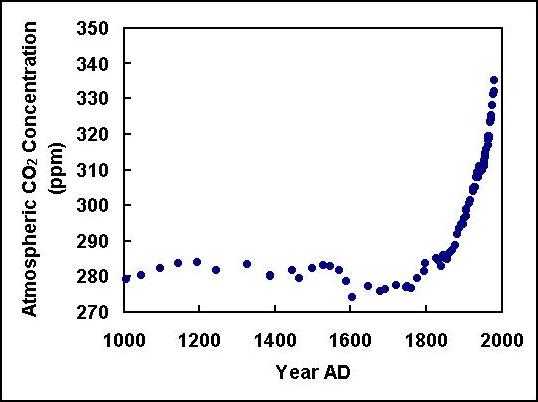
This is a really serious issue - there is OVERWHELMING scientific evidence for human causation of global temperature increases over the last century, and for an acceleration of the change in the last ten years. Take a look at this graph of CO2 concentrations over the past 1000 years, from the site of an organization that looks at the "positive side" of climate change! Anybody who doesn't find that graph extremely worrying has been drinking way too much of the happy juice. -
Here is what the original authors have to say
-
Re:Biased statisticians and economists?
So, when's the correction coming out, now that the original authors and others have demostrated that these "biases" were artifacts created by the re-examiners importing a 159-collumn spreadsheet into a 112-collumn Excel document?
-
spit in the wind
Mann, Bradley & Hughes (authors of the definitive 1998 study attacked by McIntyre and McKitrick) responded today with:
"McIntyre and McKitrick ("MM") have [...] used neither the data nor the procedures of MBH98. Thus, it is entirely understandable that they do not obtain the same result. Their effort has no bearing on the work of MBH98, and is no way a "correction" of that study as they claim. On the contrary, their analysis appears seriously flawed and amounts to a gross misrepresentation of the work of MBH98."
Scientific observers await the peer review of the MM publication to determine whose science-fu is stronger. Meanwhile, greenhouse deniers have yet to pull rabbits out of their (*ahem*) hats to explain how the Workweek Causes Climate Changes. Or they can join Timothy in celebrating propaganda like the obviously corrupt Economist. Just remember to wear your sunscreen. -
This paper is a piece of crap
-
Re:Yeah RightDon't know exactly what financial links exist between the university and the people who don't like the news of global warming spreading.
--Nice: You don't have any information, but that doesn't stop you from throwing mud.
Why is no one discussing the claims of the paper and how valid they are or aren't? Or the reply from the authors of the original paper as mentioned in this comment?
There are some pretty impressive claims in this paper. The rebuttal looks good, too. I don't know who's right, but I was hoping to see some debate on that here. Instead, there's all this back-and-forthing about the motivations of capitalists (see parent post) vs. environmentalists, or anecdotal evidence about how it's obvious that it's getting warmer ('cos a) we all know how the scientific method pales before anecdotal evidence, and b) for the love of God, the M&M paper did not say that temperatures hadn't risen in the last hundred years -- merely that that rise wasn't unprecedented).
Sorry, getting less coherent as I go on. There are discussions here on the data. But c'mon! I may be overly optimistic here. I realize this is Slashdot, but surely someone here is willing to help me find out what I think
-
Give other researchers time to read to paper first
Posting this as newsworthy less than a week after it was published in a journal is silly. Research takes time, debunking research takes more time.
The authors of the original paper have posted their rebutal already (as linked to by Millionth Monkey. At the moment its still a virtual mud-fight, each side calling the others' data and method wrong.
The abstract from this paper reads like a shotgun attack on the original paper, if your going to critique another author's work it helps not call their data obselete and their method poor, at least not in the abstract. You have a better chance of cooperation and admission of error then.
Both authors of this paper also seem to be first time authors in the field (not that the data should be discounted on that fact alone), McIntyre has no apparent affiliation with a university and McKitrick is an Economist (who has published before, albeit in book form).
For further backup of their theory, more sources are needed (they don't appear to include any supportive references). For example, we have John Daly's account of the hockey stick. There's also Massan's critique, showing essentially the same thing (medieval warm period being ignored by Mann et al.) This data seems to have been sourced from The Greening Earth Society, which, conveniently, is a Oil lobbying organisation.
We can find even more Oil funded rebutals to the original Mann paper, 1,2 (a tenuous link to the Greening Earth Society and General Motors...)
Citing a paper, published in the last week, submitted by an Anonymous Reader (to Slashdot), using the National Post and USA Today as supporting material isn't the proper way to do serious science. The USA Today article opens with " An important new paper in the journal Energy & Environment". The paper is a week old!
Anyway, at least I have some fun reading tonight, ooh, and some data to play with.
-
Only half the argument
A robust response from the authors of the original paper is here. In general a paper like hte one noted here should really be put in some kind of context.
-
Re:Interesting paper [but how to check it out?]
Why doesn't NOAA put all the data for public consumption so that anyone can see who is right and who is wrong?
Well, it was said that the data have been online since 2000. The recent paper cites to here as a source for the original data. The original authors cite to a lot of data here. They also cite to a doubtful/dead link (http://holocene.evsc.virginia.edu/pub/MBH98/TREE/ ITRDB/NOAMER/), and a list of their papers is here.
Personally I'm not sure how to make anything of the data, but I hope independent reviewers who can will weigh in on it -
Re:not strange [but who to believe?]
... if you read the reply of Professor Mann who aims to discredit the work of the authors of this study with quite apparent anger,
I'm not sure that comment is quite fair to the author of the original paper under criticism, who alleges (with quite a lot of supporting detail), that the new paper gives a 'gross misrepresentation' of the original work that is criticized, and he also says that contrary to normal practice of scientific journals, the authors of the original paper under criticism were not given an opportunity to respond.
I'm not an expert in this field but I did try to read the recent paper. The point on which it is all said to be based is data integrity. I wondered how all of the alleged data errors had been verified, and more importantly, how the outside world could repeat that verification. To me, the original author's reply certainly reinforces those concerns about verification of the alleged errors, in part because it raises issues about what makes for the difference in the conclusions -- is the difference significantly due to data errors, or was it due to intentional re-selection of data which appears to be a matter of judgement rather than of error.
Either way, it may all be a local squabble, the content of the 1998 paper under criticism clearly has not been the only evidence for climate change. -
both sides of the story
Various blogs have been talking about this recently. It seems too early to say who's right here --- the original authors have issued a vigorous interim rebuttal [pdf] of the charges, so it's hard to say what's happening. But let's not let that get in the way of a good bit of enviro-sensationalism, eh?
-
This is Microsoft Excel's fault
You seem, however, to have left out your scientific criticism of their methodology and results.
The original 1998 paper by Mann, Bradley, and Hughes was not in error. McIntyre and McKitrick screwed up their data when they published this paper. Somebody exported the raw data in the original paper to Excel but somehow exported 159 columns of data into a 112 column spreadsheet. M&M did not compare the spreadsheet and produced a "correction" to the original paper that was based on nothing but errors, since the full paleoclimatic data series of 159 columns is required to properly audit the analysis done in the 1998 paper. More information here and here. The world really is melting.
The authors of the original paper have already published a rebuttal to this M&M paper with further details about how M&M faithfully replicated neither the data nor the procedures in their audit. -
This is Microsoft Excel's fault
You seem, however, to have left out your scientific criticism of their methodology and results.
The original 1998 paper by Mann, Bradley, and Hughes was not in error. McIntyre and McKitrick screwed up their data when they published this paper. Somebody exported the raw data in the original paper to Excel but somehow exported 159 columns of data into a 112 column spreadsheet. M&M did not compare the spreadsheet and produced a "correction" to the original paper that was based on nothing but errors, since the full paleoclimatic data series of 159 columns is required to properly audit the analysis done in the 1998 paper. More information here and here. The world really is melting.
The authors of the original paper have already published a rebuttal to this M&M paper with further details about how M&M faithfully replicated neither the data nor the procedures in their audit. -
Re:"Hacker" is now a shibboleth
If they could pronounce "Shibboleth" properly, they were in. If they couldn't, they were sent on their way.
Um... actually they were dragged away and killed, as usually happens in Bible stories: Judges 12:4-6
-
Mandatory Subject Here
-
Re:Geeks with political power
Ben Franklin was a good businessman and PR man. So he is the one known as the inventor, when in fact TJ probably invented at least as many items as Ben Franklin did. Since Ben Franklin was the shrewd businessman-type, and Thomas Jefferson was the always-losing-money-on-every-business-he-tried type (and his businesses were often based on the newest and latest technologies), you'd think Ben would be more likely to come up with patent, trademark, and copyright laws than TJ would.
TJ created the patent system that was the basis for the patent system in place today, even though he disliked the idea of patents in general. He felt that patents could cause there to be an unfair monopolies.
So he never patented any of his inventions. -
Re:In other obvious News
Actualy I have looked at this in some detail, and as long as it is for academic purposes the code is mine to use. For some reason I tend to code out most of my assignments for my Astronomy class and I usualy put a GPL notice so the professor, and the University understand that I have asserted copyright on my homework. Besides it was suppose to be a joke Because I am so l337