Slashdot Mirror
Domain: virginia.edu
Stories and comments across the archive that link to virginia.edu.
Comments · 959
-
Prince de Broglie...
Yawn. Did these guys ever read Prince de Broglie?
http://galileo.phys.virginia.edu/classes/252/Bohr_to_Waves/Bohr_to_Waves.html
http://en.wikipedia.org/wiki/Louis_de_Broglie
A particle is a wave is a particle-wave; all we can say about the universe, is what we can say about the universe; there's no such thing as a "real physical object."
-
Re:Go with the simple over complex theory
Too bad the 1%ers don't read history or they'd be a hell of a lot more scared than you are. But the fact that they (or rather, the government they bought) repeated the 1920s during the Bush years and almost repeated 1929 shows that they've never cracked open a history book in their lives.
BTW, the link is to a volume that was required reading in an undergrad history class I took in the '70s. It's a very good read. It's also scary how it mirrors the times we live in now.
-
Re:Wow. Slashdot has really changed.
I am one of those kids that dont understand this (neither about why it is better in short term nor whey bad idea in long term). Someone care to explain?
I nominate Alexander Hamilton, James Madison and John Jay.
Or, for an outsider's perspective, de Tocqueville.
- aj
-
2 Weeks of Pascal
I had a blast at UVA's summer enrichment program. It looks like the program has changed a bit in 25 years:
http://curry.virginia.edu/community-programs/student-enrichment/sep/summer
-
Re:a little understanding?
the problem of the ballooning debt isn't getting any better after Bush.
War is expensive. Damned expensive.
I'm also pretty sure that Clinton didn't give Bush the precise plans on the 9/11 attack. But go ahead, blame everything on Bush.
It happened under his watch. He wasn't as culpable for WTC as Truman was for Pearl Harbor, but senior FBI agents ignored warnings from junior FBI agents. You're responsible for the conduct of your employees, and the FBI is part of the executive branch.
The joke's on him and us, because we are really paying for the previous generation, not our own healthcare. Now that the baby boomers are retiring, and the cost of healthcare is spiraling out of control, it can't continue.
The boomer generation is a temporary blip, the "pig in the python".
Right, the housing meltdown was caused by the high price of gasoline and not by people acting irrationally and dishonestly in the midst of a gigantic bubble.
The gasoline was only part of it, of course, but had it stayed under $2 per gallon the housing crisis wouldn't have been nearly as bad. The Clinton administration shares part of the blame for that, since the situation wouldn't have happened if banking regulations hadn't been stupidly relaxed. But the fact is, people could afford the houses they bought when they bought them. People expect raises and don't expect to be laid off.
The saddest part is, history repeated itself. Read Only Yesterday by Frederick Lewis Allen (required reading in a history course I took in 1976). Chapter 11 is about the housing bubble that was partly responsible for the Great Depression.
As to health care, Obama and Congress screwed up big time on that. The #1 reason we have the most expensive but far from the best health care in the world is the insurance companies, both health insurance and malpractice insurance. A single payer system like every other industrialized nation (and many non-industrialized nations) has is the fix for that. Obama's plan is just a gift to the insurance industry.
-
Mr. Jefferson
President Jefferson founded UVa, where students refer to him as Mr. Jefferson..
-
Re:Hurf hurf
Can anyone provide any insight as to how physics would allow this? A near miss with another galaxy, or very dense object? A wandering black hole scooching by and "warping" it? Must take a lot of energy to warp a galaxy.
IANAAP, but a collision with another galaxy, such as the Sagittarius dwarf galaxy, perhaps.
http://www.astro.virginia.edu/~mfs4n/sgr/
(videos at the bottom should provide more than enough detail) -
Re:Meh...
I often hear this claim that simple phones are considered secure, while smartphones are not. There is a very interesting podcast on the German Chaos Computer Club's site that discusses the state of GSM security, and there are many serious concerns there. For example, a SIM card is able to run programs that are installed transparently over the network, without the user knowing anything of it.
The interviewee has a list of related publications on his university website.
If at all possible, get someone to translate this podcast into English for you, then go ahead and treat yourself to a nice smartphone -- accepting that there is no security out there
-
Re:I guess I didnt miss much
"The person who never trained in firearms might punch or kick in that confrontational situation." or if they have not been trained and supported in the idea that violence is a good if not first option then maybe they would not fight but neutralize the situation or leave rather than be confrontational.
Quite possibly. And maybe they'll do that anyway. Humans already possess these capacities, and there are a number of factors that go into what decision a person makes. But humans have it in them to be violent already regardless of what tool or weapon you put in their hands.
"Well actually, I devoted much of my last post to unconscious gut reactions." Your point was seemed to indicate that you had a gut reaction was inviolate, unchanged, cast in concrete, your moral compass, the great unchanging hidden inner behaviour map..
You misunderstand. I was saying that I have a gut reaction that determines my perspective of something. Committing violence against a friend is an abhorrent idea. Committing violence against a stranger is abhorrent, though perhaps less so. Committing violence against an animal seems disturbing and unpleasant. Committing violence against a person's property seems inappropriate. Committing violence against a facsimile of a real person, seems uncomfortable. Committing violence against a facsimile of a fake person seems like nothing at all. My point is that training yourself to be desensitized to violence against facsimiles of fake people does not seem more profound than training yourself to be desensitized to committing violence against styrofoam cups. They aren't people. There is no place in my head that is confused on this point, either logically or unconsciously. And that is evidenced by my unconscious reaction to them. They don't elicit a reaction that is remotely similar to what a real person elicits.
"I see nothing of substance here. Give me a real reason to be concerned about it, not some vague warning about an insidious effect on our unconscious minds. Give me a meaningful bottom line. Give me a reason to care."
Well let's see Columbine Shooting,
No no, you don't get to just point to bad things and claim that they were caused by the effect you describe. If I'm going to put any faith in your theory, you have to come up with some plausible cause and effect. Let's start with me. You say that it has an effect on my unconscious that I do not notice. That's a hypothesis. Now give me something testable. What predictions are made by your hypothesis? How can we test them? In short, why should I give this any credibility? "Bad stuff happens in the world and I personally think the two are related" is not going to cut it.
Gabriel Giffords and company but according to this survey the shootings in schools has declined http://youthviolence.edschool.virginia.edu/violence-in-schools/national-statistics.html
Hell only 9% of male students in 2007 reported carrying guns in school and only 3% of females. So must not be a problem.
1 out of 3 woman report being raped, abused or beaten in their lifetime
http://www.rescue.org/campaign/wakeup-congress?ms=gg_nonb_zzz_zzzz_pm_zzzzzz&gclid=CJzbjbuFwKgCFcm8KgodMU69wg
Gun violence per state.
http://www.guardian.co.uk/news/datablog/2011/jan/10/gun-crime-us-state
Gabrielle Giffords was shot by a lunatic, violent crime does continue to decrease, and while rape is a very serious problem, many of these statistics are more a matter of creative definition than anything else. Wonder how high the proportion of men who have been "raped, abused, or beaten" is. I hate "inclusive or".
-
Re:SHould be REQUIRED on new homes
Actually, you are talking about changing an OLD home. I was talking ONLY about changing NEW homes. With a new home, the payback on geo-thermals is less than 5 years (and that is without subsidies) through the entire lower 49 (my understanding is that even Alaska has quick paybacks on geo-thermal).
Triple pane low-E argon Thermopane is the current high-end standard on new homes, however, they still have 5-7x the loss of a aerogel window.
When it comes to older homes, you have probably done all that really can be done economically. What I am suggesting is to get NEW homes up to high standards so that they do not compete with older homes like yours. Basically, we do not need/want a race to the bottom. -
Re:To mainstream lit, sci fi is like comic books
Including some of the revered names of the literary canon, such as James Fenimore Cooper - see Mark Twain's "Fenimore Cooper's Literary Offenses":
There are nineteen rules governing literary art in domain of romantic fiction -- some say twenty-two.
1. That a tale shall accomplish something and arrive somewhere.
3.They require that the personages in a tale shall be alive, except in the case of corpses, and that always the reader shall be able to tell the corpses from the others.
5. The require that when the personages of a tale deal in conversation, the talk shall sound like human talk, and be talk such as human beings would be likely to talk in the given circumstances, and have a discoverable meaning, also a discoverable purpose, and a show of relevancy, and remain in the neighborhood of the subject at hand, and be interesting to the reader, and help out the tale, and stop when the people cannot think of anything more to say.
10. They require that the author shall make the reader feel a deep interest in the personages of his tale and in their fate; and that he shall make the reader love the good people in the tale and hate the bad ones. But the reader of the "Deerslayer" tale dislikes the good people in it, is indifferent to the others, and wishes they would all get drowned together.These few rules at least seem to be more commonly violated in well-reviewed mainstream fiction than in well-reviewed SF, particularly #10. While the diction of dialogue has become more believable since the early 1800s, the failure to write dialogue and plots meeting the requirements of meaning, relevancy, and interest is so usual over the past few decades that a story or a conversation with a point seems to be considered a reactionary affectation by the mainstream lit-crit twits. The lack of any interest in the characters or any real point is what makes mainstream literature so dull and pointless.
-
Re:A BIT expensive?!
Amazing what difference a few years can make.
-
Re:Eheh
But the decades of Bread and Circusses have dult your memory till it now seems all quant and harmless.
Did you mean "dulled"?Urban Dictionary: dult
a deliberately dumb or dull insult, used when replying to someone who said or
wrote something stupid or insipid.www.urbandictionary.com/define.php%3F... - Cached - Similar
Now realize this. History books are written by people and people have motives.
History books are written by historians. Physics books are written by people, and people have motives.Have a real history book about the 1920s; the book's full text is at the link, gratis. This book was required reading in a mandatory undergraduate level history class I took at SIU in the late seventies (I still have the paperback version). It seems that a lot of what went wrong in the 1920s was exactly the same as the 2000s, including a drug prohibition (the drug alcohol in the '20s), stock market crash, and a housing market meltdown (obviously, the 1929 crash and its resulting depression was worse).
This book is an attempt to tell, and in some measure to interpret, the story of what in the future may be considered a distinct era in American history: the eleven years between the end of the war with Germany (November 11, 1918) and the stock-market panic which culminated on November 13, 1929, hastening and dramatizing the destruction of what had been known as Coolidge (and Hoover) Prosperity.
Obviously the writing of a history so soon after the event has involved breaking much new ground. Professor Preston William Slosson, in The Great Crusade and After, has carried his story almost to the end of this period, but the scheme of his book is quite different from that of mine; and although many other books have dealt with one aspect of the period or another, I have been somewhat surprised to find how many of the events of those years have never before been chronicled in full. For example, the story of the Harding scandals (in so far as it is now known) has never been written before except in fragments, and although the Big Bull Market has been analyzed and discussed a thousand times, it has never been fully presented in narrative form as the extraordinary economic and social phenomenon which it was.
Further research will undoubtedly disclose errors and deficiencies in the book, and the passage of time will reveal the shortsightedness of many of my judgments and interpretations. A contemporary history is bound to be anything but definitive. Yet half the enjoyment of writing it has lain in the effort to reduce to some sort of logical and coherent order a mass of material untouched by any previous historian; and I have wondered whether some readers might not be interested and perhaps amused to find events and circumstances which they remember well which seem to have happened only yesterday-woven into a pattern which at least masquerades as history. One advantage the book will have over most histories: hardly anyone old enough to read it can fail to remember the entire period with which it deals.
As for my emphasis upon the changing state of the public mind and upon the sometimes trivial happenings with which it was preoccupied, this has been deliberate. It has seemed to me that one who writes at such close range, while recollection is still fresh, has a special opportunity to record the fads and fashions and follies of the time, the things which millions of people thought about and talked about and became excited about and which at once touched their daily lives; and that he may prudently leave to subsequent historians certain events and policies, particularly in the field of foreign affairs, the effect of which upon the life of the ordinary citizen was less immediate and may not be fully measurable for a long time. (I am indebted to Mr. Mark Sullivan for what he has done in the successive volumes of Our Own Times to dev
-
Re:I have a much more ambitious vision
As to Twain and Huckleberry Finn - Twain took great pains to accurately capture the dialect and idioms of the characters he wrote about.
It isn't censorship, it's a rewrite. With Mark Twain there's no censorship, because the original unmolested text is public domain and there for anyone to read. You can buy unraped versions at almost any bookstore.
However, in the case of a more recent author like Vachel Lindsay, there is a very bad problem -- his heirs hold the still standing copyrights to his works, and his son has set about "correcting" the work to be more contemporary. Much if it will therefore be lost forever, since most of his books were hand made (he was known as the "Hobo Poet", riding the rails).
Odd that this controversy isn't covered in the wikipedia article, it's well known to acedemics here in Springfield.
-
Re:Ron Paul
When the US federal gov't infringes on your rights, there's basically nothing you, a citizen, can do about it.
This statement is about as dead wrong as you can get. The Federal government as established under the Constitution of the United States has checks and balances to provide even individual citizens with the power to challenge the super power.
Case in point, Welsh vs United States and here Leary vs United States and here Muhammad Ali vs United States.
Don't get me wrong, it is not perfect and oppression still occurs but make no mistake, you do have options under the Constitution to protect your rights.
Now compare this to (T)Ron Paul's option.
Yes, by all means do compare.
In Ron Pauls Religious Freedom Act he doesn't intend for there to be religious freedom for individuals like the Constitution, no, he intends "REMOVAL OF RELIGIOUS FREEDOM-RELATED CASES FROM FEDERAL DISTRICT COURT JURISDICTION" which means you will no longer have the protection of the Constitution and no recourse to the Supreme Court when the local mob in your state creates oppressive laws based on religion.
The reality is quite the opposite of what you are describing.
you would be free to vote with your feet
This is an interesting and common solution among Ron Paul supporters, don't like the oppression then leave, but here is the deal, the United State as defined by the Constitution was here before you and before Ron Paul. If you have so much trouble with the liberty and freedom of individuals that is protected by the Constitution then leave. Nobody is forcing Ron or anyone else to stay in the United States.
Any biologist will tell you that evolution proceeds fastest when it takes place in small groups.
Political oppression and tyranny are not ruled by natural selection and they do not experience variance due to random mutation. Besides, oppressive governments have been tested many times, they don't work, there is no reason to trash the Constitution and revert the states to some ridiculous mob rules democracy where the desires of the mob no matter how absurd take precedence over the rights of individuals.
-
Re:There's no need to fear Joe Lieberman
Presumably, you want your government (whatever government that might be) to have strong diplomacy and the ability to influence its region of the world.
I've posted this before, but it's worth repeating. Thomas Jefferson quotes on Foreign Policy. Replace "Europe" with "the Middle East" (or, indeed, most regions of the world) and the sentiment is the complete opposite of current U.S. foreign policy.
"We wish not to meddle with the internal affairs of any country, nor with the general affairs of Europe. Peace with all nations, and the right which that gives us with respect to all nations, are our object."
"I have ever deemed it fundamental for the United States never to take active part in the quarrels of Europe. Their political interests are entirely distinct from ours. Their mutual jealousies, their balance of power, their complicated alliances, their forms and principles of government, are all foreign to us. They are nations of eternal war. All their energies are expended in the destruction of the labor, property and lives of their people."
"Peace, commerce and honest friendship with all nations--entangling alliances with none, I deem [one of] the essential principles of our government, and consequently [one of] those which ought to shape its administration."
The last quote is particularly telling. Current U.S. foreign policy has allied and entangled the United States with dictatorial monarchies throughout the Middle East. Why is it that unelected Kings urge one of the most powerful nations on Earth to bomb and invade a Middle Eastern country that poses no military threat to North America? And the right-wingers lap it all up. In one hand they wave the Constitution, and decry anything that the government does which isn't explicitly listed there. Does the Constitution of the United States say that one of the responsibilities of the Federal government is to meddle in the affairs of other nations? Did the Founding Fathers envisage that this would be one of the main responsibilities of the government of the United States? Did they even give the President the power to start a war?
"[The President's power]. . . in substance much inferior to it [The power of the British King]. It would amount to nothing more than the supreme command and direction of the land and naval forces . . . while that of the British King extends to the declaring of war and to the raising and regulating of fleets and armies; all of which by the Constitution would appertain of the legislature."
-
Re:Little known?
Well, of course, he did win the Richard W. Hamming Medal 16 years later. I think the issue with Hamming is that he was so productive, and at the forefront of the field for so long, that he never settled into the "grand old man" role that tends to attract awards. I have a pet theory that for most researchers, winning big awards is a signal of their decline, because the politics of award committees means that its rare for somebody who still publishes controversial and original research to survive the nomination process. I mean, he wasn't even voted to be an IEEE fellow until 18 years after he published the Hamming code! His career was so successful in so many areas that it took some time for the applied mathematics community that all these really interesting little ideas in their own fields were the result of an avalanche of singular proportions.
Hamming clearly intended to do this, and often contrasted himself with Shannon. He categorized his approach in a talk called "You and Your research" delivered at Bell labs in 1986, which I'd highly recommend to any researcher who hasn't seen it.
-
Re:If you don't already....
Yeah, kid, I thought that once, too. Until I lived through a little history. Want an eye opener? Read this book, which eerily mimics the present.
Chapter 3, the Big Red Scare is like our own "OMFG Teh Terrists!!!!"
Chapter 5, Revolution in manners and morals... hell, you only have to look at its title.
Chapter 6, Harding and the scandals... some things never change.
Chapter 7, "The DotCom", er, "Coolige Prosperity".
10, Alcholol and Al Capone (Cocaine and whatsisname)
11, Home, Sweet Florida (housing boom and bust)
13, Stock Market Crash.
Yeah, studying history is useless, all right.
-
Re:Ewwww, imagine "can't skip" technology?
Project Gutenberg, alas, only has public domain works afaik. However, there are other sources of free, legal, copyrighted books online. Cory Doctorow explains in Content why he posts all his books online:
- Many writers have tried free e-book releases to tie in with the print release of their works. To the best of my knowledge, every writer who's tried this has repeated the experiment with future works, suggesting a high degree of satisfaction with the outcomes
- A writer friend of mine had his first novel come out at the same time as mine. We write similar material and are often compared to one another by critics and reviewers. My first novel had a free download, his didn't. We compared sales figures and I was doing substantially better than him -- he subsequently convinced his publisher to let him follow suit
- Baen Books has a pretty good handle on expected sales for new volumes in long-running series; having sold many such series, they have lots of data to use in sales estimates. If Volume N sells X copies, we expect Volume N+1 to sell Y copies. They report that they have seen a measurable uptick in sales following from free e-book releases of previous and current volumes
- David Blackburn, a Harvard PhD candidate in economics, published a paper in 2004 in which he calculated that, for music, "piracy" results in a net increase in sales for all titles in the 75th percentile and lower; negligible change in sales for the "middle class" of titles between the 75th percentile and the 97th percentile; and a small drag on the "super-rich" in the 97th percentile and higher. Publisher Tim O'Reilly describes this as "piracy's progressive taxation," apportioning a small wealth-redistribution to the vast majority of works, no net change to the middle, and a small cost on the richest few
- Speaking of Tim O'Reilly, he has just published a detailed, quantitative study of the effect of free downloads on a single title. O'Reilly Media published Asterisk: The Future of Telephony, in November 2005, simultaneously releasing the book as a free download. By March 2007, they had a pretty detailed picture of the sales-cycle of this book -- and, thanks to industry standard metrics like those provided by Bookscan, they could compare it, apples-to-apples style, against the performance of competing books treating with the same subject. O'Reilly's conclusion: downloads didn't cause a decline in sales, and appears to have resulted in a lift in sales. This is particularly noteworthy because the book in question is a technical reference work, exclusively consumed by computer programmers who are by definition disposed to read off screens. Also, this is a reference work and therefore is more likely to be useful in electronic form, where it can be easily searched
In my case, my publishers have gone back to press repeatedly for my books. The print runs for each edition are modest -- I'm a midlist writer in a world with a shrinking midlist -- but publishers print what they think they can sell, and they're outselling their expectations - The new opportunities arising from my free downloads are so numerous as to be uncountable -- foreign rights deals, comic book licenses, speaking engagements, article commissions -- I've made more money in these secondary markets than I have in royalties
- More anecdotes: I've had literally thousands of people approach me by e-mail and at signings and cons to say, "I found your work online for free, got hooked, and started buying it." By contrast, I've had all of five e-mails from people saying, "Hey, idiot, thanks for the free book, now I don't have to buy the print edition, ha ha!"
A textbook I was assigned in an undergrad history course in the late '70s at SIU is now online, and it's not just informative, it's a good read, as well. That's not the only book virginia.edu has online, and I would imagine they're not the only college that posts books.
-
Re:Ewwww, imagine "can't skip" technology?
Project Gutenberg, alas, only has public domain works afaik. However, there are other sources of free, legal, copyrighted books online. Cory Doctorow explains in Content why he posts all his books online:
- Many writers have tried free e-book releases to tie in with the print release of their works. To the best of my knowledge, every writer who's tried this has repeated the experiment with future works, suggesting a high degree of satisfaction with the outcomes
- A writer friend of mine had his first novel come out at the same time as mine. We write similar material and are often compared to one another by critics and reviewers. My first novel had a free download, his didn't. We compared sales figures and I was doing substantially better than him -- he subsequently convinced his publisher to let him follow suit
- Baen Books has a pretty good handle on expected sales for new volumes in long-running series; having sold many such series, they have lots of data to use in sales estimates. If Volume N sells X copies, we expect Volume N+1 to sell Y copies. They report that they have seen a measurable uptick in sales following from free e-book releases of previous and current volumes
- David Blackburn, a Harvard PhD candidate in economics, published a paper in 2004 in which he calculated that, for music, "piracy" results in a net increase in sales for all titles in the 75th percentile and lower; negligible change in sales for the "middle class" of titles between the 75th percentile and the 97th percentile; and a small drag on the "super-rich" in the 97th percentile and higher. Publisher Tim O'Reilly describes this as "piracy's progressive taxation," apportioning a small wealth-redistribution to the vast majority of works, no net change to the middle, and a small cost on the richest few
- Speaking of Tim O'Reilly, he has just published a detailed, quantitative study of the effect of free downloads on a single title. O'Reilly Media published Asterisk: The Future of Telephony, in November 2005, simultaneously releasing the book as a free download. By March 2007, they had a pretty detailed picture of the sales-cycle of this book -- and, thanks to industry standard metrics like those provided by Bookscan, they could compare it, apples-to-apples style, against the performance of competing books treating with the same subject. O'Reilly's conclusion: downloads didn't cause a decline in sales, and appears to have resulted in a lift in sales. This is particularly noteworthy because the book in question is a technical reference work, exclusively consumed by computer programmers who are by definition disposed to read off screens. Also, this is a reference work and therefore is more likely to be useful in electronic form, where it can be easily searched
In my case, my publishers have gone back to press repeatedly for my books. The print runs for each edition are modest -- I'm a midlist writer in a world with a shrinking midlist -- but publishers print what they think they can sell, and they're outselling their expectations - The new opportunities arising from my free downloads are so numerous as to be uncountable -- foreign rights deals, comic book licenses, speaking engagements, article commissions -- I've made more money in these secondary markets than I have in royalties
- More anecdotes: I've had literally thousands of people approach me by e-mail and at signings and cons to say, "I found your work online for free, got hooked, and started buying it." By contrast, I've had all of five e-mails from people saying, "Hey, idiot, thanks for the free book, now I don't have to buy the print edition, ha ha!"
A textbook I was assigned in an undergrad history course in the late '70s at SIU is now online, and it's not just informative, it's a good read, as well. That's not the only book virginia.edu has online, and I would imagine they're not the only college that posts books.
-
Re:Troll?!
You should read a little history. The 1930s were far worse than now. You'ld be hard pressed to have a worse time than in the dust bowl, or living through the Civil War. My late grandmother told me the "roarong twenties" didn't roar for many, only for the rich. It was the terrible twenties for normal people. Listening to her talk it must have been a lot like the seventies, only worse.
If you mean "worse than in Spotlight2k3's lifetime" then maybe. How old are you, kid? The seventies were pretty bad economically, although it was far better culturally than now, but my grandpa (born 1896) had it far worse than you or me ever dreamed of (raised 4 kids during the depression).
-
Re:Troll?!
I agree about Obama. But as I wasn't alive when McKinley was President I can't say, but my grandmother (who voted against Roosevelt 4 times) says Coolige was responsible for the Great Depression, and this history book agrees with her. People called it the "Hoover Depression" but Hoover had only been in office 2 years when the stock market crashed and the banks all failed. Far from average, I never thought I'd ever see a worse president than Carter until Bush II was elected.
Reagan was a wonderful President if you "earned" your money gambling the stock market or even better if you were a banker or lawyer, a very VERY bad president if you worked for a paycheck. His capital gains tax cut put businesses out of business (more lucrative to sell than stay open), put people out of work, got others' hours cut because of the orgy of buyouts and leveraged buyouts.
Clinton was a good President from what I could tell by being a working man living in America.
Nixon was a mix of extremly good and extremely bad. We landed on the moon on his watch, and although Kennedy started us on our journey there, it was the ONLY thing he did worthwhile. He could have been a great President, but just wasn't in office long enough (I was in 6th grade when he was shot).
-
Re:As the economy improves???
Actually, I think it was the price of transportation that made everything come crashing down. Gasoline here was $1 per gallon when Bush took office, and climbed to $4.50 before the economy crumbled and Bush left.
You have folks doing reasonably well so they buy a bigger house and an SUV, then WHAM -- more than a fourfold increase in transportation. It would have hit especially hard on those with long communtes to work. Then they start getting behind, and before they know it the bank has their house and they're renting because their credit isn't good any more. It snowballs to the point of house prices actually falling; this hasn't happened very often in hostory (although here's and example of when it did).
As to making money out of thin air, the folks who fill scuba tanks for a living do. And whoever said "money doesn't grow on trees" never owned a commercial orchard.
BTW, the link above is to Frederick Lewis Allen's Only Yesterday: An Informal History of the 1920s. I was assigned that book in an undergrad history class at SIU in the late seventies, still have the book on my shelf. It's a good read.
-
Re:As the economy improves???
Actually, I think it was the price of transportation that made everything come crashing down. Gasoline here was $1 per gallon when Bush took office, and climbed to $4.50 before the economy crumbled and Bush left.
You have folks doing reasonably well so they buy a bigger house and an SUV, then WHAM -- more than a fourfold increase in transportation. It would have hit especially hard on those with long communtes to work. Then they start getting behind, and before they know it the bank has their house and they're renting because their credit isn't good any more. It snowballs to the point of house prices actually falling; this hasn't happened very often in hostory (although here's and example of when it did).
As to making money out of thin air, the folks who fill scuba tanks for a living do. And whoever said "money doesn't grow on trees" never owned a commercial orchard.
BTW, the link above is to Frederick Lewis Allen's Only Yesterday: An Informal History of the 1920s. I was assigned that book in an undergrad history class at SIU in the late seventies, still have the book on my shelf. It's a good read.
-
Re:I hope this dies on the vine.
If it's in the public domain you can download it free from many internet sources. No need to visit a library at all, unlesss you want the dead tree version.
Internet Archive
Gutengerg Project
lots of universities post PD books on the internet, as well as a lot of books that are still under copyright. I was assigned Only Yesterday in a history class I took in the late 1970s at SIU (I still have the book), and now It's on the internet as well. It's a good read, I reccomend it.Plus, there are Creative Commons books out there as well.
-
Re:I hope this dies on the vine.
If it's in the public domain you can download it free from many internet sources. No need to visit a library at all, unlesss you want the dead tree version.
Internet Archive
Gutengerg Project
lots of universities post PD books on the internet, as well as a lot of books that are still under copyright. I was assigned Only Yesterday in a history class I took in the late 1970s at SIU (I still have the book), and now It's on the internet as well. It's a good read, I reccomend it.Plus, there are Creative Commons books out there as well.
-
Link to Technical Paper
-
Reading this just makes me sad...
First, in regards to the campaign contributions: based on that list you cited, it looks like one should be more concerned about tribal gaming than the NEA. While NEA was #1, the various tribal gaming donors were #2, #3, #4, #8, and #9. Combined, they squash teacher interest.
Now think about this for a moment, because I think this is incredibly important. What do you consider more important to our society, gambling or public education? What should we be fighting to preserve more? A little news for you: Thomas Jefferson, one of the founding fathers of our country, fought tooth-and-nail to establish a public educational system in this country, as he understood that it was one of the most important methods of preserving our form of government. "I have indeed two great measures at heart, without which no republic can maintain itself in strength: 1. That of general education, to enable every man to judge for himself what will secure or endanger his freedom. 2. To divide every county into hundreds, of such size that all the children of each will be within reach of a central school in it." --Thomas Jefferson to John Tyler, 1810. ME 12:393. And that's just one quote. You can read another whole fist-full here.
Considering how vital education is to our country, I think a national educators union deserves to spend whatever it needs to preserve the interests of public education, which sadly has been under attack from various businesses, philanthropists, and other institutions over the last few decades. Which leads me to my second point...
You do get what you pay for, and the teacher's union (NEA) are the single largest campaign contributors in the United States.
Then explain to me why No Child Left Behind is so vehemently opposed by teachers at large? It received widespread, bipartisan support when it was passed and renewed in Congress, so why were teachers and the unions so against it? If we were truly getting what we paid for, then I think you would see legislation that was more supportive of unions, rather than trying to undermine them and work against them. (And while NCLB was bad, it doesn't hold a candle to what Duncan and Obama are trying to push through the pipes with the latest "Race to the Top." And remember, the NEA backed Obama during the election, so why such opposition?)
Rather, I believe the NEA is spending that much money to do the best that it can to fight such radical undermining of public education.
I'm a teacher. And I will admit, there are problems with public education. Some of those are coming from outside, and some from within. Long has the unions ignored the problems with permitting poor teachers to stay on the payroll and do nothing to help them improve in their teaching skills, it has created a subgroup of individuals with no motivation to improve. But creating a punitive system that stands to bring down an entire school due to poor performance of a student population at large on invalid assessment methods is no way to fix the system. Replacing elected school board officials with unilateral tyrants who are not accountable to the public is no way to fix a the system. Teachers know better than anyone what makes a student learn, and we're so overwhelmed by all these biased and/or misguided individuals, politicians, and businesses who all fighting to take charge of a system that they have no idea how to operate, it's like letting a three-year-old into
-
Re:Elementary my dear Watson
Look at 1929. Unemployment then was less than 5%. In 1930 it more than doubled, then doubled again in 1931.
Excuse me, but FDR didn't take office until 1933.You're doing the same thing that the Right is doing today.
Not at all. I did not blame FDR for the Great Depression but I do blame him for lengthening it. I even gave the date FDR took office, "4 March 1933." No, I brought up 1929 because that was when the protectionist Smoot-Hawley Tariff Act became law and it shut down international trade. I quite clearly stated that.
A lot of the way you see FDR depends on whether you think government exists for the benefit of people or the benefit of corporations
You left one out one way of seeing government, if government exists for the benefit of the politicians who make the laws and the bureaucrats that runs government. As for how I see it, just as most mind readers on slashdot are, you're wrong, I see it as a combination of different things. As they say power corrupts and absolute power corrupts absolutely. That applies in business and in government. Businesses can, and do, actually use power to bribe or control politicians. And they've been successful at it.
We need another FDR.
No, we need another Thomas Jefferson. Jefferson warned about the corporate aristocracy: "I hope we shall... crush in its birth the aristocracy of our moneyed corporations, which dare already to challenge our government to a trial of strength and bid defiance to the laws of our country." --Thomas Jefferson to George Logan, 1816. In his first 100 days though FDR signed the National Industrial Recovery Act which suspended corporate anti-trust law enforcement. You know those laws that forbid corporations with conspiring with each other to control prices and wages? Later FDR made it illegal for employers to give employees raises. Of course that suited corporations, they could blame government for not giving employees raises.
Falcon
-
Re:LINUX rounds numbers fineActually, if you look at UVa's IT support policy, you begin to understand these numbers:
http://itc.virginia.edu/wireless/encrypted.html
At the bottom:*ITC provides limited support for these operating systems to connect to the unencrypted wahoo wireless network.
Sounds like they basically tell incoming freshman, "Don't use 'Linux,' use Windows or Mac OS X, or else we will not help you." Here is something else to consider:
http://www.uvastudentcomputers.com/shop_undergrad.asp?mscssid=30F0745C151949448828BA5BF0423D90
Notice that they place Apple's laptops higher on the page than Dell's or Lenovo's -- and that they choose words like "fastest" and "most powerful" to describe them (compare with the descriptions of other machines). This store is located in UVa's bookstore, and so incoming students are likely to purchase their computers from there. No surprise, then, that so many students at UVa are using Apple products. -
Re:Confusing Title
Take a few minutes and read the premiere issue of Action Comics; IIRC the first bad guy encountered is a wife beater. The creators/writers were children of the Depression, chock full of Roosevelt-y post-WWI modernity -- bankers were perfect targets for Superman's shenanigans.
-
Re:History Books
I hope you're being sarcastic. Those who ignore history are indeed doomed to repeat it. Prohibition with its police corruption and gang wars, and economic depression, for example. It's happened before.
-
Re:So what
I'm certainly glad that the FDA had to approve the device that's implanted in my left eye. And considering the history of snake oil and homeopathic medicine salesmen before the FDA (indeed, these are why it was instituted in the first place), not to mention all the cases of food poisoning yearly, I'm damned glad there's an FDA.
Read Upton Sinclair's The Jungle some time. Education cures neoconism.
-
Re:Prohibition?
Filesharing may be free as in beer, but it does not deliver you free beer.
Neither did speakeasies; you had to pay for the beer, and Al Capone and his ilk got the money for your beer. And comparing file sharing to alcohol prohibition is a dubious analogy at best (is slashdot's "badanalogyguy" really Peter Jenner?). It only holds in that both were laws that the public vehemently disagreed with and disregarded. Alcohol prohibition is more like drug prohibition -- it spawned violent gangs that were funded by the illicit substances, and the laws themselves caused more problems than they could possibly have solved, and many of the problems attributed to alcohol then and illegal drugs now are caused by the laws themselves, rather than the substances.
But I have to agree with Jenner, and add that piracy and the phantom "lost sales" aren't the real reason the RIAA is against file sharing. It's because the RIAA labels have radio, and the indies have P2P. P2P does in fact cost the RIAA labels sales; when you hear an indie song you like and buy the CD, that's money you don't have to buy RIAA music. The RIAA's war against "piracy" is a war against their competetion.
If there was no such thing as radio, the RIAA would certainly welcome P2P and "pirates".
-
Re:People still bank at Chase?
illusion of choice, not a real choice to have a soundly ran bank because there is all that moral hazard created by the government through FDIC and other programs.
I don't care if a business is run soundly ar not, all I care about is price, customer service, and whether they'll be in business in the future. Before the FDIC there was no more way to tell if a bank was sound than there is now, but even if it goes belly-up you'll still get yor money. The FDIC doesn't protect the bank against being run badly, it protects the bank's customers.the entire point is that the government is the reason for things going south like that.
You might want to read this book (full text at link). It was required reading in an undergrad history class I took long ago, and if you read it you'll find that the Great Depression was caused by the fact that the government (President Coolige and the legislators) were keeping their hands OFF the economy.
Government cannot guarantee jack shit, it has NO MONEY. It does not produce anything
It isn't supposed to produce anything, it's supposed to govern. It's paid for by taxes, which as one guy's sig says, pays for civilization. Bush cutting taxes on the rich while starting two wars and mismanaging everything he touched while in office didn't help the economy any, but it wasn't the cause of its collapse, either.
Government set the interest rates back in 1930s, it was printing and printing and creating incentives for people to 'invest' in stocks they didn't understand. It was yet another government caused credit bubble that burst eventually.
OK, I'm going to let you read the fucking book and get to the rest of your ill-informed comment later. Here's a hint: the economy collapsed in 1929. It gradually strengthened in the '30s, thanks to government programs, and finally lifted with the advent of WWII when everybody went back to work supporting the war effort.
Now please go read some history.
-
In Texas, though
-
Re:According to US Senator Harry Reid ...
You say "eliminating the US Department of Education" like it is a bad thing! I'm all for it. I'm for pulling out of the United Nations. I'm for getting rid of Social Security, Medicaid and Medicare. Floridation of water? Debatable. But, a local gov't issue. Alcohol? Local issue. Global warming? It IS still being debated. And then, not proven that it is man-made warming. Drilling for oil? Please, lets! I am for keeping dollars in the USA, instead of being sent overseas. Really, the States Rights vs. Federal Rights is the pivotal issue. In the words of Thomas Jefferson, whom helped found the USA. ""Most codes extend their definitions of treason to acts not really against one's country. They do not distinguish between acts against the government, and acts against the oppressions of the government. The latter are virtues, yet have furnished more victims to the executioner than the former, because real treasons are rare; oppressions frequent. The unsuccessful strugglers against tyranny have been the chief martyrs of treason laws in all countries." --Thomas Jefferson: Report on Spanish Convention, 1792. " http://etext.virginia.edu/jefferson/quotations/jeff0300.htm [virginia.edu]
Pulling out of the UN? how much Glen Beck have you been watching?
Now the UN might survive without the US, but I have my doubts. The UN manages to prevent all sorts of minor issues from turning into real conflicts. The UN steps in (though not often enough) to stop genocide bosnia, sierra leone, east timor . The WHO (branch of the UN) ended smallpox.... so yea that needs to stop.
Global Warming -- the science is there, it's real, and a good chunk is man-made. Even if it werent anthropocentric we still need to deal with it, throwing up our hands and saying not our problem seems like the right choice?. Global warming isnt a real debate among climate scientists, it's like saying evolution is still debated by biologists... total bsStorm
-
Re:According to US Senator Harry Reid ...
You say "eliminating the US Department of Education" like it is a bad thing!
I'm all for it.
I'm for pulling out of the United Nations.
I'm for getting rid of Social Security, Medicaid and Medicare.
Floridation of water? Debatable. But, a local gov't issue.
Alcohol? Local issue.
Global warming? It IS still being debated. And then, not proven that it is man-made warming.
Drilling for oil? Please, lets! I am for keeping dollars in the USA, instead of being sent overseas.
Really, the States Rights vs. Federal Rights is the pivotal issue.In the words of Thomas Jefferson, whom helped found the USA.
""Most codes extend their definitions of treason to acts not really against one's country. They do not distinguish between acts against the government, and acts against the oppressions of the government. The latter are virtues, yet have furnished more victims to the executioner than the former, because real treasons are rare; oppressions frequent. The unsuccessful strugglers against tyranny have been the chief martyrs of treason laws in all countries." --Thomas Jefferson: Report on Spanish Convention, 1792. " -
Re:In keeping with tradition, really
...
And the South didn't fight over slavery; that issue didn't enter the war til later, and Lincoln was only bent on hurting the south, not helping the slaves -- read his own words about it. The war was about states' rights, and against crushing economic pressure brought by northern industrialists.
Well, that's the story that the South has been selling for 140 years or so anyway. Not slavery, so siree! Just Northern Oppression! Relentless repetition by Southerners (the North stopped caring particularly a century ago) has given this claim a wholly unwarranted veneer of plausibility. Examination of the words and deeds of the men who actually led secession reveals this to be Southern fantasy.
Read Charles B. Dew's Apostles of Disunion: Southern Secession Commissioners and the Causes of the Civil War http://www.upress.virginia.edu/apostles/index.html. Dew examines the actual speeches, arguments, and publications of the secessionists in the months after Lincoln's election, when the South seceeded, fired on Union forts, and thus began the Civil War. The remarkable thing is that the preservation of slavery was the only thing on these men's minds. At the outset of the Civil War, the leaders of the South were of one mind - they agreed unanimously that the purpose of secession was to keep African-Americans enslaved.
Destroying slavery was not first on Lincoln's agenda, but preserving it was first on the minds of the South.*
It is striking that as soon as the smoke cleared from the battlefields, the Southerners tried to make slavery disappear from the picture and recast it as a "noble cause". One might almost suppose they realized how profoundly in the wrong they were, and that history would revile them without a whitewash.
(* And there is a classic book: The Mind of the South by W.J. Cash that makes it clear how central subjugation of African Americans was to Southern identity, to poor whites just as much as rich landowners.)
-
Neither governments nor corporations appeared out
of thin air;
You're right, government gave corporations the power they enjoy. So to make themselves bigger corporations made government bigger. Thomas Jefferson wrote his warning about corporations, "I hope we shall... crush in its birth the aristocracy of our moneyed corporations, which dare already to challenge our government to a trial of strength and bid defiance to the laws of our country." But now instead of bidding defiance to government corporations now get politicians to write laws favoring them.
Government, in that sense, is an attempt to curb the threat of centralized power by trying to have a single entity, which is at least nominally controllable, and can all other such entities - corporations - in check.
At least here in the USA, states grant most corporate charters not the federal government, and the last tyme I checked there were 50 states.
Falcon
-
Re:Broken? More like fixed.
I strongly disagree with this post.
Technically, Jefferson did the Louisiana purchase with a direct citation to the constitution, because he (and congress!) set it up as a Treaty, which the President does have the authority to do under the constitution, Article 2, section 2.
It may not be as "easy or good as it sounds in theory" but i think you're missing the point of what the Constitution does(did?) for this nation. Citing the Louisiana purchase and then following it with "in practical terms limiting the government to just the constitution isn't as easy or as good as it sounds in theory" defecates all over the idea of what Jefferson and the founding fathers were trying to do from the very beginning.
The United States Constitution was the first document to spell out absolute terms of a limited government. It is our highest law. It is the very essence of this nation. It is designed to be adhered to absolutely and there is an rigorous process in place to amend it. This is not some accident. It's not something Jefferson, James Madison and all the others thought about lightly and it's not something that they figured will be able to be worked around because it's not practical. The fact that it is interpreted loosely now isn't because there was some major epiphany about the practicality or "goodness" of limiting government, it is because of a history of Supreme court cases which stemmed from politically motivated ideals in the New Deal era.
The power of the federal government didn't grow to what it is now with the Louisiana Purchase. The power of the federal government grew slowly throughout the early 20th century, accelerated during the New Deal, and then exploded in 1942, when the Supreme Court decided Wickard v. Filburn, 317 U.S. 111 (1942). The Supreme Court took that case and broadly interpreted the Commerce Clause of the constitution so that the Federal Government can then regulate practically anything they want. For the next five decades, the Supreme Court interpreted the commerce clause to allow congress to regulate (more or less) whatever they want because anything they regulate "could have an effect on interstate commerce." This is the basis of gun regulation, The Controlled Substances Act, many of our anti-segregation laws, etc. etc. It wasn't until the Rehnquist court decided US v. Lopez (1995) that congress has some limitation on using the Interstate Commerce Clause to decide what it can regulate. This is now interpreted as a limitation on the power of congress to use the Interstate Commerce Clause, which, in my opinion, is a severe perversion of what the system was initially set up to do.
No, it's not as easy to limit the federal government to "just the constitution" in theory. But who says it's not good? How do we know? I sure don't, because I've never lived in a system like that. I doubt you have either, because as far as I know, it hasn't existed in fifty years.
Thomas Jefferson would be absolutely appalled at what the US Federal Government has become.
"To preserve the republican forms and principles of our Constitution and cleave to the salutary distribution of powers which that has established... are the two sheet anchors of our Union. If driven from either, we shall be in danger of foundering." --Thomas Jefferson to William Johnson, 1823. ME 15:452 http://etext.virginia.edu/jefferson/quotations/jeff1050.htm -
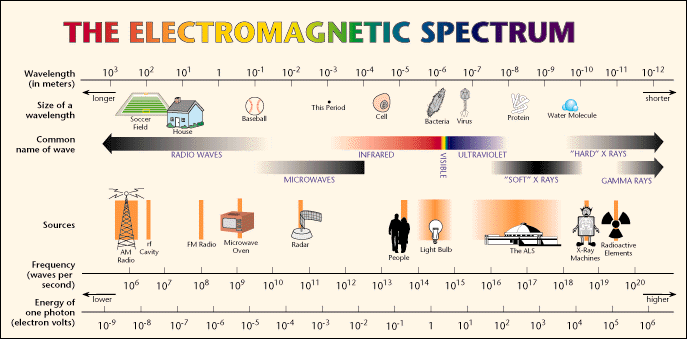
Re:Independent studies warranted
Yep, you've got the theory right, but think you're getting mixed up with some of the labels or are just picturing microwaves in the wrong place of the spectrum.
Here's an image just found using Google Images that shows it quite well:
http://galileo.phys.virginia.edu/classes/USEM/SciImg/home_files/introduction_files/EMSpec.gif -
Re:Are the Supremes likely to hear it?
every work of art is copyright by default.
NOTICE
PERSONS attempting to find a motive in this narrative will be prosecuted; persons attempting to find a moral in it will be banished; persons attempting to find a plot in it will be shot. -
Re:Get rid of textbooks already
It's not all that hard to get the info from LOC.
http://memory.loc.gov/ammem/collections/jefferson_papers/mtjtime1.html
Or elsewhere.
http://rotunda.upress.virginia.edu/founders/default.xqy?keys=TSJN-print-01&mode=TOC
Tinfoil (or paper) hat conspirists will never be happy, so why try.
-
street lights
Although urban lighting has always been with us, we have not (yet?) recognised it as a disruptive influence.
No, some of us were blessed by growing up without street lights, instead we were treated to a multitude of bright stars in the sky. In the US there is hardly any place that does not suffer from light pollution. Even after first seeing night photos from space years ago of the light pollution covering the US, parts of Canada, and elsewhere still shocks me.
Oh, and it's been known for year that light pollution takes a toll on wildlife too.
Falcon
-
Re:(smacks forehead)
Better smack it harder.
here, let me break it down to the most bare bones obvious choices:
1. no government or weakened government = unfettered corporate power (what you get with your ideology, but don't admit it or don't realize it)
No, let me break it down to the basics. The government grants corporations their corporate charter. With no government there are no corporations.
3. strong government = curtailed corporate power (where we should go)
Any government powerful enough to give you everything you want is powerful enough to take it away. Let's look at a couple of Thomas Jefferson's quotes:
"I have sworn upon the altar of God, eternal hostility against every form of tyranny over the mind of man."
And in The Forgotten Essentials of Jefferson's Philosophy. "To take a single step beyond the boundaries thus specifically drawn around the powers of Congress, is to take possession of a boundless field of power, no longer susceptible of any definition."but what you seem to want is obviously far, far worse. with no government or weakened government, the only power around, without any checks or balances on it, are the corporations.
Point to one place where I said I did not want any government. On second thought, forget it. I don't want to continue with someone who puts words in my mouth I did not say.
Falcon
-
Re:The fallacy of equating past sentiments to now.
You are assuming that the progress of knowledge is linear; that what we know now vs. what we'll know 100 years from now is the equivalent of what we knew then, 100 years ago, to what we know now.
I'm making no such assumption.
My main point is that it is impossible to know how much of the universe that we don't know. I personally find it almost unthinkable that we will know when we hit the limit of knowledge until 10,000 years after that point.
Seriously. Although much of knowledge seems to be converging, there are still huge swaths of physics that we don't understand, like gravity, magnetism, superconductivity, etc. Yes, we can write down equations for these things and make some predictions, but I don't think that there is anybody out there who can explain why a moving charge creates a magnetic field, for example.
Perhaps these answers will only be intellectual curiosities, but I would be very careful about making any predictions about what is NOT possible. The universe is just too marvelous and humans are just too young as a species for me to think that we're even close to figuring it out.
Why moving charges create magnetic fields: http://galileo.phys.virginia.edu/classes/252/rel_el_mag.html
I would agree that we do have much to learn, but at the same time there is much that we know. When it comes to the fundamental nature of physics, we understand quite a bit about how the Universe works, but we may not have all of the whys just yet.
But even if we did have the "whys", it would be, as you say, settle our academic cravings. But believe me, I am very careful about what I state. And I would just LOVE if someone can prove me wrong by actually making interstellar space travel cheap and affordable. But the equations are very clear on this -- it will take a certain amount of energy to achieve certain velocities; issues of reaction mass and specific impulse will have to be dealt with.
We can dream up all kinds of exotic "cheats", but I want to see a "cheat" that actually works. Because we have not seen one yet nor have we observed one in nature, given the level of observations we make these days, given the physics, given the equations that are verified to increasing levels of spot-on accuracy, I am forced -- despite my own dreams -- to place the possibility of cheap and affordable interstellar travel at a low order of probability -- very low. We can do it, but it's gong to cost us BIG TIME.
Also, the likelihood that a space-faring intelligent species besides us is even close enough to be worth the while of paying that cost to come to Earth is even smaller. We are getting to the point where we may able to detect earth-like planets in nearby stars, if any, and I've heard of a couple of cases where they *think* they may have detected *something*. But even given that, and given the great efforts of the SETI project over the decades, I have to look long in the eye of the possibility of intelligent technologically-advance life being "nearby". With all the gallant efforts of SETI over the decades, there has only -- to my knowledge -- be one detection of what MAY be an intelligent signal -- the so-called "Wow Signal" that was never repeated.
It's a really big Universe, and the size of it is really incomprehensible to most humans. Physics tends to be non-intuitive, especially the physics that goes beyond normal everyday experiences. The best we can do right now is an 80-year round trip to the *nearest* star, assuming all the technical issues can be solved, and it would be at great cost, with lots of huge uncertainties. I am sure we can improve on that somewhat, but the more interesting stellar systems are going to be found much further out. 50 light-years? 100 light-years? 1000?
Trust me, I don't want to be right on this. I really don't.
-
Re:Thomas Jefferson said it best:
citation(s) needed. I've seen lots of cases. Most were dealing with prayer over the PA system or teachers or students leading prayers at sporting events and such. I've seen no bans on praying on your own. In fact there have been cases upholding the "moment of silence" in schools.
And of course we all know that if you haven't seen it, it doesn't exist. I'm wondering if your google finger is broke. Here is reference to one, here is another, and I won't bother linking to the others but I'll post the link to the same sites if your interested.
http://www.firstamendmentcenter.org/news.aspx?id=19256
http://www.firstamendmentcenter.org/news.aspx?id=19517
http://caselaw.lp.findlaw.com/scripts/getcase.pl?court=us&vol=496&invol=226
http://religiousfreedom.lib.virginia.edu/court/lamb_v_cent.html
http://religiousfreedom.lib.virginia.edu/court/rose_v_rege.html
http://religiousfreedom.lib.virginia.edu/court/boar_v_merg.html
http://religiousfreedom.lib.virginia.edu/court/widm_v_vinc.htmlAnd those are just some that were compiled at a couple site showing up in the first few results of the google search. And yes, a couple of those were dealing with prayer over the PA system in which the court rules it was allowed. At least two of the cases cited refereed to the use or the PA system at either football games or graduation ceremonies and echoed the same sentiments on when it's controlled by the school or student.
That's how they've tried to sell it, but it clearly says that this nation is under God (proper noun). If that doesn't profess a belief, not just in a god, but in a specific God, then you're going to need some serious evidence to back up your explanation of what it actually means. The court's decision was essentially an appeal to tradition and a refusal to consider the matter. The addition of the phrase was intended originally to distance our country from those godless commies in Russia.
So if I say God with the capitol G as a proper noun, I'm automatically preaching or endorsing a religion? I guess you were preaching too when you wrote your statement pointing that out. Do you see how ridiculous that sounds? And no, that's not a strawman argument, it's the basis of your argument completely and undistorted outside of the subject being stated.
As I mentioned earlier which doesn't have the lunacy of your contention, the phrase under God in the pledge is not a prayer or religion,"Thus, the pledge is an endorsement of our form of government, not of religion or any particular sect." as the courts said.
You are correct as I have already noted, the phrase was intended to distance ourselves from those godless commies. But what you are not seeing here is that our system of leadership and government (until relativity recently anyways) answered to a higher power. Be it the people, a god, or patriotism and the constitution in which all it's power is derived from the consent of the people. On the contrast, the godless commies decreed the state and their personal power to be the ultimate in much the same ways as the Roman emperors and the pharaohs of Egypt eventually declared themselves a god. There was no higher power then themselves to which the US was st
-
Re:Thomas Jefferson said it best:
citation(s) needed. I've seen lots of cases. Most were dealing with prayer over the PA system or teachers or students leading prayers at sporting events and such. I've seen no bans on praying on your own. In fact there have been cases upholding the "moment of silence" in schools.
And of course we all know that if you haven't seen it, it doesn't exist. I'm wondering if your google finger is broke. Here is reference to one, here is another, and I won't bother linking to the others but I'll post the link to the same sites if your interested.
http://www.firstamendmentcenter.org/news.aspx?id=19256
http://www.firstamendmentcenter.org/news.aspx?id=19517
http://caselaw.lp.findlaw.com/scripts/getcase.pl?court=us&vol=496&invol=226
http://religiousfreedom.lib.virginia.edu/court/lamb_v_cent.html
http://religiousfreedom.lib.virginia.edu/court/rose_v_rege.html
http://religiousfreedom.lib.virginia.edu/court/boar_v_merg.html
http://religiousfreedom.lib.virginia.edu/court/widm_v_vinc.htmlAnd those are just some that were compiled at a couple site showing up in the first few results of the google search. And yes, a couple of those were dealing with prayer over the PA system in which the court rules it was allowed. At least two of the cases cited refereed to the use or the PA system at either football games or graduation ceremonies and echoed the same sentiments on when it's controlled by the school or student.
That's how they've tried to sell it, but it clearly says that this nation is under God (proper noun). If that doesn't profess a belief, not just in a god, but in a specific God, then you're going to need some serious evidence to back up your explanation of what it actually means. The court's decision was essentially an appeal to tradition and a refusal to consider the matter. The addition of the phrase was intended originally to distance our country from those godless commies in Russia.
So if I say God with the capitol G as a proper noun, I'm automatically preaching or endorsing a religion? I guess you were preaching too when you wrote your statement pointing that out. Do you see how ridiculous that sounds? And no, that's not a strawman argument, it's the basis of your argument completely and undistorted outside of the subject being stated.
As I mentioned earlier which doesn't have the lunacy of your contention, the phrase under God in the pledge is not a prayer or religion,"Thus, the pledge is an endorsement of our form of government, not of religion or any particular sect." as the courts said.
You are correct as I have already noted, the phrase was intended to distance ourselves from those godless commies. But what you are not seeing here is that our system of leadership and government (until relativity recently anyways) answered to a higher power. Be it the people, a god, or patriotism and the constitution in which all it's power is derived from the consent of the people. On the contrast, the godless commies decreed the state and their personal power to be the ultimate in much the same ways as the Roman emperors and the pharaohs of Egypt eventually declared themselves a god. There was no higher power then themselves to which the US was st
-
Re:Thomas Jefferson said it best:
citation(s) needed. I've seen lots of cases. Most were dealing with prayer over the PA system or teachers or students leading prayers at sporting events and such. I've seen no bans on praying on your own. In fact there have been cases upholding the "moment of silence" in schools.
And of course we all know that if you haven't seen it, it doesn't exist. I'm wondering if your google finger is broke. Here is reference to one, here is another, and I won't bother linking to the others but I'll post the link to the same sites if your interested.
http://www.firstamendmentcenter.org/news.aspx?id=19256
http://www.firstamendmentcenter.org/news.aspx?id=19517
http://caselaw.lp.findlaw.com/scripts/getcase.pl?court=us&vol=496&invol=226
http://religiousfreedom.lib.virginia.edu/court/lamb_v_cent.html
http://religiousfreedom.lib.virginia.edu/court/rose_v_rege.html
http://religiousfreedom.lib.virginia.edu/court/boar_v_merg.html
http://religiousfreedom.lib.virginia.edu/court/widm_v_vinc.htmlAnd those are just some that were compiled at a couple site showing up in the first few results of the google search. And yes, a couple of those were dealing with prayer over the PA system in which the court rules it was allowed. At least two of the cases cited refereed to the use or the PA system at either football games or graduation ceremonies and echoed the same sentiments on when it's controlled by the school or student.
That's how they've tried to sell it, but it clearly says that this nation is under God (proper noun). If that doesn't profess a belief, not just in a god, but in a specific God, then you're going to need some serious evidence to back up your explanation of what it actually means. The court's decision was essentially an appeal to tradition and a refusal to consider the matter. The addition of the phrase was intended originally to distance our country from those godless commies in Russia.
So if I say God with the capitol G as a proper noun, I'm automatically preaching or endorsing a religion? I guess you were preaching too when you wrote your statement pointing that out. Do you see how ridiculous that sounds? And no, that's not a strawman argument, it's the basis of your argument completely and undistorted outside of the subject being stated.
As I mentioned earlier which doesn't have the lunacy of your contention, the phrase under God in the pledge is not a prayer or religion,"Thus, the pledge is an endorsement of our form of government, not of religion or any particular sect." as the courts said.
You are correct as I have already noted, the phrase was intended to distance ourselves from those godless commies. But what you are not seeing here is that our system of leadership and government (until relativity recently anyways) answered to a higher power. Be it the people, a god, or patriotism and the constitution in which all it's power is derived from the consent of the people. On the contrast, the godless commies decreed the state and their personal power to be the ultimate in much the same ways as the Roman emperors and the pharaohs of Egypt eventually declared themselves a god. There was no higher power then themselves to which the US was st