Slashdot Mirror
Domain: wikipedia.org
Stories and comments across the archive that link to wikipedia.org.
Stories · 7,048
-
Ask Database Guru Brian Aker
Brian Aker is Director of Architecture for MySQL AB. He has also worked on the code (and database) that runs Slashdot, and is well-known in both Apache and Perl circles. Outside of the arcane world of open source "back-end" programming, though, hardly anyone has heard of him. This is your chance to ask Brian (hopefully after looking at his blog and Wikipedia listing) about anything you like, from Perl to database architecture to open source philosophy to upcoming events in Seattle. We'll send Brian 10 of the highest-moderated questions approximately 24 hours after this post appears. His (verbatim) answers will appear late this week or early next week. -
Thought-Controlled Prosthetics
Ponca City, We Love You writes "Physiatrist Todd A. Kuiken, M.D., Ph.D. has pioneered a technique known as targeted muscle reinnervation (TMR), that allows a prosthetic arm to respond directly to the brain's signals, allowing wearers to open and close their artificial hands and bend and straighten their artificial elbows nearly as naturally as their own arms. Doctors first perform nerve transfer surgery to redirect nerves that go to the amputated arm to the patient's chest muscles. Then when the chest muscle contracts, an electromyogram picks up the electrical signal to move the prosthetic arm. So when the patient thinks 'close hand,"' the hand closes. Now the team wants to see if they can extract more information from the electrical signals produced by the nerves to provide a greater number of hand and arm movements. Theyd have been able to identify unique EMG patterns with 95% accuracy for 16 different elbow, wrist, hand, thumb, and finger movements. 'We've been able to demonstrate remarkable control of artificial limbs and it's an exciting neural machine interface that provides a lot of hope,' says Dr. Kuiken." -
Where Are the Flying Cars?
Ponca City, We Love You writes "Complaints of the non-existence of flying cars as expressions of disappointment in the failure of the present to measure up to the glory of past predictions have long been a staple of popular culture but all that is about to change when Terrafugia introduces their $148,000 "Transition," a 19-foot, two-seater that the company describes as a roadable light-sport aircraft. The problem is that the U.S. doesn't have the infrastructure in place to make landing in front of your house a viable alternative yet and a sky filled with people who don't have pilot's licenses could also be a problem. The idea is to take advantage of the 6,000 public airports in the U.S. so a pilot can fly into a small airport (video) and instead of getting a rental car, just fold up the wings on the aircraft and drive away. Terrafugia expects the first production model to be ready in 2009 and says they've already received advanced orders for 30 to 50 Transitions." -
One SimCity Per Child
SimHacker writes "Electronic Arts has donated the original 'classic' version of Will Wright's popular SimCity game to the One Laptop Per Child project. SimCity is the epitome of constructionist educational games, and has been widely used by educators to unlock and speed-up the transformational skills associated with creative thinking. It's also been used in the Future City Competition by seventh- and eighth-grade students to foster engineering skills and inspire students to explore futuristic concepts and careers in engineering. OLPC SimCity is based on the X11 TCL/Tk version of SimCity for Unix developed and adapted to the OLPC by Don Hopkins, and the GPL open source code will soon be released under the name "Micropolis", which was SimCity's original working title. SJ Klein, director of content for the OLPC, called on game developers to create 'frameworks and scripting environments — tools with which children themselves could create their own content.' The long term agenda of the OLPC SimCity project is to convert SimCity into a scriptable Python module, integrate it with the OLPC's Sugar user interface and Cairo rendering library. Eventually they hope to apply Seymour Papert's and Alan Kay's ideas about constructionist education and teaching kids to program." -
One SimCity Per Child
SimHacker writes "Electronic Arts has donated the original 'classic' version of Will Wright's popular SimCity game to the One Laptop Per Child project. SimCity is the epitome of constructionist educational games, and has been widely used by educators to unlock and speed-up the transformational skills associated with creative thinking. It's also been used in the Future City Competition by seventh- and eighth-grade students to foster engineering skills and inspire students to explore futuristic concepts and careers in engineering. OLPC SimCity is based on the X11 TCL/Tk version of SimCity for Unix developed and adapted to the OLPC by Don Hopkins, and the GPL open source code will soon be released under the name "Micropolis", which was SimCity's original working title. SJ Klein, director of content for the OLPC, called on game developers to create 'frameworks and scripting environments — tools with which children themselves could create their own content.' The long term agenda of the OLPC SimCity project is to convert SimCity into a scriptable Python module, integrate it with the OLPC's Sugar user interface and Cairo rendering library. Eventually they hope to apply Seymour Papert's and Alan Kay's ideas about constructionist education and teaching kids to program." -
Expanding Fair Use To Reform Copyright Law
Hugh Pickens writes "Gigi Sohn, President of Public Knowledge, presented a six-step program for reforming outdated US copyright laws in a speech at the New Media conference at Boston University. Sohn expressed no patience with the 'disconnect between the law and the technology' of media production and distribution. He puts Fair Use at the top of the list for changes that will help return balance to copyright laws that have limited innovation, scholarship, creativity, and free speech. In addition to the four-part legal test for fair use currently on the books, Sohn recommends that Congress add incidental, transformative, and non-commercial personal uses to the list of fair uses enumerated in copyright law, and in addition expressly provide that making a digital copy for the purpose of indexing searches is not an infringement. Beyond Fair Use reform, Sohn advocates punishing copyright holders who 'knowingly or recklessly' send out false takedown notices, protecting the manufacturer of a technology from liability for the infringing activity of others if the technology has substantial non-infringing uses, promoting fair and accessible licensing of copyrighted works, limiting damages for the use of orphan works, and requiring copyright holders to provide notice of any limitations on users' ability to make fair or lawful uses of their products." -
Whose Laws Apply On the ISS?
Hugh Pickens writes "Whose laws apply if astronauts from different countries get into a fight, make a patentable discovery, or damage equipment belonging to another country while on the International Space Station? According to the Outer Space Treaty of 1967, ratified by 98 nations, states have legal jurisdiction within spacecraft registered to them. When the space station was assembled from modules supplied by the United States, Russia, Japan and the European Space Agency (ESA), partners rejected an initial proposal that US law should prevail throughout the space station. "It was agreed that each state registers its own separate elements, which means that you now have a piece of the US annexed to a piece of Europe annexed to a piece of Japan in outer space, legally speaking," said Dr Frans von der Dunk of the International Institute of Air and Space Law at the University of Leiden. So what happens if a crime is committed in space? "If somebody performs an activity which may be considered criminal, it is in the first instance his own country which is able to exercise jurisdiction," Dr. von der Dunk added." -
Slouching Toward Black Mesa
The Escapist this week is themed around stories and storytelling. The article that resonates the most with me is a Tom Rhodes piece called Slouching Toward Black Mesa. It explores the connection between the journey of Gordon Freeman and literary explorations of similar end-of-the-world themes. "Freeman isn't slouching toward Black Mesa, he's converging on the great citadel in the middle of City 17, the Bethlehem of our story. Bethlehem is a holy place in Christian theology, which makes it the perfect location for the beast of Yeats' poem to encroach upon. In City 17, that ideal is flipped on its head, replaced with a center of darkness and powe ... In an even more direct rejection of Yeats, however, the forces in Half-Life 2 are non-supernatural. It continues the series' theme, man as a force in this world; whether for good or ill is his choice. It is this choice, this need to carve out our own destiny and define ourselves based on our own hopes, dreams and fears that makes us human. So what is slouching toward Bethlehem? We are." The issue also features an article entitled The Ending Has Not Yet Been Written, about the never-ending story of Massively Multiplayer Online Games. -
Intergalactic Missing Mass Missing Again
Ponca City, We Love You writes "Researchers at the University Of Alabama In Huntsville have discovered that some x-rays thought to come from intergalactic clouds of 'warm' gas are instead probably caused by lightweight electrons — leaving the mass of the universe as much as ten to 20 percent lighter (in terms of its ordinary matter) than previously calculated. In 2002 the same team reported finding large amounts of extra 'soft' (relatively low-energy) x-rays coming from the vast spaces in the middle of galaxy clusters. Their cumulative mass was thought to account for as much as ten percent of the mass and gravity needed to hold together galaxies, galaxy clusters, and perhaps the universe itself. When the team looked at data from a galaxy cluster in the southern sky, however, they found that energy from those additional soft x-rays doesn't look like it should. 'The best, most logical explanation seems to be that a large fraction of the energy comes from electrons smashing into photons instead of from warm atoms and ions, which would have recognizable spectral emission lines,' said Dr. Max Bonamente. The work was published Oct. 20 in the Astrophysical Journal." -
The Man Behind the Google Phone
Hugh Pickens writes "The New York Times is running a story about Andy Rubin, Google's resident gadget guru, and one of the primary architects of the gPhone. You won't find any new technical details about the gPhone in the story, (Google is planning an announcement on Monday about its future mobile plans.) but the story about Rubin gives some clues that indicate that Google plans to do more than merely develop an operating system for cellular phones. One clue to the gPhone is that after Rubin left Apple he joined General Magic, the company co-founded with Mac pioneers Bill Atkinson and Andy Hertzfeld that developed Magic Cap in the 1990s, a PDA precursor years ahead of its time that included a cell phone and email. The Times speculates that Google may also be planning to replay the strategy that Microsoft used to bulldoze Netscape in the mid-1990s by 'cutting off' Microsoft's air supply by giving the gPhone away to handset makers and to put Microsoft Windows Mobile out of business. If the strategy works, it will be because Rubin and his team have successfully developed a vision of the smartphone of the future and a strategy for getting it accepted by the public and by the carriers." -
Volcanoes May Have Caused Mass Extinctions?
Hugh Pickens writes "According to recent research, huge amounts of sulphur dioxide released by volcanic eruptions may have had more to do with wiping out dinosaurs than the meteorite strike at Chicxulub on Mexico's Yucatán Peninsula. Marine sediments drilled from the Chicxulub crater have revealed that that the mass extinctions occurred 300,000 years after Chicxulub hit Earth. The Deccan volcanism was a long cumulative process that released vast amounts of greenhouse gases into the atmosphere. '"On land it must have been 7-8 degrees warmer," says Princeton University paleontologist Gerta Keller. "The Chicxulub impact alone could not have caused the mass extinction, because this impact predates the mass extinction."' Keller also postulates a second larger and still unidentified meteor strike after Chicxulub, that left the famous extraterrestrial layer of iridium found in rocks worldwide and pushed earth's ecosystem over the brink. But where's the crater? "I wish I knew," says Keller." -
Call For Halt To Wikipedia Webcomic Deletions
ObsessiveMathsFreak writes "Howard Tayler, the webcomic artist of Schlock Mercenary fame, is calling on people not to donate money during the latest Wikimedia Foundation fund-raiser. This is to protest the 'notability purges' taking place throughout Wikipedia, where articles are being removed en-masse by what many see as overzealous admins. The webcomic community in particular has long felt slighted by the application of Wikipedia's contentious Notability policy. Wikinews reporters have recently begun investigating this issue, but are the admins listening?" -
The Real Mother of All Bombs, 46 Years Ago
vaporland writes "Tsar Bomba is the Western name for the RDS-220, the largest, most powerful weapon ever detonated. The bomb was tested on October 30, 1961, in an archipelago in the Arctic Sea. Developed by the Soviet Union, the bomb had a yield of about 50 megatons. Its detonation released energy equivalent to approximately 1% of the power output of the Sun for 39 nanoseconds of its detonation. The device was scaled down from its original design of 100 megatons to reduce the resulting nuclear fallout. The Tsar Bomba qualifies as the single most powerful device ever utilized throughout the history of humanity." -
FBI Accused of Abusing Criminal Database
Peace protesters were unable to leave the country to speak in Canada because their names had been added to a database of criminals. There's a serious due-process violation here because a listing in this database is equivalent to an "infamous" conviction. "'The FBI's placing of peace activists on an international criminal database is blatant political intimidation of US citizens opposed to Bush administration policies,' says Colonel Wright, who was also Deputy US Ambassador in four countries. 'The Canadian government should certainly not accept this FBI database as the criteria for entering the country... The list is supposed to be for felony and serious misdemeanor offenses. We don't qualify — it's for sex offenders, foreign fugitives, gang violence and terrorist organizations, people who are on parole...'" -
Focus Fusion On Google Tech Talks
Henning Burdack writes "Eric Lerner talks on Google Tech Talks about Focus Fusion, which would be a much cheaper and more feasible technology as a fusion energy source than any other current approach, based upon the dense plasma focus device. The technology will use hydrogen-boron fusion with direct induction of ion energy and photovoltaic conversion of x-ray emission, obviating the need of a steam-cycle and thus resulting in higher efficiencies. High temperatures of 1 billion Kelvin (100 keV) have been reached years ago. It only needs $2 million in funding and two years of research for a proof of concept, and maybe four more years for a prototype with positive energy output. In contrast to other fusion efforts it utilizes the natural instabilities of plasma instead of fighting them. Focus Fusion has been discussed on Slashdot before, and a patent application is also available, going a bit more into detail." -
Focus Fusion On Google Tech Talks
Henning Burdack writes "Eric Lerner talks on Google Tech Talks about Focus Fusion, which would be a much cheaper and more feasible technology as a fusion energy source than any other current approach, based upon the dense plasma focus device. The technology will use hydrogen-boron fusion with direct induction of ion energy and photovoltaic conversion of x-ray emission, obviating the need of a steam-cycle and thus resulting in higher efficiencies. High temperatures of 1 billion Kelvin (100 keV) have been reached years ago. It only needs $2 million in funding and two years of research for a proof of concept, and maybe four more years for a prototype with positive energy output. In contrast to other fusion efforts it utilizes the natural instabilities of plasma instead of fighting them. Focus Fusion has been discussed on Slashdot before, and a patent application is also available, going a bit more into detail." -
String Theory in Two Minutes
An anonymous reader writes "Most of us have heard of string theory, many of us know what it is and some of us may even be experts in the field. But could you explain it in two minutes? Discover Magazine recently had a contest to do precisely that: create a two minute or less video of everything you need to know about string theory. You can view some of the best entries (video) as well as the winning video: String Ducky!" -
Brazilian Pop Music Scene Thrives on Piracy
langelgjm writes "When people talk about the failing business model of the traditional record company, they often only offer vague suggestions as to how things would work otherwise. But a concrete example of a music scene that thrives on piracy is to be found in Brazil, in the form of tecnobrega. From the article: 'While piracy is the bane of many musicians trying to control the sale of their songs, tecnobrega artists see counterfeiters as key to their success ... Ronaldo Lemos, a law professor at Brazil's respected Getulio Vargas Foundation, an elite Rio de Janeiro think tank and research center, says tecnobrega and other movements like it represent a new business model for the digital era, where music is transformed from a good to a service.'" -
Famous Criminal Opines that Technology Breeds Crime
jcatcw writes "In an interview with Computerworld's editor in chief, Don Tennant, Frank Abagnale spoke about his life of crime and crime prevention. Abagnale is a notorious criminal, whose exploits were portrayed in the movie 'Catch Me If You Can.' Abagnale claims: 'It would be 4,000 times easier to do today, what I did 40 years ago, and I probably wouldn't go to prison for it. Technology breeds crime — it always has, it always will ... I really think the more technology there is in the world, the more you have to instill character and ethics. You can build all the security systems in the world; you can build the most sophisticated technology, and all it takes is one weak link — someone who operates that technology — to bring it all down." This would seem to echo commentary in a New York Times article about the rise of Russian hackers in recent years. -
Crashed Spacecraft Yields Data on Solar Wind
Hugh Pickens writes "After the Genesis mission spent 27 months in space gathering tiny samples from different types of solar wind, Hollywood stunt pilots swooped in with a helicopter to catch the falling capsule when it returned to earth. Unfortunately the spacecraft's parachute did not open, and the spacecraft ploughed a hole into the desert. Now scientists are starting to recover data from the salvageable pieces of Genesis. Nature Magazine reports that an analysis of isotopes of neon and argon shows that the elements of main interest to the researchers have the same isotopic signature in the solar wind as in the Sun itself. Because dirt contains relatively little neon and argon, the current Science study wasn't affected too much by contamination and the the team remains hopeful that they will be able to get results on oxygen and nitrogen isotopes from the mission." -
IBM Seeking 'Patent-Protection-Racket' Patent
theodp writes "Wikipedia defines a protection racket as an extortion scheme whereby a powerful non-governmental organization coerces businesses to pay protection money which allegedly serves to purchase the organization's 'protection' services against various external threats. Compare this to IBM's just-published patent application for 'Extracting Value from a Portfolio of Assets', which describes a process by which 'very large corporations' impress upon smaller businesses that paying for 'the protection of a large defensive patent portfolio' would be 'a prudent business decision' for them to make, 'just like purchasing a fire insurance policy.' Sounds like Fat Tony's been to Law School, eh? Time for IBM to put-their-money-where-their-patent-reform-mouth-is and deep-six this business method patent claim!" -
Mythbusters to Test Cockroach Radiation Myth
redwoodtree writes "An article on the site for the Tri-City Herald sums it up perfectly: 'Contrary to popular belief, not a significant amount of research goes into cockroach radiation.' To test the old saw about 'the cockroaches being the only survivors of a nuclear war' Discovery Channel's Mythbusters are going out to Hanford Site, where plutonium was manufactured for the first nuclear bomb. It's the single most polluted nuclear waste site in the U.S. The Mythbusters are going to take cockroaches and other insects and apply successively higher doses of radiation in a controlled setting." -
Mythbusters to Test Cockroach Radiation Myth
redwoodtree writes "An article on the site for the Tri-City Herald sums it up perfectly: 'Contrary to popular belief, not a significant amount of research goes into cockroach radiation.' To test the old saw about 'the cockroaches being the only survivors of a nuclear war' Discovery Channel's Mythbusters are going out to Hanford Site, where plutonium was manufactured for the first nuclear bomb. It's the single most polluted nuclear waste site in the U.S. The Mythbusters are going to take cockroaches and other insects and apply successively higher doses of radiation in a controlled setting." -
"All Quiet Alert" Issued For the Sun
radioweather writes "The phrase sounds like an oxymoron, and maybe it is, but the sun is extremely quiet right now, so much in fact that the Solar Influences Data Center in Belgium issued an unusual 'All quiet alert' on October 5th. Since then the sunspot number has remained at zero — solar cycle 24 has not yet started. There are signs that the sun's activity is slowing. The solar wind has been decreasing in speed, and this is yet another indicator of a slowing in the sun's magnetic dynamo. There is talk of an extended solar minimum occurring. There are a number of theories and a couple of dozen predictions about the intensity solar cycle 24 which has yet to start. One paper by Penn & Livingstonin in 2006 concludes: 'If [trends] continue to decrease at the current rate then the number of sunspots in the next solar cycle (cycle 24) would be reduced by roughly half, and there would be very few sunspots visible on the disk during cycle 25.' We'll know more in about six months what the sun decides to do for cycle 24." -
Dr. Bussard Passes Away, Polywell Fusion Continues
Vinz writes "Dr Bussard, the man behind the Bussard Collector and inventor of the Polywell fusion device, passed away last Sunday in the morning. He leaves behind him a legacy of EM fusion devices, and a team determined to continue his efforts. The news of funding extension for the construction of his WB-7 fusion devices made it to slashdot months ago (as well as his talk at google). They may be a serious candidate in the run to bring commercial fusion, and may work at lower scales than other projects. Let's hope the project continues in good shape despite his departure." -
Dr. Bussard Passes Away, Polywell Fusion Continues
Vinz writes "Dr Bussard, the man behind the Bussard Collector and inventor of the Polywell fusion device, passed away last Sunday in the morning. He leaves behind him a legacy of EM fusion devices, and a team determined to continue his efforts. The news of funding extension for the construction of his WB-7 fusion devices made it to slashdot months ago (as well as his talk at google). They may be a serious candidate in the run to bring commercial fusion, and may work at lower scales than other projects. Let's hope the project continues in good shape despite his departure." -
Dr. Bussard Passes Away, Polywell Fusion Continues
Vinz writes "Dr Bussard, the man behind the Bussard Collector and inventor of the Polywell fusion device, passed away last Sunday in the morning. He leaves behind him a legacy of EM fusion devices, and a team determined to continue his efforts. The news of funding extension for the construction of his WB-7 fusion devices made it to slashdot months ago (as well as his talk at google). They may be a serious candidate in the run to bring commercial fusion, and may work at lower scales than other projects. Let's hope the project continues in good shape despite his departure." -
Has Wikipedia Peaked?
An anonymous reader writes "After more than a year with no official statistics, an independent analysis reported Wednesday showed that activity in Wikipedia's community has been declining over the last six months. Editing is down 20% and new account creation is down 30%. After six years of rapid growth and more than 2 million articles, is Wikipedia's development now past its peak? Are Wikipedians simply running out of things to write about, or is the community collapsing under the weight of external vandalism and internal conflicts? A new collection of charts and graphs help to tell the tale." -
Cracking Go
prostoalex writes "IEEE Spectrum looks at current trends in artificial technology to crack the ancient Chinese game of Go, which theoretically has 10^60 potential endings. Is conquering the game via exhaustive search of all possibilities possible? 'My gut feeling is that with some optimization a machine that can search a trillion positions per second would be enough to play Go at the very highest level. It would then be cheaper to build the machine out of FPGAs (field-programmable gate arrays) instead of the much more expensive and highly unwieldy full-custom chips. That way, university students could easily take on the challenge.'" -
2007 Physics Nobel Prize For Giant Magnetoresistance
A number of readers made sure we are aware that the 2007 Nobel Prize in physics has been awarded to Albert Fert and Peter Grunberg for simultaneously and independently discovering giant magnetoresistance. This property has allowed the explosion of disk-space growth and is cited as being one of the first nanotechnology breakthroughs. From the announcement: "Very weak magnetic changes give rise to major differences in electrical resistance in a GMR system. A system of this kind is the perfect tool for reading data from hard disks when information registered magnetically has to be converted to electric current." -
Stem Cell Targeting Wins First Nobel of 2007
An anonymous reader writes "'Gene targeting,' which allows scientists to isolate stem cells in mice and reproduce genetically modified offspring, has won the Nobel Prize for medicine. Having allowed pathologists to better understand diseases such as cancer, heart disease, diabetes and cystic fibrosis for close to 20 years, the technology is just now getting its big day in the sun. From Nobel's full how-it-works: 'Their [i.e. ES cells] use as a vehicle for the transfer into the mouse genome of mutant alleles, either selected in cell culture or inserted into the cells via transformation with specific DNA fragments, has been presented as an attractive proposition. In many of these studies the use of pluripotential cells directly isolated from the embryos under study should have great advantages.'" -
'Neurotic' is Best RTS strategy
An anonymous reader writes "Austrian researchers experimenting with adding emotion to game AI say that 'neurotic' software is best at RTS. They developed aggressive, defensive, neutral and neurotic bots to play Age of Mythology, based on psychological models of emotion. Neurotic bots beat the standard game AI every time and faster than the other personalities." -
In the UK, Possession of the Anarchist's Cookbook Is Terrorism
Anonymous Terrorist writes "Back in the midsts of time, when I was a lad and gopher was the height of information retrieval I read The Anarchist's Cookbook in one huge text file. Now it appears the UK government considers possession of the book an offense under the Terrorism Act 2000 and is prosecuting a 17 year old boy, in part, for having a copy of the book. 'The teenager faces two charges under the Terrorism Act 2000. The first charge relates to the possession of material for terrorist purposes in October last year. The second relates to the collection or possession of information useful in the preparation of an act of terrorism.'" -
Titan's Tropical Weather
Hugh Pickens writes "Climate researchers Ray Pierrehumbert and Jonathan Mitchell at the University of Chicago say that Titan, the only moon in the solar system large enough to support an atmosphere, has many of the same weather features as Earth, but with completely different substances that work at temperatures that plunge down to minus 170 degrees Celsius. Pierrehumbert and Mitchell call Titan's climate 'tropical,' a climate that is warm to hot and wet year-round, because on Titan methane assumes the role of water and exists in enough abundance to condense into rain and form puddles on the surface. Titan's tropical nature means that scientists can observe the behavior of its clouds using theories they've developed to understand Earth's tropics. For example, Titan's atmosphere produces an updraft where surface winds converge to lift evaporated methane up to cooler temperatures and lower pressures, where much of it condenses and forms clouds, 'a well-known feature on Earth called an ITCZ, the inter-tropical convergence zone,' Mitchell says." -
Blizzard, Microsoft Codify Licenses for Machinima
Wired has up a piece looking at two recent licenses released by Microsoft and Blizzard clarifying their policies towards player use of their games to create Machinima. It's an interesting discussion, because while Blizzard's license grants rights for the first time since World of Warcraft was released (essentially deliberately opening holes in their EULA), Microsoft's new policy takes rights away from enthusiastic Halo players at a time when everyone has just been given the capability to create their own in-game videos. Despite some trepidations, both licenses seem to be well received: "Even digital rights advocacy group the Electronic Frontier Foundation signed off on the rules ... Fred von Lohmann, an EFF senior staff attorney who examined both sets of rules, said the main difference between them lies in a user's base set of rights ... 'It's great news that both of these companies are taking machinima seriously enough that they have been willing to come out and authorize some kinds of machinima ... That's a huge improvement over where we were before, which was (that) no one wanted to give machinima guys any kind of guidance at all.'" -
Web Creators Call Internet Outdated
ElvaWSJ writes "Several networking pioneers are dissatisfied with the Internet's underpinnings, and some are offering remedies to ease the strain that bandwidth-hungry services put on technology networks. Along with other projects here in the US and around the world, numerous companies and organizations are looking to rewrite the underpinnings of the internet. This piece looks at new concerns from old hands at networking, with comments from folks like Larry Roberts and Len Bosack. 'Mr. Roberts's concern over the Internet's infrastructure stretches back years. Even while at ARPAnet, he says he was unsure how long the technology could work, especially since the system didn't ensure that information packets would arrive at their destination. His fears crystallized in the late 1990s when he saw companies begin to use the Internet to make phone calls and consumers begin to dabble in online video.'" -
Novel Method for Universal Email Authentication
MKaplan writes "Most spam is sent using spoofed domains. Email authentication schemes such as SPF attempt to foil spoofing by having domain administrators publish a list of their approved outgoing mail servers. SPF is sharply limited by incomplete domain participation and failure to authenticate forwarded email. A paper describes a novel method to rapidly generate a near-perfect global SPF database independent of the participation of domain administrators. A single email from an unauthenticated domain is bounced and then resent — this previously unauthenticated domain and the server listed in the return path of the resent bounce are entered into a globally accessible database. All future emails sent from this domain via this server will be authenticated after checking this new database. Mechanisms to authenticate forwarded email and to nullify subversion of this anti-spam system are also described." -
FDIC Closes Netbank, One of the First Online Banks
An anonymous reader writes "NetBank, one of the first internet banks in the country was closed by the FDIC on Friday. Being a loyal customer for 8 years, I am saddened that an institution that provided me with so much great service and a cool, hi tech way to conduct my financial transactions is shutting down. Seems that mortgage defaults are to blame: 'NetBank's closure marks the first bank to close since the recent U.S. housing boom deflated. Critics have said that weak underwriting standards have led to record number of homeowners entering the foreclosure process. But NetBank's rare Internet-based business strategy made it a unique financial institution and its problems aren't expected to mirror issues facing other mortgage lenders, analysts say.'" -
Mutant Algae to Fuel Cars of Tomorrow?
Hugh Pickens writes "Algae has long been known as a promising source of biodiesel. It's worth noting, though, that algae also produces a small amount of hydrogen during photosynthesis. The MIT Technology Review reports that researchers have created a mutant algae that makes better use of sunlight to increase the amount of hydrogen that the algae produce. Anastasios Melis and his team at the University of California have manipulated the genes that control the amount of chlorophyll in the algae's chloroplasts. Although the process is still at least five years from being used for hydrogen generation, Melis estimates that if 50% of the algae's photosynthesis could be directed toward hydrogen production, an acre could produce 40 kilograms of hydrogen per day. At the price of $2.80 a kilogram, hydrogen could compete with gasoline, since a kilogram of hydrogen is equivalent in energy to a gallon of gasoline." -
Know How To Use a Slide Rule?
high_rolla writes "How many of you have actually used a slide rule? The slide rule was a simple yet powerful and important tool for engineers and scientists before the days of calculators (let alone PCs). In fact, several people I know still prefer to use them. In the interest of preserving this icon we have created a virtual slide rule for you to play with." Wikipedia lists seven other online simulations. -
First New Nuclear Plant in US in 30 years
Hugh Pickens writes "With backing from the White House and congressional leaders, and subsidies like the $500 million in risk insurance from the Department of Energy, the nuclear industry is experiencing a revival in the US. Scientific American reports that this week NRG Energy filed an application for the first new nuclear power plant in the US in thirty years to build two advanced boiling water reactors (ABWR) at its South Texas nuclear power plant site doubling the 2700 megawatts presently generated at the facility. The ABWR, based on technology already operating in Japan, works by using the heat generated by the controlled splitting of uranium atoms in fuel rods to directly boil water into steam to drive turbines producing electricity. Improvements over previous designs include removing water circulation pipes that could rupture and accidentally drain water from the reactor, exposing the fuel rods to a potential meltdown, and fewer pumps to move the water through the system. NRG projects it will spend $6 billion constructing the two new reactors and hopes to have the first unit online by 2014." -
Ultima Online Celebrates 10 Years
The well known EA-run MMORPG Ultima Online is now celebrating its ten year anniversary. At the time, Gamespot referred to the game as a 'buggy, unplayable mess.' Here's to another ten years, UO. 'In recognition of the game's 10 year anniversary, EA has announced the "Return to Britannia" initiative. Past subscribers of the game can download the free Kingdom Reborn update through Ultima Online's Web site, and then play the game gratis until October 9. EA will also be hosting a number of events during this period, including a monster hunt where players can win loot such as an ankh pendant necklace, a map of Brittania, an Ultima Online commemorative sculpture, and a virtue armor set.' I think it's also worth pointing out that UO isn't the first big graphical game to hit ten years; that would be Meridian 59. -
DIY Biochemical Scanner From a Hacked CD Drive
holy_calamity writes "Turns out hacking two extra light sensors into a CD drive can turn it into a lab scanner to read the results of high-accuracy immunoassays used to detect disease markers or pathogens, New Scientist reports. The drive proved able to detect pesticides at concentrations as low as 0.02 micrograms per liter." -
Apple May Be Breaking the Law With Policy On iPhone Unlocks
an anonymous reader writes "Apple's recent decision to void warranties for folks that unlocked their iPhones may wind them up in legal hot water. The site Phone News points out that Apple appears to have broken a key warranty law relevant to SIM unlocks. The Magnuson-Moss Warranty Act, a law decades old, would seem to prevent Apple from voiding warranties in the way it is threatening to do with the iPhone, or so the site argues. 'The Magnuson-Moss Warranty Act states that Apple cannot void a warranty for a product with third-party enhancements or modifications to their product. The only exception to this rule is if Apple can determine that the modification or enhancement is responsible [for] damaging the product in question ... The legal [questions are]: Is the SIM Unlock process that has become mainstream doing damage to iPhone? And, also, is Apple designing future software updates to do damage to iPhone when said SIM Unlock code is present?'" -
Halo 3 Review
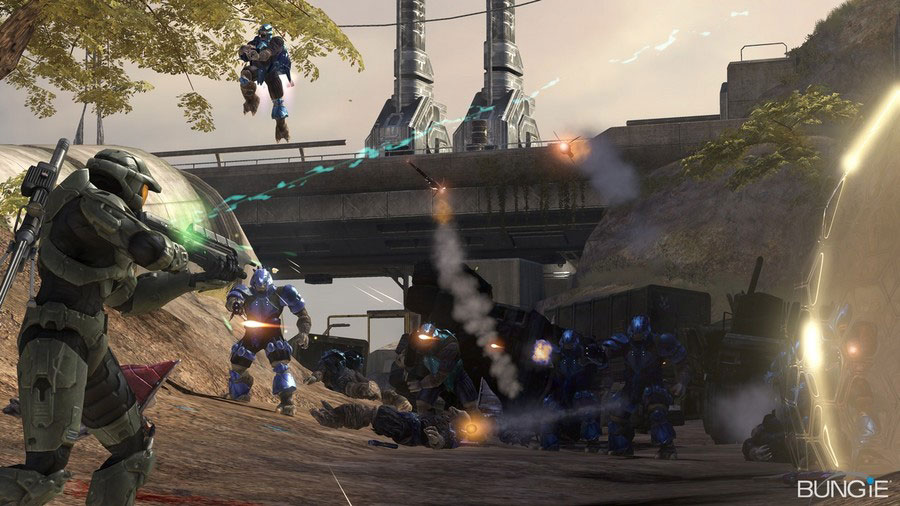
From a certain point of view, Halo 3 is without a doubt the biggest game of the year. The combination of fan anticipation, marketing, and the skill of Bungie's design combine to create a game that's larger than life; if gaming has a blockbuster franchise to match the movie industry's punch, it's the tale of Master Chief. The importance of the Halo franchise to gaming is a very big issue, though, and one worth it's own article. Having played through the game, there's really only one question I'm here to answer today. Does it meet expectations? In a word: yes. It's not the best game ever made, and it may not even be the best game this year. Will it make the fans happy, and deservedly sell thousands of Xbox 360s? Very much yes. Read on for my impressions of Bungie's years-in-the-making epic, Halo 3.- Title: Halo 3
- Developer/Publisher: Bungie / Microsoft Game Studios
- System: Xbox 360
- Genre: First Person Shooter
- Score: 4/5 - This game is above average, and excels in the genre it supports. A classic for the genre and well worth a look for every gamer.
I hope you were paying attention at the end of Halo 2, because the folks at Bungie don't waste any time getting new players up to speed. The action picks up right after the Gravemind's infestation of High Charity at the end of the previous game, and the Master Chief's escape from that doomed city in the Prophet of Truth's stolen Forerunner vessel. If that makes no sense to you, I refer you to Wikipedia for a brush-up on Halo's lore. That said, once you're in the thick of things you don't need to know a lot about the past two games to enjoy 3's story. There are a bunch of references back, and continued threads, but really ... it's a first-person shooter. There are aliens on Earth, trying to dig up an alien artifact. You have to stop them. Go to it.
If you are a fan of the previous games, the story of Halo 3 is going to satisfy your need to see things wrapped up. What it's not going to do is surprise you. The plot plays out pretty much the way you'd expect, though the writers do make some very mature choices towards the end of the tale that distinguish it a bit from every other hero's journey. I'm reluctant to say more, as I'm not sure what's common knowledge at this point, but there is one storytelling choice I wanted to point out as being particularly effective. Cortana, Master Chief's AI companion, was left behind with the Flood's master at the end of the previous game. Despite this, she connects regularly with the Chief in a form of psychic connection. This allows a sense of desperation to build throughout the title, and has a satisfying payoff late in the game.
Story is a really important component of the gameplay experience for me. Though I'm no expert, I do actually like the Halo metaplot quite a bit, and I was left well pleased by Bungie's conclusion. Suffice it to say that while you're not going to be blown away by any revelations, there are no cop-outs, no cheap tricks and (best of all) no meaningless cliffhanger endings. Just make sure you watch to the end of the credits.
Beware the Scarabs
In Halo 2 there's a sequence where you attack a building-sized walking tank in the shape of a multi-legged bug, with a giant laser on its front. It's an elaborate experience: rushing alongside it on rooftops, jumping aboard, taking out its crew, and finally destroying its core. It was, for me, one of the highlights of the game. In Halo 3 you take on these tanks at least three times, and at one point you're fighting two at once. That pretty much sums up the experience of gameplay in this title: it's like the other two, only a lot moreso. Everything is bigger, better, and very, very polished.
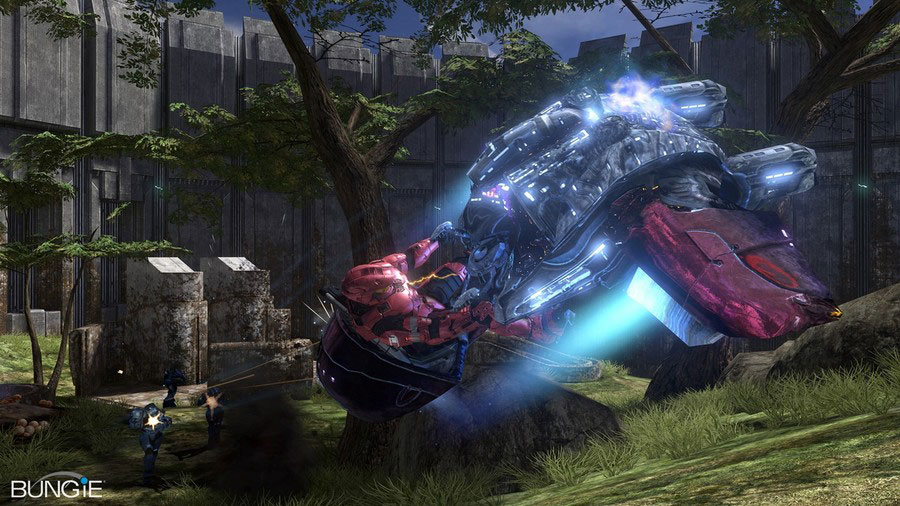
That polish is something that exists across the title, from moment-to-moment combat through to 'set piece' battles like the Scarab tanks. There are several set pieces like that spread throughout the game, areas that are more than just the movement from point A to point B with enemies in between. None of them are any more particularly challenging than the rest of the game, but provide exclamation points on areas of hard work and forward progress. There are also several vehicle sequences, more (it seemed) that even in Halo 2. Fast action in the Scorpion tank and Warthog return, but there are also sequences designed specifically to show off some of the new vehicles in this title. I felt these were much more seamless experiences than in the last game; jumping in a vehicle seems like the natural thing to do, not a decision forced upon you by game design.
The vehicle sequences - and the whole game, for that matter - would have benefited from some extra time in NPC boot camp. Once again, your AI assistants prove to be poorly equipped at driving, shooting, or doing pretty much anything other than getting in the way. This, frustratingly, is a step up from Halo 2, where they were incapable of driving without continuously flipping your vehicle. The AI is at least smart enough to get from point A to B now, but you're not going to enjoy the journey. The continued incompetence of the AI in moment-to-moment fighting is particularly frustrating because the Elite known as the Arbiter is your constant companion through most of the game. This is a shadow of the co-op play component, a reminder that it's always possible. All the Arbiter was good for in my experience, though, was waving around his energy sword ineffectually. The AI here wasn't as dumb as the grunts in Gears of War (who enjoyed mantling onto the side of cover the enemies were firing at), but they weren't much better.
The enemy AI, at least, isn't entirely ineffective. They seemed particularly adept at using some of the new toys added in since the last game. Brute chieftains regularly came outfitted with the pleasant addition of a ripped-off turret. These mounted weapons, a frequent sight in past titles, can now be removed from their housings and carried around to provide some heavy firepower. A chieftain with one of these in a secured location can mean regular trips through respawning. The ability to dig in and hold a position was greatly enhanced by this game's addition of 'equipment'. The new use for the X button (reloading is now down with the LB and RB bumpers), most equipment allows NPCs and PCs alike to better hold an area. The 'force shield' is shown off in the E3 2006 trailer but deployable cover (a tall shield), a regeneration aura (which keeps your shields charged), and even deployable turrets all allow for positions to be maintained more effectively than in the past. Other equipment is intended to bypass such advantages, like the power-draining opposite of the regenerator, a portable hover-lift device that can allow you a quick hop over enemy fortifications, and a placeable mine great for taking out drawn-in Grunts. I'll admit it: I didn't use the equipment as effectively as I could have, but it was always enjoyable to play against. Particularly the energy shield; Brutes always seemed somehow vaguely surprised when I popped through the translucent wall.
I regularly got unpleasant surprises throughout the game, and I feel like I need to point out a frustration Bungie has managed to preserve intact from Halo 2: checkpoints. Halo 3 features an autosave system that updates your progress every time you complete a specific objective; passing a point on the map, or activating a certain control panel. Most checkpoints, though, are reached by killing enemies, and you very specifically have to kill every enemy in a group. At several points I found myself frustrated by my inability to find hiding bad guys - I'd complete a long stretch of the game and die, only to find myself further back in the game than I had anticipated. On my way back to where I'd died, I would regularly encounter a checkpoint I hadn't used before. These additional checkpoints were there because I'd missed a single hiding Grunt, or one of those stealthy sniper enemies the first time through. It's always frustrating to lose progress, and even more so when you find you lost that progress because you didn't see the point in finding a single cowering trooper.
That frustration with checkpoints, though, is really my only complaint about level design and the actual experience of play. There is a lot less back tracking here than in either of the last two games, and levels themselves feature a great deal of variation. There's a far wider palette used to put together levels, and the greens and brilliant whites used in Halo 3 stand in stark contrast to the greys and browns that have dominated other next-gen shooters. Combat itself is just as much fun as ever, and it's unflinchingly fair. You never feel cheated by gameplay in Halo 3. If you screw up and die, you usually spend the few moments after your death and before you respawn going, "Yeah, fair enough." Pro tip: The loud beeping of your lowered shields should have told you to get behind cover. While everything is polished to a glistening shine, it's great to be able to say they really haven't changed the feel of gameplay that much. Nine million people didn't buy Halo 2 because of a marketing campaign: ultimately they bought it because Bungie puts together one of the best console shooter experiences, hands down.
One Fine Looking Suit of Armor
Halo 3 looks really good, especially in motion. That said, compared with a game like Gears of War or Lair, it doesn't particularly scream 'next-gen'. The water is pretty good, the explosions are works of art, and reflections off of the Chief's visor are satisfyingly accurate ... but for the most part the game looks a lot like Master Chief's previous adventure. That's fine, though, because (unlike in that title) the framerate is pegged at 60fps and never wavers. There was never once a stutter or slowdown, even with dozens of fastmoving objects on screen, swarms of enemies, or a speedy vehicle sequence. I also saw none of the 'texture popping' that I annoyingly associate with last-gen titles. There are also almost no loading times in the game. The only time you'll see a (brief) loading screen is when you start the game or load a new chapter. Otherwise from start to finish your gaming experience is essentially unbroken. Bungie obviously spent time working on the visual elements of the game, but not to the exclusion of equally important components like story and gameplay. The look of the game is conveyed more by the art style used in the varied environments that through sheer power; the graphics here get the job done, and look great doing it.
Firefly Stars and Heavy Guitar Riffs
One game element that needs no qualifiers is the title's sound presentation. Just as in the previous two games, no expense was spared to bring the world to life through sound effects, voice acting, and music. The sound effects are essentially identical to the experience a player may have had in Halo 2, with a few subtle improvements. The voice acting is extremely well done, with the likes of Keith David, Jen Taylor, Steve Downes, and David Scully reprising their roles. Jen Taylor's Cortana has some especially challenging scenes in this game, and I thought she did a great job with them. New (but familiar) voices also add their talents to the cast. Red vs. Blue viewers will recognize the name Burnie Burns, who is one of the voices of the generic soldiery, but fans of Joss Whedon's Firefly will have just as much to enjoy. Alan Tudyk and Adam Baldwin are also soldiers, and Nathan Fillion takes on the role of an NPC sergeant. I noted this during gameplay, actually, as Alan Tudyk's voice is ... distinct.
Martin O'Donnell composed the game's score, reprising his role from the two previous titles. If you've heard the moving music in the E3 2006 trailer you're already well aware of what that implies. Most of his compositions are much more low key, of course, but they nonetheless provide a welcome backdrop for the game's graphics, gameplay and story. The later levels especially benefit from this subtle but important reminder of what's at stake. The music serves as an obvious but not over-the-top pacing element. Ultimately Martin O'Donnell's compositions are the kind of music you'd be more than happy to listen to outside of the game; it's hard to see how you can pay a soundtrack a higher compliment.
Playback and Multiplay
The clearest sign that Halo 3 is a 'next generation' title is its online and playback components. Most startling are the game's video editing and level creation tools. The first time you'll play through the campaign, you'll find that you can relive the whole thing by reviewing the videos stored on your 360's hard drive. There's no need to set a special setting, it just does it automatically. From there, you can enter the recording and rewatch the whole thing, stopping to take screenshots or snip video clips. These clips and pictures are then viewable from your Bungie.net profile, proving your game mastery to awed onlookers. The real awe, for me, was stepping outside of the Chief to fly around the map as action progresses. If you recall a particularly cool moment - a really good grenade stick, for example - you can see what that looked like on the outside ... and take a picture of it. I haven't had much time or inclination to play around with the level creation tool (called the Forge), but it's incredibly robust. Think something along the lines of Gary's Mod for Half-Life 2, and you'll understand the possibilities in Bungie's generous tool offering.
I've talked extensively about the game's campaign mode, but for many gamers online multiplayer is the real reason to buy this game. And understandably so: if you participated in the Halo 3 multiplayer Beta a few months ago you're already well aware of that game element's polish level. The real draw for me, though, is the campaign co-op play. I played entirely through Gears of War three times because the co-op experience was so well done. Here Bungie has provided the opportunity for up to four players to participate in the entire campaign experience. Just as with the 'single player' campaign mode (which is really just co-op with bots), the entire experience will be recorded to your hard drive for later public mockery. Unlike in single-player, by doing a co-op session you and your team-mates participate in what the game's achievements call 'the metagame'. Players are scored on their play throughout the game, and netting a certain total score during a co-op session can earn you some gamerscore points.
As much time as the team has obviously taken on the game itself, it's great to see that they've fleshed out the experience with elements like this. Graphics aside, these playback and co-op components are truly what makes Halo 3 'next generation'.
Consider the Fight Finished
Halo 3, then, is just about everything a player of the previous games in the series could hope for. It looks good, it plays smoothly, and backstory fans are going to finally have some closure. There are obviously flaws, but none are so glaring or frustrating as to be worth more than a passing mention. Even the checkpoint thing, which I'm sure I have run into far more often than the average player, never stopped me from grinning at the chance to melee some more Brutes into submission.
In essence: Bungie has succeeded marvelously at bringing this trilogy to a close. The game's tight story is complete-able in Normal mode in about ten hours, and that feels just about right. At the end of the game you're left wanting more, but not feeling gypped. Folks who have been holding their breath for this since 2004 can relax; the only thing left to do now is play and have a good time. Halo 3 is fun. Any game - regardless of platform, generation, or genre - where you can finish up and immediately want to start playing again ... it's hard to call that anything but a success. -
Apple Platform Lock-Ins, A 3rd Party Dev's Opinion
Iftekhar writes "Wil Shipley, of Delicious Monster fame, has written a very candid essay on what he perceives as Apple's growing trend toward platform lock-ins. He writes: 'Why is the iPhone locked to a single carrier, so I can't travel internationally with it? There's really only one viable reason: Apple wanted a share of the carrier's profits, which meant giving AT&T an exclusive deal. Which meant, we get screwed so Apple can make more money. It's that simple. [...] As Apple gets more and more of its revenue from non-Mac devices, they are also getting more and more of their revenue from devices that simply exclude third parties. Consumers suffer from this. We suffer from increased prices and decreased competition and innovation. We suffer so Apple can make a few more bucks, when Apple is clearly not hurting for money.'" -
MediaDefender and the Streisand Effect
Foldarn writes "It looks like MediaDefender, in an effort to quell the explosion of negative publicity over its leaked email archive, has instead done the opposite (also known as the Streisand Effect) and spread it even more widely. Ars Technica is reporting that MediaDefender has sent scary-lawyer letters to two popular BitTorrent sites, MegaNova and IsoHunt, demanding that they remove the offending content. Both sites have responded with derision. Also, Ars notes that MediaDefender seems to be behind a DDoS attack against the site that originally leaked its email." Final word to Ars's Ryan Paul: "MediaDefender's entire business model has been based on recognition of the inescapable fact that litigation cannot stop the spread of content on the Internet, so it is ironic that the company has turned to legal threats." -
Is id Abandoning Linux?
edv writes "In a news posting dated 10th of September, Beyond3D is reporting of an article in a German publication in which id Software CEO Todd Hollenshead discusses the upcoming id title Rage and the engine it runs on, codenamed 'id Tech 5'. Amongst other things Todd mentions that no Linux version of the game is planned at the moment, and that it will run on Direct3D on Windows platform. OpenGL version is planned for the Mac however. If true, this would be a serious blow for Linux gaming (insert jokes here) as id and Carmack have been strong proponents of OpenGL and openness in the past." -
GPS Transitions to New Control System
gsfprez writes "It took us a long time, but the Air Force has finally moved off of the 1970's mainframe GPS control system and is now running on a new Unix-based Control System called AEP — Architecture Evolution Plan. It's important to remember that current GPS satellites are basically solar powered iPod shuffles with atomic clocks that simply playback whatever we upload into them at a precise rate. They don't actually have any idea where they are — its the control system at Schriever Air Force Base that does. The new system will be a lot cheaper to support and modify since Sun stocks things like SATA drives - while digging up Saturday Night Fever-era DASDs isn't simple. AEP will also allow us to be ahead of the curve: we're basically good to go to fly the new IIF birds." -
GPS Transitions to New Control System
gsfprez writes "It took us a long time, but the Air Force has finally moved off of the 1970's mainframe GPS control system and is now running on a new Unix-based Control System called AEP — Architecture Evolution Plan. It's important to remember that current GPS satellites are basically solar powered iPod shuffles with atomic clocks that simply playback whatever we upload into them at a precise rate. They don't actually have any idea where they are — its the control system at Schriever Air Force Base that does. The new system will be a lot cheaper to support and modify since Sun stocks things like SATA drives - while digging up Saturday Night Fever-era DASDs isn't simple. AEP will also allow us to be ahead of the curve: we're basically good to go to fly the new IIF birds."