Slashdot Mirror
Domain: wikipedia.org
Stories and comments across the archive that link to wikipedia.org.
Stories · 7,048
-
What Math Courses Should We Teach CS Students?
Coryoth asks: "If you're taking computer science then getting as much mathematics as you can is probably a good idea. Ultimately, however, there are only so many math courses you an squeeze in. Given that, what areas of mathematics should we be teaching CS students for maximum benefit? Traditionally university math courses are structured around the needs of the physical sciences and engineering, which means calculus is what gets offered. While a decent calculus course can teach a certain amount of formality in reasoning, wouldn't CS students be better served with a course in mathematical logic and foundations with its greater degree of formal reasoning and obvious connections to fundamental concepts in computer science? Are courses in abstract algebra and graph theory going to be useful to CS students? Should courses in category theory (yes, it applies to computer science) be required of students going on in theoretical computer science? In short — what areas of mathematics are going to be the most useful and most applicable to computer science students? What courses were of the most value to you?" -
What Math Courses Should We Teach CS Students?
Coryoth asks: "If you're taking computer science then getting as much mathematics as you can is probably a good idea. Ultimately, however, there are only so many math courses you an squeeze in. Given that, what areas of mathematics should we be teaching CS students for maximum benefit? Traditionally university math courses are structured around the needs of the physical sciences and engineering, which means calculus is what gets offered. While a decent calculus course can teach a certain amount of formality in reasoning, wouldn't CS students be better served with a course in mathematical logic and foundations with its greater degree of formal reasoning and obvious connections to fundamental concepts in computer science? Are courses in abstract algebra and graph theory going to be useful to CS students? Should courses in category theory (yes, it applies to computer science) be required of students going on in theoretical computer science? In short — what areas of mathematics are going to be the most useful and most applicable to computer science students? What courses were of the most value to you?" -
What Math Courses Should We Teach CS Students?
Coryoth asks: "If you're taking computer science then getting as much mathematics as you can is probably a good idea. Ultimately, however, there are only so many math courses you an squeeze in. Given that, what areas of mathematics should we be teaching CS students for maximum benefit? Traditionally university math courses are structured around the needs of the physical sciences and engineering, which means calculus is what gets offered. While a decent calculus course can teach a certain amount of formality in reasoning, wouldn't CS students be better served with a course in mathematical logic and foundations with its greater degree of formal reasoning and obvious connections to fundamental concepts in computer science? Are courses in abstract algebra and graph theory going to be useful to CS students? Should courses in category theory (yes, it applies to computer science) be required of students going on in theoretical computer science? In short — what areas of mathematics are going to be the most useful and most applicable to computer science students? What courses were of the most value to you?" -
100 Gbps Via Ethernet
Doc Ruby writes, "As reported at GigaOM, 'Infinera has bonded 10 parallel 10 Gb/s channels into one logical flow while maintaining packet ordering at the receiver,' bridging 100-Gbps ethernet over 10 10-Gbps optical WAN links. Infinera's press release is here. Further from GigaOM: 'The experimental system was set up between Tampa, Florida and Houston, Texas, and back again. A 100 GbE signal was spliced into ten 10 Gb/s streams using an Infinera-proposed specification for 100GbE across multiple links. The splicing of the signal is based on a packet-reordering algorithm developed at [UC] Santa Cruz. This algorithm preserves packet order even as individual flows are striped across multiple wavelengths.' We're all going to want our share of these 100Gbps networks. The current network retailers, mainly cable and DSL dealers, still haven't brought even 10Mbps to most homes, though they're now bringing fiber to the premises to some rich/lucky customers. Are they laying fiber that will bring them to Tbps, or will that stuff clog the way to getting these speeds ourselves?" Rumors say that what runs over Verizon's FiOS is ATM, to support their aspirations for triple-play. -
Cassini Observes Hurricane-Like Storm On Saturn
Aglassis writes "The Cassini spacecraft recently observed a hurricane-like storm on the south pole of Saturn. What makes this storm particularly interesting is that this is the first time that a clearly defined eyewall has been seen outside of the Earth in the Solar System. Neither the Great White Spot of Saturn nor the Great Red Spot of Jupiter have had an observable eyewall. NASA, JPL, and the Space Science Institute have released a short movie of the motion around the eyewall (mirrored at YouTube)." -
Cassini Observes Hurricane-Like Storm On Saturn
Aglassis writes "The Cassini spacecraft recently observed a hurricane-like storm on the south pole of Saturn. What makes this storm particularly interesting is that this is the first time that a clearly defined eyewall has been seen outside of the Earth in the Solar System. Neither the Great White Spot of Saturn nor the Great Red Spot of Jupiter have had an observable eyewall. NASA, JPL, and the Space Science Institute have released a short movie of the motion around the eyewall (mirrored at YouTube)." -
Remote Data Access Solutions?
magoldfish asks: "Our company has several terabytes of data, typically chunked into 2-6 GB files, that we need to share among users at sites around the US. Our users range in technical skill from novice to guru, data access needs to be secure, and we require client access from multiple platforms (Linux, Mac, and Windows). These files will likely be accessed infrequently, and cached on local hard drives by our power users. We've been running WebDAV, primarily to accommodate non-savvy users and guarantee access from firewalled environments, but the users are really complaining about download speed — maybe 50 KB/sec serving from a Mac. Any suggestions for better alternatives, or comments on the pros and cons of alternative access techniques?" -
Blind Mice See Again After Cell Transplants
Korbinus writes, "Scientists have managed to restore vision in blind mice by transplanting light-sensitive cells in their eyes, cells on their way to become photoreceptors. This might be a important step towards new treatments of eye disease." -
Chinese GPS System To Be Offered Free
MattSparkes writes, "The Chinese GPS system, Beidou, is apparently to be opened up for free access within China, worrying European investors on the €2.5 billion competing project, Galileo. Initially, China had declared that access to their system would be restricted to the military, and Europe had planned to recoup some of the cost of their system by selling licenses to China. Michael Shaw, from the US government's National Space-based Positioning, Navigation and Timing Coordination Office in Washington DC, said, 'Frankly, China's behavior towards Europe is not so different to how Europe behaved with us when GPS was the only game in town a decade ago.'" -
An Indian On the Moon By 2020
turgid writes, "The Hindustan Times reports that the Indian Space Research Organization plans to land an Indian on the Moon by 2020. First, experiments will be conducted to launch, orbit, and recover a capsule. Plans are to launch an Indian into space in 2014. Manned orbital missions will be launched, initially for a day, but eventually lasting a week or more. Expeditions to the Moon are expected to last 15 days to a month." The article doesn't estimate the cost of such a program. The US Apollo program cost about $135 billion (in 2006 dollars), according to Wikipedia. -
Global Warming Debunked?
limbicsystem writes, "I'm a scientist. I like Al Gore. I donate to the Sierra club, I bicycle everywhere and I eat granola. And I just read a very convincing article in the UK Telegraph that makes me think that the 'scientific consensus' on global warming is more than a little shaky. Now IANACS (I am not a climate scientist). And the Telegraph is notoriously reactionary. Can anyone out there go through this piece and tell me why it might be wrong? Because it seems to be solid, well researched, and somewhat damning of a host of authorities (the UN, the editors of Nature, the Canadian Government) who seem to have picked a side in the global warming debate without looking at the evidence." The author of the Telegraph piece is Christopher Monckton, a retired journalist and former policy advisor to Margaret Thatcher. -
Should Online Stores Be Subject To ADA?
prostoalex writes, "HTML tutorials usually mention alt tags for images and noscript tags as something optional that a Web designer should add to a site for the crawlers and users browsing with graphics or JavaScript turned off. However, a recent lawsuit against Target by the National Federation of the Blind accuses the retailer of not complying with the Americans with Disabilities Act. Since Target's online store is unbrowsable with a screen reader, the nation's 200,000 blind people who go online cannot become paying customers, the NFB contends. From the article: 'In denying Target's motion to dismiss the suit two months ago, Judge Marilyn Hall Patel... held that the law's accessibility requirements applied to all services offered by a place of public accommodation. Since Target's physical stores are places of public accommodation, the ruling said, its online store must also be accessible or the company must offer equally effective alternatives.' Does the judge's name ring a bell? Yes, it's the same Marilyn Hall Patel who handled the RIAA's case against Napster in 2001." Web builders and tools may need to start brushing up on the Web Accessibility Initiative. -
Should Online Stores Be Subject To ADA?
prostoalex writes, "HTML tutorials usually mention alt tags for images and noscript tags as something optional that a Web designer should add to a site for the crawlers and users browsing with graphics or JavaScript turned off. However, a recent lawsuit against Target by the National Federation of the Blind accuses the retailer of not complying with the Americans with Disabilities Act. Since Target's online store is unbrowsable with a screen reader, the nation's 200,000 blind people who go online cannot become paying customers, the NFB contends. From the article: 'In denying Target's motion to dismiss the suit two months ago, Judge Marilyn Hall Patel... held that the law's accessibility requirements applied to all services offered by a place of public accommodation. Since Target's physical stores are places of public accommodation, the ruling said, its online store must also be accessible or the company must offer equally effective alternatives.' Does the judge's name ring a bell? Yes, it's the same Marilyn Hall Patel who handled the RIAA's case against Napster in 2001." Web builders and tools may need to start brushing up on the Web Accessibility Initiative. -
Long-Term Wikipedia Vandalism Exposed
Daveydweeb writes, "The accuracy of Wikipedia, the free online encyclopedia, came into question again when a long-standing article on 'NPA personality theory' was confirmed to be a hoax. Not only had the article survived at Wikipedia for the better part of a year, but it had even been listed as a 'Good Article,' supposedly placing it in the top 0.2-0.3% of all Wikipedia articles — despite being almost entirely written by the creator of the theory himself." -
MS Patent Applications Reveal Search Technology
eldavojohn writes, "In the roughly 90 patents they applied for on November 2, 2006, Microsoft reveals that it is apparently pushing its research in the search engine market. There are a few patents that reveal improved ranking methods and document classification but the real interesting ones revolve around linking related queries, optimizing search, identifying results that are spam, and using a Bayesian classifier to measure feedback from the user. If that's not enough, there's even a few I don't quite understand. Another notable Microsoft application for a patent is the model for assisting children in authoring stories so you can't accuse Microsoft of not thinking of the children. Microsoft regularly applies for many patents but never so many revolving around search." -
Research Supports "Snowball Earth" Hypothesis
u2boy_nl writes, "A new U.S. study finds evidence for 'Snowball Earth,' the hypothesis that the entire Earth was ice-covered for long periods on several occasions, most recently 600-700 million years ago. The icy conditions (Earth's oceans frozen completely with ice more than a kilometer thick) ended violently under extreme greenhouse conditions — snowballearth.org suggests the meltdown could have occurred in as little as 2,000 years. Snowball Earth challenges long-held assumptions regarding the limits of global change. Wikipedia has more on the hypothesis." -
No More Coding From Scratch?
Susan Elliott Sim asks: "In the science fiction novel, 'A Deepness in the Sky,' Vernor Vinge described a future where software is created by 'programmer archaeologists' who search archives for existing pieces of code, contextualize them, and combine them into new applications. So much complexity and automation has been built into code that it is simply infeasible to build from scratch. While this seems like the ultimate code reuse fantasy (or nightmare), we think it's starting to happen with the availability of Open Source software. We have observed a number of projects where software development is driven by the identification, selection, and combination of working software systems. More often than not, these constituent parts are Open Source software systems and typically not designed to be used as components. These parts are then made to interoperate through wrappers and glue code. We think this trend is a harbinger of things to come. What do you think? How prevalent is this approach to new software development? What do software developers think about their projects being used in such a way?" -
Jimmy Wales Resigns Chair at Wikipedia
user24 writes "As reported by Wikipedia's Signpost ezine, 'The Wikimedia Foundation Board of Trustees has moved forward with a step in restructuring the organization by reorganizing itself. Following a planning retreat in Frankfurt, Jimmy Wales stepped down as Chair of the board, and Florence Nibart-Devouard was chosen to replace him ... Wales, meanwhile, will continue to serve on the board and assume the honorary title of Chairman Emeritus. He will remain active in Wikimedia projects, but chose to pass on the responsibility of heading the board, due in part to his commitments to outside projects.'" -
Keeping Cool May Be the Key To Longevity
merryprankster writes "New Scientist reports that Scripps Research Institute scientists have found that lowering the body temperature of mice by just 0.5C extends their lifespan by around 15%. Until now the only proven way of increasing longevity has been calorie restriction — but as this also causes a lowering of body temperature the researchers speculate that this cooling may be the underlying mechanism retarding aging. In this study mice with a defect in their lateral hypothalamus, which has the side effect of cooling body temperature, not only lived longer but also ate normal amounts." -
U.S. Publishes Guide To Building Atom Bombs To Web
Jeff writes "The New York Times is reporting that the feds have shut down the 'Operation Iraqi Freedom Document Portal' due to concerns from weapons experts that the 'papers give detailed information on how to build nuclear firing circuits and triggering explosives, as well as the radioactive cores of atom bombs.' One diplomat is quoted as saying, 'If you had this, it would short-circuit a lot of things.' Indexes to older (less sensitive) documents (and some html from pdfs) are still cached at Google today. Rep. Pete Hoekstra pushed for the public release of the archive to help determine 'whether Saddam Hussein destroyed Iraq's weapons of mass destruction or hid or transferred them'. Critics have said the archive was created to perpetuate misinformation about WMDs." -
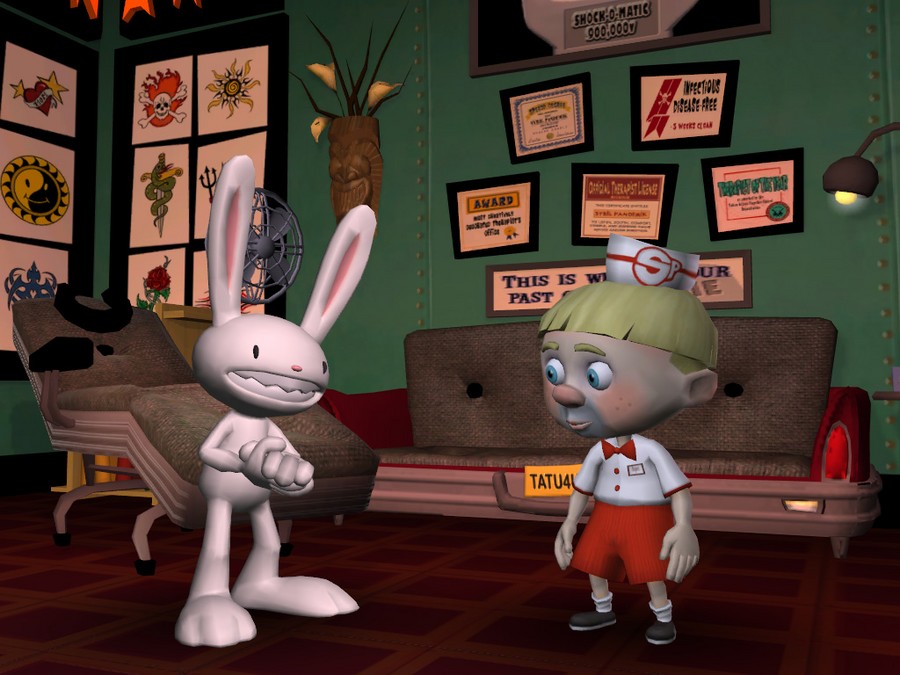
Sam and Max - Culture Shock Review
We've talked a lot about episodic gaming here on the site, considering both the good and the bad. The concerns of users, and the words of gaming commentators, focus on the limitations of the format. "Don't break up a game just to charge us more for it" is the prevalent thinking. The 'march of progress' has allowed game companies to come up with plenty of new ways to get our money, so it's an understandable fear. Until last month, though, I had never considered the possibility that the very essence of the episodic game may allow us to reflect on the past as well as the future. In the latest and most dramatic of retro-gaming coups, Sam and Max have returned to the modern PC landscape. They're colourful, they're wry, and their antics are very, very funny. Read on for my impressions of this first episode in the new Sam and Max series, and why I have high hopes for their future wacky antics.- Title: Sam and Max: Culture Shock
- Publisher/Developer: TellTale Games
- System: PC
Aside from the return of a beloved pair of gaming icons, what's exciting about Culture Shock is Telltale's novel approach to the game's structure. Instead of a single game spanning twenty to thirty hours, Sam and Max is being viewed as a 'game series', like the episodes of a cartoon.Culture Shock is the first in the series. The second episode is slated for the end of December, with each game after that just four weeks apart. The current run of the show is set to conclude with the sixth episode in April. In between the game episodes, reruns of the Adventures of Sam and Max: Freelance Police cartoon series will be available for download.
The quality of the Half-Life series (and bundles add-ons like Portal and Team Fortress) is keeping interest high for that series. Here, though, the effort Telltale is making here to keep series fans 'fed' with content seems like a winning strategy. Fickle gamers that might otherwise wander away from the story will have additional materials to keep them occupied in between game-play sessions.
Likewise, they're making the barrier to entry in the games themselves very low. Culture Shock makes no effort to frontload the game with ponderous backstory. The cynical pair starts the adventure in their familiar office. A simple problem faces them: a rat has stolen their phone. This humble beginning allows new players to familiarize themselves with the game's delightfully retro gameplay. It's via these first simple manipulations of the cartoonish world that we begin to establish the character of the titular duo. Sam and Max are introduced to players unfamiliar with their proclivities via a number of well-written and witty observations. Instead of beating us over the head with Max's homicidal tendencies or Sam's unique vocal tic, the pair's oddball reactions do a wonderful job of fleshing out the bounds of the story. Aside from the mechanical need to introduce the characters, these observations are highly chuckle-worthy.
The 'poke the object' style of gameplay used in titles such as Day of the Tentacle or Monkey Island survives here intact. Aside from a small inventory, exploratory clicking is the only thing you'll have to learn to manage. Instead of requiring timing a jump, puzzles are usually solved by leaps of logic and a good sense of humor. Some puzzles require the combination of an inventory item in-hand with clicking on an object or person, while others demand that you click on game elements in a specific pattern. There are also a few short driving sequences that require you to click with some amount of accuracy on a speeding car. Nothing about the individual game elements are particularly taxing, and even young players will quickly master the basic mechanics of the game.
Which, gratifyingly, is not to say the puzzles are easy. Some of the puzzles late in the sixish hours of play require some truly twisted leaps to unravel. You'll find yourself sitting back in your chair with your hand on your chin, wondering what exactly you're missing in an apparently simple situation. Equally gratifying is that even the toughest of puzzles won't require a FAQ to work out; given enough thought even the toughest brain teaser in the game can be unraveled. As long as you keep in mind that you're in a cartoon, you're going to have lots of success in Sam's world.
Once outside of the office, you're thrust into the heart of the game's short tale. Former TV star Brady Culture has apparently gone mad, and has brainwashed former child stars "The Soda Poppers" into doing his ineffectively evil bidding. They're passing out "Eye Workout" videos that will further spread Culture's sinister influence. You'll spend your time in-game assisting Sam and Max in freeing their neighborhood of the horrific child-star menace. As you may have already guessed here, the title's plot is very much tongue-in-cheek. A few moments of slapstick comedy are interspersed with wittily written puns, sight gags, and wordplay. The actual humor in the game is quite well done, and my only real complaint is the occasionally cheesy pop-culture reference. If the game had dragged out for twenty-some hours, even I probably would have quickly tired of the 80's-era plot setup.
That right there, though, is the beauty of episodic content. Folks new to adventure gaming, or who have been turned off to it in the past, will only be playing for about five hours. A game concept that could turn into a chore over the long haul is condensed into a bite-sized chunk. This is the way that comedy gaming should be done, and my hope is that Culture Shock is the start of a renaissance in this part of the gaming market.
As gaming has gained cultural acceptance and entered the world of big money, it's lost a lot of the charm and personality that made so many early games memorable. What Telltale is attempting, here, is no less than the resurrection of an genre of games all but forgotten by the average gamer. Titles like Dreamfall: The Longest Journey aside, there just isn't that much going on in the world of adventure gaming. And, in the world of cartoony LucasArts style games, there's been almost nothing to report since the cancellation of the proposed Sam and Max game two years ago. LucasArts has gone on record saying they're not interested in doing more of this type of game. They've moved on, and certainly whatever is the newest iteration of the Star Wars franchise will benefit from their decision. For those of us, though, who still pine for the days of Grim Fandango and Monkey Island, Culture Shock speaks of good days to come.
I have high hopes, then, for the success of the Sam and Max episodic series. The first outing here is strong, and with further refinement I can only hope future episodes will be even more polished. Adventure game fans will dive into this title with little prompting. In all likelihood they've already finished it by now. If you don't like adventure games, though, or have never played them and have held off from trying out Culture Shock, I suggest you give it a go. At eight bucks, you're looking at about $2/hour for some really funny stuff. Therein lies another beautiful angle of episodic content: if you don't like it, you can call it quits with little regret. I think you won't.
-
Why the World Is Not Ready For Linux
eldavojohn writes "While many users reading Slashdot embrace Linux, ZDNet is running an article on why the rest of the world isn't ready. One note for Linux developers: 'Stop assuming that everyone using Linux (or who wants to use Linux) is a Linux expert.' While a lot of these topics have been brought up as both stories and comments on Slashdot, this article pretty much sums up why Vista could be absolutely terrible, and people would still believe there is no other option." From the article: "The one area of Linux ownership and use where it becomes apparent that there's an assumption that everyone who uses Linux is an expert is hardware support. Your average user doesn't have the time, the energy or the inclination to deal with uncertainty. Also, they usually only have the one PC to play with. Hardware just has to work. There's a very good reason why Microsoft spends a lot of time on hardware compatibility — it's what people want." -
Prepared for Next Year's Time Change?
wohlford puts forth this query: "Next year, daylight saving time will be extended another four weeks. Slashdot has covered the time change proposal and its estimated impact, already. Since then it has been signed into law. Looking around on the Net I don't see anyone taking this seriously. Will this become the next tech doomsday or just another joke like Y2K?" -
HP Acquires VoodooPC
eldavojohn writes "HP has acquired VoodooPC, a high-end gaming PC provider who's former co-owner will now be the chief technologist of HP's newly formed gaming PC division. Back in May, we saw Dell acquire Alienware. Are gaming machines important options to consumers, or is it just plain profitable? Who will we see enter the gaming market next? Apple?" -
Classified Wiki For U.S. Intelligence Community
CortoMaltese noted that the U.S. intelligence community has unveiled their own classified wiki, the Intellipedia. Reuters says "The office of U.S. intelligence czar John Negroponte announced Intellipedia, which allows intelligence analysts and other officials to collaboratively add and edit content on the government's classified Intelink Web much like its more famous namesake on the World Wide Web. A 'top secret' Intellipedia system, currently available to the 16 agencies that make up the U.S. intelligence community, has grown to more than 28,000 pages and 3,600 registered users since its introduction on April 17. Less restrictive versions exist for 'secret' and 'sensitive but unclassified' material." For kicks, you can also read about Intellipedia on Wikipedia." -
Google Winning By Losing?
eldavojohn writes "The CEO of a small search company wrote an interesting piece for Search Insider about Google's unique strategy. It notes that Google has yet to become a leader in any technology other than search — but that its mostly unsuccessful attempts to branch out all end up bolstering its brand, and thus its search ad revenue. Is the new recipe for success to do one thing unbelievably well and several other things indifferently? Does this remind you of strategies from any other companies?" From the article, "Some of Google's non-search projects are really extensions of its search monetization, and are likely to succeed. But others projects mean entering areas where Google doesn't have much experience, and is taking a risk. With regard to those riskier areas, the key question for Google's future is whether it can realize that losing is really one of the best assets the company has." -
FBI File of Lie Detector's Creator
George Maschke writes, "It appears that the FBI considered William Moulton Marston (1893-1947), who invented the lie detector and created the comic book character Wonder Woman under the pseudonym Charles Moulton, to be a 'phony' and a 'crackpot.' He is alleged to have misrepresented the result of a study he conducted for the Gillette razor company in 1938, for which he reportedly received some $30,000, a handsome sum in those days. Despite these misgivings, the FBI today uses Marston's creation (the polygraph, not the Lasso of Truth) to guide investigations as well as to screen applicants and employees. You can download Marston's FBI file here (736 KB PDF)." -
North Korea Returns To The Table
EmperorKagato writes, "North Korea has agreed to rejoin the Six Party Talks on its nuclear weapons program. The sanctions placed against North Korea on October 9, 2006 will remain in place; however, financial sanctions will be addressed by the group of the six nations: North Korea, China, Japan, United States, Russia, and South Korea." -
Trial For The Male Pill Shows No Side-effects
Blahbooboo3 writes "Men concerned about contraception may soon be able to use the male equivalent of the Pill, without the potential side-effects of a drug based on altering the balance of sex hormones. The drug, called Adjudin, works by disrupting the interaction that takes place in the testicles between immature sperm cells and the nurse cells responsible for nurturing sperm to maturity. The germ cells need to adhere to the nurse cells for sperm to properly develop, and the drug prevents this bond from forming. It looks like it will be a gel patch type of applicator." -
World of Warcraft and UDE Point System Fiasco
Richard Manley writes "A report on the card game trinket fiasco. When the UDE (Upper Deck Entertainment) point system finally went live, I would imagine most of the people that logged in felt the same fury I did. Blizzard knows the lengths that its fans will go to get trinkets (look at the price of Murloc cards on eBay), but their arrangement with Upper Deck simply takes advantage of the good will many fans have shown." From the article: "This means that in order to get these trinkets, one would have to purchase 9 BOXES of cards for the fireworks and 21 BOXES of cards for the ogre. What does this mean? Want a fireworks trinket? Sure, it is only going to cost you $900.00. Want an Ogre trinket? No problem, it is only going to cost you $2,100.00. Bear in mind that these items are purely for show off purposes and give no in-game advantage to players." Having been through the Magic: The Gathering addiction twice, I've decided staying away from this Collectible Card Game is a good idea. -
ACLU Drops Challenge Over Patriot Act
An anonymous reader writes, "The ACLU announced on Friday that they were dropping their case against the US Government over the highly contested section 215 of the Patriot Act. ACLU Associate Legal Director Ann Beeson stated: 'While the reauthorized Patriot Act is far from perfect, we succeeded in stemming the damage from some of the Bush administration's most reckless policies. The ACLU will continue to monitor how the government applies the broad Section 215 power and we will challenge unconstitutional demands on a case-by-case basis.'" -
Alternative Launcher For Returning To the Moon
DIRECT Launcher writes, "A grass-roots effort, based around a group of engineers, managers, and others involved in the US space program, is proposing an alternative launch vehicle for NASA to adopt for the new Lunar Exploration program. The new vehicle offers serious performance and cost savings totaling $35 billion over the next twenty years. The proposal was presented to NASA last week. The concept would make possible future Hubble Space Telescope servicing missions after Shuttle has retired, allow for all the remaining ISS elements to be launched after all, free up cash to fund the JIMO mission again, and also allow NASA to return to the moon three years early." -
First Hutter Prize Awarded
stefanb writes, "The Hutter Prize for Lossless Compression of Human Knowledge, an ongoing challenge to compress a 100-MB excerpt of the Wikipedia, has been awarded for the first time. Alexander Ratushnyak managed to improve the compression factor to 5.86 and will receive a 3,416-Euro award. Being able to compress knowledge well is believed to be related to acting intelligently." The Usenet announcement notes that at Ratushnyak's request, part of the prize will go to Przemyslaw Skibinski of the University of Wroclaw Institute of Computer Science, for his early contributions to the PAQ compression algorithm. -
Microsoft's IE Team Leader Answers Slashdot Questions
We got lots and lots of questions for Dean Hachamovitch, whose formal title is "general manager Internet Explorer at Microsoft Corp." Picking a mere 10 of those questions was not easy, and I wish Dean could have answered twice as many -- and so does he, but his schedule has been tight this week. Anyway, here are his answers to the Chosen Ten. 1) How about this...
by also-rr
Would you like to make available IE on other operating systems?
Dean Hachamovitch:
We did make versions of IE available on other operating system for a pretty long time, up through IE5 on Unix and the Mac. At the time we developed them, those offerings made sense. I don't see a good reason to make IE available on other operating systems at this time.
2) IE7 release time
by BeeBeard Why did IE7 take such a long time to release after IE6?
Dean Hachamovitch:
Basically because we were doing a lot of other things before we started work on IE7: a few releases of MSN Explorer, a lot of work on what turned out to be Windows Presentation Foundation, a lot of investment in what turned into IPv6 support in Windows Vista, and lot of security response, a pretty intense effort on Windows Server 2003 (and IE's "Enhanced Security Configuration"), and then a pretty intense effort on Windows XPSP2. You can read a more detailed answer here
3) Follow up
by LordEd
If you had more time, is there a new feature you would have liked to include in IE7?
Dean Hachamovitch:
Yes, several come to mind. None were more important than shipping. None were more important than the bug fix work we did in response to beta feedback.
The temptation to get "just one more feature in" is so strong... one more CSS fix, one more neat facility for developers, one more performance optimization, one more cool end-user feature. The thing that made it easier to resist the temptation and ship is the prototype and planning work we've started on the next release of IE.
4) Simple questions
by Billosaur
IE has a dominating command of the market, although Firefox is slowly making inroads, due to innovations such as tabbed browsing that IE has had to incorporate to maintain that command. But where are the IE innovations? Why can't the IE team get ahead of the curve on Firefox? Is there anything you consider an innovation that is unique to IE that would plausibly be something the browser market would have to incorporate to stay competitive?
Dean Hachamovitch:
I think IE7 is the first browser with integrated real-time anti-phishing functionality, with an RSS platform and support for Simple List Extensions (see below), with "QuickTabs," with support for OpenSearch, and with shrink-to-fit printing on by default. In Windows Vista with Protected Mode, IE7 is the first browser to "put itself into a sandbox" and run with low privileges.
I think that during the IE7 beta process, you've seen other browser vendors copy some of these features and/or deliver add-ons for others. (IE has also delivered some functionality - like spell-checking in forms or in-line find, as add-ons; you can read more here.
I want to call out the Phishing Filter and RSS in particular. I think there's a clear difference between the protection offered in IE7 and other places. I suggest readers look here and here and decide for themselves. I was surprised when I read this because I think IE7 delivers real-time protection that respects user privacy at the same time.
I think IE7's RSS is pretty deep. First, the support for the Simple List Extensions that we made available under a Creative Commons license is cool - check out the links below in IE7. Also, the platform enables developers to deliver on some great scenarios, like sharing subscription information between different applications and services easily (from the new version of Outlook 2007 I run at work to IE7 at home via Newsgator). You can read more about that here.
- Amazon Wish List as an RSS feed
- eBay Search Result as an RSS feed
- Yahoo Music Top 10 list as an RSS feed
In regards to tabs, according to http://en.wikipedia.org/wiki/Tabbed_browsing, NetCaptor (an IE-based browser) was first.
5) My shot
by Njovich
What do you consider the greatest weakness of Firefox?
Dean Hachamovitch:
Hey, I've met a bunch of the Firefox folks and respect them and am not about to say mean things about them or their product, period. I have started to see some things that even some Slashdotters find a little confusing, like the whole Iceweasel thing.
6) Security
by Seto89
One of IE7's revolutionary features was supposed to be security, although it took less than 24 hours for Secunia to post an advisory about a security hole. Moreover, the bug seemed to be carried over from as early as IE5.5. What approach did you take to improve browser's security, and how come the vulnerabilities have been carried over?
Dean Hachamovitch:
The overall approach we took is called the secure development lifecycle. You can read more about it in general at http://msdn.microsoft.com/security/default.aspx?pull=/library/en-us/dnsecure/html/sdl.asp and http://www.microsoft.com/MSPress/books/8753.asp. The very short version is that we stepped back to analyze all the ways to attack a browser and then figured out the best ways to defend in depth against attacks. We reduced attack surface area, for example, turning off several feature and protocols by default and with ActiveX opt-in. We re-wrote a lot of the URL handling code in our networking layer. We ran a lot of tools against the source code to look for vulnerabilities. We listened to feedback from lots of smart people who are skilled in the art of attack.
As anyone who reads SecurityFocus or FullDisclosure will tell you, security is an industry problem and innovation in attacks is ongoing.
The MHTML issue is pretty interesting. IE calls another Windows component to handle some MTHML functionality. That component has a vulnerability. The important things here are (1) a malicious site can steal user data and (2) of course Microsoft cares about privacy and will fix this issue promptly. Some of the blogs over at zdnet - in particular George Ou's and Ed Bott's, have had some balanced opinion pieces on this issue.
While I was writing this, someone disclosed another issue irresponsibly. On the one hand, it's minor (a malicious site can make the address bar, when it's selected and in a pop-up window, deceiving... clicking in the pop-up window addresses the issue) and our anti-phishing technology helps a lot. The MSRC blog has more detail. At the same time, an attacker could draw a fake or misleading address bar in a pop-up window in a browser that doesn't automatically show the address bar in every window. Again, I think all this shows is that innovation in attacks is ongoing.
7) How about this....
by Toreo asesino
Let's pretend for a moment that Internet Explorer isn't the default web-browser built into Windows and instead, users are presented with a choice on first login (e.g. a message asking 'How would you like to browse the internet? MSIE, Firefox, Opera').
Would you expect IE to become as dominant as it is now if users had to specifically choose it over another?
Ignoring the slight impracticalities, if so (I'm guessing you do), on what basis would this be?
Dean Hachamovitch:
OK, I'll pretend. My first question is when we ask users this question... if it's in 1995, then Opera isn't on the list (Wikipedia just told me that its first public release was in 1996) and neither is Firefox. If it's today, then, candidly, we have 10+ years of people seeing the IE icon and all that that means to them.
The funny thing about your question is that in some ways, users are about two clicks from this scenario every time they run Windows XP: from the Start menu, select Set Program Access and Defaults. And it's not limited to the browsers you list, but any browser that they can download.
To answer your core question: I don't know how people would answer that question. I think we've asked users far simpler ones (like setup programs that ask "Do you want a typical or custom software installation?") that have proven frustrating to them. I do blog searches just about every day to read what people are saying about their browser choice, the browser I work on, and the other browsers you list. While it may surprise you, for many users, the differences between today's browsers aren't as clear and obvious as they may seem to many in the Slashdot crowd. I've read a lot of posts that say, "I tried IE7, I'm pleasantly surprised, and I'm switching back." (I read a lot of others for sure.) For some folks, having professional technical support to contact makes all the difference in their browser choice. During a press interview with a technical trade journal recently I asked the reporter "So what do you browse with" and he said "Mostly IE6, sometimes Firefox 1.5." That might surprise some of you.
8) Allowing Developers to Test for Compatibility
by miyako
IE7, like IE6, renders a lot of pages significantly differently than the other main HTML rendering engines available (Geko, KHTML, and Opera). At the same time, IE7 requires WGA to run - so that applications like Wine are unable to run it. This means that web developers who are using Linux and Mac OS X will have an extremely difficult time testing their sites with IE7. Was this intentional? If so what was the reason behind it (do you want to force developers to move to Windows for web development, or simply set IE aside as something different that isn't a regular browser and must be specifically developed for), and if not how do you plan to rectify the situation?
Dean Hachamovitch:
I think the core of your question is about giving away Windows licenses for free. We love developers, period. We're also not about to give away Windows client licenses. Because we want end-users to have a great experience on the web, of course we want web developers to have an easy experience working with IE and testing their sites with IE. That's why we published tools like the web developer toolbar and the Application Compatibility Toolkit and so much documentation during the course of IE7 development. I also respect that - as hard as everyone at Microsoft works to make Windows the best operating system for developers run - some developers will choose to run others. Mac developers have a fine solution - I've talked with hardcore Mac people who bought a copy of Windows that they run on their Mac with Parallels to test their work in IE. For other developers, I've seen some very clever solutions like BrowserCam that should help.
9) I asked Hakon about CSS and now I ask you:
by Chabil Ha'
This past summer Håkon Wium Lie was interviewed on /. and my question was selected concerning IE7's glaring lack of full CSS support. Why is it that MS has avoided meeting at least the ACID2 spec for CSS in order to bring some semblance of comformity for developers?
Håkon Wium Lie's response to these questions is boiled down to the fact that you do have the talent and resources to fix these issues and he says that "the fundamental reason, I believe, is that standards don't benefit monopolists" like MS.
How do you respond to his comments (the author of the CSS spec) and does MS have any near future plans to adhere to the existing CSS standard? If not, what would it take for MS to take a more proactive role in supporting it?
Dean Hachamovitch:
During IE7's development, we prioritized the work we did based on the web development community's real-world feedback. The engineering exercise here was choosing the best work for a finite number of developers to do during a finite period of time, especially given the compatibility impact of changing how IE behaves. The work that we delivered in IE7 simply has more positive impact and makes web developers' jobs easier than making an arbitrary (if terribly clever) web page render the way its author intended.
The Acid 2 test explicitly states that it isn't part of a formal compliance suite and it is not a "spec for CSS." It's a suite of tests of HTML, CSS, PNG, and data URL features that Mr. Lie thought were important. I'm glad that Mr. Lie - who is one of the authors of the CSS specifications - acknowledges that Microsoft's developers have the talent to address these issues.
The question here isn't whether we want to support those features or if we understand that web developers want them (we do), but simply prioritization. We focused on web developers' real world problems.
The real goal here is interoperability - something that Microsoft product teams believe in (remember, Microsoft has more than one product that works with HTML, CSS, and other web standards, and they have to interoperate too) and something that benefits customers (end-users, developers, IT Pros, et al.) across the board. The work in Windows Vista around IPv6 as well as the work we've done in IE7 with OpenSearch, RSS and with Certificate Authorities and other browser vendors on Extended Validation certificates are good examples of following through on that belief in interoperability.
Your question also asks about Microsoft's plans to comply with the existing CSS standard; there are actually several CSS standards, some still under construction (CSS level 3) and some made obsolete over time (e.g. CSS 2.1 fixing errors, removing ambiguities and changing required behavior from CSS 2). Just as we did in IE7, we're going to listen to the web development community and prioritize the remaining CSS work and deliver the parts we hear are most important first. We do intend to comply with the standard; no other browser I'm aware of has complete support of every feature in CSS 2.1, so it's clear that we all have to use prioritization to know where best to place our resources.
10) Why develop IE at all
by CmdrGravy
Given that you are not planning on selling IE 7 and the fact that there are already other browsers on the market which can allow Windows users to experience the web fully why is Microsoft investing so much time and effort in continuing the development of IE?
Dean Hachamovitch:
Windows customers expect the best, safest experience with their PCs out of the box, especially around the web browser. We're investing so much time and effort in IE in order to give Windows customers a great, secure, default experience. I'm glad that users can choose other browsers as they see fit - Windows is a platform. We're working this hard on IE because so many end-users rely on it and so many developers have built on the APIs that IE exposes as a part of the Windows platform.
-------
Editor's note: Next week's Slashdot interview guest will be a FireFox person. Only fair, right? :) -
Microsoft's Charles Simonyi to be 1st Nerd in Space
Richard L. James writes "The BBC are reporting that Hungarian-born Charles Simonyi, a 58-year old Microsoft billionaire software engineer is set to become the first 'nerd in space' on board the Soyuz TMA-10 when the spacecraft launches on Thursday 09th March 2007. Charles oversaw the development of Multiplan, Word, and Excel among many other achievements. He has launched a website detailing the 3 goals he wishes to achieve on the trip: advance civilian spaceflight, assist space station research, and involve kids in space sciences. Jó szerencse pölö Charles!" -
BitTorrent Site Admin Sent To Prison
Marc wrote in with a Torrentfreak story which opens: "The 23 year old Grant Stanley has been sentenced to five months in prison, followed by five months of home detention, and a $3000 fine for his role in the private BitTorrent tracker Elitetorrents. This ruling is the first BitTorrent related conviction in the US. Stanley pleaded guilty earlier this year to 'conspiracy to commit copyright infringement' and 'criminal copyright infringement.' He is one of the three defendants in the Elitetorrents operation better known as 'Operation D-Elite.'" -
FCC Commissioner Stumps For Media Diversity
maynard writes, "Speaking at a New York City town hall meeting on corporate media consolidation and its deleterious impact on the expression of minority viewpoints, FCC Commissioner Michael Copps stumped against greater media concentration and instead argued for greater diversity of media outlets and voices. In 2003 the FCC, under Chairman Michael Powell, changed media ownership rules to favor greater corporate media consolidation at the expense of local owners. In an attempt to reverse totally the prior FCC policy, Mr. Copps argued strongly in favor of independent media owners. Read on for what he had to say. Michael Copps: "The FCC is in the midst of a hugely important proceeding right now to decide what the future of our media, our TV, our radio, our newspapers, our cable, even our internet, are going to look like for a long, long time to come.
A little history, just to set the stage for our discussion. Three years ago, under then FCC Chairman Michael Powell and over the objections of my good friend Commissioner Adelstein and myself, the FCC severely cut back — really "eviscerated" is a better word — the rules that were meant to check big media's seemingly endless appetite for more consolidation. It passed new rules, which have allowed a single media giant to own in a single market up to three television stations, eight radio stations, the cable system, the cable channels, even the internet portal, and the local newspaper, which in most cities in the United States of America is already a monopoly. And the agency did all of that behind closed doors and without seeking meaningful input from the American people. Can you imagine that? Authorizing a sea change in how news and entertainment are produced and presented over the people's airwaves, without even involving the people who own those airwaves and who depend so heavily upon them. It was a near disaster for America.
Thankfully, citizens rose up across the land. They sent nearly 3 million protests to the Federal Communications Commission. Congress rose up, too, and then a federal court sent those rules back to the FCC saying they were badly flawed and they needed to be reworked. That was good, and anybody that doesn't believe that citizen action can have an effect should just revisit what happened there. We checked those rules. You checked those rules from going into effect. It was concerned citizens at work, and it was a citizen consumer victory.
But, here's a reality check now. We're right back at square one, and it's all up for grabs again. And if we're going to have a better result this time around, doing something positive for media democracy, it's going to be because of more citizen action and more input from folks like you. So, this time we need to make it an open public process, instead of hiding in our office in Washington like the majority did in 2003. This time, let all the commissioners come to New York City — I wish they were all here tonight — and let all the commissioners get out across America and find out what's happening in the real world, beyond that Beltway that they bemoan so much but seem to love staying behind so much.
So, as we begin our discussion, then begin with that simple reminder: it's all of us who own the airwaves. There is not a broadcaster, a business, a special interest, and any industry that owns one airwave in the United States of America. They belong to you, and they belong to me. And, my friends, now is the time to assert our ownership rights." -
Malware In Quantum Computing?
MattSparkes writes, "Today's quantum computers are not sophisticated enough to do anything malicious to your online bank account; the field is in its infancy. However, there are in theory more ways to attack quantum computers than classical ones. As quantum networking takes off, this is going to become a larger and more immediate problem." The Wikipedia article correctly identifies as an unsolved problem in physics the question of whether it is possible to construct a practical computer that performs calculations on qubits. -
Mod Community Fixing KOTOR 2
Joystiq reports on an effort by fans of the Knights of the Old Republic series to actually finish the second game in the series, something developer Obsidian was unwilling or unable to do. The prodigious amount of deleted content towards the end of the game is being put back in, with more solid endings being offered for the diligent gameplayer. From the article: "You can check the Restoration Project web site for weekly updates as they near completion of a PC patch that should give fans a more complete KoTOR2 experience than the standalone retail edition. Team Gizka is also considering an Xbox patch, but a decision won't be made until after the PC update is released." -
Metaverse the Next Big Thing?
CrashPanic writes to tell us TCS Daily has an article entitled "The Next Big Thing" which is about Multiverse. It does a good job of making the case for the evolution to a 3D web through the lens of the past history of Netscape. From the article: "Forces are coalescing that will produce a shift comparable at least to the spread of broadband. This change will have enormous financial, cultural and political repercussions, and the most interesting aspect of the coming transformation is that it will not be some new and unexpected thing. Rather, the Web for many will become the cliched 3D virtual reality that has been so overused as a literary and cinematic devise that most of us have forgotten how compelling that vision was when it first appeared." -
Wikipedia's $100 Million Dream
An anonymous reader writes "Jimmy Wales recently asked the Wikipedia community to suggest useful, 'works that could in theory be purchased and freed' assuming a 'budget of $100 million to purchase copyrights.' He went on to say that he has spoken with a person 'who is potentially in a position to make this happen.' Ideas are being collected at the meta-wiki. Some early suggestions include, satellite imagery, textbooks, scientific journals and photo archives." So how about it? What works would you like to see wikified? -
How To Make a Green Lantern Ring
Malfourmed writes "Step by step instructions for making the ultimate comic book geek jewelery — Green Lantern's power ring. Hal Jordan, Kyle Rayner and Alan Scott variations all included. Now someone find me a Katma Tui or Arisia to go with it, and we might just have ourselves a proposal!" The bigger problem of course is that there's no battery available to charge it, so it's just costume jewelry. Anyone have other good costume ideas? -
How To Make a Green Lantern Ring
Malfourmed writes "Step by step instructions for making the ultimate comic book geek jewelery — Green Lantern's power ring. Hal Jordan, Kyle Rayner and Alan Scott variations all included. Now someone find me a Katma Tui or Arisia to go with it, and we might just have ourselves a proposal!" The bigger problem of course is that there's no battery available to charge it, so it's just costume jewelry. Anyone have other good costume ideas? -
Up-coming MMORPG Based on Shakespeare's Works
Linnen writes "Edward Castronova has received a MacArthur Foundation grant to build a MMOG based on Shakespeare's plays." "Castronova said 'Arden' will launch — it's unclear when, as the game is still in the early design stage — built around the theme of 'Richard III.' That's because the play, set during the War of the Roses, offers historical context, as well as enough political intrigue, secret conniving, deal-making and war to delight any gamer, he said. 'It's a historical Shakespeare play, so that means it's really easy for us to take all the sort of fantasy stuff like knights in shining armor and peasants and woodworkers...and we can just really fit right into 'Richard III' right away.'" -
Dot-Com Bubble v2.0?
eldavojohn wonders: "With the recent acquisition of YouTube by Google, there has been a lot of speculation (on both Slashdot & The Toronto Star) that we are nearing the second economic bubble created largely in part by growth in the digital sector. While one may be able to debate that the revenue from advertising and sales can indeed back this growth, are we headed towards the second bubble and, if so, how hard is it going to pop? Keep in mind that popular voodoo economic theory has attributed the first bubble phenomenon to 'a combination of rapidly increasing stock prices, individual speculation in stocks, and widely available venture capital.' I think we're experiencing all those, although it is not as flagrant as it was during the first bubble. What do you think?" -
Dot-Com Bubble v2.0?
eldavojohn wonders: "With the recent acquisition of YouTube by Google, there has been a lot of speculation (on both Slashdot & The Toronto Star) that we are nearing the second economic bubble created largely in part by growth in the digital sector. While one may be able to debate that the revenue from advertising and sales can indeed back this growth, are we headed towards the second bubble and, if so, how hard is it going to pop? Keep in mind that popular voodoo economic theory has attributed the first bubble phenomenon to 'a combination of rapidly increasing stock prices, individual speculation in stocks, and widely available venture capital.' I think we're experiencing all those, although it is not as flagrant as it was during the first bubble. What do you think?" -
Publishing Documentaries on the Internet?
gehel asks: "While working in Rwanda as a computer engineer, I've had a discussion with a small NGO that produces video documentaries. Internews produces videos about Rwanda to raise the population awareness on different issues, mainly the Gacaca popular court for reconciliation. Those videos are the shown in public projections all over Rwanda. They would be interested in distributing this content to a larger audience: the internet. They have the rights to their documentaries, and are willing to distribute them under a Creative Common license, so we could use the Internet Archives to host the files, however we'd still have to find a good front end. I have been looking into a couple of solutions. Ourmedia is a bit too complicated to use, the Broadcast Machine doesn't seem ready for prime time, so I'm back to the standard Joomla!. I'm pretty sure there is the perfect solution somewhere, but I cant find it. Could you help me? "The perfect solution would be a Content Management System oriented toward video publishing, that can interact well with the Internet Archives. The ability to create RSS feeds for different media (French/English/Kinyarwanda with high/low quality versions) would be a plus.
Also, if anybody can help us with a good design, then suggestions are welcomed!" -
MySpace Predator Caught By Code
An anonymous reader writes, "Wired News editor and former hacker Kevin Poulsen wrote a 1,000-line Perl script that checked MySpace for registered sex offenders. Sifting through the results, he manually confirmed over 700 offenders, including a serial child molester in New York actively trying to hook up with underage boys on the site, and who has now been arrested as a result. MySpace told Congress last June that it didn't have this capability." Wired News says they will publish Poulsen's code under an open-source license later this week. -
Molecules Manipulated with Lasers
eldavojohn writes "Scientists have been busy in Ottawa using lasers to manipulate chemical reactions. While this may not seem like an impressive feat, the implications this has for quantum mechanics is quite large. From the article, "According to Albert Stolow, the NRC team leader, the tool used to alter molecular landscapes has implications beyond the control of chemical reactions. One example already mentioned is in the area of quantum information either to directly encode molecular scale information or to control molecular scale switches. Another application is in developing novel forms of optical microscopy of live cells, where quantum control methods can be used to sharpen images, enhance sensitivity and perhaps even perform molecular scale surgery on individual cells. The electric interaction underlying the NRC technique is an essential tool on the quantum mechanic's workbench. Its application to science and technology could reach deep into the quantum world of the ultrasmall." The article in science was where I caught this initially though it doesn't seem to be free anywhere online. The final words of the summary are "suggesting broad applicability" but only time will tell how far our imaginations will use this research." -
A New Stab at Interactive Fiction
pamar writes "Dr Dobbs Journal interviews Chris Crawford, the noted game designer, about a new direction for interactive fiction. In the interview, he talks of his new stab at Interactive Fiction, and mentions Storytron, his new company which he hopes will make interactive fiction easier to write, not only for games, but for complex social interactions in general."