Slashdot Mirror
Domain: wikipedia.org
Stories and comments across the archive that link to wikipedia.org.
Stories · 7,048
-
ScummVM 1.7.0 Released
jones_supa (887896) writes It's been a while since a new ScummVM release, but version 1.7.0 is now here with many exciting features. New games supported are The Neverhood, Mortville Manor, Voyeur, Return to Ringworld and Chivalry is Not Dead. The Roland MT-32 emulator has been updated, there is an OpenGL backend, the GUI has seen improvements, AGOS engine is enhanced, tons of SCI bug fixes have been applied, and various other improvements can be found. This version also introduces support for the OUYA gaming console and brings improvements to some other more exotic platforms. Please read the release notes for an accurate description of the new version. SCUMM being the language/interpreter used by many classic adventure games. -
ScummVM 1.7.0 Released
jones_supa (887896) writes It's been a while since a new ScummVM release, but version 1.7.0 is now here with many exciting features. New games supported are The Neverhood, Mortville Manor, Voyeur, Return to Ringworld and Chivalry is Not Dead. The Roland MT-32 emulator has been updated, there is an OpenGL backend, the GUI has seen improvements, AGOS engine is enhanced, tons of SCI bug fixes have been applied, and various other improvements can be found. This version also introduces support for the OUYA gaming console and brings improvements to some other more exotic platforms. Please read the release notes for an accurate description of the new version. SCUMM being the language/interpreter used by many classic adventure games. -
Comcast Carrying 1Tbit/s of IPv6 Internet Traffic
New submitter Tim the Gecko (745081) writes Comcast has announced 1Tb/s of Internet facing, native IPv6 traffic, with more than 30% deployment to customers. With Facebook, Google/YouTube, and Wikipedia up to speed, it looks we are past the "chicken and egg" stage. IPv6 adoption by other carriers is looking better too with AT&T at 20% of their network IPv6 enabled, Time Warner at 10%, and Verizon Wireless at 50%. The World IPv6 Launch site has measurements of global IPv6 adoption. -
Black Holes Not Black After All, Theorize Physicists
KentuckyFC (1144503) writes Black holes are singularities in spacetime formed by stars that have collapsed at the end of their lives. But while black holes are one of the best known ideas in cosmology, physicists have never been entirely comfortable with the idea that regions of the universe can become infinitely dense. Indeed, they only accept this because they can't think of any reason why it shouldn't happen. But in the last few months, just such a reason has emerged as a result of intense debate about one of cosmology's greatest problems — the information paradox. This is the fundamental tenet in quantum mechanics that all the information about a system is encoded in its wave function and this always evolves in a way that conserves information. The paradox arises when this system falls into a black hole causing the information to devolve into a single state. So information must be lost.
Earlier this year, Stephen Hawking proposed a solution. His idea is that gravitational collapse can never continue beyond the so-called event horizon of a black hole beyond which information is lost. Gravitational collapse would approach the boundary but never go beyond it. That solves the information paradox but raises another question instead: if not a black hole, then what? Now one physicist has worked out the answer. His conclusion is that the collapsed star should end up about twice the radius of a conventional black hole but would not be dense enough to trap light forever and therefore would not be black. Indeed, to all intents and purposes, it would look like a large neutron star. -
Black Holes Not Black After All, Theorize Physicists
KentuckyFC (1144503) writes Black holes are singularities in spacetime formed by stars that have collapsed at the end of their lives. But while black holes are one of the best known ideas in cosmology, physicists have never been entirely comfortable with the idea that regions of the universe can become infinitely dense. Indeed, they only accept this because they can't think of any reason why it shouldn't happen. But in the last few months, just such a reason has emerged as a result of intense debate about one of cosmology's greatest problems — the information paradox. This is the fundamental tenet in quantum mechanics that all the information about a system is encoded in its wave function and this always evolves in a way that conserves information. The paradox arises when this system falls into a black hole causing the information to devolve into a single state. So information must be lost.
Earlier this year, Stephen Hawking proposed a solution. His idea is that gravitational collapse can never continue beyond the so-called event horizon of a black hole beyond which information is lost. Gravitational collapse would approach the boundary but never go beyond it. That solves the information paradox but raises another question instead: if not a black hole, then what? Now one physicist has worked out the answer. His conclusion is that the collapsed star should end up about twice the radius of a conventional black hole but would not be dense enough to trap light forever and therefore would not be black. Indeed, to all intents and purposes, it would look like a large neutron star. -
Researchers Design Bot To Conduct National Security Clearance Interviews
meghan elizabeth (3689911) writes Advancing a career in the U.S. government might soon require an interview with a computer-generated head who wants to know about that time you took ketamine. A recent study by psychologists at the National Center for Credibility Assessment, published in the journal Computers and Human Behavior, asserts that not only would a computer-generated interviewer be less "time consuming, labor intensive, and costly to the Federal Government," people are actually more likely to admit things to the bot. Eliza finds a new job. -
China Plans Particle Colliders That Would Dwarf CERN's LHC
ananyo (2519492) writes Scientists at the Institute of High Energy Physics (IHEP) in Beijing, working with international collaborators, are planning to build a "Higgs factory" by 2028 — a 52-kilometer underground ring that would smash together electrons and positrons. Collisions of these fundamental particles would allow the Higgs boson to be studied with greater precision than at the much smaller (27 km) Large Hadron Collider at CERN, Europe's particle-physics laboratory near Geneva, Switzerland. Physicists say that the proposed US$3-billion machine is within technological grasp and is considered conservative in scope and cost. But China hopes that it would also be a stepping stone to a next-generation collider — a super proton-proton collider — in the same tunnel. The machine would be a big leap for China. The country's biggest current collider is just 240 meters in circumference. -
Google Offers a Million Bucks For a Better Inverter
An anonymous reader writes: With the Little Box Challenge, Google (and IEEE, and a few other sponsors like Cree and Rohm) is offering a $1 million prize to the team which can "design and build a kW-scale power inverter with the highest power density (at least 50 Watts per cubic inch)." Going from cooler-sized to tablet sized, they say, would make a whole lot of things better, and the prize is reserved for the best performing entrant. "Our testing philosophy is to not look inside the box. You provide us with a box that has 5 wires coming out of it: two DC inputs, two AC outputs and grounding connection and we only monitor what goes into and comes out of those wires, along with the temperature of the outside of your box, over the course of 100 hours of testing. The inverter will be operating in an islanded more—that is, not tied or synced to an external grid. The loads will be dynamically changing throughout the course of the testing, similar to what you may expect to see in a residential setting." The application must be filled out in English, but any serious applicants can sign up "regardless of approach suggested or team background." Registration runs through September. -
No RIF'd Employees Need Apply For Microsoft External Staff Jobs For 6 Months
theodp (442580) writes So, what does Microsoft do for an encore after laying off 18,000 employees with a hilariously bad memo? Issue another bad memo — Changes to Microsoft Network and Building Access for External Staff — "to introduce a new policy [retroactive to July 1] that will better protect our Microsoft IP and confidential information." How so? "The policy change affects [only] US-based external staff (including Agency Temporaries, Vendors and Business Guests)," Microsoft adds, "and limits their access to Microsoft buildings and the Microsoft corporate network to a period of 18 months, with a required six-month break before access may be granted again." Suppose Microsoft feels that's where the NSA went wrong with Edward Snowden? And if any soon-to-be-terminated Microsoft employees hope to latch on to a job with a Microsoft external vendor to keep their income flowing, they best think again. "Any Microsoft employee who separated from Microsoft on or after July 1, 2014," the kick-em-while-they're-down memo explains, "will be required to take a minimum 6-month break from access between the day the employee separates from Microsoft and the date when the former employee may begin an assignment as an External Staff performing services for Microsoft." Likely not just to prevent leaks, but also to prevent any contractors from being reclassified as employees. -
Why My LG Optimus Cellphone Is Worse Than It's Supposed To Be
Bennett Haselton writes My LG Optimus F3Q was the lowest-end phone in the T-Mobile store, but a cheap phone is supposed to suck in specific ways that make you want to upgrade to a better model. This one is plagued with software bugs that have nothing to do with the cheap hardware, and thus lower one's confidence in the whole product line. Similar to the suckiness of the Stratosphere and Stratosphere 2 that I was subjected to before this one, the phone's shortcomings actually raise more interesting questions — about why the free-market system rewards companies for pulling off miracles at the hardware level, but not for fixing software bugs that should be easy to catch. Read below to see what Bennett has to say.How long would it have taken you to find these bugs, as a beta tester?
-
The phone's auto-correct changes single-quotes to double-quotes in contractions -- for example, when you type you're, the phone auto-corrects it to you"re .
-
When you backspace over part of a word that you've typed and then type the rest of the word, auto-correct corrects based on the letters that you type after you've finished backspacing, rather than the letters in the entire word that you've just completed. For example, if you type couchsurfing and the phone auto-corrects it to concurring, then backspace over all of the letters except the initial co, and then type "uch" followed by a space to form the word "couch", the Optimus changes "uch" to "such" to form "cosuch", because it thinks it's auto-correcting just the "uch" fragment and doesn't see the entire word "couch".
-
Taking a screen capture still doesn't work, just like it didn't work on the Stratosphere 2. There are official directions on how to do it, but you can follow the steps and nothing happens.
-
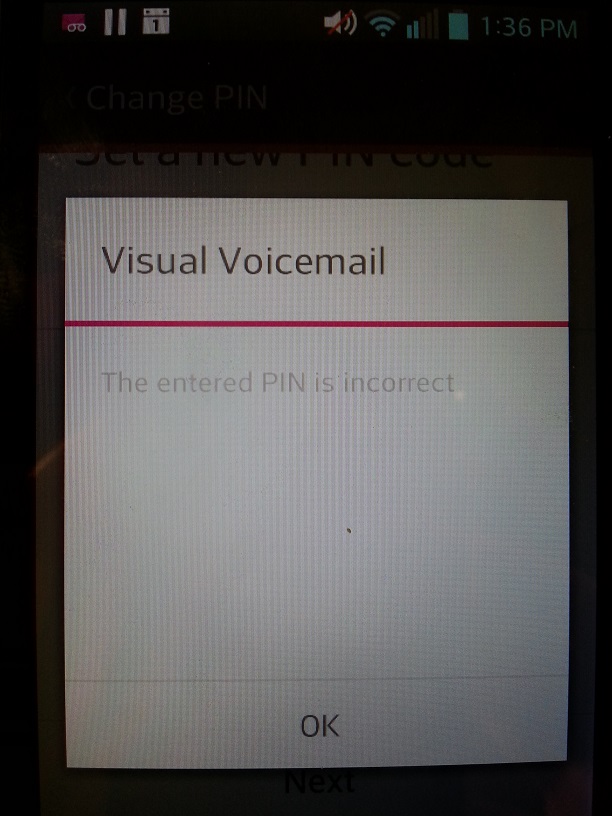
The first time I launched the voice mail application, the app prompted me to freely choose a new PIN code, and then sternly warned me, Mao-like, that my supposedly freely chosen PIN code was "incorrect". (I never got it working, and just called in to the voice mail number manually whenever I wanted to check my messages.)
-
When I bought a movie on Google Play and wanted to "pin" it to the phone -- i.e. download a static, non-streamed copy so that I could watch it offline, e.g. on a plane ride -- the phone didn't have enough internal storage left to save a copy of the movie (1.27 GB, most of it taken up in 1-2 MB increments by crapware already loaded on to the phone, so that only about 200 MB was left). So I tried saving the movie to a 32 GB SD card that I had plugged into the phone, but ran into the problem that Google Play wouldn't let me save the movie to the SD card, a problem described in Joe Levi's 2013 article "Why does Google hate your SD card?" and still not fixed almost a year later. (The comments posted on his article indicate that lots of people are pissed.)
Unlike the other bugs, this may be an example of stupidity not at the testing level but at the design specification level -- perhaps this was done in a misguided effort to prevent illegal copying. But, as Levi says of this theory, "If the DRM being used on Android is sufficient enough for content providers to accept it when media is saved internally, they should also accept it when media is saved to an SD card. Otherwise, the DRM isn't really that trustworthy, is it?" It's pointless from a copy-protection point of view, since anyone who wants to pirate a movie can just download it from various BitTorrent sites anyway; all this "feature" does is alienate people who are trying to pay for a movie legally.
-
In the Messaging (i.e. texting) app, you cannot search for messages by the name of the sender. Your conversations are listed in reverse chronological order by the date of the most recent message in each conversation, but to find a conversation with a particular person, you have to scroll down the entire list of conversations and keep your eyes peeled for the person's name.
- On certain mobile website forms (the Fandango site, for instance, and some others that I don't remember -- it's not clear why this happens on some website forms but not others), the phone won't let me type "special characters", the ones that appear in the upper-right corner of the keyboard keys (so that you can type the "@" symbol by first hitting the "Fn" key to access special characters, and then pressing the "2" key). This means that since I can't type the "@" symbol, I can't log in to any form that requires an email address as a username. (The workaround is to open the Gmail app, find an email address in an email message, copy the "@" symbol from the email address to the clipboard, and then paste it back in the browser form -- yes, I have to do every time I log in to a mobile site that has this problem.)
In my previous phone-suck article about the Samsung Stratosphere, I listed as many problems as I could think of at the time, and I completely forgot the fact that the phone recorded videos without any sound. (I know it wasn't a hardware problem with the microphone, since the phone app picked up my voice fine.) As part of my research into how to ruin Burning Man forever by telling "tourists" how to get there easily, I wanted to post a video of the quintessential Burning Man spectacle that makes all the dust and thirst and heat worthwhile -- and I had to post it with no sound recording, because Samsung's product testing is done by the same drunken bonobos that worked on the LG Optimus.
And both products raise the same question, not rhetorically, but seriously: How did this happen? More specifically, in a theoretical free market, any product improvement that costs only a small amount compared to the benefit it brings to consumers, should be implemented (and consumers will reward the company by paying additional dollars for the improvement, in proportion to the benefit it brings them). While it doesn't always work out that way in practice, it's hard to believe LG couldn't spring for a few English-language testers to point out that the phone shouldn't be correcting you're to you"re.
I think the answer in both cases is that the free market optimizes mainly for things that are easily quantifiable, like camera resolution and network speed, because those can be listed on the packaging and compared against other products. But the amount of stupid s*#t you run into while actually using the phone, is hard to define on an objective scale, so that's the first thing that companies will cut corners on, even if it's something that consumers would be willing to pay money for.
So my solution is still essentially the same as what I proposed after trashing the Stratosphere: Some Consumer-Reports-type outlet should rate phones on a Stupid S*#t Index (along with speed, reception, etc.), based on how much stupid s*#t they run into in a week of typical usage. Ideally the Stupid S*#t Index should be reduced to a number so that you can do a quick comparison between different models. If a cheap phone has a lot of stupid s*#t problems, but you don't mind because you want to save money, that's a valid choice, and if you want to pay more for a phone with less stupid s*#t, that's fine too. But people should know what they're buying.
More generally, I think people vastly overestimate the ability of the free market to meet consumer demand, in cases where the demand is for something that can't be easily quantified. I've spent a fair amount of time in "entrepreneurial" circles (while bouncing back and forth myself between entrepreneurship and regular jobs) and have heard the faithful reciting a lot of platitudes like "The market rewards the best product," or "Focus on building the best product you can make, and the customers will come." But most of them evidently didn't even believe it themselves -- they spent most of their efforts on search engine optimization, running content farms, networking with important business contacts, and other activities that didn't directly relate to the quality of their products. And who could blame them? Since their products weren't competing on qualities that were precisely quantifiable, there was no reason for any of them to try to create the "best" product, or even a particularly good one. And that strategy worked quite well for several of them.
On the other hand, when you're competing on a quantifiable metric like price, the best product or service can shoot straight to the top without wasting any time on zero-sum games like SEO or networking ass-kissery. If you're selling external hard drives on Amazon for $0.01, you'll make a lot of sales. You'll go broke, but in the meantime, the free market will connect you quite effectively with your customers.
So, make the mobile phone Stupid S*@t Index into something quantifiable, and maybe we'll have less stupid s#*t. One review body could publish the average rating from several different reviewers, or several different review bodies could publish their ratings and consumers could weight the averages themselves.
Not that it's a panacea -- I bought the LG Optimus not because it was the cheapest or because I didn't expect it to have bugs, but because it was the only offering with a slide-out keyboard, and I've become addicted to the precision of physical keys. (It is so much easier to let your fingertip feel its way to the right key first, and then actually press the key in a separate motion, rather than having to hope your fingertip lands on the right spot in the first place.) So I never returned the phone, they kept my money, and I suppose that makes me part of the problem.
-
-
Why My LG Optimus Cellphone Is Worse Than It's Supposed To Be
Bennett Haselton writes My LG Optimus F3Q was the lowest-end phone in the T-Mobile store, but a cheap phone is supposed to suck in specific ways that make you want to upgrade to a better model. This one is plagued with software bugs that have nothing to do with the cheap hardware, and thus lower one's confidence in the whole product line. Similar to the suckiness of the Stratosphere and Stratosphere 2 that I was subjected to before this one, the phone's shortcomings actually raise more interesting questions — about why the free-market system rewards companies for pulling off miracles at the hardware level, but not for fixing software bugs that should be easy to catch. Read below to see what Bennett has to say.How long would it have taken you to find these bugs, as a beta tester?
-
The phone's auto-correct changes single-quotes to double-quotes in contractions -- for example, when you type you're, the phone auto-corrects it to you"re .
-
When you backspace over part of a word that you've typed and then type the rest of the word, auto-correct corrects based on the letters that you type after you've finished backspacing, rather than the letters in the entire word that you've just completed. For example, if you type couchsurfing and the phone auto-corrects it to concurring, then backspace over all of the letters except the initial co, and then type "uch" followed by a space to form the word "couch", the Optimus changes "uch" to "such" to form "cosuch", because it thinks it's auto-correcting just the "uch" fragment and doesn't see the entire word "couch".
-
Taking a screen capture still doesn't work, just like it didn't work on the Stratosphere 2. There are official directions on how to do it, but you can follow the steps and nothing happens.
-
The first time I launched the voice mail application, the app prompted me to freely choose a new PIN code, and then sternly warned me, Mao-like, that my supposedly freely chosen PIN code was "incorrect". (I never got it working, and just called in to the voice mail number manually whenever I wanted to check my messages.)
-
When I bought a movie on Google Play and wanted to "pin" it to the phone -- i.e. download a static, non-streamed copy so that I could watch it offline, e.g. on a plane ride -- the phone didn't have enough internal storage left to save a copy of the movie (1.27 GB, most of it taken up in 1-2 MB increments by crapware already loaded on to the phone, so that only about 200 MB was left). So I tried saving the movie to a 32 GB SD card that I had plugged into the phone, but ran into the problem that Google Play wouldn't let me save the movie to the SD card, a problem described in Joe Levi's 2013 article "Why does Google hate your SD card?" and still not fixed almost a year later. (The comments posted on his article indicate that lots of people are pissed.)
Unlike the other bugs, this may be an example of stupidity not at the testing level but at the design specification level -- perhaps this was done in a misguided effort to prevent illegal copying. But, as Levi says of this theory, "If the DRM being used on Android is sufficient enough for content providers to accept it when media is saved internally, they should also accept it when media is saved to an SD card. Otherwise, the DRM isn't really that trustworthy, is it?" It's pointless from a copy-protection point of view, since anyone who wants to pirate a movie can just download it from various BitTorrent sites anyway; all this "feature" does is alienate people who are trying to pay for a movie legally.
-
In the Messaging (i.e. texting) app, you cannot search for messages by the name of the sender. Your conversations are listed in reverse chronological order by the date of the most recent message in each conversation, but to find a conversation with a particular person, you have to scroll down the entire list of conversations and keep your eyes peeled for the person's name.
- On certain mobile website forms (the Fandango site, for instance, and some others that I don't remember -- it's not clear why this happens on some website forms but not others), the phone won't let me type "special characters", the ones that appear in the upper-right corner of the keyboard keys (so that you can type the "@" symbol by first hitting the "Fn" key to access special characters, and then pressing the "2" key). This means that since I can't type the "@" symbol, I can't log in to any form that requires an email address as a username. (The workaround is to open the Gmail app, find an email address in an email message, copy the "@" symbol from the email address to the clipboard, and then paste it back in the browser form -- yes, I have to do every time I log in to a mobile site that has this problem.)
In my previous phone-suck article about the Samsung Stratosphere, I listed as many problems as I could think of at the time, and I completely forgot the fact that the phone recorded videos without any sound. (I know it wasn't a hardware problem with the microphone, since the phone app picked up my voice fine.) As part of my research into how to ruin Burning Man forever by telling "tourists" how to get there easily, I wanted to post a video of the quintessential Burning Man spectacle that makes all the dust and thirst and heat worthwhile -- and I had to post it with no sound recording, because Samsung's product testing is done by the same drunken bonobos that worked on the LG Optimus.
And both products raise the same question, not rhetorically, but seriously: How did this happen? More specifically, in a theoretical free market, any product improvement that costs only a small amount compared to the benefit it brings to consumers, should be implemented (and consumers will reward the company by paying additional dollars for the improvement, in proportion to the benefit it brings them). While it doesn't always work out that way in practice, it's hard to believe LG couldn't spring for a few English-language testers to point out that the phone shouldn't be correcting you're to you"re.
I think the answer in both cases is that the free market optimizes mainly for things that are easily quantifiable, like camera resolution and network speed, because those can be listed on the packaging and compared against other products. But the amount of stupid s*#t you run into while actually using the phone, is hard to define on an objective scale, so that's the first thing that companies will cut corners on, even if it's something that consumers would be willing to pay money for.
So my solution is still essentially the same as what I proposed after trashing the Stratosphere: Some Consumer-Reports-type outlet should rate phones on a Stupid S*#t Index (along with speed, reception, etc.), based on how much stupid s*#t they run into in a week of typical usage. Ideally the Stupid S*#t Index should be reduced to a number so that you can do a quick comparison between different models. If a cheap phone has a lot of stupid s*#t problems, but you don't mind because you want to save money, that's a valid choice, and if you want to pay more for a phone with less stupid s*#t, that's fine too. But people should know what they're buying.
More generally, I think people vastly overestimate the ability of the free market to meet consumer demand, in cases where the demand is for something that can't be easily quantified. I've spent a fair amount of time in "entrepreneurial" circles (while bouncing back and forth myself between entrepreneurship and regular jobs) and have heard the faithful reciting a lot of platitudes like "The market rewards the best product," or "Focus on building the best product you can make, and the customers will come." But most of them evidently didn't even believe it themselves -- they spent most of their efforts on search engine optimization, running content farms, networking with important business contacts, and other activities that didn't directly relate to the quality of their products. And who could blame them? Since their products weren't competing on qualities that were precisely quantifiable, there was no reason for any of them to try to create the "best" product, or even a particularly good one. And that strategy worked quite well for several of them.
On the other hand, when you're competing on a quantifiable metric like price, the best product or service can shoot straight to the top without wasting any time on zero-sum games like SEO or networking ass-kissery. If you're selling external hard drives on Amazon for $0.01, you'll make a lot of sales. You'll go broke, but in the meantime, the free market will connect you quite effectively with your customers.
So, make the mobile phone Stupid S*@t Index into something quantifiable, and maybe we'll have less stupid s#*t. One review body could publish the average rating from several different reviewers, or several different review bodies could publish their ratings and consumers could weight the averages themselves.
Not that it's a panacea -- I bought the LG Optimus not because it was the cheapest or because I didn't expect it to have bugs, but because it was the only offering with a slide-out keyboard, and I've become addicted to the precision of physical keys. (It is so much easier to let your fingertip feel its way to the right key first, and then actually press the key in a separate motion, rather than having to hope your fingertip lands on the right spot in the first place.) So I never returned the phone, they kept my money, and I suppose that makes me part of the problem.
-
-
Russian Government Edits Wikipedia On Flight MH17
An anonymous reader writes A political battle has broken out on Wikipedia over an entry relating to the crash of Malaysian Airlines flight MH17, with the Russian government reportedly removing sections which accuse it of providing 'terrorists' with missiles that were used to down the civilian airliner. A Twitter bot which monitors edits made to the online encyclopedia from Russian government IP addresses spotted that changes are being made to a page relating to the crash. All-Russia State Television and Radio Broadcasting Company (VGTRK) changed a Russian language version of a page listing civil aviation accidents to say that "The plane was shot down by Ukrainian soldiers." That edit replaced text – written just an hour earlier – which said MH17 had been shot down "by terrorists of the self-proclaimed Donetsk People's Republic with Buk system missiles, which the terrorists received from the Russian Federation." -
Russian Government Edits Wikipedia On Flight MH17
An anonymous reader writes A political battle has broken out on Wikipedia over an entry relating to the crash of Malaysian Airlines flight MH17, with the Russian government reportedly removing sections which accuse it of providing 'terrorists' with missiles that were used to down the civilian airliner. A Twitter bot which monitors edits made to the online encyclopedia from Russian government IP addresses spotted that changes are being made to a page relating to the crash. All-Russia State Television and Radio Broadcasting Company (VGTRK) changed a Russian language version of a page listing civil aviation accidents to say that "The plane was shot down by Ukrainian soldiers." That edit replaced text – written just an hour earlier – which said MH17 had been shot down "by terrorists of the self-proclaimed Donetsk People's Republic with Buk system missiles, which the terrorists received from the Russian Federation." -
Dealing With 'Advertising Pollution'
theodp writes: "Everyone gets that advertising is what powers the internet, and that our favorite sites wouldn't exist without it," writes longtime ad guy Ken Segall in The Relentless (and annoying) Pursuit of Eyeballs. "Unfortunately, for some this is simply license to abuse. Let's call it what it is: advertising pollution." CNN's in-your-face, your-video-will-play-in-00:25-seconds approach, once unthinkable, has become the norm. "Google," Segall adds, "is a leader in advertising pollution, with YouTube being a showcase for intrusive advertising. Many YouTube videos start with a mandatory ad, others start with an ad that can be dismissed only after the first 10 seconds. Even more annoying are the ad overlays that actually appear on top of the video you're trying to watch. It won't go away until you click the X. If you want to see the entire video unobstructed, you must drag the playhead back to start over. Annoying. And disrespectful." Google proposed using cap and trade penalties to penalize traditional polluters — how about for those who pollute the Internet? -
Amazon Isn't Killing Writing, the Market Is
An anonymous reader writes: Amazon has been struggling for price control of the book and ebook markets for years, battling publicly and privately with publishers while making a lot of authors nervous. With yesterday's announcement of "Kindle Unlimited," a Netflix-like ebook subscription service, Amazon is reaching their endgame in disrupting the book-selling business. But there are other companies doing the same thing, and an article at TechCrunch makes the case that it's the general market, rather than any company in particular, that's making it harder for authors to earn a living. "Driving the prices lower isn't likely to expand the market of readers, since book prices don't seem to be the deciding factor on whether someone reads a book (time is). But those lower prices directly shrink the incomes of authors, who lack any other means of translating their sales into additional revenue. That's why I don't think the big revolution for writers and other content producers will come from Amazon, but rather from startups like Patreon, which allow producers to build audiences directly and develop their own direct subscription model with their most fervent fans." -
$10 Million Lawsuit Against Wikipedia Editors "Stragetically" Withdrawn
First time accepted submitter The ed17 (2834807) writes with new developments in the $10 million defamation lawsuit against a few Wikipedia editors. From the article: On the same day the Wikimedia Foundation announced it would offer assistance to English Wikipedia editors embroiled in a legal dispute with Yank Barry, the lawsuit has been dismissed without prejudice at the request of Barry's legal team — but this action is being described as "strategic" so that they can refile the lawsuit with a "new, more comprehensive complaint." -
$10 Million Lawsuit Against Wikipedia Editors "Stragetically" Withdrawn
First time accepted submitter The ed17 (2834807) writes with new developments in the $10 million defamation lawsuit against a few Wikipedia editors. From the article: On the same day the Wikimedia Foundation announced it would offer assistance to English Wikipedia editors embroiled in a legal dispute with Yank Barry, the lawsuit has been dismissed without prejudice at the request of Barry's legal team — but this action is being described as "strategic" so that they can refile the lawsuit with a "new, more comprehensive complaint." -
Heinz Zemanek Passes At 94
Knuckles writes Austrian computer pioneer Heinz Zemanek, the first person to build a fully transistorized computer on the European mainland, died in Vienna, aged 94 (link in German). Officially named Binär dezimaler Volltransistor-Rechenautomat (binary-decimal fully transistorized computing automaton), but known as "Mailüfterl", the computer was built in 1955 and in 1958 calculated 5073548261 to be a prime number in 66 minutes. Its power was comparable to a small tube computer of the time, and it measured 4 by 2.5 by 0.5 meters. "Mailüfterl" means "may breeze" in Viennese German and was a play on US computers of the time, like MIT's Whirlwind. 'Even if it cannot match the rapid calculation speed of American models called "Whirlwind" or "Typhoon", it will be enough for a "Wiener Mailüfterl"' (Viennese may breeze), said Zemanek. Mailüfterl contained 3,000 transistors, 5,000 diodes, 1,000 assembly platelets, 100,000 solder joints, 15,000 resistors, 5,000 capacitors and 20,000 meters switching wire. It was built as an underground project at and without financial support from the technical university of Vienna, were Zemanek was an assistant professor at the time. In 1961, Zemanek and his team moved to IBM, who built them their own lab in Vienna. In 1976, Zemanek became an IBM Fellow and stayed at IBM until his retirement in 1985. He was crucial in the creation of the formal definition of the programming language PL/I. The definition language used was VDL (Vienna Definition Language), a direct predecessor of VDM Specification Language (VDM-SL). He remained a professor in Vienna and held regular lectures until 2006. -
Heinz Zemanek Passes At 94
Knuckles writes Austrian computer pioneer Heinz Zemanek, the first person to build a fully transistorized computer on the European mainland, died in Vienna, aged 94 (link in German). Officially named Binär dezimaler Volltransistor-Rechenautomat (binary-decimal fully transistorized computing automaton), but known as "Mailüfterl", the computer was built in 1955 and in 1958 calculated 5073548261 to be a prime number in 66 minutes. Its power was comparable to a small tube computer of the time, and it measured 4 by 2.5 by 0.5 meters. "Mailüfterl" means "may breeze" in Viennese German and was a play on US computers of the time, like MIT's Whirlwind. 'Even if it cannot match the rapid calculation speed of American models called "Whirlwind" or "Typhoon", it will be enough for a "Wiener Mailüfterl"' (Viennese may breeze), said Zemanek. Mailüfterl contained 3,000 transistors, 5,000 diodes, 1,000 assembly platelets, 100,000 solder joints, 15,000 resistors, 5,000 capacitors and 20,000 meters switching wire. It was built as an underground project at and without financial support from the technical university of Vienna, were Zemanek was an assistant professor at the time. In 1961, Zemanek and his team moved to IBM, who built them their own lab in Vienna. In 1976, Zemanek became an IBM Fellow and stayed at IBM until his retirement in 1985. He was crucial in the creation of the formal definition of the programming language PL/I. The definition language used was VDL (Vienna Definition Language), a direct predecessor of VDM Specification Language (VDM-SL). He remained a professor in Vienna and held regular lectures until 2006. -
Heinz Zemanek Passes At 94
Knuckles writes Austrian computer pioneer Heinz Zemanek, the first person to build a fully transistorized computer on the European mainland, died in Vienna, aged 94 (link in German). Officially named Binär dezimaler Volltransistor-Rechenautomat (binary-decimal fully transistorized computing automaton), but known as "Mailüfterl", the computer was built in 1955 and in 1958 calculated 5073548261 to be a prime number in 66 minutes. Its power was comparable to a small tube computer of the time, and it measured 4 by 2.5 by 0.5 meters. "Mailüfterl" means "may breeze" in Viennese German and was a play on US computers of the time, like MIT's Whirlwind. 'Even if it cannot match the rapid calculation speed of American models called "Whirlwind" or "Typhoon", it will be enough for a "Wiener Mailüfterl"' (Viennese may breeze), said Zemanek. Mailüfterl contained 3,000 transistors, 5,000 diodes, 1,000 assembly platelets, 100,000 solder joints, 15,000 resistors, 5,000 capacitors and 20,000 meters switching wire. It was built as an underground project at and without financial support from the technical university of Vienna, were Zemanek was an assistant professor at the time. In 1961, Zemanek and his team moved to IBM, who built them their own lab in Vienna. In 1976, Zemanek became an IBM Fellow and stayed at IBM until his retirement in 1985. He was crucial in the creation of the formal definition of the programming language PL/I. The definition language used was VDL (Vienna Definition Language), a direct predecessor of VDM Specification Language (VDM-SL). He remained a professor in Vienna and held regular lectures until 2006. -
NIF Compresses Diamonds With 50 Million Atmospheres of Pressure
sciencehabit (1205606) writes The world's largest laser [the National Ignition Facility], a machine that appeared as the warp core in 'Star Trek into Darkness', has attained a powerful result: It's squeezed diamond, the least compressible substance known, 50 million times harder than Earth's atmosphere presses down on us. ... As the researchers report online today in Nature, the x-ray assault nearly quadrupled the diamond's density. "That's a record," Smith [one of the researchers] says. "No one's compressed diamond to that extent before." The blast pulverized the diamond into dust, but before the mineral's destruction the scientists successfully measured its density ... For a billionth of a second, the diamond, which is normally 3.25 times denser than water, became ... 12.03 times denser than water. ... Scientists have speculated that diamond worlds may exist elsewhere. If a solar system arises with more carbon than oxygen, then carbon should soak up the oxygen by forming carbon monoxide, leaving excess carbon to create carbon planets—which, under pressure, become diamond worlds. Thus, Smith says, the new experiment will probe the nature of such planets. They are performing similar experiments with iron in an attempt to understand the properties of super-Earth cores. -
Malaysian Passenger Plane Reportedly Shot Down Over Ukraine
An anonymous reader writes The Russian newswire service Interfax is reporting that a Malaysian passenger plane carrying 295 people was shot down with a Buk ground-to-air missile over Ukraine near the Russian border. The Associated Press cites an adviser to Ukraine's Interior Minister as the source. First reports are that it was mistaken for a Ukrainian AN-26. Malaysia airlines confirms they lost contact with the plane (last known position), but there's no confirmation it was shot down (yet). The Ukrainian government accused Russia of shooting down a fighter jet in Ukrainian airspace last night. Reports indicate there are no survivors. -
Giant Crater Appears In Northern Siberia
New submitter DavidMZ writes: The Siberian Times reports on a large crater of unknown origin that has appeared in the Yamal Peninsula in northern Siberia. The Russian government has dispatched a group of scientists to investigate the 80-meter-wide crater. Anna Kurchatova from Siberia's Sub-Arctic Scientific Research Center believes the crater was a result of an explosion when a mixture of water, salt, and natural gas exploded underground. The Yamai Peninsula is known to hold Russia's biggest natural gas reserve." -
SRI/Cambridge Opens CHERI Secure Processor Design
An anonymous reader writes with some exciting news from the world of processor design: Robert Watson at Cambridge (author of Capsicum) has written a blog post on SRI/Cambridge's recent open sourcing of the hardware and software for the DARPA-sponsored CHERI processor — including laser cutting directions for an FPGA-based tablet! Described in their paper The CHERI Capability Model: Reducing Risk in an age of RISC, CHERI is a 64-bit RISC processor able to boot and run FreeBSD and open-source applications, but has a Clang/LLVM-managed fine-grained, capability-based memory protection model within each UNIX process. Drawing on ideas from Capsicum, they also support fine-grained in-process sandboxing using capabilities. The conference talk was presented on a CHERI tablet running CheriBSD, with a video of the talk by student Jonathan Woodruff (slides).
Although based on the 64-bit MIPS ISA, the authors suggest that it would also be usable with other RISC ISAs such as RISC-V and ARMv8. The paper compares the approach with several other research approaches and Intel's forthcoming Memory Protection eXtensions (MPX) with favorable performance and stronger protection properties. The processor "source code" (written in Bluespec Verilog) is available under a variant of the Apache license (modified for application to hardware). Update: 07/16 20:53 GMT by U L : If you have any questions about the project, regular Slashdot contributor TheRaven64 is one of the authors of the paper, and is answering questions. -
HP Claims Their Moonshot System is a 'New Style of IT' (Video)
Didn't we already have something kind of like this called a Blade server? But this is better! An HP Web page devoted to Moonshot says, 'Compared to traditional servers, up to: 89% less energy; 80% less space; 77% less cost; and 97% less complex.' If this is all true, the world of servers is now undergoing a radical change. || A quote from another Moonshot page: "The HP Moonshot 1500 Chassis has 45 hot-pluggable servers installed and fits into 4.3U. The density comes in part from the low-energy, efficient processors. The innovative chassis design supports 45 servers, 2 network switches, and supporting components.' These are software-defined servers. HP claims they are the first ones ever, a claim that may depend on how you define "software-defined." And what software defines them? In this case, at Texas Linux Fest, it seems to be Ubuntu Linux. (Alternate Video Link) -
Ask Slashdot: Future-Proof Jobs?
An anonymous reader writes: My niece, who is graduating from high school, has asked me for some career advice. Since I work in data processing, my first thought was to recommend a degree course in computer science or computer engineering. However, after reading books by Jeremy Rifkin (The Third Industrial Revolution) and Ray Kurzweil (How to Create a Mind), I now wonder whether a career in information technology is actually better than, say, becoming a lawyer or a construction worker. While the two authors differ in their political persuasions (Rifkin is a Green leftist and Kurzweil is a Libertarian transhumanist), both foresee an increasingly automated future where most of humanity would become either jobless or underemployed by the middle of the century. While robots take over the production of consumer hardware, Big Data algorithms like the ones used by Google and IBM appear to be displacing even white collar tech workers. How long before the only ones left on the payroll are the few "rockstar" programmers and administrators needed to maintain the system? Besides politics and drug dealing, what jobs are really future-proof? Would it be better if my niece took a course in the Arts, since creativity is looking to be one of humanity's final frontiers against the inevitable Rise of the Machines? -
Ask Slashdot: Future-Proof Jobs?
An anonymous reader writes: My niece, who is graduating from high school, has asked me for some career advice. Since I work in data processing, my first thought was to recommend a degree course in computer science or computer engineering. However, after reading books by Jeremy Rifkin (The Third Industrial Revolution) and Ray Kurzweil (How to Create a Mind), I now wonder whether a career in information technology is actually better than, say, becoming a lawyer or a construction worker. While the two authors differ in their political persuasions (Rifkin is a Green leftist and Kurzweil is a Libertarian transhumanist), both foresee an increasingly automated future where most of humanity would become either jobless or underemployed by the middle of the century. While robots take over the production of consumer hardware, Big Data algorithms like the ones used by Google and IBM appear to be displacing even white collar tech workers. How long before the only ones left on the payroll are the few "rockstar" programmers and administrators needed to maintain the system? Besides politics and drug dealing, what jobs are really future-proof? Would it be better if my niece took a course in the Arts, since creativity is looking to be one of humanity's final frontiers against the inevitable Rise of the Machines? -
Brazil Nut Effect Explains Mystery of the Boulder-Strewn Surfaces of Asteroids
KentuckyFC (1144503) writes When Japan's Hayabusa spacecraft gently maneuvered into a parking orbit around the asteroid Itokawa in September 2005, it conducted a comprehensive photographic survey, the most detailed ever taken of an asteroid. This survey revealed that Itokawa is covered in large boulders that look like ejecta from craters in other parts of the asteroid. But when astronomers added up the total volume of these boulders, it turned out to be greater than the volume of the craters there were supposed to have come from. Other asteroids also show a similarly skewed distribution of large boulders. That has caused some significant head-scratching among astronomers who are at a loss to explain where the boulders come from.
Now an international team has solved the mystery. They say the boulders float to the surface of asteroids in an astrophysical example of the Brazil nut effect. This is the long observed phenomenon in which shaking a mixture of big and small particles causes the larger ones to rise to the top. That's because the shaking creates gaps beneath the large particles that small particles fall into. The result is that the large particles float. The team simulated the shaking effect that collisions between asteroids would produce and say that these vibrations would cause large boulders to float to the surface in a few hours, finally explaining why asteroids have such boulder-strewn surfaces. Problem solved! -
Led By Nest, 'Thread' Might Be Most Promising IoT Initiative Yet
An anonymous reader writes Nest, Big A%@ Fans, Yale door locks, ARM, Freescale, Samsung and Silicon Labs launch the Thread Group, a standards initiative for using 6LoWPAN-based network technology with mesh capabilities optimized for home automation. Because it blends IPv6 with low-power 802.15.4 radios, a layer of security, peer-to-peer communications, and other special sauce for whole-house connectivity, Thread looks extremely promising in an increasingly crowded field. Plus, millions of units of enabled products are already deployed by way of Nest's little-known Weave technology. There's a press release. Thread is based on open technology, but it's not clear that the protocol specifications will be available for non-members. No hardware changes are required for devices with 802.15.4 radios, and the group claims the new protocol fixes enough flaws in existing standards (mostly ZigBee) to be worth the software upgrade. Promises include increased reliability (mesh network with multiple routing points), lower power use (by not requiring sensors to wake up for traffic from other sensors), and easier bridging between the mesh network and Internet (thanks to using IPv6). -
Led By Nest, 'Thread' Might Be Most Promising IoT Initiative Yet
An anonymous reader writes Nest, Big A%@ Fans, Yale door locks, ARM, Freescale, Samsung and Silicon Labs launch the Thread Group, a standards initiative for using 6LoWPAN-based network technology with mesh capabilities optimized for home automation. Because it blends IPv6 with low-power 802.15.4 radios, a layer of security, peer-to-peer communications, and other special sauce for whole-house connectivity, Thread looks extremely promising in an increasingly crowded field. Plus, millions of units of enabled products are already deployed by way of Nest's little-known Weave technology. There's a press release. Thread is based on open technology, but it's not clear that the protocol specifications will be available for non-members. No hardware changes are required for devices with 802.15.4 radios, and the group claims the new protocol fixes enough flaws in existing standards (mostly ZigBee) to be worth the software upgrade. Promises include increased reliability (mesh network with multiple routing points), lower power use (by not requiring sensors to wake up for traffic from other sensors), and easier bridging between the mesh network and Internet (thanks to using IPv6). -
Court Rejects Fox's Attempt to Use Aereo Ruling Against Dish's Hopper
Fox and Dish have been locking horns over Dish over its streaming and PVR services for a while now, and immediately after the Aereo ruling Fox sought an injunction against Dish's services. The court rejected the request. From the article: Fox pointed out the Supremes had reflected Aereo's argument (which it said was Dish's as well) that a performance was not public under the Copyright Act if each sub watches a unique stream. Fox's lawyer, Richard Stone, argued that Aereo was also essentially about attaching a Slingbox to a DVR. But that got some pushback. One judge countered that it was "completely different technology" and said that while that was the argument, "the Supreme court has all sorts of caveats in the opinion about how this was about Aereo and nothing else and a lot of the 'nothing elses' seem to be pretty similar to Slingbox." The underlying case will continue moving forward (going to trial in early 2015). -
Texas Town Turns To Treated Sewage For Drinking Water
Scientific American reports that Wichita Falls, Texas has taken an unusual step, precipitated by the years-long drought that Texas has faced: it's using treated sewage for drinking water. From the article: To launch what it calls its "Direct Potable Reuse Project," the city pipes water 12 miles from its wastewater treatment plant to this treatment facility where it goes through microfiltration. A pump pulls water through a module filled with fibers that removes most of the impurities. Then it is forced through a semi-permeable membrane that can remove dissolved salts and other contaminants. The process, called reverse osmosis, is used by the U.S. military, in ships and in the manufacture of silicon chips. The water then gets blended with lake water before going through the regular water treatment system. ... At 60 cents per 1,000 gallons, it's far cheaper than any other source of water, [Wichita Falls' public works director Russell] Schreiber said. ... He said there have been few complaints so far. A glass of the finished product, sampled at a downtown restaurant, tasted about average for West Texas. -
Chinese Hackers Infiltrate Firms Using Malware-Laden Handheld Scanners
wiredmikey (1824622) writes China-based threat actors are using sophisticated malware installed on handheld scanners to target shipping and logistics organizations from all over the world. According to security firm TrapX, the attack begins at a Chinese company that provides hardware and software for handheld scanners used by shipping and logistics firms worldwide to inventory the items they're handling. The Chinese manufacturer installs the malware on the Windows XP operating systems embedded in the devices.
Experts determined that the threat group targets servers storing corporate financial data, customer data and other sensitive information. A second payload downloaded by the malware then establishes a sophisticated C&C on the company's finance servers, enabling the attackers to exfiltrate the information they're after. The malware used by the Zombie Zero attackers is highly sophisticated and polymorphic, the researchers said. In one attack they observed, 16 of the 48 scanners used by the victim were infected, and the malware managed to penetrate the targeted organization's defenses and gain access to servers on the corporate network. Interestingly, the C&C is located at the Lanxiang Vocational School, an educational institution said to be involved in the Operation Aurora attacks against Google, and which is physically located only one block away from the scanner manufacturer, TrapX said. -
Insurance Claims Reveal Hidden Electronic Damage From Geomagnetic Storms
KentuckyFC writes: On 13 March 1989, a powerful geomagnetic storm severely disrupted the Hydro-Québec high-voltage grid triggering numerous circuit breakers and blacking out much of eastern Canada and the northeastern U.S. Since then, Earth has been hit by numerous solar maelstroms without such large-scale disruption. But the smaller-scale effect of these storms on low voltage transmissions lines, and the equipment connected to them, has been unknown. Until now. Researchers from the Lockheed Martin Solar and Astrophysics Laboratory have analyzed insurance claims for damage to industrial electrical equipment between 2000 and 2010 and found a clear correlation with geomagnetic activity. They say that the number of claims increases by up to 20 per cent on the days of highest geomagnetic activity. On this basis, they calculate that the economic impact of geomagnetic damage must amount to several billion dollars per year. That raises the question of the impact these storms have on household electronic equipment, such as computers, smartphones and tablets, and whether domestic insurance claims might throw some light on the issue. -
Prof. Andy Tanenbaum Retires From Vrije University
When Linus Torvalds first announced his new operating system project ("just a hobby, won't be big and professional like gnu"), he aimed the announcement at users of Minix for a good reason: Minix (you can download the latest from the Minix home page) was the kind of OS that tinkerers could afford to look at, and it was intended as an educational tool. Minix's creator, Professor Andrew Stuart "Andy" Tanenbaum, described his academic-oriented microkernel OS as a hobby, too, in the now-famous online discussion with Linus and others. New submitter Thijssss (655388) writes with word that Tanenbaum, whose educational endeavors led indirectly to the birth of Linux, is finally retiring. "He has been at the Vrije Universiteit for 43 years, but everything must eventually end." -
Prof. Andy Tanenbaum Retires From Vrije University
When Linus Torvalds first announced his new operating system project ("just a hobby, won't be big and professional like gnu"), he aimed the announcement at users of Minix for a good reason: Minix (you can download the latest from the Minix home page) was the kind of OS that tinkerers could afford to look at, and it was intended as an educational tool. Minix's creator, Professor Andrew Stuart "Andy" Tanenbaum, described his academic-oriented microkernel OS as a hobby, too, in the now-famous online discussion with Linus and others. New submitter Thijssss (655388) writes with word that Tanenbaum, whose educational endeavors led indirectly to the birth of Linux, is finally retiring. "He has been at the Vrije Universiteit for 43 years, but everything must eventually end." -
Mathematicians Solve the Topological Mystery Behind the "Brazuca" Soccer Ball
KentuckyFC (1144503) writes "In the 1970 World Cup in Mexico, teams used a new kind of ball called the Telstar made from 12 black pentagonal panels and 20 white hexagonal panels. This ball has icosahedral symmetry and its own molecular analogue in the form of C60, the famous soccer ball-shaped fullerene. In 2006, a new ball called the TeamGeist was introduced at the World Cup in Germany. This was made of 14 curved panels that together gave it tetrahedral symmetry. This also had a molecular analogue with tetrahedral symmetry among the fullerenes. Now teams at the current World Cup in Brazil are playing with yet another design: the Brazuca, a ball constructed from six panels each with a four-leaf clover shape that knit together like a jigsaw to form a sphere. This has octahedral symmetry. But here's question that has been puzzling chemists, topologists and..errr...soccer fans: is there a molecular analogue of the Brazuca? Or put another way, can fullerenes have octahedral symmetry? Now a pair of mathematicians have finally solved this problem. They've shown that fullerenes can indeed have octahedral symmetry just like the Brazuca, although in addition to hexagonal and pentagonal carbon rings, the ball-shaped molecules must also have rings of 4 and 8 carbon atoms. The next stage is to actually synthesis one of these fullerenes, perhaps something to keep chemists occupied until the 2018 World Cup in Russia." -
Mathematicians Solve the Topological Mystery Behind the "Brazuca" Soccer Ball
KentuckyFC (1144503) writes "In the 1970 World Cup in Mexico, teams used a new kind of ball called the Telstar made from 12 black pentagonal panels and 20 white hexagonal panels. This ball has icosahedral symmetry and its own molecular analogue in the form of C60, the famous soccer ball-shaped fullerene. In 2006, a new ball called the TeamGeist was introduced at the World Cup in Germany. This was made of 14 curved panels that together gave it tetrahedral symmetry. This also had a molecular analogue with tetrahedral symmetry among the fullerenes. Now teams at the current World Cup in Brazil are playing with yet another design: the Brazuca, a ball constructed from six panels each with a four-leaf clover shape that knit together like a jigsaw to form a sphere. This has octahedral symmetry. But here's question that has been puzzling chemists, topologists and..errr...soccer fans: is there a molecular analogue of the Brazuca? Or put another way, can fullerenes have octahedral symmetry? Now a pair of mathematicians have finally solved this problem. They've shown that fullerenes can indeed have octahedral symmetry just like the Brazuca, although in addition to hexagonal and pentagonal carbon rings, the ball-shaped molecules must also have rings of 4 and 8 carbon atoms. The next stage is to actually synthesis one of these fullerenes, perhaps something to keep chemists occupied until the 2018 World Cup in Russia." -
Single European Copyright Title On the Horizon
presroi (657709) writes "It has been 13 years after the last harmonization effort of copyright within the European Union and this period might soon be over. After the election of a new European Parliament in May this year, Jean-Claude Juncker has been nominated to become the new President of the European Commission. He has named a unified copyright his top priority, a statement repeated today at a hearing before the Greens/EFA group in the European parliament (transcript of the question by MEP Julia Reda and his answer in German, Video recording). These statements are coinciding with the upcoming release of a report by the General Directorate in charge of copyright, of which an advanced draft has been already leaked to the internet. The report analyzes four possible policy options, one of which is the introduction of a Single EU Copyright title." -
Study: Why the Moon's Far Side Looks So Different
StartsWithABang writes 55 years ago, the Soviet probe Luna 3 imaged the side of the Moon that faces away from us for the first time. Surprisingly, there were only two very small maria (dark regions) and large amounts of mountainous terrain, in stark contrast to the side that faces us. This remained a mystery for a very long time, even after we developed the giant impact hypothesis to explain the origin of the Moon. But a new study finally appears to solve the mystery, crediting the heat generated on the near side from a hot, young Earth with creating the differences between the two hemispheres. -
Study: Why the Moon's Far Side Looks So Different
StartsWithABang writes 55 years ago, the Soviet probe Luna 3 imaged the side of the Moon that faces away from us for the first time. Surprisingly, there were only two very small maria (dark regions) and large amounts of mountainous terrain, in stark contrast to the side that faces us. This remained a mystery for a very long time, even after we developed the giant impact hypothesis to explain the origin of the Moon. But a new study finally appears to solve the mystery, crediting the heat generated on the near side from a hot, young Earth with creating the differences between the two hemispheres. -
Will Google's Dart Language Replace Javascript? (Video)
Seth Ladd, Google Web engineer and Chrome Developer Advocate, is today's interviewee. He's talking about Dart, which Wikipedia says is 'an open-source Web programming language developed by Google.' The Wikipedia article goes on to say Dart was unveiled at the GOTO conference in Aarhus, October 10–12, 2011, and that the goal of Dart is 'ultimately to replace JavaScript as the lingua franca of web development on the open web platform.' A bold aim, indeed. Last month (June, 2014), InfoWorld ran an article by Paul Krill headlined, Google's Go language on the rise, but Dart is stalling. Seth Ladd, unlike Paul Krill, is obviously rah-rah about Dart -- which is as it should be, since that's his job -- and seems to think it has a growing community and a strong place in the future of Web programming. For more about Dart, scroll down to watch Tim Lord's video interview with Seth -- or read the transcript, if you prefer. (Alternate Video Link) -
DHS Mistakenly Releases 840 Pages of Critical Infrastructure Documents
wiredmikey (1824622) writes The Operation Aurora attack was publicized in 2010 and impacted Google and a number of other high-profile companies. However, DHS responded to the request by releasing more than 800 pages of documents related to the 'Aurora' experiment conducted several years ago at the Idaho National Laboratory, where researchers demonstrated a way to damage a generator via a cyber-attack. Of the documents released by the DHS, none were related to the Operation Aurora cyber attack as requested. Many of the 840 pages are comprised of old weekly reports from the DHS' Control System Security Program (CSSP) from 2007. Other pages that were released included information about possible examples of facilities that could be vulnerable to attack, such as water plants and gas pipelines. -
Climate Change Skeptic Group Must Pay Damages To UVA, Michael Mann
ideonexus (1257332) writes In January of 2014, the American Traditions Institute (ATI) sought climate scientist Micheal Mann's emails from his time at the University of Virginia, a request that was denied in the courts. Now the Virginia Supreme Court has upheld a lower court ruling that ATI must pay damages for filing a frivolous lawsuit. Thus ends "Climategate." Hopefully. -
The Billionaire Mathematician
An anonymous reader writes Dr. James Simons received his doctorate at the age of 23. He was breaking codes for the NSA at 26, and was put in charge of Stony Brook University's math department at 30. He received the Veblen Prize in Geometry in 1976. Today, he's a multi-billionaire, using his fortune to set up educational foundations for math and science. "His passion, however, is basic research — the risky, freewheeling type. He recently financed new telescopes in the Chilean Andes that will look for faint ripples of light from the Big Bang, the theorized birth of the universe. The afternoon of the interview, he planned to speak to Stanford physicists eager to detect the axion, a ghostly particle thought to permeate the cosmos but long stuck in theoretical limbo. Their endeavor 'could be very exciting,' he said, his mood palpable, like that of a kid in a candy store." Dr. Simons is quick to say this his persistence, more than his intelligence, is key to his success: "I wasn't the fastest guy in the world. I wouldn't have done well in an Olympiad or a math contest. But I like to ponder. And pondering things, just sort of thinking about it and thinking about it, turns out to be a pretty good approach." -
Microsoft Kills Off MapPoint and Streets and Trips In Favor of Bing Maps
DroidJason1 (3589319) writes Microsoft has killed off two of its mapping products, MapPoint and Streets & Trips. Both of these services have received their last update and will soon be retired in favor of Microsoft's premier mapping product, Bing Maps. The company has yet to go public with a press release announcing the retirement of these two mapping services, but the Redmond giant has quietly mentioned the fate on both the services' websites. MapPoint was first released back in 1999 and made it easier to view, edit, and integrate maps into software. Streets & Trips was a route planning package. Microsoft is now pushing Bing Maps exclusively. -
DC Entertainment Won't Allow Superman Logo On Murdered Child's Memorial Statue
An anonymous reader writes Jeffrey Baldwin was essentially starved to death by his grandparents. Funds had been raised to build a monument for Jeffrey in Toronto. The monument was designed to feature Jeffrey in a Superman costume, and even though Superman should be public domain, DC Comics has denied the request. "The request to DC had been made by Todd Boyce, an Ottawa father who did not know the Baldwin family. Boyce was so moved by the testimony at the coroner’s inquest into Jeffrey’s death last year that he started an online fundraising campaign for the monument. DC’s senior vice-president of business and legal affairs, Amy Genkins, told Boyce in an email that 'for a variety of legal reasons, we are not able to accede to the request, nor many other incredibly worthy projects that come to our attention.'... For Boyce, it was a huge blow, as he felt the Superman aspect was a crucial part of the bronze monument, which will include a bench. The coroner’s inquest heard from Jeffrey’s father that his son loved to dress up as Superman." -
Two Earth-Like Exoplanets Don't Actually Exist
Two suspected exoplanets, Gliese 581g and 581d, have been shown to not exist, and are instead misinterpretations of data from starspot activity. From the article: "Gliese 581g doesn't exist," said lead author Paul Robertson of Penn State University in State College, Pennsylvania. Neither, he said, does another planet in the same solar system, known as Gliese 581d, announced in 2009—less clearly hospitable to life, but still once seen by some astronomers as a possible place to find aliens. ... What's happening, they say, is that magnetic disturbances on Gliese 581's surface — starspots — are altering the star's spectrum in such a way that it mimics the motion induced by a planet. The star itself rotates once every 130 days, carrying the starspots with it; the disputed planets appeared to have periods of almost exactly one half and one fourth of the 130-day period. When the scientists corrected for the starspot signal, both planets disappeared. -
3D Printed PiGRRL - Raspberry Pi Gameboy
coop0030 (263345) writes "Celebrate the 25th anniversary of the classic gaming device, Game Boy, by building your own with 3d printing and DIY electronics. This project uses a Raspberry Pi and TFT touch screen to make an epic DIY Game Girl. The 3d printed enclosure houses all of the components and can be printed in your favorite color. It's controlled with SNES gaming controller components, reusing the printed circuit board, buttons and elastomers. The 3D files can be found on Thingiverse, and a video of the finished product is provided as well." -
New Class of Stars Are Totally Metal, Says Astrophysicist
KentuckyFC writes Stars form when clouds of gas and dust collapse under their own gravity, generating enough heat and pressure to fuse the atoms inside them together. When this cloud of dust and gas is the remnants of a supernova, it can contain all kinds of heavy elements in addition to primordial hydrogen, helium and lithium. Now one astrophysicist has calculated that a recently discovered phenomenon of turbulence, called preferential concentration, can profoundly alter star formation. He points out that turbulence is essentially vortices rotating on many scales of time and space. On certain scales, the inertial forces these eddies create can push heavy particles into the calmer space between the vortices, thereby increasing their concentration. In giant clouds of interstellar gas, this concentrates heavy elements, increasing their gravitational field, attracting more mass and so on. The result is the formation of a star that is made entirely of heavy elements rather than primordial ones. Astrophysicists call the amount of heavy elements in a star its "metallicity". Including preferential concentration in the standard model of star formation leads to the prediction that 1 in 10,000 stars should be totally metal. Now the race is on to find the first of this new class of entirely metal stars.