Slashdot Mirror
Domain: wikipedia.org
Stories and comments across the archive that link to wikipedia.org.
Stories · 7,048
-
Heathkit DIY Kits Are Coming Back
donberryman writes "IEEE Times reports that Heathkit, the fabled electronics kits company, is going back into that business after a two-decade hiatus. The Heathkit website says that they will be releasing Garage Parking Assistant kit (GPA-100) in late September followed by a Wireless Swimming Pool Monitor kit. Amateur radio kits may be coming by the end of the year." I hope for real this time — I never saw for sale the HERO kit they promised a few years ago. -
3TB Hard Drive Round Up
MojoKid writes "When 3TB hard drives first arrived compatible motherboards with newer UEFI setup utilities weren't quite ready for prime time. However, with the latest Intel and AMD chipsets hitting the market, UEFI has become commonplace and compatibility with 3TB drives is no longer an issue... A detailed look at four of the latest 3TB drives to hit the market from Hitachi, Seagate, and Western Digital shows ... there are some distinct differences between them. Performance-wise, Seagate's Barracuda XT 3TB drive seems to be the current leader but other, slightly less expensive drives, come close." -
Newly Digitized Film Shows Ed Catmull's 3D Graphics From 1972
AlejoHausner writes "In 1972, Ed Catmull, then at the University of Utah, put together a film showcasing many of the 3D computer graphics techniques he and others had developed while working as students in Ivan Sutherland's lab. That film has been digitized and is available. All kinds of modern techniques like Gouraud shading, deformed meshes, and z-buffering are shown in the film. There is a segment showing Catmull digitizing a plaster model of his hand. Catmull later founded Pixar, but at the time the Utah lab pioneered many of the graphics techniques we take for granted today." I'm just sorry I missed when this film was first made available online earlier this year. -
First Von Neumann Architecture Quantum Computer
holy_calamity writes "The first computers with a von Neumann architecture, where a processor has access to RAM, appeared in the 1940s. Now the first quantum computing system with a von Neumann design has been made, at University of California Santa Barbara. Their quantum processor made up of two superconducting quantum bits can use a 2-bit "quantum RAM" to save entangled bit values into." -
Ask Kevin Mitnick
The hacker with perhaps the most famous first name around, Kevin Mitnick, has gone from computer hacking of the sort that gets one on the FBI's Most Wanted list (and into years of solitary confinement) to respected security consultant and author, helping people minimize the sort of security holes he once exploited for fun. His new book is called Ghost in the Wires: My Adventures as the World's Most Wanted Hacker; it's his first since the expiration of an agreement that he could not profit from books written about his criminal activity. Kevin's agreed to answer your questions; we'll pass the best ones on to him, and print his answers when they're ready. Note: Kevin also answered Slashdot questions most of a decade ago; that's a good place to start. Please observe the Slashdot interview guidelines: ask as many questions as you want, but please keep them to one per comment. -
LHC Data Continues To Disagree With Supersymmetry
decora writes "Pallab Ghosh of the BBC reports on another piece of evidence hitting the beleaguered Supersymmetry community. Scientists at the Lepton Photon conference in Mumbai, India confirmed that extra levels of B-Meson decay have not been found in the LHC beauty experiment. Coming on the heels of a March report in Nature, this news seems to reinforce what many have suspected all along. Dark Matter is probably not explainable through massive shadow particles like squarks and selectrons, and for all practical purposes, the Supersymmetric Extension of the Standard Model of Physics is dead." -
LHC Data Continues To Disagree With Supersymmetry
decora writes "Pallab Ghosh of the BBC reports on another piece of evidence hitting the beleaguered Supersymmetry community. Scientists at the Lepton Photon conference in Mumbai, India confirmed that extra levels of B-Meson decay have not been found in the LHC beauty experiment. Coming on the heels of a March report in Nature, this news seems to reinforce what many have suspected all along. Dark Matter is probably not explainable through massive shadow particles like squarks and selectrons, and for all practical purposes, the Supersymmetric Extension of the Standard Model of Physics is dead." -
Book Review: Ghost In the Wires
brothke writes "During the 1990's when Kevin Mitnick was on the run, a cadre of people were employed to find him and track him down. Anyone who could have an angle on Mitnick was sought after by the media to provide a sound bite on the world's most dangerous computer hacker. Just one example is John Markoff, who became a star journalist for his work at The New York Times, and a follow-up book and series of articles based on Mitnick. In Ghost in the Wires: My Adventures as the Worlds Most Wanted Hacker, the first personal account of what really happened; Mitnick says most of the stories around him were the result of the myth of Kevin Mitnick, and nothing more. In the book, he attempts to dispel these myths and set the record straight." Read below for the rest of Ben's review. Ghost in the Wires: My Adventures as the World's Most Wanted Hacker author Kevin Mitnick pages 432 publisher Little, Brown and Company rating 9/10 reviewer Ben Rothke ISBN 0316037702 summary Kevin Mitnick's fascinating firsthand story Some of the myths were that he was responsible for the phone of actress Kristy McNichol to be disconnected, and perhaps the most preposterous of them all, that he could whistle into a telephone and launch missiles from NORAD. The latter myth was responsible for him spending a year in solitary confinement. Mitnick notes that he thinks it was the federal prosecutor who got that idea from the movie WarGames.
But no one really knew Mitnick or what he was about. Left on his own, he would likely have been harmless. All he wanted to do was get into corporate sites, download code, play with the code and then move on to the next target. It is undeniable that Mitnick committed crimes; but it was unreasonable for the FBI to have made him a top priority for capture.
Perhaps the most widely stated myth about him is that he was strictly a social engineer without significant technical experience. While it was his gift of social engineering that facilitated his ability to get a significant amount of information from unsuspecting individuals; in many places in the book, Mitnick details technical Unix exploits that he carried out. The book makes it clear that Mitnick had the deep technical skills necessary to execute on the information he illicitly obtained.
While the book does have a lot of technical details, it mainly is about the human side of Mitnick. Chapter 1 is appropriately titled "Rough Start." He details his early days of growing up in the Los Angeles area.
These formative years as a hyperactive child, growing up with a single mom who had boyfriends that abused him and one who worked in law enforcement that molested him; may have been what led Mitnick to find solace behind a keyboard.
Mitnick writes how his first hack and entry into the world of dumpster diving was to forge bus transfers so he could ride around Los Angeles to occupy his time while his mother was at work.
In numerous places, Mitnick sincerely expresses his contrition for the pain he subjected his mother, grandmother, aunt, wife and others to.
Above and beyond his rough start, Mitnick also notes how he had his share of bad luck. He writes that too many times when he was growing up, including having to deal with various probation officers, unexplained failures in technology anywhere would be attributed to him. When the phone of his probation officers went dead, he was assumed to be the culprit.
The reality is that the world did not know what to make of Mitnick or what to do with him. It is pretty clear from the book and from every other account that Mitnick was never it in for the money. He simply was a hacker whose goal was to gain root, and nothing more. Such a notion was incredulous to law enforcement, and even to Ivan Boesky who Mitnick met in prison. When he briefly sat with Boesky on a prison bench, he writes that when Boesky found out he did it for the hacking thrill, Boesky replied that "you're in prison and you didn't make any money. Isn't that stupid?"
It is worthy to point out that Mitnick's escapades were radically different from that of Frank Abagnale, whom Mitnick is often compared to. In Catch Me If You Can: The True Story of a Real Fake, Abagnale writes that he impersonated an airline pilot, masqueraded as the supervising resident of a hospital, practiced law without a license, passed himself off as a college sociology professor and cashed over $2.5 million in forged checks; all before he was twenty-one. For those myriad offenses, Abagnale served five years in prison, roughly the same amount of time that Mitnick served.
In chapter 31, it details how Mitnick's world turned upside down and the myth of Kevin Mitnick took hold with the now infamous Markoff 1994 New York Times article Cyberspaces Most Wanted: Hacker Eludes F.B.I. Pursuit. Mitnick writes that the article is what put the myth of Kevin Mitnick into overdrive, and would later embarrass the FBI into making the search for him a top priority. It also provided a fictional image that would later influence prosecutors and judges into treating him as a danger to national security.
Mitnick's eventual capture is detailed in chapter 35 — "Game Over." He notes that Assistant US attorney Kent Walker made a secret arrangement to provide Tsutomu Shimomura with confidential trap-and-trace information as well as confidential information from Mitnick's FBI file. This was done so Shimomura could intercept Mitnick's communications without a warrant, under the premise that Shimomura was not assisting the agency, rather he was working for the ISP.
Mitnick writes that he was never charged with hacking Shimomura, as it would have exposed the gross misconduct of the FBI, who apparently violated Federal wiretapping statues in the rush to track him down.
Overall, Ghost in the Wires: My Adventures as the Worlds Most Wanted Hacker is a most interesting read. While the book does goes into technical details of how Mitnick carried out his attacks, editor William Simon provides the editorial assistance needed and makes the book extremely readable and enjoying. Much of the books readability is due to Simon, and Mitnick acknowledges this.
When a convicted felon writes a book emotions run high. In some ways, Mitnick's story is that of redemption. He did wrongs, paid his dues and is trying to move forward. Something like that should be admired. Never does Mitnick downplay his guilt or make Dan White-like excuses.
But some people will never let a person like Mitnick let go of the past. In his review of the book, Rich Jaroslovsky, a technology columnist for Bloomberg News shows no sympathy for Mitnick when he pretentiously writes that "genius comes in many forms. Kevin Mitnick has at least two, neither particularly admirable".
The book ends with Mitnick's release from prison and provides the reader with a fascinating story of one of the most recognized information security personalities. Ghost in the Wires is an interesting account of one of the most well-known information security personalities.
Mitnick's years on the run were simply a media circus and the years after his parole he found the terms of his probation so restricted that he could not touch a keyboard. Ghost in the Wires: My Adventures as the Worlds Most Wanted Hackeris an autobiography long in coming and worth the wait.
Ben Rothke is the author of Computer Security: 20 Things Every Employee Should Know.
You can purchase Ghost in the Wires: My Adventures as the World's Most Wanted Hacker from amazon.com. Slashdot welcomes readers' book reviews -- to see your own review here, read the book review guidelines, then visit the submission page. -
Book Review: Ghost In the Wires
brothke writes "During the 1990's when Kevin Mitnick was on the run, a cadre of people were employed to find him and track him down. Anyone who could have an angle on Mitnick was sought after by the media to provide a sound bite on the world's most dangerous computer hacker. Just one example is John Markoff, who became a star journalist for his work at The New York Times, and a follow-up book and series of articles based on Mitnick. In Ghost in the Wires: My Adventures as the Worlds Most Wanted Hacker, the first personal account of what really happened; Mitnick says most of the stories around him were the result of the myth of Kevin Mitnick, and nothing more. In the book, he attempts to dispel these myths and set the record straight." Read below for the rest of Ben's review. Ghost in the Wires: My Adventures as the World's Most Wanted Hacker author Kevin Mitnick pages 432 publisher Little, Brown and Company rating 9/10 reviewer Ben Rothke ISBN 0316037702 summary Kevin Mitnick's fascinating firsthand story Some of the myths were that he was responsible for the phone of actress Kristy McNichol to be disconnected, and perhaps the most preposterous of them all, that he could whistle into a telephone and launch missiles from NORAD. The latter myth was responsible for him spending a year in solitary confinement. Mitnick notes that he thinks it was the federal prosecutor who got that idea from the movie WarGames.
But no one really knew Mitnick or what he was about. Left on his own, he would likely have been harmless. All he wanted to do was get into corporate sites, download code, play with the code and then move on to the next target. It is undeniable that Mitnick committed crimes; but it was unreasonable for the FBI to have made him a top priority for capture.
Perhaps the most widely stated myth about him is that he was strictly a social engineer without significant technical experience. While it was his gift of social engineering that facilitated his ability to get a significant amount of information from unsuspecting individuals; in many places in the book, Mitnick details technical Unix exploits that he carried out. The book makes it clear that Mitnick had the deep technical skills necessary to execute on the information he illicitly obtained.
While the book does have a lot of technical details, it mainly is about the human side of Mitnick. Chapter 1 is appropriately titled "Rough Start." He details his early days of growing up in the Los Angeles area.
These formative years as a hyperactive child, growing up with a single mom who had boyfriends that abused him and one who worked in law enforcement that molested him; may have been what led Mitnick to find solace behind a keyboard.
Mitnick writes how his first hack and entry into the world of dumpster diving was to forge bus transfers so he could ride around Los Angeles to occupy his time while his mother was at work.
In numerous places, Mitnick sincerely expresses his contrition for the pain he subjected his mother, grandmother, aunt, wife and others to.
Above and beyond his rough start, Mitnick also notes how he had his share of bad luck. He writes that too many times when he was growing up, including having to deal with various probation officers, unexplained failures in technology anywhere would be attributed to him. When the phone of his probation officers went dead, he was assumed to be the culprit.
The reality is that the world did not know what to make of Mitnick or what to do with him. It is pretty clear from the book and from every other account that Mitnick was never it in for the money. He simply was a hacker whose goal was to gain root, and nothing more. Such a notion was incredulous to law enforcement, and even to Ivan Boesky who Mitnick met in prison. When he briefly sat with Boesky on a prison bench, he writes that when Boesky found out he did it for the hacking thrill, Boesky replied that "you're in prison and you didn't make any money. Isn't that stupid?"
It is worthy to point out that Mitnick's escapades were radically different from that of Frank Abagnale, whom Mitnick is often compared to. In Catch Me If You Can: The True Story of a Real Fake, Abagnale writes that he impersonated an airline pilot, masqueraded as the supervising resident of a hospital, practiced law without a license, passed himself off as a college sociology professor and cashed over $2.5 million in forged checks; all before he was twenty-one. For those myriad offenses, Abagnale served five years in prison, roughly the same amount of time that Mitnick served.
In chapter 31, it details how Mitnick's world turned upside down and the myth of Kevin Mitnick took hold with the now infamous Markoff 1994 New York Times article Cyberspaces Most Wanted: Hacker Eludes F.B.I. Pursuit. Mitnick writes that the article is what put the myth of Kevin Mitnick into overdrive, and would later embarrass the FBI into making the search for him a top priority. It also provided a fictional image that would later influence prosecutors and judges into treating him as a danger to national security.
Mitnick's eventual capture is detailed in chapter 35 — "Game Over." He notes that Assistant US attorney Kent Walker made a secret arrangement to provide Tsutomu Shimomura with confidential trap-and-trace information as well as confidential information from Mitnick's FBI file. This was done so Shimomura could intercept Mitnick's communications without a warrant, under the premise that Shimomura was not assisting the agency, rather he was working for the ISP.
Mitnick writes that he was never charged with hacking Shimomura, as it would have exposed the gross misconduct of the FBI, who apparently violated Federal wiretapping statues in the rush to track him down.
Overall, Ghost in the Wires: My Adventures as the Worlds Most Wanted Hacker is a most interesting read. While the book does goes into technical details of how Mitnick carried out his attacks, editor William Simon provides the editorial assistance needed and makes the book extremely readable and enjoying. Much of the books readability is due to Simon, and Mitnick acknowledges this.
When a convicted felon writes a book emotions run high. In some ways, Mitnick's story is that of redemption. He did wrongs, paid his dues and is trying to move forward. Something like that should be admired. Never does Mitnick downplay his guilt or make Dan White-like excuses.
But some people will never let a person like Mitnick let go of the past. In his review of the book, Rich Jaroslovsky, a technology columnist for Bloomberg News shows no sympathy for Mitnick when he pretentiously writes that "genius comes in many forms. Kevin Mitnick has at least two, neither particularly admirable".
The book ends with Mitnick's release from prison and provides the reader with a fascinating story of one of the most recognized information security personalities. Ghost in the Wires is an interesting account of one of the most well-known information security personalities.
Mitnick's years on the run were simply a media circus and the years after his parole he found the terms of his probation so restricted that he could not touch a keyboard. Ghost in the Wires: My Adventures as the Worlds Most Wanted Hackeris an autobiography long in coming and worth the wait.
Ben Rothke is the author of Computer Security: 20 Things Every Employee Should Know.
You can purchase Ghost in the Wires: My Adventures as the World's Most Wanted Hacker from amazon.com. Slashdot welcomes readers' book reviews -- to see your own review here, read the book review guidelines, then visit the submission page. -
Book Review: Ghost In the Wires
brothke writes "During the 1990's when Kevin Mitnick was on the run, a cadre of people were employed to find him and track him down. Anyone who could have an angle on Mitnick was sought after by the media to provide a sound bite on the world's most dangerous computer hacker. Just one example is John Markoff, who became a star journalist for his work at The New York Times, and a follow-up book and series of articles based on Mitnick. In Ghost in the Wires: My Adventures as the Worlds Most Wanted Hacker, the first personal account of what really happened; Mitnick says most of the stories around him were the result of the myth of Kevin Mitnick, and nothing more. In the book, he attempts to dispel these myths and set the record straight." Read below for the rest of Ben's review. Ghost in the Wires: My Adventures as the World's Most Wanted Hacker author Kevin Mitnick pages 432 publisher Little, Brown and Company rating 9/10 reviewer Ben Rothke ISBN 0316037702 summary Kevin Mitnick's fascinating firsthand story Some of the myths were that he was responsible for the phone of actress Kristy McNichol to be disconnected, and perhaps the most preposterous of them all, that he could whistle into a telephone and launch missiles from NORAD. The latter myth was responsible for him spending a year in solitary confinement. Mitnick notes that he thinks it was the federal prosecutor who got that idea from the movie WarGames.
But no one really knew Mitnick or what he was about. Left on his own, he would likely have been harmless. All he wanted to do was get into corporate sites, download code, play with the code and then move on to the next target. It is undeniable that Mitnick committed crimes; but it was unreasonable for the FBI to have made him a top priority for capture.
Perhaps the most widely stated myth about him is that he was strictly a social engineer without significant technical experience. While it was his gift of social engineering that facilitated his ability to get a significant amount of information from unsuspecting individuals; in many places in the book, Mitnick details technical Unix exploits that he carried out. The book makes it clear that Mitnick had the deep technical skills necessary to execute on the information he illicitly obtained.
While the book does have a lot of technical details, it mainly is about the human side of Mitnick. Chapter 1 is appropriately titled "Rough Start." He details his early days of growing up in the Los Angeles area.
These formative years as a hyperactive child, growing up with a single mom who had boyfriends that abused him and one who worked in law enforcement that molested him; may have been what led Mitnick to find solace behind a keyboard.
Mitnick writes how his first hack and entry into the world of dumpster diving was to forge bus transfers so he could ride around Los Angeles to occupy his time while his mother was at work.
In numerous places, Mitnick sincerely expresses his contrition for the pain he subjected his mother, grandmother, aunt, wife and others to.
Above and beyond his rough start, Mitnick also notes how he had his share of bad luck. He writes that too many times when he was growing up, including having to deal with various probation officers, unexplained failures in technology anywhere would be attributed to him. When the phone of his probation officers went dead, he was assumed to be the culprit.
The reality is that the world did not know what to make of Mitnick or what to do with him. It is pretty clear from the book and from every other account that Mitnick was never it in for the money. He simply was a hacker whose goal was to gain root, and nothing more. Such a notion was incredulous to law enforcement, and even to Ivan Boesky who Mitnick met in prison. When he briefly sat with Boesky on a prison bench, he writes that when Boesky found out he did it for the hacking thrill, Boesky replied that "you're in prison and you didn't make any money. Isn't that stupid?"
It is worthy to point out that Mitnick's escapades were radically different from that of Frank Abagnale, whom Mitnick is often compared to. In Catch Me If You Can: The True Story of a Real Fake, Abagnale writes that he impersonated an airline pilot, masqueraded as the supervising resident of a hospital, practiced law without a license, passed himself off as a college sociology professor and cashed over $2.5 million in forged checks; all before he was twenty-one. For those myriad offenses, Abagnale served five years in prison, roughly the same amount of time that Mitnick served.
In chapter 31, it details how Mitnick's world turned upside down and the myth of Kevin Mitnick took hold with the now infamous Markoff 1994 New York Times article Cyberspaces Most Wanted: Hacker Eludes F.B.I. Pursuit. Mitnick writes that the article is what put the myth of Kevin Mitnick into overdrive, and would later embarrass the FBI into making the search for him a top priority. It also provided a fictional image that would later influence prosecutors and judges into treating him as a danger to national security.
Mitnick's eventual capture is detailed in chapter 35 — "Game Over." He notes that Assistant US attorney Kent Walker made a secret arrangement to provide Tsutomu Shimomura with confidential trap-and-trace information as well as confidential information from Mitnick's FBI file. This was done so Shimomura could intercept Mitnick's communications without a warrant, under the premise that Shimomura was not assisting the agency, rather he was working for the ISP.
Mitnick writes that he was never charged with hacking Shimomura, as it would have exposed the gross misconduct of the FBI, who apparently violated Federal wiretapping statues in the rush to track him down.
Overall, Ghost in the Wires: My Adventures as the Worlds Most Wanted Hacker is a most interesting read. While the book does goes into technical details of how Mitnick carried out his attacks, editor William Simon provides the editorial assistance needed and makes the book extremely readable and enjoying. Much of the books readability is due to Simon, and Mitnick acknowledges this.
When a convicted felon writes a book emotions run high. In some ways, Mitnick's story is that of redemption. He did wrongs, paid his dues and is trying to move forward. Something like that should be admired. Never does Mitnick downplay his guilt or make Dan White-like excuses.
But some people will never let a person like Mitnick let go of the past. In his review of the book, Rich Jaroslovsky, a technology columnist for Bloomberg News shows no sympathy for Mitnick when he pretentiously writes that "genius comes in many forms. Kevin Mitnick has at least two, neither particularly admirable".
The book ends with Mitnick's release from prison and provides the reader with a fascinating story of one of the most recognized information security personalities. Ghost in the Wires is an interesting account of one of the most well-known information security personalities.
Mitnick's years on the run were simply a media circus and the years after his parole he found the terms of his probation so restricted that he could not touch a keyboard. Ghost in the Wires: My Adventures as the Worlds Most Wanted Hackeris an autobiography long in coming and worth the wait.
Ben Rothke is the author of Computer Security: 20 Things Every Employee Should Know.
You can purchase Ghost in the Wires: My Adventures as the World's Most Wanted Hacker from amazon.com. Slashdot welcomes readers' book reviews -- to see your own review here, read the book review guidelines, then visit the submission page. -
Book Review: Ghost In the Wires
brothke writes "During the 1990's when Kevin Mitnick was on the run, a cadre of people were employed to find him and track him down. Anyone who could have an angle on Mitnick was sought after by the media to provide a sound bite on the world's most dangerous computer hacker. Just one example is John Markoff, who became a star journalist for his work at The New York Times, and a follow-up book and series of articles based on Mitnick. In Ghost in the Wires: My Adventures as the Worlds Most Wanted Hacker, the first personal account of what really happened; Mitnick says most of the stories around him were the result of the myth of Kevin Mitnick, and nothing more. In the book, he attempts to dispel these myths and set the record straight." Read below for the rest of Ben's review. Ghost in the Wires: My Adventures as the World's Most Wanted Hacker author Kevin Mitnick pages 432 publisher Little, Brown and Company rating 9/10 reviewer Ben Rothke ISBN 0316037702 summary Kevin Mitnick's fascinating firsthand story Some of the myths were that he was responsible for the phone of actress Kristy McNichol to be disconnected, and perhaps the most preposterous of them all, that he could whistle into a telephone and launch missiles from NORAD. The latter myth was responsible for him spending a year in solitary confinement. Mitnick notes that he thinks it was the federal prosecutor who got that idea from the movie WarGames.
But no one really knew Mitnick or what he was about. Left on his own, he would likely have been harmless. All he wanted to do was get into corporate sites, download code, play with the code and then move on to the next target. It is undeniable that Mitnick committed crimes; but it was unreasonable for the FBI to have made him a top priority for capture.
Perhaps the most widely stated myth about him is that he was strictly a social engineer without significant technical experience. While it was his gift of social engineering that facilitated his ability to get a significant amount of information from unsuspecting individuals; in many places in the book, Mitnick details technical Unix exploits that he carried out. The book makes it clear that Mitnick had the deep technical skills necessary to execute on the information he illicitly obtained.
While the book does have a lot of technical details, it mainly is about the human side of Mitnick. Chapter 1 is appropriately titled "Rough Start." He details his early days of growing up in the Los Angeles area.
These formative years as a hyperactive child, growing up with a single mom who had boyfriends that abused him and one who worked in law enforcement that molested him; may have been what led Mitnick to find solace behind a keyboard.
Mitnick writes how his first hack and entry into the world of dumpster diving was to forge bus transfers so he could ride around Los Angeles to occupy his time while his mother was at work.
In numerous places, Mitnick sincerely expresses his contrition for the pain he subjected his mother, grandmother, aunt, wife and others to.
Above and beyond his rough start, Mitnick also notes how he had his share of bad luck. He writes that too many times when he was growing up, including having to deal with various probation officers, unexplained failures in technology anywhere would be attributed to him. When the phone of his probation officers went dead, he was assumed to be the culprit.
The reality is that the world did not know what to make of Mitnick or what to do with him. It is pretty clear from the book and from every other account that Mitnick was never it in for the money. He simply was a hacker whose goal was to gain root, and nothing more. Such a notion was incredulous to law enforcement, and even to Ivan Boesky who Mitnick met in prison. When he briefly sat with Boesky on a prison bench, he writes that when Boesky found out he did it for the hacking thrill, Boesky replied that "you're in prison and you didn't make any money. Isn't that stupid?"
It is worthy to point out that Mitnick's escapades were radically different from that of Frank Abagnale, whom Mitnick is often compared to. In Catch Me If You Can: The True Story of a Real Fake, Abagnale writes that he impersonated an airline pilot, masqueraded as the supervising resident of a hospital, practiced law without a license, passed himself off as a college sociology professor and cashed over $2.5 million in forged checks; all before he was twenty-one. For those myriad offenses, Abagnale served five years in prison, roughly the same amount of time that Mitnick served.
In chapter 31, it details how Mitnick's world turned upside down and the myth of Kevin Mitnick took hold with the now infamous Markoff 1994 New York Times article Cyberspaces Most Wanted: Hacker Eludes F.B.I. Pursuit. Mitnick writes that the article is what put the myth of Kevin Mitnick into overdrive, and would later embarrass the FBI into making the search for him a top priority. It also provided a fictional image that would later influence prosecutors and judges into treating him as a danger to national security.
Mitnick's eventual capture is detailed in chapter 35 — "Game Over." He notes that Assistant US attorney Kent Walker made a secret arrangement to provide Tsutomu Shimomura with confidential trap-and-trace information as well as confidential information from Mitnick's FBI file. This was done so Shimomura could intercept Mitnick's communications without a warrant, under the premise that Shimomura was not assisting the agency, rather he was working for the ISP.
Mitnick writes that he was never charged with hacking Shimomura, as it would have exposed the gross misconduct of the FBI, who apparently violated Federal wiretapping statues in the rush to track him down.
Overall, Ghost in the Wires: My Adventures as the Worlds Most Wanted Hacker is a most interesting read. While the book does goes into technical details of how Mitnick carried out his attacks, editor William Simon provides the editorial assistance needed and makes the book extremely readable and enjoying. Much of the books readability is due to Simon, and Mitnick acknowledges this.
When a convicted felon writes a book emotions run high. In some ways, Mitnick's story is that of redemption. He did wrongs, paid his dues and is trying to move forward. Something like that should be admired. Never does Mitnick downplay his guilt or make Dan White-like excuses.
But some people will never let a person like Mitnick let go of the past. In his review of the book, Rich Jaroslovsky, a technology columnist for Bloomberg News shows no sympathy for Mitnick when he pretentiously writes that "genius comes in many forms. Kevin Mitnick has at least two, neither particularly admirable".
The book ends with Mitnick's release from prison and provides the reader with a fascinating story of one of the most recognized information security personalities. Ghost in the Wires is an interesting account of one of the most well-known information security personalities.
Mitnick's years on the run were simply a media circus and the years after his parole he found the terms of his probation so restricted that he could not touch a keyboard. Ghost in the Wires: My Adventures as the Worlds Most Wanted Hackeris an autobiography long in coming and worth the wait.
Ben Rothke is the author of Computer Security: 20 Things Every Employee Should Know.
You can purchase Ghost in the Wires: My Adventures as the World's Most Wanted Hacker from amazon.com. Slashdot welcomes readers' book reviews -- to see your own review here, read the book review guidelines, then visit the submission page. -
PS3 Counter-Strike To Support Keyboard and Mouse
RogueyWon writes "Eurogamer reports some encouraging news for console-bound fans of online shooters. Counter-Strike: Global Offensive, the new stand-alone version of the wildly successful Half-Life mod recently announced by Valve, will support mouse and keyboard controls on the PlayStation 3. This isn't entirely unprecedented; 2007's Unreal Tournament 3 had a similar feature, but the idea has never gained momentum. If the idea of allowing PC-style controls on a console does catch on, could this help remove some of the stigma associated with first-person shooters on consoles?" Players of the Xbox 360 version will still be required to use controllers, and they won't be able to participate in cross-platform play. Valve boss Gabe Newell has had a hard time convincing Microsoft to open up Xbox Live enough to integrate services like Steamworks. -
Imaging the Molecular Orbitals of Pentacene
eparker05 writes "Researchers at University of Liverpool have used a scanning tunneling microscope to image the aromatic molecule pentacene (Abstract). Not unexpectedly, the resulting images showed an astonishingly close correlation to the theoretically predicted molecular orbitals. This incredible set of images reminds me of the group that imaged a single carbon atom in 2009." -
Kickstarter-Like Service For Charities?
First time accepted submitter chefmayhem writes "I'm one of a number of volunteer alumni trying to revive a high school summer science enrichment program, PGSS, cut unceremoniously by Pennsylvania in 2009 due to budget issues. Our alumni association has become a 501(c)3 non-profit and we're raising money through donations (over $100K from over 300 donors so far) to try to fund the program in 2012. The idea is that running the program this summer will give us momentum, and something to show off to potential corporate, philanthropic, and other funding sources. Trouble is, some potential donors are concerned that we won't raise enough to run the program this coming summer, and are hesitant to donate, even though the money will (one way or another) go to science education, even if we can't restore the program. Is there a web-based fundraising service, like kickstarter.com, but for charities, which will take pledges (and deal with credit card info, etc) but only charge donors if the goal is reached? It would also be important that non-donor sources (like some support from the state) can also count towards our fundraising goals. This could be a powerful tool for us, as well as other non-profits looking to make a dream come true." -
Steve Jobs Resigns As Apple CEO
An anonymous reader writes "The title says it all, really; Steve Jobs has resigned as the CEO of Apple, and would like to become Chairman of the Board. Reasons are not specified, but his declining health of recent years is a likely candidate. He's named Tim Cook as his successor." -
5.8 Earthquake Hits East Coast of the US
At 1:51 p.m. EDT a 5.8 magnitude earthquake hit Virginia (map of reported tremors). Reports indicate it was felt along most of the east coast (my monitor and floor definitely wobbled a bit down here in Raleigh NC) with reported evacuations of government buildings at least in DC. QuantumPion noted that the North Anna Nuclear Generating Station is located only a few miles from the epicenter, and the NRC has confirmed the plant automatically shut down with no apparent damage. For folks who like that sort of thing, there is a hashtag on Twitter, and the WSJ has a page with live updates on the situation. -
No Higgs Just Yet
gbrumfiel writes "Last month, scientists reported a number of 'excess events' that could be caused by the appearance of the long-sought Higgs boson inside the LHC. But it looks like they'll have to put the champagne back on ice. New data presented at a conference in India shows no new signs of the Higgs. The signal was probably just a statistical fluctuation." -
Former Wikileaks Spokesman Destroyed Documents
bs0d3 writes "Former Wikileaks spokesman Daniel Domscheit-Berg claims to have destroyed more than 3,500 unpublished files that had been sent from unknown informants and are now apparently lost irrevocably. Among the files destroyed are the US gov's 'no-fly list' and inside information from 20 right wing organizations. Daniel Domscheit-Berg is now known as one of the founders of openleaks." -
Genome Researchers Wants Your Genes
An anonymous reader writes "The Beijing Genomics Institute (BGI) is looking for smart volunteers to donate their genes for analysis. They are seeking subjects with high intelligence; you can only qualify if you got a high score in SAT/ACT/GRE or got awards in competitions like Math/Physics Olympiads or TopCoder. They're also launching a drive to recruit US participants. Their first stop (PDF) appears to have been Google, which has run into trouble with the Chinese government. Also worth noting: BGI is registered in China as an 'Institutional Organization,' which by law requires it to report to a supervising governmental office or agency." -
Chinese Researchers Propose Asteroid Deflection Mission
wisebabo writes "Researchers in China have proposed sending a solar sail-driven probe to hit the asteroid Apophis to make sure it has no chance of going through a 'keyhole' near earth in 2029. If it goes through the keyhole, then it will hit the earth seven years later. The reason why they need to use a solar sail is because they want the very small probe (~10kg) to hit the asteroid in the opposite direction, a retrograde orbit which would otherwise require an insane amount of fuel (after being put on an escape trajectory, it would need to first cancel out the earth's orbital momentum and then basically speed up to a likewise high velocity in the opposite direction). They are doing this to hit the asteroid at a very high impact speed. While Apophis may not literally be capable of wiping us out (it 'only' weighs 46 million kilograms), it might be able to wreck our civilization." Read on for the rest of wisebabo's thoughts. wisebabo continues, "Rather than putting the fate of our species into the hands of an untried technology (no solar sail has yet imparted substantial delta-V to its spacecraft) may I suggest an alternative? By using Jupiter as a gravity assist, we could send a much heavier probe to hit it at comparable speeds. For example, the Juno spacecraft, recently launched to the gas giant weighs almost 8000kgs. Jupiter could sling a spacecraft around so as to completely cancel its orbital momentum (with no fuel expenditure!). Then it will fall directly towards the sun and, if guided correctly, could hit Apophis broadside. Considering it will be falling from a height of several hundred million miles, it would pack quite a wallop. Admittedly, the impact will be on the side rather than head-on, but that should be okay since all we have to do is assure that Apophis doesn't pass through the keyhole, which is only 600m wide. Don't get me wrong, I hope solar sails become widely used for the (slow, cheap) transport of cargoes in the solar system. It's just that I wouldn't base the defense of earth on them." -
Wikipedia May Censor Images
KiloByte joins the ranks of accepted submitters, writing "To appease 'morality' watchdogs, Wikipedia is contemplating the introduction of a censorship feature, where images would be flagged for containing sexual references, nudity, 'mass graves,' and so on. At least in the initial implementation, it is supposed to be 'opt-in.' However, with such precedents as the UK censoring artistic nudity, Turkey censoring references to the Armenian genocide or China's stance on information about the Tiananmen massacre (note that any sensitive photos, like the Tank Man, are already absent!), I find it quite hard to believe this feature won't be mandatory for some groups of readers — whether it's thanks to an oppressive government, an ISP or a school." -
Wikipedia May Censor Images
KiloByte joins the ranks of accepted submitters, writing "To appease 'morality' watchdogs, Wikipedia is contemplating the introduction of a censorship feature, where images would be flagged for containing sexual references, nudity, 'mass graves,' and so on. At least in the initial implementation, it is supposed to be 'opt-in.' However, with such precedents as the UK censoring artistic nudity, Turkey censoring references to the Armenian genocide or China's stance on information about the Tiananmen massacre (note that any sensitive photos, like the Tank Man, are already absent!), I find it quite hard to believe this feature won't be mandatory for some groups of readers — whether it's thanks to an oppressive government, an ISP or a school." -
13-Year-Old Uses Fibonacci Sequence For Solar Power Breakthrough
An anonymous reader tips news of 7th grader Aidan Dwyer, who used phyllotaxis — the way leaves are arranged on plant stems in nature — as inspiration to arrange an array of solar panels in a way that generates 20-50% more energy than a uniform, flat panel array. Aidan wrote, "I designed and built my own test model, copying the Fibonacci pattern of an oak tree. I studied my results with the compass tool and figured out the branch angles. The pattern was about 137 degrees and the Fibonacci sequence was 2/5. Then I built a model using this pattern from PVC tubing. In place of leaves, I used PV solar panels hooked up in series that produced up to 1/2 volt, so the peak output of the model was 5 volts. The entire design copied the pattern of an oak tree as closely as possible. ... The Fibonacci tree design performed better than the flat-panel model. The tree design made 20% more electricity and collected 2 1/2 more hours of sunlight during the day. But the most interesting results were in December, when the Sun was at its lowest point in the sky. The tree design made 50% more electricity, and the collection time of sunlight was up to 50% longer!"His work earned him a Young Naturalist Award from the American Museum of Natural History and a provisional patent on the design. -
RKK Energia Confirms Private Trip To the Moon
Teancum writes "RKK Energia, the prime contractor for the Russian space program and the company who builds the Russian Soyuz spacecraft, recently confirmed negotiations are underway with space tourism company Space Adventures for a privately financed crewed flight around the Moon. While the offer and purchase of at least one seat has been discussed earlier, this is the first time Energia has confirmed the negotiations and has gone into at least some details in terms of what they are expecting to have happen with this flight and the approximate timeframe for when this flight would take place: sometime in 2016 or 2017." -
iPhone Reportedly Coming To China This Fall
An anonymous reader writes "Executives from China Mobile have reportedly met with Apple CEO Steve Jobs a number of times to discuss introducing an iPhone model compliant with China Mobile's proprietary network standard." Moments after posting, China Mobile confirmed they are in talks with Apple, but have yet to reach a firm agreement. -
C++0x Finally Becomes a Standard
Samfer writes "On Friday August 12th 2011, the results for the final ISO ballot on C++0x came in, and the ISO C++ Standards Committee were unanimous in favor of approving the new C++0x (for now unofficially known as C++11) object-oriented programming language standard which is intended to replace the existing C++ standard. The new standard is to offer new and improved features such as lambda functions, concurrent programming functionality, direct data field initialization, and an improved standard library to name but a few." Although I haven't heavily used C++ in years, it is nice to see a decade long effort finally come to fruition. Especially nice is the support for type inference which should save quite a few people from RSI and make refactoring code a bit less obnoxious. -
C++0x Finally Becomes a Standard
Samfer writes "On Friday August 12th 2011, the results for the final ISO ballot on C++0x came in, and the ISO C++ Standards Committee were unanimous in favor of approving the new C++0x (for now unofficially known as C++11) object-oriented programming language standard which is intended to replace the existing C++ standard. The new standard is to offer new and improved features such as lambda functions, concurrent programming functionality, direct data field initialization, and an improved standard library to name but a few." Although I haven't heavily used C++ in years, it is nice to see a decade long effort finally come to fruition. Especially nice is the support for type inference which should save quite a few people from RSI and make refactoring code a bit less obnoxious. -
Yahoo, Facebook Test "Six Degrees of Separation"
An anonymous reader writes "Yahoo has partnered with Facebook to test the iconic social experiment known as 'six degrees of separation' (everyone is on average approximately six steps away from any other person on Earth). The goal of the Small World Experiment is to determine the social path length between two strangers by tapping into the world's largest social network and its 750 million users, each of whom have an average of 130 friends." Looks like a fun project, but not quite as useful as knowing how close you are to Kevin Bacon. -
US Energy Panel Cautiously Endorses Fracking
Hugh Pickens writes "The Christian Science Monitor reports that a U.S. Energy Department advisory panel has endorsed fracking, or hydraulic fracturing, a promising technology that injects a mixture of water, sand, and chemicals underground to fracture rock and release shale gas previously thought unretrievable, paving the way for tens of thousands of new wells. If fracking can be done safely, it could be a major source of domestic energy over the next century. Shale gas makes up about 14 percent of the U.S. natural gas supply today, but is expected to reach 45 percent by 2035. But first, serious environmental concerns must be addressed. Earlier this year, a Duke University study of 68 private groundwater wells in Pennsylvania and New York state found evidence that shale-gas extraction has caused them to become contaminated with methane. One key recommendation by the panel is a call for transparency regarding the use of chemicals in the extraction process. Drillers say they would like to keep the exact formula of the chemicals they use secret because it represents a competitive advantage." -
GPRS Can Be Hacked Easily, Claims German Researcher
hypnosec writes "A German technology researcher on Wednesday showed global mobile makers and technology firms how General Packet Radio Service can easily be tapped, intercepted, and decrypted with an average mobile phone and a few applications. According to the New York Times, Karsten Nohl, a computer engineer and mobile security researcher, demonstrated to fellow researchers gathered to attend Chaos Communication Camp, a Berlin-based hackers event, how to intercept the voice or data messages sent between mobile devices over GPRS easily, owing to weak protection provided by mobile network carriers for data information. Nohl, in collaboration with his colleague Luca Melette, tapped the information within a radius of five kilometers using a seven-year-old inexpensive mobile phone from Motorola." Computerworld also has an informative, link-laden account. If you are attending this year's CCC (only every four years, sadly), feel free to drop a line (with the submissions form) about cool projects you encounter there. -
Google Patents Telling Time
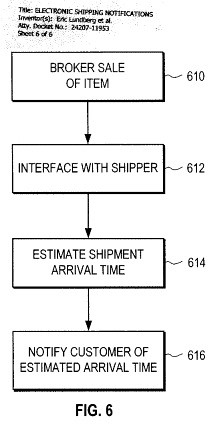
theodp writes "Will Google's battle against Microsoft and Apple over their use of 'bogus' patents result in greater scrutiny of its own IP holdings? Take Google's new patent on 'Electronic Shipping Notifications' (please!), which might pique the interest of Amazon.com, UPS, the USPS and others in the shipping business, since providing customers with guesstimates of what time The King of Queens will show up at their door with Christmas presents could now constitute patent infringement. From the patent: 'The broker sends an electronic message, such as an email or text message, to the customer prior to the estimated shipment arrival time to inform the customer of the impending arrival. The customer can thus arrange for someone to be at the shipping address to receive the shipment at the estimated arrival time.' To help the USPTO understand its invention, Google supplied this diagram." -
IBM Plays SimCity With Portland, Oregon
Hugh Pickens writes "Portland, Oregon will be the first city to use IBM's new software called Systems Dynamics for Smarter Cities, containing 3,000 equations which collectively seek to model cities' emergent behavior and help them figure out how policy can affect the lives of their citizens. The program seeks to quantify the cause-and-effect relationships between seemingly uncorrelated urban phenomena. 'What's the connection, for example, between ... obesity rates and carbon emissions?' writes Greg Lindsay. 'To find out, simply round up experts to hash out the linkages, translate them into algorithms, and upload enough historical data to populate the model. Then turn the knobs to see what happens when you nudge the city in one direction.' One of the drivers of the 'Portland Plan' is the city's commitment to a 40 percent decrease in carbon emissions by 2030, which necessitates less driving and more walking and biking. After running the model, planners discovered a positive feedback loop: More walking and biking would lead to lower obesity rates for Portlanders. In turn, a fitter population would find walking and biking a more attractive option. But as the field of urban systems gathers steam, it's important to remember that IBM and its fellow technology companies aren't the first to offer a quantitative toolkit to cities. In the 1970s, RAND built models they thought could predict fire patterns in New York, and then used them to justify closing fire stations in NYC's poorest sections in the name of efficiency, a decision that would ultimately displace 600,000 people as their neighborhoods burned." -
RIM Helping UK Police Track Down Rioters
jfruhlinger writes "Protests against a police shooting in the poor London neighborhood of Tottenham escalated into rioting and looting this past weekend. Initial reports have it that the activity was coordinated not by Twitter or Facebook but by the relatively old-tech method of BlackBerry messaging. Now the official Twitter account of RIM's UK division has announced that it is 'engaged with the authorities to assist in any way we can,' which presumably means that it's handing over messages sent by rioters. Is BlackBerry being a responsible part of British society, or is it overstepping its bounds?" -
8 Ways To Circumvent the PROTECT-IP Act
Dangerous_Minds writes "One of the things that the PROTECT-IP act is said to do is make DNS servers censor websites that have been accused of copyright infringement. Drew Wilson of ZeroPaid decided to look in to how many ways he could come up with that would circumvent such censorship. He found 8 ways to circumvent such censorship. The article includes pros and cons and links to guides on how to carry out these methods. The methods are: using a VPN service, using your HOSTs file, using TOR, using freely available DNS lookup tools, changing your DNS server to a non-US server, using command prompt, using Foxy Proxy, and using MAFIAAFire. If anything, the list raises serious doubts that the PROTECT IP Act will even put a dent on copyright infringement online." -
DARPA Commits To Funding Useful Hacking Projects
Hugh Pickens writes "Fahmida Y. Rashid reports that the Defense Advanced Research Projects Agency will fund new cyber-security proposals under the new Cyber-Fast Track project intended to cut red tape for hackers to apply for funding for projects that would help the Defense Department secure computer networks, says Peiter Zatko, a hacker known as Mudge who was one of the seven L0pht members who testified before a Senate committee in 1998 that they could bring down the Internet in 30 minutes and is now a program manager for the agency's information innovation office. Anything that could help the military will be considered, including bug-hunting exercises, commodity high-end computing and open software tools and projects with the potential to 'reduce attack surface areas, reverse current asymmetries' are of particular interest. Under the Cyber-Fast Track initiative, DARPA will fund between 20 to 100 projects annually. Open to anybody, researchers can pitch DARPA with ideas and have a project approved and funded within 14 days of the application." -
Boeing Employees To Man CST-100 Crew Capsule
The BBC reports that Boeing has a source of human passengers to populate its manned crew transport vehicle, the CST-100: Boeing employees. The CST-100 is Boeing's bid to replace more expensive options, such as the recently retired space shuttle family, for delivering astronauts to space, including to the International Space Station. The lucky employees (interns?) won't have a chance to visit space until the experimental capsule first makes two unmanned trips, lifted by an Atlas V rocket. These first three trips are all slated for 2015. -
Finding Fault With the Low, Low Price of Android
bonch writes "Google's accusation of patent abuse toward its competitors has generated many responses, some of which have asked whether Android's free price is anti-competitive. Drawing comparisons to Microsoft's antitrust trial, in which they were accused of giving away Internet Explorer to drive competitors out of the browser market, Thurrott argues that Google's rivals are 'leveling the playing field' through patent fees by removing an artificial price advantage funded by monopoly search revenues. 'One could argue that Google is using its dominance in search advertising to unfairly gain entry into another market by giving that new product, Android, away for free. Does this remind you of any famous antitrust case?'" -
US Patent Regime Is Absurd
An anonymous reader writes in with an opinion piece in the Economist about the the effects of patent trolling on the US economy. The author argues that the U.S. patent regime is causing the U.S. essentially to harm itself. Things have gotten so bad that paying for protection is par for the course. -
WiFi 802.22 Can Cover 12,000 Square Miles
tekgoblin writes "IEEE has just announced a new Wireless standard, 802.22, that can cover up to 12,000 square miles. The standard is actually for Wireless Regional Area Networks (or WRAN), which use the white spaces left in the TV frequency spectrum." -
Seigniorage Hack Could Resolve Debt Limit Crisis
UltraOne writes "With the US Senate voting to table the Boehner debt limit bill, the US is only a few days away from running out of cash to pay for all its obligations. Slate is reporting on a fascinating legal hack that could come in handy, described by blogger 'beowulf' back in January 2011. Seigniorage is the extra value added when a government mints a coin with a face value greater than the value of the precious metal contained in the coin. The statute governing the minting of coins contains a section (31 USC 5112(k) ) that authorizes the Secretary of the Treasury to mint and issue platinum coins in any denomination or quantity. To keep the government from running out of money, Timothy Geithner could order a $5 trillion platinum coin struck and deposited at the Federal Reserve. The money could then be used to fund Federal Government operations (blog post contains legal details)." -
Ask Slashdot: Do We Need Pseudonymous Social Networking?
An anonymous reader writes "While the idea of anonymous social networking sounds like an oxymoron, the use of pseudonyms to mask a user's online identity has a long history that stretches back to the earliest days of the Internet and local bulletin board systems (BBS). Such imperfect anonymity, which can often be unmasked with a few well-defined Google searches, has led to abuses like the invention of 'spambots' and the persistence of forum trolls. But, as the BBC reports, pseudonyms have their place in online communities, especially where identities are a risky commodity, under oppressive state regimes and governments where corporate interests increasingly dominate the interests of individuals: 'Some users choose to hide their identity to avoid being found by people they would not like to be contacted by. Others live in countries where identification could have serious implications for those who have expressed political views or associated themselves with others who have.' Should Google+ and maybe even the notorious Facebook evolve into two-tiered sites where those who choose to remain anonymous are 'identified' as such and denied access to certain site features, while being free to post, blog, or tweet their views, without summarily getting their accounts suspended or revoked?" -
Emacs Has Been Violating the GPL Since 2009
Digana writes "Emacs, one of GNU's flagship products and the most famous software creation of Richard Stallman, has been discovered to be violating the GPL since 2009-09-28 by distributing binaries that were missing source. The CEDET package, a set of contributed files for giving certain IDE functionality related to static code analysis, has distributed files generated from bison grammars without distributing the grammar itself. This happened for Emacs versions 23.2 and 23.3, released during late 2009, and has just been discovered." -
Interviews: Ask Technologist Kevin Kelly About Everything
Kevin Kelly has for decades been involved in some of the most interesting projects I know about, and in his roles as founding editor (and now editor at large) of Wired Magazine and editor of The Whole Earth Catalog has helped spread the word about many others. Kelly is probably as close to a Rennaisance man as it's possible to be in the 21st century, having more-than-passing interest and knowledge in a range of topics from genetic sequencing and other ways that we can use measurement in pursuit of improved health to how technology is used and reused in real life. Among other projects, he's also the founder of CoolTools, which I consider to be (unsurprisingly) the closest current equivalent to the old Whole Earth Catalogs. (Disclaimer: I've had a few reviews published there, too.) (He's also one of the founders of The WELL, now part of Salon.) Kelly is also Secretary of the Board of Directors of the Long Now Foundation, the group which for years has been designing a clock to ring on 10,000 years in the future. Below, ask questions of Kelly, bearing in mind please the Slashdot interview guidelines: ask as many questions as you want, but please keep them to one per comment. He'll get back soon with his answers. -
When Patents Attack — the NPR Version
fermion writes "This American Life is running a story this week on Intellectual Ventures, a firm some consider the leader of the patent trolls. The story delves into the origins of the term patent troll and the rise of the patent troll industry. Much time is spent presenting Intellectual Ventures both as a patent troll firm and a legitimate business that allows helpless inventors to monetize patents. It is stipulated that Intellectual Ventures does not in fact sue anyone. It is also alleged that Intellectual Ventures creates many shell companies, presumably to hide such activity. Intellectual Ventures is compared to a Mafia protection racket that may never actually burn down a business that does not pay the dues, but does encourage such burning to occur." -
Blocked Fuel Line Botched Military Satellite Orbit
Hugh Pickens writes "Dan Elliott reports that a piece of cloth inadvertently left in the fuel line during the manufacturing process may be the reason for the botched delivery to orbit of a military communications satellite that hasn't reached its planned orbit since it was launched in August. The Air Force Space Command and the contractor, Lockheed Martin, have devised a work-around plan using the remaining propulsion systems — reaction engine assemblies and electric Hall Current Thrusters drawing off of onboard fuel—to slowly raise the perigee of the Advanced Extremely High Frequency satellite until it reaches its intended orbit 22,300 miles over the Earth in October, but the GAO says that the $12.9 billion satellite system incurred at least $250 million in extra costs and a two-year delay because of quality problems due to poor workmanship, undocumented and untested manufacturing processes, poor control of those processes and materials and failure to prevent contamination, poor part design, design complexity, and an inattention to manufacturing risks. John Pike of Globalsecurity.org, which monitors defense issues, says the two-year delay is a bigger problem than the extra expense. 'You've got a lot of other things depending on the launch,' says Pike, including ground-based weapons." -
Blocked Fuel Line Botched Military Satellite Orbit
Hugh Pickens writes "Dan Elliott reports that a piece of cloth inadvertently left in the fuel line during the manufacturing process may be the reason for the botched delivery to orbit of a military communications satellite that hasn't reached its planned orbit since it was launched in August. The Air Force Space Command and the contractor, Lockheed Martin, have devised a work-around plan using the remaining propulsion systems — reaction engine assemblies and electric Hall Current Thrusters drawing off of onboard fuel—to slowly raise the perigee of the Advanced Extremely High Frequency satellite until it reaches its intended orbit 22,300 miles over the Earth in October, but the GAO says that the $12.9 billion satellite system incurred at least $250 million in extra costs and a two-year delay because of quality problems due to poor workmanship, undocumented and untested manufacturing processes, poor control of those processes and materials and failure to prevent contamination, poor part design, design complexity, and an inattention to manufacturing risks. John Pike of Globalsecurity.org, which monitors defense issues, says the two-year delay is a bigger problem than the extra expense. 'You've got a lot of other things depending on the launch,' says Pike, including ground-based weapons." -
Oracle Acquires K-splice For an Undisclosed Amount
drspliff writes "Oracle today announced it's completed the acquisition of K-Splice, dropping support for Redhat, CentOS, and SUSE, and closing doors to new customers. Unless of course you want to become an Oracle Linux Premier Support subscriber — then it comes as standard." -
FPGA Bitstream Security Broken
NumberField writes "Researchers in Germany released a pair of papers documenting severe power analysis vulnerabilities in the bitstream encryption of multiple Xilinx FPGAs. The problem exposes products using FPGAs to cloning, hardware Trojan insertion, and reverse engineering. Unfortunately, there is no easy downloadable fix, as hardware changes are required. These papers are also a reminder that differential power analysis (DPA) remains a potent threat to unprotected hardware devices. On the FPGA front, only Actel seems to be tackling the DPA issue so far, although their FPGAs are much smaller than Xilinx's." -
Online Collaboration Helps Mumbai Attack Victims
GillBates0 writes "CNN has a nice story about how online collaboration swiftly helped form a centrally organized online disaster effort during Wednesday's Mumbai attacks. India accounts for almost one-fifth of the world's cell phone subscribers. At a time when chaos reigned, and voice calls were jammed, a loose collaboration of techies, laymen, and good samaritans quickly collaborated online via social media, Wikipedia, Google docs and other online resources to coordinate blood donors, assistance, rides, and other services to help the victims of the attack." -
Online Collaboration Helps Mumbai Attack Victims
GillBates0 writes "CNN has a nice story about how online collaboration swiftly helped form a centrally organized online disaster effort during Wednesday's Mumbai attacks. India accounts for almost one-fifth of the world's cell phone subscribers. At a time when chaos reigned, and voice calls were jammed, a loose collaboration of techies, laymen, and good samaritans quickly collaborated online via social media, Wikipedia, Google docs and other online resources to coordinate blood donors, assistance, rides, and other services to help the victims of the attack."