Slashdot Mirror
Domain: wired.com
Stories and comments across the archive that link to wired.com.
Stories · 4,012
-
In-Flight Wi-Fi Provider Going Above and Beyond To Help Feds Spy
An anonymous reader sends in a report from Wired that GoGo, a company the provides in-flight Wi-Fi access to airline passengers, seems to be making every effort to assist law enforcement agencies with wiretaps. From the article: "Gogo and others that provide Wi-Fi aboard aircraft must follow the same wiretap provisions that require telecoms and terrestrial ISPs to assist U.S. law enforcement and the NSA in tracking users when so ordered. But they may be doing more than the law requires. According to a letter (PDF) Gogo submitted to the Federal Communications Commission, the company voluntarily exceeded the requirements of the Communications Assistance for Law Enforcement Act, or CALEA, by adding capabilities to its service at the request of law enforcement. The revelation alarms civil liberties groups, which say companies should not be cutting deals with the government that may enhance the ability to monitor or track users." -
In-Flight Wi-Fi Provider Going Above and Beyond To Help Feds Spy
An anonymous reader sends in a report from Wired that GoGo, a company the provides in-flight Wi-Fi access to airline passengers, seems to be making every effort to assist law enforcement agencies with wiretaps. From the article: "Gogo and others that provide Wi-Fi aboard aircraft must follow the same wiretap provisions that require telecoms and terrestrial ISPs to assist U.S. law enforcement and the NSA in tracking users when so ordered. But they may be doing more than the law requires. According to a letter (PDF) Gogo submitted to the Federal Communications Commission, the company voluntarily exceeded the requirements of the Communications Assistance for Law Enforcement Act, or CALEA, by adding capabilities to its service at the request of law enforcement. The revelation alarms civil liberties groups, which say companies should not be cutting deals with the government that may enhance the ability to monitor or track users." -
Navy Debuts New Railgun That Launches Shells at Mach 7
Jeremiah Cornelius writes: "The U.S. Navy's new railgun technology, developed by General Atomics, uses the Lorentz force in a type of linear, electric motor to hurl a 23-pound projectile at speeds exceeding Mach 7 — in excess of 5,000 mph. The weapon has a range of 100 miles and doesn't require explosive warheads. 'The electromagnetic railgun represents an incredible new offensive capability for the U.S. Navy,' says Rear Adm. Bryant Fuller, the Navy's chief engineer. 'This capability will allow us to effectively counter a wide range of threats at a relatively low cost, while keeping our ships and sailors safer by removing the need to carry as many high-explosive weapons.' Sea trials begin aboard an experimental Navy catamaran, the USNS Millinocket, in 2016." -
NASA To Catalog and Release Source Code For Over 1,000 Projects
An anonymous reader writes "By the end of next week, NASA will release a master catalog of over 1,000 software projects it has conducted over the years and will provide instructions on how the public can obtain copies of the source code. NASA's goal is to eventually 'host the actual software code in its own online repository, a kind of GitHub for astronauts.' This follows NASA's release of the code running the Apollo 11 Guidance Computer a few years back. Scientists not affiliated with NASA have already adapted some of NASA's software. 'In 2005, marine biologists adapted the Hubble Space Telescope's star-mapping algorithm to track and identify endangered whale sharks. That software has now been adapted to track polar bears in the arctic and sunfish in the Galapagos Islands.' The Hubble Space Telescope's scheduling software has reportedly also been used to schedule MRIs at hospitals and as control algorithms for online dating services. The possibilities could be endless." -
Bunnie Huang's Novena Open Source Laptop Launches Via Crowd Supply
First time accepted submitter ogcricket (3557713) writes with news about a new laptop designed by Andrew Huang and Sean Cross. "Earlier this year, the two Singapore-based engineers fashioned a laptop made almost entirely from open source hardware, hardware whose designs are freely available to the world at large. They called it Project Novena. Anyone could review the designs, looking for bugs and security flaws, and at least in theory, that meant you could be confident the machine was secure from top to bottom, something that’s more desirable than ever in the post-Edward Snowden age....The original idea was simply to encourage others to build their own open source laptops at home. But now the pair are taking the project a step further. Starting today, you can order your own pre-built Novena laptop through the crowd-funding site Crowd Supply, and it will ship out in the coming weeks. Much like Kickstarter, Crowd Supply is place where you can put up money to help fund a company and then get a product in exchange." -
Tesla's Fight With Car Dealers Could Help Decide the Next Presidential Election
Hugh Pickens DOT Com (2995471) writes "Marcus Wohlsen writes that the most recent ban against Tesla selling cars directly from the company instead of through third-party dealers was enacted in New Jersey with the support of Gov. Chris Christie, a possible contender for the GOP nomination. That prompted Florida Sen. Marco Rubio, a Christie rival, to heartily defend Tesla's direct sales model. 'Customers should be allowed to buy products that fit their need,' says Rubio, 'especially a product that we know is safe and has consumer confidence beneath it.' Perhaps even more surprising is the love shown by Texas Gov. Rick Perry, the once and possibly future presidential hopeful whose oil-rich state bars employees in Tesla's two showrooms from even telling potential customers how much the Model S costs. 'I think it's time for Texans to have an open conversation about this,' says Perry, 'the pros and the cons. I'm gonna think the pros of allowing this to happen outweigh the cons.' The sudden GOP embrace of an electric car company once reviled as a symbol of Northern California enivro-weenies might seem ironic says Wohlsen, but the real irony is that conservative politicians ever opposed Tesla at all.
'The widespread franchise rules giving car dealers virtual monopolies in their territories epitomize the government-controlled marketplace Republicans purportedly despise,' writes Wohlsen adding that possible presidential contenders realize there may be political capital to be gained in supporting Tesla. But the real winner is Tesla. If the company can manage to associate its brand with all the positive qualities Rubio and Perry hope rub off on them, few politicians will want to take the risk to stand against them. Mitt Romney called Tesla Motors a 'loser' company during his 2012 run for president. In 2016 running against Tesla might seem about as smart as running against Apple." -
Tesla's Fight With Car Dealers Could Help Decide the Next Presidential Election
Hugh Pickens DOT Com (2995471) writes "Marcus Wohlsen writes that the most recent ban against Tesla selling cars directly from the company instead of through third-party dealers was enacted in New Jersey with the support of Gov. Chris Christie, a possible contender for the GOP nomination. That prompted Florida Sen. Marco Rubio, a Christie rival, to heartily defend Tesla's direct sales model. 'Customers should be allowed to buy products that fit their need,' says Rubio, 'especially a product that we know is safe and has consumer confidence beneath it.' Perhaps even more surprising is the love shown by Texas Gov. Rick Perry, the once and possibly future presidential hopeful whose oil-rich state bars employees in Tesla's two showrooms from even telling potential customers how much the Model S costs. 'I think it's time for Texans to have an open conversation about this,' says Perry, 'the pros and the cons. I'm gonna think the pros of allowing this to happen outweigh the cons.' The sudden GOP embrace of an electric car company once reviled as a symbol of Northern California enivro-weenies might seem ironic says Wohlsen, but the real irony is that conservative politicians ever opposed Tesla at all.
'The widespread franchise rules giving car dealers virtual monopolies in their territories epitomize the government-controlled marketplace Republicans purportedly despise,' writes Wohlsen adding that possible presidential contenders realize there may be political capital to be gained in supporting Tesla. But the real winner is Tesla. If the company can manage to associate its brand with all the positive qualities Rubio and Perry hope rub off on them, few politicians will want to take the risk to stand against them. Mitt Romney called Tesla Motors a 'loser' company during his 2012 run for president. In 2016 running against Tesla might seem about as smart as running against Apple." -
Klingon Beer
An anonymous reader writes: "We may not have Saurian Brandy or Romulan Ale, but we'll soon have Klingon Beer. Tin Man Brewing Company in Evansville, Indiana has gotten the OK from CBS to create 'Klingon Warnog,' a Dunkelweizen with 'a modern aroma [of] predominantly mild banana and clove.' It will have an ABV of 5.5%. The Klingon beer will apparently join Vulcan Ale in the Federation of Beer. I wonder what their Prime Directive is." -
Time Dilation Drug Could Let Heinous Criminals Serve 1,000 Year Sentences
Hugh Pickens DOT Com (2995471) writes "Like something out of the movie Inception, Rhiannon Williams reports in the Telegraph that Dr. Rebecca Roache, in charge of a team of scholars focused upon the ways futuristic technologies might transform punishment, claims the prison sentences of serious criminals could be made worse by distorting prisoners' minds into thinking time was passing more slowly. 'There are a number of psychoactive drugs that distort people's sense of time, so you could imagine developing a pill or a liquid that made someone feel like they were serving a 1,000-year sentence,' says Roache. Roache says when she began researching this topic, she was thinking a lot about Daniel Pelka, a four-year-old boy who was starved and beaten to death by his mother and stepfather.
'I had wondered whether the best way to achieve justice in cases like that was to prolong death as long as possible. Some crimes are so bad they require a really long period of punishment, and a lot of people seem to get out of that punishment by dying. And so I thought, why not make prison sentences for particularly odious criminals worse by extending their lives?' Thirty years in prison is currently the most severe punishment available in the UK legal system. 'To me, these questions about technology are interesting because they force us to rethink the truisms we currently hold about punishment. When we ask ourselves whether it's inhumane to inflict a certain technology on someone, we have to make sure it's not just the unfamiliarity that spooks us,' says Roache. 'Is it really OK to lock someone up for the best part of the only life they will ever have, or might it be more humane to tinker with their brains and set them free? When we ask that question, the goal isn't simply to imagine a bunch of futuristic punishments — the goal is to look at today's punishments through the lens of the future.'" -
Overuse of Bioengineered Corn Gives Rise To Resistant Pests
An anonymous reader writes "Though warned by scientists that overuse of a variety of corn engineered to be toxic to corn rootworms would eventually breed rootworms with resistance to its engineered toxicity, the agricultural industry went ahead and overused the corn anyway with little EPA intervention. The corn was planted in 1996. The first reports of rootworm resistance were officially documented in 2011, though agricultural scientists weren't allowed by seed companies to study the engineered corn until 2010. Now, a recent study has clearly shown how the rootworms have successfully adapted to the engineered corn. The corn's continued over-use is predicted, given current trends, and as resistance eventually spreads to the whole rootworm population, farmers will be forced to start using pesticides once more, thus negating the economic benefits of the engineered corn. 'Rootworm resistance was expected from the outset, but the Bt seed industry, seeking to maximize short-term profits, ignored outside scientists.'" -
Interviews: Ask Jonathan Coulton What You Will
Jonathan Coulton's song Code Monkey became an anthem for many programmers (not just ones with managers named Rob) and his success is proof that you really can become an internet rock star. Since we last talked, Coulton has became the house musician for the NPR show Ask Me Another and had one of his songs copied without permission, credit, or thanks by the show Glee, much to his chagrin. Jonathan has agreed to answer all your questions about music, internet stardom, and robots. Normal Slashdot interview rules apply. -
A Look at the NSA's Most Powerful Internet Attack Tool
realized writes in with a closer look at the NSA's QUANTUM system. "Today QUANTUM packs a suite of attack tools, including both DNS injection (upgrading the man-on-the-side to a man-in-the-middle, allowing bogus certificates and similar routines to break SSL) and HTTP injection. That reasonable enough. But it also includes gadgets like a plug-in to inject into MySQL connections, allowing the NSA to quietly mess with the contents of a third-party's database. (This also surprisingly suggests that unencrypted MySQL on the internet is common enough to attract NSA attention.) And it allows the NSA to hijack both IRC and HTTP-based criminal botnets, and also includes routines which use packet-injection to create phantom servers, and even attempting (poorly) to use this for defense." -
Amazon Hikes Prime Membership Fee
An anonymous reader writes with official news that, as expected, "Amazon officially announced that it is increasing Prime Membership fees from $79 to $99. Amazon Students will pay $49, and participants of Amazon Fresh (the grocery shopping service) will continue to have a $299 fee. The price hike in Prime Membership is attributed to rising shipping costs, but some wonder if the 'real question around Prime is whether it's sustainable at all, even at a higher price.'" -
Government Accuses Sprint of Overcharging For Wiretapping Expenses
realized writes with news that the Federal government thinks Sprint overcharged them $21 million when billing for wiretaps. From the article: "Sprint, like all the nation's carriers, must comply with the Communications Assistance in Law Enforcement Act of 1994, which requires telcos to be capable of providing government-ordered wiretapping services. The act also allows carriers to recoup 'reasonable expenses' associated with those services. Sprint inflated charges approximately 58 percent between 2007 and 2010, according to a lawsuit the administration brought against the carrier today. ... The suit said that the wireless carrier breached Federal Communications Commission guidelines of 2006 that prohibited carriers from using intercept charges to recover costs of modifying 'equipment, facilities or services' to comply with the Communications Assistance in Law Enforcement Act." -
Government Accuses Sprint of Overcharging For Wiretapping Expenses
realized writes with news that the Federal government thinks Sprint overcharged them $21 million when billing for wiretaps. From the article: "Sprint, like all the nation's carriers, must comply with the Communications Assistance in Law Enforcement Act of 1994, which requires telcos to be capable of providing government-ordered wiretapping services. The act also allows carriers to recoup 'reasonable expenses' associated with those services. Sprint inflated charges approximately 58 percent between 2007 and 2010, according to a lawsuit the administration brought against the carrier today. ... The suit said that the wireless carrier breached Federal Communications Commission guidelines of 2006 that prohibited carriers from using intercept charges to recover costs of modifying 'equipment, facilities or services' to comply with the Communications Assistance in Law Enforcement Act." -
Cops Say NDA Kept Them from Notifying Courts About Cell Phone Tracking Gadget
schwit1 writes "Police in Florida have offered a startling excuse for having used a controversial 'stingray' cell phone tracking gadget 200 times without ever telling a judge: the device's manufacturer made them sign a non-disclosure agreement that they say prevented them from telling the courts. The shocking revelation, uncovered by the American Civil Liberties Union, came during an appeal over a 2008 sexual battery case in Tallahassee in which the suspect also stole the victim's cell phone. Using the stingray — which simulates a cell phone tower in order to trick nearby mobile devices into connecting to it and revealing their location — police were able to track him to an apartment." -
Mt. Gox Gone? Apparent Theft Shakes Bitcoin World
mendax was one of many readers to write with news about the apparent shutdown of Bitcoin exchange Mt. Gox, in the wake of massive theft. "The New York Times is reporting that Mt. Gox, the most prominent Bitcoin exchange, 'appeared to be on the verge of collapse late Monday, raising questions about the future of a volatile marketplace.' 'On Monday night, a number of leading Bitcoin companies jointly announced that Mt. Gox, the largest exchange for most of Bitcoin's existence, was planning to file for bankruptcy after months of technological problems and what appeared to have been a major theft. A document circulating widely in the Bitcoin world said the company had lost 744,000 Bitcoins in a theft that had gone unnoticed for years. That would be about 6 percent of the 12.4 million Bitcoins in circulation.' Maybe the U.S. Dollar isn't so bad after all." Forbes goes further, and says flatly that Mt. Gox has shut down; Wired calls it an implosion. Reader electron gunner links to the alleged leaked document which outlines the exchange's crisis strategy. Watch this story for updates, since there are bound to be new developments. -
Killing Net Neutrality Could Be Good For You
Hugh Pickens DOT Com writes "Berin Szoka and Brent Skorup write that everyone assumes that cable companies have all the market power, and so of course a bigger cable company means disaster. But content owners may be the real heavyweights here: It was Netflix that withheld high-quality streaming from Time Warner Cable customers last year, not vice versa and it was ESPN that first proposed to subsidize its mobile viewers' data usage last year. 'We need to move away from the fear-mongering and exaggerations about threats to the Internet as well as simplistic assumptions about how Internet traffic moves. The real problems online are far more complex and less scary. And it's not about net neutrality, but about net capacity.' The debate is really about who pays for — and who profits from — the increasingly elaborate infrastructure required to make the Internet do something it was never designed to do in the first place: stream high-speed video. 'While many were quick to assume that broadband providers were throttling Netflix traffic, the explanation could be far simpler: The company simply lacked the capacity to handle the "Super HD" video quality it began offering last year.' A two-sided market means broadband providers would have an incentive to help because they would receive revenue from two major sources: content providers (through sponsorship or ads), and consumers (through subscription fees). 'Unfortunately, this kind of market innovation is viewed as controversial or even harmful to consumers by some policy and Internet advocates. But these concerns are premature, unfounded, and arise mostly from status quo bias: Carriers and providers haven't priced like this before, so of course change will create some kind of harm,' conclude Szoka and Skorup. 'Bottom line: The FCC should stop trying to ban prioritization outright and focus only on actual abuses of market power.'" -
Killing Net Neutrality Could Be Good For You
Hugh Pickens DOT Com writes "Berin Szoka and Brent Skorup write that everyone assumes that cable companies have all the market power, and so of course a bigger cable company means disaster. But content owners may be the real heavyweights here: It was Netflix that withheld high-quality streaming from Time Warner Cable customers last year, not vice versa and it was ESPN that first proposed to subsidize its mobile viewers' data usage last year. 'We need to move away from the fear-mongering and exaggerations about threats to the Internet as well as simplistic assumptions about how Internet traffic moves. The real problems online are far more complex and less scary. And it's not about net neutrality, but about net capacity.' The debate is really about who pays for — and who profits from — the increasingly elaborate infrastructure required to make the Internet do something it was never designed to do in the first place: stream high-speed video. 'While many were quick to assume that broadband providers were throttling Netflix traffic, the explanation could be far simpler: The company simply lacked the capacity to handle the "Super HD" video quality it began offering last year.' A two-sided market means broadband providers would have an incentive to help because they would receive revenue from two major sources: content providers (through sponsorship or ads), and consumers (through subscription fees). 'Unfortunately, this kind of market innovation is viewed as controversial or even harmful to consumers by some policy and Internet advocates. But these concerns are premature, unfounded, and arise mostly from status quo bias: Carriers and providers haven't priced like this before, so of course change will create some kind of harm,' conclude Szoka and Skorup. 'Bottom line: The FCC should stop trying to ban prioritization outright and focus only on actual abuses of market power.'" -
Government Secrecy Spurs $4 Million Lawsuit Over Simple 'No Fly' List Error
An anonymous reader writes "After a seven-year lawsuit costing nearly $4 million, a judge has concluded that Rahinah Ibrahim's student visa was revoked because an FBI agent checked the wrong box on a form. That simple human error resulted in the detention of Rahinah Ibrahim, the revocation of her student visa years later and interruption of her PhD studies. The Bush and later Obama administrations obstructed the lawsuit repeatedly, invoking classified evidence, sensitive national security information and the state secrets privilege to prevent disclosure of how suspects are placed on the 'no-fly' list. The dispute eventually involved statements of support from James Clapper, Eric Holder and several other DOJ and TSA officials in favor of the government's case. The defendant was not allowed to enter the United States even to attend her own lawsuit trial and in a separate incident, her daughter, a U.S. citizen, was denied entry to witness the trial as well. The case exemplifies how government secrecy can unintentionally transform otherwise easily corrected errors into a multi-year legal and bureaucratic nightmare and waste millions of taxpayer dollars in doing so." -
Open Source — the Last Patent Defense?
dp619 writes "A developer might fly under the patent troll radar until she makes it big, and then it's usually open season. Apple just shared that it has faced off 92 lawsuits over just 3 years. Even Google's ad business is at risk. FOSS attorney Heather Meeker has blogged at the Outercurve Foundation on what to consider and what to learn if you're ever sued for patent infringement. 'There have been at least two cases where defendants have successfully used open source license enforcement as a defensive tactic in a patent lawsuit. ... In both these cases, the patent plaintiff was using open source software of the defendant, and the patent defendant discovered a violation of the applicable open source license that it used to turn the tables on the plaintiff. In this way, open source license enforcement can be a substitute for a more traditional retaliatory patent claim.' Meeker also examines how provisions of open source licenses can deflate a patent troll's litigation and shift the balance in favor of the defense." -
Sophisticated Spy Tool 'The Mask' Rages Undetected For 7 Years
thomst writes "Kim Zetter of Wired's Threat Level reports that Kaspersky Labs discovered a Spanish-language spyware application that 'uses techniques and code that surpass any nation-state spyware previously spotted in the wild.' The malware, dubbed 'The Mask' by Kaspersky's researchers, targeted government agencies, diplomatic offices, embassies, companies in the oil, gas and energy industries, research organizations, and activists. It had been loose on the Internet since at least 2007 before being shut down last month. It infected its targets via a malicious website that contained exploits — among which were the Adobe Flash player vulnerability CVE-2012-0773, affecting both Windows and Linux machines. Users were directed to the site via spearphishing emails." -
Silk Road's Ross Ulbricht's Next Court Date Set For November
Daniel_Stuckey writes "Ross Ulbricht, the alleged administrator behind the illegal online drug marketplace the Silk Road, will get his day in court on November 3rd, according to a blueprint laid out today in New York's Southern District Court by Judge Katherine Forrest. Ulbrict, alleged by the government to be Silk Road founder Dread Pirate Roberts, is facing four charges (PDF via Wired) related to narcotics conspiracy, running a criminal enterprise, conspiracy to commit computer hacking, and money laundering (other charges have been brought against him regarding murder for hire in Maryland). Appearing today in court—clean-shaven, in a navy blue prison uniform—he pleaded "not guilty" to all charges. Next week, on February 13th, Josh Dratel, Ulbricht's defense attorney, will be handing over hard drives sufficient to hold eight to 10 terabytes of data, which is the approximate size of the evidence which the government has said it may use against Ulbricht. By Feb. 27, two weeks later, the prosecution must return the drives with Silk Road data the FBI collected from computers in a foreign and unnamed country, as well as a drive that holds the contents of the defendant's laptop, which was seized during his dramatic arrest at a San Francisco library in October." -
Silk Road Founder Indicted In New York
An anonymous reader sends this report from Wired: "Federal authorities today announced a Grand Jury indictment against Ross Ulbricht, the alleged founder and owner of the underground drug emporium Silk Road. The indictment (PDF), in New York, includes one count for narcotics conspiracy, one count of running a criminal enterprise, one count of conspiracy to commit computer hacking and one count of money laundering, according to the indictment. It's the second indictment for the the 29-year-old, who was arrested last October in San Francisco. Ulbricht was previously charged in New York at the time of his arrest, but authorities had until December to obtain an indictment against him based on new evidence seized. They sought an extension of that time and announced the indictment today. Ulbricht had been previously indicted in Maryland on charges of conspiring to have a former administrator of Silk Road murdered in exchange for $80,000." -
Silk Road Founder Indicted In New York
An anonymous reader sends this report from Wired: "Federal authorities today announced a Grand Jury indictment against Ross Ulbricht, the alleged founder and owner of the underground drug emporium Silk Road. The indictment (PDF), in New York, includes one count for narcotics conspiracy, one count of running a criminal enterprise, one count of conspiracy to commit computer hacking and one count of money laundering, according to the indictment. It's the second indictment for the the 29-year-old, who was arrested last October in San Francisco. Ulbricht was previously charged in New York at the time of his arrest, but authorities had until December to obtain an indictment against him based on new evidence seized. They sought an extension of that time and announced the indictment today. Ulbricht had been previously indicted in Maryland on charges of conspiring to have a former administrator of Silk Road murdered in exchange for $80,000." -
Should Everybody Learn To Code?
theodp writes "In July, the Association for Computing Machinery announced it was partnering with Code.org, with ACM contributing funding and its Director of Public Policy to Code.org in a push to 'ensure that every K-12 student in the US has the opportunity to study computer science.' Interestingly, joining others questioning the conventional Presidential wisdom that everybody-must-get-code is the Communications of the ACM, which asks in its February issue, Should Everybody Learn to Code? By the way, Code.org is bringing its Hour of Code show to the UK in March. The new National Curriculum for England that is to be taught in all primary and secondary schools beginning in September includes a new emphasis on Computer Science curricula, said to have been sparked by a speech given by Google Chairman Eric Schmidt in 2011." -
Meet the Electric Porsche From 1898
cartechboy writes "We all talk about the Tesla Model S and Nissan Leaf as if electric cars are brand-new. In fact, electric cars were around long before you were alive, or your father, or maybe even your grandfather. It turns out that the very first Porsche ever built was an electric car--way back in 1898. It wasn't called a Porsche, but an 'Egger-Lohner electric vehicle, C.2 Phaeton model'--or P1 for short. Designed by Ferdinand Porsche when he was just 22 years old, it has a rear electric drive unit producing all of 3 horsepower--and an overdrive mode to boost that to a frightening 5 hp! It had an impressive range of 49 miles, not that much less than many of today's plug-in cars. Porsche recently recovered the P1 from a warehouse--where it has supposedly sat untouched since 1902--and plans to display it in original, unrestored condition at the Porsche Museum in Zuffenhausen, Germany." -
FBI Has Tor Mail's Entire Email Database
An anonymous reader writes "Tor Mail was an anonymized email service run over Tor. It was operated by a company called Freedom Hosting, which was shut down by the FBI last August. The owner was arrested for 'enabling child porn,' and the Tor Mail servers suddenly began hosting FBI malware that attempted to de-anonymize users. Now, Wired reports on a new court filing which indicates that the FBI was also able to grab Tor Mail's entire email database. 'The filings show the FBI built its case in part by executing a search warrant on a Gmail account used by the counterfeiters, where they found that orders for forged cards were being sent to a TorMail e-mail account: "platplus@tormail.net." Acting on that lead in September, the FBI obtained a search warrant for the TorMail account, and then accessed it from the bureau's own copy of "data and information from the TorMail e-mail server, including the content of TorMail e-mail accounts," according to the complaint (PDF) sworn out by U.S. Postal Inspector Eric Malecki.'" -
Edward Snowden Says NSA Engages In Industrial Espionage
Maow writes "Edward Snowden has been interviewed by a German TV network and stated that the NSA is involved in industrial espionage, which is outside the range of national security. He claims that Siemens is a prime example of a target for the data collection. I doubt this would surprise AirBus or other companies, but it shall remain to be seen what measures global industries take (if any) to prevent their internal secrets from falling into NSA's — and presumably American competitors' — hands." AirBus is a good example of a company that has experienced spying from both sides. -
Superbowl Means Time For Spy Cams, Hazmat Squads and Bomb-Sniffing Dogs
Toe, The writes "The New York Police Department has quietly installed about 200 temporary surveillance cameras in midtown Manhattan to help spot trouble along 'Super Bowl Boulevard,' a 13-block street fair on Broadway that's expected to draw large crowds during the windup to the game. The temporary cameras for the Super Bowl festivities will supplement a system of thousands of permanent cameras covering midtown and Wall Street that the NYPD monitors from a command center in lower Manhattan. The department has pioneered analytical software that allows it to program the cameras to detect suspicious activity, such as a bag or other objects left in one place for a long time. Hazmat and bomb squads will be on standby. Others officers will patrol with bomb-sniffing dogs. Still more will watch from rooftops and from police helicopters. At a recent security briefing at the stadium, police chiefs and other officials said success will be measured in part by how well authorities conceal all the concern over potential threats." Now it's a proven tradition: Superbowl crowds are a good place to test people-watching gear. -
Python Scripting and Analyzing Your Way To Love
fiannaFailMan writes "Wired reports one mathematician's mission to find love online by data mining from OK Cupid and applying mathematical modeling to optimize his profile(s). His methods included using 'Python scripts to riffle through hundreds of OkCupid survey questions. He then sorted female daters into seven clusters, like "Diverse" and "Mindful," each with distinct characteristics.' But the real work began when he started going on dates." -
'Web Junkie': Harrowing Documentary On China's Internet Addiction Rehab Clinics
cold fjord writes "The Daily Beast reports on Web Junkie, a documentary showing the unsettling efforts undertaken by the Internet Addiction Treatment Center in China to break teenagers of their internet habits. Quoting: 'China was one of the first countries to brand "Internet addiction" as a clinical disorder, and to claim it's the number one threat to its teenagers today. The Chinese government has erected 400 rehabilitation boot camps like this one ... a bizarre hybrid of military barracks and mental hospital. ... Every room in the facility is monitored by cameras. ... Teens spend a minimum of three months at Daxing. ... Wires and nodes will be hooked to their head ... they're administered daily medication (without being told what it is), they have to keep their rooms spotless, partake in individual and group therapy sessions with their parents, and do boot camp-style exercise ... One kid in the film claims to have played World of Warcraft for 300 hours straight, taking only tiny naps in between. ... "Some kids are so hooked on these games they think going to the bathroom will affect their performance. So they wear a diaper. These are the same as heroin addicts. ... That's why we call it electronic heroin."' Wired has further details and a clip from the documentary." -
'Web Junkie': Harrowing Documentary On China's Internet Addiction Rehab Clinics
cold fjord writes "The Daily Beast reports on Web Junkie, a documentary showing the unsettling efforts undertaken by the Internet Addiction Treatment Center in China to break teenagers of their internet habits. Quoting: 'China was one of the first countries to brand "Internet addiction" as a clinical disorder, and to claim it's the number one threat to its teenagers today. The Chinese government has erected 400 rehabilitation boot camps like this one ... a bizarre hybrid of military barracks and mental hospital. ... Every room in the facility is monitored by cameras. ... Teens spend a minimum of three months at Daxing. ... Wires and nodes will be hooked to their head ... they're administered daily medication (without being told what it is), they have to keep their rooms spotless, partake in individual and group therapy sessions with their parents, and do boot camp-style exercise ... One kid in the film claims to have played World of Warcraft for 300 hours straight, taking only tiny naps in between. ... "Some kids are so hooked on these games they think going to the bathroom will affect their performance. So they wear a diaper. These are the same as heroin addicts. ... That's why we call it electronic heroin."' Wired has further details and a clip from the documentary." -
Sites Blocked By Smartfilter, Censored in Saudi Arabia
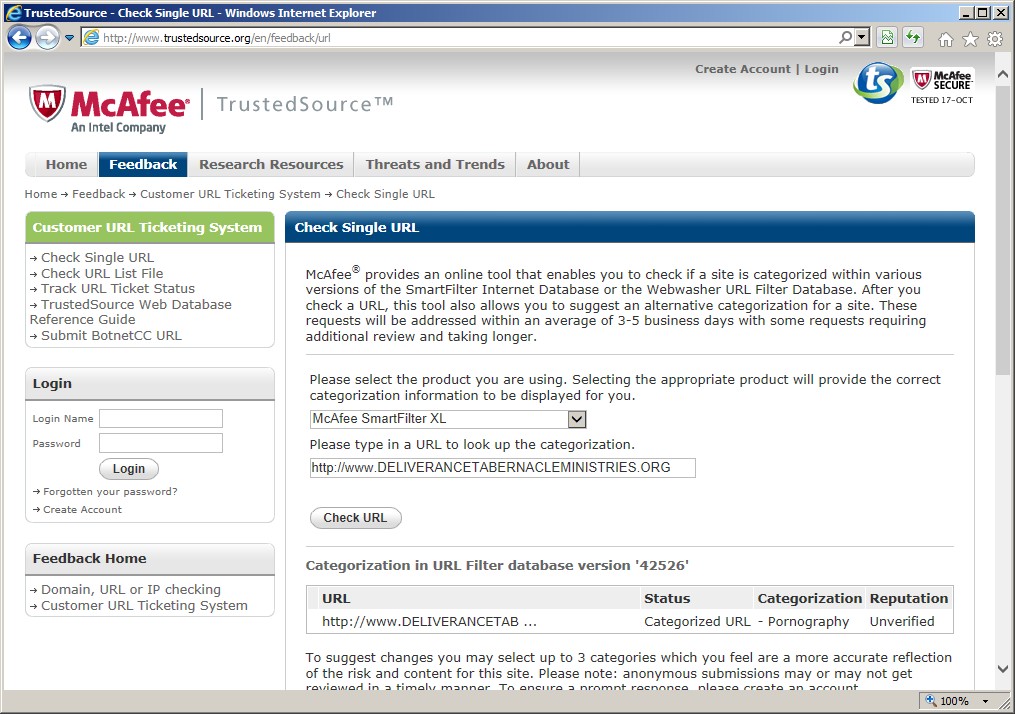
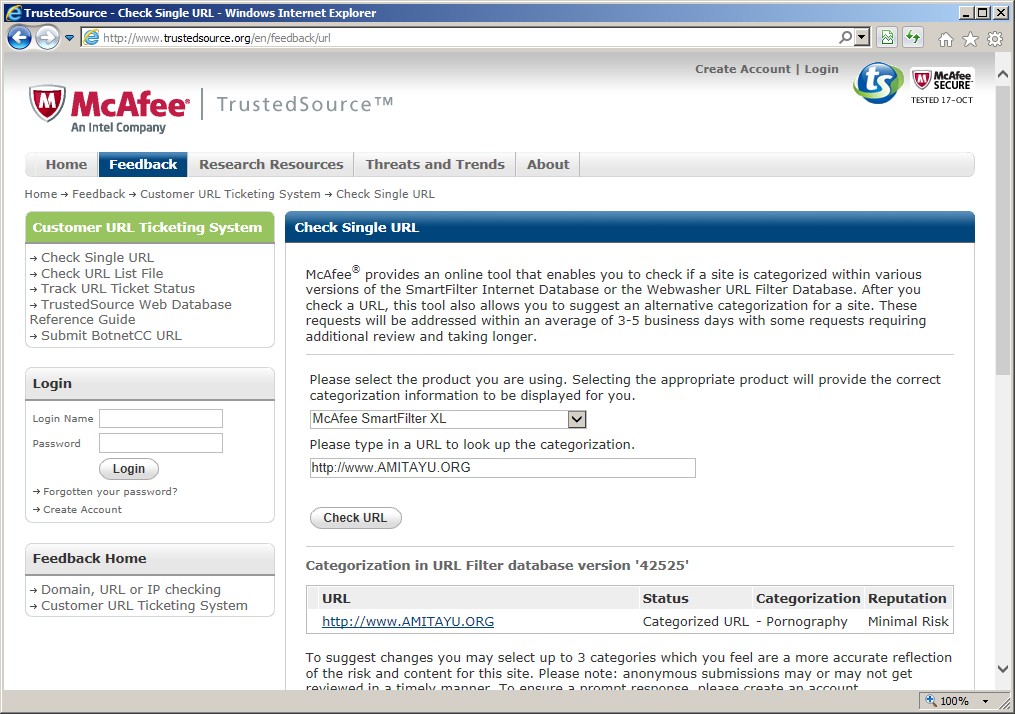
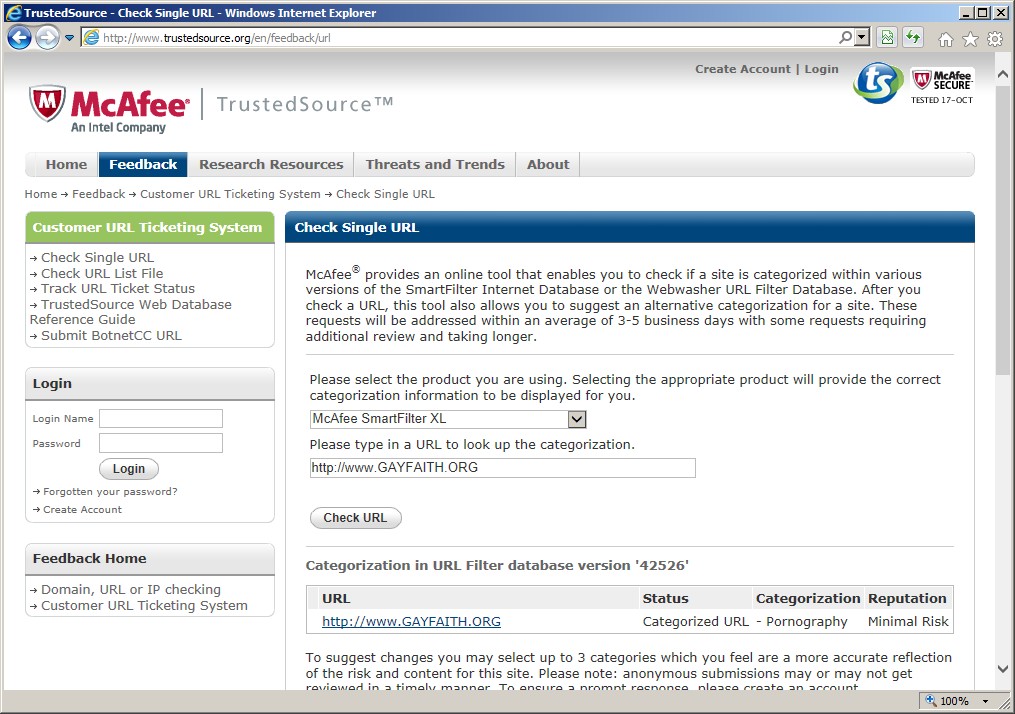
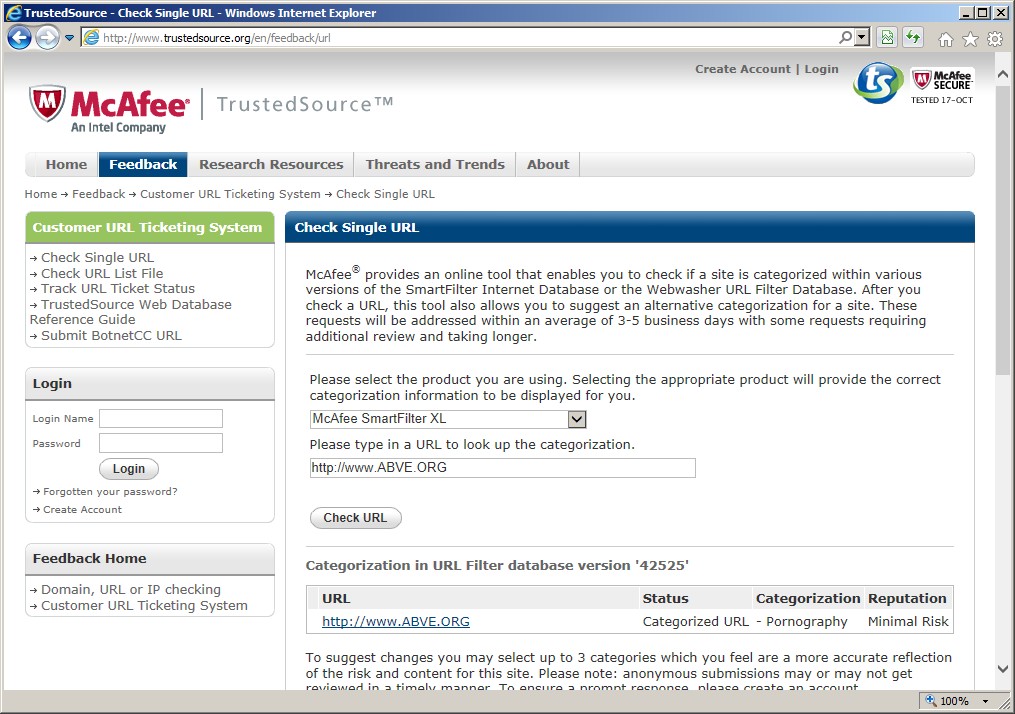
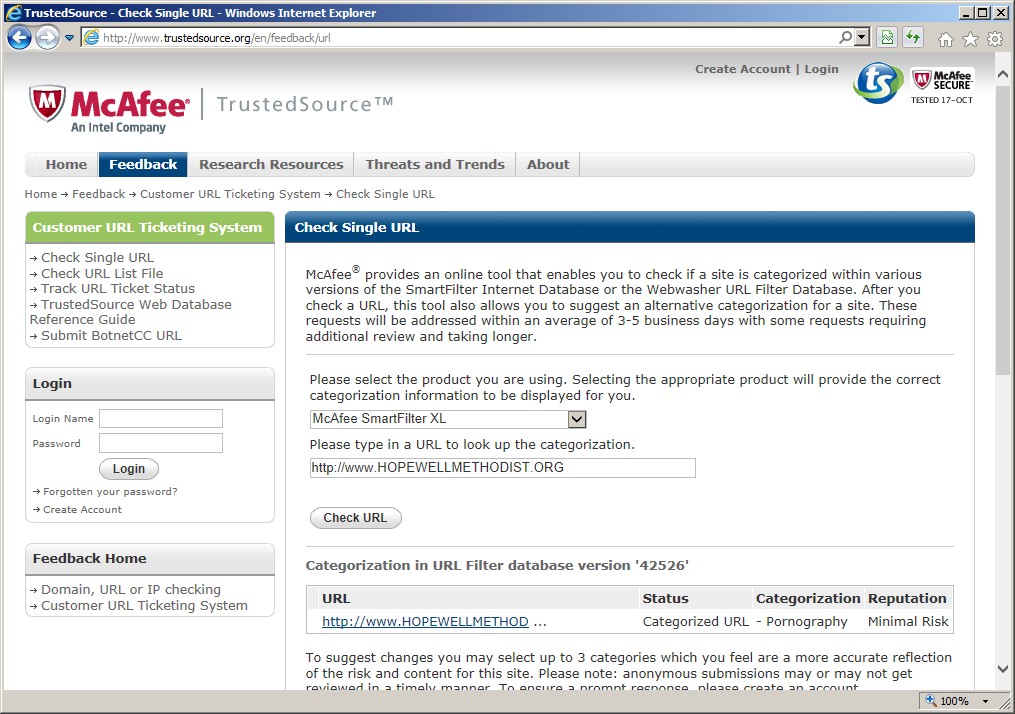
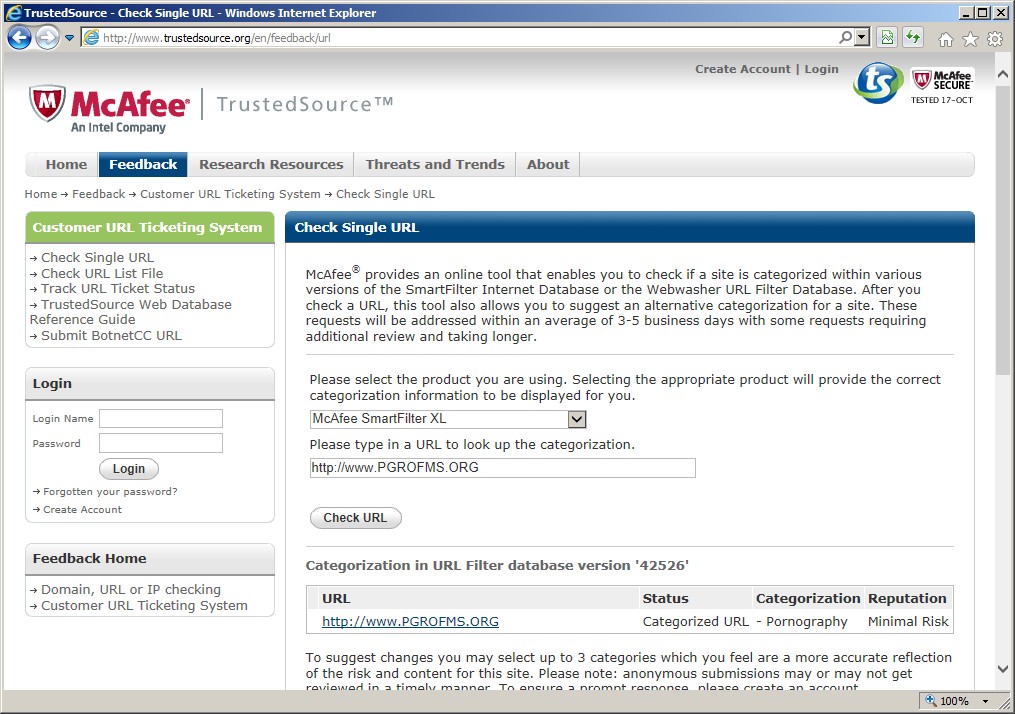
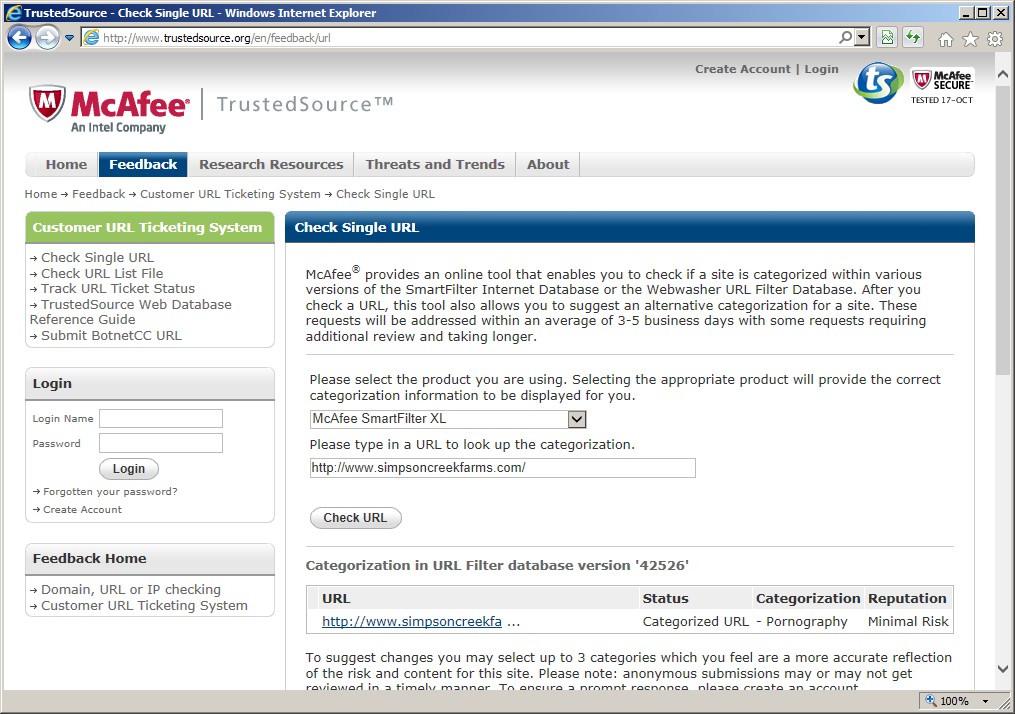
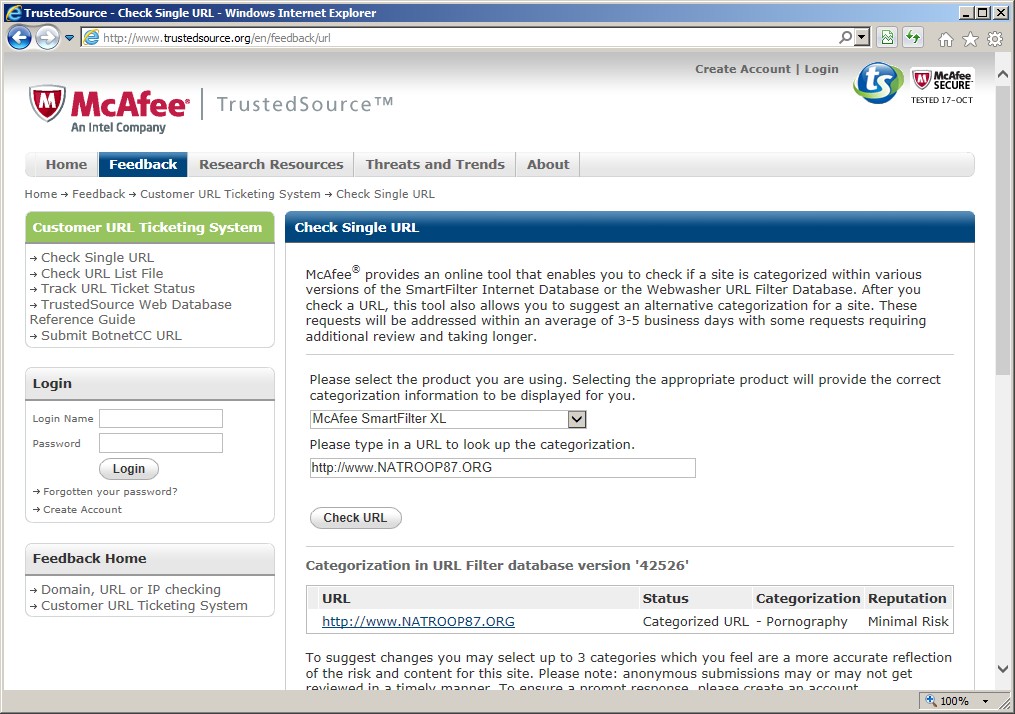
Slashdot contributor Bennett Haselton writes: "Internet users in Saudi Arabia, along with most users in the United Arab Emirates, are blocked by their respective government censors from accessing the websites of the Trinity Davison Lutheran Church, Deliverance Tabernacle Ministries in Pittsburgh, the Amitayu Buddhist Society of Taiwan, and GayFaith.org. An attempt to access any of those websites yields an error page like this one. However, the sites are not blocked because they conflict with the religions beliefs of those countries' governments. Rather, they are blocked because Smartfilter -- the American-made blocking program sold by McAfee, and used for state-mandated Internet censorship in those countries -- classifies those sites as "pornography". You can see the screen shots here, here, here and here." Read on for the rest of Bennett's thoughts.I found these blocked sites by starting with a combination of URL lists and ad hoc spidering, and running as many sites as possible through the Saudi filters to catch the ones that were blocked. Some of the sites were blocked for reasons that were easy to guess -- for example, http://www.bighornbasinsfw.org/, the home page of the Big Horn Basin, Wyoming chapter of Sportsmen for Fish & Wildlife, was almost certainly blocked because of the slang term "nsfw" in their URL. http://www.AgainstPornography.org and http://www.SearchingForMySpermDonorFather.org were presumably blocked because of the presence of the words "porn" and "sperm".
On the other hand, there appears to be no rational reason why the Filipino American Women's Network, the Tuscon Jazz Institute, or the Sacramento Police Activities League would have been blocked by Smartfilter, even by accident. A partial list of the blocked sites that I found is in the blog post I wrote for Citizen Lab, an Internet censorship research center at the University of Toronto.
Articles about sites that are erroneously blocked by Internet censorship software, have a storied history. The first widely read piece was the article "Keys to the Kingdom" written by Brock Meeks and Declan McCullagh in 1996, calling out Cyber Patrol for blocking EnviroLink.org and the University of Newcastle Computer Science Department, and CYBERsitter for blocking the National Organization for Women. I made a minor name for myself and the Peacefire.org site in the late 1990's by writing more pages about sites blocked by other products, including some (like X-Stop and SurfWatch) which no longer exist, and others that are still around, including Smartfilter. I was also one of six people comprising the Censorware Project, a loosely organized group of volunteers that published a few more reports.
By the early 2000's, however, it became clear that anyone whose mind was likely to be changed by information about what kinds of sites were blocked by blocking software, would have changed their mind already (or would, if they came across the research that had already been done up to that point). So the further reports on Internet blocking software errors, by me and other people, slowed to a trickle. I wrote a report in January 2002 on the latest list of sites blocked by Cyber Patrol, a product that most people today have forgotten. In 2006 I worked with the ACLU of Washington to publish a report on sites erroneously blocked by FortiGuard, a program used on computers in some libraries in central Washington, as part of the ACLU's suit to challenge the constitutionality of the program's use on public library terminals. (The Washington State Supreme Court rejected the lawsuit on the grounds that, regardless of what sites were blocked on the computers, it didn't matter because an adult library patron could request for the filter to be turned off.) In 2007 I wrote an article for Slashdot titled "From Bess to Worse" listing some sites that were blocked by an Internet filtering program called Bess (which was later bought out by Smartfilter and discontinued).
Most people's awareness of this debate, if they had heard about it at all, was limited to the perception that "breast cancer sites" and sites about "chicken breast recipes" were sometimes filtered by Internet blocking programs. Or they heard that "Beaver College" actually had to change its name to avoid being censored by web filters. As I tried to explain in a FAQ (written, according to the Wayback Machine, in 1999, but which still broadly holds true today), these examples are true, but they miss the point. These examples make it sound as if blocking software companies are doing the best job they can under the circumstances, and that the errors are unavoidable due to limitations on machine intelligence. In reality, any software algorithm that blocks the American Board of Vocational Experts, the Hopewell United Methodist Church, and the Patriot Guard Riders of Mississippi, as "pornography" (as Smartfilter currently does), is probably not the best algorithm the company could have come up with -- but there's no incentive for them to try harder, because few people will ever look that deep.
And yet, people continue to remember the "breast cancer site" examples. This sounds to me like an example of the narrative fallacy -- people remember that breast cancer sites were blocked, because there's a tidy explanation. There is no tidy explanation for most other examples of blocked sites, so the meme never spreads very far. Conveniently for the blocking companies, the blocked-site errors which make the company look most sloppy (the Kennels at Simpson Creek Farms, the St. Francis Institute of Milwaukee, etc.) are precisely the ones that, due to the narrative fallacy, most people won't remember or hear about.
One company, CYBERsitter, did manage to make a few blocking decisions in the 1990s that were egregious enough that their antics did make the news, and did finally raise some people's awareness that the controversy over private Internet filtering extended beyond "breast cancer sites". After TIME Magazine's website published an article (no longer online) that criticized CYBERsitter's blocking policies, CYBERsitter responded by blocking TIME Magazine's pathfinder.com domain. A few months earlier, CYBERsitter had blacklisted the monthly e-Zine "The Ethical Spectacle, after the Spectacle's founder, Jonathan Wallace, published an article criticizing CYBERsitter for blocking my own Peacefire.org website. And Peacefire.org had been blocked, in turn, because of a page I wrote (now very much out of date) listing some of the sites that CYBERsitter blocked, including the International Gay and Lesbian Human Rights Commission and Mother Jones. (Nowadays, of course, nobody would be surprised that filtering companies block Peacefire.org, since the site publishes ample instructions on how to get around Internet blockers. But at the time, the site's first and only article was the list of sites blocked by CYBERsitter, which is why CYBERsitter received so much criticism for blocking the domain in retaliation.) CYBERsitter also threatened to have Meeks and McCullagh criminally prosecuted for writing "Keys to the Kingdom" and threatened to sue me over the page that I had made.)
The moral, it seems, is that if you want an example of a censored web site to stick in people's minds, it either has to be a forgivable error, or an insane vindictive dick move -- because in either of those cases, people will understand why it happened. The vast swaths of censored websites on the spectrum in between, the ones for which there is no rational explanation for the blocking, go ignored.
These days, though, American and Canadian "censorware" makers have also come under fire for selling censoring software to foreign governments which use them for country-wide censorship. Most of the criticism focuses, naturally, not on the kinds of sites that are accidentally blocked by the blocking software, but on the immorality of these companies enabling statewide foreign censorship in the first place. Netsweeper, Blue Coat, and McAfee have all made the claim that "Once we sell their product to them, we have no control over what they do with it" -- which, as I wrote previously in Slashdot, is nonsense, because for the product to be effective, it has to rely on updates to the blocked-site list, which are provided at regular intervals by the manufacturer. Cut off the updates, and the product will not work, at least not as well.
So the fact that McAfee has classified the Boy Scout Troop 87 of North Andover, the Pan-Iranist Party of Iran, and Reptile Conservation International as "Pornography" is (rightly) overshadowed by the fact that McAfee is selling to government censors in Saudi Arabia and the UAE in the first place. However, as long as the filters are installed, these blocked sites are at least part of the problem for users in those countries, just as much as they are for students or cubicle workers in the U.S. whose network administrators happen to use Smartfilter. And, of course, I sampled only a miniscule fraction of the Web to find these examples of blocked sites, so the true number of stupid blocks affecting Saudi and UAE users is likely to be much larger. For each individual example, you might reasonably ask, "Is it really a big deal if Saudis are blocked from accessing Boy Scout Troop 87 of North Andover?" But it adds up.
-
A Data Scientist Visits The Magic Kingdom, Sans Privacy
An anonymous reader writes "MailChimp Chief Data Scientist [John Foreman] is at Disney World this weekend wearing his RFID-equipped MagicBand. Here's how he thinks the practice of digitally tracking consumers in the physical world will reach everywhere from theme parks to our homes." Foreman's conclusion (and headline) — shades of Scott McNeally's famous "Get over it" — is "You don't want your privacy." That seems to miss the mark, at least for me: I don't mind parceling out certain kinds of information (like whether I like to buy decaf at Starbucks, or how long the wait is to ride Space Mountain), in contexts of my own choosing, but that's much different from being snooped on by the NSA or other state actors in other contexts. -
Solar Lull Could Cause Colder Winters In Europe
Taco Cowboy writes "Since September of last year scientists have been wondering what's happening to the Sun. It's supposed to have reached the peak of its 11-year cycle, but sunspot and flare activity remains much quieter than expected. Experts now think the recent cold snap that hit North America and the wet weather that hit part of Europe might be linked to the eerie quietness of the Sun. According to the BBC, solar activity hasn't been this low in 100 years, and if activity keeps dropping, it may reach levels seen during the 'Maunder Minimum,' an 'era of solar inactivity in the 17th Century [which] coincided with a period of bitterly cold winters in Europe.' It wouldn't have a big effect on global temperatures, just regional ones. Why? The sun's UV output drops during these lulls, and the decreased amount of UV light hitting the stratosphere would cause the jet stream to change course. Prof. Mike Lockwood says, 'These are large meanders in the jet stream, and they're called blocking events because they block off the normal moist, mild winds we get from the Atlantic, and instead we get cold air being dragged down from the Arctic and from Russia. These are what we call a cold snap... a series of three or four cold snaps in a row adds up to a cold winter. And that's quite likely what we'll see as solar activity declines.'" -
Target Credit Card Data Was Sent To a Server In Russia
angry tapir writes "The stolen credit card numbers of millions of Target shoppers took an international trip — to Russia. A peek inside the malicious software that infected Target's POS (point-of-sale) terminals is revealing more detail about the methods of the attackers as security researchers investigate one of the most devastating data breaches in history. Findings from two security companies show the attackers breached Target's network and stayed undetected for more than two weeks. Over two weeks, the malware collected 11GB of data from Target's POS terminals. The data was first quietly moved to another server on Target's network and then transmitted in chunks to a U.S.-based server that the attackers had hijacked. Logs from that compromised server show the data was moved again to a server based in Russia starting on Dec. 2." A related article at Wired points out that Target suffered a similar breach in 2005, and apparently didn't learn its lesson. -
Credo Mobile Releases Industry's First Transparency Report
memnock writes "Wired and The Washington Post both report that mobile service provider CREDO is the first telecom to release a report detailing requests from the government for customer information. From Wired: 'A small telecom believed to be at the center of a historic court battle over government surveillance published its first transparency report on Thursday, noting that it had received 16 government requests for customer data in 2013. But the report may be most significant for what it doesn't say.'" -
Australian Teen Reports SQL Injection Vulnerability, Company Calls Police
FuzzNugget writes with an excerpt from Wired, which brings us the latest in security researcher witch hunts: "Joshua Rogers, a 16-year-old in the state of Victoria, found a basic security hole that allowed him to access a database containing sensitive information for about 600,000 public transport users who made purchases through the Metlink web site run by the Transport Department. It was the primary site for information about train, tram and bus timetables. The database contained the full names, addresses, home and mobile phone numbers, email addresses, dates of birth, and a nine-digit extract of credit card numbers used at the site, according to The Age newspaper in Melbourne. Rogers says he contacted the site after Christmas to report the vulnerability but never got a response. After waiting two weeks, he contacted the newspaper to report the problem. When The Age called the Transportation Department for comment, it reported Rogers to the police.'" -
Google Co-Opts Whale-Watching Boat To Ferry Employees
theodp writes "Purportedly intended to defuse tensions over gentrification that have led to blockades and vandalism of Google's ubiquitous shuttles (video), which make use of public San Francisco bus stops (map), Wired reports that Google is now chartering a ferry to take its workers from SF to Silicon Valley. 'We certainly don't want to cause any inconvenience to SF residents, and we're trying alternative ways to get Googlers to work,' Google explained. Inconveniencing whale-seeking visitors to The Aquarium of the Pacific, however, is apparently not considered evil. After learning that Google had co-opted the $4 million, 83-foot, 150-passenger whale-watching catamaran MV/Triumphant to ferry as few as 30-40 Googlers to work, some expressed concerns on Facebook that Google would be The Grinch That Stole Whale Watching Season (not to worry; the boat's slated to make its 'triumphant' return to Long Beach after Google's '30-day trial')." -
Bitcoin Payments Go Live At Overstock — Two Quarters Early
New submitter citab writes with news that "the first major retailer is now accepting bitcoins!" In December, Overstock.com announced that they would begin accepting Bitcoin for payment as early as the end of second quarter 2014, but decided to make it a priority task to avoid having someone else beat them to it. From the article: "Last Tuesday, the company struck a deal to handle Bitcoin payments through a service operated by the suddenly hot San Francisco startup Coinbase, and since then, a team of Overstock engineers has worked almost every waking hour to prepare the site for what is undeniably a key moment in the digital currency’s short history. ... [Overstock CEO] Byrne believes this can ultimately boost the company’s bottom line, but that’s not his only aim. For Byrne, a rather opinionated libertarian who’s unafraid to take his company places others fear to tread, embracing the cryptocurrency is as much a political statement as a business decision. Like so many others, he believes Bitcoin can free the world from the control of big banks and big government. 'It helps us fight the machine,' he says." -
New Oculus Rift Prototype Features Head Tracking, Reduced Motion Blur, HD AMOLED
crabel writes "The Oculus rift prototype Crystal Cove shown at CES uses a camera to track over two dozen infrared dots placed all over the headset. With the new tracking system, you can lean and crouch because the system knows where your head is in 3D space, which can also help reduce motion sickness by accurately reflecting motions that previously weren't detected. On top of that, the new 'low persistence' display practically removes motion blur." The new low-persistence AMOLEDs also achieve 1920x1080 across the field of vision. Reports are that immersion was greatly enhanced with head tracking. -
A Year With Google Glass
Mat Honan, a writer for Wired, has posted an article detailing his takeaways from long-term use of Google Glass. He makes particular note of how the device's form factor is much more offensive to others than the actual technology contained within. For example, his wife wanted him to take pictures and shoot videos of their child's birth, but not with Glass: "It was the way Glass looked. It might let me remain in the moment, but my wife worried it would take her out of it, that its mere presence would be distracting because it’s so goddamn weird-looking." It can get unpleasant when strangers are involved: "People get angry at Glass. They get angry at you for wearing Glass. They talk about you openly. It inspires the most aggressive of passive aggression. ... Wearing Glass separates you. It sets you apart from everyone else. It says you not only had $1,500 to plunk down to be part of the “explorer” program, but that Google deemed you special enough to warrant inclusion (not everyone who wanted Glass got it; you had to be selected). Glass is a class divide on your face." Honan found most of the default software to be handy, but the third-party software to be lacking. Glass also facilitated his unintentional switch from an iPhone to an Android phone. He ends the piece by warning of the inevitability of devices like Glass: "The future is on its way, and it is going to be on your face. We need to think about it and be ready for it in a way we weren’t with smartphones." -
Memo To Parents and Society: Teen Social Media "Addiction" Is Your Fault
FuzzNugget writes "Wired presents this damning perspective on so-called social media addiction: 'If kids can't socialize, who should parents blame? Simple: They should blame themselves. This is the argument advanced in It's Complicated: The Social Lives of Networked Teens, by Microsoft researcher Danah Boyd. Boyd ... has spent a decade interviewing hundreds of teens about their online lives. What she has found, over and over, is that teenagers would love to socialize face-to-face with their friends. But adult society won't let them. "Teens aren't addicted to social media. They're addicted to each other," Boyd says. "They're not allowed to hang out the way you and I did, so they've moved it online." It's true. As a teenager in the early '80s I could roam pretty widely with my friends, as long as we were back by dark. Over the next three decades, the media began delivering a metronomic diet of horrifying but rare child-abduction stories, and parents shortened the leash on their kids. Politicians warned of incipient waves of youth wilding and superpredators (neither of which emerged). Municipalities crafted anti-loitering laws and curfews to keep young people from congregating alone. New neighborhoods had fewer public spaces. Crime rates plummeted, but moral panic soared. Meanwhile, increased competition to get into college meant well-off parents began heavily scheduling their kids' after-school lives.'" -
Whatever Happened To Sanford "Spamford" Wallace?
Tackhead writes "People of a certain age — the age before email filters were effective, may remember a few mid-90s buzzwords like 'bulletproof hosting' and 'double opt-in.' People may remember that Hormel itself conceded that although 'SPAM' referred to their potted meat product, the term 'spam' could refer to unsolicited commercial email. People may also remember AGIS, Cyberpromo, Sanford 'Spam King' Wallace, and Walt Rines. Ten years after a 2003 retrospective on Rines and Wallace, Ars Technica reminds us that the more things change, the more they stay the same." -
Reuters: RSA Weakened Encryption For $10M From NSA
Lasrick writes "As a key part of a campaign to embed encryption software that it could crack into widely used computer products, the U.S. National Security Agency arranged a secret $10 million contract with RSA, one of the most influential firms in the computer security industry, Reuters has learned." Asks an anonymous reader: "If the NIST curves really are broken (as has been suggested for years), then most SSL connections might be too, amirite?" -
The FBI's Giant Bitcoin Wallet
SonicSpike writes with a story about the huge amount of bitcoins owned by the FBI. "In September, the FBI shut down the Silk Road online drug marketplace, and it started seizing bitcoins belonging to the Dread Pirate Roberts — the operator of the illicit online marketplace, who they say is an American man named Ross Ulbricht. The seizure sparked an ongoing public discussion about the future of Bitcoin, the world's most popular digital currency, but it had an unforeseen side-effect: It made the FBI the holder of the world's biggest Bitcoin wallet. The FBI now controls more than 144,000 bitcoins that reside at a bitcoin address that consolidates much of the seized Silk Road bitcoins. Those 144,000 bitcoins are worth close to $100 million at Tuesday's exchange rates. Another address, containing Silk Road funds seized earlier by the FBI, contains nearly 30,000 bitcoins ($20 million)." -
Interview: Ask Bruce Sterling What You Will
One of the founders of the cyberpunk genre, Bruce Sterling needs little introduction to science fiction fans. You can read what "Chairman Bruce" has to say at Beyond the Beyond on Wired and the Sterling tumblr. He has agreed to to sit down and answer any questions you may have. As usual, ask as many as you'd like, but please, one question per post. -
Oculus Raises $75 Million To Make VR Headset
An anonymous reader writes "The company making the VR headset that has John Carmack and many others in the gaming industry excited has just received another $75 million in funding to make it happen. Netscape founder Marc Andreessen is joining the company's board, along with fellow investor Chris Dixon. Dixon had seen a prototype earlier this year, but it wasn't good enough to spark his interest. After recently seeing how the device has progressed since then, he was blown away, comparing it to early demos of the iPhone. 'The dimensions where you need to improve this kind of VR are latency, resolution and head tracking, and they have really nailed those things.' Now that the device is in good shape, Oculus is going to work on turning it into a product they can produce and ship for gamers." -
Was Julian Assange Involved With Wiretapping Iceland's Parliament?
An anonymous reader writes "Wired reports that the chat logs between Bradley Manning and Julian Assange that were used as evidence in Manning's trial have made it onto the web, at least briefly. One of those logs contained something very interesting on page 4, which was picked up on by the News of Iceland, which reports, '"Jesus Christ. I think that we have recordings of all phone calls to and from the Icelandic parliament during the past four months". This text can be found in documents that the US military published on its website and is said to be part of the conversations between Julian Assange and Bradley Manning. According to the documents, Assange claims to have phone call recordings from Althingi, the Icelandic parliament, but this is the first time that the existence of such data is mentioned publicly. ... According to Icelandic laws, it is required to inform the person you are speaking with if the phone call is being recorded. Given that the parliament is not violating laws it is clear that Assange or his associates would have to have installed recording devices or wiretaps in the parliament.' — What makes it even more interesting is that Wired also reports in this recent story: Someone's Been Siphoning Data Through a Huge Security Hole in the Internet."