Slashdot Mirror
Domain: wisc.edu
Stories and comments across the archive that link to wisc.edu.
Comments · 1,436
-
Re:What Greyhole isn't
Could be an installation on Antarctica where they have to rely on solar power or diesel generators. IceCube? ( http://icecube.wisc.edu/ ). Though the boot will be a minor pwer draw compared to the data transfer, so it's unlikely or misunderstood.
-
Re:Does this also include
OP is a right-wing nationalist and minister of propaganda.
-
Re:Oh, the delicious irony!
If he were here as part of his job, he wouldn't make it so obvious.
You can't be more wrong !
The guy has already clearly stated, on his own page @http://das.doit.wisc.edu/ that he is an "Information Warfare Office of the United States Navy", and the comments that he posted on Slashdot were from the account of http://slashdot.org/~daveschroeder - which carries a link to http://das.doit.wisc.edu/
If he is not here on official duty, he do not need to use this account to post
The fact that he uses this account tells us that he is posting here in the capacity of an "Information Warfare Officer of the United States Navy"
In conclusion: This "Mr. Dave Schroeder" commented here because he is getting paid by Uncle Sam
Or
-
Re:Oh, the delicious irony!
It's easy to tell:
http://das.doit.wisc.edu/He has a post in Information Warfare in the US Navy. He prepared a large document smearing a country and managed to get first post. The evidence really is rather damning.
-
Re:Oh, the delicious irony!
Check out his homepage. On it he says:
"... I also serve as an Information Warfare Officer in the United States Navy Fleet Cyber Command/US Tenth Fleet. I have a master's degree in Information Warfare...."
http://das.doit.wisc.edu/If you think he isn't biased, and possibly being paid for his post, you are crazy.
Now, please, get off my lawn! -
Re:Oh, the delicious irony!Retrieved 20120816 9:45AM from http://das.doit.wisc.edu/
Dave Schroeder
About Me
I am located at the University of Wisconsinâ"Madison in Madison, Wisconsin. I work in the University's Division of Information Technology (DoIT) in Systems Engineering and Operations as a senior systems engineer. My work involves assessing services in enterprise IT environments at the University.
I am the Continuity of Operations (COOP) Architect, which is responsible for the technical efforts that drive business continuity, disaster recovery, and continuity of operations analysis and planning for critical IT infrastructure at the University of Wisconsinâ"Madison, a major state government agency.
I also serve as an Information Warfare Officer in the United States Navy Fleet Cyber Command/US Tenth Fleet. I have a master's degree in Information Warfare, and am currently in the graduate Space Systems program at the Naval Postgraduate School. For contact information, see the left sidebar.technically not a shill, but he is a US operative that is unquestionable.
-
Re:Typical Apple Hater whining
"Just wanted to say hi before a million people start telling us that Mac products are actually the same price, and then give a bunch of excuses about why the price tag just looks so much higher."
Well, hello! I just wanted to say why is it that whenever I get the chance to replenish my laptop at work the listed prices for Macs and Dells are about the same? Actually, the Dells are just slightly more expensive.
And here's a nice chart with a side-by-side comparison of features versus price: https://kb.wisc.edu/showroom/page.php?id=3045 -
Chemical Demonstrations (Book & Website)
It's because of this book that I remember pretty much everything I learned in high school chemistry:
http://www.amazon.com/Chemical-Demonstrations-Handbook-Teachers-Chemistry/dp/0299088901
Start with the "Oxidation of Luminol" -- how to make your own glow-in-the-dark chemiluminescent solution.
(All 3 volumes are good -- some of the experiments are dangerous -- use due caution)
(Seeing Prof. Shakhashiri in action is also pretty cool: http://scifun.chem.wisc.edu/
Check out his Experiments You can Do at Home"
)
-
Chemical Demonstrations (Book & Website)
It's because of this book that I remember pretty much everything I learned in high school chemistry:
http://www.amazon.com/Chemical-Demonstrations-Handbook-Teachers-Chemistry/dp/0299088901
Start with the "Oxidation of Luminol" -- how to make your own glow-in-the-dark chemiluminescent solution.
(All 3 volumes are good -- some of the experiments are dangerous -- use due caution)
(Seeing Prof. Shakhashiri in action is also pretty cool: http://scifun.chem.wisc.edu/
Check out his Experiments You can Do at Home"
)
-
Re:Google Maps Gripes
I'm not talking about the turn-by-turn directions, I'm talking about the maps. Quick, where are the toll roads? How 'bout now? Or now?
I guess if you just enter in a start and end into Google maps and blindly follow whatever comes out it works fine, but if you want to scan around for alternate routes (hint: Google doesn't pick the best route for going through Chicago from east-to-west or vice versa) or just want to look around at maps, that's not good enough.
-
Re:Google Maps Gripes
I'm not talking about the turn-by-turn directions, I'm talking about the maps. Quick, where are the toll roads? How 'bout now? Or now?
I guess if you just enter in a start and end into Google maps and blindly follow whatever comes out it works fine, but if you want to scan around for alternate routes (hint: Google doesn't pick the best route for going through Chicago from east-to-west or vice versa) or just want to look around at maps, that's not good enough.
-
Re:Google Maps Gripes
I'm not talking about the turn-by-turn directions, I'm talking about the maps. Quick, where are the toll roads? How 'bout now? Or now?
I guess if you just enter in a start and end into Google maps and blindly follow whatever comes out it works fine, but if you want to scan around for alternate routes (hint: Google doesn't pick the best route for going through Chicago from east-to-west or vice versa) or just want to look around at maps, that's not good enough.
-
Re:Added bonus...
And she'll make
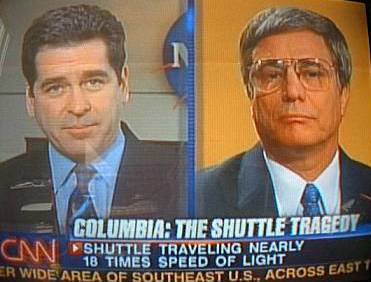
That means it's going to be twelve times slower than the Shuttle and therefore much safer.
-
Re:Cell Towers?
This must be why air-laser consumer tech never came out of Silicon Valley or the UK; instead we have fiber optics. They knew about fog, so they pointed their lasers through glass tubes.
This seems just another "maker fair" type story, the type of which gets old and annoying - (undereducated person) discovers (old technology) made from (cheap new technology) thanks to (smarter people who understand new technology). It's a step above my research paper on popsicle-stick bridges though.
-
Re:The Department of Redundancy Department
Various universities structure things differently. I have no idea what computer science "should" be, but here's a sampling:
Carnegie Mellon - School of Computer Science.
Computer Science Department
Entertainment Technology Center
Institute for Software Research
Robotics Institute
Human-Computer Interaction Institute
Lane Center for Computational Biology
Language Technologies Institute
Machine Learning Department
At CMU, CS gets its own school/department/division, as well as its own major within that.
MIT - School of Engineering Includes:
Electrical Engineering and Computer Science
Materials Science and Engineering
Mechanical Engineering
Nuclear Science and Engineering
Aeronautics and Astronautics
Biological Engineering
Chemical Engineering
Civil and Environmental Engineering
So it's a combined program within the engineering department.
CalTech - similar to MIT - Division of Engineering and Applied Science
Aerospace
Applied Physics and Materials Science
Bioengineering
Computing and Mathematical Sciences
Electrical Engineering
Environmental Science and Engineering
Mechanical and Civil Engineering
Again combined, but with math, and under sciences.
WISC - Department of Computer Sciences under the College of Letters & Science
Again, nested, but not a combined major.
YMMV. -
Re:The Department of Redundancy Department
Various universities structure things differently. I have no idea what computer science "should" be, but here's a sampling:
Carnegie Mellon - School of Computer Science.
Computer Science Department
Entertainment Technology Center
Institute for Software Research
Robotics Institute
Human-Computer Interaction Institute
Lane Center for Computational Biology
Language Technologies Institute
Machine Learning Department
At CMU, CS gets its own school/department/division, as well as its own major within that.
MIT - School of Engineering Includes:
Electrical Engineering and Computer Science
Materials Science and Engineering
Mechanical Engineering
Nuclear Science and Engineering
Aeronautics and Astronautics
Biological Engineering
Chemical Engineering
Civil and Environmental Engineering
So it's a combined program within the engineering department.
CalTech - similar to MIT - Division of Engineering and Applied Science
Aerospace
Applied Physics and Materials Science
Bioengineering
Computing and Mathematical Sciences
Electrical Engineering
Environmental Science and Engineering
Mechanical and Civil Engineering
Again combined, but with math, and under sciences.
WISC - Department of Computer Sciences under the College of Letters & Science
Again, nested, but not a combined major.
YMMV. -
An example
Here's an example of a pool for a medium sized project, IceCube -- an experiment that uses a large chunk of ice at the south pole to observe neutrinos.
Here's a list of the 39 organizations in 11 countries involved:
http://icecube.wisc.edu/collaboration/collaborators
The funding comes from 5 countries:
http://icecube.wisc.edu/collaboration/funding
Yes, the US's National Science Foundation provides the largest chunk of the funds, but it's a US based experiment (notice the wisc.edu) and the US is the world's largest economy to boot, so there's nothing crazy about that. Other experiments are primarily funded by other countries.
This is common for experiments that need large pieces of equipment. The notion that only the US funds science and the rest of the world are just funding parasites is simply false.
-
An example
Here's an example of a pool for a medium sized project, IceCube -- an experiment that uses a large chunk of ice at the south pole to observe neutrinos.
Here's a list of the 39 organizations in 11 countries involved:
http://icecube.wisc.edu/collaboration/collaborators
The funding comes from 5 countries:
http://icecube.wisc.edu/collaboration/funding
Yes, the US's National Science Foundation provides the largest chunk of the funds, but it's a US based experiment (notice the wisc.edu) and the US is the world's largest economy to boot, so there's nothing crazy about that. Other experiments are primarily funded by other countries.
This is common for experiments that need large pieces of equipment. The notion that only the US funds science and the rest of the world are just funding parasites is simply false.
-
Re:Has nothing to do with "hate" or "like"
Wow, you've got that soothing tone down! "Nothing Is Wrong Here, Move Along." Are you a cop?
Judging from his
-
proper link for #4
Your healthcare link for #4 is broken, should be this: http://silver.neep.wisc.edu/~lakes/iatrogenic.pdf No one noticed, though, because they were all going "LA LA LA LA LA I CANT HEAR YOU!" and covering their eyes with their hands.
-
parachuting to McMurdo
If you are a good linux sysadmin, you have a physics degree or related, you are in good physical health (including good teeth), you are neither claustrophobic nor agoraphobic nor nyctophobic nor frigophobic, you are a stable person with good communication skills and you are in for an adventure: apply for the position of IceCube winterover. You'll pass through McMurdo several times, possibly staying there for a few days depending on weather conditions. Parachuting is usually not part fo the deal, but who knows. They also run marathons there on the ice. Deadline for application is March 30, so if you like this idea you need to act fast.
-
Re:It's easy to lie on linkedinNow we know where all those marketing droids get their stuff!
Reminds me of the BOfH Excuse Generator: sample:
The cause of the problem is:
Terrorists crashed an airplane into the server room, have to removeplain-text list of excuses - kind of dated but still good for a laugh.
-
Re:The Atlantic (article) is a joke
OT: I rarely meet someone who cares about it so I thought I'd take the opportunity to ask: What good news sources have you found for Sub-Saharan Africa? I'll dump what I have below in case anyone is interested:
Here's what I know:
* AllAfrica.com: Unfortunately they take the "All" too seriously; far too comprehensive
* BBC: I have to wade through too much trivia to find nuggets of valuable knowledge
* Financial Times (ft.com): Sparse coverage, but the reporting is among the best in the world
* The Economist: Sparse, but excellent analysis
* The East African (theeastafrican.co.ke): Best English reporting I've found from Sub-Saharan Africa, but not enough content to cover the continent.
* Daily Nation (nation.co.ke): Similar to The East African, and I think from the same publisher
* AfricaFocus.org: I don't know much about itAlso, these sites list some options:
http://www-sul.stanford.edu/depts/ssrg/africa/news.html
http://africa.wisc.edu/?page_id=892#AfricaNews -
Re:When programming tools and databases meet..
To take CREATE VIEW one step further, I was dreaming about something like this - given guaranteed always on network connectivity with plentiful bandwidth (I know, unrealistic, but just follow me for a moment), imagine that the view actually existed in the software layer separated by the network from the database. That the view could exist on the client, but the data on the server at all times. This is what I mean by disconnected - not so much that the data has to live on the client, but that the view is not database-resident.
Imagine running a CREATE VIEW statement that actually created an access method to the database that LOOKED like an object model. Heck, should be no problem, after all this is kind of what ORMs are trying to do - create an updateable "view" of the database for the client to use to update the server. Heck, here's a crazy idea - why can't the server update the "view" in the client, if we always had an open connection (see long polling?). Well, at least if the impedence mismatch of needing SQL to get from the code to the database was not there (rather an "object interface"), things are a little nicer.
Also, imagine a dynamic object, for example - one in which you can just set the value of a property, but in the programming environment, you can intercept that operation and see oh, look, this is Person # 123 and the property Last Name is being set, why, I'll go update the database while I update the object. Imagine all changes to data in objects going straight through to the database instead of going through a complex ORM layer (yes, of course, too much traffic to the database with millions of little writes?). This is what happens when the database, and the code, are directly connected. And no, the object doesn't have to LOOK like the database, although it can. Just like a view doesn't need to look like the tables it represents, although it can. Also note, updateable views are possible when a SQL engine can determine how to decompose an update and update related tables (although almost no database can do it when there are joins involved). So updateable objects that work like views seem totally doable. Ironically, already kind of done if you consider MUMPS for example, which had persistent storage by simply going: SET ^Person("123","LastName")="Bob", right in the language itself - just didn't look like a strongly typed object.
Ironically, I am actually a strong relational supporter, and have personally built at least one major relational database that scaled up to several terabytes in the area of large scale fraud detection. So, I am familiar with, and have a deep respect for Boyce, Codd, Chris Date, the relvar, relational algebra and set logic, Inmon, Kimball, data warehousing, OLTP vs OLAP, to name a few.
I am not a "node.js" front-end web cowboy with no understanding of database technology..... and boy, did I have my fill of database replication, in SQL Server, specifically. It worked, but it could be a bear at times. I urge you - if you haven't looked into what the latest distributed relational databases can do (or even go back to Teradata which is expensive but has a long history of distributed scaling) - ACID is totally possibly, performance can be increased, and it's nowhere near as difficult as replication - it DOES work. It turns out that relational operations work really well at being decomposed and distributed in a similar fashion to map/reduce algorithms (see the work of the late Dr Jim Gray, a former top database researcher from Microsoft).
Furthermore, I am currently working a job using a legacy MULTIVALUE database - for fun, if you haven't read up on Pick/D3 or OpenQM, check them out. Most people don't even know what a MV database is, but to understand where I'm coming from, you'd need to know more about the history of what well could have been if a few technology choices had been different in the past. Not to say I'm unhappy with how things did turn out - I think every technolog
-
Re:Too Large
Actually, your guess as to the altitude is pretty good.
From http://www.ssec.wisc.edu/media/newsletter/winter09/nppsatellite.pdf:
The NPP spacecraft [was] launched into a sun-synchronous polar orbit at an altitude of 825 kilometers with an equator crossing time of 1:30 pm, a period of 100 minutes, and a repeat cycle of 16 days.
825 km is 512 miles.
So, the nadir point (center) of the image is largely distortion-free and scales closely to the geometry of the original instrument swath. As you get farther away from the center, the distortion increases, of course. Still, I'm guessing that Earth really does look that... swollen.. from that relatively low altitude.
-
You aren't a fan of "Dr. Who" then
I know he goes over "big" here (as do StarTrek, StarWars etc./et al): You just don't "get it"/"catch my drift" here's all!
I.E.-> This "new" ZFS like feature of storage pools on NTFS (ReFS)? It's almost like a "tardis" from the show (Time And, Relative Dimension In Space) - BIGGER ON THE INSIDE THAN IT IS ON THE OUTSIDE!
That's it's "TimeLord Science", Ala Dalek SEK's quote from the scene I employed, & in the episode I used, in the post you replied to (doubtless to "courageously" (lol, NOT) troll me) to make a sort of analogous point describes it!
(ReFS storage pools or better yet perhaps, NTFS compression (HPFS had it 1st afaik, @ least for release to the masses in OS/2 from the IBM-MS camp in those days) - both make MORE go 'inside' a given disk/folder/file than usual!)
Anyone who watched the show knows it & can most likely KNOW where I am coming from - which again, only tells me you're no fan of it (your loss, it's funny & yet good Sci-Fi @ the same time quite often).
* Heh, just thought about it, but.. The compression attributes in NTFS might fit that definition a wee bit better though in fact (as far as the timelord science part, & being 'bigger on the inside').
APK
P.S.=> There's also LITTLE QUESTION that "the technology is stolen" too, as SUN & BSD's had ZFS going LONG before the advent of NTFS/ReFS (or rather imitated, to be more polite about it) from ZFS (& iirc, they got it from an article, @ least the 'broad strokes' of it, called "Iron FileSystems" -> http://research.cs.wisc.edu/adsl/Publications/vijayan-thesis06.pdf but, don't quote me on THAT either...)
... apk
-
Re:Overly dramatic title
One problem with "self-published homemade works" is that there are few areas where these are yet of any quality.
Totally untrue. See my sig for a catalog of free books. Many of these are of very high quality. Here are a few examples:
- Hefferon, Linear Algebra, http://joshua.smcvt.edu/linalg.html
- Keisler, Elementary Calculus: An Approach Using Infinitesimals, http://www.math.wisc.edu/~keisler/calc.html
- Judson, Abstract Algebra: Theory and Applications, http://abstract.ups.edu/
- Thide, Electromagnetic Field Theory, http://www.plasma.uu.se/CED/Book/
Those are just the first few that came to mind.
-
Re:speak for yourselves....
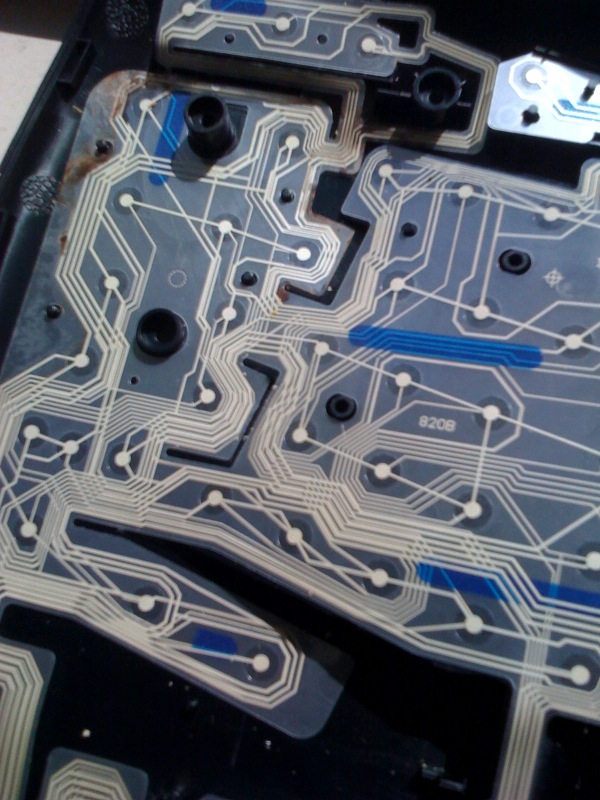
Unfortunately I got a bit unlucky there. I did actually take apart my keyboard like that the first time it happened, but the traces actually have visible water damage (see the brown bits). I tried that at the time, and again now, and it didn't help.
When I went to try that with the second keyboard, while I was separating the layers I kind of tore one of the layers through a trace. Oops.
I have occasionally wanted to go and see if I could figure the right place at MS to contact to see if I could buy a couple of those plastic things though... I think i'll give that another shot now.
-
Re:Inevitable, I Hope
Use an in-house written textbook custom to the department (done in a lot of lower-level classes) which will be cheaper, lets the department recoup some of the money, but is of much lower quality (fewer exercises by an order-of-magnitude, no proofreading for errors, no graphic design, no color, hand-drawn sketches, etc.)
I teach physics, not math, but here are some existing math books that I consider to be of pretty high quality:
- Hefferon, Linear Algebra, http://joshua.smcvt.edu/linalg.html/ (BY-SA license)
- Judson, Abstract Algebra: Theory and Applications, http://abstract.ups.edu/ (GFDL license)
- Corral, Trigonometry, http://mecmath.net/trig/ (GFDL license)
- Keisler, Elementary Calculus: An Approach Using Infinitesimals, http://www.math.wisc.edu/~keisler/calc.html (CC-BY-NC-SA license)
- Illowsky and Dean, Collaborative Statistics, http://cnx.org/content/col10522/latest/ (CC-BY license)
The lack of color in the printed versions of free books is never going to change. The cost of producing a book in color is high enough that no significant number of students will ever choose it voluntarily over a free digital book. This may become less relevant as more and more students start carrying a tablet or a laptop in their backpacks.
Proofreading, error checking, and increasing the number of exercises are all things that could definitely benefit from a wider collaborative effort, and I don't think they require government funding as proposed by Steinberg. E.g., my own physics texts are free, and I've benefited a lot over the years from having people send me emails pointing out errors. I do have a few exercises from other people's physics books that are under compatible licenses, but not very many.
High quality art would definitely be a huge plus for free textbooks. My wife paid a couple of people to do art for her free French textbook, but in general, illustrations are an area where government funding really might make a huge difference.
-
There's quite a lot of dedup work
I was doing similar research a few days ago.
Some of these are already mentioned...
- Lessfs - v1 is stable, v2 is pre-alpha/alpha. http://www.lessfs.com/
- Blackhole - http://www.vanheusden.com/java/BlackHole/ - requires Java, which seems like a bad idea to me for a block level device, but I haven't tested it yet.
- SDFS from OpenDedup - http://code.google.com/p/opendedup/ - http://www.opendedup.org/ - looks very promising, but may have stalled
- Dedupfs for Ext3 - http://pages.cs.wisc.edu/~kosmatka/dedupfs/
- ZFS. You know about that.
- DragonFly/Hammer - http://www.dragonflybsd.org/hammer/ includes dedup. Competitor to ZFS and Btrfs, also using Btree. Includes block level dedup, but I'm not sure if it's fixed block or not. Suspect it is fixed.
- Btrfs - there's a patch. Not sure if it's in mainlined yet. But without fsck btfs is not trustworthy enough. That's coming soon, but has been for a while. In case you read this as being negative about btrfs, it's not; it's an awesome file system, combining modern ideas and an excellent implementation, but it's still at testing stage for critical data.
Other stuff:
- Dext2 - an idea. No code. http://code.google.com/p/binarywarriors/
- BackupPC, the next version may have block level dedup, it's been suggested/requested. Numerous people pointed out the hard linking scheme it uses. I'm backing up VM images, which is what started me on this block-level dedup search, and when you have a small change in a 60BG file, it's a new file. (Yes, I have thought of schemes to split them.)
- Bacula have been experimenting with block level dedup, fixed and sliding. May be in future versions.
- Bup - https://github.com/apenwarr/bup has many of the ideas. It's not a file system, but could be reconstructed, I think. Based on Git store. I recommend reading http://apenwarr.ca/log/ which has more, and is entertaining. I think this is an excellent approach. Read back in his blog for details on bup ideas.
- SquashFS - for static data.
- Epitome - http://www.peereboom.us/epitome/man/ - for static data too, I think. Not fully investigated.
- I know I saw at least one Google Summer of Code submission about dedup. Haven't followed it up yet, and couldn't find the tab in my browser.
- Interesting conversation - http://news.ycombinator.com/item?id=2932335
By fixed block I mean that the file system does not search out shared data when the blocks are not on block boundaries. So if you add one byte to the beginning of a 10 GB file, and that has the unfortunate consequence of rippling up through all the blocks that make the file, then there will be no block level sharing with the original file. Of course that's a pathological case, but you get the idea.
Original poster, perhaps you could keep us informed of your findings? There's at least me who is also interested.
-
Re:Evil government!
high yield of corn crops since the 1960's (150-200 bushels and acre compared to only 50/acre years ago).
Quite true. See Figure 1.
-
Assistive technology resources
I agree with the poster upthread that JAWS is powerful (and Kurzweil has been a standard for years), but in my experience it is also pretty complicated for a novice user.
Have a look at what the Trace R&D Center has to offer on the topic. In addition to developing accessibility standards and technology, they are an amazing resource for information on AT in general. They used to have a very good "information and referral" service, though I'm not sure if that's part of their mission now.
A couple of other good resource are ABLEDATA assistive tech database, and assistivetech.net.
If you live in the upper midwest and feel like shelling out a few bucks to have your mind blown by current trends in AT, make a point of attending the Closing the Gap conference in Minneapolis next October.
Probably this is more information than you were looking for, but it does make for interesting reading!
hth
-
Re:I know this isn't what you asked but...
I think it is in place to post the following information about files systems and the risk of data corruption:
(the information within this post is derived from a forum discussion with a user named "Kebabbert" so credits should go to him(/her never met him irl) for the excellent information on this post)
Regarding shortcomings in hardware RAID, here is a whole PhD dissertation showing that normal file systems are unreliable:
http://www.zdnet.com/blog/storage/ [...] t-risk/169
Dr. Prabhakaran found that ALL the file systems shared
We observe little tolerance to transient failures;...none of the file systems can recover from partial disk failures, due to a lack of in-disk redundancy.
Regarding shortcomings in hardware RAID:
http://www.cs.wisc.edu/adsl/Public [...] fast08.pdf
"Detecting and recovering from data corruption requires protection techniques beyond those provided by the disk drive. In fact, basic protection schemes such as RAID [13] may also be unable to detect these problems.
As we discuss later, checksums do not protect against all forms of corruption"
http://www.cs.wisc.edu/adsl/Public [...] icde10.pdf
"Recent work has shown that even with sophisticated RAID protection strategies, the "right" combination of a single fault and certain repair activities (e.g., a parity scrub) can still lead to data loss [19]."
CERN discusses how their data was corrupted in spite of hardware RAID:
http://storagemojo.com/2007/09/19/ [...] -research/
Here is a whole site that only talks about the lacks and shortcomings in RAID-5:
http://www.baarf.com
Lacks and shortcomings in RAID-6:
http://kernel.org/pub/linux/kernel [...]
"The paper explains that the best RAID-6 can do is use probabilistic methods to distinguish between single and dual-disk corruption, eg. "there are 95% chances it is single-disk corruption so I am going to fix it assuming that, but there are 5% chances I am going to actually corrupt more data, I just can't tell". I wouldn't want to rely on a RAID controller that takes gambles
In other words, RAID-5 and RAID-6 are not safe at all and if you care about your data you should migrate to other solutions. In the past the disks were small and you were much less likely to run into problems. Today when the hard drives are big and RAID clusters are even bigger you are much more likely to run inte problems. Assume that there is a 0.00001% chance that you run into problems, if the hard drives are large and fast enough you will run into problems quite frequently. -
Re:I know this isn't what you asked but...
I think it is in place to post the following information about files systems and the risk of data corruption:
(the information within this post is derived from a forum discussion with a user named "Kebabbert" so credits should go to him(/her never met him irl) for the excellent information on this post)
Regarding shortcomings in hardware RAID, here is a whole PhD dissertation showing that normal file systems are unreliable:
http://www.zdnet.com/blog/storage/ [...] t-risk/169
Dr. Prabhakaran found that ALL the file systems shared
We observe little tolerance to transient failures;...none of the file systems can recover from partial disk failures, due to a lack of in-disk redundancy.
Regarding shortcomings in hardware RAID:
http://www.cs.wisc.edu/adsl/Public [...] fast08.pdf
"Detecting and recovering from data corruption requires protection techniques beyond those provided by the disk drive. In fact, basic protection schemes such as RAID [13] may also be unable to detect these problems.
As we discuss later, checksums do not protect against all forms of corruption"
http://www.cs.wisc.edu/adsl/Public [...] icde10.pdf
"Recent work has shown that even with sophisticated RAID protection strategies, the "right" combination of a single fault and certain repair activities (e.g., a parity scrub) can still lead to data loss [19]."
CERN discusses how their data was corrupted in spite of hardware RAID:
http://storagemojo.com/2007/09/19/ [...] -research/
Here is a whole site that only talks about the lacks and shortcomings in RAID-5:
http://www.baarf.com
Lacks and shortcomings in RAID-6:
http://kernel.org/pub/linux/kernel [...]
"The paper explains that the best RAID-6 can do is use probabilistic methods to distinguish between single and dual-disk corruption, eg. "there are 95% chances it is single-disk corruption so I am going to fix it assuming that, but there are 5% chances I am going to actually corrupt more data, I just can't tell". I wouldn't want to rely on a RAID controller that takes gambles
In other words, RAID-5 and RAID-6 are not safe at all and if you care about your data you should migrate to other solutions. In the past the disks were small and you were much less likely to run into problems. Today when the hard drives are big and RAID clusters are even bigger you are much more likely to run inte problems. Assume that there is a 0.00001% chance that you run into problems, if the hard drives are large and fast enough you will run into problems quite frequently. -
Re:It's not at all addictive
This is an empirical question. A quick Google search reveals this study on withdrawal in daily marijuana users: Marijuana abstinence effects in marijuana smokers maintained in their home environment (PDF link). Bottom line is that clinically significant withdrawal symptoms were observed in that population.
-
Re:Where's your mosque?
You're drawing false conclusions from incomplete data. The more Sikh a state is, the greater the odds that some will support the terrorist group Babar Khalsa, or the more Christian a state is, the more likely they'll support Christian supremacist groups like the BNP or White Pride. The reason American Muslims reject terrorism more than Muslims in a place like Pakistan could more likely be because American Muslims have nearly 100% literacy rate while Pakistan is around 50%.
Heck, the ADL believes that swastikas and anti-semitism shouldn't fall under free speech either. Rauf didn't call for an abandonment of the first amendment, he said that people shouldn't hide hate speech behind it and pretend its benign.
Sufism is not a sect, you can be Sunni and Sufi, it's a philosophy that's found all over the Muslim world. Arguably, Pakistan is a sufi country.
Like I said, Saudi doesn't represent islam, it represents a dictatorship. The king controls it; he appoints and fires religious scholars who agree with him, despite the fact that nearly zero scholars outside Saudi agree with his warped ideas. The other 95% of the 1.5 Billion Muslims who don't live under his rule are nothing like him, which is why you see Jordanian Muslims planting flowers at churches or Indonesian Muslim leaders protecting churches of minorities. The majority of Muslims support religious freedom, look at places like Senegal for an example of how most get along. Cooperation and tolerance isn't newsworthy despite being the norm, so it's ignored.
-
Under sufficiently large definitions of "widely"
I am pretty sure that, for example, Condor started as an academic project, but now it is Red Hat's grid computing platform:
http://www.cs.wisc.edu/condor/
http://www.redhat.com/mrg/grid/condor/ -
Re:would we have noticed?
Someone has invented a neutrino telescope:- http://icecube.wisc.edu/ http://antares.in2p3.fr/ But the angular resolution is awful and the energy threshold is very high. So this only detects neutrinos from really super powerful cosmic stuff like black holes colliding.
-
Re:Einstein replied "Check your measurements, son"
This is being done by the Ice Cube Neutrino observatory at the South Pole. Ice Cube uses the Earth as a shield, as is observing natural neutrinos coming in from the North (i.e., ones that transverse the entire Earth). Ice Cube may be able to directly image the Earth's core using neutrinos.
I would lay serious money that someone this morning is going over the Ice Cube specs and trying to figure out if it could be used to do timing to Fermilab or Cern. They are both, after all, in the field of view.
-
"the math of GR" -- how much math is that?
You've made an admirable attempt to define your question clearly, but you didn't quite succeed. General relativity can be understood at a variety of mathematical levels, so saying you want to understand "the mathematics of general relativity" doesn't really pin it down.
The other issue is that you haven't defined your physics background. If you really want to understand GR, you need to be fairly sophisticated in physics.
The first thing I'd suggest is that you build a solid foundation of understanding in special relativity. The best intro to SR is Taylor and Wheeler, Spacetime Physics, and you already have the math background to understand that.
Physically, GR is a field theory. The first field theory was electromagnetism. E&M is a lot easier to understand than GR, because it takes place on a fixed background of flat spacetime, and it also connects directly to everyday experience. The more intuition and technical skill you can build up in the context of E&M, the better prepared you'll be for GR. For someone ambitious about going far in physics, the best intro to E&M is Purcell, Electricity and Magnetism. Purcell uses vector calculus, and he tries to teach you all the vector calc you need as he goes along. However, you will want some of the preparation provided by a second-semester calc course, and you will probably also have an easier time if you can also study from a separate book on vector calculus. Here is a free online calc book that I like, and here is a free vector calc book you could use. When you're learning second-semester calc, I'd suggest you skip the integration tricks that form the bulk of such a course; they're largely irrelevant to your goal, and nowadays you can use Maxima or integrals.com for that kind of thing.
With that background, you're more than prepared to start studying GR at the level of Exploring Black Holes, by Taylor and Wheeler.
If you want to go on after that and understand GR at a higher mathematical level, you could try an upper-division undergrad book such as Hartle or my own free book, and then maybe move on to a graduate-level texts. The mathematics used in graduate-level texts is typically introduced explicitly in the text itself; basically tensors and calculus on a manifold. You don't need any more math prerequisites than vector calculus before diving in. The classic graduate text is Misner, Thorne, and Wheeler. I would still recommend it wholeheartedly, except that it's now decades out of date. A more modern alternative is Carroll; there is a free online version, plus a more complete and up to date print version. Other GR books worth owning are General Relativity by Wald and The Large-Scale Structure of Space-Time by Hawking and Ellis.
-
Re:probably wasn't a beach...
4.5 billion years ago, probably not. At least not for long, any water probably getting vaporized by gigantic collisions on a regular basis. But by 4.4 billion years ago, there is evidence for detrital (i.e. eroded on the surface and redeposited) zircon mineral grains in what are now highly metamorphosed sedimentary rocks. The original rocks did not survive unaltered from that period, but the recycled zircons did, implying there had to be some process to erode them from the rock in which they initially crystallized and redeposit them, likely water. Refer to this web page and this paper. They're kind of technical, so good luck if you don't have some familiarity with geology and isotope geochemistry, but if you google "cool early Earth hypothesis", you'll find more general accounts from media reports too. It's fair to say that these interpretations are relatively new and thus tentative, but if they are correct it would mean the Earth wasn't the completely lava-covered hell that most geologists used to think it was when they named the pre-4-billion-year period of its history the Hadean Era. So, you have the right idea and it's a legitimate question to wonder whether there was water so early, but the science has changed in recent years.
By 3.4 billion years (the estimated age of these new fossils), there's plenty of unambiguous evidence for oceans having been around for quite a while before.
-
Re:probably wasn't a beach...
4.5 billion years ago, probably not. At least not for long, any water probably getting vaporized by gigantic collisions on a regular basis. But by 4.4 billion years ago, there is evidence for detrital (i.e. eroded on the surface and redeposited) zircon mineral grains in what are now highly metamorphosed sedimentary rocks. The original rocks did not survive unaltered from that period, but the recycled zircons did, implying there had to be some process to erode them from the rock in which they initially crystallized and redeposit them, likely water. Refer to this web page and this paper. They're kind of technical, so good luck if you don't have some familiarity with geology and isotope geochemistry, but if you google "cool early Earth hypothesis", you'll find more general accounts from media reports too. It's fair to say that these interpretations are relatively new and thus tentative, but if they are correct it would mean the Earth wasn't the completely lava-covered hell that most geologists used to think it was when they named the pre-4-billion-year period of its history the Hadean Era. So, you have the right idea and it's a legitimate question to wonder whether there was water so early, but the science has changed in recent years.
By 3.4 billion years (the estimated age of these new fossils), there's plenty of unambiguous evidence for oceans having been around for quite a while before.
-
Um
Shuttle hits Warp 2 Graphics might come out of my butt Definitely not gay Team Name Team Name.
(NSFW) The weather penis is actually an entire category: http://www.youtube.com/watch?v=djItGln6IxY
Yeah, let's stick with professionals. For the lulz.
-
University of Wisconsin - Madison
This looks like a project to address adding checksums in the md(4) Multiple Device layer (not ideally named, because MD is perfectly usable on a single drive). Because MD is a layer under the filesystem, any filesystem is supported. They only support RAID4C (checksumming RAID4) and RAID5C (checksumming RAID5), though they show how to implement it on a single volume, albeit with a large performance penalty.
There is an excellent paper which analyzes the integrity issue you are trying to address.
I wish this would get into linux kernel mainstream.
-
Re:Is this the version with Print Preview? No.
-
Re:In other words...
Ofc it is not "easy". But it is more likely than the idea that an app serializes its internal structure like your parent thought.
Also there is old school software called "condor" that exactly does that. Dumping the process state and even let it migrate to a different machien and continue there. Not sure if it is still under development -
Re:Words by themselves are nothing
show me an example of where the Public Option has succeeded on the same scale as the private option?
IceCube South Pole Neutrino Detector
The inauguration events for the detector are being held this week in Madison, WI.
-
The Original Condor
There is already a supercomputer called Condor: Condor Project Homepage
-
Re:Big fight about the patent for the laser
The fight over the laser patent was over the idea not a working model. See for example, http://tc.engr.wisc.edu/uer/uer97/author5/content.html
-
Re:TLD for Financial Transactions
This is Slashdot, it is automatically assumed that anything can be blamed on Christianity, and the hive mind does not welcome rational discussion of the issue.
Nudity has a lot of implications:
1) Cod-pieces in the (very Christian) middle-ages in Europe, and similar penis casing in other cultures are probably some form of status display other societies suppress.
2) Monkey's display errect penises as a sign of aggression: http://pin.primate.wisc.edu/factsheets/entry/proboscis_monkey/behav
3) A visible erect penis may reveal information its owner wishes to conceal.
4) Periods, as you implied, need some clothing to deal with.
5) Breasts. Once you start concealing organs with sexual significance they are the next step.
6) Once you start wearing clothes for other reasons (e.g. protection in a cold or very hot climate) not wearing the usual level of clothing becomes sexually provocative.