Slashdot Mirror
Domain: wtrg.com
Stories and comments across the archive that link to wtrg.com.
Comments · 42
-
Re:Get some facts first, or wait til dust settles
My friends left Venezuela about 10 years ago now, because it was already getting bad then. They weren't rich. Just working-class people.
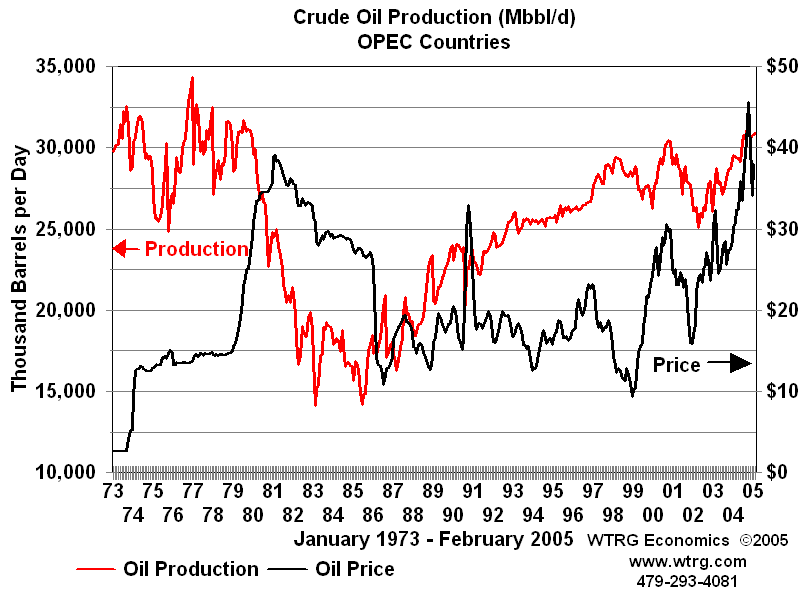
The only thing keeping the country afloat is the oil industry. Without that it would have collapsed decades ago. Even with that it's been horribly, horribly mismanaged (both the oil industry itself and the revenues from it). Chavez did not seize the oil companies. They've been national since the 1970s, and reap huge profits because of that for the country. It's a good thing. He simply discouraged any further foreign investment, which was a really stupid idea, because Venezuela needed foreign capital and knowledge to expand production. This graph pretty much tells the story. What Chavez did might have still been okay if a large fraction of the national oil company revenue was turned back into investment to keep the production going or investment in people's lives that have long term effects (e.g., education), but instead much of that revenue was simply spent on trinkets, which is great for appeasing people and making things superficially look better than they would be otherwise. In reality it's called "squandering the national endowment", and will have huge costs going forward, especially because Venezuela's production is in decline. Heaven help them if oil prices also decline significantly. It's going to implode.
-
Re:Advanced as They Were
Last friday Brent Crude Oil was trading at $126/barrel. This is near the all time high in modern history. We are already at the point where oil supply has become much less responsive to the price and price spikes are commonplace. It's a curious time for somebody to be declaring peak oil "debunked".
Oil is finite and the price of oil is getting exponentially more expensive as was predicted decades ago. Meanwhile, solar technology has been benefiting from a Moore's Law rate of advancement and the price of solar energy is plummeting exponentially. Even without cap-and-trade, the price of solar energy is projected to achieve grid parity by the end of this decade. Given prevailing trends, we can expect that people will use energy to make petrochemicals synthetically from the carbon in the air, using Green Freedom or some other such technology in the next 20 years.
Solar is the power source of the near future. If we embrace that fact now we can begin to adapt and avoid a huge amount of economic dislocation and suffering. Or we can get dragged into the future kicking and screaming and burdening the human race with massive ecological damage.
-
Re:Beating the Soviets
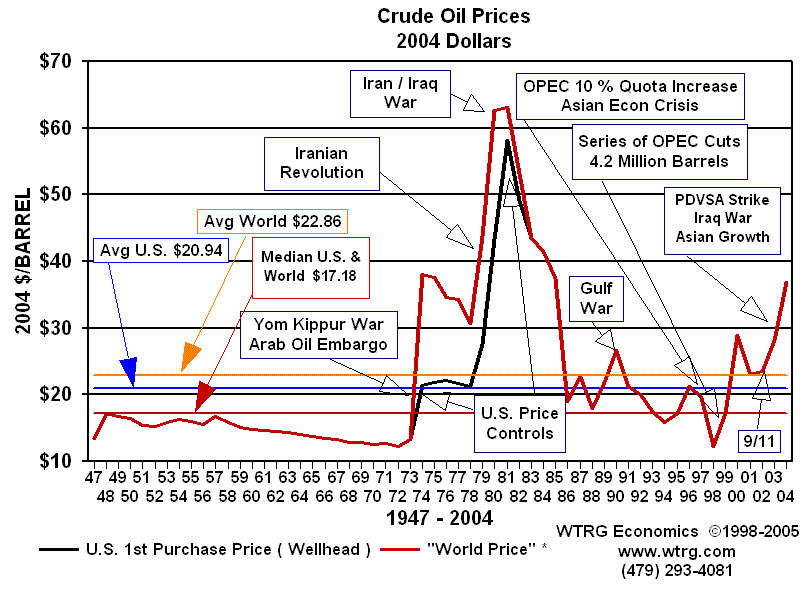
What are you talking about? Oil prices declined> a few dollars from 1948-1974, during which time the Soviet Union only increased its power and wealth. From '74 thru '82 prices skyrocketed to over triple their 1948 price, then plummeted back but stayed about 10-30% over their 1948 price.
Forget the rest of your analysis, including the role of petroleum prices in the Soviet economy. Your basic facts are completely different from reality.
-
Re:Similar Revolts
If you want to know why oil prices are fluctuating so much even though Libya is hardly relevant as an oil producing country, read Chapter 4 of Matt Taibbi's Griftopia. The short answer, however, is that, for some time now, a select number of banks have been allowed to speculate on the commodity markets. This was expressly forbidden before 1991, but after a Goldman Sachs subsidiary whined that this was unfair, this was changed for them, and then for another 16 banks under Clinton (and Bush 2).
Now, the notable thing about the commodities markets is that you can only bet one way: long (Futures). This means that, when more money flows into the market, prices can and will only go up to reflect this; and from 2003 to 2008, the amount of money invested in commodity indices has gone from $13B to $317B. Care to guess what the effect was for oil? -
Re:Well, of course.
Meh.
Peak oil is only validated if you believe that price floats freely in an actual open market system. To suggest that the price has anything more than a trivial connection with supply is naive. Finally, look at the excellent fixed-dollar graphs of the price of oil since 1947 at wtrg: http://www.wtrg.com/oil_graphs/oilprice1947.gif
How many other commodities have increased in value less than 1.5%/year since 1948?"Peak Oil" as an imminent danger (some might say "sky is falling" danger) has been a theory for 60+ years. It seems superficially logical that yes (unless you're someone who believes in the theories of abiogenic oil) the oil supply is finite, and as the supply of oil is consumed, the remainder will get more valuable over time.
However, it's not quite that simple. I'm not even going to get into the ever-increasing world reserve numbers over, as they are suspect due to OPEC's mechanism of setting member-production quotas based on reserves. Setting that aside, there is a TON of oil out there in places where it is simply economically or politically infeasible to retrieve it. In the US EEZ alone, there are the Rocky mountain oil shales - alone an estimated 1500-1800bn bbl - not to mention offshore reserves or single fields of known high-quality oil that's not currently retrievable (like the Bakken field).
This is compared to current total Saudi reserves of 220bn bbl.
Finally, to suggest that "there hasn't been a major new energy source in the last half century" is meaningless. First, simply developing new sources of energy is stupid if they don't do something better than what we currently have. Witness the push in the US for ethanol - if converting food production to fuel production for a net loss of efficiency in both isn't pure idiocy, I'm not sure what is.
Secondly, we haven't developed a new source of energy because we haven't needed to; oil, natural gas, and coal have been abundant for our purposes in the industrial age, and natural gas/coal are projected to continue to be abundant for centuries. Humans have been staggeringly successful at being flexible. As oil crosses $100/bbl for sustained periods, we will inevitably develop more efficient systems for using it - better mileage in cars, for example. As it climbs even higher
-
Re:Whew
Haha I wish.
Signed,
The rest of the worldDear the rest of the world;
BP & others are selling refined gasoline at significantly less than $3/gallon.
Speak to your government about the enormous taxes they pile on top of that price.Signed,
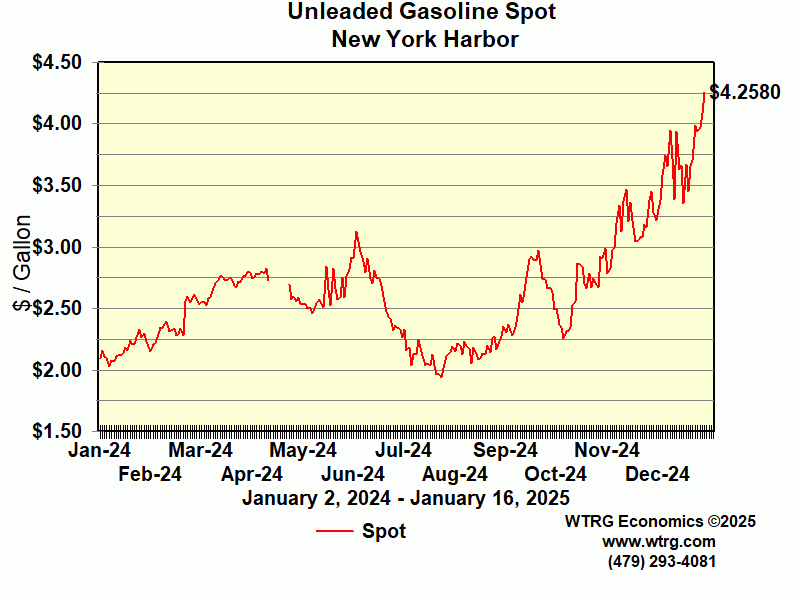
The USAP.S. Since I'm in the USA, here's the NY spot price for gasoline
Actually, it's because the USA heavily, heavily subsidizes gasoline, whereas other countries do not, to the tune of (Conservatively) $9.1 billion dollars a year.
-
Re:Whew
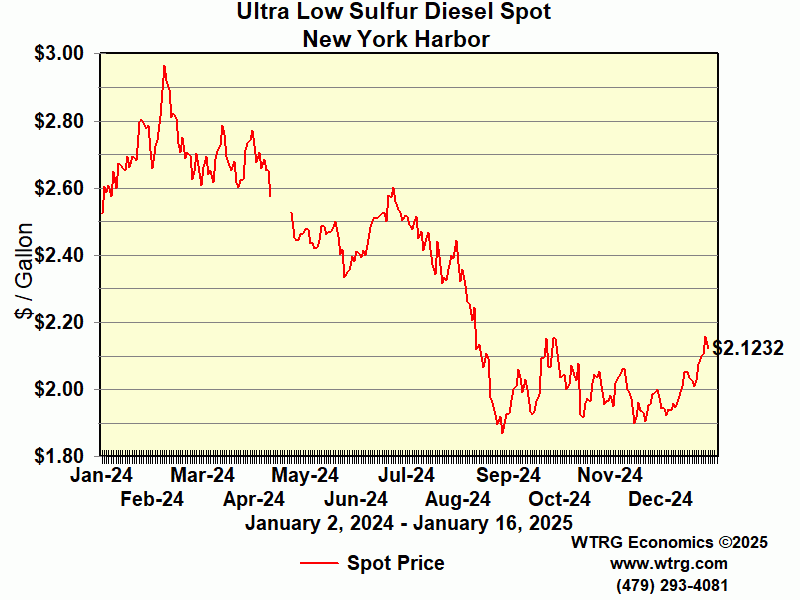
P.P.S. I accidentally linked the price for heating oil. Here's the price for gasoline. If you compare them, there isn't much of a $$ difference.
-
Re:Whew
Haha I wish.
Signed,
The rest of the worldDear the rest of the world;
BP & others are selling refined gasoline at significantly less than $3/gallon.
Speak to your government about the enormous taxes they pile on top of that price.Signed,
The USAP.S. Since I'm in the USA, here's the NY spot price for gasoline
-
Re:Good
I think the Oil Age happened because oil was incredibly cheap and convenient. My guess is that won't be the case in future. In fact oil could get a lot cheaper and still alternatives will take over.
I read somewhere that Saudi policy was to keep the price of oil below $30 per barrel to try to prevent this. Now - even during a very serious recession - that's not possible
http://www.wtrg.com/prices.htm
Mostly because China, India and so on are still growing and they have a huge need for oil. Plus there are worries about CO2, or that supplies may be interrupted in future and so on. Most countries are putting serious money into feed in tariffs for wind and solar and I suspect for algae biodiesel if it proves practical. More nuclear power plants are being built. Canadian oil shales are now economically viable.
All these things together means that the world economy is adapting to become less dependent on Saudi oil, just like it did during the 1973 oil crisis.
-
Re:peak oil clarification
This is why we had $147/barrel oil a few years ago, not speculators.
If the world population were the only factor, oil would still be at $147/bbl, because the world population hasn't gone down.
I suspect that there was rampant speculation going on, and that a great many speculators lost their shirts when the bubble they'd created burst. But I don't know who the winners and losers were.
If you "smooth out" the spike, the price of oil is still going up pretty fast since its trough in the late 90s, even if not quite as fast as the speculation-fueled spike. That would suggest that you're correct: we are looking at a price rise, possibly just based on the supply and demand, and the current dip is just the spike evening itself out.
If that's the case, we'd expect to see oil continue a gradual rise of roughly 5% per year over inflation. But the spikes make it tricky to observe that with anything less than a five-year window.
-
Re:Is an idiot
Standard Oil.
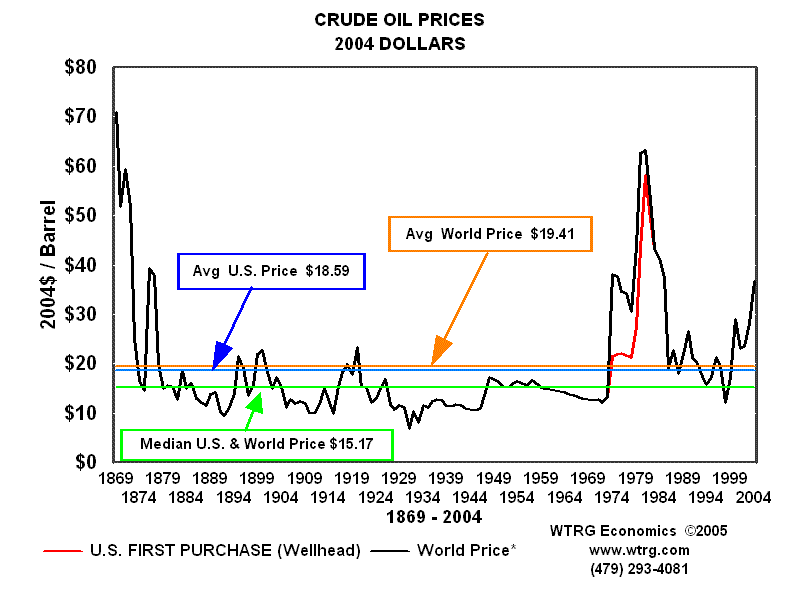
Here is a graph of oil prices from 1869: http://www.wtrg.com/oil_graphs/oilprice1869.gif
Where was Standard Oil selling at a loss, and where was it able to make it back by jacking up the price above their starting point? It cut kerosene prices by more than half in just five years -- the "unfair practices" cited by its competitors did *not* have to do with jacking up the price, but by continuing to undersell them with no end in sight. If I'm competing with you, I love it when you raise your price above my cost, since it guarantees a profit. I am much more likely to cry to the government if you are selling your product *below* my cost.
And note that I am not making any other claim about Standard Oil's business practices, and of course it was able to charge higher prices in markets where it didn't have a strong competitor. I am arguing that the price tended downward, rather than the upward slant required to make up for theoretical losses.
-
Re:Automakers
A couple of things:
1. I'm pretty sure the C in OPEC stands for countries, so OPEC is nothing but government price controls.
2. Cut in production does not necessarily mean shortages. It only means shortages when there are price controls in place by the government and prices are not allowed to adjust to equilibrium with the new level of supply and demand. But that's ok. I'm sure it had absolutely NOTHING to do with the draconian price controls implemented by the US government in the early 1970s.
http://www.wtrg.com/prices.htm
I'm sure National Socialists like yourself who want to exert dictatorial control over other peoples lives don't like to hear this, but there are no shortages in free markets, there are only accurate prices.
You know what, you're right! That must be why my Water Department is completely private, why the Police Department is completely private, why the United States Military is completely priv...oh wait.
SO! Now that we've dispelled *that* myth, I guess we can determine (by your own writings) that *I'm* a "National Socialist" because I simply want the United States to be energy independent (I could care less about the environment, BTW) and *You* are a patriot because you think the chips "should fall where they lay"?
Fuck everyone and everyone should be out for themselves, is that your "plan"?
-
Re:Automakers
A couple of things:
1. I'm pretty sure the C in OPEC stands for countries, so OPEC is nothing but government price controls.
2. Cut in production does not necessarily mean shortages. It only means shortages when there are price controls in place by the government and prices are not allowed to adjust to equilibrium with the new level of supply and demand. But that's ok. I'm sure it had absolutely NOTHING to do with the draconian price controls implemented by the US government in the early 1970s.
http://www.wtrg.com/prices.htm
http://mises.org/story/3025
http://mises.org/story/3107
I'm sure National Socialists like yourself who want to exert dictatorial control over other peoples lives don't like to hear this, but there are no shortages in free markets, there are only accurate prices.
You are right about one thing though: price controls, like every other government action, are acts of aggressive violence and do constitute and act of war. -
Re:Fine, now go after the petroleum companies,
the collusion on the price of gasoline is the minor issue, the collusion on the price of a barrel of oil is absolutely crazy, and is causing riots in countries that can't afford the price of oil and still put food on the table.
for most of the history major governments have leaned heavily on oil suppliers to keep a low, affordable price, there are all kinds of laws about this all over the world, but all of a sudden, since USA invaded iraq, one of the worst offenders for breaking opec rules, causing iran to also break opec rules... to keep pace. well the price of oil has gone up 375% in just 5 and a half years. http://www.wtrg.com/oil_graphs/oilprice1947.gif note: the graph has the date of the iraq war wrong http://en.wikipedia.org/wiki/Iraq_War march 20th 2003 not 2004 as shown... sorry first graph i could find. putting the start of the iraq war in 2004 is misleading, suggesting the price went up for all of 2003 without reason.
notice the price spike starts the EXACT YEAR the iraq war starts. sounds like exxon started the war by their proxy, gw bush, a texas oil man from way back. iraq didn't have weapons of mass destruction, they had violated exxons principals by creating artificially high supply for a quick buck instead of following opec production goals.
-
Re:elect obama
I'd say obama's big support for ethanol has driven up food prices
Did ethanol push up food prices? Yes, some farmers that were growing other things stopped to grow corn. Is it responsible for all (or even a majority) of food price increase? No, the fact the cost of oil tripled in the past decade did that.
And if the fact that the cost of inputs (oil, fertilizer, etc) increased tremendously wasn't enough, we had a record breaking corn crop last year, with an (as of the time of that article) expected surplus of 1.4bln bushels. Now, all the farmers growing corn instead of wheat might explain why the price of wheat or barley or soy or whatever else went up, but the price of corn increased too, despite that glut, so I think it's fair to say that "ethanol" isn't entirely at fault.
are worth MORE today than they were 7 years ago
Only if they were better than the S&P 500 and the Nasdaq indexes. The Dow is the only index that is still up over 2001. Nasdaq is down to 1998 levels, S&P 500 is down to 1999 levels.
-
Re:Wow, that's mature
If you were an oil trader and knew that if we started drilling today and that oil wouldn't get used for another 10 years, why in God's name would that affect your bidding on contracts for September delivery?
Oh, I don't know, because if you're trading on the futures market, you locked in your September 2008 contracts way back in Fall 2007. If you're going after energy contracts now for next month, that's practically spot market pricing, which can be even more volitile.
What they're trading now is setting up contracts for Summer 2009 onwards. It takes 1-2 years to build a land rig (ANWAR) and 3-4 years to complete a sea rig. Having Congress open up more leases for land drilling, and permitting off-shore drilling, will increase supply which can only reduce prices. Since it's a future development, it reduces the future price. Since my future price will be less, I will charge less now, since I won't need to have as much cash on hand next year to pay for the oil then.
-- Scott
-
Re:It's not the heat, it's the stupidity.
A marriage in Canada is recognised in the US, why would that change for marriages between states?
Because Ron Paul supports the "Defense of Marriage Act" which would exempt states from having to recognize gay marriage.
Putting that money into the high interest savings account would result in a loss of 600 million dollars to inflation
That's only true if: (a) a high-interest savings account were a good investment and (b) rates did not fluctuate. Neither of these things is true.
Fact is, $200 million invested in 1948 would have yielded:
# $3,099.40 if saved in a short-term asset.
# $9,822.43 if saved in a long-term asset at a term of 1 years.
# $14,658.83 if saved in a DJA portfolio.
source: this pageInflation effectively didn't exist for 200 years under the gold standard.
That's another thing that simply isn't true. Here's a chart showing inflation in the US since the 1600s. See how spiky it is? Now I'll grant you that there are also periods of deflation that tend to balance out the long-term trend. But moderate, sustained inflation is far easier to deal with than spiky, unpredictable inflation. Can you imagine trying to live during those spikes into the 20-40% range? Upward would be horrible for the working people and downward would be horrible for businesses. Pre-WW2 history is full of panics, bank failures, and depressions. And wars. Lots of poverty. In short, all of the things promised by a return to the gold standard already existed before the gold standard was abandoned.
and in the '70s when Nixon completely broke the final ties to the gold standard to help finance the war, it began to increase at an incredible rate. [inflationdata.com]
Could be, but I think it's related to government borrowing and the price of oil. Specifically, the huge spike in oil prices during the 70s drove inflation then (as it is doing now). Then, the Regan-era spending drove inflation through massive government accumulation of debt.
they've gone from being the most progressive, liberal, advanced nation in the middle east
Iraq? Under Saddam? No. Maybe you are thinking of Israel? Had we done what we should have in '91, Iraq would fine right now. The mess in Iraq was prolonged by a dysfunctional UN.
It's time we just pull out and let the Iraqis handle themselves
On this we agree, but it has to be orderly. We started the shooting and we need to end it.
We spend more on the federal army, navy, and air force than the next 20 countries combined, we should be able to defend our own borders.
LOL. We like the cheap labor. We don't really want to secure our borders. Groceries are already expensive enough as it is. You want to end illegal immigration? Stop employing illegal immigrants. We have no one to blame but ourselves. I hire them all the time every time I order take out. You hire them whenever you buy a sack of fruit. My in-laws hired them outside the 7/11 to help them move. They are just normal people trying to earn a buck, and we willingly give them bucks. Arming the border would probably be effective, but is just about the biggest waste of money in terms of potential solutions.
A family member of a dissident was put in mortal danger by the whitehouse for purely political reasons.
While I agree that incident is disturbing, and I hope that the person responsible is caught and punished - you cannot compare a leak to the press, no matter how damning, to the systematic arrest and incarceration of every political opponent.
We could be h
-
Re:Eh
That's still a bit too long an investment for this to be really practical. Prices need to come down to about a four year payoff before I'd be really interested.
This is a common mistake. The assumption that energy costs are fixed or simply follow inflation is in error. Expect electric rates to follow gasoline prices that preceed it by a couple years. Payback period could be as short as only 5 years. In another 8 years, that 4 year payoff may be a reality for those who bought equipment now, but in 8 years the demand will drive up the prices for the installations much like fuel effecient car prices have gone up while waiting lists form.
It was my rationing when I bought my Prius. I was watching peak oil, the drilling restrictions and understood why no new refineries are being built. There is no more oil to refine. I bought the Prius when the payback period was 100K miles when gasoline was under $2.00/gallon. Payback has shifted a lot lately and not because the price of the Prius is less.
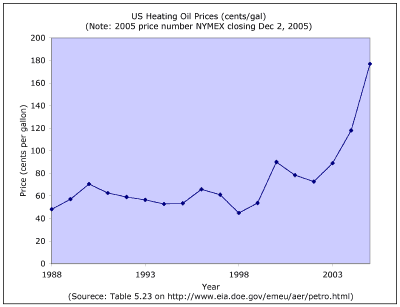
Expect the same from this solar install. It's on the way. Seen the price of home heating oil and natural gas lately? Fossil fuel electricity isn't far behind. Wind, hydro, and solar buffer this some.
http://www.wtrg.com/daily/heatingoilprice.html
http://www.theenergyco-op.com/OIL%20PRICE%20UPDATING/hhoil_pastprices.htm
http://www.wtrg.com/daily/gasprice.html -
Re:Eh
That's still a bit too long an investment for this to be really practical. Prices need to come down to about a four year payoff before I'd be really interested.
This is a common mistake. The assumption that energy costs are fixed or simply follow inflation is in error. Expect electric rates to follow gasoline prices that preceed it by a couple years. Payback period could be as short as only 5 years. In another 8 years, that 4 year payoff may be a reality for those who bought equipment now, but in 8 years the demand will drive up the prices for the installations much like fuel effecient car prices have gone up while waiting lists form.
It was my rationing when I bought my Prius. I was watching peak oil, the drilling restrictions and understood why no new refineries are being built. There is no more oil to refine. I bought the Prius when the payback period was 100K miles when gasoline was under $2.00/gallon. Payback has shifted a lot lately and not because the price of the Prius is less.
Expect the same from this solar install. It's on the way. Seen the price of home heating oil and natural gas lately? Fossil fuel electricity isn't far behind. Wind, hydro, and solar buffer this some.
http://www.wtrg.com/daily/heatingoilprice.html
http://www.theenergyco-op.com/OIL%20PRICE%20UPDATING/hhoil_pastprices.htm
http://www.wtrg.com/daily/gasprice.html -
Re:$5 a gallon?
Maybe the oil prices variation has a mean reverting tendency, however this graph show there has really been an increment in the current years.
The complete article has other interesting charts -
Re:$5 a gallon?
Maybe the oil prices variation has a mean reverting tendency, however this graph show there has really been an increment in the current years.
The complete article has other interesting charts -
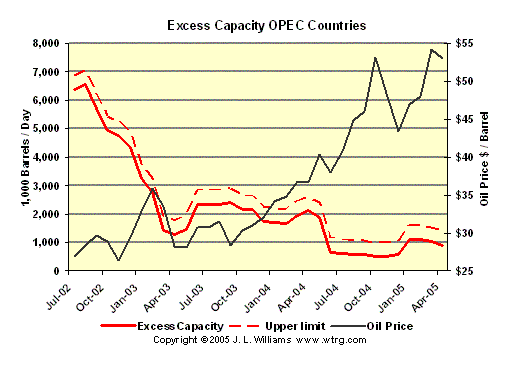
Re:Penny wise, pound foolishNo, we haven't reached the peak of production. Please look at excess capacity over the historical record. We've never had a negative amount. Excap is a measure of the unused pumping capacity of oil producers. In the last 5 years, OPEC alone has had at least 1 MILLION barrels a day of excess capacity, on a 60 day window. We're not at the peak of pumping.
New oil is getting more expensive, but that's because of extraction, not supply. The actual cost of pumping isn't that high, accounting for a few dollars per barrel; the cost is driven by exploration, royalties, transport, and refining. There's plenty of reserves AND pumping capacity - both are actually on the upswing. Peak oil isn't even close in terms of reserves OR pumping.
Aside: there's one thing the US Congress could do TODAY to eliminate $1 per gallon of gas: simply eliminate Federal taxation of gasoline and the oil companies. That accounts for about $1 per gallon. ""Evil Big Oil" is lucky to make $0.10 per gallon of gas, and they have to pay $3 in taxes for every $1 in profit they make. In the mean time, the Federal government not only gets that $3, but a direct $0.182 per gallon - about double what "Evil Big Oil" makes, per gallon.
-
Re:Fossil fuels != oil
Are you that ignorant of recent history that you actually believe the stuff your spewing? Oil was att eh price it was for several reasons outside anything you imagined. Here is a more accurate detail of what happened.
It misses a few things that are pretty much important. Until the late 90's we had tight controls on the oil futures and the ability to hedge again inflation with it. These controls were left over from the Carter era price controls and probably was one of the few things that kept oil prices somewhat stable during some unsteady moments in the 90's. It also misses the Iran embargo that has seemed to help limit spare capacity and it doesn't accurately or effectively stress the growth of Asian markets. Well, China to be more specific. China's usages has increase by far orders of magnitude more then any other country. This has to do with the US outsourcing manufacturing to China to save on increased labor costs and Europe's outsourcing pollutants in an attempt to artificially limit it's GHG emissions while using the cheap labor to hide extra costs of controls. When you look at this, you will see a sharp rise in demand stating at around 1999 and progressing which also coincides with China's development spurts.
Something else you have to remember, when viewing the charts, those aren't actual dollars for the price values. It is CPI adjusted values to factor inflation and provide a steady valuation to the purchasing parity of the dollar. I think they used 2006 as the determining year.
But even with that knowledge, none of the families or people mentioned have abused those connections with office to further their oil businesses. Even Cheney who is often criticized for keeping a salary earned before he went into office has not benefited at all from actions in office and his oil ties. It isn't hard to get the real dope on this stuff. Just look outside the cheer leader sites who want to push one sided agendas. Something like Factcheck.org might be some value to you. Don't forget google either. -
Re:Self-policing
Normally I don't respond to people with BDS (Bush Derangement Syndrome) but I figured I would just point out that OPEC controls oil prices and no matter how much any president (even the United States President) would want to change the price of oil, they're not going to be able to do much about it.
Also, oil prices have been rising since 1999 but saw a drastic increase in 2004-2006. Partly due to inflation as oil was behind inflation curve for sometime. As you can see, Oil prices are effected by a large verity of supply/demand and not just the war in Iraq (though, that's not to say there hasn't been a big impact due to it).
Currently, in the US, we're seeing record high gas prices again, not due to just the price of oil, but due to the US's capacity to refine that oil into gasoline. Here's an article from 2005 about refineries. The interesting thing is, the high gas prices of Hurricane Katrina, etc. where due to the loss of refinement capabilities.
Barrels of Oil are less than they where a year ago, but prices are higher? Refinement. The real question is, why the F**K isn't the government doing more to increase refinement? The U.S. cannot control oil prices (despite what anyone with BDS thinks, outside of taxes and subsidies), but they can control refinement.
Of course it's easier to just scream 'Bush' because you're not smart enough to think outside a box.
-
Re:"Global bandwidth crisis" is a crock
Is this sudden abundance of oil because suddenly Exxon found a huge oil reserve under the caribou-mating grounds of the arctic? Not a chance. The reason we've got a lot of oil all of a sudden is because they can charge 3 bucks a gallon for it. See? Eighty cents a gallon and there's a shortage. Three bucks a gallon and there's abundance.
Actually, gas was MORE EXPENSIVE at $0.80 per gallon in the 1970s than it is at $3.25 per gallon today. There's this thing called "inflation", which along with its close cousin "deflation" cause the value of money to rise and fall.
Adjusted for inflation, the only time gasoline has been more expensive than now is during the oil embargo in the early 1970s.
Now how did that work? These "crises" are the corporate strategies for turning the usual laws of supply and demand on their head. The guys in the record business are knocking their heads against the wall trying to figure out a way to create a music crisis, right?
The reason why you see those Lincoln Navigators (shudder) along the Kennedy Expressway is that the average American is far wealthier than in the 1970s. Gasoline thus represents a much smaller percentage of total income, so the higher gas prices have less effect.
Think about it: how many $4 lattes were there in 1970? Oh wait, you probably weren't there, were you? -
Re:DoE research on biodiesel from algae from '78-'
Because oil prices aren't constant, and 1998 was a low point in oil prices? See this chart, for instance.
-
Scientist Gamers Resurrecting Killer Fossils
Scientist Gamers Resurrecting Killer Viruses eh? Ancient virus fossils -in stasis and harming no one- brought back to life by scientists > http://science.slashdot.org/article.pl?sid=06/11/
0 1/2337203 . Yep, that's what scientists do. Well, for as many of my web pages as I have referenced, I was in hopes I would not have to list this one > http://www.newpath4.com/halloweencandyfromworldsci entistscomeswith2006embeddedrazors.htm . Now that it is becoming a daily/weekly occurrence to read about SCIENTISTS THREATENING HUMAN LIFE ON PLANET EARTH I don't see where I have a choice but to counter via SlashDot.
Scientists are out of control, un-regulated, accepting no supervision but their own, a freedom worthy of Hitler. And since I'm here I may as well add that I added information to my page about "imitation energy" vs "real energy" > http://www.newpath4.com/imitationenergy.htm . While I was in a good mood I wrote a short 10k page titled " Pay Your Energy Bills Wisely vs Imitation Energy > http://www.newpath4.com/friendlyplanetalternativer enewablegreenenergysources.htm to try and strike a little balance to TV commercials about our "need" for more of the Oil and Natural Gas Industry energy products. Imitation Energy is a whole lot more "natural" {all Nature} than natural gas. However, they do write some nice webpages > http://www.wtrg.com/data/ . -
Re:Windows
I thought gas prices were going down?
-
not much of an "economics" magazine despite name
New Scientist is a good one, I second the economist as a teatime reader.
The Economist? Hard to take them seriously. They predicted $5 per barrel oil when price was $10. And now it's north of $60. And before anyone says "9/11", or "Iraq war", this chart shows that their article pretty much called the absolute bottom. Oil went from $10 to $30 between their article and 9/11. The Economist just overlooked the fact that India and China were growing and would need increased supplies of oil. Duh. -
sources and the calculation I did
Assuming the charts are relatively accurate
Non-OPEC production:
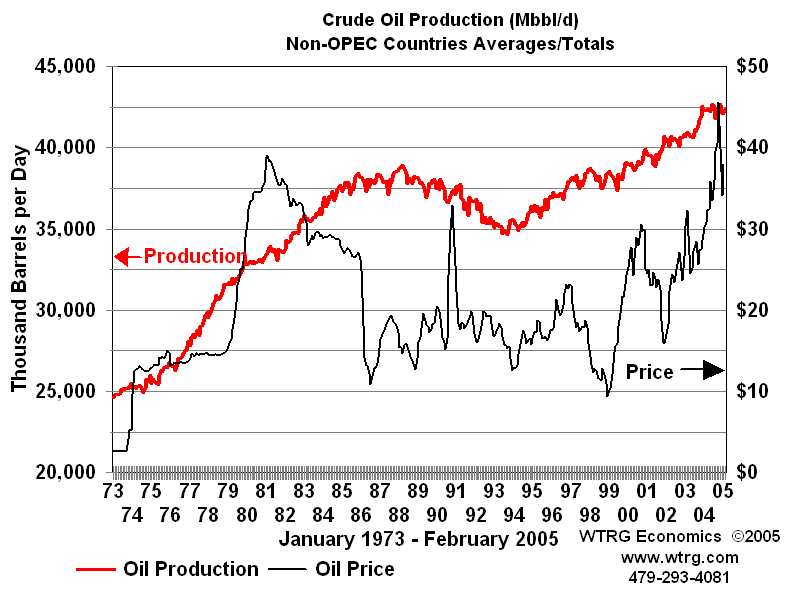
http://www.wtrg.com/oil_graphs/PAPRPNT.gif
OPEC production:
http://www.wtrg.com/oil_graphs/PAPRPOP.gif
Gallons of gas in a barrel of oil:
http://www.newton.dep.anl.gov/askasci/eng99/eng992 88.htm
CO2 (and H20) in a gallon of gas:
http://www.terrapass.com/terrablog/posts/000181.ht ml
I just shot an average on the productions and added them together, using 60,000,000 barrels per day total production. Multiply by 365 days a year, 30 years, 19.5 gallons of gas in a barrel, 20 pounds of CO2 in a gallon of gas. Divide that by 2000 lbs in a ton and you get somewhere around 130 billion tons of CO2. If you use the same source for CO2 in a gallon of gas, which says roughly 8 pounds of water come from burning a gallon of gas, then you're talking about around 50 billion tons of water vapor. Add those together and (with the figures from Phase Shifter) and you're talking about 3.6% of the existing mass we've produced in the last 30 years alone. I tried to dig up some figures on the deforestation but didn't have much luck, but trees (which we're cutting) and grass (which we're paving over) are large consumers of CO2 and H20, so losing them is compounding the effect. -
sources and the calculation I did
Assuming the charts are relatively accurate
Non-OPEC production:
http://www.wtrg.com/oil_graphs/PAPRPNT.gif
OPEC production:
http://www.wtrg.com/oil_graphs/PAPRPOP.gif
Gallons of gas in a barrel of oil:
http://www.newton.dep.anl.gov/askasci/eng99/eng992 88.htm
CO2 (and H20) in a gallon of gas:
http://www.terrapass.com/terrablog/posts/000181.ht ml
I just shot an average on the productions and added them together, using 60,000,000 barrels per day total production. Multiply by 365 days a year, 30 years, 19.5 gallons of gas in a barrel, 20 pounds of CO2 in a gallon of gas. Divide that by 2000 lbs in a ton and you get somewhere around 130 billion tons of CO2. If you use the same source for CO2 in a gallon of gas, which says roughly 8 pounds of water come from burning a gallon of gas, then you're talking about around 50 billion tons of water vapor. Add those together and (with the figures from Phase Shifter) and you're talking about 3.6% of the existing mass we've produced in the last 30 years alone. I tried to dig up some figures on the deforestation but didn't have much luck, but trees (which we're cutting) and grass (which we're paving over) are large consumers of CO2 and H20, so losing them is compounding the effect. -
Re:If supply is fixed, let'd adjust demand.
Not true, OPEC has always stated that oil should be in the $30 to $40 barrel range, not in the high sixties where it has been for a long time.
I'm not sure what you consider a long time but oil is not even at $60 right now. Oil has only been in the $60 range for the past year or so, see historical price chart here.Many people don't realize that for a long time in the 90's oil was actually $15-$20/bbl. There are families (such as mine) that do rely on oil prices to make a living and we are not some huge cartel rolling around in piles of cash.
There is a large misconception that oil prices have always been high, because people incorrectly correlate gas prices to oil prices.
-
Re:Transhumanism will never happenBack in the 1990s you were right; today it's different. It used to be that OPEC's pricing made for more expensive oil, but as recently as last December the price band for OPEC was between $22 and $28 a barrel amidst $55/bbl prices. (NB: the current price is a little above $66/bbl.) The Saudis and the US are now aiming for a price of $45/bbl which would be a significant improvement over the $66/bbl we're now paying.
Meanwhile, here's an analysis by an oil industry think thank that points to the actual cause of inflated oil prices (tight supplies, shortages in non-OPEC production, combined with fears of supply interruptions due to terrorist activity).
-
Re:That should go along nicely...
It's more complicated than just the price of crude oil...witness:
Your breakdown doesn't in any way refute my point. Instead of making personal attacks please concetrate on refuting my claim...I was honestly hoping for some information.
-the fact that oil refineries generally are working at capacity, and the "left" won't let any more be built
Are you suggesting that demand has increased almost 300% in 5 years?
-the fact that only a fraction of the crude oil used by the US is made into gasoline...the rest goes into plastics, heating oil, jet fuel, steel, asphalt, tar, pharmaceuticals, lubricants, cosmetics, etc.
gasoline prices are an indicator of oil prices, we're talking about oil here. Regardless of how it is used, the oil people are making the profit.
-the fact that 31% of the cost of gas is TAXES
Basic math, if you increase the price of the thing you're taxing the other 68% of the 'cost of gas' is still going directly into the coffers of those selling the product. I.e., higher cost==more money.
-the fact that refineries are forced by environmentalists to make many different kinds of gasoline for the canadians, the midwesterners, the east coast-ers, etc.
And this is relevant to this discussion how?
-the fact that plenty of idiots drive huge vehicles with huge engines...BY THEMSELVES, WITH NO PASSENGERS OR CARGO!
This was also true in 1998 when regular gas was $0.86 a gallon in Georgia, 6 years later it's now $2.25 a gallon. Driving habits haven't changed, and are not in any way responsible for the price increase.
And how is ANY of this Bush's fault?
None of what you brought up is Bush's fault, but that's because you brought up completely irrelevant issues. My post was about who is making money from high oil prices. -
Re:I have a dumb question
If the price of crude oil keeps growing at the same rate it did in the last months, short distance flights (few hundred km) will become very, very unpopular very fast.
-
Breaking news (not entirely O/T)One issue mentioned on the radio this morning (BBC Radio 4 'Today' programme in fact - http://www.bbc.co.uk/radio4/today )was that with the price of oil likely to stay well above $40 per barrel for the forseeable future, and expected to rise significantly in the medium to long term, work on fuel efficiency and energy saving can only be beneficial for national economies. The Sky News burbling in the corner of my office that I mentioned in an earlier post has just popped up a 'breaking news' thingy to report that mysterious "someone" has fired some sort of missile in Iran, in the vicinity of some of their nuclear installations. Actually the BBC was already carrying a story that Iran had claimed that US UAV drones were regularly flying over nuclear installations. Interesting timing.
Passing rapidly over the political ramifications of this obviously grossly illegal act (whoever carried it out), it is interesting to note that oil prices have gone up over $1 since the news broke in the last few minutes. hmmm here's a chart that might bear watching.
If (if!) this is a deliberate attack by the US, then George Bush must be out of his tiny mind.
-
Re:7E7 vs A380
This is the case because oil is still relatively cheap. Expect this to change in the future.
You sound like one of the "our current known oil supplies will run out in a decade" fear mongers. Every 15 years or so people tend to make statements like this, and every 15 years they are proven wrong.
Economics will keep our oil prices cheap and supplies plentiful for centuries. Sometimes people even point to the rise in oil prices during 2004(oil is %30 more epensive in jan 2005 than jan 2004).
Here is some historic crude oil price data
Notice how it is all scaled to 2002 dollars. Everybody in the US was complaining and whinning about prices of gas. As this chart shows gas was cheaper than it has been for the last 30 years.
Everytime oil prices get 'too high' one of two things will happen. 1) it will become more ecnomically viable to invest millions of dollars in locaing new drilling sites for oil companies. 2) it will become more economically viable for people to invest in alternative energy resources.
Naturally those who are in control of the worlds oil supplies do not want this to happen. So they let out the worlds oil at such a rate so that it is cheaper to use oil than to invest in other drilling sites or different techhnology.
This is what happened this year when Americans began complaining about high oil prices. Both OPEC and non-OPEC suppliers increased their output to compensate for the uncertainty created by the iraqi oil market and the increased consumption by China. To see this in action just look at the crude oil futures market.
I do not think oil prices will change their current trend, save some large disaster. -
??? what's the issue???
-
Price of oil.
I actually think that a major drop in the price of oil & subsequent uptick in the stock market is a possible "October Surprise". Why would they do this?
o Oil is at the 20-year high, ~$50/barrel.
o Prince Bandar bin Sultan has already said (though long enough ago that people have forgotten) he'll step up production to cut prices for the election.
o Even a small drop in oil prices will cause the stock markets to rise.
It's a question of timing, I guess, when to drop prices so that everyone gets a nice gas-pump price reduction, but I'm waiting for it to happen.
Imagine if prices went back down to ~$40/barrel: stock market up, gas prices down & still ~$10/barrel up from a year ago. <sarcasm>Everyone wins!</sarcasm> -
Re:Run for your life!
I'd far rather trust my military's fuel supply to a foreign country than engage in warmongering. Bush's actions border on that.
Yes, Venezuela is part of OPEC. OPEC also controls 75% of the known oil reserves. They also supply 40% of the world's oil needs. Think long and hard about the short- and long-term control that gives them on oil prices. Something tells me that when the production of oil is lowered in Venezuela, the price of Texas crude goes up, too. That's basic supply and demand. Again, if the U.S. can increase the supply, which direction is the price going to go?
Oh, are we back to where U.S. buys their oil from? How much of a reduction of profit is any company going to take to do the right thing? Texas oil might be cheaper than Venezuelan oil, but how much? Well, take a look at this. Or compare the values of these two links. Hmm, why is U.S. crude more expensive? Well, could be the prices don't include shipping, or it could be government pork. Why don't you determine that? So let's sing a new song: It doesn't matter which OPEC country you buy oil from, or even if you don't buy from them, all countries are going to sell at or about the going rate. And OPEC holds a lot of power over that rate.
I may not have studied the niceties of the oil market much beyond being an informed consumer, and having the previously mentioned high-school-level knowledge of economics, but it's nice to see that it all bears out. Maybe there's a difference between ignorance and an educated guess.
As for patriotism, no I don't think it's bad, so long as it isn't blind or wearing rose-colored glasses. Patriotism, like science, ought to bear up to harsh, cold scrutiny. If it doesn't, it needs to be re-evaluated. No, I don't live in the U.S., but if I did, I would like to think I would be spending time in the streets protesting a war with no forthrightness, a presidency with no regard for its constituents, and a culture with no respect for other cultures. -
Re:Its not really 1.8 Metric Tonnes
I really have to wonder about that "240kg" number. Assuming a density equal to water, that gives us 240 liters, or 63.4 US gallons. That works out to about 1.5 barrels of oil. At $37 per barrel of crude oil, we have $55.50 in the oil alone.
The article doesn't specify the type of fossil fuel, but if it is anything other than crude oil, the price goes up. Also consider that fossil fuels are less dense than water, so it's actually going to be more than 1.5 barrels.
You can get a 17" CRT for about $80 from newegg (or around $50-70 using froogle). That doesn't leave much room for anything else if you want to make any money as a manufacturer. -
Re:Um, the big one?
Gasoline prices at the pump in the US are actually below all-time highs. You can read more about the details here.
In a nutshell, today's US gasoline pump price, in inflation-adjusted dollars, is as cheap as it was in 1986, and cheaper than it ever was before 1969. And when you consider that gasoline taxes have been raised continuously over the years (now to $0.43 per gallon), gasoline itself seems very cheap.
If you want to look at inflation-adjusted crude oil prices, look at this. More recent crude oil prices ($27-$30 / barrel) are up a bit above the hundred-year median price, but still below the highs of the late 70's/early 80's.
Crude oil cost makes up about 40% of gasoline prices, manufacturing and distribution makes up 37%, the rest is taxes.
Should oil prices ever rise, I would expect that plastics would be made with biotechnology, indeed there could be a carbohydrate economy using biotech enzymes to convert cellulose to sugar and then to ethanol.