Slashdot Mirror
Domain: youtube.com
Stories and comments across the archive that link to youtube.com.
Stories · 2,039
-
Sinkhole Swallows 8 Vehicles Inside Bowling Green KY Corvette Museum
OakDragon writes "A sinkhole about 40 feet wide — and 30 feet deep — opened up inside the Corvette Museum in Bowling Green, KY early Thursday morning, swallowing eight vehicles that were sitting inside. At least one of these cars is one of a kind, and due to its location the fire department allowed its removal. The sinkhole is remarkable in that it has left the surrounding ground which supports the circular structure intact, although that assessment may change up on investigation. Security footage from inside the museum shows the collapse as it happened." -
Rand Paul Files Suit Against Obama Over NSA's Collection of Metadata
RoccamOccam writes Senator Rand Paul (R-KY) is filing a class action lawsuit against President Obama and other members of his administration over the National Security Agency's collection of phone metadata, a practice he believes violates the Fourth Amendment. In a YouTube video released Tuesday, Paul compared the government surveillance to the warrantless searches practiced by the British military prior to American independence." -
Five Easy Pieces: Short Product Presentations from CES 2014 (Video)
At CES and other big trade shows, small companies and start-ups are often overshadowed by industry giants whose huge promotional budgets let them dominate a show's exhibit area. In this video, Tim Lord asked the spokespeople for five small companies exhibiting at CES whose products interested him to give one-minute presentations about their products. So take a quick look at the ZeroHour USB "tactical grade" battery backup flashlight; MadeSolid, a 3-D printing material company; TangoPC, "the world’s most powerful Pocketable, Officeable, Entertainmentable, Gameable, Windowsable, Linuxable PC; Google Glass competitor GlassUp; and DoorBot, "the doorbell for smartphones," which was featured on the ABC TV show Shark Tank in November, 2013. DoorBot got no investment from the "sharks," but managed to raise $1 million from "traditional technology investors." DoorBot's fundraising success aside, today's video is about companies that are unlikely to get much coverage from "mainstream" news channels that cover CES. If you don't see the video (probably because you're enjoying the thrill of Slashdot Beta), you can view it here. -
Para Bellum Labs Will Attempt To Make the RNC a Political-Analytics Player
Nerval's Lobster writes "President Obama's 2012 re-election campaign relied on a sophisticated data-analytics platform that allowed organizers and volunteers to precisely target potential donors and voters. The centerpiece of that effort was Project Narwhal, which brought voter information—steadily accumulated since Obama's 2008 campaign—onto a single platform accessible to a growing number of campaign-related apps. The GOP has only a few short years to prepare for the next Presidential election cycle, and the party is scrambling to build an analytics system capable of competing against whatever the Democrats deploy onto the field of battle. To that end, the Republican National Committee (RNC) has launched Para Bellum Labs, modeled after a startup, to produce digital platforms for election analytics and voter engagement. Is this a genuine attempt to infuse the GOP's infrastructure with data science, or merely an attempt to show that the organization hasn't fallen behind the Democratic Party when it comes to analytics? Certainly the "Welcome to Para Bellum Labs" video posted by the RNC gives the impression of a huge office staffed with data scientists and programmers. However, the creation of a muscular digital ecosystem hinges on far more than building a couple of apps. Whatever the GOP rolls out, it'll face a tough opponent in the Democratic opposition, which will almost certainly emulate the robust IT infrastructure that the Obama campaign instituted in 2012 (not to mention Obama's massive voter and donor datasets). From that perspective, Para Bellum Labs might face the toughest job in politics." -
Non-Coders As the Face of the Learn-to-Code Movements
theodp writes "You wouldn't select Linus Torvalds to be the public face for the 'Year of Basketball.' So, why tap someone who doesn't code to be the face of 'The Year of Code'? Slate's Lily Hay Newman reports on the UK's Year of Code initiative to promote interest in programming and train teachers, which launched last week with a Director who freely admits that she doesn't know how to code. "I'm going to put my cards on the table," Lottie Dexter told Newsnight host Jeremy Paxman on national TV. I've committed this year to learning to code...so over this year I'm going to see exactly what I can achieve. So who knows, I might be the next Zuckerberg." "You can always dream," quipped the curmudgeonly Paxman, who was also unimpressed with Dexter's argument that the national initiative could teach people to make virtual birthday cards, an example straight out of Mark Zuckerberg's Hour of Code playbook (coming soon to the UK). Back in the States, YouTube chief and Hour of Code headliner Susan Wojcicki — one of many non-coder Code.org spokespersons — can be seen on YouTube fumbling for words to answer a little girl's straightforward question, "What is one way you apply Computer Science to your job at Google?". While it's understandable that companies and tech leaders probably couldn't make CS education "an issue like climate change" (for better or worse) without embracing politicians and celebrities, it'd be nice if they'd at least showcase a few more real-life coders in their campaigns." -
Non-Coders As the Face of the Learn-to-Code Movements
theodp writes "You wouldn't select Linus Torvalds to be the public face for the 'Year of Basketball.' So, why tap someone who doesn't code to be the face of 'The Year of Code'? Slate's Lily Hay Newman reports on the UK's Year of Code initiative to promote interest in programming and train teachers, which launched last week with a Director who freely admits that she doesn't know how to code. "I'm going to put my cards on the table," Lottie Dexter told Newsnight host Jeremy Paxman on national TV. I've committed this year to learning to code...so over this year I'm going to see exactly what I can achieve. So who knows, I might be the next Zuckerberg." "You can always dream," quipped the curmudgeonly Paxman, who was also unimpressed with Dexter's argument that the national initiative could teach people to make virtual birthday cards, an example straight out of Mark Zuckerberg's Hour of Code playbook (coming soon to the UK). Back in the States, YouTube chief and Hour of Code headliner Susan Wojcicki — one of many non-coder Code.org spokespersons — can be seen on YouTube fumbling for words to answer a little girl's straightforward question, "What is one way you apply Computer Science to your job at Google?". While it's understandable that companies and tech leaders probably couldn't make CS education "an issue like climate change" (for better or worse) without embracing politicians and celebrities, it'd be nice if they'd at least showcase a few more real-life coders in their campaigns." -
Windows Replacement? ReactOS 0.3.16 Gets Themes, CSRSS Rewrite, and More
jeditobe writes with this announcement from the ReactOS home page: "The ReactOS Project is pleased to announce the release of version 0.3.16. A little under a year has passed since the previous release and a significant amount of progress has been made. More than 400 bugs were eliminated. Some of the most significant include completion of the CSRSS rewrite and the first stages of a shell32 rewrite. 0.3.16 is in many ways a prelude to several new features that will provide a noticeable enhancement to user visible functionality. A preview can be seen in the form of theme support, which while disabled by default can be turned on to demonstrate the Lautus theme developed by community member Maciej Janiszewki. Another user visible change is a new network card driver for the RTL8139, allowing ReactOS to support newer versions of QEMU out of the box." You can download release images here. Want to see how it handles Windows software? Here are demos of Office 2003, Photoshop CS2, and OpenMPT. -
Windows Replacement? ReactOS 0.3.16 Gets Themes, CSRSS Rewrite, and More
jeditobe writes with this announcement from the ReactOS home page: "The ReactOS Project is pleased to announce the release of version 0.3.16. A little under a year has passed since the previous release and a significant amount of progress has been made. More than 400 bugs were eliminated. Some of the most significant include completion of the CSRSS rewrite and the first stages of a shell32 rewrite. 0.3.16 is in many ways a prelude to several new features that will provide a noticeable enhancement to user visible functionality. A preview can be seen in the form of theme support, which while disabled by default can be turned on to demonstrate the Lautus theme developed by community member Maciej Janiszewki. Another user visible change is a new network card driver for the RTL8139, allowing ReactOS to support newer versions of QEMU out of the box." You can download release images here. Want to see how it handles Windows software? Here are demos of Office 2003, Photoshop CS2, and OpenMPT. -
Windows Replacement? ReactOS 0.3.16 Gets Themes, CSRSS Rewrite, and More
jeditobe writes with this announcement from the ReactOS home page: "The ReactOS Project is pleased to announce the release of version 0.3.16. A little under a year has passed since the previous release and a significant amount of progress has been made. More than 400 bugs were eliminated. Some of the most significant include completion of the CSRSS rewrite and the first stages of a shell32 rewrite. 0.3.16 is in many ways a prelude to several new features that will provide a noticeable enhancement to user visible functionality. A preview can be seen in the form of theme support, which while disabled by default can be turned on to demonstrate the Lautus theme developed by community member Maciej Janiszewki. Another user visible change is a new network card driver for the RTL8139, allowing ReactOS to support newer versions of QEMU out of the box." You can download release images here. Want to see how it handles Windows software? Here are demos of Office 2003, Photoshop CS2, and OpenMPT. -
Why Games Should Be In the Public Domain
Robotron23 writes "Rock, Paper, Shotgun writer John Walker shook a hornet's nest by suggesting old videogames should enter the public domain during GOG's Time Machine sale. George Broussard of Duke Nukem fame took to Twitter, saying the author should be fired. In response to these comments RPS commissioned an editorial arguing why games and other media should enter the public domain much more rapidly than at present. 'I would no more steal a car than I would tolerate a company telling me that they had the exclusive rights to the idea of cars themselves.' says Walker, paraphrasing a notorious anti-piracy ad (video). 'However, there are things I'm very happy to "steal," like knowledge, inspiration, or good ideas...It was until incredibly recently that amongst such things as knowledge, inspiration and good ideas were the likes of literature and music.'" -
Where Old Hard Disks (with Digital Secrets) Go To Die
Hugh Pickens DOT Com writes "Justin George writes at McClatchy that in a 20,000-square-foot warehouse, where visitors are required to trade in a driver's license for a visitor's badge, some of the nation's secrets are torn apart, reduced to sand or demagnetized until they are forever silent. Need to destroy a rugged Toughbook laptop that might have been used in war? E-End will use a high-powered magnetic process known as degaussing to erase its hard drive of any memory. A computer monitor that might have some top-secret images left on it? Crushed and ground into recyclable glass. Laser sights for weapons? Torn into tiny shards of metal. "We make things go away," says Arleen Chafitz, owner and CEO of e-End Secure Data Sanitization and Electronics Recycling, a company with sixteen employees that destroys hard drives, computers, monitors, phones and other sensitive equipment that governments and corporations don't want in the wrong hands. Chafitz say the information technology departments at typical companies might not have the proper tools or training to adequately dispose of data. IT departments focus on fixing and restoring data, they say, while data-wiping companies focus on just the opposite." -
IBM's PC Junior Turns 30, Too
McGruber writes "Like the Mac, the IBM PC Junior first went on sale in late January 1984. That is where the similarities end — the PC Junior became the biggest PC dud of all time. Back on May 17, 1984, the NY Times reported that the PC Junior 'is too expensive for casual home users, but, at the same time, is not nearly powerful enough for serious computer users who can afford a more capable machine.' The article also quoted Peter Norton, then still a human programmer who had not yet morphed into a Brand, who said that the PC Junior 'may well be targeted at a gray area in the market that just does not exist.'' IBM cancelled the machine in March 1985, after only selling 270,000 of them. While it was a commercial flop, the machine is still liked by some. Michael Brutman's PCJr page attempts to preserve the history and technical information of the IBM PCjr and YouTube has a video of a PC Junior running a demo." -
An OS You'll Love? AI Experts Weigh In On Her
theodp writes "Weighing in for the WSJ on Spike Jonze's Oscar-nominated, futuristic love story Her (parodies), Stephen Wolfram — whose Wolfram Alpha drives the AI-like component of Siri — thinks that an operating system like Samantha as depicted in the film isn't that far off. In Her, OS Samantha and BeautifulHandwrittenLetters.com employee Theodore Twombly have a relationship that appears to exhibit all the elements of a typical romance, despite the OS's lack of a physical body. They talk late into the night, relax on the beach, and even double date with friends. Both Wolfram and Google director of research Peter Norvig (who hadn't yet seen the film) believe this type of emotional attachment isn't a big hurdle to clear. 'People are only too keen, I think, to anthropomorphize things around them,' explained Wolfram. 'Whether they're stuffed animals, Tamagotchi, things in videogames, whatever else.' By the way, why no supporting actor nomination for Jonze's portrayal of foul-mouthed animated video game character Alien Child?" -
Nissan Unveils 88 Pound 400-HP Race Car Engine
cartechboy writes "Motorsports used to be about lots of horsepower, torque, and big engines. In recent years there's been a shift to downsizing engines, using less fuel, and even using alternative energy such as clean diesel and hybrid powertrains. Today Nissan unveiled a 400-horsepower 1.5-liter three-cylinder turbocharged engine that weighs only 88 pounds. This engine will be part of the advanced plug-in hybrid drivetrain that will power the ZEOD RC electrified race car that will run in the 2015 LMP1 class during the race season. Nissan says the driver of the ZEOD RC will be able to switch between electric power and gasoline power with the batteries being recharged via regenerative braking. Even more impressive, according to Nissan, for every hour the ZEOD RC races, the car will be able to run one lap of the Le Mans' 8.5-mile Circuit de la Sarthe on electric power alone. If true, that will make it the first race car in history to complete a lap during a formal race with absolutely zero emissions. If this all works, we could be witnessing the future of motorsports unfold before our eyes later this year when the ZEOD RC (video) makes its race debut at this year's Le Mans 24 Hours in June." -
Bletchley Park's Bitter Dispute Over Its Future
An anonymous reader writes "Tensions are high at Bletchley Park between the new management who want a 21st century installment and the volunteers who want to show the whole story (and get dismissed for doing so). This report [Note: video, with sound] is from the BBC: 'The groundbreaking intelligence work carried out at Bletchley Park during the second world war was credited with bringing forward the end of the conflict. In 2011 the site was awarded a £4.6m grant from the Heritage Lottery Fund (HLF). But Bletchley is currently in the throes of a bitter dispute, between owners who want to create a brand new visitors centre, and volunteers who have been working on the site for years.'" -
MIT Develops Inexpensive Transparent Display Using Nanoparticles
rtoz writes "Researchers at MIT have come up with an innovative approach to creating transparent displays inexpensively, while providing wide viewing angles and scalability to large sizes. To create the transparent display, silver nanoparticles are embedded in plastic, tuned to scatter only certain wavelengths of light and to allow all other wavelengths through. In this example (video), it is tuned to scatter only blue color using 60nm silver particles. The researchers believe that it can be easily enhanced to a multicolor display by creating nanoparticles that can scatter other primary colors. The ability to display graphics and texts on an inexpensive transparent screen could enable many useful applications. For example, they could bring navigation data to windshields of cars and aircraft, and advertisements to the sides of skyscrapers. Cheap 'stick-on screens' could be developed using this technology. The messages broadcast on nanoparticle screens are accessible from virtually every angle. Transparent screens themselves are not new; for example, Google is working on Google glass. But they are expensive. This MIT invention will help to produce transparent displays easily and inexpensively." -
FreeBSD 10.0 Released
An anonymous reader writes "FreeBSD 10.0 has been released. A few highlights include: pkg is now the default package management utility. Major enhancements in virtualization, including the addition of bhyve, virtio, and native paravirtualized drivers providing support for FreeBSD as a guest operating system on Microsoft Hyper-V. Support for the high-performance LZ4 compression algorithm has been added to ZFS and TRIM support for SSD has been added to ZFS. clang is the default compiler. This release has official Raspberry Pi support. For a complete list of new features and known problems, please see the online release notes and a quick FreeBSD installation video is here. FreeBSD 10.0-RELEASE may be downloaded via ftp or via a torrent client that supports web seeding." -
CES 2014: HAL© is a Voice- and Gesture-Operated Remote (Video)
According to the company's website, "HAL© is the future of television and media management. Using proprietary gesture and voice control technology..." In this case, HAL© stands for “Human Algorithm LTE.” It looks like it's a lot safer than the original HAL 9000, anyway. Is it ready for prime time? If their CES demo is any indication, not quite. They say HAL© is going to ship in the fall of 2014. The technology? They won't say beyond, "It's proprietary." Ah! Then it must be good, right? Another voice-operated remote control -- that's already available for purchase from major retailers -- is the Ivee Sleek. There are other HALs out there, too. Like this one. And this one, which is a home automation server that costs $2499.00 (& up). Anyway, the retail price for HAL(circle-C) is supposed to be $199 when it hits the streets. And even though it doesn't look like HAL© can do much that I can't already do with my Android phone, Skyvi, and a Chromecast, it might be fun to test and review once it's in production. -
Three Videos On Codec2 and Open Hardware
Bruce Perens writes "Codec2 is the Open Source ultra-low-bandwidth speech codec capable of encoding voice in 1200 Baud. FreeDV (freedv .org) is an HF (global-range radio) implementation that uses half the bandwidth of SSB, and without the noise. Here are three speeches about where it's going."- David Rowe: Embedding Codec2: Open Source speech coding on a low-cost microprocessor, at Linux.conf.au 2014. YouTube, downloadable MP4.
- Bruce Perens: FreeDV, Codec2, and HT of the Future (how we're building a software-defined walkie-talkie that's smarter than a smartphone), at the TAPR/ARRL Digital Communications Conference 2013. Blip.tv, YouTube
- Chris Testa on the .Whitebox handheld software-defined radio design that is the RF portion of HT of the Future, which was also shown at the TAPR conference.
-
Google Co-Opts Whale-Watching Boat To Ferry Employees
theodp writes "Purportedly intended to defuse tensions over gentrification that have led to blockades and vandalism of Google's ubiquitous shuttles (video), which make use of public San Francisco bus stops (map), Wired reports that Google is now chartering a ferry to take its workers from SF to Silicon Valley. 'We certainly don't want to cause any inconvenience to SF residents, and we're trying alternative ways to get Googlers to work,' Google explained. Inconveniencing whale-seeking visitors to The Aquarium of the Pacific, however, is apparently not considered evil. After learning that Google had co-opted the $4 million, 83-foot, 150-passenger whale-watching catamaran MV/Triumphant to ferry as few as 30-40 Googlers to work, some expressed concerns on Facebook that Google would be The Grinch That Stole Whale Watching Season (not to worry; the boat's slated to make its 'triumphant' return to Long Beach after Google's '30-day trial')." -
Swarms of Small Satellites Set To Deliver Close To Real-Time Imagery of Earth
ananyo writes "A swarm of small satellites set to deliver close to real-time imagery of swathes of the planet is launching today. San Francisco-based Planet Labs, founded in 2010 by three former NASA scientists, is scheduled to launch 28 of its 'Doves' on 9 January. Each toaster-sized device weighs about 5 kilograms and can take images at a resolution of 3–5 metres. Meanwhile Skybox Imaging plans to launch a swarm of 24 satellites, each weighing about 100 kilograms, which will take images of 1 meter resolution or better. Skybox launched its first satellite on 21 November (and captured the first HD video of the world from space) and plans to launch another this year, followed by the remainder between 2015 and 2017. In a first — at least for civilian satellites — Skybox's devices will also stream short segments of near-live high-resolution video footage of the planet. So, too, will UrtheCast, a start-up based in Vancouver, Canada, whose cameras will hitch a ride on the International Space Station. Because the swarms are still to be launched, scientists have yet to fully assess the quality of the imagery. But the satellites' spatial resolutions of 1–5 metres are much higher than those of most scientific satellites. Landsat, NASA's Earth-observation workhorse, for example, has a resolution of 15–100 metres depending on the spectral frequency, with 30 metres in the visible-light range." -
CES 2014: Now You Can Make 360 Degree Videos With a Single Camera (Video)
The device that does this is the Geonaute 360 Degree Camera. The Geonaute display caught Tim Lord's eye at CES, and he got Geonauter (is that a word?) Marian Le Calves to show him the company's "action camera," which costs $499 -- or more accurately, will cost $499 when it starts shipping. Until then, you can pre-order. Or you could buy a GoPro camera for as little as $199. Geonaute has a bunch of videos on YouTube, some of which are quite fetching. But GoPo has a bunch of slick YouTube videos, too, and at this point they're the dominant brand in the action camera market niche. Will Geonaute be able to capture a decent market share with their 360 degree coolness -- and higher price? Or will they, GoPro, and other action camera vendors get into a price war so that every kid who has a skateboard can make good-looking videos? -
CES 2014: Now You Can Make 360 Degree Videos With a Single Camera (Video)
The device that does this is the Geonaute 360 Degree Camera. The Geonaute display caught Tim Lord's eye at CES, and he got Geonauter (is that a word?) Marian Le Calves to show him the company's "action camera," which costs $499 -- or more accurately, will cost $499 when it starts shipping. Until then, you can pre-order. Or you could buy a GoPro camera for as little as $199. Geonaute has a bunch of videos on YouTube, some of which are quite fetching. But GoPo has a bunch of slick YouTube videos, too, and at this point they're the dominant brand in the action camera market niche. Will Geonaute be able to capture a decent market share with their 360 degree coolness -- and higher price? Or will they, GoPro, and other action camera vendors get into a price war so that every kid who has a skateboard can make good-looking videos? -
The Geek Group's Hacker-Oriented High Voltage Lab In Michigan Damaged by Fire
Tech educational collective The Geek Group, based in Grand Rapids, Michigan, has more than 25,000 members, scattered all over the world — most of whom have never been to their flagship location in Michigan. Sadly, a fire Thursday damaged one of the facilities at their Leonard Street Labs (damage report starts about 26 minutes into this video), the High Voltage Lab. Since there aren't that many places for amateurs and hobbyists to learn about high voltage (even with the growing number of maker spaces around the world), that leaves a hole that hopefully will soon be filled; lucky for anyone interested, The Geek Group welcomes volunteers. -
Searching the Internet For Evidence of Time Travelers
Hugh Pickens DOT Com writes "Here's an interesting paper by two physicists at Michigan Technological University who have come up with a practical methodology for finding time travelers through the internet. 'Time travel has captured the public imagination for much of the past century, but little has been done to actually search for time travelers. Here, three implementations of Internet searches for time travelers are described, all seeking a prescient mention of information not previously available. The first search covered prescient content placed on the Internet, highlighted by a comprehensive search for specific terms in tweets on Twitter. The second search examined prescient inquiries submitted to a search engine, highlighted by a comprehensive search for specific search terms submitted to a popular astronomy web site. The third search involved a request for a direct Internet communication, either by email or tweet, pre-dating to the time of the inquiry. Given practical verifiability concerns, only time travelers from the future were investigated. No time travelers were discovered. Although these negative results do not disprove time travel, given the great reach of the Internet, this search is perhaps the most comprehensive to date.' Stephen Hawking's similar search (video) also provided negative results." -
Bill Nye To Debate Creationist Museum Founder Ken Ham
New submitter cusco writes "Creation Museum Founder and AiG President/CEO Ken Ham will debate Bill Nye at the Creation Museum on Tuesday, February 4, at 7 PM. According to the Washington Post, 'Ham had been hoping to attract the star of TV's 'Bill Nye The Science Guy' to the northern Kentucky museum after Nye said in an online video last year that teaching creationism was bad for children. The video was viewed nearly 6 million times on YouTube.'" -
Russian Startup Offers Wireless Remote Controller For Cars
DeviceGuru writes "A Russian startup called Virt2real has produced a small $120 Linux-based WiFi controller board for remote control and video observation applications, and has demonstrated its use in a remote controlled car. Inspired by Back to the Future and James Bond film Tomorrow Never Dies, Virt2real's Bond Car demo (YouTube video) shows a Vauxhall (Opel) Vectra being remotely controlled by an iPad via WiFi. The iPad interface includes touchscreen-based steering wheel, brakes, and accelerator, which are mirrored in the car by a mechanical contraption that physically turns the steering wheel and pushes the brake and accelerator pedals. The company is now accepting orders for the first 1,000 of its Virt2real controller board, and is working on a Virt2real-based Bond Car it that will work with most cars." -
Safeway Suspends Worker For Sci-Fi Parody of His Firing
theodp writes "After making light of a bad situation — Safeway's closing of its Chicagoland Dominick's grocery store chain and termination of 6,000 workers — with a satirical SciFi YouTube clip, Dominick's employee Steve Yamamoto found himself suspended just one day before the grocery chain closed up shop for good. 'My store manager got a phone call that she had to suspend me,' Yamamoto told NBC Chicago. 'I was like, "Are you serious?" It's crazy as it is. I'm just dumbfounded.' Perhaps Safeway was concerned that viewers of Yamamoto's video might think that aliens, robots, and monsters did Dominick's in, although the Chicago Tribune suggests financial machinations as a more likely culprit: 'By pulling the plug on Chicago [Dominick's], Safeway could not only satisfy [hedge fund] Jana, but also generate a $400 million to $450 million tax benefit.'" -
The Startling Array of Hacking Tools In NSA's Armory
littlekorea writes "A series of servers produced by Dell, air-gapped Windows XP PCs and switches and routers produced by Cisco, Huawei and Juniper count among the huge list of computing devices compromised by the NSA, according to crypto-expert and digital freedom fighter Jacob Applebaum. Revealing a trove of new NSA documents at his 30c3 address (video), Applebaum spoke about why the NSA's program might lead to broader adoption of open source tools and gave a hot tip on how to know if your machines have been owned." -
Space Junk or a Meteor? Fireball Lit Up Midwestern Skies
The Space Reporter has this to say about a fireball witnessed by many midwesterners on Thursday night: "The massive fireball was seen in the early morning hours in Iowa on Thursday night. At least 700 people have reported a sighting and the fireball was reported by people across the Midwest, including Iowa, Illinois, Missouri and Nebraska. However, astronomers say they are still unsure whether the fireball was the result of space debris or a meteor. Officials at the National Weather Service say they are working to determine the source of the fireball, although the leading theory seems to support a meteor was the source." CCTV footage of the fireball is great, though it doesn't stack up to the world of Russian dashcams. -
Space Junk or a Meteor? Fireball Lit Up Midwestern Skies
The Space Reporter has this to say about a fireball witnessed by many midwesterners on Thursday night: "The massive fireball was seen in the early morning hours in Iowa on Thursday night. At least 700 people have reported a sighting and the fireball was reported by people across the Midwest, including Iowa, Illinois, Missouri and Nebraska. However, astronomers say they are still unsure whether the fireball was the result of space debris or a meteor. Officials at the National Weather Service say they are working to determine the source of the fireball, although the leading theory seems to support a meteor was the source." CCTV footage of the fireball is great, though it doesn't stack up to the world of Russian dashcams. -
How Ya Gonna Get 'Em Down On the UNIX Farm?
theodp writes "In 1919, Nora Bayes sang, "How ya gonna keep 'em down on the farm after they've seen Paree?" In 2013, discussing User Culture Versus Programmer Culture, CS Prof Philip Guo poses a similar question: 'How ya gonna get 'em down on UNIX after they've seen Spotify?' Convincing students from user culture to toss aside decades of advances in graphical user interfaces for a UNIX command line is a tough sell, Guo notes, and one that's made even more difficult when the instructors feel the advantages are self-evident. 'Just waving their arms and shouting "because, because UNIX!!!" isn't going to cut it,' he advises. Guo's tips for success? 'You need to gently introduce students to why these tools will eventually make them more productive in the long run,' Guo suggests, 'even though there is a steep learning curve at the outset. Start slow, be supportive along the way, and don't disparage the GUI-based tools that they are accustomed to using, no matter how limited you think those tools are. Bridge the two cultures.'" Required reading. -
Upload a Spoof Video, Go To Jail (In Dubai)
Taco Cowboy writes with news, as reported by the BBC, that eight people have been imprisoned in Dubai for creating a spoof video about youth culture in that country, for which they were accused of acting "with the intent of inciting to actions, or publishing or disseminating any information, news, caricatures, or other images liable to endanger state security and its higher interests or infringe on the public order." "The video, posted to YouTube, was a gentle satire on young men in the Satwa residential suburb of Dubai who adopt a 'gangsta' pose despite living the sedate, prosperous lifestyle more usually associated with Dubai residents." -
Company That Made the First 3D Printed Metal Gun Is Selling Them For $11,900
Lucas123 writes "Solid Concepts, which last month revealed the first fully-functional, metal 3D gun, announced today that they're putting 100 limited-edition models of the 1911 .45 caliber pistol on sale for $11,900 each. Solid Concept demonstrated the gun by initially firing 50 rounds through it. Since then, the company said it has fired nearly 2,000 rounds through the pistol without a single malfunction. Unlike the very first 3D printed gun — the single-shot, plastic Liberator — Solid Concepts says is not trying to promote the right to bear arms under the Second Amendment. Its purpose in printing the firearm was to demonstrate its ability to turn out precision, durable parts that could withstand the massive pressure created by firing a bullet. People who purchase one of the limited-edition guns will also have the chance to tour Solid Concept's Texas facility to see their gun being printed, and to join their lead additive manufacturing engineers on the range for the first test firing of their limited 1911 gun." -
Ted Nelson's Passionate Eulogy for Douglas Engelbart
theodp writes "Speaking at a memorial event for the legendary Douglas Engelbart at the Computer History Museum, Ted Nelson was pissed-with-a-capital-P. Nelson in effect gave two powerful eulogies — one for his friend Dr. Engelbart, who left this Earth in July, and a second for Engelbart's career, which essentially began 'dying' four decades earlier due to short-sighted organizations' failure to fund the brilliant guy who gave the world The Mother of All Demos in 1968. 'Let us never forget that Doug Engelbart was dumped by ARPA,' Nelson laments. 'Doug Engelbart was dumped by SRI, Doug Engelbart was snubbed by Xerox PARC, and for the rest of his working life he had no chance to take us further...Just as we can only guess what John Kennedy might have done, we can only guess what Doug Engelbart might have done had he not been cut down in his prime.' It's a very moving and passionate speech (despite some oddly inappropriate audience laughter). And, alas, a very sad one in a world that throws $4 billion at the likes of Snapchat and Pinterest." -
Google Nabs Bing Maps Architect
theodp writes "In another case of Microsoft's-loss-is-Google's-gain, GeekWire reports that Google has made a big hire from Microsoft, bringing aboard TED crowd-pleaser Blaise Agüera y Arcas, the well-known software architect and designer who was among the Redmond company's elite ranks of distinguished engineers. Known for his work on services including Photosynth and Bing Maps, Agüera y Arcas called the move 'the hardest decision of my life'. A stunning preview of Photosynth was released by Microsoft last week, and TED just released a video of Agüera y Arcas demonstrating the technology at a conference earlier this year." -
NASA's Next Mars Mission Will Join the Interplanetary Internet
New submitter radioedit writes "When the MAVEN orbiter arrives at Mars on 22 September 2014, the spacecraft will join up with the other seven nodes of NASA's interplanetary internet, exchanging data with orbiters, rovers on the surface, and us back on Earth using delay-tolerant protocols. It's the latest part of Vint Cerf's mission (video) to create a giant antenna array across the solar system that'll be able to receive signals by laser from Alpha Centauri." -
Neo900 Hacker Phone Reaches Minimum Number of Pre-Orders For Production
First time accepted submitter wick3t writes "The Neo900 fundraising campaign has already achieved the milestone of 200 pre-orders which means that mass production is now feasible. This follows a successful first prototype that was showcased at the OpenPhoenux-Hard-Software-Workshop 2013. Their next target is 1000 pre-orders as they aspire to reduce the production costs of each device." For those not familiar, the Neo 900 is an offshoot of the OpenMoko GTA04 designed for use in the popular Nokia N900 case (and, yes, they're fixing the weak usb port). -
Chinese Chang'e-3 Lunar Rover On Its Way After Successful Launch
savuporo writes "The Chang'e-3 lunar probe, which includes the Yutu or Jade Rabbit buggy, blasted off on board an enhanced Long March-3B carrier rocket from the Xichang Satellite Launch Center at 1:30 a.m. (12.30 p.m. EDT). Landing is expected on December 14, at a landing site called Sinus Iridium (the Bay of Rainbows), a relic of a huge crater 258 km in diameter. Coverage of the launch was carried live on CCTV, with youtube copies available." -
Gift Review: Strandbeest Model Kit
Bennett Haselton has in years previous made some canny suggestions for tech-oriented holiday gifts; you can look forward to another one. Today, though, Bennett writes about one cool toy in particular: a kit to make your own creepy robot: "For over 20 years, Dutch inventor Theo Jansen has been building truck-sized sculptures that crab-walk eerily across the beach, using only the power of the wind to turn fan blades that power the gears and crankshafts and enable the walking motion. This kit allows you to assemble your own working model that 'walks' sideways across your desktop." Read on for the rest.The Strandbeest Model Kit is a home run in multiple categories. The box says "Ages 8 and up", and that seems about right (adult supervision recommended to make sure you're following all the assembly instructions exactly). It takes about 90 minutes to assemble (I timed it), which is enough to feel like a rewarding journey in itself, and not just an extra thing you have to do after you open the box. The work can be easily split between multiple people to make a family night out of it. The assembly instructions are reasonably clear and actually work. And the finished product actually does what the videos show it doing. (Most demo videos show the Strandbeest moving under the power of an air hose, but it works perfectly fine if you just blow on the fan.) When you can see all of the individual plastic parts moving in concert, it gives such an uncanny impression of an inanimate object come to life, that a few people that I showed the walking Strandbeest to, said that it "creeped them out". Like I said, home run.
And the kit provides a portal into the world of the full-sized Strandbeests, built from PVC pipe and corrugated cardboard by Dutch "kinetic sculptor" Theo Jansen. Of all of the links and videos that we keep sending each other about "amazing things around the world that you've never seen before", how could we have missed this?
Before or after you put the kit together, you and your kids can gorge on the over 20,000 Youtube videos showing the walking creatures. According to the BBC One piece, "Theo Jansen is evolving such clever designs that one day, he hopes they'll be able to leave home, and live permanently in the Dutch sand dunes." In the printed interview that comes with the assembly kit, Jansen says, "My ultimate goal is that the strandbeests stroll, eat, reproduce, and survive as as group on the beach without me," and I can't quite tell if he's kidding. The "reproduce" and "eat" parts are probably impossible, but as for "stroll" and "survive" -- if a future design becomes "smart" enough to change direction when it hit an incline, or to walk across uneven terrain, then couldn't they keep wandering in the sand dunes under the power of the wind, until one of the parts broke? Well, why not? I can imagine the full-size Strandbeests "in the wild" becoming such a tourist draw that they would need human volunteers at the beach just to stop visitors from getting too close and damaging them.
Until then, if you want to go in person to see one of the full-size Strandbeests walking alongside the ocean under the power of the wind, you'll probably have to check Theo Jansen's public event schedule when it ramps up again in the summer of 2014. According to his website, the studio is also open to the public year-round, where you can operate one of the non-wind-powered full-sized Strandbeests which has to be pushed or pulled manually. I'd be willing to go quite far out of my way to see one of these things up close, next time I'm anywhere in or near Holland.
The kit to build your own mini-beest is $35 from ThinkGeek. (When I wrote my gift guide last year, some people accused me of shilling for ThinkGeek, Slashdot's corporate cousin, but this year, they're owned by different parent companies, so suck it haterz.) Earlier versions of the kit cost about $70 and came only with Japanese instructions. Adam Savage from Mythbusters put one together in 45 minutes just from reading the diagrams, since he doesn't speak Japanese, but the rest of us will probably do better with the English version that is now finally available.
The kit comes with a "science and history guide" which, along with the interview with Jansen, describes the successive "generations" of Strandbeests he has built, and the new features that were added over the years, The models are described eerily like living creatures:
"Animals that can utilize wind energy to live do not need to eat food. This type of creature can dominate sandy beaches where there is an abundance of wind but not very much nutrients. This is a tremendous advantage to the strandbeests since they do not need to compete with the other animals in the nature."
In the "Vaporum period", Jansen added the ability for Strandbeests to harness energy from the wind and store it in the form of compressed air in plastic bottles attached to the bodies, which he calls "muscles". In the most recent "Cerebrum period", Jansen added the ability for different parts of the body to communicate using compressed air in polyurethane tubes, which he calls "nerves":
"When a sensory appendage, a polyurethane tube dragged behind on the ground, touches water, the beest turns itself around and walks away from the water, saving itself from drowning in the ocean. Furthermore, the beest is built with a step counter and a system to record its experience. From the second time around, the beest stops three steps in front of the memorized water line and turns itself around before its antenna hits the water."
To a steampunk fan, this must sound like one of their dreams come to life.
(Apparently a $60 coffee table book by Theo Jansen, describing the evolution of his designs and including a DVD with more video footage, also exists, but is currently out of stock.)
If you get hooked after putting your first Strandbeest together, there is at least one other model available, the mini Rhinoceros, currently only with Japanese assembly instructions. If the first English-language assembly kit is a hit, hopefully the instructions for the mini Rhinoceros kit will be translated into English some time in the next year.
In fact, judging from the quality of the "Engrish" on the box and in the "science and history" guide (presumably translated from Dutch by way of Japan), it looks as if the English-language translation was probably rushed in order to make the Christmas 2013 selling deadline -- the right decision, no doubt. (The assembly instructions, on the other hand, were clearly written by a native English speaker, and are easy to understand all the way through.) At first I the broken English detracted from the quality of the product, but now I kind of like the effect, since the writing gives the eerie feeling that the brilliantly designed object in your hands is a touchstone to a foreign culture much smarter than ours. All your beest are belong to us!
-
Gift Review: Strandbeest Model Kit
Bennett Haselton has in years previous made some canny suggestions for tech-oriented holiday gifts; you can look forward to another one. Today, though, Bennett writes about one cool toy in particular: a kit to make your own creepy robot: "For over 20 years, Dutch inventor Theo Jansen has been building truck-sized sculptures that crab-walk eerily across the beach, using only the power of the wind to turn fan blades that power the gears and crankshafts and enable the walking motion. This kit allows you to assemble your own working model that 'walks' sideways across your desktop." Read on for the rest.The Strandbeest Model Kit is a home run in multiple categories. The box says "Ages 8 and up", and that seems about right (adult supervision recommended to make sure you're following all the assembly instructions exactly). It takes about 90 minutes to assemble (I timed it), which is enough to feel like a rewarding journey in itself, and not just an extra thing you have to do after you open the box. The work can be easily split between multiple people to make a family night out of it. The assembly instructions are reasonably clear and actually work. And the finished product actually does what the videos show it doing. (Most demo videos show the Strandbeest moving under the power of an air hose, but it works perfectly fine if you just blow on the fan.) When you can see all of the individual plastic parts moving in concert, it gives such an uncanny impression of an inanimate object come to life, that a few people that I showed the walking Strandbeest to, said that it "creeped them out". Like I said, home run.
And the kit provides a portal into the world of the full-sized Strandbeests, built from PVC pipe and corrugated cardboard by Dutch "kinetic sculptor" Theo Jansen. Of all of the links and videos that we keep sending each other about "amazing things around the world that you've never seen before", how could we have missed this?
Before or after you put the kit together, you and your kids can gorge on the over 20,000 Youtube videos showing the walking creatures. According to the BBC One piece, "Theo Jansen is evolving such clever designs that one day, he hopes they'll be able to leave home, and live permanently in the Dutch sand dunes." In the printed interview that comes with the assembly kit, Jansen says, "My ultimate goal is that the strandbeests stroll, eat, reproduce, and survive as as group on the beach without me," and I can't quite tell if he's kidding. The "reproduce" and "eat" parts are probably impossible, but as for "stroll" and "survive" -- if a future design becomes "smart" enough to change direction when it hit an incline, or to walk across uneven terrain, then couldn't they keep wandering in the sand dunes under the power of the wind, until one of the parts broke? Well, why not? I can imagine the full-size Strandbeests "in the wild" becoming such a tourist draw that they would need human volunteers at the beach just to stop visitors from getting too close and damaging them.
Until then, if you want to go in person to see one of the full-size Strandbeests walking alongside the ocean under the power of the wind, you'll probably have to check Theo Jansen's public event schedule when it ramps up again in the summer of 2014. According to his website, the studio is also open to the public year-round, where you can operate one of the non-wind-powered full-sized Strandbeests which has to be pushed or pulled manually. I'd be willing to go quite far out of my way to see one of these things up close, next time I'm anywhere in or near Holland.
The kit to build your own mini-beest is $35 from ThinkGeek. (When I wrote my gift guide last year, some people accused me of shilling for ThinkGeek, Slashdot's corporate cousin, but this year, they're owned by different parent companies, so suck it haterz.) Earlier versions of the kit cost about $70 and came only with Japanese instructions. Adam Savage from Mythbusters put one together in 45 minutes just from reading the diagrams, since he doesn't speak Japanese, but the rest of us will probably do better with the English version that is now finally available.
The kit comes with a "science and history guide" which, along with the interview with Jansen, describes the successive "generations" of Strandbeests he has built, and the new features that were added over the years, The models are described eerily like living creatures:
"Animals that can utilize wind energy to live do not need to eat food. This type of creature can dominate sandy beaches where there is an abundance of wind but not very much nutrients. This is a tremendous advantage to the strandbeests since they do not need to compete with the other animals in the nature."
In the "Vaporum period", Jansen added the ability for Strandbeests to harness energy from the wind and store it in the form of compressed air in plastic bottles attached to the bodies, which he calls "muscles". In the most recent "Cerebrum period", Jansen added the ability for different parts of the body to communicate using compressed air in polyurethane tubes, which he calls "nerves":
"When a sensory appendage, a polyurethane tube dragged behind on the ground, touches water, the beest turns itself around and walks away from the water, saving itself from drowning in the ocean. Furthermore, the beest is built with a step counter and a system to record its experience. From the second time around, the beest stops three steps in front of the memorized water line and turns itself around before its antenna hits the water."
To a steampunk fan, this must sound like one of their dreams come to life.
(Apparently a $60 coffee table book by Theo Jansen, describing the evolution of his designs and including a DVD with more video footage, also exists, but is currently out of stock.)
If you get hooked after putting your first Strandbeest together, there is at least one other model available, the mini Rhinoceros, currently only with Japanese assembly instructions. If the first English-language assembly kit is a hit, hopefully the instructions for the mini Rhinoceros kit will be translated into English some time in the next year.
In fact, judging from the quality of the "Engrish" on the box and in the "science and history" guide (presumably translated from Dutch by way of Japan), it looks as if the English-language translation was probably rushed in order to make the Christmas 2013 selling deadline -- the right decision, no doubt. (The assembly instructions, on the other hand, were clearly written by a native English speaker, and are easy to understand all the way through.) At first I the broken English detracted from the quality of the product, but now I kind of like the effect, since the writing gives the eerie feeling that the brilliantly designed object in your hands is a touchstone to a foreign culture much smarter than ours. All your beest are belong to us!
-
Gift Review: Strandbeest Model Kit
Bennett Haselton has in years previous made some canny suggestions for tech-oriented holiday gifts; you can look forward to another one. Today, though, Bennett writes about one cool toy in particular: a kit to make your own creepy robot: "For over 20 years, Dutch inventor Theo Jansen has been building truck-sized sculptures that crab-walk eerily across the beach, using only the power of the wind to turn fan blades that power the gears and crankshafts and enable the walking motion. This kit allows you to assemble your own working model that 'walks' sideways across your desktop." Read on for the rest.The Strandbeest Model Kit is a home run in multiple categories. The box says "Ages 8 and up", and that seems about right (adult supervision recommended to make sure you're following all the assembly instructions exactly). It takes about 90 minutes to assemble (I timed it), which is enough to feel like a rewarding journey in itself, and not just an extra thing you have to do after you open the box. The work can be easily split between multiple people to make a family night out of it. The assembly instructions are reasonably clear and actually work. And the finished product actually does what the videos show it doing. (Most demo videos show the Strandbeest moving under the power of an air hose, but it works perfectly fine if you just blow on the fan.) When you can see all of the individual plastic parts moving in concert, it gives such an uncanny impression of an inanimate object come to life, that a few people that I showed the walking Strandbeest to, said that it "creeped them out". Like I said, home run.
And the kit provides a portal into the world of the full-sized Strandbeests, built from PVC pipe and corrugated cardboard by Dutch "kinetic sculptor" Theo Jansen. Of all of the links and videos that we keep sending each other about "amazing things around the world that you've never seen before", how could we have missed this?
Before or after you put the kit together, you and your kids can gorge on the over 20,000 Youtube videos showing the walking creatures. According to the BBC One piece, "Theo Jansen is evolving such clever designs that one day, he hopes they'll be able to leave home, and live permanently in the Dutch sand dunes." In the printed interview that comes with the assembly kit, Jansen says, "My ultimate goal is that the strandbeests stroll, eat, reproduce, and survive as as group on the beach without me," and I can't quite tell if he's kidding. The "reproduce" and "eat" parts are probably impossible, but as for "stroll" and "survive" -- if a future design becomes "smart" enough to change direction when it hit an incline, or to walk across uneven terrain, then couldn't they keep wandering in the sand dunes under the power of the wind, until one of the parts broke? Well, why not? I can imagine the full-size Strandbeests "in the wild" becoming such a tourist draw that they would need human volunteers at the beach just to stop visitors from getting too close and damaging them.
Until then, if you want to go in person to see one of the full-size Strandbeests walking alongside the ocean under the power of the wind, you'll probably have to check Theo Jansen's public event schedule when it ramps up again in the summer of 2014. According to his website, the studio is also open to the public year-round, where you can operate one of the non-wind-powered full-sized Strandbeests which has to be pushed or pulled manually. I'd be willing to go quite far out of my way to see one of these things up close, next time I'm anywhere in or near Holland.
The kit to build your own mini-beest is $35 from ThinkGeek. (When I wrote my gift guide last year, some people accused me of shilling for ThinkGeek, Slashdot's corporate cousin, but this year, they're owned by different parent companies, so suck it haterz.) Earlier versions of the kit cost about $70 and came only with Japanese instructions. Adam Savage from Mythbusters put one together in 45 minutes just from reading the diagrams, since he doesn't speak Japanese, but the rest of us will probably do better with the English version that is now finally available.
The kit comes with a "science and history guide" which, along with the interview with Jansen, describes the successive "generations" of Strandbeests he has built, and the new features that were added over the years, The models are described eerily like living creatures:
"Animals that can utilize wind energy to live do not need to eat food. This type of creature can dominate sandy beaches where there is an abundance of wind but not very much nutrients. This is a tremendous advantage to the strandbeests since they do not need to compete with the other animals in the nature."
In the "Vaporum period", Jansen added the ability for Strandbeests to harness energy from the wind and store it in the form of compressed air in plastic bottles attached to the bodies, which he calls "muscles". In the most recent "Cerebrum period", Jansen added the ability for different parts of the body to communicate using compressed air in polyurethane tubes, which he calls "nerves":
"When a sensory appendage, a polyurethane tube dragged behind on the ground, touches water, the beest turns itself around and walks away from the water, saving itself from drowning in the ocean. Furthermore, the beest is built with a step counter and a system to record its experience. From the second time around, the beest stops three steps in front of the memorized water line and turns itself around before its antenna hits the water."
To a steampunk fan, this must sound like one of their dreams come to life.
(Apparently a $60 coffee table book by Theo Jansen, describing the evolution of his designs and including a DVD with more video footage, also exists, but is currently out of stock.)
If you get hooked after putting your first Strandbeest together, there is at least one other model available, the mini Rhinoceros, currently only with Japanese assembly instructions. If the first English-language assembly kit is a hit, hopefully the instructions for the mini Rhinoceros kit will be translated into English some time in the next year.
In fact, judging from the quality of the "Engrish" on the box and in the "science and history" guide (presumably translated from Dutch by way of Japan), it looks as if the English-language translation was probably rushed in order to make the Christmas 2013 selling deadline -- the right decision, no doubt. (The assembly instructions, on the other hand, were clearly written by a native English speaker, and are easy to understand all the way through.) At first I the broken English detracted from the quality of the product, but now I kind of like the effect, since the writing gives the eerie feeling that the brilliantly designed object in your hands is a touchstone to a foreign culture much smarter than ours. All your beest are belong to us!
-
Gift Review: Strandbeest Model Kit
Bennett Haselton has in years previous made some canny suggestions for tech-oriented holiday gifts; you can look forward to another one. Today, though, Bennett writes about one cool toy in particular: a kit to make your own creepy robot: "For over 20 years, Dutch inventor Theo Jansen has been building truck-sized sculptures that crab-walk eerily across the beach, using only the power of the wind to turn fan blades that power the gears and crankshafts and enable the walking motion. This kit allows you to assemble your own working model that 'walks' sideways across your desktop." Read on for the rest.The Strandbeest Model Kit is a home run in multiple categories. The box says "Ages 8 and up", and that seems about right (adult supervision recommended to make sure you're following all the assembly instructions exactly). It takes about 90 minutes to assemble (I timed it), which is enough to feel like a rewarding journey in itself, and not just an extra thing you have to do after you open the box. The work can be easily split between multiple people to make a family night out of it. The assembly instructions are reasonably clear and actually work. And the finished product actually does what the videos show it doing. (Most demo videos show the Strandbeest moving under the power of an air hose, but it works perfectly fine if you just blow on the fan.) When you can see all of the individual plastic parts moving in concert, it gives such an uncanny impression of an inanimate object come to life, that a few people that I showed the walking Strandbeest to, said that it "creeped them out". Like I said, home run.
And the kit provides a portal into the world of the full-sized Strandbeests, built from PVC pipe and corrugated cardboard by Dutch "kinetic sculptor" Theo Jansen. Of all of the links and videos that we keep sending each other about "amazing things around the world that you've never seen before", how could we have missed this?
Before or after you put the kit together, you and your kids can gorge on the over 20,000 Youtube videos showing the walking creatures. According to the BBC One piece, "Theo Jansen is evolving such clever designs that one day, he hopes they'll be able to leave home, and live permanently in the Dutch sand dunes." In the printed interview that comes with the assembly kit, Jansen says, "My ultimate goal is that the strandbeests stroll, eat, reproduce, and survive as as group on the beach without me," and I can't quite tell if he's kidding. The "reproduce" and "eat" parts are probably impossible, but as for "stroll" and "survive" -- if a future design becomes "smart" enough to change direction when it hit an incline, or to walk across uneven terrain, then couldn't they keep wandering in the sand dunes under the power of the wind, until one of the parts broke? Well, why not? I can imagine the full-size Strandbeests "in the wild" becoming such a tourist draw that they would need human volunteers at the beach just to stop visitors from getting too close and damaging them.
Until then, if you want to go in person to see one of the full-size Strandbeests walking alongside the ocean under the power of the wind, you'll probably have to check Theo Jansen's public event schedule when it ramps up again in the summer of 2014. According to his website, the studio is also open to the public year-round, where you can operate one of the non-wind-powered full-sized Strandbeests which has to be pushed or pulled manually. I'd be willing to go quite far out of my way to see one of these things up close, next time I'm anywhere in or near Holland.
The kit to build your own mini-beest is $35 from ThinkGeek. (When I wrote my gift guide last year, some people accused me of shilling for ThinkGeek, Slashdot's corporate cousin, but this year, they're owned by different parent companies, so suck it haterz.) Earlier versions of the kit cost about $70 and came only with Japanese instructions. Adam Savage from Mythbusters put one together in 45 minutes just from reading the diagrams, since he doesn't speak Japanese, but the rest of us will probably do better with the English version that is now finally available.
The kit comes with a "science and history guide" which, along with the interview with Jansen, describes the successive "generations" of Strandbeests he has built, and the new features that were added over the years, The models are described eerily like living creatures:
"Animals that can utilize wind energy to live do not need to eat food. This type of creature can dominate sandy beaches where there is an abundance of wind but not very much nutrients. This is a tremendous advantage to the strandbeests since they do not need to compete with the other animals in the nature."
In the "Vaporum period", Jansen added the ability for Strandbeests to harness energy from the wind and store it in the form of compressed air in plastic bottles attached to the bodies, which he calls "muscles". In the most recent "Cerebrum period", Jansen added the ability for different parts of the body to communicate using compressed air in polyurethane tubes, which he calls "nerves":
"When a sensory appendage, a polyurethane tube dragged behind on the ground, touches water, the beest turns itself around and walks away from the water, saving itself from drowning in the ocean. Furthermore, the beest is built with a step counter and a system to record its experience. From the second time around, the beest stops three steps in front of the memorized water line and turns itself around before its antenna hits the water."
To a steampunk fan, this must sound like one of their dreams come to life.
(Apparently a $60 coffee table book by Theo Jansen, describing the evolution of his designs and including a DVD with more video footage, also exists, but is currently out of stock.)
If you get hooked after putting your first Strandbeest together, there is at least one other model available, the mini Rhinoceros, currently only with Japanese assembly instructions. If the first English-language assembly kit is a hit, hopefully the instructions for the mini Rhinoceros kit will be translated into English some time in the next year.
In fact, judging from the quality of the "Engrish" on the box and in the "science and history" guide (presumably translated from Dutch by way of Japan), it looks as if the English-language translation was probably rushed in order to make the Christmas 2013 selling deadline -- the right decision, no doubt. (The assembly instructions, on the other hand, were clearly written by a native English speaker, and are easy to understand all the way through.) At first I the broken English detracted from the quality of the product, but now I kind of like the effect, since the writing gives the eerie feeling that the brilliantly designed object in your hands is a touchstone to a foreign culture much smarter than ours. All your beest are belong to us!
-
Digital Taste Interface
Tutter writes with news that Smellovision is being joined in reality by Tasteovision. "Possible applications in healthcare and gaming — it works by using electrodes on your tongue to stimulate salty, sweet, bitter and sour. It can produce the taste of virtual foods or drinks, allowing you to enjoy the taste without the calories (or chewing...). They are also good reasons to do this, for example, a diabetic can now taste sweets without actually affecting their blood sugar levels. Quote: 'The team is also working on a spin-off called a digital lollipop that will give the effect of a continuous sugar hit – but without sugar. For taste messaging they have developed TOIP — Taste Over Internet Protocol. This is a data format that makes it easy to transmit information on how to recreate the different tastes via the electrode. ... It is early days. The four major taste components, plus the fifth, the savoury 'umami' tang, are only a part of what we call flavor. Smell and texture are important, too — and the team now wants to work on adding those effects.' A video on youtube shows what it can do." -
Microsoft Adds Node.js Support To Visual Studio
shutdown -p now writes "Coming from the team that had previously brought you Python Tools for Visual Studio, Microsoft has announced Node.js Tools for Visual Studio, with the release of the first public alpha. NTVS is the official extension for Visual Studio that adds support for Node.js, including editing with Intellisense, debugging, profiling, and the ability to deploy Node.js websites to Windows Azure. An overview video showcases the features, and Scott Hanselman has a detailed walkthrough. The project is open source under Apache License 2.0. While the extension is published by Microsoft, it is a collaborative effort involving Microsoft, Red Gate (which previously had a private beta version of similar product called Visual Node), and individual contributors from the Node.js community." -
Object Lessons: Evan Booth's Post-Checkpoint Airport Weapons
Jah-Wren Ryel writes "In early-2013, independent security researcher, Evan 'treefort' Booth, began working to answer one simple question: Can common items sold in airports after the security screening be used to build lethal weapons? As it turns out, even a marginally 'MacGyver-esque' attacker can breeze through terminal gift shops, restaurants, magazine stands and duty-free shops to find everything needed to wage war on an airplane." We mentioned Evan's work several months back; now his not-just-a-thought-experiment exploration of improvised weapons has been cleaned up and organized, so you don't have to watch his (fascinating) talks to experience the wonders of the Chucks of Liberty (video) or the Fragguccino (video). -
Object Lessons: Evan Booth's Post-Checkpoint Airport Weapons
Jah-Wren Ryel writes "In early-2013, independent security researcher, Evan 'treefort' Booth, began working to answer one simple question: Can common items sold in airports after the security screening be used to build lethal weapons? As it turns out, even a marginally 'MacGyver-esque' attacker can breeze through terminal gift shops, restaurants, magazine stands and duty-free shops to find everything needed to wage war on an airplane." We mentioned Evan's work several months back; now his not-just-a-thought-experiment exploration of improvised weapons has been cleaned up and organized, so you don't have to watch his (fascinating) talks to experience the wonders of the Chucks of Liberty (video) or the Fragguccino (video). -
Zuckerberg To Teach 10 Million Kids 0-Based Counting
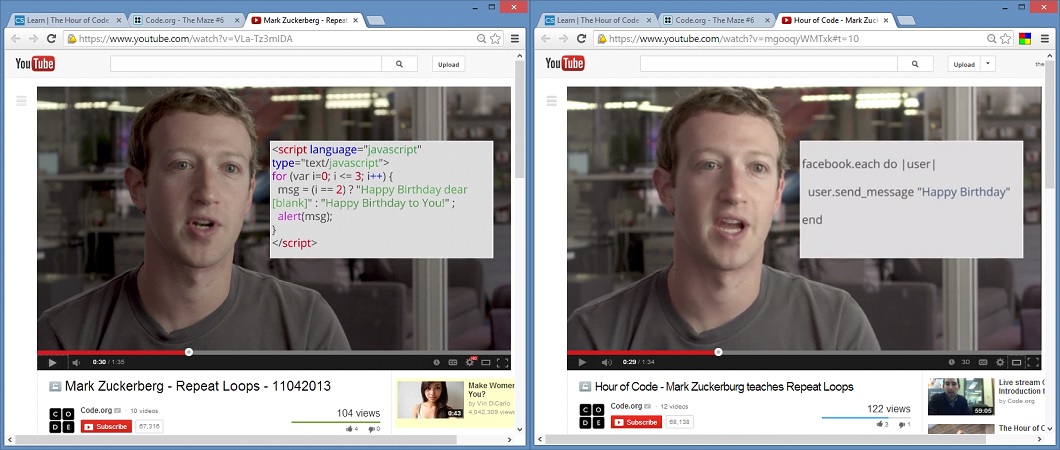
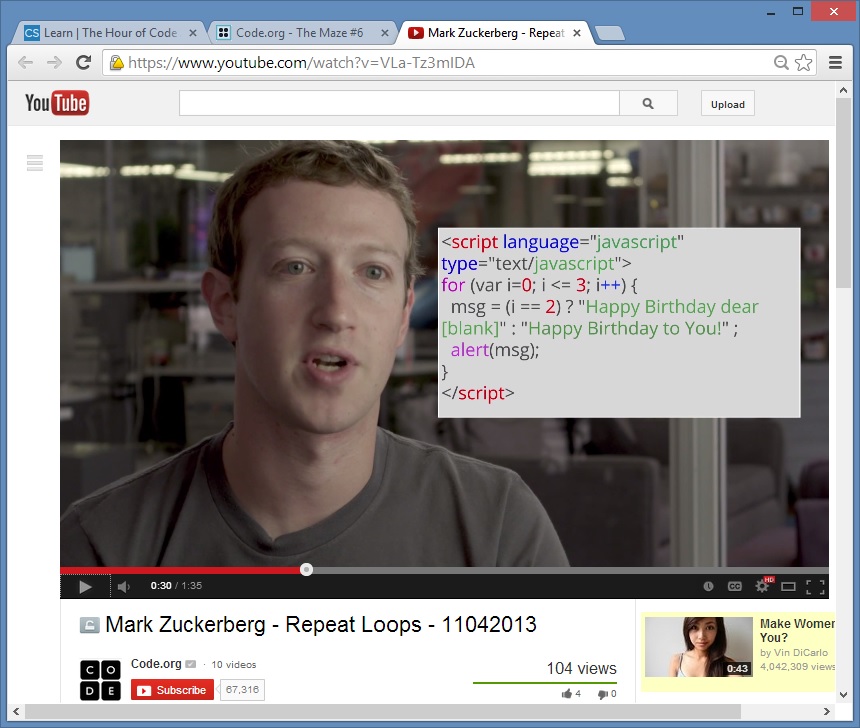
theodp writes "'Why do programmers start counting at zero?' wondered Mike Hoye, questioning the conventional programming wisdom. Code.org will soon introduce the practice to a hoped-for audience of 10 million schoolchildren as part of Computer Science Education Week's Hour of Code. In a tutorial created by engineers from Microsoft, Google, Twitter and Facebook that's intended to introduce programming to kids as young as six years old, an otherwise breezy lesson featuring look-ma-no-typing Blockly and characters out of Angry Birds and Plants vs. Zombies, a Mark Zuckerberg video introducing the concept of Repeat Loops includes an out-of-place JavaScript example that shows kids it's as easy as 0-1-2-3 to generate 4 lines of lyrics from Happy Birthday to You by using zero-based numbering with a For-loop and ternary If statement. Accompanying videos by Bill Gates on If Statements and basketball star Chris Bosh on Repeat Until Blocks show the Code.org tutorial is still a work-in-progress. That's no big deal, since CSEdWeek has pushed back the delivery date for final Hour of Code tutorials from its prior little-time-for-testing due date to Dec. 9th, the first day of a five-day period during which teachers are expected to deliver the lessons to 10 million students." -
Zuckerberg To Teach 10 Million Kids 0-Based Counting
theodp writes "'Why do programmers start counting at zero?' wondered Mike Hoye, questioning the conventional programming wisdom. Code.org will soon introduce the practice to a hoped-for audience of 10 million schoolchildren as part of Computer Science Education Week's Hour of Code. In a tutorial created by engineers from Microsoft, Google, Twitter and Facebook that's intended to introduce programming to kids as young as six years old, an otherwise breezy lesson featuring look-ma-no-typing Blockly and characters out of Angry Birds and Plants vs. Zombies, a Mark Zuckerberg video introducing the concept of Repeat Loops includes an out-of-place JavaScript example that shows kids it's as easy as 0-1-2-3 to generate 4 lines of lyrics from Happy Birthday to You by using zero-based numbering with a For-loop and ternary If statement. Accompanying videos by Bill Gates on If Statements and basketball star Chris Bosh on Repeat Until Blocks show the Code.org tutorial is still a work-in-progress. That's no big deal, since CSEdWeek has pushed back the delivery date for final Hour of Code tutorials from its prior little-time-for-testing due date to Dec. 9th, the first day of a five-day period during which teachers are expected to deliver the lessons to 10 million students." -
Zuckerberg To Teach 10 Million Kids 0-Based Counting
theodp writes "'Why do programmers start counting at zero?' wondered Mike Hoye, questioning the conventional programming wisdom. Code.org will soon introduce the practice to a hoped-for audience of 10 million schoolchildren as part of Computer Science Education Week's Hour of Code. In a tutorial created by engineers from Microsoft, Google, Twitter and Facebook that's intended to introduce programming to kids as young as six years old, an otherwise breezy lesson featuring look-ma-no-typing Blockly and characters out of Angry Birds and Plants vs. Zombies, a Mark Zuckerberg video introducing the concept of Repeat Loops includes an out-of-place JavaScript example that shows kids it's as easy as 0-1-2-3 to generate 4 lines of lyrics from Happy Birthday to You by using zero-based numbering with a For-loop and ternary If statement. Accompanying videos by Bill Gates on If Statements and basketball star Chris Bosh on Repeat Until Blocks show the Code.org tutorial is still a work-in-progress. That's no big deal, since CSEdWeek has pushed back the delivery date for final Hour of Code tutorials from its prior little-time-for-testing due date to Dec. 9th, the first day of a five-day period during which teachers are expected to deliver the lessons to 10 million students."