Slashdot Mirror
Domain: youtube.com
Stories and comments across the archive that link to youtube.com.
Stories · 2,039
-
The State of ReactOS's Crazy Open Source Windows Replacement
jeditobe writes with a link to a talk (video recorded, with transcript) about a project we've been posting about for years: ambitious Windows-replacement ReactOS: "In this talk, Alex Ionescu, lead kernel developer for the ReactOS project since 2004 (and recently returning after a long hiatus) will talk about the project's current state, having just passed revision 60000 in the SVN repository. Alex will also cover some of the project's goals, the development and testing methodology being such a massive undertaking (an open source project to reimplement all of Windows from scratch!), partnership with other open source projects (MinGW, Wine, Haiku, etc...). Alex will talk both about the infrastructure side about running such a massive OS project (but without Linux's corporate resources), as well as the day-to-day development challenges of a highly distributed team and the lack of Win32 internals knowledge that makes it hard to recruit. Finally, Alex will do a few demos of the OS, try out a few games and applications, Internet access, etc, and of course, show off a few blue screens of death." -
Indonesian Erruption Forces Evacuation of 1300
ABC News reports that "A volcano in western Indonesia erupted again Sunday, unleashing volcanic ash high into the sky and forcing the evacuation of villagers living around its slope. Officials raised Mount Sinabung's alert status to the second-highest level after the 2,600-meter (8,530-foot) -high mountain erupted early Sunday, said National Disaster Mitigation Agency spokesman Sutopo Purwo Nugroho. Authorities were working to evacuate residents from four North Sumatra province villages located within the mountain's three-kilometer (two-mile) danger zone, Nugroho said. About 1,300 villagers have been relocated to safer areas so far. It was the volcano's second big eruption since late last month, with its Oct. 24 explosion prompting the evacuation of more than 3,300 people." This video of Sinabung's 2010 eruption gives some clue about what to expect. -
Mind Control In Virtual Reality, Circa 2013
New submitter chrisjz writes "What happens when you combine a virtual reality headset and a brainwave reading device? Here's a simulation showing off what's possible with current technology, using the Emotiv EPOC to read a person's brainwaves for movement in a virtual environment. Along with the Oculus Rift, a VR headset, and the Razer Hydra for hand tracking, this demonstrates another alternative to using omni-directional treadmills or full body tracking for movement and interaction in virtual reality. Consumer level brain computer interfaces are still primitive these days, but it doesn't seem too far off that we'll have virtual reality similar to what William Gibson envisioned in his novels or movies such as The Matrix has shown us." -
TxK, Tempest 2000 Remake for PS Vita Demoed
If you happen to be one of the other five people who own an Atari Jaguar, you've probably played the excellent Tempest 2000. As chance would have it, a few months ago Llamasoft announced they were approached by Sony to write TxK, based "...on the essence of the original T2K. ... . We're not going to overload you with ultra psychedelia, but we will make it fluid and colourful and awesome-looking ... We're going to give you a perfect treat for your eyes, ears and thumbs with a modern extrapolation of one of the best shooters ever made on hardware that's just perfectly suited for it, and in a way that retains the purity of the original design." A couple of weeks ago, a working version of TxK was demoed at Play Expo. Read below to see the video. It really seems to retain the aesthetic of Tempest 2000 enhanced by modern hardware and a full color range, with a touch of Space Giraffe tactics (you can kill enemies at the rim somehow at least). -
Slashdot Asks: What Are You Doing For Hallowe'en?
Hallowe'en is my favorite holiday: I like seeing costumes (and walking around in my own), and seeing what people do to decorate their houses, yards, etc. For the second year in a row though, I've failed to come up with a really good scheme for making my own place appropriately spooky. So, in hopes of loosing some inspiration for myself and others, I ask today what you're doing to spookify your surroundings (or your person) tomorrow, especially if it means using technology in interesting ways. Sensor-activated scary sounds or lights? An Arduino or Raspberry Pi-controlled costume? Elaborate trap-door? Infrasonic hackle-raising subwoofer install? Maybe one year Alek Komarnitsky will switch to Hallowe'en instead of Christmas, and offer a webcam-equipped remote-controllable haunt. -
Car Hackers Mess With Speedometers, Odometers, Alarms and Locks
mask.of.sanity writes "Researchers have demonstrated how controller area networks in cars can make vehicles appear to drive slower than their actual speed, manipulate brakes, wind back odometers and set off all kinds of alarms and lights from random fuzzing (video). The network weaknesses stem from a lack of authentication which they say is absent to improve performance. The researchers have also built a $25 open-source fuzzing tool to help others enter the field." -
New Goggles Offer Minority Report-Style Interface With Heads-Up Display
Lucas123 writes "A Taiwanese non-profit R&D organization is demonstrating a new heads-up type display that allows users to interact with the floating virtual screens using finger swipes. The new i-Air Touch technology from the Industrial Technology Research Institute is being developed for an array of devices, including PCs, wearable computers and mobile devices. The technology allows a user's hand to be free of any physical device such as a touchpad or keyboard for touch input. ITRI plans to license the patented technology to manufacturers. The company sees the technology being used in not only consumer arenas (video), but also for medical applications such as endoscopic surgery and any industrial applications that benefit from hands-free input." -
5-Year Mission Continues After 45-Year Hiatus
Okian Warrior writes "Hackaday brings us news about a continuation of the original Star Trek series. The Kickstarter-funded project is attempting to complete the original 5-year mission, which ended after only three seasons on the air. The fan-based and fan-supported reincarnation is cleverly titled Star Trek Continues and has CBS's consent. Check out the first episode, Pilgrim of Eternity. For being fan-made, it's actually pretty good." The attention to detail in the sets, costumes, and even lighting is incredible. It's far and away the most faithful re-creation of the original series I've ever seen. -
First Experimental Evidence That Time Is an Emergent Quantum Phenomenon
KentuckyFC writes "One of the great challenges in physics is to unite the theories of quantum mechanics and general relativity. But all attempts to do this all run into the famous 'problem of time' — the resulting equations describe a static universe in which nothing ever happens. In 1983, theoreticians showed how this could be solved if time is an emergent phenomenon based on entanglement, the phenomenon in which two quantum particles share the same existence. An external, god-like observer always sees no difference between these particles compared to an external objective clock. But an observer who measures one of the pair — and so becomes entangled with it--can immediately see how it evolves differently from its partner. So from the outside the universe appears static and unchanging, while objects that are entangled within it experience the maelstrom of change. Now quantum physicists have performed the first experimental test of this idea by measuring the evolution of a pair of entangled photons in two different ways. An external god-like observer sees no difference while an observer who measures one particle and becomes entangled with it does see the change. In other words, the experiment shows how time is an emergent phenomenon based on entanglement, in which case the contradiction between quantum mechanics and general relativity seems to melt away." -
Scenes from the Fort Wayne Regional Maker Faire (Video)
Slashdot visited Fort Wayne, Indiana, during its 2013 Maker Faire. We brought back videos of R2D2 model makers in all their bleeping glory, Mad Sasquatch Rocketry launching rockets, and functioning home-made jet engines, which no Maker Faire should be without. Since Fort Wayne has a strong industrial history, it is not surprising that this Maker Faire had more industrial-scale exhibits than most maker-type events Slashdot has attended. The noise level in much of the event area was industrial scale, too, which is why this video sounds the way it does. But we love large, noisy machinery, not just computers so quiet you can't hear their fans (if, indeed, they *have* fans), so we're happy to enjoy some good Industrial Sound and check out some of Mark Phenicie's steampunk creations now and then. -
Teachers Get 1 Week To Test Tech Giants' Hour of Code
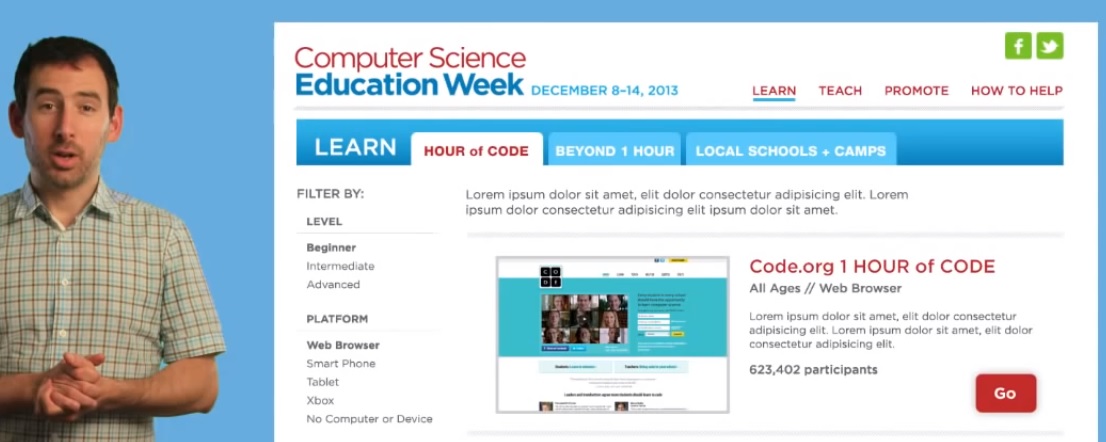
theodp writes "In a move straight out of Healthcare.gov's playbook, teachers won't get to preview the final lessons they're being asked to roll out to 10 million U.S. students until a week before the Dec. 9th launch of the Hour of Code nation-wide learn-to-code initiative, according to a video explaining the project, which is backed by the nation's tech giants, including Facebook, Microsoft, Apple, Google, and Amazon. The Hour of Code tutorial page showcased to the press sports Lorem Ipsum pseudo-Latin text instead of real content, promised tutorial software is still being developed by Microsoft and Google, and celebrity tutorials by Bill Gates and Mark Zuckerberg are still a work-in-progress. With their vast resources and deep pockets, the companies involved can still probably pull something off, but why risk disaster for such a high-stakes effort with a last-minute rush? One possible explanation is that CS Education Week, a heretofore little-recognized event, is coming up soon. Then again, tech immigration reform is back on the front burner, an initiative that's also near-and-dear to many of same players behind Hour of Code, including Microsoft Chief Counsel Brad Smith who, during the Hour of Code kickoff press conference, boasted that Microsoft's more-high-tech-visas-for-U.S.-kids-computer-science-education deal found its way into the Senate Immigration Bill, but minutes later joined his fellow FWD.us panelists to dismiss a questioner's suggestion that Hour of Code might somehow be part of a larger self-serving tech industry interest." -
Teachers Get 1 Week To Test Tech Giants' Hour of Code
theodp writes "In a move straight out of Healthcare.gov's playbook, teachers won't get to preview the final lessons they're being asked to roll out to 10 million U.S. students until a week before the Dec. 9th launch of the Hour of Code nation-wide learn-to-code initiative, according to a video explaining the project, which is backed by the nation's tech giants, including Facebook, Microsoft, Apple, Google, and Amazon. The Hour of Code tutorial page showcased to the press sports Lorem Ipsum pseudo-Latin text instead of real content, promised tutorial software is still being developed by Microsoft and Google, and celebrity tutorials by Bill Gates and Mark Zuckerberg are still a work-in-progress. With their vast resources and deep pockets, the companies involved can still probably pull something off, but why risk disaster for such a high-stakes effort with a last-minute rush? One possible explanation is that CS Education Week, a heretofore little-recognized event, is coming up soon. Then again, tech immigration reform is back on the front burner, an initiative that's also near-and-dear to many of same players behind Hour of Code, including Microsoft Chief Counsel Brad Smith who, during the Hour of Code kickoff press conference, boasted that Microsoft's more-high-tech-visas-for-U.S.-kids-computer-science-education deal found its way into the Senate Immigration Bill, but minutes later joined his fellow FWD.us panelists to dismiss a questioner's suggestion that Hour of Code might somehow be part of a larger self-serving tech industry interest." -
Valve Shows How Steam Controller Works In Real Life
sfcrazy writes "Valve Software have demonstrated how the controller works in the real world with popular games like Portal 2, Civilization V, and Counter-Strike: Global Offensive. Valve has posted a video on their YouTube channel to give users a glimpse of the Steam Controller experience." -
Bennett Haselton's Response To That "Don't Talk to Cops" Video
In response to both of my previous articles raising questions about the Fifth Amendment, people sent me a link to a famous video titled "Don't Talk To Cops" delivered by Regents University law professor James Duane. Whether his conclusion is correct or not, I think the argument is flawed in several ways. Please continue reading below to see what I think is wrong with his position.In my first article about the Fifth Amendment, I asked: Why is it a good thing that the Fifth Amendment allows a suspect to refuse to answer "Yes" or "No" as to whether they committed a crime or not? (I was emphatically not saying that a suspect should have to answer questions that are nobody else's business -- if you weren't at the scene of the crime, you should be free to say, "I wasn't at the scene of the crime, but I would prefer not to tell you where I was." However, the Fifth Amendment lets you refuse to answer the question of whether you even committed the crime at all, and I didn't see what was so great about that, because it is everybody's legitimate business whether or not you committed the crime.)
In the second article, I asked a different question: If you do accept the rationale for allowing a suspect to refuse to answer the question of whether they committed the crime or not, why don't we extend the same protection to third-party witnesses? In other words, if Bob commits a crime and Alice is a witness, and the police ask Bob and Alice the same question -- "Did Bob do it?" -- and both refuse to answer, then Bob is allowed to do this but Alice can go to jail for remaining silent, even though Bob might be guilty, and Alice is the one who is known to be innocent! That seems crazy.
The full arguments are given in each of the articles linked above (and dissected further in the comments) and I don't want to rehash either of them here, but in response to both articles, multiple people sent me the link to Professor Duane's "Don't Talk To Cops" video, which has been viewed about 2 million times on Youtube. (Professor Duane also ceded half his presentation time to police officer George Bruch, giving him the chance to offer a 'rebuttal', which has been uploaded as a separate video -- Bruch's video has been viewed about 1 million times.) I've watched Professor Duane's presentation twice, and one problem I have with the video is that I don't know what Professor Duane's actual position is. Yes, he says that he would "never talk to any police officer under any circumstances, ever", but does that really mean that if he witnessed a violent altercation on the street and the cops wanted to ask him about it, that he wouldn't say a word to them? Or, if he got pulled over for speeding, would he really hand over his license and registration and then sit silently in the driver's seat refusing to respond the cop's questions (which pretty much eliminates your chance at being let off with a warning)? What if his house got broken into, would he really refuse to call the cops and tell them? And, uh, there's a police officer who co-presents in the video with him, didn't Professor Duane have to talk to him to get him in the video? In fact, he speaks directly to the cop on camera! Busted!
"Oh, stop being so literal, Bennett, you know that's not what he meant!" OK, but what did he mean? One problem with staking out a fairly extreme position to begin with, is that if you describe it hyperbolically, there's no way for people to know what your actual position is. I emailed Professor Duane to ask if he could clarify, but didn't get a response. (Since his video has been viewed over 2 million times, possibly my email got lost in the pile of mails he gets every week saying, "Oh shit I got arrested and I opened my big mouth, you got any ideas for what I should do now??")
For the purpose of this discussion, let's assume that Professor Duane means that if the police approached him with questions about a crime (and excluding "hot pursuit" situations such as when the police are chasing a mugger and ask "Which way did he go?"), he would refuse to talk to them. In that case, I have a couple of points to make in response to the video, but first, if you haven't seen it, you may want to watch it now, along with the 'rebuttal' offered by police officer George Bruch, and see if you come up with the same objections that I did.
Everybody back? OK, here are my thoughts:
1. The video is answering a different question from the one I asked. The video weighs the costs and benefits to the individual, of remaining silent; I was asking whether the defendant's right to remain silent is good for society as a whole. Of course if you're innocent, then it's in both your interest and society's interest for you to go free. If you're guilty, on the other hand, you may want to walk free, but it's usually in your society's interest for you to be convicted. (You could argue an exception for pot laws or whatever, but generally speaking, we do want criminals to get caught.)
Professor Duane, beginning at the 24:50 mark, specifically invokes Martha Stewart, Marion Jones, and Michael Vick, as examples of people who he thinks would have gotten lighter sentences, or gotten off completely, if they had remained silent throughout their legal ordeals. Yes, but all three of those people were guilty (Martha Stewart, very probably; Jones and Vick, beyond any doubt), so while it may have been better for them to remain silent, it would not have been better for the legal system as a whole. (All three of them had supporters who said the laws they were being charged under, were unjust in the first place, but that's a separate problem.)
This is not an explicit error on Professor Duane's part -- since he was arguing that remaining silent is good for the individual, not for society -- but it does mean the video is not precisely a response to the point I was making.
2. The argument about the danger of talking to cops is based on a sampling error. Professor Duane says that criminal defense attorneys "always, always say it was a bad idea for their client to talk to the police". But this sample obviously only includes people who talked to the police and ended up getting arrested, and charged, and needing a criminal defense attorney. The sample wouldn't include anyone that the police talked to and decided not to arrest -- whether they were initially brought in as a suspect but then convinced the police that they were innocent, or whether they were simply third-party witnesses who volunteered information to the police that they thought was useful.
In fact, in the 'rebuttal' video from Officer Bruch, he says at the 6:20 mark:
"You're going to lose [in the police interrogation room], unless you're purely innocent. On the other side of it, I don't want to put anyone who's innocent in jail. I try not to bring anyone in to the interview room who's innocent. And there are a couple that I have let walk away because they were innocent."
This appears to contradict Professor Duane, who said repeatedly that even if you're innocent, "it CANNOT help" to talk to the police, and that "you CANNOT talk to the police out of arresting you". Unless Bruch was lying, then Duane's statement was wrong, although neither of them seemed to notice. But if you did talk the police out of arresting you, then you wouldn't end up in Professor Duane's sample of people whose ended up needing a defense lawyer.
And even this sample is restricted to people who are brought into the interrogation room, where Officer Bruch said he tried not to bring anybody in at all unless the thought they were probably guilty. If you include all the people that the cops try and talk to, who the police don't think are guilty -- people casually stopped on the street, or called on the phone, or visited in their house, because they might have relevant information -- then your sample becomes much larger, and the proportion who talk to the cops and do not subsequently get in trouble, goes way up.
Also, of course, Professor Duane's sample includes people who talked to the police and were convicted, who were in fact guilty. Their defense attorneys may wish that their clients had kept silent and possibly walked free as a result, but that wouldn't be good for the rest of us.
3. His advice ignores the benefits of leniency if you're guilty and you're almost positive you'll be caught anyway. For most of this discussion I've been focusing on the merits of talking to the police if you're innocent. But Officer Bruch also says that if people in the interrogation room answer questions and cooperate, then even if they're ultimately convicted, the police do testify to the judge that you were cooperative, and the judge can take that into account and reduce your prison sentence. That is at least theoretically another legitimate reason to violate Professor Duane's "Don't Talk To Cops" rule, if you're 99% sure that the police will find enough evidence to convict you anyway, you can hope for leniency by cooperating. That's essentially why I do talk to the police if I get pulled over for speeding -- I've gotten off with a warning a few times, whereas I'm pretty sure that if I'd just sat silently and stared straight ahead, I would have gotten the ticket.
4. Professor Duane's argument is about talking to the cops; I'm asking about the merits of the Fifth Amendment as it applies in a courtroom as well. At the 15:22 mark, for example, Professor Duane gives the fictional example of a suspect who says to the police:
"I don't know what you are talking about. I didn't kill Jones and I don't know who did. I wasn't anywhere near that place. I don't have a gun, and I have never owned a gun in my life. I don't even know how to use a gun. Yeah, sure I never liked the guy, but who did? I wouldn't kill him. I've never hurt anybody in my life, and I would never do such a thing."
Professor Duane continues: "Let's suppose every word of that is true, 100% of it is true. What will the jury hear at trial? 'Officer Bruch, was there anything about your interrogation, your interview with the suspect that made you concerned that he might be the right one?' 'Yes sir there was. He confessed to me that He never liked the guy.'"
Even if that scenario is a valid reason not to talk to the police, it wouldn't be possible in a courtroom, where all of your answers are recorded, and it will be obvious if someone is trying to distort the meaning of something that you said earlier.
This is also not an error on Professor Duane's part, since his talk was called "Don't Talk To Cops", not "Don't Ever Answer Questions In Court". (While he's right that most criminal defense attorneys wish that their clients had not talked to the police, some criminal defense attorneys do encourage their clients to take the stand at trial.) So it's not relevant to the question of whether society benefits from giving defendants a Fifth Amendment right to remain silent in a courtroom.
5. Finally, are the police really that corrupt and/or stupid? Go back up to Professor Duane's hypothetical in which a suspect protests his innocence, and Duane imagines that Officer Bruch -- Professor Duane's real-life co-presenter in this talk! -- takes five words out of context and testifies in court, "He confessed to me, 'I never liked the guy'."
When the real Officer Bruch gave his 'rebuttal', he started out by started out by saying, "Everything he just said was true. And it was right, and it was correct." If I had been in the room at the time, I would have asked him, "Seriously? Were you listening when Professor Duane said that if a suspect protested his innocence in the way that he described, you would take that out-of-context quote and only tell the jury that he said 'I never liked the guy?'" Well, we already know that George Bruch didn't really agree with everything that Professor Duane said, since Bruch contradicted him on some points, such as Duane's claim that "talking to the police cannot possibly help you even if you're innocent". But I would have liked for Officer Bruch to say if he thinks the police are anywhere as stupid and corrupt as Professor Duane was implying that they are.
More to the point -- and I went into this in my first article about the Fifth Amendment -- if the police and the courts are even remotely that corrupt and incompetent, then that's a wide-ranging problem that applies to all types of evidence gathered in the case, not just statements from suspect. And if that's the case, then the Fifth Amendment is just a band-aid that only solves the stupid-cops-and-courts problem as it applies to suspect statements specifically. It doesn't solve the problem as it applies to circumstantial evidence, unreliable eyewitness testimony, false memories, evaluating the credibility of other witnesses, and other factors.
In other words, if you're arrested, suppose the cops really are so dumb and/or evil that they would quote your "I never liked the guy" out of context to try and get you convicted. So, taking Professor Duane's advice, you say nothing. Do you still trust those same police officers to handle the other aspects of your case fairly? To make sure any exculpatory evidence is brought to light? To interrogate other witnesses without leading them towards a pre-set conclusion?
As I said in my first article, that doesn't mean that this is not a valid argument for the Fifth Amendment. But it means that if this is the primary argument in favor of the Fifth Amendment, then what the people making this argument are really saying, is that the whole system is broken.
The Weekly Standard published a more devastating rebuttal to Professor Duane's video, in which the author describes the devastating effects that the "Don't Snitch" movement has had on high-crime neighborhoods, as a result of large numbers of people following Professor Duane's philosophy to the letter. The article quoted one rap celebrity saying that he wouldn't even tell the police about a known murderer living next door to him. Professor Duane may not endorse that view directly, but he could hardly disagree that it follows logically from his admonition to "never talk to the police under any circumstances, ever". This is essentially the same logic error that I pointed out in point #2 -- if you focus only on people who talked to the police and ended up getting arrested, you're ignoring the benefits of people talking to the police who not only don't get arrested, but may help stop a crime or catch a criminal. It might still be a bad idea on balance to talk the police, but you couldn't make that argument by limiting your sample to the people who get arrested.
More generally, there may be an argument why either the individual or society benefits from the legal right to remain silent -- but it would have to be based on a sample drawn from all innocent people who talk to the cops, and the proportion who subsequently benefit as a result, and the proportion who are subsequently penalized, and weighing the magnitude of the benefits versus the drawbacks, and the likelihood of each. The "Don't Talk To Cops" video doesn't do that.
-
Bennett Haselton's Response To That "Don't Talk to Cops" Video
In response to both of my previous articles raising questions about the Fifth Amendment, people sent me a link to a famous video titled "Don't Talk To Cops" delivered by Regents University law professor James Duane. Whether his conclusion is correct or not, I think the argument is flawed in several ways. Please continue reading below to see what I think is wrong with his position.In my first article about the Fifth Amendment, I asked: Why is it a good thing that the Fifth Amendment allows a suspect to refuse to answer "Yes" or "No" as to whether they committed a crime or not? (I was emphatically not saying that a suspect should have to answer questions that are nobody else's business -- if you weren't at the scene of the crime, you should be free to say, "I wasn't at the scene of the crime, but I would prefer not to tell you where I was." However, the Fifth Amendment lets you refuse to answer the question of whether you even committed the crime at all, and I didn't see what was so great about that, because it is everybody's legitimate business whether or not you committed the crime.)
In the second article, I asked a different question: If you do accept the rationale for allowing a suspect to refuse to answer the question of whether they committed the crime or not, why don't we extend the same protection to third-party witnesses? In other words, if Bob commits a crime and Alice is a witness, and the police ask Bob and Alice the same question -- "Did Bob do it?" -- and both refuse to answer, then Bob is allowed to do this but Alice can go to jail for remaining silent, even though Bob might be guilty, and Alice is the one who is known to be innocent! That seems crazy.
The full arguments are given in each of the articles linked above (and dissected further in the comments) and I don't want to rehash either of them here, but in response to both articles, multiple people sent me the link to Professor Duane's "Don't Talk To Cops" video, which has been viewed about 2 million times on Youtube. (Professor Duane also ceded half his presentation time to police officer George Bruch, giving him the chance to offer a 'rebuttal', which has been uploaded as a separate video -- Bruch's video has been viewed about 1 million times.) I've watched Professor Duane's presentation twice, and one problem I have with the video is that I don't know what Professor Duane's actual position is. Yes, he says that he would "never talk to any police officer under any circumstances, ever", but does that really mean that if he witnessed a violent altercation on the street and the cops wanted to ask him about it, that he wouldn't say a word to them? Or, if he got pulled over for speeding, would he really hand over his license and registration and then sit silently in the driver's seat refusing to respond the cop's questions (which pretty much eliminates your chance at being let off with a warning)? What if his house got broken into, would he really refuse to call the cops and tell them? And, uh, there's a police officer who co-presents in the video with him, didn't Professor Duane have to talk to him to get him in the video? In fact, he speaks directly to the cop on camera! Busted!
"Oh, stop being so literal, Bennett, you know that's not what he meant!" OK, but what did he mean? One problem with staking out a fairly extreme position to begin with, is that if you describe it hyperbolically, there's no way for people to know what your actual position is. I emailed Professor Duane to ask if he could clarify, but didn't get a response. (Since his video has been viewed over 2 million times, possibly my email got lost in the pile of mails he gets every week saying, "Oh shit I got arrested and I opened my big mouth, you got any ideas for what I should do now??")
For the purpose of this discussion, let's assume that Professor Duane means that if the police approached him with questions about a crime (and excluding "hot pursuit" situations such as when the police are chasing a mugger and ask "Which way did he go?"), he would refuse to talk to them. In that case, I have a couple of points to make in response to the video, but first, if you haven't seen it, you may want to watch it now, along with the 'rebuttal' offered by police officer George Bruch, and see if you come up with the same objections that I did.
Everybody back? OK, here are my thoughts:
1. The video is answering a different question from the one I asked. The video weighs the costs and benefits to the individual, of remaining silent; I was asking whether the defendant's right to remain silent is good for society as a whole. Of course if you're innocent, then it's in both your interest and society's interest for you to go free. If you're guilty, on the other hand, you may want to walk free, but it's usually in your society's interest for you to be convicted. (You could argue an exception for pot laws or whatever, but generally speaking, we do want criminals to get caught.)
Professor Duane, beginning at the 24:50 mark, specifically invokes Martha Stewart, Marion Jones, and Michael Vick, as examples of people who he thinks would have gotten lighter sentences, or gotten off completely, if they had remained silent throughout their legal ordeals. Yes, but all three of those people were guilty (Martha Stewart, very probably; Jones and Vick, beyond any doubt), so while it may have been better for them to remain silent, it would not have been better for the legal system as a whole. (All three of them had supporters who said the laws they were being charged under, were unjust in the first place, but that's a separate problem.)
This is not an explicit error on Professor Duane's part -- since he was arguing that remaining silent is good for the individual, not for society -- but it does mean the video is not precisely a response to the point I was making.
2. The argument about the danger of talking to cops is based on a sampling error. Professor Duane says that criminal defense attorneys "always, always say it was a bad idea for their client to talk to the police". But this sample obviously only includes people who talked to the police and ended up getting arrested, and charged, and needing a criminal defense attorney. The sample wouldn't include anyone that the police talked to and decided not to arrest -- whether they were initially brought in as a suspect but then convinced the police that they were innocent, or whether they were simply third-party witnesses who volunteered information to the police that they thought was useful.
In fact, in the 'rebuttal' video from Officer Bruch, he says at the 6:20 mark:
"You're going to lose [in the police interrogation room], unless you're purely innocent. On the other side of it, I don't want to put anyone who's innocent in jail. I try not to bring anyone in to the interview room who's innocent. And there are a couple that I have let walk away because they were innocent."
This appears to contradict Professor Duane, who said repeatedly that even if you're innocent, "it CANNOT help" to talk to the police, and that "you CANNOT talk to the police out of arresting you". Unless Bruch was lying, then Duane's statement was wrong, although neither of them seemed to notice. But if you did talk the police out of arresting you, then you wouldn't end up in Professor Duane's sample of people whose ended up needing a defense lawyer.
And even this sample is restricted to people who are brought into the interrogation room, where Officer Bruch said he tried not to bring anybody in at all unless the thought they were probably guilty. If you include all the people that the cops try and talk to, who the police don't think are guilty -- people casually stopped on the street, or called on the phone, or visited in their house, because they might have relevant information -- then your sample becomes much larger, and the proportion who talk to the cops and do not subsequently get in trouble, goes way up.
Also, of course, Professor Duane's sample includes people who talked to the police and were convicted, who were in fact guilty. Their defense attorneys may wish that their clients had kept silent and possibly walked free as a result, but that wouldn't be good for the rest of us.
3. His advice ignores the benefits of leniency if you're guilty and you're almost positive you'll be caught anyway. For most of this discussion I've been focusing on the merits of talking to the police if you're innocent. But Officer Bruch also says that if people in the interrogation room answer questions and cooperate, then even if they're ultimately convicted, the police do testify to the judge that you were cooperative, and the judge can take that into account and reduce your prison sentence. That is at least theoretically another legitimate reason to violate Professor Duane's "Don't Talk To Cops" rule, if you're 99% sure that the police will find enough evidence to convict you anyway, you can hope for leniency by cooperating. That's essentially why I do talk to the police if I get pulled over for speeding -- I've gotten off with a warning a few times, whereas I'm pretty sure that if I'd just sat silently and stared straight ahead, I would have gotten the ticket.
4. Professor Duane's argument is about talking to the cops; I'm asking about the merits of the Fifth Amendment as it applies in a courtroom as well. At the 15:22 mark, for example, Professor Duane gives the fictional example of a suspect who says to the police:
"I don't know what you are talking about. I didn't kill Jones and I don't know who did. I wasn't anywhere near that place. I don't have a gun, and I have never owned a gun in my life. I don't even know how to use a gun. Yeah, sure I never liked the guy, but who did? I wouldn't kill him. I've never hurt anybody in my life, and I would never do such a thing."
Professor Duane continues: "Let's suppose every word of that is true, 100% of it is true. What will the jury hear at trial? 'Officer Bruch, was there anything about your interrogation, your interview with the suspect that made you concerned that he might be the right one?' 'Yes sir there was. He confessed to me that He never liked the guy.'"
Even if that scenario is a valid reason not to talk to the police, it wouldn't be possible in a courtroom, where all of your answers are recorded, and it will be obvious if someone is trying to distort the meaning of something that you said earlier.
This is also not an error on Professor Duane's part, since his talk was called "Don't Talk To Cops", not "Don't Ever Answer Questions In Court". (While he's right that most criminal defense attorneys wish that their clients had not talked to the police, some criminal defense attorneys do encourage their clients to take the stand at trial.) So it's not relevant to the question of whether society benefits from giving defendants a Fifth Amendment right to remain silent in a courtroom.
5. Finally, are the police really that corrupt and/or stupid? Go back up to Professor Duane's hypothetical in which a suspect protests his innocence, and Duane imagines that Officer Bruch -- Professor Duane's real-life co-presenter in this talk! -- takes five words out of context and testifies in court, "He confessed to me, 'I never liked the guy'."
When the real Officer Bruch gave his 'rebuttal', he started out by started out by saying, "Everything he just said was true. And it was right, and it was correct." If I had been in the room at the time, I would have asked him, "Seriously? Were you listening when Professor Duane said that if a suspect protested his innocence in the way that he described, you would take that out-of-context quote and only tell the jury that he said 'I never liked the guy?'" Well, we already know that George Bruch didn't really agree with everything that Professor Duane said, since Bruch contradicted him on some points, such as Duane's claim that "talking to the police cannot possibly help you even if you're innocent". But I would have liked for Officer Bruch to say if he thinks the police are anywhere as stupid and corrupt as Professor Duane was implying that they are.
More to the point -- and I went into this in my first article about the Fifth Amendment -- if the police and the courts are even remotely that corrupt and incompetent, then that's a wide-ranging problem that applies to all types of evidence gathered in the case, not just statements from suspect. And if that's the case, then the Fifth Amendment is just a band-aid that only solves the stupid-cops-and-courts problem as it applies to suspect statements specifically. It doesn't solve the problem as it applies to circumstantial evidence, unreliable eyewitness testimony, false memories, evaluating the credibility of other witnesses, and other factors.
In other words, if you're arrested, suppose the cops really are so dumb and/or evil that they would quote your "I never liked the guy" out of context to try and get you convicted. So, taking Professor Duane's advice, you say nothing. Do you still trust those same police officers to handle the other aspects of your case fairly? To make sure any exculpatory evidence is brought to light? To interrogate other witnesses without leading them towards a pre-set conclusion?
As I said in my first article, that doesn't mean that this is not a valid argument for the Fifth Amendment. But it means that if this is the primary argument in favor of the Fifth Amendment, then what the people making this argument are really saying, is that the whole system is broken.
The Weekly Standard published a more devastating rebuttal to Professor Duane's video, in which the author describes the devastating effects that the "Don't Snitch" movement has had on high-crime neighborhoods, as a result of large numbers of people following Professor Duane's philosophy to the letter. The article quoted one rap celebrity saying that he wouldn't even tell the police about a known murderer living next door to him. Professor Duane may not endorse that view directly, but he could hardly disagree that it follows logically from his admonition to "never talk to the police under any circumstances, ever". This is essentially the same logic error that I pointed out in point #2 -- if you focus only on people who talked to the police and ended up getting arrested, you're ignoring the benefits of people talking to the police who not only don't get arrested, but may help stop a crime or catch a criminal. It might still be a bad idea on balance to talk the police, but you couldn't make that argument by limiting your sample to the people who get arrested.
More generally, there may be an argument why either the individual or society benefits from the legal right to remain silent -- but it would have to be based on a sample drawn from all innocent people who talk to the cops, and the proportion who subsequently benefit as a result, and the proportion who are subsequently penalized, and weighing the magnitude of the benefits versus the drawbacks, and the likelihood of each. The "Don't Talk To Cops" video doesn't do that.
-
Bennett Haselton's Response To That "Don't Talk to Cops" Video
In response to both of my previous articles raising questions about the Fifth Amendment, people sent me a link to a famous video titled "Don't Talk To Cops" delivered by Regents University law professor James Duane. Whether his conclusion is correct or not, I think the argument is flawed in several ways. Please continue reading below to see what I think is wrong with his position.In my first article about the Fifth Amendment, I asked: Why is it a good thing that the Fifth Amendment allows a suspect to refuse to answer "Yes" or "No" as to whether they committed a crime or not? (I was emphatically not saying that a suspect should have to answer questions that are nobody else's business -- if you weren't at the scene of the crime, you should be free to say, "I wasn't at the scene of the crime, but I would prefer not to tell you where I was." However, the Fifth Amendment lets you refuse to answer the question of whether you even committed the crime at all, and I didn't see what was so great about that, because it is everybody's legitimate business whether or not you committed the crime.)
In the second article, I asked a different question: If you do accept the rationale for allowing a suspect to refuse to answer the question of whether they committed the crime or not, why don't we extend the same protection to third-party witnesses? In other words, if Bob commits a crime and Alice is a witness, and the police ask Bob and Alice the same question -- "Did Bob do it?" -- and both refuse to answer, then Bob is allowed to do this but Alice can go to jail for remaining silent, even though Bob might be guilty, and Alice is the one who is known to be innocent! That seems crazy.
The full arguments are given in each of the articles linked above (and dissected further in the comments) and I don't want to rehash either of them here, but in response to both articles, multiple people sent me the link to Professor Duane's "Don't Talk To Cops" video, which has been viewed about 2 million times on Youtube. (Professor Duane also ceded half his presentation time to police officer George Bruch, giving him the chance to offer a 'rebuttal', which has been uploaded as a separate video -- Bruch's video has been viewed about 1 million times.) I've watched Professor Duane's presentation twice, and one problem I have with the video is that I don't know what Professor Duane's actual position is. Yes, he says that he would "never talk to any police officer under any circumstances, ever", but does that really mean that if he witnessed a violent altercation on the street and the cops wanted to ask him about it, that he wouldn't say a word to them? Or, if he got pulled over for speeding, would he really hand over his license and registration and then sit silently in the driver's seat refusing to respond the cop's questions (which pretty much eliminates your chance at being let off with a warning)? What if his house got broken into, would he really refuse to call the cops and tell them? And, uh, there's a police officer who co-presents in the video with him, didn't Professor Duane have to talk to him to get him in the video? In fact, he speaks directly to the cop on camera! Busted!
"Oh, stop being so literal, Bennett, you know that's not what he meant!" OK, but what did he mean? One problem with staking out a fairly extreme position to begin with, is that if you describe it hyperbolically, there's no way for people to know what your actual position is. I emailed Professor Duane to ask if he could clarify, but didn't get a response. (Since his video has been viewed over 2 million times, possibly my email got lost in the pile of mails he gets every week saying, "Oh shit I got arrested and I opened my big mouth, you got any ideas for what I should do now??")
For the purpose of this discussion, let's assume that Professor Duane means that if the police approached him with questions about a crime (and excluding "hot pursuit" situations such as when the police are chasing a mugger and ask "Which way did he go?"), he would refuse to talk to them. In that case, I have a couple of points to make in response to the video, but first, if you haven't seen it, you may want to watch it now, along with the 'rebuttal' offered by police officer George Bruch, and see if you come up with the same objections that I did.
Everybody back? OK, here are my thoughts:
1. The video is answering a different question from the one I asked. The video weighs the costs and benefits to the individual, of remaining silent; I was asking whether the defendant's right to remain silent is good for society as a whole. Of course if you're innocent, then it's in both your interest and society's interest for you to go free. If you're guilty, on the other hand, you may want to walk free, but it's usually in your society's interest for you to be convicted. (You could argue an exception for pot laws or whatever, but generally speaking, we do want criminals to get caught.)
Professor Duane, beginning at the 24:50 mark, specifically invokes Martha Stewart, Marion Jones, and Michael Vick, as examples of people who he thinks would have gotten lighter sentences, or gotten off completely, if they had remained silent throughout their legal ordeals. Yes, but all three of those people were guilty (Martha Stewart, very probably; Jones and Vick, beyond any doubt), so while it may have been better for them to remain silent, it would not have been better for the legal system as a whole. (All three of them had supporters who said the laws they were being charged under, were unjust in the first place, but that's a separate problem.)
This is not an explicit error on Professor Duane's part -- since he was arguing that remaining silent is good for the individual, not for society -- but it does mean the video is not precisely a response to the point I was making.
2. The argument about the danger of talking to cops is based on a sampling error. Professor Duane says that criminal defense attorneys "always, always say it was a bad idea for their client to talk to the police". But this sample obviously only includes people who talked to the police and ended up getting arrested, and charged, and needing a criminal defense attorney. The sample wouldn't include anyone that the police talked to and decided not to arrest -- whether they were initially brought in as a suspect but then convinced the police that they were innocent, or whether they were simply third-party witnesses who volunteered information to the police that they thought was useful.
In fact, in the 'rebuttal' video from Officer Bruch, he says at the 6:20 mark:
"You're going to lose [in the police interrogation room], unless you're purely innocent. On the other side of it, I don't want to put anyone who's innocent in jail. I try not to bring anyone in to the interview room who's innocent. And there are a couple that I have let walk away because they were innocent."
This appears to contradict Professor Duane, who said repeatedly that even if you're innocent, "it CANNOT help" to talk to the police, and that "you CANNOT talk to the police out of arresting you". Unless Bruch was lying, then Duane's statement was wrong, although neither of them seemed to notice. But if you did talk the police out of arresting you, then you wouldn't end up in Professor Duane's sample of people whose ended up needing a defense lawyer.
And even this sample is restricted to people who are brought into the interrogation room, where Officer Bruch said he tried not to bring anybody in at all unless the thought they were probably guilty. If you include all the people that the cops try and talk to, who the police don't think are guilty -- people casually stopped on the street, or called on the phone, or visited in their house, because they might have relevant information -- then your sample becomes much larger, and the proportion who talk to the cops and do not subsequently get in trouble, goes way up.
Also, of course, Professor Duane's sample includes people who talked to the police and were convicted, who were in fact guilty. Their defense attorneys may wish that their clients had kept silent and possibly walked free as a result, but that wouldn't be good for the rest of us.
3. His advice ignores the benefits of leniency if you're guilty and you're almost positive you'll be caught anyway. For most of this discussion I've been focusing on the merits of talking to the police if you're innocent. But Officer Bruch also says that if people in the interrogation room answer questions and cooperate, then even if they're ultimately convicted, the police do testify to the judge that you were cooperative, and the judge can take that into account and reduce your prison sentence. That is at least theoretically another legitimate reason to violate Professor Duane's "Don't Talk To Cops" rule, if you're 99% sure that the police will find enough evidence to convict you anyway, you can hope for leniency by cooperating. That's essentially why I do talk to the police if I get pulled over for speeding -- I've gotten off with a warning a few times, whereas I'm pretty sure that if I'd just sat silently and stared straight ahead, I would have gotten the ticket.
4. Professor Duane's argument is about talking to the cops; I'm asking about the merits of the Fifth Amendment as it applies in a courtroom as well. At the 15:22 mark, for example, Professor Duane gives the fictional example of a suspect who says to the police:
"I don't know what you are talking about. I didn't kill Jones and I don't know who did. I wasn't anywhere near that place. I don't have a gun, and I have never owned a gun in my life. I don't even know how to use a gun. Yeah, sure I never liked the guy, but who did? I wouldn't kill him. I've never hurt anybody in my life, and I would never do such a thing."
Professor Duane continues: "Let's suppose every word of that is true, 100% of it is true. What will the jury hear at trial? 'Officer Bruch, was there anything about your interrogation, your interview with the suspect that made you concerned that he might be the right one?' 'Yes sir there was. He confessed to me that He never liked the guy.'"
Even if that scenario is a valid reason not to talk to the police, it wouldn't be possible in a courtroom, where all of your answers are recorded, and it will be obvious if someone is trying to distort the meaning of something that you said earlier.
This is also not an error on Professor Duane's part, since his talk was called "Don't Talk To Cops", not "Don't Ever Answer Questions In Court". (While he's right that most criminal defense attorneys wish that their clients had not talked to the police, some criminal defense attorneys do encourage their clients to take the stand at trial.) So it's not relevant to the question of whether society benefits from giving defendants a Fifth Amendment right to remain silent in a courtroom.
5. Finally, are the police really that corrupt and/or stupid? Go back up to Professor Duane's hypothetical in which a suspect protests his innocence, and Duane imagines that Officer Bruch -- Professor Duane's real-life co-presenter in this talk! -- takes five words out of context and testifies in court, "He confessed to me, 'I never liked the guy'."
When the real Officer Bruch gave his 'rebuttal', he started out by started out by saying, "Everything he just said was true. And it was right, and it was correct." If I had been in the room at the time, I would have asked him, "Seriously? Were you listening when Professor Duane said that if a suspect protested his innocence in the way that he described, you would take that out-of-context quote and only tell the jury that he said 'I never liked the guy?'" Well, we already know that George Bruch didn't really agree with everything that Professor Duane said, since Bruch contradicted him on some points, such as Duane's claim that "talking to the police cannot possibly help you even if you're innocent". But I would have liked for Officer Bruch to say if he thinks the police are anywhere as stupid and corrupt as Professor Duane was implying that they are.
More to the point -- and I went into this in my first article about the Fifth Amendment -- if the police and the courts are even remotely that corrupt and incompetent, then that's a wide-ranging problem that applies to all types of evidence gathered in the case, not just statements from suspect. And if that's the case, then the Fifth Amendment is just a band-aid that only solves the stupid-cops-and-courts problem as it applies to suspect statements specifically. It doesn't solve the problem as it applies to circumstantial evidence, unreliable eyewitness testimony, false memories, evaluating the credibility of other witnesses, and other factors.
In other words, if you're arrested, suppose the cops really are so dumb and/or evil that they would quote your "I never liked the guy" out of context to try and get you convicted. So, taking Professor Duane's advice, you say nothing. Do you still trust those same police officers to handle the other aspects of your case fairly? To make sure any exculpatory evidence is brought to light? To interrogate other witnesses without leading them towards a pre-set conclusion?
As I said in my first article, that doesn't mean that this is not a valid argument for the Fifth Amendment. But it means that if this is the primary argument in favor of the Fifth Amendment, then what the people making this argument are really saying, is that the whole system is broken.
The Weekly Standard published a more devastating rebuttal to Professor Duane's video, in which the author describes the devastating effects that the "Don't Snitch" movement has had on high-crime neighborhoods, as a result of large numbers of people following Professor Duane's philosophy to the letter. The article quoted one rap celebrity saying that he wouldn't even tell the police about a known murderer living next door to him. Professor Duane may not endorse that view directly, but he could hardly disagree that it follows logically from his admonition to "never talk to the police under any circumstances, ever". This is essentially the same logic error that I pointed out in point #2 -- if you focus only on people who talked to the police and ended up getting arrested, you're ignoring the benefits of people talking to the police who not only don't get arrested, but may help stop a crime or catch a criminal. It might still be a bad idea on balance to talk the police, but you couldn't make that argument by limiting your sample to the people who get arrested.
More generally, there may be an argument why either the individual or society benefits from the legal right to remain silent -- but it would have to be based on a sample drawn from all innocent people who talk to the cops, and the proportion who subsequently benefit as a result, and the proportion who are subsequently penalized, and weighing the magnitude of the benefits versus the drawbacks, and the likelihood of each. The "Don't Talk To Cops" video doesn't do that.
-
Bennett Haselton's Response To That "Don't Talk to Cops" Video
In response to both of my previous articles raising questions about the Fifth Amendment, people sent me a link to a famous video titled "Don't Talk To Cops" delivered by Regents University law professor James Duane. Whether his conclusion is correct or not, I think the argument is flawed in several ways. Please continue reading below to see what I think is wrong with his position.In my first article about the Fifth Amendment, I asked: Why is it a good thing that the Fifth Amendment allows a suspect to refuse to answer "Yes" or "No" as to whether they committed a crime or not? (I was emphatically not saying that a suspect should have to answer questions that are nobody else's business -- if you weren't at the scene of the crime, you should be free to say, "I wasn't at the scene of the crime, but I would prefer not to tell you where I was." However, the Fifth Amendment lets you refuse to answer the question of whether you even committed the crime at all, and I didn't see what was so great about that, because it is everybody's legitimate business whether or not you committed the crime.)
In the second article, I asked a different question: If you do accept the rationale for allowing a suspect to refuse to answer the question of whether they committed the crime or not, why don't we extend the same protection to third-party witnesses? In other words, if Bob commits a crime and Alice is a witness, and the police ask Bob and Alice the same question -- "Did Bob do it?" -- and both refuse to answer, then Bob is allowed to do this but Alice can go to jail for remaining silent, even though Bob might be guilty, and Alice is the one who is known to be innocent! That seems crazy.
The full arguments are given in each of the articles linked above (and dissected further in the comments) and I don't want to rehash either of them here, but in response to both articles, multiple people sent me the link to Professor Duane's "Don't Talk To Cops" video, which has been viewed about 2 million times on Youtube. (Professor Duane also ceded half his presentation time to police officer George Bruch, giving him the chance to offer a 'rebuttal', which has been uploaded as a separate video -- Bruch's video has been viewed about 1 million times.) I've watched Professor Duane's presentation twice, and one problem I have with the video is that I don't know what Professor Duane's actual position is. Yes, he says that he would "never talk to any police officer under any circumstances, ever", but does that really mean that if he witnessed a violent altercation on the street and the cops wanted to ask him about it, that he wouldn't say a word to them? Or, if he got pulled over for speeding, would he really hand over his license and registration and then sit silently in the driver's seat refusing to respond the cop's questions (which pretty much eliminates your chance at being let off with a warning)? What if his house got broken into, would he really refuse to call the cops and tell them? And, uh, there's a police officer who co-presents in the video with him, didn't Professor Duane have to talk to him to get him in the video? In fact, he speaks directly to the cop on camera! Busted!
"Oh, stop being so literal, Bennett, you know that's not what he meant!" OK, but what did he mean? One problem with staking out a fairly extreme position to begin with, is that if you describe it hyperbolically, there's no way for people to know what your actual position is. I emailed Professor Duane to ask if he could clarify, but didn't get a response. (Since his video has been viewed over 2 million times, possibly my email got lost in the pile of mails he gets every week saying, "Oh shit I got arrested and I opened my big mouth, you got any ideas for what I should do now??")
For the purpose of this discussion, let's assume that Professor Duane means that if the police approached him with questions about a crime (and excluding "hot pursuit" situations such as when the police are chasing a mugger and ask "Which way did he go?"), he would refuse to talk to them. In that case, I have a couple of points to make in response to the video, but first, if you haven't seen it, you may want to watch it now, along with the 'rebuttal' offered by police officer George Bruch, and see if you come up with the same objections that I did.
Everybody back? OK, here are my thoughts:
1. The video is answering a different question from the one I asked. The video weighs the costs and benefits to the individual, of remaining silent; I was asking whether the defendant's right to remain silent is good for society as a whole. Of course if you're innocent, then it's in both your interest and society's interest for you to go free. If you're guilty, on the other hand, you may want to walk free, but it's usually in your society's interest for you to be convicted. (You could argue an exception for pot laws or whatever, but generally speaking, we do want criminals to get caught.)
Professor Duane, beginning at the 24:50 mark, specifically invokes Martha Stewart, Marion Jones, and Michael Vick, as examples of people who he thinks would have gotten lighter sentences, or gotten off completely, if they had remained silent throughout their legal ordeals. Yes, but all three of those people were guilty (Martha Stewart, very probably; Jones and Vick, beyond any doubt), so while it may have been better for them to remain silent, it would not have been better for the legal system as a whole. (All three of them had supporters who said the laws they were being charged under, were unjust in the first place, but that's a separate problem.)
This is not an explicit error on Professor Duane's part -- since he was arguing that remaining silent is good for the individual, not for society -- but it does mean the video is not precisely a response to the point I was making.
2. The argument about the danger of talking to cops is based on a sampling error. Professor Duane says that criminal defense attorneys "always, always say it was a bad idea for their client to talk to the police". But this sample obviously only includes people who talked to the police and ended up getting arrested, and charged, and needing a criminal defense attorney. The sample wouldn't include anyone that the police talked to and decided not to arrest -- whether they were initially brought in as a suspect but then convinced the police that they were innocent, or whether they were simply third-party witnesses who volunteered information to the police that they thought was useful.
In fact, in the 'rebuttal' video from Officer Bruch, he says at the 6:20 mark:
"You're going to lose [in the police interrogation room], unless you're purely innocent. On the other side of it, I don't want to put anyone who's innocent in jail. I try not to bring anyone in to the interview room who's innocent. And there are a couple that I have let walk away because they were innocent."
This appears to contradict Professor Duane, who said repeatedly that even if you're innocent, "it CANNOT help" to talk to the police, and that "you CANNOT talk to the police out of arresting you". Unless Bruch was lying, then Duane's statement was wrong, although neither of them seemed to notice. But if you did talk the police out of arresting you, then you wouldn't end up in Professor Duane's sample of people whose ended up needing a defense lawyer.
And even this sample is restricted to people who are brought into the interrogation room, where Officer Bruch said he tried not to bring anybody in at all unless the thought they were probably guilty. If you include all the people that the cops try and talk to, who the police don't think are guilty -- people casually stopped on the street, or called on the phone, or visited in their house, because they might have relevant information -- then your sample becomes much larger, and the proportion who talk to the cops and do not subsequently get in trouble, goes way up.
Also, of course, Professor Duane's sample includes people who talked to the police and were convicted, who were in fact guilty. Their defense attorneys may wish that their clients had kept silent and possibly walked free as a result, but that wouldn't be good for the rest of us.
3. His advice ignores the benefits of leniency if you're guilty and you're almost positive you'll be caught anyway. For most of this discussion I've been focusing on the merits of talking to the police if you're innocent. But Officer Bruch also says that if people in the interrogation room answer questions and cooperate, then even if they're ultimately convicted, the police do testify to the judge that you were cooperative, and the judge can take that into account and reduce your prison sentence. That is at least theoretically another legitimate reason to violate Professor Duane's "Don't Talk To Cops" rule, if you're 99% sure that the police will find enough evidence to convict you anyway, you can hope for leniency by cooperating. That's essentially why I do talk to the police if I get pulled over for speeding -- I've gotten off with a warning a few times, whereas I'm pretty sure that if I'd just sat silently and stared straight ahead, I would have gotten the ticket.
4. Professor Duane's argument is about talking to the cops; I'm asking about the merits of the Fifth Amendment as it applies in a courtroom as well. At the 15:22 mark, for example, Professor Duane gives the fictional example of a suspect who says to the police:
"I don't know what you are talking about. I didn't kill Jones and I don't know who did. I wasn't anywhere near that place. I don't have a gun, and I have never owned a gun in my life. I don't even know how to use a gun. Yeah, sure I never liked the guy, but who did? I wouldn't kill him. I've never hurt anybody in my life, and I would never do such a thing."
Professor Duane continues: "Let's suppose every word of that is true, 100% of it is true. What will the jury hear at trial? 'Officer Bruch, was there anything about your interrogation, your interview with the suspect that made you concerned that he might be the right one?' 'Yes sir there was. He confessed to me that He never liked the guy.'"
Even if that scenario is a valid reason not to talk to the police, it wouldn't be possible in a courtroom, where all of your answers are recorded, and it will be obvious if someone is trying to distort the meaning of something that you said earlier.
This is also not an error on Professor Duane's part, since his talk was called "Don't Talk To Cops", not "Don't Ever Answer Questions In Court". (While he's right that most criminal defense attorneys wish that their clients had not talked to the police, some criminal defense attorneys do encourage their clients to take the stand at trial.) So it's not relevant to the question of whether society benefits from giving defendants a Fifth Amendment right to remain silent in a courtroom.
5. Finally, are the police really that corrupt and/or stupid? Go back up to Professor Duane's hypothetical in which a suspect protests his innocence, and Duane imagines that Officer Bruch -- Professor Duane's real-life co-presenter in this talk! -- takes five words out of context and testifies in court, "He confessed to me, 'I never liked the guy'."
When the real Officer Bruch gave his 'rebuttal', he started out by started out by saying, "Everything he just said was true. And it was right, and it was correct." If I had been in the room at the time, I would have asked him, "Seriously? Were you listening when Professor Duane said that if a suspect protested his innocence in the way that he described, you would take that out-of-context quote and only tell the jury that he said 'I never liked the guy?'" Well, we already know that George Bruch didn't really agree with everything that Professor Duane said, since Bruch contradicted him on some points, such as Duane's claim that "talking to the police cannot possibly help you even if you're innocent". But I would have liked for Officer Bruch to say if he thinks the police are anywhere as stupid and corrupt as Professor Duane was implying that they are.
More to the point -- and I went into this in my first article about the Fifth Amendment -- if the police and the courts are even remotely that corrupt and incompetent, then that's a wide-ranging problem that applies to all types of evidence gathered in the case, not just statements from suspect. And if that's the case, then the Fifth Amendment is just a band-aid that only solves the stupid-cops-and-courts problem as it applies to suspect statements specifically. It doesn't solve the problem as it applies to circumstantial evidence, unreliable eyewitness testimony, false memories, evaluating the credibility of other witnesses, and other factors.
In other words, if you're arrested, suppose the cops really are so dumb and/or evil that they would quote your "I never liked the guy" out of context to try and get you convicted. So, taking Professor Duane's advice, you say nothing. Do you still trust those same police officers to handle the other aspects of your case fairly? To make sure any exculpatory evidence is brought to light? To interrogate other witnesses without leading them towards a pre-set conclusion?
As I said in my first article, that doesn't mean that this is not a valid argument for the Fifth Amendment. But it means that if this is the primary argument in favor of the Fifth Amendment, then what the people making this argument are really saying, is that the whole system is broken.
The Weekly Standard published a more devastating rebuttal to Professor Duane's video, in which the author describes the devastating effects that the "Don't Snitch" movement has had on high-crime neighborhoods, as a result of large numbers of people following Professor Duane's philosophy to the letter. The article quoted one rap celebrity saying that he wouldn't even tell the police about a known murderer living next door to him. Professor Duane may not endorse that view directly, but he could hardly disagree that it follows logically from his admonition to "never talk to the police under any circumstances, ever". This is essentially the same logic error that I pointed out in point #2 -- if you focus only on people who talked to the police and ended up getting arrested, you're ignoring the benefits of people talking to the police who not only don't get arrested, but may help stop a crime or catch a criminal. It might still be a bad idea on balance to talk the police, but you couldn't make that argument by limiting your sample to the people who get arrested.
More generally, there may be an argument why either the individual or society benefits from the legal right to remain silent -- but it would have to be based on a sample drawn from all innocent people who talk to the cops, and the proportion who subsequently benefit as a result, and the proportion who are subsequently penalized, and weighing the magnitude of the benefits versus the drawbacks, and the likelihood of each. The "Don't Talk To Cops" video doesn't do that.
-
All Your Child's Data Are Belong To InBloom
theodp writes "Q. What do you get when Bill Gates and Rupert Murdoch put their heads together? A. inBloom (aka SLC), the Gates Foundation-bankrolled and News Corp. subsidiary-implemented collaboration whose stated mission is to 'inform and involve each student and teacher with data and tools designed to personalize learning.' It's noble enough sounding, but as the NY Times reports, the devil is in the details when it comes to deciding who sees students' academic and behavioral data. inBloom execs maintain their service has been unfairly maligned, saying it is entirely up to school districts or states to decide which details about students to store in the system and with whom to share them. However, a video on inBloom's Web site suggesting what this techno-utopia might look like may give readers of 1984 some pause. In one scene, a teacher with a tablet crouches next to a second-grader evaluating how many words per minute he can read: 55 words read; 43 correctly. Later, she moves to a student named Tyler and selects an e-book 'for at-risk students' for his further reading. The video follows Tyler home, where his mom logs into a parent portal for an update on his status — attendance, 86%; performance, 72% — and taps a button to send the e-book to play on the family TV. And another scene shows a geometry teacher reassigning students' seating assignments based on their 'character strengths', moving a green-coded female student ('actively participates: 98%') next to a red-and-yellow coded boy ('shows enthusiasm: 67%'). The NYT also mentions a parent's concern that school officials hoping to receive hefty Gates Foundation Grants may not think an agreement with the Gates-backed inBloom completely through." -
All Your Child's Data Are Belong To InBloom
theodp writes "Q. What do you get when Bill Gates and Rupert Murdoch put their heads together? A. inBloom (aka SLC), the Gates Foundation-bankrolled and News Corp. subsidiary-implemented collaboration whose stated mission is to 'inform and involve each student and teacher with data and tools designed to personalize learning.' It's noble enough sounding, but as the NY Times reports, the devil is in the details when it comes to deciding who sees students' academic and behavioral data. inBloom execs maintain their service has been unfairly maligned, saying it is entirely up to school districts or states to decide which details about students to store in the system and with whom to share them. However, a video on inBloom's Web site suggesting what this techno-utopia might look like may give readers of 1984 some pause. In one scene, a teacher with a tablet crouches next to a second-grader evaluating how many words per minute he can read: 55 words read; 43 correctly. Later, she moves to a student named Tyler and selects an e-book 'for at-risk students' for his further reading. The video follows Tyler home, where his mom logs into a parent portal for an update on his status — attendance, 86%; performance, 72% — and taps a button to send the e-book to play on the family TV. And another scene shows a geometry teacher reassigning students' seating assignments based on their 'character strengths', moving a green-coded female student ('actively participates: 98%') next to a red-and-yellow coded boy ('shows enthusiasm: 67%'). The NYT also mentions a parent's concern that school officials hoping to receive hefty Gates Foundation Grants may not think an agreement with the Gates-backed inBloom completely through." -
All Your Child's Data Are Belong To InBloom
theodp writes "Q. What do you get when Bill Gates and Rupert Murdoch put their heads together? A. inBloom (aka SLC), the Gates Foundation-bankrolled and News Corp. subsidiary-implemented collaboration whose stated mission is to 'inform and involve each student and teacher with data and tools designed to personalize learning.' It's noble enough sounding, but as the NY Times reports, the devil is in the details when it comes to deciding who sees students' academic and behavioral data. inBloom execs maintain their service has been unfairly maligned, saying it is entirely up to school districts or states to decide which details about students to store in the system and with whom to share them. However, a video on inBloom's Web site suggesting what this techno-utopia might look like may give readers of 1984 some pause. In one scene, a teacher with a tablet crouches next to a second-grader evaluating how many words per minute he can read: 55 words read; 43 correctly. Later, she moves to a student named Tyler and selects an e-book 'for at-risk students' for his further reading. The video follows Tyler home, where his mom logs into a parent portal for an update on his status — attendance, 86%; performance, 72% — and taps a button to send the e-book to play on the family TV. And another scene shows a geometry teacher reassigning students' seating assignments based on their 'character strengths', moving a green-coded female student ('actively participates: 98%') next to a red-and-yellow coded boy ('shows enthusiasm: 67%'). The NYT also mentions a parent's concern that school officials hoping to receive hefty Gates Foundation Grants may not think an agreement with the Gates-backed inBloom completely through." -
The Era of Young Innovators: Looking Beyond Universities To Source Talents
New submitter billylo writes "Tech heavy industries are constantly looking for new sources of innovations. But where are the best place to find them? Increasingly, businesses are looking beyond universities and source ideas from savvy high schoolers. Cases in point: High school programming team finished in the Top 5 of MasterCard's NXT API challenge (3rd one down the list) last weekend in Toronto; Waterloo's Computing Contest high-school level winners [PDF] tackled complex problems like these [PDF]; the FIRST robotics competition requires design, CAD, manufacturing and programming all done by high schoolers. Do you have other good examples on how to encourage high schoolers to become young innovators? Do you have any other successful examples?" -
Owner of Battery Fire Tesla Vehicle: Car 'Performed Very Well, Will Buy Again'
cartechboy writes "The Tesla Model S fire that, to date, is either electric car Armageddon or 'no big deal' has been fun Internet theatre combined with a dose of crowd-sourced battery-pack pseudo-expertise. Now the actual car owner (and Tesla investor) weighs in with his take, which is, basically, 'nothing to see here and yes, I can't wait to get back into a Tesla.' Owner Robert Carlson wrote an email in response to contact by Tesla's vice president of sales and service, Jerome Guillen, saying he found the car had 'performed very well under such an extreme test. The batteries went through a controlled burn which the Internet images really exaggerates.' Carlson had no comment on the guy who videoed his car fire, who is now Internet infamous for shooting video in portrait mode." You can read Elon Musk's take, along with Carlson's correspondence. -
MuseScore Aims Make 50,000 New Braille Scores Available To Blind Musicians
rDouglass writes "After meeting Eunah Choi, a blind pianist from S. Korea (video), and learning about the accessibility problems faced by classical musicians who cannot see, MuseScore is planning to radically increase the number of Braille scores available, to make them easier to find, and affordable to acquire. This effort is an extension to the Open Well-Tempered Clavier project, and will involve the creation of a free web-service that bridges the gap between open source MuseScore and MusicXML-to-Braille libraries. It also involves converting the 50,000 scores on MuseScore.com into Braille, and making the website more accessible to blind and vision impaired visitors." -
Steve Jobs Video Kills Apple Patent In Germany
An anonymous reader writes "Today the Federal Patent Court of Germany shot down an Apple photo gallery bounce-back patent over which Cupertino was/is suing Samsung and Motorola. A panel of five judges found the patent invalid because the relevant patent application was filed only in June 2007 but Steve Jobs already demoed the feature in January 2007 (video). While this wouldn't matter in the U.S., it's a reason for a patent to be invalidated in Europe. For different reasons someone thought the iPhone presentation was a mistake. It now turns out that when Steve Jobs said "Boy have we patented it!" his company forgot that public disclosure, even by an inventor, must not take place before a European patent application is filed. But Apple can still sue companies over the Android photo gallery: in addition to this patent it owns a utility model, a special German intellectual property right that has a shorter term (10 years) and a six-month grace period, which is just enough to make sure that history-making Steve Jobs video won't count as prior art." -
Undiscovered Country of HFT: FPGA JIT Ethernet Packet Assembly
michaelmalak writes "In a technique that reminds me of the just-in-time torpedo engineering of Star Trek VI: The Undiscovered Country, a company called Argon Design has "developed a high performance trading system" that puts an FPGA — and FPGA-based trading algorithms — right in the Ethernet switch. And it isn't just to cut down on switch/computer latency — they actually start assembling and sending out the start of an Ethernet packet simultaneously with receiving and decoding incoming price quotation Ethernet packets, and decide on the fly what to put in the outgoing buy/sell Ethernet packet. They call these techniques 'inline parsing' and 'pre-emption.'" -
CCC Says Apple iPhone 5S TouchID Broken
hypnosec writes with word that the Chaos Computer Club claims to have "managed to break Apple's TouchID using everyday material and methods available on the web. Explaining their method on their website, the CCC hackers have claimed that all they did was photograph a fingerprint from a glass surface, ramped up the resolution of the photographed fingerprint, inverted and printed it using thick toner settings, smeared pink latex milk or white woodglue onto the pattern, lifted the latex sheet, moistened it a little and then placed it on the iPhone 5S's fingerprint sensor to unlock the phone." Update: 09/22 21:32 GMT by T :Reader mask.of.sanity adds a link to a video of the hack. -
Those Magnificent Googlers and Their Flying Machines
theodp writes "To paraphrase Sean Parker: "Flying your fleet of planes using NASA-discounted fuel isn't cool, you know what's cool? Flying your fleet of planes using zero-cost fuel." Having piqued CEO Larry Page's interest with its solar and battery-powered aircraft, Solar Impulse is partnering with Google to promote its goal of circumnavigating the globe in 2015, a Green Movement take on Wiley Post's 1933 achievement." -
Japan Controls Rocket Launch With Just 8 People and 2 Laptops
SpaceGhost writes "Sky News reports that the Japanese Space Agency (JAXA) has launched an orbital telescope on a new generation rocket from the Uchinoura Space Centre in Kagoshima, in southwestern Japan. The Epsilon rocket uses an onboard AI for autonomous launch checks by the rocket itself (launch video). A product of renewed focus on reducing costs, the new vehicle required two laptops and a launch team of eight, compared to the 150 people needed to launch the previous platform, the M-5. Because of the reduced launch team and ease of construction, production and launch costs of the Epsilon are roughly half that of the M-5. The payload, a SPRINT-A telescope, is designed for planetary observation." -
Time For a Hobbyist Smartphone?
theodp writes "Over at Scripting News, Dave Winer has a hobbyist phone on his wish list. Innovative phone manufacturers, Winer suggests, should 'make a smart phone with a really great scripting language, with all kinds of scriptable tools on board. Instead of disallowing scripting, disallow apps that can't be scripted. Make a great simple programming environment that runs on desktops or laptops that plugs right in, but it should also be easy to write scripts on the phone itself. Dave concludes, 'We've already seen the Jobs phone. Now it's time for Woz's.' Having ditched App Inventor, it would appear that Google isn't interested. Microsoft Research has the idea, if not the right implementation, with TouchDevelop (video). Any other existing or in-the-works projects that might fit the bill?" -
Apple Has a Lot In Common With The Rolling Stones (Video)
Tech journalist Ron Miller (not a relative) wrote a piece titled Apple has a lot in common with The Rolling Stones, based on the song It's Only Rock 'N' Roll (But I Like It). In the article, Ron writes: "Much like the Rolling Stones, Apple has to get up on stage again and again and figure out a way to blow the audience away – and it’s not always easy." In fact, Apple's latest iPhone announcement seems to have been greeted with a massive "ho hum" instead of the frenzied interest some of their earlier product announcements have created. In today's video, Ron tells us why he thinks this is, and ruminates briefly about the future of Apple and what kinds of products might help people get excited about Apple again. -
How Seeing Can Trump Listening, Mapped In the Brain
cortex writes "University of Utah bioengineers discovered our understanding of language may depend more heavily on vision than previously thought: under the right conditions, what you see can override what you hear. In an article published in PLOS One, 'Seeing Is Believing: Neural Representations of Visual Stimuli in Human Auditory Cortex Correlate with Illusory Auditory Perceptions,' the authors showed that visual stimuli can influence neural signals in the auditory processing part of the brain and change what a person hears. In this study patients were shown videos of an auditory illusion called the McGurk Effect while electrical recordings were made from the surface of the cerebral cortex." -
How Seeing Can Trump Listening, Mapped In the Brain
cortex writes "University of Utah bioengineers discovered our understanding of language may depend more heavily on vision than previously thought: under the right conditions, what you see can override what you hear. In an article published in PLOS One, 'Seeing Is Believing: Neural Representations of Visual Stimuli in Human Auditory Cortex Correlate with Illusory Auditory Perceptions,' the authors showed that visual stimuli can influence neural signals in the auditory processing part of the brain and change what a person hears. In this study patients were shown videos of an auditory illusion called the McGurk Effect while electrical recordings were made from the surface of the cerebral cortex." -
Unmanned NASA Rocket Lifts Off From Wallops Island, On Way To Moon
A moon-bound NASA rocket was launched successfully Friday evening from Virginia's Wallops Island. The launch was visible over a wide stretch of the east coast; YouTube videos are beginning to show up. The robotic probe, to study lunar dust, is the first rocket launched into outer space from the Virginia launch site. -
Man Killed By His Own Radio-Controlled Helicopter In Brooklyn
An anonymous reader sends this news from the Wall Street Journal: "A 19-year-old model helicopter enthusiast was killed Thursday when a toy helicopter he was flying struck him in the head, a law-enforcement official said. Victim Roman Pirozek 'was known to be aggressive in his flying and often executed tricks. He was executing a trick when he was struck,' the official said. Mr. Pirozek – depicted in [this YouTube video] he posted in July — was flying a remote-controlled helicopter worth about $2,000 when it struck him, cutting off the top of his head, the official said. The Woodhaven, Queens, resident was pronounced dead at the scene. His father was with him at the time of the accident, the official said." -
Ken Wallis Autogyro Pioneer Dies At 97
First time accepted submitter gb7djk writes "Wing Commander Ken Wallis the developer and promoter of small autogyros died peacefully today 4th September, aged 97, at his home in Norfolk. Ken is mainly remembered for 'Little Nellie', the tooled up autogyro that took on some helicopters in the James Bond film You Only Live Twice. He made the breakthrough discovery of the offset rotor head that made autogyros stable as well as many other aviation inventions. More info here and a video of him flying one of his creations (at the age of 95)." -
Prankster Calls NSA To Restore Deleted E-mail
First time accepted submitter manu0601 writes "Since the NSA snoops, intercepts and store our e-mails forever, why not use it as a backup service? It just lacks the API to restore files, therefore this guy [YouTube video] called the NSA to ask for a backup restoration. Guess what? It did not work." After all, why should we have to pay twice for services already performed with tax dollars? -
Murdoch's AP Computer Science MOOC Goes Live
theodp writes "Friday saw the launch of Rupert Murdoch's AP Computer Science MOOC. Taught by an AP CS high school teacher, the Java-centric course has students use the DrJava lightweight development environment for the exercises. 'If this MOOC works,' said Amplify CEO Joel Klein, 'we can think of ways to expand and support it.' Only the first week's videos are posted; course content is scheduled to be presented through March, with five weeks thereafter set aside for AP Exam prep. Might as well check it out, you may have helped pay for it — a MOOC-related Amplify job listing notes that 'This position may be funded, in whole or in part, through American Recovery & Reinvestment Act funds.'" -
Nissan's Crash-Free R&D: 7 Cute Robots Mimicking Bees and Fish
cartechboy writes "As Nissan develops autonomous cars for its 2020 target date, the company's engineers are modeling the tech after behaviors seen in bumblebees and fish. Nissan actually tests self-navigation algorithms in seven small toy-looking robots called EPORO. The robots have 180-degree vision (modeled after bees) and monitor each others' positions, travel nose to nose and avoid collisions--just like a school of fish. Getting small robots to zip around without bumping into things might be the first step in getting cars to do the same." -
Interviews: Guido van Rossum Answers Your Questions
Last week you had a chance to ask Guido van Rossum, Python's BDFL (Benevolent Dictator For Life), about all things Python and his move to Dropbox. Guido wasted no time answering your questions and you'll find his responses below. From Google to Dropbox
by nurhussein
Hi, What prompted the move from Google to Dropbox? What did you do at Google, and what are you going to do at Dropbox?
Guido: After seven years at Google I was just ready for some change in environment, and then the Dropbox offer came along. At a high level, my job hasn't changed much: I still
- spend 50% of my time on whatever I want to do for Python in my BDFL role
- am a regular engineer in the organization (not a manager or even TL)
- do a lot of code reviews, architecture and design work
- handle a lot of email
- do a lot of actual coding for my job, in Python
The specifics differ of course. I really did only two things at Google: the first two years I worked on one of the first online code review tools Mondrian, which itself was never open-sourced but begat Rietveld, which did, and is used amongst others, by the Python, Go and Chromium communities. After that I joined Google App Engine where I did a lot of different things, almost all of them in Python. My last big project there was a new Python database API, NDB.
I've been at Dropbox for 7 months and my main project has been the design of the Dropbox Datastore API . It's ironic but not my fault that this also uses the "datastore" moniker -- there's little overlap between Dropbox Datastores and the Google App Engine Datastore.
What's even more ironic is that even though I did much of the design, and wrote two prototypes in Python, the SDKs we released last month only support Java, Objective-C and JavaScript. But I am working on a fix, this interview is just slowing me down. :-)
Why did Python avoid some common "OO" idioms?
by i_ate_god
Interfaces, abstract classes, private members, etc... Why did python avoid all this?
Guido: I can think of two reasons: (a) you don't really need them, and (b) they are hard to do if you have no compile-time type checking. Python started out as a skunkworks project (not endorsed or encouraged by management but not actively prevented), and I wanted results quickly. This led me to remove features that weren't actually needed or urgent; it also led me to do all type checking at run time, which gave me natural constraints on what features Python could support. I also had no religious OO ax to grind -- I just wanted an easy language, and it became OO more or less by accident.
In modern Python there are rough equivalents for all of these, but they don't necessarily work all that well, or they cause a lot of execution overhead, so they are often avoided, but they have their uses and their fans.
functional programming
by ebno-10db
Some people claim that Python is, at least partly, a functional language. You disagree, as do I. Simply having a few map and filter type functions does not make for a functional language. As I understand it those functions were added to the libraries by a homesick Lisper, and that several times you've been tempted to eliminate them. In general it seems you're not a fan of functional programming, at least for Python.
Question: do you feel that the functional programming approach is not very useful in general, or simply that it's not appropriate for Python? It would be nice to hear your reasons either way.
Guido: I'm not a fan of religiously taking some idea to the extreme, and I try to be pragmatic in my design choices (but not *too* pragmatic, see the start of this sentence :-). I value readability and usefulness for real code. There are some places where map() and filter() make sense, and for other places Python has list comprehensions. I ended up hating reduce() because it was almost exclusively used (a) to implement sum(), or (b) to write unreadable code. So we added builtin sum() at the same time we demoted reduce() from a builtin to something in functools (which is a dumping ground for stuff I don't really care about :-).
If I think of functional programming, I mostly think of languages that have incredibly powerful compilers, like Haskell. For such a compiler, the functional paradigm is useful because it opens up a vast array of possible transformations, including parallelization. But Python's compiler has no idea what your code means, and that's useful too. So, mostly I don't think it makes much sense to try to add "functional" primitives to Python, because the reason those primitives work well in functional languages don't apply to Python, and they make the code pretty unreadable for people who aren't used to functional languages (which means most programmers).
I also don't think that the current crop of functional languages is ready for mainstream. Admittedly I don't know much about the field besides Haskell, but any language *less* popular than Haskell surely has very little practical value, and I haven't heard of functional languages *more* popular than Haskell. As for Haskell, I think it's a great proving ground for all sorts of ideas about compiler technology, but I think its "purity" will always remain in the way of adoption. Having to come to grips with Monads just isn't worth it for most people.
(A similar comment applies to Scala. It may be the best you can do trying to combine functional and OO paradigms in one language, but the result isn't all that easy to use unless you're really smart.)
Multi-line lambdas
by NeverWorker1
One of the most common complaints about Python is the limitations of its lambdas, namely being one line only without the ability to do assignments. Obviously, Python's whitespace treatment is a major part of that (and, IIRC, I've read comments from you to that effect). I've spent quite a bit of time thinking about possible syntax for a multi-line lambda, and the best I've come up with is trying to shoehorn some unused (or little used) symbol into a C-style curly brace, but that's messy at best. Is there a better way, and do you see this functionality ever being added?
Guido: Really? I almost never hear that complaint except from people who submit questions to Slashdot interviews. :-)
There is indeed a better way, and that is using the 'def' keyword to define a regular function in a local scope. The defined function object becomes a local variable that has exactly the same semantics as a lambda except that it is bound to a local variable, and it doesn't have any of the syntactic constraints. For example, there is *no* semantic difference between
def make_adder(n):
__def adder(x):
____return x + n
__return adder
and this equivalent using lambda:
def make_adder(n):
__return lambda x: x + n
(except that when you introspect the lambda asking for its name, it will say '' instead of 'adder').
Andrew Koenig once pointed out to me that there's one pattern where lambdas are really much more convenient, and that is if you have a long list or dict (perhaps some kind of switching definition) containing lots of lambdas, since if you wanted to do that without lambda you'd end up first having to define lots of little functions, giving them all names, and then referencing them all by name from inside the list or dict. But in that pattern the lambdas are usually simple enough to be lambdas, and if you have a few exceptions, using 'def' before starting the list or dict is a fine compromise.
PyPy
by Btrot69
Do you see PyPy as the future? Or do you remain unconvinced, and -- if so -- why ?
Guido: I'm still unconvinced, for two reasons: (a) they don't support Python 3 (well) yet, and (b) there are lots of extension modules (both third party and in the standard library) that they don't support well. But I hope they'll fix those issues. I think it's competition from projects like PyPy, Jython and IronPython that keeps the CPython project honest and on its toes.
Python in the browser ?
by Btrot69
Over the years, there have been several attempts to create a sandboxed version of python that will safely run in a web browser.Mostly this was because of problems with Javascript. Now that Javascript works -- and we have nice things like CoffeeScript -- is it time to give up on python in the browser ?
Guido: I gave up on it in 1995, so yes. And please don't try to compile Python to JavaScript. The semantics are so different that you end up writing most of a Python runtime in JavaScript, which slows things down too much. (CoffeScript's strength is that it is designed to map cleanly to JavaScript, and the two are now co-evolving to make the mapping even cleaner.)
Python 3
by MetalliQaZ
How do you feel about the current state of the migration to Python 3 (Py3k)? From a user perspective it seems that the conversion of popular libraries has lagged far behind, which has impeded the transition. In my professional capacity, nearly every single system I use lacks an installed 3.x interpreter. In fact, 2.7 is a rarity. I'd like to get your thoughts.
Guido: Curious where you work. I agree that Python 3 migration will still take a long time, but if your systems don't come with Python 2.7 they must be pretty ancient! When I left Google they were about done with the internal transition to Python 2.7 (having successfully migrated from 2.4 to 2.6 over the past few years) and here at Dropbox both the client and the server are using Python 2.7. Both companies are already thinking about Python 3 too.
Back to Python 3 migration, I am actually pretty optimistic. Lots of popular libraries have a working port or are working on one. (The Python Software Foundation also occasionally funds projects to port libraries that are widely used but don't have enough of a community to do a port.) It will take a long time, but I see a lot of progress, and in a few years I expect most new code will be written in Python 3. Totally eradicating Python 2 usage will probably take much longer, but then again, Windows XP isn't quite dead yet either. :-)
Key question for any language designer
by dkleinsc
Have the prospects of Python in any way improved since you grew a beard? To what degree does language success correlate to beard length?
Guido: It is absolutely essential. Just look at Perl's fate -- Larry Wall is just too clean-shaven. :-) -
Solar Eruption To Reach Earth Soon
rastos1 writes "Spacecraft from NASA recently observed an eruption on the Sun sending billions of tons of particles toward Earth. The solar eruption, called a coronal mass ejection, occurred Tuesday at 1:24 a.m. EDT (0524 GMT) and sent charged particles streaking outward at 380 miles per second. That's just over 1.3 million mph (2.2 million km/h). The solar fallout from the sun storm is expected to reach Earth over the next few days. Interestingly, an unnamed icy comet from the outer solar system dove into the sun and disintegrated nearly a the same time (video)." -
Diablo 3 Expansion Announced: Reaper of Souls
Today at Gamescom in Germany, Blizzard announced the first expansion to Diablo III, titled Reaper of Souls. The story will follow a fallen archangel called Mathael who has returned as the Angel of Death. The level cap will increase to 70, and the expansion will bring a new playable class to the game called the Crusader, whom they described as a "natural walking tank." Reaper of Souls will also bring vast improvements to the loot system; in addition to having a better chance to find good, useful gear for the character you're playing, the items themselves are getting an overhaul to make for more interesting gameplay. Instead of being simply loaded down with combat stats, legendary items will include unique ways to modify how your character functions. They're also implementing something the community has been asking for since shortly after the game came out: randomized dungeons. Further, the Paragon leveling system, put in place after launch as a way to provide character progression after reaching the level cap, will be made account-wide, rather than on a per-character basis. A new profession NPC has been added as well: the Mystic, which lets players reroll one of the stats on a powerful item. As you might expect, Blizzard did not mention a release date. The Reaper of Souls opening cinematic is available on YouTube, as is a brief gameplay video. -
Diablo 3 Expansion Announced: Reaper of Souls
Today at Gamescom in Germany, Blizzard announced the first expansion to Diablo III, titled Reaper of Souls. The story will follow a fallen archangel called Mathael who has returned as the Angel of Death. The level cap will increase to 70, and the expansion will bring a new playable class to the game called the Crusader, whom they described as a "natural walking tank." Reaper of Souls will also bring vast improvements to the loot system; in addition to having a better chance to find good, useful gear for the character you're playing, the items themselves are getting an overhaul to make for more interesting gameplay. Instead of being simply loaded down with combat stats, legendary items will include unique ways to modify how your character functions. They're also implementing something the community has been asking for since shortly after the game came out: randomized dungeons. Further, the Paragon leveling system, put in place after launch as a way to provide character progression after reaching the level cap, will be made account-wide, rather than on a per-character basis. A new profession NPC has been added as well: the Mystic, which lets players reroll one of the stats on a powerful item. As you might expect, Blizzard did not mention a release date. The Reaper of Souls opening cinematic is available on YouTube, as is a brief gameplay video. -
Syrian Rebels Claim Hundreds Killed By Poison-Gas Attack
Hugh Pickens DOT Com writes "Haroon Siddique reports for The Guardian that opposition activists have accused forces loyal to the Assad regime of using chemical weapons in towns in the eastern Ghouta. Accounts of the death toll vary wildly. The British based Syrian Observatory of Human Rights put the number killed at 'dozens.' Others put the figure much higher. The Local Coordination Committees said 'hundreds' were killed, the majority of them civilians. Graphic videos purporting to show the victims of the attack have been posted online (WARNING: graphic) showing chaotic scenes of people, including children, having seizures, being treated, and dead bodies lined up. 'Symptoms of the patients include nausea, hallucinations, suffocation, hard coughing, high blood pressure, seizures etc,' says the Syrian Revolution General Commission (SRGC). 'There is still no clue of the chemical weapon/toxic gas that was used by the regime's forces to target the innocent civilians.' Ake Sellstrom, the Swedish scientist who heads the U.N. inspection team in Syria, told the Swedish media that he had seen only the television images of the alleged attacks. 'But the high number of wounded and dead they are speaking about sounds suspicious,' Sellström told Swedish news agency TT, via telephone from Damascus. 'It sounds like something one should take a look at.'. The official Syrian news agency called the reports 'untrue' and designed to derail a United Nations inquiry into charges of chemical weapons in the conflict." -
Hacking Lightbulbs To Cause a Sustained Blackout
An anonymous reader writes "Researcher Nitesh Dhanjani just published an evaluation of the Philips Hue wireless lighting system that is available at Apple stores (and online). These lightbulbs come with a wireless bridge that you can control from your iPhone. Dhanjani has published a video demonstrating a vulnerability he found that can be exploited by malware to cause a sustained blackout. The video shows how the malware script can continuously turn the light bulbs off. Dhanjani also discusses other scenarios such as the systems' tie in with IFTTT (If This Then That) to cause a blackout by tagging a Facebook user on a completely black photo. Lots of interesting ideas on security vulnerabilities targeting future malware and smart devices. The paper can be downloaded here (PDF)." -
Looking Beyond Corn and Sugarcane For Cost-Effective Biofuels
carmendrahl writes "The abundance of shale gas in the U.S. is expected to lower the cost of petrochemicals for fuel and other applications, making it harder for plant-based, renewable feedstocks to compete in terms of price. In the search for cost-competitive crops, companies are testing plants other than traditional biofuel sources such as corn and sugarcane. In this video, you can see how a company is test-growing a relative of sugarcane, which is expected to yield 5 times the ethanol per acre compared to corn." -
Back To 'The Future of Programming'
theodp writes "Bret Victor's The Future of Programming (YouTube video; Vimeo version) should probably be required viewing this fall for all CS majors — and their professors. For his recent DBX Conference talk, Victor took attendees back to the year 1973, donning the uniform of an IBM systems engineer of the times, delivering his presentation on an overhead projector. The '60s and early '70s were a fertile time for CS ideas, reminds Victor, but even more importantly, it was a time of unfettered thinking, unconstrained by programming dogma, authority, and tradition. 'The most dangerous thought that you can have as a creative person is to think that you know what you're doing,' explains Victor. 'Because once you think you know what you're doing you stop looking around for other ways of doing things and you stop being able to see other ways of doing things. You become blind.' He concludes, 'I think you have to say: "We don't know what programming is. We don't know what computing is. We don't even know what a computer is." And once you truly understand that, and once you truly believe that, then you're free, and you can think anything.'" -
Building a Full-Auto Gauss Gun
Okian Warrior writes "Adding to the 3-D printed gun/rifle controversy, Delta-V Engineering built a Full-auto Gauss gun (aka 'machine gun'), capable of firing 15 steel bolts from its magazine in less than two seconds. At 3% the muzzle energy of a .22, it's still in the prototype stage. Bullets are made from turned-down nails, and the gun uses no chemical propellants. The builder has posted the design notes online. Video of the gun in action is pretty interesting." -
Version 2.0 of 3D-Printed Rifle Successfully Fires 14 Rounds
coolnumbr12 writes "The world's first 3D-printed rifle, named 'The Grizzly' after Canadian-built tanks used in World War II, was fired in June, but the first shot fractured the barrel receiver. The creator, a Canadian man who simply goes by 'Matthew,' refined his design and posted a video Friday on YouTube of Grizzly 2.0 successfully firing 3 rounds of Winchester bullets. The video description says the Grizzly 2.0 fired 14 rounds before it cracked. The new rifle was also safe enough for Matthew to fire it by hand rather than the string system used in the first test." -
Woz & Jobs 2.0: Leap Motion's Holtz & Buckwald
theodp writes "Over at Popular Science, Tom Foste takes a look at the $79 Leap Motion controller and inventors David Holz and Michael Buckwald, best friends since they were fifth graders in Florida. Potential applications for the device are many, as proof-of-concept demos ranging from controlling Windows 8 (video) to driving JPL's Athlete Rover (video) show. 'If we're successful and build something that is a fundamentally better way to interact with a computer, there are essentially an unlimited number of use cases,' Buckwald says. 'Eventually, anything that has a computer could be controlled with it—every laptop, every desktop, every smartphone, every tablet, every TV, every surgical station, every robot, potentially even a Leap in every car.' And even if 'it's got some growing pains to experience,' writes Ars Technica's Lee Hutchinson, 'it's cool-it's extremely cool. It's not yet a game-changing interface device, but it could be.'" -
Woz & Jobs 2.0: Leap Motion's Holtz & Buckwald
theodp writes "Over at Popular Science, Tom Foste takes a look at the $79 Leap Motion controller and inventors David Holz and Michael Buckwald, best friends since they were fifth graders in Florida. Potential applications for the device are many, as proof-of-concept demos ranging from controlling Windows 8 (video) to driving JPL's Athlete Rover (video) show. 'If we're successful and build something that is a fundamentally better way to interact with a computer, there are essentially an unlimited number of use cases,' Buckwald says. 'Eventually, anything that has a computer could be controlled with it—every laptop, every desktop, every smartphone, every tablet, every TV, every surgical station, every robot, potentially even a Leap in every car.' And even if 'it's got some growing pains to experience,' writes Ars Technica's Lee Hutchinson, 'it's cool-it's extremely cool. It's not yet a game-changing interface device, but it could be.'"