Slashdot Mirror
Domain: aclu.org
Stories and comments across the archive that link to aclu.org.
Stories · 209
-
ACLU To Feds: Your 'Hacking Presents a Unique Threat To Individual Privacy' (arstechnica.com)
The American Civil Liberties Union, along with Privacy International, a similar organization based in the United Kingdom, have now sued 11 federal agencies, demanding records about how those agencies engage in what is often called "lawful hacking." From a report: The activist groups filed Freedom of Information Act requests to the FBI, the Drug Enforcement Agency, and nine others. None responded in a substantive way. "Law enforcement use of hacking presents a unique threat to individual privacy," the ACLU argues in its lawsuit, which was filed Friday in federal court in New York state. "Hacking can be used to obtain volumes of personal information about individuals that would never previously have been available to law enforcement." -
Google Pledges To Hold Off On Selling Facial Recognition Technology (engadget.com)
In a blog post today, Google detailed how its facial recognition technology will and won't be used. Citing a number of risks associated with the technology, the company vowed to refrain from selling facial recognition products until it can come up with policies that prevent abuse. Engadget reports: "Like many technologies with multiple uses, facial recognition merits careful consideration to ensure its use is aligned with our principles and values, and avoids abuse and harmful outcomes," Google said. "We continue to work with many organizations to identify and address these challenges, and unlike some other companies, Google Cloud has chosen not to offer general-purpose facial recognition APIs before working through important technology and policy questions." "This is a strong first step," the ACLU's Nicole Ozer said in a statement about Google's announcement. "Google today demonstrated that, unlike other companies doubling down on efforts to put dangerous face surveillance technology into the hands of law enforcement and ICE, it has a moral compass and is willing to take action to protect its customers and communities. Google also made clear that all companies must stop ignoring the grave harms these surveillance technologies pose to immigrants and people of color, and to our freedom to live our lives, visit a church, or participate in a protest without being tracked by the government." -
The Secret Service Wants To Test Facial Recognition Around the White House (theverge.com)
The Secret Service is planning to test facial recognition surveillance around the White House, "with the goal of identifying 'subjects of interest' who might pose a threat to the president," reports The Verge. The document with the plans was published by the American Civil Liberties Union, describing "a test that would compare closed circuit video footage of public White House spaces against a database of images -- in this case, featuring employees who volunteered to be tracked." From the report: The test was scheduled to begin on November 19th and to end on August 30th, 2019. While it's running, film footage with a facial match will be saved, then confirmed by human evaluators and eventually deleted. The document acknowledges that running facial recognition technology on unaware visitors could be invasive, but it notes that the White House complex is already a "highly monitored area" and people can choose to avoid visiting. We don't know whether the test is actually in operation, however. "For operational security purposes we do not comment on the means and methods of how we conduct our protective operations," a spokesperson told The Verge.
The ACLU says that the current test seems appropriately narrow, but that it "crosses an important line by opening the door to the mass, suspicionless scrutiny of Americans on public sidewalks" -- like the road outside the White House. (The program's technology is supposed to analyze faces up to 20 yards from the camera.) "Face recognition is one of the most dangerous biometrics from a privacy standpoint because it can so easily be expanded and abused -- including by being deployed on a mass scale without people's knowledge or permission." -
ACLU Urges Cities To Build Public Broadband To Protect Net Neutrality (thehill.com)
The ACLU is calling on cities across the country to build their own public municipal broadband networks to help preserve net neutrality after the Federal Communications Commission repealed the open internet rules. From a report: In a report released Thursday morning, the civil liberties group argued that in the absence of the FCC's rules cities could give residents an alternative to private service providers who will soon no longer be required to treat all web traffic equally. "Internet service has become as essential as utilities like water and electricity, and local governments should treat it that way," Jay Stanley, an ACLU policy analyst who authored the report, said in a statement. "If local leaders want to protect their constituents' rights and expand quality internet access, then community broadband is an excellent way to do that," Stanley added. The ACLU sent the report to more than 100 mayors across the country who had spoken out against the FCC's decision to scrap the rules. -
US Cops Can't Keep License Plate Data Scans Secret Without Reason, Court Rules (theregister.co.uk)
An anonymous reader quotes a report from The Register: Police departments cannot categorically deny access to data collected through automated license plate readers, California's Supreme Court said on Thursday -- a ruling that may help privacy advocates monitor government data practices. The ACLU Foundation of Southern California and the Electronic Frontier Foundation sought to obtain some of this data in 2012 from the Los Angeles Police Department and Sheriff's Department, but the agencies refused, on the basis that investigatory data is exempt from disclosure laws. So the following year, the two advocacy groups sued, hoping to understand more about how this data hoard is handled. The LAPD, according to court documents, collects data from 1.2 million vehicles per week and retains that data for five years. The LASD captures data from 1.7 to 1.8 million vehicles per week, which it retains for two years. The ACLU contends [PDF] that indiscriminate license plate data harvesting presents a risk to civil liberties and privacy. It argues that constant monitoring has the potential to chill rights of free speech and association and that databases of license plate numbers invite institutional abuse, not to mention security risks. -
Wikimedia Is Clear To Sue the NSA Over Its Use of Warrantless Surveillance Tools (engadget.com)
The Wikimedia Foundation has the right to sue the National Security Agency over its use of warrantless surveillance tools, a federal appeals court ruled. "A district judge shot down Wikimedia's case in 2015, saying the group hadn't proved the NSA was actually illegally spying on its communications," reports Engadget. "In this case, proof was a tall order, considering information about the targeted surveillance system, Upstream, remains classified." From the report: The appeals court today ruled Wikimedia presented sufficient evidence that the NSA was in fact monitoring its communications, even if inadvertently. The Upstream system regularly tracks the physical backbone of the internet -- the cables and routers that actually transmit our emoji. With the help of telecom providers, the NSA then intercepts specific messages that contain "selectors," email addresses or other contact information for international targets under U.S. surveillance. "To put it simply, Wikimedia has plausibly alleged that its communications travel all of the roads that a communication can take, and that the NSA seizes all of the communications along at least one of those roads," the appeals court writes. "Thus, at least at this stage of the litigation, Wikimedia has standing to sue for a violation of the Fourth Amendment. And, because Wikimedia has self-censored its speech and sometimes forgone electronic communications in response to Upstream surveillance, it also has standing to sue for a violation of the First Amendment." -
Two Activists Who Secretly Recorded Planned Parenthood Face 15 Felony Charges (npr.org)
mi writes: California prosecutors on Tuesday charged two activists who made undercover videos of themselves interacting with officials of a taxpayer-supported organization with 15 felonies, saying they invaded privacy by filming without consent. State Attorney General Xavier Becerra, a longtime Congressional Democrat who took over the investigation in January, said in a statement that the state "will not tolerate the criminal recording of conversations." Didn't we just determine that filming officials is not merely a right, but a First Amendment right? The "taxpayer-supported organization" is Planned Parenthood, and the charges were pressed against David Daleiden and Sandra Merritt. Daleiden has called the charges "bogus," claiming that Planned Parenthood "has violated the law by selling fetal tissue -- an allegation that has been investigated by more than a dozen states, none of which found evidence supporting Daleiden's claim," reports NPR. "Daleiden claimed the video showed evidence that Planned Parenthood was selling that tissue, which would be illegal. Planned Parenthood said the footage was misleadingly edited and that the organization donates tissue following legal guidelines and with permitted reimbursements for expenses, which investigations have corroborated." -
Encryption App Signal Wins Fight Against FBI Subpoena and Gag Order (dailydot.com)
An anonymous reader quotes a report from The Daily Dot: Signal, widely considered the gold standard of encrypted messaging apps, was put to the test earlier this year when a FBI subpoena and gag order that demanded a wide range of information on two users resulted in a federal grand jury investigation in Virginia. The makers of Signal, Open Whisper Systems, profoundly disappointed law enforcement. The app collects as little data as possible and therefore was unable to hand anything useful over to agents. "That's not because Signal chose not to provide logs of information," ACLU lawyer Brett Kaufman told the Associated Press. "It's just that it couldn't." "The Signal service was designed to minimize the data we retain," Moxie Marlinspike, the founder of Open Whisper Systems, told the New York Times. The subpoena came with a yearlong gag order that was successfully challenged by the American Civil Liberties Union. Signal's creators challenged the gag order as unconstitutional, "because it is not narrowly tailored to a compelling government interest." The challenge was successful. In addition to being popularly considered the best consumer encrypted messaging app available, Signal's technology is used by Facebook for Secret Conversations, WhatsApp for encrypted messages, and Google's Allo. Confronted with the subpoena, Marlinspike went to the ACLU for legal counsel. The ACLU responded with a letter saying that even though Signal did not have data the FBI sought, it still strenuously objected (PDF) to the fact the FBI wanted so much information. -
New Illinois Law Limits Police Use Of Cellphone-Tracking Stingray (go.com)
An anonymous Slashdot reader quotes a report from ABC News: A new Illinois law limits how police can use devices that cast a wide net in gathering cellphone data... [Stingray] gathers phone-usage data on targets of criminal investigations, but it also gathers data on other cellphones -- hundreds or even thousands of them -- in the area. The new law requires police to delete the phone information of anyone who wasn't an investigation target within 24 hours. It also prohibits police from accessing data for use in an investigation not authorized by a judge.
A dozen other states have adopted such regulations, and Congress is considering legislation that would strengthen federal guidelines already in place... Privacy advocates worry that without limits on how much data can be gathered or how long it can be stored, law enforcement could use the technology to build databases that track the behavior and movement of people who are not part of criminal investigations.
Earlier this month a U.S. judge threw out evidence gathered with Stingray for the first time, saying that without a search warrant, "the government may not turn a citizen's cell phone into a tracking device." The ACLU has identified 66 agencies in 24 states using Stingray technology, "but because many agencies continue to shroud their purchase and use of stingrays in secrecy, this map dramatically underrepresents the actual use of stingrays by law enforcement agencies nationwide." -
ACLU Lawsuit Challenges Computer Fraud and Abuse Act (thestack.com)
An anonymous reader writes: The American Civil Liberties Union (ACLU) has filed a lawsuit with the U.S. Department of Justice contending that the Computer Fraud and Abuse Act's criminal prohibitions have created a barrier for those wishing to conduct research and anti-discrimination testing online. The ACLU have pursued the matter on behalf of a group of academic researchers, computer scientists and journalists seeking to remove that barrier to allow for third-party testing and research into potential online discrimination. In a public statement the ACLU contend: "The CFAA violates the First Amendment because it limits everyone, including academics and journalists, from gathering the publicly available information necessary to understand and speak about online discrimination." -
Feds Used 1789 Law To Force Apple, Google To Unlock Phones 63 Times (arstechnica.com)
An anonymous reader writes: The FBI has been citing a 1789 law, the All Writs Act, to compel Apple to assist the authorities in unlocking the iPhone 5c belonging to San Bernardino killer, Syed Farook. The law allows for judges to issue orders for people or companies to do something despite Congress not passing laws to cover specific instances. According to the Civil Liberties Union, the U.S. government has cited the All Writs Act in 63 cases since 2008 to compel Apple or Google to assist in accessing data stored on an iPhone or Android device. Most of the orders involved Apple. "To the extent we know about the underlying facts, these cases predominantly arise out of investigations into drug crimes," said Eliza Sweren-Becker, an ACLU attorney. -
ACLU Shows How the Apple-FBI Fight Was About Much More Than One Phone (theverge.com)
Russell Brandom reports for The Verge: Apple's San Bernardino fight may be over, but the government is still seeking both Apple and Google's help in unlocking phones. New research from the American Civil Liberties Union shows 63 different cases in which the government compelled help from Apple or Google in unlocking a handset. It's unclear how many of the orders were filled, although companies often complied with such orders where possible before last year. The bulk of the cases target Apple, but nine of the orders also look to compel Google's help, typically to reset the password on a given device. The devices include phones from Alcatel, Kyocera, and Samsung, many of which shipped without the default device encryption that blocked the use of traditional forensic tools in the San Bernardino case. -
Federal Judge Admits Existence Of NSA's PRISM Program (vocativ.com)
An anonymous reader writes: A U.S. judge has just admitted the existence of the NSA's infamous PRISM program by name, apparently the first time any federal judge has done so. PRISM has been an open secret since June 2013, when documents leaked by former NSA contractor Edward Snowden were first made public. An ominous NSA PowerPoint training slide claimed that PRISM allowed "collection [of user data] directly from the servers" of major American tech companies like Yahoo, Google, and Apple, though those tech companies immediately and fiercely protested that no, to their knowledge, they didn't give the NSA such access. It's since been generally accepted that the NSA wasn't physically accessing those companies' servers with PRISM, but instead creating a streamlined legal process to compel those companies, via orders processed in the secret Foreign Intelligence Surveillance Court, to turn over users' data. Since the program's disclosure, most government reports and redacted FISA court orders have referred to PRISM by the legal authority the NSA claims authorizes it, Section 702 of the Foreign Intelligence Surveillance Act. But that's confusing, because 702 also authorizes what's called Upstream collection, which gives the NSA access to raw internet data -- not the same thing as PRISM, which is more specifically targeted. -
Federal Judge Admits Existence Of NSA's PRISM Program (vocativ.com)
An anonymous reader writes: A U.S. judge has just admitted the existence of the NSA's infamous PRISM program by name, apparently the first time any federal judge has done so. PRISM has been an open secret since June 2013, when documents leaked by former NSA contractor Edward Snowden were first made public. An ominous NSA PowerPoint training slide claimed that PRISM allowed "collection [of user data] directly from the servers" of major American tech companies like Yahoo, Google, and Apple, though those tech companies immediately and fiercely protested that no, to their knowledge, they didn't give the NSA such access. It's since been generally accepted that the NSA wasn't physically accessing those companies' servers with PRISM, but instead creating a streamlined legal process to compel those companies, via orders processed in the secret Foreign Intelligence Surveillance Court, to turn over users' data. Since the program's disclosure, most government reports and redacted FISA court orders have referred to PRISM by the legal authority the NSA claims authorizes it, Section 702 of the Foreign Intelligence Surveillance Act. But that's confusing, because 702 also authorizes what's called Upstream collection, which gives the NSA access to raw internet data -- not the same thing as PRISM, which is more specifically targeted. -
Snowden: FBI's Claim It Can't Unlock The San Bernardino iPhone Is 'Bullshit' (theguardian.com)
An anonymous reader writes: Edward Snowden, the whistleblower whose NSA revelations sparked a debate on mass surveillance, has waded into the arguments over the FBI's attempt to force Apple to help it unlock the iPhone 5C of one of the San Bernardino shooters. The FBI says that only Apple can deactivate certain passcode protections on the iPhone, which will allow law enforcement to guess the passcode by using brute-force. Talking via video link from Moscow to the Common Cause Blueprint for a Great Democracy conference, Snowden said: "The FBI says Apple has the 'exclusive technical means' to unlock the phone. Respectfully, that's bullshit." Snowden then went on to tweet his support for an American Civil Liberties Union report saying that the FBI's claims in the case are fraudulent. Apple's clash with the FBI comes to a head in California this month when the two will meet in federal court to debate whether the smartphone manufacturer should be required to weaken security settings on the iPhone of the shooter. -
A Phone App Helps Day Laborers Attack Wage Theft (nytimes.com)
An anonymous reader writes with this story from the New York Times, excerpting "After three years of planning, an immigrant rights group in Jackson Heights is set to start a smartphone app for day laborers, a new digital tool with many uses: Workers will be able to rate employers (think Yelp or Uber), log their hours and wages, take pictures of job sites and help identify, down to the color and make of a car, employers with a history of withholding wages. They will also be able to send instant alerts to other workers. The advocacy group will safeguard the information and work with lawyers to negotiate payment." Adds the submitter: "Although I completely support the app, personally, I see this encountering some significant legal challenges. Hope they've lawyered up." Though the use case is different, this is similar in spirit to "cop watch" apps, like Cell411 and the ACLU's Mobile Justice. (And of course there's Periscope.) -
Police Agencies Using Software To Generate "Threat Scores" of Suspects (washingtonpost.com)
Koreantoast writes: It's no secret that governments across the globe have been taking advantage of new technologies to create stronger surveillance systems on citizens. While many have focused on the actions of intelligence agencies, local police departments continue to create more sophisticated systems as well. A recent article highlights one new system deployed by the Fresno, California police department, Intrado's Beware. The system scours police data, public records, social media, and public Internet data to provide a "threat level" of a potential suspect or residency. The software is part of a broader trend of military counterinsurgency tools and algorithms being repurposed for civil use. While these tools can help police manage actively dangerous situations, providing valuable intel when responding to calls, the analysis also raises serious civil liberties questions both in privacy (where the data comes from) and accuracy (is the data valid, was the analysis done correctly). Also worrying are the long term ramifications to such technologies: there has already been some speculation about "citizen scores," could a criminal threat score be something similar? At very least, as Matt Cagle of the ACLU noted, "there needs to be a meaningful debate... there needs to be safeguards and oversight." -
US Senate Passes the Cybersecurity Information Sharing Act 74-21 (dailydot.com)
blottsie writes with news that the U.S. Senate voted 74-21 in favor of CISA, a controversial cybersecurity bill. All five amendments submitted in an attempt to bolster privacy failed to pass. From The Guardian's coverage: Try asking the bill’s sponsors how the bill will prevent cyberattacks or force companies and governments to improve their defenses. They can’t answer. They will use buzzwords like “info-sharing” yet will conveniently ignore the fact that companies and the government can already share information with each other as is. There were barely any actual cybersecurity experts who were for the bill. A large group of respected computer scientists and engineers were against it. So were cyberlaw professors. Civil liberties groups uniformly opposed (and were appalled by) the bill. So did consumer groups. So did the vast majority of giant tech companies. Yet it still sailed through the Senate, mostly because lawmakers - many of whom can barely operate their own email - know hardly anything about the technology that they’re crafting legislation about. -
Judge Tosses Wikimedia's Anti-NSA Lawsuit Because Wikipedia Isn't Big Enough (arstechnica.com)
An anonymous reader writes: A federal judge has dismissed a lawsuit filed by the Wikimedia Foundation, Amnesty International, and others against the NSA and other U.S. intelligence agencies for their surveillance of internet communications. The judge used some odd reasoning in his ruling to absolve the NSA of any constitutional violations. He said that since the plaintiffs couldn't prove that all upstream internet communications were monitored, they didn't have standing to challenge whatever communications were monitored. This is curious, given that tech companies are known to be under gag orders preventing them from discussing certain types of government data collection. The judge also made a strange argument about Wikipedia's size: "For one thing, plaintiffs insist that Wikipedia's over one trillion annual Internet communications is significant in volume. But plaintiffs provide no context for assessing the significance of this figure. One trillion is plainly a large number, but size is always relative. For example, one trillion dollars are of enormous value, whereas one trillion grains of sand are but a small patch of beach." -
Judge Tosses Wikimedia's Anti-NSA Lawsuit Because Wikipedia Isn't Big Enough (arstechnica.com)
An anonymous reader writes: A federal judge has dismissed a lawsuit filed by the Wikimedia Foundation, Amnesty International, and others against the NSA and other U.S. intelligence agencies for their surveillance of internet communications. The judge used some odd reasoning in his ruling to absolve the NSA of any constitutional violations. He said that since the plaintiffs couldn't prove that all upstream internet communications were monitored, they didn't have standing to challenge whatever communications were monitored. This is curious, given that tech companies are known to be under gag orders preventing them from discussing certain types of government data collection. The judge also made a strange argument about Wikipedia's size: "For one thing, plaintiffs insist that Wikipedia's over one trillion annual Internet communications is significant in volume. But plaintiffs provide no context for assessing the significance of this figure. One trillion is plainly a large number, but size is always relative. For example, one trillion dollars are of enormous value, whereas one trillion grains of sand are but a small patch of beach." -
TPP Fast Track Passes Key Vote In the Senate, Moves On To the House
onproton writes: The Senate voted yesterday to reauthorize the controversial Trade Promotion Authority (TPA), which expedites, or 'Fast Tracks,' the passage of trade agreements through Congress. If also approved by the House, it will grant the authority to decide and negotiate the terms of agreements like the Trans-Pacific Partnership (TPP) to the executive branch, significantly limiting congressional involvement and leaving little room for debate. Proponents of the bill, namely the USTR, claim that Fast Tracking the TPP is critical to successfully negotiating its terms internationally, and will "ensure that Congress, stakeholders and the public are closely involved before, during and after the conclusion of trade agreement negotiations." Though in reality, it does not introduce significant changes in the transparency or reporting requirements that are currently in place, which have allowed the negotiations of this deal to be held in secret since 2009. With concerns being raised about the deal's impacts on everything from intellectual property rights to government sovereignty, it is surprising to many that Congress would abdicate their role in determining the specifics of agreements that may have far reaching implications for their constituents. -
What To Say When the Police Tell You To Stop Filming Them
HughPickens.com writes: Robinson Meyer writes in The Atlantic that first of all, police shouldn't ask. "As a basic principle, we can't tell you to stop recording," says Delroy Burton, a 21-year veteran of DC's police force. "If you're standing across the street videotaping, and I'm in a public place, carrying out my public functions, [then] I'm subject to recording, and there's nothing legally the police officer can do to stop you from recording." What you don't have a right to do is interfere with an officer's work. ""Police officers may legitimately order citizens to cease activities that are truly interfering with legitimate law enforcement operations," according to Jay Stanley who wrote the ACLU's "Know Your Rights" guide for photographers, which lays out in plain language the legal protections that are assured people filming in public. Police officers may not confiscate or demand to view your digital photographs or video without a warrant and police may not delete your photographs or video under any circumstances.
What if an officer says you are interfering with legitimate law enforcement operations and you disagree with the officer? "If it were me, and an officer came up and said, 'You need to turn that camera off, sir,' I would strive to calmly and politely yet firmly remind the officer of my rights while continuing to record the interaction, and not turn the camera off," says Stanley. The ACLU guide also supplies the one question those stopped for taking photos or video may ask an officer: "The right question to ask is, 'am I free to go?' If the officer says no, then you are being detained, something that under the law an officer cannot do without reasonable suspicion that you have or are about to commit a crime or are in the process of doing so. Until you ask to leave, your being stopped is considered voluntary under the law and is legal." -
Except For Millennials, Most Americans Dislike Snowden
HughPickens.com writes: Newsmax reports that according to KRC Research, about 64 percent of Americans familiar with Snowden hold a negative opinion of him. However 56 percent of Americans between the ages of 18 and 34 have a positive opinion of Snowden which contrasts sharply with older age cohorts. Among those aged 35-44, some 34 percent have positive attitudes toward him. For the 45-54 age cohort, the figure is 28 percent, and it drops to 26 percent among Americans over age 55, U.S. News reported. Americans overall say by plurality that Snowden has done "more to hurt" U.S. national security (43 percent) than help it (20 percent). A similar breakdown was seen with views on whether Snowden helped or hurt efforts to combat terrorism, though the numbers flip on whether his actions will lead to greater privacy protections. "The broad support for Edward Snowden among Millennials around the world should be a message to democratic countries that change is coming," says Anthony D. Romero, executive director of the American Civil Liberties Union. "They are a generation of digital natives who don't want government agencies tracking them online or collecting data about their phone calls." Opinions of millennials are particularly significant in light of January 2015 findings by the U.S. Census Bureau that they are projected to surpass the baby-boom generation as the United States' largest living generation this year. -
LAUSD OKs Girls-Only STEM School, Plans Boys-Only English Language Arts School
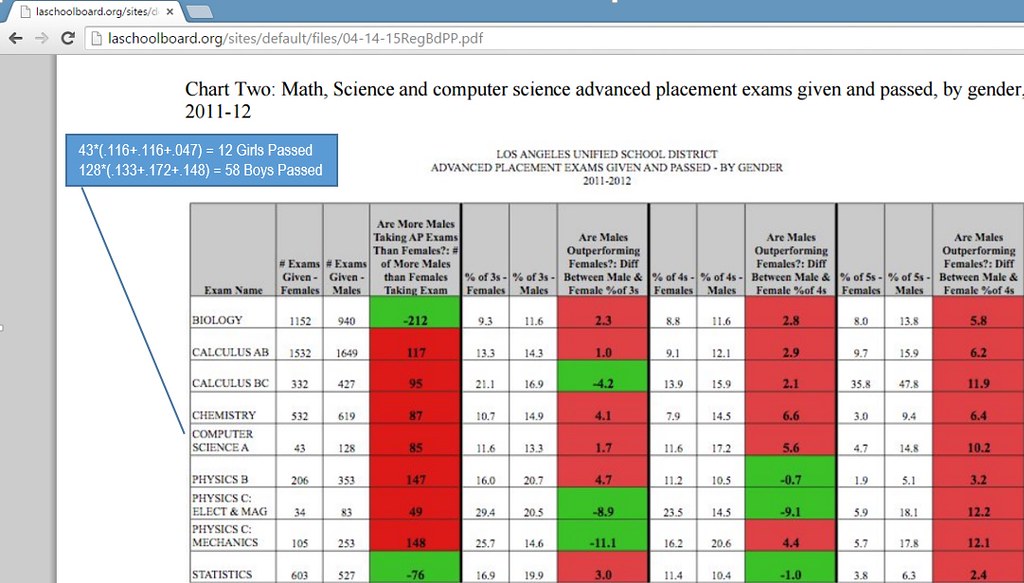
theodp writes: Citing statistics that showed a whopping 46 more boys than girls passed the AP Computer Science Exam in 2011-12, the 640,000+ student Los Angeles Unified School District (LAUSD) on Tuesday approved a waiver to enable the District to operate a single-gender, all-girls STEM School called the Girls Academic Leadership Academy (GALA). Students in GALA will follow a six year sequence of computer courses starting in middle school that will culminate in AP Computer Science Principles. "Fewer females take AP courses in math, science, or computer science, and they are not as successful as males in receiving passing scores of 3, 4 or 5," argued the General Waiver Request (PDF, 700+ pages). "An all girls environment is reasonably necessary for the school to improve the self-confidence of girls in their academic abilities, especially in STEM areas where an achievement gap currently exists. GALA's admissions shall also comply with AB 1266 to ensure male students who identify as female are admitted to the school." The school's CS-related Partners include the UCLA Exploring Computer Science Program, as well as Google-bankrolled Girls Who Code, Black Girls Code, and NCWIT. One of the reasons the all-girls STEM school reportedly got the green light is that its backers satisfied federal regulations requiring a "substantially equal school" for excluded male students by submitting a plan for a companion all-boys school that would emphasize English Language Arts, where they often fall short of girls' test scores, rather than GALA's focus on STEM. One suspects the no-fan-of-gender-restricted-public-schools ACLU may call BS on this maneuver. -
$1B TSA Behavioral Screening Program Slammed As "Junk Science"
schwit1 writes The Transportation Security Administration has been accused of spending a billion dollars on a passenger-screening program that's based on junk science. The claim arose in a lawsuit filed by the American Civil Liberties Union, which has tried unsuccessfully to get the TSA to release documents on its SPOT (Screening Passengers by Observation Techniques) program through the Freedom of Information Act. SPOT, whose techniques were first used in 2003 and formalized in 2007, uses "highly questionable" screening techniques, according to the ACLU complaint, while being "discriminatory, ineffective, pseudo-scientific, and wasteful of taxpayer money." TSA has spent at least $1 billion on SPOT. The Government Accountability Office (GAO) reported in 2010 that "TSA deployed SPOT nationwide before first determining whether there was a scientifically valid basis for using behavior detection and appearance indicators as a means for reliably identifying passengers as potential threats in airports," according to the ACLU. And in 2013, GAO recommended that the agency spend less money on the program, which uses 3,000 "behavior detection officers" whose jobs is to identify terrorists before they board jetliners. -
DEA Planned To Monitor Cars Parked At Gun Shows Using License Plate Readers
HughPickens.com writes According to a newly disclosed DEA email obtained by the ACLU through the Freedom of Information Act, the Drug Enforcement Administration and the Bureau of Alcohol, Tobacco, Firearms and Explosives collaborated on plans to monitor gun show attendees using automatic license plate readers. Responding to inquiries about the document, the DEA said that the monitoring of gun shows was merely a proposal and was never implemented. "The proposal in the email was only a suggestion. It was never authorized by DEA, and the idea under discussion in the email was never launched,'' says DEA administrator Michele Leonhart.
According to the Wall Street Journal the proposal shows the challenges and risks facing the U.S. as it looks to new, potentially intrusive surveillance technology to help stop criminals. Many of the government's recent efforts have scooped up data from innocent Americans, as well as those suspected of crimes, creating records that lawmakers and others say raise privacy concerns. "Automatic license plate readers must not be used to collect information on lawful activity — whether it be peacefully assembling for lawful purposes, or driving on the nation's highways," says the ACLU. "Without strong regulations and greater transparency, this new technology will only increase the threat of illegitimate government surveillance." National Rifle Association spokesman Andrew Arulanandam says the NRA is "looking into this to see if gun owners were improperly targeted, and has no further comment until we have all the facts." -
DEA Cameras Tracking Hundreds of Millions of Car Journeys Across the US
itwbennett writes: A U.S. Drug Enforcement Administration program set up in 2008 to keep tabs on cars close to the U.S.-Mexican border has been gradually expanded nationwide and is regularly used by other law enforcement agencies in their hunt for suspects. The extent of the system, which is said to contain hundreds of millions of records on motorists and their journeys, was disclosed in documents obtained by the American Civil Liberties Union as part of a Freedom of Information Act request. -
Federal Government Removes 7 Americans From No-Fly List
An anonymous reader writes: In response to a district judge ruling that declared the Department of Homeland Security's Traveler Redress Inquiry Program unconstitutional, the federal government has annouced its removal of seven Americans from its no-fly list (PDF). The American Civil Liberties Union (ACLU) is representing a total of 13 people suing to get off that list, and the government has until January of this year to deal with remaining six in that group. "Federal agencies have nominated more than 1.5 million names to terrorist watch lists over the past five years alone. Yet being a terrorist isn't a condition of getting on a roster that, until now, has been virtually impossible to be removed from..." One of the seven removed from the list is Marine Corps veteran and dog trainer Ibraheim Mashal of Illinois. The others had similarly Middle-Eastern-sounding names. -
First US Appeals Court Hears Arguments To Shut Down NSA Database
An anonymous reader writes: The second of two lawsuits filed against the U.S. government regarding domestic mass surveillance, ACLU vs. Clapper, was heard on Tuesday by "a three-judge panel on the U.S. Court of Appeals for the 2nd Circuit." The proceeding took an unprecedented two hours (the norm is about 30 minutes), and C-SPAN was allowed to record the whole thing and make the footage available online (video). ACLU's lawyers argued that mass surveillance without warrants violates the 4th Amendment, while lawyers for the federal government argued that provisions within the Patriot Act that legalize mass surveillance without warrants have already been carefully considered and approved by all three branches of government. The judges have yet to issue their ruling. -
Ross Ulbricht's Lawyer Requests Suppression Of Silk Road Evidence
Despite a failed attempt to have charges dismissed, the alleged Silk Road operator Ross Ulbricht's lawyer has filed a new motion to have evidence dismissed, citing recent court rulings in an argument that the Silk Road related searches were overly broad. From the article: Dratel [Ulbricht's lawyer] argues in his 102-page motion filed last Friday that "the government conducted a series of 14 searches and seizures of various physical devices containing electronically stored information ('ESI'), and of ESI itself from Internet providers and other sources. Some of the ESI was obtained via search warrant, but other ESI was obtained via court order, and still other ESI was obtained without benefit of any warrant at all." ...
The defense lawyer argues that even the searches for which the government had a warrant were overbroad and based on evidence that may have been obtained illegally. The attorney writes: " As set forth ante, all of the searches and seizures conducted pursuant to warrants and/or orders were based on the initial ability of the government to locate the Silk Road Servers, obtain the ESI on them, and perform extensive forensic analysis of that ESI. Thus, all subsequent searches and seizures are invalid if that initial locating the Silk Road Servers, obtaining their ESI, and gaining real-time continued access to those servers, was accomplished unlawfully." -
Federal Judge Rules US No-fly List Violates Constitution
New submitter dmitrygr sends this news from Reuters: The U.S. government's no-fly list banning people accused of links to terrorism from commercial flights violates their constitutional rights because it gives them no meaningful way to contest that decision, a federal judge ruled on Tuesday. ... "The court concludes international travel is not a mere convenience or luxury in this modern world. Indeed, for many international travel is a necessary aspect of liberties sacred to members of a free society," [U.S. District Judge Anna Brown] wrote in her 65-page ruling (PDF). "Accordingly, on this record the court concludes plaintiff's inclusion on the no-fly list constitutes a significant deprivation of their liberty interests in international travel," Brown said. -
Federal Judge Rules US No-fly List Violates Constitution
New submitter dmitrygr sends this news from Reuters: The U.S. government's no-fly list banning people accused of links to terrorism from commercial flights violates their constitutional rights because it gives them no meaningful way to contest that decision, a federal judge ruled on Tuesday. ... "The court concludes international travel is not a mere convenience or luxury in this modern world. Indeed, for many international travel is a necessary aspect of liberties sacred to members of a free society," [U.S. District Judge Anna Brown] wrote in her 65-page ruling (PDF). "Accordingly, on this record the court concludes plaintiff's inclusion on the no-fly list constitutes a significant deprivation of their liberty interests in international travel," Brown said. -
US Marshals Seize Police Stingray Records To Keep Them From the ACLU
An anonymous reader writes 'A routine request in Florida for public records regarding the use of a surveillance tool known as stingray took an extraordinary turn recently when federal authorities seized the documents before police could release them. "This is consistent with what we've seen around the country with federal agencies trying to meddle with public requests for stingray information," Wessler said, noting that federal authorities have in other cases invoked the Homeland Security Act to prevent the release of such records. "The feds are working very hard to block any release of this information to the public." ... "We've seen our fair share of federal government attempts to keep records about stingrays secret, but we've never seen an actual physical raid on state records in order to conceal them from public view," the ACLU wrote in a blog post today.' -
ACLU and EFF Endorse Weaker USA Freedom Act Passed By Committee
First time accepted submitter sumakor (3571543) writes "The House Judiciary Committee has advanced a weakened version of the USA Freedom Act (HR3361). The amended compromise version allows collection of phone call records up to two hops away from a target, potentially including millions of customer records, and allows for collection without a judge's order in emergency cases. The amended bill also drops the requirement for a privacy advocate who can appeal the rulings of the Foreign Intelligence Surveillance Court and extends the controversial Section 215 of the Patriot Act from 2015 through 2017.
Despite these significant changes the amended bill has been endorsed by the ACLU and the EFF as a first step and the most promising path towards reigning in government surveillance. The two organizations called for further Congressional measures to tighten control of surveillance authorities including an explicit definition of the term 'selector,' a reduction in the number of hops from 2 to 1 under most circumstances and the closing the loophole that allows searches of Americans' data inadvertently collected thru Section 702.
The bill now proceeds to the House Intelligence Committee, who has advanced its competing bill, the FISA Transparency and Modernization Act (HR 4291). The committee will mark up both bills on the same day, beginning at 10am Thursday, behind closed doors." -
Rand Paul Starts New Drone War In Congress
SonicSpike (242293) writes with news that the ACLU and Rand Paul both think every Senator should read David Barron's legal memos justifying the use of drones against an American citizen before he is confirmed to the 1st Circuit Court of Appeals. From the article: "Paul, the junior Republican senator from Kentucky, has informed Reid he will object to David Barron's nomination to the 1st Circuit Court of Appeals unless the Justice Department makes public the memos he authored justifying the killing of an American citizen in Yemen. The American Civil Liberties Union supports Paul's objection, giving some Democratic lawmakers extra incentive to support a delay to Barron's nomination, which could come to the floor in the next two weeks. Barron, formerly a lawyer in the Justice Department's Office of Legal Counsel, penned at least one secret legal memo approving the Sept. 2011 drone strike that killed Anwar al-Awlaki, a radical Muslim cleric whom intelligence officials accused of planning terrorist attacks against the United States." -
Edward Snowden and Laura Poitras Win Truth-Telling Award
An anonymous reader writes with news that Snowden has received the Ridenhour Truth-Telling award. From the announcement: "We have selected Edward Snowden and Laura Poitras for their work in exposing the NSA's illegal and unconstitutional bulk collection of the communications of millions of people living in the United States. Their act of courage was undertaken at great personal risk and has sparked a critical and transformative debate about mass surveillance in a country where privacy is considered a constitutional right." The award will be presented at the National Press Club. It is hoped that Snowden and Poitras will be able to appear remotely (Poitras is in effective exile in Berlin). In related news, the ACLU has indexed all publicly released documented leaked by Snowden. You can even full-text search them. -
One Person Successfully Removed From US No-Fly List
An anonymous reader writes "In February, Judge William Alsup ruled in favor of Rahinah Ibrahim, who sued the U.S. government in 2006 after she was mistakenly added to the no-fly list and subsequently denied entry to the country. Now, the Department of Justice has finally decided it won't appeal the ruling, making Ibrahim the first person to challenge the list at trial and get herself removed. 'But Ibrahim's case, as just one of hundreds of thousands of individuals who have been placed on such lists, shows the system's opacity. First, the only surefire way to even determine if one is on such a list in the U.S. is to attempt to board a flight and be denied. Even after that happens, when a denied person inquires about his or her status, the likely response will be that the government "can neither confirm nor deny" the placement on such lists. The government's surrender in Ibrahim comes on the heels of a new report by the American Civil Liberties Union that shows just how insanely difficult it is to contest one's status on the government blacklists (PDF).'" -
US Federal Judge Rules Suspicionless Border Searches of Laptops Constitutional
AHuxley writes "The American Civil Liberties Union sought to challenge the U.S. legal 'border exemption' three years ago. Can your laptop be seized and searched without reasonable suspicion at the border? A 32 page decision provides new legal insight into legal thinking around suspicionless searches: your electronic devices are searchable and seizable for any reason at the U.S. border. The ACLU may appeal. Also note the Kool-Aid comment: 'The report said that a reasonable suspicion standard is inadvisable because it could lead to litigation and the forced divulgence of national security information, and would prevent border officers from acting on inchoate "hunches," a method that it says has sometimes proved fruitful.'" It's even legal for them to copy the contents of your laptop for no reason at all, just in case they need to take a peek later. A bit of context from the ACLU: "The lawsuit was filed on behalf of Pascal Abidor, a dual French-American citizen who had his laptop searched and confiscated at the Canadian border ... Abidor was travelling from Montreal to New York on an Amtrak train in May 2010 when he had his laptop searched and confiscated by customs officers. Abidor, an Islamic Studies Ph.D. student at McGill University, was questioned, taken off the train in handcuffs, and held in a cell for several hours before being released without charge. When his laptop was returned 11 days later, there was evidence that many of his personal files had been searched, including photos and chats with his girlfriend." -
US Federal Judge Rules Suspicionless Border Searches of Laptops Constitutional
AHuxley writes "The American Civil Liberties Union sought to challenge the U.S. legal 'border exemption' three years ago. Can your laptop be seized and searched without reasonable suspicion at the border? A 32 page decision provides new legal insight into legal thinking around suspicionless searches: your electronic devices are searchable and seizable for any reason at the U.S. border. The ACLU may appeal. Also note the Kool-Aid comment: 'The report said that a reasonable suspicion standard is inadvisable because it could lead to litigation and the forced divulgence of national security information, and would prevent border officers from acting on inchoate "hunches," a method that it says has sometimes proved fruitful.'" It's even legal for them to copy the contents of your laptop for no reason at all, just in case they need to take a peek later. A bit of context from the ACLU: "The lawsuit was filed on behalf of Pascal Abidor, a dual French-American citizen who had his laptop searched and confiscated at the Canadian border ... Abidor was travelling from Montreal to New York on an Amtrak train in May 2010 when he had his laptop searched and confiscated by customs officers. Abidor, an Islamic Studies Ph.D. student at McGill University, was questioned, taken off the train in handcuffs, and held in a cell for several hours before being released without charge. When his laptop was returned 11 days later, there was evidence that many of his personal files had been searched, including photos and chats with his girlfriend." -
Boston Cops Outraged Over Plans to Watch Their Movements Using GPS
Hugh Pickens DOT Com writes "The Boston Globe reports that the pending use of GPS tracking devices, slated to be installed in Boston police cruisers, has many officers worried that commanders will monitor their every move. Boston police administrators say the system gives dispatchers the ability to see where officers are, rather than wait for a radio response and supervisors insist the system will improve their response to emergencies. Using GPS, they say, accelerates their response to a call for a shooting or an armed robbery. 'We'll be moving forward as quickly as possible,' says former police commissioner Edward F. Davis. 'There are an enormous amount of benefits. . . . This is clearly an important enhancement and should lead to further reductions in crime.' But some officers said they worry that under such a system they will have to explain their every move and possibly compromise their ability to court street sources. 'No one likes it. Who wants to be followed all over the place?' said one officer who spoke anonymously because department rules forbid police from speaking to the media without authorization. 'If I take my cruiser and I meet [reluctant witnesses] to talk, eventually they can follow me and say why were you in a back dark street for 45 minutes? It's going to open up a can of worms that can't be closed.' Meanwhile civil libertarians are relishing the rank and file's own backlash. 'The irony of police objecting to GPS technology for privacy reasons is hard to miss in the aftermath of United States v. Jones,' says Woodrow Hartzog. 'But the officers' concerns about privacy illustrate just how revealing GPS technology can be. Departments are going to have to confront the chilling effect this surveillance might have on police behavior.'" -
ACLU: Lavabit Was 'Fatally Undermined' By Demands For Encryption Keys
An anonymous reader writes "When encrypted email provider Lavabit shut down in August, it was because U.S. authorities demanded the company release encryption keys to get access to certain accounts. Lavabit's founder, Ladar Levison, is facing contempt of court charges for his refusal to acquiesce to their demands. But now the ACLU has filed a 'friend of the court' brief (PDF) in support of Levison, saying that the government's demand 'fatally undermined' the secure email service. 'Lavabit's business was predicated on offering a secure email service, and no company could possible tell its clients that it offers a secure service if its keys have been handed over to the government.' The ACLU added, 'The district court's contempt holding should be reversed, because the underlying orders requiring Lavabit to disclose its private keys imposed an unreasonable burden on the company. Although innocent third parties have a duty to assist law enforcement agents in their investigations, they also have a right not to be compelled "to render assistance without limitation regardless of the burden involved."' Lavabit is also defending itself by claiming a violation of the 4th amendment has occurred." -
DEA Argues Oregonians Have No Protected Privacy Interest In Prescription Records
schwit1 writes "Like emails and documents stored in the cloud, your prescription medical records may have a tenuous right to privacy. In response to a lawsuit filed by the American Civil Liberties Union (ACLU) over the privacy of certain medical records, the U.S. Drug Enforcement Administration is arguing (ACLU response) that citizens whose medical records are handed over to a pharmacy — or any other third-party — have 'no expectation of privacy' for that information." Oregon mandates that pharmacies report information on people receiving certain drugs to a centralized database (ostensibly to "...help people work with their health care providers and pharmacists to know what medications are best for them."). State law does allow law enforcement to access the records, but only with a warrant. The DEA, however, thinks that, because the program is public, a citizen is knowingly disclosing that information to a third party thus losing all of their privacy rights (since you can always just opt out of receiving medical care) thanks to the Controlled Substances Act. The ACLU and medical professionals (PDF) don't think there's anything voluntary about receiving medical treatment, and that medical ethics override other concerns. -
DEA Argues Oregonians Have No Protected Privacy Interest In Prescription Records
schwit1 writes "Like emails and documents stored in the cloud, your prescription medical records may have a tenuous right to privacy. In response to a lawsuit filed by the American Civil Liberties Union (ACLU) over the privacy of certain medical records, the U.S. Drug Enforcement Administration is arguing (ACLU response) that citizens whose medical records are handed over to a pharmacy — or any other third-party — have 'no expectation of privacy' for that information." Oregon mandates that pharmacies report information on people receiving certain drugs to a centralized database (ostensibly to "...help people work with their health care providers and pharmacists to know what medications are best for them."). State law does allow law enforcement to access the records, but only with a warrant. The DEA, however, thinks that, because the program is public, a citizen is knowingly disclosing that information to a third party thus losing all of their privacy rights (since you can always just opt out of receiving medical care) thanks to the Controlled Substances Act. The ACLU and medical professionals (PDF) don't think there's anything voluntary about receiving medical treatment, and that medical ethics override other concerns. -
DEA Argues Oregonians Have No Protected Privacy Interest In Prescription Records
schwit1 writes "Like emails and documents stored in the cloud, your prescription medical records may have a tenuous right to privacy. In response to a lawsuit filed by the American Civil Liberties Union (ACLU) over the privacy of certain medical records, the U.S. Drug Enforcement Administration is arguing (ACLU response) that citizens whose medical records are handed over to a pharmacy — or any other third-party — have 'no expectation of privacy' for that information." Oregon mandates that pharmacies report information on people receiving certain drugs to a centralized database (ostensibly to "...help people work with their health care providers and pharmacists to know what medications are best for them."). State law does allow law enforcement to access the records, but only with a warrant. The DEA, however, thinks that, because the program is public, a citizen is knowingly disclosing that information to a third party thus losing all of their privacy rights (since you can always just opt out of receiving medical care) thanks to the Controlled Substances Act. The ACLU and medical professionals (PDF) don't think there's anything voluntary about receiving medical treatment, and that medical ethics override other concerns. -
DEA Argues Oregonians Have No Protected Privacy Interest In Prescription Records
schwit1 writes "Like emails and documents stored in the cloud, your prescription medical records may have a tenuous right to privacy. In response to a lawsuit filed by the American Civil Liberties Union (ACLU) over the privacy of certain medical records, the U.S. Drug Enforcement Administration is arguing (ACLU response) that citizens whose medical records are handed over to a pharmacy — or any other third-party — have 'no expectation of privacy' for that information." Oregon mandates that pharmacies report information on people receiving certain drugs to a centralized database (ostensibly to "...help people work with their health care providers and pharmacists to know what medications are best for them."). State law does allow law enforcement to access the records, but only with a warrant. The DEA, however, thinks that, because the program is public, a citizen is knowingly disclosing that information to a third party thus losing all of their privacy rights (since you can always just opt out of receiving medical care) thanks to the Controlled Substances Act. The ACLU and medical professionals (PDF) don't think there's anything voluntary about receiving medical treatment, and that medical ethics override other concerns. -
Device Security: How Border Searches Are Really Used
onehitwonder writes "Newly released documents reveal how the government uses border crossings to seize and examine travelers' electronic devices instead of obtaining a search warrant to take them, according to The New York Times' Susan Stellin. The documents reveal what had been a mostly secretive process that allows the government to create a travel alert for a person (regardless of whether they're a suspect in an investigation), then detain that individual at a border crossing and confiscate or copy any electronic devices that person is carrying. The documents come courtesy of David House, a fund-raiser for the legal defense of Chelsea Manning, formerly known as Pfc. Bradley Manning." A post at the ACLU blog (besides being free of NYT paywall headaches) gives more details, and provides handy links the documents themselves. -
Device Security: How Border Searches Are Really Used
onehitwonder writes "Newly released documents reveal how the government uses border crossings to seize and examine travelers' electronic devices instead of obtaining a search warrant to take them, according to The New York Times' Susan Stellin. The documents reveal what had been a mostly secretive process that allows the government to create a travel alert for a person (regardless of whether they're a suspect in an investigation), then detain that individual at a border crossing and confiscate or copy any electronic devices that person is carrying. The documents come courtesy of David House, a fund-raiser for the legal defense of Chelsea Manning, formerly known as Pfc. Bradley Manning." A post at the ACLU blog (besides being free of NYT paywall headaches) gives more details, and provides handy links the documents themselves. -
One Strike Against No Fly List; More Scrutiny To Come
New submitter MickyTheIdiot writes "The Jurist reports: 'A judge for the U.S. District Court for the District of Oregon ruled Wednesday (PDF) that those placed on the U.S. government's no-fly list have 'a constitutionally-protected liberty interest in traveling internationally by air, which is affected by being placed on the No Fly List.' The plaintiffs in the case are 13 U.S. citizens who were denied boarding on flights over U.S. airspace after January 2009.' Judge Anna Brown hasn't ruled on the constitutionality of the No Fly List yet, and has instructed the attorneys involved to present a roadmap for deciding the remaining issues. However, she has acknowledged that the No Fly List is a major burden to those on the list and they have the right to get that status reviewed." -
Google Asks Government For More Transparency, Other Groups Push Back Against NSA
Nerval's Lobster writes "In an open letter addressed to U.S. attorney general Eric Holder and FBI director Robert Mueller, Google chief legal officer David Drummond again insisted that reports of his company freely offering user data to the NSA and other agencies were untrue. 'However,' he wrote, 'government nondisclosure obligations regarding the number of FISA national security requests that Google receives, as well as the number of accounts covered by those requests, fuel that speculation.' In light of that, Drummond had a request of the two men: 'We therefore ask you to help make it possible for Google to publish in our Transparency Report aggregate numbers of national security requests, including FISA disclosures—in terms of both the number we receive and their scope.' Apparently Google's numbers would show 'that our compliance with these requests falls far short of the claims being made.' Google, Drummond added, 'has nothing to hide.'" Another open letter was sent to Congress from a variety of internet companies and civil liberties groups (headlined by Mozilla, the EFF, the ACLU, and the FSF), asking them to enact legislation to prohibit the kind of surveillance apparently going on at the NSA and to hold accountable the people who implemented it. (A bipartisan group of senators has just come forth with legislation that would end such surveillance.) In addition to the letter, the ACLU sent a lawsuit as well, directed at President Obama, Eric Holder, the NSA, Verizon and the Dept. of Justice (filing, PDF). They've also asked (PDF) for a release of court records relevant to the scandal. Mozilla has also launched Stopwatching.us, a campaign to "demand a full accounting of the extent to which our online data, communications and interactions are being monitored." Other reactions: Tim Berners-Lee is against it, Australia's Foreign Minister doesn't mind it, the European Parliament has denounced it, and John Oliver is hilarious about it (video). Meanwhile, Edward Snowden, the whistleblower who leaked the information about the NSA's surveillance program, is being praised widely as a hero and a patriot. There's already a petition on Whitehouse.gov to pardon him for his involvement, and it's already reached half the required number of signatures for a response from the Obama administration. -
Fed. Appeals Court Says Police Need Warrant to Search Phone
An anonymous reader writes "In a decision that's almost certainly going to result in this issue heading up to the Supreme Court, the Federal 1st Circuit Court of Appeals [Friday] ruled that police can't search your phone when they arrest you without a warrant. That's contrary to most courts' previous findings in these kinds of cases where judges have allowed warrantless searches through cell phones." (But in line with the recently mentioned decision in Florida, and seemingly with common sense.)