Slashdot Mirror
Domain: agu.org
Stories and comments across the archive that link to agu.org.
Comments · 331
-
Re:Bullshit
Did you read the DRAFT paper you cited.
That's because it's the publically accessible version. Here's the version you want if you're on campus. Citation: Annan, J. D., and J. C. Hargreaves (2006), Using multiple observationally-based constraints to estimate climate sensitivity, Geophys. Res. Lett., 33, L06704, doi:10.1029/2005GL025259.
I've already discussed the lag between temperature and CO2. Aside from your conspiracy theories, the only other thing you say is that model parameterizations in general can't be used to learn about the universe. What a weird attitude coming from someone who's using technology created with the help of computer models!
-
Re:So let me get this straight
If you want to learn more about the effects of CO2 on climate you should watch the Bjerknes Lecture from the recently concluded American Geophysical Union conference in San Fransisco. In it Richard B. Alley calls CO2 the "biggest control knob" on climate. IOW while other things have have their effects, over and over again when they examine paleoclimate it fundamentally comes back to CO2 as a primary reason for the particular climate. You can see the lecture here.
AC to preserve mods.
-
Re:Is there any way to avoid disaster?
There has been some evidence that the Toba supervolcano in Indonesia nearly wiped out Homo Sapiens and contributed to a genetic bottleneck.
http://www.agu.org/pubs/crossref/2009/2008JD011652.shtml
http://en.wikipedia.org/wiki/Toba_catastrophe_theory -
Re:Modern-Day Galileo
When geologists start telling me its time to panic, I'll panic.
They are. Read the statement of the American Geophysical Union. That statement is also supported by the Geological Society of America [PDF].
-
Meanwhile, back in reality...
You are quite right: this is pure politics, and has no impact on the actual science. People are making a big deal of this who do not understand that scientific theory rests on multiple, independent, reproducable lines of evidence and does not depend on the credibility of one particular institution. The laws of physics don't change because someone hacked someone's email.
This "scandal" is a tempest in a teapot, with much political but little scientific significance.
Meanwhile, back in reality, the ice caps are melting, the oceans are warming, the last decade was the hottest on record, and the current warming is unprecedented for at least 1300 years. I am a big fan of The Hitchhiker's Guide, so I don't think panic is ever an appropriate reaction, but there is plenty of cause for strong action to reduce the risk of catastrophic climate change.
-
Re:Great...
No, 2007 was not the 'steepest drop' in arctic ice cover, it was the 'smallest minimum extent' recorded. The increase and decrease in arctic ice cover follows the seasonal cycle and the rate of the decrease and increase in the seasonal change is similar from year to year. It is the 'minimum' and 'maximum' extent of the ice cover during the year that are of interest as a monitor of climate warming or cooling.
Thanks for the lecture about seasons; it would've been informative if I were still in elementary school. If you'd clicked on the "steepest drop" link, you'd notice that the plot's title is "Sea ice area at summer minimum." A casual visual inspection will confirm the peer-reviewed conclusion that the summer minimum experienced its steepest drop from 2006-2007.
The increase in the 'minimum' extent in 2008 and 2009 indicate a cooling trend that cannot be attributed to carbon dioxide or greenhouse gases since the concentration of those has increased during that time period.
Well, first of all it's not that simple. Ice extent at the summer minimum is just one observable, others include duration of the melt season, and thickness of the ice.
More importantly, please recognize that climate models don't predict monotonic warming. This strawman you're attacking simply doesn't exist. Short-term variability is expected; long-term averages are what's important.
If you want to claim that cooling somehow validates the models (which it obviously does not)...
The models predicted drops in sea ice extent, but nothing like the drop observed in 2007. If the drop in 2007 had continued for (at least) several years, that would've been a genuine climatic signal rather than short-term variability due to weather. But since the models never predicted such an extreme drop, that would've indicated that the models were flawed.
... you need to explain where a significant amount of planetary heat is being stored since the 'greenhouse gas' theory of planetary warming requires that the amount of heat being radiated from the earth must continuously decrease.
Contrary to popular belief, climatologists aren't denying the fact that natural variations such as changes in the Sun's brightness affect the climate. Climatologists aren't saying that our emissions are completely responsible for everything that's happening to the climate. It's just that once we account for all known natural variations, an artificial signal remains which is best explained by accounting for greenhouse gas emissions.
For example, modern dynamical climate models can't account for the physics of El Nino and La Nina events. Usually, circulation in the Pacific ocean sends cold water to the surface which serves to cool the atmosphere by warming the ocean. El Nino pauses that upwelling of cold water, thus warming the atmosphere by reducing the rate at which heat from the atmosphere is dumped into the ocean. La Nina does the opposite; it intensifies the upwelling of cold water, which draws more heat than usual from the atmosphere. The large dip in atmospheric temperatures in 2008 occurred because of a significant La Nina. These short-lived events have no effect on the long-term climate because they merely swap heat between the oceans and atmosphere. But they do make it difficult to use either ocean or atmosphere temperatures alone to st
-
Re:Great...
No, 2007 was not the 'steepest drop' in arctic ice cover, it was the 'smallest minimum extent' recorded. The increase and decrease in arctic ice cover follows the seasonal cycle and the rate of the decrease and increase in the seasonal change is similar from year to year. It is the 'minimum' and 'maximum' extent of the ice cover during the year that are of interest as a monitor of climate warming or cooling.
Thanks for the lecture about seasons; it would've been informative if I were still in elementary school. If you'd clicked on the "steepest drop" link, you'd notice that the plot's title is "Sea ice area at summer minimum." A casual visual inspection will confirm the peer-reviewed conclusion that the summer minimum experienced its steepest drop from 2006-2007.
The increase in the 'minimum' extent in 2008 and 2009 indicate a cooling trend that cannot be attributed to carbon dioxide or greenhouse gases since the concentration of those has increased during that time period.
Well, first of all it's not that simple. Ice extent at the summer minimum is just one observable, others include duration of the melt season, and thickness of the ice.
More importantly, please recognize that climate models don't predict monotonic warming. This strawman you're attacking simply doesn't exist. Short-term variability is expected; long-term averages are what's important.
If you want to claim that cooling somehow validates the models (which it obviously does not)...
The models predicted drops in sea ice extent, but nothing like the drop observed in 2007. If the drop in 2007 had continued for (at least) several years, that would've been a genuine climatic signal rather than short-term variability due to weather. But since the models never predicted such an extreme drop, that would've indicated that the models were flawed.
... you need to explain where a significant amount of planetary heat is being stored since the 'greenhouse gas' theory of planetary warming requires that the amount of heat being radiated from the earth must continuously decrease.
Contrary to popular belief, climatologists aren't denying the fact that natural variations such as changes in the Sun's brightness affect the climate. Climatologists aren't saying that our emissions are completely responsible for everything that's happening to the climate. It's just that once we account for all known natural variations, an artificial signal remains which is best explained by accounting for greenhouse gas emissions.
For example, modern dynamical climate models can't account for the physics of El Nino and La Nina events. Usually, circulation in the Pacific ocean sends cold water to the surface which serves to cool the atmosphere by warming the ocean. El Nino pauses that upwelling of cold water, thus warming the atmosphere by reducing the rate at which heat from the atmosphere is dumped into the ocean. La Nina does the opposite; it intensifies the upwelling of cold water, which draws more heat than usual from the atmosphere. The large dip in atmospheric temperatures in 2008 occurred because of a significant La Nina. These short-lived events have no effect on the long-term climate because they merely swap heat between the oceans and atmosphere. But they do make it difficult to use either ocean or atmosphere temperatures alone to st
-
Climate Models Proved Useless
The Earth isn't following the climate models, it missed the memo. Truth is we're at 1930s level of average global temperatures with the recent fall.
http://www.spiegel.de/international/world/0,1518,662092,00.html
It's time to start listening to real geophysicists and not "climatologists", whatever the hell those are. I didn't see degree in that field offered when I began my physics degree. The truth is that while the Antarctic Peninsula has warmed, it's 0.5% of the land mass there while the other 99.5% of Antarctica has been *cooling* since the 1960s. That's real science, folks. http://www.agu.org/pubs/crossref/2008/2007JD009094.shtml
"The sea levels are rising!". The sea levels have been rising for over 10,000 years, and for most of that at a rate of over a meter per 200 years, thankfully it's slowed down the past 2,000 years!
"Carbon dioxide levels are at record high, it's a dangerous greenhouse gas!". The dominant greenhouse gas on planet earth is water vapor, its effect far outweigh the effects of all other greenhouse gases combined! Carbon dioxide is reactive, it increases after the earth warms. horse. cart. Warm some soda pop the the stove and see what happens. Carbon dioxide levels about the pan increase!
Note how the world leaders are rushing to get climate protocols in place before the real truth gets out, that the earth is cooling in response to Sun output at record low in last three years compared to last 50+ years. Solar output at record high in late 90s. Sun driving climate, what a shocker.
-
Re:But it goes beyond the computer models.
I've already discussed this issue:
Surfacestations.org is saying that the surface temperature record is contaminated by the "urban heat island" effect-- that temperatures are only rising around cities because of economic growth. One example he shows is that exhaust vents have been placed closer and closer to the sensors over the years.
This is a superficially compelling argument, but it's also one that scientists have considered and rejected. One test is that the urban heat island effect should be less pronounced on windy days than calm days. That's because if this warming is just caused by local exhaust vents, wind should carry that heat away whereas calm weather won't. This doesn't happen: calm and windy days have the same warming trend. This conclusion is from an article published in Nature by Dr. Parker in 2004; here's a BBC article quoting it. Other studies have confirmed this result using different methods and data in 2003, 2006, and 2008.
NOAA recently published an answer to that specific website. They took the 70 stations that surfacestations.org designated "best" or "good" and created a time series based on them. Then they used all 1218 stations to create another time series. Both of those time series are plotted on page 3. They're practically identical.
Also, scientists don't have to blindly trust these sensors because surface temperature measurements are also confirmed by satellite measurements and proxies such as ice cores, boreholes, coral growth, tree rings, stalactites, fossil beds, ocean sediments and glacial deposits.
-
Re:Prediction depends on an unproven thesis
But what difference does it make that they don't include x-ray and EUV output in TSI if they are cycling in conjunction with the 2000 nm to 200 nm window anyway?
The big difference is that it allows people to reject the sun as causative. The relatively minor variations in the TSI measurements that do not include EUV+X-rays (1365 W/m^2 plus or minus 0.5W/m^2) suggest a global temperature effect of only +/- 0.03K or so. This is markedly less than the 0.1K-0.2K (depending on whom to believe) per decade global temperature rise measured during the 1970-2000 period. That, plus the fact that most of the variation is short-term (goes with the solar cycle) has led people to ignore the sun.
In order for them to be a factor in climate change they would have to be monolithically increasing over time. Do you have evidence that is happening?
Yes, see this paper. Quoting from the conclusion of that paper:
"This finding has evident repercussions for climate change and solar physics. Increasing TSI between 1980 and 2000 could have contributed significantly to global warming during the last three decades [Scafetta and West, 2007, 2008]. Current climate models [Intergovernmental Panel on Climate Change, 2007] have assumed that the TSI did not vary significantly during the last 30 years and have therefore underestimated the solar contribution and overestimated the anthropogenic contribution to global warming."
-
Re:Showboating
Finally, there is no discernable rise in sea level in any major Australian port
e.g.
I always thought that water always sought its own level, so tidal effects aside, if the sea is rising in the Maldives it should be rising everywhere.
I thought so as well, but — apparently not.
From Wikipedia: "Future sea level rise, like the recent rise, is not expected to be globally uniform (details below). Some regions show a sea-level rise substantially more than the global average (in many cases of more than twice the average), and others a sea level fall.[29] However, models disagree as to the likely pattern of sea level change." (There are other sources as well).
IMHO, there obviously are processes that lead to climate change, sea level rise etc.. — but humanity cannot do much about it, as the system is already on its way and time lags involved as well as (missing) ability to issue control prevent process termination.
Besides, I am to old to get involved.
CC. -
Re:global coolingThat's all fine and dandy, but there is no correlation between cosmic ray activity and cloud formation.
http://www.agu.org/pubs/crossref/2002/2001JD000560.shtml
http://www.sciencedaily.com/releases/2008/12/081217075138.htmThe Maunder minimum was a period of low sunspot activity in the mid 1600s to early 1700s. The "Little Ice Age" lasted from about 1250 (when the arctic ice pack started to grow at an accelerated rate) to about 1820. What does something that happened around 1650 have to do with something that started in 1250?
We've been experiencing a low sunspot activity period since about 1985, during which time we have experienced the highest temperatures on record.
http://en.wikipedia.org/wiki/File:Temp-sunspot-co2.svg -
Re:global cooling
Your research is a little old. try finding some newer research to back up your arguments. Of course not many people are working on this hypothesis. Scientists are very busy cherry picking dendro-proxies to make it look like recent warming is unprecidented. They don't have much time for solar variance.
-
Re:Snow compactness?
Heh. Having read the paper, it seems that it's not that simple, unfortunately. However, they seem to have assumed a standard model for snow:
We assumed density of 240 kg m3 for the new snow and a snow temperature of 2C ( = 1.48 i2.76 × 104), after Jacobson [2008].
-
Your might think it's unimportant.
All jokes aside, the western US and Canada are completely reliant on snow pack for water supply. No snow, and you have severe drought. Knowing what is happening with snow pack is a huge issue there and in may other places in the world.
-
Re:So, we've discovered
not really, no. Satellite radar altimetry is just simple time domain reflectometry. Send a pulse of light, microwaves, whatever and use the elapsed time (along with knowledge of the speed of light) until hearing the echo to determine distance, subtract ephemeris data describing the satellite's orbit and get alitmetry out. Done. That is not at all what is being done here. So far as I know, there is no way of directly measuring snow depth from a satellite. If you're in orbit at 400 miles up trying to measure snowpack with even a ridiculously huge +/-1 foot accuracy, you're going to need less than 0.5ppm precision measurements on your reflectometry time - I have to think that the atmospheric-transit pulse broadening alone would smear that type of precision to hell, even with LIDAR. No, this technique uses a very clever, much more nuanced method to detect snow depth. They're modeling multi-path reflections of GPS signals off the ground using knowledge of the dielectric constant and surface roughness of the material being reflected off of, and the satellite elevation angle and antenna gain profile of the receiver, among other things, to model the effects of snow cover on signal to noise ratio, which is directly measurable by the GPS reciever. It's really a very solid piece of work http://www.agu.org/pubs/crossref/2009/2009GL039430.shtml . We already have the SNOTEL network of meteorology and snow depth detection stations in the western US, which is made up of several hundred individual sites. However, while SNOTEL is a large system (really a gorgeously designed piece of parsimonious engineering if you ask me - small solar powered stations sitting out in the middle of nowhere patiently listen for reflections of radio waves off of meteors in the upper atmosphere, and upon hearing them, send a quick burst of the day's collected data out, which reflects off of the few-second-lived plasma tail of the burnt-up meteoroid, which is then detected by a central ground station in Boise. fantastic!) but the US is BIG, and getting more accurate detailed maps of snow cover over larger areas using already in place equipment is a very cute trick that could have important implications for monitoring, for instance, global warming effects over long periods of time.
-
Re:Do they know if this is unusual?
Higher average global temperatures imply higher upper ocean temperatures, which imply a higher water vapor pressure. Thus more water vapor will evaporate into the atmosphere. Yes, Roderick 2007 showed that wind speed had a stronger affect on the evaporation rate than changes in temperature, but I doubt that affects the expected theoretical equilibrium vapor pressure from basic thermodynamics. When that more humid air is carried across a tall mountain range, its temperature decreases and the water precipitates.
(I'm the AC you responded to).
While searching for an elevation map of Greenland I came across a map showing rates of surface-elevation change. It's tangental to my specific point, but I found it interesting nonetheless. I don't have access to recent climate data indicating evaporation rates, rainfall, or quantity of particulate matter in the atmosphere, but in the Horizon episode they asserted that there was a decrease in rainfall because extra particulate matter in the atmosphere created more water droplets that -- in aggregate -- were too small to form rain. Even if warmer temperatures were to increase evaporation, there are other factors involved in the amount of rainfall that would result from increased evaporation. The evidence presented thus far is a decrease in rainfall, not an increase. But, as I said, I don't have access to the raw data required to prove that definitively either way.
-
Re:Do they know if this is unusual?
Higher average global temperatures imply higher upper ocean temperatures, which imply a higher water vapor pressure. Thus more water vapor will evaporate into the atmosphere. Yes, Roderick 2007 showed that wind speed had a stronger affect on the evaporation rate than changes in temperature, but I doubt that affects the expected theoretical equilibrium vapor pressure from basic thermodynamics. When that more humid air is carried across a tall mountain range, its temperature decreases and the water precipitates.
-
Re:Science =! Public Policy
Nice selective quote, the sentance that precedes it was "...it's a political thing on both sides, the left have their 'truthers' and the right have their 'birthers' both as equally bat-shit crazy".
Presumably for your own political reasons you chose to ignore that and start into a rant about how the right are acting rationally and the left are bat-shit crazy. Then you go on to dissmiss Hansen because you don't trust him. That right there my friend is called arguing from authority and is no different to the creationist habit of calling people "Darwinists" in an effort to make the argument about choosing between God's authority and Darwin's authority (neither of which actually exist in any tangible form).
Besides, if Hansen is a liar and a cheat, how do you explain "alarmist" articles such as this one in Nature or this list of similar articles in Science, are they all part of the left-wing "cosensus" conspiracy? Do you really belive that they all respect Hansen because he is the second in command behind Gore in their conspiracy, or is it because your politics won't allow to consider that they might actually respect him because his predictions have been remarkably **accurate?
"...it is HONEST to disregard the word of someone who's been caught altering data to suit his conclusions time and again".
Yes, lying is dishonest, so why are you clinging on to your beliefs by inventing/repeating lies about Hansen? And why do lie to yourself by ignoring the mountain of data, observations, experiments, and predictions that do not suit your conclusions? Are you paid to make such "grassroot" comments? Or are you really gullible enough to fall for the anti-science conspiracy theories of less rationalright wing think tankslobbyists?
**A selction of Hansens accurate predictions, I belive the first four were made in his now famous 1988(?) testimony to the senate...
# - Cooling stratosphere. - observed by sattelite and used by (amoung others) Bob Carter to confuse people.
# - More warming over land and ice - observed
# - More warming over poles - observed, the phenomena is now known as Polar Amplification .
# - More warming in the winter - observed (IPCC 2007).
# - Rapid disintergration of Artic sea ice - observed (NSIDC,WMO,NOAA,ect).
You would think people who call themselves geeks would point out that Hansen made all those predictions using the much maligned computer models rather than poo-pooing the whole idea of models, as is often the case here on slashdot. I have argued with thousands of people like you over the last decade or so, over that time people with your opinion on AGW have shrunk dramatically due solely to the overwhelming weight of the evidence.
"look at a major problem in the medical world today."
Good idea!
I agree some drug companies attempt to abuse the scientific process even going to extremes such as publishing their own journals through front groups. They use the same disinformation methods as the tabacco industry uses for it's propoganda, which also happens to be identical to the disinformation methods that the fossil fuel companies are (successfully) using on you. If you were alive duri -
Re:and natural CO2 production is 20x mans
It looks to me like the earth has been going through warm spikes for a lot longer than we've been around. Our current spike started well before mankind was doing much of anything. One could even conjecture that we're around because it got warmer...
- We're talking about spikes in CO2, not temperature. One way to see that the current climate change is artificial is that the spike in CO2 is happening before the temperature spike rather than centuries afterwards like in the natural record.
- I've already said that the climate varies on long timescales but that Meehl 2004 shows the current warming can't be accounted for by natural forcings. Greenhouse gas emissions are the only way we can explain the temperatures over the last ~40 years. And as I've said, it's quite easy to measure our emitted CO2 because governments tax oil and coal. Those estimates are easily high enough to account for the sudden increase in CO2. We're definitely causing the CO2 spike, and it's very likely causing the temperatures to increase at a rate that's likely to be dangerous.
- Again, as I've repeatedly stressed, events such as Heinrich and Dansgaard-Oeschger events are the best examples of abrupt climate change in the paleoclimate record. These are well known in the climatology community, but they're different from what's happening today for reasons I just mentioned. These ancient events are worrying, though, because they show the climate has a propensity to shift quickly from one state to another, given even small forcings.
As far as "rates of change" go, I'm not certain you can say much at all about the long term history without better resolution in the data. For instance, the rate could vary quite wildly in the blink of 100 years, but that would be blurred in the long term record. These ice and sediment cores implement a nice low pass filter based on how they accumulated and are measured.
Yes, ice core data are smoothed by diffusion and compaction, but studies like Delmotte 2004 and Jouzel 2007 have examined the data at a resolution of ~100 years and largely support the conclusions in the original Vostok and EPICA papers.
Of course, you could respond that decadal variations could exist, but to the best of my knowledge no known natural mechanism exists that could allow CO2 to fluctuate so wildly so quickly. Actually, the Siberian traps may qualify as a plausible natural source, but what sink could possibly have absorbed the CO2 quickly enough to drive the level down far enough below the average for the low-pass signal to record no evidence of this event?
-
Re:Ice melting or technological advance ?
We've known that the Arctic ice has been melting for quite some time. Not only is the surface area of the ice decreasing, but the total volume of Arctic ice is also decreasing. In a few decades, the Arctic might be completely ice free during the summer.
-
Re:Oh, I don't know, but
I counter your ice melting with this Antarctic ice increasing:
Sea Ice May Be On Increase In The Antarctic
Late 20th Century increase in South Pole snow accumulation
South Pole: Ice Core and Snow Accumulation Studies
I'm not worried about global warming. I do however enjoy having clean air to breath. Those of you who have been to China in the last decade know what I'm talking about. -
Re:Not the OP, but a physics-based criticism.What mistakes - specifics examples from his 2005 paper please?
Read the McIntyre and McKitrick (2005) report. It's been discreted by Rutherford et al. (2005) If you read my post carefully, you'll realise that I made those accusations, and backed them up by referring to Rutherford's paper. For the lazy, this is the short of it:- M&M used the wrong version of Mann et al. (1998). (that should be enough right there.)
- M&M eliminated 70% of Mann's data due to some methodological misunderstanding. (I will not summerize, you must read. It's on page 13-14.)
- Mann et al.s reconstruction is reproducible, and within close approximation (2 standard deviations) of other methods. M&M's is not.
- Interestingly, the hockey stick does appear in a reconstruction using M&M's method and subset of data. This fact is left out of their report.
Good enough? If not, I don't care - honestly. There's a whole page on McIntyre and McKitrick myths. I think James Annan said it best on google-groups: Steve McIntyre has found a molehill and is doing his best to make a mountain out of it.
"I want to know what the observed experimental data is, from a ~10 meter tube, or the observed atmosphere, or such, not computer models" - the absorption spectrum of CO2 is measured by a spectrometer over ~1cm, I think it's important to have done the (simple) experiment that would verify we know how CO2 behaves over longer distances, if it's a fundamental part of our models.
Here is a derivation. Here is an article on observations of CO2 absorption. Also, the linked diagram was observational data.
I did some googling, and I think I found the argument your putting forward - that CO2 absorption saturates after 10m. See here
My specific claim about standard deviation is that no one has taken the observed temperature readings, and calculated the standard deviation from that, for 1 day, 1 week, 1 month, and 1 year. If you've read a paper which has this value, please provide a quote, and link.
Is this some oblique way to assert that prediction models don't have standard deviations built into them? Here is a model from 2002, that includes variance of estimates
Anyway, you wanted to know what's wrong with the equation you specified, *I don't care about the rest*. Please upload a well-formated copy somewhere, with the numbers and working for Earth and Venus. I'll figure it out and get back to you.
It's rather disingenuous to expect me to provide a simpler derivation
If you say so, however, I'm not after a simpler derivation. I'd like to see your working with your numbers, and formatted so I can read it without having to write is out from scratch. I don't want to do the leg work only to have you tell me I didn't do it right. I want to see you do it, and be happy with the equation, and then I'll do the leg work. -
Re:Driving BlindYour link is based on Jones et al (2008), whose chief conclusion was that urban warming accounts for about one degree per century of the measured surface trend in China. Or to quote from the abstract
Urban-related warming over China is shown to be about 0.1ÂC/decade over the period 1951â"2004, with true climatic warming accounting for 0.81ÂC over this period"
Cute, isn't it, how he compares a rate-per-decade with a rate-per-specific-54-year-period in order to make the former appear small. Here's a chart of China's warming since 1900; if UHI accounts for 0.1ÂC/decade there's not much left. The other plots featured - the ones that don't involve China - are basically cover fire, answering a claim nobody made. But it actually gets better than that. Jones claims urban trends are carefully accounted for in the NASA data, but the nature of these corrections is basically a secret. Jones is famously uncooperative with anyone who wants to look at the source data and try to reproduce his calculations. Jones is the one who said:
We have 25 or so years invested in the work. Why should I make the data available to you, when your aim is to try and find something wrong with it.
-
Re:Now I know who to blame
When you publish in a scientific journal, you typically have to transfer the copyright (but not other rights) to the journal before they can publish it.
From the American Geophysical Union's copyright transfer form:
The Copyright Law enacted in 1978 requires the American Geophysical Union to obtain specific rights to articles published. This legal requirement does not alter in any way the long-standing relationship between AGU and its authors, nor does it change the philosophy behind our practice of copyrighting our journals and books.
AGU's philosophy recognizes the need to ensure that authors have a say in how their works are used and the necessity to foster broad dissemination of scientific literature while protecting the viability of the publication system. Authors still retain all proprietary rights other than copyright (such as patent rights), the right to present the material orally, the right to reproduce figures, tables, and extracts properly cited, and the right to deny subsequent commercial use of the paper." -
Re:So
OK, here's the actual paper:
http://www.agu.org/pubs/crossref/2008/2008GL034791.shtml -
Re:PS:
You do realise journals are ranked in acedemia don't you, Nature is ranked #1, I threw in the lowly Science rag as backup.
Academia? You're serious? Academia is a liberal bastion of socialist thought by people who couldn't get a job doing what they teach. Of course, they do good work on occasion, but never rely on a single source for information.
Refer to the NASA link and the previous list of 50 Nature and science articles. Also the site you link to does not mention that climate models predicted higher rates of warming in the Artic and The antartic pennisula, exactly what we have been observing, see IPCC wrt polar amplification.
First, I have provided my own data that shows Antarcica is NOT losing ice, or more precisely, the Souther Hemisphere is not losing ice. The difference is that my data had numbers. It showed that the ice had increased and by how much. Your data had some guy saying that Antarctica is losing ice. Sorry, but I need numbers and the raw data, not a conclusion from some guy who is looking to insure funding.
Of course, I respect NASA and NASA does good work. However, as you have said yourself, they screw up from time to time. Why just read this slashdot article that tells how NASA went with an older, less accurate method of measuring ice because more accurate data would negate the older, less accurate data. Seriously! Now are these measurements you bring up from NASA using the older "sensor drifting" tech? Yes they are because it's what NASA uses! Here's a quote from the article:
Today, however, they say that they have been the victims of 'sensor drift' that led to an underestimation of Arctic ice extent by as much as 500,000 square kilometers. The problem was discovered after they received emails from puzzled readers, asking why obviously sea-ice-covered regions were showing up as ice-free, open ocean. It turns out that the NSIDC relies on an older, less-reliable method of tracking sea ice extent called SSM/I that does not agree with a newer method called AMSR-E. So why doesn't NSIDC use the newer AMSR-E data? 'We do not use AMSR-E data in our analysis because it is not consistent with our historical data.
GRACE is not as accurate as you would believe either. I noticed that your searches were limited to two sources and GRACE data only.
So, who do you believe? Do you believe your sources that say Greenland and Antarctica are melting? Do you believe the sources that are counter to that?
The result is a mixed picture, with a net increase of 6.4 centimetres per year in the interior area above 1500 metres elevation. Below that altitude, the elevation-change rate is minus 2.0 cm per year, broadly matching reported thinning in the ice-sheet margins. The trend below 1500 metres however does not include the steeply-sloping marginal areas where current altimeter data are unusable.
The spatially averaged increase is 5.4 cm per year over the study area, when corrected for post-Ice Age uplift of the bedrock beneath the ice sheet. These results are remarkable because they are in contrast to previous scientific findings of balance in Greenland's high-elevation ice.
Truth is that you don't know. The scientists don't know. No one knows for sure. When you find a source that says they don't know, that's the one you believe. You rely on data, not opinion. Make your own analysis, don't rely on someone else's.
As for the climate prediction models you mentioned.... which ones? The ones that say we'll increase our temperature by 1.6 degrees over the next 100 years? How about the ones that say that the Northwest passage will be open in 40 years? Maybe the one that says that the north pole wil
-
Re:If the ice melts
An error margin greater than 50%? Presuming that this is based on a typical 3 standard deviations...
Actually, reading the paper, it looks to me that 80 km^3 is just 1 standard deviation. (They say the GRACE errors were calculated as 1-sigma, and the ice volume error is obtained by sum-of-squared GRACE errors, so it too is presumably 1-sigma.) If so, a 95% interval includes the possibility of zero volume change (but barely).
I don't see any statistics experts mentioned in that link, so I gotta assume that we cannot expect a normally distributed error, that in fact they have no idea what the distribution might be.
Ah, the old "I don't like Mike Mann, therefore nobody in the world except a professional statistician knows what a normal distribution is" argument. Very compelling.
Anyway, if you want to know about the distribution of the errors, read this. They find that the aggregate residuals are normal, but the RMS errors — after standardizing against the spatial and time dependence of the residuals — are non-normal. They discuss the consequences of making a normal approximation. The normal approximation is what they used in the above Science paper.
-
Re:Formation of the moon
GRACE has found what many believe to be an ancient impact crater in Antarctica. It might have been responsible for splitting Antarctica away from Australia, and might have been responsible for the Permian extinction. The researchers note that it formed 260 million years ago- around the right time, and it was directly opposite to the usual culprit- the Siberian traps. It's possible that the impact sent shockwaves around the world, which converged on the antipodal point and triggered the Siberian traps.
But that's a "new" 260 million year old meteorite. What you're talking about is a 3 billion year old impact with something the size of Mars. Plate tectonics have probably erased that evidence. Also, large scale impacts are HARDER to find than smaller impacts because large impactors penetrate the crust, and magma rises up to fill the crater.
Interesting notion, but I'd be surprised if it's possible...
-
Re:Global warming isn't really cutting in yet
See also: Indian Ocean Dipole.
It's been stuck in the "positive" phase for 3 seasons, which is unprecedented in recent history (past ~100y). The positive phase seems to correspond with warmer western Indian Ocean water. Effects of this phase are stronger monsoons on the Indian subcontinent and deeper droughts in the east.
Here is the site maintained by the team who first described the phenomenon in 1999. It has since been evidenced by historical observations this century and examination of fossil coral. BBC article seems to suggest that there are skeptics in climatology, but I think it's misleading; its existence is non-controversial, only its influence when compared to the ENSO is questioned.
Here is news from UNSW, and here is the abstract of the paper that the popular press is referring to.
-
Re:well we're f*****d
Given your statements below, I don't think your knowledge of this subject warrants such bold assertions.
If you don't believe that the CO2 hysteria is media and political hype, then you are not paying attention to the common perspective on the whole thing. I'm not talking about the science. I'm talking about the people using the science wrongly to push an agenda.
In the glacial-interglacial cycle, this is true, but it's also not a surprise; it's a prediction of Milankovitch theory, which existed before any lags or leads were ever measured in the data. It also does not imply that CO2 has no effect on temperature.
I didn't say CO2 has no effect on climate. I only said it follows rather than leads the temperature change. I understand chaos theory well enough to know that almost EVERYTHING has an effect, at least in the long term.
It's both. According to the Milankovitch theory, orbital variations cause shifts in temperature. These temperature shifts cause changes in the carbon cycle, which alters CO2 levels. The altered CO2 levels in turn amplify the original orbital temperature change.
If you leave the CO2 feedback part of that process out, then you can't explain the amplitude of the glacial-interglacial cycles anymore, and it's unclear whether you can even, say, trigger a glaciation without the contribution of CO2 drawdown.
Sure. CO2 has an effect. But, it is not THE cause as the media and political class would have us believe.
You could start here, here, or here.
Those are great references and support my argument that CO2 has an effect, but is certainly not THE cause. And, it is clearly illustrated that the coldest period in the last half billion years had a CO2 level 10 times the present level. Those references point out that there are clearly other drivers that are MUCH more significant on climate than CO2. That's not what the mass media and political class would have us believe. Orbital, solar and cloud variation are much more impactful than CO2. But, we can't write laws to deal with those things. So, we push the minor things that we believe we can control.
Human emissions don't vary smoothly, nor does the terrestrial carbon sink, which has quite a bit of interannual variability due to climatic effects on, e.g., photosynthesis and heterotrophic respiration. Just as a guess, I'd look first at the collapse of the Soviet Union (assuming there is a significant slowdown during those years, which I haven't checked).
Great point... at least partially. The natural CO2 cycle has quite a bit of interannual variability. That's why it's hard to nail down what the human factors are. And, given that the CO2 levels have been MUCH higher on the order of 1000's of percents prior to the existence of humans on the planet, it's hard to say that we are going to push things beyond what has been NATURALLY observed on Earth. Sure, there are plenty of hypothesi about the different types of carbon isotopes, but there are plenty of natural ways for those same isotopes to be released. The only thing we are doing to release them is to burn things. That happens naturally all the time.
As for human activity driving the observed increase, that's been proven beyond all reasonable doubt. Nobody seriously argues that part of the story anymore; there are about six independent lines of evidence, including historic emissions data, measurements of cumulative ocean carbon and air-sea CO2 f
-
Re:well we're f*****d
The CO2 causing warming myth is nothing but media and political hype...
Given your statements below, I don't think your knowledge of this subject warrants such bold assertions.
Looking at the data, it's clear to see that CO2 increase follows, not leads, an increase in temperature.
In the glacial-interglacial cycle, this is true, but it's also not a surprise; it's a prediction of Milankovitch theory, which existed before any lags or leads were ever measured in the data. It also does not imply that CO2 has no effect on temperature.
If there is causation (thus far only some correlation has been established), then the rise in CO2 is caused by the increase in temperature, not the other way around.
It's both. According to the Milankovitch theory, orbital variations cause shifts in temperature. These temperature shifts cause changes in the carbon cycle, which alters CO2 levels. The altered CO2 levels in turn amplify the original orbital temperature change.
If you leave the CO2 feedback part of that process out, then you can't explain the amplitude of the glacial-interglacial cycles anymore, and it's unclear whether you can even, say, trigger a glaciation without the contribution of CO2 drawdown.
For those that support the CO2 driving the increase, I've yet to see how the climate models explain how the temperature 450 million years ago was colder than it has ever been in the last half billion years, but the CO2 levels were 10 times what we have today.
You could start here, here, or here.
And for those arguing that human activity is driving the increase, why does the rate of increase vary so greatly (particularly looking at the significant decrease in rate during 1991-1993) despite the consistent growth of human CO2 producing activities.
Human emissions don't vary smoothly, nor does the terrestrial carbon sink, which has quite a bit of interannual variability due to climatic effects on, e.g., photosynthesis and heterotrophic respiration. Just as a guess, I'd look first at the collapse of the Soviet Union (assuming there is a significant slowdown during those years, which I haven't checked).
As for human activity driving the observed increase, that's been proven beyond all reasonable doubt. Nobody seriously argues that part of the story anymore; there are about six independent lines of evidence, including historic emissions data, measurements of cumulative ocean carbon and air-sea CO2 fluxes, measurements of terrestrial CO2 fluxes, modeling of said fluxes, shifts in carbon isotope ratios in air and sea, and changes in the CO2/O2 ratio of the atmosphere.
However, it seems that deforestation along with ever expanding cities with concrete and asphalt that absorb and radiate heat make an even better explanation than CO2,
Urban heat islands don't explain the warming. CIties are a small fraction of the Earth's surface and the amount of heat they radiate, even if you take into account subsidiary albedo changes, isn't big enough to account for the warming. Land use change is a good idea in principle (e.g., due to surface albedo changes, alterations in evapotranspiration, etc.), because it's more widespread. But it still falls well short in magnitude: in some locations it has a substantial effect on local temperatures, but simply doesn't explain the global amount or spatial distribution of surface warming.
-
Re:source http://www.esa.int
I actually shelled out $9 to read the Geophysical Review Letters paper (I take my armchair planetary science geekery pretty seriously, but sadly not enough to justify journal subscriptions.) One possibility mentioned is sub-surface reservoirs as a possible source keeping the atmosphere topped up. (Note that unlike on earth, where methane has an atmospheric lifetime measured in weeks, at Titan it's millions or tens of millions of years.) Another interesting thing is the description of GCMs (global circulation models) and evidence of classical, earth-style Hadley cells, a major feature of earth's climate.
-
Re:Ummm, probalby not so much
As for Sagan himself on the issue, his research seems more speculative rather than concrete. Remember he also predicted that the first Iraq war would lead to global cooling because of the particulate matter generated from the oil fires Saddam threatened to set. Well indeed Saddam did set those fires as he threatened and it had no measurable impact on our climate.
He never predicted "global cooling", even so his predictions were still wrong. In the autumn of 1990, Sagan made his most serious scientific blunder. Short version: Sagan assumed that the soot from the fires could reach stratosphere, which then would endanger food production in Asia. He was wrong about that - however, the ecology of Kuwait was damaged, temperatures going down more than 4 degrees C.
Also, Sagan was only one of 5 people who wrote the paper on Nuclear Winter. A simple oil well fire (no matter how big) simply can't reach the stratosphere, an atomic explosion does - and thousands do to.
There is a newer paper on Nuclear Winter: http://www.agu.org/pubs/crossref/2007/2006JD008235.shtml
-
Re:Pollution/Habitat loss, not global warming!
Been reading too many oil company lackeys' "studies", eh? Guess everyone in the field is a gullible fool compared to you, random anonymous Internet poster.
Sun Not a Global Warming Culprit, Study Says
Solar Variability Unlikely To Have Caused Recent Warming
Don't Blame Sun for Global Warming, Study Says
Solar Activity Not Causing Warming -
Re:Global Warming.
Global warming is real! But temporary. The real question is: "is it anthropogenic?" and "is it permanent?"
We have a very limited view of what weather should be like. Only now are we finding out that Cairo Egypt used to be a very fertile place, with water up to the pyramids. Of course, anthropogenic factors did not cause
There are dicussions being started about the growing evidence to the anthropogenic contrary. How many outlier events do we have to have before the outliers are no longer outliers?
When is the warming trend over? And melting trend over as well? When are record lows a sign of a change in direction?
It seems there is as much more evidence against global warming continuing as there is for it to continue.
When will we see NASA AIRS co2 distribution factored into the IPCC models? (Right now they assume even atmospheric distribution)
-
Greenhouses for climate cooling
There's always building more Greenhouse farms to cool the lower atmosphere. Or we could research this further to come up with alternative way of cooling locally.
-
Re:Back-of-the-envelope costsYou can't recover He when it escapes, as it flies out into space, hence non-renewable.
Helium escape from the terrestrial atmosphere: The ion outflow mechanism
http://www.agu.org/pubs/crossref/1996/95JA02208.shtml -
Wrong
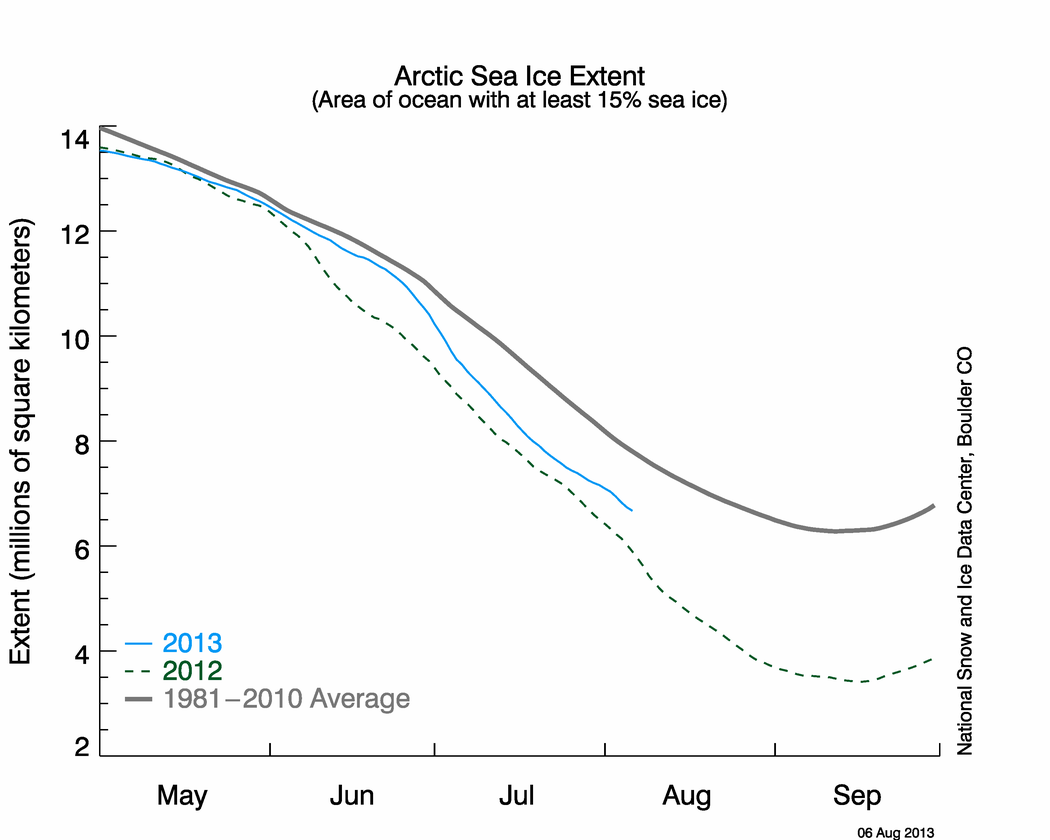
Umm. There's more ice in the arctic this year than last year.
No, there is less. As the graph from the article you site shows, the present sea-ice coverage area is very slightly larger than it was this time last year (which was a record low), but the thickness of the ice is steadily decreasing, and as a consequence, so is the total amount of ice.
In fact, as the ice melts and breaks up it tends to spread out, temporarily increasing the "sea area with > 15% ice" which is what the graph shows.
--MarkusQ
-
Re:suspected? are you kidding?
Bullshit. The Viking lander saw water frost, as evident from the temperatures:
http://www.solarviews.com/cap/mars/frost.htm
http://www.agu.org/pubs/crossref/1990/89JB03428.shtml
http://en.wikipedia.org/wiki/Viking_2 -
Re:NASA disaggrees with youEven NASA's data seems to disagree with you. NASA doesn't have any data for the last 150 years. We had twice your number since 1970 alone. If that were a long term trend, you might have a point. But you're not looking at the trend, you're looking at the difference in minima, and you're only looking at two full solar cycles at that. i.e., you're basically looking at noise.
If you look at the trend over the last 150 years or so, as I said, you find about 1 to 3 W/m^2 increase in irradiance, e.g. here or here. A 0.05% increase per decade, over a century, is 0.5%. Solar irradiance has not been increasing at a constant rate, either. Now it doesn't go the full 1.2% we'd need to explain the Global Warming (unless it went up as a different rate before), but it almost halves the effect we can blame ourselves for. This analysis has already been performed, far more carefully than your analysis, and does not support your conclusion. See, for instance, here, which I cited elsewhere in this thread. -
Re:So now we have theI think many alarmists forget that Earth was once significantly warmer than it is now, and had significantly higher levels of atmospheric CO2 than it has now. Was the Earth a desert? Hardly. The Earth was an even greater oasis of life than it is now. The warm Earth gave us the dinosaurs, and all the massive vegetation required to support such enormous animals. Hey, you might want to live in a Cretaceous climate, but I don't. We are still living within these natural trends, which we puny humans are powerless to stop or alter in any way. [citation needed]
Well, if that isn't begging the question, I don't know what is. But try reading this. This is why I oppose ALL of the proposed "solutions" to the "anthropogenic climate change" hoax. EVERY ONE of them, without exception, leaves us in a weaker position to weather change than if we did not follow them. [citation needed] They all propose some sort of socialistic or communistic top-down managed approach, FORCING people to alter their lifestyles in some vain attempt to "live green". No, they attempt to correct a market inefficiency by accounting for a heretofore unrecognized externality. See, e.g., the work of Pigou, which is the basis for the solution advocated by most card-carrying economists who work in this field. (Cap-and-trade is another, albeit more easily gamed approach.)
Why do you hate the free market? -
Maybe.
I'll preface this with saying that I'm currently at the AGU Joint Assembly -- but I'm not a scientist. (I'm in information science, not physical sciences) I'd actually say that we're getting to the point where I could actually see that it's quite possible that future scientists might not need to learn how to program.
Now, there are going to need to be scientists who can program, but there were plenty of scientists in the past who couldn't program -- coming up with the theories and thinking about their given discipline in new and interesting ways are more important. Knowing how to program might make the scientists think about the problem in such a way that it fits within the given language -- and it might bind their hands, keeping them from thinking as freely about their disciple. (and that being said, you'd have to go to a completely non-number crunching educations system, where even spreadsheets aren't used).
But, there's another aspect -- all of the scientists I work with can program -- but to significantly varying degrees. Most of them don't keep up on the languages, so they're still writing Perl 4 code or IDL, Matlab, Fortran, whatever it was that they learned during grad school, and don't use the majority of the features of the language. If they learn a second language, they'll probably still write it as if it were their first language. (ever seen IDL code written in Perl? It's not pretty -- imagine pre-initializing the size of your array, rather than using 'push'.) In many cases, it may be better for scientists to have a pool of programmers to assign jobs to, sort of like the old secretary pools.
Also, if everyone knows how to program, they end up making their own solutions to every problem they run into, rather than looking for existing solutions. I just spent most of the day in session on data informatics, with people talking about how they're trying to get scientists to work to common standards, so that we can share data, and ultimately make better use of it. We won't need every new experiment to write all new visualization tools -- you make your data set, you register it with a federated data system, and you can plot / generate movies / whatever to your heart's content. With some of the new semantic systems being built (eg, SESDI), we're getting closer to that point.
That's not to say that there won't be a need for scientists who are programmers, or programmers who are scientists, I'm not saying that I don't think every scientist needs to be a programmer. -
Re:global warming comparison in 3,2,1....
Well, there is a political conspiracy surounding it. But when the hypothesis of observed facts starts to not react in the predicted ways, then it is time to rethink it. That's just sound science. This isn't on the order of the conspiracy or me claiming it isn't happening, it is on the order of we got something wrong or are missing some force and don't completely understand what is happening as much as we thought. Of course the importance of the evidence and predictions are being overstated by the political agendas which might bring us to a conclusion of facts that just don't exist, But on the evidence alone, we have these observed effects; temps seem to rise in correlation to Co2 levels; Something happened in the last ten years that seems to break that cycle; the explanations so far seem to be attributing something that would also effect the previous statements.
Throughout the years we have had other scientists making claims that the sun was part of the problem and to one point even cause some of the climate models to be reworked in order to account for new evidence. Then we have what should be a forcing with water vapor increases for atmospheric content which has been attributed to solar activity . There were a few other claims but the most recent one which seems to be supported by the Co2 global warming crowd is that (multi)decadal oscillations like El Nino and La Nina are the causes for the disparaging results.
Well, we have at least one notable effect of that in that the oceanic oscillations have been thought to be effected by the solar activity since the late 80's to mid 90's. That link is to a sort of on a biased site but it has been validated by further research published in the AGU JOURNAL OF GEOPHYSICAL RESEARCH in 2000/2001
A problem I have with this is that we know the cooling effects and warming effect of these oscillation patterns aren't completely cyclical in that they don't cancel each other out. They can warm longer then cool and cool longer then warm producing a larger effect to one side over the other. Another issue is in how we changed the way of calculating surface water temperatures in the oceans which both El Nino and La Nina effect on a very large scale. This doesn't seem to be taken into account when averaging the global temperatures but they don't seem to have a problem invoking the same effect when attempting to discount the last decade of stale warming where the Co2 levels increased but the temperatures didn't. Now, this knowledge bucking the trends of heating the earth is relatively new specifically because when the bulk of the research was done to show the warming and form the models, the data sets where a few years old based on the shear complexity of gathering it, organizing it, and extracting it from the various sources to make it usable (read no conspiracy, just the nature of the game).
The data sets have finally caught up with the time and we are able to make comparisons without strong anomaly influences that have cause the 90's to be labeled as the warmest period on record before it was found that an error on adjustments for compiling US temps was made and the 30's held that title. The interesting thing here is that the 90's was caused by global warming, or at least that is what the political organizations like the UN's IPCC and advocate like Hansen and Realclimate.org. But now, it is not global warming because it is El Nino and La Nina. It like having their cake and eating it too. It just doesn't make sense that it is global warming when it suits your needs and something else when the pieces don't fit.
So we need to rethink this situation without the bias of political agendas and determine a proper cause and effect even if it invalidated the Co2 model and it is found that Co2 levels follow warming trends instead of causes them. That is also something floating around in recent times by the same scientist who once -
Re:Solution without a ProblemAns as I have explained in the past, there are other people who have other ideas about Co2 and it's importance in the manufactured crisis of global warming. Your paranoid conspiracy theories have nothing to do with the science. I have made the judgment that the process has been overrun by politics and if you can't understand that your insistence of their being one true way with all other research needing to stop now Stop putting words in my mouth. I'm saying that the evidence strongly supports CO2 as a dominant source of warming since the late 20th century. Nonsense about "one true way" and censoring research is your paranoid fantasy, not anything I said. It's clear that you've allowed your political prejudices to blind you to the point that you cannot honestly evaluate any science which supports AGW. Now the question remains, is a the increase in something that is less then
-
Re:Hydrogen? Carbon?
No. At best your going to have an average of different locations at certain temperatures but that has no real reflection of the situation.climate zones depend on climate falling within a given statistical range or anything, or that changing that range would be a change to a completely different zone. What was I thinking?
First, A feedback can have a forcing effect.
Look, you can argue against definitions all you want. Feedback is, by definition, not forcing.
That is to say that a feedback can raise temperatures which under the Co2 model would generally be a forcing.
No! That is feedback. It occurs in response to a long-lasting stimulus, and only in response to that stimulus. Feedback can be positive or negative. What you described is known as "positive feedback".
Water vapor is a feedback and a forcing though, I though I made that clear.
You made it clear that you're wrong.
But under the Co2 models, they aren't prepared to account for water vapor as a variable which is why you see explanations using it as a constant.
In *NO* model is water vapor a constant.
And no, water doesn't average 10 days in the atmosphere because the saturation points differ.
Wow, do we need to go all the way back to the definition of the word average?
I suggest you quite getting your information from loaded sites designed to convince you regardless of the truth. Real science and at least one of the scientist contributing to it is one of them.
I suggest you get your data from somewhere other than your a**^H^H^Himagination. -
Collisionless plasma isn't gas
I have not performed any experiments on exploding double layers. Acutally, I am not aware of any having been done at all. The idea of exploding DLs by Alfven was to describe the substorm process in the Earth's magnetotail.
To be sure, double layers explode not only in the magnetotail. Alfven himself observed it en vivo, for example, when he was invited to investigate certain large-scale accidents at the Swedish power company. Moreover, double layers are heavily involved in the process deceptively called "magnetic" reconnection.
J.F. Drake. Collisionless Magnetic Reconnection.
However, this tenet is not usable any more, because this double layer has not been found to exist in the Earth's magnetotail.
Really? Not found to exist? Please point me to the sources for your statement. In the meantime, allow me to remind the readers of the most elementary properties of plasma. Double layers always form at the boundaries between plasma regions of different physical conditions. As an example, consider the stable double layer in the magnetopause. They even form under the conditions of relativistic Weibel instability; in lab, point a relativistic electron-positron or electron-ion beam at a slightly magnetized plasma; in space, a gamma ray burst will do:
Milosavljevic M., et. al. Steady-State Electrostatic Layers from Weibel Instability in Relativistic Collisionless Shocks. Astrophys. J. 637 (2006)
Double layers also form in current-carrying plasmas; in general, wherever there exists a voltage differential in plasma. Their formation leads to and/or is result of various plasma instabilities. Therefore, among other things, double layers are very common in multi-ion-species plasmas (typical in space). The cross-field current instability, that plays such an important part in the current disruption model, is one; see, for example:
G. Zimbardo, et. al. Magnetic turbulence and particle dynamics in the Earth's magnetotail. Annales Geophysicae 21 (2003)
R. L. Stenzel, et. al. Double layer formation during current sheet disruptions in a reconnection experiment. Geophysical Research Letter 9 (1982)
J. E. Borovsky. Double layers do accelerate particles in the auroral zone. Physical Review Letters 69, 7 (1992)
Reddy R.V., Lakhina G.S. Ion acoustic double layers and solitons in auroral plasma. Planetary and Space Science 39, 10 (1991)
El-Taibany, W. F.; Sabry, R. Dust-acoustic solitary waves and double layers in a magnetized dusty plasma with nonthermal ions and dust charge variation. Physics of Plasmas 12, 8 (2005)
Xiao C., et. al. Cluster Observation of Wave Excitation in the Magnetopause Caused by Interplanetary Shocks. 2006 Western Pacific Geophysics Meeting
Quoting the abstract: "Intense geomagnetic storms are usually caused by the CME-magnetosphere interaction. Up to now there are only very few in situ measurements with respect to the details of interactions of CME with the front shock and magnetosphere. In this paper we report such a fortuitous observation made by Cluster four spacecraft. At 16:35 UT on Nov. 4, 2001 LASCO/SOHO observed an Earth-direction halo CME. Associated with the CME were a front shock and a magnetic cloud, which caused an intense magnetic storm with $DstI could keep citing articles ad nauseum; there are too many to list here. Jus
-
Resources, second pass
Unlike astronomy, where there are just a few journals that cover most of the field, it seems that papers on the general topic of planetary system, and planets/moons/etc, formation are found in many.
In addition to Icarus, there is MNRAS (Monthly Notices of the Royal Astronomical Society), ApJ (Astrophysics Journal), JGRE/JGRA (Journal of Geophysical Research), P&SS (Planetary and Space Science), GeoRL (Geophysical Research Letters), E&PSL (Earth and Planetary Science Letters),
There are also at least two regular meetings/conferences; examples from recent ones: 39th DPS meeting, session 32 (Planet and Satellite Creation and Evolution, on 10 October 2007) http://www.abstractsonline.com/viewer/viewSession.asp (link may not work); Fall 2007 AGU meeting, session P54A (Planetary Formation and Evolution) http://www.agu.org/cgi-bin/sessions5?meeting=fm07&part=P54A&maxhits=400.
Somewhere among all these there must be a good review paper or three, published in the last year or so
A very readable, recent, book, with oodles of references is The Big Splat (Or How Our Moon Came to Be), by Dana Mackenzie. Of course, its focus is much narrower than the topic of this thread!
And that'll have to do for now. -
Setting the record straight
It is a true synthesis of all of the natural sciences, but what it concludes is that plasmas in space are being mathematically modeled incorrectly. And this is where people tend to turn off. In plasma-based cosmologies, plasmas are electrodynamic entities that, like in the lab, respond with electrical resistance and luminosity to changes in their charge density. In conventional cosmologies, astrophysicists *assume* that plasmas are "perfect conductors", they *assume* that space is "quasi-neutral" -- that a given volume of space essentially has equal numbers of positive and negative charges -- and they *assume* that magnetic fields are "frozen-in place" within a plasma (as opposed to being affected by the mechanics and electrodynamics of the plasma itself).
The concept of "magnetic reconnection", for instance [...] has never been validated within a laboratory despite being discussed for decades now. And importantly, there is no reason for why we cannot validate magnetic reconnection within the lab.
If asked to guess, I'd say you wrote this without critically thinking about it, and certainly without investigating the work of the scientists who study the Earth's magnetosphere and the IPM (inter-planetary medium).
Last month, the AGU (American Geophysical Union) held its Fall 2007 meeting in San Francisco. I think I recall reading that some 15,000 people attended.
Just from the titles of the sections (http://www.agu.org/meetings/fm07/?content=program&show=glance), I'd guess that this would have been an extremely important meeting for all Plasma Universe/Electric Universe groupies - 'Atmospheric and Space Electricity', 'Planetary Sciences', 'Solar and Heliospheric Physics', 'Magnetospheric Physics', and so on.
Within Solar and Heliospheric Physics (http://www.agu.org/cgi-bin/sessions5?meeting=fm07&sec=SH) it would seem there were quite a few sessions that would have been of intense interest to you. Some examples:
SH41C - Magnetic Reconnection in Laboratory, Magnetospheric, and Solar Plasmas I (http://www.agu.org/cgi-bin/sessions5?meeting=fm07&part=SH41C&maxhits=400), with such sessions as:
* "Causes and Consequences of Reconnection in the Laboratory" (abstract is here: http://adsabs.harvard.edu/abs/2007AGUFMSH41C..06P), and,
* "Experimental merging, coalescence, reconnection, and bouncing of two flux ropes" (abstract: http://adsabs.harvard.edu/abs/2007AGUFMSH41C..07I - note that the six authors seem to work in the same lab as Peratt; interesting, don't you think?)
SH44A - Magnetic Reconnection in Laboratory, Magnetospheric, and Solar Plasmas IV Posters (http://www.agu.org/cgi-bin/sessions5?meeting=fm07&part=SH44A&maxhits=400), which featured posters with such interesting titles as:
"Magnetic reconnection with multiple X-lines in an open system: Two fluid simulations with finite electron inertial effects"
"Breakdown of the Frozen-in Condition and Plasma Acceleration: Dynamical Theory"
"Self-regulation of the reconnecting current sheet in relativistic pair plasmas"
"Fast Reconnection in Electron-Positron Plasmas via Turbulent Outflow Jets"
"Universal Method for Describing Magnetic Reconnection"
From a different pln2bz comment:Nereid, you seem to think that I *really* care about responding to your interruptions. But you present nothing for my mind to chew on. You are little more than a pest to
-
Setting the record straight
It is a true synthesis of all of the natural sciences, but what it concludes is that plasmas in space are being mathematically modeled incorrectly. And this is where people tend to turn off. In plasma-based cosmologies, plasmas are electrodynamic entities that, like in the lab, respond with electrical resistance and luminosity to changes in their charge density. In conventional cosmologies, astrophysicists *assume* that plasmas are "perfect conductors", they *assume* that space is "quasi-neutral" -- that a given volume of space essentially has equal numbers of positive and negative charges -- and they *assume* that magnetic fields are "frozen-in place" within a plasma (as opposed to being affected by the mechanics and electrodynamics of the plasma itself).
The concept of "magnetic reconnection", for instance [...] has never been validated within a laboratory despite being discussed for decades now. And importantly, there is no reason for why we cannot validate magnetic reconnection within the lab.
If asked to guess, I'd say you wrote this without critically thinking about it, and certainly without investigating the work of the scientists who study the Earth's magnetosphere and the IPM (inter-planetary medium).
Last month, the AGU (American Geophysical Union) held its Fall 2007 meeting in San Francisco. I think I recall reading that some 15,000 people attended.
Just from the titles of the sections (http://www.agu.org/meetings/fm07/?content=program&show=glance), I'd guess that this would have been an extremely important meeting for all Plasma Universe/Electric Universe groupies - 'Atmospheric and Space Electricity', 'Planetary Sciences', 'Solar and Heliospheric Physics', 'Magnetospheric Physics', and so on.
Within Solar and Heliospheric Physics (http://www.agu.org/cgi-bin/sessions5?meeting=fm07&sec=SH) it would seem there were quite a few sessions that would have been of intense interest to you. Some examples:
SH41C - Magnetic Reconnection in Laboratory, Magnetospheric, and Solar Plasmas I (http://www.agu.org/cgi-bin/sessions5?meeting=fm07&part=SH41C&maxhits=400), with such sessions as:
* "Causes and Consequences of Reconnection in the Laboratory" (abstract is here: http://adsabs.harvard.edu/abs/2007AGUFMSH41C..06P), and,
* "Experimental merging, coalescence, reconnection, and bouncing of two flux ropes" (abstract: http://adsabs.harvard.edu/abs/2007AGUFMSH41C..07I - note that the six authors seem to work in the same lab as Peratt; interesting, don't you think?)
SH44A - Magnetic Reconnection in Laboratory, Magnetospheric, and Solar Plasmas IV Posters (http://www.agu.org/cgi-bin/sessions5?meeting=fm07&part=SH44A&maxhits=400), which featured posters with such interesting titles as:
"Magnetic reconnection with multiple X-lines in an open system: Two fluid simulations with finite electron inertial effects"
"Breakdown of the Frozen-in Condition and Plasma Acceleration: Dynamical Theory"
"Self-regulation of the reconnecting current sheet in relativistic pair plasmas"
"Fast Reconnection in Electron-Positron Plasmas via Turbulent Outflow Jets"
"Universal Method for Describing Magnetic Reconnection"
From a different pln2bz comment:Nereid, you seem to think that I *really* care about responding to your interruptions. But you present nothing for my mind to chew on. You are little more than a pest to