Slashdot Mirror
Domain: anandtech.com
Stories and comments across the archive that link to anandtech.com.
Comments · 3,318
-
Re:High density.
Generally hard to find benchmarks, but the AMD processors usually lie between the i3 and i5 in terms of single threaded performance and the i3 and i5 trounce the Atom.
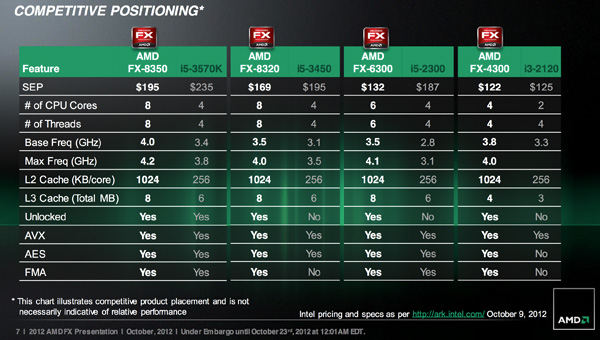
I guess it must be hard, with the blindfold on and all. Here is a list for example, where the FX-8350 is even beaten by the Phenom II x6 and performs worse than the Intel Pentium G840 in single threaded performance. Anyway comparing 6W/2 = 3W and 140W/16 = 8.75W those Piledriver cores had better do much more than one Atom core. Intel is again trying to create a two-front war against AMD, should they go lower to match the Atoms or higher to match the Xeons or spread themselves too thin doing both. Worst thing is, this is really just a spinoff of their smartphone/tablet work - that they release a 6W server chip I think is only because they can, why risk anyone else taking the market.
-
This is a preemptive strike against ARM
Original poster: "Amazing that it supports ECC since Intel seems committed to making you pay through the nose for stuff like that."
This article gives some insight into why Intel is doing this. Basically, ARM has been making noises for some time about getting into the server market. Intel is very concerned about this, because ARM is used to lower margins and willing to license their designs widely, and could easily undercut Intel on price. They see the writing on the wall. Sure, they would like to keep ECC and other server-type goodies as premium features, but that's no longer a realistic option. Either they have to offer something cheaper, or customers who want low-cost, high-reliability server hardware will jump ship as soon as they can. This is the market niche the Atom S1200 is designed to fill. Intel gets to tout its advantage of backwards compatibility while being able to dramatically undercut other server-grade hardware on price. With this, ARM is going to have a much harder time convincing data centers to switch.
By the way, if all you care about is ECC, you don't have to buy an expensive CPU from Intel to get that (though you do need a C-series chipset rather than the consumer-grade stuff). Many of Intel's Ivy Bridge Pentium and Core i3 processors now support ECC, though this has not been widely publicized. For example, this i3-3220 is only $119.99 at Newegg and according to Intel's official site it supports ECC.
-
Re:Waste Line
anandtech wasn't particularly pleased with the monitor, either.
Superwide + can't rotate 90 degrees + poor refresh rate? you bet.
Also, the resolution is 2560x1080. My cellphone has more pixels than that (at least in the vertical direction).
-
Re:Waste Line
anandtech wasn't particularly pleased with the monitor, either.
Superwide + can't rotate 90 degrees + poor refresh rate? you bet.
-
Re:Huehuehuehue
It still uses the painfully slow and limited Safari engine underneath it. It's not much more than a skin for Safari.
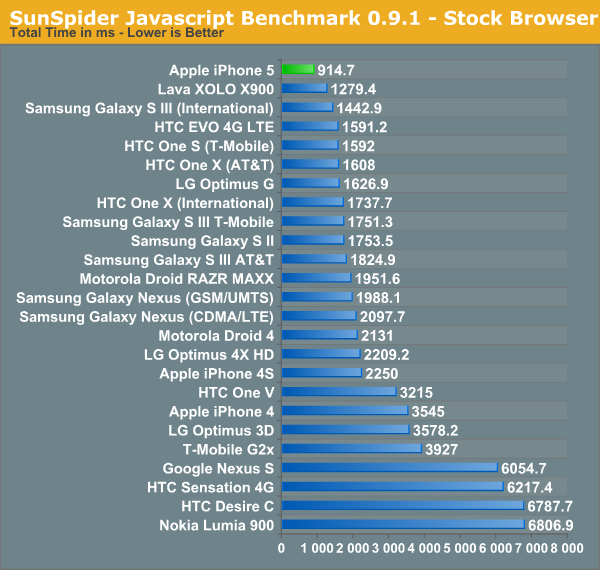
That painfully slow Safari browser just happens to be faster than any Android tablet *or* phone ever released.
http://images.anandtech.com/doci/6309/49915.png -
Re:These really aren't much
This says it only has 512 mb: http://www.anandtech.com/show/2939 "Coupled with the GT218 GPU on the G210 is 512MB of DDR2 RAM, using the customary 64bit memory bus. Interestingly, unlike most other entry-level products, the G210 only comes in 1 memory configuration: 512MB."
You're looking at an MSI 512MB model, he linked an eVGA 1GB model. Also, the GT210 was low end when it came out - not something you should be expecting a good gaming experience from. Either way, it's an extremely old card. I just bought an evga 620 a few weeks ago to add a few more monitors to my pc for under $50 and it had 1GB. Current high end cards have 2-4GB onboard. Even my (also outdated) gtx 480 from a few years ago had 1.5GB.
-
Re:These really aren't much
This says it only has 512 mb:
http://www.anandtech.com/show/2939
"Coupled with the GT218 GPU on the G210 is 512MB of DDR2 RAM, using the customary 64bit memory bus. Interestingly, unlike most other entry-level products, the G210 only comes in 1 memory configuration: 512MB." -
Re:Well that eliminates a popular build
Integrated graphics. Seriously?
Starcraft II is hardly the most graphically-challenging game. Neither is R6: Vegas. And the WEI scores are essentially useless.
The A10 uses a Radeon 7660D which, in "real"-card terms, fits somewhere between 7570 and a 7470. However, the integrated Radeons are known to be extremely memory-bandwidth-bound, enough that they're frequently used in RAM benchmarks. So in practice you're looking at a graphics processor that's already weak, and further crippling it by bottlenecking its memory access.
Look at the benchmarks. 48 FPS in Crysis: Warhead - at 1366x768. 41 FPS in Metro: 2033, on low, at the same low resolution. 68 FPS in Dirt 3. 58 FPS in Battlefield 3, at low quality. For any game that has a reputation for being GPU-heavy, integrated graphics will not suffice.
Yes, the Fusions are pretty awesome chips. I almost got one myself. They're excellent for mobile or light gaming usage. I'm not surprised you sell a lot of them. But (at the risk of sounding like a True Scotsman) they're not the kind of thing a real PC gamer uses. And Crysis 3 is definitely trying to target the "real PC gamer".
-
Re:Fuck secure boot.
No they don't, not from the technorati. The lumpenproletariat don't care, but that's because they don't know and don't want to know.
The problem here is that marketing a product to the technorati and only the technorati is often unprofitable. The proles dictate what enjoys economies of scale. Otherwise, for example, there would be more video games targeted at members of the technorati who want to replace a video game console with a home theater PC. Instead, because of tradition, video games in console-style genres tend to be released only for PlayStation 3 and Xbox 360 and not ported to the PC, despite that PCs use an operating system that's compatible with the Xbox 360's controllers and APIs, and even Intel's integrated graphics can play a PS3-class game.
-
Re:Benchmarks don't mean much...
This is assuming they don't go broke before the 5 years is up. Warranties are usually void in the case of bankruptcy proceedings.
Anandtech seems to like what they've seen of the OCZ Vector so far, but keep in mind that it hasn't been time-tested and that it is basically OCZ's Hail Mary pass: it's succeed or go bankrupt.
Personally, I wouldn't mind seeing OCZ go away. They've been at the bleeding edge too long and have done more than any other company to hurt the reputation of SSDs. Maybe WD or Seagate will buy them for their Indilinx division so they can put out reasonably credible (and hopefully better-tested) SSD offerings.
-
Re:you don't want a $20 PSU in any system
Most PSUs hit their peak efficiency at 50% load. So if you have a 350W typical load then you'll want to go with a 700W PSU to minimize your at the wall power consumption.
Also its nice to have a little room for power demand variance and future expansion.
1. http://www.anandtech.com/show/2624/3
2. http://hexus.net/tech/tech-explained/psu/29911-80-plus-certification/ -
Re:you don't want a $20 PSU in any system
One word : Efficiency.
Some PSU calculators are actually good. With this one, for a system you're defining as a "real" gaming one (i7-3820, RadeonHD 7970, 3 sticks of DDR3, 2 high-rpm SATA HD, 1 DVD-RW/DVD+RW Drive, Sound Blaster, 2 120mm fans) and for that they recommend 487W, so with 550W you still have spare capacity. See ? Ancient123 gave you sound advice and doesn't need to be told what a gaming machine is.
Now, of course, you need to factor in that cheap PSU tend to advertize input wattage while reputable brands advertize sustained output wattage (but you better read the charts to be sure anyway). -
Re:A Question of Scale
Actually you are correct, numerous cores are the future. Intel are planning a 48 core smartphone within the decade, http://www.engadget.com/2012/10/30/intel-48-core-chip-smartphones-tablets/ and Haswell is concentrating on both a reduction in power and has some neat improvements to make multicore programming much easier to manage (TSX looks very intriguing) http://www.anandtech.com/show/6290/making-sense-of-intel-haswell-transactional-synchronization-extensions. Both of these will continue as we up the core counts. The power is important as we race to the 1 exaflop supercomputers, which is actually slightly ahead of the exponential growth curve. There's some worry about continuing that trend to exaflop by 2015-2018 but we now have India, China and the US all attempting to beat one another and only India lacks every having the experience of a number 1 supercomputer. We could be entering a space-race like era again but with super computers.
Who needs all that computing power? You do know what that sounds like right? That mythical "640K ought to be enough for everybody". Look I don't want to be too mean but what you seem to lack is vision, do you really not expect new applications to arise from the excess power and fill the void? Maybe it's because I've been programming for 20 years and can see the bottlenecks so I can assure you every little bit of cpu power can be squeezed out and will bring new opportunities previously too slow for real-time calculations. We use the power we have available is how it's best summed up. I haven't even touched on the world's middle class exploding by 100's of millions, a scale like never before thanks to India and China. The strain this will place on resources does warrant a consideration, but that's a whole debate on it's own. Many applications of AI will start showing up in Joe average's devices because the power to run them is now possible, if you can only think of trying to streamline server requests you really need to read up on the near future. There's some exciting times ahead -
Re:intel is...
a) Bulldozer sucks, Vishera is quite a bit better but still not where AMD's value is (except for the very attractive FX6300);
b) compare these similarly priced processors: http://www.anandtech.com/bench/Product/675?vs=677 ;
c) referring to item b, remember that the A10 comes with about 3x the graphics capabilities of the i3 (and that the games tested by Anand use a powerful discrete card, so graphics performance is not represented at all). -
Re:Better get used to it, THQ
Sorry to self reply. But you can see from things like GLbenchmark which the iPad 4th gen runs at over 120 fps at 1080p, that the iPad is more than capable of rendering at detail levels comparable to the PS3
-
Re:also 1GB ram for the OS
Consoles are already I/O bound and the HDDs aren't super fast (5400 RPM), so that wouldn't make a difference you are expecting. Having a pagefile would however help console games avoid memory fragmentation, but this reason alone does not justify the effort.
-
Re:any objective numbers?
Something that is is known http://www.anandtech.com/show/6465/nintendo-wii-u-teardown , is that the Wii U CPU is made in 45nm and has a size of 32.76mm2
This puts it into the ballpark of the size of a current Atom CPU and the same ballpark of computing power. IBM has no magic fairy dust to do (much) better than Intel in a smaller die with worse process tech. 3.5GHz x86 is simply crazytalk. -
Re:Mac Mini wannabe
So, 2 loaves of bread, that's 30cm, by 30cm, by 15cm. Into that space, you could fit 12 MacMinis, or 25 NUCs. Your 1050T is already actually slower than similar CPUs to the current MacMini or NUC (sorry, couldn't find bunchmarks against the exact same CPU) http://www.anandtech.com/bench/Product/147?vs=677; so they're respectively about 12 to 25 times faster than your system by volume, and about 4 times faster per watt.
Don't get me wrong there's nothing wrong with a bog standard desktop PC, but I really don't understand why people are so disparaging of small, low power systems like this. They're mighty impressive things.
-
Re:Upgradeable?
The internal storage device is an eMMC module soldered to the motherboard. Unless you have a BGA rework setup and nerves of ice, no go.
this gallery has motherboard shots.
It does support SDHC cards and USB mass storage devices.
-
PS3-class graphics
To be more specific, Anandtech reports that Intel HD 4000 runs Skyrim playably. If it plays current gen games, it can't be all bad.
-
Efficiency!
" efficiency now matters more than gains in raw performance"
Sure, so why don't you start off by telling us why an Exynos Cortex A-15 chip running a web benchmark is using about 8 watts of power, with the display turned off so only SoC power is being measured, while Intel has already demoed a full-blown Haswell running Unigine Heaven at... 8 watts.
So when the miraculous Cortex A-15 uses the same amount of power as the supposedly "bloated" x86 Haswell, while Haswell is running a benchmark that is massively more intensive than a web-browser test, who is really making the most "efficient" platform?
Exynos Source: http://www.anandtech.com/show/6422/samsung-chromebook-xe303-review-testing-arms-cortex-a15/7
Haswell Demo Video: http://www.youtube.com/watch?v=cKvVdhkgAxg -
Re:Is this going to save AMD ?
From 1999 to 2003, AMD's Athlon was a moderately superior CPU to Intel's Pentium III competitor. More most of that time I felt that success was limited by AMD's lack of high quality motherboards to place the CPUs in.
Avoid all things VIA and you were pretty good, I had AMDs in that period and they were excellent bang for the buck. No doubt that AMD was gaining momentum in that period, remember the first Pentium IV was released in November 2000, this is what Anandtech wrote at its release:
It's amazing at how quickly the industry can turn from being dominated almost completely by a single CPU manufacturer over to a point where the underdog is now in a position to lead the market into the 21st century. Over the past 12 - 18 months we have seen this very situation occur right in front of our own eyes. Intel, a manufacturer never associated with delays or processor shortages and AMD, a manufacturer that was associated with sub-par performance and an inability to deliver on time, essentially switched roles in the past year alone.
-
Re:What's stored in DRAM?
What are context and indirection tables?
There are some details in this Anandtech article about the tables and the controller's use of DRAM.
-
Re:OK, stick a fork in them, they're done. NOT!
" The Nexus 10 and Nexus 7 are selling well and higher spec than the latest iPad and iPad Mini respectively"
Uh really -higher specced?
http://www.anandtech.com/show/6426/ipad-4-gpu-performance-analyzed-powervr-sgx-554mp4-under-the-hood
As far as "selling well"....
Less than 3 million in 3 months?
http://news.cnet.com/8301-1035_3-57542796-94/asus-nexus-7-sales-climb-toward-1-million-a-month/
-
Re:So, the next MIPS?
Even if Intel chips had exactly the same power usage as ARM (highly unlikely), what's the benefit of having an Intel chip in your mobile device?
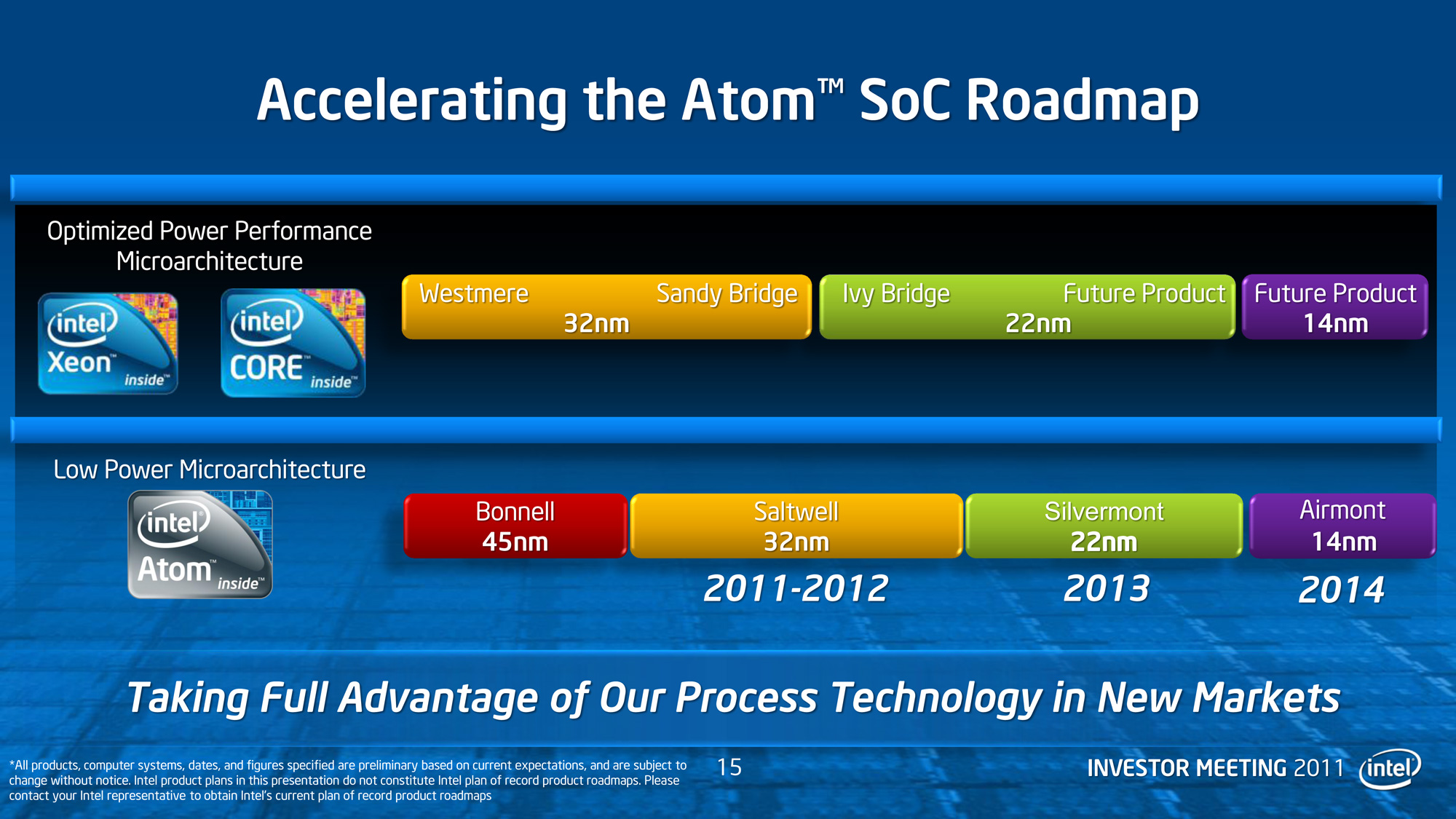
Why do you think this is unlikely? On the contrary, Intel has a massive fab/manufacturing advantage over any ARM chipmaker - they are at least 1 process shrink (node) ahead of any other foundry, not to mention their process at any given node is better than all competitors (TSMC, GloFo, Samsung). This fab advantage directly translates to lower power usage, and by all accounts, Intel's advantage there is only getting larger - ask AMD how it feels to be on the receiving end of this advantage. Intel needs to put out a microarchitecture which targets about the same performance range that ARM Cortex-A9 (or maybe A15 [1]) does, and in all likelihood, Intel's chip will be lower power because it will be manufactured on either one shrink ahead of any ARM equivalent, or the same node but using Intel's superior process at that node. In fact, Intel is doing just that - the next-gen Atom chip (Silvermont/Valleyview) is targeting right around where A15 is in terms of performance, area, and power.
ARM isn't magic; there is nothing in the ARM ISA that makes it inherently lower power than x86. Yes, I'm counting all the decode hardware and microcode that x86 chips need to support legacy ISA. There just isn't much power burned there compared to modern cache sizes, execution resources, and queue/buffer depths which all high-performance cores need regardless of ISA. If you have an x86 processor that targets A9 performance levels, it will burn A9 power (or less if Intel makes it, given Intel's manufacturing advantage). If you have a ARM processor that targets Sandy Bridge performance levels, it will burn Sandy Bridge (or more) power.
[1] I say maybe A15, because from Anandtech's latest review here, Samsung's Exynos 5250 using A15 cores does not have a prayer of getting into smartphones using 5W at load. Your smartphone will be dead in an hour of web browsing with that kind of power draw. Yeah yeah, Exynos 5250 is on a 32nm process and the 28nm A15's are right around the corner, which should be lower power. But still.
-
Re:Yay Cortex A-15!
That is interesting.
I've always thought that a lot of the problem with ARM systems is that they typically use mobile SDRAM, Which is low power, but is also clocked slowly and has a rather narrow bus. So if you paired an ARM with the same memory you get in an Atom system, you'd see better figures. I think that is part of what has happened with the Chromebooks.
E.g.
http://www.anandtech.com/show/6422/samsung-chromebook-xe303-review-testing-arms-cortex-a15/3
There are a total of 8 x 256MB DDR3L devices (2GB total) that surround the Exynos 5 Dual SoC (4 on each side of the PCB). Each device is 8-bits wide, all connecting up to the 64-bit wide DDR3L memory controller. The DRAM is clocked at a 1600MHz data rate, resulting in 12.8GB/s of memory bandwidth to the chip. The Exynos 5 Dual integrates two ARM Cortex A15 CPU cores as well as an ARM Mali-T604 GPU.
Yeah - Finally an ARM with memory bandwidth, and it seems like it has really paid off if you look at the CPU benchmarks.
It's also worth pointing out that the Atom 570 is a rather old design. The new Atoms are going to be out of order and hopefully have better performance, though you wonder what will happen to power consumption. Lastly Atom is the slowest x86 CPU and Exynos 5 is one of the fastest ARMs. You can get x86 chips that far surpass the fastest ARM - a Core i7 for example.
Also I think Atoms have always been let down by their chipset - the first Atom chipset consumed much more than the CPU. And the Intel GPU in that chipset is like some sort of sick joke. It's not very low power and the performance is terrible.
Still for a long time Atom was better than AMD for low power and cheap and that meant that it basically owned the netbook segment. So Intel spent its R&D resources on Core i7s and i5s because you can make a lot more cash at the high end.
Now with a bit of luck getting beaten by an Exynos 5 and indeed losing the market for Chromebooks at Samsung will cause Intel to spend some R&D resources on Atom. We know there is a new ValleyView Atom core coming, and we also know they are going to put in a decent integrated GPU. With a bit of luck Atoms will get more R&D resources after that so Atom cores get revved a bit more frequently.
Then again, for what netbooks are meant for - web browsing, email etc - they are basically good enough. I'm not going to switch to ARM on netbook, because I like Windows and Windows RT is a locked down nightmare, whereas x86 Windows runs all the things I need. If I need more power for things like Visual Studio, I've got a Core i5 laptop.
And even if Valleyview is a bit of a disappointment, I'm probably going to end up buying a netbook based on it at some point, purely based on the fact that it runs x86 Windows and that is what I want to run.
-
Different genres
Joysticks, HOTAS, racing wheels and gamepads have been always available for PCs but they weren't strictly necessary due to the sheer flexibility of keyboard and mouse.
How many keyboards and mice has a single PC traditionally supported at the same time?
And there hasn't ever been such a huge mandatory bureaucratic overhead when trying to publish for PC. Spend thousands of dollars for a dev kit, an unlocked console AND so called QA from Microsoft, Sony and Nintendo?
I'm told by at least one persistent member of Slashdot that there are certain genres that just don't work on a PC, such as fighting games (like Mortal Kombat series and Super Smash Bros. series), casual party games (like Mario Party series), and cooperative platformers (like New Super Mario Bros. Wii). This difference in genre preferences between console and PC gamers pushes developers to go through the multi-year process of paying their alleged dues just so that they can get their product out to a demographic that wants it.
The Ouya has potential because it does away with that crap.
If it ever comes out. Whatever happened to Pandora and the nD?
Aim assist due to THE F*CKING WRONG INPUT DEVICE
In the Nintendo 64 era, would you rather have tried to play a game like GoldenEye 007 with four mice and four keyboards and one TV?
Skyrim sticks out like a sore thumb in that respect and that doesn't even run on PS3.
I thought Skyrim was ported to PS3. At least I've been using it as an example of the fact that the Ivy Bridge IGP can finally run games comparable to the current console generation.
-
Re:Yay Cortex A-15!
Replying again with some more concrete information, that you may be interested in:
From http://hexus.net/tech/news/cpu/47517-samsungs-exynos-5-dual-faces-off-intels-atom-n570/ and http://www.anandtech.com/show/6422/samsung-chromebook-xe303-review-testing-arms-cortex-a15/6
Latest dual-core Exynos 5 thrashes a dual-core Atom with HyperThreading.
-
Re:While you're at it...
Can your average onboard video card drive monitors at that resolution?
Most of the silicon supports it, even if the connections might not. Intel's Ivy Bridge supports 4K output, but this requires dual-DisplayPort. Haswell will support it through a single port.
The early adopters for 4K will probably be using at least midrange graphics cards, which do this resolution just fine (though of course the framerate on Crysis may be less than stellar). By the time the monitors are widely available, standard integrated graphics should be able to support it.
-
A better article at anandtech.com
Anandtech has a better article:
http://www.anandtech.com/show/6420/arms-cortex-a57-and-cortex-a53-the-first-64bit-armv8-cpu-cores
According to them, ARM Cortex A57 core is a tweaked ARM Cortex A15 core with 64 bit support. And ARM Cortex A53 core is a tweaked ARM Cortex A7 core with 64 bit support. It is possible to mix A57 and A53 cores in the same die to improve efficiency.
What I would like to see is this kind of approach in the x86 world. Imagine having an AMD processor with two fast cores (Piledriver's successor, Steamroller) for heavy processing and two lower cores for longer battery life (Bobcat's successor Jaguar).
Or Intel with their future Haswell and Silvermont architectures...
-
Re:Welcome to the club
Second, they've managed to survive in the x86 market for 30 years. I think that counts as competing.
The OP has a point.
AMD has abandoned the high end CPU market to Intel.AMD's brand new, 8-core, flagship CPU, is competing with Intel's 4-core i5 chip.
And despite being clocked higher, it loses to the i5 in almost(?) every single-core test.I know AMD pioneered the multi-core field, but they've gotten left behind.
-
Re:so this fixes smaller cell = less reliability?
Last I heard, failure rate was directly tied to process size. Does any of this fix that?
I haven't heard anything about failure rate, but smaller process size generally means it will wear out earlier. Anandtech's review says it is still rated at 3000 P/E (program/erase cycles) like the 25nm NAND that preceded it, but they found some very disturbing results of less than 1000 P/E so I'd definitively wait to see how that checks out. Personally I'm sitting on a 5K-rated drive that according to the life meter should die after three years, so yeah... these new SSDs may be "cheap", but they're also consumables. The speed is addictive though so I'll just get a small and fairly cheap one until the dust settles, then maybe I'll spring for an "enterprise" SSD. They often have 10x the life span, so if I say 3 years for this one I'm thinking 30 years. That's good enough.
-
Re:Interesting...
Rock solid by whose definition? Yours, or the rest of the actual world?
http://www.techspot.com/news/44694-intel-confirms-8mb-bug-in-320-series-ssds-fix-available.html
http://www.guru3d.com/news_story/intel_ssd_320_firmware_fix_for_8mb_bug.html
http://www.anandtech.com/show/4625/intel-testing-firmware-fix-for-ssd-320-8mb-power-bugP.S. -- This comment comes from someone who owns 5 of these SSDs and none of them have experienced the aforementioned problem, and that's probably because I upgraded the F/W almost immediately. But despite that, a bug is a bug, especially of this catastrophic nature. I can refer folks to similarly catastrophic bugs in other SSDs such as the Crucial m4, so don't think Intel is the only naughty one.
-
Skyrim on Intel IGP
Intel integrated graphics probably runs circles around the XBox 360
I wouldn't be entirely sure of that. Ivy Bridge only recently became able to run a PS3-class game like Skyrim at a playable frame rate, with AA and AF off. See Anandtech's benchmark.
-
Re:DOA..
Interestingly it appears that Microsoft was quite complementary about the iPad during its presentation.
http://www.anandtech.com/show/6385/microsoft-surface-reviewA Different Perspective
A week ago, I sat in an auditorium and listened to Steve Sinofsky talk about the tablet market. He talked about how the iPad was a great device, and a logical extension of the iPhone. Give iOS a bigger screen and all of the sudden you could do some things better on this new device. He talked about Android tablets, and Google’s learning process there, going from a phone OS on a tablet to eventually building Holo and creating a tablet-specific experience. He had nothing but good things to say about both competitors. I couldn’t tell just how sincere he was being, I don’t know Mr. Sinofsky all that well, but his thoughts were genuine, his analysis spot-on. Both Apple and Google tablets were good, in their own ways. What Steve said next didn’t really resonate with me until I had spent a few days with Surface. He called Surface and Windows RT Microsoft’s “perspective” on tablets. I don’t know if he even specifically called it a tablet, what stuck out was his emphasis on perspective.
-
Re:Windows 8
Wrong.
Intel Atom Z2760 SoC uses a PowerVR SGX 545 GPU and 3W for HD video playback. By comparison the iPad 3 uses 6W for HD video playback.
Source -
Re:Gotta admit
You're plainly wrong. Heck, just read the reviews, it's all there with screenshots to prove it.
-
Intel integrated graphics have caught up with PS3
to me, it's more bang for the big bucks that modern console cost.
The integrated graphics in Intel's Ivy Bridge CPU has finally caught up to Xbox 360 integrated graphics and PS3 discrete graphics. Case in point: they all run Skyrim, even Ivy Bridge). With this in mind, how much more does it cost to build a PC with Ivy Bridge graphics than it would to buy a PS3 and homebrew it? Or better yet, a PC with AMD integrated graphics?
-
Re:Genetic disadvantage? Hardly
Anand has a really good write up of the Intel instruction decoder at http://www.anandtech.com/show/6355/intels-haswell-architecture/6. It's significant, but who's to say ARM wouldn't be similar? I also think the article author is overstating the point.
-
Re:Perfect for the 99%
I am typing this on a Phenom II 6-core system. It is quiet, 45 watts (...) - 45 watts
I guess if the facts don't support your argument, make something up. All the Phenom II 6-core CPUs have either 95W or 125W TDP. But yes, the X6 was a quite competitive chip by offering you 50% more cores for about the same money as an Intel quad. Anandtech's conclusion did have a prelude to what was coming though:
You start running into problems when you look at lightly threaded applications or mixed workloads that aren't always stressing all six cores. In these situations Intel's quad-core Lynnfield processors (Core i5 700 series and Core i7 800 series) are better buys. They give you better performance in these light or mixed workload scenarios, not to mention lower overall power consumption.
Let's look at what has happened since 2010:
Cinebench R10 single-threaded:
Intel Core i5 750: 4238
Intel Core i5 3570K: 6557
AMD Phenom II X6 1090T: 3958
AMD FX-8350: 4319
Intel has improved 55%. AMD? 9%.Load power consumption:
Intel Core i5 750 (95W TDP): 140W
Intel Core i7 3570K (77W TDP): 101W
AMD Phenom II X6 1090T (125W TDP): 201W
AMD FX-8350 (125W TDP): 195W
Intel has improved 28%. AMD? 3%. And Intel includes an IGP in those 77W, AMD doesn't.If this was a boxing match, I'd say Intel is throwing all the punches and AMD is taking them. Even if both are on their feet, one of them is in really big trouble.
-
Re:Perfect for the 99%
I am typing this on a Phenom II 6-core system. It is quiet, 45 watts (...) - 45 watts
I guess if the facts don't support your argument, make something up. All the Phenom II 6-core CPUs have either 95W or 125W TDP. But yes, the X6 was a quite competitive chip by offering you 50% more cores for about the same money as an Intel quad. Anandtech's conclusion did have a prelude to what was coming though:
You start running into problems when you look at lightly threaded applications or mixed workloads that aren't always stressing all six cores. In these situations Intel's quad-core Lynnfield processors (Core i5 700 series and Core i7 800 series) are better buys. They give you better performance in these light or mixed workload scenarios, not to mention lower overall power consumption.
Let's look at what has happened since 2010:
Cinebench R10 single-threaded:
Intel Core i5 750: 4238
Intel Core i5 3570K: 6557
AMD Phenom II X6 1090T: 3958
AMD FX-8350: 4319
Intel has improved 55%. AMD? 9%.Load power consumption:
Intel Core i5 750 (95W TDP): 140W
Intel Core i7 3570K (77W TDP): 101W
AMD Phenom II X6 1090T (125W TDP): 201W
AMD FX-8350 (125W TDP): 195W
Intel has improved 28%. AMD? 3%. And Intel includes an IGP in those 77W, AMD doesn't.If this was a boxing match, I'd say Intel is throwing all the punches and AMD is taking them. Even if both are on their feet, one of them is in really big trouble.
-
Re:So they are not dead
Don't tell me, ask games developers: http://www.anandtech.com/show/6396/the-vishera-review-amd-fx8350-fx8320-fx6300-and-fx4300-tested/5
-
Re:How about idle??
I agree about multithreaded performance being important thing moving forward.
Regarding power consumption, anandtech review puts total system power consumption for Vishera tested at 12-13W more than Ivy Bridge. Scroll to bottom of page for chart. Bar and line graphs at top of page are misleading-- they put x axis at 50W, not 0W.
If you are concerned about power consumption, find 100W lightbulb in your house. Replace with CFL. You will have greater energy saving.
-
Re:Capitalism, or an un-critical consumer base?
Yeah, well... they don't do that. They keep buying overpriced cable, ridiculous cell phone plans, Nickelback, lies by politicians, McRibs, etc.
They don't do that because most people don't need arrogant commenters who think they know better and want to dictate what they buy. What do you think such a condescending attitude accomplishes?
And FWIW, personally I like the McRib, I think my politicians are doing a alright (B/B-) job and I'm quite happy that I can buy a cell phone that would be in the top 500 supercomputers in 1993 with a WWAN faster than LANs of the time (remember 100baseT came out only in 1995). I don't know how you decided that this is "overpriced" but it looks like a fucking steal to me.
Nickelback sucks though, no argument there.
-
Re:Inflammatory story...
"Trying" is probably an overstatement in this case. Intel has a well-devised plan to get there, but it's a plan that involves them taking one step at a time. First they needed the Atom CPU design, then they needed to get it integrated into a true SoC, then they need to integrate their own GPU, etc.
Silvermont is where Intel makes their architectural leap over ARMv7 (Cortex) with the new Atom architecture coupled with Intel's own, higher performance GPUs. Then in 2014 Intel does Airmont, where Atom gets promoted to first-class status in Intel's fabs, jumping to new process nodes at the same time as Core. If all goes to plan, at this point Intel will be roughly a node ahead of the competition with an architecture as good as or better than any planned ARMv7 designs. This is the tick-tock strategy in full swing, the same strategy that is currently bludgeoning AMD to death.
So Intel may be the challenger here, but never underestimate them. Their fabs are unrivaled and they can afford to hire some of the best architects on Earth. If Intel does their homework and doesn't screw up, they're a very dangerous foe. The only place Intel can't (or won't) go is into low-margin products, and as bad as competition from Intel would be, the ARM partners don't want to sacrifice their margins too much just to scare off Intel. It would be a Pyrrhic victory.
-
Re:Explain this one to me...
Intel has some of the best (the best?) fabs in the world, and has chips that use a smaller process than what other companies are pushing out, right? So why can't they make a small, power-efficient chip that can at least meet (if not beat) the offerings from ARM and the licenses?
From what I've read on AnandTech, low power Haswell chips might meet your criteria, which are due out the middle of next year. I'd be very surprised if Broadwell (the 14nm die shrink of 22nm Haswell) doesn't.
-
Inflammatory story...
It's been pretty much proven that the "x86 legacy baggage" or however you want to put it does not seriously affect Intel's Atom for phones.
http://www.anandtech.com/show/6330/the-iphone-5-review/10
Razer i, which has an Atom processor, beats A6, the best performer in the ARM field, most of the time in non-GPU tasks (one area it is lacking is GPU power), while power consumption is average for a phone. Android adds additional overhead not present in iOS, too.
If anyone can work miracles and cram x86 into a phone, it's Intel. As ARM designs have to start dealing with greater complexity, Intel can apply their immense experience with x86 and improve performance without dramatically increasing power consumption.
With some more work, I can see Atom beating the hell out of any ARM design in the same power envelope. I'll give it one or two generations.
-
Re:If AMD Dies...
If Intel wants to bend consumers over, they are already in a position to do so. However, they seem to be sticking to their roadmap despite the fact that AMD has been falling farther and farther behind.
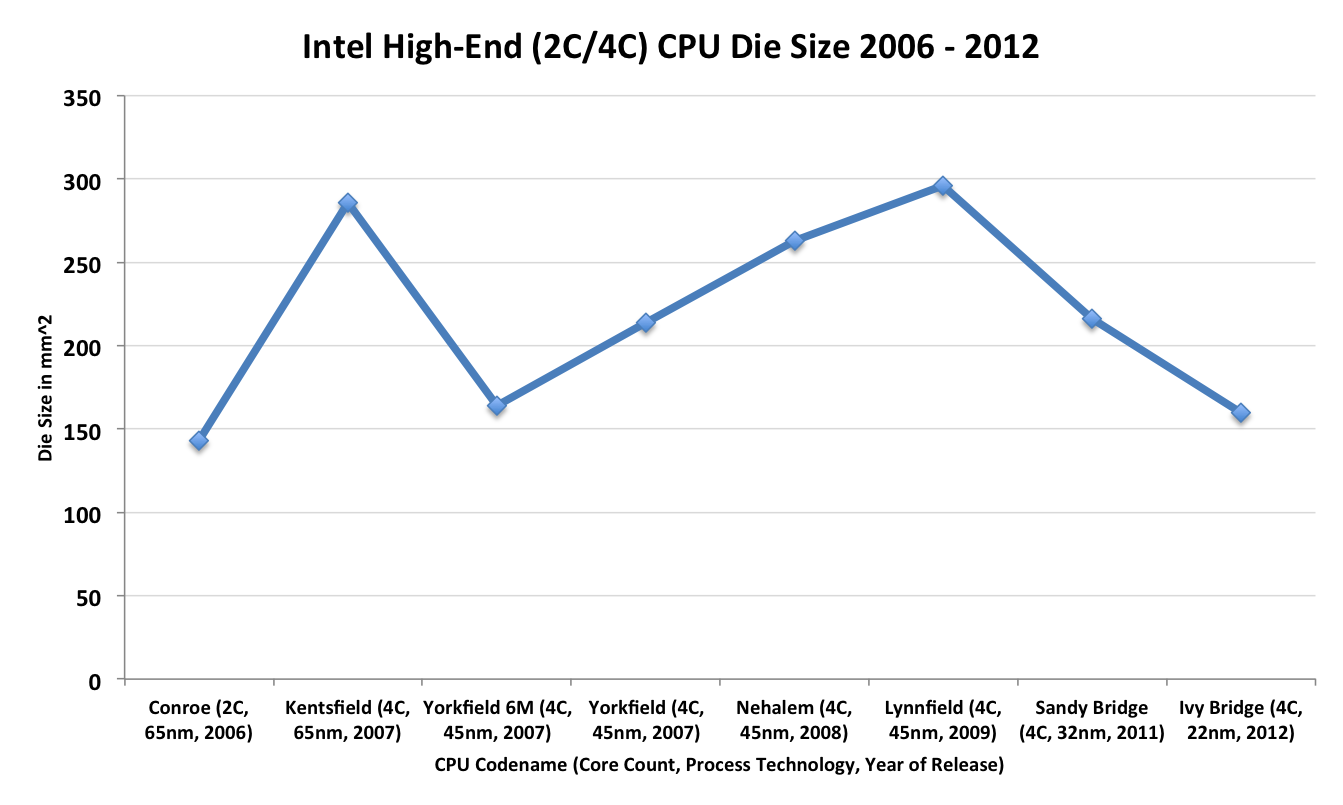
Of course they are, because their process and IPC improvements is how they have such a huge gross margin - I think around 62%. AMD has been in the 40s but their last quarter was an abysmal 37%. Look at this chart over die sizes. From Lynnfield in 2009 to Ivy Bridge in 2012 their mainstream die has shrunk from around 300mm^2 to 150mm^2 which makes the chips far cheaper to produce while their prices stay high and Intel pockets the difference. That might be good for Intel but with fierce competition they could have easily delivered an 8-core chip for $332 instead of a 4-core IVB. And with AMD increasingly bailing on the traditional CPU market, it's not going to get better.
-
Shameless Copy
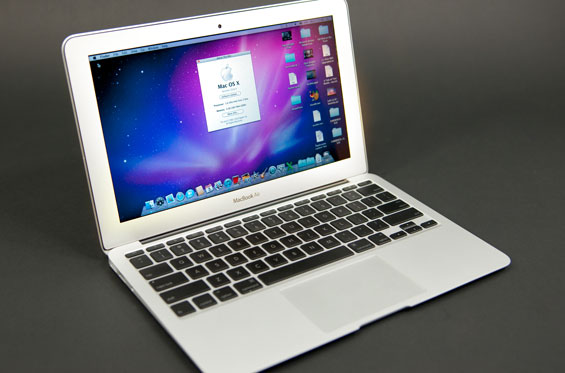
Visually this Chromebook is a pretty egregious copy of the Macbook Air. On a side note, the Surface is also a pretty shameless copy of the iPad. I'm not saying it's right that Apple sues them, but the designers who drew this thing up should be ashamed of themselves. If I wanted an Apple product I would buy one, the lack of originality these companies are showing is robbing us of possible innovations. Sources: I'm an Industrial Designer
-
OCZ Questionable Reliability, Intel Fanboyism
I personally know of (3) OCZ Agility 1 30GB drives fail, 2 on Linux, 1 on Windows.
OCZ Agility -> Intel SSD Image -> Distro Upgrade to Fix Corruption
The failure mode on one was file system corruption like an HDD but check disk would find problems, fix them but error out and another run would find different errors. I was able to image that one off to an Intel X25-V (Value) G1 40GB SSD then did a whole Ubuntu distro upgrade that basically overwrote pretty much all the important files on the system to downloaded good ones and that took care of the corruption and any problems from the previous hard drive. System is still running Asterisk PBX to this day without any errors surprisingly. I'm still a little amazed at how simple this recovery was and that there were no issues after distro upgrade that seemed to fix any corrupted files. I sent the failed OCZ drive back to my friends after fixing their PBX with with instructions to put a bullet through it instead of sending it for replacement, and I was being serious and literal and it is likely that they did just that.
Another failed with inaccessible and unbootable from Windows XP. The last one just kernel panicked disappeared from the BIOS completely. Both went back to OCZ for replacement and new ones showed up. I told the folks to not open the boxes and sell them on eBay and instead buy Intel X25-M or -V series drives to replace them.
OCZ Bashing
I still have a sealed OCZ Agility 1 30GB in my house and I posted it on eBay twice and nobody wants to buy it. I guess the word is out that OCZ SSD has shit for reliability. Newegg reviews are just full of failure reports. Even though Anandtech keeps reviewing these OCZ Vertex 2, 3, 4 series drives and praising them for performance I stay the hell away from OCZ as a vendor due to the massive amounts of complaints of failures people report on these.
As a side story, I also got burned by a performance grade OCZ 550W power supply with unstable 12V rail that wasn't even heavily loaded that would drop to 11V for no reason and destabilize my system causing weird behavior. Switched to Corsair TX750 after that and weirdness went away.
Intel SSDs - 3 Generations Going Strong
I still run an Intel X25-M G1 80GB in my laptop for a few years now without issues that used to be a desktop drive. I have an Intel X25-M G2 80GB at work and it's still working fine. I also have an Intel 320 (G3) 160GB as my new desktop drive andI applied the firmware upgrade to it that was available to fix that weird lock-up 8MB issue that was reported. I also have that Intel 320 40GB in my Ubuntu XbmcLive HTPC in my living room and another Intel X25-V G1 40GB in a friend's Ubuntu based Asterisk PBX system running just fine.
Love Intel for their SSD, never had an issue and I'm quite happy with them and the engineering that they did on the drives. Looking at the return numbers Intel has very low return rates for SSD, somewhere within the neighborhood of 1% and most of those were related to the two firmware bugs found, the one in the X25-M series early and the other the 320 series.
Intel 520 Series and SandForce SF-2281 Controller Firmware
There's a nice little story on Anandtech when Intel was choosing the new SandForce SF-2281controller for their Intel 520 SSD product line that they ran so many tests and did so much engineering on the drives that they came up with firmware updates that they gave to the vendor due to the issue that they discovered. Too bad that later on Intel found out that the controller can't do AES256 only AES128 encryption and it offering refunds for those that care about it.
http://www.anandtech.com/show/5508/intel-ssd-520-review-cherryville-brings-reliability-to-sandforce/
All of my Intel SSDs are about 2 to 3 generations behind and still use the old Intel controller that's limited to SATA-2 3Gbps speeds but