Slashdot Mirror
Domain: anandtech.com
Stories and comments across the archive that link to anandtech.com.
Comments · 3,318
-
Re:Bulldozer sucked, the PC is good.
AMD's fault in was keeping the details hidden before releasing Bulldozer. Bulldozer isn't far off the I7s ( at least, not the 1000$ extremes ), but neither were the Phenom IIs.
If and only if you use well threaded applications that can evenly distribute loads across 8 threads. In single threaded performance the FX-8150 is slower than the Intel Pentium G620 (slowest Sandy Bridge chip) and the I7-3770K offers 62% (Cinebench 11.5 single threaded) higher performance for $332. In good cases it offers 80-90% of the 3770K performance - running at a 125W vs 77W TDP for the 3770K including the integrated graphics. In CPU benchmarks Anandtech found that system consumption increased between idle and full load with 145W and 66W respectively including PSU loss, but the figures are comparable. Together it means the Bulldozer spends about 145/(0.8 to 0.9)/66 = 2.44-2.74W to compute what the 3770K does with 1W.
So to sum it up, in many workloads with single/mixed threads - where performance is capped by the speed of one thread - it's not performing well. And in the cases where it does perform well, it doesn't perform efficiently. That means higher power bill, more expensive and loud cooling and lower battery life - not that you'd put this one in a laptop but for AMDs chips in general. Granted this is the latter half of the FX-8150's life cycle, initially it would be pitted against the 2600K but it didn't perform well to start with either and while.new Piledriver chips are out any day now it's only half a year left until Intel comes with Haswell too. The Piledriver upgrade is reportedly quite evolutionary, so I doubt Piledriver vs Haswell will fare any better than Bulldozer vs Ivy.
-
Re:Bulldozer sucked, the PC is good.
AMD's fault in was keeping the details hidden before releasing Bulldozer. Bulldozer isn't far off the I7s ( at least, not the 1000$ extremes ), but neither were the Phenom IIs.
If and only if you use well threaded applications that can evenly distribute loads across 8 threads. In single threaded performance the FX-8150 is slower than the Intel Pentium G620 (slowest Sandy Bridge chip) and the I7-3770K offers 62% (Cinebench 11.5 single threaded) higher performance for $332. In good cases it offers 80-90% of the 3770K performance - running at a 125W vs 77W TDP for the 3770K including the integrated graphics. In CPU benchmarks Anandtech found that system consumption increased between idle and full load with 145W and 66W respectively including PSU loss, but the figures are comparable. Together it means the Bulldozer spends about 145/(0.8 to 0.9)/66 = 2.44-2.74W to compute what the 3770K does with 1W.
So to sum it up, in many workloads with single/mixed threads - where performance is capped by the speed of one thread - it's not performing well. And in the cases where it does perform well, it doesn't perform efficiently. That means higher power bill, more expensive and loud cooling and lower battery life - not that you'd put this one in a laptop but for AMDs chips in general. Granted this is the latter half of the FX-8150's life cycle, initially it would be pitted against the 2600K but it didn't perform well to start with either and while.new Piledriver chips are out any day now it's only half a year left until Intel comes with Haswell too. The Piledriver upgrade is reportedly quite evolutionary, so I doubt Piledriver vs Haswell will fare any better than Bulldozer vs Ivy.
-
Or they'll go Intel: Haswell processors from 10W
According to Anandtech, Intel Core 2013 ULV processors will start from 10W
See http://www.anandtech.com/show/6355/intels-haswell-architecture/4
" Finally, at IDF Intel showed a demo of Haswell running the Unigen Heaven benchmark at under 8W.
The chain of events tells us two things: 1) Intel likes to play its cards close to its chest, and 2) the sub-10W space won't be serviced by Atom exclusively.
Intel said Haswell can scale below 10W, but it didn't provide a lower bound. It's too much to assume Haswell would go into a phone, but once you get to the 8W point and look south you open yourself up to fitting into things the size of a third generation iPad. Move to 14nm, 10nm and beyond then it becomes more feasible that you could fit this class of architecture into something even more portable." -
Re:SSD Drives
I am not 100% clear on NAND tech, but Samsung had an announcement about a NAND based SSD last week. I believe this is related to the F2FS announcement today. http://www.anandtech.com/show/6329/samsung-releases-tlc-nand-based-840-ssd
-
Re:Intel increases performance-per-dollar
AMD is also the king of Multicore. Try finding a sub-$200 six or even 8 core processor from Intel. For those of use who care about multiprocessing and parallelism over single core performance, AMD is pretty much the only game in town.
And benhmark after benchmark shows the reason for that: the AMD quad-core is nowhere near powerful enough to compete with the Intel quad core (this goes for both Stars AND 'dozer). Just see here where the A10-5800K (their best quad core right this second) gets bested by the Intel 2500 (priced at around $200) in their best test. It just goes downhill from there.
AMD is offering 8 cores at $200 not because they're nice guys and want to share the love - they're offering them because they can't compete wth just 4 cores at the same price point. If they did have that ability, you can bet they would be charging a premium price for that.
So, what is the result of the $200 showdown? Pit the 2500 versus the 8150 (their best 8-core chip)! In this one test the 2500 wins the first pass by 30%, and the 8150 wins the second pass by 25%. Now, the second pass takes much longer, so the 8150 still wins (by about 15%), but it's a small win in a sea of disappointment.
h.264 video transcoding is AMD's BEST BENCHMARK, and they barely scrape by with twice the cores. Add Hyperthreading to the mix (i7 3770K), and they get blown away once again.
People wonder idly why Intel charges so much money for their quad-core parts, but the reason is obvious if you see the test results - they're almost twice as fast in single-threaded tasks!
-
Re:Well, DUH.
The problem is, the i5 is faster for multithreaded performance too (and that's even an older, slower i5 than the one I asserted)...
If you cared only about the single threaded performance, an i3 would do, and be half the price.
-
Re:Well, DUH.
The problem is, the i5 is faster for multithreaded performance too (and that's even an older, slower i5 than the one I asserted)...
If you cared only about the single threaded performance, an i3 would do, and be half the price.
-
Re:Why isn't it good for consumers?Even Intel's OLD processors are holding value. I have a Core 2 duo system I was considering upgrading to Core 2 quad, but their cost - new or used - is almost the same as it was when they were released 4 years ago.
For example the Q9550s released at $369 and now sells for around $300.
I guess you could argue the high resale value makes it very cheap to own so long as you remember to sell it a few years later.
-
Re:Wow
The problem is the fact that AMD "lies" for want of a better word, to Windows and tells it that its real cores instead of hyperthreading. Lets say you have an 8 core/4 module unit with two related loads, a1 and a2, along with two unrelated loads, b1 and c1. The way it SHOULD be scheduled is a1 and a2 on module 1,b1 on module 3/4 and c1 on module5/6. Instead Windows will give you something like a1 and b1 on cores 1 and 2, a2 and c1 on cores 3 and 4. Now this is NOT the fault of MSFT and Windows, because Windows has NO way based on what the chip tells it to know that all the cores aren't equal so it treats them as full cores instead of modules that share resources.
A problem here is that Bulldozer modules are somewhere in-between hyperthreading and two real cores. So whatever they report to the OS, it will be somewhat misleading. Of course one might wonder how they would perform if they reported each module as hyperthreading-enabled core.
But the question is sort of obsolete, as there is a hotfix for Windows 7:
http://www.anandtech.com/show/5448/the-bulldozer-scheduling-patch-tested
It brings some minor improvements, but nothing spectacular (and if reporting each module as hyperthreading-enabled core would be better, I'm sure the hotfix would do that ).But the real problem is that Bulldozer just plain sucks compared to the Phenom II. In the one benchmark from the Anandtech test where a Phenom II X6 was included, it beat the FX.
So I think a simple shrink of the Phenom II architecture to 32 nm might have been better than the current FX generation. I hope the upcoming Piledriver architecture can fix that. -
Re:Wow
You're getting ahead of yourself. AGP was impossible to bridge multiple cards together, and PCI Express only made an entrance in 2004. That's nowhere near a decade yet, and by the time it was released pure 2D cards were long-dead.
But your dream lives on in the embedded world, where PowerVR is dominant thanks to the low memory bandwidth demands of tiled rendering and Infinite Planes/HSR to eliminate overdraw. The only problem with that platform? It's so tiny and integrated that your dream of a swappable 3D module is simply impossible to implement.
But don't worry your little head. The video cards in existence today can turn off parts OR the entire 3D core to save power, so you don't have to have your dream of modular removable cores to get the power savings you've been dreaming of.
-
Re:This Poll is Dumb
DisplayFusion already does everything that the 'new' multiscreen support does. For free. On Win7
faster boot/sleep/resume should be required for newer OS/hardware.
Power mgmt has traditionally sucked in Windows. It damn well should get better.
http://www.anandtech.com/show/3969/apple-mac-pro-mid-2010-review/7 -
Re:Intel displaying weakness
Intel already has a mobile platform prepared - they've shipped a couple Android phones based on it already. Its battery life is comparable with ARM.
-
Re:News For This Nerd
Sorry, not an expert, but you might find this article (about AMD Steamroller) interesting. At least check the short "Looking Forward: High Density Libraries". They are rebuilding hand-drawn diagrams to be more efficient. http://www.anandtech.com/show/6201/amd-details-its-3rd-gen-steamroller-architecture/2
-
Re:Zero performance, where it matters...
-
Re:Intel already realized where their market is
>Since Intel cannot or do not want to manufacture CPUs cheaper than ARM licensees plus they still have lousy performance/watt their only remaining market is something which takes advantage of the vast catalog of pre-existing software for the x86 architecture namely Windows
Wrong.
http://www.engadget.com/2012/09/05/motorola-razr-m-europe-intel/
http://www.anandtech.com/show/5770/lava-xolo-x900-review-the-first-intel-medfield-phone/6
-
Re:ARM is not RISC and x86-64 is not CISC
That's a good point. ISA goes beyond instructions and also defines the memory and interrupt models, which Atom must then emulate as well. I'm not an expert on the interrupt models, but if I recall correctly, ARM's can be implement more easily and with less power, so Atom loses there. But, to my knowledge, it's still not a large difference.
You're right that iPhone 4S creams Medfield reference in battery performance benchmarks, I'm looking at the ones on AnandTech right now. But the iPhone 4S creams other Android smartphones, too, so it's not just the ISA. Many of the android phones compared in the XOLO review (and the newer ones, too) do about as well as the Medfield reference design in the normalized power charts. AnandTech doesn't include all of the phones in the review in the later link, so you have to tab back and forth. I'm not going to demand that you call the Atom stellar, but its deficiencies are (I think) removed from the ISA and CISC vs. RISC at large.
-
Re:ARM is not RISC and x86-64 is not CISC
That's a good point. ISA goes beyond instructions and also defines the memory and interrupt models, which Atom must then emulate as well. I'm not an expert on the interrupt models, but if I recall correctly, ARM's can be implement more easily and with less power, so Atom loses there. But, to my knowledge, it's still not a large difference.
You're right that iPhone 4S creams Medfield reference in battery performance benchmarks, I'm looking at the ones on AnandTech right now. But the iPhone 4S creams other Android smartphones, too, so it's not just the ISA. Many of the android phones compared in the XOLO review (and the newer ones, too) do about as well as the Medfield reference design in the normalized power charts. AnandTech doesn't include all of the phones in the review in the later link, so you have to tab back and forth. I'm not going to demand that you call the Atom stellar, but its deficiencies are (I think) removed from the ISA and CISC vs. RISC at large.
-
Re:ARM is not RISC and x86-64 is not CISC
So you decided that the best way to get this point across to the Slashdot denizens (who never read the article) is to NOT ONCE mention the weaknesses of ARM or the strengths of x86 in your summary.
Never in all my years reading Real World Tech have I ever seen a thread or article absolutely decide the question of "which instruction set is better?" between ARM and x86 (and some of the biggest industry heavyweights weigh-in on those discussions). Does better code density trump better compiler optimization flexibility. And does it even matter when ARM introduces out-of-order in mainstream cores like the A9, and Intel keeps Hyperthreading attached to every new Atom core to deal with blocking?
So just because you feel slighted you write this fluff piece? Bruce, you shouldn't say things that aren't true just because you didn't get what you want, and because this "locked-down" tablet ecosystem is quickly taking away the free software community's free-ride.
And you can keep pretending all you want that Intel can't compete with ARM on performance/watt or price. I guess you weren't paying attention when Intel released the Atom Z2460 phone platform, with competitive performance and battery life? The Xolo x900 has a street price of around $400, so you can bet Intel is charging a tiny fee for that chipset.
Tell me again why Intel can't compete?
-
Sorry Bruce, but that is total nonsense.
"ARM ends up being several times more efficient than Intel"
Wow. Someone suffered a flashback to the ancient CISC vs RISC wars.
This is really totally out to lunch. Seek out some analysis from actual CPU designers on the topic. What I read generally pegs the x86 CISC overhead at maybe 10%, not several times.
While I do feel it is annoying that Intel is pushing an Anti-Linux platform, it doesn't make sense to trot out ancient CISC/RISC myths to attack it.
Intel Chips have lagged because they were targeting much different performance envelopes. But now the performance envelopes are converging and so are the power envelopes.
Medfield has already been demonstrated at competetive power envelope in smartphones.
http://www.anandtech.com/show/5770/lava-xolo-x900-review-the-first-intel-medfield-phone/6
Again we see reasonable numbers for the X900 but nothing stellar. The good news is that the whole x86 can't be power efficient argument appears to be completely debunked with the release of a single device.
-
Re:Really, Linux won't (currently) support CT
http://androidandme.com/2011/09/news/intel-and-google-announce-android-x86-optimization/
http://www.v3.co.uk/v3-uk/news/2109367/df-intel-outlines-developer-tools-android-tablet-integrationhttp://www.itproportal.com/2011/12/05/intel-google-design-android-smartphones-run-atom-processors/
http://www.extremetech.com/computing/105189-intels-x86-android-smartphone-and-tablet-plans-exposed
http://www.anandtech.com/show/5770/lava-xolo-x900-review-the-first-intel-medfield-phone
http://www.theverge.com/2012/5/24/3040706/intel-x86-image-for-android-ice-cream-sandwich-sdk -
Re:Will it run OS X?
Actually Apple hasn't used Atoms because Apple severely bifurcates the performance levels of their closed IOS (iPhone. iPad) ecosystem from that of the much faster OS/X-based Intel Core i-based Mac products. Atom actually outperforms most ARM procs but is much less powerful than the full out-of-order Core architecture cpus so it exists in a middle ground where Apple doesn't choose to have a product today. As performance requirements for phone/pad devices rise, Apple may wind up choosing to use x86 Atom esp if they bring OS/X OS components downward into that space. Atom could run OS/X (or IOS) nicely if Apple wanted it to.
-
Re:Meh
The ASUS Transformer Pad Infitity has is of comparable resolution (a little lower, but native width for full HD video) and kicks ass on the SIPS+ end of things. Furthermore it has the truly unparalleled dock that gives a sleek, integrated keyboard and extends battery life to 14 hours. No, a bluetooth keyboard in a shitty, ugly case does not come even close. And Apple has nothing that even remotely compares to the Nexus 7, I suspect that there will be no iPad Mini, just bullshit sneering about the uselessness of the particular form factor because they can't compete on price.
-
Re:Closing in on Atom
Intel's top Atom chips have a 10W TDP. Of course the chipset/RAM also play a large factor, but still -- this is an amazingly frugal CPU
You're thinking of the wrong Atom CPU there. You want to compare Intel's lowest-power Core architecture to...their lowest-power Atom.
Intel has placed an Atom Z2460 on a smartphone platform, complete with 1.6 GHz core speed and sub 1w typical power consumption, and they've done it on just the old 32nm process. The 10w parts you're thinking of are for desktops.
These 10w Haswell chips will also be the pick of the litter, but the power consumption will be nowhere near that of Atom (and neither will the price...expect to pay upwards of $300 for these exotic cores). The Lava Xolo X900 costs only $400 on the street, so you can imagine Intel's charging around $25 for their chipset.
-
Re:Closing in on Atom
Intel's top Atom chips have a 10W TDP. Of course the chipset/RAM also play a large factor, but still -- this is an amazingly frugal CPU
You're thinking of the wrong Atom CPU there. You want to compare Intel's lowest-power Core architecture to...their lowest-power Atom.
Intel has placed an Atom Z2460 on a smartphone platform, complete with 1.6 GHz core speed and sub 1w typical power consumption, and they've done it on just the old 32nm process. The 10w parts you're thinking of are for desktops.
These 10w Haswell chips will also be the pick of the litter, but the power consumption will be nowhere near that of Atom (and neither will the price...expect to pay upwards of $300 for these exotic cores). The Lava Xolo X900 costs only $400 on the street, so you can imagine Intel's charging around $25 for their chipset.
-
Re:Colour me a cynic for saying this...
You're forgetting that Glide was arguably the best API around at the time. That's why so many games supported it. I owned a lot of different 3D accelerators and the only ones that I can remember being worth anything back in 98 were the 3Dfx Voodoo cards and the Rendition Verite cards. Further, the software renderer in Unreal was actually quite good.
Glide was only supported by a single manufacturer. For an interesting read on Unreal 1 tech and various bugs and issues with various cards take a look here. It details things like lines of code required to support DirectX, Glide, OpenGL etc. I have fond memories of my Voodoo 3 2000. I also owned a 5500 (didn't buy it new) and the glorious Sound Blaster AWE64. And I'll agree with you that the Unreal Software renderer was very good and supported (nearly?) everything the hardware one did. It's a tough sell to say hardware will be slower than software (on identical setups).
Sales numbers don't usually reflect upon quality.
Very true! But, awards and peoples' (professional and amateur) reviews do which is why I mentioned them. Failing that there are always screenshots, which may not tell the entire story but help validate claims.
As far as Quake engines, Unreal surpassed id Tech 2 in every way. id Tech 3 surpassed Unreal in many ways, but was not as much of a technological leap as Unreal was from Q2. The comparison shots you've linked aren't equal because they show Q3 at maximum detail, while the UT shot is clearly someone playing with settings turned way down.
Surpassed them in every way? Perhaps you're not aware that when Unreal was released it featured poorly performing netcode and no OpenGL support (Directly from Tim Sweeny's own mouth and low hanging wiki fruit). Quake II came out before Unreal and ID Tech 2 beat them to the punch with multicolored lighting. Unreal's strengths were Unreal Script and their texture technology (which only worked with Glide, even then it was problematic thread lamenting the fact circa 2000). As far as the screenshots I didn't cherry pick them, you're welcome to find some better vintage shots along with hardware specs.
Games had been using redbook audio for years by then (ie. Mechwarrior 2, Super Street Fighter II, Little Big Adventure, FX Fighter, etc.), but it wasn't always the best choice because you couldn't have seamless transitions for dynamic music as you could with MIDI and MOD like formats.
Red book audio is not the same as an API provided by the Operating System. A specification enables you to write an implementation whereas an API is already implemented. Needless to say it isn't 3D nor is it specific to games, it's the specification for audio CDs developed by Phillips and Sony describing the CD's physical specifications, such as the tracks, sector and block layout, coding, and sampling etc.
"One of the best ever made" is not the same thing as "the best ever made". And I disagree with you about Mario. Star Control II is my personal choice for best ever.
I'll raise you a Robotron 2084.
But how did Windows get to that point? It didn't always have that huge library of applications and it wasn't always familiar to people. It gained popularity despite being a worse product than competitors (ie. GEOS and OS/2) in much the same way as Half-Life.
I provided some examples, which I'll refine and add to: it ran on a wide variety of hardware, it was easy to develop for, it ran DOS games which many people had and were quite familiar with (didn't require you to buy new everything). Dire
-
Staying Relevant
Unfortunately this isn't all that surprising. With the market failure of WiMAX in the US, Sprint has been put in a very bad position overall. At this point it's everything the company can do just to stay relevant, particularly when the big two (VZ and AT&T) are ahead of you in both coverage and LTE deployment and "little" T-Mobile has a lock on the cities by offering good prices combined with fast speeds (3G DC-HSPA+).
Meanwhile Sprint's network is still almost entirely composed of a last generation CDMA network, unless you're fortunate enough to be in Atlanta where their first LTE deployment is. Even then the performance sucks thanks to the fact that they are deploying their LTE network on such a high frequency.
Because of these reasons, expect to see Sprint do more "crazy" things like MVNO LTE. They're not going to win in a price war, a speed war, or a coverage war; they're going to have to keep throwing things at the wall until they find something that reverses their fortunes, if such a thing can be found in time.
-
Re:AMD has cool code names.
The cost difference is not nearly an order of magnitude when you take into account all the other components of the server besides CPUs you have to pay for anyway.
In desktop systems and low-end servers, the processor is often the most expensive component (or second most expensive, behind the video card), and can easily be 25-30 percent of the total system cost. But as the server becomes bigger and more expensive, with hundreds of gigabytes of RAM and terabytes of storage, the processor can become a smaller part of the total cost. For example, Dell's PowerEdge R910, a 4-socket Xeon server, lets you spend up to about $22,000 on processors, if you get four of the most expensive parts offered (the Xeon E7-4870). That's a lot, but it's nothing compared to the $185,000 that equipping the machine with 2TB RAM would cost.
Not to mention that Intel wins on performance/watt and performance/core and thus in total cost of ownership when power consumption and software licensing costs are taken into account. http://www.anandtech.com/show/5279/the-opteron-6276-a-closer-look/12
If you calculate the price of a Dell R710 with the Xeon E5649 and compare it with a Dell R715 with the Opteron 6276 with similar specs, you end up more or less the same acquisition cost. However, the E5649 is an 80W TDP and should thus consume a bit less power. That is why we argued that the Opteron 6276 should at least offer a price/performance bonus and perform like an X5650. The X5650 is roughly $220 more expensive, so you end up with the dual socket Xeon system costing about $440 more. On a fully speced server, that is about a 10% price difference.
When we look at the higher end OLTP and the non low end ERP market, the cost of buying server hardware is lost in the noise. The Westmere-EX with its higher thread count and performance will be the top choice in that case: higher thread count, better RAS, and a higher number of DIMM slots.
AMD also lost the low end OLAP market: the Xeon offers a (far) superior performance/watt ratio on mySQL. In the midrange and high end OLAP market, the software costs of for example SQL Server increase the importance of performance and performance/watt and make server hardware costs a minor issue. Especially the "performance first" OLAP market will be dominated by the Xeon, which can offer up to 3.06GHz SKUs without increasing the TDP.
The competitive picture has not improved for AMD since then, with the release of the Intel Xeon E5's that are Sandy-Bridge based 6 months ago, as opposed to the Westmere-based Xeons that were benchmarked in the above reviews.
-
Re:What are you talking about?
Heads up: The x264 project's incorporating OpenCL support for certain parts of the encoder. Take a look over here - initial results are very promising.
-
One more reason why APU in the high end is stupid
Personally I thought the whole idea was retarded except for the mobile chips like Brazos, on the desktop the idea was completely stupid and on the server even more so. For those that don't know the original plan was to go "Full APU" and have the GPU take the place of the FP on chip, which would be a much simpler and weaker design than in years past thus freeing up more TDP for more cores. Why is this dumb? Well what if you want to use the GPU AND do some floating point heavy task? Or what if you don't want the integrated GPU because you can't OC worth a crap with the GPU built in?
All correct, but I could live with those aspects. I usually don't OC, and if I know I want the GPU AND do some floating point heavy task, I could get an additional discrete GPU. There is, however, a worse one:
Memory bandwidth congestion. A typical lower midrange graphics card with 128 bit data bus and GDDR3 is significantly slower than the same model with GDDR5. In an APU, the GPU part has to share the even lower bandwidth of the DDR3 main memory with the CPU part.
When the LLano was new, Anandtech published a preview:
http://www.anandtech.com/show/4448/amd-llano-desktop-performance-preview
It shows some comparisons to discrete graphics cards, including the HD 5570 which represents the lower midrange graphics card w/128bit mentioned above.
In gaming frame rates, the HD 5570 beats the LLano even when it runs on DDR3-1866 RAM, which was not a JEDEC standard at the time. With standard DDR3, the difference gets bigger. Which shows clearly the LLano is limited by memory bandwidth and really could use four-channel memory as in Intel's socket 2011.
With bigger and faster GPUs, the bandwidth demands will only grow, and for a Bulldozer APU with matching GPU part even four-channel memory may be insufficient.. -
Re:It's not all graphics
But they aren't making Trinity without the GPU correct? Trinity is fine for office boxes but who wants to be stuck with an IGP constantly pulling power and needing graphics drivers? If they manage to get hybrid CF working I can see it but so far the guys on the forums that have messed with it say its hit and miss, more often its a miss, with bugs, hangs, crashes, graphics corruption, its just not ready for prime time. And I have some customers that prefer Nvidia GPUs, who wants to have to run AMD AND Nvidia graphics drivers?
I just hope the new chip designer they hired away from Apple knows his foo and can solve the problems as I haven't built a single Intel unit since finding out about the OEM bribery, but with each rev its getting harder and harder to ignore the facts. The facts are that AMD runs hotter, gets less IPC, sucks battery life, and unless you want Metro...shudder, you'll get shitty scheduling from Windows because it treats the half core design as hardware HT which kills performance and MSFT has already said they won't fix the scheduler in older versions of Windows, all you get is a lame patch that tells it to spread the HT across cores...yuck.
-
Homework-and-Facebook PCs with Intel GMA
Because people who own consoles NEVER play PC games right?
I wouldn't say never, but PCs owned by people who primarily game on consoles are more likely to have Intel GMA ("Graphics My Ass") because they're bought for homework and Facebook and the like. Only recently did Intel graphics begin to match the graphical complexity of seventh-generation consoles, with Ivy Bridge running Skyrim at a playable frame rate.
-
Re:Starts with apple
http://www.anandtech.com/show/6162/lenovo-thinkcentre-m92-system-review-pintsized-power
Probably same size as the mac mini, 4GB of RAM 5400RPM hard drive 2x2.9GHz procs turbo up to 3.6
No wireless
-
Re:Procrastination
So I really wouldn't be surprised if this next refresh is probably the last for the pro line, Apple doesn't really need them and they cost Apple more than any other division on hardware. Its just good business sense to bail out of a niche that doesn't bring in the sales and the Apple pros simply don't move like the Macbooks and iMacs.
First off, do you REALLY think the Pro line isn't profitable for Apple? Have you seen the list prices for Mac Pros? If you listen to the Linux fanbois, they could build TEN systems with TWICE THE SPECS for these prices (but I digress...)
And then there's this little email from Tim Cook, that seems to affirmatively put to bed your meme... -
Re:I wonder how many fools..
Windows 7 comes with a paid for H.264 codec while XP, and Linux? Do NOT. And yet again you are mistaking HARDWARE FOR software. dxva AND va-api are simple APIs but do NOT, I repeat do NOT give you the H.264 codec.
This is completely incorrect. The entire purpose of the DXVA, VA-API, and VDPAU APIs is to allow video bitstreams to be sent directly to the graphics hardware for decoding. See, for instance, this page on Intel Linux graphics which specifically states that Intel's newer graphics chips support H.264 hardware decoding on Linux via VA-API. Newer versions of VLC have the ability to use these protocols. The way these APIs work is that you hand them a video bitstream and they give you back pointers to decoded frames. Your software never needs to touch the patented decoding steps; that's all done in hardware and/or firmware which already has its license fees paid by the manufacturer. You said there was something on the Mozilla Blog saying the opposite of this, but I was unable to find any such article there. In fact, they are going to be supporting H.264 on mobile devices using basically the same method I outlined here (sending bitstreams to low-level APIs that talk directly to the hardware).
-
Re:People want cheaper tablets
Transformer Infinity. Absolutely superior to the latest ipad in almost every way for a similar price. The ipad has an extra inch of screen on one side due to having a different aspect ratio, and a little more battery but no more endurance. That's its only advantage
Are you serious? This AnandTech article [1] proves you wrong on about a dozen points (ie, color gamut, GL benchmark, wifi 5ghz support etc
But all of this is irrelevant - the Apple ecosystem is still superior including apps and content - that and the usability of the device, fit and finish is what sells folks.I do agree that the Transformer series is a pretty good differentiator from the iPad given the keyboard dock. Microsoft's Surface looks like it's going to target this niche pretty hard, so Asus must be doing something right.
[1] http://www.anandtech.com/show/6036/asus-transformer-pad-infinity-tf700t-review/4
-
Re:Not a reason for me
Unfortunately mounting USB storage natively is not supported on the Nexus 7.
-
Re:Ha ha he he
There is at least one, the Lava Xolo X900 released in India: http://www.anandtech.com/show/5770/lava-xolo-x900-review-the-first-intel-medfield-phone/
-
Metrobox 360
The only time I was kicked from a game was in Metro.
And guess what: All of Xbox Live has been Metro since December 6, 2011.
-
Re:none
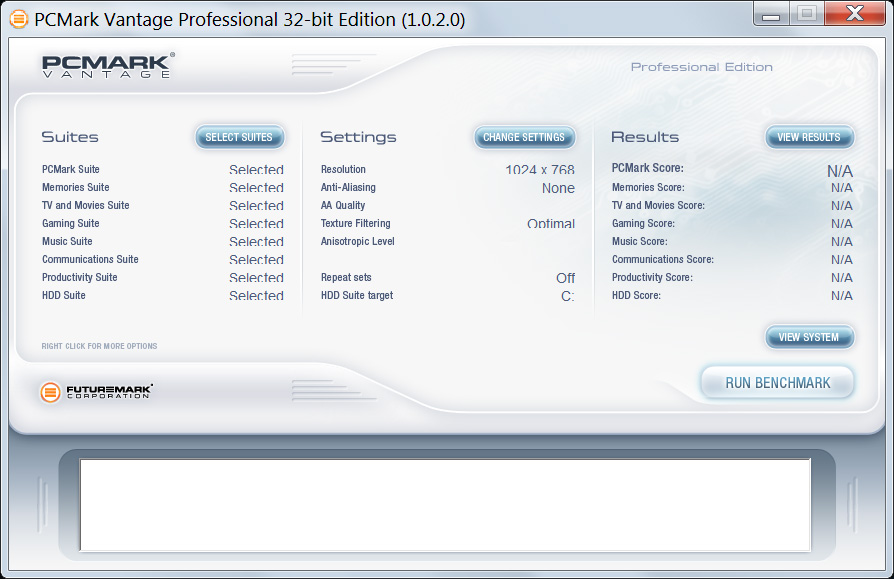
Take for example the PCVantage screen shot ( http://images.anandtech.com/reviews/mobile/ASUS/ZenbookPrime/UX21A/pcmarkvantagescaling.jpg )
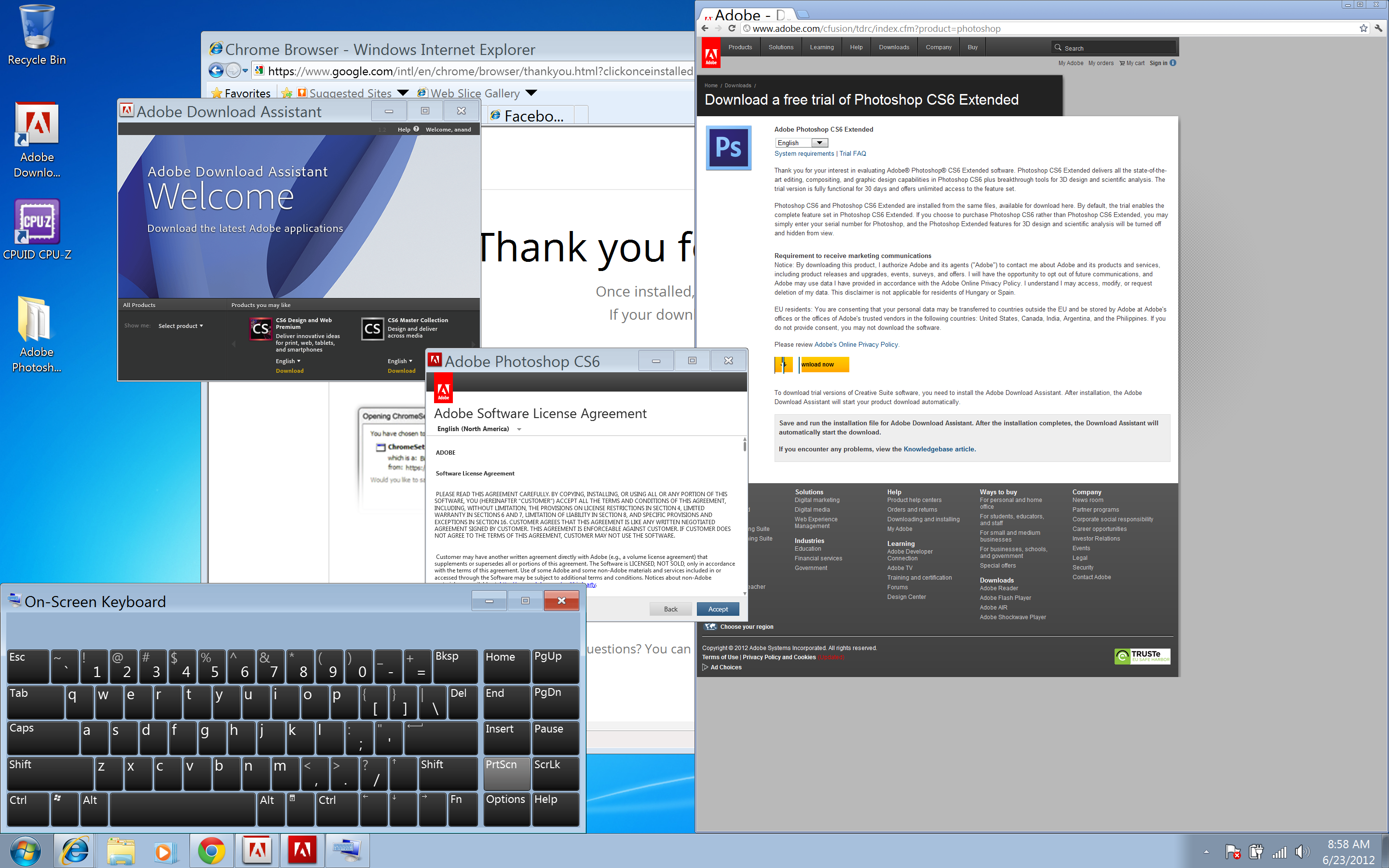
You can see the fonts are actually clipped unable to fit into the box at all.Or on the retina one ( http://images.anandtech.com/galleries/2116/200pct4.png ). Look at the size of the text in the screen from adobe relative to the text in the address bar and the tab.
-
Re:none
Take for example the PCVantage screen shot ( http://images.anandtech.com/reviews/mobile/ASUS/ZenbookPrime/UX21A/pcmarkvantagescaling.jpg )
You can see the fonts are actually clipped unable to fit into the box at all.Or on the retina one ( http://images.anandtech.com/galleries/2116/200pct4.png ). Look at the size of the text in the screen from adobe relative to the text in the address bar and the tab.
-
Re:none
They had the technology. They haven't worked it out end to end on the ecosystem. Here are some very recent examples on the Asus zen: http://www.anandtech.com/show/5843/asus-zenbook-prime-ux21a-review/4
If things get even weirder like on the Macbook retina you can see the same sorts of problems with Windows 7 itself:
http://www.anandtech.com/Gallery/Album/2116#1 -
Re:none
They had the technology. They haven't worked it out end to end on the ecosystem. Here are some very recent examples on the Asus zen: http://www.anandtech.com/show/5843/asus-zenbook-prime-ux21a-review/4
If things get even weirder like on the Macbook retina you can see the same sorts of problems with Windows 7 itself:
http://www.anandtech.com/Gallery/Album/2116#1 -
Re:I'm confused
That's clear enough.
No, that's just the definition of a design patent.
And what gave you the idea that simply slapping "Pepsi" on a Coke bottle would make it not infringing?
What an idiotic strawman comment, i never said or implied anything of the sort.
Are the differences between the 2 devices pictured here not immediately obvious to you? Or here? Or here? -
Re:People must be blind..
Taking a quick look at this makes me realise just how insanely similar they are, and just how much apple has a point.
But then you take a quick look at this or this or this and then you realise just how different they are. Yes it's possible to make them look very similar if you set up the screen just right and look at it from the right angle but obviously you can see why Samsung opposes this litigation.
-
Re:People must be blind..
and think that you can invalidate it by pointing out that tablets are not new, or that other things have round corners.
The reason for that is that Apple is cherry picking similarities and ignoring key differences, like this or this or this, that last one even Apple so obvious that they went to the trouble of photoshopping it to make them the same size and aspect ratio.
I just think it's a waste of time, no one who wants an Apple iPad is going to buy a Samsung Galaxy Tab just because they look similar from a certain angle, if they were infringing on the trademark then that is a different story though. -
Re:This game is tough to win, though
2006 Samsung digital photo frame viewed from other angles
So it is agreed that the design of the iPad from a frontal perspective is basically identical to Samsung's digital photo frame.
So it is likewise agreed that Samsung's digital photo frame does not invalidate Apple's design patent (I can play your silly game too, you know).
And since the side by side comparison posted above only shows frontal views, then it is also agreed that the frontal perspective is the most important one.
Nope, I don't agree to that. This lawsuit looked at all perspectives, not just the "frontal" one.
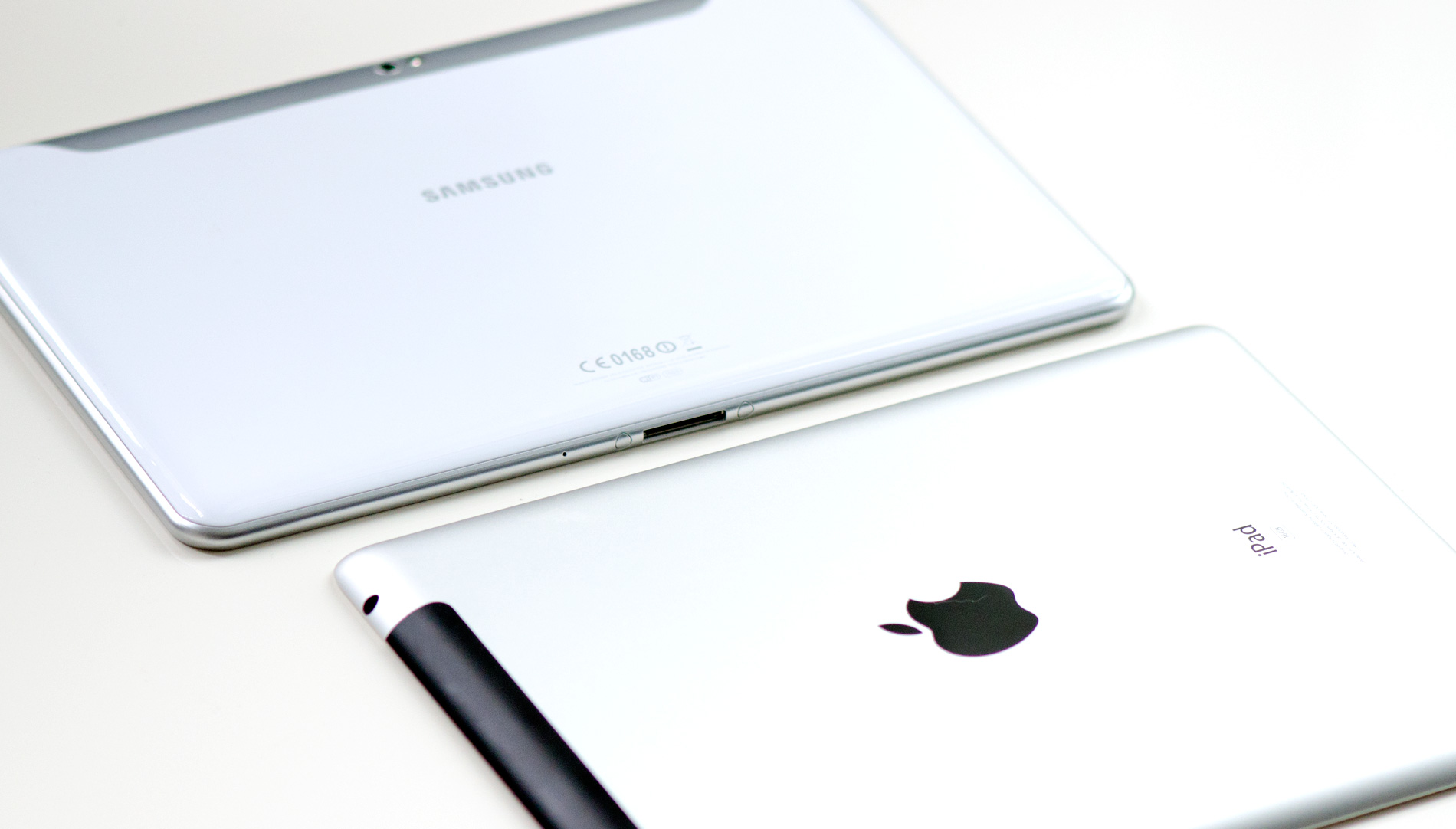
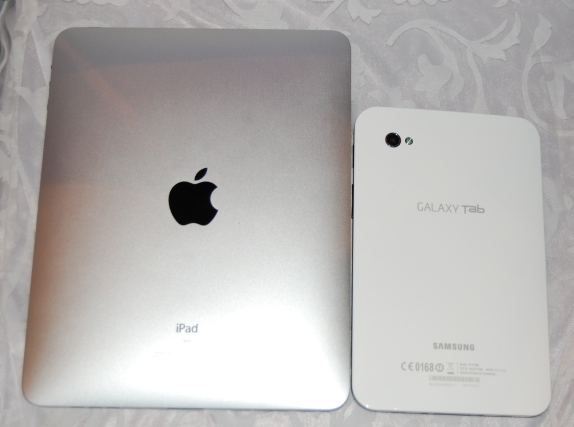
If a differing rear design is supposed to be a valid differentiator, then see: iPad vs Galaxy Tab from another angle The iPad and Galaxy Tab appear very different when viewed from the rear; obviously not the same device.
Yes, they do. The iPad also appears very different from the XBox 360, which, like the Galaxy Tab, was not an issue in this lawsuit. There are a whole host of things that the iPad does not resemble, such as a car, a toaster, and a tuba.
The iPad does however look a lot like the Galaxy Tab 10.1 , which was the product in question.
An honest, good faith poster would acknowledge that point and concede that they had inadvertently compared the iPad to a product that wasn't in the lawsuit and is not subject to an injunction, much like toasters and tubas. Believing you to be such an honest, good faith poster, I'll wait for your reply.
Cheers.
-
Re:Consider this.
-
Re:How about a decent sized screen?
14" good enough?
And that's x86, not ARM, so you can actually put a full-fledged Linux distro on it. Or leave Win8 if you don't mind it.
-
Re:choices
The primary reason a 48fps average may not be good enough for gaming is because of variability. In a 48fps movie, every single frame comes 20.83ms after the one before it. If a game has an average of 61 FPS, it could be that sixty frame times are 15ms and the sixty-first is a very noticeable and jarring 100ms. Hardware reviewers, starting with Tech Report, are starting to catch on to the fact that the longest frame times matter much more than the average.
Two other reasons why a framerate where movies are smooth may not suffice for gaming:
- Normal 3d rendered frames are like using a camera with an infinitely fast shutter. The difference between the resulting sudden motions and the natural blur in frames that have had exposure times comparable to their frame display times is the same thing as the difference between "jaggies" and smoothly antialiased edges in a single frame, except in the time domain rather than the spatial. Artificial motion blur effects try to improve on that, but often it's easier to just increase framerate (just as increasing the resolution makes the "jaggies" in a single frame less obvious).
- The relationship between Input lag and frame delay in a game is somewhat complex. It would of course be possible to have a thousand or more frames per second and still have a full second of input lag, and it's possible to have input lag low enough for twitch FPSes with less than 60fps. But if a game's engine design, buffering, and the hardware input and output pathways were such that input lag is 3*frame time + 50ms, you would notice improvements in input lag from having ridiculously high frame rates well beyond the point of smooth motion.
Here's the study showing little difference between 30fps and 60fps for a first person shooter. Note the dramatic differences up to 15fps, where we begin to perceive many things as motion rather than individual frames, the still-quite-noticeable improvement in moving to a 30fps rate, where quick full-frame motions are starting to appear smooth, and the much smaller change (esp. the almost-zero perceived quality change) between 30fps and 60fps. Since the frame time difference between 30fps and 48fps is 12.5ms and the difference between 48fps and 60fps is only 4.17ms, I sincerely doubt their test setup would have showed any difference between 48fps and any higher rate (even 240+). However, their test setup was different from most games in one or maybe two of the three points I mentioned above. The frame rate limitations in the paper were artificial- the computer was capable of producing a much much higher framerate- so the frame times were probably almost exactly consistent. It's also possible that their mechanism for limiting framerate didn't give as strong a link between framerate and input lag as most games have (you'd have to look at the code to be sure).
-
Re:Zenbook.
Yeah, because the hard plastics that have been traditionally used are so much better. And you of course don't mention WHY Aluminum is the WORST (not just a bad, but the WORST) material to use in a laptop.
Actually, the heat transference rate basically makes Aluminum laptops a toaster under medium load. The answer is advanced polycarbonates, magnesium-alloy shells, and other materials such as carbon fiber. At least they don't dent when you drop a feather on them.
No, they just crack and shatter. The MILLED aluminum body of a MacBook is not going to "dent when you drop a feather on [it]." That is reserved for the LOOK-ALIKE faux-unibody laptops, like my work-supplied Samsung RV511, which use Aluminum (I think) SHEET METAL in a desperate bid to LOOK like a MacBook, but without the quality...
And I don't know what you call "better build quality". Unibody Apple laptops are pretty much universally accepted as having the best build quality in the industry.
And ASUS having better build quality that Apple?!? That's a laugh riot!
No, Apple laptops are lauded by amateur review sites as having "good build quality" because these sites and journalists measure build quality by how much something flexes when you squeeze it. Asus is well known for making high-quality hardware.
I guess then EVERYBODY is an "amateur review site"; because that's who disagrees with you, and more importantly, agrees with me. MUST I drag out two fistfuls of "non-amateur" reviews?
From what I can tell, it's a Macbook Air ripoff through and through, but with a shitty TN panel (except for the one that costs as much, or MORE THAN an Air), and a dodgy trackpad, for not a whole lot less than an Air, and in the case of the one with an IPS panel, MORE. And as far as build quality goes, ask anyone who has owned an Asus laptop. By the way, if not Aluminum, what exactly is the Zenbook made of? Asus seems to think it's made of... wait for it...
ALUMINUM Which they explicitly say was the best material out of the many that they tried.
As I said, Asus usually makes great, quality products.
Re-read my damn comment; I recommended one of the magnesium-alloy notebooks, while detracting the deluded manufacturers who use it in their products. The only reason it's used in that way is because Apple, in their infinite margin-building exercise, was able to convince the world that abundant, shiny materials are 'high-end". They realized that they didn't really need to put good components in the box, because that's not what people look at. That's not what gets shown off in a coffee shop.
I guess then that Asus was deluded, too; since they chose ALUMINUM, not Mg, as the Zenbook's main material... And if you want to build "margin", the LAST thing you want to do is create an entirely-new (and EXPENSIVE!) way to make consumer electronics' cases (CNC Milling). Name ONE other manufacturer that has followed Apple's lead in the Unibody design. Wanna know why? Because it CUTS "margin" for a given price-point! In fact, if it wasn't for Apple's insane buying-power, making the commodity parts as cheap as possible, and their ability to create custom silicon wherever and whenever they need, THEY couldn't afford to do it, either. Think about it.
But unlike Apple, who MILLS the case out of a SOLID BLOCK of aluminum (a quite time-consuming and expensive process compared with stamping a body out of SHEET aluminum like Asus does), the Zenbook uses only enough aluminum to make it LOOK like a Macbook; but without the structural integrity o