Slashdot Mirror
Domain: anandtech.com
Stories and comments across the archive that link to anandtech.com.
Comments · 3,318
-
Re:Finally someone cracks down on stupid marketing
Ooh, I donno bout dual cores being a mixed bag...
(kormoc gives a link to Sun's jonathan processor)Not all of the designs are yet fully optimized for the bus they will be using, so the speed increase may not be as great as people would be led to believe. And just because one company implements the design correctly doesn't mean the others have to, in order to get the marketing benefit of calling it "dual core."
This was discussed in the slashdot articles:
and the anandtech article:
-
Re:Is AMD really that much better for games?
In reviewing the 3.8GHz P4, Anand did a comparison of the CPU with a bunch of Intel and AMD CPUs. The Athlon 3400+ only lost to a 3.6GHz P4 twice, by one fps each time. It even beat the 3.8GHz P4 in nearly every benchmark. Given that the 3.6GHz P4 is nearly twice as much as a 3400+, and a full $200 more than the 3500+, the choice (for gamers), is a no-brainer.
-
Re:Is AMD really that much better for games?Plus with things like MPEG encoding and compiling, which is also important to me, P4 beats even the AMD FX.
With regards to compiling, it is absolutely not true that P4 beats the AMD FX. In fact Athlon 64 wins all the compiling benchmarks.
As for video encoding, if encoding performance is seriously important to you, then you should be using a 64-bit OS for video encoding. The use of 64-bit code gives a significant performance boost compared to 32-bit code, enough to surpass the Intel offerings.
-
Re:Is AMD really that much better for games?Plus with things like MPEG encoding and compiling, which is also important to me, P4 beats even the AMD FX.
With regards to compiling, it is absolutely not true that P4 beats the AMD FX. In fact Athlon 64 wins all the compiling benchmarks.
As for video encoding, if encoding performance is seriously important to you, then you should be using a 64-bit OS for video encoding. The use of 64-bit code gives a significant performance boost compared to 32-bit code, enough to surpass the Intel offerings.
-
Re:Not quite as dramatic as CmdrTaco says it is
I know that modern games (I've tested Doom 3 and Far Cry) perform exactly the same on a Celeron 1.8ghz system as a 3.2ghz 800mhz FSB P4, with the rest of the system *exactly* the same. (Radeon 9800, SB Live)
While I find that particular scenario hard to believe, it does vary from game to game whether it will be processor or gpu intensive. Take a look at http://anandtech.com/cpuchipsets/showdoc.aspx?i=2
2 75&p=10 for a comparison of the new intel 3.8ghz against other CPUs in games. As you'll see some games end up with the exact same FPS across the board showing a limitation in other hardware(GPU, RAM, Motherboard, etc) and others quite varied showing the CPU limitation. -
Re:"...how fast we respond"
The article you reference only talks about AMD outselling Intel for one week. This is not the same as the gaming and server microprocessor market. That is the desktop market, where Dell and other huge PC manufacturers selling computers to businesses and consumers matter.
In the gaming market, AMD is faster than Intel. In the server market, Opeteron popularity is growing quickly, because they are in the same price range as the Xeon, but perform better, have the capability to access larger amounts of ram, have faster buses, perform better in multiprocessing systems because of the Hypertransport bus, and are about to have dual cores, before the Intel competition. -
Re:always six months, isn't it?
I got a Dell 2001FP which uses the LG.Philips LCD LM201U04 for the LCD. A pre-production review can be found http://www.anandtech.com/showdoc.html?i=1918.
Of particular interest is this quote from the second page of the review:
"The screen itself is a very nice LG.Philips LCD LM201U04. This is perhaps the first true 16ms 24-bit LCD panel commercially produced and doesn't rely on over-inflated contrast ratio and brightness numbers to draw attention to itself. We will go into more detail about the panel later on."
This link:
http://www.anandtech.com/showdoc.aspx?i=1918&p=5
Talks about true 24-bit colour rather than 18-bit colour.
Finally, though the review points out a startlingly unacceptable 5 dead pixels it was a preproduction unit. I have none thus far, but that is always a concern with LCDs of course.
Another excellent LCD may be the Sony SDM-P232W/B for those with a larger budget. Review:
http://www.digitalvideoediting.com/articles/viewar ticle.jsp?id=20358 -
Re:always six months, isn't it?
I got a Dell 2001FP which uses the LG.Philips LCD LM201U04 for the LCD. A pre-production review can be found http://www.anandtech.com/showdoc.html?i=1918.
Of particular interest is this quote from the second page of the review:
"The screen itself is a very nice LG.Philips LCD LM201U04. This is perhaps the first true 16ms 24-bit LCD panel commercially produced and doesn't rely on over-inflated contrast ratio and brightness numbers to draw attention to itself. We will go into more detail about the panel later on."
This link:
http://www.anandtech.com/showdoc.aspx?i=1918&p=5
Talks about true 24-bit colour rather than 18-bit colour.
Finally, though the review points out a startlingly unacceptable 5 dead pixels it was a preproduction unit. I have none thus far, but that is always a concern with LCDs of course.
Another excellent LCD may be the Sony SDM-P232W/B for those with a larger budget. Review:
http://www.digitalvideoediting.com/articles/viewar ticle.jsp?id=20358 -
Lightweight window managers?
To those of you suggesting that a lightweight window manager is the way to go, I have to ask, what exactly is the point? The last time I did this was back in the early G400 days, when things like CPU meters updating add significant X server context-switch overhead (far more than the under 1% of CPU time such apps might take). It saves some RAM, sure, but think about it:
1) RAM costs next to nothing these days - 512MB goes for under AU$100 locally.
2) Even without enough real RAM, this is a classic example of what virtual memory is for. After a quick game, is logging back in to your desktop, reloading all your apps and then getting back to your work really quicker than just leaving the OS to swap your apps back in?
For me, one of the joys of Linux is the ability to have my desktop and applications open 24/7 for weeks on end. If you're going to log out every time you play a game, you might as well just hit the reboot button in your login manager and go play in XP.
To answer the topic, I'd suggest an NVIDIA video card (the 6600GT is, by all indications, awesome, and NVIDIA's Linux drivers are better than ATI's), a Creative SB Live! or Audigy card (no need to knock yourself out - an older OEM Live! card will do fine), and an Athlon 64 CPU. There's no Linux-specific reason to go for the Athlon 64 over the P4 (though playing with 64-bit Linux can be fun), but they just seem to be a better chip for the money overall, and a better gaming chip in particular. -
Current review of GPU Drivers
As far as graphics cards go it seems as if nvidia, although not open source, still has the lead as is noted in this review
-
Re:Err...bollocks
As long as you remove some keys from your keyboard, it's all good.
-
Re:They admit it can be hacked
SonyBMG plans to begin the new year with a batch of freshly pressed music cds that will feature copy protection technology from First 4 Internet. First 4 Internet's technology encodes the music files with a heavy encryption that allows standard cd players to playback the music. There are also additional data files on the CD that further enhance encryption. All of which is easily bypassed by simply holding down the shift button when you load the CD into a PC.
-
Anandtech recently did (another) article on this
-
Re:Woot, another 3D screensaver card
I read the fucking article, and YOU'RE WRONG. Start from this benchmark and keep going. Doom3 800x600 no AA got 34 and 21.5fps with the new cards. That's barely playable and unplayable at 1024. Farcry 800x600 gets 36.3 and 27.1. In just six months the newest games will only be playable at 640x480.
-
Re:Am I the only one
... because obviously, 45.9 fps in Half-Life 2 at 1024x768 is unplayable. And just look at those screenshots! All those missing features! [/sarcasm]
-
Also at Anand's
AnandTech also has a review up. I'm wondering if this solution will be interesting to... anyone, basically. Perhaps if/once it becomes available integrated into or onto motherboard chipsets.
Btw, I find AnandTech's terminology annoying, they refer to all graphics memory as "the framebuffer" which I find inaccurate. In my world, the frame buffer is only that part of graphics memory that has a 1-to-1 mapping to on-screen pixels. Front- and backbuffers, stencil and Z buffers, basically. Not texture buffers, off-screen rendering targets, geometry arrays, and all that stuff. Oh well. Nice review anyway.
-
More reviews
Here are some other reviews:
TechReport
AnandTech
HotHardware
Some of these make a little more sense because they benchmark the 6200TC against some of its direct competitors in the low end instead of against a mid range card.
I think Gamers Depot's conclusion is a bit off too. What's notable isn't that it is slower than enthusiast cards. Of course it is. What's surprising is how well it still runs the very newest games, despite the drawbacks associated with that pricing range. -
By no means new
This technology is by no means new... It's in both Intels and AMD's 90 nm offerings, and it has been discussed for years.
This is a good article (from 2002!). -
Re:Framerate
I dont have time to reread the article but anandtech did a review a bit back of different cards and setting them at dx9 and dx8 and benchmarking, probably some fairly usefull info for you all. here is the article http://anandtech.com/video/showdoc.aspx?i=2281
-
Re:Really warranted?
Actually, Katmai wasn't a process shrink, it was just the addition of SSE and the SECC-2 cartridge format. It was still at 250nm, just like the last P2 core that preceded it(Deschutes). Coppermine included a process shrink down to 180nm though.
-
Useful for recording video
Here are some links to some sites that teach you how to build a Linux PVR:
http://www.mythtv.org/
http://anandtech.com/linux/showdoc.aspx?i=2190
http://www.linuxprofessionalsolutions.com/pavlicek
http://ozzzy.dhis.org/poorpvr-gtk.html
http://www.bluelightning.org/ebox/status.html
http://www.cadsoft.de/people/kls/vdr/
This distribution could prove very useful in recording videos such as these. -
Re:Rocket Crowbar!
Auctally, since Valve did a good job with the Source engine, it has DirectX 7/8/8.1/9 codepaths, so you can even play the game with acceptable framerates on a geforce4mx card.
It runs pretty decently on a 1.3ghz athlon with a geforce4mx 420, WAY better than doom3 did. (Slideshow city!)
see http://www.anandtech.com/video/showdoc.aspx?i=2281 &p=10 -
Date with a Macintosh GUI, and simler eXplanations
Well, first thing I thought when I saw this was this previous article that was listed on
-
Agreed, this is a surprise? :)
You mean the "rumors" aren't officially "news" until they appear on
PSSST!!! I've heard the rumor that Apple is planning on ditching Motorola's chips for IBM processors in their upcoming Macintoshes. Has anyone elseo heard about something called a "G5"? Some say it might also be 64 bit? Heavens-to-Betsy, let's post it to -
Re:AMD Better Get Its Act Together
AMD processors will soon have SSE3 and don't have much need for HyperThreading to make use of idle execution units as does Pentium 4. The highly efficient Pentium M doesn't need it either.
AMD had a 1+ year head-start distributing reference materials and winning developer mind-share. They're not likely to lose their advantage anytime soon, especially as Athlon64 is faster than current EMT64 chips in 64-bit mode, is cheaper, and runs cooler.
You can expect developers to write code that works on both architectures, it'd be unwise to release something which didn't run well on AMD's chips. -
AMD is getting SSE3 soon
in early 2005 Anandtech
-
Re:SLI != SLI
AnantTech has a nice article about the Nvidia SLI.
It includes an explanation on how it works, power consumption and benchmarks of several games. -
Re:SLI != SLI
First it is mildly interesting to note that SLI from Voodoo was "scan-line interleaving", as in every other line was alternated between the 2 cards. Nvidia SLI is "scalable link interface" and instead renders the top half of the image on one and the bottom on the other.
Actually, nvidia's solution does either, based on their own testing of which performs better for a given game. The drivers include profiles of the 100 most popular 3D titles which state which technique to use.
-
Power consumptionAnd we're not even speaking of how much power (wattage) these 'dual solutions' consume...
-
Re:Praise Indeed
Do you use the DirectX9 rendering path? If so, try the DX8 or DX7 instead. See this round-up from Anandtech.
Blah, my stupid XP 1600+ can't handle the game anyway. -
Actually, four years ago, they did
In Spring of 2000, my LeadTek GeForce 256 came with a fan, a noisy little bugger that failed in less than a year. Here's a picture . So did most of the other flavors (Asus, Guillemot, etc.), as a fan was specified on the nVidia reference design. I ended up taking the fan off, and attaching a large passive heatsink. End of problem.
-
Re:Nvidia's Linux support superior to Intel
"Ok then, if that's true, for what system was this core developed? Does it behave identical on different operating systems?"
I guess windows and yes being the answers, however I'm not nivida and I can't tell without looking at the code. Which was the original point wasn't it?
You want some more application benchmarks, ok then. -
Re:Nvidia's Linux support superior to Intel
I don't think anyone has done any benchmarks comparing Linux vs Windows performance of the nForce chipsets. However on the graphics card front there is this Anandtech article using Doom 3 and Nvidia graphics cards. Although the article is primarly concerned with image quality, they do note a 25% performance drop in several configurations. Thats hardly "just as good FPS" now is it? IIRC Nvidia claim they use the same driver core for their graphics card drivers too. If the anandtech results are anything to go by, it doesn't bode well for any chipset benchmarks anyone might try.
No, my main beef with the binary drivers is that firstly they are binary drivers. It kind of goes against the grain of the distro I use (Gentoo) that I have to install a binary blob to make my motherboard work respectably. It doesn't help with the compatability either, remeber the whole 4k stacks saga for instance? What happens next time? we have to wait several months again for nvidia to fix it?
Granted there are opensource drivers avalible in the offical Linux tree now, but this begs the question why? If the nvidia drivers are as great as you profess why does forcedeth even exist?
As to features, where's my 6.1 audio? where's my Gigabit Ethernet? -
Always question PR benchmarksThe ATI PR benchmarks are crap, as should be expected of any benchmark in a PR release. The thing that sucks is ATI is distributing demos made by them for people to benchmark off as if they are good overall representations of gameplay which clearly isn't true. Also the fact that ATI was even able to make these demos ahead of time while others were denied seems wrong.
On a side note, the NVIDIA SLI PR benchmarks were actually fairly close to those done by Anandtech.
-
Re:SLI is where its atThe 6600 cards are pretty reasonably priced, so picking up two of them and getting 180% performance of a single 6600GT AGP is pretty attractive
But picking up 2 6600's is going to cost the same as or more than a 6800GT. And the single 6800GT is faster than the SLI 6600's. IMO, the SLI feature only really appeals if you've got $800 to drop on video cards. If you've got $400, a single card is still more powerful.
-
Re:SLI is where its at
The 6600 cards are pretty reasonably priced, so picking up two of them and getting 180% performance of a single 6600GT AGP is pretty attractive...
No, it isn't. According to reputable benchmarks, dual 6600 GTs ($200 x 2) typically perform slightly worse than a single 6800 GT ($400 x 1).
Why would you accept the undoubtedly higher power consumption of dual 6600 GTs versus a single 6800 GT, when the price is about the same?
Those who can afford a new motherboard (and probably a new CPU) just for the SLI capability won't be stooping to 6600 GTs; they'll opt for something better.
-
More
Lets not forget AnandTech's review either http://www.anandtech.com/video/showdoc.aspx?i=227
7
I think this card is a great one, but it looks like most store are marking it up too much. I think it should retail for around $200, but the cheapest I have found it is $220 with most store on the web hovering around $250. This card needs to be at $200 since vanilla 6800s can be found for $250. I'm looking for a new card myself, and this is definetly on the top of my list. The only thing holding me back is the possibility that I might be able to get a 9800 Pro for $150 from a friend. -
Re:New Title:That's what happens with technology for technology's sake.
OTOH, this guy (Clifford Ross) http://marshallbrain.blogspot.com/2004_06_01_mars
h allbrain_archive.html built himself a gigapixel camera because he saw a beautiful view he wanted to share. He was impressed with the beauty of Colorado mountains but unimpressed by his pictures of them.OK, it's not digital but the results are far more impressive than building roofs. I've seen the picture - it's pretty amazing and pretty as well.
Some more details are here: http://www.anandtech.com/news/shownews.aspx?i=222
5 2. -
Would that case/motherboard be a good MythTV box?MythTV is the first thought that came to my mind when I saw the AOpen B300 microBTX case and read the words "cool", "quiet", and "small". The case looks about the same size as an XBox and the motherboard has 2 PCI slots, 1 PCIe x1 slot, and 1 PCIe x16 slot.
A picoBTX case/motherboard would seem even better (about the size of a small DVD player), but I don't know if a good MythTV box can be build with only one PCIe x1 slot.
Has anyone heard any announcements about a PCIe x1 HDTV card? Now I'd like to get one before July 1st, 2005.
-
Would that case/motherboard be a good MythTV box?MythTV is the first thought that came to my mind when I saw the AOpen B300 microBTX case and read the words "cool", "quiet", and "small". The case looks about the same size as an XBox and the motherboard has 2 PCI slots, 1 PCIe x1 slot, and 1 PCIe x16 slot.
A picoBTX case/motherboard would seem even better (about the size of a small DVD player), but I don't know if a good MythTV box can be build with only one PCIe x1 slot.
Has anyone heard any announcements about a PCIe x1 HDTV card? Now I'd like to get one before July 1st, 2005.
-
Re:Good design, but poor implementation.
However all the refrence boards I've seen have fewer expansion and memory slots then the average ATX board.
The motherboard spec for "standard" BTX specifies "up to 7 add-in card slots." The reference boards we have been seeing have been microBTX ("up to 4 add-in card slots") and picoBTX ("up to 1").In fact, the difference between picoBTX, microBTX, and standard BTX seems to be defined by the number of expansion slots. A previous Anandtech article has a nice illustration on this page: Three different BTX sizes
All three BTX sizes are the same length (10.5"), but their widths differ (8.0"-12.8") depending on how many PCI/PCIe slots are on the right edge of the motherboard. You can think of a picoBTX board as a standard BTX board with all but one of its PCI slots "chopped off."
-
What is old is new again
Pictures of the demo case in the article
Is it just me, or does this case look like a throwback to the desktop models of the early nineties? (Especially if you can imagine a riser card to support full-height expansion slots.)
Also, combine this trend in thermal mobo/case design with the pentium-M's coming out and you have a nice cold desktop computer just like we all had 12 years ago. Nice.
All it would need is a 'turbo' switch on the front panel to make it fully retro-tastic. -
Re:Any Innovation?!
idle and full load system power
A system with Athlon64 3500+ uses 85 watts at idle, others take more power at idle. -
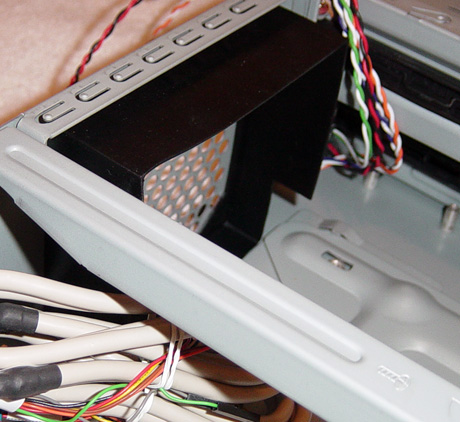
Re:BTX cases? Did they finally fix those case wire
Judging by this image I'd say no. Looks like the same assortment of little twistyfellas.
-
Re:No 64 bit benchmark..
The benchmark referenced in this article gives Intel a big break by not comparing the Athlon 64 in native 64 bit mode
We should also note that Intel currently sells 64-bit Pentium 4 CPUs (EM64T) to system manufacturers and will sell them individually in Q1 2005. I'm not saying Intel's EM64T wouldn't get its clock cleaned by Athlon64, but we don't have to compare 32-bit Pentium 4 to 64-bit Athlon.Another important fact - a socket 939 based motherboard purchased today should accept a dual core Athlon 64 in about a year.
Another fact - an LGA 775 based motherboard purchased today has PCI Express. Socket 939 motherboards with PCI Express (nForce 4) are supposed to be coming soon.An LGA 775 based motherboard purchased today will accept a 64-bit Pentium 4 in Q1 2005 and might accept a dual-core Pentium 4 in about a year (Q3 2005). I say "might" because the first dual-core Pentium 4 CPUs will be Prescott-based with 800MHz FSB, which today's chipsets support. However, Anandtech's roadmap says dual-core P4s will be made for next generation's LGA 775 chipsets (Glennwood and Lakeport). But note that Dothan was supposed to work with the next generation Centrino chipset (which is delayed), but works fine with the older Centrino chipset.
Also, the pessimist in me thinks Intel might have set an unrealistic Q3 2005 release date just to counter AMD's dual-core announcements. On the other hand, Opteron and Athlon 64 had long delays before they were finally released. If I was a betting man, I'd bet on AMD being first with dual-core for the desktop.
I'm not trying to sound like an Intel fanboi. I'm just trying to be "fair and balanced" (I hate Fox News).
-
Re:No 64 bit benchmark..
The benchmark referenced in this article gives Intel a big break by not comparing the Athlon 64 in native 64 bit mode
We should also note that Intel currently sells 64-bit Pentium 4 CPUs (EM64T) to system manufacturers and will sell them individually in Q1 2005. I'm not saying Intel's EM64T wouldn't get its clock cleaned by Athlon64, but we don't have to compare 32-bit Pentium 4 to 64-bit Athlon.Another important fact - a socket 939 based motherboard purchased today should accept a dual core Athlon 64 in about a year.
Another fact - an LGA 775 based motherboard purchased today has PCI Express. Socket 939 motherboards with PCI Express (nForce 4) are supposed to be coming soon.An LGA 775 based motherboard purchased today will accept a 64-bit Pentium 4 in Q1 2005 and might accept a dual-core Pentium 4 in about a year (Q3 2005). I say "might" because the first dual-core Pentium 4 CPUs will be Prescott-based with 800MHz FSB, which today's chipsets support. However, Anandtech's roadmap says dual-core P4s will be made for next generation's LGA 775 chipsets (Glennwood and Lakeport). But note that Dothan was supposed to work with the next generation Centrino chipset (which is delayed), but works fine with the older Centrino chipset.
Also, the pessimist in me thinks Intel might have set an unrealistic Q3 2005 release date just to counter AMD's dual-core announcements. On the other hand, Opteron and Athlon 64 had long delays before they were finally released. If I was a betting man, I'd bet on AMD being first with dual-core for the desktop.
I'm not trying to sound like an Intel fanboi. I'm just trying to be "fair and balanced" (I hate Fox News).
-
Re:How the mighty have fallen!
Don't mention Celeron. I don't know why Intel keep on releasing it
They keep releasing Celerons because there is a large market for brand-new $400-$500 computers. Dell and HP can't build them without sub-$100 processors and matching low-end chipsets.They give low-budget a new low.
According to another Anandtech article, today's Prescott-based Celerons (Celeron D) give surprisingly good performance for "low-budget" processors. The Celeron D is a huge improvement over the Northwood-based Celeron, which was hindered by its low cache (8k L1 cache, 128K L2) and resulting pipeline stalls. The Celeron D's increased cache and other architectural improvements have resulted in good performance for a CPU that starts at $66.50. Remember, buyers of sub-$500 PCs aren't expecting good Doom 3 performance.What's even worse are the laptop Celerons, which perform like 486 chips relabeled.
Again, you aren't looking at the newest Celeron M processors, which are based on the Pentium M core. The Dothan-based Celeron M CPUs have 1MB L2 cache, 400MHz bus, high IPC, and very low power requirements. For moderately-priced thin-and-light notebooks with long battery life, I think the Celeron M is better than any mobile Athlon or G4 processor.I'm not saying that Intel hasn't released some stinkers under their "Celeron" label. The Pentium 4-based Celerons sucked when they only had 128K of L2 cache, but now they have 256K and the Prescott core. Recent notebook Celerons had the same core as those sucky desktop Celerons, but now they use the highly-praised Pentium M core.
Two years ago, desktop and notebook Celerons did suck. But now, Dell offers a Celeron D desktop with PCI-Express (915G chipset) for $568. HP/Compaq sells a $599 notebook with a Dothan-based Celeron M. I think that's pretty good performance and technology for those prices.
-
Re:Anandtech - single-page version
However the full review is a good 14 pages of ad cluttered pages.
Here's the single-page version. I'm running AdBlock, so I don't know if it has any ads. -
Execute Disable Bit
-
Massive power consumption difference
Look at the power consumption difference between this new P4 and the Athlon 64. It's big enough between the 90nm P4's and 130nm A64's, but a 90nm P4 system uses nearly twice the juice of a 90nm A64. Mind you, that's the difference between entire systems, so the consumption difference between just the CPUs is even more extreme.
Imagine a Beowulf cluster of these...