Slashdot Mirror
Domain: apple2.org.za
Stories and comments across the archive that link to apple2.org.za.
Comments · 26
-
Blame ASCII, Outlook, and X
This problem has been around for ages:
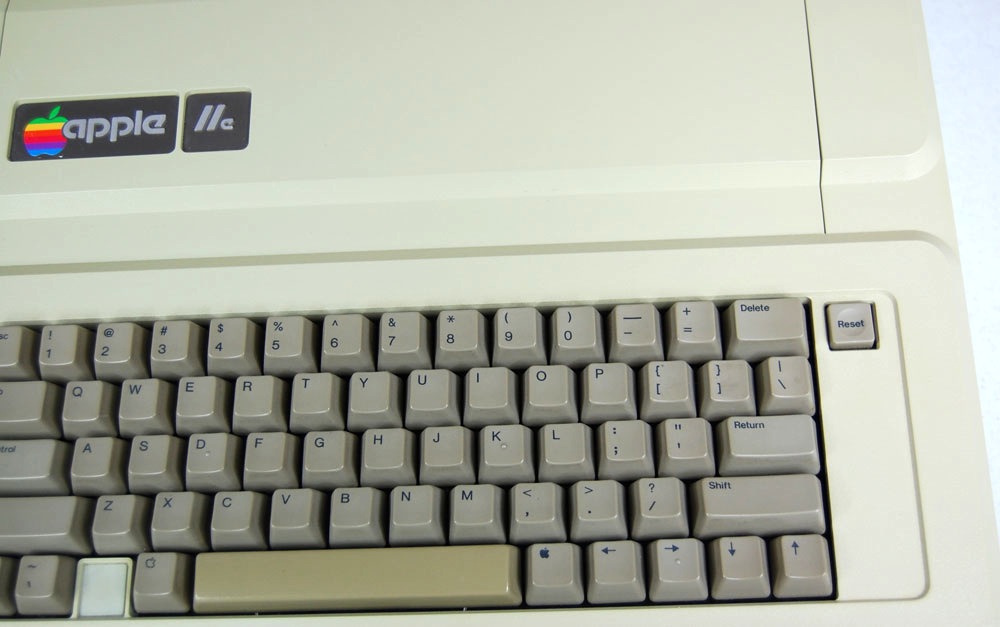
If you look at early computer keyboard, Apple ][+ there is only one type of double-quote.
! " # $ % & ' ( ) * =
1 2 3 4 5 6 7 8 9 0 : -When the Apple
! @ # $ % ^ & * ( ) _ +
1 2 3 4 5 6 7 8 9 0 - =The double-quote was moved to the same key as the single quote.
Part of the problem is that the ASCII standard screwed things up by NOT providing dedicated Curly Quotes. HACKs such as ` and ' became popular on X.
i.e.
ASCII and Unicode quotation marksUnfortunately, the X Window System fonts contained for a long time the following mutually symmetric glyphs:
0x27 APOSTROPHE -- end curly single quote
0x60 GRAVE ACCENT -- begin curly single quoteOutlook also fucked things up by auto-correcting quotes into "Smart Quotes".
And of course most compilers are too stupid to understand anything other then ASCII so they barf on as well.
Banning double-quotes isn't solving the problem. Having _dedicated keys_ for them would.
-
Re:First AI Post
Wordstar was released in June 1979 but the Apple 2 (][
i.e.
BPL
STA $C010 ; clear keyboard
; A >= $80Reading a native character had the high bit set. Writing a character to screen required the high-bit ALSO set unless you specifically wanted INVERSE (0x00..0x3F) or FLASHing characters (0x40..0x7F). See Beagle Bros Peeks and Pokes Chart
> but they still broke the defacto standard because no one else could make use of it.
That's not technically true. Apple DOS 3.2 and 3.3 also used the same trick to signal end-of-string.
Remember, at the time there were 3 ways to signal end-of-string:
* C's null-terminated (ASCIIZ) -- last byte is zero.
* Pascal's first-byte-string-length
* Dextral Character Inverted (DCI) -- the last byte has the sign bit flipped. (This was popular on Apple 2 assemblers such as Merlin. Thankfully this pseudo-opcode has been preserved on modern assemblers)--
First Contact is scheduled for ~ 2024. Are you ready to accept the facts that humans were genetically engineered? -
Might this be upfront, rather than nefarious?
If I wanted to develop a sexbot, it might make sense to be collecting this kind data and trying to build models from it.
The issue is obviously whether or not the users know it's happening. The Internet connectivity (rather than it being just USB or bluetooth or something) alone strongly implies it, but apparently different people draw different inferences.
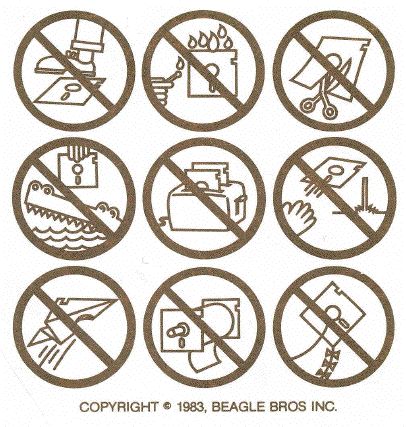
I think we're getting to the core of why dessicant packets have to be labeled with "do not eat" and your floppy disk label should warn against feeding it to alligators. It's better to be explicit about even extremely obvious things, because somebody is always going to step up and claim they were too stupid to understand what you thought was obvious. All they have to do is convince one other person that they're serious rather than pretending, and then at that point, even you will believe that people are as stupid as they say they are.
The only way to win is to not play: be explicit.
-
Re:No Interlacing
This coupled with the fact you can use the 256 bytes of zero page
Except for the anoying detail that if you wanted to be interoperable with anything that was written in Applesoft Basic and ProDOS, weren't very many of them to really play around with.. One would usually have to resort to saving most of the entries they wanted to use, and then restoring them upon exit. This works, but I recall it wasn't very amenable to being interrupted with reset. While writing a custom reset handler mitigated some of that, in practice one would always need to reserve at least a couple of zero page memory locations that weren't being used by anyone else to actually have a genuinely robust system that wouldn't ever crash. When I was writing my Applesoft multitasker operating system as a replacement for ProDOS's basic.system back in the mid 1980's (I find it personally amusing when recalling the endeavor that I wrote it before I ever even knew what the word "multitasking" was, actually), I found that I needed to still have a few zero page memory locations that I would have to completely rely on to not get stomped on anything else even when my code was not actually running in order to have a usable system.
-
Re:I've seen the defragging happen
Good point. A little mind boggling how small the gain would be from defragging a floppy, but still.
-
Re:Apple ][ note: schematics included
Well, I had a revision B motherboard (something I specifically requested, because of certain features I wanted to experiment with), and the extended 80 column adapter, which expanded my system memory to 128k (bank switched, since only 64k was addressable), but the CPU in my system was definitely not a 65c02.
My system also did not have the MouseText characters that came out with the
This website refers to a model that was discontinued in 1985, and is right beside an image that looks exactly like the model that I had. Note that it has the
It's all pedantry anyway. But sounds like you had what could be called a "partially enhanced" machine:
http://mirrors.apple2.org.za/ground.icaen.uiowa.edu/MiscInfo/Empson/iie.vers
If you are able to turn the machine on, the easiest way to identify an
enhanced IIe is to look at the machine name printed on the top line of
the startup screen:Apple ][ indicates an unenhanced IIe
AppleThe catch is that you might have a machine which has been partially
enhanced: it is possible for the CPU, video ROM and firmware ROMs (CD
and EF) to be updated independently (the firmware ROMs must be a
matching pair). Looking at the chips would be safest bet.I remember engaging in many online (BBS & Usenet) discussions where the common shorthand was to use ][e for unenhanced,
-
Re:What are fake GB?
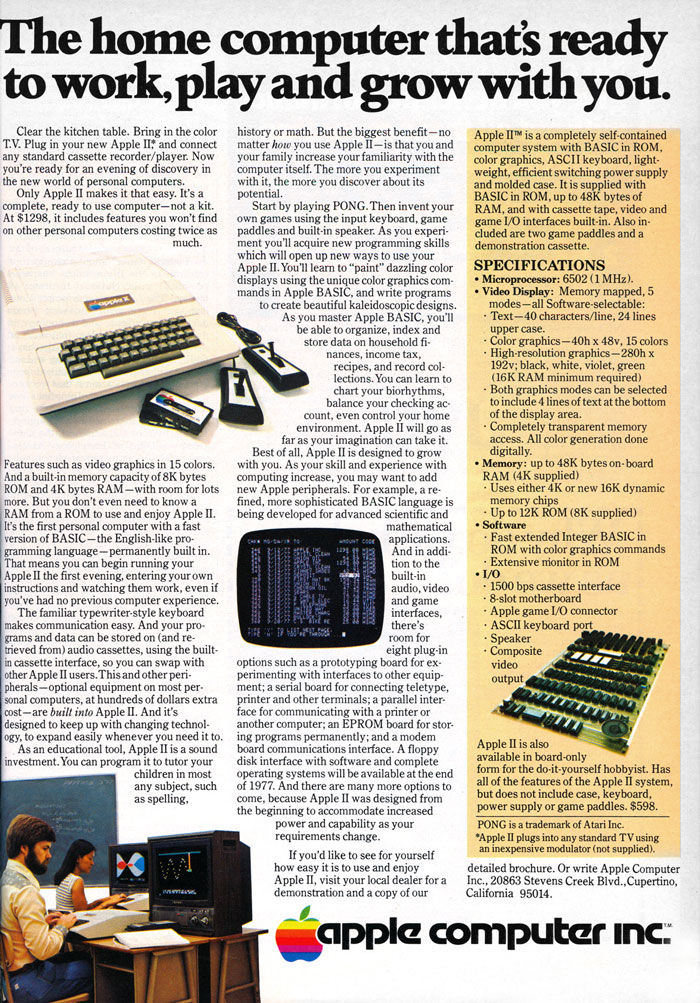
I'm actually not sure when the whole kilobytes thing came in, and if it was the CS people or not. It seems in a lot of old literature, it wasn't "kB" or "kilobytes", but "K", where K is understood to be 2^10. If you don't believe me look up some of the old literature for things like the Commodore 64 or the Apple II. As in this, where the speed is denoted in "MHz" and the memory sizes in "K" or "K bytes". Was it the marketing people who started the whole K = kilo thing? Or just the unwashed masses when they got into computers back in the mid-late 80's?
-
As an Apple II fan, I must remind folks...
...that not all was well-designed and pretty. For example, portions of graphics memory were also used for slot/peripheral I/O. These were called "screen holes" and greatly complicated every Apple II program that used those areas of memory -- there were literally tons of one-offs you had to write into your code, special cases depending on what peripherals were installed or used. This applied to both lo-res (GR) and high-res (HGR) modes. Here's an example (hope you can read 6502).
I think since the days of the Apple II we've learned the importance of having a linear section of memory without a bunch of interleaved one-offs... or have we? x86 architecture is filled with crap like this (mainly the legacy stuff, not much present-day), but still. My point is that even though Woz was a genius/very clever and knew how to make the most out of what he had available, the aforementioned was a serious annoyance.
-
Re:Roland MT32
The Apple IIGS had an Ensoniq 5503 digital oscillator chip
15 voices. I'm not sure how that compares to the Amiga or the Mac.
Here's the opening to Zany Golf I'm told it was pretty impressive for the time.
-
From The Beginning
Apple's trend away from tinkering predates the company. During the design and building phase of the ][, Woz was building in things which Jobs didn't want. Three specifically that they argued over were color (vs. black and white output), the lid (and by extension, poking around inside) and memory expansion past the max installed 16 K (this is the actual source of the often repeated and rarely correct "Who would ever need more than X-kb of memory?" -- It was Jobs and it was 16K). The second and third are both in the 'tinkering' group of features. In all cases Woz won, and we got a machine that ultimately was pushed to do things which by design it supposedly 'couldn't'.
When Jobs decided to make his own machine, all three of the above limitations were built in. The first Mac was B&W, had no lid, and came with the only memory configuration that it could run. At the time I was senior/technical editor of The Road Apple, a 'zine for Apple ][,
and USSR (Moscow, Russia); my co-editor was a member of the Russian Academy of Sciences; Academician Vladimir Fedorov). When Woz left, Jobs prevailed and we lost. Jobs' design choices for the first Mac and his acquiring complete control when Woz left, were the second and third major changes away from tinkering. Both were a direct result of Job's taking back those things he wanted done on the ][ that allowed tinkering (or were just plain neat hacks) but which Woz chose to do his own way. Simply put, this direction was based on the fact that Jobs lost those arguments. resented it, and when he got the chance, he finally got his own way.References for the historical stuff can all be located if one digs. Support for Jobs' tendency towards management techniques such as tantrums and verbiage bordering on abuse has also been documented up through the point where John Scully took over for 10 years so Jobs could grow up and gain some people skills. Collections of The Road Apple were available on some of the Apple ][ ftp sites. One that has been converted to webby stuff is at http://apple2.org.za/gswv/a2zine/GS.WorldView/Resources/ROAD.APPLE/
-
Re:Buy Repton
I only know of one remaining original disk - and I run that on my Apple II+ every now and again. I don't even have all of the original source code to make a new disk.
There are some good emulators: Virtual II seems very nice. Disks can be found with Google, or here http://mirrors.apple2.org.za/ftp.apple.asimov.net/images/games/file_based/
I just found http://www.virtualapple.org/reptondisk.html and it seems an amazing presentation.
I have not found an original version, all of these versions seem to be cracked versions, which given the copy protection is not surprising. Naturally my name and that of my coauthor appear nowhere in the cracked versions.
BTW - The iPhone version is better -
And here's where to find the original Silpheed...Proving you can't go a month without Apple II related news on Slashdot, you can still view screenshots and download the disk images of the original Silpheed game for the Apple IIGS at http://www.whatisthe2gs.apple2.org.za/the_fairway
/ game_pages/silpheed.html, which is "The Apple IIGS Gaming Memory Fairway."Who cares if these young whippersnappers spelled the name of the game wrong?
-
Re:The list
I'm not sure if the Ensoniq chip had volume envelopes or filters or LFOs, but if it did, I just wonder why they never used it on the Mac.
No filters, but one oscillator in a pair can modulate the volume of the other:
Oscillators
The 5503 Ensoniq Digital Oscillator Chip (DOC) has 32 sound oscillators. Each of them are capable of making an independent sound. Two oscillators paired up are a generator. The paired generator arrangement is favored by most IIgs sound/music programs, because that arrangement offers greater flexibility with better sound quality.
The DOC produces 8-bit waveforms, with a center line at $80 (128 decimal). Reserved for 'stop' is $00 or (0 decimal). If the sample value of 0 is encountered by a DOC oscillator, it will halt immediately and will not produce any more sound. The DOC also has an 8-bit volume register for every oscillator using a linear slope. The dynamic range of the DOC (the 'space' between the softest and loudest sounds which are produced) being approximately 42 dB.
Each oscillator has a 16 bit frequency register, ranging from 0 to 65535. In the normal DOC configuration, each step of this frequency register increases the play rate by 51 Hz.
Oscillator Modes
When oscillators are paired as generators, four possible modes can be used. These four modes as termed, are listed below.
- Free (Free-run) (Loop) : The oscillator simply plays the waveform and stops. No interaction with it's 'pair' occurs.
- Swap (Loop) : Only one oscillator of the pair is active at a time. When one stops, its pair starts immediately.
- Shot : The oscillator plays the waveform and if it reaches the waveforms end without encountering a zero, it starts over (loops) at the beginning.
- Sync (AM): One oscillator of the pair modulates the volume of the other paired oscillator with the waveform it's playing. Unique and very effective. But, not commonly used.
As for why this chip never found its way into a Mac, you can blame the Beatles:
Though including a professional-grade sound chip in the Apple IIGS was hailed by developers and users both, and hopes were high that it would be added to the Macintosh, it drew a lawsuit by Apple Records. As part of an earlier trademark dispute with the record company, Apple Computer had agreed not to release music-related products. Apple Records considered the inclusion of the Ensoniq chip in the IIGS as a violation of that agreement. Though the IIGS was allowed to keep the Ensoniq, Apple has not included dedicated hardware sound synthesizers in any of its Macintosh models since (though of course, third-party products exist).
-
Best floppy disk labels ever
-
Nice, Thanks!!!
This is great, thanks so much for posting this link!
I've been searching for some fun PWOT games for the last 3-4 weeks, and this'll fill the void perfectly!
For those of you that keep saying there's no mac games, I think I know why:
I read the lists of "top 10 games of 2006" and "top 10 indy games" and all those things hoping for some good games: they all sucked.
They're full of fantastical role-playing games, not the kind of game where you can't just open it and play, but instead all these long, drawn out stories: absolutely not what I'm looking for. I want a fun game, not a soap opera or 2 month-long drama. You guys just want a different type of game.
I DID just install BootCamp for a game, in fact. 1/2 year ago, I tried SimCity (in Parallels/Windows), then deleted it. I Tried Halo then deleted it. This time I installed Windows solely for WORMS ARMAGEDDON, the best game ever invented (short of the Mario games)! (Pissed that I have to use BootCamp, it used to work great in VirtualPC, meaning I didn't have to shut down my servers just to play a game! Parallels doesn't do "DirectDraw" or some crap, so I gotta fully restart into Windoze)
So the games I've found are great. Ambrosia Software has Great Mac games (tho I wish they'd update some old one's out of Classic). I even found a new version of CrystalQuest for Mac OS X (in 3D!). That game absolutely kicks ass, the first game ever to really use the mouse as a totally new type of input device.
Also, NES and SNES emulators absolutely rule. Back before insane 3D graphics, people were forced to sell games on gameplay Only. Hey, I'm only 24 and I'm this into retro games, so it's not just nostalgia! -
Re:It's a little late...
-
Crystal Quest derivative?
Played this a ton on Macs back in the late 80's, seems to be abandonware now: http://www.whatisthe2gs.apple2.org.za/the_fairway
/ game_pages/crystal_quest.html It has the same concept of enemy's behavior indicated by their shape. -
out of this world
> "Probably the worst thing that could happen with small cyclotrons is that the operator might electrocute themselves."
Or send himself to another world! -
Re:anyone know how to copy stuff off of an Apple /
There a number of ways to do so. If you have a 3.5" drive and access to a mac, it can read the disk that way. If you have a PCTransporter card, you can save the data on PC formated disks. You can buy a compact flash reader i/o card and shrink your disks and transfer via the flash card.
I've not tried it but apparently you can now read Apple disks on a PC in FDI format and use a program called CiderPress to convert them after.
But the typical way is connecting a cable between the PC and the Apple and use ADT (http://apple2.org.za/gswv/a2zine/Sel/ADTWin.html) -
Re:Apple IIGS?
Are you kidding me? the apple IIGS was friggin awesome. So awesome that we still have ours. It was a execellent educational tool, and had tons of games for it. It was one of the first PC's that had integrated sound and a color monitor, and a color printer. It was useful for making small DB's, word processing and other office related work. It truly was a remarkable machine for its time. http://www.whatisthe2gs.apple2.org.za/
-
Re:Dump...
I bought a circa 1995 ThinkPad for $20 at a garage sale. Had Win 3.1 on it. (And a lot of hilarious personal letters that were never deleted.) And Word and Excel. I use it mainly for a DOS program that serves Apple II disk images from the PC to actual disks on my Apple IIe via the SuperSerial card, but my gf has used it very well for word processing when our main computer, my circa 2003 ThinkPad is not at home (all our desktop machines have broken and not been replaced due to our reliance on the ThinkPad). Main issue is just transferring from floppy once you're done -- no machines have floppies any more, but if you can find an old USB floppy drive, you're ok.
-
Hidden Messages
I remember finding hidden messages in the Apple ][ games I played. It was relatively easy todo, because you could memory scan for $C000 or $C010 (IO address for the keyboard strobe) (i.e. Trivial to stash a memory scanner program at $0300 the memory area before the text page, because most cases would load their code at $0800.
Another cool thing was finding hidden messages using a sector editor. It was quite feasable to scan 40 tracks * 16 sectors.
Some of the hidden codes/messages I remember..
Mario Bros
- Instead of running the game, if you loaded it and took a look at the entry point, you saw a jump. If you "started" the game, 3 bytes later, you would get a text pages of message from The Fly about cracking it.
i.e.
BLOAD MARIOS BROS
CALL -151
803G
- Gumball
Press Ctrl-Z during the intermission to get hints about another Br0derbund game.
- Spare Change
Ctrl-z would bring up a secret control panel.
more can be found here Apple Game Secrets
--
Original, Fun Palm games by the Lead Designer of Majesty!
http://www.arcanejourneys.com/ -
Re:Carmen Sandiego?Where in Hell is Carmen Sandiego
Yes, IWantMoreSpamPlease, "Where in Hell is Carmen Sandiego" really does exist. Blows my mind, thought the hardcore Apple ][ geek who told me about it was pulling my leg.
-
Re:End of the internet?
-
Re:Anyone remember Nibble ?
Sure do. Here's an archive of the programs from Nibble. No articles though...
-
Re:Gates' Comment
> Anyone who remembers computing in the early '80's should recognize that the industry wasn't going anywhere.
Obviously, you don't
$5000 for an Apple 2?
1978: Apple II is $1295. 1979: Apple II+ is $1195. Maybe you're thinking the Apple III ($4340-$7800, yikes!)
> The only software is rudimentary databases and word processors.
Like visicalc, in 1978. Or appleworks, an integrated office suite.
> Games are less sophisticated than those on the Atari 2600. Monitors are monochrome.
Apple II was color and much better than the 2600. If you're talking early PC graphics (monochrome, CGA), yeah, they sucked. But it wasn't microsoft that improved them.
> Apple is enforcing a closed source policy which improves the quality of the machines, but hampers development.
Like publishing the schematics and ROM source code? Most of the demo code is written in listable basic, and code magazines (like nibble) flourish.
> It was the pairing of M$'s DOS with IBM PCs, and an open policy towards clones, that allowed the explosion of PCs seen in the mid-80's.
Did you read the article? IBM fought the clones vigourously... Compaq spent $1 million to make a clean-room bios.
![Apple ][+](http://www.hp9845.net/9845/history/comparison/images/closeups/apple2-top-view.jpg)