Slashdot Mirror
Domain: archive.org
Stories and comments across the archive that link to archive.org.
Stories · 353
-
The Open Source Design Conundrum
Matt Asay writes "Walk the halls of any open-source conference and you'll see a large percentage of attendees with ironically non-open-source Apple laptops and iPhones. One reason for this seeming contradiction can be found in reading Matthew Thomas' classic 'Why free software usability tends to suck.' Open-source advocates like good design as much as anyone, but the open-source development process is often not the best way to achieve it. Open-source projects have tended to be great commoditizers, but not necessarily the best innovators. Hence, Red Hat CEO Jim Whitehurst recently stated that Red Hat is "focused on commoditizing important layers in the stack." This is fine, but for those that want open source to push the envelope on innovation, it may be unavoidable to introduce a bit more cathedral into the bazaar. Without an IBM, Red Hat, or Mozilla bringing cash and discipline to an open-source project, including paying people to do the 'dirt work' that no one would otherwise do, can open source hope to thrive?" -
Better Tools For Disabled Geeks?
layabout writes "We've seen tremendous advances in user interfaces over the past few years. Unfortunately, those UIs and supporting infrastructure exclude the disabled. In the same timeframe there has been virtually no advance in accessibility capabilities. It's the same old sticky keys, unicorn stick, speech recognition, text-to-speech that kind-of, sort-of, works except when you need to work with with real applications. Depending on whose numbers you use, anywhere from 60,000 to 100,000 keyboard users are injured every year — some temporarily, some permanently. In time, almost 100% of keyboard users will have trouble typing and using many if not all mobile computing devices. My question to Slashdot: Given that some form of disability is almost inevitable, what's keeping you from volunteering and working with geeks who are already disabled? By spending time now building the interfaces and tools that will enable them to use computers more easily, you will also be ensuring your own ability to use them in the future." Follow the link for more background on this reader's query.
This question is aimed mostly at the kind of disability we are susceptible to and I have been living with for the past 15 years. Even though we have speech recognition, it doesn't solve any problem except writing text. There have been a couple of attempts at making speech recognition more useful to programmers [0], but they have failed. The needs are clear:
[1] A working full-vocabulary, continuous recognition system on Linux.
[2] Tools that don't expect you to "speak the keyboard."
[3] Tools that let you edit as well as create code.
So why don't more geeks work on securing their own future, or at the very least, work to help their fellow geeks to stay on the economic ladder?
[0] VoiceCode and VR-Mode: VoiceCode or is an amazing piece of work. It makes it possible for a disabled programmer to generate Python code very quickly. Unfortunately, it does not solve the editing problem. Even more unfortunately, it's hand-wearingly complicated to set up and get working. VR-Mode makes it possible to use Naturally Speaking's "Select and Say" mode in Emacs — that is, if you can get it to work. It seems to have drifted into non-functionality as Emacs has moved forward.
[1] Naturally Speaking works well, is reasonably cheap, and works somewhat under Wine today. If we can make it work reliably under Wine, it solves the problem in months rather than decades. Other tools such as Sphinx 1-4 are great IVR systems if you have a vocabulary and grammar under 15,000 words. In contrast, Naturally Speaking's working vocabulary is in the 100,000-word range. Any disabled user will choose Naturally Speaking because it works so much better than the nearest alternative. We have people who are injured now and need these tools. They can't afford to wait 10 years or more for an OSS solution.
[2] "Speaking the keyboard" refers to speech user interfaces developed by people who don't use speech recognition. They expect you to say too much, which creates a vocal form of RSI — see [3]. Listen to what disabled users do, not to what you think they should speak.
[3] See VoiceCode in [0]. Unfortunately, today's tools are only for writing code, not correcting code. Code correction is a very different process and must be spoken in a different way: "change index" instead of "search forward left bracket leave mark search forward right bracket copy region." This is also an example of "speaking the keyboard." -
Internet Archive Seeks Same Online Book Rights As Google
Miracle Jones writes "Brewster Kahle's Internet Archive has jumped on Google's 'Authors Guild' settlement and asked to be included as a party defendant, claiming that they ought to get the same rights and protections from liability that Google will receive when the settlement is approved by federal court. From the Internet Archive's letter to Judge Denny Chin: 'The Archive's text archive would greatly benefit from the same limitation of potential copyright liability that the proposed settlement provides Google. Without such a limitation, the Archive would be unable to provide some of these same services due to the uncertain legal issues surrounding orphan books.'" -
Apple Shifts iTunes Pricing; $0.69 Tracks MIA
Hodejo1 writes "Steve Jobs vowed weeks ago that when iTunes shifted to a tiered price structure in April, older tracks priced at $0.69 would outnumber the contemporary hits that are rising to $1.29. Today, several weeks later, iTunes made the transition. While the $1.29 tracks are immediately visible, locating cheaper tracks is proving to be an exercise in futility. With the exception of 48 songs that Apple has placed on the iTunes main page, $0.69 downloads are a scarce commodity. MP3 Newswire tried to methodically drill down to unearth more of them only to find: 1) A download like Heart's 34-year-old song Barracuda went up to $1.29, not down. 2) Obscure '90s Brit pop and '50s rockabilly artists — those most likely to benefit from a price drop — remained at $0.99. 3) Collected tracks from a cross-section of 1920s, '30s, and '40s artists all remained at $0.99. Finally, MP3 Newswire called up tracks in the public domain from an artist named Ada Jones who first recorded in 1893 on Edison cylinder technology. The price on all of the century-old, public-domain tracks remained at $0.99. (The same tracks are available for free on archive.org.) The scarcity of lower-priced tracks may reflect the fact that the labels themselves decide which price tier they want to pursue for a given artist; and they are mostly ignoring the lower tier. Meanwhile, Amazon's UK site has decided to counter-promote their service by dropping prices on select tracks to 29 pence ($0.42)." -
We're In Danger of Losing Our Memories
Hugh Pickens writes "The chief executive of the British Library, Lynne Brindley, says that our cultural heritage is at risk as the Internet evolves and technologies become obsolete, and that historians and citizens face a 'black hole' in the knowledge base of the 21st century unless urgent action is taken to preserve websites and other digital records. For example, when Barack Obama was inaugurated as US president last week, all traces of George W. Bush disappeared from the White House website. There were more than 150 websites relating to the 2000 Olympics in Sydney that vanished instantly at the end of the games and are now stored only by the National Library of Australia. 'If websites continue to disappear in the same way as those on President Bush and the Sydney Olympics... the memory of the nation disappears too,' says Brindley. The library plans to create a comprehensive archive of material from the 8M .uk domain websites, and also is organizing a collecting and archiving project for the London 2012 Olympics. 'The task of capturing our online intellectual heritage and preserving it for the long term falls, quite rightly, to the same libraries and archives that have over centuries systematically collected books, periodicals, newspapers, and recordings...'" Over the years we've discussed various aspects of this archiving problem. -
White House Exempts YouTube From Web Privacy Rules
An anonymous reader writes "The new White House website privacy policy promises that the site will not use long-term tracking cookies, complying with a decade old rule prohibiting such user tracking by federal agencies. However, Obama's legal team has quietly exempted YouTube from this rule. Visitors to the official White House blog will receive long-term tracking cookies whenever they surf to a web-page with an embedded YouTube video — even those users that do not click the "play" button. As CNET reports, no other company has been singled out and rewarded with such a waiver." -
Collateral Damage as UK Censors Internet Archive
An anonymous reader noted the latest developments in the controversial censoring of the internet by UK ISPs. Apparently since some content of the Wayback Machine is bad, the whole thing needs to be blacklisted. -
Documentary Released On Canadian Fight Against DMCA
An anonymous reader writes "The ongoing fight against the Canadian DMCA is the focus of a new documentary film called Why Copyright? Produced by Michael Geist and available as a streamed version, OGG download version, or a torrent, the film features Red Hat founder Bob Young, sci-fi writer Karl Schroeder, the owner of Skylink Technologies (which fought the DMCA garage door opener case) and many other voices from across Canada." -
Web Singletons?
tcmb writes "There are an uncounted number of web mail and picture sharing services, there are more than enough web sites for online bookmark management and friend-finding, but as far as I know there is only one Internet Archive. Which are the true web singletons, services that exist only once in this form?" And does anything approach the singular time-wasting abilities of IMDB or Wikipedia? -
Google Turns 10
Ian Lamont writes "It was on September 7, 1998 that Larry Page and Sergey Brin founded Google Inc., aiming to provide a better search engine. You can see what it looked like here. Google had a relatively good search engine technology that succeeded in burying many late 1990s competitors, and it eventually developed a successful advertising model and pledged to operate on a 'don't be evil' philosophy. The company now has nearly 20,000 employees and a $150 billion market value, and has been acquiring or developing a host of groundbreaking technologies. When did you start using its search engine? Is the world a better place because of Google?" -
How Can Nerds Make a Difference In November?
Scott Aaronson offers an intriguing call for ideas on how nerds can supercharge the political process this year. He's clearly an Obama admirer and phrases his challenge this way: "What non-obvious things can nerds who are so inclined do to help the Democrats win in November?" But the question itself is not inherently partisan. The analogy Aaronson gives is to the Nadertrading idea in 2000 (which we discussed at the time). What's the Nadertrading for 2008? "The sorts of ideas I'm looking for are ones that (1) exploit nerds' nerdiness, (2) go outside the normal channels of influence, (3) increase nerds' effective voting power by several orders of magnitude, (4) are legal, (5) target critical swing states, and (6) can be done as a hobby." -
Inside the Internet Archives
blackbearnh writes "O'Reilly Media is running an interview with Gordon Mohr, Chief Technologist for the Internet Archive (archive.org). If you've ever wondered how pages are selected for archiving, or just how they manage such a huge quantity of data, the answers are here. The interview also touches on the problems of intellectual property in archives, archiving the Internet in a post Web 2.0 world, and the potential vulnerabilities exposed by archiving web sites that may include security exploits." -
Archive.org Defeats FBI's Demand For User Information
eldavojohn writes "Although we don't know what they were after due to the settlement, a gag order was just released that kept Internet Archive member Brewster Kahle quiet. The FBI had issued a national security letter to them under the Patriot Act. Kahle fought it. Hard. The EFF came to the aid of his lawyers and what resulted was one of the only three times an NSL has been challenged: all three have been rescinded. The FBI agreed to open some of the court files now for it to be public. The ACLU added, 'That makes you wonder about the the hundreds of thousands of NSLs that haven't been challenged.'" -
The Curious Histories of Generic Domain Names
cheezitmike writes "ITworld.com uses the Wayback Machine to document the histories of five generic domain names: music.com, eat.com, car.com, meat.com, and milk.com. 'In this brave new Web 2.0 world, it's almost a badge of honor to have a Web site name that only hints at what the user will find there (see Flickr) or is so opaque as to offer no clue at all as to what the Web site is about (see del.icio.us). It's easy to forget the first Internet gold rush of the mid-to-late '90s, when dot-com domain names based on ordinary (and, investors hoped, marketable) nouns and verbs were snapped up by hopeful companies from the humble geeks who had purchased them (often ironically) in the early '90s.'" -
Internet Archive Challenges Google
richards1052 writes "The Internet Archive, whose main claim to fame is the Wayback Machine, designed to archive the internet's web history, has created a new project: the Open Content Alliance. It's purpose is to open the nation's library collections to universal web search. A number of major library systems, including the Boston Public Library and Smithsonian, have refused to sign up with competing ventures by Microsoft and Google because they do not provide for universal access to digitized books. These commercial ventures prohibit books being accessed by competing search engines. So far, 80 libraries and research institutions have signed on with Open Content Alliance. They must pay for the scanning of their books while Google and Microsoft offset that cost for their participating institutions." -
IFPI Domain Dispute Likely to Go To Court
fgaliegue writes "Ars Technica has a follow-up on the ifpi.com domain takeover by The Pirate Bay. The International Federation of the Phonographic Industry, ifpi.org, is quite unhappy that the .com is now a link to the (still not live) International Federation of Pirates Interests. The ifpi.com domain has been free as soon as March of this year, according to WebArchive. Nevertheless, the "real" IFPI wants to take it to the WIPO under the accusation of cybersquatting." -
Open Library Goes Online With Public Domain Books
mrcgran writes "A competitor to Google Book Search emerges as the Yahoo-backed Open Content Alliance launches an 'open library' of its own. After several years of scanning and archiving, the Internet Archive and the Open Content Alliance this week unveiled the Open Library, their attempt at bringing public domain books to the masses. The Internet Archive has hosted texts for quite some time, but the Open Library makes fully-searchable, high-quality scans of books available, along with downloadable PDFs. It offers an experience designed to match paper: there's even a page-flipping animation as readers move forward and backward through the book. Ben Vershbow of the Institute for the Future of the Book says that when it comes to presentation, 'they already have Google beat, even with recent upgrades to the [Google Book Search] system including a plain text viewing option.'" We have previously discussed this project, though this is a bit more complete rundown on the initiative. -
Hotmail vs Goodmail
Frequent Slashdot Contributor Bennett Haselton wrote in with his latest column. He says "Are we being too hard on Goodmail for their plans to charge senders a quarter-penny per message to bypass companies' spam filters? Hardly anyone has mentioned that Microsoft has been doing the same thing for years, only (surprise!) charging more. Hotmail lets senders pay a $1,400 "fee" to help get through their spam filter; when I wrote to them about my newsletter being blocked as spam, they said they knew it wasn't spam, but they told me several times they would not even talk about unblocking it unless I paid the $1,400. It's odd that so little attention has been paid to Hotmail's program, since it not only mirrors the Goodmail situation, it validates Goodmail's critics who have said that once you start charging to bypass spam filters, the next step is the marginalization of people who won't pay." Read on for more words.As you hear words like "Hotmail" and "AOL", you may be tempted to think this doesn't affect you if you've outgrown those companies, but I think that's a mistake. First of all, if you think you might ever run a business that publishes an e-mail newsletter, you'll have to worry that your mail might be blocked unless you pay to unblock it. Second, even if you're only a subscriber to a company's newsletter and you're not worried about filters on your e-mail address, the company publishing the newsletter has to spend time and resources getting their mails unblocked that they send to other people, time that could be otherwise spent improving their services. Third, even if you're not on the Internet at all, in a real sense it affects the kind of world we all live in, if the wealthy are able to communicate with their listeners more easily than everyone else (that gap has always existed, but the Internet narrowed it, and then unblocking-mail fees widened it a little). If the Republican National Committee can get their mail out and MoveOn.org can't, then that could influence elections, and could affect your life even if you're an Iraqi peasant goat farmer who hasn't updated his blog in weeks. And of course what Microsoft and AOL do, sets a precedent for what other companies can get away with -- so every anecdote about boneheaded mail filtering that you hear about, is potentially significant if it could become the norm.
I wasn't thinking about this when I wrote to Hotmail in 2006 about their users missing our e-mails because of the filter blocking them as "spam", as I jumped through some hoops before talking to a human. But the mentality of the people that I talked to seemed to be that "non-paying sender" and "spammer" were more or less equivalent. I explained that we only send mail to people who request it, we verify all new subscriptions, and every message contains an unsubscribe link. Hotmail replied, "The filters are there for the protection of hotmail subscribers. The Junk Mail Reporting program isn't in place to help you circumvent those filters... I recommend you do what you can on your end to educate your subscribers, keep your mailing lists up to date and follow the other guidelines for senders on the postmaster.msn.com site and don't expect our junkmail filters to be modified." Call me a dreamer, but I thought the whole point of having humans in the loop was that if the filter is making a mistake, you can modify it.
(Many people have suggested that I publish via RSS instead of e-mail. For me the problem with that is that our newsletter is used to send out the location of new sites for getting around blocking software, so that by the time the last sites have gotten blocked in most places, the new ones are being mailed out. As long as people can access their e-mail accounts, they can get the new site announcements. But if we used an RSS feed instead of e-mail, then blocking software companies would just block our RSS feed. And besides, even a normal newsletter publisher would lose most of their existing subscribers if they told everybody that they had to switch over to RSS to receive the newsletter in the future. Is it right that they should have to pay that penalty just because an ISP is falsely labeling their mail as spam?)
The $1,400 "fee" that you pay to help get your mail unblocked at Hotmail's servers, is to a third-party company called Sender Score Certified, formerly known as Bonded Sender, whose certifications are used by Hotmail. I didn't think I could get anywhere discussing with them the ethics of charging people to unblock their mail as spam, so instead I asked them, what would happen if someone forked over the cash and then their enemies started filing phony "spam" complaints against them, hoping to get their certification revoked? I think this is an important question for any spam policing system, but unfortunately it usually puts people on the defensive, because there's no real answer -- if you accept spam complaints, then you allow crackpots to do damage, and if you don't accept spam complaints, how do you know if a client is spamming? Bonded Sender's rep replied, "Do you really have that many enemies? If you are running a true 'non-profit', who is that mad at you? Maybe finding this out should be a little higher on the agenda. Where is the 'peace' in Peace Fire?" I asked the same question again, and eventually he said that complaints were based on SpamCop complaints -- a system known for being set up so that anyone could report anyone as a "spammer" without proof -- and that each such complaint would cause $20 to be depleted from your bond, and once it was all gone, you'd lose your certification.
"After reading all of your emails you have sent me," he continued, "it seems that you aren't really trying to find a solution to anything. You are mainly interested in pointing out flaws in programs and letting me know about how people don't like you." Actually I don't think I have enough enemies to cause me serious problems, but I'm working on it! I aspire someday to reach the level of notoriety achieved by groups like MoveOn.org, who does have enough enemies that if systems like Hotmail's were widely deployed, MoveOn would have to worry about militants falsely reporting their mails as spam in order to cost them money and/or get them blacklisted. That's the other basic problem with certification systems: they don't just favor the wealthy, they also favor the non-controversial. Do we really want an Internet where everyone has to be careful about who they offend, because anyone could get them listed as a spammer? I mean, that would be like having a free online encyclopedia where anyone could edit your bio and say that you killed someone!
Is it legal to block someone's mail as spam until they pay you money? Whoah, before I even use the l-word, I'd better insert a disclaimer. No, not that disclaimer. Nobody could possibly think that I was a lawyer after I filed motions in court with the pages stuck together to prove that judges weren't really reading them, unless I had some kind of career death wish. The disclaimer is that at least from my own experiences suing spammers, the law is whatever the judge wants it to be. Some judges say you can sue spammers out-of-state, and some say you can't. Some of them say you can sue in Small Claims only if you've lost money, and some say you can sue for damages even if you haven't lost anything. Some of them say a non-lawyer is allowed to represent their own corporation in court, and some say no. If judges don't even agree on the basic rules, good luck getting a legal consensus on a more abstract issue. Asking objectively if deliberately blocking non-spam e-mail is "legal" is like asking "Do apples taste good?"
But as a general rule, I think courts take a dim view of systematically publishing false statements about someone to try and get them to pay you off in order to stop. Unless you're a spammer, every time Hotmail labels one of your messages as "Junk Mail", they're publishing something untrue about you (at least to everyone who sees the message labeled as junk), and if you've brought it to their attention, then they may agree the statement is untrue but they go on making it anyway. In libel law, liability is partly determined by how much someone has been harmed by the false statements about them; in the case of mail being blocked as "Junk Mail", the harm is about as direct as possible, since because it was falsely labeled as spam, most users will never see it. This is why I think people who say "Hotmail/AOL/Yahoo can do whatever they want with their private network" are missing the point. If I used my own "private network" to publish a subscription service that people use to find out the names of new convicted felons in their neighborhood so that they can avoid doing business with those people, would you have no objection if I "accidentally" included your name on the list, but promised to review your situation for one low fee of $1,400?
There was a time in the late '90's when if Microsoft had said they were going to be blocking non-partner e-mails as "junk mail" unless senders paid a $1,400 "fee" to get unblocked, Congress would have hauled up Bill Gates and given him a good wedgie and told him to cut it out. But these days the Department of Justice doesn't have time to worry about other people's lost e-mail when they can't even lose their own e-mails properly.
All this happened at about the same time Goodmail was first attracting controversy for charging senders a quarter penny per message to bypass AOL's spam filters. When the EFF registered DearAOL.com to call attention to the issue (now defunct, but the Wayback Machine saved a snapshot), I hopefully registered DearHotmail.com in case any anyone wanted to use that example as well, but nothing ever coalesced around that. Meanwhile, some random mis-fire seems to have cancelled out some other random mis-fire, and Hotmail is apparently no longer blocking my mail, at least until this article gets published.
As far as I can tell, the only reason Hotmail got off scott-free and AOL/Goodmail didn't, was that Hotmail snuck their system in quietly, while AOL and Goodmail announced their partnership with great fanfare, apparently overestimating the extent to which e-mail publishers would greet them as liberators. This doesn't reflect very well on the outrage grapevine, people.
But the lesson took -- when Goodmail recently announced their partnership with four more e-mail providers, Goodmail featured a press release on their own site, but of the four ISPs, Verizon was the only one issued their own press release. Apparently the other three saw what happened with AOL/Hotmail and got the message.
You didn't ask, but my own idea for an anti-spam system would be to follow a protocol such that when you reply to a list server to confirm your subscription, the reply goes to an address like:
list-peacefire-confirm-481534893-sender=bennett=peacefire.org@mailserver.com
When you send that reply from your Hotmail account, Hotmail would see the "sender=bennett=peacefire.org" part of the address you're replying to, and recognize that to mean that you want to receive future messages sent from bennett - at - peacefire.org. So future messages from that address would be weighted not to be blocked as spam for that user. It wouldn't do anything to unblock person-to-person messages that get blocked as spam, but those are not mis-blocked as often as legitimate newsletters are, and this method would give newsletter publishers a way to get whitelisted at the same time that the user confirms their subscription. It wouldn't be perfect, since if the user then unsubscribes from the newsletter, but bennett - at - peacefire.org is a jerk and continues to send them mail, that mail would still get through because the Hotmail filter for that user still "remembers" that they confirmed their subscription, and doesn't know that they unsubscribed. However, the vast majority of nuisance spam comes from people you've never heard of, not from people whose newsletters you signed up for and then continued to send you mail after you unsubbed.
Or, suppose you're Amazon and you send mail to millions of users from orders@amazon.com, but you don't want everyone to have that address whitelisted because then a spammer could use the address "orders@amazon.com" to spam millions of people, hoping it would get through the filter of anyone who's an Amazon customer. So in that case people could confirm by replying to:
list-peacefire-confirm-481534893-sender=orders=amazon.com&senderip=72.21.203.1@mailserver.com
When the user sent their reply to that address, Hotmail would parse out the "sender=orders=amazon.com" part and the "senderip=72.21.203.1" part, and whitelist future mails from that address that come only from that IP.
I like this idea because it treats everyone equally, regardless of wealth or popularity, as long as they confirm subscriptions to their newsletter (which is regarded as good mailing list hygiene anyway). On the other hand, if you prefer filtering systems that work better for people who are rich and never offend anybody, then you'll be pleased to know that those seem to be winning.
-
Eben Moglen on the Global Software Industry Post-GPL3
Dan Shearer writes "Three days before GPLv3 was released, Eben Moglen delivered the annual lecture of The Scottish Society of Computers and Law in Edinburgh, Scotland giving his thoughts on 'The Global Software Industry in Transformation: After GPLv3.' The text transcription, audio and 384kbit video are up at archive.org. Eben looks back at the 'legislative action' achieved by the GPLv3 community over the last 18 months, and also from the 22nd century. A riveting presentation for all present." -
Eben Moglen on the Global Software Industry Post-GPL3
Dan Shearer writes "Three days before GPLv3 was released, Eben Moglen delivered the annual lecture of The Scottish Society of Computers and Law in Edinburgh, Scotland giving his thoughts on 'The Global Software Industry in Transformation: After GPLv3.' The text transcription, audio and 384kbit video are up at archive.org. Eben looks back at the 'legislative action' achieved by the GPLv3 community over the last 18 months, and also from the 22nd century. A riveting presentation for all present." -
Eben Moglen on the Global Software Industry Post-GPL3
Dan Shearer writes "Three days before GPLv3 was released, Eben Moglen delivered the annual lecture of The Scottish Society of Computers and Law in Edinburgh, Scotland giving his thoughts on 'The Global Software Industry in Transformation: After GPLv3.' The text transcription, audio and 384kbit video are up at archive.org. Eben looks back at the 'legislative action' achieved by the GPLv3 community over the last 18 months, and also from the 22nd century. A riveting presentation for all present." -
Amazon's Lawyers Jerking USPTO Around?
theodp writes "Reacting to an actor's do-it-yourself legal effort that triggered a reexam of Amazon.com's 1-Click patent, attorneys for Amazon have fired back, deluging the USPTO with documents to review, including Wikipedia articles. With the latest batch, Amazon's high-priced law firm even requested that USTPO examiners review an archived page of Norm Quotes (yes, Norm from Cheers) and rule that it does not invalidate CEO Jeff Bezos' 1-Click patent." -
CA Proposes Rigorous Voting Machine Testing
christian.einfeldt writes "During her successful campaign for California Secretary of State, newly-minted California Elections Czar Debra Bowen spoke repeatedly of the need to use free open source software in voting machines to ensure the integrity of California's elections. Now that Secretary Bowen is acting on that campaign pledge, closed-source voting machine vendor Diebold worries aloud that rejecting its black-box voting machines could snarl California's elections. Diebold's concerns come at the same time that it is suing Massachusetts for declining to purchase those same voting machines." Quoting: "California's elections chief is proposing the toughest standards for voting systems in the country, so tough that they could [have the result of banishing] ATM-like touch-screen voting machines from the state. For the first time, California is demanding the right to try hacking every voting machine with 'red teams' of computer experts and to study the software inside the machines, line-by-line, for security holes." -
High Tech High 2.0
theodp writes "A week ago, in his How to Keep America Competitive Op-Ed, Bill Gates touted the Gates Foundation-backed High Tech High as the future of American education. One small problem. Two days earlier, tearful Bay Area High Tech High students — recruited by a Bill Gates video — were told that their school of the future has no future. So would Bill be too embarrassed to lay out his education plan before the Senate Wednesday? Nah. Not too surprisingly though, mentions of High Tech High were MIA in Bill's prepared remarks (PDF), which touted Philly's imaginatively named $65M School of the Future, built under the guidance of Microsoft, as the new school of the future. Committee politicians reportedly embraced virtually all of the suggestions made by Gates." -
Amazon Using Patent Reform to Strengthen 1-Click
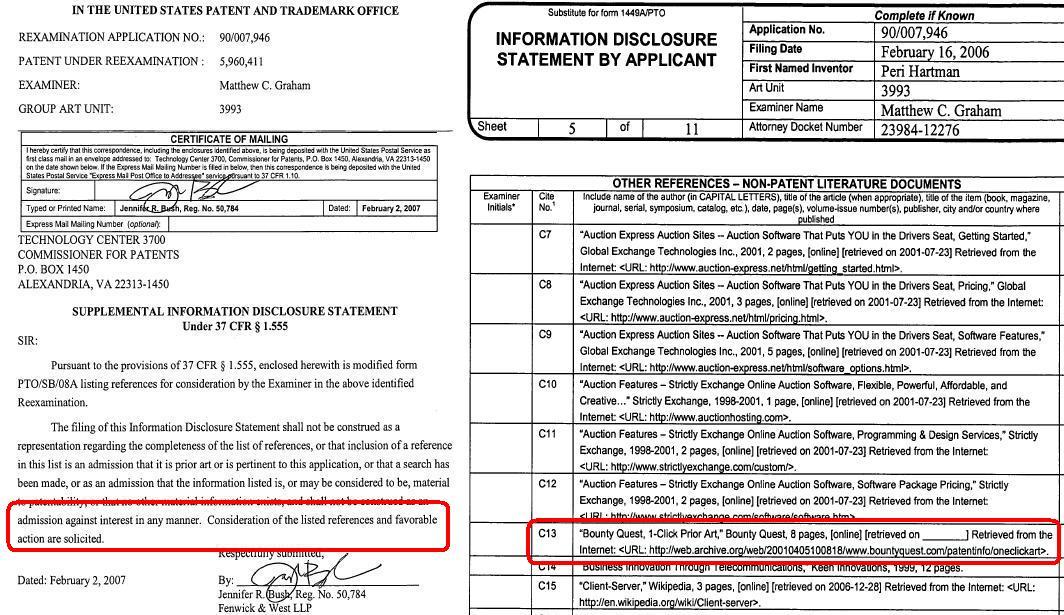
theodp writes "As some predicted, lawyers for Amazon.com have recently submitted 1-Click prior art solicited by Tim O'Reilly under the auspices of Jeff Bezos' patent reform effort to the USPTO, soliciting a 'favorable action' that would help bulletproof the patent. Last June, an Amazon lobbyist referred to deficiencies with the same prior art as he tried to convince Congress that 1-Click was novel, prompting Rep. Howard Berman to call BS." -
Moglen on Social Justice and OSS
NewsCloud writes "What does Firefox have to do with social justice? How will the one laptop per child project discourage genocide? How soon will Microsoft collapse? Watch Eben Moglen's inspiring keynote from the 2006 Plone Conference (Archive.org: mp3 or qt; or YouTube). The video presentation is ordinary, so the mp3 is an equally good format. 'If we know that what we are trying to accomplish is the spread of justice and social equality through the universalization of access to knowledge; If we know that what we are trying to do is build an economy of sharing which will rival the economies of ownership at every point where they directly compete; If we know that we are doing this as an alternative to coercive redistribution, that we have a third way in our hands for dealing with long and deep problems of human injustice; If we are conscious of what we have and know what we are trying to accomplish, when this is the moment for the first time in lifetimes, we can get it done.'" -
Moglen on Social Justice and OSS
NewsCloud writes "What does Firefox have to do with social justice? How will the one laptop per child project discourage genocide? How soon will Microsoft collapse? Watch Eben Moglen's inspiring keynote from the 2006 Plone Conference (Archive.org: mp3 or qt; or YouTube). The video presentation is ordinary, so the mp3 is an equally good format. 'If we know that what we are trying to accomplish is the spread of justice and social equality through the universalization of access to knowledge; If we know that what we are trying to do is build an economy of sharing which will rival the economies of ownership at every point where they directly compete; If we know that we are doing this as an alternative to coercive redistribution, that we have a third way in our hands for dealing with long and deep problems of human injustice; If we are conscious of what we have and know what we are trying to accomplish, when this is the moment for the first time in lifetimes, we can get it done.'" -
Moglen on Social Justice and OSS
NewsCloud writes "What does Firefox have to do with social justice? How will the one laptop per child project discourage genocide? How soon will Microsoft collapse? Watch Eben Moglen's inspiring keynote from the 2006 Plone Conference (Archive.org: mp3 or qt; or YouTube). The video presentation is ordinary, so the mp3 is an equally good format. 'If we know that what we are trying to accomplish is the spread of justice and social equality through the universalization of access to knowledge; If we know that what we are trying to do is build an economy of sharing which will rival the economies of ownership at every point where they directly compete; If we know that we are doing this as an alternative to coercive redistribution, that we have a third way in our hands for dealing with long and deep problems of human injustice; If we are conscious of what we have and know what we are trying to accomplish, when this is the moment for the first time in lifetimes, we can get it done.'" -
Internet Archive Gets DMCA Exemption
Paul Hickman writes "The Internet Archive has successfully lobbied for a DMCA exemption for the Software Archive. The IA keeps out-of-date programs, games and other random craziness for future programmers to savor. At the rapid pace of software development, this makes sure that we can create a history for us to remember and wonder at the programming of early games." -
Internet Archive Gets DMCA Exemption
Paul Hickman writes "The Internet Archive has successfully lobbied for a DMCA exemption for the Software Archive. The IA keeps out-of-date programs, games and other random craziness for future programmers to savor. At the rapid pace of software development, this makes sure that we can create a history for us to remember and wonder at the programming of early games." -
Publishing Documentaries on the Internet?
gehel asks: "While working in Rwanda as a computer engineer, I've had a discussion with a small NGO that produces video documentaries. Internews produces videos about Rwanda to raise the population awareness on different issues, mainly the Gacaca popular court for reconciliation. Those videos are the shown in public projections all over Rwanda. They would be interested in distributing this content to a larger audience: the internet. They have the rights to their documentaries, and are willing to distribute them under a Creative Common license, so we could use the Internet Archives to host the files, however we'd still have to find a good front end. I have been looking into a couple of solutions. Ourmedia is a bit too complicated to use, the Broadcast Machine doesn't seem ready for prime time, so I'm back to the standard Joomla!. I'm pretty sure there is the perfect solution somewhere, but I cant find it. Could you help me? "The perfect solution would be a Content Management System oriented toward video publishing, that can interact well with the Internet Archives. The ability to create RSS feeds for different media (French/English/Kinyarwanda with high/low quality versions) would be a plus.
Also, if anybody can help us with a good design, then suggestions are welcomed!" -
LiveJournal Introduces "Sponsored Content"
piphil writes, "LiveJournal.com has just announced via their Business Discussions journal that they are introducing 'sponsored communities and features.' This has lead to an outcry from those who watch this community, who accuse LiveJournal of starting down the 'slippery slope' towards placing advertising on users' journals — some of which users already pay for the privilege of not having to see ads on the site. Read more below."
Interestingly, a few years ago — before LiveJournal's takeover by SixApart.com — the management released a "Social Contract" stating that LiveJournal would remain advertisement-free. Unfortunately it is impossible to link to this page at LiveJournal, as it has been silently deleted. However, we can read a copy of the document on the Internet Archive.
The user outcry has so far been limited to those who actively watch the lj_biz community. However, users are employing their own "viral marketing" techniques to spread the word across the user base. Many are worried about a MySpace-like descent into user-targeted advertising.
All this comes after the user base resisted introduction of advertising-supported user accounts, which swapped paying for extra features for seeing "targeted" banner adverts on the site.
These events raise prickly issue of user rights on such websites, and the validity of "user contracts" that can be changed at will by the provider with no subsequent compensation to affected users. -
Wayback Machine Safe, Settlement Disappointing
Jibbanx writes "Healthcare Advocates and the Internet Archive have finally resolved their differences, reaching an undisclosed out-of-court settlement. The suit stemmed from HA's anger over the Wayback Machine showing pages archived from their site even after they added a robots.txt file to their webserver. While the settlement is good for the Internet Archive, it's also disappointing because it would have tested HA's claims in court. As the article notes, you can't really un-ring the bell of publishing something online, which is exactly what HA wanted to do. Obeying robots.txt files is voluntary, after all, and if the company didn't want the information online, they shouldn't have put it there in the first place." -
Barcodepedia - a Social Network Barcode DB
Thor Larholm writes "Barcodepedia is a community-based online barcode database, where everybody can contribute whichever barcodes they have lying around on their crowded desks simply by holding it in front of your webcam. The database is completely free to use, and everyone is invited to participate. The site should be available in French, Russian, German and Swedish within a week, so get all your friends and go to your local store with a laptop for massive fun. Donations of cuecats and other specialized scanners are welcomed." Anyone who's read Bruce Sterling's book Shaping Things may immediately think of Sterling's concept of "spimes" — for those who haven't, Sterling's 2006 SXSW address explains a bit, too. (It's easy to create your own barcodes, too — and then, not quite as easily, you can use them to control your house.) -
Best Server Storage Setup?
new-black-hand asks: "We are in the process of setting up a very large storage array and we are working toward having the most cost-effective setup. Until now, we have tried a variety of different architectures, using 1U servers or 6U servers packed with drives. Our main aims are to get the best price per GB of storage that we can, while having a reliable and scalable setup at the same time. The storage array will eventually become very large (in the PB range) so saving just a few dollars on each server means a lot. What do people out there find is the most effective hardware setup? Which drives and of what size? Which motherboards, etc? I am familiar with the Petabox solution which is what the Internet Archive uses — they have made good use of Open Source software. So what are some of the architectures out there that, together with Open Source, can give us a storage array that is much better than the $3 per GB plus that the commercial vendors ask for?" -
Best Server Storage Setup?
new-black-hand asks: "We are in the process of setting up a very large storage array and we are working toward having the most cost-effective setup. Until now, we have tried a variety of different architectures, using 1U servers or 6U servers packed with drives. Our main aims are to get the best price per GB of storage that we can, while having a reliable and scalable setup at the same time. The storage array will eventually become very large (in the PB range) so saving just a few dollars on each server means a lot. What do people out there find is the most effective hardware setup? Which drives and of what size? Which motherboards, etc? I am familiar with the Petabox solution which is what the Internet Archive uses — they have made good use of Open Source software. So what are some of the architectures out there that, together with Open Source, can give us a storage array that is much better than the $3 per GB plus that the commercial vendors ask for?" -
Copyright Study Group Seeks Comments
jeh0bu writes "The Section 108 Study Group, a group of copyright experts, has been meeting to discuss Section 108 of the U.S. Copyright Law. It is focusing on preservation of websites and access to digital copies of library materials. Representatives of Internet Archive, including Brewster Kahle, went to the group's public roundtable sessions in March. Google did not register to attend the roundtable sessions even though the findings of the Section 108 Study Group may impact Google's Library Project. The Section 108 Study Group seeks written comments through April 17, 2006, according to this Federal Register notice." -
Advice for Open Source Startups: Remember LinuxCare
Dave Rosenberg, Principal Analyst, Open Source Development Labs, contributed this commentary piece: Despite all the open source software and services companies funded in 2005, the associated business models are still considered experimental and unproven. The new crop need only to look to the past avoid missteps. At the Open Source Business Conference in November, VCs and open source software company executives wondered aloud if what we’re seeing today is a “bubble” of open source start-ups being funded. One journalist’s recap of the event cited $144 million in open source start-ups receiving VC funding in 2005, double the venture capital flow for open source start-ups in 2004. Bubble or not, there is a company that every would-be open source start-up investor should learn a lesson from: LinuxCare.LinuxCare was born in 1999 -- venture-backed by top tier VC firms like Kleiner Perkins, with total funding in the ballpark of $70 million.
Those were the frontier days for Linux. There was a ton of industry interest and activity despite the fact that the jury was still out with respect to end user adoption. Nobody really knew exactly how Linux was going to be used – would it be for the desktop, servers, etc.? The company used the vast venture coffers to promote the brand and staff star-power (even Linus Torvalds consulted for them briefly)– and LinuxCare quickly became the recognized name for Linux services and support, doing work for big systems vendors like Dell and IBM in addition to developing device drivers and offering education services.Red Hat had the Linux OS and software, VA Linux had the hardware – and LinuxCare had the services. It was a theoretically perfect enterprise Linux ecosystem triumvirate.
But it wasn't meant to be.
The demise of LinuxCare can be attributed to many factors. The first was that enterprises were slow to adopt Linux – in the early ‘00s, IT spending came to a grinding halt with the dot-com and stock market crash. But the key factor to LinuxCare’s spectacular death spiral was the fact that they were going up against Red Hat, the very company they were basing their business on. Red Hat not only developed their own distribution of Linux, but also started offering support for it. Red Hat offered a one-stop shop for Linux software and services regardless of hardware. Enterprise customers decided it was easier to buy from one vendor. This same sentiment is what drives sales of Microsoft software in enterprises today.
LinuxCare suffered a painful public death over months of executive departures and layoffs, VA Linux abandoned hardware for software, and RedHat, with the cash to weather the tech spending downturn, expanded its revenue streams and became the de-facto enterprise Linux distribution.
It's easy to dismiss LinuxCare as "ahead of their time", which is definitely true. But the fundamental and fatal flaw was that they based their products on someone else's IP, with no IP of their own. When the market tanked abruptly, LinuxCare didn't have the money to weather the storm and didn't have consistent alternative revenue streams to combat the lack of services income.Some of the executives from LinuxCare went on to start a new company called Levanta, which focuses on Linux systems management. They have since developed IP in software and hardware that can sustain the business beyond the services revenue.Their LinuxCare experience taught them how to build a sustainable technology business model on top of open source software. No longer do they rely on IP that walks out the door every night in their employees' heads.
In the end, it all comes down to IP. Building a business on top of something you don't own is extremely risky. Companies need to develop their own IP to be innovative and have competitive differentiation. And if they don't develop it themselves, they need to acquire or license the relevant code to protect themselves and ensure they aren't caught without alternatives.
An Open Source Danger Zone?In my eyes, the bubble associated with open source is less related to the millions of VC dollars and more related to the reliance on software and components that are not part of a company's internal IP. When Oracle acquired InnoDB, it had a less than positive effect on MySQL, but MySQL is a smart enough company to not bet the farm on something it doesn't own. It owns enough IP to sustain its products-and it's business from the risk associated with relying on someone else's code.
IT Groundwork has built a business on top of an open source network monitoring project called Nagios. They don't own the copyrights and they don't employ the creator. Kleiner-backed SpikeSource offers "certified stacks" of open source software components, but they don't actually create the open source components themselves.
And in SpikeSource's case, Red Hat announced that they too would offer "certified stacks." Who do think is going to win that battle? Red Hat, the one-stop shop that offers the OS and the apps, or the company that offers merely a portion of the total package. Does SpikeSource have the IP or alternative revenue sources to withstand Red Hat? Let's wish them luckand hope they know the LinuxCare tale.
If there is a bubble, it will burst when the open source projects these new company's products and services depend on go private, fork, or get acquired. The market for open source is so new we haven't seen much of this yet. Only time will tell if the recently funded open source companies can build sustainable businesses, or if this grand experiment will result in a few 800 pound gorillas and many tiny monkeys.Have something important to say to the Slashdot community? Email roblimo at slashdot period org with the complete article or an article proposal.
-
Engineers Bringing Soap Box Racing Back Again
kpw10 writes "It appears that soap box racing has made a recent comeback as traditional races are getting big attention again. But at the same it is also adapting itself into a more modern engineering challenge: pro car designers from companies like Audi and BMW just last week raced in California's Extreme Gravity Series, with super aerodynamic racers reaching speeds of 44mph. Meanwhile on the east coast, industrial designers and artists competed in the Durham "Fall Classic Soap Box Invitational" with converted lazy boy recliners and enormous eight foot wheeled vehicles. I hope this is just a sign of what's to come!" We have come a long way since the 1930's. -
Nitpicking Wikipedia's Vulnerabilities
tiltowait writes "A lot of Wikipedia critics point to hypothetical situations when giving reasons for not valuing the site. Wikipedia even has a 'Replies to common objections' article set up to field these. I'd rather look at some real examples of applying the same level of scrutiny to materials often held up as the Platonic ideal of 'scholarship,' such as peer-reviewed journals, conference papers, established journalism sources, monographs, and print encyclopedias. Even these have disclaimers because they can be can be vandalized or have their reliability and accuracy questioned. As dangerous as it is to trust unverified information, it can be just as bad to make prior judgments discounting information because the source happens to be anonymous. The above examples illustrate that all materials existing along a continuum of valuable information formats. Wikipedia articles can be useful for quickly obtaining factual overviews or as a starting point to further research. But that's just one librarian's opinion. How do tech-savvy people view Wikipedia?" -
Hundreds of Hours of BBS Documentary Interviews
Jason Scott writes "Hi, this is Jason Scott, director of the BBS Documentary, a 4 year project to tell the story of the dial-up bulletin board systems of the 70s, 80s and 90s. The documentary's out, for sale, and is completely Creative Commons licensed. But like most documentaries, there's tons of stuff left on the cutting room floor. And that just won't do. I'm happy to announce that I have partnered with archive.org to present what will be hundreds of hours of interviews online. The BBS Documentary Interview Collection will be extended edits of the 205 interviews I conducted, presented as video and audio files, along with ZIP archives of all the photos and supporting materials for that interview. And of course, every minute is Creative Commons licensed as well. It's going to take me upwards of half a year to edit and upload the half-terabyte of files; I hope people watch a few hours here and there to get an even deeper knowledge of the history of the BBS, or maybe even make a documentary of their own." -
Hundreds of Hours of BBS Documentary Interviews
Jason Scott writes "Hi, this is Jason Scott, director of the BBS Documentary, a 4 year project to tell the story of the dial-up bulletin board systems of the 70s, 80s and 90s. The documentary's out, for sale, and is completely Creative Commons licensed. But like most documentaries, there's tons of stuff left on the cutting room floor. And that just won't do. I'm happy to announce that I have partnered with archive.org to present what will be hundreds of hours of interviews online. The BBS Documentary Interview Collection will be extended edits of the 205 interviews I conducted, presented as video and audio files, along with ZIP archives of all the photos and supporting materials for that interview. And of course, every minute is Creative Commons licensed as well. It's going to take me upwards of half a year to edit and upload the half-terabyte of files; I hope people watch a few hours here and there to get an even deeper knowledge of the history of the BBS, or maybe even make a documentary of their own." -
Public Domain from Outer Space
Black_by_Pubic_Deman writes "It is a work of art that truly represents the nadir of film making; a movie so bad that it's good. It has been labelled 'The Worst Movie Ever' by the Golden Turkey Awards and is also the winner of two notable Razzies. Ed Wood's classic and every Slashdot reader's favorite movie Plan 9 from Outer Space is now in the Public Domain and available as a free download thanks to the fine folks over at Archive.org." -
Public Domain from Outer Space
Black_by_Pubic_Deman writes "It is a work of art that truly represents the nadir of film making; a movie so bad that it's good. It has been labelled 'The Worst Movie Ever' by the Golden Turkey Awards and is also the winner of two notable Razzies. Ed Wood's classic and every Slashdot reader's favorite movie Plan 9 from Outer Space is now in the Public Domain and available as a free download thanks to the fine folks over at Archive.org." -
Bittorrent Creator A Digital Pirate?
Alex_Ionescu writes "According to an article in Wired, the old webpage of Bram Cohen contained a manifesto stating that his goal for creating software was to 'Commit Digital Piracy'. Cohen argues that the quote is taken out of context and represents a parody. He argues having written it in 1999, 2 years before even coming up with Bittorrent. You can find the archived copy of his site at archive.org. From the article: "Cohen has never publicly encouraged piracy, and he has consistently maintained that he wrote BitTorrent as a legitimate file-distribution tool. That would seem to make him and his budding company, BitTorrent, safe under the Grokster ruling. But legal experts worry the newly discovered manifesto extolling 'digital piracy' could put him on less certain legal ground." -
PetaBox: Big Storage in Small Boxes
An anonymous reader writes "LinuxDevices.com is reporting that a Linux-based system comprising more than a petabyte of storage as been delivered to the Internet Archive, the non-profit organization that creates periodic snapshots of the Internet. The PetaBox products, made by Capricorn Technologies, are based on Via mini-ITX motherboards running Debian or Fedora Linux. The IA's PetaBox installation consists of about 16 racks housing 600 systems with 2,500 spinning drives, for a total capacity of roughly 1.5 petabytes, according to the article. Now to strap one of those puppies to my iPod!" The Internet Archive continues to astound. -
Command Line for the Web
flood6 writes "SearchEngineWatch offers a look at a new method of interacting with the Internet, YubNub. This 'social command line for the web' lets users create commands that interact with websites. Currently, most of the commands apply to search, but new commands could work with any site that accepts variables passed with HTML's GET command. For example, iap moon would search the Internet Archive for all media related to 'moon'." -
All Your Base Are Turned Five
Subm writes "All your base are turned five! According to AYBABTU: The History, 'June 5, 2000: The Zero Wing Dub Project is posted at OverClocked - the first original AYB humor.' Before then there was only an oddly (brilliantly?) translated game. But five years ago, someone set up us the bomb!" The Flash Video is, of course, still available. -
New Amazon Patent Cites Bezos Patent Reform
theodp writes "In seeking yet another patent related to 'single-action ordering of items,' Amazon asked the USPTO to consider a number of documents, including Doonesbury cartoons, which Amazon earlier claimed vindicated its 1-Click patent. Ironically, much of this material was collected and edited by BountyQuest, which reportedly received $1+ million from Amazon CEO Jeff Bezos in the name of patent reform. A USPTO examiner dutifully considered the material, and on Tuesday U.S. Patent No. 6,907,315 was issued to Amazon." -
A RAW repository, The Internet Archive and OpenRAW
Stan writes "I just read this in the OpenRAW mailing list, OpenRAW plans to create a RAW repository, a final resting place for RAW file documentations of current and already abandoned digital cameras. The RAW repository will be hosted in the Internet Archive, which describes themselves as a digital archive of the Internet and other cultural artifacts. And they have all reasons to support OpenRAW, they currently photograph billions of book pages with cameras and store them in RAW format. Unfortunately the camera makers think different (which is not always a good thing)."