Slashdot Mirror
Domain: astronautix.com
Stories and comments across the archive that link to astronautix.com.
Comments · 776
-
Re:the hell?
Or use a rocket that's both really big and really cheap.
-
correction and numbers are for LEO not GTO
Falcon 9 is 60,000 pounds or so. Ares I is around 55,000 pounds or so. Also, these are LEO numbers because I cannot find GTO numbers for the Ares I. It's definitely not 50,000 pounds to GTO. That would require some high ISP technology that currently isn't planned for the Ares I. Plus the other rockets could use that magic technology as well. At least two already lift more to LEO, so with the same tech they will lift more to GTO.
-
Re:Gap?
You're overstating things a bit. The initial plan was simply to attach a reboost module to be flown on an early (2nd, later 5th) STS flight. Martin Marietta was awarded a contract for studying development of such a module with a goal of building it in less than 2 years. But then STS got delayed because of SSME problems, and then the atmosphere changed quicker than expected.
By your strict definition, during the same time frame, there were no "actual plans" for anything past STS-4... but we all knew what sorts of plans were in the works. If Skylab had still been up there are the time, "actual plans" would have materialized for at least reboost. Refurbishment would have been contingent upon necessary funding.
-
I hate to nitpick, but...
But then we're talking about an agency that flew Space Shuttles for 40 years.
The first Space Shuttle flight was a test of Enterprise in August 1977. The first actual mission was in April 1981 with Columbia . Unless I've dropped through some kind of freaky weird timewarp, it's only been 31 years.
-
Not even in the same class as the SR-71
now, don't get me wrong. this is a cool bird. but I wouldn't say it was cooler than the SR-71.
I've found a few better articles and videos, here, here , here & here.
It's probably designed to be the replacement for the "blackstar" program, which doesn't exist, but is hands-down the very coolest thing out there, the only thing cooler would be a functioning Orion spacecraft.
But this looks like it might have the capability of taking the place of the blackstar "mothership", although I bet with less performance & payload; as this isn't designed to be a Mach 3+ cruise nuclear bomber, that's understandable. but those cold-war birds have got to be tired by now, and looking forward to retirement. i think one would look great in my driveway as a static display.
I do wonder what they are going to use to replace the orbital component, which was probably based on the X-20. Maybe a NASP? The X-43?
-
Re:Sounds unfeasible
As stated earlier, there are SHARP guns. Although if you could build one for 2k I'm sure there would be a bunch of military people that would be interested.
-
Re:Skynet precedes Terminator
-
Re:fewer than half?
I count only three non-American Mars landing missions, too: Russian M-71 and M-73, and Europe's Beagle 2 on Mars Express. But perhaps he was referring to the numerous international Mars orbit and flyby missions which have also failed.
See Astronautix.com for details.
-
Re:It won't get cheap enough until...
It would be pure st00pid to build a nuclear ground to orbit to ground space plane. Without sufficient shielding anything electronic aboard would have its circuits destroyed. With sufficient shielding it'd never get off the ground.
I've been doing my own propulsion, aerodynamics and flight profile math for years; I have a high powered rocketry license, and design and build my own.
Forgive me, but that's spoken like someone who hasn't done the math. Go read the actual, y'know, article I linked to.
I've read TFA. It doesn't do much math either. It just quotes someone else's figures, badly. I'm not going to bother checking up on all of them because I'm confident the writer has done the same with those that he's done with a few of the details given -- selective reproduction without checking them himself and showing that. As I will show, the author is almost certainly unable to do so.
If the design were as safe as stated, it should show the math that supports that, not just make the assertion and say someone else calculated it. If it did show that math it could be picked apart. Most important would be the calculations of specific impulse and the pressure required to reach it vs. the containment stated as making it safe as well as making the propulsion system robust enough to launch and land.
One case of math being "done" is the assertion "I mentioned that the exhaust of this nuclear spaceship shoots out at a whopping fast 30 kilometers per second. If you add this 30 kilometers per second to the 8.5 kilometers per second the whole rocket is moving while in orbit...". This shows the compete inability of the author to grasp the necessary concepts. You do not add orbital velocity and exhaust velocity to arrive at a new orbital or other trajectory velocity. You use Isp to calculate exhaust velocity (not by itself relevant) as well as delta V (relevant, requiring among other details vehicle and exhaust mass).
More problematic in TFA is the use of invalid and egregious comparisons attempting to justify the "safety" of the design by providing historical figures on deaths by various means, as if killing fewer with radiation sickness, cancer, etc. is acceptable just because more died from other things. That's not just wrong, it's sick.
If I want background details I don't go to some guy's blog, but rather to a site that the NASA historical office themselves recommend to others for this purpose: http://www.astronautix.com/ . Go there and look up the relevant launch vehicle family, NERVA. Every design was canceled in either the study phase or during development. The references provided tell why, and the reasons apply to the design here. The article stated as the primary reference (in NuclearSpace) is 404. Details in other material presented on the site shows this supposed pro-something outfit to have the same selective attention problem. For instance they say that NERVA design and development ended in 1973. DARPA's 'Timberwind' NERVA project was closed during development (not just design) in 1992. The fact that they (at least at one time) published TFA containing problems such as the velocity error noted above indicates they too are as qualified as the blog's author, ie. not very. I would ask that anyone making appeal to "the math" would themselves check it, as appealing to authorities that aren't leaves one open to guilt by voluntary association. I'll give NuclearSpace the benefit of the doubt and assume TFA is 404 because they caught the errors they originally let slip past.
If the design were built and it failed, making comparisons with automobile deaths would be useless. Making comparisons with Chernobyl would provide details, if not in scale, then at least in specific problems likely to occur. -
Re:Full Manual Re-entry is Possible in Soyuz
Addendum:
According to this link: http://www.astronautix.com/flights/mireo23.htm the landing rockets failed anyway, which resulted in a hard, but survivable landing.
And according to this: http://www.jamesoberg.com/soyuz.html the crew has no control over the parachute deployment. (This is written in entry 6 B under "Special Questions) -
Re:Orion spaceships, wimps!
I suspect the author of the article just wanted to make all current efforts to have a manned mission to mars look bad so people could later push for something nuclear. There are even more sane nuclear means of propulsion than Orion out there. Not that I would say it couldn't work, but having nuclear explosions happen under your behind while still on planet earth is just plain naughty from an environmental point of view.
Here is a good example for a nuclear engine
http://www.astronautix.com/engines/nerva.htm
It has been argued though that it wasn't as much of an improvement over the chemical engines it was meant to replace (J-2).
This was in the sixties however and who knows where we could be now without all the naysayers. -
Re:do what now?
The summary doesn't describe the system itself very well - if that was how it worked I'd agree it'd be idiotic. The "vehicle" the summary mentions is actually just a separate rocket engine attached to the nose of the capsule. If something goes wrong, the astronauts don't have to go anywhere; the bolts holding the capsule onto the main Ares launch vehicle blow, and the escape rocket fires, lifting the entire Orion capsule off the Ares rocket and high enough into the air to get clear of the launch pad and any unpleasant explosions. Then the escape rocket separates from the capsule, while the capsule is hopefully high enough to land softly by parachute. For more info (and pictures), see here: http://en.wikipedia.org/wiki/Launch_escape_system and here: http://www.astronautix.com/craft/orionlas.htm.
-
SupergunsSuperguns were the coolest idea I ever heard of for low cost launching systems. The cargo would need to be able to survive a 100G excelloration but that's not a problem with raw materials and even electronics can be hardened for that force. The cost would be a fraction of current rocket technologies and they could launch far more often. It's a brilliant system so I can't believe no one has pushed it since the inventor died.
-
Re:Explosives on Soviet space satellites
It may have been before that too, according to http://www.astronautix.com/craft/soyuzp.htm Soviet satellites had the self-destruct since the 1960s.
-
Zubrin's Idea, using COTS tech: Black Colt
No fancy dual-mode engines are necessary. Zubrin's Black Colt just pairs a couple of fighter jet engines with existing Kerosene/LOX rockets. By using in air refueling, you save a lot of structural weight. (You only have to build for empty weight on the ground.)
You could use such a vehicle as a 1st stage for cheap TSTO launch of small payloads. It can also be used for hypersonic intercontinental package delivery.
http://www.astronautix.com/lvs/blakcolt.htm
The idea also scales up. (To the point where the size of the fuel tanker becomes prohibitive.) -
Re:New Shuttle?
What did Rocketplane Kistler come up with before this breakup?
Here's Kistler's design:
http://www.astronautix.com/lvs/kislerk1.htm
Basically, they were started up back in the late 90s, but went into bankruptcy when the economy tanked. Rocketplane bought them and attempted to resuscitate them for COTS, but they were unable to get the sufficient private funds that NASA's milestone required. They attempted to sue NASA to get more money despite not meeting the milestone, but weren't successful. -
Vs Light Gas Gun?
I think the jury is still out on whether rail guns or light gas guns will be the next step.
Let me list the current advantages/disadvantages:
Rail Gun:
+ Simple firing mechanism (Two rails, one plug, massive juice)
+Very little muzzle flash
+Very rapid fire (Gatling configuration to spread out heat on rails)
*Acceleration limited by current carrying capability of rails.
- Complex/heavy electrical system (Banks of caps + power supply to charge them)
- Rail wear
-Heavy projectiles increases support structure significantly
Light Gas Gun:
+ Heavy projectiles scales up rather well.
* Medium complexity (More complicated than Gatling mechanism)
* Acceleration limited by maximum chamber pressure.
- Bore wear
- HUMONGOUS muzzle flash (hydrogen combusting)
- Medium rate of fire.
Bottom line: Flechettes: Rail gun; Sub Orbital or ship killer: Light Gas Gun
Currently light gas guns emit a huge fireball out the end of them, which may tend to limit their use for a shoulder fired weapon (anti-tank, anti-air). On the other hand it is a lot easier to store and release obscene amounts of energy in a gas or powder than in electrical form. I would imagine porting the barrel would allow recovery of some of the hydrogen.
One advantage the railgun might have is it might allow different projectile shapes like fins that would be difficult to achieve with a light gas gun.
We should be using light gas guns to ship fuel up to the bottom of a chain of a LEO space elevators. -
Re:Solid Rocket BoostersSolid Rocket Boosters are sort of like strapping yourself to a firecracker. We can't have liquid ones? We have had a number of launch vehicles that have used only liquid propellants:
Redstone/Jupiter http://www.astronautix.com/lvs/redstone.htm [astronautix.com]
Titan http://www.astronautix.com/lvs/titan2.htm [astronautix.com]
Saturn http://www.astronautix.com/lvs/saturnv.htm [astronautix.com]
But, today, all of the current US boosters use a combination solid motors and liquid engines:
Space Shuttle http://www.astronautix.com/lvs/shuttle.htm [astronautix.com]
Delta http://www.astronautix.com/engines/ssme.htm [astronautix.com]
Atlas http://www.astronautix.com/lvs/atlasv.htm [astronautix.com]
The selection of propellant type and combination are the result of a number of design trade-offs. Liquid propellants have much higher performance but also require a lot more inert mass (in the form of turbopumps or pressurization systems, tanks, cooling systems, etc.) than solid motors do. Solid propellants are more dangerous since you have both propellants mixed together (subject to ignition/explosion/detonation due to bullet impact/cook-off/drop/electrostatic discharge/etc.) but they are also very storable compared to cryogenic propellants thus they are often used in most military applications.
That said, it is worth noting that the so-called "New Space" companies developing rockets are using liquid or hybrid (liquid oxidizer/solid fuel) propulsion systems, which at least preliminarily indicates that the extra mass and complexity are worth the performance, safety and infrastructure advantages in a consumer-based market. -
Re:Solid Rocket BoostersSolid Rocket Boosters are sort of like strapping yourself to a firecracker. We can't have liquid ones? We have had a number of launch vehicles that have used only liquid propellants:
Redstone/Jupiter http://www.astronautix.com/lvs/redstone.htm [astronautix.com]
Titan http://www.astronautix.com/lvs/titan2.htm [astronautix.com]
Saturn http://www.astronautix.com/lvs/saturnv.htm [astronautix.com]
But, today, all of the current US boosters use a combination solid motors and liquid engines:
Space Shuttle http://www.astronautix.com/lvs/shuttle.htm [astronautix.com]
Delta http://www.astronautix.com/engines/ssme.htm [astronautix.com]
Atlas http://www.astronautix.com/lvs/atlasv.htm [astronautix.com]
The selection of propellant type and combination are the result of a number of design trade-offs. Liquid propellants have much higher performance but also require a lot more inert mass (in the form of turbopumps or pressurization systems, tanks, cooling systems, etc.) than solid motors do. Solid propellants are more dangerous since you have both propellants mixed together (subject to ignition/explosion/detonation due to bullet impact/cook-off/drop/electrostatic discharge/etc.) but they are also very storable compared to cryogenic propellants thus they are often used in most military applications.
That said, it is worth noting that the so-called "New Space" companies developing rockets are using liquid or hybrid (liquid oxidizer/solid fuel) propulsion systems, which at least preliminarily indicates that the extra mass and complexity are worth the performance, safety and infrastructure advantages in a consumer-based market. -
Re:Solid Rocket BoostersSolid Rocket Boosters are sort of like strapping yourself to a firecracker. We can't have liquid ones? We have had a number of launch vehicles that have used only liquid propellants:
Redstone/Jupiter http://www.astronautix.com/lvs/redstone.htm [astronautix.com]
Titan http://www.astronautix.com/lvs/titan2.htm [astronautix.com]
Saturn http://www.astronautix.com/lvs/saturnv.htm [astronautix.com]
But, today, all of the current US boosters use a combination solid motors and liquid engines:
Space Shuttle http://www.astronautix.com/lvs/shuttle.htm [astronautix.com]
Delta http://www.astronautix.com/engines/ssme.htm [astronautix.com]
Atlas http://www.astronautix.com/lvs/atlasv.htm [astronautix.com]
The selection of propellant type and combination are the result of a number of design trade-offs. Liquid propellants have much higher performance but also require a lot more inert mass (in the form of turbopumps or pressurization systems, tanks, cooling systems, etc.) than solid motors do. Solid propellants are more dangerous since you have both propellants mixed together (subject to ignition/explosion/detonation due to bullet impact/cook-off/drop/electrostatic discharge/etc.) but they are also very storable compared to cryogenic propellants thus they are often used in most military applications.
That said, it is worth noting that the so-called "New Space" companies developing rockets are using liquid or hybrid (liquid oxidizer/solid fuel) propulsion systems, which at least preliminarily indicates that the extra mass and complexity are worth the performance, safety and infrastructure advantages in a consumer-based market. -
Re:Solid Rocket BoostersSolid Rocket Boosters are sort of like strapping yourself to a firecracker. We can't have liquid ones? We have had a number of launch vehicles that have used only liquid propellants:
Redstone/Jupiter http://www.astronautix.com/lvs/redstone.htm [astronautix.com]
Titan http://www.astronautix.com/lvs/titan2.htm [astronautix.com]
Saturn http://www.astronautix.com/lvs/saturnv.htm [astronautix.com]
But, today, all of the current US boosters use a combination solid motors and liquid engines:
Space Shuttle http://www.astronautix.com/lvs/shuttle.htm [astronautix.com]
Delta http://www.astronautix.com/engines/ssme.htm [astronautix.com]
Atlas http://www.astronautix.com/lvs/atlasv.htm [astronautix.com]
The selection of propellant type and combination are the result of a number of design trade-offs. Liquid propellants have much higher performance but also require a lot more inert mass (in the form of turbopumps or pressurization systems, tanks, cooling systems, etc.) than solid motors do. Solid propellants are more dangerous since you have both propellants mixed together (subject to ignition/explosion/detonation due to bullet impact/cook-off/drop/electrostatic discharge/etc.) but they are also very storable compared to cryogenic propellants thus they are often used in most military applications.
That said, it is worth noting that the so-called "New Space" companies developing rockets are using liquid or hybrid (liquid oxidizer/solid fuel) propulsion systems, which at least preliminarily indicates that the extra mass and complexity are worth the performance, safety and infrastructure advantages in a consumer-based market. -
Re:Solid Rocket BoostersSolid Rocket Boosters are sort of like strapping yourself to a firecracker. We can't have liquid ones? We have had a number of launch vehicles that have used only liquid propellants:
Redstone/Jupiter http://www.astronautix.com/lvs/redstone.htm [astronautix.com]
Titan http://www.astronautix.com/lvs/titan2.htm [astronautix.com]
Saturn http://www.astronautix.com/lvs/saturnv.htm [astronautix.com]
But, today, all of the current US boosters use a combination solid motors and liquid engines:
Space Shuttle http://www.astronautix.com/lvs/shuttle.htm [astronautix.com]
Delta http://www.astronautix.com/engines/ssme.htm [astronautix.com]
Atlas http://www.astronautix.com/lvs/atlasv.htm [astronautix.com]
The selection of propellant type and combination are the result of a number of design trade-offs. Liquid propellants have much higher performance but also require a lot more inert mass (in the form of turbopumps or pressurization systems, tanks, cooling systems, etc.) than solid motors do. Solid propellants are more dangerous since you have both propellants mixed together (subject to ignition/explosion/detonation due to bullet impact/cook-off/drop/electrostatic discharge/etc.) but they are also very storable compared to cryogenic propellants thus they are often used in most military applications.
That said, it is worth noting that the so-called "New Space" companies developing rockets are using liquid or hybrid (liquid oxidizer/solid fuel) propulsion systems, which at least preliminarily indicates that the extra mass and complexity are worth the performance, safety and infrastructure advantages in a consumer-based market. -
Re:Solid Rocket BoostersSolid Rocket Boosters are sort of like strapping yourself to a firecracker. We can't have liquid ones? We have had a number of launch vehicles that have used only liquid propellants:
Redstone/Jupiter http://www.astronautix.com/lvs/redstone.htm [astronautix.com]
Titan http://www.astronautix.com/lvs/titan2.htm [astronautix.com]
Saturn http://www.astronautix.com/lvs/saturnv.htm [astronautix.com]
But, today, all of the current US boosters use a combination solid motors and liquid engines:
Space Shuttle http://www.astronautix.com/lvs/shuttle.htm [astronautix.com]
Delta http://www.astronautix.com/engines/ssme.htm [astronautix.com]
Atlas http://www.astronautix.com/lvs/atlasv.htm [astronautix.com]
The selection of propellant type and combination are the result of a number of design trade-offs. Liquid propellants have much higher performance but also require a lot more inert mass (in the form of turbopumps or pressurization systems, tanks, cooling systems, etc.) than solid motors do. Solid propellants are more dangerous since you have both propellants mixed together (subject to ignition/explosion/detonation due to bullet impact/cook-off/drop/electrostatic discharge/etc.) but they are also very storable compared to cryogenic propellants thus they are often used in most military applications.
That said, it is worth noting that the so-called "New Space" companies developing rockets are using liquid or hybrid (liquid oxidizer/solid fuel) propulsion systems, which at least preliminarily indicates that the extra mass and complexity are worth the performance, safety and infrastructure advantages in a consumer-based market. -
Re:Thought about something like this
You are absolutely right.
Instead of using water as the propellant directly, have the water press against a piston that compresses hot hydrogen.
The seal issues have been addressed for the HARP gun:
http://www.dunnspace.com/harp.htm
http://www.astronautix.com/lvs/sharp.htm
http://www.astronautix.com/lvfam/gunnched.htm
http://en.wikipedia.org/wiki/Light_Gas_Gun
I don't know if heat buildup is more of an issue with a longer, lower G force tube. -
Re:Thought about something like this
You are absolutely right.
Instead of using water as the propellant directly, have the water press against a piston that compresses hot hydrogen.
The seal issues have been addressed for the HARP gun:
http://www.dunnspace.com/harp.htm
http://www.astronautix.com/lvs/sharp.htm
http://www.astronautix.com/lvfam/gunnched.htm
http://en.wikipedia.org/wiki/Light_Gas_Gun
I don't know if heat buildup is more of an issue with a longer, lower G force tube. -
Knowledge Economy
If I understand well, the Chinese did take real hi-res pics of the Moon but when they tried to combine them prior release they suck it up and a crater was duplicated in error.
For programmers, this is similar to combining two subroutines by copying and pasting the code but then forgetting or failing to properly merge the code of the two parts. Let's say you have, for example:
int add_seven_add_three (int num)
{
num += 7;
num += 3;
return (num);
}
int cut_two_add_three (int num)
{
num -= 2;
num += 3;
return (num);
}
int compute (int num)
{
num = add_seven_add_three (num);
num = cut_two_add_three (num);
return (num);
}Now the above at this state is the same as having two moon photos with a crater (number 3) being one time in the first photo, and a second time in the second photo. Essentially two photos that feature a small region in common. This happens all the time in space imagery.
Then you look at the code and you realise it's silly and carries a performance penalty, so you want to fix it. Seeing that the merge is easy, you give out this task to a junior programmer. But the junior is sloppy and drunk and when they copy-paste they produce this little beast:
int compute (int num)
{
num += 7;
num += 3;
num -= 2;
num += 3;
return (num);
}Now at this point the above is equivalent to having two moon photos badly merged with the same crater being visible twice in the same photo.
During the code review you find that stupidity and you fix it, while yelling at the junior before firing them:
int compute (int num)
{
return (num + 11);
}The above is like a properly processed moon photo with no duplicate craters.
(and the junior then sues for wrongful dismissal, oh my)
For me, the fact that the Chinese comminists built a spaceship and then failed to properly merge two photos shows that technology can be easily imitated across nations and the only thing that can keep a nation competitive is the knowledge and skills its people have in their brains. The Chinese successfully copied US and Russian technology, but then failed miserably when they needed to do some work involving knowledge and skills.
A nation investing solely in technology, as the current US administration does, will surely fail and get eaten by other countries that invest more. It can only take a huge hurricane or a superstrong earthquake in the wrong place to damage vital US economy centres and thus to slow down the US economy, allowing competitors to take the number 1 position internationally. Technology is easily copied (for example, the Russian spaceshuttle is a perfect clone of the US one, just look at it, this without saying that Russian engineers aren't good, they do know their stuff, but their until recently communist administration, which is still quite anti-democratic, seemed more inclined to copy rather than research).
What a smart nation must do is to invest in its people... or more specifically in their brains. A nation composed of knowledgeable skilled people will never fail, even if its economy is damaged by hurricanes. Knowledge and skills cannot be imitated by competing nations. While technology can just be copied or surpassed by paying higher grants, basic science and skills take decades to be developed and therefore cannot be copied. The Chinese copied Soyuz (which is also a copy of US crafts) very easily, but they did sloppy scientific work while merging moon photos. Interestingly, TFA says that the first Soviet moon photos also had scientific errors. This means that nations spending
-
More like cannon
Jules Verne most likely first imagined it, and Gerard Bull designed it: http://www.astronautix.com/lvs/babongun.htm
-
The toddler Turing test
Computing has now passed the toddler Turing test. Seeing Skynet's been operational for quite a while now, it's about time the robots caught up.
-
Re:Also the Fear of Where the Money Comes From
You doubt the entire thing will weigh (okay, mass) 4000 pounds? Look, I was with your back-of-the-envelope numbers up to that point, but 2000 pounds for 10 megawatts of solar panels, plus meteorite shielding, control/propulsion systems, and the microwave transmitter to beam the power back down? No way. 5000 pounds is a fair weight estimate for a modern communications satellite, and they're a whole lot simpler.
Do you even have an idea of how many square feet of PV cells you need for 10MW? There's a system in Portugal that's that big, you can see a photo of it here. Even figuring that you might get slightly more efficient cells and by putting them in orbit might be able to get more power out of each, you're still talking about a *huge* station.
I strongly suspect you are talking about a Shuttle launch or using one of the Russian or European heavy-lift rockets (I think an Ariane 5 can lift something like 10,000 kilos to geostationary orbit), and that's assuming you can lift it in one shot to begin with.
I think this is neat technology too, but let's not understate the difficulty here. This is an immense undertaking. -
Re:an extraordinary claim!
Wow, that is an extraordinary claim. You have some evidence you can show us, right?
The Jupiter C rocket was capable of orbiting a satellite prior to October, 1957:
Re-entry vehicle test booster and satellite launcher derived from Redstone missile. The Jupiter A version of the Redstone missile was modified with upper stages to test Jupiter re-entry vehicle configurations. Von Braun's team was ordered to ballast the upper stage with sand to prevent any 'inadvertent' artificial satellites from stealing thunder from the official Vanguard program. Korolev's R-7 orbited the first earth satellite instead.
-
Re:Space Age Colonialism
And so the seeds of space piracy and "independent traders" are sown...
Recipe for telling the state go suck bricks through a thin straw sideways:
1. Buy an old oil platform
2. Refurbish
3. Reregister under the flag of a tiny pacific island which is not a signee to the treaty (optional)
4. Tow outside territorial waters (bonus points for launching from near the equator to save fuel).
5. Launch... And potentially Profit...
Example: http://www.boeing.com/special/sea-launch/why_sea_launch.htm. Surprise who are the usual suspects - the darlings of the USA defence industry - Boeing and the darlings of the russian defence industry - Energia. Cousying in the same bed. Nicely and quietly while the USA and Russia politicians rattle the sabres in the name of a new Cold War.
Alternative recipe
1. Buy or hire an Il-76, An-124 or Mriya. The last is difficult, for the rest call this chap: http://news.bbc.co.uk/1/hi/world/africa/6991487.stm. He is rumoured to be good. Alternatively, get your hand on a White Swan or a Concorde (that may be quite difficult, but as our Bulgarian friends say "What cannot be bought with money can be bought with a A LOT of money").
2. Reregister it under a suitable nation in the middle of Africa or Oceania (optional).
3. Load a launch vehicle on it. Two under development - Shtil-3A and RIF-MA. Both are rumoured to work. To buy - call the same chap. Or build your own.
4. Fly outside the airspace of all nations signing the treaty (again - bonus points for equatorial launch)
5. Launch... and potentially Profit...
Example: http://www.friends-partners.org/partners/mwade/lvs/shtil3a.htm and http://www.friends-partners.org/partners/mwade/lvs/rifma.htm. Actually the last 5 on the right will all do nicely: http://www.friends-partners.org/partners/mwade/graphics/n/newlv640.jpg.
Alternatively (if you manage to get your hands on a White Swan or manage to get the French to sell you a Concnorde as a launch vehicle): http://www.astronautix.com/lvs/burlak.htm -
Re:That's nothing..
Reading the (now Slashdotted) article, it sounds like this design came directly out of research done into antimatter catalyzed micro-fission. ACMF is a well-proven technology that uses minuscule amounts of antimatter to kickstart or enhance a fission reaction. Because the technology was fairly straightforward and had good returns for antimatter quantities that are reasonable to produce, NASA was funding research into an engine called ICAN.
I remember that there was some talk of actually launching a small probe based on the concept, but apparently the plan was scrapped. (Probably to help fund manned space travel.) Whatever antimatter confinement technologies they were working on may have led to the development of this new magnetic confinement fission technology. Or it could just be a coincidence.
Either way, nuclear technology of this sort is fairly well developed and is not a pipe dream. At least not from an engineering standpoint. Getting the risk adverse US Government and NASA to actually build one of the many known-quantity engines we have on hand is a completely different ball of wax. They're still trying to get us reliable LEO access (Thank God for Griffin is all I can say), so I doubt we'll be seeing any advanced engines in practice until the CEV/Orion project enters its third phase. -
Re:How long has this been happening?
Just a small correction. According to my copy of "Rockets of the World" by Peter Alway and http://www.astronautix.com/lvs/energia.htm and http://www.buran-energia.com/energia/energia-desc
. php, Energia used LOX/Kerosene strap on boosters and a LOX/LH2 core. No toxic, hypergolic fuels (though they were considered early in the design). -
Re:Land claimCould you fill me in on just what systems make lots of countries capable of delivering munitions to the moon?
A W88 warhead masses something like 360kg. A Saturn V rocket was capable of sending 47,000kg to the Moon, or 118,000kg to Low Earth Orbit. Assuming linear scaling, to get a payload of 360kg to the Moon would require an LEO capacity of some 900kg. Such capacity is available to the US, Europe, Russia, China, India... basically, anyone who's remotely likely ever to want to nuke a target on the Moon is capable of doing so.
As for anyone who positions themselves on the moon - well they sit at the top of a large gravity well. I think you might want to consider this a bit more.
A self-sufficient moonbase would be a fearsome adversary indeed. Given some form of cargo launcher - a railgun would do nicely - they could fling rocks at any target on Earth, which would strike at escape velocity. Nasty. I am not certain, however, of the strategic utility of this weapon. It would take a couple of days for the rocks to arrive, by which time their intended victims would surely have nuked the crap out of the aggressor's targets on Earth. It would make a decent deterrent - an enemy might take out all your assets on Earth, but nothing could reach the Moon quickly enough to prevent retaliation - but it's no First Strike weapon.
-
People really died even in a spacecraft
In June 1971 an USSR crew died in a spacecraft that was accidentally de-pressurized during re-entry and none of the crew had spacesuits on due to the lack of space in the module.
http://www.astronautix.com/flights/soyuz11.htm
At sea level the atmosphere is pressure is 14 PSI and space is 0PSI so you will start to "exploded" because this pressure difference. Really what will happen you will "degas" since all dissolved gases in your body and other materials (ie water) that boils at 0 PSI will turn to gas and exit your body at a rapid rate, depending on the temperature. This is the same as the bends drivers get when they rise to quickly from a deep long dive. However you need air to live so all a few or more seconds is all you need to go unconscious then another few more seconds you will die because of this degassing of your body. The radiation and other stuff are secondary since the Soyuz 11 crew had a good protective spacecraft minus the air during re-entry. -
Re:Protecting their IP?
Changing over to more and smaller nozzles would create additional points of failure. Larger engine bells would also be more efficient in terms of mass (consider a single container vs. several containers with the same total volume). Not to mention the additional plumbing, even if you share pumps between engines.
That said, the USSR did as you suggest with their N-1, which used 30(!) engines on the first stage and varying thrust as you suggest for attitude control.
All 4 test launches failed prior to second stage ignition, one creating the largest explosion in the history of rocketry (destroying the launch pad as well as the vehicle). The program was then cancelled.
The Ares I (single 5-segment SRB for first stage, LH/LOX second) does, if I recall, use small thrusters for attitude control during ascent rather than engine gimbaling. -
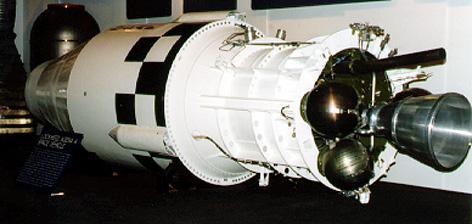
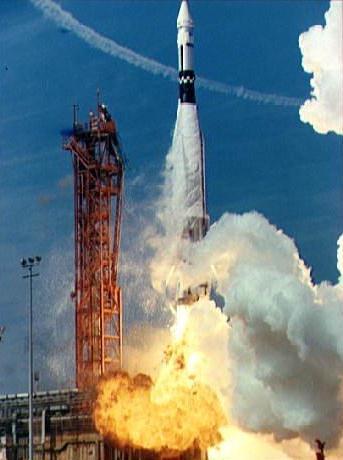
alternate Agena
-
alternate Agena
-
Re:Other news: Fatal explosion at Mojave Airport
As far as I can see, Scaled Composites and Xcor are the only tenants at Mojave using nitrous. SC in the HTPB hybrid from SpaceDev http://www.astronautix.com/engines/spaybrid.htm , and Xcor in its 15 and 50 Lbf motors http://www.xcor.com/products/engines/2P1_N2O_etha
n e_rocket_engine.html . The latter wouldn't need a truck load of the stuff. SpaceDev is working on a lot more hybrid projects than just SC's, but their test own stand is at Capistrano. SC is both secretive about its running projects and notoriously bad about updating it web sites about what it does announce, but by now they should be ramping up for testing the motor for SS2.
This certainly throws a wrench into the "hybrids are so much safer" works. Very bad for the two dead and four hurt, I'm just hoping Rutan wasn't among them. -
Not exactly a new idea
This looks a lot like the space activity suit from the sixties. In fact, there's an edit in the wikipedia entry from january 2005 noting that the MIT is doing research that would lead to the suit we are seeing today.
Check the papers at the end of the wikipedia article, too. -
Re:Slashcode predicts ...
And once again, slashcode is right. At least there's nothing new for us to see, since the newfangled biosuit is just a revieved space activity suit from the early seventies, featured in an even goofier picture at astronautix.
-
Re:Star Wars
That wasn't just the USSR's idea. The United States also had a functional ABM system operating on the same principle - using Nike Zues (or Nike X) rockets with a few kiloton warhead strapped on top. I don't believe it got deployed anywhere but Guam however.
The USSR's system was called Galosh, or A35. The missile was in operational use around Moscow from 1971 on. It has since been replaced, although by what I don't know. I think the Gorgon but I could be wrong. The system was only used to protect Moscow as per the terms of the 1972 ABM treaty. -
Re:Rhetorical Hairsplitting
> This story is complete horseshit. [blahblah] http://www.svengrahn.pp.se/histind/ASAT/F15ASAT.h
t ml
Sure it is. Now. See also http://www.astronautix.com/lvs/asat.htm
22 years ago it wasn't. Solwind was still downlinking data when it poofed. http://www.patricksaviation.com/wiki/F-15_ASAT I got the story from Astronomy magazine at the time.
It was taking a lot of work to keep it synched, but USAF (its original owner) had not shut it down. http://franksblog.hoferfamily.org/2004/01/21/
Usually very complete with their data, Vought is rather mute about it, naming the sat only by its designator. http://www.voughtaircraft.com/heritage/products/ht ml/asat.html
Makes you wish they'd get their horse shit straight.
I was wrong about one thing. The debris from Solwind was tracked and the data made available. 250 pieces. One almost hit ISS 8 years ago. http://cns.miis.edu/pubs/week/070124.htm So if the US says pieces of the Chinese test might hit ISS, we can assume they're correct because they have experience in these things. -
Space Guns anyone?
I know it's slightly offtopic, but I always wonder why a highly speculative and fragile concept like the space elevator which is barely theoretically possible is getting so much press, while space guns, which are cheaper, more robust and don't require any new technology, are practically ignored.
In case you're not familiar with the concept: It's basically about accelerating a small vessel (by a light gas gun, a RAM accelerator, electromagnetically or a combination thereof) in a relatively short (about the order of one km) barrel / tunnel to about orbital speed. The vessel itself will only require enough fuel for circularizing its orbit, so unlike conventional boosters, a much bigger part of its mass can be actual payload as the exponential regime of the rocket equation can be mostly avoided.
While the capital costs will be high, a space gun is still dirt cheap compared to a space elevator, and isn't prone to be completely destroyed when hit by lightning, space debris or, for the matter, a shotgun.
http://en.wikipedia.org/wiki/Space_gun
http://www.fas.org/news/iraq/1998/05/980500-bull.h tm
http://www.astronautix.com/lvs/julncher.htm -
Women's Rights Activist Complain...
... that there shouldn't be a record by gender.
Oh wait. I don't hear em' complaining. I for one think this takes away from the record for longest single spaceflight:
Dr Valeri Vladimirovich Polyakov - 437 days -
Re:fifteen other groups have plans
Since when is SpaceShipOne the only private rocket development in history? Start reading through Astronautix for a while, and then come back here and tell me with a straight face that small companies have a remotely decent track record in rocketry. Not that SpaceShipOne didn't have its own share of near disasters, despite its greatly simplified scope and small number of flights -- a trim actuator failure, multiple separation roll abnormalities, shedding of a chunk of polybut, failure of the flight control system, and so on. Any one of those could potentially have been fatal were it not for a combination of luck and/or the skill of the pilot.
-
"First Vietnamese in space" no longer a "goal":
And hasn't been for a long time, at least according to this.
-
Re:Wishful thinking
The new suit does sound like a suite, so to speak. From the photos it doesn't incorporate an MCP undersuit, which I think is critical for Mars. MCP and constant-volume balloon suits are incompatible, both on the "skin" layer and in the life support system (they have different requirements, generally). For the article it sounds like they will be swapping backpacks and possibly torso segments per task. It still doesn't make the new suits quite right for Mars, but they should work on the moon. Still wouldn't want to drag that much dust into the return capsule, though.
For Mars suits, the goal is generally a 50lb suit because of the
All of this aside,a lot of development is required before we're ready for any kind of surface EVA.
Biosuit:
http://mvl.mit.edu/EVA/biosuit/index.html
http://www.astronautix.com/craftfam/spasuits.htm
http://www.astronautix.com/craft/nasrkiii.htm -
Re:Wishful thinking
The new suit does sound like a suite, so to speak. From the photos it doesn't incorporate an MCP undersuit, which I think is critical for Mars. MCP and constant-volume balloon suits are incompatible, both on the "skin" layer and in the life support system (they have different requirements, generally). For the article it sounds like they will be swapping backpacks and possibly torso segments per task. It still doesn't make the new suits quite right for Mars, but they should work on the moon. Still wouldn't want to drag that much dust into the return capsule, though.
For Mars suits, the goal is generally a 50lb suit because of the
All of this aside,a lot of development is required before we're ready for any kind of surface EVA.
Biosuit:
http://mvl.mit.edu/EVA/biosuit/index.html
http://www.astronautix.com/craftfam/spasuits.htm
http://www.astronautix.com/craft/nasrkiii.htm -
Re:Hey look, just for Slashdot!
The entire return to the moon plan might have an alternative military purpose. http://www.astronautix.com/craft/apolmcsd.htm It should be noted the orion CEV has almost the same on orbit delta V as the old apollo LEM CSD except it also can carry several tons of equipment.