Slashdot Mirror
Domain: bcgreen.com
Stories and comments across the archive that link to bcgreen.com.
Comments · 95
-
You don't have to be athiest to accept evolutionFirst of all, Genesis only says that God created the world -- It doesn't say how. Science doesn't say who -- It just investigates how.
Genesis doesn't claim that God's days are 24 hours long. By some reports, the original Hebrew word that we now translate as 'days' is more like 'aeons' -- the Sun and the Moon weren't even created until the 4th 'day'.
Then, of course, there are those who say that the 31 lines of Genesis that describe creation aren't to be taken as a detailed account of creation -- and, more importantly, that we shouldn't make up all sorts of random stuff and pretend that that's in those 31 lines as well and demand that other people accept the stuff that people made up be included as God Given Truth. They even expect god to abide by our own 24 hour day. Rather presumptuous of us, yes?
Consider it, instead, as a parable for people who didn't even have a firm grasp of Newtonian mechanics, much less Relativity (and for the most part wouldn't have cared less about the later, even if God had tried to explain it back then). Notice, even, that between Genesis 1 and Genesis 2 there is a different order for the creation of man and beast. God, it seems, is outside of the ordere of time.
I take from Genesis a few key talking points:
- God created this world, and gave us Dominion over it.. There's no promise of another one, so we better treat our 'toys' nicely
- God takes time off to rest and recuperate and so should you.
The details of how god created the universe, the world and us is really left as an exercise for the reader. Those who claim that the stuff that they made up after reading Genesis is the God given truth are simply playing god, themselves.
-
You don't have to be athiest to accept evolutionFirst of all, Genesis only says that God created the world -- It doesn't say how. Science doesn't say who -- It just investigates how.
Genesis doesn't claim that God's days are 24 hours long. By some reports, the original Hebrew word that we now translate as 'days' is more like 'aeons' -- the Sun and the Moon weren't even created until the 4th 'day'.
Then, of course, there are those who say that the 31 lines of Genesis that describe creation aren't to be taken as a detailed account of creation -- and, more importantly, that we shouldn't make up all sorts of random stuff and pretend that that's in those 31 lines as well and demand that other people accept the stuff that people made up be included as God Given Truth. They even expect god to abide by our own 24 hour day. Rather presumptuous of us, yes?
Consider it, instead, as a parable for people who didn't even have a firm grasp of Newtonian mechanics, much less Relativity (and for the most part wouldn't have cared less about the later, even if God had tried to explain it back then). Notice, even, that between Genesis 1 and Genesis 2 there is a different order for the creation of man and beast. God, it seems, is outside of the ordere of time.
I take from Genesis a few key talking points:
- God created this world, and gave us Dominion over it.. There's no promise of another one, so we better treat our 'toys' nicely
- God takes time off to rest and recuperate and so should you.
The details of how god created the universe, the world and us is really left as an exercise for the reader. Those who claim that the stuff that they made up after reading Genesis is the God given truth are simply playing god, themselves.
-
IANAL, but I don't think he is either.It seems like neither is the head of the Human Rights Commission.
First of all, the charter of rights has certain limits:
1. The Canadian Charter of Rights and Freedoms guarantees the rights and freedoms set out in it subject only to such reasonable limits prescribed by law as can be demonstrably justified in a free and democratic society.
Current jurisprudence says that the law should , if feasible, be interpreted in such a way as to make it consistent with the charter.
Now, there are clearly cases of hate speech that are so egregious as to be inherently inconsistent with Canada retaining it's status as a free and democratic language. In this way, I'd say that the law could be interpreted as being consistent with the charter.
In this case, I would say that, if the speech being encouraged on this website was mild enough that it wouldn't justify the exception in section 1 of the charter, then it should be deemed to be below the threshold of application of the law. To declare unconstitutional a law that is meant to prevent the kind of hate speech that results, at it's worst, in things like lynch mobs is to ignore both the purpose of that law and the purpose of the charter of rights.
To put it another way, If you're going to declare this law unconstitutional, you might as well disband the entire human rights commission as unconstitional.
-
Re:Troll? I love itThe city wasn't offered anything. The telco refused to help the city build the network, so city got the funding to go it their own.
BTW: Adam Smith (the grandfather of modern capitalism) didn't see any real difference between big government and big business.
-
Re:Just what's wrong with his suggestion?" And the earth was without form, and void;"
and you should notice that the direct part of the quote ends after 'light'. The 'and whoof, there was a universe' comes from big bang theory, but it's not that different than 'and there was light' in genesis.
You have to remember, too, that the bible was written for people for whom the closest thing to quantum theory was "there's nothing smaller than a penny" (well, whatever the equivalent was back then), and it wasn't intended as a science text.
-
Re:This isn't justice: too little, too lateLiberals may not win any elections, but they sure won one part of the "small, powerless government" agenda, and it ain't the "small" one. You are, I think confuse liberals with libertarians. The fight to 'get governments out of the way of large megacorps like Microsoft which would happily chew up even medium-sized competitors and spit their not-so-juicy leftovers out on the sidewalk' is one area where libertarians and conservatives seem to be in alliance. It's also one area where liberals don't want to see things go.
These people will often site Adam Smith as the grandfather of Laissez-faire capitalism and the principle of 'free market'. If you take a closer look at his work, however, it becomes apparent that he saw "big business" as being just as corruptive on the economy as "big government" -- some people would even say that he saw them as roughly equivalent. In both cases you have people at a far-away headquarters ('capital') making decisions about what's going to happen in my quarter of the world -- and often with no real care for what happens to the 'little people' like me.
I mean, from the point of view of the average bloke, how is 'big business' really any better than 'big government'?
-
Re:Multiple OSes are good - monopolies are bad
Click here to reach The MS monopoly findings of fact.
-
Re:No increase in oil demand?That they would publicize a bare claim that we have 122 years worth of oil, based on static current consumption says a lot about the view that they're trying to push.. Just a quick bit of spreadsheet work (i.e. about 10 minutes) gives a prediction that if you allow oil consumption to increase by only 1%/year, we have only 79 years worth of oil left before hitting the wall. If consumption increases by 5%/year, that drops to 39 years. ( spreadsheet in ODF format ).
Given that almost all economic projections pretty much require a geometrically increasing economy, 122 is pretty much an upper bound for conventional predictions... (( I will, however, note that a 1%annual decrease in consumption results in a nearly infinite theoretical timeline ))
I would also raise the question of whether their predictions include non-recoverable oil (i.e. oil that would probably take more energy to extract than it would provide). I'm guessing that it probably does.
-
Re:You might as well ask...
Well, looking at luke20:41 it seems to me like he's talking about David, not himeslf.
-
Re:Duopolies may not help
Adam Smith's Open Market consisted of many small businesses. Heavy market concentration and massive economies of scale -- while good for big business wasn't part of his vision. Supposedly (I'm not a Smith scholar), he considered big business to be no better than big government. Personally, I consider big business worse than big government, since big government at least has some modicum of public mediation built into it in the form of elections. A big-business monopoly or cartel, on the other hand, only answers to it's own greed.
-
Re:The bottom line is thisCops, like anybody else, have a tendency to do whatever they think they can get away with. The laws and policies that dribble down from the top will tend to set the bar for this.
Right now, we have laws on the books that allow cops to hunt through your electronic data on a hunch, and arrest and detain you on a hunch that you're a security risk. It's not gonna be a big hunch to see some cops testing their new powers to see how far they can run with them... If we don't push back against cops who try to bully us into not taking pictures of them then the nastiest of them will think that they have the freedom to do whatever they want want.
It may be a 'right', but rights need to be fought for and defended. The lines of our freedom are dynamic. If we don't fight to expand them then they'll shrink, and if they shrink far enough it will take a bloody and vicious fight to get them back again. It's far better to fight while the fighting is easy.
Try reading the paraphrasing of a famous poem on my website.
-
Don't Judge a Book By it's CoverWorst... brothel... ever....
Remember -- that was the prevailing fashion of the time -- but just because they dressed up conservatively (by today's standards) doesn't mean that they couldn't dance up a storm when you got them in the mood.
(( suggestion: wait 30 seconds before giving up on the video )) -
Re:Yeah, he's right.http://www.bcgreen.com/spam/spamlogger.tar . It's a cluster of about 4 shell and perl scripts.
I figure out the 'legitimate' addressess manually -- any machine in your 'legitimate' email delivery path should be listed... I.E. primary and secondary MXs
Note that if you use this to 'report' messages delivered to you via mailing list, you must include the IPs associated with the mailing lists as well. Any address not in the 'legitimate' list is presumed to be the first IP in the SPAM chain (i.e. an Open Relay, the ISP relay of the spambot, or the spambot itself).
-
That's Six Inches???!!!The DHS, put out a Request For Information (RFI) looking for someone who had the technology to read ID tags from 25 feet away at 55MPH... Through the skin of a bus... All the passengers at once.
They seem to suggest that they only want it so that they can identify people stopped at border checkpoints.
-
Re:NOT a server cabinet
This time I'm testing the link to the corrected picture.
-
Re:Parent shows lack of insight into Windows histoI believe Vista runs on a heavily
There was a recent article about how there was virtually no
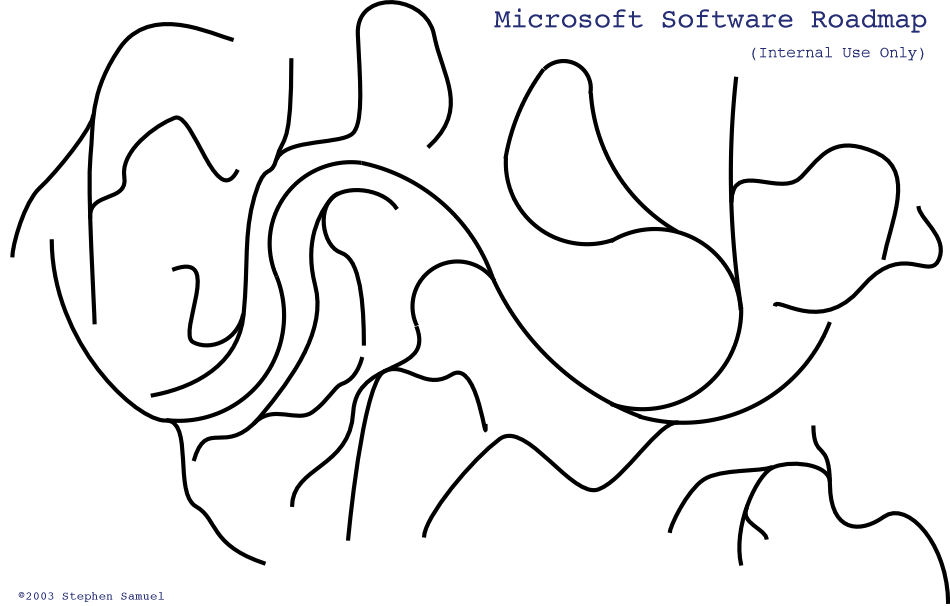
Who knows. The Microsoft software roadmap always has seemed a little bit random.
-
Re:Two other links.
A copy of the paper (or, at least, something very closely resembling what was printed in nature) can be found here.
-
Re:Intended Consequences of lawsYou offer some very valid advice -- if we were still living in 1910 or 1950 or maybe even 1970.
The difference between then and now is that we now have laws in place that disallow the worst of those past abuses. Remove the laws and the abuses will almost certainly come back.
I'm working on a mathematical proof of the need for anti-monopoly laws. Without activity limiting laws, it is easy for corporations to go completely overboard.
'Company towns' are just fine for the priviledged few who the corporation considers critical to their survival.... for as long as that's true. However, once those people are deemed disposable, the services that the corporation provided can disappear as quick as it takes to write a memo.
I talked to a forester on the central coast of British Columbia who told me of what happened to a 'company town' late '80s early '90s. (I didn't get an exact date, but I was told the story in 1995 and it was given as recent history).
It was a company town in the general region of Bella Coola that was based on the logging industry. It had wonderful conveniences, and the company built, for example, a brand new gymnasium/theatre for the community to use. The next year, they decided to shut down logging in the area, and they ordered everybody out. The brand-new gymnasium was ordered abandoned. People were not allowed to remain there -- even if they wanted to -- because the town was private property of the corporation.
-
Re:Hey, its better than LinuxAt least I can try most of the various versions of Linux without having to pay $400 a pop.
And, once I have a version I like. I don't have to fork out another $400 just because I decide to upgrade my motherboard.
And a lot of the so-called 4000 versions of Linux are specific versions that people have built for their preferred application. An example would be my netboot CD that allows net-booting Knoppix from a CD -- which I designed so that I can give students in a classroom their own Linux box (without touching their hard drives), and also a way to do semi-automated backups and restore for public Windows boxes.
That's something that I (as a hobbyist) could never create with Windows (much less distribute). -
Then, of course, there's timeline.Then, of course there's Microsoft's dealings with Timeline, where they (for a substantial discount), signed a license with the company for a data warehousing technology that was almost guaranteed Not to cover customers and developers, because it didn't cover the case where the customer included any code of their own.
When Microsoft's lawsuit (which pretty much echoed SCO's charge against Novell for the rights to UNIX of "We must have gotten those rights -- why would we pay so much for a contract that gives us so little"?) failed, their response to Timeline was. 'If you don't like it, then sue our customers.'
Their software indemnity policy specifically does not seem to cover the kind of situation that they created with Timeline (where there is any sort of custom programming involved -- whether by the customer or Microsoft).
(IANAL)Hmm... And almost immediately after a judge told Microsoft that they had this indemnity exposure for their customers, SCOg gets this 'idea' to create a big (fake) kerfluffel about how Linux has an indemnity exposure
-
Evaluating MS Office by Microsoft's criterionI wrote the following rant about what would happen if you evaluated Microsoft Office by their own criticism of the MA decision. Microsoft doesn't come out too well.
Essentially their criticism makes a reasonable source of inquiry, but it's very hypocritical.
- My executive Summary:
- If Microsoft believes that, by refusing to implement the OpenDoc Protocol, they can Bring the Commonwealth to it's knees, this would simply be an indication of disdain for their customers and the degree to which they wield, and hope to continue to wield, control and fear over their customers, including the commonwealth, and it's citizens.
- Microsoft's format is not a standard, open or otherwise. It has not, (to my knowledge) been submitted to any standards body, and it is only implemented by one company (themselves) in a limited beta. That they would try to pass off their limited beta a 'standard' and expect people to accept that statement unexamined indicates little more than the thrall which they endeavor to hold their customers, and the public in.
- The cost of document incompatibility and upgrades would remain (and probably worsen) under the Microsoft-proposal, in the long term.
- Massachusetts could probably provide Free Software to the entire commonwealth for about the cost of procuring Microsoft Office-12 updates for a single (large) department.
-
Oh joy!
So much for market forces, eh?
Adam Smith considered 'the free market' to be a good number of small merchants. Big business produces the same sorts of centralized stupidity as big government -- especially when it has a (pseudo) monopoly. -
It's not writing it down that's the problemThe problem is people who do things like write down their password, and then tape it to the keyboard (and things like that).
A friend of mine has a good rule "Never store a written password within 8 feet of your computer". (why 8 feet, and not 10?? 10 sounds like a rounded-off number that quickly degenerates to 5, and then 2 8 sounds like it was chosen for a reason -- Just tell them that it was chosen for social engineering reasons).
Another thing that I'll do is not actually put the password itself onto paper == instead, I'll put something from which I can generate the password. For passwords that I use often enough to memorize I'll destroy the written version once I've got it memorized.
For short passwords (e.g. Solaris 8,9) I suggest that people use the mnemonic method
-
Acronym passwordsI have a web page for creating secure passwords I essentially tell them to use acronyms... Come up with a phrase, and use that phrase to generate a password. My web page is oriented towards the 8 characther password limit endemic to Solaris (I'm SO glad they've finally extended that), but easily extended to more modern limits.
I teach this method to students, and then I run john the ripper on the results. I found one of two results -- either they completely ignored my teachings and came up with passswords like '123456', or I didn't guess their passwords in days of running ripper.
I think that forcing 'safe' passwords on people is a bad idea.. this problem was addressed on slashdot a couple of years ago, and what they found was that 'random' passwords usually resulted in people writing down their passwords and keeping them in places like their wallets or taped to their keyboard (!).
Far better is to periodically run a password checker on people's accounts.. If you find a password, change their password, and/or send them an email telling them that their password has been guessed, and they need to come up with something secure (and somp pointers to ideas on how to create a 'good' password).
Sooner or later, they'll come up with a password that at least you can't guess, which is as good a heuristic I can come up with.
-
Re:IdeaOK: them and Brazillian bikini manufacturers, but then it's not the bikini you're paying for, it's everything else it's _not_ covering
-
Been there, done that...
Does a story count as prior art? Arthur C. Clarke did it with waterbeds and geosynchronous satellites.
-
Re:Mysterious FutureOn the other hand, spikes like that occur in random data as a matter of course... Take a look at my quick investigation of into random sum results on my website. I have similar spikes, but with no 'interesting' event to cause it. If I let it run for longer (or just used
The program used to evaluate the data is there (perl), and the graphing was done using gnumeric's graphing function (the x/y graph to be precise).
-
It's a human engineering thing.If you tell someone to come up with a password they'll try and come up with a word, and chances are that it will be between 4 and 6 letters long -- 8 if you're lucky.
If you ask them to come up with a passphrase then they'll come up with a phrase. It's almost that easy.
Of course, we'll soon end up with crack dictionarys containing things like "Natalie Portman with grits", but it's still a lot harder on the crackers than 'password7'.
I'll still strongly suggest that people throw in a few random special symbols, since that will help throw off most dictionary attacks. (I.e. "Natalie Portman(8) 4 gr!ts")
I think that some Security geeks figured out that a random english word is worth about10-15 bits of entropy (randomness), but if you tie them together into a proper english phrase, then you can easily see how the successive words will have way less entropy to them. Adding or substituting other characters and/or words helps to break up the pattern and add back entropy.
Of course, you'll then have to remember how you mangled the passphrase, but that's the nature of entropy. Check my password page for a better idea of what I'm talking about. It was written for an 8 letter password world (Solaris), but the full phrases can work in a more real world. -
I'm just *waiting* for them to patent this.I have a short instruction sheet for passwords that I use when I'm teaching intro to OS and sysadmin type courses. Because Solaris was (until very recently) still limited to 8 characters, I had to teach them how to build hard to guess 8 character passwords.
Thing to note here is that I still suggest that you mangle the pass phrase that you're using so that it's not pure english (or any other language). As far as I'm concerned, expanding the password to a passphrase is a good thing, since it's always adding a few more bits of entropy into any brute force (or even more finessed) search algorithm.
I think that, these days, just about every modern well-designed operating system, the 'password' system allows semi-arbitrary long passwords (255 characters or more).
Hmm.. I just went and actually RTFA. It looks like Windows likes to store your password as a cryptographically weak hash, if it can, and then converts to something a bit harder. Sigh.
Oh well. Yet another reason to use long passwords -- short passwords in Window are easily recognizable as easy to crack. . -
(always test your links)
The proper link for my site on popping popcorn
-
Hot Air Popper from Hell.If you want to grow your own, you might want to build an industrial-grade hot-air popper.
My suggestion would be to go out and rent a high-volume propane dryer/heater. You then want to get the air volume down, and the propane volume up to the point where the gas coming out of the thing is about the same temperature as comes out of a hot air popper (I don't have one, so I can't do the measurement for you -- those cheap oven thermometers that you can get in some dollar or grocery stores should do a good job of this).
Once you've tuned your dryer, then you need to pump the air from it thru a reasonably large drum with a mesh bottem nailed onto it. The mesh needs to be fine enough to hold popcorn kernels in (obviously). I'd suggest that you also weld some metal rods to the bottom to help keep the mesh from sagging, and a yard or two of piping between the heater and the popcorn bin, to keep open flame from any popcorn bits.. At a quick guess, you should be able to pop around 10 pounds of popcorn at a batch and get some number of cubic feet/minute.
some trivia:
Dunno how I did it, but I have a reasonably high-rated site on "making popcorn" (as opposed to, say "popping popcorn"). This goes well beyond what my site addresses.
Popcorn is used by some companies as a packing supply, so I don't think that it's going to be that highly flamable.. That having been said, It's far from flame-resistant. If you're going to do something like this you would probably be well off to make sure that the pilot lights on the furnaces and stoves (etc) are turned off.The flame war over the flamability of popcorn got me curious, so I did a quick test. I did a batch of (oil-popped) popcorn, and tried lighting a small sample. It wasn't trivial to light (took a few seconds with a match to get it to light), but once lit it produced a growing flame. I'd suggest keeping a loaded garden hose nearby when you do this.
-
"Communist"People run around screaming "Communist!" like it's a threat to democracy. It's really not. Soviet Russia suffered under Stalinism. True communism is really not much different than Capitalism, except for the fact that the profits are more evenly distributed to the workers and management gets minimum perks from their position (at least in theory).
Fact of the matter is that that's really the way that capitalism was meant to work under Adam Smith's Wealth of Nations (considered by many to be the godfather of modern capitalism. Under his view, big multinational corporations were (are) no different than big government -- both result in centralized decision making which warps local economies.
What the GPL does is it forces decision-making back down to the local levels and prevents a big company from controlling the entire market by force. This is actually far closer to real capitalism than either Microsoft's market-warping monopoly. And also far closer to closer to capitalism than it it is to Stalin's market-warping communism.
It's also far more intrinsically democratic than either.
So, the next time Gates & company starts screaming 'communist', respond
It's not communism. It's financial democracy
-
Re:Thank God for people....Sometimes they have complete idiots reading the logs.
Back when the nimda worm was running around, I wrote a home-grown IDS to watch web hits, identify nimda-type probes and, if I could find a reporting address for the offending IP email a complaint off to the responsible ISP.
We were being serviced by Shaw Cable at the time, and every once in a while, they'd misread my complaints, and figure that my box was the source of the attack, and they'd send a nasty email to my roommate (who the connection was registered to) threatening to cut off our internet if we didn't delete the viruses install a firewall, etc. (we each had our own BSD firewall).
I got to know one of the supervisors there reasonably well, modified the letter I sent out to make it all but impossible for the people who read the email to confuse the attacking box with the defender, and he even added a note to the file for our connection, which resulted in a period of quiet after which we got yet another threatening letter.
I responded with this letter. My roommate (who took this very seriously because he was paying business rates to be allowed to run servers on the line) thought that I was being a bit flippant about something so important (flippant?! It took me an hour to write the damn thing!), but the supervisor at shaw said that he got a bit of a chuckle out of it when he phoned me to apologize for the error and promise a fix. His explanation was that shaw had installed a new abuse reporting system and that the note about our account had been lost in the transition (but would be added back in).
If you read my letter, (which includes the original autocomplaint) then you'll understand just how far people are willing to go to misread log files.
-
Teaching users.I have a page that I direct most of my students to when trying to teach them passwords. It's changed slowly over time, but it tries to teach them the passphrase method. (it was originally based on the problem that, until recently, Solaris has been limited to 8 character passwords).
Getting users to use secure passwords is a serious problem. For classes, I've gotten to the point of giving them my treatise, letting them set their passwords and then using something like John-the-ripper to crack people who choose bad passwords. Doing it in front of them and getting a handfull of passwords in under a minute will generally get the attention of at least some of them.
One thing to note about the 'change the password every few weeks' approach is that it presumes that an intruder has access to the encrypted password file. Given current security systems, it's now rare that you have access to the encrypted password unless you've already gotten admin access -- at that point you can expect that your security is hosed, anyways.
Rather than just not suggesting that sites use the 'change every 6 months' rule, it should be explicitly discouraged unless you have seriously elite users with the cycles to spare for repeated memorization.
-
Re:Berkeley's Florida "study" "debunked"?
Just for completeness: One of the letters I wrote about using easter-eggs to modify a vote on the fly.
-
Knopix Options for Maximum Portability.I'd set 'nodma'. I've run into a good number of boxes that snark up on the boot without that option -- that includes more than a few laptops. You lose a bit of speed talking to the HD but at least it talks.
Knoppix also has a bug for setting the timezone. It chooses the timezone based on the keyboard you pick. For the US keyboard it's EST. If you're not in the proper timezone, you pretty much have to rewrite the
There are two fixes: One is to hardcode the proper TZ into the knoppix-autoconfig file. The other is to fix the bug for setting the timezone.. at that point you can set the timezone in the isolinux.cfg file without having to recompress the whole KNOPPIX filesystem.My TZ patch is here. Once you install it, you can use 'tz=America/Vancouver' (etc.) on the boot line, or change the isolinux.cfg file and write a new CD (far easier in my mind).
-
Re:"Managed" news in the US? The hell you say!The complaints that I saw about Bowling for Columbine were mostly technical -- things like the way that he edited together bits of speeches by Clint Eastwood. What they didn't seem to be aware of is that News Sources like NBC news and Fox do much the same on a daily basis.
I've done my own low-budget documentary, and what I can say from experience is that condensing more than 60 hours of footage down to 50 minutes of documentary is not an easy thing to do. There will be distortions. Unless you release the unedited text (like I did here), then the only choice is how you're gonna warp things.
I've been on the inside of enough news stories to know that the 'big' media regularly induce distortions into what they report. My start into the area of politica and communications came from a recognition of such a distortion which left me both shocked and disgusted.
Moore is very open that he has an aze to grind, and how he's grinding it. As far as I'm concerened, this is the best he can do. It's far better than news sources like the NYT and FOX, ABC, etc. that pretend to be neutral but are, in fact, far from it.
(See, for example, the previous comment about big US media not bothering to report rulings against copyright prosecutions).
-
Re:Michael!I've only got 256MB of ram, so it's a bit more of an issue for me.
As for the compositing , it wasn't that bad...
The one what was more of a bitch was the blackout comparison image. Those two images weren't quit so close It took a good bit more work to get the registration accurate, delete the extraneous bits, etc.
-
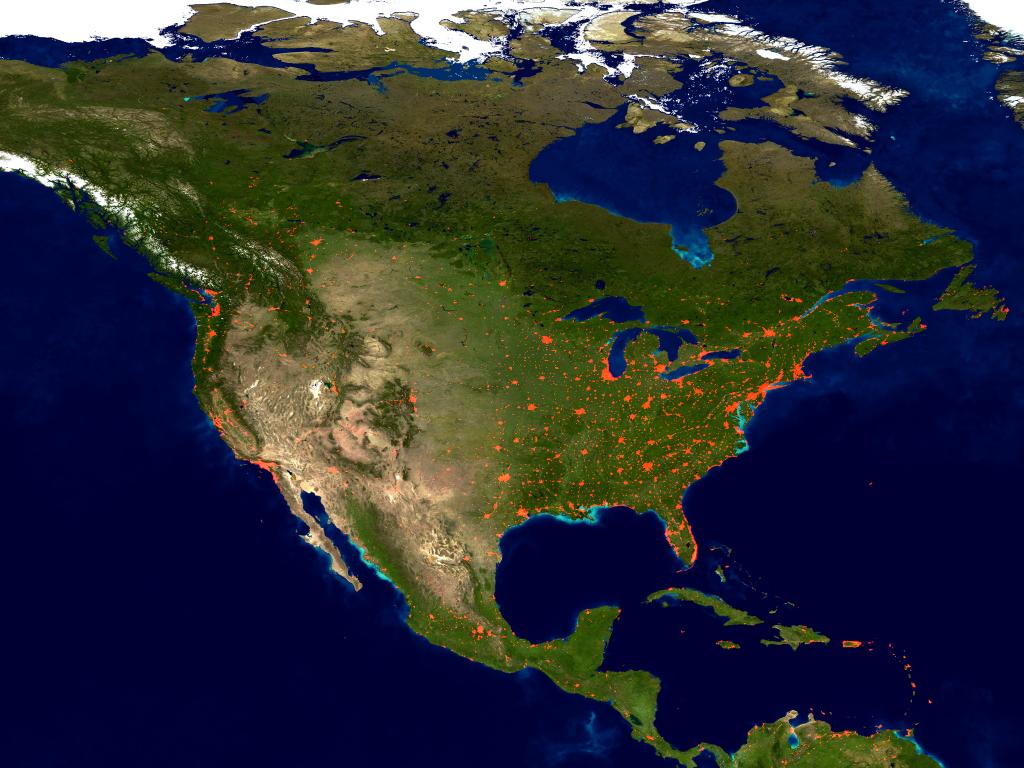
Re:Michael!These images (or, at least, a version of them) was put up in Feb of 2002. They had a daytime image, and a nighttime image. I took a couple of hours with GIMP for me to create a a composite of the two..
CAUTION: the following link is a 2MB JPEG that expands to an 8Kx4K image
I have a second image of North America only that's a bit more manageable in size (1024x768),
-
Re:Michael!These images (or, at least, a version of them) was put up in Feb of 2002. They had a daytime image, and a nighttime image. I took a couple of hours with GIMP for me to create a a composite of the two..
CAUTION: the following link is a 2MB JPEG that expands to an 8Kx4K image
I have a second image of North America only that's a bit more manageable in size (1024x768),
-
That's really your password?I got a frantic IM from an acquaintence the other day. Someone who didn't like her website had hacked and trashed it. The following is an accurate log of the first part of the session: (names have been changed to protect the, uhm, innocent).
(16:13:55) hackeduser25: omg i cant belive they did this to me
(16:14:35) stephen samuel: precisely what did they do?? All I saw was on the guest log page.
(16:14:53) hackeduser25: they put porn on it and changed everything around
(16:15:19) hackeduser25: im gonna havet to do it all over again it took me months and now i must re-type it all
(16:15:23) stephen samuel: Do you have a backup copy at home?
(16:15:29) hackeduser25: im gonna have a panic attack...no
(16:16:05) stephen samuel: It's possible that (most of) the original stuff is still there.
(16:16:18) hackeduser25: i know the site is frozen
(16:16:35) stephen samuel: How do you do updates??
(16:16:49) hackeduser25: easily but i cant access my account!!!!!
(16:16:52) hackeduser25: cuz they changed it all
(16:17:30) stephen samuel: You may want to get to the people who host the site and ask them to reset it back to what it was yesterday... (at least the password).
(16:19:26) stephen samuel: In the meantime, I'd suggest that you come up with a password that's not easily guessable.
(16:19:48) stephen samuel: Did you have an 'easily guessable' password?
(16:20:19) hackeduser25: well it was password.
(16:20:47) stephen samuel: That explains why you got slimed... It's the first password that a hacker would try.
(16:21:13) hackeduser25: omg great
(16:21:15) stephen samuel: Literaly -- it's the absolute MOST used password by newbies.
(16:21:27) hackeduser25: oh well great then
(16:21:49) stephen samuel: justasec.. I'm looking for my file on how to create relatively secure passwords....
(16:22:13) hackeduser25: k
(16:24:24) stephen samuel: http://www.bcgreen.com/solaris/passwords.htmlThe above session is now tacked on as a warning at the end of the referenced web page.
-
Re:Speed vs. SCO-secureThe intention is that it does not cause a big impact on the development process. It simply requires that anybody making a contribution claim responsibility for it. That way, you have something of an electric paper-trail for Linux.
The timing of this actually ties nicely with the SCO/IBM trail shenanigans. IBM has just made a request that the Court certify that It's use of Linux (and, in effect, anrybody's use of Linux does not violate any of SCO's purported copyrights. This would apply to pretty much everything contributed up to SCO's last disclosure in court (which would be, I think, sometime mid-April).
Given that the UNIX code base (read: SCOX) is the biggest threat to the legal cleanliness of the Linux, having a responsibility trail for everything that gets added in from here on in is a good fit. It only leaves about a one month hole in the documented cleanlines of Linux -- which shouldn't be that hard to close.
The groklaw article about the (proposed) change in the Linux submission process tries to explain (among other things) some fof the legal and technical implications of the change.
-
Kinkos isn't worth it (probably).Somebody else noted that Kinko's would probably charge $.30/page. That's $30/100 pages. If you can manage to set up a sheet-feeding scanner such that you can do one page/30 seconds you would be getting cheaper results by paying that person $30/hour to do the same job.
As other people pointed out, if you can get a couple of departments in on this, then you can more easily amortize the costs of really good equipment to do this...
One thing that I'll note is that I don't really like PDFs for this sort of stuff. If you really have a 100 page article, you're going to be looking at a 3 meg file and, perhaps, a 30 second startup time... That's fine for someone who's going to read the document from cover to cover, or print it... On the other hand, it's a pain if you only want to look at pages 37 and 38.
GrokLaw gets PDFs of court filings regularly, and I got so fed up with PDF's that I created a (semi-automated) batch system to split up the PDF's into separate PNG images and create a simple index.
You can see a sample here. Far easier to view a page or two there (IMNSHO) -- but not as easy if you just want to download and print it.
Before you go too far, you might want to get a good handle on how people are likely to use what you produce -- Use that knowledge to decide just how you want to organize the result. You may want to make it available in two (or more) different formats. It's not that difficult to bulk convert things between different forms (at lest, not if you can dual boot into Linux, or have OS/X).
-
Re:Canadians Are Evil
I think you forgot Sarah McLauclin
-
Re:I Just Cancelled My Ticket.
for an interesting parallel between the early history of the third Reich and the goings on of the Bush administration around 9/11, This pretty little rant.
-
And for those interested in PopCORN....
I have a web page on my website describing how to make popcorn the oldfashioned way. (i.e. oil, and a big pot). Includes some flavouring suggestions, too.
-
Re:Your definition of terrorism
our violence is always justified.
Oh, damn. I've been hit by the slashdot lameness filter. You can find my response (formatted as I would like it)on my website.
Of course this is false. I hope you are not attributing these statements toward me. On the contrary, I am saying that justice must be determined individually and not based upon whatever arbitrary group someone may belong to.
What I mean is that people tend to have an easier time justifying the violence done in the name of their own group.
The German people were told that jews were attempting to destroy their country, It was kinda hard to justify defending people doing that.
The Israelis are convinced that the palistinians are out to destroy their country... It's kinda hard to defend people doingthat.
Palestinians are convinced that israelis are out to destroy their homeland. It's hard to defend people out to do that.
US citizens are convinced that the Muslim world is out to destroy their country... It's kinda hard to justify defending people doing that.
Some Iraqis are convinced that the US is just out to steal their oil It's hard to defend people killing Iraqis to do that.The point about terrorism becoming it's own justification is that people use the terrorism comitted in the name of the other side to justify the terror inflicted by their side. after a while the original source of the dispute becomes almost (or actually) irrelevant.
You've effextively proven my point, trying to justify the violence committed by the US "In it's defence".
- But for the Iraqi's who really hate the US, they are defending
- their country against invaders, and you definitely can?t call the US soldiers on foreign soil 'innocent civilians'.
- but try telling that to those soldiers' families. So the US
- must be justified in blowing up the homes of those involved in the attacks.
Which now really pisses off people who've just lost a home that may have been in theifr family for centuries.
and so on,
and so on.....
So now can you see the cycle of justification and violence and terror?
The violence always seems justified when we do it.
It's never terrorism when it's doen by our side.But who we is and who they are is always relative to the speaker.
-
Not really non-recursiveHis "non-recursive" solutions aren't really non-recursive. They simply store the state (what's being moved where) onto the stack, and then pulls and pops the state. It's just a simple enough 'machine' that you only have 4 variables (from, to, using, depth). All you've really done is taken the stackwork away frm th compiler.
Back in the late '70s, me and some friends came up with a solution that is more honestly non-recursive:
Move the smallest disk to the right (cyclically). If the other two stacks are empty, you're done, else move the smallest top disk of the two stacks to the other stack (the only move you can make if you're not moving disk 1 again).
(note: The above solution only works for an even number of disks... For an odd number of disks, disk 1 moves to the LEFT.)
Oh, sigh... The perl implementation of this is on my website.
Yes, the solution is provably correct, but I don't have the time to write it up right now... Just consider the fact that you can never move disk1 twice in a row, (or you're wasting a move), and if you're not moving disk1, there's only one move, then you have to move disk1 again (or you're wasting a move). All you have to do then is prove that disk1 always moves in the same direction.
-
Re:Not going to sign up for Don't-email-listthe only way to fight spam is by attacking their business model.
The CAN-SPAM act includes provisions for forfieture of proceeds from spamming, and hefty fines... this seems like an attack on the economics of spam to me.
Also: I'd say that there are multiple ways of attacking spam. Each little bit helps. There are some people who feel that this law was enacted to head off the much nastier California law, but I'll take what I can get.
Note: The California law apparently goes into effect in January, while the US law (which pre-empts the CA law) goes into effect at the end of March -- so, if you live in California, get ready to avail yourself of the provisions of that law in the (small) window that you have.
-
Re:Beat the RIAA?You obviously have no idea as to how many people have music that's not signed by the RIIA. I have music from two friends on my website...
Theda has an incredible voice that she shows off in the tracks I have online (and more music available).
Phat Tank is more hip-hop in style. Enjoyable in a completely different style. There are other sites where you can go to find far more good music.